April Showers

0

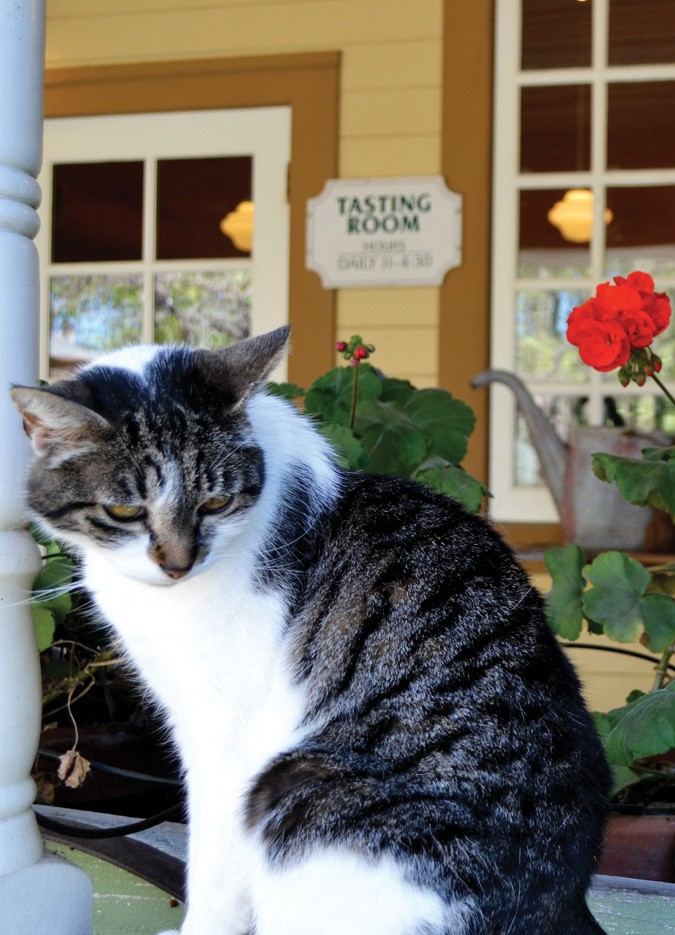
Winery Cats Live Longer Than Winery Dogs

Researchers are puzzling over a new study that has revealed a surprising truth about cats and dogs in the wine industry. Until now, wine and longevity studies have narrowly focused on human populations, including the “French paradox.” In a paper released in March, researchers at the University of Wallaby in South Australia correlated the life spans of cats and dogs to time spent as pettable icons in wineries and vineyards. Their conclusions were striking: on average, winery cats enjoy 130 percent longer lives than winery dogs.

This time, resveratrol in red wine may not be a key factor, suggests Wallaby professor of felicific enology, Tabitha Twitchit. “Persistence seems to also be positively correlated with a high percentage of non-pigmented vinosity,” says Twitchit. In other words, wineries that produce white wines are associated with even longer-lived felines. The stress of producing a point-driven Cabernet Sauvignon, on the other hand, may negatively impact the feline environment.

One explanation is that it’s the terroir, after all: cats that eat mice and gophers that eat high-quality grape material get first choice of essential micronutrients, while dogs, who eat the poop of cats, receive secondary nutritional values.

But the cause of what is being termed the “feline paradox” remains a mystery, and winery cats have nothing on the world’s longest-lived beverage industry cats, the distillery cats of Scotland still holding the record.

Good News for North Coast Grape Growers

California’s four-year drought will come to an abrupt and soggy end in mid-April, meteorologists are now predicting with 95 percent confidence.

After a relatively dry winter, the jet stream will bring a cool air mass in contact with moisture-laden systems from the tropics, creating a variant on the so-called pineapple express that meteorologists are calling “tropic thunder,” according to Noah Modell, curator of the website weatherwonky.com.

“A high arctic char index plus a strong SST anomaly is a sure-fire indication that happy, rainy days are here to stay,” says Modell. After rains pound the North Coast for one week, however, refilling aquifers with much-needed water, a high pressure ridge will move in during bloom, allowing vineyards to set a beautiful crop. Rain returns in mid-June to lend a few more inches of water to a mild growing season and a perfect vintage.

Secret to Terroir Discovered

After a vineyard study spanning two decades and four continents, a team of German researchers at the Lemberger Viticultural Institute have solved the mystery of terroir. The secret to terroir is (continued next page)

Fresh Crop

Who says winter is the only time for settling down with a good book? In this year’s spring literature issue, we present a variety of works from local authors. We sought a range of books—fiction and nonfiction. Some of them were recommended by booksellers, others were walked into the office by the authors themselves. It doesn’t get more local and independent than that. Happy reading.—Stett Holbrook

Behind the Gates of Gomorrah (Gallery Books), Stephen Seager

In his first-person memoir of his time working at the Napa State Hospital, Dr. Stephen Seager offers lots of anecdotes and insights into the gory goings-on at one of the country’s more notorious prison-hospitals.

The Cramps played at the Napa Hospital in the 1980s, which is kind of cool, but Seager’s experiences are nothing to sing home to Lux Interior about—the mental hospital is a violent hellhole, whose dangers are very real and in-your-face.

Another doctor there had been beaten into a coma, writes Seager, and the prison-hospital hybrid, with its minimal correctional protocols, created a climate of maximal uneasiness for staffers.

In his author’s note, Seager explains that a lot of people had asked him why the Napa State Hospital was such a violent but “persistently unguarded place.” The answer, says the psychiatrist, is simple: “You can’t be a prison and a hospital at the same time.”

The book has two basic narratives running through it. One is Seager’s sharp blow-by-blow account of his daily encounters with inmates and staff, their interactions and struggles to remain safe while serving the client-criminals.

To put it mildly, there’s lots of stress and blood and violence between the covers of this book. The other, more reflective thrust of the book is when Seager starts asking deeper, historical questions about the uneasy relationship between mental illness and criminality—and how this history plays out at the hospital.

He writes that many of the patients at the hospital fall into the category of “psychopathic sociopaths,” sort of the worst of both worlds, and quite difficult to manage from a clinical perspective—especially when the child rapist-murderer insists on wearing a raccoon mask.

He knew some of the patients were psychopaths, “which helps explain the often bizarre and grisly nature of their crimes,” he writes. “Sociopaths will perpetuate a stock fraud, steal your wallet, or shoot you during a botched drug deal. Psychopaths slice you into small pieces because God told them to.”

Scary stuff, yet Seager isn’t just interested in laying out the nasty details to sell books. He argues that this is no way to run a mental-health system, and concludes
with a call to citizens to get on Gov. Brown’s case about it.

“Up to this point, the state Government of California . . . has been unable to successfully dodge blame for this epidemic of hospital violence. . . . Jerry Brown is ultimately responsible for the mayhem committed in the state facilities that he oversees.”—Tom Gogola

A Thousand Slippers (self published), John McCarty

I had a blast reading John McCarty’s fun, historical novel about the early days of World War II, in San Francisco, after the bombing of Pearl Harbor.

The novel tells the story of Anne Klausen, an aspiring ballerina who winds up working in burlesque after the 1941 sneak attack. She and her father get caught up in all sorts of intrigue involving the Black Dragons, a homegrown Japanese-American “terror cell,” in today’s vernacular.

San Francisco in the early days of the war was on high, panicked alert. The Japanese were going to invade the mainland, and the so-called Yellow Peril arrived with super-top-secret submarines that could launch airplanes, very stealthy.

A freaked-out city expected to be bombed and invaded at any moment—and yet when the invasion finally came, it was one guy in an airplane launched from a submarine, with one bomb. He was expected to die a hero’s death on the exploding deck of the USS Lexington, but instead crash-landed the plane, escaped into the city and got a job (before he is eventually captured).

A Thousand Slippers provides some perspective on our own quivering, al-Qaida times, with its rampantly paranoid xenophobia and the fear of a new “other” in our midst with malevolence towards ‘murica. The novel hits on some of the big wartime themes that unfolded in those early days, not the least of which was the debatable wisdom of sending Japanese-Americans to internment camps for the duration. After 9-11, numerous right-wing media thugs called for the same treatment of Muslim-Americans.

McCarty also provides some nuanced historicity when he lays out the war-borne complexities of the Japanese-American population of San Francisco and what to do with it. Through dialogue between his characters, McCarty demonstrates how some Japanese-American citizens were permitted to join American intelligence agencies, even as the city was, by and large, emptied of Japanese-Americans pretty soon after Pearl.—T.G.

[page]

Kiss of Salvation (McCaa Books), Waights Taylor Jr.

On his way to Sunday morning mass, homicide detective Joe McGrath gets a phone call that will change everything. Set in the blistering heat of autumn in Birmingham, Alabama, 1947, the intensely paced Kiss of Salvation by Waights Taylor Jr. explores a pre-civil rights southern city at the mercy of a serial killer targeting black prostitutes.

Joe McGrath is a smart, Shakespearean-quoting fellow, but he quickly realizes he can’t solve the case alone. To help him work with the black community in Birmingham, he covertly hires African-American private investigator Sam Rucker, against the better wishes of his chief and the town’s white elite. Together, the two take on a bullying police force and even the Klan in this sizzling detective novel written in the vein of pulp fiction crime novels from the 1940s.

Author Waights Taylor Jr. himself grew up in Birmingham, which explains the flawlessly atmospheric settings he describes. This history also informs Taylor, now living in Santa Rosa, in his less-than-politically-correct dialogue and action, an unfortunate yet authentic sign of the period. Taylor isn’t afraid to confront the racial currents of the time, as when an innocent witness is beaten into a confession simply for the color of his skin.

Throughout, McGrath and Rucker are incredibly progressive figures, astounding even to their peers, one of whom looks on slack-jawed at the sight of a simple conversation. In fact, the partnership between the heroes here is the central victory of the novel, and if it ever feels out of place, it’s only because Taylor has crafted such a thoroughly convincing context of racial fear and intimidation on a daily level.

Kiss of Salvation is a page-turner from the very beginning—it twists in all the right ways and concludes in heart-pounding fashion, when McGrath’s unexpected entrance into Birmingham’s high society uncovers a seedy underbelly that could hold the key to his mystery.—Charlie Swanson

Eliminating Satan and Hell: Affirming a Compassionate Creator God (WIPF & Stock),
V. Donald Emmel

Heaven and Hell is a great Black Sabbath album from the Ronnie James Dio era, but as far as actually being a reflection of your available post-death destinations—thanks, but no thanks. Science has rendered dead-and-buried that mythically Manichean construct, and good riddance.

The basic premise of Eliminating Satan and Hell,
a semi-academic treatise by
V. Donald Emmel, is that Satan is a bunch of baloney, and Hell is for children. No, wait, Pat Benatar said that.

Emmel says that Hell is basically a mythic construct that reflected the cruel and stupid worldview that created it, back in the pre-enlightened day when people believed in things like the sun rotating around the earth.

Back in the day, there was thunder, lightning, big floods and all kinds of scary natural-world things happening, and nobody knew what the hell was going on. So they said: It’s God, and he’s punishing us, and now I’m going to commit this incredible act of human savagery on you, heathen.

Nowadays we just turn to the Weather Channel for spiritual guidance in the rain. Who needs to blame Superstorm Satan when you’ve got Doppler radar telling you that it’s a really just an upper atmospheric disturbance?

Emmel is a theologian and professor at San Jose State, and he’s respectful and polite toward the Christian faith—but makes the point, often, that science has proven that there’s no discernible destination out there called “Heaven.”

You can look through that telescope all you want, Ted Cruz, but that’s Uranus we’re all staring at now, not Heaven. Or, as the great theologian-rocker Belinda Carlisle once declared, “Heaven is a place on Earth.”

And hell? Where the hell is hell?

I thought it was in aisle two at Whole Foods. Wrong again! Here it is: “Ancient populations were very conscious of evil: the evil of occupying nations, the evil of economic exploitation, the evil of personal enemies and their vendettas,” Emmel writes. “The myth of a Satan was developed to explain for them the cause of evil. The myth of hell was developed to justify for them that their enemies would be punished.”

All it took, then, was an Angry Creator to mete out the punishment. Then you could go back to skinning heretics alive, confident in your status as dumb-dumb medieval sadist, and with God on your side. —T.G.

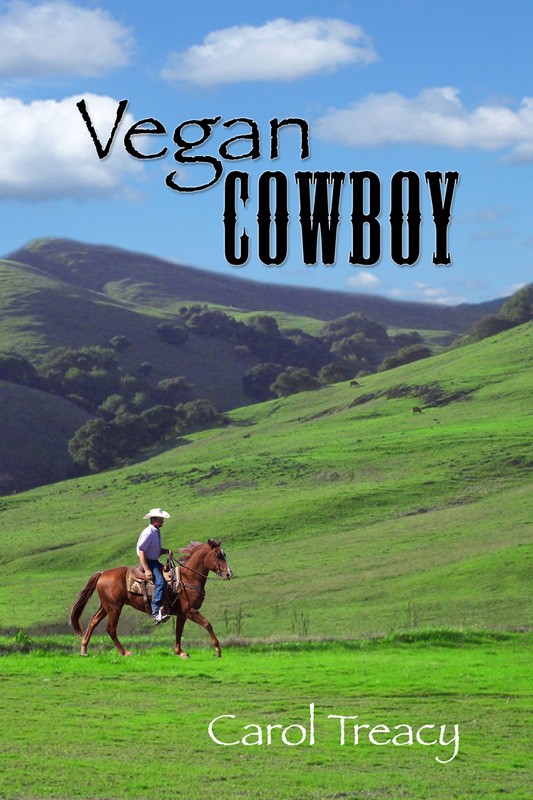
Vegan Cowboy (self published), Carol Treacy

Rae O’Brien is on another disastrous date at the beginning of Carol Treacy’s Vegan Cowboy. A divorcée and single mom, O’Brien is an instantly relatable and sympathetic character, a single mom whose teenage son is strikingly cruel to her, and whose hopes of a partner have all but dissolved. O’Brien is also a devoted vegetarian and animal rights advocate, and her struggles to make a difference culminate in an ambitious documentary film project to expose the horrific realities of factory farming.

Enter Granger Bowden, the titular cowboy of the novel. Running a Petaluma dairy farm-turned-animal sanctuary with his daughter, Allie, Bowden is a rugged, no-nonsense cowboy in every sense of the word, yet his work is dedicated to caring for creatures rather than consuming them, and he regularly rescues abused animals. A traumatic event brings O’Brien and Bowden together, and in the aftermath, the novel follows them as a romance blossoms between the two that revolves around their shared animal rights interests and efforts.

Treacy’s real-life passion about veganism is evident throughout Vegan Cowboy. Her characters are emphatic about it; Allie even has a tattoo of the word “Vegan” on her arm. And sprinkled all through the novel are striking images and descriptions that almost read like after-school specials, but Treacy’s treatment of the subject matter never outweighs her investment in the storytelling. One such scene in particular, where a severely beaten sow is brought to the sanctuary in a flatbed pickup truck, is of the most enduring and memorable moments in the book.

Treacy, who lives in Petaluma, includes plenty of lighthearted moments and numerous local references to keep the pace quick and the action realistic. The romance between O’Brien and Bowden progresses gracefully amid early awkward conversations and feelings, and Vegan Cowboy succeeds in sharing sincerely relatable individuals who happen to be older and maybe a little grayer on top. The book is available at local stores and online at caroltreacy.com.—C.S.

[page]

A Terrible Beauty: The Wilderness of American Literature (Regent Press),
Jonah Raskin

Santa Rosa’s own Jonah Raskin, a contributor to these pages, has published this amazing literary treatise on the intersection of wilderness and words in the American experience. He jumps off the diving board at Walden Pond to explore numerous post-Thoreau moments in American letters where the great outdoors plays a key role—or is itself the central character.

In A Terrible Beauty Raskin describes that which he wishes to preserve—the rapidly disappearing American wilderness—and writes that, “It may be that the wilderness will not loom large in the world of the future. But there will continue to be interest in wilderness,” he says, because it’s basically in our (mostly European) blood as Americans. “Ironically, the wilderness as a place that came to be synonymous with America and the United States began as a transplanted European trope. The wilderness trope went wild in America.”

There’s a very basic connection here that lies at the heart of Raskin’s beautifully written book. And I’ll just go and beat you over the head with it: Writers he admires and emphasizes in A Terrible Beauty—Henry Thoreau, Walt Whitman, Herman Melville, Emily Dickinson and others from the American Renaissance—”are among the wildest writers that our nation has ever seen.”

Raskin displays the wise and nimble mind of a literary trickster of the highest order as he conjures an awe at nature with a correspondent awe at the literature that reflects and honors it—and brings it all back home under the shared thematic bosom implied in the title, which is drawn from a line of Yeats’ that goes, “A terrible beauty is born.”

In Raskin’s able hands, the “terrible beauty” of nature animates an activist spirit that honors the power and beauty of language as it cuts across a wilderness that’s as pungently real as it is a metaphor for our own inner Wildman. At some protean level, we’re all eager for release into living poetry along the long trail (at least I am, your experiences may differ).

But if you pack it in, pack it out, Raskin warns. The wrath is beautiful, is terrible. Writing on Moby Dick, he notes, “attack the wild and the wild will seek revenge, Melville seems to say. Aim to destroy it, and it will destroy you.”—T.G.

More Than Meatballs (Skyhorse Publishing),
Michele Anna Jordan

Meatballs not only happens to be one of Bill Murray’s finest cinematic accomplishments, meatballs are a favorite around my dinner table. But I always make them the same way—ground beef, onion, fresh herbs, breadcrumbs and an egg. They’re good, but Michele Anna Jordan’s new book More Than Meatballs has opened my eyes to a whole world of new recipes. “World” is the right word, because meatballs are a global staple cooked in any number of ways that travel well beyond the stereotypical Italian-American meatball—some aren’t even made with meat. The humble meatball is dynamic, changing to take on the flavor, ingredients and techniques of any number of culinary traditions.

“Admittedly low on the trendie/foodie food chain of our day,” writes L. John Harris in the book’s foreword, “the meatball is, at its core, more a strategy or methodology than a specific recipe, the poor man’s way of using leftover cooked meat or uncooked meat and fat scraps.”

At least that’s how meatballs may have started out—peasant food. But as Sebastopol’s Jordan lays out in her comprehensive book, specific recipes and fresh ingredients are definitely worth seeking out. The recipes range from traditional to contemporary. One chapter is dedicated to meatless meatballs—an oxymoron but that sounds better than just calling them “balls.” Think falafel, arancini (rice balls), Spanish croquettes and K&L Bistro’s beloved salt cod fritters.

The final chapter of recipes is my favorite because it offers them in context, with accompaniments, i.e., meatball soup, Thai salad with duck meatballs, meatball tagine and, of course, themeatball sandwich. Like meatballs themselves, the cookbook deserves to be a staple in your kitchen.—Stett Holbrook

One Too Many (Tough Rose Press), Maureen Anne Jennings

By day, Rose Leary writes murder mysteries; by night, she tends bar to pay the bills. Set in 1980s New York City, One Too Many continues the adventures of writer-turned-witness Rose Leary. First captivating readers in Jennings’ debut novel, Bartender Wanted, our witty protagonist is still struggling in all the usual ways, trying to finish a novel while dealing with new management at the bar and strained relations with detective Frank Butler.

That’s when Leary finds the body of a murdered colleague and sets off another round of mystery that escalates the action and the humor. At the heart of One Too Many is Jennings’ fully realized world of New York City. The author calls west Sonoma County home today, but in another time she was a veteran of several Manhattan dives while working as a copy writer and journalist. Here, Jennings creatively culls these real-life experiences for a vividly crafted re-creation where a simple walk down Houston Street comes alive with vendors and colors and where a “promiscuous musk scented the humid air, as if damp sheets tented the city.” It would be easy to get lost wandering these endless streets, but luckily Jennings never lets the action wander, as our heroes must confront a series of dangers and their own suspicions before time runs out.

One Too Many works well as a murder mystery with a mix of murky atmospheres and compelling characters. Leary doesn’t suffer fools, and she isn’t afraid to tell you so. Yet at the same time, Jennings achieves a subtle level of detail throughout the novel in her brief but knowing descriptions of looks and drink orders that read volumes of character development between the lines. —C.S.

‘Arcadia’ Redux

0

‘Arcadia is a very funny, very smart play,” says director Sheri Lee Miller, affectionately describing Tom Stoppard’s masterpiece about love, sex, mathematics, art, architecture and the power of intellectual imagination.

Set in England, partly in the early 1800s and partly in the present, Arcadia enthusiastically namedrops a veritable parade of Regency-era historical scientists, mathematicians, artists and poets. “To that end,” says Miller, who is directing the play for Cinnabar Theater, “this play gives audiences a chance, not just to see a great show, but to play a really good game of Jeopardy at the same time.”

Arcadia opens this weekend, and Miller—who’s directing it for her second time in 16 years—knows that her new production cannot escape comparisons to the one she did in 1999 at Actors Theater. That production, an enormous success hit for AT (absorbed 10 years ago into the current 6th Street Playhouse), is a show people still talk about as one of the most impressive, eye-opening productions ever seen
in the North Bay. Miller knows
that with this new production, expectations are high.

She’s not worried.

“I’m not directing Arcadia again to recapture something from the experience of doing it a decade-and-a-half ago,” she says. “I just love the play, and I wanted to revisit it. There’s always more to plumb from a good play, and it’s been a really long time.

“Unfortunately,” she laughs, “I don’t remember any of my original staging, none of it! But I do remember certain line-readings very well. Part of the challenge of doing a play a second time is allowing the new cast of actors to find their own voices, and not to accidentally force the voices of
the previous cast onto them. Fortunately, I have brilliant actors, then and now—and I trust them totally. It’s definitely going to be a different kind of production from the first one. I hope it will be every bit as wonderful, and I believe it will be—if not even a little bit better.”

Miller says that theatergoers not yet ready to compete on Jeopardy will still find plenty to enjoy in Arcadia. Viewed by critics as one of the greatest plays of the 20th century, it’s about much more than facts, figures and history.

“What this play is about,” she says, “is the human hunger for answers, for discovery, for learning, for expanding our breadth of understanding and our place in the universe.

“Everybody can relate to that.”

Oh, the Fecundity!

Recently, a quartet of editors was standing outside on a cool and breezy corner in Pt. Reyes Station, waiting for the deliveryman and his truck. There were 1,000 issues of the debut Inverness Almanac rolling around out there somewhere in the early West Marin evening—and an imminent launch party at which those issues were sorely required.

Yet the air was not so much filled with tension as with mirth as the youthful editors (Katie Eberle, Nina Pick, Ben Livingston and Jordan Atanat) chatted outside the Western Saloon—the Almanac office is upstairs—until, at last! Hoots and hollers and cheers for the deliveryman and the big, shrink-wrapped pallet of words. A fifth editor, Jeremy Harris, was standing by at the Dance Palace.

Peeled back as literary-poetic object, the Inverness Almanac is an exquisite refraction of its environmental and spiritual trappings, the greater glory of West Marin. The paper stock is heavy and textured, and its “natural” tone complements the earthy, rich content that characterizes the pub. That balance is especially true of the smattering of in-the-woods photographs. Turn the page, and the photos emerge as deep, calm portals into mysterious wilds—reproduced on soft, creamy paper stock. It’s lovely.

The Almanac is rooted in poetry and the thoughtful walk through the woods; lines of prose spring across the page with empathic energy at the drop of a deeply held gaze. At one point, stopping by woods on a foggy coast, Pick describes a sort of shape-shifting encounter between a bay stallion and an elk: “. . . and it was you, in the woods, in your animal skin, that I saw, the barest of you / whom I had scarcely met and knew already to be kin.”

The poems are joined by essays and drawings and recipes and tidbits of practical wisdom—and a great illustrated history of Tomales Bay forms a kind of visual and conceptual centerpiece. On almost every page there’s a rendering: a branch or a bird or a dandelion or a snake, to enliven and entertain and inform.

The Almanac also offers a tide chart for the year along the bottom of every page. The chart is highlighted with seasonal phenomena, such as “Bat Rays mating” (April 5—be on the lookout!).

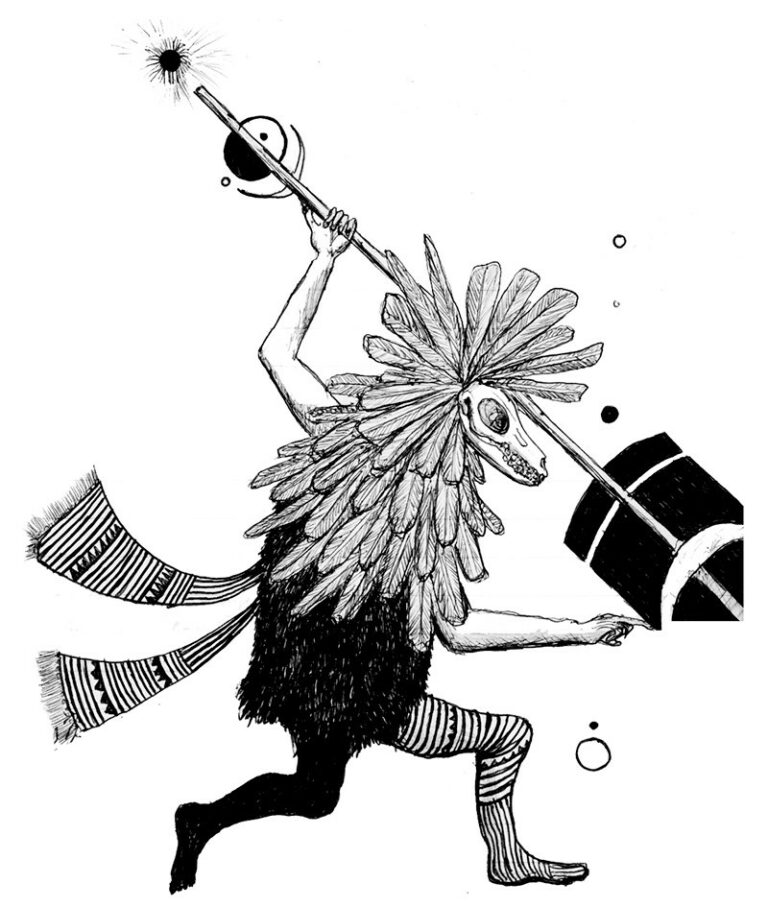
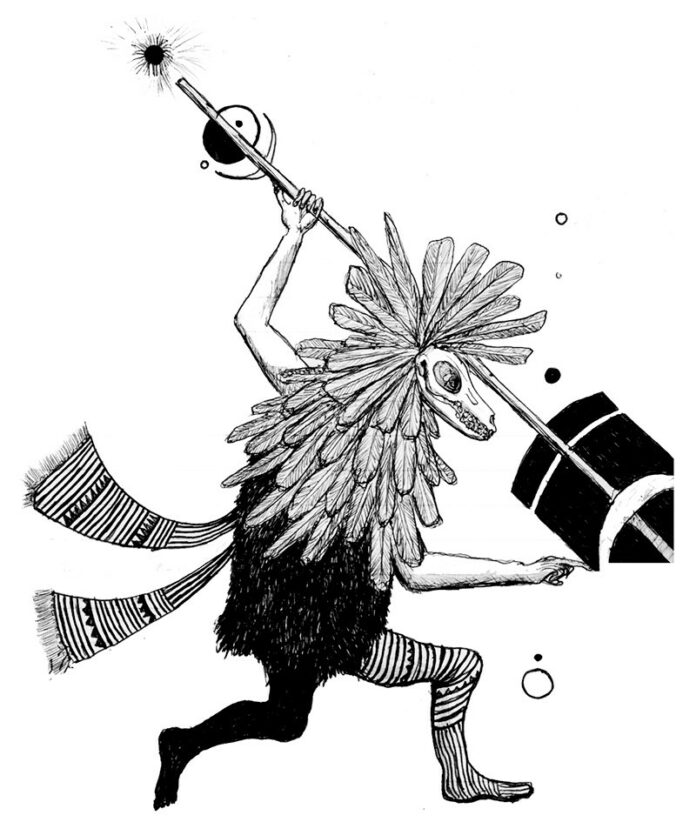
The image above is from Livingston, a rendition of the Miwok myth of the coyote as creator-destroyer. The illo evokes some of the more sobering content, where creation and destruction mingle. There’s a difficult, rewarding meditation on a wounded deer and a man with a knife; a 1931 photo of a dead mountain lion being hauled through the wilderness is reprinted, and it’s very sad.

It’s impressive that nowhere in these pages are you invited to like the Almanac on Facebook. The only tweeting going on here involves birds. It’s a throwback pub grounded in a youthful dance-meditation, a compendium of wild-child wisdom at the fringes of ferality and deep-forest decadence—and 1,000 copies worth of fulfilled intention plopped right there in the middle of the main drag in Pt. Reyes Station, just in time for the celebration.

This purchase information has been corrected, and is now correct, with apologies: Get yours for $18 at invernessalmanac.com.

Green Grocer Goes Indoors

0

The Green Grocer is a staple of Sonoma County farmers markets. The big, grilled-cheese sandwiches with the griddle-crisped cheese are one of my favorites. The “hippie hash” is good too. Now the popup restaurant and catering service has gone indoors while still maintaining its presence at the markets. The Grocer set up shop in the train car vacated by Starlight Wine Bar and Restaurant at Sebastopol’s Gravenstein Station. The new place is called the Gastronomist but has a Green Grocer sign and chalkboard menu out front in hopes of attracting those who know it by its more familiar name.

The menu includes many of the Grocer’s farmers market dishes (burgers, those grilled cheese sandwiches, eclectic tacos), as well as several more upscale items like foie gras and pumpkin gnocchi. The simpler items best known at the farmers markets are best. The fancier stuff doesn’t translate so well into the fine dining setting of the vintage train car.

The menu offers something for carnivores, vegetarians and even vegans. Though the Green Grocer celebrates local produce and meat (and is happy to accept trade if you’ve got a surplus of produce from your backyard), the wine list on my visit was poor, just one or two lackluster wines.

The dining room is intimate and cozy—
a world apart from waiting in line at the farmers market. There are a few tables out front, too, if you miss the outdoor experience.

The Gastronomist, Sebastopol,
6681 Sebastopol Ave., Sebastopol. 707.837.8113.
greengrocerdirect.com.

Debriefer: April 1, 2015

CANNABIZ

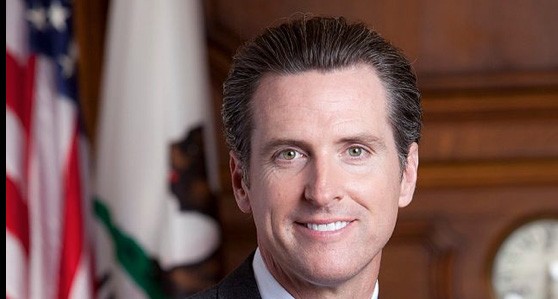
Last week Gavin Newsom issued the first progress report in his role as point-person in the state’s unfolding shift toward cannabis legalization. The so-called Blue Ribbon Commission on Marijuana Policy comprises the Lieutenant Governor, an ACLU representative, and a Stanford egghead.

The report is kind of neat in that it’s premised on an expected outcome—a 2016 legalization referendum will pass—and is delivered with the imprimatur of the state’s second-in-command. There’s some expected hand-wringing about protecting the children from the devil weed, and some discussion about tax revenues and how to best collect them. The report, for instance suggests a possible $50 state surcharge per ounce of boo.

The California conundrum identified by Newsom is that it’s a sloppy state that’s still grappling with its own pioneering ways in medical cannabis policy. Sacramento has been unable to conjure a set of statewide rules for its medical dispensaries, even after lawmakers paved the way for other states to enact provisions of their own. If the state can’t get its medical house in order, goes the logic, how is it going to grapple with a full-bore recreational push in 2016?

Newsom is pro-legalization and just might run for governor. And his report comes as the U.S. Congress may be taking a serious step toward rescheduling cannabis as a “Schedule 2” drug. Sen. Barbara Boxer signed on to a bill last week that gets deep into the weeds of medical cannabis (for example, it would make it easier for THC-free cannabis to be used in pediatric medicine). Cannabis activists have gathered in Washington this week to lobby for the bill, which would put medicinal cannabis on the same schedule as cocaine, speaking of Gov. Jerry Brown—who opposes legalization even as his leafy lieutenant is clearing the proverbial chamber for it.

POT STICKLER

Speaking of, are outlaw cannabis growers the most hated people in the state these days, given their water-diverting, eco-destructive ways? It would appear so, even given the emergence of that odious proposition known as the “Sodomite Suppression Act.” Every time Debriefer turns around, there’s another politician or organization blasting the outdoor growers—they’ve become a convenient mark for not-sure-about-pot policymakers faced with a push toward legalization. Shut those illegal dope grows down, for they are evil, say pols ranging from U.S. Rep. Jared Huffman to State Sen. Mike McGuire. We agree, even if the dog-pile is starting to reek of scapegoating. Now the California Department of Fish and Wildlife (CDFW) has issued a study that blames outdoor growers for helping to destroy the state salmon fishery.

It’s tough times for outlaw growers, but as the CDFW notes in a release, cannabis farmers can be a part of the solution. First they have to be encouraged out of the shadows, and then they have to get a permit—but only if they’re medical cannabis growers. “Responsible growers help conserve the state’s natural resources,” notes CDFW, “and are less likely to be subject to enforcement action.”

NO FRACKING CREDIBILITY

On March 20, the United States Department of the Interior released its first-ever guidelines on fracking, designed to “support safe and responsible hydraulic fracturing” on public lands. With all the talk of the ongoing, severe drought in California, Debriefer was taken by this one comment from Interior Secretary Sally Jewell, which she made in a conference call to reporters: “We really are upholding the public trust here. There’s a lot of fear, a lot of public concern, particularly about groundwater and the safety of water supplies…. I think the industry recognizes that thoughtful regulation can help them, because it reassures the public that we’re protecting them.”

That’s what you call an exercise in obfuscation. Who is protecting whom? Back in January, Jewell criticized states and localities around the country who have taken it upon themselves to enact fracking bans, saying it was unfair to the gas and oil industry, in that it would create confusion for them, and that could be costly to the poor dears. Ah, the public has been reassured that you’re protecting them, thanks.

LOAN TO PICK

Last year, this paper published a cover story that reported on the rise of payday lenders and their rapacious, under-regulated ways. At the time we wrote that story, the Consumer Financial Protection Board said it would issue guidelines to rein in an predatory industry that’s run roughshod over persons of limited means who use the service. On March 26—voila!—the feds laid down some welcome reform. The California Reinvestment Coalition applauded the move, which, among other things, compels lenders to determine a borrowers’ ability to pay a loan back before making it. The feds also enacted regs aimed at the debt-spiral that can ensue when borrowers get caught in the trap of having to constantly borrow against their next paycheck in order make the payday-loan payment.

The rules are welcome, says the CRC, given the California Legislature’s repeated failure to enact payday-loan reform, because “every year, industry lobbyists and campaign contributions stymied proposals
that could have helped consumers.”

Dreams of Cannes

0

It’s hard to think of a more prestigious film festival than the Festival de Cannes, the French tradition that celebrates the most high-brow achievements and the most daring works by celebrated filmmakers, from Truffaut to Tarantino.

Two Sonoma State University students will add their names to those who’ve shown at Cannes when their short films “Snake Eyes” and “Rampage” are screened as part of the Cannes Short Film Corner. Mary-Madison Baldo, a 21-year-old English major, and Alex Bretow, a 23-year-old business administration major, are both passionate about film and the industry, and they’ve already succeeded on local levels with their films and videos. “Snake Eyes” and “Rampage” are two of only 26 films that were selected out of thousands of entries through the nationwide College Campus Movie Fest competition held earlier this year.

Obviously, Baldo, Bretow and Sonoma State are all ecstatic over the news, but there is just one catch. The films are guaranteed a spot at the festival, which takes place May 13–24; the filmmakers, not so much. The two students need to raise a little coin to help them get to and survive in France, somewhere in the neighborhood of $11,000. That sounds tough, but they might just make it with a little help. You can support these aspiring filmmakers—and maybe even get
a producer credit—by donating to their
page at gofundme.com/cannesfest2015.

Culture Crash

In synopsis, the glossy yet fascinating Italian import Human Capital sounds like a Paul Haggis tag-teamer—the high and low classes make an unwilling meeting over a traffic accident. It’s shrewder than anything ever influenced by Crash, however.

Based on a Connecticut-set novel by Stephen Amidon, director Paolo Virzi’s moves the story to a small city outside of Milan. After a Christmas gala held by a well-endowed private school, someone injures a busboy in a hit-and-run collision as he returns home from work on his bicycle. The accident sets off the kind of class antagonism entrenched in Italy since the Roman Empire.

Flashback to the beginning of the trouble. Mid-level real estate agent Dino (Fabrizio Bentivoglio) has a beautiful daughter named Serena (Matilde Gioli), who has been dating the son of the local gentry, of the Bernaschi family, inhabitants of a villa that’s like something out of a car commercial. (To mock those familiar images, Virzi stages a parade of shiny luxury models, slowly ascending a hill up to the mansion.) Dino, a peasanty gladhander with a bad haircut and a bulky suit, wangles his way into the Bernaschis’ orbit, first as a tennis partner, then as an investor bearing a load of borrowed money.

The young Bernaschi prince, Massimiliano (Guglielmo Pinelli), is the kind of entitled young jerk who artfully defaces his shiny SUV with camouflage patches and a “Fuck You” sticker on the back. But as Virzi weaves the story, we learn that we don’t really know what’s going on. We need to pay more attention to the sad-eyed, throaty-voiced lady of the manor, Carla (Valeria Bruni Tedeschi), who’s in a state of emotional cachexia over smothered artistic ambitions.

Human Capital is a suavely told drama—it’s rich, if not always subtle. Yet Virzi brings the color and breadth of opera to this story of widespread corruption. Troubled young romance gives shape, flavor and hope to the story of downfall.

‘Human Capital’ is playing at Summerfield Cinemas, 551 Summerfield Road, Santa Rosa. 707.522.0719.

2015 Bohemian Best Of Party!

0

We had a blast at our Best Of party at Santa Rosa’s Flamingo Resort & Spa. Congratulations to all our winners. You make he North Bay the great place that it is. See you next year.

Mar. 28: Big Top in Sebastopol

0

Sonoma County’s newest circus sensation is unveiled this weekend with the debut of Circus Maximus. The spectacular assembly of performers present a colorful journey through the senses with their show “Synesthesia.” Aerial and trapeze artists, contortionists, sword swallowers and snake charmers are just the beginning, as the evening boasts three rings of fun. Best of all, it’s a family event, meaning kids will enjoy the robot dancing, and maybe get their faces painted too. For the adults, an after-party featuring El Radio Fantastique caps off a vibrant night of dazzling sights and sizzling sounds. Circus Maximus presents “Synesthesia” on Saturday, March 28, at 775 After Dark, 775 Petaluma Ave., Sebastopol. 6pm. $10–$20. 707.206.2638. 

April Showers

Winery Cats Live Longer Than Winery Dogs Researchers are puzzling over a new study that has revealed a surprising truth about cats and dogs in the wine industry. Until now, wine and longevity studies have narrowly focused on human populations, including the "French paradox." In a paper released in March, researchers at the University of Wallaby in South Australia correlated...

Fresh Crop

Who says winter is the only time for settling down with a good book? In this year's spring literature issue, we present a variety of works from local authors. We sought a range of books—fiction and nonfiction. Some of them were recommended by booksellers, others were walked into the office by the authors themselves. It doesn't get more local...

‘Arcadia’ Redux

'Arcadia is a very funny, very smart play," says director Sheri Lee Miller, affectionately describing Tom Stoppard's masterpiece about love, sex, mathematics, art, architecture and the power of intellectual imagination. Set in England, partly in the early 1800s and partly in the present, Arcadia enthusiastically namedrops a veritable parade of Regency-era historical scientists, mathematicians, artists and poets. "To that end,"...

Oh, the Fecundity!

Recently, a quartet of editors was standing outside on a cool and breezy corner in Pt. Reyes Station, waiting for the deliveryman and his truck. There were 1,000 issues of the debut Inverness Almanac rolling around out there somewhere in the early West Marin evening—and an imminent launch party at which those issues were sorely required. Yet the air was...

Green Grocer Goes Indoors

The Green Grocer is a staple of Sonoma County farmers markets. The big, grilled-cheese sandwiches with the griddle-crisped cheese are one of my favorites. The "hippie hash" is good too. Now the popup restaurant and catering service has gone indoors while still maintaining its presence at the markets. The Grocer set up shop in the train car vacated by...

Debriefer: April 1, 2015

CANNABIZ Last week Gavin Newsom issued the first progress report in his role as point-person in the state's unfolding shift toward cannabis legalization. The so-called Blue Ribbon Commission on Marijuana Policy comprises the Lieutenant Governor, an ACLU representative, and a Stanford egghead. The report is kind of neat in that it's premised on an expected outcome—a 2016 legalization referendum will pass—and...

Dreams of Cannes

It's hard to think of a more prestigious film festival than the Festival de Cannes, the French tradition that celebrates the most high-brow achievements and the most daring works by celebrated filmmakers, from Truffaut to Tarantino. Two Sonoma State University students will add their names to those who've shown at Cannes when their short films "Snake Eyes" and "Rampage" are...

Culture Crash

In synopsis, the glossy yet fascinating Italian import Human Capital sounds like a Paul Haggis tag-teamer—the high and low classes make an unwilling meeting over a traffic accident. It's shrewder than anything ever influenced by Crash, however. Based on a Connecticut-set novel by Stephen Amidon, director Paolo Virzi's moves the story to a small city outside of Milan. After a...

2015 Bohemian Best Of Party!

We had a blast at our Best Of party at Santa Rosa's Flamingo Resort & Spa. Congratulations to all our winners. You make he North Bay the great place that it is. See you next year.

Mar. 28: Big Top in Sebastopol

Sonoma County’s newest circus sensation is unveiled this weekend with the debut of Circus Maximus. The spectacular assembly of performers present a colorful journey through the senses with their show “Synesthesia.” Aerial and trapeze artists, contortionists, sword swallowers and snake charmers are just the beginning, as the evening boasts three rings of fun. Best of all, it’s a family...
12,118FansLike
4,924FollowersFollow
6,928FollowersFollow