End Times: Pretty Frankenstein is in love at the apocalypse

Pretty Frankenstein has a certain attitude toward the perils of the moment. It comes across in the band’s new single, “Love Letter to the Apocalypse,” just released across streaming platforms.

A slow, deep burn, the song has the feel of something stirring deep within the heart, a creaking refrain of a timeless theme with particular resonance at this inflection point in history.

“It’s talking about being with the person that you love during the chaos of an apocalyptic situation,” said the songwriter in a heartfelt chat by phone. “What it means for me now is a sense of defiance.”

The song had a long road to release, being written by fronthuman Grey Starr for their husband 10 years ago. In that time, it has continually evolved, finding its final form in part shaped by the current line-up of Pretty Frankenstein.

“I’m very happy with this version, you know? It does the most justice to the style I wanted the song to sound,” mused Starr. “A lot of the time when you write a song, you have all these different ideas in your head, and I feel like this is the closest to how I wanted it to sound.”

With the twang of Roy Orbison filtered through the echo chamber of Mazzy Star, the single is a musical love letter to the band’s distinct inspirations and personal roots.

Pretty Frankenstein will follow up the single with a music video this month, just in time for Valentine’s Day, giving fans visuals to their take on love in an apocalyptic world. 

The glam-vampire aesthetic of the band lends a playful kink to the probing message of the song, one of love, authenticity and the power of communion in the face of threatened erasure. 

“I felt like the song needed to be released now. Right now is a time where we kind of feel hopeless, and there’s a [reflex] to almost go into hiding at the moment,” explained Starr, echoing the sentiment of queer folks all around America right now.

“[For] people like me and other queer people, other queer people of color, and trans people, for my band and really anybody on the spectrum of queerness, I think now is a time to stand proud and be close to one another,” said Starr. “Get closer to your community; be kind of like safety nets for each other.”

Preach.

“My guitarist and my bassist, who sings backup vocals in this song, are married as well. They’re a lesbian couple, and [that brings] more connection and love to the song,” said Starr. Having multiple connections of love and co-creation cloaked in the commitment signified by marriage makes the message all the more salient for the end times.

Starr, who will also be organizing the Filipino Festival in Oakland in May, offers plain and simple advice. “Help your communities,” they summarize.

“[With] all that is going on around us, all these laws targeting queer people, staying in the fight is the most revolutionary thing you can do. I think right now being close to your community of other queer people is very important,” Starr continued.

The message aspires to be intersectional and universal. Starr knows that people across all categories are feeling despondent right now. Can we learn even from those different from ourselves? Pretty Frankenstein and Starr want to spread love by showing love.

“Hopefully, other people will get that same sense from the song, you know?” they said.

As corporate and federal actions align to threaten individuals and communities across a diverse swath of society, Pretty Frankenstein reminds us that it is a time to be loud and proud.

‘Love Letter to the Apocalypse’ by Pretty Frankenstein is streaming now on one’s favorite platform.

Deportation on the Menu: Trump’s Immigration Policies Affect How We Eat

Nearly every bite of food we eat in the U.S. has passed through the hands of an undocumented immigrant. 

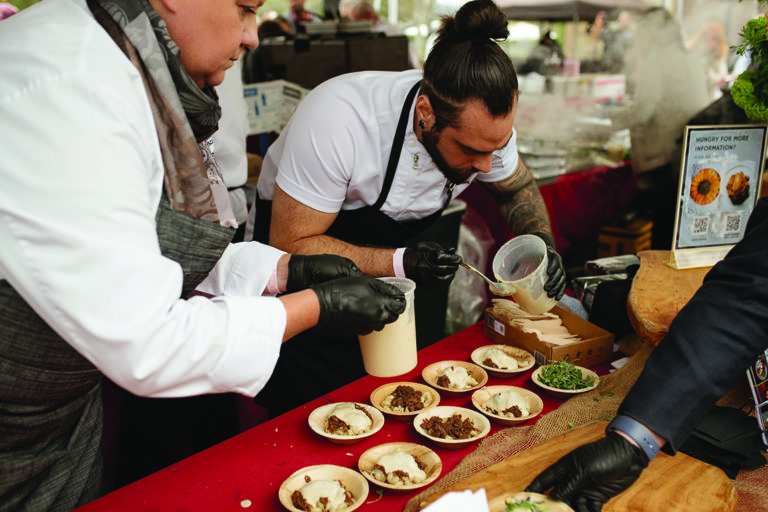
Along the entire food system, from farms and vineyards to meat processing plants and restaurant kitchens, undocumented immigrants feed our nation.

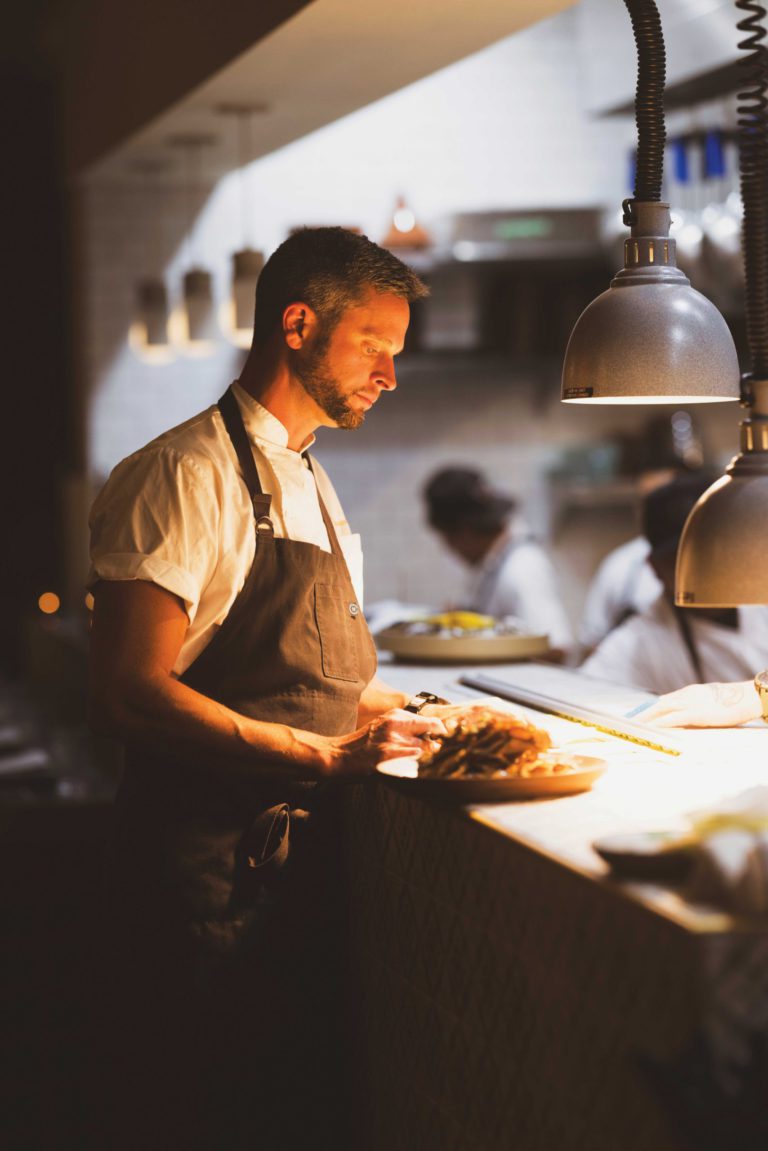
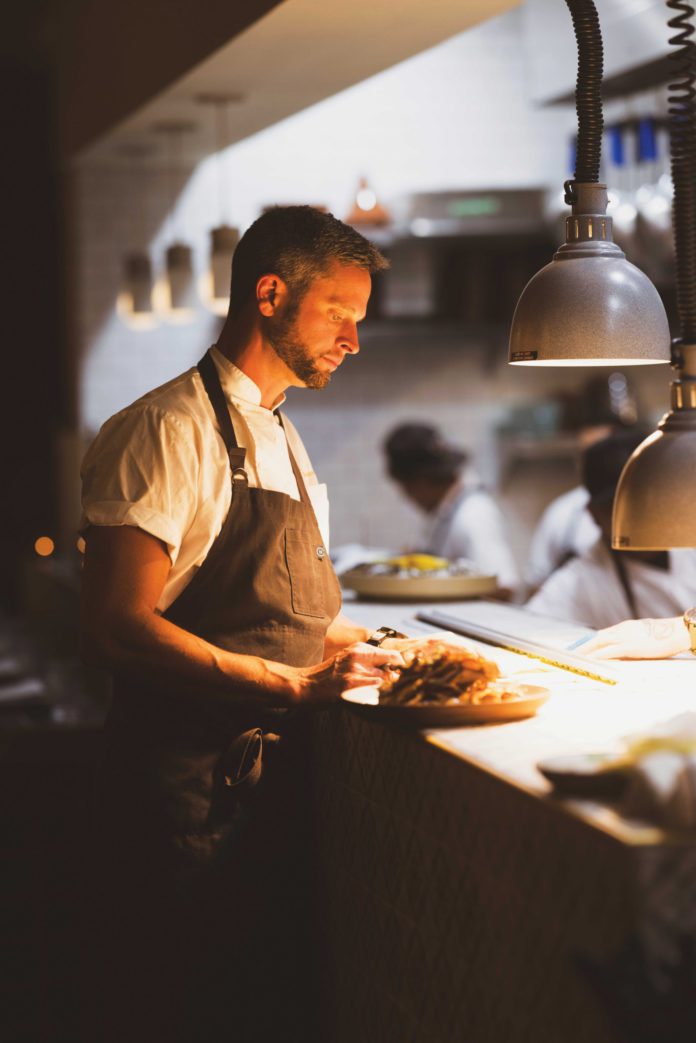
That is especially true here in the North Bay, where, according to chef Elijah Trujillo, immigrants are the “unsung heroes.”

Trujillo, the son of immigrants, has worked in some top Sonoma County restaurants and is the co-founder of Shokakko Food Truck.  

“In Sonoma and Napa counties, we’re wine country, wine and agriculture. That’s our bread and butter; that’s what we tout to the world. And if you look at it, it’s all run off of immigrants,” Trujillo said. “If you were to take that labor force away, the whole thing would collapse.”

Undocumented immigrants make up around half of U.S. farm workers, 47% in 2022, according to the U.S. Department of Agriculture, and an estimated 75% in California.    

At the other end of the food system, undocumented immigrants represent 9% of the hospitality workforce nationwide, according to the Pew Research Center, and up to 40% in cities like Los Angeles, according to the nonprofit One Fair Wage.

“If you’re around it every day, you stop seeing it,” Trujillo said of how easy it is to overlook the contributions of undocumented immigrants to the North Bay’s world class wineries and restaurants. “If you stay at a hotel, guess what? The kitchens are immigrants, the housekeeping’s immigrants, the people that built the darn buildings are immigrants.”

President Donald Trump has promised to deport all 11 million undocumented immigrants living in the U.S. and signed a slew of executive orders, including declaring a national emergency at the southern border, reinterpreting the 14th Amendment to end birthright citizenship and forcing asylum seekers to remain in Mexico.  

Although the swift deportation of 11 million people is legally and logistically unlikely, a study by American Farm Bureau Federation estimates that if U.S. policy took the stance of enforcing deportations without offering a path to citizenship, essentially what Trump has proposed, then farm income would drop 15-29%. 

These losses could lead to the closure of hundreds of farms and vineyards, with producers of fruit, vegetables, meat and dairy hit the hardest. We’d likely see food shortages and be forced to increase imports, and, according to the study, the price of groceries would likely rise 6%. 

Trump himself couldn’t escape the hypocrisy when an immigration lawyer argued that Trump Winery in Virginia knowingly hired undocumented workers for the harvest season in 2020.    

While a 2017 law makes California a sanctuary state by preventing law enforcement from cooperating with Immigration and Customs Enforcement (ICE), on Jan. 7 of this year, a different agency, Border Patrol, rounded up people who looked like farm workers in parking lots in a Kern County raid. This resulted in 78 arrests, showing that the state is not immune to immigration sweeps. 

Rumors of more raids reached wine country. And Madeline Hernandez, regional directing attorney at Immigration Institute of the Bay Area, worked to dispel the false information and offer resources to the immigrant communities.

Sheriffs from Sonoma and Napa counties have stated they will comply with the state law and stay out of immigration matters. Other institutions, like the Napa Board of Supervisors and Napa Valley College, have reinforced their commitment to keeping the immigrant community safe from ICE raids. The Marin sheriff has not responded. 

Since many immigrant households are of mixed legal status, Hernandez said the fear of family separation leads people to stop going to work and stop shopping, disrupting the economy. The fear also leads to decreased school attendance, and dissuades immigrants from seeking healthcare and reporting crimes.    

There’s a myth that undocumented immigrants get paid cash and don’t contribute taxes, but the opposite is true. While there are strict punishments for businesses that get caught paying under the table, there’s plausible deniability in accepting a fake Social Security card and putting an undocumented immigrant on the payroll. 

“If you’re a working individual and you’re on a payroll, you are paying taxes. You actually are getting Social Security and other things taken out of your paycheck monthly. And then when you retire, whenever you finish working, you’re not eligible to receive the benefits that you worked for,” Hernandez said. “It’s really sad for a lot of individuals who have worked for 40 plus years.”

In 2022, undocumented immigrants paid $8.5 billion in taxes in California alone, and $96.7 billion nationwide. According to the Institute on Taxation and Economic Policy, undocumented immigrants pay 8% of their income in taxes, compared to the top 1% of taxpayers who pay just 5.4%. 

They pay into a system they don’t benefit from, work in the shadows of the glitzy industries that rely on them and live in constant fear of deportation. 

“Regardless of what your views are, or how you feel about the issue, I think it is an issue that needs to be talked about,” Trujillo said. “Whether you want to get involved or not, it directly affects every aspect of your life.”

The contradiction between Trump’s aggressive deportations and the reality that our region’s pride and joy: wine and food, rely on the hard work of undocumented immigrants, is coming to a head.

A Comedy of Eros, Dating in One’s 50s

At some point, I stopped trying to count how many first dates I’d had. Was it 37? 48? The number was less important than the slow realization that I was essentially speed-dating the entire middle-aged male population of the North Bay. 

It was like I had unwittingly entered an endurance race, but instead of a medal at the end, I got ghosted by a guy named Gary, who called his dog his “business partner.”

I’m not new to the game—just newly single after a long-term relationship ended with the mutual realization that our love had evolved into something best described as “amicable roommate energy.” 

So, I dusted off my metaphorical dating shoes (a pair of well-worn Blundstones, because, North Bay) and jumped into the deep end of the dating pool. What I discovered was that the pool is shallow, chlorinated with the tears of ex-wives, and occasionally features a rogue pool noodle that thinks it’s ready for commitment but is, in fact, just floating aimlessly.

The Apps: A Graveyard of Bio Clichés

I started with the usual suspects: Bumble, Hinge and the requisite three-day stint on Tinder, before realizing it was where hope went to die. Bumble seemed promising—if one ignored the profiles that were either entirely photos of motorcycles (are you dating, or is it just the Ducati?) or contained bios like “fluent in sarcasm” and “I’ll make you laugh—guaranteed.” The men here were very into hiking, very into IPA culture and very committed to never texting back in a timely manner.

Hinge had more of a “I’m ready for my second marriage” energy, which I admired. But there were also a lot of photos of guys standing on boats. Where are all these boats? Is there a secret marina full of midlife divorcées waiting for me to swipe right?

And, of course, there was the friend setup, which was less of a lifeline and more of a slow-motion disaster that I walked into because I am an optimist.

Date #1: The Man Who Hugged Too Long

Gary (not his real name, but if you’re out there, Gary, I hope your dog is thriving) was a setup from my well-meaning yoga friend. She described him as “a really deep thinker” and “super into spirituality.” This should have been my first clue that I was about to embark on a journey best documented for anthropological study.

We met at a vegan café in Mill Valley. He arrived wearing a linen tunic and exuding the strong scent of patchouli and aura work. He held my hand a beat too long when we met and said, “I already feel so connected to you.” I nodded politely, as one does when someone on mushrooms starts explaining quantum physics at a party.

Over matcha lattes, he shared that he lived off the grid (but had excellent WiFi, somehow), and he made his living leading “intimacy retreats” in Sonoma. (“Intimacy” being the operative word here.) When I asked what that entailed, he gazed deeply into my eyes and said, “Let’s just breathe together for a moment.”

And reader, I did. Because I am polite. And because I was still hoping for a slice of banana bread before I fled the scene. But as we sat there, eyes locked, breathing in rhythm like two synchronized swimmers in the pool of what is my life, I realized I was in the opening chapters of a woman-in-peril novel.

Ultimately, the moment ended when I fake-checked my phone and told him I had to pick up my (nonexistent) dog from the groomer.

Date #2: The Man With the Exit Strategy

Then there was Steve. Steve, I found on Hinge, and his profile gave off solid “dad who does his own taxes energy.” He had a beard (as required by North Bay ordinance), two kids in college and liked “exploring new restaurants.” Perfectly fine.

We met at a wine bar in Petaluma, and within 10 minutes, I knew two things:

1. He was very prepared for this date to be terrible.

2. He had an escape plan.

I discovered this when, midway through our charcuterie plate, he glanced at his Apple Watch and said, “Oh man, my buddy just texted me—he’s locked out of his apartment. I should probably go help him.”

I stared at him, asking, “Your buddy, a grown man, has no other way into his own apartment?” 

Steve blinked and said, “Yeah, well, he, uh… lost his keys?”

I took a sip of my wine and nodded, saying, “That’s weird because I thought you were the one looking for the exit.”

To his credit, he did not try to deny it. He just shrugged and said, “You seem cool, but I have a rule about not dating women who have read more than 100 books.”

I stared at him and said, “That is… a very specific rule.”

He replied, “I dated a woman who read 200 books in a year once. It was intense.”

And that’s how I got dumped for literacy.

The Philosophical Reckoning

After these (and other) adventures, I started wondering: What exactly was I looking for? Was I actually searching for love, or was I just accumulating material for a Netflix dramedy starring Sarah Paulson? (Working title: On All Dating Apps.)

As Miranda July aptly puts it in All Fours, “You had to withstand a profound sense of wrongness if you ever wanted to get somewhere new.” Maybe I was looking for love, or maybe I was just looking for a dinner partner who could hold a conversation that didn’t involve “spiritual downloads” or escape plans.

What I do know is this: Dating at this age is less about chasing the fairy tale and more about finding someone whose weirdness complements one’s own. Someone who won’t judge your overly complicated coffee order or your encyclopedic knowledge of ’90s rom-coms. Someone who might, on a random Tuesday, say, “Hey, let’s go to that weird roadside attraction in Sebastopol,” just because it seems fun.

Until then, I’ll be over here, living my best protagonist life—awkward, hopeful and still open to whatever strange, beautiful thing comes next.

Kris Eff lives a fictional life in Petaluma.

Con Game of Life, ‘Six Degrees…’ in Sonoma

Six Degrees of Separation is the concept that everyone can be connected via six or fewer social connections. First posited in the 1920s, it entered the cultural lexicon in 1990 through John Guare’s play of the same name. Sonoma Arts Live is staging a production of Six Degrees of Separation through Feb. 16.

Socialite friends told Guare a story about a young man who claimed to be the son of Sidney Poitier and ingratiated himself into their lives. From that story, Guare developed his award-winning play.

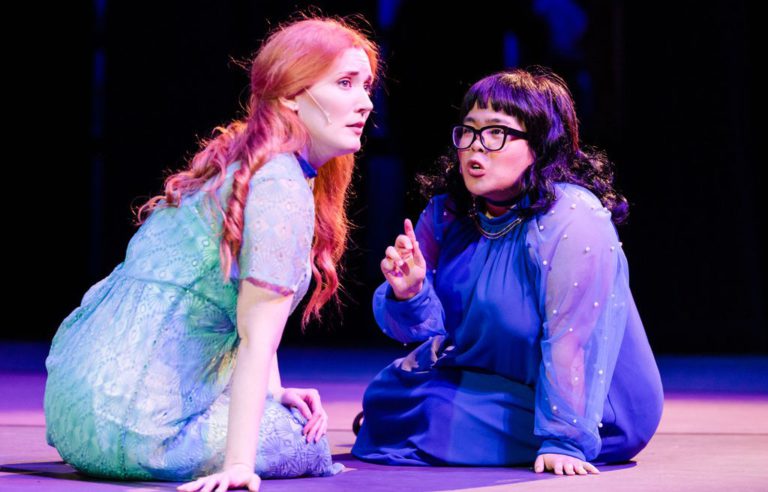
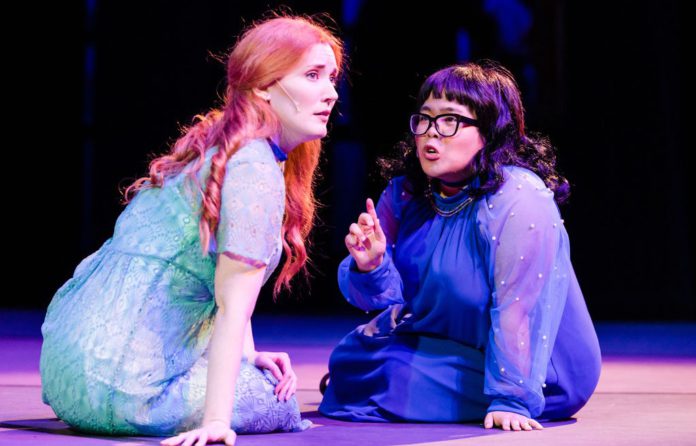
Art dealer Flan Kittredge (Larry Williams) and his wife, Ouisa (Mary Samson), are entertaining a guest (Lukas Raphael) with the hope of him making a substantial investment in an art piece.  They’re interrupted by the arrival of Paul (Jonathen Blue), a young man claiming to have just been mugged, who turns to the Kittredges for help, as he is a friend of their children. Paul is invited to spend the evening.

Ouisa discovers Paul in bed with a hustler, and Flan throws them out. They contact their children and discover they’ve never heard of Paul. How did he know so much about them? Who was he? Their investigation leads them to other people who had similar experiences, one ending in tragedy. How were they all connected?  

The human desire for connection is at the heart of this play, and the measures one’s willing to take to make those connections provide the drama. The measures one takes to project an “image” provides the comedy. 

Director Libby Oberlin cast the show well, with Jonathen Blue showing impressive range and a complex dramatic character. Mary Samson is remarkable as Ouisa, whose desperation for a genuine connection with Paul as a replacement for the lack of connection with her children is palpable. Larry Williams also does well as the family patriarch. 

A very talented ensemble (Jake Druzgala, Beth Ellen Ethridge, Pilar Gonzalez, Sean O’Brien, Jess Rodgers, Felizia Rubio, Tim Setzer, Lukas Raphael) takes on multiple roles and through those characters provides many of the play’s lighter moments.

Six Degrees… is neither pure comedy nor pure drama but a show where both are utilized to engage an audience while subtly addressing such issues as classism, racism, the allure of celebrity and the vapidity of Cats. It’s as much a rumination on storytelling as anything else.

Other than some unnecessary directorial flourishes, this production is a story well told.

Sonoma Arts Live presents ‘Six Degrees of Separation’ through Feb. 16 on the Rotary Stage at Andrews Hall in the Sonoma Community Center, 276 E. Napa St., Sonoma. Thurs-Sat, 7:30pm; Sun, 2pm. $25 -$42. 707-484-4874. sonomaartslive.org.

Rebels With a Cause: ‘UNRULY’ Opens at SoCo Museum

1

The San Francisco Art Institute was never about playing it safe. 

For more than 150 years, the institute nurtured rule-breakers, visionaries and artists who colored outside the lines—sometimes quite literally. The legendary institution closed in 2022, but its rebellious spirit lives on in UNRULY: North Bay Artists from the San Francisco Art Institute, opening Feb. 15 at the Museum of Sonoma County. 

The exhibition honors SFAI, the oldest and most influential fine arts school on the West Coast, which fostered generations of bold, boundary-breaking art. The show illustrates the school’s notable impact on the North Bay art scene. It includes 18 North Bay artists who studied or taught at the institute, featuring more than 30 works, including painting, photography, sculpture and mixed media. 

Guest curator Jude Mooney, an SFAI alumna and Sonoma County liaison for SF Artists Alumni (SFAA), says, “In times of political and social division, teaching young people to think outside the box and speak their minds is more critical than ever.”

SFAI was founded in 1871 by Northern California artists and intellectuals. By the 20th century, it was renowned for its radical exploration and occasional controversy. Mooney showcases these aspects in UNRULY.

“The work that I was drawn to was more experimental, mixed media or really pushing boundaries in the way we think about art because we can learn from the work that is really asking questions,” Mooney says. “There were plenty of well-behaved artists at SFAI, but it’s often the rule breakers who stand out.” 

Historically, SFAI became a hub for innovation in art and culture in the American West, setting the trends rather than following them. The vast, glowing color field paintings of SFAI professor Mark Rothko—though not featured in this show—were a radical departure from the norm in their time.

“I recall a young man in my painting class who did not feel like painting,” reminisces Mooney of her own days at SFAI. “While I toiled away at my paintings, he found a creative way to not paint and make it through the critiques. Each day, he peed in a mason jar. The color of the pee was different each day because of what he ate. In our [critiques], we looked at all his jars of pee together against the white wall and discussed the varying shades of yellow. Our teacher, Carlos Villa, accepted the student, his work, and everyone took it very seriously. Acceptance was a big part of the ethos.”

Featured UNRULY artists include Richard H. Alpert, Chester Arnold, David Best, Mark Grieve, Robert Hudson, Anton Kuehnhackl, Evri Kwong, Virginia Linder, Janis Crystal Lipzin, Phil McGaughy, naomi murakami, Sam Roloff, Alice Shaw, Simone Simon, Liz Steketee, Inez Storer, Hwei-Li Tsao and Heather Wilcoxon.

UNRULY traces the creative lineage of living SFAI artists. To put this in perspective, multi-media artist Virginia Linder studied at SFAI in the late 1950s, while photographer Anton Kuehnhackl completed his MFA just before the school closed in 2022. 

“The loss of the San Francisco Art Institute is a blow to the Bay Area art community,” says Mooney. But while SFAI’s closure marks the end of an era, alumni and supporters are determined to carry its spirit forward.

‘UNRULY: North Bay Artists from the San Francisco Art Institute,’ Feb. 15–June 8. A public opening and reception will be held, and two live performances will be given by SFAI alumni. From 5 to 7pm, Feb. 15, at the Museum of Sonoma County, 425 Seventh St., Santa Rosa. The event is free. museumsc.org

PUBLIC PROGRAMS

Curatorial walk-through (artists present) at 2pm, Saturday, March 8. Free.

SFAA Spotlight Online Program featuring artist Liz Steketee in conversation with ‘UNRULY’ curator Jude Mooney at 10am, March 3. Free.

SFAI librarian emeritus Jeff Gunderson speaks about the history of Sonoma County’s SFAI alumni at 5pm, Saturday, April 19. $10 general public. Free for SFAI alumni.

Museum hours are Wednesday through Sunday, 11am–5pm. Adults: $10; seniors 62+, students, people with disabilities: $7; museum members: free; children 12 & under: free. Through Museums for All, those receiving food assistance (SNAP benefits) can gain free admission for up to four people to the Museum of Sonoma County simply by presenting their EBT card.

Free Will Astrology, Feb. 5-11

0

ARIES (March 21-April 19): The world’s largest mirror isn’t an actual mirror. It’s Bolivia’s Salar de Uyuni salt flat, a vast area that’s almost perfectly flat. After a rain, a thin layer of calm water transforms the surface into a perfect reflector that can be used to calibrate observation satellites. In these conditions, it may be almost impossible to tell where the Earth begins and the sky ends. I foresee metaphorically similar developments for you during the coming weeks. Boundaries between different aspects of your world—professional and personal, spiritual and practical—might blur in interesting ways. A temporary dissolution of the usual limits may offer you surprising insights and unexpected opportunities for realignment. Be alert for helpful clues about how to adjust the way you see things.

TAURUS (April 20-May 20): From day to day, glaciers appear static. But they are actually slow-moving rivers of ice that have tremendous creative power. They can make or reshape valleys, moving tons of dirt and rock. They pulverize, grind and topple trees, hills and even mountains. New lakes may emerge in the course of their activity. I invite you to imagine yourself as a glacier in the coming months, Taurus. Exult in your steady transformative power. Notice and keep track of your slow but sure progress. Trust that your persistence will ultimately accomplish wonders and marvels.

GEMINI (May 21-June 20): In recent weeks, have you stirred up any dynamic fantasies about exotic sanctuaries or faraway places or mercurial wild cards? Have you delivered enticing messages to inspiring beauties or brave freedom-fighters or vibrant networkers? Have you been monitoring the activities of longshots or future helpers or unification adepts who might be useful to you sooner than you imagine? Finally, Gemini, have you noticed I’m suggesting that everything important will arise in threes—except when they come in twos, in which case you should hunt for the missing third? P.S.: When the wild things call to you, respond promptly.

CANCER (June 21-July 22): Archaeologists found two 43,000-year-old flutes in Germany. Constructed of mammoth ivory and bird bone, they still produce clear notes with perfect pitch. They were located in a cave that contains ancient examples of figurative art. Some genius way back then regarded art and music as a pleasurable pairing. I propose we make these instruments your power symbols for the coming weeks, Cancerian. May they inspire you to resuscitate the value of your past accomplishments. May you call on the help of melodies and memories that still resonate—and that can inspire your future adventures. Your words of power are regeneration, revival and reanimation.

LEO (July 23-Aug. 22): It’s your unbirthday season, Leo—the holiday that’s halfway between your last birthday and your next. During this interlude, you could benefit from clarifying what you don’t want, don’t believe and don’t like. You may generate good fortune for yourself by going on a quest to discover rich potentials and stirring possibilities that are as-yet hidden or unexpressed. I hope you will be bold enough to scan the frontiers for sources of beauty and truth that you have been missing. During your unbirthday season, you will be wise to gather the rest of the information you will need to make a smart gamble or daring change.

VIRGO (Aug. 23-Sept. 22): Austrian playwright Elfriede Jelinek won the Nobel Prize for Literature in 2004, and Romanian-German author Herta Müller earned it in 2009. But garnering the world’s most prestigious award for writers did not provide a big boost to their book sales. In some markets, their famous works are now out of print. In 2025, I hope you Virgos do in your own spheres what they only half-accomplished in theirs. I would love for you to gather more appreciation and attention while simultaneously raising your income. According to my reading of the astrological omens, this is a reasonable expectation. 

LIBRA (Sept. 23-Oct. 22): By day, Libra-born Forrest Bess (1911-1977) worked as a commercial fisher in Texas. By night, he created visionary paintings inspired by symbols that appeared to him in states between sleeping and waking. Other influences in his art came from alchemy, the psychological philosophy of Carl Jung and Indigenous Australian rituals. His life was living proof that mystical exploration and mundane work could coexist. I’m hoping he might serve you as an inspirational role model. You are in a phase when you have the power to blend and synergize seemingly opposing aspects of your world. You would be wise to meditate on how to find common ground between practical necessity and spiritual aspiration. Are there ways you can unite the desires of your head and heart? Of your need for safety and your longing for adventure? Of your craving for beauty and your fondness for usefulness?

SCORPIO (Oct. 23-Nov. 21): The first emperor of China, Qin Shi Huang, arranged for himself to be buried after death with an army of 8,000 soldiers made from terracotta, which is a clay ceramic. Joining the gang below the Earth’s surface were 770 horses and 130 chariots. For more than 2,000 years, this assemblage was lost and forgotten. But in 1974, farmers digging a new well found it accidentally. In this spirit, I am predicting that sometime in the next five months, you will make interesting discoveries while looking for something other than what you find. They won’t be as spectacular as the terracotta army, but I bet they will be fun and life changing.

SAGITTARIUS (Nov. 22-Dec. 21): Author Zora Neale Hurston said, “There are years that ask questions and years that answer.” I will adjust that counsel for your use, Sagittarius. According to my astrological analysis, the first half of 2025 will ask questions, and the second half will answer them. For best results, I invite you to gather and polish your best questions in the next five months, carefully defining and refining them. When July begins, tell life you are ready to receive replies to your carefully wrought inquiries.

CAPRICORN (Dec. 22-Jan. 19): Hemoglobin is an iron-bearing protein that’s crucial to most life. It enables the transportation of oxygen in the blood. But one species, the icefish of the Antarctic seas, lacks hemoglobin. They evolved other ways to obtain and circulate enough oxygen in the frozen depths, including larger hearts and blood vessels. The system they’ve developed works well. So they are examples of how to adjust to an apparent problem in ways that lead to fine evolutionary innovations. I suspect you’re now in the midst of your own personal version of a comparable adaptation. Keep up the good work.

AQUARIUS (Jan. 20-Feb. 18): Born under the sign of Aquarius, Clyde Tombaugh discovered the heavenly body known as Pluto in 1930. This was years before he earned advanced degrees in astronomy. His early education was primarily self-directed. The telescopes he used to learn the sky were built from tractor parts and old car components from his father’s farm. During the coming months, I surmise there will be elements of your life resembling Tombaugh’s story. Your intuition and instincts will bring you insights that may seem unearned or premature. (They’re not.) You will garner breakthroughs that seem to be arriving from the future.

PISCES (Feb. 19-March 20): One of the world’s deepest caves is Veryovkina in the nation of Georgia. At its lowest, it’s 7,257 feet down. There are creatures living there that are found nowhere else on Earth. I propose we make it your symbolic power spot for now. In my astrological opinion, you will be wise to dive further into the unknown depths than you have in quite some time. Fascinating mysteries and useful secrets await you. Your motto: “Go deeper and deeper and deeper.”

Your Letters, 2/5

Praise for the ‘Graze’ Story

I want to applaud the well written and balanced article by Cole Hersey (“Given, Then Taken,” Jan. 29). In the town hall meeting with Jared Huffman referenced, there was a huge amount of outrage, sadness and disappointment at the outcome delivered. It was refreshing to hear that the Pacific Sun reminds its readers that the ranchers had a choice and took the money, just like they did in the early ’60s. 

Interesting that for all the misdirected anger and cataclysmic changes ahead, ranchers didn’t do just one thing. If the employees, way of life and multi-generational traditions are so important to them, saying so was within their choices. “No” is a complete sentence last time I checked, and some lessees so stated.

Joseph Brooke
Point Reyes Station

Generic but Gendered

Regarding Buck Moon’s “Dumbass Debate” Jan. 22 letter to the editor that objected to me concluding that the play POTUS, etc. or Behind Every Dumbass are Seven Women Trying to Keep Him Alive is misandrist as it’s only hateful of Donald Trump: Please advise him that before he calls someone a “dumbass,” he might want to do his homework, as the play, which opened in 2022, does not show the president. He is treated as a generic man whose name is never spoken.

Joe Manthey
Petaluma

Culture Crush, 2/6

0

Petaluma

Old School Photo Ops

Photo conservator Gawain Weaver unravels the mysteries of early California portraiture in an upcoming workshop offering a deep dive into 19th- and early 20th-century photography. Hosted by the Petaluma Regional Library at the Petaluma Arts Center, the workshop explores how these portraits were made, how to interpret them and what they reveal about the era. “This is an opportunity to place yourself and your family in local history and improve your understanding of the artifacts in your homes and local museums,” said Connie Williams, the history room librarian at the Petaluma Regional Library. Attendees are encouraged to bring their own family portraits for discussion and can even scan them for digital preservation. 10am-noon, Saturday, Feb. 22, at Petaluma Arts Center, 230 Lakeville St.

Santa Rosa

Paws for Love

What happens when shelter pets become painters? The result is a Wine Country winter gala. Paws for Love features original art created by homeless animals, plus live and silent auctions benefiting sick, injured and abused pets. Now in its 26th year, this event raises funds to support animal welfare all year long. The gala runs from 5-9pm, Thursday, Feb. 8, at Finley Center, 2060 W. College Ave., Santa Rosa. Tickets: $50 donation in advance, $60 at the door. More info at pawsforlove.info.

Mill Valley

Wedding Expo

One may say “I do” to the ultimate event-planning experience. Whether they’re part of an engaged couple, planning a milestone celebration or an event pro seeking inspiration, the Marin Wedding & Event Expo is a one-stop shop for all things weddings and special events. At the event, one can meet vendors, explore the latest trends and discover everything from décor to gourmet catering—all under one roof. Plus, an RSVP entitles one to the chance to win raffle prizes. 1-4pm, Sunday, Feb. 23, at the Mill Valley Community Center, 180 Camino Alto. Free admission. RSVP on Eventbrite online at bit.ly/mv-wedding-25.

San Rafael

Galentine’s Crafts

It’s almost time to get that craft on with those best gals (and pals) this Valentine’s Day. The Galentine’s Open Crafting Event is the chance to unleash creativity, celebrate friendship and make something—no crafting experience required. One may bring their own supplies or use what’s provided, and explore a variety of DIY stations. The event is open to all, regardless of gender. 4-6pm, Friday, Feb. 14, at 1033 C St., San Rafael. Ages 18+. Tickets are $47.73 on Eventbrite and available at bit.ly/galentines-craft.

Meet Kimi Barbosa, Director of Positive Images

I met Kimi Barbosa (they/he/she), executive director of Positive Images, during lunch hour at their art-decorated rainbow clubhouse. I entered their spot in step with their door-dasher. Lunch was politely deferred, and we had a friendly chat. 

As Barbosa talked and I listened, I came to see that their cozy and somewhat cramped clubhouse reflected the origins of Positive Images—that of a safe meeting place for queers founded in the darkest years of the AIDS crisis. 

The non-profit’s services now reflect its present moment: resource navigation, youth and adult support groups, an LGBTQI+ therapy fund, workplace sensitivity training, public presentations, school clubs, public events, parade contingents, partnerships and public policy. 

Their progressed mission was the bridge between past and present—an effort to turn all of the North Bay into a safe space for LGBTQI+ people—because a single room, no matter how large and colorfully decorated, is too much like a closet.

CH: Kimi, what is your message for your LGBTQI+ community in these times?

KB: It is a scary time. It feels like the world is against us because, frankly, the world is against us. Many of Trump’s executive orders directly target our community. This is the time—more than ever—to find the light in each other. Support each other. Be the rock for each other. Community care needs to be held very closely for the next four years.

CH: And Kimi, what is your message to the broader community?

KB: We aren’t going to be scared back into the closet or kept from living our truth in our authentic identities. But we need allies. Now more than ever. We need our allies to show up and stand in solidarity with us—visibly, in public, out loud. We can’t do this alone. The CDC has reported that anti-LGBT hate crimes were on the rise even before Trump took office.

Learn more. Visit posimages.org for a complete list of services, history and video introductions with their incredibly stylish staff. Barbosa warns that the Trump administration is cutting off Federal dollars to LGBTQI+ non-profits like Positive Images, so they encourage donations. 

If one feels that their workplace would benefit from queer and trans sensitivity training, Barbosa invites a booking with Positive Images.

Trump 2.0, the Next Narrative

Americans have long been subjected to political and corporate sleight-of-hand, the creation of a narrative that says it is doing one thing while behind the scenes doing another. 

America’s corporate tyrants work with our elected officials to claim they are keeping us safe and secure in our continental cocoon of North America as they spend $1 trillion a year preparing for and engaging in war across the globe. 

This false narrative is part of the long-standing military-industrial complex narrative. It propagates fear so that Americans open their national treasury and allow it to be drained of hard-earned tax dollars to purchase weapon systems that do not work, empty inventories of ammunition on unarmed populations and create endless wars when diplomacy would have resolved the issue. 

Let us not create a moral equivalency between the Democratic Party and the Republican Party or between Donald Trump and Joe Biden, but rather let us highlight to Americans that they now have another narrative containing some truth, some falsehoods and some hysteria, all being aimed their way so they will not object to or attempt to prevent corporate theft abroad or here at home. 

The point is not to obsess about Trump but rather to obsess about the entire American political system. Outrage at Trump must be channeled to the broader system that allows Trump and other elected officials, Democrat and Republican, to commit war crimes, gut our national treasury and benefit their corporate donors, all while pointing the finger at the malevolent character on the other side of the political aisle, or the evil foreigner on the other side of the globe. 

It is time to reject these narratives. The truth of corporate tyranny is outrageous enough. Let us stay focused on that. Brad Wolf is director of Peace Action Network and co-coördinates the Merchants of Death War Crimes Tribunal.

End Times: Pretty Frankenstein is in love at the apocalypse

Pretty Frankenstein has a certain attitude toward the perils of the moment. It comes across in the band’s new single, “Love Letter to the Apocalypse,” just released across streaming platforms. A slow, deep burn, the song has the feel of something stirring deep within the heart, a creaking refrain of a timeless theme with particular resonance at this inflection point...

Deportation on the Menu: Trump’s Immigration Policies Affect How We Eat

Nearly every bite of food we eat in the U.S. has passed through the hands of an undocumented immigrant.  Along the entire food system, from farms and vineyards to meat processing plants and restaurant kitchens, undocumented immigrants feed our nation. That is especially true here in the North Bay, where, according to chef Elijah Trujillo, immigrants are the “unsung heroes.” Trujillo, the...

A Comedy of Eros, Dating in One’s 50s

At some point, I stopped trying to count how many first dates I’d had. Was it 37? 48? The number was less important than the slow realization that I was essentially speed-dating the entire middle-aged male population of the North Bay.  It was like I had unwittingly entered an endurance race, but instead of a medal at the end, I...

Con Game of Life, ‘Six Degrees…’ in Sonoma

Six Degrees of Separation is the concept that everyone can be connected via six or fewer social connections. First posited in the 1920s, it entered the cultural lexicon in 1990 through John Guare’s play of the same name. Sonoma Arts Live is staging a production of Six Degrees of Separation through Feb. 16. Socialite friends told Guare a story about...

Rebels With a Cause: ‘UNRULY’ Opens at SoCo Museum

The San Francisco Art Institute was never about playing it safe.  For more than 150 years, the institute nurtured rule-breakers, visionaries and artists who colored outside the lines—sometimes quite literally. The legendary institution closed in 2022, but its rebellious spirit lives on in UNRULY: North Bay Artists from the San Francisco Art Institute, opening Feb. 15 at the Museum of...

Free Will Astrology, Feb. 5-11

ARIES (March 21-April 19): The world’s largest mirror isn’t an actual mirror. It’s Bolivia's Salar de Uyuni salt flat, a vast area that’s almost perfectly flat. After a rain, a thin layer of calm water transforms the surface into a perfect reflector that can be used to calibrate observation satellites. In these conditions, it may be almost impossible to...

Your Letters, 2/5

Praise for the ‘Graze’ Story I want to applaud the well written and balanced article by Cole Hersey (“Given, Then Taken,” Jan. 29). In the town hall meeting with Jared Huffman referenced, there was a huge amount of outrage, sadness and disappointment at the outcome delivered. It was refreshing to hear that the Pacific Sun reminds its readers that the...

Culture Crush, 2/6

Petaluma Old School Photo Ops Photo conservator Gawain Weaver unravels the mysteries of early California portraiture in an upcoming workshop offering a deep dive into 19th- and early 20th-century photography. Hosted by the Petaluma Regional Library at the Petaluma Arts Center, the workshop explores how these portraits were made, how to interpret them and what they reveal about the era. “This...

Meet Kimi Barbosa, Director of Positive Images

I met Kimi Barbosa (they/he/she), executive director of Positive Images, during lunch hour at their art-decorated rainbow clubhouse. I entered their spot in step with their door-dasher. Lunch was politely deferred, and we had a friendly chat.  As Barbosa talked and I listened, I came to see that their cozy and somewhat cramped clubhouse reflected the origins of Positive Images—that...

Trump 2.0, the Next Narrative

Americans have long been subjected to political and corporate sleight-of-hand, the creation of a narrative that says it is doing one thing while behind the scenes doing another.  America’s corporate tyrants work with our elected officials to claim they are keeping us safe and secure in our continental cocoon of North America as they spend $1 trillion a year preparing...
11,084FansLike
4,606FollowersFollow
6,928FollowersFollow