Wouldn’t it be great if Google or Facebook moved to Sonoma County? Well, yes and no. It would certainly create a lot of jobs, but the impact on housing prices and traffic wouldn’t be great. Anyway, such a move isn’t likely to happen, and I say that’s just as well.
Folks move to or choose to remain in the North Bay because of the quality of life, open spaces and the slower pace. Silicon Valley’s crushing traffic, Gold Rush–style development and stratospherically high cost of housing are not things we aspire to. In fact, many bail on Silicon Valley and San Francisco for those reasons, present company included.
But we still need jobs and economic development. Increasingly, that’s coming from small-scale makers, farmers and artisans, not big corporations. Small and home-based businesses are part of the North Bay experience. Local purveyors are part of what gives the North Bay its look and feel. And while they don’t have the economic might of a Google, local businesses create local jobs, reduce reliance on carbon-intensive imports, keep dollars circulating locally and contribute to the North Bay’s identity.
Last year, Sonoma County’s GoLocal Cooperative, a network of local businesses, residents and nonprofits that support local, sustainably minded businesses, produced $5.6 million in sales through its rewards card program. That generated an estimated
$2 million for the North Bay’s economy.
Two years ago farmer Kelley Rajala and weaver Pam Dale founded a different local business group called North Bay Made. The membership-based group is helping to unify small North Bay businesses by acting as their sales and marketing team. With more than 50 makers and markets in its portfolio, the group is really a force of private-sector economic development. But instead of trying to attract new business to the North Bay, North Bay Made is cultivating homegrown makers in the North Bay and stoking the benefits of a homegrown economy.
“We’re just stacking up win-win scenarios,” says Rajala
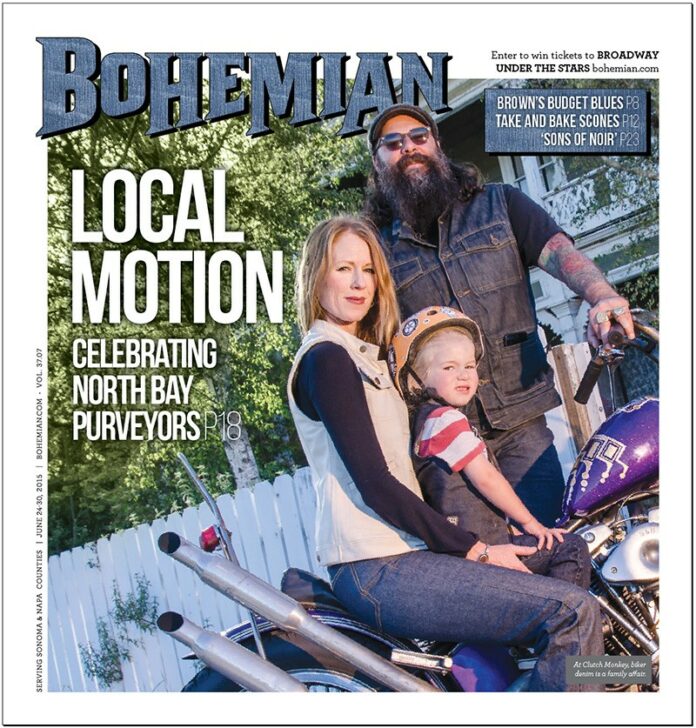
We write about local purveyors every week in the Bohemian, but in this issue we’re highlighting several of our favorites. The good news is there’s more where that came from.—Stett Holbrook
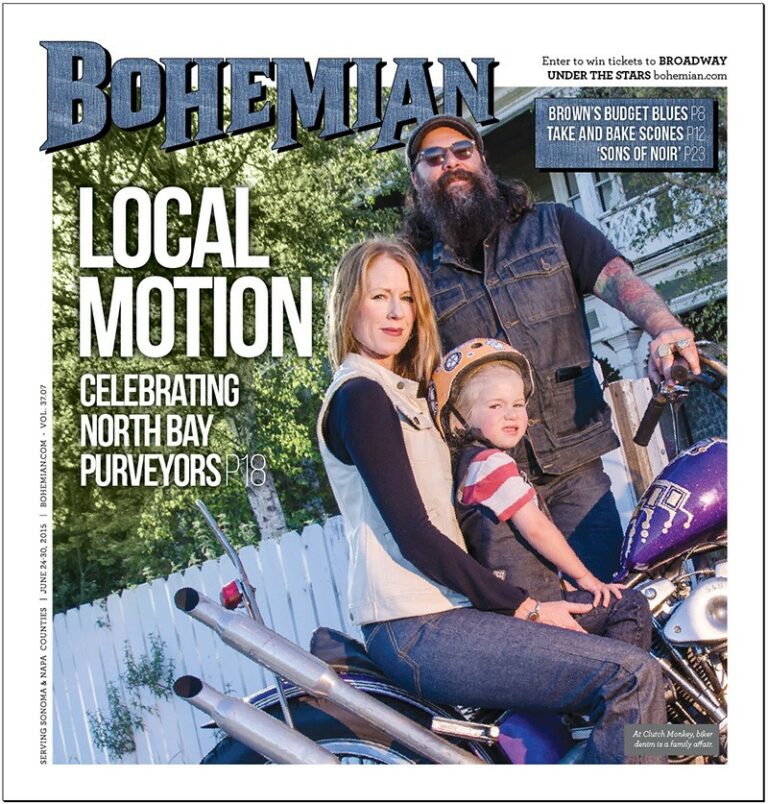
CLUTCH MONKEY
There’s something very wrong about throwing your leg over a vintage motorcycle while wearing a pair of Dockers. It’s not only fashion suicide, it’s not smart. Riding a bike requires a heavy-duty pair of trousers built to withstand hot tailpipes, flying gravel and high-speed asphalt encounters.
Jeans are the pants of choice for most self-respecting bikers, but as Bodega vintage motorcycle enthusiast Marc Bencivenga discovered, there’s not a lot of high-quality, heavyweight denim on the market, especially when you’re 6-foot-3 and 260 pounds of badass biker. (Note to self: Make sure you spell “Bencivenga” correctly.)
“There wasn’t anything out there,” says co-founder Bencivenga. His wife, Jennifer Klein, is the other founder. “That was the inspiration for Clutch Monkey. There was an unmet need.”
Clutch Monkey makes burly, selvedge denim jeans and vests for bikers and those who appreciate bulletproof denim. Selvedge is heavy, stiff (at first) denim made on shuttle looms that fell out of favor when denim went mainstream in the 1950s. Newer projectile looms make more denim faster and cheaper, but it’s not as durable as selvedge. Selvedge is made in tightly woven strips of heavy fabric and finished with bands down each side that prevent fraying and unraveling.
Turns out there is only one mill in the United States that makes selvedge to Clutch Monkey’s standards: North Carolina’s Cone Mills. Clutch Monkey also sources its selvedge from Japanese mills that use retooled Draper and Toyota looms.
“The Japanese put out the best selvedge on the planet,” says Bencivenga.
Clutch Monkey jeans and vests are designed in Bodega and sewn in San Francisco’s last denim factory. (The factory is in such high demand that Bencivenga was asked not to divulge its name. Top-secret denim!)
As a revival product, selvedge is often expensive, but Clutch Monkey sells most of its goods via crowdfunding campaigns and so can offer it at near wholesale prices, because a production run only begins with cash from backers on hand. No marketing required, although Clutch Monkey leans heavily on Facebook and Instagram.
“All the marketing comes to us in real dollars,” says Bencivenga. “People pay for what they believe in.”
If you want to handle a pair of Clutch Monkey jeans or a vest for yourself, get on your bad motor scooter and ride to the newly
opened Soul Riders in Santa Rosa (404 Mendocino Ave., 707.978.3810), the company’s only retail outlet. Opened by former Brotherhood skate shop owner Kurt Hurley, Soul Riders specializes in Southern California beach-culture ware in the form of surf, skate, hot rod fashions and reissues of classic skateboard decks along with a bin of vintage vinyl in the rear. Hurley is excited to carry Clutch Monkey denim as the one nod to the North Bay.
“The jeans will outlive you,”
he says. clutchmonkey.com.
—Stett Holbrook
[page]
dhbetty
Spokes, cogs, chain, fenders, rims, valves—for Christine Culver, owner of dhbetty Bicycle Gems, an artist creating jewelry from upcycled bicycle parts, “it’s all about the bicycles.”
Dhbetty Bicycle Gems was the first business to connect with North Bay Made. Culver, a longtime cyclist, found a passion for bicycles in her late teens when she started racing professionally. She moved up to Sonoma County to work at a bike shop and continue racing.
Culver’s bike love led her to a position as executive director of the Sonoma County Bicycle Coalition in Santa Rosa, where she served from 2003 to 2011. The group advocates for better bicycle access throughout Sonoma County.
“I had gotten involved as a volunteer, then got myself on the board and created a job for myself,” Culver says.
While Culver was running the bike organization, she began creating her jewelry. “The thing that really kicked off this whole ‘doing the jewelry with the bicycle focus’ is that I just wanted a pendant with a bicycle on it. Everything I was finding was really chintzy. It started as a quest looking for one, and then finally I started making them.”
Culver designs bracelets, earrings, glass pendants and necklaces, some made from upcycled bicycle parts, including gears, chains, tires and spokes. Bike shops and the Santa Rosa Cycling Club donate retired bicycle parts for their next
lives as jewelry. Culver sells her jewelry at bike-based events,
local retailers and Clif Family Winery in St. Helena. dhbetty.com. —Haley Bollinger
THE SHOP
It’s a hot and delightful Thursday in Olema, and there’s really no place to be except eased back on the sun-dappled porch of a new West Marin outpost of “uncommon mercantile” called, simply, the Shop.
Sit on the porch in a Jane Brooks–designed baseball hat that features the store logo—she’s a co-owner and designer here—as you sip cold-pressed iced coffee out of a milk bottle and watch a flow customers peruse the offerings.
Repurposed as a shop of local goods, vintage wares, “Northern California classics and practical provisions,” the joint is positively bustling today.
Score! A young man of obvious means emerges with a pair of vintage California license plates tucked under his arm. There’s a whole crate of them out back, if you take the time to look.
Take the time. It’s worth it.
The Shop began in Fairfax several years ago when a quartet of West Marin makers took over the former Good Earth parking garage.
“We did a pop-up mercantile that lasted two years,” says Brooks, where she, her partner Val Yandell, Liz Lavoie and Michele Schwartz made stuff, gathered stuff and sold stuff.
When the Good Earth building sold, the women scoped out the Olema property, which last housed an art gallery. It’s the original Olema post office and there’s an old-time print behind the cash register that shows the building as it was way-back-when.
Together, the four set out to curate a retail joint that would offer and emphasize a particularized aesthetic. The gist is utility with style, preferably repurposed, salvaged or otherwise gathered from the beach, the woods or some old barn somewhere. And, where possible, Brooks says they set out to keep the preciousness factor at a bare minimum. Preferably, none at all. This is, after all, rugged and wild—and quirky—West Marin.
One section of the shop features kids toys along with Schwartz’s exquisitely soft and luxe cashmere creations, hats, ponchos and scarves repurposed from previous couture incarnations.
Elsewhere, vintage hand tools share shelf space with soft hand-made Sun Dog T-shirts that depict old maps of Mt. Tamalpais and other iconic outposts. There are hand-printed greeting cards from Bolinas’ Sirima Sataman, jewelry from Fairfax’s Sarah Roberston, and T-shirts and bags with the shop logo, to go along with that baseball cap.
The quirky factor finds a voice of sorts in the shelves themselves. The post office survived the 1906 earthquake, but the wall-in shelves wound up on a permanent slant after the fact. Hey, it adds character.
“We don’t put marbles on those shelves,” says Brooks with a laugh. They do, however, offer 5 cent pieces of Double Bubble gum to the kids.
Another anchor product comes from Lavoie. The Store is peppered inside and out with simple stencil designs of surfers (and others) rendered on repurposed grape-drying trays; those go for $90 or so.
Visitors to the Shop are heartily encouraged to hang around until they’ve uncovered every choice niblet of functional nostalgia, utility and the handmade on display here.
Oh look, a box filled with old matchbooks! Jewelry fashioned from beach flotsam and jetsam, cool. Delicious fudge offered in an old fruit jar, yum. Handmade beaded jewelry and leather bracelets from Sister Sue—beautiful.
The well-curated, handmade stuff drives the aesthetic here, like the one-of-a-kind, functional mini sailboats from Inverness’ Ray Forbes that start at about $250.
“He’s an off-the-grid craftsman who makes the most delicate and refined pieces of sculpture—and that take a ton of time to make,” says Brooks.
“We love handmade, we love vintage, and we love new stuff,” she adds, “but mostly we just love community. We’re proud to be representing people who are making things.” 9960 Hwy. 1, Olema. theshop-olema.com.
—Tom Gogola
[page]
WILDBRINE
Driving by the unassuming Windsor Business Park, it’s hard to believe it’s the home of local fermented magic. And yet this is where business partners Richard Goldberg and Chris Glab launched Wildbrine five years ago, the go-to spot for all things pungent, crispy and spicy.
Former San Francisco residents and now proud citizens of Windsor and Santa Rosa, Goldberg and Glab have been friends for more than 30 years.
“We met through friends, and since we both were triathlon athletes, we would run together and then meet and cook for friends,” says Goldberg. Goldberg brought the restaurant and cooking experience, Glab had the food marketing background, and the two soon left corporate life behind and launched a line of cheeses, hummus and salsas. After a five-year break following that business, they opened Wildbrine.
The Windsor operation employs 40 people, and Wildbrine is currently carried in eight Whole Foods divisions nationwide and every local gourmet grocer in Sonoma County. The modest plastic jars contain some of the most unique kimchi, pickles, sauerkrauts and fermented salsas an adventurous condiments lover can wish for. Kimchi flavors include Japanese (with miso and horseradish) and Thai (with lemongrass and basil), and the sauerkrauts are not too traditional either—arame ginger or Madras curry cauliflower, anyone?
“We use our imagination and look for current trends, stuff we like that go well together. We’re both foodies and do all product development ourselves,” says Goldberg.
Smoky kale and tamari Brussels sprouts, as well as candy-striped beets and beet greens are some of the ingredients soon to make their way into Wildbrine products, and the latest innovation—fermented salsas with everything from cabbage to carrots—already has a devout following.
“I love our products as a side dish, or incorporating sauerkraut into salad dressings—I purée it!” says Goldberg. How very wild. wildbrine.com.—Flora Tsapovsky
NBC POTTERY
Settled in the mountains above St. Helena in the small town of Angwin, husband-and-wife duo Will and Nikki Callnan create intimately crafted clay works that are redefining everything from plates and vases to sculpture. Under the name NBC Pottery (named after Nikki Ballere Callnan), the pair specialize in custom-made wares designed for private customers as well as restaurants and wineries.
“We’ve been in clay and creating as long as we can remember,” says Will Callnan.
The two met while studying fine arts at Sierra Nevada College in Lake Tahoe. Originally from the East Coast, Will says they decided to stay and work in California because of the rugged beauty of the area, something that’s reflected in their work.
If you’ve ever dined in the Restaurant at Meadowood in St. Helena, you’ve eaten off their plates. Often resembling organic materials such as bark or mushrooms, the pieces highlight chef Christopher Kostow’s cuisine.
“They were looking for something different,” says Will Callnan. “With each piece, we want to show the qualities of the material.”
The flexible qualities of the clay are also on display in the way their vessels, vases and bottles mimic the fluid movements of waterfalls and birds taking flight. With a world of influence right outside their home studio, Will, Nikki, their young son Gavin, and newest addition Evie, are happy to host guests for a studio visit. Their custom wares are available for order or commission online, or directly from the studio. 707.965.1007. www.nbcpottery.com.
—Charlie Swanson