Season of Spirits

0

The sugar skulls and festive altars popping up around Petaluma are designed to honor rather than scare, as the Mexican tradition of El Dia de los Muertos, the Day of the Dead, once again envelopes the town.

Now in its 15th year, the annual celebration takes the traditional Mexican holiday of remembrance and turns it into a month of special events and art shows. And this weekend, several Petaluma galleries and museums open their shows to get the celebration started.

For artist Marc Schmid, a longtime North Bay resident who has lived in Mexico and Spain, the Day of the Dead is as artistic as holidays get. “If you’ve ever been to Mexico, and you’re driving along, you’ll see little art pieces on the side of the road,” he says. “There’s a Christian symbol in there or a tequila bottle or a photograph. And as it grows, it becomes a beautiful work of art.”

Working as a cartoonist and caricature artist for 40 years, Schmid was invited by the owners of Heebe Jeebe in downtown Petaluma to create a new show for their Back House Gallery inspired by the Day of the Dead. Schmid not only conceived of the new show, “Dreams of the Dead,” (opening Saturday, Oct. 3, with a reception at 7pm), but he worked for the first time in scratchboard.

“It was a very experimental process,” he says. Scratchboard involves scratching away at a black painted canvas with a knife to reveal lines of white underneath.

“It’s like buttering bread, like X-ray art in a way.”

Once Schmid found the flow, he began expanding his small traditional pieces into elaborate scenes of fairy-tale figures depicted in the skull-and-bones style of the Day of the Dead. The artist also experimented with dyes to incorporate the vivid colors the holiday is known for.

“There’s a certain humor and whimsy in Mexico, too,” says Schmid. “I know it’s still there. A lot of it has been lost lately, but the spirit is still there.”

Schmid’s show is one of several exhibits showing around town. The Petaluma Historical Library & Museum’s features a community altar and art from Bay Area–based Latino artists. It also opens Oct. 3.

Aqus Cafe and other downtown spots also get in on the festivities, which continue through October with various community events. Mezcal tastings, cemetery tours and poetry readings are all on the calendar, and the month-long celebration culminates on Sunday, Nov. 1, in a procession that runs from Water Street Bistro to the Petaluma Historical Museum.

Last year’s parade drew thousands of spectators and participants who joined together in honoring those who’ve passed on with song and dance, food and drinks, giant life-sized puppets and family-friendly activities.

Total Recall

0

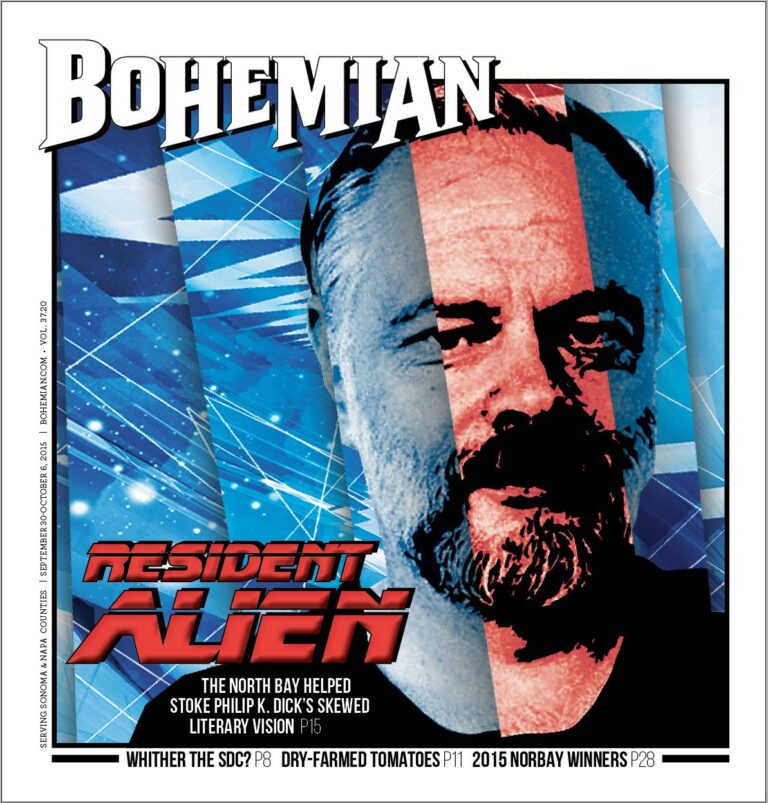
Philip K. Dick is the van Gogh of science fiction writers, striding the hazy line between genius and insanity. PKD, as his fans call him, never lived to
see his writing transformed into such blockbuster films as Blade Runner, Total Recall, Minority Report,
The Adjustment Bureau and A Scanner Darkly. North Bay fans of his stories should know that he lived in the area, and his time here shows up in his work.

When Dick died in 1982 at age 53, his New York Times obituary described him as a “prolific, sometimes visionary science-fiction writer, whose multilayered stories probed the discrepancies between illusion and reality.” While bureaucratic absurdities are Kafkaesque and governmental overreach is Orwellian, in the world Dick created, reality itself conspires against you.

Dick never lived to see the amazing and lasting legacy his labors gave birth to, but it’s intriguing to follow his path through the North Bay to see how it influenced his skewed literary visions. Philip K. Dick was born in Chicago and grew up in Berkeley. He began visiting Sonoma County as a child and lived in Sonoma at 550 Chase St. with Joan Simpson in the summer of 1977.

A character with Simpson’s name appears in Dick’s short story “The Day Mr. Computer Fell Out of Its Tree.” The two were introduced by Dick’s childhood friend Ray Nelson, who co-authored The Ganymede Takeover with him. Nelson also wrote the short story “Eight O’clock in the Morning,” which was the basis for the cult sci-fi film They Live.

Anthony Peake wrote in A Life of Philip K. Dick: The Man Who Remembered the Future that Dick attended the Cazadero Music Camp when he was 11. While there, he nearly drowned in the Russian River, and developed a lifelong fear of water.

During the late 1950s and early 1960s, Dick lived in Point Reyes Station with his third wife, Anne. It was there that he wrote The Man in the High Castle, his Hugo Award–winning masterpiece recently adapted into a TV series by Amazon Studios.

In a 2010 New York Times article on Dick’s time in West Marin, the writer Jonathan Lethem said in an interview it was Dick’s most productive time. Lethem included five novels from Dick’s time in Point Reyes Station in the Library of America anthologies that he edited.

“The river of his literary ambitions—his interest in ‘respectable’ literature—joins the river of his guilty, disreputable, explosively imaginative pulp writing,” Lethem told the Times. “It’s the most important passage of his career—more masterpieces in a shorter period of time.”

Anne Dick says in an email that Dick was a fan of Jack London. He visited Jack London State Park in Glen Ellen, and had read his works. London’s 1908 dystopian novel, The Iron Heel, inspired 1984, according to Orwell biographer Michael Shelden, and probably struck a chord with Dick.

Sonoma County features in several of his short stories. “Exhibit Piece” mentions a camping trip to the Russian River, and a character in The Man Whose Teeth Were All Exactly Alike lived in Fountain Grove, now part of Santa Rosa. In “What’ll We Do with Ragland Park?” a character owns Sonoma Valley vineyards.

Dick even mentions Luther Burbank, the plant (and marketing) wizard of Santa Rosa, in the short story “A Terran Odyssey”:

Scratching his nose, Hardy murmured, “What did you have in mind?”

“Maybe I could find a mutant potato that would feed everybody in the world.”

“Just one potato?”

“I mean a type of potato. Maybe I could become a plant breeder, like Luther Burbank. There must be millions of freak plants growing around out in the country, like there’s all these freak animals and funny people here in the city.”

Hardy said, “Maybe you could locate an intelligent bean.”

“I’m not joking about this,” Stuart said quietly.

[page]

The story later became the 1965 book Dr. Bloodmoney, a post-apocalyptic novel that features a self-governing community in West Marin menaced by Hoppy Harrington, a Thalidomide baby missing all of his limbs who gets around with servo-powered prosthetics and aggressive powers of psychokinesis.

The town of Sonoma is headquarters for the Rhipodian Society in Dick’s semi-autobiographical novel VALIS (“Vast Active Living Intelligence System”).

VALIS is based on a series of mystical visions that Dick had between February and March 1974 while living in Santa Ana, which he called the “2-3-74” or “Pink Light” experience. Robert Crumb, of Zap Comix fame, illustrated a version of the event that he titled “The Religious Experience of Philip K. Dick” in Weirdo issue 17. Dick continued writing about this experience for the rest of his life, trying to interpret and explain it to himself. His voluminous notes were stored in a home in Glen Ellen and published posthumously as his 944-page Exegesis.

The Pink Light experience begins with Dick in great pain after having his wisdom teeth removed. When the pharmacy delivered his medication, he opened the door and light reflected off the young delivery woman’s fish medallion. Mesmerized, he asked what it was, and she explained it was a symbol of the early Christians.

Dick said he then entered a time-slip and felt himself co-existing in ancient Rome just after the crucifixion. Another personality from that era took him over for about a year. In his shorthand notes, he called our world the Black Iron Prison and wrote repeatedly, “The [Roman] Empire never ended.”

Later, he said a pink light flashed in his eyes and beamed information into his brain, telling him his son had a congenital hernia and needed immediate surgery. Dick was right. After taking his son to the hospital, he was told by a doctor that his child could have died at any time.

Information kept flooding into Dick’s brain, which he thought came from an ancient alien satellite orbiting our planet. The Pink Light experience formed the basis of VALIS and The Divine Invasion, and the film Radio Free Albemuth directed by John Alan Simon.

In 1978, Dick attended the Octocon II convention in Santa Rosa. The guest of honor was Dune author Frank Herbert, who wrote and took photos for the Press Democrat from 1949 to 1953. While it is unclear whether Dick connected with Herbert at that convention, he definitely met Robert Anton Wilson, author of The Illuminatus! Trilogy.

Wilson had had his own mystical experience, which he thought came from the star Sirius, around the same time as Dick had his visions. The two discussed their common experiences at the Octocon convention.

In his foreword to the first book in the Cosmic Trigger trilogy, Wilson describes their conversation: “My impression was that he was worried his experience was a temporary insanity, and was trying to figure out if I was nutty, too. . . . The parallels to my own experience are numerous, but so are the differences. If the same source was beaming ideas to both Phil and me, the messages got our individual flavors mixed into them as we decoded the signals.” One of Dick’s characters in VALIS even mentions having read Cosmic Trigger.

The world that Dick knew has slowly transformed into a Phildickian story. Paranoid PKD never imagined the voluntary popularity of data mines like Facebook. Smartphones spying on their owners is predictably Orwellian; the twist is now they are must-have status symbols.

Dick would probably be pleasantly surprised to see solar-powered homes sprouting like mushrooms across the county, but the near-monopolistic Pacific Gas & Electric’s effort to cut compensation for residential solar power generators and increase fees for solar customers has a faintly Phildickian feel.

Maybe he wasn’t so paranoid after all.

Hats Off

0

Our annual appreciation of North Bay bands, the NorBays Music Awards, is taking a break from hosting a live concert and ceremony this year. We’re retooling the show to make it bigger and better, but in the meantime, we’ve still got awards to hand out to nine of the best bands and musicians in the North Bay, in categories that range from jazz to folk to hip-hop. Without further ado, the winners of the 2015 NorBays, as voted on by readers (that means you):

Blues/R&B: Volker Strifler

Santa Rosa guitarist and North Bay fixture Volker Strifler dazzles as a bandleader and solo act with superb blues licks and funky, breezy arrangements. His talent as a guitarist got him a gig as a member of the Ford Brothers Blues Band and his sound is often compared to Duane Allman.

Country/Americana:
McKenna Faith

Technically, McKenna Faith is not from the North Bay, but we’re going to let it slide on account of her stunning songwriting ability and sublime voice. At 20 years old, Faith is a newcomer to the country-music scene, but she’s already making a lot of noise in Nashville recording studios and touring nonstop all over the country. Her next show is on Oct. 10 at Wild Flowers Saloon in Healdsburg.

DJ: DJ Beset

The Petaluma-based DJ Beset makes the rounds between Sonoma and Marin County parties and clubs, spinning an eclectic array of reggae, dancehall, hip-hop, soul and mainstream hits. He’s been heard on Wild 94.9 and he’s been getting shout-outs most recently for his sizzling remix of Janet Jackson’s “No Sleeep.” A resident DJ at Flatiron in San Rafael, DJ Beset will be spinning there next on Friday, Oct. 2.

Folk/Acoustic: Misner & Smith

There’s something exceedingly timeless about folk-revival duo Misner & Smith, as if they stepped out of another era. In fact, Megan Smith and Sam Misner—who are also thespians, it turns out—met at a Shakespeare festival where they continue to perform, a testament to their old-timey enthusiasm and theatrical presentation. This fall, Misner & Smith are journeying through Europe on a cultural exchange trip. Their next North Bay show is on Nov. 22 at the Big Easy in Petaluma.

Hip-Hop/Electronica: Broiler

Santa Rosa underground rapper Broiler just dropped his ultra-dope LP Someone’s Thunder last June, and it’s packed with guest stars and sick beats. Look no further than the chill opening track, “Minivan Cruisin’,” a song about rolling down Mendocino Avenue in a Ford Aerostar.

Jazz: Hot Club Beelzebub

Hot Club Beelzebub is an infernally entertaining five-piece formed in Santa Rosa in 2010. The longtime friends who make up the band have their hands in several North Bay music projects, yet when it comes to cabaret-style jazz, there’s nothing like the bawdy and brash sound they make as the Hot Club.

Indie/Punk: The Velvet Teen

This has been a landmark year for Sonoma County indie rock trio the Velvet Teen. We here at the Bohemian have already fawned over their new record, All Is Illusory, released this summer; and we rocked at their blowout Phoenix Theater show in Petaluma last month. If you’ve not heard the new tunes from these North Bay favorites, now is the time.

Rock: Frobeck

There’s nothing low-key about the funk rock of Frobeck. Led by keyboardist and vocalist Spencer Burrows, the band, which includes a full horn section and a tight rhythm foundation, have been cranking out feel-good grooves since 2005. Frobeck has amassed a dedicated North Bay fan base that enjoys the band’s high-energy live shows and top-notch musicianship. Frobeck’s next show is an album-release concert, where the band will unveil their new record, Sea of Truth, on Oct. 24 at HopMonk Novato.

World/Reggae: Arcane Dimension

Most of us live in a world of three dimensions. And then there’s Arcane Dimension, the avant-garde, world-music collective. With a melding of bowed guitar melodies, belly dancing, performance art and tribal drums, the edgy and envelope-pushing Arcane Dimension are highly influenced by main man Jarek Tatarek’s metal and industrial background. This month, as the votes came in for the NorBays, Arcane Dimension announced they were going on hiatus for the fall. But when they decide to return to the tribe, the band will have plenty of fans ready to welcome them back.

New Shed Chef

0

[image-1

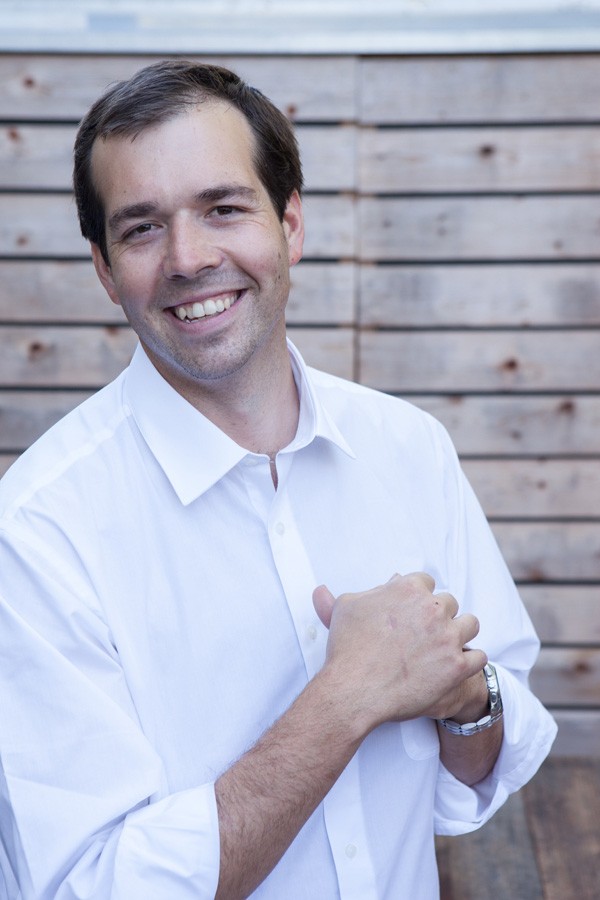
There’s a new chef at Healdsburg’s Shed.

Perry Hoffman replaces Miles Thompson, who was top toque at the restaurant for a little over a year. Hoffman is a Napa Valley native with a long culinary background. His grandparents, Sally and Don Schmitt, were the original owners of the French Laundry, where he helped out in the kitchen at a young age. At 18 he was hired as sous chef at the Boonville Hotel. He went on to cook at Santé Restaurant at Fairmont Sonoma Mission Inn before moving to Auberge du Soleil in Rutherford in 2005. During his two years at Auberge, Hoffman, 31, helped the restaurant earn its first Michelin star. His last post was at étoile Restaurant at Domaine Chandon, where he was appointed head chef. While at the now closed restaurant, he earned a Michelin star three years in a row.

As culinary director of Shed, Hoffman will work with the restaurant’s farm and nearby growers to showcase a seasonal, farm-driven menu. Hoffman will oversee the entire culinary program—breakfast, lunch, dinner and special events.

“I am eager to be a part of the Shed community—to get to know the farmers—and to learn and collaborate,” says Hoffman. “I’m especially looking forward to exploring seasonality and terroir in Sonoma County, and being part of creating and completing the cycle from seed to plate.”

Healdsburg Shed 25 North St., Healdsburg. 707.431.7433. healdsburgshed.com.—Stett Holbrook

Kelly’s Cave

0

Stop me if you’ve heard this one before, because all of the wine writers recently invited to a tour of Kelly Fleming Wines reached for their pens when the proprietress told the story of how Big Pour got its name.

Kelly Fleming’s 2012 Big Pour Napa Valley Red Blend ($75) is the 230-case winery’s entry-level red, a juicy Bordeaux-style blend with plum fruit and a note of tobacco on the nose. Each vintage features new label artwork: the 2012 label sports Ms. Fleming, with one of her dogs (not the all-black, Slovakian, police-trained German shepherd that barked at me from the second story of this Provence-inspired, stone winery as I walked up), and a vintage shotgun. Among other animals in Fleming’s care are four rescued donkeys—the gray one is named Clooney.

But back to the story. It’s so easy to lose the thread here, especially in the mist-shrouded wine caves, where rows of stage-lit wine barrels on either side lead to a central chamber of exposed rock walls. The cave took two years to dig, out of solidified volcanic ash. It’s crumbly, that’s for sure, and required buffering with sprayed-on concrete.

And here, also, there’s a table of charcuterie and olives, perfect with a sip of 2014 Kelly Fleming Rosé ($36). Fleming has a bright young team working with her, including winemaker Becky George and winery manager Bryan Timonere, who explains that the rosé is made mainly from a saignée of Cabernet Sauvignon (a reduction of the juice before fermentation, which helps concentrate the Cabernet), with a soupçon of Syrah. For my taste, I’d reverse that formula—but one can’t help but admire the confidence that setting this price point for rosé of Cabernet Sauvignon demands.

The 2012 Kelly Fleming Cabernet Sauvignon ($110) is as well priced as any of its near neighbors. A young Cab that keeps you guessing, it finishes on a juicy, cola-and-black-cherry note after sidetracking the nose through dusty, desiccated fruit, cranberry and cassis, and a chocolatey nutmeg aroma that evokes something fanciful: an oak cookie.

I’m not sure if I prefer it over Big Pour—ah, yes, the wine inspired by Kelly Fleming’s tour of Domaine de la Romanée-Conti in Burgundy, the legendary house of Pinot Noir that she only need refer to—in present company—as “DRC.” Because of her poor command of French, Fleming says, the host, thinking that she wanted more wine, reluctantly poured more in her glass. Another visitor melted the frost by announcing, “I want to stand next to ‘Big Pour’!”

Kelly Fleming Wines, 2339 Pickett Road, Calistoga. Tours and tastings by appointment only, limited to eight persons per day. Tasting fee, $60. 707.942.6849.

Let the People Vote

0

Are corporations people? Is money speech? The Supreme Court, in deciding Citizens United v. Federal Election Commission in 2010, answered yes to these questions. The ruling maintained that, since corporations are people and money is speech, political spending is protected under the First Amendment.

This ruling has released a downpour of “dark money” through Super PACs that work to influence elections. As corporations are granted certain privacy and other legal protections, most of these contributions are never made public.

The court decided that corporations, PACs and unions are “natural” persons with constitutional rights. But in his dissent, Justice John Paul Stevens argued that corporations are not people, and are therefore not protected by the Constitution.

After the Citizens United ruling, President Obama said, “[L]ast week, the Supreme Court reversed a century of law that I believe will open the floodgates for special interests—including foreign corporations—to spend without limit in our elections.”

Obama was prophetic. The Brennan Center for Justice reports that super PACs spent $486 million in the 2014 Senate elections, more than twice what they spent in 2010. Just 195 donors gave nearly 60 percent of the $1 billion spent by super PACs on all federal elections since Citizens United was decided in 2010.

In 2014, the California Legislature passed SB 1272 to place Proposition 49 on the ballot. The non-binding legislation would have asked California’s congressional delegation to support a constitutional amendment to overturn Citizens United. But the California Supreme Court blocked the proposition because of lengthy legal review, and it was pulled from the ballot. However, if we act now, we may still have a chance to vote on Proposition 49, as the court concludes its review of the measure Oct. 6.

If you want to send a strong message to Congress, go to http://bit.ly/sign-prop49 to sign the petition and demand that the California Supreme Court let the people vote. You must sign the petition before Oct. 5. When corporations become people and money becomes speech it’s time to get involved.

Bill Wadsworth lives in Occidental.

Open Mic is a weekly feature in the ‘Bohemian.’ We welcome your contribution. To have your topical essay of 350 words considered for publication, write op*****@******an.com.

Letters to the Editor: September 30, 2015

Up in Smoke

The legalization issue is complex (“Legalization Realization,” Sept. 23). There has not been enough research and regulation to put marijuana and all the related products, including edibles, on the market. The potential for harm on the developing brain is not talked about enough. Teens do not perceive there to be harm around using marijuana, and this is wrong. Let’s get the right messaging to parents about the real impact of marijuana on the developing brain. Today’s marijuana is not the marijuana of our youth. The THC levels are 20 to 30 percent and higher in products like wax, butter and dabs. The edibles are not regulated, and you do not know what you are consuming. Let’s do more work on this issue before we rush into destroying our teens. Twenty sixteen is too early to vote on this measure.

Via Pacificsun.com

The issue of legal marijuana has very little to do with weed itself. It’s more of a government issue of how to tax it. Many years ago, tobacco companies designed packs for joints. How to get billions of dollars from citizens legally growing pot? Another case of the “almighty dollar” over common sense.

Via Bohemian.com

I liked the style of this piece, giving direct voice to the interviewed. The North Bay Pothead was savvy. Chief David Bejarano was unfortunately disturbing.

If law enforcement leaders recognize that the public sentiment is in favor of legalization (or anything, for that matter) and law enforcement takes the stand that it is against this idea, sentiment, or trend, essentially this is a declaration that law enforcement does not identify with the people.

Via Bohemian.com

The federal government should make it legal to grow up to 500 or 1,000 plants, so that it will be legal to farm on a commercial level without allowing mega-corporations to monopolize the market. I like that it’s grown by thousands of people in relatively small amounts with love and care about the product, and not for the love of money.

Via Bohemian.com

Good Grief

This is outrageous behavior (“Back Door Men,” Sept. 23) from a local police department supposedly pledged to “serve and protect” their community. “Surveil and harass” is more like it. With so many in every community being incarcerated for nonviolent crimes and first-time offenses, why have the police increased the sense of injustice with these tactics? Good grief, three officers to conduct a parole search when no crime was suspected, no complaint made?

Via Bohemian.com

Write to us at le*****@******an.com.

Mixed Media

0

A story is an illusion, a series of events that are not really taking place, presented in a way that fool an audience into believing they’re really happening. Telling that story in a book or movie is a certain kind of trick, with its own rules and traditions, and telling it on the stage is quite another. And transferring that story from one medium to another may be the hardest trick of all.

Two stories, one a classic book and the other a beloved modern masterpiece of cinema, have both landed on stage in the Bay Area, and each carries its own unique kind of cross-media magic.

At Spreckels Performing Arts Center in Rohnert Park, Robert Louis Stevenson’s Treasure Island hits the stage in a compact, robust adaptation by Ken Ludwig. Directed with humor and charm by David Yen and staged in the intimate studio theater with exhilarating, in-your-face invention and swashbuckling energy, the crafty condensation of Stevenson’s adventure story works surprisingly well.

The strong, versatile cast—led by a grounded and non-cartoonish John Rathjen as Long John Silver—slip gracefully in and out of dozens of characters. Animated projections combine with adaptable set pieces to turn the stage, in one section, into the deck of a ship, with waves rolling over the stern, and in another section, into an island jungle filled with waving foliage. The trick works well, and if some of the book’s detail and character depth are swept overboard in the process of translation, the loss is more than made up for in the rollicking fun the able-bodied cast and crew bring to the stage.

Rating (out of 5):

Translating the 2001 French comedy Amélie to the stage is a different kind of trick altogether, and turning it into a musical, as Berkeley Rep does, only makes the challenge harder. But with a book by Craig Lucas (Prelude to a Kiss) and lovely, ethereal tunes by Daniel Messé and Nathan Tysen, this supremely satisfying adaptation—directed with immense creativity by Tony-winner Pam MacKinnon—is a sweet, sneaky surprise of a show.

As Amélie, the cafe worker who sets out to make the world a happier place, Samantha Barks is everything an Amélie should be—beautiful, sweet, a little wacky and thoroughly beguiling.

Rating:

‘Treasure Island’ runs Thursday–Sunday through Oct. 4 at Spreckels Performing Arts Center, 5409 Snyder St., Rohnert Park. $16–$26. 707.588.3400. ‘Amélie, a New Musical’ runs Tuesday–Sunday through Oct. 11 at Berkeley Repertory Theatre,
2025 Addison St., Berkeley. $39–$103. 510.647.2949.

A Fence Too Far

If the state gets its way, Kathleen Miller’s disabled adult son and some 400 other patients will be forced to leave the care of Glen Ellen’s Sonoma Development Center for a destination unknown.

“[State officials] say they want to collaborate with us, but this is a fast-track for closure,” Miller says. “They want to close it very quickly, and almost dangerously.”

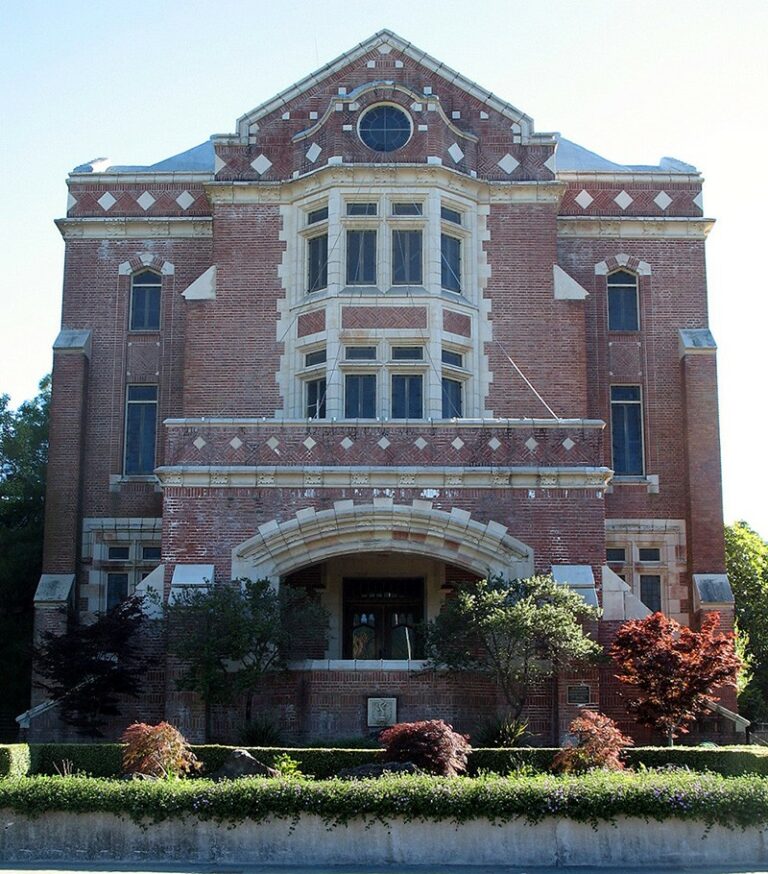
Miller is the head of the Parent Hospital Association at the Sonoma Developmental Center (SDC), which the state has scheduled to close in 2018. Last week she was one of several local advocates for the center who teed off on the proposed closure plan offered by the state Department of Developmental Services.

State Sens. Mike McGuire, D-Healdsburg, and Bill Dodd, D-Napa, share her concerns and took issue with a plan that they said doesn’t address the fate of the developmentally and behaviorally disabled people now living at the facility.

“We are incredibly disappointed with the draft plan that was put forward last week,” the lawmakers asserted in a Sept. 21 press release. “The report is inadequate and lacks the specific details that we as a community expected, and quite frankly, were led to believe would be delivered.”

The question hanging in the air is what happens if efforts at community placement of residents fail by the time the facility closes?

Closing the SDC means closing a facility of last resort for some residents who might otherwise find themselves getting their mental-health services in locked-down hospital psychiatric wards or, worse, in jail.

“We already know that the Sonoma Developmental Center is home to the state’s most medically fragile residents,” the lawmakers wrote, “and we know that, in past transitions, some residents have struggled to succeed in community placement. It is unacceptable that this draft plan lacks any details about contingency planning for these residents, and others who may not thrive in the community. This report essentially takes a wait and see position on care: Wait and see if residents struggle or fail in the community, and then act to make changes.”

The state has slated the facility for closure as a cost-cutting move. It’s been in operation at the Sonoma Valley location since 1891. The state push is part of a years-long effort to get out of the pricey mental-health-services business and privatize care in smaller, group-home settings.

But the SDC is a unique asset—”the largest and most significant unprotected land in the Sonoma Valley,” says the county website—and part of the treatment for residents has historically been open access to the natural wonders around it.

Miller says the lawmakers are spot-on in their critique of the closure plan, which, she says amounts to “close it first and then let’s see what happens.”

Miller has welcomed efforts from county officials and other agencies to create an alternative to the closure, an effort that is ongoing. Susan Gorin, president of the Sonoma County Board of Supervisors, is a supporter of the parents’ coalition.

Patient advocates have called on the state to continue using the SDC. McGuire and Dodd want to use the space for specialty services and propose transitioning the facility to a health center for those with severe behavioral issues.

The state has said that while it won’t put the property into the “surplus” category—which might have meant its eventual sale to commercial interests, such as a vineyard operator—it has not shown interest in any continued use that provides services to those living there now.

Local advocates for SDC have called for a facility that provides, for example, specialized dental services for the developmentally disabled, as well as housing for the behaviorally challenged. The closure plan from Developmental Services generally rebuffs those plans while simultaneously claiming that the first priority of the state is to find adequate housing for the residents.

Many have lived there for decades, including Miller’s son. Those patients may find a tough transition road ahead.

“It feels like we have this strong local voice with this strong local vision that has been ignored by Sacramento,” Miller says.

A key issue for Miller is that the SDC is a facility of last resort for residents like her son, who is in his late 40s and has a dual diagnosis of mental illness and autism. Over the years, Miller has tried to find housing for him in smaller group homes, but he always wound up back at SDC, where he lives now.

Miller is also concerned about a state effort to replace long-term, state-run centers such as the SDC with smaller facilities that would be built to “delayed egress/secure perimeter” standards. Those are facilities surrounded by a fence where residents can’t go outside unless they are let out.

The concern is that these would wind up being a “one size fits all” solution for developmentally challenged adults.

The state of California is mandated to provide safe housing for the developmentally disabled with a minimum of restrictions on their mobility, but Miller fears that the state may over-rely on these homes as a catch-all for whoever comes out of the SDC when it closes in 2018.

State disability advocates have noted that these “delayed egress/secure perimeter” buildings are a good deal for people who would otherwise be forced into more secure facilities, such as jail. As such, the state launched a pilot program in 2014 to develop six of the facilities around the state, and loosened restrictions on existing group homes of less than 15 beds to allow for delayed egress/secure perimeter upgrades. But what about residents at SDC who are used to living in a less secure facility, have lived there for practically their whole lives and now face the prospect of being locked behind a fence?

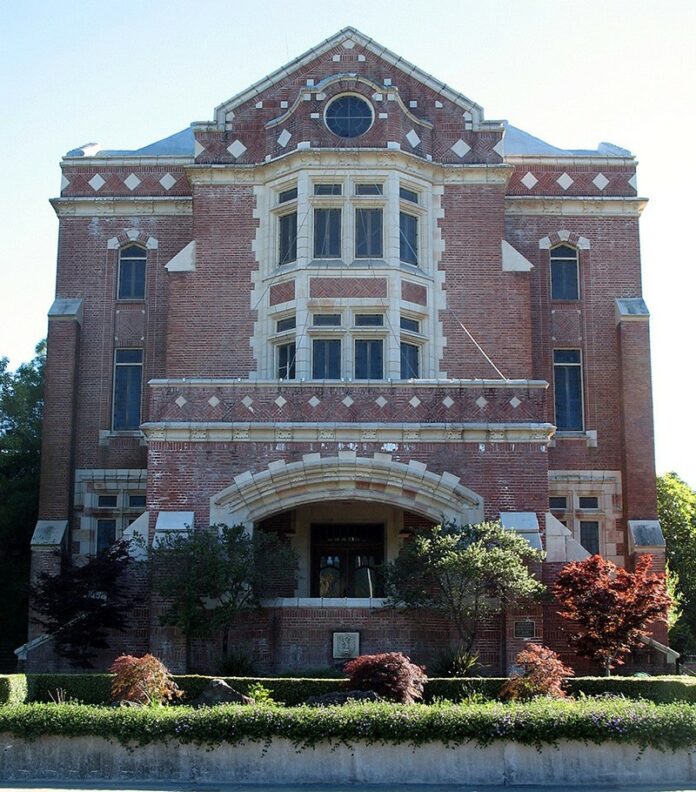
John McCaull, land acquisition property manager at the Sonoma Land Trust, echoes Miller’s concerns. McCaull’s organization is keenly interested in the fate of the SDC grounds, which provide critical habitat and act as a wildlife corridor straddling Sonoma Regional Parks land and Jack London State Park.

The grounds originally comprised some 1,600 acres, but about 15 years ago, 600 acres were cleaved into the adjacent Jack London State Park. Of the roughly 1,000 remaining acres, about 200 are dedicated to the SDC campus itself, which contains multiple buildings, some in better shape than others; the remaining land is undeveloped and open to the public. The main building is structurally unsound and not in use.

McCaull shares Miller’s concern about the advent of secured off-site facilities and what it might mean for residents. He notes that even as the SDC campus has been downsized, there remains “a huge environmental asset that the state has managed quite well.” His organization was relieved at the state pledge to keep the land out of the surplus pile.

“Of course we care about the land, but the wellbeing of the 400 people and the thousands of people that have lived there over the years is connected to the fact that they can get around, they can move freely,” McCaull says. “It’s an open setting and being in nature has helped a lot of the people there.”

Fresh Pleasures

0

The New Mastersounds formed in Leeds, England, nearly 20 years ago, and though much has changed in the lives of guitarist Eddie Roberts, drummer Simon Allen, bassist Pete Shand and keyboardist Joe Tatton, the tightly knit and funky foursome have never lost their musical connection to each other.

On Oct. 2, the New Mastersounds release their 10th album, Made for Pleasure, on the Royal Potato Family label. The band plays from the record when they hit the Sweetwater Music Hall in Mill Valley on Sunday, Oct. 4, a day after they play San Francisco’s Hardly Strictly Bluegrass Festival.

The upbeat, dance-inducing Pleasure was recorded in New Orleans, a city that has long influenced the band’s larger-than-life funk sound. Frontman Eddie Roberts spent a few years living in the city, after a stint living in San Francisco and before moving to Denver, where he resides now.

The lively sounds of the French Quarter are prominent throughout the new record, which also includes several guest appearances by the likes of multi-instrumentalist Mike Dillon (Les Claypool’s Fancy Band) and soul singer Charly Lowry (Dark Water Rising), as well as a full horn section courtesy of band mates from Roberts’ former San Francisco jazz combo, West Coast Sounds.

The New Mastersounds play from
Made for Pleasure on Sunday, Oct. 4, at Sweetwater Music Hall, 19 Corte Madera Ave., Mill Valley. 8pm. $22–$24. 415.388.1100.
—Charlie Swanson

Season of Spirits

The sugar skulls and festive altars popping up around Petaluma are designed to honor rather than scare, as the Mexican tradition of El Dia de los Muertos, the Day of the Dead, once again envelopes the town. Now in its 15th year, the annual celebration takes the traditional Mexican holiday of remembrance and turns it into a month of special...

Total Recall

Philip K. Dick is the van Gogh of science fiction writers, striding the hazy line between genius and insanity. PKD, as his fans call him, never lived to see his writing transformed into such blockbuster films as Blade Runner, Total Recall, Minority Report, The Adjustment Bureau and A Scanner Darkly. North Bay fans of his stories should know that...

Hats Off

Our annual appreciation of North Bay bands, the NorBays Music Awards, is taking a break from hosting a live concert and ceremony this year. We're retooling the show to make it bigger and better, but in the meantime, we've still got awards to hand out to nine of the best bands and musicians in the North Bay, in categories...

New Shed Chef

[image-1 There's a new chef at Healdsburg's Shed. Perry Hoffman replaces Miles Thompson, who was top toque at the restaurant for a little over a year. Hoffman is a Napa Valley native with a long culinary background. His grandparents, Sally and Don Schmitt, were the original owners of the French Laundry, where he helped out in the kitchen at a young...

Kelly’s Cave

Stop me if you've heard this one before, because all of the wine writers recently invited to a tour of Kelly Fleming Wines reached for their pens when the proprietress told the story of how Big Pour got its name. Kelly Fleming's 2012 Big Pour Napa Valley Red Blend ($75) is the 230-case winery's entry-level red, a juicy Bordeaux-style blend...

Let the People Vote

Are corporations people? Is money speech? The Supreme Court, in deciding Citizens United v. Federal Election Commission in 2010, answered yes to these questions. The ruling maintained that, since corporations are people and money is speech, political spending is protected under the First Amendment. This ruling has released a downpour of "dark money" through Super PACs that work to influence...

Letters to the Editor: September 30, 2015

Up in Smoke The legalization issue is complex ("Legalization Realization," Sept. 23). There has not been enough research and regulation to put marijuana and all the related products, including edibles, on the market. The potential for harm on the developing brain is not talked about enough. Teens do not perceive there to be harm around using marijuana, and this is...

Mixed Media

A story is an illusion, a series of events that are not really taking place, presented in a way that fool an audience into believing they're really happening. Telling that story in a book or movie is a certain kind of trick, with its own rules and traditions, and telling it on the stage is quite another. And transferring...

A Fence Too Far

If the state gets its way, Kathleen Miller's disabled adult son and some 400 other patients will be forced to leave the care of Glen Ellen's Sonoma Development Center for a destination unknown. " say they want to collaborate with us, but this is a fast-track for closure," Miller says. "They want to close it very quickly, and almost dangerously." Miller...

Fresh Pleasures

The New Mastersounds formed in Leeds, England, nearly 20 years ago, and though much has changed in the lives of guitarist Eddie Roberts, drummer Simon Allen, bassist Pete Shand and keyboardist Joe Tatton, the tightly knit and funky foursome have never lost their musical connection to each other. On Oct. 2, the New Mastersounds release their 10th album, Made for...
12,123FansLike
4,995FollowersFollow
6,928FollowersFollow