
This story on gun control and the National Rifle Association was removed on June 7, 2016 because a freelancer who co-authored the piece could not provide supporting documentation required by the Bohemian’s editorial standards.


FOLLOW US

This story on gun control and the National Rifle Association was removed on June 7, 2016 because a freelancer who co-authored the piece could not provide supporting documentation required by the Bohemian’s editorial standards.

The Santa Rosa Salsa Festival returns for its sixth year of dance and celebration with Grammy Award–winning performers, world-class instructors and an expanded schedule of activities this weekend at the Flamingo Resort.
The tastiest addition to the festival this year is a food and wine event on Saturday that offers customizable menus, wine from several locally owned wineries and live entertainment. Master percussionist and singer Braulio Barrera leads San Francisco salsa orchestra Somos el Son in a fiery performance, while Simoncini Vineyards, Willowbrook Cellars and Sonoma Cider offer their flavorful profiles and handcrafted pours. The next night, another heavy hitter on the Bay Area salsa scene, the tropical Pacific Mambo Orchestra (pictured), comes to the Flamingo for an exciting dance party.
The Santa Rosa Salsa Festival also features its usual schedule of Latin dance workshops, led by local and nationally recognized instructors and open to all skill levels, that cover everything from mambo, bachata, cumbia and even the Hustle. Rounding out the weekend are all-star performances by a dozen Latin dance troupes and couples from the Bay Area and beyond. Emphasizing the joy of dance and community, the Santa Rosa Salsa Festival moves to the rhythm on Saturday and Sunday, Jan. 16–17, at the Flamingo Resort, 2777 Fourth St., Santa
Rosa. $20 and up. Saturday, 9am; Sunday, 7pm. Santarosasalsafestival.com.
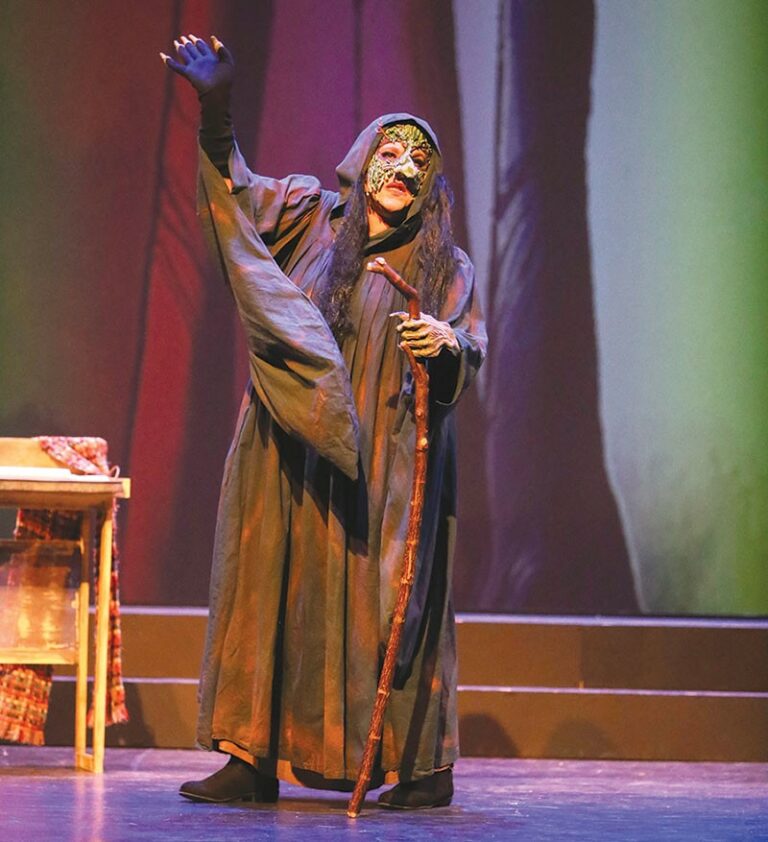
A strong ensemble of North Bay performers, bolstered by uniformly fine singing voices, is the primary magic ingredient in Theater-at-Large’s production of Stephen Sondheim’s Into the Woods.
Resurrected for a reprise run at Spreckels Performing Arts Center, this is an encore staging of the delightfully dark fairy-tale mashup that played to sold-out houses and rave reviews last fall in Novato.
Such a plan worked out well last year, when Theater-at-Large brought its stellar rock musical Next to Normal to Spreckels for a repeat run. In this case, Into the Woods, while highly recommended for its musical prowess and stellar performances, seems a bit flat and theatrically undercooked compared to the pristine perfection of Next to Normal.
In all fairness, though, that show is a high bar to match, and this one, directed again by Kim Bromley, does occasionally come close. The jaw-dropping beauty of the music—spun as if from a magic loom by a chamber orchestra directed by Debra Chambliss—and the fine singing and playful presence of the cast, will make audiences glad enough they came, even if the woefully straightforward staging and a few disappointingly clumsy transitions do come off as less than inspired. What seemed cozy and warm at the much smaller Novato Theater Company space, struggles to fill out the massive Spreckels stage, often swallowing the best efforts of the first-rate cast.
As the sweet but conflicted Cinderella, Julianne Thompson Bretan gives one of many standout performances, and Krista Joy Serpa, as a fierce and funny Little Red Riding Hood, is a song-belting hoot. Also exceptional are Sean O’Brien and Alison Peltz as the show’s childless protagonists, the baker and his wife, who launch the action with a scavenger hunt for magical items to reverse a witch’s curse and give them a baby.
Playing Cinderella’s prince with a swashbuckling grin and a smarmy swagger, Anthony Martinez is wonderful, as is Johnny DeBernard, bringing a comforting presence and supremely clear diction as the mysterious narrator. And as the witch, the unexpected moral authority of this fractured fairy tale, Daniela Innocenti Beem is a force of nature, taking chances with the first part of the story, playing the witch for laughs rather than the usual menace, then morphing into a powerhouse of emotional strength and sheer vocal dynamite.
Yes, some of the effects may leave you underwhelmed, but there’s no escaping the forceful enchantment of this fine ensemble of actors, making merry magic with their mighty voices.

A few days before Christmas, many homeless people in Santa Rosa were trying to stay warm under flimsy umbrellas during an onslaught of cold rain. While we are happy for the rain, it presents a dilemma to hundreds of local residents without shelter.
Times are getting worse for many of these poor folks, but there was a bright spot for some that day. The good people at Los Arcos Restaurant on Marlow Road in west Santa Rosa gave out hot, fresh Christmas burritos to many grateful folks. Francisco Cano was the man behind the giveaway, while volunteers from Homeless Action, Santa Rosa Together, and VetConnect hand delivered the Christmas Burritos to people on the streets.
Thank goodness for people with big hearts like Mr. Cano, who was willing to give away more than a hundred burritos, worth hundreds of dollars, to help those worse off than himself.
The people from Homeless Action have also been helping with homeless encampments in Roseland, where local restaurants have been stepping up to help the disadvantaged. VetConnect has been hosting meals and handing out warm clothing to veterans while trying to help anyone else in need this season. There are many more people in need than you might surmise, so please take the time to reach out to your fellow men, women and children and help whoever you can be warm and dry, as well as fed. The new year is a perfect time to make a resolution to help others in need.
Centuries ago it was said, “God bless everyone!” I wish the same to all of you, and look forward to a better year for all Americans. Good deeds, not just words, are needed.
Duane De Witt is from Roseland and volunteers on many Roseland adventures. He hands out Paco’s burritos when he can.
Open Mic is a weekly feature in the ‘Bohemian.’ We welcome your contribution. To have your topical essay of 350 words considered for publication, write op*****@******an.com.

Getting fit is a New Year’s resolution cliché, the stuff health magazines, health clubs and online listicles thrive on. But how often do commitments to get in shape stick? All the Fitbits and CSA veggie deliveries in the world won’t make it any easier to actually get off your butt and start making exercise a regular and enjoyable part of your life. Too often, fitness devolves into a boring gym chore, something you should do but don’t want to do. But fear not. We’ve compiled a list of 10 fun and novel ways to get your body moving and to have fun doing it. No treadmills required.
Be a Trail Maven
Bay Area–based Trail Mavens is a hiking and adventuring website for women, offering overnight camping trips in Marin County and farther destinations like Tahoe and Big Sur. The Mavens team supplies the gear and food, and serve as guides for participants. In addition to learning essential off-the-grid skills, such as how to pitch a tent, those trips (priced around $400) promise bonding, memories and good old girl power, i.e., climbing that mountain without complaining. Upcoming trips include Point Reyes and Angel Island. trailmavens.com.
Pound Away
If a workout consisting of rocking drum sticks to infectious music sounds too good to be true, you probably haven’t heard of Pound. The patented technique involves energetic, dynamic moves planned with “strategic distractions” from the cardio effort. Fierce Fitness, the longstanding Santa Rosa destination for all things movement, just added a new Pound class for 2016, and it can be tried for a mere $8 a visit. It’s an excellent way to tone arms and curb work and personal frustrations. facebook.com/srfiercefitness.
Join the Circus
Ever imagined being a part of Cirque du Soleil? Sonoma’s TrapezePro caters to that fantasy while training body muscles in all sorts of ways. The small studio offers a bunch of classes you’ve probably never tried before: aerial silk, flying trapeze, trampoline and circus skills. Judging by the way acrobats and trapeze artists usually look, you might want to take all of them. Classes cost $40, not cheap, but the thrills (and bragging rights) are worth it. trapezepro.com
Train for the Vineman
We all have that friend, once a normal person, now a marathon junkie, who posts running images on Instagram and gushes over every race she’s run. Somehow, the triathlon seems the cooler way to go, especially when it’s called Vineman. The Sonoma County twist on the swim, bike, run combo? A scenic path from Guerneville to Windsor, river views, riding through vineyards and winetasting after the big day. Three races await in March and July, so there’s plenty of time to start a training group. vineman.com.
Join a New Fitness Studio
There’s something about a new, slick studio that makes jumping into workout mode easier. This year, there are plenty of new places to check out, with everything from Pilates to brutal TRX and beyond. SweatMood (sweatmoodfitness.com) in Santa Rosa specializes in boot camp–like workouts, in a nightclub atmosphere, low lights and bouncy music and all. The minimalist Body by X in Corte Madera (getfitmarin.com) offers indoors cycling and rowing. And in Napa, there’s a brand-new In Shape gym, complete with a photogenic pool and a wide variety of classes (inshape.com/health-clubs/california/napa).
Cycling often doesn’t feel like exercise; pedaling while surrounded by beautiful scenery sounds more like the perfect daytrip. Sonoma County’s Grasshopper Adventure Series capitalizes on this with scenic and moderate-to-grueling rides that range from 27 to 100 miles long. Ride locations include Lake Sonoma, Kings Ridge, Chileno Valley and many others. grasshopperadventureseries.com.
Put a Mask On
They say wearing layers while working out makes you shed even more pounds. This is pretty much a guarantee with fencing. The Marin Fencing Academy takes the practice very seriously and offers beginner adult classes and tournaments. Monthly memberships begin at $130. Have a competitive streak? Like sword fighting? Look no further. marinfencing.com.
Paddle Away
Paddleboarding looks free-spirited and stylish, but it’s also a strenuous workout. Petaluma’s Clavey Paddlesports offers $70 beginner and advanced stand-up paddle classes, in Tomales Bay or on the Petaluma River. It’s fun, but you might be surprised by how hard it is, too. clavey.com.
Try Piloxing
No, not boozing with pillows. Piloxing combines Pilates and kickboxing. The workout combines interval work and the importance of supplementing muscle strength with outbursts of cardio. Throw weighted gloves and dance moves into the mix, and you’ve got a crazy-effective, slightly terrifying fitness smorgasbord you simply must try. Pilates Napa Valley (pilatesnapavalley.com) and Bridgeway Gym (bridgewaygym.com) in Sausalito are on it, with weekly Piloxing classes for the masses.
Join an Adventurous Meetup
Working out is always better in a supportive group, especially if it’s not really called a workout. Santa Rosa’s Spirit of Adventure Meetup group has more than a thousand active members and fun, sporty activities to boot, from whitewater rafting to rock climbing. In Marin, the Marin Running Club is perfect for aspirational runners, and Napa-based North Bay Hikers and Backpackers awaits folks who like to burn their calories while looking at nature and chatting with new friends. And the best part? It’s free. meetup.com/Spirit-of-Adventure; meetup.com/Marin-Running-Club; meetup.com/North-Bay-Hikers-and-Backpackers.

REDWOODS DOWN?
The city of Santa Rosa is moving forward with what it has called a “high-priority infrastructure plan” to reunify Courthouse Square downtown, a plan that has been fraught with controversy over the fate of some 35 redwood trees, some of them quite majestic. The city held its second of two community-input meetings on Jan. 9. Critics say the fix is in, and that all those redwoods are going to be toppled in the name of reunifying the square and adding new parking downtown in the process. Those concerns may be a little overstated.
The Jan. 9 meeting was held to review preliminary design plans. No one is calling for the total removal of all the redwoods, but city officials previously told Debriefer that at least some would likely be felled to accommodate whichever of the designs is ultimately selected. Attendees at the Jan. 9 meeting were given a chance to signal approval or disapproval of the designs, and most of the approvals, reported the Press Democrat, were given to a plan that would create a big green space, surrounded by trees. Some of them, presumably, redwoods.
A noteworthy point of departure for some of the businesses in and around the square clamoring for more parking was their insistence that the redwoods are essentially an invasive species on the square as it is. Those are fighting words, and the Ents are on the move in solidarity with the redwoods as we speak. No decision has yet been made on a final design for the square.
PARKER POT PLEDGE
Sean Parker, Facebook co-founder, philanthropist and Big Sur defiler, has made good on a pro-pot promise he made last year, and donated $500,000 to a new pro-legalization organization called—wait for it, because it’s kind of long—Californians to Control, Regulate and Tax Adult Use of Marijuana While Protecting Children, Sponsored by Business, Physicians, Environmental and Social Justice Advocate Organizations. That’s one all-encompassing organization, no further explanation required as to their orientation, but Debriefer is trying to figure out how to pronounce this mind-bender in the acronym form, which is CCRTAUMWPCSBPESJAO.
The organization formed in anticipation of a 2016 ballot initiative to legalize cannabis in California, but, while we are on the subject, don’t tell that to the anti-pot chair of the Democratic National Committee, Debbie Wasserman Shultz, who foolishly told the world last week that she opposes legalization even as she’s drunk on big dollars from the booze lobby.
ESTERO PROTECTION
Jan. 7 was a big day for a trio of area land-preservation organizations, as they announced the $3.8 million purchase of the 547-acre Estero Ranch west of Valley Ford. The Sonoma County Agricultural Preservation & Open Space District, the Sonoma Land Trust and the Wildlands Conservancy worked with the California Coastal Conservancy and the Gordon and Betty Moore Foundation to purchase the sensitive and breathtaking slice of coastal land, located where the Estero Americano meets the Pacific Ocean. A press release announcing the purchase noted that it would link to another forever-wild piece of land adjacent to the Estero Ranch previously scooped up
by the Sonoma Land Trust.

If the first sight of gray weather brings a hearty pint of stout to mind, then as winter storms line up across the Eastern Pacific, stronger imperial stouts are ever more tempting. But a sweet, spirit-scented imperial stout aged in whiskey barrels—that’s a shelter-in-place warning in a glass.
Recently, I brown-bagged some strong, local brews and their barrel-aged editions, where available, and poured them for
Bohemian staffers—carefully, two ounces at a time—to elicit their reactions to these monsters of craft beer.
Marin Brewing Old Dipsea Barleywine Style Ale Long before the triple IPA, there was the barleywine: a souped-up, maltier version of brown English ale. It’s been a long time since I had one, and I was surprised by the creamy smoothness of this 9 percent alcohol by volume (abv) regular release.
Marin Brewing 2013 Old Dipsea (aged 15 months in whiskey barrels) The same raisin and date sugar aromas are amped-up here, but it isn’t just the booze that lends sweet, sherried notes, says brewmaster Arne Johnson. Like wine, beer undergoes micro-oxygenation when aged in barrels, a slow, tiny dose that rounds out flavors without spoiling the beer. This is the last barrel-aged barleywine for a while, because Johnson only has room for a few barrels. But look for an Imperial stout aged in Breckenridge Distillery bourbon barrels, on draft for SF Beer Week, Jan. 22.
Moylan’s Ryan Sullivan’s Imperial Stout A smoky whiff of dark roasted grain and coffee introduces this imperial Irish-style stout, which finishes on a dry, pleasingly bitter note for a brew of
10 percent abv.
Moylan’s 2014 Ryan Sullivan’s Imperial Stout Perhaps because it was aged six months in single malt whiskey barrels (from Stillwater Spirits, under the same ownership), this stands out from the bourbon-barrel pack, retaining a dry, roasty Irish stout palate with molasses, vanilla, licorice and sarsaparilla overtones. A rare bird in stores.
Lagunitas 2015 High West-ified Imperial Coffee Stout Aged in High West Distillery rye barrels, with all the caramel, syrup and booze of a Bananas Foster, this is the most whiskey-fied of the lineup, a chocolaty, 12 percent abv winter warmer that wants pouring over ice cream. Look for a draft-only release this month, or wait until November for the next bottled edition.
Fogbelt Federation Giant Imperial Milk Stout This collaboration beer gets an infusion of subtle flavor from oak chips and the bits of char that collect on the bottom of local distillery barrels, but is dominated by cold-brew from Santa Rosa’s Brew coffeehouse. Bohemians loved all 64 ounces of this growler. The last keg of this 9.1 percent abv batch gets tapped for SF Beer Week.

In brief, The Revenant is what The Hateful Eight promised to be: the toughest Western since True Grit, complete with awe-inducing snowscapes. It’s dazzling to see that such magnificent desolation is still left in a crowded world.
Director Alejandro González Iñárritu based The Revenant on the legend of Hugh Glass, previously filmed in 1971 as Man in the Wilderness with Richard Harris. Iñárritu grounds the violence in the fur trade in the upper Missouri river in the 1820s. Rival groups of Europeans are denuding the forest of its creatures, while holding off the understandably furious Arikara Indians. Scouting for a party of trappers, Glass (Leonardo DiCaprio) is mauled by a bear and left for dead by his companions. Despite severe wounds and a broken leg, Glass fights his way back to civilization to confront the man, Fitzgerald (the ever-impressive Tom Hardy), who abandoned him.
What doesn’t happen to DiCaprio’s Glass in this epic, set in the Dakotas but taking in real-life locations from Tierra del Fuego to British Columbia? Indian attacks, blizzards and the money scene from Jack London’s “To Build a Fire.” A fall off a cliff, a tumble down freezing river rapids, a cauterization that tops the one in Two Mules for Sister Sara, Gollum-style meals of raw fish and the most vicious bear attack ever filmed for a fictional movie.
As seen from his various melodramas, from Babel to Biutiful, Iñárritu is a stranger to the word “enough.” Still, the plethora of events includes an intelligent subplot about a chief and some of his companions searching for a kidnapped girl, as if in an inversion of John Ford’s The Searchers. Within the extremities and occasional nonsense in The Revenant is a superb blood-and-guts Western with shock and sweeping visual scope. Hardy’s Fitzgerald—he’s been cracked since he was scalped (“I got my head turned inside out”)—proves that a Western is better when you can see an antagonist’s point. Hitting age 40, a never-tougher DiCaprio makes you tend to believe this story of hellish endurance.
‘The Revenant’ is playing in wide release in the North Bay.
Deputy Sonoma County Counsel Josh Myers just called the Fishing Report with the information that the county has settled its lawsuit with Esa Wroth for $1.25 million. Wroth sued in federal court after being Tasered over 20 times during a Nov. 2014 arrest and booking at the Sonoma County Main Adult Detention Center.
“A settlement was reached,” Myers said, adding that there was mutual agreement over the terms: “The county didn’t admit liability, and Esa Wroth agreed to dismiss all claims against the county and the individual deputies” named in the federal lawsuit.
Was there a financial settlement? “There was.” To the tune of of $1.25 million. The county auditor’s office will cut the check, Myers said.

With the news of David Bowie’s passing still sending shockwaves throughout the musical community, filmgoers are also looking for comfort in his varied and versatile film career. In that vein, Sebastopol’s Rialto Cinemas will be screening the surreal 1976 British sci-fi film starring Bowie, The Man Who Fell to Earth, beginning Friday, Jan 15.
Rightfully hailed as a cult classic, this stunning film stars a red-haired, pale-skinned David Bowie as an alien who crash lands on our planet while looking for help saving his own. Using his advanced technology, the “Man” infiltrates American industry and business with a goal of building a way back home, though the wealth and decadence of society pulls him in the opposite moral direction.
Directed by Nicolas Roeg, who also helmed ’70s cult favorites Walkabout and Don’t Look Now, this film is a uniquely profound and meditative work, and Bowie is perfect in his major film debut as the literal Starman. This upcoming big screen showing is a rare treat, as the film is largely unavailable in good condition; even it’s Criterion Collection release long out-of-print.
The Man Who Fell to Earth screens from Friday, Jan 15 to Thursday, Jan 21, at Rialto Cinemas, 6868 McKinley St, Sebastopol. 707.525.4840. Check their site for showtimes.






FOLLOW US
Copyright © Weeklys All rights reserved.
Our Publications
