Starring Role

0

Coming to a film festival near you, Leslie and James Simmons’ independent film For What It’s Worth tells a love story set in Sonoma County. A suspense drama, the movie is about the relationship between a younger man and an older woman—but with a sinister twist.

The Simmons have owned Shoot Blue Productions for 12 years. The production company has produced a variety of films, commercials and documentaries, and now the couple enter the spotlight with their own original movie.

“We love what we do, but we wanted to go in new directions,” says Leslie Simmons. “We wanted to focus on our own film,” rather than make movies for other people.

For What It’s Worth is set in Geyserville and uses the rural Sonoma County backdrop as an idyllic setting for the film. Leslie grew up in Geyserville, along with Marc Bojanowski, one of the writers of the film.

“Yeah, Leslie and Marc grew up together on a dirty road in Geyserville,” James jokes.

“Dirt road,” Leslie corrects. “It was a dirt road; it wasn’t dirty.”

When looking for a script, the couple was searching for something that had few locations and a small cast, but it was hard to find something that met their needs.

“So many scripts start with bank robberies,” James says. The couple went through many screenplays before they turned to Bojanowski, who had been working on a story since 2014. When James and Leslie approached him, they saw a script they could work to their advantage and that could be filmed locally—
a big savings in cost.

The rural Geyserville setting wasn’t the only thing that drew in this dynamic filmmaking duo. They wanted their movie to be set in wine country, but didn’t want it to be the main focus.

“We live here, and so it was much easier to film here, plus it’s gorgeous,” Leslie says.

The couple own most of the equipment that was used to shoot the film, and relied on interns and volunteers to produce it.

“I was absolutely amazed at what young people can do in this county, they are so talented,” James says. “And they showed up for work every day. The amount of dedication in this county is really amazing.”

With the limited budget and amount of resources, there were times when filming the movie was difficult, running into issues such as fighting the elements, working with a new crew and staying on budget.

“We took all the hardships of the film and worked together to create a story,” Leslie says.

“Yeah, we made lemons into lemonade,” adds her husband.

The duo plan to submit the film to both local and national film festivals. The film screens at the Alexander Valley Film Festival Oct. 22 at the Raven Theater in Healdsburg and at at the Sacramento Film & Music Festival (Sept. 6–11) on Sept. 8.

Full Circle

The firt time I smoked pot was in Eric Schroeder’s garage in Fullerton, 1969. The high was different than now. Much more visceral.

Fast forward 10 years. Sonoma State. Consuming the occasional edible. Getting a little uncomfortable. Forgetting I had graduated and attended another two years. I’m free to go?

Fast forward 10 or 20 years. Pot definitely changed. Consuming pot had become an ordeal. Who the hell kidnapped the jovial Panama Red? This was knife-wielding-son-of-Chucky-with-spooky-soundtrack pot. Paranoia. So I joined a country club and started drinking beer. Please don’t judge me.

In 2008, my breathing faltered, and my words were getting choked off, like in the movies where someone is being strangled and fighting to speak. Ak, lek argghh. You’re cho-choking me.

Fortunately, I got an early diagnosis: adductor spasmodic dysphonia (AdSD). Huh? No known cure, but I could get Botox injections in my vocal cords or surgery to cut and reattach them. No thanks.

By 2009, my voice was gone. Friends and clients could no longer understand me. Soon, both were all gone. The dark years began. I ended up living in my mother’s basement.

I never gave up. While researching AdSD, an incident in 2011 never left my memory. A friend somehow persuaded me to smoke pot. I dutifully took a few hits and waited for Leatherface to start chasing me. But no. Something different was happening. I was a little high, but no paranoia. It was “puppies, rainbows and ice cream” pot. And my voice was perfect. I could talk normally! In my head, I sounded like James Earl Jones. “Luke, this is CNN.” Wow!

I tried to reproduce what happened. No luck. The old paranoia was back. Why did pot make my voice normal one time but not others? The Bohemian provided the big clue I needed.

I heard former editor Gabe Meline on The Drive with Steve Jaxon talking about CBD. Gabe explained that there were other things besides THC in some strains of pot, and those other things, such as CBD, had amazing medicinal properties. I knew immediately that CBD was the key.

I began to avidly research CBD. I did volunteer work with Martin Lee of Project CBD. I began interacting with cannabis researchers around the world, leaning about cannabinoids, terpenoids. More important, Martin introduced me to producers of CBD products. Eventually, I found the right ones. My voice normalized. Among its multiple properties, CBD is anti-spasmodic. That was all I needed.

My voice isn’t completely normal, but I can function. My life is back. I am employed and living on my own with most of my debts repaid, karmic and otherwise.

Fast forward. Full circle. Cured. More or less. In the coming weeks, I’ll be sharing more of what I’ve learned with Bohemian readers. In fact, I owe it to the Bohemian. Thank you.

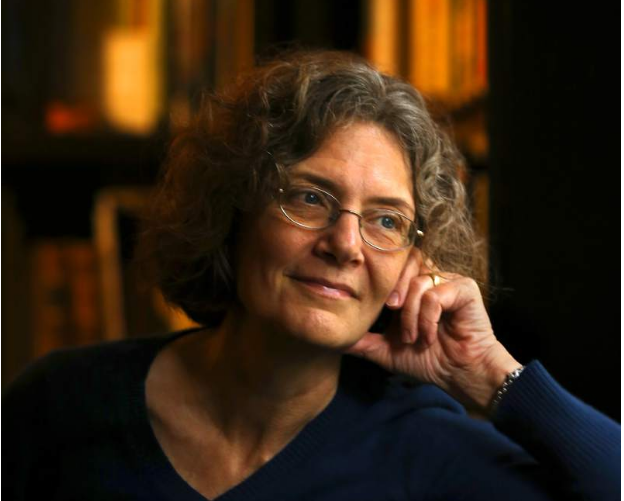
Michael Hayes works for Project CBD. Contact him at mh*******@*****st.net.

Grape Expectations

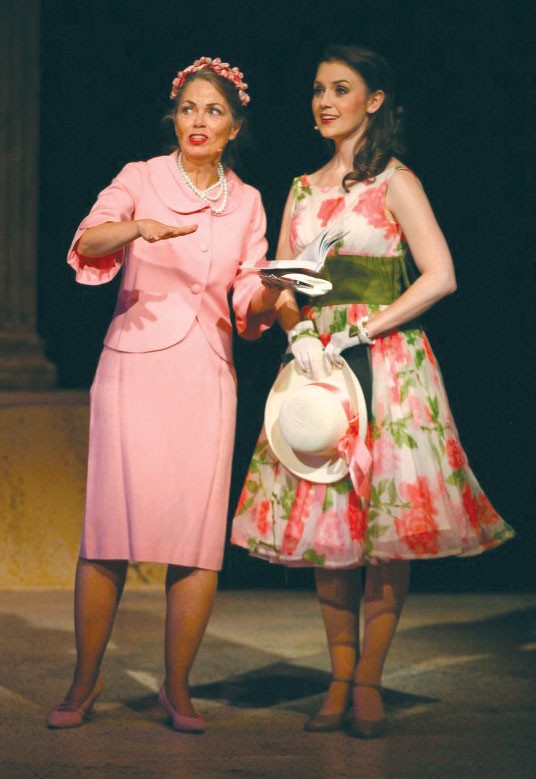
It’s been 12 years since Stephen Walsh last played Tony the grape grower, in the classic Frank Loesser musical ‘The Most Happy Fella,’ at Cinnabar Theater. And to employ an over-picked cliché, in his second run of the show at Cinnabar, Walsh has only gotten better, deeper and rich—like a really, really good, well, you know.

The show itself—about romantic complications arising when the much older Tony, an Italian wine-maker in Napa, impulsively leaves a love letter for a San Francisco waitress—is a blend of fantasy romance and soap-opera heartbreak. It’s like something John Steinbeck might have written if asked to pitch an idea for a musical about love.

Nicely directed by Elly Lichenstein, with her patented knack for filling the stage with things to look at, the production pivots on the performance of Walsh, who not only sings gorgeously, but nails the role of a love-struck sweetheart who believes he’s too old and unattractive to deserve happiness. Walsh makes Tony’s emotional journey so believable it’s impossible not be happy when happy and devastated when his desperate attempt at love hits snags, which it does from the very beginning.

This is hardly light and fluffy musical material. There is real human drama here, and the music—with the exception of the poppy ear-worm ‘Standin’ on a Corner’— is complex and operatic, beautifully light and dark, bubbly and haunting, and occasionally a bit weird. This is the kind of show in which people sing whatever is in their soul, even if that means singing a single name over and over and over.

As Amy—who Tony seems to think is named Rosabella—Jennifer Mitchell is charming. She’s especially strong in the early scenes where she is tricked—due to Tony having sent her a photo of his foreman instead of himself—into believing that her coffee shop pen-pal is the young and handsome guy she recognizes from the photo when she arrives at the vineyard. She’s there in Napa, having impulsively agreed to marry the man she’s been swapping letters with. Mitchell sings beautifully, and plays the early flirtations of love and attraction to lovely effect.

When she learns of the deception, a series of actions take place that steer the tale in the direction of tragedy, but never leaves us doubting that true love might somehow be possible for Tony, one way or another, no matter how unlikely.

Michael Van Why, as Tony’s optimistic farmhand Herman, is magnificent—like the Scarecrow of Oz crossed with Curly from ‘Oklahoma’—and his guileless courtship of Amy’s friend Cleo—a power-force performance by Krista Wigle—is a nice balance to the rockier romance of Tony and his “Rosabella.” The music, played simply on two pianos and a set of drums, is nicely directed by Mary Chun.

There are many reasons to see this show, but in the end, it all comes down to Walsh, who returns to a favorite role after a dozen years, and somehow makes it even better, giving one of the best performances of his career, and easily one of the North Bay’s best musical productions of 2016.

★★★★½

Milk Money

0

Anja Raudabaugh, CEO of Western United Dairymen in Sacramento, published an eyebrow-raising memo on Aug. 26 in response to the debate underway in the California State Legislature over a contentious effort to overhaul the state’s overtime rules for farmworkers.

Raudabaugh, whose organization lobbies on behalf of state dairy farmers, was responding to implicit charges that opponents of proposed overtime extensions to farmworkers had played the proverbial race card, and the lobbyist flat-out went off on legislators who had thrown the card into the debate. “The snowflake culture, a culture that some belong to and feel entitlement is owed and due,” she wrote on the Dairymen’s online newsletter, “is one that utilizes the cry-bully tactic and calls its enemies racists, slavers, and falsely sows the seeds of hatred to damage the logical optics in play on an issue.”

The correct view in this case, she added, is a focus on choice—as in, the choice of workers to labor in the fields, which was theirs to make. The “logical optic with the allowance of agricultural overtime—along with many other industries and sectors that have been given the exemption to overtime, is that this is a VOLUNTARY method for people in this state to make money and decide for themselves how to feed their families. Eliciting phony racism sentiments and likening agriculture to slavery is the lowest point the conversation could have gone. I don’t think the leadership’s capacity for loathing agriculture could be matched with this low blow.”

Raudabaugh’s note did not mention that, as harsh as it may sound, dairy farmers themselves are not obligated to participate in their chosen industry, but let’s set that aside for the moment. The bill, AB 1066, passed through the Legislature with healthy majorities and awaits Gov. Brown’s signature or veto by the end of September. It would phase in new overtime rules over the next nine years and was passed without the support of most of the North Bay delegation to Sacramento, a curious development given that they’re all Democrats and this is a very ag-oriented region where there is general consensus that farmworkers are a struggling class of workers whose efforts are critical to the economic well-being of the region.

But there you have it. Senators Mike McGuire and Jim Wood joined assemblymen Bill Dodd and Marc Levine to either vote against the bill or abstain from voting. Napa senator Lois Wolk was alone among North Bay legislators to vote aye for time-and-a-half hourly overtime wages at the heart of the bill, which was sponsored by San Diego Democrat Lorena Gonzalez and offers a phased-in overtime regime for agriculture workers, beginning in 2019. Farms with operations of fewer than 25 workers would be phased in beginning in 2022.

In voting no, the former Republican Dodd emailed the Bohemian in advance of the Labor Day holiday to say that “I had concerns with the bill that weren’t worked out, so I wasn’t able to support it. I’m supportive of what it’s trying to do, but I want to ensure that changes are balanced and crafted in a way that minimizes unintended negative consequences.”

There lies the rub behind legislators’ no votes and abstentions from the final vote, whose rationales tended toward an implied critique of its one-size-fits-all approach to agricultural workers that lumped dairy and cattle workers in with field workers. Dodd’s district is exceedingly agricultural in its fidelity to Big Grape, but you’d be hard-pressed to find a dairy farm in Napa County.

McGuire offered a more specifically anguished reasoning behind his did-not-vote posture on the bill. He’s got dairy and grape farms in his district, which includes all of Marin and most of Sonoma County.

“This was a difficult decision,” McGuire says via email. “I’m never going to vote against farmworkers, which is why I stayed off the bill. The concerns we advanced relating to small family farmers and dairy owners here on the North Coast were never addressed. Given the tight time frame of this bill we were unable to find middle ground.” Lawmakers signed off on the overtime measure in the last-minute legislative scramble before the Labor Day break, when bills had to be moved or scrapped.

Dairy owners are already paying more than twice the average wage than field workers, according to advocates I talked to who represent those respective workers. Factor in a state dairy industry that is already highly subsidized—which could collapse without annual federal subsidies to prop it up and where the price of milk is essentially socialized with state-set price controls—and the no votes begin to make a little more sense, despite the clear and obvious social-justice question at the heart of the farmworker wage battle.

Because of the price controls and rules governing the subsidies, dairy farmers can’t pass off increased labor costs to consumers if they are forced to pay higher wages. Non-dairy farmers were also opposed to the new overtime bill and argued that it would force them to further automate their operations to make up for the workers they’d no longer be able to afford to hire or pay.

But let’s back up a minute here. To understand the genesis of Raudabaugh’s juicy online riposte—whose “snowflake culture” language is more typically seen in rightward-leaning discourses that slam college campuses over trigger warnings and safe spaces as a bulwark against the dread onslaught of the oversensitized and politically correct—the overtime bill aims to move California beyond federal overtime rules that date back to the presidency of Franklin Roosevelt and are enshrined in the 1938 Federal Fair Labor Standards Act, which, as
AB 1066 itself recalls, “excluded agricultural workers from wage protections and overtime compensation requirements.”

California, as Raudabaugh observes, is one of four states where overtime pay does kick in for all farmworkers, at a 60-hours-worked threshold. The bill on Brown’s desk offers overtime pay through a phase-in period and by the time it’s fully implemented, overtime would kick in at 40 hours worked, for all workers, in 2025.

Marty Bennett of North Bay Jobs with Justice, which vociferously and unsurprisingly supported the proposed overtime overhaul, says that the bill is “at least a half a century overdue and it really does go back to the era of segregation, when African-Americans were cut out of wage-hour legislation because of Southern segregationists in Congress. Roosevelt cut a deal with the racists,” who at the time were Southern Democrats hell-bent on enforcing Jim Crow, often through lynching and other terror tactics. It was an ugly compromise for its dust-bowl time, but what does that have to do with Northern California Democrats in 2016?

Well, sure, there’s a drought. And AB 1066 was passed amid an unpleasantly anxious backdrop as California’s agriculture industry faced almost $9 billion in losses in 2015, according to an annual state crop report issued last week by the U.S. Department of Agriculture that garnered headlines around California. The biggest drop was in the dairy industry, which accounted for about one-third of the total lost revenues between 2014 and 2015, and which saw state output plummet from $56.5 billion to $47 billion. The trickle-down impacts have been just shy of disastrous for the dairy industry, as hundreds of dairy operations have been driven out of business around the state since the advent of the drought.

The drought extends to North Bay field workers themselves, who are very definitely feeling the pinch of low wages and could use a rainmaker of their own to come to the rescue. An October 2015 report from the Sonoma County Department of Health Services focused on farmworkers’ health and well-being, and is filled with awful stats that tell the story of a woefully underpaid workforce that binge-drinks too much and can’t afford the rent as it noted that 92 percent of farmworker families didn’t “earn enough to meet their family’s basic needs in Sonoma County.” The survey highlighted a “dramatic disparity between farmworkers and even the poorest Sonoma County residents.”

And the USDA report found confluence in Sonoma County, where the 2015 crop report found a “dramatic decrease in yield” between 2014 and 2015 which translated into a 14 percent decrease in total crop value over those two years—$756 million from $879 million in 2014.

As the overtime battle unfolded, critics noted that the United Farm Workers, which represents California laborers, could have fought for overtime benefits for their workers through collective bargaining instead of pushing through the Legislature a wholesale redo of the entire agriculture-worker economy, where field workers earn an average of $9 an hour, says Bennett, though dairy workers are in the $21-an-hour range, according to Raudabaugh. A collective-bargaining set-to was always going to be a losing fight, say observers of the process, and supportive lawmakers led by Gonzalez took up the call this year to force the issue across the board, from grape field to milking station.

There’s a big difference between picking grapes and milking or slaughtering cattle, and Raudabaugh says that higher wages are paid to cattle-workers because of regulations and sanitary requirements and the cattle themselves, who must be managed in a responsible and humane way. Because of the skill set and particularities of the industry, she says “we want to hire the most competitive labor possible.”

The particulars of the dairy industry are also distinct from other agricultural pursuits when it comes to those subsidies and price controls. According to federal data compiled by the Washington, D.C.–based Environmental Working Group, between 1995 and 2014, the Sonoma County dairy industry received $17 million in federal subsidies out of a total of $95 million that flowed to the county, the highest subsidy delivered to any sector of the economy, including emergency services.

Marin County, which hosts numerous small- and mid-size dairy operations that provide some of the country’s most sought-after and delicious dairy and cheese products, not to mention the beef itself, got $6 million in subsidies over that same time, out of a total of $13 million.

Clover Stornetta works closely with 28 family farms in Sonoma and Marin counties to make its organic milk products in Petaluma, says company CEO Marcus Benedetti, who adds that “the impacts are on their cost side” as he highlights the price controls that restrict any North Bay dairy operation’s ability to cover increased labor costs with a higher price at the market. And he notes the particulars of the local dairy economy itself, where workers at some dairies that contract with Clover Stornetta are housed on-site—a form of compensation in the high-rent North Bay. “In many cases, it’s a community,” Benedetti says of local dairy operations adding that “not all dairy is monolithic in the state of California, and these farms here are vastly different than what you’ll find in the Central Valley,” with its corporate and decidedly non-organic mega-dairies.

In an interview with the Bohemian last week, the Dairymen’s Rudabaugh reflected on her blistering critique of the Sacramento snowflake crowd with a chuckle as she defended the pushback against social-justice arguments for the bill that focus on race. “I do think the race card was played here, and once that rabbit hole was gone down, it became a very difficult argument to overcome logically,” she says.

Raudabaugh, who has been in her post since 2015 and was once a staffer for former Republican Congressman Doug Ose, stresses that she is “respectful of the dynamics; this is a social-justice issue and I am cognizant of that.”

But she says the race card tainted what should have been a rugged and logic-driven debate over the catch-all nature of a bill that did not distinguish between respective groups of farmworkers and failed to appreciate the struggling margins that dairy farmers, many of them minorities, already occupy.

“It’s really deployed when you have no merits left in the argument,” Raudabaugh says, noting that “we have a very Latino- and black-owner industry, my owners are across the board, but that is not how it was depicted.”

The final bill, with its phase-in of the overtime changes, appears on its surface to be a compromise bill that reflected input from concerned parties such as the Dairymen. Raudabaugh says the lobby has expressed its misgivings to Brown and worked to create a better bill for its members despite ultimately opposing it. And despite the phase-in period designed to lessen the blow on farmers’ bottom lines, she says dairy workers are already fretting. “The scramble is already on to see how to make this work without having to let people go.”

Why weren’t there two separate tracks or a bill that excluded dairy and cattle farms from its scope? “Believe me,” she says, “the Dairymen talked about it but there was no separate effort” by any legislators to offer a bill that would be “better tailored to the types of commodities that we are looking at. There is an intense harvest period for cabbage, for grapes,” she adds. Dairy work is not seasonal or subject to high-season hiring spikes and “some of the more logical lawmakers who did not know that were put into a corner, and there was no way for them to win that corner,” she says. The fix was in when lawmakers started making speeches about how their relatives were sharecroppers, she says, while stressing that’s she’s not unsympathetic to the history.

“I don’t discount those things,” she says, even if many lawmakers did not appreciate the particularities of the dairy and cattle industries as they made speeches over past racial sins and tied them to the current battle.

Marc Levine was among the lawmakers whose position synced with the dairy industry. The lawmaker’s district, which straddles Marin and Sonoma counties, produces many millions of dollars a year in specialty organic cheeses and dairy products, and Raudabaugh says her office discussed the bill with the two-term Democratic assemblyman “at great length.” Levine didn’t vote for the bill, and Raudabaugh notes that his district his filled with the putatively progressive new-economy farmers, “the smaller producers, the non-GMO, the grass-fed-beef ones—those are the ones that are going to take this the hardest.”

In a telephone interview, Levine says it was a difficult call to abstain but insists it was the right call. The lamaker notes that he has supported other efforts designed to address income inequality and that he spoke to Gonzalez about the unintended consequence her bill would bring to family dairies. The major unintended consequence he fears is that farm owners will put “downward pressure on the number of hours on the schedule” and reduce work hours for all their workers and tear at the “amazing but fragile dairy economy” of the North Bay.

Levine says he is all for raising the wages of the lowest paid and lowest skilled farm workers but sees a value in pushing on other fronts to get at the strain on the weekly paycheck and the person signing the check—affordable housing being the standout concern in the North Bay, not to mention the boutique nature of much of the dairy action here. “It’s challenging to distinguish between multibillion-dollar ag enterprises and dairy farms that young entrepreneurs are trying to start with a commitment to the local ethic,” he says. “I want to treat all workers fairly,” he adds and highlights, for example, efforts that small-time operators put into providing on-site housing for their workers.

But legislators’ efforts to cleave cattle from the overtime bill did not ultimately hold sway. Once the specter of race was raised, Levine says “it became a difficult conversation, and unfortunately the national political conversation today is quite toxic.”

But hey, at at least the milk is organic.

Italian Style

0

North Coast Sangiovese is buon vino, but can we tell it from the real-deal Chianti?

Seghesio 2012 Venom Alexander Valley Sangiovese ($54) My top pick comes from a winery that boasts the longest experience with Sangiovese in California. Edoardo Seghesio planted the vine here in 1910, and because the Seghesios stuck with the variety, they still have their own unique “clone” growing at their rocky Rattlesnake Hill vineyard—hence the name. Not overdressed with new oak, this suggests only a dusty, petrified hint of oak, inspiring me to try to get clever about its origin. Rutherford? No, but like the Frank Family wine below, and even more so, it’s richly fruited with ripe cherries and licorice over the faintest hint of dried rose and patchouli, and characteristic acidity sweeps up the finish.

Frank Family 2013 Winston Hill Vineyard Rutherford Sangiovese ($65) This could be one of Napa’s nervier Merlots, with its toasty note of “oak cookie” and chewy, juicy palate of red licorice and plum. A beefier version, but still quite varietal. The winery likes to add a splash of Cabernet Sauvignon to their Sangiovese, and why not? The Italians do it.

Trentadue 2014 Block 601 Alexander Valley Sangiovese ($25) Spicy chicory and Red Zinger tea aromas come first, followed by dried cranberry, cherry-licorice and fig flavors, and capped with a vanilla-raspberry perfumed finish. Like the rest in this bunch, this medium-bodied wine is no California blockbuster, but has just a little more stuffing than the Chiantis here.

Badia a Coltibuono 2013 Chianti Classico ($20) Made from organically grown Sangiovese blended with local red grapes Canaiolo, Ciliegiolo and Colorino (the bad old days when Chianti could be stretched with cheap white grapes are only fairly recently gone), this teases the nose with woodsy spice and dried cranberry, like a red, Christmas-themed candle. Bright, red maraschino cherries roll across a tannin-prickled palate. Bring on the pasta primavera, no matter the season, and I’m guessing Italian.

Selvapiana 2013 Chianti Rufina ($17) The second of two authentic Chiantis, this 95 percent Sangiovese wine also stands out from the rest—nothing from California smells quite like it. Dried roses pressed in an old photo album, plus cherry liqueur—if it sounds like some Pinot Noir, it doesn’t taste like it. Curiously, the heartier local wines go better with dry salami and asiago, which kill the high-toned, astringent Selva.

Hart’s Desire 2015 Dry Creek Valley Sangiovese Rosé ($22) Sangiovese is also usefully employed as a pink wine, often called “rosato,” but rosé will do for this refresher, which hits the palate like a slab of perfectly ripe watermelon, but leaves it as tangy as a not-quite-ripe raspberry.

Forty Years of Music

This weekend marks the 40th anniversary of the Russian River Jazz and Blues Festival. It’s been a long, jazzy trip, all right, yet despite some name changes and the recent integration of the previously separated jazz and blues weekends, the festival has remained a fixture of Guerneville’s summer schedule and has retained its status as the biggest party on the Russian River.

Before you go out to Johnson’s Beach this weekend, Sept. 10–11, and hear the soulful sounds of headliners like Chaka Khan, Jonny Lang, Sheila E, Keb’ Mo’ and many others, travel back in time as we revisit Russian River Jazz and Blues festivals of old . . .

The year was 1976. America was celebrating its bicentennial. The new Concorde jet was cutting the travel time between New York and London to three and a half hours. Gas cost less than 60 cents a gallon, though a Zenith 25-inch color TV ran to almost $600. It was the year that Steve Jobs and Steve Wozniak established the Apple Computer Company and IBM introduced the first commercial laser printer.

It was also the year that the Russian River Jazz Festival began as a locally produced event with a goal of boosting tourism. When a 1976 drought preempted Guerneville’s annual Fire Mountain Pageant, barber and musician Clive Hawthorne proposed a jazz festival to replace it. Sonoma County supervisors granted the Russian River Chamber of Commerce $10,000 to make it happen.

That first festival featured trumpeter Dizzy Gillespie as the main attraction and brought some 3,000 music lovers to Guerneville’s Johnson’s Beach. According to news reports of the time, it was an artistic, though not a financial, success.

For several years, a committee of locals ran the festival, eventually hiring a succession of paid directors. The festival featured such luminaries as Count Basie, Carmen McCrae and Etta James, filling out the two-day bill with lesser-known performers, including area musicians like drummer Benny Barth and pianist Bob Lucas.

The blues festival was first added to the summer schedule in 1996 as its own musical affair, discontinued three years later, and then revived once again in 2002 when talent agent and festival board of directors’ member Lupe DeLeon took over operations. The Russian River Blues Festival typically took place in June; the jazz festival, briefly renamed “Jazz on the River” by DeLeon, happened in mid-September.

In 2007, Omega Events took over the festivals from DeLeon, who was suffering from health problems. At the time, it was still two separate weekends. Aside from joining the two events into one packed weekend, Omega Events president Richard Sherman says not much has had to be done in the way of updating the festival. His theory, in short, is that if isn’t broken, don’t fix it.

Based in Southern California, Omega Events was already producing concerts in and around Sonoma County when the company was approached by local partners. “The first meeting we had was with the owners of Johnson’s Beach, Clare Harris—who was at the time in his 80s—and his family,” Sherman recalls. “He made a handshake deal with us that he would give us the beach as long as we produced good events, and we lived on that handshake deal the whole time.”

Harris and his family bought Johnson’s Beach in 1967 and ran it with great affection for nearly half a century. Last year, at the age of 94, Harris sold the landmark beach to new owners Nick Moore and Dan Poirier. At the time of the sale, the San Francisco couple noted that they had a deep bond with the beach, and said they would continue to host the Russian River Jazz and Blues Festival there.

“We learned in our first year here that these festivals are entrenched in our community,” Sherman says. “It’s really the community’s event more than it is ours, that’s how we look at it. So we try to do the best job we can every year, and we try to represent the history of the event as well as we can.”

Sherman and company have kept the festival’s tradition of welcoming headlining acts to the river intact. Past legends like Etta James and Al Green signified the festival’s traditional roots, and recent headliners like Buddy Guy and Robert Cray have carried that aesthetic along. Sherman notes that they’ve also reached out to other crossover artists to expand the festival’s lineup and have hosted musicians like Boz Scaggs and the Doobie Brothers in the last decade.

The design of the event, a two-stage festival on the water, remains unchanged. Kayaks, boats and rubber tubes still occupy the river, and the beloved wine garden and popular food and craft vendors keep the flavors international. “If somebody came to the event 20 years ago and came this year, it probably would look very much the same, and that’s part of the charm,” Sherman says. “Johnson’s Beach as a whole still feels that way, like a throwback in time.”

Citing the communal nature of the festival, Sherman relates a story about the “Year of the Mud” as he calls it. Three years ago, in 2013, it started to rain the day before the festival. When staff showed up Saturday morning, they came across mud—a lot of mud. The sand and silt of the riverbed had mixed into what Sherman describes as a “chocolate mousse mud,” and the venue was nearly impassable.

“What happened was, all the neighbors, a couple of ranchers, guys who had access to hay and flatbeds, just jumped into action,” Sherman says. “We drove trucks through the venue, throwing hay bales off of it. Then people with pitchforks started breaking it up and we were putting it everywhere. It happened organically and it happened with the help of the community, literally the president of the chamber of commerce was out there. People we had and hadn’t met, everyone chipped in.”

Sherman also carries with him countless musical memories, such as the last year B.B. King graced the festival’s stage, sitting in with Buddy Guy for a spirited set in 2011. “You think back on it now, it was pretty special,” Sherman says. “B.B. King was talking with the audience all day; it was really kind of a victory lap to some degree, even though he would keep playing for a few more years. And the reverence that Buddy Guy had for King, to see that in Guerneville, a set that may only happen in New York City or Los Angeles, was really something.

“I think we’ve had a lot of those moments over the years on the Russian River, and the community can be proud of that.”

Freedom of Expression

0

After reviewing the body-cam video in which a Sonoma County sheriff’s deputy body-slammed Gabby Lemos in June, I concluded that the deputy overreacted to the verbal challenges made by Lemos and her sisters.

Legally, the First Amendment protects a significant amount of verbal criticism and challenge directed at police officers. In the case of Houston v. Hill, the courts stated “the freedom of individuals verbally to oppose or challenge police action without thereby risking arrest is one of the principal characteristics by which we distinguish a free nation from a police state.” The Hill court held that, “in the face of verbal challenges to police action, officers and municipalities must respond with restraint.”

To be sure, I am in no way advocating that people yell obscenities at law enforcement officials, nor do I agree with how the Lemos women yelled at the deputy. However, I also don’t agree that law enforcement officials such as the deputy who body-slammed Gabby should be out on patrol if they are unable to control their emotions in the face of verbal challenges which are protected by the First Amendment.

If a law enforcement official is so thin-skinned that he will react simply because he feels his authority has been verbally challenged, he needs to be taken off patrol or obtain training. I understand that law enforcement officials are human beings and, like the rest of us, do not like to be verbally criticized, but law enforcement officials must ensure they are not trampling on a person’s constitutional rights, especially by using excessive force, simply because they feel their authority has been challenged.

Asking a law enforcement official “What are you doing?” or calling him a name or asking for a badge number should not subject a person to a body slam. No Sonoma County resident should be subjected to police abuse simply because he or she mouths off. Failure to properly train our officers will not only cost our cities and counties millions from lawsuits but does nothing to build public trust.

Alicia Roman is a Santa Rosa Attorney.

Open Mic is a weekly feature in the ‘Bohemian.’ We welcome your contribution. To have your topical essay of 350 words considered for publication, write op*****@******an.com.

Sonoma Music Festival Cancelled

0

image001
In what was to be its 30th anniversary, officials behind the Sonoma Music Festival announced last week they have cancelled the 2016 fundraising concert weekend, scheduled to happen Oct 7-9.
Despite a schedule that featured headlining acts like John Fogerty and Steve Miller, the nonprofit concert event was scrapped due to very low ticket sales. From the festival’s website:

Unfortunately, with the addition of an enormous festival at Coachella the same weekend and the following weekend with the Rolling Stones et. al., it is apparent that many of our long-time patrons chose to attend those events rather than our event. That circumstance has put our non-profit at a large financial loss jeopardizing our charitable efforts, therefore, we had no choice but to cancel. Our extreme thanks go out to the artists and others who have been willing to work with us in this crisis.

The Sonoma Music Festival is run by Bruce Cohn Charity Events. Patrons can visit the festival’s website for ticket refund information starting October 1.

Sept. 3: Very Peculiar in Corte Madera & Petaluma

0

If you haven’t heard of the book ‘Miss Peregrine’s Home for Peculiar Children,’ you will soon. Tim Burton is adapting the young adult story of an orphanage where children possess superpowers and fight off bizarre monsters as a film set for release at the end of September. This weekend, Ransom Riggs, author of ‘Miss Peregrine,’ reads from his latest illustrated collection of stories, appropriately titled ‘Tales of the Peculiar.’ Compelling characters and rich plots abound when Riggs signs copies of the book, on Saturday, Sept. 3, at 4:30pm at Book Passage (51 Tamal Vista Blvd., Corte Madera; $27; 415.927.0960) and at 7pm at Copperfield’s Books in Petaluma (140 Kentucky St.; $27; 707.782.0228).

Sept. 4: Founders Fun in Tomales

0

Celebrating the colorful history of Tomales, this year’s annual Tomales Founders Day is themed “Old California” and commemorates the generations of residents who’ve called the town home since Europeans reached the bay over 150 years ago. Highlighting the volunteer-run event is a parade that travels along scenic Highway 1 and concludes at a big-top tent. Live music from country rockers Transistor Rodeo and Randy & the Special Agents keeps the fun moving throughout the day. Barbecued oysters and other delicious food feed the masses while kids’ activities, craft booths, farm demonstrations and more embrace all things Tomales on Sunday, Sept. 4, Shoreline Highway, downtown Tomales. Noon. Free admission. 707.879.8202.

Starring Role

Coming to a film festival near you, Leslie and James Simmons' independent film For What It's Worth tells a love story set in Sonoma County. A suspense drama, the movie is about the relationship between a younger man and an older woman—but with a sinister twist. The Simmons have owned Shoot Blue Productions for 12 years. The production company has...

Full Circle

The firt time I smoked pot was in Eric Schroeder's garage in Fullerton, 1969. The high was different than now. Much more visceral. Fast forward 10 years. Sonoma State. Consuming the occasional edible. Getting a little uncomfortable. Forgetting I had graduated and attended another two years. I'm free to go? Fast forward 10 or 20 years. Pot definitely changed. Consuming pot...

Grape Expectations

It’s been 12 years since Stephen Walsh last played Tony the grape grower, in the classic Frank Loesser musical ‘The Most Happy Fella,’ at Cinnabar Theater. And to employ an over-picked cliché, in his second run of the show at Cinnabar, Walsh has only gotten better, deeper and rich—like a really, really good, well, you know. The show itself—about romantic...

Milk Money

Anja Raudabaugh, CEO of Western United Dairymen in Sacramento, published an eyebrow-raising memo on Aug. 26 in response to the debate underway in the California State Legislature over a contentious effort to overhaul the state's overtime rules for farmworkers. Raudabaugh, whose organization lobbies on behalf of state dairy farmers, was responding to implicit charges that opponents of proposed overtime extensions...

Italian Style

North Coast Sangiovese is buon vino, but can we tell it from the real-deal Chianti? Seghesio 2012 Venom Alexander Valley Sangiovese ($54) My top pick comes from a winery that boasts the longest experience with Sangiovese in California. Edoardo Seghesio planted the vine here in 1910, and because the Seghesios stuck with the variety, they still have their own unique...

Forty Years of Music

This weekend marks the 40th anniversary of the Russian River Jazz and Blues Festival. It's been a long, jazzy trip, all right, yet despite some name changes and the recent integration of the previously separated jazz and blues weekends, the festival has remained a fixture of Guerneville's summer schedule and has retained its status as the biggest party on...

Freedom of Expression

After reviewing the body-cam video in which a Sonoma County sheriff's deputy body-slammed Gabby Lemos in June, I concluded that the deputy overreacted to the verbal challenges made by Lemos and her sisters. Legally, the First Amendment protects a significant amount of verbal criticism and challenge directed at police officers. In the case of Houston v. Hill, the courts stated...

Sonoma Music Festival Cancelled

In what was to be its 30th anniversary, officials behind the Sonoma Music Festival announced last week they have cancelled the 2016 fundraising concert weekend, scheduled to happen Oct 7-9. Despite a schedule that featured headlining acts like John Fogerty and Steve Miller, the nonprofit concert event was scrapped due to very low ticket sales. From the festival's website: Unfortunately, with the...

Sept. 3: Very Peculiar in Corte Madera & Petaluma

If you haven’t heard of the book 'Miss Peregrine’s Home for Peculiar Children,' you will soon. Tim Burton is adapting the young adult story of an orphanage where children possess superpowers and fight off bizarre monsters as a film set for release at the end of September. This weekend, Ransom Riggs, author of 'Miss Peregrine,' reads from his latest...

Sept. 4: Founders Fun in Tomales

Celebrating the colorful history of Tomales, this year’s annual Tomales Founders Day is themed “Old California” and commemorates the generations of residents who’ve called the town home since Europeans reached the bay over 150 years ago. Highlighting the volunteer-run event is a parade that travels along scenic Highway 1 and concludes at a big-top tent. Live music from country...
11,084FansLike
4,446FollowersFollow
6,928FollowersFollow