Hugs, Not Hate

The poet Mark Eckert and I were attending one of the free concerts that take place throughout Sonoma County in the summer a couple weeks ago—I won’t say where because Mark and I thought the band really stunk.

Mark started making undecipherable, indescribable gestures to signify his disgust, which made me laugh. The man standing in front of Mark turned around, and he must’ve thought Mark was mocking him. This crusty old-timer, with his San Francisco Giants cap, long, curly white hair and goatee, plenty of meat on his bones and a T-shirt that read “Guns don’t kill people—people kill people,” suddenly grabbed Mark in a bear hug and said in his ear, loud enough for me to hear, “I’m friends with Sonny Barger.”

Then he looked at me. I rolled my eyes as if to say, “I’m with Stupid, please don’t hold it against me,” and Crusty said, “I like your hat.” (Thank God I was wearing my Giants hat!) And for the rest of the concert, we were all best buddies!

I think I learned something from that guy, something to pass on. Next time you find yourself in presence of someone with whom you don’t agree (I don’t agree with Crusty’s T-shirt) or you think you have grounds for a potential conflict, like maybe they disrespected you, grab them in a big bear hug and tell them something straight from the heart that you think they might need to hear. “Sonny Barger is my friend” is good. So is “Be the change you want to see.” Or maybe “Jesus said, ‘Love your enemies.'”

Or tell them, “You’re not going to catch the Midnight Rider.”

Richard Nixon ended his resignation speech on Aug. 9, 1974, with these words: “Always remember others may hate you. But the ones who hate you can’t win unless you hate them. And then you destroy yourself.”

Don’t hate Trump and his supporters or anyone else with whom you might disagree or have grounds for conflict. Like Trump, Nixon and their supporters, you and I, too, can destroy ourselves with hate.

David Madgalene is a poet-lyricist who lives in Windsor.

Open Mic is a weekly feature in the ‘Bohemian.’ We welcome your contribution. To have your topical essay of 350 words considered for publication, write op*****@******an.com.

Terminal Beach

Think of the different battlefronts in World War II. Now choose the one you are the gladdest that you missed. The Golden Staircase in New Guinea? Saipan? The London Blitz? That great engineer of cage-rattling cinema, Christopher Nolan, convinces you that Dunkirk ought to be way up on the list.

On the cusp of May and June 1940, some 400,000 troops of the British Expeditionary Force were pushed to the sea at the resort town of Dunkirk by the sudden collapse of the French army. A character describes the soldiers, lined up and waiting to be ferried back home, as “fish in a barrel.” It’s more like machine-gunning a sardine can. Strafing planes and dive bombers decimated the crowd waiting for rescue.

Nolan divides the film into a triptych: one hour with patrolling Spitfire pilot Farrier (Tom Hardy); one day with Mr. Dawson (Mark Rylance), captain of the pleasure boat The Moonstone, one ship in the motley armada requisitioned by the Royal Navy; and one week with some nigh-mute soldiers who have an unspoken compact to escape together.

In different combos, these soldiers pose as medics, surviving one shipwreck after another. Part of the ordeal is hiding in a ship, waiting for the tide to rise, with bullets busting through the bulkheads—it’s as much of a wringer as the scenes in Das Boot when the water pressure blows out rivets like .45 slugs. Dunkirk is an ordeal in which every facet is stomach-turning with tension.

Nolan’s film misses the grim humor in Len Deighton’s histories of the war, or some other indication of how the Dunkirk Miracle proves the importance of being lucky over being smart. Winston Churchill propagandized a humiliating retreat as a brave regrouping, in one of his noblest speeches—his words are read aloud haltingly from a newspaper at the end of the movie.

The film’s final shot is of a survivor’s look of wonder, realizing the size of the feat. One could just as easily have finished with a caption: “And then the war began in earnest.”

‘Dunkirk’ is playing in wide release in the North Bay.

Czech Me Out

0

It took a long summer afternoon’s rummage around town to find just a handful of locally brewed examples of America’s favorite beer.

Beer style, that is, not a particular brewery’s beer—that’s still a matter of some debate. The great breweries of the American Century made the lightly hopped pilsner style from Bohemia synonymous with “beer,” and it was exactly that canned, flavorless villain that the ale-centric microbrew movement was set up in opposition to. Lately, craft brew has come back to the classic American beer of summer.

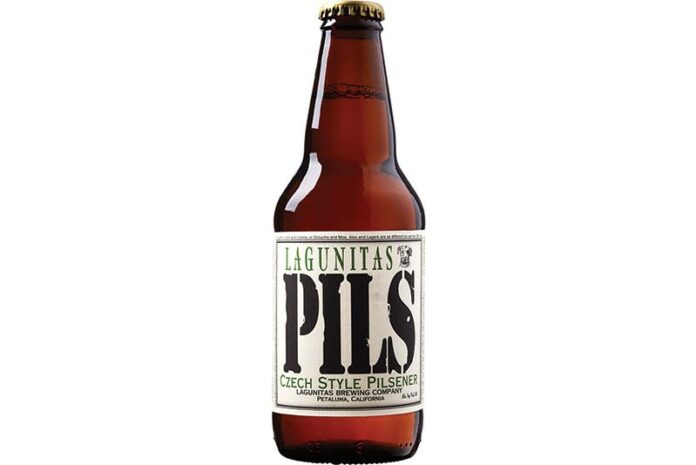
Lagunitas Pils Czech Style Pilsner The big surprise of this single blind tasting, as I waited and waited for the Lagunitas to show up—where was that telltale, piney hop aroma? Instead of smelling like yet another version of their pale ale, this shows a floral, sweet and toasty aroma of shortbread biscuits and fresh, pale malt grain (to get this in your aromatic repertoire, take a trip to the brew supply store and stick your head in a barrel of pale 2-row). “Reminds me of Michelob,” said one taster—high praise for style. Fresh, foamy, dry enough but
not raspy, this is a doggone exemplar of the finely tuned yet uncomplicated-tasting suds that refresh at the fair, the beach or other summer events. ★★★★

Weihenstephaner Pilsner Billed as the world’s oldest brewery, this Bavarian import seemed like a good bet for a control group of one. And it is: fresh, unbuttered popcorn and lemon grass meet on the foamy head of this fine brew. ★★★★

Sierra Nevada Summerfest Crisp Lager Remember when it was a big deal to find Sierra Nevada pale ale on tap alongside the usual Bud, Miller, Coors? The microbrew giant has since introduced new styles to stay relevant, and here’s this: a classic American beer that’s middle-of-the-road mellow aromatically, and juices the palate with just a hint of fruity grain and white raspberry. ★★★½

St. Florian’s California Common Lager More a St. Florian’s style than anything else, with rich, amber hue, caramel and bruised pear aroma and ashy, almost peaty finish. It’s a fine brew for those cool North Bay summer evenings when the fog rolls in. ★★★

Plow Sonoma Coast Pils Talk about beer in a can! This is canned while you wait in a huge 32-ounce crowler ($9). On the other hand—beer in a can. While technically unflawed, we found this flavor-neutral and watery. ★★½

Bear Republic ‘Double Aught’ Pilsner This looks like fun,
with a Bohemia-inspired label, but with a butyric top note and raspy, steely backend, wasn’t fun drinking. Have a Racer instead. One bottle tasted. ★★

Wine & Weed

This past December, when the Wine Industry Network (WIN) held its annual tradeshow, the marketing and media company scheduled a one-hour session on cannabis legalization and its impact on the wine industry. “It was packed,” says George Christie, WIN president. “It was the busiest workshop we’ve ever put on by far in five years.”

Following that experience, Christie struck upon the idea of an all-day event dedicated to the subject. Thus the Weed & Wine Symposium was born. The event is Aug. 3 at the Hyatt Vineyard Creek in Santa Rosa. Tickets sold out long ago.

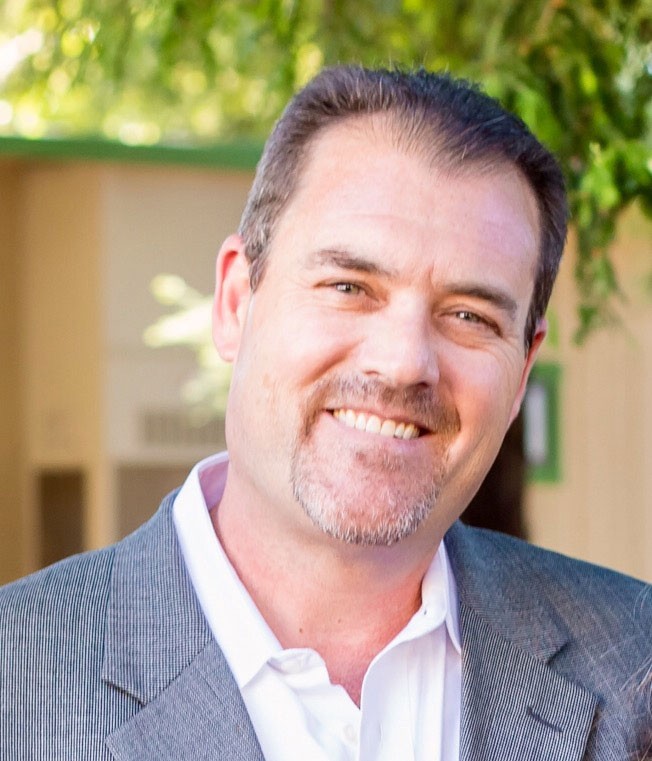
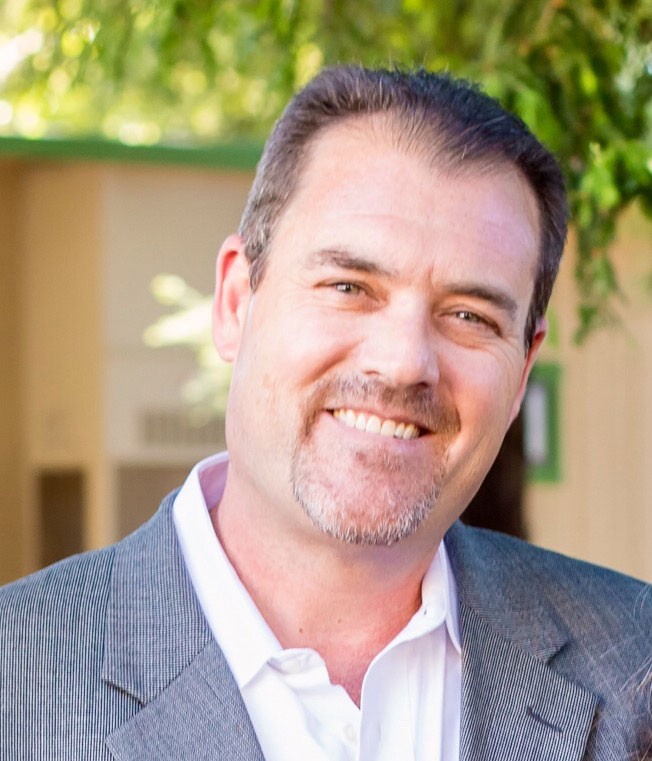
“There are just so many more questions then there are answers,” says Christie (pictured) “I think that’s what’s really the impetus behind why it’s so popular.”

Here are my questions for Christie.

How did you design the format for the symposium?

The curriculum is geared for people in the wine industry who want to better understand what just happened [with legalization] and what the potential impacts and opportunities might be. Everything is built around that.

Has WIN taken an official position on cannabis?

It’s too early [to take a position], but I will say that I believe strongly that if you’ve got an emergent industry like cannabis and
you are going to be sharing the neighborhood with them, then it is in your best interest to know them as best you can and really understand their industry to the best of your ability. To do otherwise is just naïve and bad business.

What’s the basis of wine-industry opposition to cannabis?

It’s across the board depending on whom you’re talking to. [It ranges from] competing for labor, water, warehouse and commercial space and land, to the morality piece. There’s definitely still a stigma attached to who some people think the cannabis-industry people are. But I think it’s really rooted in basic human nature and fear of the unknown.

What do you think the landscape will look like in five years?

I think five years from now you’re going to see a lot of collaboration between these two industries. You’re going to see wine and weed events. I think you’re going to see, if not partnerships, then definitely strategic alliances.

I think it would be naïve to believe that there aren’t going to be grape farmers out there who are going to dip their toe into the cannabis waters. If the realities kick in and they are able to make two, three, five or 10 times the amount of money per acre than they are able to make with grapes, I think you are going to see some growers diversify. I do not think were going to drive down Dry Creek Road and the vineyards are going to disappear. That’s definitely not happening. But are we going to see little pockets of commercial grows? I think so.

Screen Scene

0

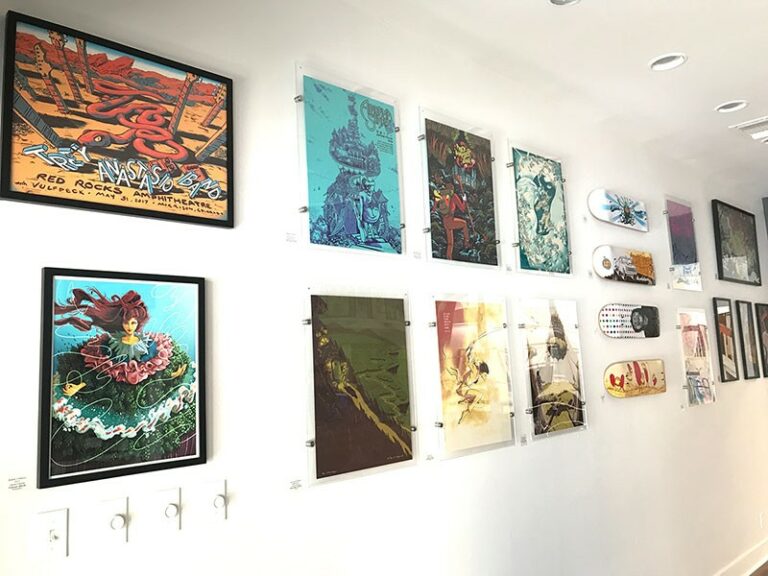
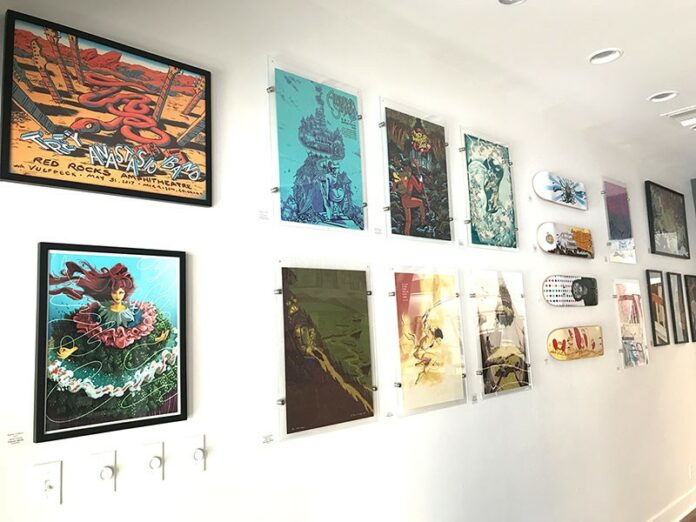
Curt Barnickel started collecting Shepard Fairey screen-print posters about 10 years ago. Fairey is best know for his “Obey” images and Obama “Hope” posters.

Since then, he has expanded his collection from screen printing to concert posters, records and apparel printing and stickers—enough to fill up a gallery, Agent Ink, on Fifth Street in Santa Rosa.

After owning and operating a marketing company in downtown Santa Rosa for four years, Barnickel decided that the end of his building’s lease was a sign to finally pursue his dream of running a screen-print gallery.

“It’s really been a passion of mine to open up a gallery that’s a little bit different than what most people are used to,” Barnickel says. “I feature screen prints, so that’s a little different from what Santa Rosa is used to. I think of myself as more of a Haight-Ashbury slash Berkeley type of gallery than a fine-art gallery.”

Agent Ink features everything from screen-printed apparel, records, skateboard decks, rock-art posters and enamel stickers to collectible vinyl dolls.

“I wanted to hit every demographic, so we also have onesies,” says Barnickel. “We’re trying to get the families in here.

“The screen-printing thing,” he continues, “is a big focus. All the apparel is screen-printed as well. Everything is screen-printed, even the covers for the records we sell are screen-printed by local artists.”

After a soft opening in March, Agent Ink officially opened its doors on May 13. “Our grand opening was very successful,” Barnickel says. “We probably had around 150 or 200 people in here that night, which was way more than I ever could’ve imagined.”

Barnickel says the gallery sees increased foot traffic due to the new Old Courthouse Square and Wednesday Night Market–goers. “I really like downtown Santa Rosa,” he says. “I wouldn’t open a gallery anywhere else.”

Barnickel says downtown Santa Rosa is perfect for his gallery.

“I think my art is more for 25-to-45-year-old-type people,” he says. “I think Montgomery Village is a little old; Railroad Square has too many high-end galleries. I’m not really a high-end gallery. What I go for is art for everybody. ‘Art for everyone’ is one of my taglines. You can come in here with $15 and buy something, or you can come in here with $1,000 and buy something.”

Barnickel’s favorite part about Agent Ink is that it allows him to show the community a glimpse into the history of screen-printing.

“It’s not only a gallery; it’s going to be more of an educational center, where I’ll have people out here actually doing the screen print process so people can see what it takes to actually create one of these posters.

“I’m just passionate about the art, and I’ve always wanted to let other people know about it.”

Poet of Pot

0

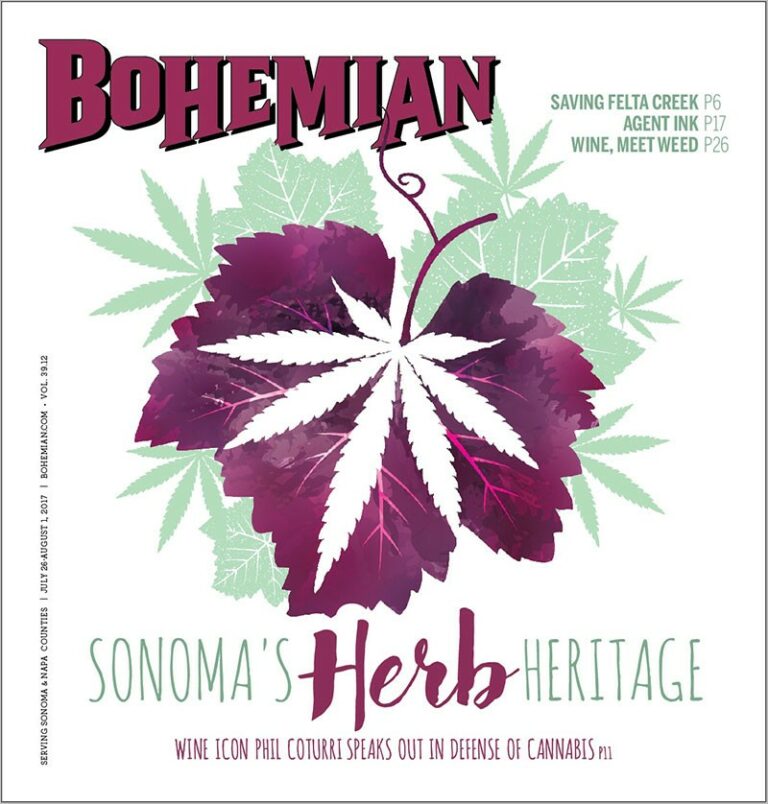
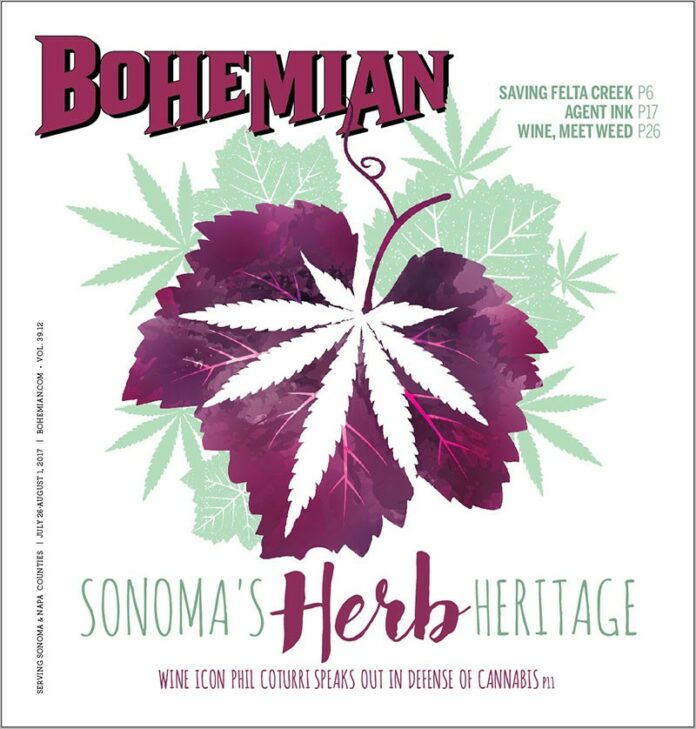
As a winemaker, sought-after vineyard manager, cannabis aficionado and Deadhead, Sonoma County’s Phil Coturri has loads of stories to tell about his long, strange trip. Or maybe it’s not so strange or so long, either. Indeed, in some ways it’s just getting going, especially now with the cannabis world in upheaval and with so-called experts mouthing off about the irreconcilable differences between wine and weed.

The founder and CEO of Enterprise Vineyard Management and the co-owner of Winery Sixteen 600, Coturri thinks that wine and weed are compatible in the field and on the dining room table. He’d like to see more pairing between the two, and with food as well.

Coturri is coming out of the cannabis closet to warn us all of the dangers ahead for the world of cannabis. Before it’s too late. Before the regulators destroy something valuable that has been shaped by growers and smokers, farmers and aficionados for the past half century.

Indeed, he has thought carefully about the repercussions of his words and his deeds. In his case, caution seems to have been the better part of wisdom. He hasn’t forgotten that cannabis is illegal under federal law and that Attorney General Jeff Sessions has put it near the top of his list of drugs to be eliminated.

I’ve known Coturri for years, not only as a grape grower and winemaker, but also as a cannabis connoisseur. I’ve previously written about him under pseudonyms. That’s the way he always wanted it. If he’s allowed his name to be used in print now, it’s because he recognizes that cannabis is in crisis and needs all the friends it can muster.

As a connoisseur of wine and weed, he’s worried that in the rush to legalize, regulate and normalize marijuana in California, the beauty of the plant and its aromatic flowers that he has known intimately since his college days at Sonoma State University will fall by the wayside. That’s why he’s coming out of the cannabis closet little by little, slowly and steadily. Indeed, he invited me to his office on First Street West in Sonoma, not far from the Plaza, because he wanted to sound an alarm, before the bureaucrats crush a whole way of life.

Coturri isn’t the only one to sound an alarm. All across Northern California, small growers share his fear that new rules will drive many of them out of business and hand the pot industry over to the big guys who have big money and who can afford to hire lawyers and consultants. Then, too, Coturri and his ilk argue, quality will suffer, as weed goes corporate and quantity soars. Some say the quality has already declined and that it’s essential to save the endangered world of boutique pot.

In some ways, Coturri seems like the last of the old school hippies. He grew up and came of age in the counterculture of the San Francisco Bay Area, which thrived on pot, protest and psychedelic rock.

Coturri arrives for our meeting right on time, smelling of the great outdoors and as fresh as one of the many vineyards he manages.

“Come springtime, vineyards take over my life,” he says. He wears glasses, a full beard, boots, shorts and a sweatshirt that reads: “Resist.” Indeed, he’s probably as much of a resister now as he was during the Vietnam War era, and as critical of Trump as he was of presidents Johnson and Nixon.

On the wall of the office are pictures of some of Coturri’s heroes: Janis Joplin, Beat poet Michael McClure, Jerry Garcia, Gary Snyder, the environmentalist and Pulitzer Prize winner, and Owsley Stanley, often described as “the King of LSD.”

Born into a working-class Italian-American family in San Francisco, Coturri is a product of the city’s bohemian and immigrant communities. His father and grandfather both made wine. His brother Tony makes wine. His sons Sam and Max also make wine. It’s in their blood. So, too, is THC.

“I’ve heard people describe cannabis as a threat to wine, but I definitely don’t see it that way,” Coturri says. “I think it’s time to emphasize the connoisseurs in both worlds—the people who are using both, not to get wasted, intoxicated and high just for the sake of getting high, but to appreciate the flavors, the taste and the aroma. In my world, they’re both familial—something to be shared with the whole extended family.”

Like many others who straddle the worlds of wine and weed, Coturri wonders how the Wine & Weed Symposium, taking place Thursday, Aug. 3, at the Hyatt Vineyard Creek in Santa Rosa, might open eyes and present new information. (See the Nugget, p26, for more.)

Meanwhile, he looks up at the photo of Gary Snyder. “We also need to remember the vital 50-year history of cannabis in our community here in Sonoma,” he says, “and remember that it’s an integral part of our values and our traditions. We have to keep it alive. It provides meaning to what we do and how we think and feel.”

Coturri began to smoke marijuana at the age of 14. (He dropped acid, he told me, before he began to experiment with pot.) He grew his first crop on Sonoma Mountain in 1978. All four of the pot plants in his tiny garden were stolen. Still, he wasn’t discouraged, in part because the California artist and longtime bohemian, Robert Pearson McChesney, showed him the marijuana that he grew in a greenhouse on Sonoma Mountain for his own personal use and the use of his friends.

McChesney was in his mid-60s; Coturri was in his 20s. “I was impressed,” he says. “McChesney built his own house with his own hands, and he cultivated his own weed. Now I’m worried that the cultural descendants of McChesney will have a hard time surviving in the new overly regulated world of marijuana. I want them to be protected. I also want the heritage strains to be protected.”

Still, Coturri says he understands some of the reasons why the industry is being so intensely regulated by the government, more than any other crop in California.

“Every Tom, Dick and Harry is growing pot,” he says. “For the most part, they don’t understand the complexities of the plant, or its medicinal and therapeutic properties.”

These Johnny-come-latelys often don’t know what real pot ought to taste like, smell like and look like, he says.

At the end of a hard day’s labor, Coturri likes to go into his greenhouse and putter with his pot plants as a way to relax, unwind and be at peace with himself and the world. “Marijuana is an amazing plant,” he says. “I enjoy watching the whole growing cycle, from the germination of the seeds to the flowering of the female plants. It has long been a passion of mine.”

This past April, the

New York Times published a couple of photos of Coturri. In one, he walks through a vineyard at Kamen Estate, which he manages; in the other, he’s in his greenhouse surrounded by marijuana starts. The article that accompanied the photos describes marijuana as Coturri’s “hobby.”

Maybe that’s the way it looks from New York. In Sonoma, it’s more like a quest for something that’s hard to define and difficult to pin down, but that adds zest to life. The Times article also claimed that Coturri was as “exalted locally” for his marijuana as he was “for his vineyard practices.” That’s an exaggeration, to say the least. As an icon of the organic and biodynamic California grape and wine industry, Coturri has mostly kept his cannabis connection under his hat and not advertised it.

As an undergraduate at SSU, Coturri read and wrote poetry. Back then, he would have liked nothing better than to be a poet like Gary Snyder, though he realized that he probably would not have been able to make a living writing verse. Still, his love of poetry hasn’t abandoned him and he hasn’t abandoned it.

“Once a poet always a poet,” he says. “I’m a poet in the vineyard and in the greenhouse, a poet with pot and with Pinot.”

Now, at the end of our conversation, he’s off to San Francisco with his wife to watch the new four-hour documentary about the Grateful Dead, Long Strange Trip. Coturri’s journey is clearly not over yet.

Jonah Raskin is the author of ‘Marijuanaland: Dispatches from an American War.’

Wine & Weed

[image-1]

This past December, when the Wine Industry Network (WIN) held its annual tradeshow, the marketing and media company scheduled a one-hour session on cannabis legalization and its impact on the wine industry. “It was packed,” says George Christie, WIN president. “It was the busiest workshop we’ve ever put on by far in five years.”

Following that experience, Christie struck upon the idea of an all-day event dedicated to the subject. Thus the Weed & Wine Symposium was born. The event is Aug. 3 at the Hyatt Vineyard Creek in Santa Rosa. Tickets sold out long ago.

“There are just so many more questions then there are answers,” says Christie (pictured) “I think that’s what’s really the impetus behind why it’s so popular.”

Here are my questions for Christie.

How did you design the format for the symposium?

The curriculum is geared for people in the wine industry who want to better understand what just happened [with legalization] and what the potential impacts and opportunities might be. Everything is built around that.

Has WIN taken an official position on cannabis?

It’s too early [to take a position], but I will say that I believe strongly that if you’ve got an emergent industry like cannabis and
you are going to be sharing the neighborhood with them, then it is in your best interest to know them as best you can and really understand their industry to the best of your ability. To do otherwise is just naïve and bad business.

What’s the basis of wine-industry opposition to cannabis?

It’s across the board depending on whom you’re talking to. [It ranges from] competing for labor, water, warehouse and commercial space and land, to the morality piece. There’s definitely still a stigma attached to who some people think the cannabis-industry people are. But I think it’s really rooted in basic human nature and fear of the unknown.

What do you think the landscape will look like in five years?

I think five years from now you’re going to see a lot of collaboration between these two industries. You’re going to see wine and weed events. I think you’re going to see, if not partnerships, then definitely strategic alliances.

I think it would be naïve to believe that there aren’t going to be grape farmers out there who are going to dip their toe into the cannabis waters. If the realities kick in and they are able to make two, three, five or 10 times the amount of money per acre than they are able to make with grapes, I think you are going to see some growers diversify. I do not think were going to drive down Dry Creek Road and the vineyards are going to disappear. That’s definitely not happening. But are we going to see little pockets of commercial grows? I think so.

Roses for ‘Gypsy’

0

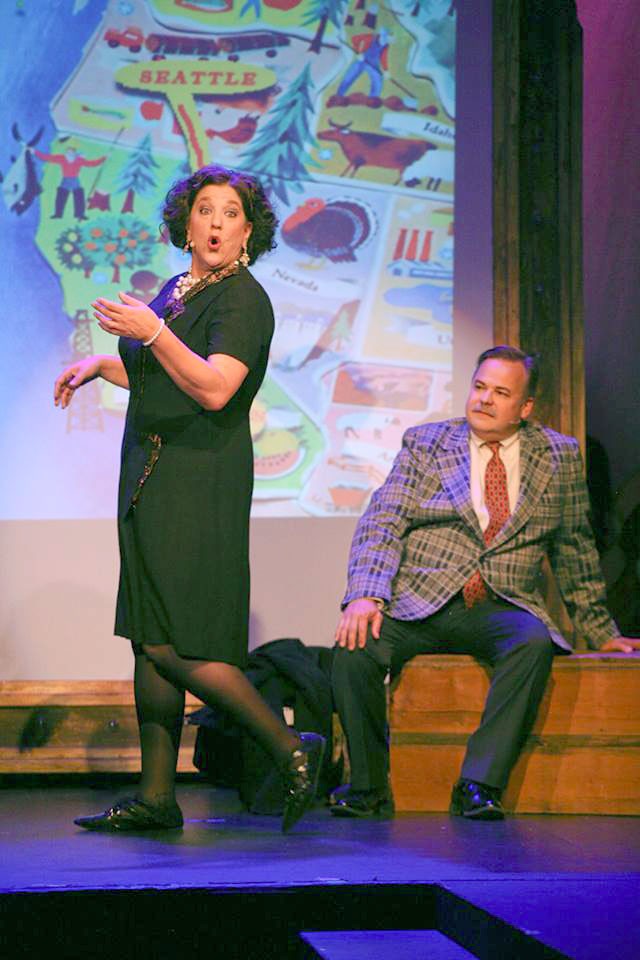
Gypsy is one of those classic Broadway musicals where the songs—including “Everything’s Coming Up Roses” and “Let Me Entertain You”—are arguably better known to the general public than the show itself is.

That’s a shame, because Gypsy, by Arthur Laurents, Jule Styne and Stephen Sondheim, is a sensational show. Sonoma Arts Live’s production, directed with obvious love and loads of heart by Michael Ross, shows us why.

Though occasionally sluggish—and musically wobbly to a maddening degree—this otherwise first-rate production features some truly sensational, must-see performances, if only the orchestra, under musical director John Partridge, were as strong and energetic as the cast. With better musical support, this could (and should) have been one of the best shows of 2017.

Even so, it frequently comes close.

A huge hit when it debuted on Broadway in 1959, Gypsy is based on the memoir of Gypsy Rose Lee, a 1930s striptease pioneer. An homage to the golden age of Burlesque—and partly a psychological analysis of Lee’s obsessive, compulsively self-defeating mother, Rose—Gypsy, as storytelling, is both heartwarming and heartbreaking.

Over the course of several years, Mama Rose (a magnificent Daniela Innocenti Beem) drags her daughters Louise (first Sofia Carlson, then Danielle DeBow) and June (Tuolumne Bunter, Amanda Pedersen) from one Vaudeville theater to another, in hopes of turning the singing-and-dancing June into a star. Louise, meanwhile, is left in the shadows.

Beem is brilliant, playing Mama Rose with ferocious energy, her beautiful belter’s voice and high-voltage charm convincing us she could make anyone believe that her own dreams of stardom are their dreams too.

She’s not the only star in the show, however.

As Herbie, Rose’s patient paramour and agent, Tim Setzer is outstanding. He gives Herbie a sense of goodness and devotion that make his eventual moment of realization all the more shattering.

And DeBow, as the teenage Louise—eventually forced into working as a stripper to pay the bills—is also wonderful. Her big transformation scene, as we watch Louise become the hardened Gypsy Rose Lee through a quick series of confidence-raising, risk-taking performances, is sad, complex, unexpected and absolutely thrilling.

Rating (out of 5): ★★★½

‘Gypsy’ runs through July 30 at Andrews Hall, 276 E. Napa St., Sonoma. Thursday–Saturday, 7:30pm; Sunday, 2pm. $22–$37. 866.710.8942.

Brine of the Time

0

Pickling season is upon us. Summer’s bounty will soon become soggy unless you it all eat quickly, or turn to pickling.

I advocate both. How you eat them is up to you, but I’ll offer some advice on pickling.

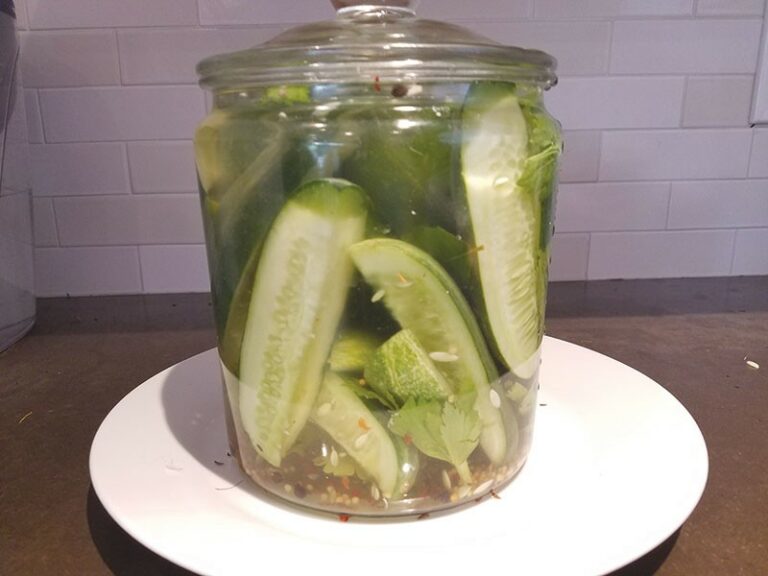
There are two kinds of pickles: fermented pickles and vinegar-brined pickles. Both are good, but I think fermented pickles are better. For one, canning is a pain, what with all that equipment and worries about botulism. Fermenting is much easier. And there’s something magic about leaving the job to beneficial

Lactobacillus bacteria to do the work for you.

Lactobacillus consumes the sugars found in vegetables and fruits (technically, cukes are fruit) and converts them into lactic acid, which creates a hostile environment for harmful bacteria and fungi. Plus, fermented foods offer healthful, probiotic benefits for your gut.

You can ferment just about any firm vegetable (peppers, onions, carrots, beets, asparagus, turnips), but you can’t beat good ol’ pickled cucumbers; i.e., pickles.

Ingredients

8–10 pickling (Kirby) cucumbers

5 tbsp. kosher salt

3–4 cloves garlic

1 tbsp. mustard seeds

1 tsp. chile flakes

four or five oak leaves

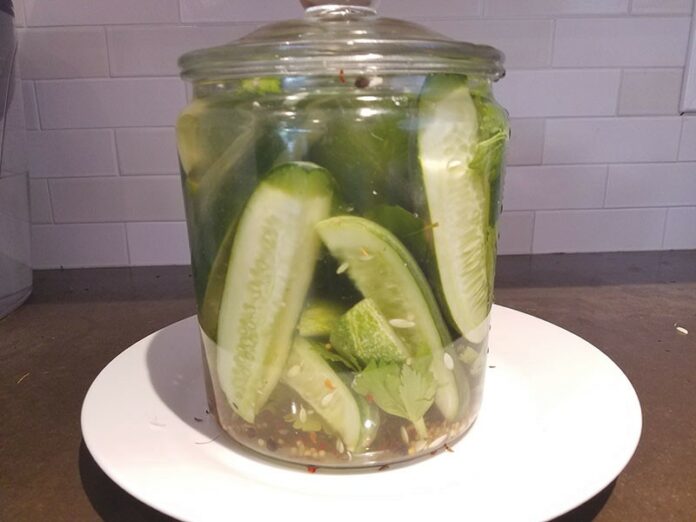
Wash the cukes and slice into quarters. Peel and smash the garlic. Pour water (preferably filtered or chlorine-free) into a half-gallon glass jar big enough to hold the cucumbers with room for one or two inches of brine above the pickles-to-be.

Add salt and mix to dissolve, then add the garlic, spices and oak leaves. Place the cucumbers in vertical stacks so they stand up. You can fit more in this way, pushing additional cucumbers into the gaps. Make sure the vegetables are completely submerged in the brine.

Cover with a cloth or loosely fitted lid and set out on your counter. After a few days, bubbles will start to form. That’s fermentation! After a week or so, taste a pickle to see if it’s to your liking. The longer it goes, the more sour the taste. Two weeks is probably long enough.

Once done, cover tightly and store in the refrigerator. Mine last a month or more before they start to get a bit soggy—but they usually get eaten up well before that.

Best of His Love

0

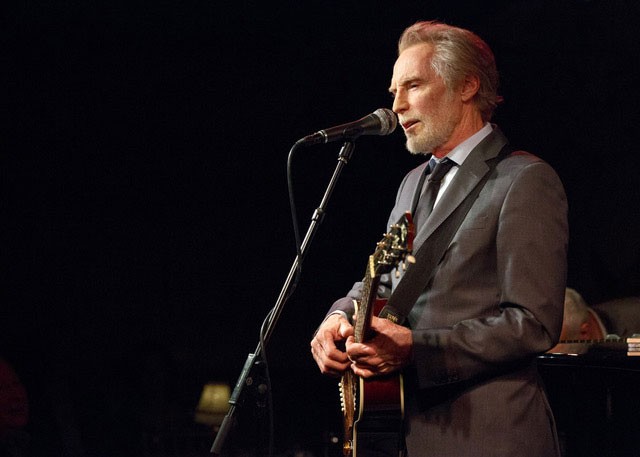
When he was inducted into the Songwriter’s Hall of Fame in 2013, JD Souther was called a “principal architect of the Southern California sound and a major influence on a generation of songwriters.”

Souther’s output has largely resided in the country and rock genres, but he’s showing off a wide array of styles on his most recent albums, including 2015’s

Tenderness. Souther appears at the Mystic Theatre on July 29 in a solo performance.

Souther got his start playing country-rock tunes at the Troubadour in Los Angeles, though he grew up in a house filled with opera and jazz.

“My father’s mother was an opera singer, and she played me all the great composers,” says Souther from his home outside of Nashville. “And my dad was a big-band singer, so I heard a lot of Sinatra, Sinatra, Sinatra and Sinatra.”

Growing up playing drums and tenor sax player, Souther discovered country music as a teen, and picked up guitar after moving to Los Angeles from Amarillo, Texas, in the late ’60s. There, he shared open mics with Jackson Browne and roomed with Glenn Frey when Frey and Don Henley started up a band called the Eagles.

“I got fascinated with country music,” he says. “Then I met Linda Ronstadt, who knew everything about country music. It made a deep impression on me how genuine and how heartfelt the music was, and how it depended more on story and sincerity than technique, though that is involved.”

Throughout the 1970s, Souther co-wrote a number of Eagles’ hits, including “Best of My Love” and “New Kid in Town,” and wrote songs for Ronstadt and Bonnie Raitt. He also released several acclaimed solo records that in turn featured Frey, Henley, Ronstadt and others.

These days, Souther’s country styling has become intertwined with a new palette of sounds, starting with 2008’s album
If the World Was You, recorded live with a jazz sextet, and 2015’s Tenderness, which includes stunning string arrangements and jazz piano courtesy of famed performer Billy Childs.

Souther also recently released newly expanded editions of three of his older solo albums: his 1972 debut John David Souther, 1976’s Black Rose and 1984’s Home by Dawn.

Souther’s current solo tour will offer fans the most intimate offering yet of his biggest hits, his current repertoire and his favorite stories from the last 40-plus years.

“I’ll play a little of everything,” he says. “But it’s going to be a different kind of show.”

JD Souther performs on Saturday, July 29, at the Mystic Theatre,
23 Petaluma Blvd. N., Petaluma. 7:30pm. $32. 707.775.6048.

Hugs, Not Hate

The poet Mark Eckert and I were attending one of the free concerts that take place throughout Sonoma County in the summer a couple weeks ago—I won't say where because Mark and I thought the band really stunk. Mark started making undecipherable, indescribable gestures to signify his disgust, which made me laugh. The man standing in front of Mark turned...

Terminal Beach

Think of the different battlefronts in World War II. Now choose the one you are the gladdest that you missed. The Golden Staircase in New Guinea? Saipan? The London Blitz? That great engineer of cage-rattling cinema, Christopher Nolan, convinces you that Dunkirk ought to be way up on the list. On the cusp of May and June 1940, some 400,000...

Czech Me Out

It took a long summer afternoon's rummage around town to find just a handful of locally brewed examples of America's favorite beer. Beer style, that is, not a particular brewery's beer—that's still a matter of some debate. The great breweries of the American Century made the lightly hopped pilsner style from Bohemia synonymous with "beer," and it was exactly that...

Wine & Weed

This past December, when the Wine Industry Network (WIN) held its annual tradeshow, the marketing and media company scheduled a one-hour session on cannabis legalization and its impact on the wine industry. "It was packed," says George Christie, WIN president. "It was the busiest workshop we've ever put on by far in five years." Following that experience, Christie struck upon...

Screen Scene

Curt Barnickel started collecting Shepard Fairey screen-print posters about 10 years ago. Fairey is best know for his "Obey" images and Obama "Hope" posters. Since then, he has expanded his collection from screen printing to concert posters, records and apparel printing and stickers—enough to fill up a gallery, Agent Ink, on Fifth Street in Santa Rosa. After owning and operating a...

Poet of Pot

As a winemaker, sought-after vineyard manager, cannabis aficionado and Deadhead, Sonoma County's Phil Coturri has loads of stories to tell about his long, strange trip. Or maybe it's not so strange or so long, either. Indeed, in some ways it's just getting going, especially now with the cannabis world in upheaval and with so-called experts mouthing off about the...

Wine & Weed

This past December, when the Wine Industry Network (WIN) held its annual tradeshow, the marketing and media company scheduled a one-hour session on cannabis legalization and its impact on the wine industry. "It was packed," says George Christie, WIN president. "It was the busiest workshop we've ever put on by far in five years." Following that experience, Christie struck upon...

Roses for ‘Gypsy’

Gypsy is one of those classic Broadway musicals where the songs—including "Everything's Coming Up Roses" and "Let Me Entertain You"—are arguably better known to the general public than the show itself is. That's a shame, because Gypsy, by Arthur Laurents, Jule Styne and Stephen Sondheim, is a sensational show. Sonoma Arts Live's production, directed with obvious love and loads of...

Brine of the Time

Pickling season is upon us. Summer's bounty will soon become soggy unless you it all eat quickly, or turn to pickling. I advocate both. How you eat them is up to you, but I'll offer some advice on pickling. There are two kinds of pickles: fermented pickles and vinegar-brined pickles. Both are good, but I think fermented pickles are better. For...

Best of His Love

When he was inducted into the Songwriter's Hall of Fame in 2013, JD Souther was called a "principal architect of the Southern California sound and a major influence on a generation of songwriters." Souther's output has largely resided in the country and rock genres, but he's showing off a wide array of styles on his most recent albums, including 2015's Tenderness....
11,084FansLike
4,606FollowersFollow
6,928FollowersFollow