On October 30, 2017, as thousands of Sonoma County homes smoldered in ruins from the Tubbs Fire, Darius Anderson established the nonprofit Rebuild North Bay Foundation. Anderson is a longtime lobbyist for Pacific Gas and Electric Corporation and owner of the Press Democrat.
In a subsequent application for 501(c)(3) tax-exempt status, Anderson told the Internal Revenue Service his charity would “provide immediate disaster relief to those residents of the North Bay who were hardest hit: families and individuals with low incomes who have been displaced from their homes and/or lost their jobs due to the wildfires.” The foundation would also work with local governments to help residents rebuild in a “fire safe” fashion, “for example, by assisting with the construction of fire-retardant roofs,” Anderson wrote. According to a six-month investigation of Rebuild North Bay Foundation by the Bohemian, that’s not exactly what happened.
The organization’s independent audit and tax returns and hundreds of emails obtained from local governments under the California Public Records Act reveal that Rebuild North Bay Foundation functions more as a lobbyist than a disaster relief group.
During its first year of existence, most of the foundation’s expenses went to management and administration; it spent relatively little money on grants to the public, according to its audit.
The foundation made erroneous claims in its tax return regarding its lobbying activities; serious errors which the organization says they will correct.
The law prohibits the foundation from making campaign contributions. Yet, the campaign committee of a Sonoma County supervisor disclosed a contribution from the foundation, which also “gifted” money to the mayor of Santa Rosa, public records show.
According to an aide for North Bay Congressman Mike Thompson, some of the foundation’s lobbying activities may be doing harm by “injecting politics” into the disaster-funding process.
Rebuild North Bay Foundation is mostly funded by PG&E.
While Rebuild North Bay Foundation has performed some charitable acts, it has focused on creating a network of businesspeople and local public officials to lobby bureaucrats and legislators in Washington, D.C., on specific issues. Under IRS rules and regulations a charity is allowed to do some lobbying related to its nonprofit purpose—but focusing on lobbying can result in the loss of a nonprofit’s tax-exempt status, tax experts say.
According to a nationally prominent expert consulted by the Bohemian, the Rebuild North Bay Foundation crossed over the boundary between charity and lobbying. Ellen Aprill is the John E. Anderson Professor of Tax Law at Loyola Law School in Los Angeles. She reviewed the foundation’s IRS Form 990 federal tax return for 2017–2018, which discloses its financial information and lobbying and charitable activities. Aprill concluded, “It’s not even a close call, it’s blatant lobbying. The foundation is primarily a lobbyist, not a charity.”
Philip Hackney is a professor of nonprofit law at the University of Pittsburgh and a former-IRS lawyer. He explained that asking public officials to support specific legislation or funding requests is the definition of lobbying. Hackney said that spending a substantial amount of an organization’s effort on lobbying can violate the charitable mandate.
It is up to the IRS to determine whether the Rebuild North Bay Foundation has fallen afoul of nonprofit rules and regulations by focusing on lobbying. “Trying to give a definitive answer about the legality of this organization is like sticking my hand into a pile of goo,” Hackney said. “What is most interesting is that Rebuild told the community it was going to do one thing and then ended up doing another.”
Why does that matter? It matters because Anderson chartered the Rebuild North Bay Foundation for providing disaster relief; not for sending politicians and businesspeople to lobby politicians in Washington. It matters because the activities of Rebuild North Bay Foundation intersect with its founder’s business, publishing and political interests.
For example, until Nov. 1, 2019, PG&E was a client of Anderson’s California- and Washington, D.C.–based lobbying firm, Platinum Advisors. PG&E is bankrupt and facing $30 billion in liabilities for sparking wildfires around California. Two PG&E executives have served on the foundation’s board of directors; it names PG&E as its “partner” in charitable activities. And a disaster-debris removal firm named Ashbritt Environmental hired Anderson’s lobbying firm, and gifted the foundation with $450,000, after Anderson and its board members lobbied federal officials to change debris-removal reimbursement regulations.
It matters because Anderson’s Sonoma Media Investments LLC owns the major news, business and lifestyle print publications in the North Bay, including the Press Democrat, Petaluma Argus-Courier, Sonoma Index Tribune, North Bay Business Journal, Sonoma Magazine, Spirited Magazine, La Prensa Sonoma and Emerald Report.
It matters because Anderson is the power broker in Northern California—politicians, government officials, businesspeople, editors and reporters avoid incurring his displeasure.
It matters because, as first reported in the Bohemian, the San Francisco Superior Court ruled in 2018 that Anderson and his partner in Kenwood Investments, Doug Boxer, son of the former senator for California, Barbara Boxer, had defrauded the Federated Indians of Graton Rancheria when the tribe was trying to develop a casino in Sonoma County in 2003. (The Press Democrat did not report the finding of fraud in its brief coverage of the court-ordered $725,000 award to the tribe.)
The account of Anderson’s unsavory dealing with the Indians resulted in the Bohemian taking a closer look at Rebuild North Bay Foundation and other Anderson ventures. The Fund for Investigative Journalism supports “The Power Brokers” series, which receives pro bono legal assistance from attorneys at the Reporters Committee for Freedom of the Press.
Rebuild North Bay Foundation’s executive director, Jennifer Gray Thompson, provided the Bohemian with financial information and responses to questions. In early September, Thompson and four members of the foundation board met with Bohemian reporters at Mountain Mike’s Pizza in Santa Rosa. Subsequently, Thompson and the board declined to answer any further queries. Anderson did not reply to requests from the Bohemian for comments on factual issues raised in this story.
Days of fire
The founding directors of Rebuild North Bay Foundation were Anderson and Marisol Lopez of Platinum Advisors. The 18-member board of directors is a Who’s Who of local business elite. Elizabeth Gore is the president; she runs Alice—an artificial-intelligence website for business owners—and is married to Sonoma County 4th District Supervisor James Gore.
Directors include Henry Hansel, the auto dealer; and four vintners, including Michael Mondavi; and United Way of the Wine Country–CEO Lisa Carreño. In the tax filing, Anderson’s business partner, Press Democrat publisher Steve Falk, is titled “FOB,” friend of the board.
Shadowing the board is a 43-member Advisory Council packed with vintners, politicians, nonprofit executives and Sonoma, Lake, Mendocino and Napa county officials. Congressman Mike Thompson and Governor Gavin Newsom compose the Honorary Board.
The foundation does have charitable accomplishments. It organized businesses, including PG&E, to help replace burned street walls fronting several neighborhoods. It gave a county government $25,000. It is partnering with United Way of the Wine Country to distribute $300,000 of the United Way’s money to community groups in small grants.
For these charitable acts, Rebuild North Bay Foundation has received lots of coverage in the Press Democrat in articles that “disclose” Anderson as the founder of the charity. On the other hand, Press Democrat articles do not reveal Anderson’s role as a PG&E lobbyist in stories about the utility. Nor did the Press Democrat report that PG&E gifted Rebuild North Bay Foundation with millions in start-up funds; money which has not trickled down to fire victims.
As the 2017 fires raged, nonprofits such as Redwood Credit Union’s North Bay Fire Relief Fund and Tipping Point’s Emergency Relief Fund responded immediately. They distributed $66 million in cash and groceries and survival necessities to fire victims. The public was generous with donations; dozens of nonprofits involved themselves in massive fire relief efforts in Sonoma, Lake, Napa and Mendocino counties. For example, after the Redwood Complex fire destroyed hundreds of houses in Mendocino County, the nonprofit Community Foundation of Mendocino County raised and distributed more than $2 million for housing replacement and survival assistance. Rose Bell, the foundation’s communications manager, said, “We do case management with the families. Lobbying is handled by the county officials, not the nonprofits. We do not take donations from PG&E.”
FEMA trailers
Shortly after Anderson launched Rebuild North Bay Foundation, the Press Democrat featured it for hiring former FEMA director James Lee Witt as executive director, and for sponsoring a lobbying trip to Washington, D.C. with Anderson and several prominent businessmen serving on its board of directors.
Email records obtained from the California Office of Emergency Services show that in late October 2017, Anderson and Witt conferred with top officials at that agency to talk about the emergency-funding process. A week later, Rod Sweetman, an executive with Witt’s disaster management company, Witt Global Partners, contacted Emergency Services director, Mark Ghilarducci. Sweetman pitched him a $16 million sale of 1,600 refugee housing containers from a company he described as a “partner” to Witt Global Partners. Ghilarducci did not go for it. By Christmas, Witt had moved on from his position with Rebuild North Bay Foundation.
During his brief tenure, Witt averaged five hours a week on the job, according to the foundation’s tax return. It paid Witt’s firm $64,838 for its services. Notably, the tax return records a conflict of interest, reporting Witt Global Partners as “disqualified” because they hired Witt’s firm under a consulting contract managed by himself.
IRS regulations call for repayment of a payment to a disqualified entity if the amount is determined to be an “excess benefit.” Witt kept the money because the foundation’s board of directors determined the payment to be “reasonable compensation,” said Thompson, who the Foundation hired to replace him in January 2018. Thompson declined to make Witt’s invoices available or to reveal details about his firm’s services. Witt did not reply to requests for comment.
PG&E to the rescue?
The day after Christmas in 2017, PG&E cut Rebuild North Bay Foundation a check for $2 million. The utility’s donation came with a prohibition: “It is our understanding that these funds will not be used for federal, state, or local campaign activity, including independent expenditures to support or oppose candidates for elective office or lobbying efforts.”
A PG&E spokesperson told the Bohemian that the $2 million donation was not a tax-deductible contribution, because the foundation’s tax-exempt status had not yet been approved (the government approved it in May 2018). Subsequent PG&E donations to the foundation were tax-deductible, the spokesperson explained. The utility appears to be counting the $2 million donation as a business expense, but it declined further comment on the relationship.
The PG&E donation accounts for 75 percent of the nearly $2.7 million in “contributions” the foundation booked during its first year, according to the independent audit. Anderson appointed PG&E executive Steve Malnight to the board of directors. In March 2018, PG&E hired Platinum Advisors to lobby for its corporate interests, paying it $90,000 that year.
After Malnight left, a former PG&E executive, Brian Bottari, joined the board.
PG&E also donated $200,000 to an Anderson-run nonprofit called Ramekins-Cornerstone Foundation, according to records at the California Public Utilities Commission. The donation, as reported in Anderson’s Sonoma Index Tribune, was to build an outdoor ice-skating rink south of Sonoma to raise money for fire victims. The Bohemian could find no evidence that the rink raised any money for charity before it closed in January 2018.
During 2018, PG&E made additional cash donations to the Rebuild North Bay Foundation, which advertises the utility as its charitable partner and sports its blue-and-white logo on brochures.
The foundation disbursed only 1 percent of its cash to the public during its first year. It spent hundreds of thousands of dollars on salaries, consulting fees, overhead, lobbying, advocacy and travel, according to its tax filings. It ended its first fiscal year with $1.8 million in the bank. Thompson explained, “We were conservative in the first year because we are committed to the long term.”
A March 2018 Press Democrat article about Rebuild North Bay Foundation quoted Anderson, “Our goal—three years from now—is to be the organization that the electeds rely on.” Or as the foundation’s tax return states, “We advocate only on behalf of the requests of the elected and staff leadership of the four counties we represent: Lake, Mendocino, Napa and Sonoma.”
But, “These activities do not qualify as lobbying, though we acknowledge that lobbying is a subset of advocacy,” the tax return states.
There is, however, no line item on a nonprofit tax form for reporting expenses on “advocacy,” only for lobbying. Lobbying is commonly defined by the IRS as attempting to influence legislation or public officials through direct, indirect or grassroots communications. In its tax return, the foundation claims public officials granted its requests for supporting specific legislative actions and funding certain projects. Those requests meet the definition for lobbying. Meanwhile, fire survivors are still awaiting Rebuild North Bay Foundation’s “immediate” disaster relief, not to mention the fire-retardant roofs.
Lobbying? What lobbying?
According to the foundation’s independent audit of its cash flow for its first fiscal year, it made only one cash grant—$25,000 to Lake County to help it pay for fighting the Pawnee wildfire. That amounts to 1 percent of the foundation’s donations.
Management and administration costs were $302,760—an astonishing 83 percent of the total cash expenses of $362,428.
By contrast, following the fires, Redwood Credit Union’s North Bay Fire Relief Fund distributed $31 million from more than 41,000 donors. Its administrative costs amounted to 3 percent of its grants, according to its 2017 tax return.
The non-profit North Bay Organizing Project’s UndocuFund made $6 million in cash grants to almost 1,900 families who lost homes, possessions and earnings in the fires. UndocuFund estimated that 10 percent of the funds went to costs and administration.
The law allows Rebuild North Bay Foundation, as a charitable organization, to focus some of its activities on lobbying government officials on issues relevant to its mission. Hackney and other non-profit tax experts say such a group should spend more than 80 percent of the budget on the charitable purpose, not on lobbying of any sort.
According to tax filings and financial documents provided by Thompson, Rebuild North Bay Foundation booked $2,815,116 in cash and non-cash donations from more than 100 donors in its first year. PG&E donated most of the cash. Ordinary people wrote checks for $20 or $50, richer folks donated five-figure sums for disaster relief. The Ford Dealers Advertising Association gave $25,000; the Associated Students of Stanford University gave $5,000; a Girl Scouts Brownie Troop raised $904. What happened to the money?
During its first year, Rebuild North Bay Foundation distributed $169,499—6 percent of its donations—as wildfire disaster relief. But they offered only a small part of that charity in cash. Most of the charity was in the form of donated items passed through the foundation’s books and counted as grants to the public.
According to its tax return, much of the foundation’s first year budget went to “coordination,” paying staff salaries, consulting fees and more than $100,000 for building a website featuring headshots and glowing biographies of its directors. It spent $28,500 on “advocacy” and $18,500 for lobbying, which it defined as “direct contact with legislators, their staffs, government officials or a legislative body.”
Recharacterizing its charitable mission as described in its application for nonprofit status, the tax return for the foundation’s first year asserts, “Our mission is achieved through a focus on advocacy, community impact projects and convening to create a more sustainable and resilient community.” Thompson repeatedly told the Bohemian that advocacy is not the same as lobbying. Tax-expert Aprill scoffed at the notion that “advocating” for specific legislation and funding is not lobbying. Scores of emails between foundation staff and public officials in Lake, Mendocino, Napa and Sonoma counties reveal lobbying as a major focus of those communications.
It turns out that the foundation’s tax return failed to properly disclose the extent of its lobbying activities as the IRS requires. (It filled out the wrong section of Form 990, Schedule C, regarding lobbying.) Thompson acknowledged the omission and said they will file a corrected return with the IRS. Hackney opined that if the correction ends up increasing the amount allocated to lobbying activities, the foundation’s tax exempt status could be jeopardized.
There is another serious problem with the tax filing. Sonoma County resident Christy Pichel is a legend in California philanthropy. She has distributed hundreds of millions of charitable dollars at the James Irvine Foundation, the Public Policy Institute of California and the CS Fund. Pichel said learning that Rebuild North Bay Foundation’s tax return claims as one of its accomplishments, “Connected Christy Pichel with Bay Area Council to receive $1M grant award from Hewlett to fund post-disaster assessment,” shocked her.
Pichel told the Bohemian that the Bay Area Council did receive a $925,000 grant from Hewlett for disaster assessment, but that it was not due to efforts by Rebuild North Bay Foundation. She emailed the Bohemian, “Wow! I have never seen a 990 [tax return] like this! Should I be flattered that I was mentioned by name under ‘accomplishments’? or horrified?! … I will think about these, and how (or if) to follow up with Jennifer about this misrepresentation.” Subsequently, Pichel said Thompson has agreed to file a correction with the IRS removing the claim. Thompson did not reply to a request for comment.
Counting “swag” as grants
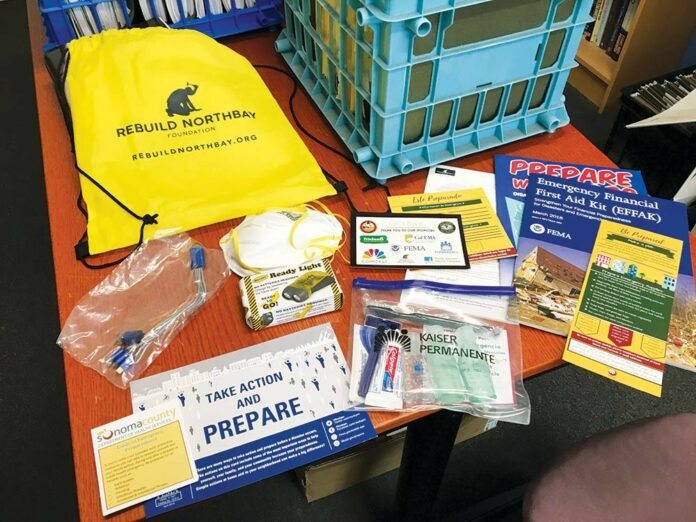
Celebrating its first anniversary in October 2018, Rebuild North Bay Foundation distributed 5,000 “GO! Bags” to North Bay residents, at little cost. The nonprofit’s logo festoons the basketball-sized sacks. The Press Democrat portrayed the bags as “encouraging community emergency preparedness.” The bags do not contain the standard emergency kit items that are recommended by the California Department of Public Health: non-perishable foods, warm clothing, rain gear, blankets, radios and pet and medical supplies.
Rather, the bags contain two dust masks donated by Freidman’s Home Improvement; a tiny, hand-cranked flashlight courtesy of PG&E corporation; a throw-away cell phone charger supplied by Comcast corporation; a small toothbrush, toothpaste, plastic razor, shampoo and conditioner gifted by Kaiser Permanente. Completing the GO! Bags are a handful of emergency preparedness brochures, including a “Prepare with Pedro” coloring book, without crayons. A FEMA brochure warns us to “Save for a Rainy Day” and “Make a Plan.” A shiny placard features the logos of the GO! Bag’s corporate sponsors, including PG&E.
Casey Mazzoni, a San Rafael-based lobbyist who the nonprofit paid $60,000 to as a consultant, oversaw the bag project, according to Thompson. In July 2018, Mazzoni emailed Abby Browning at the California Office of Emergency Services, “We are planning on giving away 5,000 disaster kits in October and hoping CAL OES can provide informational brochures or chachkies to include.” Browning replied she’d provide brochures, but, “Regarding the chachkies/swag, unfortunately we do not have any. The current Administration is very fiscally responsible and a strong steward of taxpayer dollars. Sorry!”
In its tax return, Rebuild North Bay Foundation calculated the grant value of the GO! Bags at $75,000. The foundation distributed 200 donated PlayStations and Chrome books to schools and community groups, calculating the value of those items at $62,000.
PG&E’s millions sat in the bank.
Disaster lobbying
Santa Rosa did not yet have a lobbyist in the nation’s capital in December 2017. Analysts projected disaster clean-up costs to run in the billions of dollars with uncertainties about how much the local jurisdictions would have to pay. Then–Santa Rosa Mayor Chris Coursey and City Manager Sean McGlynn flew to Washington to meet with North Bay Congressman Mike Thompson and FEMA officials.
Coursey told the Bohemian he does not know if his lobbying effort made a difference but, “It is always good to sit down with a person and tell your story.” Among the topics Coursey discussed with federal officials was a provision in the annual appropriations bill then pending before Congress that raised the reimbursement rate for the cost of fire debris removal to local governments from 75 percent to 90 percent. That clause passed into law in early 2018, carefully watched over by Congressman Thompson’s staff and Sonoma County’s lobbyists. In its tax return, Rebuild North Bay Foundation, however, grabbed the credit.
Here is the backstory: Since before the fires, Sonoma County has retained two lobbyists in Washington—Alcalde & Fay and Van Scoyoc Associates. These firms concentrate on the daily grind of moving the city’s funding requests through bureaucratic hoops. In 2018, Santa Rosa contracted with a Washington lobby firm called MMO Partners. The city pays MMO Partners $9,000 a month to oversee its federal disaster funding needs, and it is, by all accounts, doing a good job.
In January 2018, Rebuild North Bay Foundation sponsored a lobbying trip to Washington for board members Anderson, Mondavi, Hansel and Larry Florin of Burbank Housing, and “FOB” Falk. They met with HUD and FEMA officials. They scored an hour alone with Office of Management and Budget Director Mick Mulvaney at the White House. “Mulvaney was giving us advice,” Hansel told the Bohemian. “He said in all the disasters since he’s worked under the current administration, never has the private sector come to talk to him.” Hansel did not elaborate on the content of further conversation. But according to Jennifer Thompson, the board members and Mulvaney “discussed the liking of wine, but not the business of wine.”
In its IRS tax filing, Rebuild North Bay Foundation credits its lobbying for Congress passing the reimbursement rate increase in the annual appropriations bill. The Bohemian asked Jennifer Thompson for evidence that the foundation’s lobbying was responsible for the rate increase passing. She replied, “Prove that we didn’t.”
One effect of the increase in the reimbursement rate is that FEMA paid more cash on the spot to debris-removal contractors—90 percent, not just 75 percent. It was a significant benefit for the contractors involved, since cash-strapped localities were not likely to be able to pay a 25 percent share. In the end, the state and federal government covered all of the costs, said a spokesperson for Santa Rosa City Hall. The contractors took advantage of the confusion.
A KQED investigation in July 2018 found that the tab for removing the North Bay fire debris was $1.3 billion, making it the most expensive disaster cleanup in the history of California. Contractors charged an average of $280,000 per site, compared to the norm of $77,000 in previous fires. Per-ton removal charges were greatly inflated because contractors removed far too much debris, gouging gaping holes that shocked homeowners later had to backfill. Haste and lack of governmental oversight resulted in injuries and safety violations and lack of monitoring of contractor job performance.
Ashbritt Environmental, a prime contractor for the North Bay fire-debris removal project banked $320 million for its work. Lawsuits alleging over-excavation and misconduct were filed against Ashbritt, and the publicity stank. On October 1, 2018, Ashbritt hired Platinum Advisors, paying it a total of $120,000, state records show. Ashbritt’s charitable foundation donated $450,000 to Rebuild North Bay Foundation to help pay for replacing a street barrier fronting burned-out Coffey Park.
The Press Democrat wrote several stories about Ashbritt’s generosity, without mentioning that Anderson is its lobbyist, or that he and Rebuild North Bay Foundation board members lobbied on an issue of importance to Ashbritt.
Campaign contributions
In the first week of September 2018, Rebuild North Bay Foundation sent board members Anderson, Mondavi, Hansel, Florin and Falk back to Washington on another lobbying mission. The lobbying meetings were set up by MMO Partners, Santa Rosa public records show. Thompson said the board members paid their own way, although the foundation covered staff travel costs and dinners for the delegation at exclusive Capitol Hill restaurants Charlie Palmers and Monacle. Elected officials from Lake and Napa counties accompanied the board, whose travel, meals and lodging expenses were mostly picked up by taxpayers, with the foundation covering some of their costs. And that is a problem.
Coursey and Sonoma County Supervisor, David Rabbitt, and several of their staffers went along. The David Rabbitt for Supervisor 2018 campaign committee disclosed a contribution of $401.23 from Rebuild North Bay Foundation for “food, beverages, car service” during the trip. Nonprofit expert Hackney commented, “Political campaign intervention is prohibited. The foundation cannot do that and maintain its charitable tax exempt status.” Attorney Marcus S. Owens of Loeb & Loeb LLP in Washington D.C. concurred with Hackney. “Charitable organizations are explicitly prohibited from making contributions, whether cash or in-kind to campaigns for elected public office,” he said. Rabbitt told the Bohemian, “My understanding is that Rebuild Northbay Foundation is not a 501(c)(3) [a charity].”
Coursey, a former columnist for the Press Democrat who is campaigning for county supervisor, disclosed a “gift” of $546 from the foundation in his 2018 Statement of Economic Interests. Owens explained, “Giving a ‘gift’ to a sitting mayor does not further charitable purposes. The gift to the mayor and the contribution to the supervisor’s campaign could trigger an inquiry by the California Attorney General.”
Lobbying in the nation’s capital in the fall of 2018, the political and business members of the Rebuild North Bay Foundation delegation split up into groups, some led by Anderson, as they met with officials from FEMA, HUD, Senator Feinstein, several North Bay congressmen and Congressman Jeff Denham, a Trump-supporting Republican from Turlock who chaired a committee overseeing railroads and oil pipelines.
A week or so after lobbying Denham, Anderson and Mondavi hosted a $5,400-a-couple reelection campaign-fundraising breakfast in Napa for Denham, who was besieged by Democratic challengers.
Denham lost the election, but before leaving office, he inserted a statement in the Congressional Record “honoring” Darius Anderson “for his outstanding business acumen and host of contributions to his community.”
In its tax filing, the foundation claimed that the September lobbying trip resulted in a funding increase for rebuilding the Fountaingrove fire station. Thompson declined to present any evidence in support of that claim.
First, do no harm
There is evidence that Rebuild North Bay Foundation’s lobbying adventures may be doing some harm. Emails obtained from Lake County through a public records request show that, in June 2019, the foundation began soliciting local officials to go on a third lobbying trip to Washington with the board members and Press Democrat publisher Falk.
As part of the lobbying campaign, on June 17, Thompson emailed Brad Onorato, deputy chief of staff for Congressman Mike Thompson, asking for advice on lobbying FEMA officials for a fire engine.
Onorato replied forcefully: “First and most importantly, these grants are competitive grants NATIONWIDE and POLITICAL intervention is NOT WARRANTED AT ALL! … Second, it is my experience that it takes one or two grant cycles for a district to have their grant application approved. … [I]njecting politics into it could be detrimental to the Fire District … Please do not have any politicians, on any level, call [FEMA regional administrator] Bob Fenton. It’s most inappropriate as these programs all [go] through FEMA IN DC.”
Thompson replied. “Oh my gosh. So many caps. … Promise! I will not ask any politician to do anything.”
Public records show, however, that Rebuild North Bay Foundation continued to reach out to politicians and officials all over the North Bay, inviting them to join a trip to Washington in late October. Many officials turned down the invitation; some were eager. The costs to the taxpayers is several thousand dollars per official, according to public records. Rabbitt and Santa Rosa Mayor Tom Schwedhelm both planned on attending. “It makes a difference to have a delegation of businesspeople and politicians,” Schwedhelm told the Bohemian. Not to mention Falk, the publisher of the Press Democrat, which endorses or fails to endorse politicians come election time.
The lobbying trip took place even as the Kincade Fire erupted, reportedly due to a PG&E power-line malfunction. Rabbitt and Schwedhelm stayed in Sonoma County to grapple with the emergency, as did the supervisor from Lake County who had planned to go. Napa County supervisor, Belia-Eugenia Ramos, and Mendocino County supervisor, John Haschak, went along for the taxpayer-funded trip. In Washington, Rebuild North Bay Foundation board member Michael Mondavi, a grape farmer, lobbied the US Department of Agriculture to provide funding for agricultural worker housing, according to the foundation’s Facebook page.
Playing with the Press Democrat
Last June 16, the Press Democrat published a lifestyle article about the vacation wonderland of Clear Lake, replete with bass fishing, fine restaurants and spa hotels. According to public records, Thompson emailed the touristy article to Lake County administrators. She commented, “I delivered the request to cover Lake more often to the PD [Press Democrat] leadership and all I can ever do is ask … I see they are making the effort … I am so happy to see this coverage.”
Lake County Deputy CAO Michelle Scully responded to Thompson, “We so appreciate your advocacy for Lake County! A while back the PD initiated a ‘towns’ section which includes ads and editorial. Kind of pay-to-play but nonetheless we appreciate all positive coverage.” Thompson and Scully did not return requests for comment. Falk told the Bohemian in an email, “I have never crossed the line between journalism and advertising at any newspaper I have published.”
Rebuild’s recent accomplishments
In January, Elizabeth and Supervisor James Gore, Carreño and Thompson traveled to New Orleans to meet with other non-profit executives at Impact Experience, a “boot camp” and “accelerator” for disaster-focused corporations. Impact “brings together investors, entrepreneurs and innovators” to share “best practices,” according to its website. Thompson told the Bohemian that the trip to New Orleans was partly for her “professional development.” Still, there are no fire-retardant roofs.
Rebuild North Bay Foundation’s August newsletter features a statement from Newsom, whose gubernatorial campaign took $208,400 from PG&E. In the letter, Newsom effusively thanked the legislature for passing AB 1054. Many utility experts, including Loretta Lynch, the former president of the California Public Utilities Commission, have labeled that bill a PG&E bailout. Supervisor Gore is on record as supporting the PG&E bailout bill, as is the editorial page of the Press Democrat.
Anderson resigns
Last fall, a few weeks after the Bohemian published the court finding of Anderson’s defrauding of the Graton tribe, the Bohemian reached out to Elizabeth Gore, Jennifer Thompson, Hansel and other members of the Rebuild North Bay Foundation board. We referenced the court ruling and asked, “What measures, if any, is the board taking to make sure that no one in the leadership of Rebuild is using the organization to benefit his or her own financial interests?” We received no replies.
Notably, Anderson resigned as a director of Rebuild North Bay Foundation in January 2019. According to Thompson, Platinum Advisors Chief Financial Officer Charles Fina supervised the preparation of the foundation’s tax return. The return does not list Anderson as a board member in 2017-2018. Rebuild North Bay Foundation’s annual report, public records and numerous Press Democrat articles show that he most certainly was.