Where California Stands with Coronavirus Testing Right Now

0
By Rachel Becker and Ana B. Ibarra, CalMatters

Coronavirus testing has been plagued by confusion, delays and chaos, with the number of available, usable tests far outstripped by the need.

The situation, healthcare providers and experts say, has impaired their ability to know how many people have the virus—but a significantly larger number, they suspect, than that confirmed by state and federal officials.

Gov. Gavin Newsom says, however, that help is on the way, from university medical centers, private labs, the tech sector and more.

So where are we on this? Who can get tested and where exactly should you go? If you do get a hold of a test, is it going to cost anything? Here’s what you need to know.

How many tests does Calif. have?

On Sunday, Newsom said California has conducted 8,316 tests, and has the capacity to run just short of 9,000 more. On Monday evening, he said that the state’s 19 public health labs have increased tests “by a few hundred” over the previous 24 hours. Still, he said, “That clearly is not enough.”

By Tuesday, the number of public health labs conducting testing had increased to 21. And the state has also turned to academic medical centers as well as private companies to fill in those gaps. UC San Francisco, UC Los Angeles, UC San Diego, and Stanford University are all offering tests for the novel coronavirus—and UC Davis is currently racing to get three different types of tests online.

Nam Tran, associate professor and senior director of clinical pathology at UC Davis, said one of the tests that runs on an SUV-sized instrument created by Roche Diagnostics should come online within weeks and is expected to churn out 1400 results per day.

He called it a “game changer.”

As for private firms, Quest Diagnostics has been running 1,200 tests a day out of its lab in San Juan Capistrano, Newsom said Monday—and could ramp up to 10,000 tests per day across the country with the addition of another laboratory by the end of this week.

Should I get tested?

Californians are still facing delays, or no tests at all. And a surge of demand for testing supplies—including swabs, kits for extracting the virus’s genetic material, and personal protective equipment for healthcare workers—threatens efforts to scale up tests.

At a time of limited resources, testing should be reserved for people with moderate to severe symptoms and for those with underlying health conditions, said Michael Romero, a program manager with Placer County’s public health emergency preparedness team.

Symptoms can show up between two days and two weeks after exposure to the virus, and include fever, cough, and trouble breathing, according to the CDC.

“Our guidance is if you have mild symptoms, just stay home, testing would help you know whether you have it or not, but it wouldn’t change anything,” because there is currently no treatment, he said.

Can I get tested?

One challenge is the patchwork of guidance about whom to test first across California’s counties, private testing companies, and health systems, according to Kat DeBurgh, executive director of the Health Officers Association of California.

Guidelines may vary by county because of the uneven spread of the coronavirus, and local public health departments are required to approve the tests run through their labs, DeBurgh said.

She’s calling for more guidance from the state about whom to prioritize, she said, to help with the crush of calls that local public health officers are triaging.

In Los Angeles, for instance, the public health lab “will test specimens from high risk patients requiring a rapid public health response if they test positive,” according to guidance from the county. Any other patients with fever and symptoms of a respiratory illness who may have been exposed should be tested by a commercial lab instead.

At Kaiser Permanente, clinicians decide who to test, spokesman Marc Brown told CalMatters in an email.

Tests are only available to Kaiser members with a doctor’s order.Priority goes to hospitalized patients as well as people with symptoms who also have additional risk factors such as being over 60, heart or lung disease, or being immunocompromised. Anyone exposed to someone with a confirmed or suspected case of the virus, or who recently traveled somewhere affected by it, will also be prioritized.

Where can I get tested?

People should first check with their doctor to ask whether they’re collecting specimens, said Romero with Placer County. If their doctor is not doing testing, they can try calling their local urgent care. Romero said people should not go to the emergency department just for testing. That is what would cause unnecessary over-flooding in the ER, he said.

Some counties, such as Los Angeles and San Diego, ask that people who do not have a primary care provider call the county’s 2-1-1 line for information on where they can find providers with tests. Sutter Health, for example, asks that its patients schedule a video visit with a doctor to check whether they meet testing criteria. If they do, then doctors make arrangements with patients about specific locations where they can go for testing.

Some health systems have also opened drive-through testing for its members.

Are tests free? What if I’m uninsured?

Earlier this month, Newsom announced that all screening and testing fees would be waived for about 24 million Californians. That includes co-pays and deductibles for a hospital and doctor office visit associated with the test. But if a person is sick and needs further treatment and care, that cost is not required to be waived.

Newsom’s order does not apply to people who work for large employers and whose private health plans are regulated by the federal government. That said, an emergency coronavirus response bill pending in Congress would require that testing and all related fees be covered by all forms of insurance without out-of-pocket costs for the patient.

The California Department of Public Health has said that people who are uninsured and have symptoms should contact their county for information on how to get tested.

Some health clinics, like the AltaMed group in Southern California, are waiving test fees even for patients who are uninsured, but again, tests are only given to people who are showing symptoms. Also, clinics can help enroll patients in any available county program that may cover fees, and clinics themselves often charge on a sliding scale, which means costs are based on a person’s ability to pay.

Testing through the Verily screening pilot program screening in Santa Clara and San Mateo counties is a philanthropic effort and also free to the public.

What’s the deal with Verily’s triage?

Confusion has dogged the rollout of a triage site aimed at directing concerned Californians to testing. At first, President Donald Trump said Friday that “Google has 1,700 engineers working” on a screening website that would be “very quickly done.”

In fact, it was Verily, the life sciences subsidiary of Google’s parent company Alphabet, behind the effort, and the site was not a nationwide screening tool but one specifically for Californians in the Bay Area. Newsom announced the triage website on Sunday, where people can fill out a questionnaire and schedule an appointment at one of two test sites in Santa Clara and San Mateo.

So far, demand outstrips availability: 174,000 people visited the website in the first day since it opened, Newsom said Monday. 174 people filled out the questionnaire. Fifty people signed up for specific appointments—and 30 people actually showed up. Newsom said he expects testing to grow by 200 to 400 tests per site, and in a press briefing on Tuesday, he projected the Verily mobile test sites had conducted 320 tests that day.

Newsom said the whole idea is to expand these mobile test sites beyond the Bay Area. “The good news is operationally, things went fairly well, not perfectly, but fairly well.”

What will this test actually tell me?

The current test for the novel coronavirus looks for the virus itself by sniffing out the virus’s genetic code. These tests can tell you if you have an active infection. What they can not tell you is whether you’ve been infected and recovered.“

Something that is missing from our knowledge of this virus is how many people are exposed to it,” said Philip Felgner, director of the vaccine research and development center at the UC Irvine School of Medicine. That data is key for understanding the breadth of the outbreak, and just how lethal it really is.

How can we track the virus?

Researchers across the world are working on developing another kind of test—one that looks for signs of the immune response to the virus, called antibodies. This kind of test—a serological test—would allow scientists to search out people who have recovered from less severe or asymptomatic cases of the virus who never ended up in a hospital.

That could help scientists identify chains of viral transmission, home in on hotspots of the outbreak, and would be a first step towards a fuller understanding of why some people recover more readily than others. STAT has reported that the CDC is working on developing two of these tests, and Science has reported that scientists in Singapore used a serological test to track the outbreak.

Here in California, Felgner at UC Irvine has teamed up with a company called SinoBiological to create tests that can hunt for antibodies to nine different infectious agents including other coronaviruses like ones that cause SARS and MERS, as well as viruses that lead to similar symptoms, like influenza.

Felgner and a research institute in San Francisco called Vitalant intend to validate these tests and other, similar ones, by running them with leftover samples of donated blood from Seattle. Another test will look for the kinds of antibodies that can neutralize infections, giving a sense for how effective the immune response actually is.

Michael Busch, director of the Vitalant Research Institute, clarifies that these tests aren’t to screen the blood.

“We don’t screen blood purposefully for this virus, it’s not a transfusion transmissible agent,” Busch said.

The goal, instead, is to survey communities to find out just how far the virus spreads, and for how long.

“What it does show you is how many people were infected,” Busch said. That changes the calculus for what we understand about how often the virus causes severe symptoms, or kills people—and where exactly to be looking for it.

CalMatters.org is a nonpartisan media venture explaining policies and politics.

BottleRock Napa Valley Postponed to October

In a move that comes as little surprise given the North Bay “shelter-in-place” orders, the organizers of BottleRock Napa Valley have rescheduled the three-day music festival from May 22–24 to October 2–4, 2020.

The festival released a statement announcing the postponement in the interest of public safety and health in the face of a spreading coronavirus pandemic.

Fortunately for music fans, the festival also announced that all headlining acts, including Stevie Nicks, Dave Matthews Band, Red Hot Chili Peppers and others, are already confirmed for the new dates, and all passes to the sold-out fest will be honored in October. Read the full statement below:

BottleRock Napa Valley has been rescheduled for the weekend of October 2nd – 4th, 2020 at the Napa Valley Expo, after careful consideration and in coordination with our local and state authorities.

We made this decision with the safety and best interests of our fans, musicians, partners, employees, and community being paramount. We are committed to putting on the festival to not only share great music and the incredible Napa Valley hospitality, but because it’s vitally important to the livelihood of all those who make BottleRock Napa Valley the festival it is.

It is with great pleasure we can announce that all our headliners, including Red Hot Chili Peppers, Stevie Nicks, Dave Matthews Band, Miley Cyrus, Khalid, Anderson .Paak & The Free Nationals, Zedd and more are confirmed for the rescheduled dates. Additional lineup updates will be announced as soon as possible.

All passes will be valid for the new October 2nd – 4th, 2020 dates.

We will be emailing tickets holders within the next few weeks with more details about exchanges and returns.

Thank you for your patience and understanding, and we look forward to seeing you in early October.

With love from the entire BottleRock Napa Valley Family.

Sonoma County Issues “Shelter-In-Place” Order

0

One day after six Bay Area counties issued “shelter-in-place” orders in response to the spread of the Coronavirus, Sonoma County has followed suit.

Sonoma County’s order, issued by the county’s interim Health Officer Dr. Sundari Mase, goes into effect at midnight.

The following text comes from a county press release:

The Sonoma County Health Officer has issued a Health Order directing residents to shelter in place effective at midnight (12:00am) on Wednesday March 18, 2020. This Health Order will be in place for three weeks until April 7, 2020. The Health Order limits activity, travel and business functions to only the most basic and essential needs.


This recent Order comes after the County received two additional cases of local transmission from coronavirus (COVID-19) yesterday, and two cases over the past weekend.


All individuals currently living within the County are ordered to shelter at their homes. To the extent individuals are using shared or outdoor spaces, they must at all times as reasonably possible maintain social distancing of at least six feet from any other person when they are outside their residence.


The guidance comes after substantial input from the Centers for Disease Control and Prevention (CDC), the California Department of Public Health (CDPH), and from international health experts.


Social distancing is scientifically-proven to be one of the most effective methods to slow the transmission of communicable disease, such as COVID-19.


“In light of the recent cases of local transmission of COVID-19 in the County, we are taking proactive action to curtail the spread of the virus,” said Dr. Sundari Mase, Sonoma County Interim Health Officer.


“We urge our residents not to panic, however, please take this Order seriously, as COVID-19 is a real threat to our community at this time. Please adhere to the social distancing of six feet from another person as well as continue to maintain good hygiene practices.”

Please Remember

  • Keep a distance of at least six feet away from another person
  • Wash hands with soap and water for at least 20 seconds
  • Refrain from touching your face
  • Use hand sanitizer
  • Covering coughs or sneezes (into the sleeve or elbow, not hands)
  • Regularly cleaning high-touch surfaces, and not shaking hands.
This Order was issued in response to the six cases of COVID-19 in the County, as well as at least 258 confirmed cases and at least three deaths in the seven Bay Area jurisdictions who also jointly issued similar health orders yesterday.


This also comes in response to the significant and increasing number of suspected cases of community transmission and likely further significant increases in transmission. The order defines essential activities as necessary for the health and safety for individuals and their families.


Essential businesses are those that provide food, shelter, social services and homeless services, and other necessities of life for economically disadvantaged or otherwise needy individuals; fresh and non-perishable food retailers (including convenience stores); pharmacies; child care facilities; gas stations; banks; laundry businesses and services necessary for maintaining the safety, sanitation and essential operation of a residence.


Health care operations are also essential businesses and include hospitals, long-term care facilities, clinics, dentists, pharmacies, licensed cannabis businesses, pharmaceutical and biotechnology companies, other healthcare facilities, healthcare suppliers, home health care services providers, mental health providers, or any related and/or ancillary health care services.


Health care operations also includes veterinary care and all health care services provided to animals. This does not include fitness and exercise gyms and similar facilities. Licensed cannabis retail facilities/dispensaries shall operate only for the purpose of providing medical cannabis, and only via curbside pickup or delivery.


Essential businesses also include: agriculture, food, and beverage cultivation, processing, and distribution, including but not limited to, farming, ranching, fishing, dairies, creameries, wineries and breweries in order to preserve inventory and production (not for retail business);


In addition, health care, law and safety, and essential government functions will continue under the recommended action.


Campgrounds, hotels and motels are considered shelters and therefore an essential service and will remain open.


The goal is to limit groups congregating together in a way that could further spread the coronavirus.


This Order comes days after Governor Gavin Newsom ordered adults, age 65 and older, to remain at home.


The violation of any provision of this Order constitutes an imminent threat to public health and will be enforced by law enforcement.


The Health Officer will continue to assess the quickly evolving situation and may modify or extend this Order, or issue additional Orders, related to COVID-19.


For the latest information about the coronavirus in Sonoma County and advice from health experts on prevention and care, visit www.socoemergency.org, call 2-1-1, or text your zip code to 898-211. Updates and videos are also on the County of Sonoma Facebook page and Twitter feed @countyofsonoma.


Stay Home

0

News breaks quickly these days.

Over the weekend, Sonoma County officials announced two cases of “community transmitted” Coronavirus, adding to two previous cases residents acquired while traveling outside of the county. On Monday, the county announced two more cases, bringing the total number to six.

In an address on Sunday afternoon, Gov. Gavin Newsom strongly recommended that all bars, wine tasting rooms, nightclubs and breweries in the state close for the coming weeks. Additionally, Californians older than 65 and those with preexisting conditions—the demographics most vulnerable to COVID-19—should isolate themselves at home, Newsom said.

On Monday, six Bay Area counties, not including Sonoma County, issued a “shelter-in-place” order, effective until at least Monday, April 7. As of Tuesday morning, Sonoma County officials had not issued a similar order, but were strongly considering doing so.

The spread of the virus and related business closures are revealing deep, often unexamined economic inequalities in the country. So far, it’s not clear whether government efforts to patch the holes will be anywhere near adequate.

In the North Bay, where the economy is largely based on tourism, entertainment and food services, the impacts are growing, with business owners and their employees facing significant costs.

In an effort to mitigate one of the expected impacts of lost wages, activists around the state are pushing local governments to implement protections for renters and workers.

San Francisco implemented a temporary moratorium on evictions on Friday, March 13, and lawmakers are considering similar legislation at the state level. (The San Francisco legislation specifies that rent payments are delayed until the end of the crisis, not forgiven.) Multiple Sonoma County activist groups have asked local governments to a similar step but, so far, they have not.

In a letter sent to elected officials throughout Sonoma County on Saturday, March 14, the North Bay Organizing Project requested that local governments implement “a moratorium on all evictions for the duration of the COVID-19 outbreak; allocate rental assistance for those who will be most impacted economically by this virus; provide emergency shelter to our homeless population a disproportionate number of whom are immunocompromised.”

On Monday, the Sonoma Valley Housing Group sent a similar request for a temporary ban on evictions to local elected officials.

At a press conference on Sunday, hours before Newsom asked bars throughout the state to close, Sonoma County Board of Supervisors Chair Susan Gorin acknowledged that she and other elected officials have received requests for a temporary halt of evictions related to COVID-19 in the county, but indicated that the county may wait for the state to take action.

“The first step is really evaluating what is happening from a public health perspective and then evaluating how the impact will be felt throughout all of our community,” Gorin said Sunday, noting that Newsom had been asked to take similar action at the state level.

On Monday, Newsom passed the issue back to local governments. He signed an executive order which, according to a press release, “authorizes local governments to halt evictions for renters and homeowners, slows foreclosures, and protects against utility shutoffs for Californians affected by COVID-19.”

Crucially, the order does not require local jurisdictions to halt evictions and mortgage payments. The order also “does not relieve a tenant from the obligation to pay rent,” according to the press release. Instead, if a local government does pass a temporary ban on evictions of their own, rent payments will likely be delayed until after the crisis, not permanently forgiven.

Research shows that even the threat of eviction causes negative mental and physical health impacts.

Furthermore, if evicted, families and workers could wind up living on the street, adding to the state’s already-large population of shelterless people.

Cannabis Crackdown

On March 9, Sonoma County pushed out an email request for qualifications that may strike fear into the hearts of local pot growers still attempting to skirt government regulations in this era of legalized—and increasingly corporatized—cannabis.

Here’s the full announcement:

“The County of Sonoma is seeking to identify a Satellite Imagery Contract so the Code Enforcement Division at Permit Sonoma will be able to identify black market cannabis grows at a much quicker rate. Officers will then be able to drive directly to identified properties and post a notice and order without having to catch growers off guard. This will drastically improve officer safety and expedite field operations,” the announcement states.

A little internet sleuthing reveals an ongoing debate about the legality and ethics of similar eye-in-the-sky programs farther north.

A few days before Sonoma County started seeking a contractor, Humboldt County’s Environmental Impact Reduction Program received an award from the California State Association of Counties (CSAC).

“Now instead of sending staff into the depths of the 4,000-square-mile county to come across grows that are not in compliance, all it takes is a click of the mouse to review current satellite footage,” a CSAC press release praising Humboldt’s “state-of-the-art” enforcement program pronounces.

In the same press release, Scott Greacen, executive director of Friends of the Eel River, praises the program, noting that un-registered growers who have flocked to the region since legalization often use pesticides, illegally trim trees and cause numerous other environmental impacts.

Critics of Humboldt’s program highlight other factors at play.

In a letter to elected officials shared on the Redheaded Blackbelt, a popular news site covering the Emerald Triangle, cannabis attorney Eugene “ED” Denson raised some concerns about the program, including invasion of privacy and “extortion” of landowners identified by the satellite imagery.

According to Denson, several code enforcement actions based on information gathered from the county’s “eye-in-the-sky” program are currently being litigated in the Humboldt County Superior Court.

“The program has been a civil rights disaster, and a taste of what life under Big Brother can become,” Denson warns in his letter.

Soon enough, a similar conversation may take place in Sonoma County.


Residents Request Eviction Protections

0

Hours before Gov. Gavin Newsom called for the closure of bars, nightclubs and wineries throughout California in response to the spread of COVID-19, Sonoma County’s top elected official said that grappling with the economic fallout of the crisis is the “next step” after coping with the public health impacts of the virus.

Asked at Sunday, March 15 press conference whether the county will implement a temporary ban on evictions, Sonoma County Board of Supervisors Chair Susan Gorin said that “many community members” have made the request.

“People are extremely nervous about what loss of income may mean. Will they be evicted from their apartments? [But] there is two-way street, of course. The landlords would then say, ‘What happens if I lose my income and I might potentially lose that house?'” Gorin said, adding that Newsom has been asked to consider a similar ban at the state level.

“As in other disasters, we are going to be carefully monitoring the economic impact [of COVID-19]. [The] potential job loss, the need for benefit enhancement and eligibility services out there in the community,” Gorin continued. “I think that’s the next step. The first step is really evaluating what is happening from a public health perspective and then evaluating how the impact will be felt throughout all of our community.”

Some California cities, including San Jose and Sacramento are already considering temporary bans on evictions when a tenant can prove they are unable to pay rent due to lost wages caused by the COVID-19.

On Friday, March 13, San Francisco Mayor London Breed implemented legislation which will bar landlords from evicting tenants who are unable to pay rent due to lost income because of a business closure, lost work hours, layoffs or out-of-pocket medical expenses related to COVID-19.

State Senator Scott Weiner and Assemblymember Phil Ting are reportedly working on legislation to do the same thing at a state level.

[UPDATE: On Monday, March 16, Newsom issued an executive order which “authorizes local governments to halt evictions for renters and homeowners, slows foreclosures, and protects against utility shutoffs for Californians affected by COVID-19.” Crucially, the order does not halt evictions but allows cities and counties to do so. The full order is available here.]

Later on Sunday, March 15, Newsom called for the closure of bars, nightclubs, breweries and wineries throughout the state. He also recommended that individuals older than 65 years old isolate themselves.

The Sonoma County press conference was scheduled following an announcement on Saturday, March 14, that health officials had identified a patient who had caught the virus within the community, not while traveling.

“A Rohnert Park Health Center employee has tested positive for novel coronavirus (COVID-19). The employee is in self-quarantine. The Health Center is identifying and notifying anyone who might have come in close contact with them, including patients and staff,” according to a March 15 press release from the Rohnert Park Mayor Joe Callinan.


“Another individual associated with the patient has Coronavirus test results that are pending; this person is also self-quarantined and without symptoms,” Callinan continued.

At the March 15 press conference, county officials repeated prior recommendations to reduce and slow the spread of the virus. Those recommendations include maintaining distance from other people, regularly washing hands and avoiding non-mandatory gatherings, especially large ones.

More information on Sonoma County’s response to COVID-19 is available at socoemergency.org.

County officials will participate in two informational radio programs on Tuesday, March 17.

A Spanish language program will be streamed at 5pm on KBBF, 89.1 FM in Santa Rosa.

An English language program will be stream at 7pm on KRCB, 91.1 FM in Santa Rosa.

A Man, a Van, a Plan

0

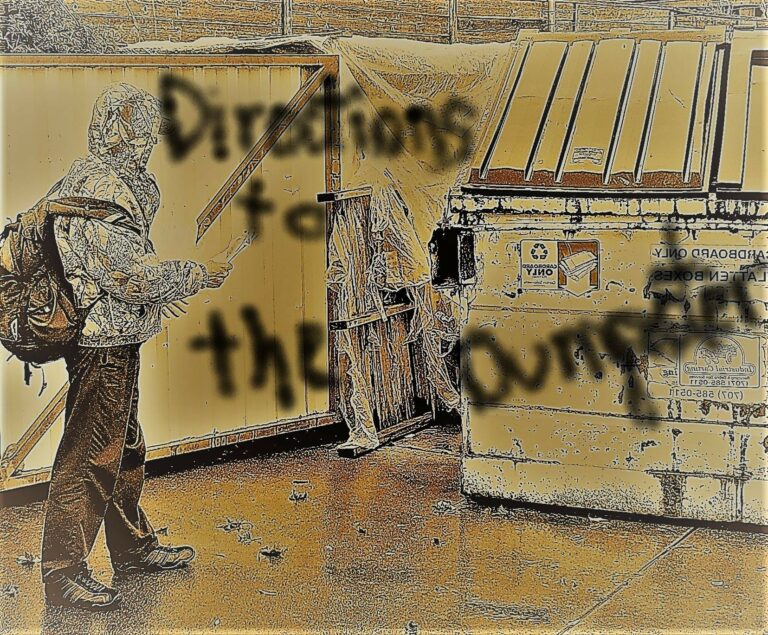
It’s just after midnight, and somebody is pounding on my window so hard I think it will shatter. I creep to the front of my stealth van and the security guard stops hammering at the glass with his flashlight. He says “you can’t sleep here” and finishes writing down my license plate number.

There are a lot of reasons I feel like I should be able to park here. I’m a member at this 24 Hour Fitness. It’s the middle of the night and there are plenty of spaces in the nearly empty lot. I’m inside my vehicle keeping quiet and bothering no one. As soon as the grocery store here opens I’m going to go inside and get breakfast, then go to the Starbucks across the lot for coffee. I’m giving money to three of the businesses this parking lot services.

But I know this security guard doesn’t care about any of that, he’s just doing the job required of him by another person who is also just doing their job.

More importantly, if I make it an issue and the police get involved, my only home could be towed or impounded, held hostage for amounts of money I don’t have—despite being employed. I have to get up and go to work in the morning. I’ll be back in a few hours to use the gym here, but will my license plate number be on some kind of list? Will my van get towed while I’m in the shower?

To be safe, I’ll have to park nearby and walk an extra block to the gym in the morning. These are my thoughts as I drive my stealth camper out of the Rohnert Park shopping center and look for a new place to sleep.

A stealth camper is a vehicle designed for living on the inside, but with the exterior of a “normal” vehicle. Mine is a minivan. It sacrifices living space for maximum ability to blend in with other cars on side streets and in parking lots. Even so, if you know what to look for, you can still often tell when someone’s sleeping in their vehicle. That’s why the security guard was able to single me out. It’s also how I know that every single parking lot I’ve hit up between San Rafael and Santa Rosa has had at least one other person sleeping in it, usually more like three to six. There are a lot more people living this way than you might suspect. For me, it was the best of a bad choice, and I choose to see it as an adventure. For others, it’s a hardship they cannot escape.

I grew up in Kenwood and Sonoma. I’ve attended school in Napa and Santa Rosa, I’ve worked in Novato and Yountville, and I’ve lived in Suisun and Rohnert Park. I’m a North Bay human, through and through. I watched the number of people living in their vehicles explode during the years I lived in San Francisco and Oakland, and now I’m seeing it happen in the North Bay, too.

According to the Public Policy Institute of California, more than a third of all California residents live in, or near, poverty. The situation in California continues to worsen, as more and more people with good jobs can’t afford to buy a house, lack the finances to raise children and struggle to pay rent.

During my first nine months in my current vehicle, I worked as a restaurant manager in Novato. I put in 65-hour weeks, and I couldn’t afford my own apartment. Let me clarify—I had the money to pay rent, but not enough to also pay the rest of my bills and eat. I’ve learned from experience: a rent situation like that leaves you one bad month away from homelessness. My opinion is that it’s better to be homeless on purpose, with a workable plan, than to wind up dealing with it unexpectedly. And I have reason to know.

About 15 years ago, I became homeless in Santa Cruz. I’d been working a job that barely covered my expenses, then I lost some hours one month—I got sick one week and a couple of weeks later they closed for a few days for repairs—and that’s all it took. Trying to play catch up for the next couple of months while late fees exploded throughout my budget was a losing proposition; I lost my room in the house I lived in the same week I picked up a second job. I spent that winter homeless.

It was a serious situation. That year was a cold one, and we lost a couple of people to the low temperatures. I still think about one old man in particular, who died of exposure halfway through the season. I struggled. Even with two jobs, I couldn’t dig my way out of my situation. Living functionally while on the streets can actually cost more money than if you have a home. Without a kitchen, I spent hundreds of dollars more per month on food, and still got less nutrition. It cost me a couple hundred dollars a month in random purchases to access “customers only” bathrooms, just so I didn’t have to urinate in the streets like a dog. It was an impossible situation. I finally moved back to Sonoma County, where I had a better support system and, with significant help, was able to get back on my feet.

The time I spent homeless taught me something important; the experience itself can unbalance you significantly. It may be impossible to tell if a severely mentally ill person is on the streets because of their condition, or has become severely mentally ill simply because they are on the streets. That person you see yelling at the empty park bench might have been a normal, sane person not long ago. Living that life for those few months was mentally challenging in ways I had not anticipated.

Close to a decade later, unemployment was higher than it had been in almost 30 years. I was in Portland, failing to get more than a part-time job and facing a situation similar to my Santa Cruz experience. I knew I had to move before I became homeless again.

My move depended on some money I was owed; however, I found out I wouldn’t be getting that money 27 days after I turned in my 30-day notice on the apartment. The result was that I spent that summer living in my truck while I saved up enough for a deposit so I could move back to the Bay Area.

Once again I faced difficult and frightening times. The back window on the camper shell door shattered just as it started to rain one day. Somebody tried to break into my truck while I was sleeping in it one night. Sleeping in my vehicle took a toll on my mental health. Still, having the truck made a huge difference, and my previous homeless experience helped me navigate this second round.

So in 2018, when I faced the fact that even with a decent, full-time job I couldn’t dependably pay rent in my home state, I considered alternatives that might seem extreme to some.

Researching, I found a surprising number of people on “Van Life,” “Stealth Camper” and “Van Dweller” forums online. As soon as I started actually living in my vehicle, I began noticing how many other people were doing the same thing. Some in old, busted-up vehicles, others in built-out campers, still others in brand-new SUVs. Clearly, several of them are doing what I am doing, staying homeless while employed. More so than people on the streets or in tents, people who live in their cars keep to themselves, which makes sense; alone we’re often not noticed, but grouped together, we become a target for concerned citizens and the authorities—a fact hammered home with a recent boom in “shoppers only—others will be towed” signs in grocery-store parking lots.

But I became curious. How many people are living this way? Is that number going up as much as it seems like it is? Who else is living this way and why? Similar curiosity plagues me regarding the tent encampments we’re seeing more and more of these days.

Search “homelessness in the U.S.” online, and your first few hits might suggest homelessness is declining nationally. However, there are reasons to conclude this isn’t true. For one, most of those homeless population studies and charts only take into account the last 10 years or so, which means the numbers go back no further than the Great Recession, when homelessness would have reached an all-time high. Naturally, there has been some decrease since then. On the other hand, there is plenty of evidence to indicate this is a serious problem with highs both before and after the recession.

According to the U.S. Conference of Mayors, the demand for emergency shelter in 270 U.S. cities increased 13 percent in 2001 and 25 percent in 2005. Additionally, despite what some statistics seem to indicate, homelessness hasn’t progressively decreased since 2007; according to the United States Department of Housing and Urban Development, in 2017 the number of people experiencing homelessness in unsheltered locations increased for the third consecutive year. Steep increases in homeless populations in California seemingly indicate that U.S. homelessness is on the rise overall.

The Department of Housing and Urban Development reports that in 2019, 21 states reported increases in the number of persons experiencing homelessness, with California’s homeless population increasing by 21,306 people, or 16.4 percent. That’s more than the total national increase of every other state combined. The Golden State has the dubious honor of containing about half our country’s homeless people.

Here, in the Bay Area, we are home to the third-largest homeless population in the country, surpassed only by New York and L.A. And our homeless crisis is moving from well-known urban centers such as Oakland and San Francisco to smaller communities such as Napa, Petaluma and Novato.

Santa Rosa, in particular, is facing homeless issues. And there may be far more people without homes than have been counted—homeless populations are notoriously difficult to track. It’s easy to find interviews with experts who explain why official counts miss many people. HUD counts, for example, take place during one of the coldest parts of the year—early in the morning in late January, when anyone who can find a temporary shelter of any kind is hidden from canvassers. And there is virtually no way to count people who are in “couchsurfing” situations.

It is similarly difficult to accurately assess the number of people living out of their cars. To answer my questions about who is homeless and why, I’ve begun interviewing homeless people in San Rafael and Santa Rosa.

It’s an emotionally exhausting exercise, but one I feel is important. In articles, talk shows and municipal propositions for homeless solutions, I almost never see any actual input from the thousands of homeless people themselves. And that is why, while I live in my little stealth camper and travel around the North Bay, I will be conducting more interviews and polls in homeless encampments and among vehicle dwellers.

I want to bring their points of view forward. We need to stop assuming we know any real information about these populations—who they are and what they need. I want to get information directly from the people experiencing it and bring it to
the public.

Homeless Shuffle

0

At a meeting on Jan. 28, the Santa Rosa City Council took two disparate steps. First, it approved an amendment to a contract with a local company which tows and stores vehicles, some of which people live in. Next, it discussed the possibility of expanding a long-running program to offer “safe parking” spaces for people living in their vehicles.

The county’s latest homeless count, conducted in late January 2019, states that, of the 2,951 people experiencing homelessness in the county, 29 percent live in vehicles.

According to the same count, there are 1,661 homeless people within Santa Rosa’s city limits—more than half of the total homeless in the whole county.

Local supporters of safe parking and sanctioned encampments—properties, often publicly owned, where people without shelter can stay without fear of law enforcement action—believe they give homeless people
an opportunity to get back into permanent housing.

Both Santa Rosa and Sonoma County have long opposed implementing sanctioned encampments or safe parking at a meaningful scale. Instead, officials have largely argued for a Housing First model which calls for constructing new housing units to house homeless people.

While Housing First might offer the best form of long-term shelter, critics point out that thousands of people will be left on the streets with no formal shelter while the county attempts to build thousands of additional housing units.

That stance may be changing. Following the highly-publicized stand-off at Joe Rodota Trail, the county approved a temporary, sanctioned encampment at Los Guilicos and will discuss the possible location of a safe parking lot.

At the Jan. 28 council meeting, Santa Rosa appeared to be moving in the same direction.

The city council discussed the possibility of expanding its safe parking pilot program, known as Community Homeless Assistance Program (CHAP). CHAP has been in operation since October 2015, when it was first approved as a year-long pilot program. The program allows local churches and other private property owners to let people living in their vehicles stay in parking lots.

In Nov. 2016, the city council formalized the program and set aside $20,000 to pay property owners hoping to join the program. To date, the city has paid two churches a total of $13,890, according to a staff report from the Jan. 28 meeting. Three churches are participating in the program, offering approximately 30 parking spots where people can park overnight.

“The estimate [by Catholic Charities, one of the city’s nonprofit contractors] to operate a 100-spot, scattered-site program, overnight (8pm to 7am) with comprehensive services (housing-focused) is approximately $530,000 annually,” the staff report states.

At the same time, the city has continued its policy of towing recreational vehicles around the city, sometimes resulting in a person losing their vehicle permanently.

At the Jan. 28 meeting where they discussed expanding the safe parking program, the council approved a $100,000 extension to the city’s contract with Cream’s Towing, a local company which has long offered services to Sonoma County and local cities.

The addition would bring the city’s total spending on towing vehicles to $295,000 since the contract was first approved in 2018. That’s far more than the council ever gave to CHAP, the safe parking pilot program.

In order to recover their vehicle, a person must pay the Santa Rosa Police Department a $200 “recovery fee” on top of the tow and storage fee charged by Cream’s Towing. Sgt. Josh Ludtke, head of the police department’s traffic division, says the recovery fee varies depending on the reason they towed the vehicle. For instance, the city doesn’t charge to release a stolen vehicle.

If an individual is unable to pay to release their vehicle, they may end up living on the street, in a tent or in a homeless shelter.

Alicia Roman, an attorney who represents local homeless people, says the practice of towing vehicles people are using as housing is “counterproductive.”

“Citing and towing vehicles for parking violations makes them less likely to transition to stable housing and creates a dangerous situation by leaving them exposed and vulnerable out in the streets,” Roman said.

According to a Jan. 28 staff report, the number of recreational vehicles towed in recent years has exceeded expectations, leading to increased costs for the city.

“Funding for this contract has well exceeded historical annual spend levels for these services,” the staff report states. “There were several large-scale clean-up and disposal projects that have exhausted all previous approved funds.”

Under Cream’s contract with the city, the towing company will tow and store all small vehicles without additional fees, but tacks on additional fees for recreational vehicles.

Cream’s charges the city between $1,500 and $3,500 to tow and store an RV depending on the size of the vehicle, according to the amended contract.

It’s not clear how much Cream’s charges vehicle owners for storage and towing fees. The company does not publish the information on its website and did not respond to multiple requests for comment.

Ludtke says the city cannot regulate the amount tow companies charge because the California Highway Patrol regulates costs statewide.

In an interview, Brandalyn Tramel, the city’s purchasing agent, confirmed that the expanding cost of the contract was due to the increase in the number of large vehicles Cream’s towed, the only uncontrolled cost in the contract.

Ludtke acknowledges that towing a vehicle could pose a serious problem for someone using it as shelter. However, he says the larger solution to the problem is something policymakers at all levels need to find solutions to. It is the police department’s duty to respond to complaints, Ludtke says.

Vice Mayor Victoria Fleming, a supporter of the proposed expansion of safe parking, did not respond to a request for comment.

In San Francisco, lawmakers are considering reducing tow fees for those who can prove they are homeless to just $100.

District Attorney Warns Against Coronavirus Price Gouging

0

With concern continuing to grow over the possible spread of the Coronavirus, Sonoma County District Attorney Jill Ravitch reminded local businesses of the state’s anti–price gouging law last week.

“California’s price gouging law prevents business from wrongfully profiteering on essential goods, supplies and services during an emergency,” Ravitch said in a statement. “I urge all businesses operating in and around Sonoma County to understand and comply with the law, and I encourage anyone who has been the victim of price gouging, or who has information regarding potential price gouging, to immediately file a complaint.”

Penal Code Section 396 defines price gouging as “raising the price of many consumer goods and services by more than 10 percent after an emergency has been declared.”

The Sonoma County Department of Health Services and Gov. Gavin Newsom have both declared a state of emergency due to the spread of the virus. Price gouging protection will stay in effect until Sept. 4, 2020 under Newsom’s declaration of emergency.

Violators of the price-gouging ordinance could be subject to as much as a year in county jail and a $10,000 fine.

Ravitch’s office sent out similar warnings following the October 2017 wildfires. On Dec. 24, 2019 Newsom extended the state of emergency for Sonoma, Napa and several other fire-affected counties until Dec. 31, 2020.

That order covers rental housing, food, medical or emergency supplies and construction materials, among other things.

Residents can file complaints online at the Sonoma County District Attorney’s website (sonomacounty.ca.gov/District-Attorney/) or call 707.565.5317.

Climate Activists Organize Community Summit

[UPDATE: The following event was cancelled due to the spread of COVID-19.]

The Sonoma County Climate Activist Network (SoCoCAN) will host an event this Sunday, March 15 that will include numerous local activist groups and nonprofits, and a local elected official.

Speakers will include wildlife biologist and Sonoma County Poet Laureate Maya Khosla, Sonoma State University graduate student Cory O’Gorman and North Bay Organizing Project Environmental Justice Organizer Tayse Crocker, who will share their work on wild lands and waters.

Elizabeth Kaiser, of Singing Frogs Farm in Sebastopol, will speak about how using sustainable farming methods can regenerate soils, grow healthy foods and restore balance to local ecosystems.

Members of the youth climate action groups, Sunrise Movement and Schools for Climate Action, will talk about their work—and how older activists can assist them.

Lynda Hopkins—farmer, environmentalist and Sonoma County Supervisor—will speak about the environmental issues facing the county in the coming years and elected officials’ role in solving them.

The event will be held on Sunday, March 15 from 1:30–6:00pm at the Odd Fellows Hall at 545 Pacific Ave. in Santa Rosa. The Sonoma County Bicycle Coalition will provide free bicycle parking. For more information, contact So*************@***il.com or call 707.595.0320.

Sci-Fi Takes Center Stage

0

To genre purists, the idea of androids navigating the footlights of a stageplay may lack the obvious Reese’s factor (“two great tastes together at last”).

There’s precedent, however; 2020 marks the 100-year anniversary of the coinage of the word “robot,” courtesy of Czech playwright Karel Capek and his play R.U.R.: Rossum’s Universal Robots, published in 1920. Here, playwright David Templeton takes the baton and points it deep into outer space to explore the most interior of matters.

Many know of Templeton’s contributions to these very pages the past quarter-century or of his various turns as a playwright in the last decade or so (Drumming with Anubis, Wretch Like Me), but now Templeton is boldly going where no Sonoma County theater has gone before in his play, Galatea.

It’s 2167 and robot-specialist Dr. Margaret Mailer (Madeleine Ashe) conducts a series of clinical sessions with an android named 71 (Abbey Lee), the sole-surviving member of a “synthetic support crew” assigned to the colony-vessel Galatea. But that’s not the weird part—the Galatea disappeared over 100 years ago along with its 2,000 human passengers. As 71’s shrink-sessions progress, Dr. Mailer realizes she’s hiding something—something potentially horrifying.

Much of Templeton’s onstage writing has been autobiographical—heavy stuff like overcoming a teenage bout of Christian fundamentalism. And yet, the genre’s trappings and tropes (robots; long, cryogenic naps) opened ways for Templeton to explore his own existential quandaries—as it has with many sci-fi writers.

“In some ways, it’s one of the most personal plays I’ve ever written,” says Templeton, who is most-likely human (though his dead-on impression of Donald Sutherland as a pod person from Invasion of the Body Snatchers does raise questions).

Another human aboard this theatrical vessel is director Marty Pistone, whose own science fiction bona fides include appearing on-screen as Controller #2 in Star Trek 4: The Journey Home and performing stunts in Jay and Silent Bob Strike Back.

“The questions and conundrums that ‘Galatea’ explores—questions about the meaning of humanity and its value on Earth—are questions I’ve been thinking about for much of my life,” Templeton says.

Indeed, questions loom—namely, how did 71 wind up alone in deep space, and what exactly happened aboard the Galatea? But perhaps the deeper mystery Templeton and his characters hope to solve—and one to which this particular mix of artists, genre and medium are uniquely suited—is: what does it mean to be human?

A Call for Grit

0

Sonoma County has a long history of “problems” with law enforcement agencies going back at least 20 years or so. For example, this quote from a Press Democrat story from 2014: “In 2000, a U.S. Civil Rights Commission advisory committee recommended Sonoma County, Santa Rosa and Rohnert Park implement citizen review boards, noting the grand jury’s lack of financial independence and organizational separation from local law enforcement.”

In point of fact, there have been problems with the Sheriff’s Department and cities in Sonoma County with law enforcement agencies—an inordinate number of deaths of people held in custody and of fatalities during arrests by police or Sheriff’s Deputies—and recommendations by federal civil rights commissions and grand juries for independent citizen review bodies at the county level.

Prompted by the Andy Lopez fatal shooting by Deputy Gelhaus a few years back, a citizen’s police review board (IOLERO) was finally established after decades of expressed concern by county residents. Yet still and very recently there have been fatal incidents, killings of people by county law enforcement, and so it appears that police oversight, independent investigation and accountability are more in need than ever.

But now it also appears that the agency created to do this oversight work—referred to in bureaucratese as “auditors”—is being manipulated to become a toothless, compliant and subservient tool of the Sheriff’s Office. You may think this is hyperbole, but with even the most basic awareness of police/civilian relationships here and elsewhere it’s a common problem of major proportions and everyone knows that.

The Sheriff’s Office fought with the prior head of the oversight agency until he resigned in utter frustration and resistance to doing his job. We, the public, know this. His current replacement seems hell-bent on rendering the agency she’s supposed to lead and champion into one of no consequence that serves the law enforcement agency she’s supposed to watchdog.

Is this your objective as well, Board of Supervisors? Are you going to relinquish your promise and duty to the people of Sonoma to hold police accountable for their actions and subject them to an independent investigation by outside agencies? Are you so politically intimidated by the sheriff and the district attorney that you will not stand up for the people who elected you? Will you show some grit in this matter and honor what you set out to do just a few years ago in the name of a child who was killed—shot eight times—for carrying a toy gun?

This is bigger than Sonoma County. This is a national issue. Be the leaders we elected you to be.

We welcome your contribution. To have your topical essay of 350 words considered for publication, write op*****@******an.com.

Where California Stands with Coronavirus Testing Right Now

By Rachel Becker and Ana B. Ibarra, CalMatters Coronavirus testing has been plagued by confusion, delays and chaos, with the number of available,...

BottleRock Napa Valley Postponed to October

Headliners confirmed for new dates, festival passes will be honored

Sonoma County Issues “Shelter-In-Place” Order

One day after six Bay Area counties issued "shelter-in-place" orders in response to the spread of the Coronavirus, Sonoma County has followed suit. Sonoma County's order, issued by the county's interim Health Officer Dr. Sundari Mase, goes into effect at midnight. The following text comes from a county press release: ...

Stay Home

News breaks quickly these days. Over the weekend, Sonoma County officials announced two cases of “community transmitted” Coronavirus, adding to two previous cases residents acquired while traveling outside of the county. On Monday, the county announced two more cases, bringing the total number to six. ...

Residents Request Eviction Protections

Hours before Gov. Gavin Newsom called for the closure of bars, nightclubs and wineries throughout California in response to the spread of COVID-19, Sonoma County's top elected official said that grappling with the economic fallout of the crisis is the "next step" after coping with the public health impacts of the virus. Asked at Sunday, March 15 press...

A Man, a Van, a Plan

It's just after midnight, and somebody is pounding on my window so hard I think it will shatter. I creep to the front of my stealth van and the security guard stops hammering at the glass with his flashlight. He says "you can't sleep here" and finishes writing down my license plate number. There are a lot of reasons I...

Homeless Shuffle

At a meeting on Jan. 28, the Santa Rosa City Council took two disparate steps. First, it approved an amendment to a contract with a local company which tows and stores vehicles, some of which people live in. Next, it discussed the possibility of expanding a long-running program to offer “safe parking” spaces for people living in their vehicles. The...

District Attorney Warns Against Coronavirus Price Gouging

With concern continuing to grow over the possible spread of the Coronavirus, Sonoma County District Attorney Jill Ravitch reminded local businesses of the state's anti–price gouging law last week. "California's price gouging law prevents business from wrongfully profiteering on essential goods, supplies and services during an emergency," Ravitch said in a statement. "I urge all...

Sci-Fi Takes Center Stage

To genre purists, the idea of androids navigating the footlights of a stageplay may lack the obvious Reese's factor ("two great tastes together at last"). There's precedent, however; 2020 marks the 100-year anniversary of the coinage of the word "robot," courtesy of Czech playwright Karel Capek and his play R.U.R.: Rossum's Universal Robots, published in...

A Call for Grit

Sonoma County has a long history of "problems" with law enforcement agencies going back at least 20 years or so. For example, this quote from a Press Democrat story from 2014: "In 2000, a U.S. Civil Rights Commission advisory committee recommended Sonoma County, Santa Rosa and Rohnert Park implement citizen review boards, noting the grand jury's lack...
11,084FansLike
4,446FollowersFollow
6,928FollowersFollow