Craft Beer Week

Annual Cali brew cruise

This much I know I love: California Craft Beer Week starts on a Friday and ends on a Tuesday—11 days later.

That’s a helluva week of beer and precisely the kind of math I do after I’ve had a couple of pints (and by a couple, I mean multiply everything I say by a factor of two). This recalls the “fuzzy logic” some mathematicians made vogue in the ’90s, but with more fizz.

Fuzzy logic is “employed to handle the concept of partial truth, where the truth value may range between completely true and completely false,” according to the mathematical minds of V. Novák, I. Perfilieva and J. Močkoř in their treatise Mathematical Principles of Fuzzy Logic. “Fizzy logic,” from the tragicomical mind of D. Howell, means about the same, but with some local brews, a pinch of deadline anxiety and more press releases from the beloved flack of fizz Jesse P. Cutler than one ever thought possible thrown in.

Nearly a decade ago, I had a gig at Fandom (then Wikia) seeding their beer wiki with beery bon mots. Cutler, if memory serves, secured me media credentials to an early iteration of California Craft Beer Week that was tantamount to scoring one of Bogart’s ill-gotten letters of transit in Casablanca. It meant I had safe passage from the South Park, San Francisco, tech barge and could wade my way to the Isle of Beer and still be on the clock. I remain both grateful and hungover.

When our dear publisher reminded me that the Craft Beer Week was upon us, falling as it does close to our Love & Sex edition, I was confident I could combine the concepts into a single, frothy valentine.

But love of beer is different than love and beer. If they meet in the wrong proportions, they get jealous of one another and the sense of betrayal sounds something like Caesar slurring “Eh, brew, touché?”

If you’re one of a couple and looking for a third in the form of brew, here’s my Fizzy Logic: If a beer can survive in Wine Country, it must boast some kind of evolutionary mutation that makes it worth raising the wrist. I found it in HenHouse Brewing Company’s timely release “Cluck The ’Rona.” This kick-ass Kölsch may not cure Covid, but it will definitely help you survive quarantine (not to mention, help get your craft brew column to the finish line).

Editor Daedalus Howell is the lead singer of Beers for Fears at DaedalusHowell.com.

Open Mic: The Death Penalty’s True Cost

By David Dozier

A study in California revealed that the cost of capital punishment in the state has been over $4 billion since it was reinstated in 1978. Since California has executed 13 prisoners during that time, the cost per execution is more than $307 million. Other financial facts about the death penalty show capital cases in some states costing millions more than life imprisonment. 

So, more people are asking: Is it worth it? 

Cost is one factor people sometimes don’t consider in that debate. The complexity of seeking it and carrying out an execution is a long and expensive process. Many capital cases are appealed, and incarceration on death row can span 10, 15 or 20 or more years. And with capital punishment costs imposing a burden on state government budgets that are already stretched, it’s more cost-effective to commute death penalties to life imprisonment without parole. 

But cost is just one reason that President Joe Biden should work toward ending the death penalty in the U.S. As part of his criminal justice reform platform, he has pledged to abolish the federal death penalty and to give incentives to states to stop seeking death sentences. (Currently, capital punishment is authorized in 28 states.) Another reason to end the death penalty is its ties to racism. The Biden-Harris administration plans to address racism on many fronts. 

Awareness of the killings of unarmed Black people by police has heightened the sensitivity of White Americans to racial injustice and prompted protests. The death penalty is targeted at persons of color: Black Americans make up 13% of the U.S. population – but 34% of persons executed since 1976. 

Too often, the death penalty is a poor man’s punishment. District attorneys are more likely to go after poor defendants who are trying to fight for their lives with overworked and underpaid public defenders. DA’s sometimes put dirty cops above the law by refusing to prosecute police who kill unarmed persons of color. That’s because police unions and prison guard unions pump lots of money into DA political campaigns. But if a Black man kills a policeman, police and police unions will push DA’s to seek the death penalty. 

A third reason the death penalty should be eliminated both in the U.S. and around the world is because it is cruel – a barbaric and sadistic violation of human rights. It is pure hypocrisy for a nation such as ours to view itself as a beacon for human rights while ranking seventh in the world for the number of executions we administer. Executions are a form of torture that violate the Eighth Amendment prohibiting the federal government from imposing cruel and unusual punishment. 

The U.S. government under President Donald Trump in 2020 carried out the most federal executions ever in a single year. But under Biden, the pendulum should swing; the question is how much on a state level. Meantime, it’s good to see public opinion shifting toward the elimination of the death penalty. Using an unbiased question, a 2019 Gallup poll on capital punishment showed 60% of Americans favored life in prison for murder while only 36% preferred the death penalty. 

Public support for the death penalty has dipped near a 48-year low, and at the same time there is a bipartisan movement in state legislatures and Congress to end it. Many politicians and ordinary Americans are bothered by executions of innocent people. For every nine prisoners executed, an innocent death row inmate is exonerated. DNA science and advances in law enforcement have cleared numerous death row inmates. 

Numerous Democratic lawmakers have already written to President Biden about their objections to the death penalty, asking him to sign an executive order to eliminate federal executions and calling capital punishment unjust, racist and defective. And conservatives in several states have pushed back against the death penalty, saying it is too costly, inconsistent with conservatives’ opposition to abortion, subject to error, and not an effective deterrent. 

The momentum of states toward abolishing the death penalty, and the strengthening  bipartisan footing against it on state and federal levels, make Biden’s goal of ending capital punishment a stronger possibility. You can measure the cost of the death penalty in many ways – in terms of public policy and sheer, enormous dollars; in morality; and in racism. But any way you slice it, it comes out as wrong. The Biden Administration has a great opportunity to get it right. 

David Dozier is the author of “The California Killing Field.” To have your topical essay considered for publication, write to us at op*****@******an.com.

Letters to the Editor: Past the “Good By” Date

Past Time

I read with interest the sad story of Mr. Peter and the City of Petaluma (“Spilled Milk,” Jan. 27). First off, I think it necessary to reiterate the obvious: full marks to the City of Petaluma for repeatedly trying to see this business succeed. I think a “reasonable” person would agree that basically: enough is enough, and those efforts need to be discarded and further action, like a tax lien, is the next step.

Ray Charles can see that Mr. Peters management of this business presents a real hazard to the community he apparently so wants to be a part of. I personally think this business could possibly be profitable, but it will take a person with tenacity and willingness to work within the system as it is today, as well as management skills and a solid business plan to make this happen. Here’s to hoping so. When one has a carton of milk which is spoiled … Mr. Peters is past his “best by” date.

Joseph Brooke, Pt. Reyes Station

New Start

Editors,     

President Biden is foolishly endangering this nation and the whole humanity by attempting to intimidate Russia’s President Vladimir Putin with his barrage of highly critical and insulting remarks made toward Russia’s present leader. I was hoping-perhaps naively-that our new President would show greater wisdom than our former presidents by finally replacing the U.S.’s cold war hostility towardRussia with a genuinely sincere attempt to de-escalate the frightening tensions with that great nation. It is this angry rivalry between our nations that has created the suicidal nuclear arms race and has kept the entire human race in constant peril of a nuclear holocaust.   

By quickly leveling serious charges of human rights abuses against President Putin, President Biden has denied Russia’s leader of the basic right afforded to even common criminals-the right and human courtesy to express his own views on Navalny’s arrest ect. without being prejudged as guilty.   

It is this constant and underlying rage expressed by our new president toward another world leader that has brought nations to war in the past 10,000 years and led to the deaths of untold millions of innocent human beings in the most ugly and inhuman military conflicts imaginable.   

To continue on this now ancient path toward future wars will lead to the destruction of all life on this planet. The impending catastrophe of global warming coupled with the existence of thousands of nuclear weapons will not permit us humans to remain as we are. Our very survival as individuals and as a species demands that humankind take a quantum leap in intelligence, empathy and understanding each other.    

In the name of sanity and all that is beautiful, just and compassionate, I urge President Biden and our nation’s other leaders to abandon this failed path of anger, excessive national pride and international confrontation. We must not miss the fleeting opportunity to join with Russia, China, Iran, North Korea and all the other nations of the world in finally replacing violence, hatred, global warming and nuclear weapons with genuine international peace and an atmosphere of love and human solidarity.   

Most sincerely yours,     

Rama Kumar, Fairfax

Convict Trump

Dear Editor,

Today I was sickened once again by the video scenes of mayhem at the Capitol on January 6. Ask anyone who was involved (or see their hats, banners, and flags) and they will say they were “invited” by Trump. That they were urged to storm the Capitol. We heard him do that, and imply he would go with them. It was criminal of a President–or a private citizen–to request this deadly action.

People were killed. Others thought they would die. Senators were threatened. People were using the American flag to beat police officers. The world was watching the near downfall of our Democracy.

What are Senators doing in Washington if they do not have the moral courage to uphold their oath of office, and defend the constitution by officially condemning and convicting Donald Trump? Damn their next election. Vote to uphold decency and Democracy!

Alice Cochran, San Rafael

West County Ballot Measure Seeks to Raise Hotel Tax

Love birds visiting the Sonoma County coast and Russian River for Valentine’s Day next year will need to pay a little more for their romantic getaway if voters pass a measure on the March 2 ballot.

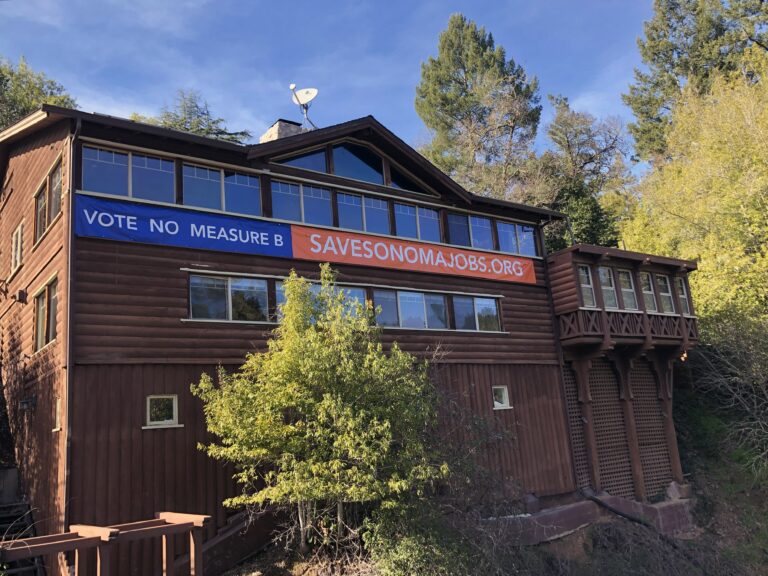
Measure B, one of two items up for consideration in Sonoma County’s upcoming special election, would increase an existing tax on West County hotels and vacation rentals until the measure is repealed. Currently, the bed tax on short-term stays, known as a transient occupancy tax (TOT), is 12 percent on hotels in the unincorporated county, included in the West County. If passed with two-thirds of the vote, Measure B will raise the TOT to 16 percent on West County establishments, generating an estimated $2.7 million per year for local services.

Half of the new funds would be designated to fund West County fire departments’ paramedic services and the consolidation of fire departments, which proponents say will increase the departments’ efficiency. The other half of the funds would pay for school infrastructure and programs, with the specific spending decision to be determined by a special advisory committee created by the Board of Supervisors.

The proposal for school funding comes as enrollment in West County schools continues to decline, leading officials to threaten to close El Molino High School this August in an effort to save funds by consolidating students. Measure A, the other item on the March 2 ballot, would extend an existing parcel tax for three years to delay the closure of the school and give administrators time to plan for the West County school system’s future.

Unsurprisingly, the debate around Measure B centers on whether the tourists who flock to the area to see natural beauties, shops, restaurants and other attractions are paying enough to support the local services they use.

Sonoma County Supervisor Lynda Hopkins, who represents West County and supports Measure B, believes the industry can afford to chip in more. She says hotels can pass the additional tax on to guests and argues that most tourists will not be put off from spending the night in the West County by the additional tax.

“Given the amenities that we have: the Sonoma County coastline, the Russian River and beautiful redwoods. … is $8 [on a $200 room] really going to stop you from traveling to Sonoma County when you could easily spend 10 times that on dinner?” Hopkins said in an interview.

Opponents of the measure—who include local hoteliers, restaurant owners, Airbnb hosts and the Sonoma County Farm Bureau—disagree, worrying that the tax will decrease the number of overnight guests and slow the recovery of the tourism industry, which has been one of the worst impacted by the Covid-19 pandemic.

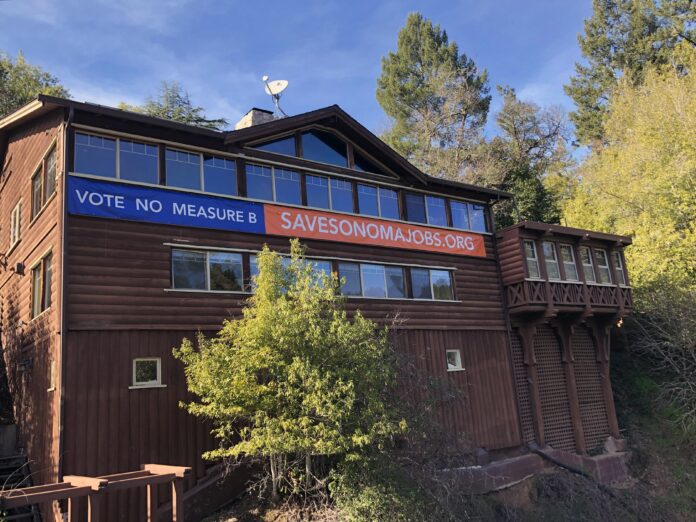
“Our position isn’t one of not wanting to support emergency services or schools … but more just the fact that the tax increase, without a doubt, will decrease visitation and slow our recovery coming out of Covid,” Joe Bartolomei, the owner of Forestville’s Farmhouse Inn, told the Bohemian. Bartolomei is an organizer behind the “Save Sonoma Jobs” campaign committee opposing Measure B.

As of Jan. 19, “Save Sonoma Jobs” had raised $4,750 from a variety of West County business owners to oppose Measure B, according to available campaign finance records. “Tax Tourists Fairly,” the committee supporting the measure, had raised $11,000 by Feb. 5, with funds so far coming from Hopkin’s supervisorial campaign committee, the Russian River and Bodega Bay firefighters’ unions and Operating Engineers’ Local Number 3.

Ups and Downs

In 2019, Sonoma County gathered $48.7 million in TOT funds, matching 2018 for an all-time high, according to the Sonoma County Economic Development Board’s (EDB) 2020 tourism industry report. All told, 10.2 million tourists visited the county, with 4.9 million staying overnight in 2019.

Tourism, however, can be a fickle industry—especially during worldwide pandemics as it turns out.

Job loss in Sonoma County’s hospitality industry reached nearly 30 percent in the county due to the Covid-19 pandemic and resulting health restrictions.

In 2020, hotel and short-term rental occupancy rates in Sonoma County fell by 40 percent as compared to 2019, according to the EDB’s annual report. And, according to a study by the National Travel Association, worldwide rates of domestic and international travel may not reach 2019 levels again until 2024. Those trends make Measure B and other similar taxes a crapshoot, opponents warn.

In a recent report on the possible impacts of Measure B, Robert Eyler, a Sonoma State University economics professor, predicts that the results of Measure B will be tied to the West County’s overnight occupancy rates. If the rate increases above 2019 levels, businesses will split the additional revenues with the county. If overnight tourists don’t flock back, the new tax measure won’t raise as much—or anything in the worst case scenario—and employers will lay off workers.

Another factor at play is the rise—and vilification—of digital vacation rental platforms like Airbnb and Vrbo. Politicians and housing advocates around the world have panned the platforms for incentivizing property owners to remove housing units from circulation, driving up the prices for people who want to live in an area full-time. 

A 2017 study found that a 1 percent increase in the number of Airbnb listings in a zip code led to a 0.018 percent increase in rents and a 0.026 percent increase in home prices. The West County, beautiful as it is, no doubt suffers from this effect to some degree.

Tax Targeting

Opponents of Measure B also question whether the tax should target the tourism industry. They argue that the first responders are more burdened by daytrippers visiting from the Bay Area or the urban centers of Sonoma County than the area’s overnight guests, who would end up paying the additional TOT fees.

At a Feb. 3 community forum hosted by the League of Women Voters, Sonoma County Fire District Chief Mark Heine said that 80 percent of patients treated and transported by the Bodega Bay Fire District were non-taxpayers, meaning that residents of the fire district are subsidizing emergency services for tourists.

Heine later acknowledged that he does not know how many of the non-taxpayers (i.e. tourists) who used Bodega Bay emergency services are daytrippers or overnight guests.

Still, opponents of Measure B have not suggested an alternative method to pay for the services. Their main argument is that the tax is overly burdensome and ill-timed.

Hopkins says she was partially inspired by Measure W, a TOT tax increase which nearly three-quarters of West Marin County voters supported in November 2018. Marin County’s TOT measure was projected to raise approximately $1.3 million for affordable housing and emergency services each year.

Recent Sonoma County elections indicate the electorate may be leaning in Measure B’s favor. In the November 2020 election, county voters passed all of the tax measures on the ballot.

Sonoma County Will Open Three New Vaccination Centers

By Bay City News Service

Sonoma County will open three new vaccination centers to serve residents age 70 and older.

According to a county press release, the first center will open today at the Petaluma campus of Santa Rosa Junior College at 680 Sonoma Mountain Parkway in Petaluma. 

Another will open Wednesday at the Huerta Gym in Windsor at 9291 Old Redwood Highway, Suite 200. The third is set to open Tuesday, Feb. 16, in the Sonoma Valley Veterans Memorial Hall at 126 First Street West in Sonoma, in partnership with the Sonoma Valley Community Health Center.

All three centers will have the capacity to provide 300 vaccinations per day. This brings to 19 the number of clinics being supported by vaccines from the county’s Department of Health Services.

The county announced last week that 11 Safeway stores across Sonoma County are scheduling vaccination appointments for eligible residents. In addition, CVS Health has said it will start administering vaccines to eligible populations at CVS Pharmacy locations in 100 communities across California, including the City of Sonoma starting Thursday.

For a complete list of vaccination sites in Sonoma County as well as the latest vaccine numbers, who is eligible for a vaccine and how to receive a vaccine, visit SoCoEmergency.org/vaccine or call 2-1-1.

Virtual and Distanced Events Offer Love in the North Bay

For a holiday that celebrates togetherness, Valentine’s Day in the pandemic is going to be a socially distant affair for many in the North Bay.

Luckily, several local venues and organizations are making due with virtual offerings and to-go goodies. Here’s a few place to look for love in the North Bay this week.

Events

Throughout the winter, Healdsburg’s open spaces and parks have been the canvas for the “Illuminations” art and light installations. One of the most popular installations, the New Year’s Light Archway by Artist Jordy Morgan, transforms this month into The Love Tunnel, a romantic and interactive community sculpture about love. At night, the tunnel will be illuminated with pink lights, paying tribute to the love shared in the community and in the world. Find the tunnel at artinhealdsburg.com.

While the Charles M. Schulz Museum in Santa Rosa remains closed due to the pandemic, it has been busy online with monthly drawing classes and other interactive live events. This month, the museum gets all mushy when it hosts “How to Draw Peanuts: Valentine’s Day Edition.” Cartoonist Robert W. Pope leads the online class and demonstrates how to turn the Peanuts gang into fun Valentine’s Day cards or other creative illustrations. The class meets on Thursday, Feb. 11, at 4pm. Tickets are $10 for Schulz Museum members and $15 general. Pre-registration required. Schulzmuseum.org.

Based in Sonoma County, the Paws for Love Foundation provides a lifeline to homeless pets by offering financial assistance to shelters and rescue organizations in the Western States. Each year, the nonprofit group gets the public involved with a fundraising gala. This year, the bidding goes online in the Paws For Love Virtual Silent Auction, featuring both popular returning auction items and exciting new packages. Bid in the auction from the safety of home and help at-risk animals find their “forever homes” beginning Friday, Feb. 12, at 5pm. Pawsforlove.info.

Wine and comedy always go well together when the Laugh Cellar and Charles Krug Winery team up for standup shows featuring special menus and local vino. During social distancing, the partners are presenting a new Virtual Wine & Comedy Series that kicks off this week with an online show featuring headlining comedian and broadcaster Maureen Langan on Friday, Feb. 12, at 6:30pm. Reservations includes wine delivered to you. Tickets are available at CharlesKrug.com.

Marin County–based Murphy Productions has been producing events that boast art and music in the North Bay for more than a decade. One of the group’s most successful ventures is the Sunday Salon series that continues this weekend with the seventh annual “Art of Love” Sunday Salon. Presented in collaboration with O’Hanlon Center for the Arts in Mill Valley, the online salon showcase features music by Tim Hockenberry, poetry from Cruwys Brown, photography of Paris from Lila Sparks-Daniels and more on Sunday, Feb. 14, at 5pm. $5–$20. Ohanloncenter.org.

Each February, the creative folks who participate in the Sonoma Writers Workshop come together to riff on Valentine’s Day in a poetry spectacular that usually takes place at Bump Wine Cellars in Sonoma. With social distancing still in effect, this year’s version of “Kiss and Tell: Confessions of the Heart” goes online and features writers including Jonah Raskin and Carol Allison and host (and this paper’s editor) Daedalus Howell, who will share their thoughts and feelings on Valentine’s Day, Sunday, Feb. 14, at 7pm. Free. Get the Zoom link at st********@***il.com.

Gifts & Goodies

East Washington Place, Petaluma’s latest shopping and dining center, is helping spread the love this holiday with a contest for a Valentine’s Day Gift Package to share with a loved one. The contest, open to those 18 and older, ends on February 10th. One winner will be randomly selected and notified via email on Feb. 11. Enter the contest for free at Eastwashingtonplace.com.

Sonoma County staples Bear Republic Brewing Company and Volo Chocolate are combining their flavors for a special Valentine’s Day beer and chocolate gift box. Available online now, the gift set features Bear Republic’s Baba Yaga chocolate stour in cans and Brown Porter in bottles paired with 3 different chocolates, two small tasting glasses, and a bottle opener. Order online at bearrepublic.com.

As it does every holiday, Left Bank Brasserie in Larkspur will be celebrating Valentine’s Day 2021 by offering special prix fixe menus available for on-premise outdoor dining as well as pick up and delivery. The special selection of French culinary offerings will be available alongside a selection of Champagne and sparkling wines, as well as cocktails, will also be available for pickup and delivery. Find the menus and reserve brunch or dinner delights at LeftBank.com.

Two of Healdsburg’s signature spots, Spoonbar and The Rooftop at Harmon Guest House, have reopened and are offering decadent dining experiences throughout Valentine’s Day weekend, February 12-14. The menu at Spoonbar includes delicious holiday additions to the restaurant’s a la carte menu, and Spoonbar will also offer a three-course to-go menu available for pick-up Saturday, Feb. 13 and 14. Harmon Guest House is also featuring a special holiday Bubbles and Bites menu throughout the weekend. Spoonbar.com / Harmonguesthouse.com.

Nestled in the Russian River Valley, Bricoleur Vineyards is hosting a Valentine’s Weekend Tasting Special Menu featuring four of their wines along with expertly paired seasonal bites by Executive Chef Shane McAnelly. The special will be available for outdoor dining from Friday, Feb. 12, to Monday, Feb. 15. For those who are stating home this weekend, McAnelly is also hosting a virtual culinary class on Feb. 13 at 5pm as part of the “All You Need is Love” bundle which is available for pick-up–and local delivery on Feb. 13 from 11am-2pm, with options for groups of 2 people and 4 people. Spots are limited, so reserve your spot at Bricoleurvineyards.com.

Located at the gateway to Napa Valley, The Meritage Resort and Spa and its neighboring Vista Collina Resort are looking forward to welcoming guests and valley residents to celebrate Valentine’s Day with an exquisite Valentine’s Day menu, outdoor activities and special room packages. Families will enjoy the Valentine’s Children’s Cookies Decorating on Feb. 13 at 9am and Tea Parties on Feb. 14 at 11am. Romantic couples will want to take advantage of the “Love, Napa” package featuring Champagne, Valentine’s dinner for two, spa services and more. There is also a “Galentine’s” package, wellness offerings and more at Meritagecollection.com.

Nurses Caravan for Health Care in Petaluma

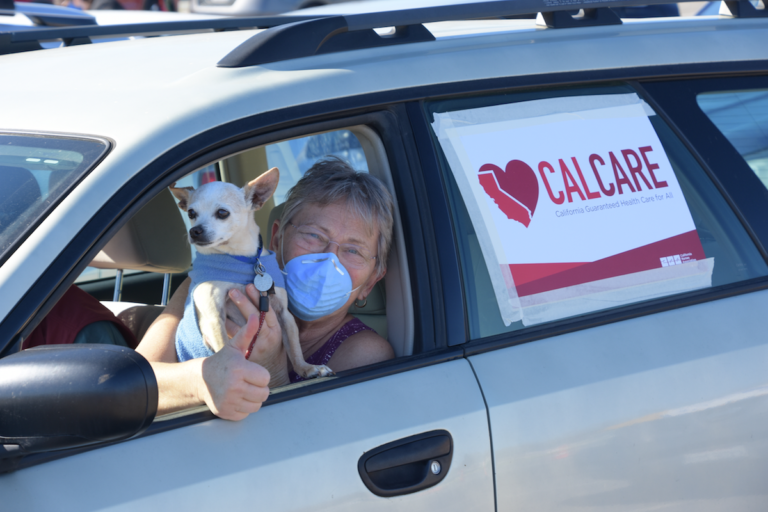
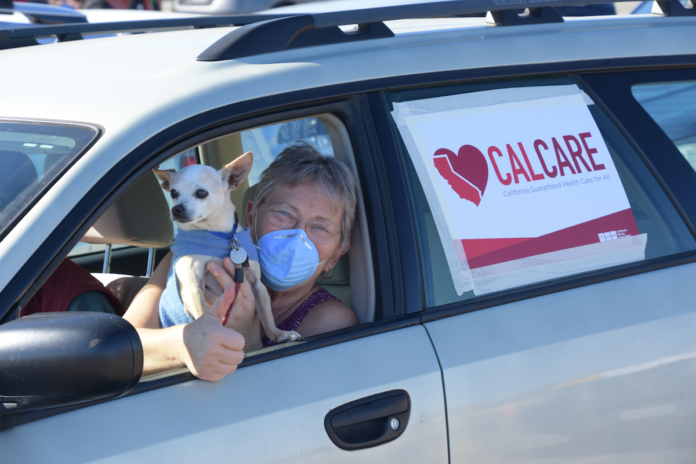
A caravan of more than 20 cars made its way through downtown Petaluma this past Saturday, Feb. 6, honking horns and waving handmade signs at passing cars and pedestrians as it zigzagged from the Petaluma Fairgrounds to Petaluma City Hall.

The caravan, made up of North Bay health care advocates working with the California Nurses Association, was part of a statewide day of action calling on state legislators to introduce California Guaranteed Health Care for All, also known as CalCare.

Advocates for Calcare compare it to Medicare for All and say that CalCare is a single-payer bill that would guarantee health care as a human right in the state of California.

For the Feb. 6 day of action, activists and nurses hosted car caravans in 23 cities across the state to highlight the need for universal health care. That need has only increased during the Covid-19 health crisis that is directly impacting the state, including more than 2.7 million Californians who currently lack health insurance.

Petaluma resident and event organizer Hilary Smith describes herself as an accountant who supports guaranteed jobs, housing and healthcare.

“That’s the way I think our society should work,” Smith says. “If I get opportunities to work toward that, I try to take them.”

The California Nurses Association brought the event to Smith’s attention, and she coordinated with the association to organize the Petaluma caravan and ensure that participants practiced physical distancing, mask wearing, and other Covid-related safety guidelines during the event.

Smith and the nurses got plenty of support from passing cars and pedestrians during the caravan. Overall, the event remained peaceful and positive throughout its course. Smith adds that the caravan ended at Petaluma City Hall because assembly member Mark Levine has an office there.

“We’re trying to press legislators to introduce the CalCare single payer bill into the legislature this session, right away,” Smith says. “If that happens, we know more events and pressure will need to be brought to get it passed and signed.”

Smith adds that the state needs a Medicare waiver from the federal government for a single-payer system. Yet, the waiver happens after the state legislation.

“About 15 million Americans have lost employer-provided health insurance since the pandemic started,” said Linda Carpenter, who participated in the caravan. “This includes Americans who were laid off, and their dependents. With a single-payer system, this just simply would not have happened.”

Another event attendee, Marian Killian added that CalCare is important to her, “because I want to live in a society that values all people, a humane society.”

According to CNA president Zenei Triunfo-Cortez, the U.S. has long looked to California for guidance in the fight for universal health care.

“We’ve come closer than any other state in history to passing guaranteed health care for all our residents,” Triunfo-Cortez says. “The nurses will always do what it takes to protect our patients, and we know CalCare will save lives.”

Visit Medicare4all.org for more information on CalCare.

Santa Rosa City Council to Review Homeless Services, Policies

By Bay City News Service

Santa Rosa, the Bay Area’s fifth most populous city, will review existing and proposed homeless service programs this week. 

The Santa Rosa City Council will hold a homeless study session during its meeting Tuesday.

The proposals include adding a safe parking program — public or private residential property where people can live in their vehicles — and establishing more homeless shelters throughout the city.

In response to the coronavirus pandemic, the city expanded emergency shelters and created its safe social distancing program, a program where homeless people could camp in a community center parking lot to adhere to social distancing guidelines.

In 2020, Sonoma County’s homeless population was 2,745, according to the county’s 2020 homeless census report.

The Santa Rosa City Council provided a similar study session to review homeless services programs during a meeting last July.

Tuesday’s city council meeting begins at 1:30 pm.

North Bay Artist Exposes Bias in Collage Series

Marin County artist Patricia Leeds worked in the commercial photography world for over 25 years, but even she was taken aback by what she discovered recently in a book called Mid-Century Ads.

“These were ads from the 1950s and ’60s,” Leeds says. “I found the ads at first to be pretty funny, the doctors recommending cigarettes and all that stuff. On closer look, I started realizing the impact and the influences of these ads on our society and how it continues to influence.”

Leeds found herself inspired to deconstruct those advertisements in a recently completed series of works entitled “Just for the Record,” which pulls outdated messages from our past into a conversation that touches on modern themes.

Using advertising copy from the past and collaging it with other historical remnants and text from the time, the resulting series calls out the influence of big business inherent in advertising.

This bias regularly celebrated whiteness and the patriarchy, and advertising at the time almost solely targeted white men, who advertisers assumed were the people who had the money and the power to be the consumer.

Even the ads featuring women or women’s products were geared to appeal to men, with sexist language about housework and a narrative that coerced women into pleasing their husband above all else.

“I noticed in these ads a blatant misogyny, racism, xenophobia and disregard for our planet,” Leeds says. “Basically, I took out the subtext and made it the main text.”

To a degree, the works included in “Just for the Record” are whimsical, with images and words juxtaposed in mocking sentiments on the paper. Yet, the legacy of these ads is almost entirely negative.

“It’s important to recognize the past and look at the impact that advertising has had in selling us the values of this country,” Leeds says.

“Just for the Record” was meant to make its gallery debut last year, but the pandemic kept it off the walls. Currently, the art can be seen online courtesy of Seager Gray Gallery as well as on Leeds’ website and Instagram page.

Born in Oakland and raised in Los Angeles, Leeds has been making art since high school. After relocating back to San Francisco to attend college at San Francisco State, she remained in the Bay Area and moved to Marin County more than 30 years ago.

“It’s a beautiful place, I think everybody says that, but I love the beauty here,” Leeds says.

For the past seven years, Leeds has worked out of a studio at MarinMOCA in Novato, and she is on the exhibition team there. During the last several months, Leeds says she has used the lockdown to experiment on a new series of works that focus on climate change and declining bird populations.

“I’ve been very political all my life,” Leeds says. “I would say a lot of my work has hidden messages in it. In the abstract work, which is primarily what I do, hidden under the layers of paint are words that are describing the moment for me.”

“Just For the Record” is viewable online at Seagergray.com, patricialeedsart.com and Instagram.com/patricialeedsart.

Salons, Personal Care Services Got a Bad Rap in Pandemic, Industry Members Say

Workers in the beauty industry generally usually celebrate the holidays with more work. In a regular year, a surge of bookings can double or triple the income of a hairstylist.

But, in 2020, the most glamorous time of year—a mainstay of the $50 billion beauty industry—lost its verve when California ordered another lockdown in early December, slashing earnings for hairstylists, manicurists, aestheticians, massage therapists, plastic surgeons, barbers, herbalists and massage therapists.

Last month’s news of Gov. Gavin Newsom’s relaxation of pandemic-related business restrictions brought some relief. But, after nearly a year of abrupt closures, cautious re-openings and a steady stream of bad press, stylists still struggle. 

In addition to the closures, safety regulations have greatly restricted the number of clients a stylist can serve on a work day.

“I was happy to be able to make half of what I would normally make during the holidays,” says Shelby Neubauer, the owner of Sparrow Hair in downtown Santa Rosa.

Still, the most frustrating part of the most recent shutdown for many workers is that the state failed to prove that the beauty industry posed a greater risk than retail stores and shopping malls, many of which remained open throughout the holidays.

In a lawsuit filed Jan. 21 against Newsom and other state officials, the Professional Beauty Federation of California (PBFC) argues California singled out the industry because of its lack of lobbying power.

“The personal-services sectors are the quintessential small-business sectors,” PBFC attorney Fred Jones said in a recent phone call, “and yet, because we don’t have the same clout as Hollywood or big business, we have become the sacrificial lambs to the Covid gods.”

It’s a sacrifice borne disproportionately by minorities, he points out.

The state’s assiduous focus on salons and cosmetic services has hammered an industry composed overwhelmingly of women, immigrants and members of the LGBTQ community. Of PBFC’s 621,000 dues-paying licensees, Jones says, more than 80 percent are female and 75 percent are first-generation immigrants.

“This is the profession that this governor has sacrificed,” he says. “That’s not very politically correct, is it?”

Rachel De La Montanya, who currently works at Cheveux Studio in Corte Madera, says it was disheartening to see that many larger retailers like Nordstrom and Sephora were allowed to remain open while small businesses in the beauty industry, which follow stringent safety guidelines even in normal times, were restricted.

“This industry is made up of women who generally went into it so they could have some level of freedom to be able to make a living and provide for their family,” says De La Montanya. “The beauty of the industry is that it allows you to set your schedule and still make a decent living.”

In Jones’ telling, the industry’s financial woes began when Gov. Newsom blamed a Northern California nail salon for the first known case of community spread of the novel coronavirus. PBFC, reporters and other industry groups demanded data to support the assertion. State officials never provided that.

Newsom’s claim proved baseless. But the damage was done.

“What he didn’t realize was that he was throwing all this shade at our industry in the minds of Californians,” Jones says. “As a result, we’ve had a cumulative seven months of lockdowns. This is our third reopening after our third closure since March, and every time we reopen, there are less clients coming back because they’re picking up the message that this industry is unsafe.”

While state officials and their local counterparts repeated the narrative of the dangers inherent to salons, research by the U.S. Centers for Disease Control and Prevention (CDC) suggested otherwise. The study published last summer found face masks may have prevented a pair of Covid-positive Missouri hairstylists from spreading the virus to as many as 140 clients.

Missouri’s Springfield-Greene County Health Department, which led the investigation, determined that policies requiring people to cover mouths and noses and the salon’s strict sanitation policies played a substantial role in curbing what could have been a huge outbreak.

Jen Erickson, founder and CEO of Silicon Valley Apprenticeship Barbering/Cosmetology and a 25-year industry veteran, says clients should rest assured that salons are safe to patronize. Passing the California Board of Barbering and Cosmetology test requires 1,600 class-hours—about 1,000 more than needed to become a cop—and fluency in sterilization and cross-contamination.

“With the pandemic,” she says, “a lot of us even went above and beyond, retrofitting salons to make things safe, spending money even though we weren’t making any.”

For the first time, Erickson says, she took out a business loan—a 30-year mortgage to sustain her training program.

“I’m not making any money right now,” she says. “I’m trying to work with students to find them other places to work, but it’s tough. Salons have shut down. I’ve lost apprentices—almost a third of them got pregnant and quit. And me, myself, I’m at a standstill.”

If public health officials produced data that showed salons as high-risk for coronavirus outbreaks, that would be one thing, Jones says. But he has yet to see any from the state or local governments. What few numbers are available seem to back his suspicions about the shutdowns being less science-and-data-based than Newsom lets on.

Statistics released last month by New York Gov. Andrew Cuomo’s office show that 74 percent of Covid cases for which there’s contact-tracing data available were attributed to household gatherings. Bars and restaurants accounted for just 1.43 percent of the spread. Salons and personal care services, just 0.14 percent.

Jones wants to see similar California data.

The PBFC lawsuit, which includes restaurant owners as plaintiffs, argues that lobbying money influenced the state’s double standard for certain industries. When California initially defined what work it considered essential enough to continue at the start of the pandemic, it excluded Hollywood studios. A month later, the lawsuit points out, a new state order deemed “the entertainment industries, studios, and other related establishments” to be essential “provided they follow Covid-19 public health guidance around physical distancing.”

Newsom’s press secretary, Daniel Lopez, says the governor stands by the state’s public health mandates.

“We will vigorously defend against any lawsuit challenging public health orders implemented to preserve the ability of our medical system to provide needed care to all Californians,” he says. “We are confident the court will uphold the order, as have numerous courts that have recently considered similar challenges.”

Additional reporting by Will Carruthers.

Craft Beer Week

Craft Beer Week
Annual Cali brew cruise This much I know I love: California Craft Beer Week starts on a Friday and ends on a Tuesday—11 days later. That’s a helluva week of beer and precisely the kind of math I do after I’ve had a couple of pints (and by a couple, I mean multiply everything I say by a factor of two)....

Open Mic: The Death Penalty’s True Cost

By David Dozier A study in California revealed that the cost of capital punishment in the state has been over $4 billion since it was reinstated in 1978. Since California has executed 13 prisoners during that time, the cost per execution is more than $307 million. Other financial facts about the death penalty show capital cases in some states costing millions more than life...

Letters to the Editor: Past the “Good By” Date

Petaluma Creamery California Daedalus Howell
Past Time I read with interest the sad story of Mr. Peter and the City of Petaluma (“Spilled Milk,” Jan. 27). First off, I think it necessary to reiterate the obvious: full marks to the City of Petaluma for repeatedly trying to see this business succeed. I think a “reasonable” person would agree that basically: enough is enough, and those...

West County Ballot Measure Seeks to Raise Hotel Tax

Love birds visiting the Sonoma County coast and Russian River for Valentine’s Day next year will need to pay a little more for their romantic getaway if voters pass a measure on the March 2 ballot. Measure B, one of two items up for consideration in Sonoma County’s upcoming special election, would increase an existing tax on West County hotels...

Sonoma County Will Open Three New Vaccination Centers

By Bay City News Service Sonoma County will open three new vaccination centers to serve residents age 70 and older. According to a county press release, the first center will open today at the Petaluma campus of Santa Rosa Junior College at 680 Sonoma Mountain Parkway in Petaluma.  Another will open Wednesday at the Huerta Gym in Windsor at 9291 Old Redwood...

Virtual and Distanced Events Offer Love in the North Bay

For a holiday that celebrates togetherness, Valentine's Day in the pandemic is going to be a socially distant affair for many in the North Bay. Luckily, several local venues and organizations are making due with virtual offerings and to-go goodies. Here's a few place to look for love in the North Bay this week. Events Throughout the winter, Healdsburg’s open spaces...

Nurses Caravan for Health Care in Petaluma

A caravan of more than 20 cars made its way through downtown Petaluma this past Saturday, Feb. 6, honking horns and waving handmade signs at passing cars and pedestrians as it zigzagged from the Petaluma Fairgrounds to Petaluma City Hall. The caravan, made up of North Bay health care advocates working with the California Nurses Association, was part of a...

Santa Rosa City Council to Review Homeless Services, Policies

By Bay City News Service Santa Rosa, the Bay Area's fifth most populous city, will review existing and proposed homeless service programs this week.  The Santa Rosa City Council will hold a homeless study session during its meeting Tuesday. The proposals include adding a safe parking program -- public or private residential property where people can live in their vehicles -- and...

North Bay Artist Exposes Bias in Collage Series

Marin County artist Patricia Leeds worked in the commercial photography world for over 25 years, but even she was taken aback by what she discovered recently in a book called Mid-Century Ads. “These were ads from the 1950s and ’60s,” Leeds says. “I found the ads at first to be pretty funny, the doctors recommending cigarettes and all that stuff....

Salons, Personal Care Services Got a Bad Rap in Pandemic, Industry Members Say

Shelby Neubauer Santa Rosa, CA
Workers in the beauty industry generally usually celebrate the holidays with more work. In a regular year, a surge of bookings can double or triple the income of a hairstylist. But, in 2020, the most glamorous time of year—a mainstay of the $50 billion beauty industry—lost its verve when California ordered another lockdown in early December, slashing earnings for hairstylists,...
12,122FansLike
4,933FollowersFollow
6,928FollowersFollow