Sonoma County Library and the Santa Rosa Zine Collective are teaming up this month to hold the second annual Santa Rosa Zine Fest, a weeklong event in celebration of zines and local talent. Running March 22–25, the DIY fest features four days of virtual events, ranging from instructional seminars to panel discussions and casual hangouts. The week culminates with an in-person event gathering artists and creators, hands-on workshops and more. The in-person ZIne Fest is on Saturday, March 26, at the Northwest Santa Rosa Library, 150 Coddingtown Center, Santa Rosa. 1pm. Free. Registration recommended. events.sonomalibrary.org.
Ross
Brahms Bash
Founded by violinist Craig Reiss, the Eos Ensemble features members of the San Francisco Opera orchestra performing together as an exciting chamber music group. The ensemble’s intimate concerts boast wide ranging musical styles and instrumental artistry. This weekend, Eos Ensemble celebrates composer Johannes Brahms with a concert that includes works from his early life, as well as from late in his career. The ensemble plays on Sunday, March 27, in the Studio at Marin Art and Garden Center, 30 Sir Francis Drake Blvd, Ross. 3pm. $25. Relevant health and safety measures will be observed. Maringarden.org.
Petaluma
Late New Year
Due to the pandemic, The Petaluma Museum Association and Sky Hill Cultural Alliance had to postpone their 12th annual New Year’s Eve Concert. Now, the museum welcomes audiences to enjoy the music meant for last winter at the New Year’s Eve in March concert. Featuring high-caliber musicians from the San Francisco Symphony, the concert will offer a wide range of composers, including Bach, Mendelssohn, Chopin and others. Some of the music was chosen to honor those lost, some to soothe the souls and some to lighten the mood. Sunday, March 27, at Petaluma Historical Museum and Library, 20 4th St., Petaluma. 3pm. $40-$60. Petalumamuseum.com.
North Bay
Awards Night
You don’t have to live in Hollywood to enjoy this weekend’s Academy Awards, and North Bay audiences have several options for watching the event on a big screen. In Larkspur, the Lark Theater hosts “Awards Night 2022” with an hors d’oeuvres reception from Left Bank Brasserie followed by a live telecast. In Sebastopol, Rialto Cinemas holds the “2022 Awards Night Viewing Party” featuring appetizers, costume contest, trivia and prizes. In St. Helena, Cameo Cinemas offers its “Oscar Bash 2022” with Napa Valley wines, prizes, Oscar IQ quiz and more. Sunday, March 27. Larktheater.net; Rialtocinemas.com; Cameocinema.com.
I am grateful for Gaye LeBaron’s professionalism in accurately collecting and preserving key historical events that scholars will draw from for decades to help us understand Sonoma County in the 20th Century. This includes Clarence Barnard’s participation in the 1920 lynching (“The Shame of Santa Rosa,” Bohemian, March 16)–I was Gaye’s assistant the day he came to her office to “set the record straight”–and the many, many, even hundreds, of columns she has written about Hispanics, Blacks, Chinese, Italians, Japanese, others and race/caste relations in Sonoma County.
Mary Fricker
Sebastopol
Elephant in the Room
Thank you for publishing Joseph Brooke’s essay (“Roots of the Tree of News,” Open Mic) in your March 16 issue. He unveils the elephant in the room, while most of us shut our eyes against it. The underlying basis of most of the suffering on this planet is clearly traced to the exploding (exploded!) human population.
We recycle in the face of an estimated 150 million metric tons of plastic littering the world’s oceans, and we incentivize electric vehicles because our nearly 1.5 billion cars are a significant contributor to global warming.
Yet we continue to add more humans to this small, precious planet, as though there will be no consequences. Surely, we have the courage to acknowledge that human overpopulation affects all of us, and choose to have only as many children as our compassion for humanity and our Earth allow. Brooke uses the term “infestation.” As I watch our unchecked overpopulation, the word “metastasis” arises. Healthy cells do not multiply endlessly; only cancerous cells do that. Aren’t we more intelligent, more compassionate than a host-destroying illness?
Laurie Hammond
Rohnert Park
Challenging Thompson
As I write this, it has been four and a half years since I first challenged my corporate opponent, Mike Thompson, to a debate on the issues. This challenge was delivered by mail and in person, as well as through social media and in the letter to the editor section. Still he refuses, not just to debate me, but ANY of his opponents for more than a decade. Why? He’s afraid to have his views challenged publicly. He’s afraid that you, reader, will discover the truth about his hypocrisy, inaction and outright dishonesty. He is a political coward, who is on a coast, simply following the party line on just about every issue. That isn’t loyalty to you, the voter. That isn’t serving you. That’s serving his party. No party is 100% good, just as no party is 100% bad. This country is having major issues right now, and the people deserve to hear the truth, deserve to hear opposing viewpoints and solutions they may not have considered. And the people deserve to have elected officials who are accountable to answer for their policy decisions and share their view about how we move forward. Because of Mike, there has been no Congressional debate for more than a decade, because he knows the League of Women Voters won’t host an event if even one candidate is absent, so all he has to do is make himself unavailable. It’s cowardice. To Mike, I say: Quit hiding from challenges. If you’ve got nothing to fear, debate will only make you stronger. And to the reader, I say: You can make a debate happen if you bombard him with calls and letters. How about it, Mike?
Good morning, glitter babies! And happy Wednesday! How is everyone’s week? I’m in Brooklyn as I write this, so suffice to say my week is off to a phenomenal start, though I did take a redeye here and promptly threw up upon arrival due to an inimitably disgusting airport sandwich. But never fear, I’m now gracefully sipping an oat latte and all is well.
This week’s Look is very exciting—drumroll please—welcome to WERKSTATT!
Was ist das? one might be asking. Well, allow me to illuminate; WERKSTATT is a pop-up shop curated by artist and goldsmith Lilia Chandran, currently being hosted at The Shop at Marin Art and Garden Center. Yes please and thank you.
From now until April 9, Thursdays + Fridays 10-4 and Saturdays 10-5, explore an exceptional curation of art, locally-produced handcrafts, jewelry and décor, all to the accompaniment of Lilia’s own curated soundtrack. Bands like Starchild, Wyld Iris—a dreamy trio of female vocals with a banjo to boot—disco folk singer/songwriter Caitlin Gemma, and artists Andrew Byars, who, according to his Instagram bio, is “just a guy.” With major finger-picking chops and a beautiful voice.
This is the kind of event I live for—an amalgam of great music, beautiful art—like the featured photo, an intriguing piece by one of the featured artists, Jack Ketcham—and of course wearables, to enhance the Look!
Who is Lilia Chandran?
I had the same question, after learning about WERKSTATT. Lilia Ramachandran was born and raised in Germany, where she studied goldsmithing and received accreditation from the Handwerkskammer Karlsruhe in 2019 after attending the Goldschmiedeschule Pforzheim and completing an apprenticeship at Bagger & Gehring in Hamburg, Germany.
Chandran now lives in Northern California and works with 18 karat gold, drawing inspiration from her German and Indian heritage and the ancient practices of metal work she learned in Germany. Her work is graceful and minimal, and as well as gold, she also creates in pencil and ink, sketching and drawing intriguing and playful linework.
WERKSTATT is so worth it. Take the trip to the Marin Art and Garden Center this Saturday, enjoy some sweet music, meet Lilia and revel in all the content northern California has to offer.
Looking phenomenal, everyone.
Love,
Jane
Jane Vick is an artist and writer currently based in Oakland, California. She splits her time between Europe, New York and New Mexico. View her work and contact her at janevick.com.
With the end of a state eviction protection law fast approaching, the Sonoma County Board of Supervisors on Tuesday, March 22, directed staff to request additional relief funds for tenants and landlords financially impacted by the Covid-19 pandemic.
Board members also spoke about holding a more in-depth discussion about extending or amending local pandemic eviction regulations, but did not set a date.
The topic of eviction protections has once again become pressing because some state regulations established by Assembly Bill 832 will expire at the end of March. In the absence of state protections, California tenants will be left to rely on local laws, which vary by county.
Sonoma County’s Just Cause protections, passed early in the pandemic, are set to end on June 30, but could be extended or otherwise altered by the board of supervisors.
Under AB 832, tenants who apply for rent relief money between Oct. 1, 2021 and March 30, 2022, are protected from eviction until a decision is made about whether they are eligible to receive funds. Under the county’s Just Cause ordinance, tenants are shielded from most evictions unless their landlord decides to take a property off the rental market, the tenant poses an “imminent threat to health or safety” or the tenant falls behind on rent for a reason unrelated to Covid-19.
If you’re confused, you’re not alone.
“It’s hard to believe that anyone would be confused by any of this,” Supervisor Chris Coursey quipped during the meeting after hearing a report from a county attorney.
Indeed, the framework of overlapping eviction protections set up in the first months of the pandemic quickly became dizzyingly complicated. Depending on a home’s location, an eviction case could be impacted by interlocking federal, state, county and city ordinances, all of which have different expiration dates.
Local rent relief programs have also proven difficult to access for many tenants and landlords financially impacted by the pandemic.
According to a staff report, Sonoma County, working with local nonprofits, has distributed $26.5 million to 2,193 applicants since launching its Emergency Rental Assistance Program last April.
However, nearly a year after the program began, many applicants are still waiting for funds while the county prioritizes distributing funds to applicants with very low incomes, currently considered below $34,000 for a family of four.
At the time of the March 22 board meeting, 3,872 applicants were still waiting for funds, although the county had only $16.6 million left to distribute.
“If we assume that the typical assistance per household in 2022 is about $8,500, then the current caseload may create an over subscription of about $8 million,” a county staff report states.
Because of the concern that the remaining ERAP funds will not cover the wait list of applicants, the county stopped accepting new applications in mid-February.
On Tuesday, the board voted unanimously to allow Dave Kiff, the interim director of the county’s community development commission, to apply for an additional $20 million in leftover state and federal rent relief funds. If approved, the cash infusion would allow the county to fulfill more applicants’ requests, potentially reducing the severity of a long-feared wave of evictions.
Margaret DeMatteo, a housing policy attorney at Legal Aid of Sonoma County, warned the supervisors at their meeting that the true risk may not become clear until the eviction protections begin to expire.
“The economic effect of the tenant protections is going to be felt more fully as they expire. We have all sorts of folks, including undocumented individuals and families unable to access ERAP, that were otherwise protected from eviction by local and state price gouging gaps in the local Just Cause moratorium. As these diminish, the stability of our local recovery is going to be upset,” DeMatteo said during the meeting’s public comment period.
DeMatteo urged the board to either amend the county’s current eviction protections or pass new legislation “that ensures economic stability for tenants.”
During the board’s discussion, supervisor Coursey raised similar concerns about the ongoing economic impacts of the pandemic.
“My feeling is that we are far from through with this crisis. Even if the immediate health crisis is gone, the economic crisis is going to continue for a while. There are a lot of people who are still dealing with that and will be going into the future,” Coursey said. “My question is, how do we, as a board, get to the place where we can look at options to deal with rent non-payment and Just Cause evictions and other tenant protections continuing after some of these protections otherwise would expire?”
Board of Supervisors Chair James Gore voiced support for scheduling a more in-depth conversation about future eviction regulations, including gathering more input from landlord and tenant groups. Staff did not announce the date of that discussion at Tuesday’s meeting.
For what it’s worth, Sonoma County, which opted to operate its own rent relief program instead of participating in the state’s, is hardly alone in struggling to distribute rent relief funding quickly enough to meet demands. In early March, the National Equity Atlas published a report on California’s statewide program’s progress distributing rent relief funds.
The report, based on records obtained from the state agency managing the program, found that only a third of applicants had received payment a year into the program. On average, applicants waited an average of 92 days before hearing whether they were eligible for ERAP funds. It took applicants who were approved another 21 days to receive payment from the state.
Approximately 271,000 California households were still waiting for the state to process their applications, although the state eviction protections are set to expire next week.
[EDITOR’S NOTE: A shorter version of this article appeared in our March 16 print issues.]
Four Democrats are competing in the June 7 primary election for the seat being vacated by state Assemblyman Marc Levine, who is running for California insurance commissioner.
The winner will represent all of Marin County and part of Sonoma County in the 12th Assembly District, which replaces the 10th District due to recent state redistricting.
The three Marin candidates include California Coastal Commissioner Sara Aminzadeh, Marin County Supervisor Damon Connolly and Ida Times-Green, board president of the Sausalito Marin City School District. Steve Schwartz, the lone candidate from Sonoma County, leads a nonprofit food collaborative.
Aminzadeh, a Kentfield resident, is an attorney who has spent her career advocating for sustainable water solutions through leadership positions at nonprofit organizations including the US Water Alliance, Pisces Foundation and California Coastkeeper Alliance. Appointed to the California Coastal Commission in 2017, she is now serving her second term at the state agency tasked with protecting California’s coast and ocean. A centerpiece of Aminzadeh’s assembly campaign is her commitment to addressing the climate crisis. She is concerned that less than one-third of the assembly is represented by women, which she says has had an impact on issues facing women and children.
Connolly, an attorney and 25-year resident of San Rafael, has served in public office for almost two decades. Currently in his second term on the Marin County Board of Supervisors, he was also a two-term member of the San Rafael City Council, a local school board president and a California supervising deputy attorney general. In addition, Connolly was a founding board member of Marin Clean Energy and worked on the committee that developed a climate change action plan for San Rafael, the first to be adopted by a Marin city.
Steve Schwartz, of Sebastopol, was the chief of staff for two California assembly members and has led nonprofit organizations for more than 25 years. Much of his work has been focused on sustainable agriculture and supporting farmers, and he runs a small organic farm in Sonoma County. As the founder and director of the Interfaith Sustainable Food Collaborative, Schwartz works to bring together congregations with local farmers, giving people access to organic foods and helping the local economy. He has served as a board member of the Gravenstein Union School District, International Farm Transition Network, California Reinvestment Coalition and Sonoma County Farm Trails, as well as on the steering committee of the Marin Food Policy Council.
Ida Times-Green, a Marin native and long-time resident of Marin City, has served for eight years on the Sausalito-Marin City School Board and is currently the president. Along with her late husband, Edward “Boone” Green, Times-Green founded One Kid at a Time, a nonprofit organization for at-risk youth. Having earned a master’s degree in social work, she is a social worker for Marin County in the Behavioral Health and Recovery Services department.
With the primary election less than three months away, the Pacific Sun presented each candidate with the same four questions to find out where they stand on important issues facing Marin and Sonoma counties.
CANDIDATES (L to R) Sara Aminzadeh, Damon Connolly, Steve Schwartz and Ida Times-Green are competing to replace Marc Levine in representing Marin County and southern Sonoma County in the state Assembly. Photo credits (L to R): Laura Kudritzki Photography; Wild Horse Productions, David Law; Sari Singerman; Bay Area Parlay.
What is the most important issue in this election and how would you address it?
Aminzadeh:
Climate change. There was a series of weeks in 2020 when the wildfires had made the air quality so poor that I was concerned for my then one-year-old son Henry’s health. I was missing work to drive hours to get him to areas with clean air to breathe. It both broke my heart and fortified my resolve to earn a seat at Sacramento decision-making tables where climate action can and must happen.
That fear for my son’s health and determination to fight for his future drove me to run for this seat. I know that I am uniquely qualified to organize, negotiate, and lead on this issue and apply the full force of my environmental law and policy expertise to Sacramento to accelerate climate action. I am a California Coastal Commissioner, environmental leader, and attorney who has spent my life successfully defending the Clean Water Act, winning actions against big polluters, and stopping Trump from weakening California’s environmental and worker protections.
I have a detailed climate action plan that has served as the foundation of my campaign and candidacy. My plan aims to advance environmental justice in three key areas of climate action: 1) power-building and governance reforms in Sacramento decision-making; 2) decarbonization and electrification reforms; 3) adaptation and preparedness for impacts already occurring.
In simpler terms: I’ll take bold action to accelerate the end of fossil fuel use and address the effects of drought, extreme wildfires, and pollution.
Connolly:
Long term, the most important issue facing the North Bay and California is the climate crisis. Wildfires and droughts have already significantly altered our lives in the last decade. California is and needs to continue being a leader in providing solutions to climate change that are bold and inspirational. At the same time, we must build resilience to cope with the threats that are already upon us in ways that I have supported at the local level like wildfire preparedness, including more firefighting resources and staffing, and funding for sea level rise protections.
My most immediate concern is dealing with the fallout from the pandemic. It has caused disruptions in our local businesses, our schools, our personal finances, not to mention our mental health. It has exacerbated inequities in our society for housing, jobs and the environment that need to be addressed. We are sure to experience more disruption from the financial fallout of the sanctions against Russia (which I support as a moral necessity). People will experience higher prices, but our state government can help with financial relief and policies that dampen the harm, especially to our most vulnerable populations.
To accelerate economic revitalization, my priorities include restoring K-12 funding to a point where California is in the top 10 states in per pupil funding and making college more affordable while reducing student debt. All of this must be done with an eye toward equity to ensure that shared prosperity is reached by all communities.
Schwartz:
We need to maintain the character of our communities and the beautiful open space and robust agriculture that Sonoma and Marin counties are known for. This relates to investments in climate change resiliency, excellent schools, and workforce housing. The state budget is expected to be over $285 billion, and legislators will vote on as many as 3,000 bills in a session. For this race, the most important issue is whether we will elect someone with bold vision and the experience necessary to successfully hammer out solutions on a broad range of issues that impact the North Bay, and bring back dollars to support community priorities.
My community knowledge, my track record of creating and implementing innovative programs, and my experience as a Chief of Staff in the Capitol demonstrate I’m the best qualified to accomplish this.
Times-Green:
There are numerous issues facing our state I believe are critical – single payer healthcare, affordable housing, homelessness, wildfire resiliency – with the climate crisis being an existential threat and dealing with that must underlie everything we do. Wildfires, drought, sea level rise, health issues arising from poor air quality, for example, are direct effects of climate change. It’s about more than just this district — it’s about the future of California. I believe there is also an ethical imperative to solve the climate crisis simultaneously with the crisis of inequity. We need to build healthy, sustainable, equitable communities.
We must also act with a sense of urgency. We must achieve greenhouse gas carbon neutrality in California by 2030. We must act decisively with massive efforts to restore ecological balance and economic stability. This requires direct greenhouse gas emission reductions, removal of carbon dioxide from the atmosphere, and the accelerated transition away from fossil fuels. We must prioritize renewable energy projects by investing in programs to achieve 100% clean electricity by 2030. We must do this while creating well-paying union jobs in the zero-carbon and alternative domestic energy production sectors.
Do you support the state’s current approach to reducing homelessness and increasing the availability of affordable housing? What, if any, state policy changes do you believe would help to reduce the number of people experiencing homelessness in the district?
Aminzadeh:
We are clearly in a housing crisis, and our teachers, firefighters, and essential workers cannot find housing that is affordable in the communities where they work. People are sleeping in their cars or spending hours every week commuting. We also have roughly 2,500 unhoused community members in our District. This is a human rights and safety issue for everyone in the 12th Assembly District that we must address.
As a statewide decision maker, I would continue work to set targets and reforms that help us build new housing, particularly policies that incentivize transit-oriented and affordable housing. But housing leadership and land use control must be retained at the local level. That is why it is critical that Assembly District 12 have a representative that has more than a decade of work crafting state policies to address community needs and has the relationships with legislators to be effective on day one. I also have granular knowledge of the levers needed to help preserve our beautiful rural areas and open space for future generations. I am that candidate.
Connolly:
While bold state action was needed sooner, the Project Homekey initiative to address the twin crises of homelessness and housing affordability is a strong foundation that I will build on in the State Assembly. It embraces a Housing First approach, offering local communities grants to invest in affordable housing and transitional and permanent supportive housing. This includes creative solutions like tiny homes, converting motels into housing, and repurposing underutilized buildings for housing.
As a legislator, I will push to ensure that investments in affordable housing and homelessness services produce noticeable results for those in need of housing. We also need to recognize that our mental health and substance abuse services are significantly underfunded, a legacy of the Governor Reagan era that our state is still grappling with.
Additional affordable housing solutions include infill (especially in downtown and transit corridors), increasing the supply of accessory dwelling units, social housing, rezoning of commercial property, and other opportunities with community voices at the center. As we provide housing solutions, it’s important that we preserve valued open space and avoid construction in high-risk wildfire areas. It’s the role of the North Bay’s assemblymember to make sure that these concerns are heard in our state government rather than the state prescribing a one-size-fits-all approach.
Schwartz:
The Governor and Legislature have recently made much needed investments in transitional housing. A roof is essential, but doesn’t solve everything. We need to support social services which includes mental health support to help people get on a positive trajectory. There is some ‘catch up’ going on, as our government has not invested enough dollars to address this problem for over 10 years. Innovative groups, including the faith-community are stepping up to offer safe parking, tiny-home villages, and more – we need to support groups that have proven they can shelter people quickly in months instead of years.
Not all ‘below-market’ rate housing is affordable for working people that do essential services in our communities. Nonprofit housing developers are doing great work. They need access to more financing including bonds and guarantees. They cannot ‘move the needle’ fast enough. Individual homeowners who want to build an ADU (auxiliary dwelling unit), or Junior ADU, can help address the challenge. We need to support access to financing for middle-income property owners who seek to add housing stock in this way.
We need to focus partly on asset-building strategies, like Individual Development Accounts which match savings. I have personal experience launching this kind of program. Santa Clara has a great model for IDAs to help teachers buy their first home. I would like to scale this with state dollars. Communities of color have especially poor access to housing. We need to prioritize state policies that redress this. I have six years of experience with advocacy for housing through the Community Reinvestment Coalition.
Times-Green:
Affordable and workforce housing, while linked, are not the same issue as homelessness and need to be approached in a variety of ways. Certainly, affordable housing helps keep people from moving into homelessness, as we recognized during the worst of COVID. Affordable housing also creates a more diverse community where our seniors can age in place, our young people can live where they grew up, and our essential workers can be part of our community. Many of our workers commute from other areas causing traffic congestion and greenhouse gas emissions. While infill, ADUs and repurposing existing sites are part of the solution, I also support thoughtful, nonprofit development of affordable housing, built to green standards, in transit areas.
Most municipalities and their residents are grappling with new housing laws and the latest housing mandates which seem out of touch to many. The state needs to invest in affordable housing with additional funding to our local governments and be more helpful with articulating useful guidelines to support these programs and their implementation. That being said, locally we need to seek creative, sustainable and equitable ways to meet these goals.
With regards to homelessness, as a social worker for Marin County, I grapple with this on a daily basis. Project Homekey is a good start and has housed 10,000 people statewide so far, with a goal of 50,000 in the coming year, but that is nowhere near enough. Marin County’s “Housing First” approach is also a positive step. Moving people to permanent, supportive housing is a primary stabilizing factor in ending the cycle of homelessness. We need greater support and resources from the state if we’re going to make significant progress on the challenge of homelessness.
As a social worker, I see that homelessness needs a comprehensive solution that delivers housing, programs, services, job training and opportunities. An effective crisis response can also help people in crisis, to prevent them from becoming homeless, but there needs to be housing and support services ready to go at a moment’s notice.
Photo: Andre M./Wikimedia
What state legislation would you support to reduce greenhouse gas emissions in District 12 and statewide?
Aminzadeh:
We need a series of reforms and private-public sector partnerships to decarbonize our economy and reach carbon neutrality as a state. I would sponsor legislation and negotiate budget allocations for programs to accelerate the uptake of renewable energy and electric vehicles, e-bikes and e-scooters, and support micro-grids to reduce our state’s demand on fossil fuels. As we reduce demand for dirty fuels, California must also stop issuing new oil and gas leases and permits, and approving new wells, which continues to cause oil spills and affect the health and futures of frontline communities. Phasing out fossil fuels is essential for our planet’s future and to serve environmental justice for disproportionately burdened communities of color throughout California. And California has already proven that we can do it while continuing to grow our economy.
If you would like to see my climate action plan, please email at sa**@*************ly.com.
Connolly:
I believe the state should phase out fossil fuels as fast as possible. I would introduce legislation for faster Zero Emission Vehicle adoption; current legislation establishes 100% ZEV by 2035. I authored a resolution in Marin County calling on the State to transition to 100% ZEV by 2030, a policy that this year was adopted into the California Democratic Party platform. This transition requires incentives to ensure price parity and equitable access.
Our transition to EV’s must be complemented with the revolutionization of our transit systems, ensuring more seamless mobility to improve dependability, along with funding at the state level for safe and expanded bicycle and pedestrian infrastructure.
I support banning fracking and new oil and drilling permits, and accelerating phasing out of fossil fuels, but this must include a just transition for workers in those industries. We must increase adoption of home and building electrification and preserve the incentives for rooftop solar installation.
Schwartz:
California has been a big part of the problem on emissions, and we must continue to be bold with our solutions. We can do more to lead the nation in reducing greenhouse gas emissions. I will fight for policies and state dollars for: food waste reduction, carbon sequestration through climate friendly farming, and clean energy including more roof-top solar and storage.
I support Sen. Dodd’s SB 833, the Community Energy Resilience Act, which would create a technical assistance and grant program administered by the California Energy Commission. The legislation would support more solar and storage on schools, senior centers, and other critical facilities.
As the only candidate from Sonoma County, I especially applaud the budget package approved last fall that includes investments in fire prevention and I will work closely with Sen. McGuire to expand on it. State authority to make stricter emission standards for cars, trucks and SUVs than the federal government was restored this week by the Biden administration. We need to act swiftly on this as an intermediate step on the way to phasing out sales of gas powered cars. We can use state resources to incentivize reduction of greenhouse gases. I will apply an equity lens when introducing policies that do this. We also need to minimize green-washing. I support SB 260,which would require large corporations to disclose and monitor greenhouse gases.
Agriculture represents some 10% of greenhouse gas emissions nationally. Local farmers and advocates in Marin and Sonoma counties are leading the way on proven methods of sequestering carbon in soil, and reducing emissions from food and agricultural waste. We need to continue to fund grants and incentives for businesses leading the way on this transition, like the Healthy Soils Program. Much of this can happen through the State budget process.
Times-Green:
This is a crucial decade. We must take aggressive action towards carbon neutrality by 2030. I would support accelerated transition to zero emission vehicles and the infrastructure to support them, and improving and expanding, transit systems that are integrated with Bay Area counties for ease, equity and affordability of use. You can’t get people out of their cars unless they have viable alternatives.
I would also support setting ambitious goals for carbon sequestration in urban locations as well as on natural and working lands, relying primarily on nature-based solutions.
Assembly Bill 1400, the single-payer healthcare legislation, died in the legislature recently without a public vote. If elected, would you vote in favor of AB 1400 or another similar single payer healthcare policy?
Aminzadeh:
The pandemic has laid bare our continuing healthcare and mental health crisis, and we must address it now. I support single payer healthcare and would have voted to enact AB1400. While I am saddened it did not come up for a vote, I will work with the Administration, California Nurses Association and other health care champions in the legislature to make progress on health care reforms that prioritize people over profits. Even as we continue the important work of getting single payer health care across the finish line, I will work on shoring up the system we have to ensure that our most vulnerable, seniors, children, and people with disabilities will get the physical and mental healthcare they need, regardless of the size of their pocketbook. Destigmatizing mental health conditions and reducing barriers to treatment and services ranks as another top priority.
Connolly:
Fundamentally, I believe that healthcare is a human right that should be available and affordable to every Californian, regardless of their income level. I support AB 1400 and a single payer healthcare system. I am interested in exploring all options available to ensure the necessary funding requirements are met. Until that transition materializes, we should immediately embrace expanding Medicaid eligibility.
Schwartz:
Access to healthcare is a right. If elected I would support single payer healthcare legislation until that goal is realized. I applaud Governor Newsom’s call to cover healthcare for undocumented people who are not currently able to get health insurance support due to their age and income level. COVID taught us much: that when we don’t provide access to health care to all in our community, everyone can be at greater risk, especially our elders. We also saw that in addition to their own personal suffering, individuals without access to healthcare can be stuck at home for longer than necessary, causing labor shortages at schools and small businesses, impacting our economy. Californians cannot wait for change at the federal level on this.
Times-Green:
Yes, and I would want to co-author the next version of this vital legislation. The reasons to support a universal, Medicare for all, single payer, system are simple: you get more, you cover everyone, and it costs less. COVID has spotlighted the cultural and economic inequities of our current healthcare delivery system and 60% of likely voters now support a single payer plan.
AB 1400 incorporated all the principles we should be looking for in a single payer healthcare bill. It had universal coverage with fully comprehensive benefits and the freedom to choose care providers. Patient care must be based on the needs of the patient and the advice of their medical professionals. Period. Additionally, it provided for a robust jobs conversion program for those currently working in the health insurance industry.
As an assemblywoman, I see my mission as finding out what the roadblocks to the passage of AB 1400 were, and then working collaboratively with other legislators to craft a bill that is ready for the Governor’s signature in 2023. We have the roadmap in AB 1400 and Assembly Constitutional Amendment (ACA) 11. Electing legislators like myself, people who are fully committed to providing universal, quality, affordable, single payer healthcare, will bring us one step closer to true universal healthcare for all Californians.
For more information, visit the candidates’ websites:
In early March, the Sonoma County Board of Supervisors honored retiring Press Democrat reporter Gaye LeBaron for “chronicling the people, culture and history of Sonoma County.”
From 1959 to this year, Lebaron penned thousands of gossipy columns splashed with a bit of history, attesting to the old-fashioned goodness of local businesses, salt-of-the-earth ranchers, and police and sheriff’s deputies who can do no wrong.
A ProQuest search of LeBaron’s columns in the Press Democrat from 1994 to the present reveals hundreds of stories glorifying white men wielding badges, batons, guns, and in some instances, hanging nooses. There is not a mention of the killing of 13-year-old Andy Lopez on Oct. 22, 2013 by Deputy Sheriff Erick Gelhaus. LeBaron, 86, has also not reported on killings by Sonoma County law enforcers, a fact that she acknowledged in an interview with the Bohemian last week.
“You have to think about the times we were in. We managed to overlook so much,” LeBaron said. She agreed that the countywide rate of police killing has skyrocketed in tandem with 30 years of radical change in racial demographics, observing, “Everybody’s angry now. And I would be, too, if I were a minority.” Unfortunately, her empathy arrives a bit late.
In the 1980 census, Sonoma County registered as 96% “white” people. By 2021, the whiteness quotient plummeted to 62%, replaced mostly by the Latinx category. We note, emphatically, that “white” and “race” are sociopolitical constructs and not rooted in meaningful biological differences. In America, “whiteness” describes a social caste, not skin color.
Beginning in the 1990s, the county’s “non-white” categories rapidly increased, climbing toward a majority of the population. And not coincidentally, the rise in police killings mirrors the rise of the Latinx population, according to investigations by federal and local agencies.
In the history of Sonoma County, only one cop has been prosecuted for homicide, and he got off. In early February, a jury selected from registered voters voted to exonerate deputy sheriff Charles Blount, who, according to the coroner, bludgeoned, beat, terrified and murdered the unarmed, disoriented David Ward in 2019. In her press columns, Lebaron did not acknowledge the existence of this extra-judicial execution or police lynching of Ward. She has, however, written scores of newspaper columns and a book featuring tales about community-supported lynchings, typified as “pioneers” handing out “rough frontier justice.”
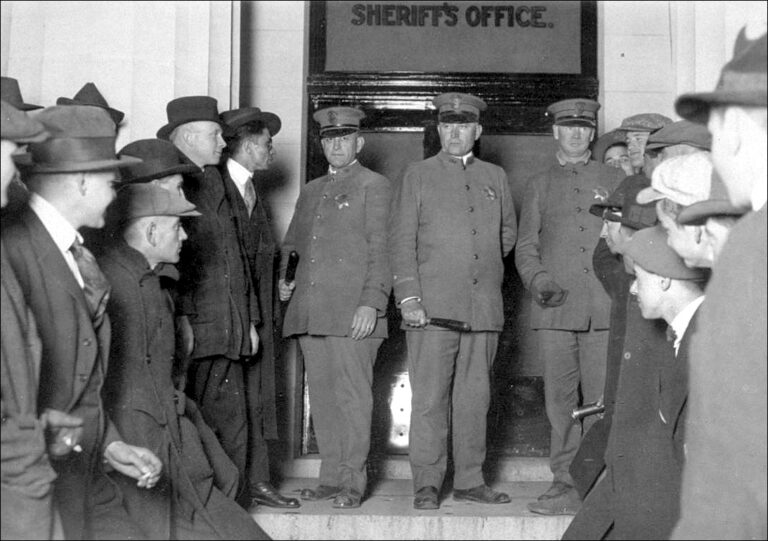
One of her most oft-repeated stories revolves around the 1920 lynching in Santa Rosa of three prisoners by a vigilante force of cops and citizens.
In the Dec. 1, 1985 Press Democrat, LeBaron regaled readers with a story about three murder suspects who were hustled out of the Santa Rosa jail around midnight and hanged in a cemetery on Dec. 10, 1920.
On that cold morning, 65 years prior, huge, bold, black Press Democrat headlines had proclaimed, STATE IS FAIRLY WILD OVER GANG LYNCHING, ACCLAIM MEMBERS OF THE MOB TO BE HEROES, TWO VICTIMS CRY FOR MERCY, BOYD UTTERS GROAN. Such was the hunger for this salacious news that the Press Democrat printed extras.Capturing eyeballs, the front page featured a photograph of the dead men hanging limply, necks horribly askew, clothed only in soiled long underwear.
In 1985, the Press Democrat republished the macabre photograph to complement LeBaron’s recounting of the deed. Within days, a remarkable confession by an octogenarian member of the lynching vigilantes led to a series of ethical missteps, during which LeBaron and her editors and publishers may have become “accomplices after the fact” to the crime of murder, according to California statutes and an attorney at a journalism ethics organization.
A hanging tale
Lebaron’s retelling of the lynching of George Boyd, Terry Fitts and “Spanish Charley” Valento was not in the least bit sympathetic toward the dead men, who appear to have been rather vicious criminals, members of the Howard Street gang in San Francisco, who reportedly raped two women the day before Thanksgiving.
Pursued by big city lawmen, the trio ended up in a house eating soup in Santa Rosa, where, on Sunday, Dec. 4, they were cornered by Sonoma County Sheriff James Petray. Petray was portrayed by LeBaron as “enormously popular among the citizens of the county” – a category which seemingly did not include Blacks, Chinese, Mexicans and Indians or lower caste whites who may have held more jaundiced views. According to LeBaron, Petray was “a role model for the young people, an honest cop and an ideal family man.” She failed to mention that Petray had himself spent three years on the lam, sought for the 1894 killing of an elderly man, whom he admitted to battering. At trial, a jury of his peers let Petray off after deliberating for three minutes, according to local historian Jeff Elliot, who dives well and deep into contemporaneous accounts of the 1920 lynching in his online narrative, There Will Be Prices Paid.
Boyd shot Petray and two of his deputies dead on the spot. The three men rushed out the back door into the hands of armed deputies who incarcerated them in the county jail, downtown. On Friday, a troop of armed, masked men stormed the jailhouse, liberated cell keys from deputies and hogtied the three prisoners, stuffing their mouths with rags, and looping nooses over their heads. Within minutes, the hapless trio were trucked to the cemetery. The hanging ropes were hoisted over the limb of a locust tree as a caravan of car headlights illuminated the scene. The gaggle of self-appointed executioners, who, according to contemporaneous newspaper reports, included San Francisco lawmen, jerked on the ropes, jeering obscenities.
In December 1985 LeBaron wrote, “The newspaper headlines called them ‘heroes,’ and before noon on the same day, the Grand Jury returned a verdict of ‘death by persons unknown.’”
Pieces of the hanging ropes and chunks of the tree were passed down as family heirlooms.
On Dec. 8, LeBaron followed-up with a scoop. She reported that “an anonymous member of the lynching party, who was in his early 20s when he joined the group,” had visited her office and confessed to the crime, “because his conscience told him, not that the act was wrong, but that history should be made accurate.”
Takeaways were that the militarily disciplined lynch mob was organized by a Healdsburg businessman called the “Captain,” who was later elected county coroner. (LeBaron declined to disclose his name at the time and in her interview with the Bohemian last week.) The vigilantes had enjoyed enthusiastic inside help from jailhouse deputies. LeBaron did not print the identity of the confessed killer, who, because there is no statute of limitations on murder, was liable to be arrested for the triple homicide.
The unrepentent confession unleashed a flood of correspondence from relatives of men who were known by their families to have been part of the lynching gang. The letters and reporter notes are archived at the Gaye LeBaron Collection housed at Sonoma State University. In January 1986, LeBaron published another follow up, focused on whether the hanging tree was perhaps an oak and not a locust. Lost in the newsprint was any real consideration of why it is not okay to cheer for lynchings. A San Francisco history magazine observed, “The entire episode became a curious source of civic pride.”
LeBaron says that she took notes for her original story about the anonymous vigilante without tape recording him, so as “not to spook him.” But four years later, on Aug. 29, 1989, she tape recorded a repeat interview with the now-90-year-old vigilante in Healdsburg. He reiterated what he had previously told her, adding names and details.
LeBaron promised not to reveal the vigilante’s identity until 10 years after his death, and she “locked the tape recording in the vault of the Sonoma County Library.” As it turned out, Clarence H. “Barney” Barnard lived to be 108, dying in 2008. Within days of his demise, LeBaron outed him as the lyncher in the Press Democrat – “with his daughter’s permission,” she says.
In 2008, Lebaron praised the late Barnard as “the last of a generation of north country pioneers … guardian of an 88-year-old secret involving frontier justice.” Bernard had said that the lynching was “the right thing … I just can’t believe it was wrong. … Nobody spoke against it. Ninety-five percent of the people were in favor after it happened.”
In a February 2015 column, LeBaron remarked on, “the paternalism that ruled in the 19th and 20th centuries … Obviously, the system wasn’t perfect. But it seemed to work for as long as the county and towns were run by community leaders who were, in general, well respected and well educated by the standard of the times. … The dispatch with which this landmark event [the triple lynching] was concluded may be surprising in an era when legal matters take months, even years, to resolve. It did not, of course, go away. A photo of the men hanging from the tree became an object of curiosity all over California and earned Santa Rosa a reputation as a tough frontier town.”
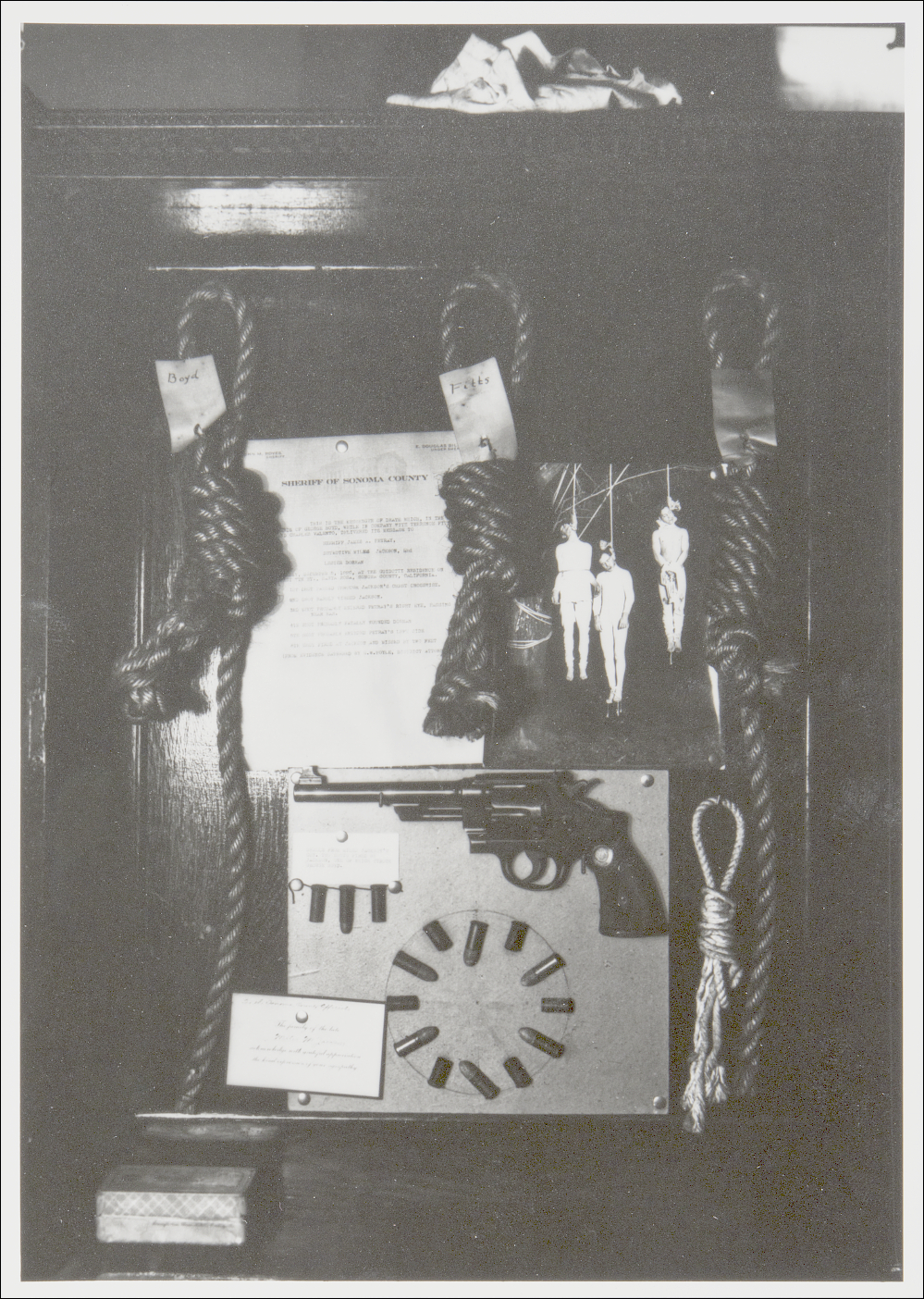
In fact, the obscene photograph, festooned with pieces of the nooses, was the centerpiece of a display in the Sheriff’s Office created shortly after the lynching, according to historical newspaper reports. By 1949, the ropey loops had been moved to the Freemason’s Scottish Rite Temple. Today, the nooses reside at the Museum of Sonoma County.
A photograph, festooned with pieces of the nooses, was the centerpiece of a display in the Sonoma County Sheriff’s Office created shortly after the lynching, according to historical newspaper reports. Photo courtesy of Sonoma County Library.
The Bernard tape
It is worth diving into the transcript of Bernard’s tape recording, including the parts of his testimony that LeBaron did not publish in her lynching columns.
Barnard said the vigilantes drilled for three nights preparing the armed assault on the jail house. He named names. He carried a rifle. The men wore bandanas and covered license plates with mud. The jail deputies gave them the cell keys without any resistance, “They was as much in favor of it being done as we were,” he said.
Barnard bragged about terrorizing Valento, who was a dark-skinned man of Latino descent, saying, “he just reared back against the bars and on the side. His eyes big as saucers, he was just froze.”
And now in the transcript of the tape comes this curious passage: “Everything was so well organized, everything went smooth … the first group to go in got the keys from the sheriff, the acting sheriff, Erick Gelhaus.”
Erick Gelhaus is the name of the deputy who killed Andy Lopez. When I pointed this out to Lynn Prime, the curator of the LeBaron Collection at Sonoma State, she was unable to explain the coincidence. Listening to the hissy tape, the name is unclear, but it was probably “jail house.” Perhaps the transcriber had a sense of the uncanny. In any case, news reports that listed the names of the deputies on jail duty that night did not include a “Gelhaus.” The LeBaron Collection contains a letter from a woman stating that her father, Ray Lattin, was the deputy who gladly handed over the keys to the vigilantes.
Barnard eagerly helped with the hanging, “You have to drag him off the ground, see. It takes several men to drag a man up. I know. I helped pull on one of the ropes and it was quite a job to get him off the ground. And it took him quite a while to asphyxiate, by not breaking his neck,” he said.
LeBaron asked Barnard if he and the others were afraid they would be arrested. He said, no, “it worked out so nice.” Barnard explained that the vigilantes were afraid that the court trial would “be a long drawn out deal. Look how it is now. Personally, I think the whole judicial system has fell apart, you know. … My grandparents come across the plains, and that’s the way it was. We shot [unintelligible] ourselves, and we had [to kill], and that’s the way they operated in them days, and if it hadn’t have, why, you know, there would be no law at all.”
LeBaron: Did your parents know you went? That you were involved in this?
Barnard: Absolutely.
LeBaron: Were you the only one in your family?
Barnard: No.
LeBaron: There were others?
Barnard: My Dad, yeah.
LeBaron: Thank you.
[End of transcript]
Is hiding a crime a crime?
According to the California Penal Code, Section 32: “Every person who, after a felony has been committed, harbors, conceals or aids a principal in such felony, with the intent that said principal may avoid or escape from arrest, trial, conviction or punishment, having knowledge that said principal has committed such felony or has been charged with such felony or convicted thereof, is an accessory to such felony.” The charge of “accessory after the fact” is punishable by a jail sentence of up to three years and a $5,000 fine.
I asked LeBaron why she had not turned Barnard over to law enforcement. She said that a lawyer for the New York Times, which owned the Press Democrat, told her to go ahead with the story since a 86-year-old man was not likely to be prosecuted for a 65-year-old crime of that nature. And that was before she made a tape recording of the confession.
Since 1980, the California Constitution has shielded journalists who are subpoenaed by law enforcement to turn over unpublished information. And that is generally believed to be a social good as it protects the identity of whistleblowers and confidential sources and witnesses to crimes and misbehaviors by governments and corporations.
But does the shield law allow a reporter to conceal evidential knowledge of a heinous crime such as murder? The Bohemian reached out to attorney David Snyder of the First Amendment Coalition, a public interest organization created “to protect and promote freedom of expression and the people’s right to know.”
Snyder said there is no California law exempting a reporter from the duty to report knowledge of a crime to law enforcement. He opined, however, that the law would likely shield a reporter from producing evidence of a crime if subpoenaed by law enforcement. Snyder mused, “When a reporter stumbles across a crime, there is nothing keeping her from reporting it to law enforcement. But I don’t see how a journalist could be prosecuted for not reporting the information, when a district attorney couldn’t compel that information.
“On the other hand, there’s a journalism ethics question. Is it ethical to not report it when you have evidence of a crime? And I think the answer to that is ‘no’ in many, but not all, circumstances.”
Snyder suggested that the New York Times was not ethically compelled to volunteer Daniel Ellsberg’s name to the FBI when he gave reporters top secret files purloined from the RAND Corporation, known as the Pentagon Papers.
But LeBaron and the owners of the Press Democrat were not protecting a whistleblower producing incriminating evidence of governmental wrongdoings. Rather, they decided to hide the identity of a man who had confessed to participating in three brutal homicides. LeBaron and her editors could have told Barnard, “Stop talking! If you are confessing to a crime, we are obligated to report it.” But, they chose instead to commercialize the sensational confession, and county law enforcers did nothing in response after the story was published.
LeBaron explained, “If there was a chance the district attorney would have come after Barney, I would not have written the story.” But she still would have known about the murders. Asked what she would do now if someone came into her office and confessed to a murder, she said, “I would call the authorities.” Press Democrat editor Rick Green did not respond to a query about the paper’s policy on granting anonymity in stories about a confessed murderer.
A culture of lynching
LeBaron’s account of the 1920 lynching is featured on the History page of the Sonoma County Sheriff’s website. And much of that official “history” is sourced from LeBaron’s writings, echoing her attitude that in retrospect, a series of county lynchings were culturally understandable acts of justice.
In 1854, vigilantes led by “pioneer” James Bennet hanged a man named Ritchie for supposedly rustling mules. During the 1850s, at least one “squatter” was lynched at Bodega Ranch. In 1876, “nightriders” broke into county jail and hanged murder suspect, Charles Henley.
Of note, in 1935, deputies watched 200 vigilantes tar and feather “communist reds.” During the 1960s, having to deal militantly with labor organizers, “hippies” and antiwar demonstrators made the county “a busy place to work” for deputies.
In 1990, the sheriff created the Gang Team, which, notably, included Erick Gelhaus. The website fails to mention that Gelhaus fired eight shots into the child, Lopez, nor does it breathe a word about any of the many homicides committed by deputies empowered by the prerogatives of whiteness to terrorize and kill members of disempowered groups.
A local historian has created a spreadsheet of 115 deaths attributed to Sonoma County police forces since 1989. Of the mostly male victims, 45 were killed by police gunshot; 12 by police beatings; seven by “suicide” during law enforcement actions; six during police car chases; and 45 while in sheriff’s custody. Since 2020, the names of the dead are Ricky Estrada, Douglas Thoreson, Salvador Jimenez, Michael Webber, Sean Bell, Donald Miller, Amber Marcotte, Gabriel Wibier, Jordan Pas and Benjamin Vega.
In May 2000, the U.S. Commission on Civil Rights investigated Sonoma County, reporting, “The committee is appalled at the number of deadly incidents, justified or not, that have occurred within 25 months. … law enforcement officers shot and killed eight citizens … Demographically, Sonoma County is undergoing dramatic change which affects its agrarian, small town atmosphere. In addition, minority populations have increased…. The committee found a highly polarized and charged atmosphere in respect to community-police relations.”
In 2018, the newly-formed Independent Office of Law Enforcement Review and Outreach (IOLERO) reported that the Sheriff’s work force was 78 % self-described “white.” It is now about 72 % white, with a sudden influx of Latinx employees. But all is not fraternal inside the department. IOLERO’s report for 2021 recommends that the Sheriff “should consider adopting a policy disavowing white supremacy and extremism and prohibiting employee speech and association that promotes racist or extremist ideology.”
Each year during Sunshine Week (March 13-19), The Foilies serve up tongue-in-cheek “awards” for government agencies and assorted institutions that stand in the way of access to information. The Electronic Frontier Foundation and MuckRock combine forces to collect horror stories about Freedom of Information Act (FOIA) and state-level public records requests from journalists and transparency advocates across the United States and beyond. Our goal is to identify the most surreal document redactions, the most aggravating copy fees, the most outrageous retaliation attempts, and all the other ridicule-worthy attacks on the public’s right to know.
And every year since 2015, as we’re about to crown these dubious winners, something new comes to light that makes us consider stopping the presses.
As we were writing up this year’s faux awards, news broke that officials from the National Archives and Records Administration had to lug away boxes upon boxes of Trump administration records from Mar-a-Lago, President Trump’s private resort. At best, it was an inappropriate move; at worst, a potential violation of laws governing the retention of presidential records and the handling of classified materials. And while Politico had reported that when Trump was still in the White House, he liked to tear up documents, we also just learned from journalist Maggie Haberman’s new book that staff claimed to find toilets clogged up with paper scraps, which were potentially torn-up government records. Trump has dismissed the allegations, of course.
This was all too deliciously ironic considering how much Trump had raged about his opponent (and 2016 Foilies winner) Hillary Clinton’s practice of storing State Department communications on a private server. Is storing potentially classified correspondence on a personal email system any worse than hoarding top secret documents at a golf club? Is “acid washing” records, as Trump accused Clinton, any less farcical than flushing them down the john?
Ultimately, we decided not to give Trump his seventh Foilie. Technically he isn’t eligible: his presidential records won’t be subject to FOIA until he’s been out of office for five years (releasing classified records could take years, or decades, if ever).
Instead, we’re sticking with our original 16 winners, from federal agencies to small town police departments to a couple of corporations, who are all shameworthy in their own rights and, at least metaphorically, have no problem tossing government transparency in the crapper.
The C.R.E.A.M. (Crap Redactions Everywhere Around Me) Award – U.S. Marshals
The Wu‐Tang Clan ain’t nothing to F’ with…unless the F stands for FOIA.
Back in 2015, Wu-Tang Clan produced Once Upon a Time in Shaolin, but they only produced one copy and sold it to the highest bidder: pharma-bro Martin Shkreli, who was later convicted of securities fraud.
When the U.S. Marshals seized Shkreli’s copy of the record under asset forfeiture rules, the Twitterverse debated whether you could use FOIA to obtain the super secretive album. Unfortunately, FOIA does not work that way. However, BuzzFeed News reporter Jason Leopold was able to use the law to obtain documents about the album when it was auctioned off through the asset forfeiture process. For example, he got photos of the album, the bill of sale, and the purchase agreement.
But the Marshals redacted the pictures of the CDs, the song titles, and the lyric book citing FOIA’s trade secrets exemption. Worst of all, they also refused to divulge the purchase price–even though we’re talking about public money. And so here we are, bringing da motherfoia-ing ruckus.
(The New York Times would later reveal that PleasrDAO, a collective that collects digital NFT art, paid $4 million for the record.)
Wu-Tang’s original terms for selling the album reportedly contained a clause that required the buyer to return all rights in the event that Bill Murray successfully pulled off a heist of the record. We can only daydream about how the Marshals would’ve responded if Dr. Peter Venkman himself refiled Leopold’s request.
The Operation Slug Speed Award – U.S. Food and Drug Administration
The federal government’s lightning fast (by bureaucratic standards) timeline to authorize Pfizer’s COVID-19 vaccine lived up to its Operation Warp Speed name. But the Food and Drug Administration gave anything but the same treatment to a FOIA request seeking data about that authorization process.
55 years – that’s how long the FDA, responding to a lawsuit by doctors and health scientists, said it would take to process and release the data it used to authorize the vaccine. And yet, the FDA needed only months to review the data the first time and confirm that the vaccine was safe for the public.
The estimate was all the more galling because the requesters want to use the documents to help persuade skeptics that the vaccine is safe and effective, a time-sensitive goal as we head into the third year of the pandemic.
Thankfully, the court hearing the FOIA suit nixed the FDA’s snail’s pace plan to review just 500 pages of documents a month. In February, the court ordered the FDA to review 10,000 pages for the next few months and ultimately between 50,000-80,000 through the rest of the year.
These 10-day Deadlines Go To 11 Award – Assorted Massachusetts Agencies
Most records requesters know that despite nearly every transparency law imposing response deadlines, they often are violated more than they are met. Yet Massachusetts officials’ time-warping violations of the state’s 10-business-day deadline take this public records’ reality to absurd new levels.
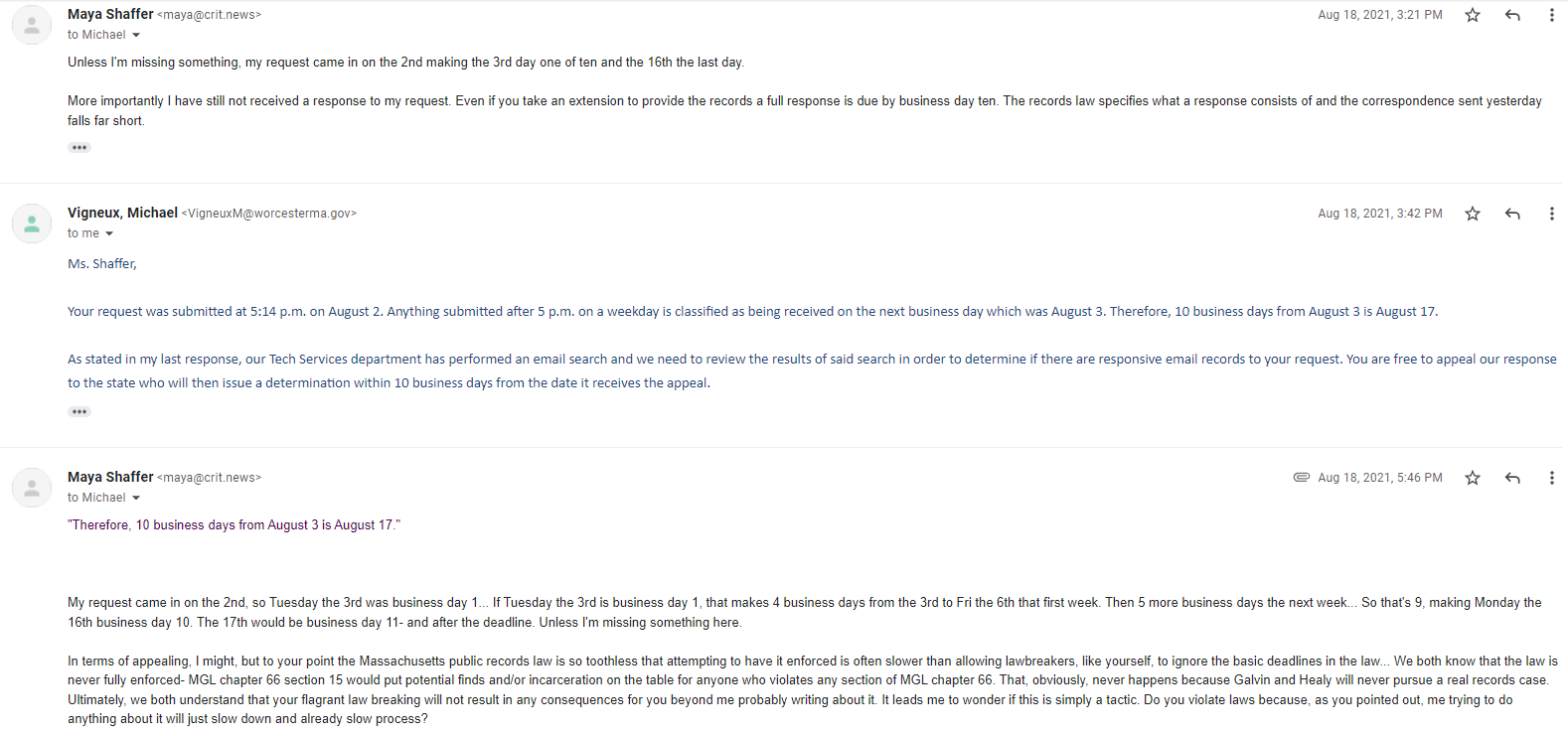
DigBoston‘s Maya Shaffer detailed how officials are giving themselves at least one extra business day to respond to requests while still claiming to meet the law’s deadline. In a mind-numbing exchange, an official said that the agency considers any request sent after 5 p.m. to have technically been received on the next business day. And because the law doesn’t require agencies to respond until 10 business days after they’ve received the request, this has in effect given the agency two extra days to respond. So if a request is sent after 5 p.m. on a Monday, the agency counts Tuesday as the day it received the request, meaning the 10-day clock doesn’t start until Wednesday.
The theory is reminiscent of the This Is Spinal Tap scene in which guitarist Nigel Tufnel shows off the band’s “special” amplifiers that go “one louder” to 11, rather than maxing out at 10 like every other amp. When asked why Spinal Tap doesn’t just make the level 10 on its amps louder, Tufnel stares blankly before repeating: “these go to eleven.”
Although the absurdity of Tufnel’s response is comedic gold, Massachusetts officials’ attempt to make their 10-day deadline go to 11 is contemptuous, and also likely violates laws of the state and those of space and time.
The Return to Sender Award –Virginia Del. Paul Krizek
There are lawmakers who find problems in transparency laws and advocate for improving the public’s right to know. Then there’s Virginia lawmaker Paul Krizek.
Krizek introduced a bill earlier this year that would require all public records requests to be sent via certified mail, saying that he “saw a problem that needed fixing,” according to the Richmond Times-Dispatch.
The supposed problem? A records request emailed to Krizek got caught in his spam filter, and he was nervous that he missed the response deadline. That never happened; the requester sent another email that Krizek saw and he responded in time.
Anyone else might view that as a public records (and technology) success story: the ability to email requests and quickly follow up on them proves that the law works. Not Krizek. He decided that his personal spam filter hiccup should require every requester in Virginia to venture to a post office and pay at least $3.75 to make their request.
Transparency advocates quickly panned the bill, and a legislative committee voted in late January to strike it from the docket. Hopefully the bill stays dead and Krizek starts working on legislation that will actually help requesters in Virginia.
The Spying on Requestors Award – FBI
If government surveillance of ordinary people is chilling, spying on the public watchdogs of that very same surveillance is downright hostile. Between 1989 and at least 2004, the FBI kept regular tabs on the National Security Archive, a domestic nonprofit organization that investigates and archives information on, you guessed it, national security operations. The Cato Institute obtained records showing that the FBI used electronic and physical surveillance, possibly including wiretaps and “mail covers,” meaning the U.S. Postal Service recorded the information on the outside of envelopes sent to or from the Archive.
In a secret 1989 cable, then-FBI Director William Sessions specifically called out the Archive’s “tenacity” in using FOIA. Sessions specifically fretted over former Department of Justice Attorney Quinlan J. Shea and former Washington Post reporter Scott Armstrong’s leading roles at the Archive, as both were major transparency advocates.
Of course, these records that Cato got through its own FOIA request were themselves heavily redacted. And this comes after the FBI withheld information about these records from the Archive when it requested them back in 2006. Which makes you wonder: how do we watchdog the spy who is secretly spying on the watchdog?
The Futile Secrecy Award – Concord Police Department
When reporters from the Concord Monitor in 2019 noticed a vague $5,100 line item in the Concord Police Department’s proposed budget for “covert secret communications,” they did what any good watchdog would do–they started asking questions. What was the technology? Who was the vendor? And they filed public records requests under New Hampshire’s Right to Know Law.
In response, CPD provided a license agreement and a privacy policy, but the documents were so redacted, the reporters still couldn’t tell what the tech was and what company was receiving tax dollars for it. Police claimed releasing the information would put investigations and people’s lives at risk. With the help of the ACLU of New Hampshire, the Monitor sued but Concord fought it for two years all the way to the New Hampshire Supreme Court. The police were allowed to brief the trial court behind closed doors, without the ACLU lawyers present, and ultimately the state supreme court ruled most of the information would remain secret.
But whenThe Monitor reached out to EFF for comment, EFF took another look at the redacted documents. In under three minutes, our researchers were able to use a simple Google search to match the redacted privacy policy to Callyo, a Motorola Solutions product that facilitates confidential phone communications.
Hundreds of agencies nationwide have in fact included the company’s name in their public spending ledgers, according to the procurement research tool GovSpend. The City of Seattle even issued a public privacy impact assessment regarding its police department’s use of the technology, which noted that “Without appropriate safeguards, this raises significant privacy concerns.” Armed with this new information, the Monitor called Concord Police Chief Brad Osgood to confirm what we learned. He doubled-down: “I’m not going to tell you whether that’s the product.”
The Highest Fee Estimate Award – Pasco County Sheriff’s Office
In September 2020, the Tampa Bay Times revealed in a multi-part series that the Pasco County Sheriff’s Office was using a program called “Intelligence-led Policing” (ILP). This program took into consideration a bunch of data gathered from various local government agencies, including school records, to determine if a person was likely to commit a crime in the future—and then deputies would randomly drop by their house regularly to harass them.
Out of suspicion that the sheriff’s office might be leasing the formula for this program to other departments, EFF filed a public records request asking for any contact mentioning the ILP program in emails specifically sent to and from other police departments. The sheriff responded with an unexpectedly high-cost estimate for producing the records. Claiming there was no way at all to clarify or narrow the broad request, they projected that it would take 82,738 hours to review the 4,964,278 responsive emails—generating a cost of $1.158 million for the public records requester, the equivalent of a 3,000-square seaside home with its own private dock in New Port Richey.
The Rip Van Winkle Award – FBI
Last year, Bruce Alpert received records from a 12-year-old FOIA request he filed as a reporter for the Times-Picayune in New Orleans. Back when he filed the request, the corruption case of U.S. Rep. William Jefferson, D-New Orleans, was still hot — despite the $90,000 in cash found in Jefferson’s cold freezer.
By the time Alpert got the 83 pages he requested on the FBI’s investigation into Jefferson, Alpert himself was retired and Jefferson had been released from prison. Still, the documents did reveal a new fact about the day of the freezer raid: another raid was planned for that same day, but at Jefferson’s congressional office. This raid was called off after an FBI official, unnamed in the documents, warned that while the raid was technically constitutional, it could have “dire” consequences if it appeared to threaten the independence of Congress.
In a staff editorial about the extreme delay, The Advocate (which acquired the Times-Picayune in 2019) quoted Anna Diakun, a staff attorney with the Knight First Amendment Institute at Columbia University: “The Freedom of Information Act is broken.” We suppose it’s better late than never, but never late is even better.
The FOIA Gaslighter of the Year Award— Louisiana Attorney General Jeff Landry
In another case involving the Times-Picayune, the FOIA gaslighter of the year award goes to Louisiana Attorney General Jeff Landry for suing reporter Andrea Gallo after she requested documents related to the investigation into (and seeming lack of action on) sexual harassment complaints in Landry’s office.
Gallo filed the original request for complaints against Pat Magee, a top aide to Landry, after hearing rumblings that Magee had been placed on administrative leave. The first response to Gallo’s request was that Magee was under investigation and the office couldn’t fulfill the request until that investigation had concluded. A month later, Gallo called the office to ask for Magee and was patched through to his secretary, who said that Magee had just stepped out for lunch but would be back shortly.
Knowing that Magee was back in the office and the investigation likely concluded, Gallo started pushing harder for the records. Then, late on a Friday when Gallo was on deadline for another story, she received an email from the AG’s office about a lawsuit naming her as the defendant.
The Redacting Information That’s Already Public Award – Humboldt-area Law Enforcement
Across the country, police departments are notorious for withholding information from the public. Some agencies take months to release body camera footage after a shooting death or might withhold databases of officer misconduct. California’s state legislature pushed back against this trend in 2018, with a new law that specifically puts officer use-of-force incidents and other acts of dishonesty under the purview of the California Public Records Act.
But even after this law was passed, one northern California sheriff was hesitant to release information to journalists – so hesitant that it redacted information that had already been made public. After a local paper, the North Coast Journal, filed a request with the Humboldt County Sheriff’s Office under the 2018 law, the sheriff took two full years to provide the requested records.
Why the long delay? One possible reason: the agency went to the trouble of redacting information from old press releases – releases that, by definition, were already public.
For example, the sheriff’s office redacted the name of a suspect who allegedly shot a sheriff’s deputy and was arrested for attempting to kill a police officer in May 2014–including blacking out the name from a press release the agency had already released that included the suspect’s name. And it’s not like the press had accidentally missed the name the first time: reporter Thadeus Greenson had published the release in the North Coast Journal right after it came out.
That isn’t Greenson’s only example of law enforcement redacting already public information: in response to another public records request, the Eureka Police Department included a series of news clippings, including one of Greenson’s own articles, again with names redacted.
The Clear Bully Award – Clearview AI
Clearview AI is the “company that might end privacy as we know,” claimed The New York Times’s front page when it publicly exposed the small company in January 2020.
Clearview had built a face recognition app on a database of more than three billion personal images, and the tech startup had quietly found customers in police departments around the country. Soon after the initial reports, the legality of Clearview’s app and its collection of images was taken to court. (EFF has filed friend-of-the-court briefs in support of those privacy lawsuits.)
Clearview’s existence was initially revealed via public records requests filed by Open the Government and MuckRock. In September 2021, as it faced still-ongoing litigation in Illinois, Clearview made an unusual and worrying move against transparency and journalism: it served subpoenas on OTG, its researcher Freddy Martinez, and Chicago-based Lucy Parsons Labs (none of which are involved in the lawsuit).
The subpoenas requested internal communications with journalists about Clearview and its leaders and any information that had been discovered via records requests about the company.
Government accountability advocates saw it as retaliation against the researchers and journalists who exposed Clearview. The subpoena also was a chilling threat to journalists and others looking to lawfully use public records to learn about public partnerships with private entities. What’s more, in this situation, all that had been uncovered had already been made public online more than a year earlier.
Fortunately, following reporting by Politico, Clearview, citing “further reflection about the scope of the subpoenas” and a “strong view of freedom of the press,” decided to withdraw the subpoenas. We guess you could say the face recognition company recognized their error and did an about face.
Whose Car is it Anyway? Award – Waymo
Are those new self-driving cars you see on the road safe? Do you and your fellow pedestrians and drivers have the right to know about their previous accidents and how they handle tight turns and steep hills on the road?
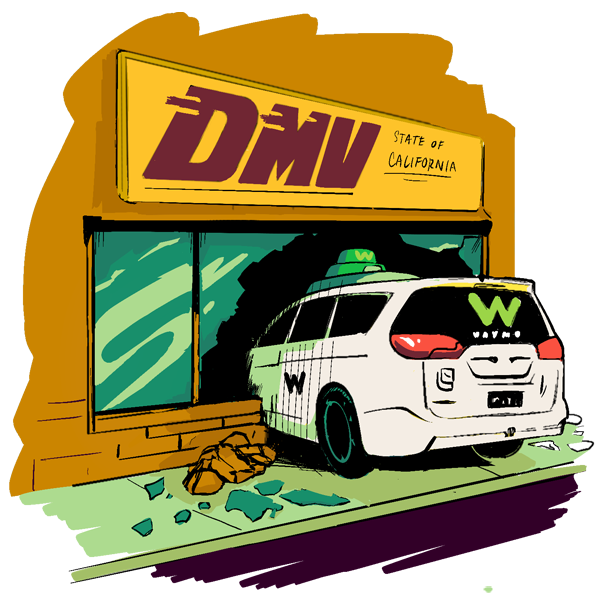
Waymo, owned by Google parent Alphabet Inc. and operator of an autonomous taxi fleet in San Francisco, answers, respectively: none of your business, and no! A California trial court ruled in late February that Waymo gets to keep this information secret.
Waymo sued the California Department of Motor Vehicles to stop it from releasing unredacted records requested by an anonymous person under the California Public Records Act. The records include Waymo’s application to put its self-driving cars on the road and answers to the DMV’s follow-up questions. The DMV outsourced the redactions to Waymo, and claiming that it needed to protect its trade secrets, Waymo sent the records back with black bars over most of its answers, and even many of the DMV’s questions.
Waymo doesn’t want the public to know which streets its cars operate on, how the cars safely park when picking up and dropping off passengers, and when the cars require trained human drivers to intervene. Waymo even redacted which of its two models — a Jaguar and a Chrysler — will be deployed on California streets … even though someone on those streets can see that for themselves.
#WNTDWPREA (The What Not to Do With Public Records Ever Award) – Anchorage Police Department
“What Not to Do Wednesday,” a social media series from the Anchorage Police Department, had been an attempt to provide lighthearted lessons for avoiding arrest. The weekly shaming session regularly featured seemingly real situations requiring a police response. Last February, though, the agency became its own cautionary tale when one particularly controversial post prompted community criticism and records requests, which APD declined to fulfill.
As described in a pre-Valentine’s Day #WNTDW post, officers responded to a call about a physical altercation between two “lovebirds.” The post claimed APD officers told the two to “be nice” and go on their way, but instead the situation escalated: “we ended up in one big pile on the ground,” and one person was ultimately arrested and charged.
Some in the public found the post dismissive toward what could have been a domestic violence event — particularly notable because then-Police Chief Justin Doll had pointed to domestic violence as a contributor to the current homicide rates, which had otherwise been declining.
Alaska’s News Source soon requested the name of the referenced arrested individual and was denied. APD claimed that it does not release additional information related to “What Not To Do Wednesday” posts. A subsequent request was met with a $6400 fee.
By the end of February 2021, the APD decided to do away with the series.
“I think if you have an engagement strategy that ultimately creates more concern than it does benefit, then it’s no longer useful,” Chief Doll later said. It’s not clear if APD is also applying this logic to its records process.
Do As I Say, Not As I Do Award – Texas Attorney General Ken Paxton
Texas law requires a unique detour to deny or redact responsive records, directing agencies to go through the Attorney General for permission to leave anything out. It’s bad news for transparency if that office circumvents proper protocol when handling its own records requests; it’s even worse if those records involve a government official—current Texas AG Ken Paxton—and activities targeted at overthrowing the democratic process.
On January 6, 2021, Paxton (who is currently up for reelection, facing multiple charges for securities fraud, and was reportedly the subject of a 2020 FBI investigation) and his wife were in Washington, D.C. to speak at a rally in support of former President Donald Trump, which was followed by the infamous invasion of the Capitol by Trump supporters. Curious about Paxton’s part in that historic event, a coalition of Texas newspapers submitted a request under the state’s public records law for the text messages and emails Paxton sent that day in D.C.
Paxton’s office declined to release the records. It may not have even looked for them. The newspapers found that the AG doesn’t seem to have its own policy for searching for responsive documents on personal devices, which would certainly be subject to public records law, even if the device is privately-owned.
The Travis County District Attorney subsequently determined that Paxton’s office had indeed violated the Texas open records law. Paxton maintains that no wrongdoing occurred and, as of late February, hadn’t responded to a letter sent by the DA threatening a lawsuit if the situation is not remedied ASAP.
“When the public official responsible for enforcing public records laws violates those laws himself,” Bill Aleshire, an Austin lawyer, told the Austin American-Statesman, “it puts a dagger in the heart of transparency at every level in Texas.”
The Transparency Penalty Flag Award – Big 10 Conference
In the face of increasing public interest, administrators at the Big 10 sporting universities tried to take a page out of the ol’ college playbook last year and run some serious interference on the public records process.
In an apparent attempt to “hide the ball” (that is, their records on when football would be coming back), university leaders suggested to one another that they communicate via a portal used across universities. Reporters and fans saw the move as an attempt to avoid the prying eyes of avid football fans and others who wanted to know more about what to expect on the field and in the classroom.
“I would be delighted to share information, but perhaps we can do this through the Big 10 portal, which will assure confidentiality?” Wisconsin Chancellor Rebecca Blank shared via email.
“Just FYI — I am working with Big Ten staff to move the conversation to secure Boardvantage web site we use for league materials,” Mark Schlissel, then-President of the University of Michigan, wrote his colleagues. “Will advise.”
Of course, the emails discussing the attempted circumvention became public via a records request. Officials’ attempt to disguise their secrecy play was even worse than a quarterback forgetting to pretend to hand off the ball in a play-action pass.
University administrators claimed that the use of the private portal was for ease of communication rather than concerns over public scrutiny. We’re still calling a penalty, however.
The Remedial Education Award – Fairfax County Public Schools
Once a FOIA is released, the First Amendment generally grants broad leeway to the requester to do what they will with the materials. It’s the agency’s job to properly review, redact, and release records in a timely manner. But after Callie Oettinger and Debra Tisler dug into a series of student privacy breaches by Fairfax County Public Schools, the school decided the quickest way to fix the problem was to hide the evidence. Last September, the pair received a series of letters from the school system and a high-priced law firm demanding the removal of the documents from the web and they return or destroy the documents.
The impulse to try to silence the messenger is a common one: A few years ago Foilies partner MuckRock was on the receiving end of a similar demand in Seattle. While the tactics don’t pass constitutional muster, they work well enough to create headaches and uncertainty for requesters that often find themselves thrust into a legal battle they weren’t looking to fight. In fact, in this case, after the duo showed up for the initial hearing, a judge ordered a temporary restraining order barring the further publication of documents. This was despite the fact that they had actually removed all the personally identifiable data from the versions of the documents they posted.
Fortunately, soon after the prior restraint, the requesters received pro bono legal assistance from Timothy Sandefur of the Goldwater Institute and Ketan Bhirud of Troutman Pepper. In November — after two months of legal wrangling, negative press, and legal bills for the school — the court found the school’s arguments “simply not relevant” and “almost frivolous,” as the Goldwater Institute noted.
The Foilies were compiled by the Electronic Frontier Foundation (Director of Investigations Dave Maass, Senior Staff Attorney Aaron Mackey, Frank Stanton Fellow Mukund Rathi, Investigative Researcher Beryl Lipton, Policy Analyst Matthew Guariglia) and MuckRock (Co-Founder Michael Morisy, Senior Reporting Fellows Betsy Ladyzhets and Dillon Bergin, and Investigations Editor Derek Kravitz), with further review and editing by Shawn Musgrave. Illustrations are by EFF Designer Caitlyn Crites. The Foilies are published in partnership with the Association of Alternative Newsmedia. For more transparency trials and tribulations, check out The Foilies archives at https://www.eff.org/issues/foilies.
Santa Rosa’s Roustabout Theater is best known as one of the leading theatrical training and performance programs in the San Francisco Bay Area.
With a focus on youth ages 11 to 20, their Apprentice Program and Summer Theater Camp productions lean toward lighter fare, like this summer’s scheduled production of The SpongeBob Musical.
Roustabout also has a Professional Ensemble component consisting of program staff, graduates and guest artists, and once a year or so they put up a more “mature” production.
Roustabout returns with Alexi Kaye Campbell’s Apologia. The Clark Lewis-directed show runs in the Carsten Cabaret in the Luther Burbank Center for the Arts through March 27.
“Apologia” is defined as a formal, written defense of one’s opinions or conduct. It’s also the title that renowned art historian Kristin Miller (Kate Brickley) has chosen for her memoir. She makes clear to the family and friends gathered to celebrate her birthday at her English countryside home that it’s not to be confused with an apology.
Her son, Peter (Jared N. Wright), has come with his American girlfriend, Trudi (Jessie Rankin), seeking just that or at least an explanation as to why her text is devoid of any mention of him or his brother, Simon (Bohn Connor), and, more so, why she never fought for their return after they were taken away as children by their father. The siblings’ erasure has sent Simon over the deep end, leaving his not-soap-opera actress wife, Claire (Ellen Rawley), to attend solo. They are soon joined by Kristin’s gay best friend, Hugh (Bill Davis), whose purpose seems to be to utter Oscar Wilde-like bons mots. Simon eventually shows up, words are exchanged and nothing is really resolved.
Campbell’s script delves into such well-worn issues as 60’s radicalism and idealism, religion, capitalism, patriarchies and the sacrifices one makes in life, but there’s really nothing new here. It’s your typical dysfunctional family reunion. Moments of humor and emotional depth only highlight the shallowness of what surrounds them.
The cast is good, but still needs to shake off some understandable rust.
But don’t we all?
‘Apologia’ runs through March 27 in the Carsten Cabaret at the Luther Burbank Center for the Arts. 50 Mark West Springs Rd., Santa Rosa. Fri–Sat, 7:30pm; Sun, 2pm. $20–$26. Proof of vaccination or a negative test within 48 hours required. Masking required if unvaccinated. roustabout-theater.org
Good morning, afternoon or evening, my stylish hounds. How are we all? I got a manicure this past Sunday that has me seeing rose-colored stars and gesticulating wildly, so I’m essentially tip-top. For those searching the plug, btw, Deja Vu nails in Sebastopol is doing an absolutely stunning job for a resoundingly reasonable fee. Don’t walk; run. Go for a nude base with some flowers, rainbows and smiley faces. It’s nearly spring! I want to see some chipper nails at the end of those hello-waving and high-fiving hands.
I’m excited about this week’s Look — it’s part of the growing wealth of Santa Rosa local fashion outposts. Holee Vintage, the new vintage hookup on Fourth Street, is hosting a fashion show! Yes, a fashion show!
For those not yet in the know, Holee Vintage in downtown Santa Rosa, owned and operated by power couple Mercedes Herndandez (@mercedes_hrndz) and Tito Ramos (@titoramos_) features a well-curated selection of goods, from locally-made Nike Blazer candles made by @beeyondbotique, to the swooshes themselves — think Panda Dunks and Vintage Jordan 1s. They’re also packing a solid selection of denim, Carhartt and graphic tees. Essentially, Holee can get it.
The Street Style Fashion Show on March 26 will debut spring styles from local vintage vendors pulling their favorite looks for the upcoming warm weather. Spring is here! Get cute!
This is a ticketed event with limited seating, and sales are live – go to eventbrite.com to secure a spot along this local runway. Event starts at 7:30 and, along with the models and looks, will include nibbles and a post-walk DJ. Put those Jordans to use! No scuffs please.
Go see and be seen. Go drip and drip clinic. Go, go!
Looking phenomenal, everyone.
Love,
Jane
Jane Vick is an artist and writer who has spent time in Europe, New York and New Mexico. She is currently based in Oakland, California. View her work at janevick.com.
As I survey the news, no matter what the source—CNN, BBC, Al Jazeera or anywhere else—it occurs to me that the center of 85% of the news stories are due to just one thing. From the micro: housing/homelessness, water scarcity, farmers and Ag competing with National Park directives … to the macro: jobs, housing, good schools, immigration, food scarcity, climate change/water supplies … pick your own and see if the model fits. The roots of almost every story can be found in one place.
Although, in my observations of news reporting, I can’t remember when the reporter of the story du jour included this reason and pointed to the natural causality. Human beings have basically taken over the planet as a dominant species, and with the use of tools such as the ones invented by Remington and Colt, we have basically killed off all our “natural” predators and a hell of a lot more than that, one could argue … and for dubious value I, for one, could argue; but I digress. The word “infestation” comes to mind.
The rain forests are being clear-cut … for what? Right, farms. Water systems cannot meet the demands placed on them because more people are being added to the denominator yearly. And people are living longer, which compounds the duration of already-stressed resources. Oceans are being fished to the point of extinction, and a new, rotated fish found on plates can be seen in stores every five years or so. Thirty-five years ago, no person walking the earth would have kept a talapia and eaten it, unless under duress.
Demand on land for housing has caused people to leave the Bay Area because they can’t raise their kids with a backyard and a park down the street. Hello? Anyone see a trend here besides me? Sadly, I suspect that people do not think. They don’t think that one child can be an exponential taxation on the world for generations. Know any families with four kids, how about six, nine kids? I do. Is anyone thinking about our impact on the world in which we live? Or are we just planning to let Musk and all those other guys find us another planet to screw up?
Santa Rosa
Small Press
Sonoma County Library and the Santa Rosa Zine Collective are teaming up this month to hold the second annual Santa Rosa Zine Fest, a weeklong event in celebration of zines and local talent. Running March 22–25, the DIY fest features four days of virtual events, ranging from instructional seminars to panel discussions and casual hangouts. The week...
Grateful to Gaye
I am grateful for Gaye LeBaron’s professionalism in accurately collecting and preserving key historical events that scholars will draw from for decades to help us understand Sonoma County in the 20th Century. This includes Clarence Barnard’s participation in the 1920 lynching (“The Shame of Santa Rosa,” Bohemian, March 16)–I was Gaye’s assistant the day he came to...
x
Good morning, glitter babies! And happy Wednesday! How is everyone’s week? I’m in Brooklyn as I write this, so suffice to say my week is off to a phenomenal start, though I did take a redeye here and promptly threw up upon arrival due to an inimitably disgusting airport sandwich. But never fear, I’m now gracefully sipping an oat...
With the end of a state eviction protection law fast approaching, the Sonoma County Board of Supervisors on Tuesday, March 22, directed staff to request additional relief funds for tenants and landlords financially impacted by the Covid-19 pandemic.
Board members also spoke about holding a more in-depth discussion about extending or amending local pandemic eviction regulations, but did not set...
Four Democrats are competing in the June 7 primary election for the seat being vacated by state Assemblyman Marc Levine, who is running for California insurance commissioner.
The winner will represent all of Marin County and part of Sonoma County in the 12th Assembly District, which replaces the 10th District due to recent state redistricting.
The three Marin candidates include California...
In early March, the Sonoma County Board of Supervisors honored retiring Press Democrat reporter Gaye LeBaron for “chronicling the people, culture and history of Sonoma County.”
From 1959 to this year, Lebaron penned thousands of gossipy columns splashed with a bit of history, attesting to the old-fashioned goodness of local businesses, salt-of-the-earth ranchers, and police and sheriff’s deputies who can...
Each year during Sunshine Week (March 13-19), The Foilies serve up tongue-in-cheek "awards" for government agencies and assorted institutions that stand in the way of access to information. The Electronic Frontier Foundation and MuckRock combine forces to collect horror stories about Freedom of Information Act (FOIA) and state-level public records requests from journalists and transparency advocates across the United...
Santa Rosa’s Roustabout Theater is best known as one of the leading theatrical training and performance programs in the San Francisco Bay Area.
With a focus on youth ages 11 to 20, their Apprentice Program and Summer Theater Camp productions lean toward lighter fare, like this summer’s scheduled production of The SpongeBob Musical.
Roustabout also has a Professional Ensemble component consisting...
Good morning, afternoon or evening, my stylish hounds. How are we all? I got a manicure this past Sunday that has me seeing rose-colored stars and gesticulating wildly, so I’m essentially tip-top. For those searching the plug, btw, Deja Vu nails in Sebastopol is doing an absolutely stunning job for a resoundingly reasonable fee. Don’t walk; run. Go for...
As I survey the news, no matter what the source—CNN, BBC, Al Jazeera or anywhere else—it occurs to me that the center of 85% of the news stories are due to just one thing. From the micro: housing/homelessness, water scarcity, farmers and Ag competing with National Park directives … to the macro: jobs, housing, good schools, immigration, food scarcity,...