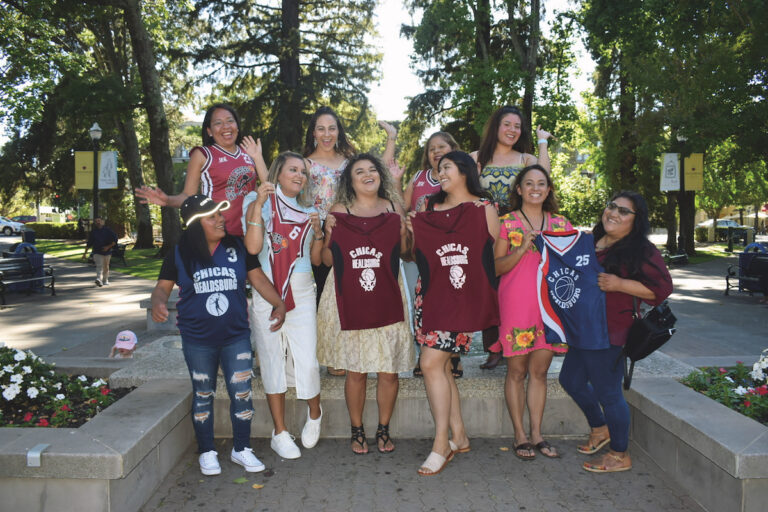
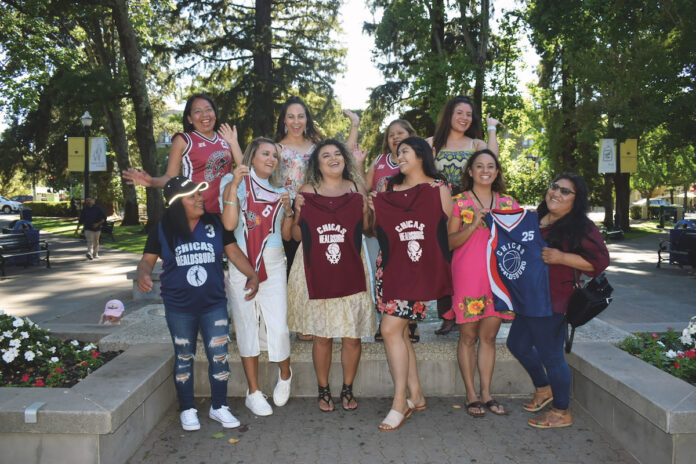
“Are you guys a basketball team?” Dave Hopla, an NBA shooting coach who was sitting on a bench in Healdsburg Plaza, asked Chicas Healdsburg. They were wearing their uniforms to take photos. Linda Sanchez, who is part of the team, replied, “Yes, we are.”
It was a surprising and delightful coincidence that the local Latina basketball team ran into Hopla and another coach while being interviewed for this paper.
But the best piece of good luck was how the team, founded in Healdsburg a few years ago, tapped into an unmet desire for a basketball team, leading the group to quickly grow from three players to more than 14 today. Their origin story is simple: Maria Garcia, who loves basketball, wanted to start a team with her sister-in-law, Otilia Lopez. They began to play in Giorgi Park in the afternoons, and little by little, more women joined them.
“One day, we both said, let’s create a basketball women’s team. I played it for a long time in Mexico, in Oaxaca since I was 11. But the idea of a team began four years ago,” Garcia said, speaking in Spanish, as did the rest of her teammates interviewed for this article.
Teammate Martha Brito saw Garcia and Lopez play one day and joined right then and there.
“God gave us the opportunity for us to join forces, and God put them on my path because, personally, it was the right moment for me to meet them. It helped me get out of a strong depression I had for months,” Brito said.
“It was a difficult period in my life, but it was also a very graceful one and filled with luck because I met them,” she noted.
Garcia said the three of them began to brainstorm ways to get more ladies interested in playing. They needed to be at least five to play against other teams. Slowly but surely, other friends who heard of them playing began to join. The first two years, there were only six players.
Now, the team consists of Carmen Lara, Belen Coppiano, Martha Brito, Feli Pacheco, Otilia Lopez, Mary Garcia, Vanessa Isquierdo, Edith Vargas, Paulina Garcia, Linda Sanchez, Karen Mercado, Maribel Viruel, Lourdes Bautista and Victoria Mendez.
Lara found out the team existed from seeing videos on social media of the ladies playing. Two of them were already a part of it at the time. Lara said she did not know much about basketball or the rules of the game, but her teammates quickly gave her insight.
“I played one of our first tournaments in Napa and we won second place. For me, this is like a small family, a sisterhood, which has motivated me a lot. I have learned so much,” Lara said.
“We are all dedicated to getting better every time.”
Coppiano joined after learning about the team from Lara. Like Garcia, she started to play when she was 11 as well. She played for eight years and stopped after having her first child. Coppiano is the only Ecuadorian on a team of Mexican ladies. But she fits right in.
“I like the passion of basketball. Running, the connection you have to have when you play. With the ball and with the team,” Coppiano said.
“It gives me so much satisfaction to play. I feel the same passion I had when I was a child. I connect again. It gives me so much happiness. To play again has been incredible. I used to do other activities, and now my free time is dedicated to it,” she noted.
Viruel never played with the proper rules as a young girl. But she has learned through her teammates to play accordingly. “It does not upset me to be told how to do things. They have motivated me every day to be better,” Viruel said.
The first time she saw their uniforms arrive, Viruel said she was excited. She had been waiting to wear hers for a long time, and the happiness she felt once she did was indescribable.
Their first uniforms were bought by Garcia, and the second donated by Mario’s Jewelry, a Healdsburg business.
Sanchez, Mercado and Isquierdo were the earliest teammates to join the Chicas. Like Garcia and Coppiano, Sanchez began to play when she was 11, a common denominator among several of them.
“For me, I like to see women unite and do stuff for one another. Push each other to do better and lift each other up,” Sanchez said.
“It also got me out of a depression I was dealing with,” she continued.
Mercado joined her sister on the team, but she said she was reluctant at first. Being a mother and working while juggling other activities made her wonder if it was necessary. But Mercado said the team welcomed her with open arms, and the members are always compassionate.
“They always understand when I cannot make it to practice. That is what I like. Sometimes life gets busy, but they get it,” Mercado said.
Isquierdo learned of the team from Lara, and she used to play in Mexico as well. Isquierdo works and goes to school, but also makes basketball her priority.
Coppiano added that almost all of the players are mothers. Although they have busy schedules, they all try to make time for their practice every week. Some of them live in Santa Rosa, but drive to Healdsburg to practice regardless.
The majority are immigrants, who have had to leave their past lives and make new ones. This is something that can be difficult to navigate.
Lara has lived in Sonoma County almost 10 years. She explained that leaving a family and traditions can affect a person.
“The new language, new traditions. I was searching for something that would make me feel a part of this country, and I tried different things. Thanks to life or destiny, I found something that truly fills me, which is this,” she said.
“I feel the familiarity, customs and ideas. So much we left behind and we are trying to relive through our conversations and reminiscing about what we used to do back home. It connects all of us,” Lara continued.
For Isquierdo, playing on the team makes her feel as if she is back in Mexico. She grew up playing, particularly with her mother.
“It reminds me so much of my mom. She is in Mexico. Playing makes me feel closer to her,” Isquierdo said. As a comfort, her teammates told her she could find a mother in them.
Garcia pointed out that the majority of the teams around are of younger women, while the Chicas is the only team made of older ages.
“Sometimes others want to make us feel bad because of our age, but we do not pay attention to negativity,” Lara said.
Chicas Healdsburg has played in Rohnert Park, St Helena and Santa Rosa, among other places. Their vision is to create another team and add light to their court as well. Currently, Giorgi Park does not have lights that can allow them to play during the wintertime.
The money the Chicas has made whenever the players win a monetary prize goes into the team. Lara said the team has not received much support from the city or local organizations. However, after asking several times, she pointed out that their court got repainted.
“We want support for our court because it is part of the community and so are we. If they could help us a little bit more, it would be very helpful,” she said.