This is our “meta” issue … and I don’t know what “meta” means. Which is OK with me, by the way. I don’t want to know what meta means; I pride myself on not knowing what it means. Only the lure of filthy lucre is enough to entice me into losing my integrity by finding out what it means. My time here on Earth has been, in many ways, graced by supernatural guidance and influence for all my blessed 53 years in spite of not knowing what meta means.
What I do know is that Facebook recently changed its name to Meta … but not really. Because it’s still called Facebook. Is that, in and of itself, meta?
Please don’t answer that question for me. It’s not a real question. I was thinking out loud. I’m getting paid to write this. I only wrote it to reach my word count.
Sidenote: Ignorance is bliss. And I love bliss.
What I thought meta meant was, like, “global.” Or, “big picture.” Like, “the whole thing.” But that doesn’t sound right. That sounds more like the definition for the word universal.
My boss, who I call Hoss, told me that meta means “self-conscious.” If that is what meta means, then I am inherently the most meta thing ever descended from the finned creatures that once sprouted legs and crawled forth from the watery blue depths to walk God’s alarmingly green Earth. Because I’m so self-conscious that I get wobbly walking the crosswalk in front of cars knowing that the drivers are all watching me and maybe even goggling my sagging old-man ass much to their condescending amusement. Which is a horror, quite honestly. On all levels. I wouldn’t recommend any of it to anyone.
But I get the feeling that meta doesn’t inherently suck as a concept, so I’m probably wrong.
My colleague is writing an article about writing an article, and that, I am told, is meta. And that is such an awesome concept that I wish I’d thought of it first, and I can’t wait to read his article.
But I’m still not exactly sure what meta means. And, am I stealing his idea by writing an article about not knowing what meta means? Kinda sorta, but not exactly—which makes it seem like it’s OK if I do. Because his article is sure to contain actual information, while mine does not. And that is a significant difference.
Well, I’d better get started on my research to find out what meta means. Hoss ordered me to. Don’t anyone hold their breath. Carry on as usual; my people will contact your people when realization occurs.
Mark Fernquest lives and works somewhere north of Facebook HQ. He is SOOOO meta.
Read the Bohemian’s previous coverage of SMART’s freight takeover here, here and here.
Last Wednesday, Jan. 19, the Sonoma-Marin Area Rail Transit district’s board of directors selected a company to take over the agency’s recently-acquired freight operations.
Beginning on March 1 and lasting for three months, the temporary contract with Willits-based Summit Signal is the SMART’s most recent step in taking over freight operations from Northwestern Pacific Railroad Company (the privately-owned railroad company which currently serves four customers in Petaluma twice a week and stores trains filled with Liquified Petroleum Gas for Bay Area refineries).
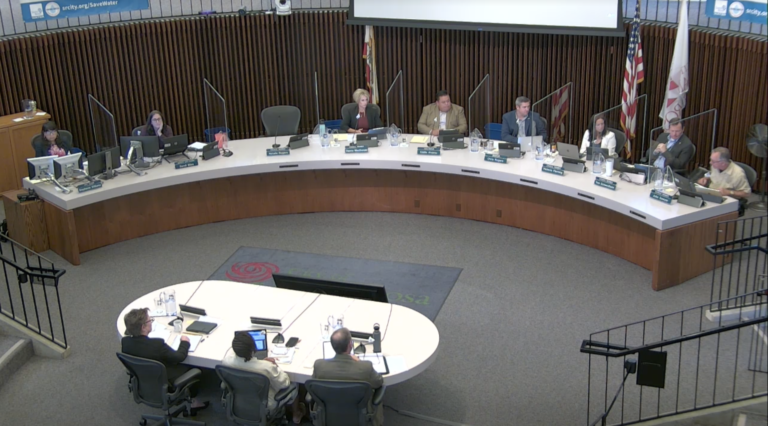
Throughout the freight takeover process, beginning in May 2020, SMART’s board of directors appears to have made decisions before receiving complete financial information and has allowed agency staff to present conflicting financial projections without explaining the reason for the discrepancies. The interim freight contract raised still more questions because Summit Signal, the company SMART selected, does not have any experience operating a freight railroad, while two companies who submitted competing bids do.
ALL ABOARD Passengers board a southbound SMART train in downtown Santa Rosa on Monday, Jan. 24. Photo by Will Carruthers.
On Friday, Jan. 21, the Bohemian/Pacific Sun sent the agency’s new director, Eddie Cumins, and several other staff members questions requesting clarification about the process of awarding the freight contract and other related issues mentioned in this article. On Monday, instead of answering the questions, SMART spokesman Matt Stevens said that he had sent the questions to the agency’s public records coordinator to search for documents, a process which often takes weeks. The Bohemian/Pacific Sun reiterated that we were requesting answers to specific questions, not filing a public records request. We also forwarded the questions to David Rabbitt and Barbara Pahre, the chair and vice chair of SMART’s board of directors. No representative of SMART responded before our print deadline.
At a May 20, 2020 meeting, 11 of 12 SMART board members voted to inherit freight services in the North Bay, after the state decided to shut down the North Coast Railroad Authority, a heavily-indebted agency which owned rails running through the North Bay up to Humboldt County.
As the Bohemian/Pacific Sun reported last November, at the time of the meeting, SMART’s directors had little information about the financial prospects of the business they were taking over.
Doug Bosco, the CEO of NWP Co, the company which leased rights to run freight on NCRA’s lines, has repeatedly declined to share complete information about the company’s revenues and operating costs with SMART. At the May 2020 SMART board meeting, Bosco said that the company brought in about $2 million in revenue per year but declined to share additional information. Bosco, a former congressman representing the North Coast in the 1980s, is an investor in Sonoma Media Investments, which owns the Press Democrat and numerous other print publications in Sonoma County.
Read “Freight Railroaded” and “Train Lines” to learn about the curious relationship between the NCRA and NWP Co, and the process of shutting down the NCRA.
In late August 2020, three months after agreeing to take over freight, SMART started searching for an outside firm to study the financial prospects of the North Bay’s freight rail market. At the time, SMART was aiming to hire a consultant by Oct. 22 and complete the report within three months. Instead, the agency ended up hiring a consultant, Project Finance Advisory Limited, in February 2021.
SMART published a five-page executive summary of the full report in August 2021, followed by the final report on Dec. 9, 2021, almost 11 months after the original planned completion date.
The agency released the executive summary as part of a Request For Information seeking input from rail companies interested in temporarily taking over freight services on SMART’s lines. All told, 11 companies responded, with many expressing interest in the opportunity and asking questions about SMART’s freight plans.
However, at a Nov. 17 board meeting, SMART staff did not reference the consultant’s executive summary or the responses from freight rail companies. The board was asked to decide whether the agency should operate freight in-house or hire an outside company to manage freight and business outreach on behalf of SMART. The board also considered whether SMART should continue NWP Co’s practice of temporarily storing train cars filled with LPG near Schellville.
Go figure
Instead of using figures from the consultant’s executive summary, a presentation by SMART’s Chief Financial Officer Heather McKillop cited differing revenue and cost estimates based on “conversations with NWP Co.” In the same presentation, McKillop estimated that operating freight in-house would cost $1.7 million per year, while hiring an outside company to manage the freight operation in part or full would cost SMART between $3 million and $3.4 million per year. (Read our coverage of the Nov. 17 meeting here.)
McKillop’s staff report and slideshow presentation did not offer the public any specific insight into how she had calculated the estimated operating costs.
SMART’s board voted to handle freight in-house, an exceedingly rare arrangement in the freight world, where private companies most frequently operate freight lines.
To David Schonbrunn, a long-time transit advocate and president of TRANSDEF, the presentation was an example of “faith-based accounting” seemingly designed to make handling freight in-house appear to be the most financially desirable choice.
“[The calculation] was based on absolutely nothing. In my view, it was preposterous that they made an actual decision on that basis,” Schonbrunn said.
At the same meeting, the board of directors voted to get rid of one of NWP Co’s most lucrative income streams: storing LPG cars.
Explosive revelations?
NWP Co began storing full and empty LPG cars at Schellville in 2016 despite opposition from SMART, which shared ownership of the lines with NCRA, the agency which NWP Co leased freight rights from. At SMART’s Nov. 17 board meeting, Sonoma County residents raised concerns that the tanker cars might explode or leak, damaging the environment, homes and businesses and leading to massive legal claims against SMART. They also submitted a petition signed by over 400 citizens.
While critics of the LPG storage claim that the cars are highly dangerous, state and federal rail regulators offer a different picture. Though there have been LPG explosions in the past, the risk of a massive explosion is low, even if a train derails in transit.
According to a Federal Railroad Administration spokesperson, the last time an LPG-filled car “catastrophically failed” was in 1996, when a 36-car train derailed in Weyauwega, Wis. Of the 14 train cars filled with LPG, three cars caught on fire. A fourth car exploded after two hours of fire.
Terrie Prosper, a spokesperson for the California Public Utilities Commission, which regulates railroads and numerous other industries, saidthat, “Chain explosions are not common with LPG cars.”
According to CPUC data, six railroads, including NWP Co, currently store LPG in various locations around the state. Employees in the CPUC’s Rail Safety Division track the location of hazardous materials being stored by railroads in monthly reports, checking whether the railroads storing hazardous materials are complying with federal regulations.
For SMART, the LPG decision was political. At the November meeting, SMART director Susan Gorin, who represents the area where the tanker cars are stored on the Sonoma County Board of Supervisors, said that voters in her district would oppose a crucial SMART sales tax renewal if SMART allowed the LPG cars to stay in Schellville. Quickly falling in line, the board voted to end LPG storage as soon as possible.
Several weeks later, SMART finally published the consultant’s full freight market report.
The full report paints a fairly grim picture of the prospects of increasing freight revenue and highlights the fact that LPG storage was the most lucrative freight business opportunity currently available.
“Without assistance from public or alternate funding sources to help level the competitive field, it is unlikely that a meaningful number of area businesses would elect to ship by rail [instead of by truck],” the report states. The report goes on to say that there could be opportunities to install some new freight spurs and set up transloading facilities, locations where multiple companies can access a freight spur with trucks. However, those options will cost SMART, and the businesses who use them, money up front to set up.
Although it is more in-depth than any other previous analysis by SMART, the Dec. 9 report does not recommend a path forward and is more limited in scope than SMART originally planned.
“The portion of the study that will provide an operational review, financial analysis & modeling, development of a strategic plan, and recommendations for freight business investments as described in the September 2020 [Request For Proposals] has been deferred at SMART’s request and is therefore not included in this initial report,” the report states.
One reason SMART may have requested the consultant hold off on the financial analysis is that the agency has still not gained access to NWP Co’s full financial records. Emails obtained from the SMART via public records request show that NWP Co provided SMART’s staff and consultants with some of the company’s recent financial data, but required that the consultants writing the report sign non-disclosure agreements. SMART did not provide copies of the NDAs before our print deadline.
With their hands tied, the consultant’s freight report ends with a disclaimer: “The information and preliminary conclusions presented in this report may be further refined and developed following receipt of complete financial and traffic records from NWPCo. and additional information from various customers. Once that information is obtained and financial modeling conducted, it will be possible to formulate strategic policies to guide decision making and investments regarding SMART’s freight business.”
Still, that lack of “strategic policies” hasn’t stopped SMART from pushing ahead.
Photo by Chelsea Kurnick
Second thoughts
At a Jan. 5 meeting, following another freight report from McKillop, board members Barbara Pahre, Judy Arnold and Deborah Fudge seemed to have second thoughts about eliminating LPG storage after McKillop told the board that SMART would lose approximately $42,000 per month—$504,000 per year—in revenue by eliminating LPG storage.
“Is there a way to safely store the LPG [cars] on our tracks? I mean, it’s an amazing financial hit to us,” Pahre said at the meeting. “Have they [refineries and freight companies] ever taken into account how those could safely be stored away from people and away from other areas? I don’t need to have that answered right now, but if that information is available, I think that would be important to us as we move forward.”
In response to comments by Pahre and other board members, Gorin reminded her colleagues of their November vote and questioned whether any of the other board members would like to have LPG cars stored in their districts. The board stuck to their November decision.
At the board’s next meeting, on Jan. 19, board members unanimously approved a staff recommendation to hire Summit Signal to manage SMART’s freight operations for three months beginning on March 1, the day after NWP Co has agreed to stop running trains on SMART’s lines. The original contract will cost SMART up to $395,000.
Summit Signal’s contract costs only half what McKillop—SMART’s CFO—previously estimated SMART would pay to contract out freight services. In November, McKillop stated it would cost SMART between $3 and $3.4 million per year to partially or fully outsource freight services. Yet, if Summit Signal’s current three-month contract was extended to a full year, it would cost SMART only $1.58 million.
SMART did not respond to questions about what accounts for the major discrepancy between McKillop’s November estimates and the cost of Summit Signal’s contract.
SMART’s lack of transparency about their decision-making process and financial calculations is cause for concern, says Schonbrunn, the transit advocate.
“[They] should have been thorough in documenting everything and then stop appearing like they’re trying to slip something over on the public. That’s what it looks like, whether it is or isn’t is a little harder to say, but it sure looks like there’s something going on that they’re trying to hide. That’s never good.”
NOTE: A shorter version of this article appeared in print on Wednesday, Jan. 26. We have added additional detail to the online version.
A friend who has been living in New York for almost twenty years since we both graduated from Petaluma High in 2002 is moving back to the area, now with a young child and East Coast partner. I inquired as to what kind of place they wanted. They responded, “2.5 bedroom house in Petaluma or Sebastopol.”
I moved back to the Bay in March of 2020, single with 0 kids, and moved five times before finding a semi-permanent spot. I was in San Francisco, back in Western Colorado shortly, West Marin, Petaluma, and then finally found some “affordable” housing in the heart of downtown San Rafael above some storefronts.
Sonoma County has changed and I felt it was necessary to warn my friend about what to expect. First, Petaluma itself has taken the red path and Trumper energy has all but taken over the small city. During the Winter surge of late 2020 and early 2021, one of the most popular indoor/outdoor restaurants/bars played Fox News while no one wore a mask, even in the kitchen, and the shift manager would shame you if you asked to be seated away from the groups of mask-less patrons. Another brew pub had an ignorant “#OpenSonomaSchoolsNow” banner up while they disregarded county orders to keep people from gathering and continued to serve. At the same time, hipster barbers with non-ironic Hitler Youth haircuts flaunted their mask-less faces at Petaluma Market.
Sonoma County COVID case counts still tend to be double or triple what they are in Marin County, and are more than half of what they are in San Francisco, where there are way more people and much higher population density.
She could look for spots in Marin County where you don’t have to drive more than five minutes to be in beautiful hiking spot and the cases are less; and where the Trumpers are at least hidden in plain sight, and the ones who are not, usually get drowned out by all the white women virtue signaling in Pixar swag while they talk down to any and all service industry workers.
I had to move back because I wanted to spend more time and help my 91-year-old grandmother, who had to evacuate her home year after year due to fires. For that simple reason I cannot safely hang out at most places in Petaluma. But I also do not support any business that thinks it’s okay to politicize and disobey common sense safety that keeps people like my Grandma alive. I wouldn’t cough in your grandma’s face when I have the flu.
To my friend, build a family wherever it is easiest; but don’t support anyone in Sonoma County who doesn’t give a shit about you and your families health and well-being.
In 1996, a horror film shot in Marin and Sonoma County by master director Wes Craven changed the rules of the genre by going meta.
The now-iconic Scream ushered in a new era of self-aware slashers and played with the conventions of movies in a fun and gory manner. Since that first tongue-in-cheek bloodbath, the Scream franchise has kept audiences guessing who the killer is behind the Ghostface mask with sequels that explain the rules of surviving horror movies and, sometimes, break them.
So, how does a critic review a movie when the movie knows that the audience knows that the movie knows that the audience knows that the movie knows it’s a movie?
With the latest chapter of the series—the so-called “re-quel” simply titled Scream—in theaters now, critics are—or are not—enjoying a new round of meta-chills. And, much like the rules of horror, there are rules to reviewing a horror movie.
Rule No. 1: No Spoilers! This is a longtime reviewer rule that became an unwritten rule of society once Netflix began dropping entire seasons of shows at once. Additionally, the Scream franchise differs from most slashers in the fact that Ghostface is a different person—or people—each time. Knowing who the killer is going into the movie really changes the experience, and not for the better. So, while it’s tempting to tip one’s hat to the ending, it’s essential not to spoil the fun.
Rule No. 2: Praise the original and bash the sequels. There’s a trend among horror movie reviewers to recognize a great original movie while bemoaning almost all the sequels that come after. The Scream films mostly follow that trend, except for Scream 2, which is now recognized as an excellent follow-up. With a 77% positive rating on Rotten Tomatoes, the new Scream is actually the best-reviewed part-five horror movie out of the major franchises, though critics like Peter Bradshaw, of the Guardian, and Christy Lemire, of FilmWeek, almost seem surprised they liked it—because that’s against the rules. Rule No. 3: Make it personal. Horror movies are always personal for the viewer, and the things that scare us differ as much as our individual experiences. Good critics know this, and let the reader decide for themselves, such as when Rolling Stone film-critic David Fear and Us Weekly critic Mara Reinstein refer to the audience as “You,” and ask, “Do you like scary movies?” If you do, you’ll like the new Scream, in theaters now.
A few weeks ago I spoke with Kate Randle, public policy manager with Meta—formerly Facebook—on what she refers to as “the next phase of the internet.” Social media and communication platforms, while still a priority, she says, are no longer Meta’s primary focus, as it pioneers a new frontier in internet capacity and utilization. The name Meta was chosen, said Meta CEO Mark Zuckerberg, because it “reflects the full breadth of what we do and the future we want to help build.”
Zuckerberg also said he chose Meta for its Greek meaning—beyond, transcending, dealing with the fundamental matters of. As in metaphysics—the science of that which transcends the physical. This is a move to change the geography of technology, on a global scale.
In my conversation with Randle, we discussed how Meta’s changes might impact what she refers to as a “cornerstone” of their focus, small businesses. Here is our conversation on the next phase of digital customer service as offered by Meta.
JV— Can you tell me more about the decision to switch over from Facebook to Meta?
KR— We feel that this name accurately reflects what we think is going to be the next chapter of the internet—which is the metaverse. So we’re continuing to have our legacy products—Facebook, Instagram—but we hope that this name reflects our commitment to building what we see as the next phase of the internet, which will be a more immersive set of digital spaces that will kind of layer above the existing internet today.
JV— Interesting … layer above the existing internet. “Immersive” and “layer above” seem a bit contradicting, is this an integration of the internet more deeply into the daily human experience?
KR— Yeah, I think you can think of it that way. The metaverse doesn’t exist yet, so this is all imagined based on what we expect this to look like, and of course we’re just one of many companies working to build this next phase, but you can think of how you access the internet today, through a screen or your computer, mobile device, etc. We see the metaverse offering a set of digital spaces you can access through potentially wearable technology, or other access points that are potentially more immersive. But at the end of the day you can still use your computer or phone to enter into these spaces. It’s meant to be an additional access point to the internet rather than to supplant how the internet operates.
JV— And in terms of wearable technology, are we talking about glasses, watches? What are we thinking?
KR— In terms of what we’re working on today, we have the Oculus headset, but we’re working on future technology that will allow people to engage with the metaverse without looking directly at their screen. Things like watches, glasses, other types of wearable we haven’t imagined yet, that will allow people to have a more engaged experience through the metaverse.
VIRTUAL REALITY SPACE The internet is quickly moving from 2D to 3D. Photo provided by Kim Ericksen
JV— This is all very intriguing. So in terms of small businesses, they’re obviously not necessarily early adopters, there can be a fracturing that happens when tech moves forward really quickly and small businesses struggle to keep up. How is Meta working to address this?
KR— We see so much of the internet’s current capacity as an opportunity for businesses to connect to consumers. The move to mobile internet, for example, allows for businesses to operate without the investments needed for a brick-and-mortar location, or advertising costs. We see the metaverse as an opportunity to expand access for businesses as well, but to your point it is about businesses being prepared for these changing trends and making sure that they’re able to anticipate consumer activities and desires.
JV— And how does Meta plan to help with that preparation? Say, for example, you have a small business trying to understand a tech-based change in its target demographic, how can a business pivot to meet those changing needs based on its use of Meta?
KR— In the short term, people are going to experience the metaverse through 2D apps, so think of things like Facebook Shop or Instagram Shop, where customers are able to reach their consumers, but in the future this will be the bridge to the metaverse. A good use case to ground this in reality is, you can imagine a furniture company that uses AR [augmented reality] to look at a room and help a customer place furniture before buying. We have an augmented reality company called Spark AR that allows you to create filters that might allow a customer to see what glasses look like on their face, or what certain makeup looks like on their face. So implementing this technology into something like ads or into an existing social channel is a great way to help customers experience a product before purchasing it.
JV— That seems useful and definitely applicable. A potential pain point I could see small businesses facing in adopting something like Spark AR is that it detracts from a personal relationship they might otherwise cultivate with a customer. Is Meta viewing this as the next level of customer service?
KR— Exactly, we are. And this is not meant to take over personal or in-person interactions. I think from a personal standpoint, certainly there are some stores where I’ll want to go in, chat with my local shopkeeper, get updates on new inventory and get recommendations. But this could be an opportunity for a small business to reach a customer that maybe doesn’t live nearby or doesn’t have the time to come in person. It’s not about replacing the in-person relationship management, it’s about broadening the opportunities for businesses to engage with other customers.
JV — So suddenly a small business has the opportunity to be a global business.
KR— Exactly, and we’ve seen that with the expansion of the mobile internet, and companies leveraging platforms like Facebook and Instagram to connect with customers all over the world. We see this as an additional layer on top of that, an additional tool to help people reach customers.
JV— So, how accessible is it? How affordable? How available?
KR— The tools I’m talking about now—Instagram Shop, Facebook Shop—you can go on and create for free and leverage these opportunities to connect with people. Our goal as a company, and Mark [Zuckerberg] said this when he announced the name change, is to keep these technologies affordable and accessible. Small businesses continue to be a cornerstone of our priorities, and as we build we’re going to continue providing resources and support to help those businesses leverage our product.
JV— I didn’t realize Meta considered small businesses a cornerstone.
KR— Absolutely. We see small businesses and small-business development as really crucial to our business. We support so many businesses that have been able to create their shops directly on our platforms, because they’re free. Our goal is to connect people, and that includes helping businesses grow and keeping them connected with their consumers.
JV— That’s interesting to hear. The metaverse is such a massive conglomerate that it’s support of small businesses isn’t immediately obvious, but your outline does make sense, and I do know many small businesses that use Instagram almost primarily, for PR, sales, marketing, etc.
KR— Absolutely. The affordability of a custom ad on Instagram Shop, geared towards a target demographic, is an amazing opportunity for small businesses looking to grow but without the capital for an ad on primetime television or other mainstream traditional means.
JV— Is there a particular tool that Meta really wants small businesses to be aware of?
KR— [We are] continuing to impress on small businesses the value of our 2D platforms like Facebook and Instagram Shop, and to support the integration of Spark AR as an additional tool in customer service and the beginning of the next wave of technological tools. These channels that we have, and an eye towards what’s to come, is how businesses will benefit the most.
Jane Vick is a painter, writer and journalist who has spent time in Europe, New York and New Mexico. She is currently based in Sonoma County. Connect with her at janevick.com.
THIS MAY BE THE LAST TIME Veteran comedian, podcast host, actor and author Marc Maron appears in Napa as part of his current standup tour on Sunday, Jan. 30, at Uptown Theatre. Proof of vaccination and masks required. Uptowntheatrenapa.com.
Online
Digital Art
Petaluma Regional Library’s eighth annual LumaCon! Comic Convention for Youth goes online this weekend in response to Covid-related city and county health guidance. As the event grows and expands in a virtual format, it now will include exclusive videos, activities, contests, take-and-make crafts and presentations that are uniquely suited to the online environment. LumaCon! will still happen live at the Sonoma-Marin Fairgrounds in Petaluma on Saturday, April
30, with all the fun and excitement of past live events. For now, LumaCon! offers digital excitement on Saturday, Jan. 29. Free. Get details and sign up for activities at lumacon.net.
Online
Virtual Reading
Acclaimed author Isabel Allende won worldwide acclaim in 1982 with the publication of her first novel, The House of the Spirits. Since then, she has authored 26 bestselling and critically acclaimed books, which have been translated into more than 42 languages. In addition to her work as a writer, Allende devotes much of her time to human rights causes. This weekend, Allende appears online, courtesy of Book Passage, to read from her latest novel, Violeta, that is both fiercely inspiring and deeply emotional. Allende reads from the book on Saturday, Jan. 29, at 4pm. $40. Register at bookpassage.com.
Napa
Mozart’s Birthday
Celebrating 31 years of concerts, music training and other programs, Napa Valley Music Associates returns to live performances that enrich the community when it presents the 27th annual Mozart in Napa Valley concert. In honor of the classical composer’s 266th birthday, the Associates once again offer an exhilarating program at a beautiful historic Victorian home, featuring mezzo-soprano vocalist Taraneh Seta, pianists Mark Osten and Elena Akopova, and violinist Jassen Todorov in concert on Sunday, Jan. 30, at Churchill Manor in Napa. 1:30pm. $10–$20. For further information, visit napavalleymusicassociates.org.
Napa
Hawaiian Style
Four-time Grammy-winning master slack-key guitarist George Kahumoku Jr., known as “Hawaii’s Renaissance Man,” is also a vocalist, storyteller, songwriter, author, world-traveling performer and teacher. This weekend, he brings his music to the North Bay for two performances of “Masters of Hawaiian Music,” which features the distinctly Hawaiian style of open-tuning slack-key guitar and the down-home spirit of the islands. Veteran musician Led Kaapana and ukulele virtuoso Herb Ohta Jr. join Kahumoku Jr. in concert on Sunday, Jan. 30, at Blue Note Napa. 4pm and 7pm. Proof of vaccination and masks required. Bluenotenapa.com.
Rodney Toy’s Vibrant Response to Anti-Asian Racism
The Chinese New Year and the arrival of the Year of the Tiger are just around the corner. Festivities begin on January 25, 2022. They last until February 7, 2022, with food, fireworks, and gifts.
Rodney Toy, 53, a Chinese American artist, plans to celebrate with his family. Toy has a lot to be thankful for: surviving the pandemic, and the opening of his art exhibit in San Francisco, about an hour north of his home in San Jose, where he worked for Apple, Palm, and Forescout Technologies. Toy doesn’t know a lot about his family history, but he knows that when his grandparents arrived in California their last name was changed from Choy to Toy. My mother’s family name was Kvitkow in Russia. It was changed to Quitkin when my grandparents, Aaron and Ida, arrived in Ellis Island more than 100 years ago. Like Toy, I’m the descendant of immigrants. Like him, I’m an artist and like him, I’ve been the target of hate; in my case against Jews.
Two years ago, in the wake of the pandemic, which often kept him confined in his studio—and in the midst of the rising tide of “Asian Hate”— Toy decided no more Mr. Nice Guy. No more “Model Minority,” a stereotype he lampoons in several of his artworks which are at the Canessa Gallery on Montgomery Street in the Financial District, not far from Chinatown, where he was born and where he spent significant time in his childhood.
“Rising Son” is the name of the exhibit which brings together 31 individual pieces, many of them mixed-media collages, with wordplay, some with overt messages, and others abstract and inspired by artists such as Jackson Pollock.
“In 2020, the escalating anti-Asian rhetoric forced me to take a critical look at myself and how I should respond,” Toy told me on a Sunday when Canessa was packed with friends and family members who paid thousands of dollars to acquire his work. Toy added, “I decided to use my art as my megaphone.”
The work in the exhibit is playful, provocative, and colorful and with a mix of the two cultures, Chinese and American, to which he belongs. “Son” is the keyword in the title and an intentional play on the phrase “Rising Sun,” often associated with Asia. Toy calls the piece “an ode” to his parents.
“Choy,” a 30’ x 40’ canvas made with both acrylic and spray paint, was inspired by traditional Chinese calligraphy. “Perfect Pitch” offers a photo of his mother, once a talented performance pianist, along with the hands of Stevie Wonder on a keyboard. His father, who was a school principal, was, he says, his first real hero. He died over 35 years ago but left a lasting impression on his son.
“Caution: Do Not Work” features a strip of yellow tape with the word “CAUTION, in capital letters used to block off a section of seats at the SAP Center, often referred to as the “Shark Tank,” where he often watched ice hockey, not far from his home in San Jose.
“FTP-Z” incorporates photos of his sons, Cameron and Brendan, and was inspired, Toy explains by, “modern streetwear, surf & skateboard graphics.” “Season Pass” includes an image of the artist’s own Audi R8 convertible, and another of the Golden Gate Bridge viewed from Marin.
In the spirit of the writers and artists of the Beat Generation, Toy allows for spontaneity and improvisation. To make the piece, “Pink, Pink Used Ink,” he flicked off the bright lights in his studio and turned it into a dark room where he could use a light-sensitive emulsion. The resulting color scheme—pink, yellow and orange—is psychedelic.
The piece that attracts the most attention and that also holds it, is called “Immigration Sensation.” There’s a mirror at the center of a wood panel and a text that reads “This Is What American Looks like” with the letter “A” in the word “What” upside down and the letter R in the word “American” also upside down.
Another work that attracts attention offers white letters on a black background with the word “Believe” broken in two so that it reads “Beli” on one line and “eve” on another. “I made this piece with stereotypes in mind,” Toy says. “I am also looking to shatter my own biases that generally lead me to avoid sensitive and politically charged topics that might upset others and instead push myself to speak freely regardless of what others might think.”
For art lovers who don’t want messages, Toy has plenty to offer, especially in a series called “Geode” and in a 48” x 60” piece titled “Re-Entry” that he made by adding paint to an ordinary dustpan and pouring the mixture on the canvas.
“I’ve always been an optimist,” Toy tells me. He’s also a sentimentalist who’d like to go back to his boyhood when the whole family gathered every Sunday at his grandmother’s house in Oakland and ate real Chinese food.
You may not know it by looking at him, but Mike Birbiglia has issues.
The comedian, writer, filmmaker and NPR darling specializes in turning his personal problems and family foibles into funny and endearing stage shows. This month, the Brooklyn-based performer is back in the Bay Area for a limited-run engagement of his new one-man-show, Mike Birbiglia: The Old Man and The Pool, at Berkeley Repertory Theatre.
Birbiglia burst onto the national scene a decade ago with his solo show Sleepwalk With Me, which he turned into his feature-film debut in 2012. That show and film chronicled Birbiglia’s early days of standup comedy, particularly an incident in which he jumped out of a second-story window while sleepwalking. Today, he sleeps in a sleeping bag with mittens on his hands so he can’t get out while he sleeps.
During the last decade, Birbiglia’s other shows, including My Girlfriend’s Boyfriend and Thank God For Jokes, enjoyed successful off-Broadway runs. His last show, The New One, moved to Broadway where he received the Drama Desk Award for outstanding solo performance.
Birbiglia quickly shares the sleepwalking story and dives into other tales from his life in The Old Man and the Pool, deftly mining laughs from heavy topics. Despite the serious content, especially talk about his own fear of dying, this is one of Birbiglia’s funniest shows yet. His understated acerbic wit comes through in his descriptions of the Brooklyn YMCA, where he takes up swimming, and in relating family gatherings and reliving arguments with doctors.
Performing the show in Berkeley Rep’s intimate Roda Theatre, Birbiglia keeps the set design to a minimum—a small chair, table and lamp, and a blue backdrop that gives the show an underwater feel. Birbiglia makes use of the whole stage to act out many of his stories.
The Old Man and the Pool has been in the works for three years, and this run is the first time audiences are seeing it fully formed. In a statement, Birbiglia remarks, “The Bay Area has smart, theatre-savvy audiences, and when an artist is creating new work that’s what they crave most. I debuted The New One at Berkeley Rep in 2017, and that show went all the way to Broadway. So maybe Berkeley has some kind of secret magical energy? It seems that way.”
‘The Old Man and The Pool’ runs through Sunday, Jan. 23, at Berkeley Repertory Theatre, 2025 Addison St., Berkeley. Proof of vaccination (with photo ID) and masks required. Find showtimes and tickets at berkeleyrep.org.
Last week I received some trade-pub spam from Editor & Publisher topped by the headline:
“Optimizing obituaries to drive traffic and increase revenue.” Ugh. I’m all for driving traffic and increasing revenue, but not as a digital grave robber.
Reconciling how our words are read by both humans and the search bots that feed them is par for the course these days. It’s to the point where some word choices comprise more algorithm than alphabet. And by word choices, I mean “keyword choices,” because I’m optimizing for a search ENGINE, which makes me sound less like a writer and more like a mechanic.
Certainly journalism isn’t poetry, but it isn’t code either, which I know is confusing to the makers of our content management system, WordPress, whose motto is “Code is Poetry.” That said, some businesses have found that journalism and code blend quite well.
Chicago-based Narrative Science has supplied Forbes with tech to write business stories, and the Associated Press accomplishes the same via another Chicago company, Automated Insights. Who knew the Second City would be first in robo-reporters?
In fact, there are now numerous AI-fueled verbiage generators online that are smarter than the average intern. Some use GPT-3, the latest AI algorithm for natural language production, which it learned from reading the internet. Frankly, it’s a wonder it can write at all given the sad state of online discourse. Consider this next paragraph, which was seeded by the verbiage above and “written” by Copy AI:
“To the editor: I read with interest the piece you published last week titled ‘Optimizing obituaries to drive traffic and increase revenue.’ This particular article caught my attention due to the fact that I am a journalist by trade and have dabbled some in reporting on obituaries. I would like to take this opportunity to set a few things straight for you and your readers about obituaries.”
Yes, this was written by an AI. If I wrote it, trust me, it would be funnier. But I do love that this AI has “dabbled some in reporting” and considers itself a journalist. So does everyone, mate.
Here’s a dirty little newsroom secret—we have speculative obits at-the-ready in the event that somebody notable dies. That’s how, say, the New York Times, published a ream on director Peter Bogdanovich before the ink was dry on his death certificate. If a person’s a somebody in my market, there’s a chance I already drafted their obituary. And if current trends prevail, it will soon be optimized to drive traffic and increase revenue. Or be re-written by a robot.
This is our “meta” issue … and I don’t know what “meta” means. Which is OK with me, by the way. I don’t want to know what meta means; I pride myself on not knowing what it means. Only the lure of filthy lucre is enough to entice me into losing my integrity by finding out what it means....
A poem
By Jack Crimmins
there’s a man with a blanket on
standing at Round Barn Park
in Santa Rosa’s historic West End
head to toe covered and his
shopping cart is laden down
with tarps and assorted bags
overflowing really he’s
got a ton of stuff there’s
a freeze warning here
in California though
people in the East
would laugh wishing
the temperature would
get as high as freezing
everything’s relative and
somehow at this...
Read the Bohemian's previous coverage of SMART's freight takeover here, here and here.
Last Wednesday, Jan. 19, the Sonoma-Marin Area Rail Transit district’s board of directors selected a company to take over the agency’s recently-acquired freight operations.
Beginning on March 1 and lasting for three months, the temporary contract with Willits-based Summit Signal is the SMART’s most recent step in taking...
A friend who has been living in New York for almost twenty years since we both graduated from Petaluma High in 2002 is moving back to the area, now with a young child and East Coast partner. I inquired as to what kind of place they wanted. They responded, “2.5 bedroom house in Petaluma or Sebastopol.”
I moved back to...
In 1996, a horror film shot in Marin and Sonoma County by master director Wes Craven changed the rules of the genre by going meta.
The now-iconic Scream ushered in a new era of self-aware slashers and played with the conventions of movies in a fun and gory manner. Since that first tongue-in-cheek bloodbath, the Scream franchise has kept audiences...
A few weeks ago I spoke with Kate Randle, public policy manager with Meta—formerly Facebook—on what she refers to as “the next phase of the internet.” Social media and communication platforms, while still a priority, she says, are no longer Meta’s primary focus, as it pioneers a new frontier in internet capacity and utilization. The name Meta was chosen,...
Photo courtesy Uptown Theatre Napa
THIS MAY BE THE LAST TIME Veteran comedian, podcast host, actor and author Marc Maron appears in Napa as part of his current standup tour on Sunday, Jan. 30, at Uptown Theatre. Proof of vaccination and masks required. Uptowntheatrenapa.com.
Online
Digital Art
Petaluma Regional Library’s eighth annual LumaCon! Comic Convention for Youth goes online this weekend in response...
Rodney Toy’s Vibrant Response to Anti-Asian Racism
The Chinese New Year and the arrival of the Year of the Tiger are just around the corner. Festivities begin on January 25, 2022. They last until February 7, 2022, with food, fireworks, and gifts.
Rodney Toy, 53, a Chinese American artist, plans to celebrate with his family. Toy has a lot to...
You may not know it by looking at him, but Mike Birbiglia has issues.
The comedian, writer, filmmaker and NPR darling specializes in turning his personal problems and family foibles into funny and endearing stage shows. This month, the Brooklyn-based performer is back in the Bay Area for a limited-run engagement of his new one-man-show, Mike Birbiglia: The Old Man...
Last week I received some trade-pub spam from Editor & Publisher topped by the headline:
“Optimizing obituaries to drive traffic and increase revenue.” Ugh. I’m all for driving traffic and increasing revenue, but not as a digital grave robber.
Reconciling how our words are read by both humans and the search bots that feed them is par for the course these...