Good morning, my darlings! How is everyone getting along with Wednesday? As this is now apparently a half travel half fashion column, I’ll update you on my location—Chicago, which is freezing and gray and a stark change from the balmy 72 degrees and gently swaying palm trees of Los Angeles. Take me back! I’m here for my brother’s senior art show however, and tremendously proud. He’s a gifted artist and one of my favorite human beings, so I’ll take the somber ambiance. It’s a mood anyway; I can get with it. Thrilled to report that when next I take a look at Look, it will be from the well-lit and art-covered nest of my home office. Hooray for homecomings!
To this week’s fashion affair. Is anyone familiar with the New York based market, Artists & Fleas? Prepare to be, because they’re coast hopping and can be found this week at none other than the Marin Country Mart in Larkspur, CA! Think The Barlow’s Way Out West Market, but with an NY flair. Quelle rêve!
Marin Country Mart has had an open air shopping vibe since 1975 and reps a collection of organic eateries, boutique fitness and wellness spots, independent boutiques and myriad events, all situated around a central courtyard overlooking the Bay. Very European.
Artists & Fleas is the flea marketer/thrifter/local buyer’s fantasy—vintage, hand tie-dyed surf ware, crocheted bikinis, handmade sustainable jewelry and more can be found here. So many cute and unique options will add a level of inspiration and intrigue to any outfit.
Don’t miss the looks, the vibe and the fun! Head to Marin Country Mart’s Artists & Fleas Market this weekend. Revel in the California sun—do it for me; I miss it! For info and times, go to marincountymart.com or @artistsandfleas + @marincountrymart instagram.
Looking phenomenal, everyone. See you next week!
Love,
Jane
Jane Vick is an artist and writer currently based in Oakland. She splits her time between Europe, New York and New Mexico. View her work and contact her at janevick.com.
1 California’s toughest maximum-security prison has what birdlike name?
2 What’s the current year, in Roman numerals?
3 British Queen Elizabeth II was born in London on April 21 of what year, whose digits add up to 18?
4 Cats have whiskers not only on their face and head, but also where on their bodies, and for what beneficial purpose?
5 After the American Civil War, 15,000 freed slaves left the United States to live in what African country?
6 Who was the first vice president in the U.S.?
7a. Today’s Russia was previously known as the USSR, an abbreviation for what 4-5-word name?
7b. The USSR existed for about how many years?
8a. This past year’s popular movie, Belfast, won a number of awards. In what country is the city of Belfast located?
8b. What world-famous singer/songwriter and former Marin Country resident was born in Belfast?
8c. The Academy Award-winning Best Picture from 2002 had a one-word title, the name of a large city, but not Belfast. What was the title of this Best Picture?
9a. What is the scientific name for the North Star?
9b. Seven of the stars in the constellation Ursa Major form what grouping, named for a household product?
10 At 16,066 ft, the Vinson Massif is the highest mountain peak in what continent?
BONUS QUESTION: In 2010, 24-year-old Georgia Boscolo, of Venice, Italy, became the first woman to hold which profession, ending 900 years of male dominance in this field.
Have a great question? Send it in with your name and hometown, and if we use it, we’ll give you credit. ho*****@********fe.com.
ANSWERS:
1 Pelican Bay, in Del Norte County
2 MMXXII
3 1926
4 On the back of lower front legs–used for navigation, sensing movement and position
5 Liberia (whose capital is Monrovia, named after the U.S. president)
6 John Adams, who served under George Washington
7a. Union of Soviet Socialist Republics
7b. About 70 years, from 1922 until 1991
8a. Northern Ireland
8b. Van Morrison (whose music is featured in the movie)
8c. Chicago
9a. Polaris, also called polar star or polestar
9b. Big Dipper
10 Antarctica, about 700 miles from the South Pole
BONUS ANSWER: She became the first woman to pilot a gondola on the canals of Venice, the first gondoliera, after 400 hours of training and practice.
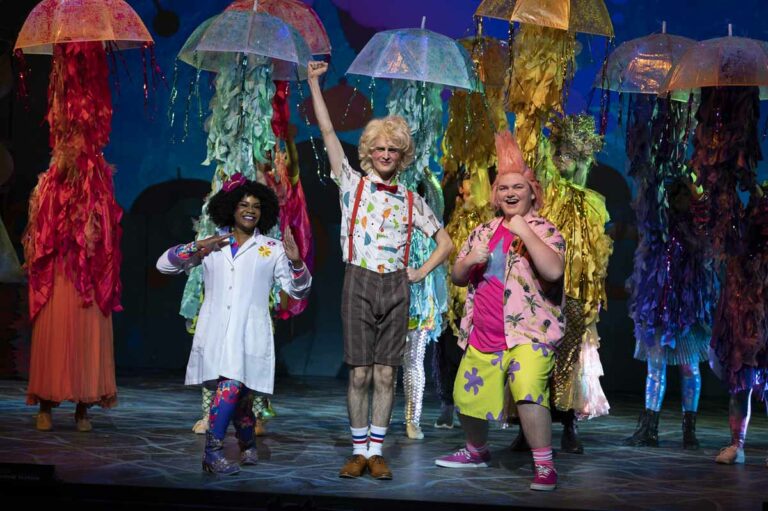
Playwriting is often a form of artistic exorcism. Many a play has been written to bring a form of closure to unresolved conflicts, strained relationships or traumatic experiences, and to release the hold that personal demons have on their authors. For playwright Edward Albee (Who’s Afraid of Virginia Woolf?), that demon happened to be his adoptive mother. Three Tall Women, Albee’s two-act exorcism, is running at Petaluma’s Cinnabar Theater through April 24.
It’s a four-character piece in which names are never spoken. The program lists them only as “A,” “B,” “C” and “The Young Man.” A (Laura Jorgensen) is a woman of 92, though she’ll only admit to being 91. B (Amanda Vitiello) is her caretaker, and C (Tiffani Lisieux) is a young lawyer assigned to assist in managing her financial affairs. A is in failing health, both physically and mentally. She struggles with incontinence, has short term memory problems and is extremely argumentative. B is used to A’s behavior, but it’s C’s first visit, and she has little patience for A and her accusations of theft and mismanagement. After a lengthy conversation about A’s past that’s full of the casual racism and homophobia that comes with privilege, A retires to her bed, where she suffers a stroke.
When the curtain rises on the second act, A is still in her bed. B and C enter the room dressed in beautiful evening wear. Then A walks in and joins them. The conversation begins again, and within a short while one realizes that all three are in actuality one person. B and C are now A at younger stages in her life, and they have questions to ask and things to say to each other. This is never more so than when The Young Man (Jean Colin-Cameron) appears.
Director Michael Fontaine has an excellent cast up to the challenge of not only playing multiple roles, but playing the same role as well. The contrast between the characters portrayed in the first act and the character portrayed in the second is striking, with Vitiello in particular having to do a 180.
While there are laughs in the show, it is by no means a comedy. I actually found the audience’s reaction to some of A’s bigoted epithets a little disconcerting.
That’s no fault of the artists, though, all of whom should stand tall for their work here.
‘Three Tall Women’ runs through Apr. 24 at Cinnabar Theater, 3333 Petaluma Blvd. N., Petaluma. Fri–Sat, 7:30pm; Sun, 2pm. $25–$35. Proof of Covid vaccination and masks required to attend. 707.763.8920. cinnabartheater.org
“To be a or not to be a playwright” has crossed the mind of more than a few scribes. For Petaluma’s resident playwright, David Templeton, a recent accolade affirms that writing for the stage has indeed been the right choice.
Templeton was recently honored by the 2022 Harold and Mimi Steinberg/American Theatre Critics Association (ATCA) New Play Award and Citations for his play Galatea—a sci-fi think piece that is by turns comedic, heartrending and ultimately cathartic. The citation for the work (which our own theater critic called “Excellent”) came with a sizable cash prize. What follows is a Q&A with the playwright.
What does a recognition of this caliber mean to you as a playwright? I’d imagine it is extremely validating. How have you kept alive the faith and drive to create throughout your career, which just seems to get better every year?
David Templeton: It means a lot, and I’m deeply honored by it and grateful for it. It means, I’d like to think, that I’m writing plays and telling stories that people are excited about, that are engaging enough and unusual enough to inspire people to talk about them, and remember them and, in this case, nominate them for national playwriting awards. As you point out, I’ve been doing this for a while now, and this is by far the most significant validation I’ve received. As for how I’ve kept the momentum going, I think it’s a combination of inspiration and stubbornness. I have ideas for new stories all the time, and when one really grabs me, the way the core idea of Galatea did, that’s the spark of inspiration I need to start writing it, and when the writing goes well, each new discovery I make as I tap away at my laptop seems to inspire more ideas and more discoveries. It’s kind of intoxicating.
Why plays? You’ve written prose and journalism of all sorts but what keeps bringing you back to the stage?
DT: I’m not sure I have a clear answer why. I just love the theater, the way stories on stage are often told through dialogue and conversation rather than primarily action. That feels magical to me. The first professional play I ever saw on stage, when I was 9 years old, was James Baldwin’s “Blues For Mister Charlie,” in Los Angeles in 1969. It was produced by a friend of my mom, and she was involved in doing box office and publicity and stuff for it. I actually was brought along to rehearsals, some of them held outdoors by the director’s pool. I’d sit there mesmerized as they ran lines, some of which were pretty scathing and eye-opening to a 9-year-old. Then I saw at least three performances of the play, and spent a lot of time with the actors during that period. I imagine that experience gave me a sense of the power of theater that was strong enough to stay with me as I’ve dabbled in other forms of writing, which I also love. But theater will always carry a special spark of magic for me.
I think it’s fascinating how you take an ancient art form and, with Galatea, use it to explore the future. From where do you summon the inspiration and courage to push the boundaries of the stage into genres like sci-fi?
DT: I love all kinds of genres, and I never want to write the same play twice. Though “Mary Shelley’s Body” has science-fiction-adjacent themes, it’s more of a straight-ahead horror story with touches of gothic romance. So though I’ve written science fiction short stories, “Galatea” really is my first science-fiction play. I think the fact that it’s done so rarely on stage is part of the appeal because I really do want to bring something new to the stage every time I tackle a play. Once I had envisioned the key ideas at the heart of the play, which came from questions I started playing with about robots and everyone’s assumptions that synthetic life forms would inevitably view themselves as superior to humans, I felt obligated to see the project through, because as far I know, some of the things I explore here have never been done exactly like this. That’s pretty exciting, and for me, it fueled the long effort of creating something as complicated as a science-fiction play.
How has being a theater critic and culture writer informed your creative pursuits?
DT: I was a reviewer for 16 years. That’s at least one play a weekend, often more, for 52 weeks a year for over a decade and a half. I estimate that I’ve seen between 1,000 and 1,500 plays on stage. That’s quite an education. I’ve seen so many new plays that basically do nothing original. I think that adds to my drive to always tell a story in an original way, or bring something new to a familiar set-up. In “Drumming with Anubis,” I loved the idea of incorporating an actual drumming circle around a campfire and then introducing characters who at first might seem like stereotypes, but quickly shred the audience’s assumptions about these guys and what they’re about. In my next play, the plot incorporates competitive jigsaw puzzling, so I get to have actors rapidly building puzzles as part of the action, something I’ve never seen on stage before. I think all of my years as a reviewer and an arts writer have given me a pretty clear idea of what kinds of things have been done to death, so I have a strong awareness of where to go as I attempt to tell stories in new ways.
What’s next?
DT: I’m currently working on the aforementioned puzzle play, which is actually about a parrot and its relationship with two of the humans it knows during its long life. It’s titled “Featherbaby,” and with any luck, it will be produced in about a year or so. It’s the hardest thing I’ve done so far, but it’s going to be funny, and sweet and heartbreaking and make us all think about the true meaning of friends and companionship. This November I will be performing my one-man show “Polar Bears” in New York City at the United Solo Theater Festival. And if things go according to plan, there will be a book collection of four of my plays coming out this year or early next, presenting my genre stuff as literature, since it’s something of an open secret that reading plays is a blast. The book will be titled “Monsters, Gods and Robots.” Meanwhile, I’m researching two other plays I hope to do, one of them a ghost story, of sorts, set in the world of female boxing. As I said, I never want to write the same story twice.
This November, Templeton will perform his one-man-show ‘Polar Bears,’ at New York City’s United Solo Theater Festival. A collection of four of his plays, ‘Monsters, Gods and Robots,’ will be published next year. A longer version of this interview is available at bohemian.com and pacificsun.com.
Why is the SMART train so stupid? I’m sure that if you have driven through San Rafael in the past few years, you have found yourself in a traffic line waiting for the SMART train.
For some unexplained reason, when the crossing gates go down, traffic ends up waiting minutes for the train to come lumbering across the road. And then, after passing the intersection, there is another 30 second wait for the gates to lift. It also seems that the gates are not timed with the municipal traffic lights, usually leaving a chaos of frustration in the wake of the train. Having a train run the commuter corridor is a fabulous idea, as evidenced by so many successful urban transit systems world-wide.
So how is it that the SMART train is such an unused annoyance in Marin? I grew up in Los Angeles, which was “Ground Zero” for the deprecation of public and commercial rail. I recall parking for extended periods of time while freight trains idled across main traffic thoroughfares, purportedly doing their freight business. It didn’t take long for everybody to hate anything rail.
We could not drive on I-10 to LA without my parents grousing about the freight lines running their right-of-way along the corridor. It turned out that the deprecation of the Los Angeles rail systems was a conspiracy by corporate interests wanting to eliminate public transit and have us all drive our own cars. The SMART train idiocy has a similar smell.
Well into the 20th Century, an aging Frenchman recalled his youth and said that you hadn’t really lived unless you’d experienced the pleasure of undressing a woman in turn-of-the-century clothing.
As one lacy layer gave way to another and the erotic tension mounted to a frenzy, alas, one can’t help but think of Marcel Proust’s bittersweet discovery—made during the same era of corsets and petticoats—that anticipation is often more pleasurable than pleasure itself.
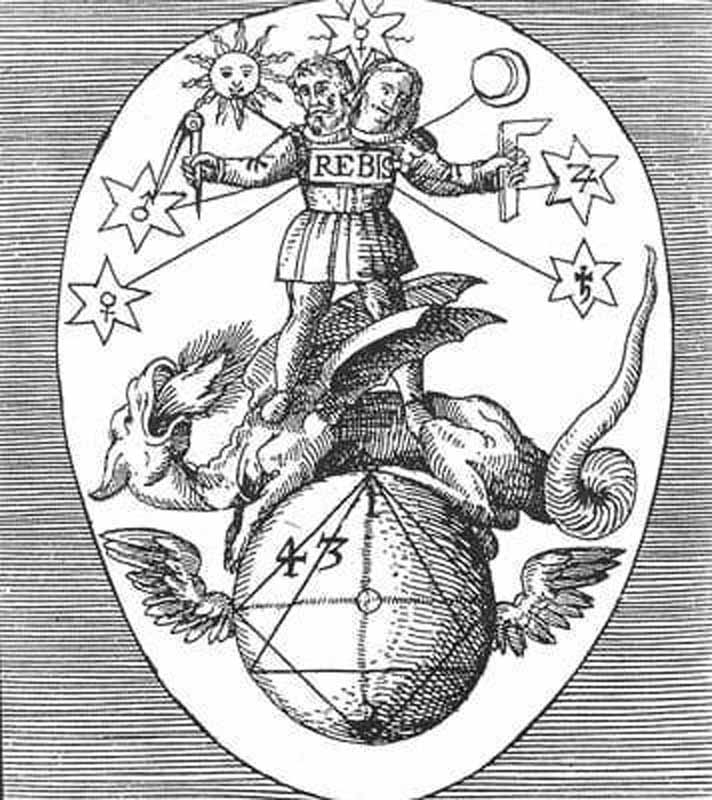
Absinthe, the signature drink of Belle Epoque France, also had a ritual based on delayed gratification, though one not nearly as complex as the jigsaw puzzle of women’s undergarments. The traditional way of drinking the moss-colored spirit—nicknamed “the green fairy” for the supposed buzz it brings—is to start by pouring an ounce of the potent potable in a glass. Next, perch on the rim, like a vulture hovering over your soon-to-be comatose self—a slotted spoon holding a sugar cube. Now slowly pour ice water over the cube, which takes the sugar down into the glass, releases the oils of anise, fennel and wormwood, and turns the verdant elixir a cloudy white known as the louche. The next part is easy: down the hatch. But be forewarned, overindulge and the green fairy may suddenly appear as a hologram-hallucination of Edgar Degas, who’s sketching your stone-faced expression for his famous 1876 painting entitled simply Absinthe.
NAME GAME Oakland-based Absinthia Vermut was destined to become a follower of the green fairy—that’s not her brand, but rather her actual name.
With its heavily literary and historical associations, absinthe certainly fuels the imagination, and the tipsiness it brings is certainly different than with other spirits. But the supposed hallucinogenic properties of the once-outlawed drink is really the result of what today we call misinformation. The Great French Wine Blight, an outbreak of phylloxera, claimed nearly half the vineyards in France in the middle of the 19th Century. Nature abhors a vacuum, so absinthe stepped in to fill the drinking void and soon 5pm was known as “the green hour.”
When the French wine industry recovered from the blight, it found it could not compete with the craze for absinthe, which appealed to bohemians and beau monde alike. And so it launched a propaganda campaign smearing absinthe as poison that will drive you mad. The United States banned the drink in 1912 and the ban stayed in effect until 2007. Fifteen years later, the Bay Area is home to no less than four absinthe makers (not to mention the Absinthe Brasserie And Bar in San Francisco), each with its own special approach.
For over a century, France and Sonoma County have had winemaking in common, and now thanks to Healdsburg’s Young & Yonder, we are confreres in absinthe-making as well. Founded in 2013 by husband and wife team Josh and Sarah Opatz, the distillery debuted with vodka and gin before introducing an absinthe boasting a contemporary flavor profile.
“We wanted to stay true to the spirit with anise, fennel and wormwood,” says Sarah Opatz, “but added lemongrass, ginger, peppermint and eucalyptus to make drinking it more interesting than just a black lirocrice bomb. We joke that ours is a gateway to absinthe.” One of Opatz’s favorite recipes is called the Suisse Coffee Cocktail, and consists of absinthe, a shot of espresso, simple syrup and half-and-half shaken and served in a coupe.
Caffeine and absinthe make for an interesting combination for adventurous drinkers. According to a toxicologist friend of Opatz, the spirit’s mysterious effect is not specifically from wormwood but rather the entire mix of ingredients—including the 120-proof alcohol— that “affects your nerves.” This is in perfect keeping with the fashion for nervous disorders that reigned during the French fin-de-siecle. But did absinthe soothe the nerves of jaded sophisticates facing the dawn of modernism, or cause their decadent neurasthenia? Most likely it was the green fairy flying a feedback loop, with absinthe alternately soothing nerves and revving them up.
Lance Winters “wanted to know what all the fuss was about” when it came to absinthe, and began tinkering with recipes after joining Alameda’s St. George Spirits in 1996. By the time the ban was lifted in 2007, says the master distiller and company president, “We had an absinthe that we really enjoyed, that was all about striking a balance between a group of really forward botanicals. It’s inspired by a traditional recipe, but rebalanced to something I really love to drink. Modern American drinkers aren’t huge fans of that black licorice profile, but the balance of mint and citrus that comes from the brandy base and the additional botanicals round that out. Our use of the non-traditional star anise gives more mouthfeel, and the opal basil draws the anise flavor to a different place.”
Oakland-based Absinthia Vermut was destined to become a follower of the green fairy. First off, that’s not her brand, but rather her actual name. Her family name was originally spelled Wermuth, she says, and the spirit known as vermouth originally contained wormwood, one of the defining botanicals in absinthe. She discovered the emerald elixir at the Burning Man festival in 1996, and immediately became obsessed with making it bootleg. Friends soon nicknamed her Absinthia, which is now her legal name, as well as the name of her eponymous brand.
“I call it traditional absinthe for Americans who didn’t grow up with a lot of anise on our palates,” she says. Her recipe is extra-smooth so that it doesn’t require any added sweetener, and is distilled in San Carlos by Coastal Spirits, an award-winning gin maker. “I like to shatter misconceptions and show people that absinthe, when well crafted, can be delicious,” Vermut says. “I felt like this is an amazing spirit that people need to understand is not dangerous or disgusting, and that’s what’s motivated me all these years to keep making it. ”
Vermut also offers a cocktail syrup called Fairy Dust, which she created after numerous acquaintances said they wanted a non-alcoholic absinthe alternative. It contains simple syrup flavored with the traditional ingredients anise, wormwood and fennel. Vermut says it makes for an amazingly refreshing beverage when mixed with soda water and lemon juice.
As with anything, there are innovators and there are purists. Carter Raff, maker of San Francisco-based Emperor Norton absinthe, is the latter, and claims to be one of the few distilleries of the real deal. Given Emperor Norton’s 100-point score from Bonfort’s Wine and Spirits Journal, he may have a point. “Ninety percent of the absinthe out there isn’t made correctly,” says Raff. “I’ve been studying it since 1985. For one thing, most distilleries use star anise, which gives a heavy black licorice taste that numbs the tongue so you can’t taste the other herbs. I don’t know why some other makers even call it absinthe.”
Photo courtesy of Ben Krantz DISTILLED A view of the distilling equipment at Alameda’s St. George Spirits.
Emperor Norton uses California grapes for its brandy base, and a Roman wormwood is added after the distilling to provide the natural green color that looks yellowish under light. “A lot of contemporary absinthes are neon green, which means they’ve been artificially colored, or they’re brown.” As for Roman wormwood, it’s only grown in the world for one reason and that’s coloring absinthe. Raff gets his from a small supplier in France that has been growing it for 150 years. But back in the bootleg days, it was so expensive that he decided to grow his own.
“I got interested in absinthe because it was obscure and everything said about it was BS,” says Raff. “It never made you hallucinate or go crazy—that was all just propaganda by the French wine industry. I also like the ritual involved. You have to prepare it, like making espresso, devote time and attention to it and not just pour three fingers of whiskey and drink. Absinthe is something to cherish.”
Photo courtesy of Emperor Norton REGAL Emperor Norton boasts a100-point score from ‘Wine and Spirits Journal.’
Cherishing the green fairy—instead of provoking her—and absinthe can provide a night of elegant gaiety or quiet artistic creation, depending on what you ask of it. “The green fairy was a very poetic description of what one might experience after having some absinthe,” says St. George’s Lance Winters, “inspired by the beautiful, diaphanous swirls of opalescence in a glass, conjuring up the image of a fairy’s gown. But the toughest job of any honest absinthe producer is dispelling all of the myths around absinthe. What you should really expect is a complex spirit, with layers of complexity that slowly peel back after each sip to reveal a drink like no other.”
For the tatted and soon-to-be-tatted, run, don’t walk to the 30th Annual Tattoos & Blues Convention, being held at Flamingo resort in Santa Rosa! This is the longest running tattoo convention on the west coast, and the second longest running in the country. Get ready for three days of tattooing from over 200 tattoo shops, including Faith Tattoo of Santa Rosa, Hidden Coast Tattoo of Sebastopol, Switchblade Tattoo Club of Sacramento and many more. As well as artists, there will be live music, including Derek Irving & Combo on Friday and Nobody’s Baby on Saturday night. Saturday also boasts a car show, with a chance to pre-register any must-see lowriders. Event is Friday, April 22-Sunday, April 24. Hours are noon-11 pm Friday and Saturday, noon-8 pm Sunday. Flamingo Hotel, 2777 4th St., Santa Rosa. Tickets sold at the door. $25 for a day pass, $50 for a weekend pass. Free to children under 12. www.santarosatattoosandblues.com
Sebastopol
Apple Blossom Parade
The magical annual event not to be missed—come out to the Apple Blossom Festival and Parade! This year’s theme is “Mask-a-Rade.” With handmade floats, animals and joyful, colorful displays, there’s something in this parade for everyone. In addition to the parade, the festival runs both Saturday and Sunday, featuring an art show from Western Sonoma County artists, a wide variety of exhibitors and vendors selling crafts, goods, jewelry and more, and a music lineup including acts like Volker Strifler, Sol Horizon, the Pulsators and more. This is a weekend full of local pride and sweet vibes. Put it on the calendar! The event runs April 23-24, with the parade starting at 10am on April 23. Event and activity times vary. 282 S. High St., Sebastopol. Tickets $10 for adults, $8 for seniors, $8 for students ages 5-17, free for children four and under. www.appleblossomfest.com
Petaluma
Bard Birthday
“There was a star danced, and under that was I born,” quoth the Bard, and right was he! Come to the Bard’s Birthday Bash—the man who coined the term eyeball deserves a legion of birthday tidings—this Saturday at Cafe Central in Petaluma. This will be a birthday party for the books—nay, the stage? Expect music by Mood Jungle, an open mic with performances by Petaluma Shakespeare Company, Bard-themed trivia, prizes and cake! Local actor Jeffrey Weissman—famous for his roles in Back to the Future I and II—will MC the event and bring the snickers and soliloquies. This is a whole family affair, so come one, come all; any age is welcome. Read or perform a favorite sonnet, scene or soliloquy to honor the Bard! The more theatrical the delivery, the better. Event is Saturday, April 23, 2:30-4:30pm. Grand Central Cafe, 226 Weller St., Petaluma.
Mill Valley
Earth Day
This Sunday, join the Mill Valley Community Center at Earth 2050, an event celebrating Earth Day and working to build a better world! Featuring art, games, environmentally-oriented talks, food and music, this is a family-friendly festival. Earth 2050 invites people of all ages to imagine a more just and sustainable world by the year 2050. Playful activities will teach simple actions available to protect the future, such as using clean energy, eating sustainably, living lightly and building healthy communities. Featured musicians include Maria Muldaur and the Red Hot Bluesiana Band, as well as Matt Jaffe, Reed Fromer, the Shady Ladies and the Freedom Singers. Participating artists include Tom Killion, Tess Felix, young creators and many more. Free registration required. Children under 13 are welcome, but recommend they be accompanied by an adult. No dogs allowed. Event is at the Mill Valley Community Center, 180 Camino Alto, Mill Valley. 1-5pm. Tickets free, registration required. Visit eventbrite.com to purchase. Donations recommended. With questions, email te**@*********ge.net.
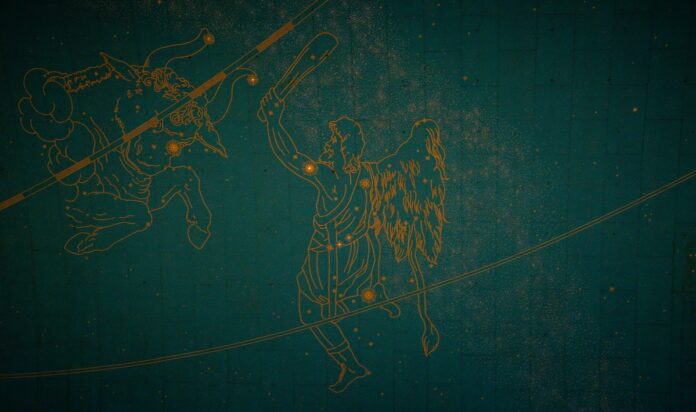
ARIES (March 21-April 19): Aries author Marge Piercy writes, “I love people who harness themselves, an ox to a heavy cart, who pull like water buffalo, with massive patience, who strain in the mud and the muck to move things forward, who do what has to be done, again and again.” According to my analysis of the astrological factors, you’ll be wise to be like the person Piercy describes. You’re entering a phase of your cycle when diligent work and impeccable self-discipline are most necessary and most likely to yield stellar rewards.
TAURUS (April 20-May 20): In 1879, Taurus-born Williamina Fleming was working as a maid for astronomer Edward Charles Pickering, director of the Harvard Observatory. Impressed with her intelligence, Pickering hired Fleming to do scientific work. By 1893, she had become a prominent, award-winning astronomer. Ultimately, she discovered the Horsehead Nebula, helped develop a system for identifying stars and cataloged thousands of astronomical phenomena. I propose that we make her your role model for the duration of 2022. If there has ever been a year when you might achieve progress like Fleming’s, it’s this one.
GEMINI (May 21-June 20): For 2,500 years, Egypt was a conquered territory ruled by non-Egyptians. Persians took control in 525 BCE. Greeks replaced them. In succeeding centuries, Egypt had to submit to the authority of the Roman Empire, the Persians again, the Byzantine Empire, the Arab Islamic Caliphate, the Mamluk Sultanate, the Ottomans and the British. When British troops withdrew from their occupation in 1956, Egypt was finally an independent self-ruled nation. If there are any elements of your own life story that even partially resemble Egypt’s history, I have good news: 2022 is the year you can achieve a more complete version of sovereignty than you have ever enjoyed. And the next phase of your freedom work begins now.
CANCER (June 21-July 22): During the next four weeks, some of the best lessons you can study and learn will come to you while you’re socializing and communicating. Even more than is usually the case, your friends and allies will offer you crucial information that has the power to catalyze dynamic decisions. Lucky encounters with very interesting people may open up possibilities worth investigating. And here’s a fun X-factor: The sometimes surprising words that fly out of your mouth during lively conversations will provide clues about what your deep self has been half-consciously dreaming.
LEO (July 23-Aug. 22): “Hold on tight, I would tell myself, but there was nothing for me to hold on to.” A character in one of Haruki Murakami’s novels says that. In contrast to that poor soul, Leo, I’m happy to tell you that there will indeed be a reliable and sturdy source for you to hold onto in the coming weeks—maybe more than one. I’m glad! In my astrological opinion, now is a time when you’ll be smart to get thoroughly anchored. It’s not that I think you will be in jeopardy. Rather, you’re in a phase when it’s more important than usual to identify what makes you feel stable and secure. It’s time to bolster your foundations and strengthen your roots.
VIRGO (Aug. 23-Sept. 22): In the latter half of the 19th Century, the U.S. government collaborated with professional hunters to kill millions of bison living in America’s Great Plains. Why? It was an effort to subjugate the indigenous people who lived there by eliminating the animals that were their source of food, clothing, shelter, bedding, ropes, shields and ornaments. The beloved and useful creatures might have gone extinct altogether if it had not been for the intervention of a Virgo rancher named Mary Ann “Molly” Goodnight. She single-handedly rebuilt the bison herds from a few remaining survivors. I propose that we make Goodnight your inspirational role model for the rest of 2022. What dwindling resources or at-risk assets could you restore to health?
LIBRA (Sept. 23-Oct. 22): British Admiral Horatio Nelson (1758–1805) was born under the sign of Libra. He was a brilliant and unconventional strategist whose leadership brought many naval victories for his country. Yet he was blind in one eye, missing most of his right arm from a battle wound and in constant discomfort from chronic seasickness. I propose we make him one of your patron saints for the coming weeks. May he inspire you to do your best and surpass your previous accomplishments, even if you’re not feeling perfect. (But also keep in mind: The problems you have to deal with will be far milder than Nelson’s.)
SCORPIO (Oct. 23-Nov. 21): Anti-apartheid activist Bantu Stephen Biko (1946–1977) was profoundly committed to authenticity. The repressive South African government hated that about him. Biko said, “I’m going to be me as I am, and you can beat me or jail me or even kill me, but I’m not going to be what you want me to be.” Fortunately for you, Scorpio, you’re in far less danger as you become more and more of your genuine self. That’s not to say the task of learning how to be true to your deep soul is entirely risk-free. There are people out there, even allies, who may be afraid of or resistant to your efforts. Don’t let their pressure influence you to dilute your holy quest.
SAGITTARIUS (Nov. 22-Dec. 21): “The artist must train not only his eye but also his soul,” said Sagittarian painter Wassily Kandinsky. Inspired by his observation, I’m telling you, “The practical dreamer should train not only her reasoning abilities but also her primal intuition, creative imagination, non-rational perceptivity, animal instincts and rowdy wisdom.” I especially urge you to embody my advice in the coming weeks, Sagittarius. Now is a favorable time to make abundant use of the other modes of intelligence that help you understand life as it really is—and not merely as the logical, analytical mind conceives it to be.
CAPRICORN (Dec. 22-Jan. 19): The language spoken by the indigenous Cherokee people is at least 3,000 years old. But it never had a written component until the 1820s. Then a Cherokee polymath named Sequoyah formulated a syllabary, making it possible for the first time to read and write the language. It was a herculean accomplishment with few precedents in history. I propose we name him your inspirational role model for the rest of 2022. In my astrological understanding, you are poised to make dramatic breakthroughs in self-expression and communication that will serve you and others for a long time.
AQUARIUS (Jan. 20-Feb. 18): A study by psychologists concludes there is a good way to enhance your willpower: For a given time, say one week, use your non-dominant hand to brush your teeth, wield your computer mouse, open your front door with your key or perform other habitual activities. Doing so boosts your ability to overcome regular patterns that tend to keep you mired in inertia. You’re more likely to summon the resolution and drive necessary to initiate new approaches in all areas of your life—and stick with them. The coming weeks will be an especially favorable time to try this experiment. (For more info, read this: https://tinyurl.com/BoostWillpower)
PISCES (Feb. 19-March 20): In his book, Thus Spoke Zarathustra, philosopher Friedrich Nietzsche wrote, “You have your way. I have my way. As for the right way, the correct way and the only way, it does not exist.” According to my reading of the astrological omens, you will be justified to say something like that in the near future. Now is a favorable time to honestly acknowledge differences between you and others—and accept those differences just as they are. The important point is to do what you need to do without decreeing that other people are wrong or misguided.
It felt like the best kind of deja vu to coordinate with Iréne Hodes, director of film festivals and cultural events at the Jewish Community Center (JCC) of Sonoma County.
We spoke for a Bohemian article in October of last year, when the JCC presented their 26th Sonoma County Jewish Film Festival, in purely remote form due to the circumstances of Covid.
Now, the JCC is presenting its 7th annual Israeli Film Festival, which is being shown in a hybrid form, with four screenings at the Rialto Cinema in Sebastopol, and online streaming of all films for three weeks. It’s important to the JCC to maintain the hybrid format going forward—they have no plans to stop virtual accessibility.
“We learned during the last two years that having access to high quality films and entertainment at home was a lifeline to many people,” said Hodes. “All of the Israeli Film Festival films are available to be streamed at home through our dedicated platform, including two films that can only be seen online. A hybrid festival is the best of both worlds—for those who would like to celebrate in-person together, and for those who feel more comfortable at home. There is something for everyone—a film for everyone, and a medium for everyone.”
The accessibility is ideal—this year’s lineup is as phenomenal and carefully curated as ever, featuring unique and powerful independent Israeli cinema. As with the Jewish Film Festival, the Israeli Film Festival films are curated by a selection committee of dedicated volunteers who meet weekly for much of the year. They screen films, as well as discuss and rate them. Hodes tells me it was a real delight this year, and difficult to narrow the selection with so many exceptional films from Israel. For this reason, the festival also features two “online-only” films, giving people a chance to see even more than what’s being screened in the cinema.
Here are some of Hodes’s tips and insights into the upcoming lineup.
“If I had to choose a particularly unique pairing (of the festival’s films), it would be the documentary double feature on May 3, Black Flowers, written and directed by Tammy Federman, and That Orchestra with the Broken Instruments, produced and directed by Yuval Hameiri. Black Flowers follows the story of five Holocaust survivors who became very skilled and accomplished artists, and how their relationship with their art has affected their memories of their trauma.”
Hodes emphasizes that this is no ordinary Holocaust documentary or bio-pic. This film received the highest rating from her organization’s film selection committee.
“In the second film,” said Hodes, “That Orchestra with the Broken Instruments, we meet musicians and composers, Jerusalemites, who come from very different walks of life. Young and old, professional and amateur, Jewish, Muslim, Christian, Hebrew-speakers, Arabic-speakers, English speakers, to name a few demographics. It’s a one-time concert that brings them together, and their instruments are all broken. It’s playful and poetic, delving into the spaces, similarities and differences between broken and whole.”
Black Flowers filmmaker Tammy Federman will be giving a talk on May 5 at noon via Zoom. There will also be a Zoom panel talk and Q&A with a Sonoma County local art therapist and a local music therapist, who will have both seen the films and will be leading a talk on the therapeutic power of the arts, with the films as inspiration and point of reference. The dates for this are not firm yet, so stay tuned.
In addition to these two choices, the festival also features Greener Pastures, directed by Matan Guggenheim and Assaf Abiri, The Raft, directed by Oded Raz—the director of Maktub, one of Israel’s biggest box office sensations—Give it Back, directed by Ruchama Ehrenhalt and One More Story, directed by Guri Alfi.
Greener Pastures is a comedy and tells the story of Dov, a penniless widower who is forced to live in a nursing home, to his misery and chagrin. He dreams of leaving the nursing home and buying back his beloved family home to live in until he dies. But Dov has no money since losing his pension. When he notices that all his fellow residents smoke legal medical cannabis, he realizes that weed could be his salvation—not in the smoking of it, but the selling. When love, the police and the mafia come into play, Dov finds himself at a crossroads: will he risk it all to make his dream come true? This film was nominated for 11 Ophir Israeli Academy Awards.
The Raft is a story of intense, life-changing adventure. In an incredibly rare feat, Israel’s soccer team has won a critical match and is now vying for a chance to reach the World Cup, but, due to increased security measures, has moved the game to the island of Cyprus. Four adolescent Israeli kids and diehard soccer fans undertake whatever measures necessary to make it to the game. Inspired by the mythological journey of Kon-Tiki, they decide to build a raft on their own and cross the Mediterranean Sea to attend the fateful game. During their perilous journey, their friendship is put to the ultimate test as they get a taste of first love and discover things about themselves that they didn’t know existed. Their innocent adventure evolves into an unforgettable coming-of-age journey.
Give it Back is the story of Olivia, a 12-year-old girl who has just moved with her family from New York and is starting at a new school. She struggles to find her place within the hierarchy of her new classmates, finding herself caught between the popular students and her shy classmate, Alem. Olivia must ultimately make a choice about who she is and how she will navigate her newfound circumstances. This is a drama about young character and identity development in a new place.
One More Story is a romantic comedy that tells the story of Yarden Gat—a young, brilliant, ambitious journalist working at a famous newspaper and who doesn’t believe in love. Nonetheless, she takes on the mission of finding love for her best friend, a hopeless romantic who has no idea how to talk to women. In the guise of an experiment, she convinces him to go on 30 dates in 30 days with 30 women, all while publishing the scoop in her newspaper. Will he find love through science? Will she change her mind? Or will fate take its course? A fun, sweet and funny movie, it stars Guri Alfi, Lior Ashkenazi, Dina Sanderson, Maayan Bloom and Danielle Gal.
Visit socoiff2022.eventive.org to view all show times, access films online and attend accompanying programming—much of which has still pending dates, so stay tuned for finalizations.
Good morning, my darlings! How is everyone getting along with Wednesday? As this is now apparently a half travel half fashion column, I’ll update you on my location—Chicago, which is freezing and gray and a stark change from the balmy 72 degrees and gently swaying palm trees of Los Angeles. Take me back! I’m here for my brother’s senior...
1 California's toughest maximum-security prison has what birdlike name?
2 What’s the current year, in Roman numerals?
3 British Queen Elizabeth II was born in London on April 21 of what year, whose digits add up to 18?
4 Cats have whiskers not only on their face and head, but also where on their bodies, and for what beneficial purpose?
5 After the...
Playwriting is often a form of artistic exorcism. Many a play has been written to bring a form of closure to unresolved conflicts, strained relationships or traumatic experiences, and to release the hold that personal demons have on their authors. For playwright Edward Albee (Who’s Afraid of Virginia Woolf?), that demon happened to be his adoptive mother. Three Tall...
“To be a or not to be a playwright” has crossed the mind of more than a few scribes. For Petaluma’s resident playwright, David Templeton, a recent accolade affirms that writing for the stage has indeed been the right choice.
Templeton was recently honored by the 2022 Harold and Mimi Steinberg/American Theatre Critics Association (ATCA) New Play Award and Citations...
Sung to the tune of Harry Belafonte’s “(Day-O) The Banana Boat Song,” released in 1956.
Day-o, day-o
Javelins come and Russians want to go home
Day, is a day, is a day, is a day, is a day,
Is a day-o
Stingers come and Russians want to go home
Kill all night on a drink of vodka
Missiles come and Russians want to go home
Stack corpses...
Train Pain
Why is the SMART train so stupid? I’m sure that if you have driven through San Rafael in the past few years, you have found yourself in a traffic line waiting for the SMART train.
For some unexplained reason, when the crossing gates go down, traffic ends up waiting minutes for the train to come lumbering across the road....
Well into the 20th Century, an aging Frenchman recalled his youth and said that you hadn’t really lived unless you’d experienced the pleasure of undressing a woman in turn-of-the-century clothing.
As one lacy layer gave way to another and the erotic tension mounted to a frenzy, alas, one can’t help but think of Marcel Proust’s bittersweet discovery—made during the same...
Santa Rosa
Tattoo Time
For the tatted and soon-to-be-tatted, run, don’t walk to the 30th Annual Tattoos & Blues Convention, being held at Flamingo resort in Santa Rosa! This is the longest running tattoo convention on the west coast, and the second longest running in the country. Get ready for three days of tattooing from over 200 tattoo shops, including Faith...
ARIES (March 21-April 19): Aries author Marge Piercy writes, "I love people who harness themselves, an ox to a heavy cart, who pull like water buffalo, with massive patience, who strain in the mud and the muck to move things forward, who do what has to be done, again and again.” According to my analysis of the astrological factors,...
It felt like the best kind of deja vu to coordinate with Iréne Hodes, director of film festivals and cultural events at the Jewish Community Center (JCC) of Sonoma County.
We spoke for a Bohemian article in October of last year, when the JCC presented their 26th Sonoma County Jewish Film Festival, in purely remote form due to the circumstances...