Hip-hop Showcase Manifests at Big Easy

Lately, when one encounters the term “manifest,” two notions come to mind.

Either the woo-woo pseudoscientific “Law of Attraction” or the odious 19th-century doctrine that the United States had the right to expand and colonize the North American continent.

Then there is Decolonized Mindz Entertainment’s play on the term—“Manifest Your Destiny,” which upends facile definitions as it manifests its ongoing North Bay hip-hop showcase in local venues. The next iteration will be at Petaluma’s Big Easy, Friday night. 

The brainchild of local hip-hop artist Damion Square, the promoter partnered with the area’s resident impresario, Josh Windmiller, to create the showcase, which delivers a diverse array of artists, each with a unique take on the genre.

Says Square, “The distinguishing factor about these particular acts is that they are the cremé de la cremé of hip-hop acts in the North Bay.” He adds, “Every single one of the artists has shown an extreme amount of dedication and devotion to their craft, and the elevation of hip-hop in general. These artists are breaking the mold, with an eclectic array of hip-hop artists, as opposed to the conventional ‘male dominated’ lineup of most hip-hop showcases.” 

The bottom line, adds Windmiller, is creating a community and introducing more people to performers who are “advancing homegrown hip-hop in the North Bay.”

Among the line-up for the Big Easy showcase are Simoné Mosely, D.square, KingLung and Eki’Shola. Also performing is Tru Lyric, an artist born and raised in Santa Rosa, who attended the high school formerly known as Analy.

“I want to bring something new and fresh to the genre of hip-hop,” says Tru Lyric, who is frank about using his talent for penning lyrics as a means of managing his depression and anxiety. Part of his project is using his musicianship to help others facing the same challenges. His most recent release, a digitally launched EP entitled Black Kids Like Emo, dropped in June 2021.

The critically-lauded Eki’Shola, who local audiences will recognize from such accolades as being featured in NPR’s Tiny Desk Contest, on KQED, and as Best of the Bay 2020 Editors’ Pick, also shares the bill this Friday. KingLung, who appeared in last week’s showcase at Horse and Plow Winery in Sebastopol, returns for this week’s showcase. “I’d say my music is leaning towards revolutionary, and would be a mix between hip-hop, R&B, soul and conscious rap,” says KingLung. “I consider myself a MC, and a poetic lyricist, more than just a rapper.”

Says Windmiller, “Damion and I booked five incredible acts that represent an expansive approach to hip-hop and soul.” 

He adds, “The variation over the course of the evening will really be exciting, featuring everything from lone MCs to electronic jazz, R’n’B and a live band.”

‘Manifest Your Destiny’ begins at 7:30pm, Friday, Sept. 9 at The Big Easy, 128 American Alley, Petaluma. Tickets are $10 (sliding scale option available).

Left Edge at The California Theatre

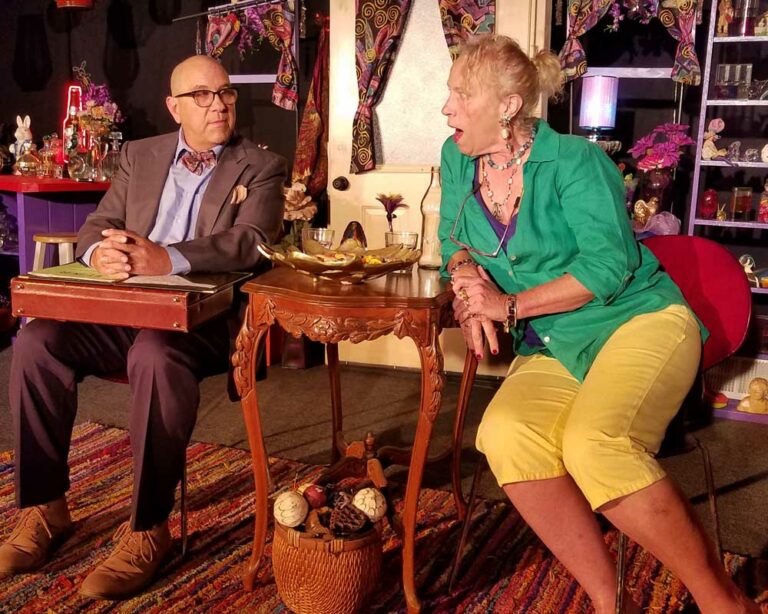
The California Theatre, the North Bay’s newest entertainment venue, hosts Left Edge Theatre’s season-opening production of Fun Home. A musical adaptation of Alison Bechdel’s 2006 graphic memoir of the same name, it took home five Tonys, including Best Musical, for its 2015 Broadway run. The show is scheduled to run through Sept. 18.

Bechdel’s original work, Fun Home: A Family Tragicomic, is a graphic memoir of her childhood and youth, her relationship with her father and her struggles with her sexual identity. The show, with book and lyrics by Lisa Kron and music by Jeanine Tesori, presents itself as if the panes Bechdel were drawing to illustrate her memoir come to life on stage.

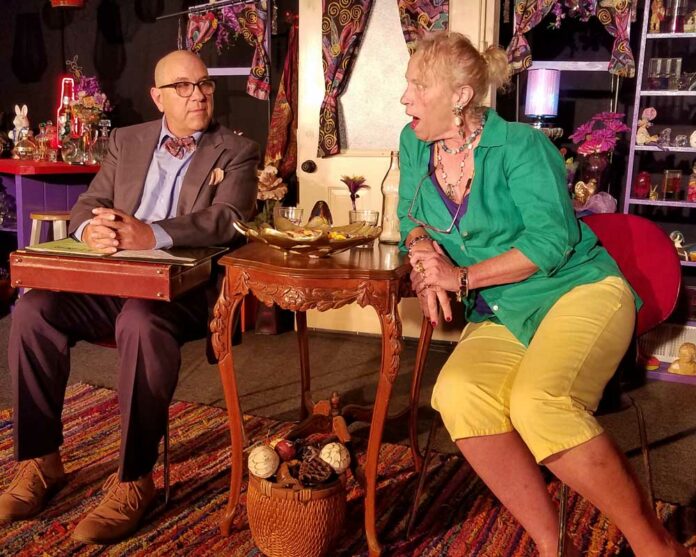
Adult Alison (Emily Jansen-Adan) sits at a drawing board as she attempts to caption the illustrations representing significant moments in her life from childhood through the present. The show is nonlinear, so recollections of Alison as a child (Addison Sandoval) are intermingled with memories of Alison’s time at college (Rae Lipman). Her relationship with her father Bruce (Anthony Martinez) is the thread that connects it all together. Bruce is emotionally unstable due to a lifelong inability to deal with his own sexuality that’s exacerbated when Alison finally becomes comfortable with hers.

More “coming out” than “coming of age” story, Fun Home hits a lot of emotional buttons, and director Maureen O’Neill’s cast push those buttons with surprising depth and sincerity of feeling. The three Alisons are all superb, with Sandoval’s delivery of “Ring of Keys” and Lipman’s performance of “Change My Major” definite highlights. The songs perfectly capture the awakening of sexual identity and the joy of a “morning after.”

The supporting cast is good, with Elizabeth Henry doing fine work as a woman coming apart after a lifetime of looking the other way at her husband’s “dalliances.”

Keyboards and percussion by Lucas Sherman and Grant Branham provide the musical support. Even just two pieces occasionally overwhelm the vocals, as the lyrics are key for a full appreciation of the show. Adjustments in either sound levels or speaker placement should be considered.

The venue itself shows promise, though modifications to turn a former restaurant into a performance space are no-doubt still in the works.  

Fun Home and The California are both welcome entries to the North Bay theater scene.

Left Edge Theatre’s ‘Fun Home’ runs through Sept. 18 at The California Theatre. 528 7th St., Santa Rosa. Thu-Sat, 7:30pm; Sun., 2pm. $15–$40.  Masking optional but encouraged.  707.536.1620. www.leftedgetheatre.com www.leftedgetheatre.com

West County Insiders Share Gems

Your average Sebastopudlian, as I will choose to call the residents of this jewel of west county Sonoma, might not be what you think.

For some, Sebastopol is a hippy enclave; for others, a hick ag-town; and for still others, the hipster epicenter of 21st century Sonoma County.


Yes, the answer is yes, all these things are true. Which makes Sebastopol as equally compelling for a stop off on a weekend drive as for a week-long destination holiday.

In my interviews, I got the sense that Sebastolpudlians are a prideful people, not boastful, but confident in their contribution to the collective good. The recommendations I got from talking to everyone from elected officials to the literal man on the street always started with something that was truly local, available to all, and fun.


Famed local real estate agent and long time personal friend Amee Sas recommended Wildflour Bread in Freestone, calling it “a must.”


“That’s 10 minutes from here,” I said over tea at Taylor Lane in The Barlow. “Is that Sebastopol though?”


“Yeah, certainly people from Sebastopol pop over there. It really is just like outer Sebastopol, you know what I mean?” said Sas, all respect to the 300 or so Freestoners. “And if you’re coming out to Sebastopol on a weekend, you absolutely must go to the Wildflour Bakery. You absolutely must.”


There you will find unique savory and sweet breads well worth the drive. Kids can stretch their legs in the large patron’s garden. Easy going hiking trails are nearby.
Both women recommended the Ives Pool, “serving the community since 1941,” according to its website. Located in Ives Park, the recreational pool offers a place to do laps, have family swim times, participate in swim team and take lessons.


“Ives Pool is so lovingly stewarded by the board of directors and the swim team folks,” said Hopkins. “A lot of people really come together to keep [the pool] open and functioning.”


“It’s a lot of fun to head over there, especially on a hot day,” she said. “[Swimming] is such a great form of exercise.”


Sas enthused about the generous activities of the local Rotary, which uses the pool as the site for a city-wide school district program called Learn to Swim. “Every public school in Sebastopol has this free swimming program that all second graders go to,” said Sas. How great is that, all funded through Rotary efforts? “Like, you’ll save a life, you know?”


Of course Sebastopol is famous for its annual event, the Gravenstein Apple Fair, a festival where attendees learn about animal husbandry, dying wool and “how to make your own apple cider,“ enthused Sas.


While the Gravenstein Apple Fair happened last month, Sebastopol has plenty of outdoor events in summer and fall, especially music oriented.


“If you ever get a chance to go to one of the Love Choir concerts, it will hit you in your soul bone to like go to that thing, you know?” preached Sas, speaking about the standout west county ensemble.


On Wednesdays during the summer, the Peacetown Summer Concert Series plays at The Barlow, downtown Sebastopol’s friendly rival next door, a well landscaped walking, shopping and eating center mixed-in with commercial business space.


You still have time to catch the last performance of the year, if you read this fast enough. On Sept. 8, the Whiskey Family Band will play—“Poor Man’s Whiskey lite,” according to the Peacetown website. The concert series displays that range of cultures that makes Sebastopol so interesting. While it may be country revival this week, earlier this summer reggae came through for the hippies, and afro-funk for the hipsters. And I will bet you a dollar that a broad swath of the Sebastopol cultural tapestry is there for all the shows.


At The Barlow, “there’s also art browsing, nature walks, Family Village at McKinley Street Community Stage, and lots of great food and drink at area restaurants,” according to The Barlow’s website.


Pro-tip: Pop into the lovely Community Market at the edge of The Barlow along Highway 12 for fresh, local products.


The charming HEAD WEST, a regional, outdoor retail marketplace, happens on the second weekend of the month right there on McKinley Street, the main street of The Barlow.


A market of makers, merchants, crafters, designers and artists, it gives preference to handmade, locally sourced, small batch, eco-friendly, conscious offerings and products. The market also provides “community booths,” featuring no-cost space for BIPOC, AAPI, LGBTQIA+ or non-profit vendors.


Across the street from The Barlow is the, as its name suggests, wonderful and unique Chimera Arts & Maker Space.


“Chimera Arts provides access to tools, classes and one-on-one training to Sonoma County and beyond. Beginners to skilled craftspeople use our facility to bring their creative projects to life.

“In the past year, we’ve also launched our youth program, designed to help kids experience the joy of hands-on making,” said Joe Szuecs, Chimera’s president, via email.


Chimera hosts First Fridays, an open house spread across the ample grounds of the Makerspace, with live music, hot dogs for sale and demos of works in progress. All are welcome.


Another insider tip from Sas: “You have to go to the Slow Food Russian River chapter to find the community-run apple press that’s free to use. You can press 100 pounds of your own apples to make your own apple juice there, just totally free.”


As you can imagine, there are endless options to eat around town. Here are a few local favorites that have a broad appeal for any visitor.One that is a personal favorite in my family, and which we will drive 30 minutes from Petaluma especially for, is Handline, a fast-casual masterpiece of seafood that takes on classic fast food—but classier than I made it sound.

“There is an homage to the old Foster Freeze [that was there for years],” said Sas, talking about the swirl cones on sale at Handline. “It is organic, and I enjoy it,” she laughed.


Asking people around downtown what was good to eat, Ramen Gaijin came up more than any other. In case you are out of the market, and think this is just another good ramen joint, this purely Sebastopudlian farm fresh ramen exemplifies that magic ratio of authentic to wholly original. Dope, trippy superhero art on the walls is another plus. Book ahead of time.


While you wait for your table, pull out that preroll you purchased at everybody’s favorite dispensary, Solful, just outside downtown. Light up in the square like everybody else does, and lean back in appreciation of the high quality cannabis that was carefully recommended to your preferences by the friendly and singularly attentive Solful team.

In the few minutes before Ramen Gaijin staff call your name, you will admire the mix of Priuses and big trucks, the lovingly displayed American and Pride flags, the long haired hippy and the big-bearded mechanic walking past.


“Another thing that I really enjoy and love about Sebastopol,” said Sas, “is that on Fridays you’ll often see on one street corner in town, women in black protesting and on the other corner, you’ll see like veterans holding American flags with pictures like, ‘My son served in the Navy.’ And this is a town where those kinds of discussions are still being had in a public forum.”


“Certainly Sebastopol is a place where in the 1960s people came from San Francisco to go live back on the land, and we still have those communes here in Sebastopol,” said Sas.


“And we also still have a healthy dose of farming community that still lives here,” she said, “and the combination of the two is what makes us great. I really believe that.”

Look—How Kind Should We Be?

Hi Ho and heLLO! To all yet again. If my editor will allow it, I’m taking today’s “Look” off of fashion and towards the human experience once more. Those looking for a garment-oriented put on, tune in next week; those considering the ever-changing and oft challenging circumstances of living—and being fashionable while doing it—let’s go. 

Love and kindness are at the core of today’s query. Specifically, when and how do we engage in them, in our everyday relationships?

Here are my thoughts: Building off my article, “Look Within,” from a few weeks ago, in which I quote Nietzsche to the tune of suffering being our best teacher, it seems fair to admit that life is a series of hard knocks. And I couldn’t agree more than I do—though life is suffering, it would be nice to have some ease sometimes, sheesh!

Shifting locality and looking at an Eastern relationship to suffering, Buddha talks about metta— Sanskrit, Maitri—which in English translates roughly to “loving kindness,” or the feeling of benevolent affection. Similar to Rumi’s “meeting each moment with friendly curiosity,” this state alchemicalizes the experience of suffering into something not quite so painful. It’s the whole “life is difficult, suffering is optional” concept, which, without denouncing the Nietzschian value of growing through tough times, leans less on brittle acceptance and more on engaged resilience. 

To wit, there is an invitation to meet bad things with a good nature. This is to practice metta in the face of an angry partner, a negligent parent, a racist neighbor, and to witness an outcome that ultimately serves us and them better than meeting them at their level of anger, hurt, bigotry or any other pain-afflicting circumstance. Instead of rejecting, we love; we are kind. 

The question is—how deeply do we take this? I have had people mockingly refer to my efforts to lead with love as “the martyr act” or the “Mother Teresa act” or “spiritual bypassing,” and further, I think of the bruises on my own heart. Are we really better off smiling at our assailants, offering them patience and second chances? Does this do us or them any good? And what about when we are the ones on the stand?

I have always been an active student in the school of loving kindness, yet I both constantly fall short and, when my heart is bruised and battered, begin to wonder, am I misunderstanding something?

I am earnestly curious, readers, as to your thoughts. How kind, how loving, ought we to be?

As ever, love always and to the best of my abilities, 

JaneJane Vick is an artist and writer. View her work and contact her at janevick.com.

Culture Crush—Bird Watching, Marin Theater, and More

Ross
Bird Watching
Step onto the glorious grounds of the Marin Art and Garden Center for an evening with birder and author Jack Gedney, reading from his new book, The Private Lives of Public Birds. Gedney, who was born in California and wandered around the U.S. in his younger years, studied literature and natural history at UC Berkeley. He has written a compact field guide to the trees of the San Francisco Bay Area, and co-owns a wild bird feeding and nature shop in Novato called Wild Birds Unlimited. Gedney studies birds intimately, illuminating the lives of different species, their relationships to humans and how we can deepen our relationship with them. Attendees of the evening with Gedney will gain his expert knowledge in identifying bird calls and their meanings, have a chance to get their book signed and partake in a wine reception afterwards. This event will be held on Thursday, Sept. 29 at the Marin Art and Garden Center Studio, 30 Sir Francis Drake Blvd., Ross. 5:30-7:30pm. Free. www.maringarden.org

Mill Valley
Marin Theater Company
A professional theater company since 1987, the Marin Theater Company grew out of the Mill Valley Center for the Performing Arts, founded in 1966. In short, this 56 year old venue and 35 year old company knows how to put on a show. This fall’s lineup includes Dunsinane, David Greig’s sequel to Shakespeare’s Macbeth, in partnership with Tamalpais High School’s Conservatory Theatre Ensemble, and August Wilson’s Two Trains Running, his seventh play in The American Century Cycle chronicling the African American experience in the 20th century. Both shows run through Oct. 16, with shows on Tuesday through Sunday evenings, as well as Saturday and Sunday matinees. The Marin Theater Company, 397 Miller Ave., Mill Valley. For tickets, showtimes and information, visit www.marintheatre.org.

Jenner
Art and Wine Tasting
This weekend, spend some time in the fresh, salty air and high blue skies of late summer at Sonoma Coast Art & Wine. This two-day event, held at Jenner by the Sea, is a gathering of local artists, including wines, to benefit the Waves of Compassion Foundation. The nonprofit was founded by Bodega Bay residents to provide food to local residents struggling with the high prices resulting from an influx of tourist traffic and homes being purchased for short-term housing. At the event, learn more about the foundation and marvel at the talent of the nine Bodega Bay artists whose work will be on display. A variety of red and white wines will be available to sample, donated by such vineyards as Kenwood, Nimble and Comstock. This event is Saturday, Sept. 10 and Sunday, Sept. 11 at Jenner by the Sea, 10400 CA-1, Jenner. Art gallery open 10am to 4pm. Wine tasting noon to 4pm, including either three whites, reds or a glass for $10. www.sonomacoastart.com

Rohnert Park
Indigo Girls
The Green Music Center welcomes yet another phenomenal act—Indigo Girls! Originally released in 1989, the group’s eponymous major label debut sold over two million copies and included singles such as “Closer to Fine” and “Kid Fears,” turning the group into one of the most successful folk duos in history. Over a 35-year career that began in clubs around their hometown of Atlanta, the Grammy-winning duo has recorded 16 studio albums—seven gold, four platinum, one double platinum—sold over 15 million records, and built a dedicated, enduring following. Their sound and power have only grown, creating an inclusive and expansive act full of heartfelt reflection and energy. Indigo Girls plays at the Green Music Center, 1801 E Cotati Ave., Rohnert Park, Thursday, Sept. 8 at 7:30pm. Tickets $30-$95. www.gmc.sonoma.edu

Petaluma Opens First Riverside Boat Rental

Greg Sabourin, expert boatsperson and the executive director of the Petaluma Small Craft Center (PSCC), has a reminder: “We’re a river town, but we don’t have a place to rent boats!”

PSCC, a nonprofit, nearly 15 years old, is dedicated to improving access to the Petaluma River. For the last 15 years, they’ve partnered with nonprofits and summer camps, offering paddle boarding and kayaking lessons, providing sailing lessons for kids and adults, and generally following their mission statement of “putting butts in boats.”

The Floathouse Petaluma, an idea almost as old as the nonprofit, has long been on their horizon. An upcoming River Art Fundraiser is being held to support it on Saturday, Sept. 17 at The Watershed in Petaluma.

A community gathering, it will feature artwork from 26 Petaluma artists, each of whom was taken out on the Petaluma River to find inspiration for their piece.

Floathouse Petaluma, when it opens at the end of the month, will be Petaluma’s first waterfront boat rental facility. The idea is to provide water access to everybody, not just those with hitches to bring rented boats to dock, or boats of their own.

The Petaluma River, Sabourin points out, is Petaluma’s longest park. And it’s PSCC’s mission to provide people with access to it.

It’s a dock-based boat rental center, right on Petaluma’s turning basin in the heart of the city. The Floathouse is built to rise and fall with the tide, and will offer a wide variety of watercraft options, year-round.

“You can go to Clavey Paddle Sports in Petaluma, and they can set you up if you have a car with a rack for a half day, the day or a weekend. But in terms of hourly rentals where you walk down to the dock and rent a boat and you’re out and gone, no cars, no transport, this is the first place,” says Sabourin.

Essentially, PSCC is in love with the Petaluma River, and they’re looking to share the love. And in fundraising, they started with artists—bringing the artistic community out onto the river to showcase the beauty as only they can.

“The idea really was to bring the active and lively artistic community out on the river. The question is what’s the view from the river? Not just looking at it but on it. What does it feel like? What is it like out there?” Sabourin explained. “So, last fall through this spring we took dozens and dozens of artists out on the river. Some people wanted low tide, some high; some people wanted mornings, sunrise; some people wanted sunsets. We took a lot of artists out, some multiple times, and they would go back to their studios to create the work as inspired by the river. We wanted to integrate these two communities, and it’s been very successful.”

It’s almost as though Sabourin and company at PSCC are the voice of the Petaluma River, and have called in the creative community, taught them the language and invited them to create their own relationship with the water that runs like a heart vein through the city of Petaluma.

“The more people you get out on the river, enjoying the river, and using it recreationally, the more people are going to want to serve and protect it. Our niche, if you will, is to really get people out on the river year-round. The more people on the water, the more they’re going to serve, protect and educate,” said Sabourin. “What’s been lacking is access. If you don’t own your own boat or have a car that can carry a boat, you can’t access; you can’t fall in love.”

The Floathouse corrects this lack of access, in an affordable, accessible way, and is intent on ensuring that everyone is able to create a relationship with the water.

“We’re making sure we also connect with underserved communities. On the program side, we’re making sure that populations who wouldn’t normally be able to access the river can also enjoy it. And it really took a nonprofit to make all of this possible. By the time all of this is finished, we’ll have raised almost $1 million to do all the funding, permitting, pile driving, dock building, buying the fleet, plumbing, electricity, solar, all of that. It’s a huge investment that wouldn’t have [been] penciled out if this was a commercial business.”

PSCC has stuck with this labor of river love for 12 years, through ups and downs and everything in between, and the payoff, as Sabourin said, is “that it’s going to be open soon.”

When fully operative, the Floathouse will provide enough income—along with continued fundraising—to keep PSCC functioning with a paid staff, while also providing access to the water and giving more Petalumans access to one of the city’s greatest gifts. It couldn’t be a better situation.

Join the community of Petaluma, the artists who made the work and the Petaluma Small Craft Center staff on Sept. 17 at The Watershed, 429 1st St., from 4-7pm.

Labor agreements renew struggle over Sheriff review agency’s powers

The latest chapter in a yearslong fight over the powers of Sonoma County’s law enforcement review office started in late June.

A set of labor agreements Sonoma County entered into with two unions representing employees of the county Sheriff’s Office while the county fought the same groups in court triggered the latest struggle.

At issue is the implementation of Measure P, a November 2020 ballot item intended to strengthen the powers of the Independent Office of Law Enforcement Review and Outreach (IOLERO), which reviews the actions and policies of the Sheriff’s Office. 

Critics of the labor agreements argue that they amount to significant, behind-the-scenes changes to the voter-approved ballot measure.

In an Aug. 1 letter to the Board of Supervisors, the IOLERO Community Advisory Committee (CAC), a group of community members who advise IOLERO, wrote that “it appears that the County has done exactly what community members most feared would happen” by undermining “the intent of Measure P and the will of the voters by the concessions it made in the Letters.” 

Meanwhile, Garrick Byers, the interim director of IOLERO, and Richard Bolanos, an attorney who represented the county in the negotiations with the labor unions, argued at two CAC meetings this summer that the agreements do not substantially restrict the scope of Measure P. 

Reached by phone on Sept. 1, Byers said he believes Measure P can be fully implemented now, thanks to the labor agreements. He declined to comment on his interpretation of specific elements of the agreements, because he wanted to leave the matter to John Alden, who took over as IOLERO’s permanent director on Tuesday, Sept. 6, after the Bohemian’s print deadline. 

IOLERO was formed in 2016 following years of public protest and meetings after the killing of 13-year-old Andy Lopez by a Sheriff’s deputy in October 2013. Almost since it was formed, the scope of the IOLERO’s power has been the subject of political struggle over the independence of the Sheriff who, unlike a city’s police chief, is directly elected by voters and largely shielded from outside oversight.

Under the original legislation creating IOLERO, the office was tasked with reviewing the Sheriff’s Office’s internal investigations of possible misconduct by Sheriff’s employees, offering non-binding policy recommendations and conducting public outreach. 

However, IOLERO proved weaker than local community advocates had hoped, with the Sheriff’s Office wielding the ability to “lock out” IOLERO from files needed to complete investigations. 

Advocates took the issue directly to voters. In August 2020, after renewed public pressure due to that year’s Black Lives Matter protests, the Board of Supervisors added Measure P to the November 2020 ballot. Measure P would significantly increase IOLERO’s budget and strengthen its investigatory abilities and access to documents.

However, two unions representing Sheriff’s employees, the Sonoma County Law Enforcement Association and the Sonoma County Deputy Sheriff’s Association, quickly filed a complaint with the state Public Employment Review Board (PERB), arguing that the county had violated state law by failing to adequately “meet and confer” with Sheriff’s employees before adding Measure P to the ballot. 

That November, Measure P passed with support from 65% of voters. Still, the legal battle has dragged on, delaying the full implementation of the measure.

In June 2021, PERB ruled largely in favor of the unions, overturning core aspects of Measure P. The county appealed the case and, on June 23, 2022, the Court of Appeals released an opinion in favor of the county, throwing out most of PERB’s decision.

In a press release the same day, IOLERO announced that, after negotiations, the county had reached agreements with the law enforcement unions “to strengthen law enforcement oversight in the county.”

“The agreement strikes the right balance between increased transparency and oversight and fair and consistent investigatory procedures for the affected [Sheriff’s Office employees],” Damian Evans, president of Sonoma County Law Enforcement Association, said in the release.

Measure P’s supporters were alarmed, however. In effect, the agreements sign away some of the elements of Measure P which the court ultimately upheld, critics argue. And, while the county was required to bargain with the labor groups in good faith about the implementation of Measure P, it was not required to agree to weaken the voter-approved ballot measure.

In two monthly meetings following the release of the agreements, the IOLERO CAC grilled Byers and then Bolanos about the agreements.

At an Aug. 1 meeting, Bolanos said that the county entered into negotiations with the unions last year while the lawsuit dragged on, in hopes that they could implement Measure P as quickly as possible. The county had also heard that PERB might challenge the Court of Appeals’ decision by taking it to the state Supreme Court, potentially delaying the implementation of Measure P again. (PERB has requested that the state Supreme Court review the Court of Appeals decision. That case is ongoing.)

In an Aug. 1 letter to the Board of Supervisors, the CAC laid out concerns about three elements of the labor agreements:

  1. Although Measure P would have allowed IOLERO to conduct investigations into a death resulting from the actions of a Sheriff’s employee while the Sheriff’s Office is investigating the matter, the labor agreements specify that IOLERO’s investigation will not begin “until the Sheriff’s Department has completed its investigation and sent the incident to IOLERO,” the CAC letter states. Because such internal investigations can drag on for months, the CAC raised concern that, by the time IOLERO investigates, “witnesses’ memories will have faded and documents and other physical evidence [are] likely to be lost, essentially rendering any investigation by IOLERO virtually meaningless.”
  2. The labor agreements state that whistleblower complaints received by IOLERO must be referred to “the appropriate enforcement agency” after an intake process. In contrast, Measure P specified that such complaints “shall not need to be reported by IOLERO to the sheriff-coroner, including the Internal Affairs Division.” The CAC is concerned the “appropriate enforcement agency” could be interpreted as the Sheriff’s Office, potentially outing a Sheriff’s Office employee who filed an anonymous complaint with IOLERO. Bolanos acknowledged at the Aug. 1 CAC meeting that the wording of that section “could be more clear” about the fact that whistleblower complaints should not be referred back to the Sheriff’s Office for enforcement. 
  1. Lastly, the CAC’s letter notes that the labor agreements weaken IOLERO’s access to documents. While Measure P directed the Sheriff’s Office to share documents IOLERO requested as part of investigations, the labor agreements “allow” IOLERO to “request” such documents, leaving the decision of whether to share them in the hands of the Sheriff’s Office. 

Although the state Supreme Court case may drag on for months, the labor agreements are in effect and have no sunset date.

Local groups, including the Santa Rosa-Sonoma County NAACP, Community For Law Enforcement Accountability (CLEAN) and North Bay Organizing Project have called on the county to renegotiate the labor agreements. The Sonoma County Board of Supervisors and the Sheriff’s labor associations would both have to agree to reopen negotiations.

Only time will tell how IOLERO’s brand new director, John Alden, will handle this ongoing mess.

Labor Rebound: A new breed of organizers is leading the way

On Labor Day, conservative prognosticators will inevitably revel in their tired prediction about the demise of the U.S. union movement. While there may be a seeming kernel of truth in their negative statistical data—“organized labor only represents 6.4% of the private-sector workforce”—their misplaced reliance on gross numbers is misleading and doesn’t begin to recognize today’s unfolding story of a newly invigorated union movement.

After years of decline, labor is experiencing a resurgence on two fronts. The first is increasing militancy and resistance among workers already members of existing trade unions. Over the past year, discontent among tens of thousands of working-class Americans crested in a wave of strikes, walk-outs and protests as union represented workers flexed their muscles, confronting the owning class with ever more militant resistance.

The second front is a rapidly spreading movement fueled by youthful activists’ intent on organizing new sectors of the unorganized. The first nine months of this year saw a 58% increase in petitions for union elections, and the most recent Gallup poll found support for labor unions at its highest point since 1965, with 68% support! 

Today’s movement is being nourished by rebellious workers at places like Amazon, Starbucks, REI, Chipotle, Trader Joe’s and Apple (to name a few), with new organizing efforts popping up with regularity.

The new generation of youthful activists are fighting not just for better wages and working conditions, but are united in their common struggle for dignity and humane treatment on the job.

A young Starbucks organizer from the Boston area recently explained, “We’re creating a movement that is intersectional. We’re not just about wages and benefits; we are organizing to change the world. We are a social justice movement that advocates against the climate crisis, for gender affirming health care, against creeping fascism, and for the recognition of all personal and individual privacy rights, such as the freedom to love who you love, to marry who you marry and to have access to abortion. We unequivocally decry all forms of sexism and racism.” 

This younger generation is seeing its future and trying to do something positive about it.

On Labor Day, conservative prognosticators will inevitably revel in their tired prediction about the demise of the U.S. union movement. While there may be a seeming kernel of truth in their negative statistical data—“organized labor only represents 6.4% of the private-sector workforce”—their misplaced reliance on gross numbers is misleading and doesn’t begin to recognize today’s unfolding story of a newly invigorated union movement.

After years of decline, labor is experiencing a resurgence on two fronts. The first is increasing militancy and resistance among workers already members of existing trade unions. Over the past year, discontent among tens of thousands of working-class Americans crested in a wave of strikes, walk-outs and protests as union represented workers flexed their muscles, confronting the owning class with ever more militant resistance.

The second front is a rapidly spreading movement fueled by youthful activists’ intent on organizing new sectors of the unorganized. The first nine months of this year saw a 58% increase in petitions for union elections, and the most recent Gallup poll found support for labor unions at its highest point since 1965, with 68% support! 

Today’s movement is being nourished by rebellious workers at places like Amazon, Starbucks, REI, Chipotle, Trader Joe’s and Apple (to name a few), with new organizing efforts popping up with regularity.

The new generation of youthful activists are fighting not just for better wages and working conditions, but are united in their common struggle for dignity and humane treatment on the job.

A young Starbucks organizer from the Boston area recently explained, “We’re creating a movement that is intersectional. We’re not just about wages and benefits; we are organizing to change the world. We are a social justice movement that advocates against the climate crisis, for gender affirming health care, against creeping fascism, and for the recognition of all personal and individual privacy rights, such as the freedom to love who you love, to marry who you marry and to have access to abortion. We unequivocally decry all forms of sexism and racism.” 

This younger generation is seeing its future and trying to do something positive about it.

Jonathan Melrod’s new book, ‘Fighting Times: Organizing on the Front Lines of the Class War,’ will be published by PM Press on Sept. 15.

Fuller Idea: Solo show for late sculptor Mary Fuller McChesney

Sipping lemonade in room 200 at the Astro Motel, the AC is working diligently to keep us cool in Santa Rosa’s 5pm swelter. 

There, Gretchen Giles, Spring Maxfield and I discussed the brilliant and under-represented artist, Mary Fuller McChesney. 

Dwarfed in her day by the success of her male counterpart, artist Robert “Mac” McChesney, Mary McChesney’s work is now finally taking center stage after her passing in May. 

From its opening last week to Nov. 25, The Astro Motel, in collaboration with the Santa Rosa Urban Arts Partnership, hosts “Mary Fuller McChesney: Myth and Monument from Sonoma Mountain.” Curated by Maxfield, the exhibition features 18 of McChesney’s sculptures taken from the McChesney’s Sonoma Mountain top home, many never before seen by the public. 

In order to fully appreciate the value of this exhibition, aside from the overdue light shined on McChesney’s exceptional and previously undersung creative talent, readers must also consider a) The ongoing bypassing of female artists for their traditionally male counterparts, and b) the woman, artist and arts advocate who curated the show. 

Though she’s humble, asking for no praise and expressing only a desire to elevate the arts and community connection of Sonoma County, Maxfield is not only a pivotal fixture in Santa Rosa’s growing—even flourishing, thanks to many efforts—arts scene, but an artist herself. She was referred to once by a journalist as “the wife of artist Todd Barricklow,” despite her rather endless list of successes and contributions to the art world. Those include co-founding the Great Handcar Regatta in 2008, working with the City of Santa Rosa to market the city to visitors via hiring local artists to paint murals and design city graphics, and co-founding the nonprofit Santa Rosa Urban Arts Partnership, dedicated to developing community vibrancy and revitalizing Santa Rosa’s SOFA District, in particular and the whole city by proxy. 

In short, the idea that anyone would refer to Maxfield via association with a male counterpart is at best humorous and at worst the remnant of underappreciated female talent. And though she’s gotten tremendous press—“Arts Advocate is a Creative Force of Nature” from a 2014 Press Democrat article comes to mind—McChesney’s overlooked creative life resonated with Maxfield. 

“When I was invited to meet Mary in 2016, I really wasn’t familiar with who she was; for all of my art history classes, her name never came up. And something had just come out referring to me as ‘the wife of the artist.’ And it was obviously someone new, someone who didn’t do their research, and I laugh about it, but that was Mary’s entire situation,” Maxfield explained.

She isn’t seeking personal recognition or an ego boost, but to continue correcting the art world’s tremendous imbalance towards male artists, while also continuing her mission of bringing art and community together in Santa Rosa. While she actually genuinely found the poor word choice amusing, and gracefully chalked it up to 20-year-old writers fresh from college and new to the area, and while she loves, as she says, “being an artist’s wife,” she knows the difference if an artist is trying to sell her work or gain recognition. Maxfield and I both agreed that for a woman working to establish herself in the artworld, being sidelined for a famous husband isn’t very funny at all. 

“I really wanted her to be honored because I knew she was always an afterthought to her famous husband, even though her work was phenomenal and she put as much time and energy into her practice as he did,” Maxfield reflected. 

Maxfield—along with gallerist Dennis Calabi, who represented Mac McChesney and later Mary McChesney also—is responsible for preserving McChesney’s work after her death, with no immediate heirs, and wishes only that the show could have happened while McChesney was alive. Tears came to her eyes as we discussed the inevitable delay that resulted in her passing before the show’s organization, in part due to Maxfield’s own impostor syndrome, along with the realities of being a mother of two and working on myriad different projects around the city. 

“She was having financial issues and trying to sell her house, and I said, ‘Well, let’s have a show! This is your time. You’ve got all of this work. Some of it has never been seen. Let’s do this.’ But I also thought, ‘Well, who am I to do this, when I barely know this woman?’”

Feeling unsure and pressed for time pushed the idea back. In 2020, Maxfield thought to revisit it, but felt concerns about exposing the vulnerable McChesney to COVID. In 2021, Maxfield started calling, with no response. In January of 2022, she visited Calabi and learned McChesney had been moved into an assisted living situation. She suggested the idea of a show to Calabi, who was initially skeptical. 

Around the same time, Maxfield was hired by Astro Motel owners and friends, Liza Hinman and Eric Anderson, to spec art and assess damage in the mid-renovation rooms, which they’d opened to the homeless population during the pandemic. It was while doing this work that she learned that McChesney had passed. There was big press coverage—her obituary ran across the country—and Maxfield realized that in the Astro she finally had a space to curate the show, though McChesney wouldn’t be there. 

Who Was Mary Fuller McChesney? 

Gretchen Giles, an art critic, journalist, founder of Made Local Magazine and previous editor of the North Bay Bohemian, among other accolades—I was in a room full of powerful women and their ghosts this day—described McChesney as healthy, hale and squat; a powerhouse of a woman, creating work about vaginas and fecundity, about a woman’s life and the physicality of a woman’s life. Maxfield described her as “spicy, piss and vinegar, a spitfire.” 

The pamphlet McChesney wrote about the San Francisco Abstract Expressionist movement became a proverbial rosetta stone for the later book, The San Francisco School of Abstract Expressionism by Dr. Susan Landauer. She wrote murder mysteries to support her and Mac McChesney during the year they spent in Mexico, where they fled after refusing to denouce communisim. McChesney sculpted in concrete mixed with vermiculite, which created a unique, strong yet delicate, slower drying material. A commercial potter, she had a philosophy degree from UC Berkeley and worked in the Richmond Shipyards as a welder during World War II. 

Upon returning to Sonoma County from Mexico, the McChesneys moved into a home at the very top of Sonoma Mountain that was to become an epic, inimitable, nearly-unreachable artist retreat space, bursting with her work, placed in myriad locations across the landscape. She took care of Mac McChesney until his death. Giles said he “relied on her completely.” 

Deeply inspired by Aztec and Myan culture, especially after their stint in Mexico, McChesney’s work is a testament to mythology, fertility, masculinity and femininity, philosophy and her ongoing exploration of existence. A brilliant star in the sky of San Francisco art history, she is rightly, though belatedly, being given her due in the pantheon. 

“I love who she was, and I am angry that women aren’t getting their due,” said Maxfield. “And it’s a huge point of sadness for me that this didn’t happen before she died. I wanted her to be seen for who she was and not Robert’s wife.” 

The Astro Motel hosts ‘Mary Fuller McChesney: Myth and Monument from Sonoma Mountain’ through Nov. 25. An opening is scheduled for Sept. 8 from 5-7pm. 323 Santa Rosa Ave., Santa Rosa.

The Bard al Fresco: ‘Two Gentlemen’ comes to Mill Valley

0

Marin County’s venerable Curtain Theatre returns to the Old Mill Park Amphitheatre in Mill Valley for their more-or-less annual offering of Shakespeare al fresco. This year it’s Two Gentlemen of Verona, what many consider the Bard’s first (but still lesser-known) play.

If you find Shakespeare difficult to follow, fear not! The plot is fairly simple, and while it contains many of the devices seen in his later works (star-crossed lovers, rivalries, impersonation, etc.), there are not so many layers to them as to confound. It helps that right from the get-go there’s an original musical number that explains it all.  

Two BFF’s have come to crossroads in their lives. Valentine (Nic Moore) seeks to leave his home in Verona and find adventure in Milan. Proteus (Nelson Brown) plans to stick around and pursue his beloved Julia (Isabelle Grimm). In Milan, it’s love at first sight for Valentine when he spies the fair Sylvia (Gillian Eichenberger), but the Duke of Milan (Glenn Havlan) will have none of it, as he’s promised Sylvia to the foppish Thurio (Jamin Jollo). Things really get complicated when Proteus ends up being sent to Milan and also falls for the fair Sylvia. So much for his eternal love for Julia.

Add meddling servants, sword fights, bandits, dancing, a damsel locked in a tower and a dog, and you’ve got yourself a show!     

Director Steve Beecroft deftly handles all the elements and comes up with a top-notch bit of entertainment here. The cast of (mostly) veterans is well-balanced and works as a true ensemble. Brown did such good work as the fickle lover that his later appearances elicited boos from the well-engaged audience.

Appearances by servant Launce (GreyWolf) and his dog Crab (Jamin Jollo again) provide a lot of the comedy relief. At the performance I attended, they were quick to amusingly deal with some unexpected canine contributions from the audience.  

Music is always a feature at Curtain Theatre, and music director/composer Don Clark and a band of four deliver delightful original era-appropriate musical accompaniment and a few helpful expository songs.  

The Curtain Theatre production of Two Gentlemen of Verona is as approachable a production of Shakespeare as I’ve seen in a while. Pack a picnic, dress in layers and head out to the park for a very pleasant afternoon’s entertainment.

‘Two Gentlemen of Verona’ runs Saturday and Sunday through Sept. 4, with a special Monday, Sept. 5 (Labor Day) performance at the Old Mill Park Amphitheater, 352 Throckmorton Ave., Mill Valley. All shows 2pm. Free. curtaintheatre.org

Hip-hop Showcase Manifests at Big Easy

Lately, when one encounters the term “manifest,” two notions come to mind. Either the woo-woo pseudoscientific “Law of Attraction” or the odious 19th-century doctrine that the United States had the right to expand and colonize the North American continent. Then there is Decolonized Mindz Entertainment’s play on the term—“Manifest Your Destiny,” which upends facile definitions as it manifests its ongoing North...

Left Edge at The California Theatre

The California Theatre, the North Bay’s newest entertainment venue, hosts Left Edge Theatre’s season-opening production of Fun Home. A musical adaptation of Alison Bechdel's 2006 graphic memoir of the same name, it took home five Tonys, including Best Musical, for its 2015 Broadway run. The show is scheduled to run through Sept. 18. Bechdel’s original work, Fun Home: A Family...

West County Insiders Share Gems

Your average Sebastopudlian, as I will choose to call the residents of this jewel of west county Sonoma, might not be what you think. For some, Sebastopol is a hippy enclave; for others, a hick ag-town; and for still others, the hipster epicenter of 21st century Sonoma County. Yes, the answer is yes, all these things are true. Which makes Sebastopol...

Look—How Kind Should We Be?

Hi Ho and heLLO! To all yet again. If my editor will allow it, I’m taking today’s “Look” off of fashion and towards the human experience once more. Those looking for a garment-oriented put on, tune in next week; those considering the ever-changing and oft challenging circumstances of living—and being fashionable while doing it—let’s go.  Love and kindness are at...

Culture Crush—Bird Watching, Marin Theater, and More

RossBird WatchingStep onto the glorious grounds of the Marin Art and Garden Center for an evening with birder and author Jack Gedney, reading from his new book, The Private Lives of Public Birds. Gedney, who was born in California and wandered around the U.S. in his younger years, studied literature and natural history at UC Berkeley. He has written...

Petaluma Opens First Riverside Boat Rental

Greg Sabourin, expert boatsperson and the executive director of the Petaluma Small Craft Center (PSCC), has a reminder: “We’re a river town, but we don’t have a place to rent boats!” PSCC, a nonprofit, nearly 15 years old, is dedicated to improving access to the Petaluma River. For the last 15 years, they’ve partnered with nonprofits and summer camps, offering...

Labor agreements renew struggle over Sheriff review agency’s powers

Tingey Injury Law Firm/Unsplash
The latest chapter in a yearslong fight over the powers of Sonoma County’s law enforcement review office started in late June. A set of labor agreements Sonoma County entered into with two unions representing employees of the county Sheriff’s Office while the county fought the same groups in court triggered the latest struggle. At issue is the implementation of Measure P,...

Labor Rebound: A new breed of organizers is leading the way

microphone_matt_botsford_unsplash
On Labor Day, conservative prognosticators will inevitably revel in their tired prediction about the demise of the U.S. union movement. While there may be a seeming kernel of truth in their negative statistical data—“organized labor only represents 6.4% of the private-sector workforce”—their misplaced reliance on gross numbers is misleading and doesn’t begin to recognize today’s unfolding story of a...

Fuller Idea: Solo show for late sculptor Mary Fuller McChesney

Sipping lemonade in room 200 at the Astro Motel, the AC is working diligently to keep us cool in Santa Rosa’s 5pm swelter.  There, Gretchen Giles, Spring Maxfield and I discussed the brilliant and under-represented artist, Mary Fuller McChesney.  Dwarfed in her day by the success of her male counterpart, artist Robert “Mac” McChesney, Mary McChesney’s work is now finally taking...

The Bard al Fresco: ‘Two Gentlemen’ comes to Mill Valley

Marin County’s venerable Curtain Theatre returns to the Old Mill Park Amphitheatre in Mill Valley for their more-or-less annual offering of Shakespeare al fresco. This year it’s Two Gentlemen of Verona, what many consider the Bard’s first (but still lesser-known) play. If you find Shakespeare difficult to follow, fear not! The plot is fairly simple, and while it contains many...
11,084FansLike
4,446FollowersFollow
6,928FollowersFollow