
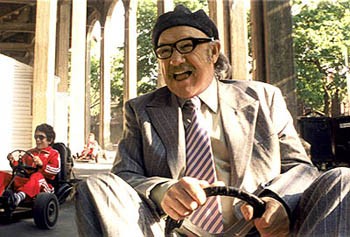
‘The Royal Tenenbaums’

0

Head Games

Nerdy novelist examines the brainy pain of ‘Royal Tenenbaums’

Writer David Templeton takes interesting people to interesting movies in his ongoing quest for the ultimate post-film conversation.

“Wow. Um . . . This could possibly bore me.” Andrew Sean Greer, author and self-described “secret nerd,” has come to a dead stop here at the far end of the Exploratorium, the world-renowned San Francisco museum famous for its whimsical blend of science, technology, and art.

Having worked our way past hundreds of humming, buzzing, spiraling machines, echo tubes, tornado chambers, and circular wave umbrellas, we’ve come to the entrance of a special exhibit. Titled “Mathematica: A World of Numbers . . . and Beyond,” it promises to be a series of displays demonstrating various principles of mathematics.

Admits Greer, “I’m like a kid. I love to watch all the machines and push all the buttons, but I’m kind of too impatient to stand around and read all the explanations.”

“Well,” I confess, “that makes two of us.”

Thankfully, “Mathematica” has no shortage of buttons to push and levers to pull. But we’re not really here to learn about minimal surfaces and projection geometry anyway. No, we’re here to discuss The Royal Tenenbaums, the critically lauded oddball of a film starring Gene Hackman, Luke Wilson, Ben Stiller, Gwyneth Paltrow, and Anjelica Huston.

In the movie, which follows a New York family full of one-time geniuses, Hackman and Huston play the long-divorced parents, Royal and Etheline, whose kids were all child prodigies who’ve grown up into outrageously failed adults. Chas (Stiller), a mouse-breeding entrepreneur, is now a paranoid safety addict. Margot (Paltrow), a playwright whose first work was staged at age 12, hasn’t written a word in half a dozen years. And Richie (Wilson), a one-time tennis champ, has been living on a cruise ship since a dramatic meltdown on the court at Wimbledon.

Since The Royal Tenenbaums explores the eccentric underbelly of genius, it only seemed fitting to bring our discussion of the film to the world’s most eccentric science museum. And who better to discuss it with than Andrew Sean Greer, author of the sensational new novel The Path of Minor Planets (Picador, $23). A poetic, surprising story of love, sex, death, and meteors, Greer’s novel features a very large array of brilliant astronomers and hard-driven scientists, none of whom–like the poor Tenenbaums–is all that adept at negotiating everyday life on Earth.

“One of the things I liked about The Royal Tenenbaums,” says Greer, “was the way it shows that smart people, even geniuses, are also very ordinary people with very ordinary problems.”

We’ve stopped to stare at a tall, narrow, glass-fronted box illustrating the concept of the bell curve. We watch as little balls randomly fall from above, bouncing down through a maze of pegs, each coming to rest in one of many slots at the bottom. While a few balls make their way into slots at the far edges of the box, where they sit all alone, the majority end up in a great big pile right in the middle.

“That,” Greer remarks, “is really eerie.” We move on, pausing again at the celestial mechanics display, a giant model of the solar system resembling a misshapen funnel. At the push of a button, a steel ball is released to race around the diameter of the funnel, gradually slipping lower and lower with each revolution down toward the exit hole at the center.

“I read this one book about the sociology of scientists,” says Greer, one eye on the ball as he talks. “It was very moving. It told about the career disappointments of brilliant people, how you could be an academic star in graduate school but then get assigned to a job at a nonresearch university–and then you’re stuck in that position forever, unable to move on to Harvard or somewhere important, because you’re forever viewed as a nonresearch kind of scientist.

“How disappointing that must be,” he continues. “I never thought about that before. I just always assumed that brilliant people got to do whatever they wanted to do.”

This brings him back to the Tenenbaums. “We assume that if, as a kid or a young person, you write a hit play or figure out a way to make a lot of money or establish yourself as a sports prodigy, then you’ll live happily ever after,” he says. “Or at least, that you’ll amount to something. These people didn’t, and they have no idea what went wrong.”

“And still,” I suggest, “everyone, secretly, wants to be a genius. Or at least be thought of as smart.”

“I think most people do think of themselves as smart,” he replies, “whether they are or not, while a lot of smart people think they’re not smart enough. They think they’re frauds, the way Margot Tenenbaum says at one point, ‘I’m not a genius. I never was a genius.'”

Greer now turns his full attention to the metal ball, moving at a ridiculous speed toward the center hole of the funnel, a planet accelerating its orbit as it draws closer to the sun.

“Come on! Come on!” Greer encourages the ball. “Yes! It’s sinking into the sun! The Earth is falling into some sort of gravity well!”

Finally, the ball drops out of sight, and Greer cheers.

“Now that,” he says, “was cool!”

From the January 10-16, 2002 issue of the North Bay Bohemian.
© Metro Publishing Inc.

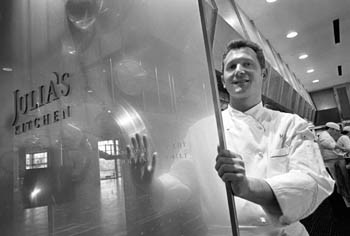
Julia’s Kitchen

0

Wild Child

Canteen ambiance mars fine cuisine at Julia’s Kitchen

By Paula Harris

One way to attract SUV-loads of salivating visitors to your brand new restaurant is to name it after Julia Child, that heavy-boned American food icon who has been dubbed the patron saint of the pantry. That’s what Napa’s new tourist magnet, the American Center for Wine, Food, and the Arts (COPIA), a $55-million foodie paradise, has christened its gourmet dining room. And the famous moniker seems to be bringing in diners by the drove.

But hold on to your potholders–don’t expect to catch a glimpse of the gourmet grande dame here. Child’s donated personal collection of copper cookware, on display at the center, is probably the closest you’ll get to the beloved chef.

Although she’s bestowing her name to a commercial enterprise for the first time, the 89-year-old Julia Child (who also serves as a trustee to COPIA, jumping on the Robert Mondavi-driven bandwagon with other icons Alice Waters and Martha Stewart) is not in attendance.

The cooking at Julia’s Kitchen is done by Mark Dommen, who has worked at San Francisco’s Fleur de Lys and New York’s Lespinasse.

Dommen focuses on creating upscale French-Californian dishes using regional and seasonal produce, especially produce and herbs from COPIA’s 3 1/2-acre landscaped organic gardens located outside the sprawling 80,000-square-foot building.

Although COPIA is surrounded on three sides by the scenic Napa River, and though the views of water, gardens, and rows of newly transplanted mature olive trees are picturesque, the center is surprisingly harsh and plain inside.

Julia’s Kitchen, despite the cozy name, is no less industrial. With its narrow open kitchen, sharp-edged decor, cold stainless-steel touches, gray concrete floor, and high noise level, the place resembles a busy office canteen rather than a premier restaurant.

There are big overhead lamps and pale green walls. The only softness comes from the heavy white tablecloths. The prep kitchen, which includes a tile installation in shades of blue by renowned contemporary artist Jorge Pardo, can be seen in glimpses though a swinging door–and it seems more aesthetically inviting than this spare dining room.

That’s one strike against Julia’s. The other is that, although the restaurant offers a highly touted chef’s tasting menu featuring five courses for $55, or $75 with wine pairing (lunch prices), they are only capable of offering it to entire tables and can’t accommodate vegetarians.

When my vegetarian companion offered to pick veggie items from the regular menu, I thought I would get the tasting menu but was rather snootily told the chef couldn’t accommodate a vegetarian on the tasting menu. This seems ludicrous in a top-class destination restaurant such as Julia’s.

Still, despite the drawbacks, the food is noteworthy.

A roasted onion and saffron soup ($10.50) arrives without liquid, just chubby, curled rock shrimp, tiny pearl onions, and fresh, snipped chives in the bowl. The server pours in the steaming, creamy soup from a silver teapot. The effect is like drinking velvet and silk with a rich salty tang from the saffron and shrimp. Comfort city!

The baby beet salad ($10.50) makes great use of the garden treasures and is composed of small, very sweet beets, frisée, and curly cress, plus warm chèvre cheese, candied walnuts, and sherry wine vinaigrette.

Hungrier visitors may prefer the sunchoke risotto appetizer ($11), which is a creamy, delicate delight featuring Jerusalem artichokes cooked with arborio rice and enlivened with hazelnuts, garlic, chives, and parmesan cheese.

A roasted monkfish ($19.50) is a sturdy seafood entree accompanied by rabe, applewood smoked bacon, and meaux mustard vinaigrette. Very tasty, although I question the recommended glass of Zinfandel with this dish.

For the ultimate in tenderness, try the braised veal short ribs and delicate sweetbreads ($21). The dish boasts butterlike meat with the sweetbreads crisply fried, plus turnips, rutabagas, celery root, and carrots. My one quibble is that it just tasted too salty.

One of the most exciting vegetarian dishes–both visually and gustatorily–that we’ve seen in a while is the roasted winter squash skewer ($16.50). The thick and colorful slabs of various garden-fresh squashes resemble a shelf of tiny books on their skewer.

A tiny trio of crème brûlées in vanilla, coffee, and chocolate are all chilled, smooth, and ultra intense–but the vanilla wins my vote.

Julia’s Kitchen offers 25 wines by the glass, several wine flights, and a 240-bottle wine list boasting vinos from the United States, Europe, Australia, and New Zealand.

Currently the restaurant is open only for lunch, but there are plans in upcoming months to offer dinner also. In the warm weather, Julia’s Kitchen plans to expand its current seating to outdoor dining.

Center organizers say diners will be able to eat on the paved deck or in the gardens where a wood-fired oven is installed. I would recommend going alfresco and giving the hyperactive dining room a miss.

Julia’s Kitchen Address: Inside COPIA, 500 First St., Napa. 707.265.5700. Hours: Thursday-Monday, 11:30 a.m. to 4 p.m. Plans to open for dinner later in the year. Food: French-Californian Service: Good though rushed Ambiance: Loud, intense noise level and a very sparse and industrial setting Price: Expensive Wine list: Great selection befitting the center Overall: Food 3 stars; ambiance 1 star (out of 4)

From the January 10-16, 2002 issue of the North Bay Bohemian.
© Metro Publishing Inc.

‘Speed-the-Plow’

Mad about Mamet

Fine cast distinguishes AT’s ‘Speed-the-Plow’

By Patrick Sullivan

Ever wonder why Hollywood churns out so many crappy movies? David Mamet knows the answer, and in Speed-the-Plow, which kicks off a Mamet festival at Actors Theatre, he reveals all. Sort of.

Mamet ought to have plenty of insight on this subject. After all, while he made his bones in the theater with landmark dramatic works such as Glengarry Glen Ross, he scored the big bucks by writing screenplays for films ranging from The Postman Always Rings Twice and State and Main to Hannibal and Heist.

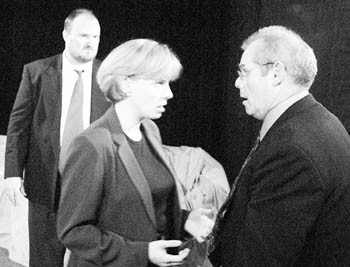
In Speed-the-Plow, Mamet gives us all of Tinseltown compressed into one room: the new office of Bobby Gould, the freshly minted head of production at a big film studio. The promotion has put Bobby (played by Joe Winkler) in a position of power, but he’s been around long enough to know that it also makes him a target.

And sure enough, before you can say “I’m ready for my close up, Mr. DeMille,” Bobby finds himself at the center of a peculiar battle of wills between two of his underlings.

Think back to those old Heathcliff cartoons, where an angel and a devil whisper conflicting advice into the titular feline’s ear. Bobby’s shoulders are just as crowded. On his right, pitchfork gripped firmly in a hammy fist, sits the production boss’ right-hand man, a hard-charging Hollywood insider named Charlie Fox (Robert Conard). Wearing the angel costume is Bobby’s idealistic new secretary, an attractive young temp named Karen (Heather Siglin).

The fight is over which script the studio will next produce. Charlie wants to make “great big jolly shitloads of money” with a prison movie featuring action superstar Dougie Brown. Karen, who appeals to both Bobby’s conscience and his eye for beauty, wants to save the world with The Bridge, a script by a highbrow novelist that would, as she says, “teach people they don’t need to be afraid.”

The AT production of this morality play offers an excellent cast. Winkler and Conard are big, very physical guys with hugely expressive faces and voices–perfect for a Mamet play. Both actors also have a flair for the kind of macho comic dialogue that pervades Speed-the-Plow. Pondering how Bobby should decorate his new office, Charlie offers this advice: “Why don’t you paint it with broken capillaries, decorate it like the inside of your nose?”

Heather Siglin brings the necessary physical beauty to the play, but unlike actresses sometimes chosen for this part, she also achieves the potent mix of intelligence and naiveté crucial to making her appeal to the cynical Bobby believable. Confronted by her sincerity and simple questions (“Why must it all be garbage?”), the two men are often reduced to babble. And Siglin even manages to make a halfway compelling case for the quality of the play her character has chosen to champion–which is no easy task.

For Mamet has certainly stacked the deck in this contest between conscience and commerce, as might be expected from a Hollywood insider. Are there good scripts the movie biz will never touch because they don’t feature enough quivering bosoms, raging gun battles, and thinly disguised racism? Sure, but The Bridge ain’t one of ’em. Charlie has great fun giving comic readings of lines like “He thought of architecture.” And, really, the script sounds no better than his prison movie.

Speed-the-Plow also bears the Mamet trademarks: a raging case of sexism and a lot of irritatingly repetitive dialogue: “This morning a man came to see me.” “A man came to see you?” and so on.

But it’s generally a funny play with a compelling conflict, and the cast assembled by director Brian Newberg manage to wring nearly every drop of comic juice to be found in the script. Just leave your sensitive side at home.

‘Speed-the-Plow’ continues through Feb. 2 at Actors Theatre, LBC, 50 Mark West Springs Road, Santa Rosa. For details, call 707.523.4185.

From the January 10-16, 2002 issue of the North Bay Bohemian.

© Metro Publishing Inc.

Emergency Contraception

0

Birth Control

Getting morning-after pill still far from simple

By Patrick Sullivan

California women in need of emergency contraception can now obtain the so-called morning-after pill without a doctor’s prescription. At least that’s how the process is supposed to work under a new state law that went into effect Jan. 1.

But don’t count on waltzing into a local pharmacy and getting the drug anytime soon. “I just asked the pharmacist, and she says you need a prescription,” explains an employee at a Longs Drugs in Santa Rosa. “I don’t know, maybe you should try one of those little clinics.”

That’s exactly the kind of delay and uncertainty the new law is supposed to end. The morning-after pill–actually a combination of ordinary birth control pills–can prevent pregnancy after unprotected sex. However, the first dose must be taken within 72 hours, so the law aims to speed access by cutting out the need to see a doctor.

But it turns out that pharmacies can’t start dispensing the drug until state officials finish developing a mandated curriculum to educate participating pharmacists, according to Steve Smith, communications manager with the legislative arm of Planned Parenthood.

“The process is expected to be completed some time in April,” Smith says. “That’s when people should actually be able to use the law as it’s intended.”

The morning-after pill has faced fierce opposition from pro-life groups, who argue that the new law could lead to dangerous misuse of the FDA-approved treatment. The law’s supporters, including the California Medical Association, say it’s a safe and effective way to cut down on unintended pregnancy.

California is only the second state in the nation to permit pharmacists to dispense the drug without a prescription. Morning-after pill advocates say that’s a shame. “There are some statistics that say more commonly available emergency contraception could prevent more than 1 million pregnancies a year [in America] and more than 800,000 abortions,” Smith says.

Last Night

About 12,000 people braved uncertain weather to attend Santa Rosa’s First Night celebration on New Year’s Eve. But that turnout may not be enough to ensure the survival of the alcohol-free arts and music event.

One big problem: Only 5,000 First Night attendees actually bought the $7-$10 buttons that allow access to indoor attractions, according to the Cultural Arts Council of Sonoma County, which is currently reconsidering its longtime sponsorship of the event.

First Night’s initial budget required the sale of 6,000 buttons to cover costs. But Jim Johnson, the CAC’s new executive director, says the organizers will still break even this year, thanks to some significant last-minute cost cutting. “It looks like the event is going to be in the black this year,” Johnson says. “We’re talking a few hundred dollars.”

The arts council has sponsored First Night for the event’s entire seven-year history in Santa Rosa, but the organization’s board of directors will consider ending that sponsorship at a meeting on Jan. 28.

“It’s not because it wasn’t successful for us, but it’s time for the arts council to look at its future,” Johnson says. “[First Night] may continue under our auspices, or it may not.”

Heavy Petting

Where should Bill Clinton go to find a new dog? A Marin County animal rights group is calling on the former president not to shop at a pet store to replace Buddy, the Clinton family’s dog, who was recently killed in a car accident. In a press release, the Mill Valley-based In Defense of Animals urges Clinton to adopt a new dog from a shelter or an animal rescue group. “For every animal who is purchased at a pet store or breeder, another homeless animal dies in a shelter,” the organization argues.

From the January 10-16, 2002 issue of the North Bay Bohemian.
© Metro Publishing Inc.

Train

0

Train Time

North Bay rockers score five Grammy nods

By Greg Cahill

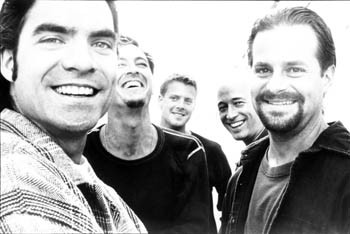
What started eight years ago as a two-man band with acoustic guitars and powerful voices honed in college coffeehouses has built up a full head of steam and become a record industry juggernaut of sorts. Train, a Bay Area band with Petaluma connections, is definitely on a roll.

The popular rock act picked up five Grammy Award nominations last week–including the coveted Song of the Year (a songwriter award) and Record of the Year (an artist and producer award)–on the strength of their Drops of Jupiter (Sony) album and the hit title track.

Those nominations put the band in such lofty company as U2, flower pop star Nelly Furtado, and soul singers India.Arie and Alicia Keys. Train’s ruggedly handsome singer, songwriter, and guitarist Pat Monahan, a Pennsylvania native who now lives in Petaluma, was on hand when the nominations were announced Jan. 4 at a press conference in Beverly Hills. The 44th annual Grammy Awards, televised worldwide, will take place on Feb. 27 at the Staples Center in Los Angeles.

Train also picked up nominations for Best Rock Performance by a Duo or Group with Vocals, Best Rock Song, and Best Instrumental Arrangement Accompanying Vocalists, all for the “Drops of Jupiter” single. The band, which launched their Drops of Jupiter tour earlier this year with a show at the Mystic Theatre, heads for Europe Jan. 13 for a two-week tour.

Other North Bay artists involved in Grammy-nominated projects include rock guitarist Joe Satriani (Best Rock Instrumental Performance: “Always with Me, Always with You”), former Journey axe slinger Neal Schon (Best Pop Instrumental Album: Voice), and Indian classical and jazz fusion tabla player Zakir Hussain (Best World Music Album: Saturday Night in Bombay: Remember Shakti with John McLaughlin).

A host of local blues acts were also tagged, including singer Maria Muldaur (Best Traditional Blues Album: Richland Woman Blues with Roy Rogers and Bonnie Raitt), guitarist Joe Louis Walker (Best Traditional Blues Album: Hellhound on My Trail: Songs of Robert Johnson), folk/blues great Geoff Muldaur (Best Traditional Folk Album: Avalon Blues: A Tribute to the Music of Mississippi John Hurt), and blues harmonica ace Charlie Musselwhite (Best Traditional Soul Gospel Album: Spirit of the Century with the Blind Boys of Alabama, featuring Musselwhite).

“Once again, this year’s nominations reflect many different musical points of view, from those established artists whose influence has shaped the evolution of our musical language to newcomers who speak with a unique resonance,” said Recording Academy President/CEO Michael Greene. “We are gratified to see so many truly talented singer/songwriters; they remain a vital part of music’s foundation.”

Meanwhile, Train also leads the list of nominees for the California Music Awards (formerly the Bammy Awards) with six nominations, including Outstanding Album, Outstanding Single, Outstanding Rock/Pop Album, Outstanding Group, Outstanding Male Vocalist, and Outstanding Songwriter. That gala awards ceremony recognizing significant musical contributions made by California artists will be held Saturday, April 27, at the Henry J. Kaiser Arena in Oakland.

Other North Bay favorites nominated for a California Music Awards include Joe Satriani and Les Claypool.

From the January 10-16, 2002 issue of the North Bay Bohemian.
© Metro Publishing Inc.

John Walker

0

John Walker is deluded, but does anybody remember Columbine?

By Dan Savage

Remember the school shooting in Jonesboro, Ark., that left five dead and 10 wounded? How about the school shooting in West Paducah, Ky.? Or Springfield, Ore.? The mother of all school shootings took place in Littleton, Colo., on April 20, 1999, when Eric Harris and Dylan Klebold opened fire at Columbine High School. The two had been planning an attack on their school for more than a year and managed to kill 12 students and one teacher before killing themselves.

Now here’s an interesting fact: Littleton voted for Bob Dole in 1996 and George W. Bush in 2000. Jonesboro also went for Bush in 2000, as did West Paducah. Springfield bucked the school-shooting-cities-for-Bush trend and voted for Gore.

What difference does it make who the residents of Littleton supported for president?

Quite a lot, if right-wing pundits are to be believed. According to conservative commentators, John “American Taliban” Walker tells us everything we’ll ever need to know about Marin County, where Walker grew up.

Writing in the Washington Times, Wesley Pruden insists Walker is “bad news . . . for hot-tub liberalism.” How Walker wound up in Afghanistan fighting for the Taliban, Pruden writes, “will be the stuff of endless argument, harangue, and speculation.”

Then Pruden speculates that Walker–whose parents still live in San Anselmo–is the logical end product of a culture that doesn’t teach the young “very much about right, wrong, God, flag, and country.” In Marin, political liberalism, permissive parents, and moral relativism all combine to create murderous traitors.

Right-wing commentators have also accused liberals of wanting to excuse Walker’s crimes. “I don’t think John was doing anything wrong,” John Walker’s father famously told a TV news reporter. “We want to give him a big hug and then a little kick in the butt for not telling us what he was up to.”

But Walker’s parents are about the only people in the United States who think Walker’s life should be spared–even most liberals want to pack Walker off to paradise–and the anguish of Walker’s parents is understandable.

What did they expect Walker’s father to say? “Please hang my son”? My-kid- converted-to-Islam- and- took-up-arms- against-his-country is not exactly covered in What to Expect When You’re Expecting.

And if John Walker’s actions–or his “journey,” as they say in San Anselmo–tell us everything we need to know about that part of the country, then Eric Harris and Dylan Klebold must tell us everything we need to know about Littleton, Colo.

If growing up in Marin means Walker was taught too little about right, wrong, God, flag, and country, perhaps growing up in Littleton means Harris and Klebold were taught too much about these same things. The pair seems to have been well versed in their Second Amendment rights, that’s for sure.

If political liberalism, permissive parents, and moral relativism create murderous traitors, then conservative small towns apparently create school shooters. And Milwaukee creates cannibals (Jeffrey Dahmer), Boston creates stranglers, and London creates rippers named Jack.

The right simply can’t have it both ways: If one son of liberal Marin joining the Taliban and taking up arms against his country proves that Marin breeds traitors, then two sons of conservative Littleton taking up arms against their defenseless classmates proves something similar about Littleton.

Or, hey, maybe all that Marin’s Walker and Littleton’s Harris and Klebold can prove is that some people are murderous, deluded little shits, and that these murderous shits grow up in both liberal and conservative parts of the country. Like Harris and Klebold, Walker is an American tragedy, not Marin’s tragedy.

Walker was a creation of the political left no more than Harris and Klebold are creations of the political right.

From the January 10-16, 2002 issue of the North Bay Bohemian.

© Metro Publishing Inc.

Blues Harmonica Blowout

0

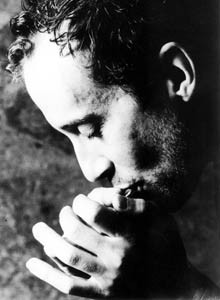
Humming Along: Canadian blues phenom Carlos del Junco brings his talented mouth to Santa Rosa on Jan. 13 for the Blues Harmonica Blowout.

Blues Blowout

Festival gives voice to the humble harmonica

The average harmonica weighs only about four ounces. That’s not what you’d call heavy, and it places the distinguished device among the smallest musical instruments on the planet. That said, there’s nothing tiny about a harmonica’s sound, which ranges from a mesmerizing intonation of diatonic complexity to an eardrum-shredding blast of wildly multitudinous chords and tones.

And yet, ever since its unexpected birth nearly two hundred years ago–reportedly around 1829 at the hands of either Sir Charles Wheatstone or Friedrich Buschmann, depending on your source–the humble harmonica has struggled to gain the kind of respect given to the flute, the piano, the guitar, and the fiddle. Only the accordion and the bagpipe have suffered similar public relations woes. Still, those instruments have long enjoyed their own high-profile music festivals.

“A lot of people look at the harmonica as a toy,” states East Bay bluesman and harmonica virtuoso Mark Hummel. “The problem is, with a harmonica, the audience can’t see what the player is doing, because unlike with a piano or a guitar, it’s all being done in the harmonica player’s mouth. The harmonica–like the blues–has always been given the back seat in the music business.”

But things do change.

The blues themselves are enjoying a resurgence, and the harmonica is finally beginning to earn some respect as well. And thanks to Hummel, the harmonica has even been given its very own music festival.

For 11 years, Hummel has been staging an increasingly popular Bay Area event called the Blues Harmonica Blowout. In years past, Hummel has invited the Bay Area’s reigning masters of the mouth organ to come out and strut their stuff. But this year’s show marks a milestone for the event. For the first time, Hummel has arranged to bring in some of the best blues harmonica players from around the country and beyond. “This will be the most varied lineup I’ve ever had,” Hummel says.

The show–which comes to the Last Day Saloon in Santa Rosa on Sunday, Jan. 13–will feature blues legend Snooky Pryor, one of the oldest living pioneers of the Chicago blues sound and one of the first blues players to amplify the harmonica.

Hummel himself will perform with his own band, the Blues Survivors. The bill also includes the great Sam Myers, Canadian phenom Carlos del Junco, Anson Funderburgh, and Sonoma County’s own Norton Buffalo.

The show also boasts a rare California appearance by Annie Raines, the hot, young Boston-based harmonica player whom Hummel–and many fans and critics–ranks among the best blues harp players in the business.

“She kicks most guys’ asses on the harp,” Hummel says. “Seriously. Annie Raines is better than 85 percent of the other players out there.” Noting that there are remarkably few women playing blues harmonica, Hummel says, “Women don’t tend to gravitate to the blues the way men do. It’s never had a big a female fan base. I don’t know why.

“Maybe the guys aren’t cute enough.”

“I don’t know why there are so few female harmonica players,” says Raines, who makes her home in Boston and has burned a path through the blues world with her guitar-playing partner Paul Rishell, who will join her onstage at the festival.

Two of a Kind: Boston’s Annie Raines and Paul Rishell blow into town for the harmonica festival.

Photograph by Eric H. Antonjou

Raines is looking forward to the Blues Harmonica Blowout, having heard colorful tales for years concerning Hummel’s yearly extravaganza. She’s especially anticipating a good time with the other performers, most of whom she’s played with in the past. And she doesn’t mind being the only woman on the bill.

“My grandmother played the harmonica,” she says, citing her earliest influences. “My mother plays a little, though neither one was a professional musician. But I have to say that, growing up, I never felt like there was anything I couldn’t do just because I was a female.

“All I know is the harmonica moves me strongly,” she adds. “The minute I started playing it, I knew I never wanted to stop. Now, when I’m up on stage, if I’m doing my job, it doesn’t matter if I’m male or female. The people in the crowd will be just as moved.”

Raines has noticed that the blues has been attracting more and more young players. She predicts that an increasing number of women players–some with a similar love of the harmonica–will appear in the near future.

The blues, says Raines, is in the midst of a major renaissance.

“An even more sustained renaissance,” she says, “than the one that took place in the sixties.” As to why the blues is enjoying a resurgence of respect, Raines is less certain. “I really don’t know,” she says. “Maybe people are finally starting to get it now that everything on the radio has at least a little blues in it.”

As for the new respect that seems to be growing for the long-suffering harmonica, Raines laughs as she says, “I hope that’s true. It seems to be true. People have always loved or hated the harmonica. I like to just concentrate on the people who like it.”

“It’s a taste thing,” says Hummel. “Harmonica is an acquired taste, and even the people who love harmonica have different tastes as to which kind of playing they like. Some people think Bob Dylan’s a great harmonica player. I think he’s pretty terrible. You can use the harmonica as an accompaniment to guitar as Dylan or Bruce Springsteen or Tom Petty do. Or you can use it as a solo instrument. I prefer the players who use it that way, who know how to make the harmonica sing.

“For me,” he continues, beginning to sound like a kid at Disneyland, “people like Snooky Pryor and Sam Myers are my heroes. I’ve learned from them. I’ve inherited my love of the blues–and my love of the harmonica–from them.”

Like Raines, Hummel foresees a powerful, worldwide re-energizing of the blues and looks forward to whatever the future brings to the art form.

“I’ve never seen the harmonica as prevalent in commercials and pop music as it’s been in the last few years,” he says. “Fortunately, there are more good harmonica players now than there have ever been.”

The Blues Harmonica Blowout takes place on Jan. 13 at 5 p.m. at the Last Day Saloon, 120 Fifth St., Santa Rosa. Tickets are $25. 707.545.2343.

From the January 10-16, 2002 issue of the North Bay Bohemian.

© Metro Publishing Inc.

Karma Indian Bistro

0

New Indian bistro heats up Cotati

By Paula Harris

Indian restaurants abound in my home town. London, and the rest of Britain for that matter, is teeming with Asian-Indian food establishments. From chic tandoori restaurants, boasting servers in silken saris, to grungy hole-in-the-wall curry take-outs, the perennial late-night staple of boozy pub crawlers, fire and spice rule.

Well, we’re no longer in London, but tonight Sonoma County feels pretty similar. The rain is slicing down outside as the cloudy sky deepens and traffic snarls. It’s cold. It’s wet. It’s just like home.

And I need a curry hit.

So, as we enter Karma Indian Bistro in Cotati, the intoxicating fragrance of simmering onions and ginger and the dizzy anticipation of savoring a thick, tongue-searing sauce are especially welcome.

This new restaurant, with a main dining room and a lunch buffet area, isn’t fancy. Yet the white linen tablecloths and fresh flowers on each table lend a classy tone.

The walls are a sunny turmeric yellow. There’s a little bar with three diner-type red leatherette and silver chrome stools, plus comfy booths and several tables. The recessed lighting and simplicity of the place is pleasing.

The music from the sound system emits a variety of melodies, from traditional Indian folk to smooth jazz from Kenny G.

Karma has received mixed reports about its service. According to the restaurant’s owners, much of the problem was due to a faulty tandoor oven that was sometimes slow to bake the food.

After a closure of some three weeks to fix the traditional brick and clay heat source, the restaurant is back up and running.

The restaurant seems also to have alleviated the service problem by adding staff. We’re served by several men in white shirts and black pants, and all are very helpful. Questions are encouraged, and the chefs will prepare dishes from mild to spicy to suit your taste and heat tolerance.

The cuisine of various Indian regions is represented. Specialties include tandoori meats and seafood marinated in yogurt and spices and cooked in the clay oven, and a generous selection of curries. Vegetarians enjoy choices galore.

Samosas ($3.95)–two crisp pastry puffs, plump with spiced potatoes and peas–are a satisfying appetizer. They’re served with two sauces, a tangy tamarind and a spicy mint.

The menu calls aloo tikki ($3.50) “lightly breaded potato cubes seasoned with herbs and spices,” but these aren’t cubes; they’re patties. Still, with the toasty, non-oily outside and the fluffy mashed potato inside, they are a texture treat.

We order the baigan barta ($8.50), a vegetarian curry, extra spicy. But this version is actually quite mild, and doesn’t resemble the fire served in England, where for some, the mark of a superior curry is when you sweat uncontrollably, your nose runs, and you tear up simultaneously.

This baigan barta, with freshly roasted eggplant, chopped onion, bell pepper and garlic, ginger, and herbs, is more smoky than spicy. I didn’t care for the consistency, which is like mashed baby food.

The lamb saagwala ($12.95) is a rich curry featuring big cubes of lamb (chewy rather than tender) thickly coated in a fresh spinach and coriander sauce. It’s bright with flavor but once again on the mild side, even though we ordered medium.

A lighter dish is the vegetable biryani ($9.95), rice-baked in the oven and brimming with green beans, roasted cashew nuts, peas, raisins, carrots, scallions, and spices.

Miniature copper dishes hold lemon-scented dal (lentil purée), which is so thick and fortifying that we drink it down rather than pour it over the rice.

A variety of condiments drive the intense flavors home. Raita ($1.95) is a cool refreshing yogurt and cucumber blend; sweet chutney ($1) is homemade using fresh mangos; and achar pickles ($1), an acquired taste, have a jarring flavor like a mouthful of stale, spicy seawater.

There’s a wonderful selection of leavened breads baked in the clay oven, some studded with garlic and cilantro, others stuffed with potato and spinach. But I found the texture to be overly doughy.

A few wines are available, but cold beer may be a better choice. Try the Taj Mahal, Flying Horse, Golden Eagle, or Majaraja, all imported from India.

The one dessert offered this evening is a very runny looking rice pudding. We passed and sweetened our spicy breaths instead with a spoonful of fennel seeds and pinhead-sized mints offered in a bowl by the door.

We leave happy. Indian food can be stodgy, oily, and glutinous, so Karma is to be praised for offering a wide variety of flavorful regional specialties with a lighter touch–even though the sweating was kept to a modest minimum.

Karma Indian Bistro Address: 7530 Commerce Boulevard, Cotati; 707.795.1729. Hours: Lunch buffet Monday-Friday, 11:30a.m. to 2:30 p.m.; Dinner Monday-Saturday, 5-9p.m. Closed Sundays. Food: Indian Service: Good and helpful Ambiance: Comfortable rather than exotic Price: Inexpensive to moderate Wine list: Small wine selection but several Indian beers Overall: 3 stars (out of 4)

From the December 27, 2001-January 2, 2002 issue of the Northern California Bohemian.

© Metro Publishing Inc.

‘The Lord of the Rings: The Fellowship of the Ring’

0

Fate Forward

A master of myth meets the ‘Lord of the Rings’

Writer David Templeton takes interesting people to interesting movies in his ongoing quest for the ultimate post-film conversation.

Phil Cousineau is exhausted. The award-winning documentarian, teacher, storyteller, photographer, and author–who certainly ought to be worn out, if only from carrying the weight of so many hats on his head–has only been back home in San Francisco for 12 hours, following a long week of bicoastal book-touring.

Yet there he is, waiting–and yawning–on the steps of Grace Cathedral from whence we will embark on a rainy, two-hour drive to San Jose to catch an early-morning screening of The Fellowship of the Ring. And though the film, based on the first book of J. R. R. Tolkien’s Lord of the Rings trilogy, is all of three hours long, Cousineau remains energized through every exciting second, not yawning once. In fact, it’s all he can do to remember to breathe.

When he finally does, it’s to sigh “Unbelievable!” and “Magnificent!” as the film concludes. Moments later, on the way out of the theater, Cousineau stops to gaze at the eight foot high Lord of the Rings display standing in the lobby. There is the astonishing, expressive face of Frodo Baggins (Elijah Wood), Tolkien’s unwilling hero, the fur-footed Hobbit whose task it is to destroy a golden ring so evil it could plunge his world into darkness. Looking over Frodo’s shoulder are the assorted members of the fellowship of elves, dwarves, hobbits, and men that have formed to help him, most notably Gandalf the wizard (Ian McKellen), the young hobbit’s mentor and spiritual guide.

“This will turn out to be a very important film,” says Cousineau, a widely recognized expert on myths, best known for his documentary, The Hero’s Journey: The World of Joseph Campbell, and the best-selling book, Once and Future Myths: The Power of Ancient Stories in Modern Times.

“In my studies of myth over the years, I’ve seen that at about the two-thirds point in all of our great classical myths and fairy tales, the hero or heroine has an opportunity, a choice, to make a decision to either be a victim of fate–or to turn fate into destiny,” Cousineau observes.

“In this story, Frodo–this wonderful young boy–has to make that decision repeatedly,” he continues. “To turn his fate into destiny, or turn his back. Those moments are part of what make this one of the most powerful films of the last decade.”

Slowly, almost reluctantly, Cousineau forces his eyes away from Frodo’s half-panicked, half-determined face. With that we embark on a quest for lunch.

“At the heart of this story,” Cousineau says 30 minutes later, as a mostly untouched plate of pasta waits on the table before him, “underneath the story of Frodo the hobbit, is the eternal fascination and obsession with the source of evil. What do we do about it in every generation? Will it overwhelm us, or will someone have the courage to go through the dark night of the soul, to enter the dark forest, to go down into the underworld to defeat the monstrous source of evil?”

“The deep fascination that exists in all of our hero literature, all of our quest stories, is the question, ‘Will I have what it takes when that moment is here for me?’ ‘Will I be just a victim of fate, or will I turn fate into destiny?'”

From the December 27, 2001-January 2, 2002 issue of the Northern California Bohemian.

© Metro Publishing Inc.

2001 in Review

Remembering 2001, the year that sucked

By Patrick Sullivan

Looking back over this year that’s about to pass mercifully into history seems like a dangerous thing. Maybe all memories have fangs, but 2001 is surely the year that bites.

You could describe it in general terms–as a time of layoffs, rip-offs, and death from above. But our modern world is a visual place, and most of us could sum it up in one image, whether it’s a plane smashing into a building or something closer to home, something more personal–something with teeth, something sucks the air right out of your lungs. Something you’d prefer not to think about.

“You’re writing 600 words about 2001, the year that sucked?” my brother said. “You should just write ‘mom died’ 300 times.'”

Very true. After staring at a little white box holding my mother’s ashes, Sept. 11 felt less like a surprise than a strange confirmation of something I already knew.

But for many Americans, I think, the events of the last few months–the suicide attacks, our war in Afghanistan, the world’s apparent ongoing economic collapse–packed such a wallop because we’d been riding so high for so long. Even those who weren’t benefiting much from this long period of peace and prosperity were at least getting high off the fumes.

Being punched is one thing; getting sucker punched is something else.

Of course, the first half of 2001 wasn’t all beer and Skittles: It wasn’t only Al Gore’s campaign staff that was left feeling a bit queasy about the less-than-clear resolution of the presidential election confusion. And ominous signs of our coming economic woes were everywhere–we could all hear the cruel cackle of the poltergeists loose in those little houses on Wall Street.

But we were urged to forget. Forget the election controversy, never mind the economy, full speed ahead. The subtext? Looking back, dwelling too long on the past–these are dangerous things. They kill the momentum. They sap the will.

Those calls have started again, after a barely decent interval following the events on that black September day.

During the holiday season, nearly every city in the country was covered with posters showing an American flag with shopping bag handles attached. The not too subtle message? America is open for business, so get on with your life–and your shopping.

It didn’t work, of course: For Christmas, most retailers got a lump of coal in their cash registers.

But the “forget about it” attitude lives on in the way 2001 is described. There are some who employ the soothing euphemisms of the talk-show nation, the narcotic narrative of Oprah-speak. They call it “the year of challenges” or “a time of testing.”

If you think that sort of description does justice to those forced to jump from the upper stories of the World Trade Center (or to the Afghan children maimed and killed by stray American bombs), raise your hand.

Didn’t think so.

It’s often said that Americans hate history–that we prefer to live in the present rather than dwell on the past. And it may be especially tempting to throw a blanket over this traumatic year. But let’s not try.

For one thing, it won’t work. Why not? It’s those grim images, those indelible mental snapshots, that keep returning to haunt the mind’s eye.

For you, it might be collapsing buildings or falling people. For me, it’s that newspaper photo of the small boy hunched over the coffin of his mother, who was killed on Sept. 11. For that kid, 2001 was not a time of testing. For him, 2001 will not be over until 2020–or maybe longer.

And for another thing, coming to terms with horror takes time. It’s not something you can multi-task, processing the grim effluvia of the subconscious and coming to terms with the existence of evil while chatting on the cell phone and updating your website.

It’s popular to say that Sept. 11 changed the world; it’s not so quite so common to say we all ought to take a good long time to figure out exactly what that means.

But that’s exactly what we should be doing.

From the December 27, 2001-January 2, 2002 issue of the Northern California Bohemian.

© Metro Publishing Inc.

‘The Royal Tenenbaums’

Head Games Nerdy novelist examines the brainy pain of 'Royal Tenenbaums' Writer David Templeton takes interesting people to interesting movies in his ongoing quest for the ultimate post-film conversation. "Wow. Um . . . This could possibly bore me." Andrew Sean Greer, author and self-described "secret...

Julia’s Kitchen

Wild Child Canteen ambiance mars fine cuisine at Julia's Kitchen By Paula Harris One way to attract SUV-loads of salivating visitors to your brand new restaurant is to name it after Julia Child, that heavy-boned American food icon who has been dubbed the patron saint of the pantry. That's what...

‘Speed-the-Plow’

Mad about Mamet Fine cast distinguishes AT's 'Speed-the-Plow' By Patrick Sullivan Ever wonder why Hollywood churns out so many crappy movies? David Mamet knows the answer, and in Speed-the-Plow, which kicks off a Mamet festival at Actors Theatre, he reveals all. Sort of. Mamet ought to have plenty...

Emergency Contraception

Birth Control Getting morning-after pill still far from simple By Patrick Sullivan California women in need of emergency contraception can now obtain the so-called morning-after pill without a doctor's prescription. At least that's how the process is supposed to work under a new state law that went into effect Jan. 1....

Train

Train Time North Bay rockers score five Grammy nods By Greg Cahill What started eight years ago as a two-man band with acoustic guitars and powerful voices honed in college coffeehouses has built up a full head of steam and become a record industry juggernaut of sorts. Train, a Bay Area...

John Walker

John Walker is deluded, but does anybody remember Columbine? By Dan Savage Remember the school shooting in Jonesboro, Ark., that left five dead and 10 wounded? How about the school shooting in West Paducah, Ky.? Or Springfield, Ore.? The mother of all school shootings took place in Littleton, Colo., on April 20, 1999, when...

Blues Harmonica Blowout

Humming Along: Canadian blues phenom Carlos del Junco brings his talented mouth to Santa Rosa on Jan. 13 for the Blues Harmonica Blowout. Blues Blowout Festival gives voice to the humble harmonica The average harmonica weighs only about four ounces. That's not what you'd call heavy, and it...

Karma Indian Bistro

New Indian bistro heats up Cotati By Paula Harris Indian restaurants abound in my home town. London, and the rest of Britain for that matter, is teeming with Asian-Indian food establishments. From chic tandoori restaurants, boasting servers in silken saris, to grungy hole-in-the-wall curry take-outs, the perennial late-night staple of boozy pub crawlers, fire...

‘The Lord of the Rings: The Fellowship of the Ring’

Fate Forward A master of myth meets the 'Lord of the Rings' Writer David Templeton takes interesting people to interesting movies in his ongoing quest for the ultimate post-film conversation. Phil Cousineau is exhausted. The award-winning documentarian, teacher, storyteller, photographer, and author--who certainly ought to be worn...

2001 in Review

Remembering 2001, the year that sucked By Patrick Sullivan Looking back over this year that's about to pass mercifully into history seems like a dangerous thing. Maybe all memories have fangs, but 2001 is surely the year that bites. You could describe it in general terms--as a time of layoffs, rip-offs, and...
11,084FansLike
4,606FollowersFollow
6,928FollowersFollow

