‘Wisconsin Death Trip’

Hell’s Hamlet

‘Wisconsin Death Trip’ revives some troubling memories

By

In roughly a million movies, amnesiac characters try desperately to remember some urgent, forgotten matter. Most recently, Kurt Russell in Vanilla Sky and Joe Pantoliano in Memento played figures trying to tease reluctant memories awake in their films’ leading characters. The popularity of this kind of mystery echoes a national problem: We in the United States have a chronic case of historical amnesia.

One attempt to wake us up from it is found in Michael Lesy’s fascinating 1973 book Wisconsin Death Trip, which chronicles the wave of late 19th-century crimes and mortality in the vicinity of Black River Falls, a small town in Wisconsin. Reading this book could give you the impression that the hamlet was built on an 1890s version of a Hellmouth, a la Buffy the Vampire Slayer.

The residents of Black River Falls were recent immigrants who came to mine and farm in the newly opened territory. But the land was too scrubby to live off. The banks, railroads, and mines were subject to sudden failure, inflamed by the depression of the 1890s. Even by the standards of the Norwegian immigrants, the winters were cruel. The pressure crushed the settlers through hard work and bankruptcy. Thus the local history, recorded in a small weekly newspaper, is a record of depression, suicide, disease, and murder.

James Marsh’s film version of Wisconsin Death Trip is a 76-minute-long condensation of the book–and the movie is a total success.

Marsh deftly captures the mood of the threatening wilderness. His bare-bones budget complements the rawness of frontier life, which he studies with the velvety cinematic obsession of a David Lynch. Here, a nonprofessional cast silently reenact the old crimes. Marsh divides the film into seasons and connects his almanac of doom with recurring characters.

Wisconsin Death Trip finds a charismatic antiheroine in Mary Sweeney (played fiercely by Jo Vukelich), a traveling madwoman who loved to snort coke and smash windows. In the account of Mrs. Larson (Molly Anderson), who drowned her three children, the film presents a parallel to Susan Smith, sentenced in 1994 to life in prison for driving the car that contained her sleeping children into a lake. And there’s even a decadent celebrity: Pauline L’Allemand (Marilyn White), a noted opera star who retreated to the wilds of Wisconsin–and then into madness.

Actor Ian Holm, most recently seen as the ring-jonesing hobbit Bilbo Baggins in The Lord of the Rings, narrates the casebook. Aside from his narration, Wisconsin Death Trip is mute, accompanied by a beautifully eclectic soundtrack that ranges from Debussy to Finnish folk songs to Blind Lemon Jefferson’s “See That My Grave Is Kept Clean.”

Marsh goes a step farther than the book by visiting Black River Falls today. He seems to wonder: How could a past so infamous be interred beneath this peaceful small town? He observes children playing, the high-school homecoming game and parade, the old people half-dead in the retirement home.

Naturally, some critics have accused Marsh of patronizing the town, especially by filming nursing home residents drowsing through a visiting glee club’s rendition of “The Star-Spangled Banner.” But isn’t this a perfect metaphor for how Black Rock Falls’ memory sleeps? And though the film doesn’t mention this, Black River Falls isn’t a backwater today; it’s heavily touristed, visited in the summer by Chicago area hikers and mountain bikers. What we see today may look a little stodgy, but it’s a triumph over a lurid, agonizing past.

In its way, Wisconsin Death Trip is an optimistic film. Today’s young people are supposed to be lost, addicted to drugs and television, a generation of nihilist lawbreakers whose misdeeds testify to the lapse of family values. Marsh’s film, set in a time of thoroughly religious, strong families, is alive with murders, drug abuse, and teen crime. By forgetting the trouble we once had, we exaggerate the trouble we have today.

‘Wisconsin Death Trip’ opens Friday, Feb. 8, at the Rafael Film Center, 1118 Fourth St., San Rafael. For details, see or call 415.454.1222.

From the February 7-13, 2002 issue of the North Bay Bohemian.

© Metro Publishing Inc.

Zen Food-Sex

0

Hunger Artist

Zen and the art of food-sex

By Gretchen Giles

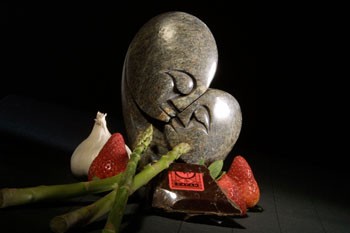
The gorgeous furred silk of a man’s belly and the dark, lovely hollow a neckline reveals when a woman bends down all make me hungry. Not starving for smooches, but longing for foodstuffs that ooze and goop, that add a touch of sweet to the savory, that are made to be eaten with just fingers or licked from a thigh.

The distinctive physical pleasures of food and sex go together in human history as naturally as do roasted mastodon and cave-born babies. Now that we’re presumably somewhat evolved, we can choose the hunt and control the babies. This is when the real pleasures of food-sex arise.

Food-sex is a Zen concept, if you will, a koan instructing that good food shared well is just as important to intimacy as good lovemaking well shared. In today’s lesson, food-sex is not that meal designed to sweep a potential love-mate off his or her feet and into your consensual clutches for the very first time. Today’s lesson, in fact, is about heightening the gustatory pleasure of that someone who is already well-swept.

Applying the rules of the perpetual picnic, your adventure consists of anything you and your lover both enjoy, delicacies not usually indulged, dishes made ahead, and fresh green things straight from the ground.

Garlic, at least in my small, rosy world, is essential. So, too, are several uninterrupted hours, a reliable source of heat, and the joyous musical religion of Al Green. Texture, shape, and consistency are important, but dress is strictly casual–just one large linen napkin will do.

As with any feast, preparations must be made. Even that impressive soul who rises from the rumple to whip together a postcoital treat has probably thought about such a graceful arising well in advance–or should have. As necessary as the prelove rituals of bathing and brushing are the mundanities of shopping and cooking.

But not everything must be cooked by you. After all, this is about sensual swoon, not Betty Crocker. Simply buying little truffley treats is often just enough; a good loaf of bread and a ripe cheese marry well; a grocer’s roast chicken and deli pasta salad will suffice; and yes, there should always be enough wine.

Allowing time to be thoughtful and unhurried only adds to the anticipation. Your Zen-influenced boink-repast should ideally consist of things that can wait and mellow until you’re ready for them. Risotto, that stir-stir-stir pretty pet of the rice family, is, for example, a poor choice.

However, cheese tortellini that have been cooked to plumpness, well-drained, and then coddled in a bowl with the rough chop of three Roma tomatoes–seeds and all–a handful of fresh slivered basil, a few pressed garlic cloves, the grate of fresh Parmesan cheese, and a three-to-one bath of extra-virgin olive oil and balsamic vinegar, is an excellent choice. Salted and peppered to taste and left to infuse while covered on the table, this dish is always ready when you are.

Similarly, asparagus that have been washed and then dried in a clean dish towel can wait for your attentions. Break the ends just where they wish to bend–never force your edible koan to do anything it doesn’t want to. Arrange on a cookie sheet or pizza pan, drizzle with olive oil and a sprinkle of kosher salt (table salt is fine). Roll these wonderfully green, phallic stems about on the pan until they’re somewhat evenly covered in oil. Broil for about seven minutes, taking the pan out half way through to shake the asparagus around for even cooking. Remove from the broiler, squeeze half a fresh lemon over the stalks, and arrange on a plate. They’ll still be there when your fancy finally produces a taste for produce.

It has somehow held our collective romantic imagination that chocolate-dipped strawberries connote almost unscalable heights of the la-ti-dah, but how many of us actually know how simple these are to make?

Lean closer, and I shall reveal that the large, seeded nipple of a strawberry need merely be dipped in the melt of a bag of ordinary semi-sweet chocolate chips that have been heated in a double-boiler. (In my humble abode, double-boiler refers to a pan of hot water with an old glass bowl set atop it because it happens to fit). Dip your strawberries in the chocolate, swirl, and place on a piece of wax paper. Instant elegance! Crunch and juice and sweet on a plate.

This also works for dried apricots, almonds, banana chunks, raw tuna, nasturtium heads, or any other thing you could possibly ever wish to dip in chocolate.

I often think that the best part of being divorced, other than the glory of simply being no longer married, is Dad’s Weekend, that infrequent event when the children’s father takes them away to troll the malls, watch marathon bouts of TV, and munch fried pies, just five for a dollar. Then, the tyranny of a regular dinner no longer looms, and my lover and I can be fueled solely by exactly that which pleases us best.

This bed-heavy freedom is usually sustained by store-bought goodies that I greedily purchase in lieu of saving for a new car or a down payment on a house.

The local fancy store barbecues meat on weekend nights, so I get a hot, rare slab. Next in the basket go a stout loaf of fresh Campagna bread, a wedge of stinky-ripe Cambonzola cheese, and a container of cured green olives.

Fresh scallions are later washed and shaved into thin, curly sticks. A simple salad is quickly tossed from lettuce cannily washed on Thursday and a vinaigrette mixed up while boiling farewell oatmeal that morning for the children.

Berries or cold grapes? Ripe fragrant cantaloupe to wrap with prosciutto? Such dilemmas. Chocolate, the dark, thick kind that must sometimes be chopped with a cleaver, not that waxy type put out by the good folks in Pennsylvania, is essential.

When considering this lesson, it’s only natural that your food be as naked as you are. This is your life, your spring, your lips and teeth and tongue and fingers and mouth.

Your hunger.

From the February 7-13, 2002 issue of the North Bay Bohemian.

© Metro Publishing Inc.

SAMM

0

They are SAMM

Sonoma Alliance for Medical Marijuana flexes political muscle

By Mari Kane

Marijuana smoke mingled with anticipation in the air of the Forestville home of teacher Marsha Cameron. It was one week before the 1996 presidential election, and a group of signature gatherers, educators, and patients were meeting to plan for the possibility of victory–the passage of Proposition 215, California’s Compassionate Use Act.

Cameron brought the meeting into focus by announcing, “If Proposition 215 wins, our work is just beginning!” That night, the Sonoma Alliance for Medical Marijuana was born.

Now, after five years of dogged advocacy, the organization stands in the vanguard of the movement. Its work has helped make Sonoma County one of the most medical marijuana-friendly counties in the nation.

Next week, SAMM will flex its political muscle by holding a public meeting in which candidates for a range of local offices will debate their positions on marijuana in advance of the March 5 primary. Controversy over the issue has grown again in recent months as the Bush administration cracks down on California marijuana dispensaries.

Among the heavy hitters scheduled to attend the SAMM meeting are Sonoma County District Attorney Mike Mullins and his opponent in the DA’s race, Stephan Passalaqua, a deputy district attorney who opposes prosecuting medical marijuana cases. Santa Rosa Mayor Mike Martini and a representative of Congresswoman Lynn Woolsey will also attend.

What’s the secret of SAMM’s success? “Being a consensus-based educational and advocacy group is SAMM’s biggest distinction,” Cameron explains. “We made a commitment from the very beginning to only do what the law allowed. We didn’t create a cannabis club because that wasn’t part of the law.”

Talking Softly

While the passage of Proposition 215 was igniting a national controversy, SAMM members were quietly arranging meetings with Sonoma County’s Health Department, sheriff, and district attorney to hammer out protocols for enforcement of the vaguely-worded law.

“What impressed me was their willingness to engage in dialogue, not diatribe,” Mike Mullins recalls. “I was struck by how diverse [SAMM members] were. They had a lot of representation and different viewpoints, and they were willing to listen to our concerns.”

SAMM’s first milestone was the peer review process, a verification system by which the Sonoma County Medical Association’s Professional Standards and Conduct Committee determines if patients meet established criteria for medical marijuana use.

“Basically, peer review was set up to protect the doctors and to make them comfortable in writing approvals and recommendations,” says SAMM member Mary Pat Jacobs, a teacher turned caregiver. “Before peer review was established, doctors were afraid to write recommendations.”

Still, arrests of patients and caregivers continued in Sonoma County, and in the Spring of 2001 two test cases went to court. Jurors acquitted the defendants in both high-profile trials, sending a strong message to the district attorney’s office to back off on medical marijuana.

One week after the second court defeat, Mullins and the county’s police chiefs adopted SAMM’s Medical Marijuana Cultivation Guidelines, which allow patients or caregivers to grow up to 99 plants with 100 square feet of canopy, producing an average of three pounds per year.

“The Sonoma guidelines were a real breakthrough,” says Dale Gieringer, California director of the National Organization for the Reform of Marijuana Laws. “They are the most realistic guidelines adopted to date because they are based on growing area, which is much more closely related to yield than plant numbers. Already, the SAMM guidelines have replaced the old Oakland 144-plant guidelines as the favored model, and Del Norte County is seriously considering adopting them.”

Now that SAMM’s garden guide is official policy, Mullins says law enforcement’s focus should be on garden robberies and associated violence. In fact, Mullins envisions going the way of Canada, where that government is under court order to grow medical marijuana for its citizens. “If we’re going to adopt statewide standards, we should also enact state growing,” he asserts. “We need to have a state ID system and a system for growing centrally with distribution by the state.”

The Heart of SAMM

SAMM spokesman Doc Knapp and secretary-treasurer Kumari Sivadas are gathered around the kitchen table in their Sebastopol home stuffing envelopes. Knapp and Sivadas are both patients and retirees, and they operate SAMM’s nerve center. They field approximately 25 calls from patients and would-be patients per week and send “Dear Folks” communiqués to SAMM’s 600-700 supporters.

Because SAMM is not a cannabis club, Knapp says the organization is not afraid of threats from the federal government, even in light of the Drug Enforcement Administration’s recent crackdown on the Los Angeles Cannabis Resource Center and other growers.

“Look, we met with the DEA’s commander of the Sonoma County Narcotics Task Force and he said they weren’t interested in prosecuting cases of less than 250-300 plants,” Knapp explains with a shrug. “One hundred plants is the first line the feds draw, so we advise people to follow our guidelines and stay under the radar with 99 plants. At that level, the feds are simply not interested in Sonoma County growers.”

But Sonoma County’s five marijuana dispensaries are concerned about federal intervention, even though they argue that the DEA lacks jurisdiction in what some call a state’s rights issue. Alan Silverman of Guerneville’s Farmacy thinks the Los Angeles raids were the feds’ attempt “to scare the pants off clubs.”

“I don’t believe the DEA will go any further once the they realize they don’t have any authority here,” Silverman says.

SAMM’s upcoming meeting–which takes place Feb. 11 at the Rincon Valley branch of the Sonoma County Library–will vet local candidates with the aim of facilitating the election of marijuana-friendly candidates.

“The DA’s office is critical for obvious reasons, but the county Board of Supervisor seats are also important,” Knapp says. “We’d like them to sign off on the guidelines, but we haven’t approached the current sups because we don’t think they’re receptive enough. We’re just waiting to get new blood.”

Among the candidates confirmed for the meeting are Fred Euphrat, an environmental consultant running against Fourth District Supervisor Paul Kelley. Last week, District Attorney Mike Mullins also agreed to attend and face off against Passalaqua.

“Knowing Mike is willing to show the public he cares about this issue just proves how far we’ve come,” Sivadas says. “This meeting is going to be very interesting!”

From the February 7-13, 2002 issue of the North Bay Bohemian.

© Metro Publishing Inc.

Open Mic

0

Vietnam syndrome is alive and thriving

By Mark Weisbrot

Politicians and journalists have interpreted widespread support for the military actions in Afghanistan as a significant shift in Americans’ attitudes toward war. In the weeks following the massacre of Sept. 11, Vice President Dick Cheney described the crowd’s reaction to a speech he made in New York: “There wasn’t a dove in the room,” he said with a smile.

This isn’t the first time in the post-Vietnam era that our leaders have made such pronouncements. “By God, we’ve kicked the Vietnam syndrome once and for all,” President George Bush (senior) declared in 1991 in the wake of the Gulf War.

But their words are starkly contradicted by their own actions. In every military action since Vietnam, our politicians and generals have been extremely reluctant to risk American military casualties. In the Gulf War, there were more soldiers killed in training and accidents (including friendly fire) than at the hands of enemy troops. In the war over Kosovo, we did not lose even a single pilot.

The murder of thousands of civilians in the worst terrorist action ever on American soil seems not to have changed this part of the Vietnam syndrome at all. The U.S. military has fought this war, like the others, from the air. Our planes now bomb from altitudes so high that they cannot even be seen by the fighters and civilians below.

When it came time to search the caves of Tora Bora for Osama and his friends, U.S. officials started talking about “the right mix of incentives” (money, weapons) to get Afghans to do the job.

From the snug safety of their armchairs and op-ed pages, pundits have argued vehemently that American troops should take on these dangerous tasks. But this isn’t likely to happen any time soon.

What our politicians fear, but what nobody wants to talk about, are the political consequences of American casualties.

This is not because Americans are lacking in courage; as the heroic actions of the firefighters and others at the site of the World Trade Center showed, there is no shortage of people willing to risk their lives for fellow citizens.

But since Vietnam, there has been widespread mistrust of American foreign policy. During that war, we were told we were helping the Vietnamese–saving them and the world from communism.

This turned out to be a huge lie, with terrible consequences. Millions discovered that the United States was really fighting a dirty colonial war that the French had abandoned.

Recent revelations have only reinforced this mistrust, as well as provide the worst picture imaginable of that war: the atrocities committed by former senator Bob Kerrey, for example, or historian Michael Beschloss’ analysis of Lyndon Johnson’s tapes, showing that the president knew as early as 1965 that the war in Vietnam could not be won while he continued to send tens of thousands of Americans to die there.

In the post-Vietnam era, Washington has mainly contracted out the dirty work–mass murder in Guatemala and El Salvador and the attempt to overthrow the Nicaraguan government in the 1980s, for example. But whether the U.S. military was directly involved (as it was in the invasions of Grenada and Panama, the Gulf War, and Kosovo) or not, it is still a sordid record. In general, U.S. officials have lied about the purpose of their interventions, none of which had much to do with U.S. national security.

For these reasons, public support for the War on Terrorism is miles wide but only inches deep. Our political leaders want to use this crusade the way they used the War against Communism, and more recently the War on Drugs in Colombia: as an excuse for the violence and brutality necessary to police a worldwide empire.

It remains to be seen how much of this they can get away with, or whether they will expand the current war to other countries, such as Iraq, Somalia, Iran, or elsewhere. But our leaders know one thing very well: They cannot allow the U.S. casualty count to rise too high, or people begin to question their motives.

This Vietnam syndrome will not be reversed. It is a permanent change in American consciousness, like those that followed the abolition of slavery and the victories (however partial and incomplete) of the civil rights movement. What will fade, eventually, is our leaders’ addiction to empire. But when that goes, America will not have much need for foreign military adventures.

Mark Weisbrot is co-director of the Center for Economic and Policy Research in Washington, D.C., (www.cepr.net).

From the January 31-February 6, 2002 issue of the North Bay Bohemian.

© Metro Publishing Inc.

Yao-Kiku

0

Japanese Blossom

Sushi and beyond at Santa Rosa’s Yao-Kiku

By Paula Harris

Yao-Kiku is lively tonight. Settled into my favorite little table, the one under the crazy, colorful painting of the sword-wielding Samurai pool player, I curl my cold hands around a flask of boiling sake and watch the action.

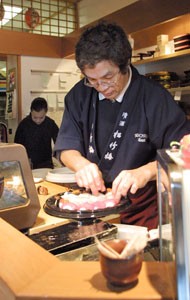
The small sushi bar, which is presided over by owner Sam and his adept fish-slicing, rice-molding team, curves around one side of the dining room and is decorated with Japanese dolls and other knick-knacks. It’s always a prime location for entertaining diners.

Tonight, a group of four Japanese men are perched on the high bar chairs. They intersperse mouthfuls of gleaming raw fish sashimi with raucous laughter and slugs of premium chilled sake.

A fawning couple at a nearby table order the una-ju, eel with special sauce served on rice. According to Japanese lore, unagi (eel) builds stamina. It’s eaten during the hottest months to avoid exhaustion, and anytime as an aphrodisiac. Hmm, maybe this pair is on to something.

At another table, a family introduces their young-uns to shrimp tempura. The kids munch and crunch happily, wielding the batter-dipped tidbits like french fries.

Yao-Kiku is a comfortable neighborhood joint tucked away in the heart of a strip mall on Santa Rosa’s Yulupa Avenue. The restaurant’s reputation for using the freshest ingredients, sometimes flown in from Japan, keeps customers coming back for more.

The partly screened dining room is small, orderly, and minimalist. It’s decorated in shades of gray and burgundy. Plain tables are set with wooden chopsticks in paper packets and burgundy linen napkins.

The service is gracious and attentive. If you drop a chopstick or run out of sake, someone usually notices right away.

A meal here usually commences with a bowl of steamy, fortifying miso soup and a green salad (both included with the dinner entrées, along with steamed rice). Yao-Kiku’s miso is a great version of the Japanese staple and is enlivened with cubes of tofu and strips of seaweed lurking at the bottom.

The salad is a pile of chilled, crisp Sonoma greens and carrot pieces with tangy dressing that tastes of mirin, a rice wine vinegar.

Appetizers are a bit hit-and-miss. The gyoza ($6)–Japanese-style pot stickers–are tasty and generously filled with minced pork and veggies. But the chicken tatsuta ($7), boneless chicken bits marinated in ginger sauce, is covered in too much batter and is a disappointment.

Gammo ($5.50), a steamed vegetable tofu cake with ginger sauce, is another letdown: In a small black cauldron, flavorless, spongelike tofu ovals float in a bland watery liquid.

But things get back on track with the hamachi kama ($8), broiled collar of yellowtail. Use your chopsticks to poke around the nook and crannies for sweet morsels of this dense white fish that’s reminiscent of swordfish.

Yao-Kiku offers a limited, reasonably priced wine list, but many diners opt for the hot or chilled sake or a Japanese beer.

Noteworthy entrées include the yose-nabe ($16-$18), an enormous, ceramic serving bowl filled with tasty treasures of seafood, chicken, or vegetable. The veggie version boasts a rainbow mix of carrots, red pepper, broccoli, onion, celery, scallions, shitake mushrooms, green beans, two kinds tofu, opaque udon noodles, and transparent glass noodles in miso broth. The bowl of steamed sticky rice on the side seems like overkill.

Another great choice is the salmon teriyaki ($16). A generous portion of tender, pink salmon glazed with a slightly gingery teriyaki sauce comes with starch galore–noodles, rice, and roast potatoes. I’ve sampled the salmon teriyaki in at least four other local Japanese restaurants, and Yao-Kiku’s version wins hands down.

Of course, many raw fish addicts come here for the superior sushi. And if you know your aji from your ebi and uni (Spanish mackerel, prawn, and sea urchin) this place is for you. Yao-Kiku serves a broad selection of both maki (rolled) sushi and nigiri (wrapped or layered) sushi.

More unusual sushi choices include herring eggs, giant clams, pickled plum and leafstick, and pickled Japanese radish. At one time the restaurant served a refreshing aloe vera sushi, but I haven’t seen it here in a while.

If you have room for dessert (I never do), there’s green tea or mochi (short-grained glutinous rice) ice cream. With the check come sections of fresh orange, and also some intensely flavored coffee candy, a very weird choice after sushi.

Still, Yao-Kiku is a consistently great place for a relaxed, informal neighborhood meal. Give it a try (but note that they don’t accept personal checks).

Yao-Kiku Address: 12700 Yulupa Ave., Santa Rosa. 707.578.8180. Hours: Mon-Fri 11:30am to 2:30pm; Sat 4:30 to 9 :30pm; Sun 4:30 to 9pm. Food: Japanese Service: Attentive and gracious Ambiance: Happy, neighborhood haunt Price: Moderate Wine list: Limited wine selection, premium sakes available Overall: Three stars (out of four stars)

From the January 31-February 6, 2002 issue of Metro, Silicon Valley’s Weekly Newspaper.

© Metro Publishing Inc. Metroactive is affiliated with the Boulevards Network.

For more information about the San Jose/Silicon Valley area, visit sanjose.com.

Art in Napa

0

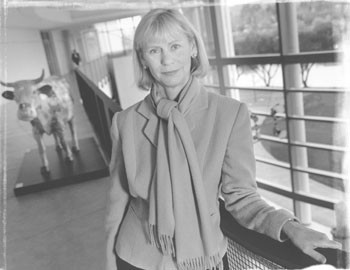
Big Bucks: COPIA director Peggy Loar rides herd on the new $55 million arts and food facility.

Napa Rising

Arts blossom in once neglected riverfront town

By Paula Harris

Not too long ago, as Cabernet-hunting tourists and their loot flooded into the trendy, upscale, and picturesque Napa County wine country meccas of St. Helena, Yountville, and Calistoga, the death knell was sounding for the city of Napa. Potential visitors snubbed the lackluster city, avoiding its decaying downtown lined with empty storefronts and its hazardous river that routinely flooded the area.

And as the muddy waters inundated the city, the community’s character and heritage were also quietly but surely washing away.

“The downtown suffered,” says Napa developer George Altamura. “The powers that be tore down the beautiful buildings and put up modern buildings that are crap. They completely neglected downtown.”

Altamura, who in recent years has snapped up several downtown properties as investments in the hopes of a Napa comeback, sees a major change ahead for the city. He plans to be part of it.

Most notably, Altamura is currently restoring the city’s Uptown Theater in partnership with a big-name co-investor–acclaimed Hollywood director Francis Ford Coppola. Altamura says the renovated theater will revitalize the city by offering special movie premieres and world-class live performances.

But the Uptown Theater is only one piece of a holy trinity of major new facilities that are making dramatic entrances onto the Napa arts scene.

About to join the well established Jarvis Conservatory are the renovated Napa Valley Opera House and COPIA, vintner Robert Mondavi’s new multimillion dollar monument to food, wine, and the arts.

The arts and entertainment vision for Napa is brashly ambitious, with an impressive amount of new investment, despite the economic slowdown. These lofty plans seem calculated to outdo all the county’s trendy wine country sister towns combined.

It’s a far cry from the Napa of just a few years ago. In fact, the downtown was almost defunct when groups of environmentalists, business people, and politicians finally collaborated to rescue it.

A challenging and costly project is underway to restore the city’s neglected crucial lifeblood, the Napa River. Four years ago, citizens voted to raise their taxes in order to develop the riverfront, preserve the waterway, and protect the city from inundation.

“It’s a $230 million flood control project to bring back the focus of the river in downtown Napa,” explains Cassandra Walker, economic development director for the city of Napa.

The plan, currently in progress, calls for a seven-mile river trail system, including a downtown portion that will feature large, two-tiered promenade areas overlooking the river and new outdoor community gathering places.

The river walk will also link the key arts and entertainment venues.

“The arts component is naturally evolving because of COPIA,” Walker says. “And people are coming back to the downtown now that cultural activities are opening and having a broader presence.”

According to city boosters, the emergence of a new Napa arts scene will not only finally put the city on the tourist map and cater to a growing office population that keeps people in town after work, it will also serve local folks starved for nightlife.

“We’re trying to give people more reason to be here,” Walker says.

CornuCOPIA

The numerous directional signs are in place, the city’s repaving and revamping of First Street is complete, and high-profile vintner Robert Mondavi’s much-anticipated castle celebrating food, wine, and art has been open 12 weeks.

COPIA is now an integral part of Napa.

Named for the Greek goddess of abundance (depicted naked and tending a vine in the center’s logos), COPIA aspires to be “the world’s leading cultural center dedicated to the discovery, understanding, and celebration of wine, food, and the arts,” according to ads.

The $55 million ($27 million of which was poured in by Mondavi) facility offers a slew of exhibits, lectures, tastings, gardens, movies, and live musical performances.

But it has received mixed reviews.

Organizers say the private nonprofit institution is doing well. They point to a membership of 7,000 and a stream of daily visitors, half of whom come from Napa County. “We’re very pleased with attendance thus far and have been on target with our predictions, averaging about 500 visitors daily,” says COPIA spokesperson Holly Krassner. Organizers are predicting 300,000 visitors this year.

Before COPIA opened, some critics worried about potential traffic snarls. In addition, various local business owners complained about the lack of parking at the facility, although COPIA organizers say that’s now been addressed with a 370-space parking lot.

Other folks fretted over the center’s perceived elitist image. Heavy hitters like Martha Stewart, Alice Waters, Hugh Johnson, Robert Parker, and Julia Child jumped on the COPIA bandwagon to serve as honorary trustees. Child even loaned her name to the center’s gourmet restaurant, Julia’s Kitchen.

But some visitors are reluctant to plunk down the $12.50 daily admission fee. Others, perhaps expecting a winery, are confused over what the center actually is. “Probably, a portion heard about [COPIA] and it may not have been what they thought, but that doesn’t mean they were disappointed,” says Krassner.

The interior of the sprawling facility, which sits on 12 acres purchased by Mondavi at the edge of the Napa River, is surprisingly sparse, angular, and industrial looking, with concrete floors and harsh stainless steel.

Visitors experience a range of activities that can fill an entire day (note: you must pay extra for some activities), ranging from tours, winetasting, and cooking demonstrations to art exhibits, live music, and movies.

The art on display at COPIA has caused some furor. Just plain weird is what some visitors are calling the exhibits, which include a pyrotechnic piece of wall art created by torching thousands of kitchen matches, and a “field” of large blocks of melting caramel undulating on spring legs.

“For nonregulars to art museums, this is something very new for them,” Krassner says. “It challenges what they think art is. Before we opened and talked about what COPIA is going to be, people didn’t get it.”

Krassner adds that while visitors are quick to understand why COPIA is showing a collection of precious ancient glassware, other exhibits are harder to appreciate. “The glass collection has to do with fine wine, so they see the connection there, but contemporary art is not so easily understandable,” Krassner says.

And then, of course, there’s the Miralda exhibit, which is causing quite a stink.

Spanish artist Antoni Miralda filled soda machines with “food-related objects,” including bedpans and defecating statuettes. These figurines, known as caganers in Miralda’s native Catalonia, are traditional additions to Christmas nativity scenes. They date back to the 18th century and symbolize fertilization and the hope for prosperity in the coming year.

Miralda’s exhibit features ceramic figurines of the pope, nuns, angels, and others with their pants down, squatting over their bowel movements. The display sparked angry denunciations from the New York-based Catholic League of Religious and Civil Rights, which blasted the pieces, calling them “insulting” and “gratuitous.”

COPIA organizers say the Miralda exhibit comes down April 22 as scheduled. “This is not the first time, nor will it be the last, that museums have had to withstand a flood of criticism regarding the nature and content of their exhibitions,” says COPIA director Peggy Loar. “Often, as in our case, this is the result of misinformation and a lack of knowledge.”

Krassner says the center received a handful of complaints in the first six weeks, but no religious complaints. “Other parts of the exhibit concerning gluttony and scarcity are much more difficult to look at,” she muses. “Art’s not all about pretty things.”

It remains to be seen how successfully COPIA can cover its $15 million-a-year operating budget, which pays for a 60-person staff. (The center also has more then 300 volunteers and docents.) Organizers say the money will be generated by entry tickets, gift shop sales, special events, and fundraising.

Krassner says plans are in place to expand the exhibition space and offer classical and acoustic performances on the Concert Terrace in the summer.

“We hope to collaborate with the Napa arts scene rather than compete,” says Krassner. “We’ve known what COPIA was going to be for several years, and it’s turned out how we planned.”

Vintage Gem

Don’t assume that the multimillion-dollar restoration of the 121-year-old performing arts space known as the Napa Valley Opera House on Main Street will create a snobbish venue for high arts, high class, and oodles of opera.

The facility will feature opera, operetta, musical theater, dance, plays, symphony music, chamber music, recitals, and poetry readings. And the theater may also become a venue for the Napa Valley Repertory Company and chamber music outfits in Napa Valley.

But in a shift from earlier plans, the opera house will also offer more popular entertainment, including folk and blues music.

Because the facility is a national historical landmark building, organizers say they will retain the name “opera house.” But they point out that in the late 1800s, any venues where you could bring ladies were called opera houses to distinguish them from those other kinds of houses.

“The name may mislead some,” admits executive director Michael Savage. “But we will be rapidly known for what we do.”

After an Internet audience survey of 40,000 homes, organizers discovered that folks wanted a “mixed bag” of programming. And that’s just what they’ll get according to Savage, who hopes the Opera House will appeal to locals, day-trippers, and out-of-state tourists alike.

One major addition to the historic space is the 200-seat Cafe Theater, an intimate and informal cabaret space downstairs. It will feature comedy shows and a wide range of music, including Latin, world, jazz, and folk. Sundays will be designated for family programming, including storytelling and other kid-friendly entertainment.

The Cafe Theater will open June 13, and the first few shows will include performances by Grammy Award-winning singer Dianne Reeves and jazz guitarist John Pizzarelli.

The 500-seat main theater, a historical space that will retain the original curved, wood facade of the balcony and the original proscenium arch over the stage, could open as soon as October. But it’s more likely to come online in January 2003, according to organizers.

The cost of the decade-long project is $13 million, and almost $10 million has been raised so far. “Things slowed down since September last year, but we have accelerated the opening of Cafe Theater to June and delayed opening the upstairs theater a bit,” says Savage. “But we’re considering negotiating a loan to open both this year.”

Most of the money raised so far has winery ties. The major donor is the Mondavi family, which has gifted $2.2 million. The main theater will be named for Margrit Biever Mondavi.

The Opera House first opened in 1880 as a second-story music center with street level shops. The last time artists performed there was in 1914. The venue was damaged by the 1906 San Francisco earthquake and further challenged by the advent of motion pictures.

The building crumbled for years. Then, in the 1970s, some farsighted locals, including former city planner John Whitridge and artist Veronica di Rosa, managed to get it listed as a historical building, saving the dilapidated but still stately facility from the wrecker’s ball. When di Rosa died in an accident in 1991, others picked up her cause.

Savage, who worked as managing director of the San Francisco Opera for six years, plans to use his extensive connections to bring in nationally known entertainers and international stars. He even envisions a small-scale summer opera festival. “But it will take time to develop,” Savage says.

Other plans call for an outdoor gathering area called the Opera House Plaza and a coffee shop called the River Room behind the building that backs Napa Creek, one of the main tributaries to the river.

“There are things going on in Napa that are quite revolutionary,” Savage says. “People used to bypass it to go to Yountville or St. Helena or Calistoga, but now it will be a main stop in the valley.”

Silver Screen

Forget Hollywood. Picture downtown Napa as the location for glitzy film premieres, complete with roped-off streets, dramatic search lights, and more movie stars than tipsy tourists lounging in the back of those shiny wine country limousines.

Sound like a fairy tale?

Not according to acclaimed movie director Francis Ford Coppola, Napa developer George Altamura, and a handful of other investors. This team of investors is currently restoring the Uptown Theater, Napa’s once neglected 1937 art deco movie house.

In six to eight months, the vintage theater will reopen in all to its former glory. Investors hope to re-create the golden days of the big screen cinema in the building, featuring some 900 new plush seats, a state-of-the-art sound system, and restored original art deco motifs.

“We discovered the original ceiling underneath, but it had been discolored by cigarette smoke so we’re in the process of restoring it exactly,” Altamura says. “It has ladies in chariots, gazelles, and people playing the lute. It’s great!”

The Uptown’s artistic director will be no less a figure than Coppola, a resident of Rutherford who owns Niebaum-Coppola Estate Winery.

“There aren’t many art deco theaters around, and Francis Ford Coppola saw the magnificent beauty of this one,” Altamura says. The famed director of The Godfather and Apocalypse Now has brought in movie designers and tech people to work on restoring the theater.

According to the investors, Coppola will also use his considerable industry connections to bring film premieres to the Uptown.

And that’s not all. Bucking a national trend that has single-screen cinemas going dark across the country, investors are converting the building back into a single-screen movie theater. The way to survive, they reason, is to supplement the films with top-notch live entertainment.

“We can’t compete with the 10- and 12-plex theaters,” Altamura avers. “We don’t care about them. We can’t compete with them, and they can’t compete with us. We’re going to have a lot of stage performances with high-profile people. We’re going to bring some of the best performers in the country to Napa.”

Then, to whet audience appetites, Altamura tosses out such names as singer Natalie Cole and the Russian Philharmonic Orchestra.

The Uptown Theater will host concerts, movies, comedy performances, lectures, and benefits. Altamura says that his personal wish is to open the Uptown with Carlos Santana performing a free outdoor concert for the local Latino population, followed by a parade and a second show in the theater.

“That’s my dream: to do something for the Hispanic community, the grape workers,” he says. “Without them, the wine country would be shot.”

Altamura, who has owned the theater for four years, is mum on the cost of the renovation project. But he has no problem discussing the positive impact he thinks it will have on the city.

In December, a public ceremony marked the replacement of the Uptown’s rusted marquee and the relighting of the new one. Altamura claims that one elderly couple, who remembered the theater in its glory days and then watched it decay, wept when they saw the lights once again.

Altamura sees a bright future for the city.

“In the next four to five years, Napa is going to be the place, because Yountville, St. Helena, and Calistoga are completely built out,” he says. “Now, with Mondavi’s COPIA and the widening of the river and the river walk, it’s not a ‘maybe.’ It’s a reality.

“They killed Napa. But now it will become a jewel.”

From the January 31-February 6, 2002 issue of the North Bay Bohemian.

© Metro Publishing Inc.

Gigi

0

Photograph by Jonathan Griffith

Horn of Africa

Ethiopian singer Gigi makes North Bay debut

By Greg Cahill

During the past couple of years, 19 Broadway–the little Fairfax nightspot with big ambitions–has played host to an impressive array of jazz, blues, and world-music artists. On Feb. 6, the club presents the North Bay debut of Gigi, the red-hot Ethiopian singer whose self-titled CD on the Palm Pictures label topped New York Times music critic Jon Pareles’ list as the best obscure album of 2001!

The album–which blends Gigi’s often eerie vocals with North African rhythms, jazz virtuosity, and reggae dubs–was produced by world-music mastermind Bill Laswell. It features saxophonists Wayne Shorter, Henry Threadgill, and Pharoah Sanders; guitarist Nicky Skopelitis; percussionists Aiyb Dieng and Karsh Kale; and Laswell himself on bass.

The result has prompted an outpouring of rave reviews.

“With a single bold stroke, Gigi stands as the most important new African singer on the scene today,” opined Afropop Worldwide.

You can catch up with Gigi (currently on tour with West African Afropop star Baaba Maal–Gigi opens for Maal on Feb. 5 at the Fillmore in San Francisco) on Wednesday, Feb. 6, at 9pm, at 19 Broadway (located at 17 Broadway Ave.) in Fairfax. Tickets are $10. For details, call 415.459.1091.

But why stop there? The great sounds of world music continue at 19 Broadway on Feb. 7 and 8 when Thomas Mapfumo–the Lion of Zimbabwe–takes the stage with an astounding band that captivated a Mystic Theatre audience last year. He’s followed Feb. 14 by Jamaican singing legend Carlton Manning (a major influence on the ’60s rock-steady bands), Feb. 24 by African reggae star Majek Fashek and the Prisoners of Conscience, and Feb. 26 by Grammy-nominated Jamaican reggae artist Tony Rebel.

Meanwhile, blues hounds and ’60s rock fans may want to stop by 19 Broadway on Feb. 5 to check out former Blues Project flutist Andy Kulberg and drummer Roy Blumenfeld when they team up with powerhouse blues guitarist Ron Thompson.

Random Notes: Of course, the big news in February is that David Byrne–culture vulture of immense proportions or pop music’s most ardent supporter of world music, depending on your viewpoint–brings his Look into the Eyeball tour to the Luther Burbank Center in Santa Rosa on Feb. 12.

In the next few weeks, San Rafael’s Marin Center will feature a pair of breathtaking acts from China: the Peking Acrobats (Feb. 2) and the Shoalin Warriors (March 9).

Cajun music heavyweights Beausoleil with fiddler Michael Doucet perform Feb. 9 at the Mystic Theatre in Petaluma, and the Wild Magnolias whoop it up there on Feb. 17. Doucet later returns to the Mystic on April 11 with the newly formed Fiddlers 4, featuring fiddlers Doucet, Darol Anger, and Bruce Molsky, and cellist Rushad Eggleston.

Other world-music acts rolling into the formidable riverfront music hall in upcoming weeks include Hawaiian slack-key guitar great Led Kaapana (March 3), Jamaican reggae giant Eek-A-Mouse (March 15), and ¡Cubanismo! (April 1). And on March 10, Shashmaqam, arguably America’s premiere purveyors of Central Asian Bukharan Jewish music and dance, will perform at the Osher Marin JCC in San Rafael.

From the January 31-February 6, 2002 issue of the North Bay Bohemian.

© Metro Publishing Inc.

‘Opposites Attract’

0

Photograph by Michael Amsler

Come Together

Two artists find likeness in ‘Opposites Attract’

By Gretchen Giles

Let’s begin with some basic math: One, a man; the other, a woman. Now to algebra: One, a sculptor; the other, a painter. Geometry: One is immersed in the enormous exploration afforded by just three forms. The other can’t help but find an unintentional avian in almost everything she does. Calculus: One produces painstaking pieces, worked down to such on-the-bottom details as would never be discovered unless an earthquake knocked the artwork over or an excitable child romped by. The other offers large, voluptuous paintings that sometimes appear as if the artist just flung herself upon the canvas in gorgeous, momentary epiphany. Trig: One, abstract; the other, representational.

No, wait–that doesn’t add up: Both abstract, both representational.

Perhaps the abacus should just be retired, since a dizzying number of calculations may be made when Nicolas van Krijdt and Marg Starbuck come together for “Opposites Attract,” a new exhibit opening Jan. 26 at the Cultural Arts Council Gallery in Santa Rosa.

Indeed, when trying to puzzle out how opposites might coalesce, it becomes easier to see how much harmony is wrought. Both artists deal in archetypes, and both aim to offer effortless-appearing work that is thoughtful and deep, and waiting with coiled tension for a viewer to aid its release.

Not that one would feel too tense strolling into the impeccable Petaluma chicken coop where van Krijdt spends his working days. Houses, chairs, and vessels–the latter resembling a trim canoe’s shape when seen from above–are the possibly “domestic” forms that absorb him. “Gosh, for only about the last 15 years,” he admits with a laugh. “I see them as representing something much broader [than the shape might suggest], depending on the way they’re arranged or presented. A big part of what I like to have happen with my work is that it’s intriguing enough to draw you in for more than just visual impact.”

Van Krijdt often records the sounds–conversation, saws, welders, sanders–of the work being crafted and puts the resulting audio loop into pieces before they’re exhibited.

“I like to create a contextual boundary and put things in it that are perceived one way but are actually something else,” he smiles. “If someone gets settled enough into the piece to see the quality of it, they’re rewarded. The sound that they’re hearing is not just something going on outside.”

For such seemingly simple forms, van Krijdt’s sculptures are rigorously created. That yellow isn’t just yellow. It’s 10 to 15 layers of yellow, separately applied, left to dry, and sanded back before another coat goes on. “All of it imparts an energy,” he says. “With the work that I’m most attracted to, a sixth sense tells me that a lot of time went into it. It’s a cumulative effect.”

The viewer takes a critical look and lowers her voice. “You know,” she confides, “those are penises, people, and vulvas.”

“I’ve caused a thought process!” van Krijdt crows happily. “This isn’t what I meant for them, and I find it fascinating. If you’re a minimal artist, you run into this a lot. I didn’t sculpt penises, people, or vulvas. I don’t mean for them to be representational. The thing that I respond to the most are those that lead me to imagine how I’d relate to it.”

To that end, some of the chairs to be shown in “Opposites Attract” will sport dainty white gloves that viewers may don for use in relating to them–that is, reconfiguring their position. Those of van Krijdt’s chairs one won’t be able to alter are a number he is preparing to place amid seven sculptural domiciles this spring at the Vineyard Creek Hotel and Conference Center in downtown Santa Rosa.

And if his chairs aren’t people, they’re peopled, offering perhaps just a whiff of that impatient soul who got up and left things slightly askew. Van Krijdt recalls the day after he and his wife, artist Anna Corba, were married when they had to return to their nuptial scene to help clean up.

“The chairs were coupled, passed out, tipped over, pulled to one side,” he smiles. “You could still see the afternoon.” The void made palpable.

If the worst one could say about van Krijdt is that he thinks too much about his work, the opposite case might be made for West County painter Marg Starbuck. At least while she’s doing it, it’s with a mind clear and buoyant enough to occupy a van Krijdt chair.

“I do approach things in a different way than a lot of people,” she admits, seated comfortably in the converted barn that serves as her studio. “I approach my panels and try to apply paint without being too aware of what I’m doing.”

For many years, Starbuck says, she worked with her “eyes closed–metaphorically,” using an almost trancelike state to paint, standing so close to the canvas that she couldn’t see the images as she wrought them.

“I’m a big planner,” she says, “and I have to break through that some way.”

But Starbuck didn’t plan to become an artist at all. Married to a busy oil executive who kept the family moving, she raised four children, kept house, and went to church. When her liberal congregation, excited by the wide-open ideas of the ’70s, sent her to study the methods taught at the C. G. Jung Educational Center in Houston, her own world broke open.

“I left the church first thing, of course,” she laughs. Then in her 40s, she resumed her studies and took an art class. What started as a diversion became her life.

Using the extremely unusual method of painting with her fingers and hands directly onto her panels came naturally to Starbuck, who was initially torn between becoming a ceramicist or a painter. “I can’t imagine why other painters don’t do it,” she says. “It’s marvelous to be so in touch.”

The resulting paintings are vivid, swirling abstracts with strong color statements that somehow keep showing up . . . as birds. Starbuck doesn’t know why, but she now accepts these forms as archetypes simply meant for her. “I try to bypass control and creep up on the unconscious. And in order to sneak up on the unconscious,” she chuckles, “you have to be tricky.”

The bold colors of her recent work also surprise her. Before this, she hadn’t used the strong flash of the primaries in years. In fact, her last decade’s works are known collectively as “fog paintings,” swirling white-muted abstracts, wholly birdless, wholly toned to the greeny-gray, whitey-blues of a moisture shroud.

Starbuck again is undisturbed. She talks of trying to tell the truth. Trying to be honest. “The painter,” she says, “becomes very humble. It’s a lesson in humility.”

‘Opposites Attract’ exhibits Jan. 26-March 8 at the Cultural Arts Council, 602 Wilson St., Santa Rosa. A reception for the artists takes place Saturday, Jan. 26, from 4 to 7 p.m. The gallery is open Monday-Saturday, noon to 5 p.m. Admission is free. 707.579.ARTS.

From the January 24-30, 2002 issue of the North Bay Bohemian.

© Metro Publishing Inc.
Offshore Banking

0

Enron and al Qaida share offshore banking tactics

By Lucy Komisar

How did top executives of Enron do it? How did they cause the world’s biggest bankruptcy while making off with millions of dollars? Simple: They used the same financial tools as Osama bin Laden.

To attack the Osama bin Laden financial network, the Bush administration knew right where to look–in offshore secrecy havens, including the Bahamas, Switzerland, Luxembourg, Dubayy, and Panama.

Investigators know that the world’s bank and corporate secrecy system was set up to move money for people with something to hide. Sometimes they are terrorists. Sometimes they are financial swindlers. They are welcomed in offshore centers that promise to keep ownership of companies and bank accounts secret, even from law enforcement.

To uncover the al Qaida money trail, U.S. investigators had to use muscle. When a Nassau bank refused to open records, the United States had it cut off from the world’s wire transfer systems. The bank changed its mind in two hours.

Now, with Enron, U.S. investigators and the lawyers suing the firm’s executives are turning offshore again. Before they finish, their revelations should make lawmakers and the public question the continued existence of the world’s financial services system for criminals.

We know a lot about how Osama bin Laden used the system. Here is how Enron used it. Andrew Fastow, the company’s chief financial officer until October 2001, was known as a master of international offshore banking laws. The key to the Enron swindle was the company’s 3,000 corporate subsidiaries and partnerships. A fourth of them were registered in Grand Cayman or Turks and Caicos, two notorious offshore centers.

Why put company ownership records in secrecy jurisdictions? So that regulatory authorities, investment analysts, and stockholders won’t know about self-dealing or other improper activities.

If authorities don’t know who the owners are, they can’t know if Enron managers or associates secretly own a partnership. They can’t check the books to see if the offshore company is dealing with another insider-owned company that is siphoning off its wealth. That’s how Russian oligarchs looted their country.

The offshore system was central to Enron’s collapse. Frank Karam, an attorney at Milberg Weiss Bershad Hynes and Lerach who is working on a suit against top Enron executives, explained that Enron used offshore partnerships “to borrow at least $10 billion from banks. Enron guaranteed these loans with its own stock. They traded with themselves and reported the money as income–as revenue and profit.”

Two offshore partnerships were set up in 1999 simply to move debt off Enron’s balance sheet and hide losses, Karam said. And Enron moved its “profits” to offshore subsidiaries to avoid paying U.S. taxes in four of the last five years.

Enron officials also used the offshore system to hide their own exorbitant pay. “We hear of middle-level executives making $10 or $20 million,” Karam said. “If shareholders knew this. . . .”

Records of Arthur Andersen’s contribution to this offshore system were very likely in the files the accounting firm shredded. “Aggressive accounting” is a common euphemism for using offshore companies to juggle the books and evade taxes. Accounting firms get consulting fees to set up such systems and then “audit” them.

The Clinton administration was working with European allies to rein in the offshore system, but was blocked in the Senate by Republican Phil Gramm, whose wife, Wendy, is an Enron director, and by Republican House leader Dick Armey.

At first, the Bush administration also fought reforms. Treasury Secretary Paul O’Neill weakened an Organization for Economic Cooperation and Development strategy against tax havens. But Sept. 11 compelled Washington to change its tune somewhat.

Legislation adopted in October, for example, bans American banks from opening accounts for shell banks with no physical presence and thus no clear purpose but money laundering. It requires banks, securities, and insurance firms to verify the identities of customers.

But U.S. banks lobbied successfully against requiring additional “due diligence” rules for American banks dealing with offshore banks.

What would real reform look like? Congress could ban U.S. institutions from dealing with banks that don’t list owners’ real names on accounts or cooperate with international law enforcement. The OECD is developing proposals for dealing with shell companies. Washington could support an agreement to end recognition of companies registered in secrecy jurisdictions where they don’t do business.

Imagine if Enron subsidiaries had been forced to reveal who their owners were and to keep their books where they operated and where they could be examined. Imagine if U.S. law enforcers could demand to see bank accounts of Enron “partnerships” and top officials, rather than having to track them down through the murky swamp of offshore secrecy.

Lucy Komisar is a New York journalist who investigates international crime and corruption.

From the January 24-30, 2002 issue of the North Bay Bohemian.

© Metro Publishing Inc.

Randall Kennedy

New book about racial epithet misses the point

By Earl Ofari Hutchinson

When I saw the title of Randall Kennedy’s book Nigger: The Strange Career of a Troublesome Word, I immediately thought of a conversation I had with my son not long ago. I had overheard him greet a buddy on the phone with “Yo nigger, what’s up?” It wasn’t the first time this had happened. In the past I ignored it. I knew it was the way many young blacks talked to each other; the word is part of their hip jargon, and they aren’t particularly troubled by its odious significance.

But this time I was.

I asked him why he used it. He shrugged and said that everybody does it. “Then what if one of your white friends calls you a nigger?” I asked. “Is that O.K.?” He was silent. We both knew that would not be acceptable. When any white person, especially a celebrity, athlete, or public official, slips and uses the word or makes any other racist reference, they hear about it from outraged blacks.

Randall Kennedy, in his provocative but misguided polemic, denounces the double standard that my son and other young blacks apply to whites. He contends that “nigger” is hardly the earthshattering, illegitimate word that many blacks and whites brand it. Kennedy is intrigued by the rappers and black comedians who sprinkle the word throughout their lyrics and jokes, and by black writers and filmmakers who go through lengthy gyrations to justify using it.

Their rationale boils down to this: The more a black person uses the word, the less offensive it becomes. They claim they are cleansing the word of its negative connotations so that racists can no longer use it to hurt blacks. Comedian-turned-activist Dick Gregory had the same idea some years ago when he titled his autobiography Nigger. Black writer Robert deCoy also tried to apply this form of racial shock therapy to whites when he titled his novel The Nigger Bible.

In his book (Pantheon; $22), Kennedy ticks off the litany of defenses many blacks cite to justify using the word. They claim that it is a term of endearment or affection. They say to each other, “You’re my nigger if you don’t get no bigger” or “That nigger sure is something.” Some use it in anger or disdain: “Nigger, you sure got an attitude.” Still others are defiant. They say they don’t care what a white person calls them, since words can’t harm them.

Kennedy understands, even sympathizes with their defense. He has no truck with those who want to purge the word from public discourse, wage war against its presence in such classics as The Adventures of Huckleberry Finn, encode it in hate-speech laws, and impose penalties and sanctions on professors, basketball coaches, and public officials who use it, no matter how instructive or benevolent their intentions.

But in his passionate plea to recast public thinking and debate over the word, Kennedy makes the same mistake as other n-word apologists. Words are not value-neutral. They express concepts and ideas. Often words reflect society’s standards. If colorphobia is a deep-rooted standard in American life, then a word as emotionally charged as “nigger” will always reinforce and perpetuate stereotypes. It can’t be sanitized, cleansed, inverted, or redeemed as culturally liberating.

“Nigger” can’t and shouldn’t be made acceptable, no matter whose mouth it comes out of or what excuse gets made for it. Kennedy goes further and creates straw-man enemies to bolster his warning against making too much ado about the word. He cites cases of blacks who lie for gain or publicity by claiming they were assailed by racist whites (e.g., the Tawana Brawley case), who demand excessive punishment for offending whites, or who push to purge the word from dictionaries.

These are extreme, media-sensationalized examples of blacks overreacting to the word. Yet there are dozens of daily examples where whites taunt and harass blacks by calling them “nigger”; spray-paint the word on their homes, businesses, churches; use the word as part of assaults, even murders, of blacks. The word “nigger” still has a grotesque and deadly meaning. And even if some blacks do occasionally protest too much, maybe that’s because “nigger,” as Kennedy himself admits, pricks agonizing historical and social sores.

That’s certainly why comedian Richard Pryor publicly changed his mind about the word. The irreverent Pryor had practically made a career out of using “nigger” in his routines. But after returning from Africa, he told a concert audience that he now considered the word profane and disrespectful, and was dropping it from his act. His audience applauded.

Although Kennedy frowns on Pryor’s racial conversion as a betrayal of cultural faith and freedom, Pryor got it right. And anyone who reads Kennedy’s Nigger should immediately go rent the tape of that concert to understand why there’s no excuse for “nigger.”

Earl Ofari Hutchinson is a columnist and the author of ‘The Crisis in Black and Black.’

From the January 24-30, 2002 issue of the North Bay Bohemian.

© Metro Publishing Inc.
‘Wisconsin Death Trip’

Hell's Hamlet 'Wisconsin Death Trip' revives some troubling memories By In roughly a million movies, amnesiac characters try desperately to remember some urgent, forgotten matter. Most recently, Kurt Russell in Vanilla Sky and Joe Pantoliano in Memento played figures trying to tease reluctant memories awake in their films' leading characters. The...

Zen Food-Sex

Hunger Artist Zen and the art of food-sex By Gretchen Giles The gorgeous furred silk of a man's belly and the dark, lovely hollow a neckline reveals when a woman bends down all make me hungry. Not starving for smooches, but longing for foodstuffs that ooze and goop, that add a...

SAMM

They are SAMM Sonoma Alliance for Medical Marijuana flexes political muscle By Mari Kane Marijuana smoke mingled with anticipation in the air of the Forestville home of teacher Marsha Cameron. It was one week before the 1996 presidential election, and a group of signature gatherers, educators, and patients were meeting to...

Open Mic

Vietnam syndrome is alive and thriving By Mark Weisbrot Politicians and journalists have interpreted widespread support for the military actions in Afghanistan as a significant shift in Americans' attitudes toward war. In the weeks following the massacre of Sept. 11, Vice President Dick Cheney described the crowd's reaction to a speech he made in New...

Yao-Kiku

Japanese Blossom Sushi and beyond at Santa Rosa's Yao-Kiku By Paula Harris Yao-Kiku is lively tonight. Settled into my favorite little table, the one under the crazy, colorful painting of the sword-wielding Samurai pool player, I curl my cold hands around a flask of boiling sake and watch the action. ...

Art in Napa

Big Bucks: COPIA director Peggy Loar rides herd on the new $55 million arts and food facility. Napa Rising Arts blossom in once neglected riverfront town By Paula Harris Not too long ago, as Cabernet-hunting tourists and their loot flooded into the trendy, upscale, and picturesque Napa...

Gigi

Photograph by Jonathan Griffith Horn of Africa Ethiopian singer Gigi makes North Bay debut By Greg Cahill During the past couple of years, 19 Broadway--the little Fairfax nightspot with big ambitions--has played host to an impressive array of jazz, blues, and world-music artists. On Feb. 6, the club presents...

‘Opposites Attract’

Photograph by Michael Amsler Come Together Two artists find likeness in 'Opposites Attract' By Gretchen Giles Let's begin with some basic math: One, a man; the other, a woman. Now to algebra: One, a sculptor; the other, a painter. Geometry: One is immersed in the enormous exploration afforded by...

Offshore Banking

Enron and al Qaida share offshore banking tactics By Lucy Komisar How did top executives of Enron do it? How did they cause the world's biggest bankruptcy while making off with millions of dollars? Simple: They used the same financial tools as Osama bin Laden. To attack the Osama bin Laden financial...

Randall Kennedy

New book about racial epithet misses the point By Earl Ofari Hutchinson When I saw the title of Randall Kennedy's book Nigger: The Strange Career of a Troublesome Word, I immediately thought of a conversation I had with my son not long ago. I had overheard him greet a buddy on the phone with "Yo...
11,084FansLike
4,606FollowersFollow
6,928FollowersFollow