Pumpkin spice lattes are back on the menu, which means—drum roll—it must be fall. Finally!
After the long, hot slog of summer, immersing oneself in some local harvest-themed events sounds like the perfect elixir (and much healthier than an artificially-flavored latte—spoiler alert: there’s no actual pumpkin in them). Anyway, we’ve harvested the following picks for your seasonal sojourns, which will see one through the Autumnal Equinox (Friday, Sept. 22) and beyond.
Petaluma Antique Faire
Everything old is new again at Petaluma’s 38th annual fall Antique Faire. The multi-block antique market is eagerly anticipated all year and promises a trove of treasures from a couple hundred dealers. The faire is free and commences at 8am, Sept. 24, and can be found on Kentucky Street, Fourth Street (and the adjacent A Street parking lot), as well as Western Avenue in downtown Petaluma. petalumadowntown.com/antique-show.
Oktoberfest at The Patch Raise steins and don those lederhosen! The Santa Rosa Pumpkin Patch transforms into a Bavarian wonderland from 8am to 2:30pm on Sept. 30. Partake in Bavarian cuisine, live bands and an adventurous Orange Obstacle Course at 5157 Stony Point Rd., Santa Rosa. santarosapumpkinpatch.com.
Pride n’ Vino For those aged 21 and over, Pride n’ Vino (formerly known as Pinot On The River) offers a curated selection of wine tastings and artisan foods from 11am to 3pm on Oct. 7. The event takes place at Santa Rosa’s historic Old Courthouse Square. pridenvino.com.
Russian River Pride 2023 From Oct. 13 to 15, celebrate a cornucopia of colors and festivities in Guerneville. The parade starts at noon on the 15th, moving through Main Street and Armstrong Woods Road. A grand festival follows at Johnson’s Beach from 1 to 5pm. russianriverpride.org.
Petaluma Pride Join a three-day jubilee from Oct. 13 to 15, featuring activities ranging from a dance party to a farmers’ market at Walnut Park in Petaluma. Cap off the celebration with a musical performance by Ellie James at River Front Cafe on Sunday, Oct. 15. petalumapride.org.
Americana Music Festival On Oct. 7, become immersed in a musical journey from 7:30 to 10pm at Santa Rosa’s California Theatre. Take in performances by Mads Tolling, John R. Burr and Maria Muldaur, among others, located at 528 Seventh St., Santa Rosa. caltheatre.com/event-details/americana-music-festival.
Sonoma County Harvest Fair Savor the essence of Sonoma’s terroir on Oct. 14 from noon to 4pm at 1350 Bennett Valley Rd., Santa Rosa. Experience wine tastings, culinary marvels and even a world championship grape stomp. harvestfair.org.
Santa Rosa Junior College Shone Farm Fall Festival Witness agrarian splendor from 10am to 3pm on Oct. 14. Visit Shone Farm, part of Santa Rosa Junior College, located at 7450 Steve Olson La. in Forestville. shonefarm.santarosa.edu/fall-festival.
15th Annual Greek & Middle Eastern Festival Embark on a culinary journey from noon to 7pm on both Oct. 14 and 15. Taste shawarmas, gyros and baklava, accompanied by traditional music and dance, at St. George Orthodox Church, 7311 College View Dr., Rohnert Park. stgeorgerp.org/festival.
Healdsburg Crush
Elevate the wine-tasting experience from noon to 4pm, Oct. 15 with Healdsburg Crush at thePlaza. Sample more than 60 local wineries’ limited production wines and some bites, as well as participating in a wine-centric auction. Proceeds of the 21+ event benefit the Boys & Girls Clubs of Sonoma-Marin. bgcsonoma-marin.org/healdsburgcrush.
The Centers for Medicare & Medicaid Services (CMS) just proposed a rule supposedly designed to improve transparency in Medicaid.
That’s hardly the real objective, however. The proposal is a back-door effort to expand price controls in Medicaid and beyond, a surefire way to derail the next generation of medical breakthroughs.
The CMS rule would require certain drug makers to participate in annual “price verification surveys.” The agency claims the surveys will shed light on why certain drugs are priced the way they are. The kicker is that through this “survey” process, drug companies would have to share proprietary and confidential data with the government.
CMS has offered drug makers an escape route, however—much the way blackmailers and extortionists offer their victims a way out. All a company has to do to excuse itself from these annual audits is agree to set its drug prices at whatever level the government deems fair—or, as an alternative, to hand over larger rebates to Medicaid.
Those who don’t play ball and cut prices “voluntarily” can look forward to selective release or leaks of confidential material that activists will pounce on to apply outside pressure on prices.
The expansion of price controls will immediately reduce the funds research companies have to invest in the development of new medicines. For companies or investors to assume that level of risk, they need to know that they will have the ability to bring their new drug to market at a price that reflects this expensive development process. But when the government gets involved in that conversation, the odds that future drug development efforts will continue with the same fervor drop dramatically.
Everyone is in favor of transparency. But that doesn’t mean the government should use the coercive threat of snooping to further a hidden agenda. The CMS rule is a thinly veiled effort to expand the power of the government to dictate prices, with no regard for the long-term interests of patients.
Peter J. Pitts is a former FDA associate commissioner and president of the Center for Medicine in the Public Interest.
Members of the opposition party have been thrilled about Nancy Pelosi’s decision to seek re-election in 2024. No one, not even President Joe Biden, is more accountable for Democratic Party ineptness than the congressperson from Pacific Heights.
My impression of Pelosi is that when her house is burning down, she is outside mowing the lawn. Both parties need to get younger, smarter and more competent really, really fast. The first one to do so will keep a third party from taking over. Otherwise, the duopoly is done.
Craig J. Corsini
San Rafael
Numbers Game
The mandatory retirement ages for federal government employees should be as follows: President of the United States = 85 years old.
Vice president of the United States = 85 years old.
United States senator = 80 years old.
Supreme Court justice = 80 years old.
Presidential cabinet members = 75 years old.
United States representative = 75 years old.
Sub-cabinet level department heads = 70 years old.
Federal judges and prosecutors = 70 years old.
All other federal government employees = 65 years old.
Historically mariachi music comes out of places like Guadalajara and Mexico City. Súper-stylish Mariachi Herencia de México starts with that rich tradition and puts a big midwest heaping of style on top. Take mariachi’s smooth grooves, double the band size, upgrade the charro clothing and the result is an eye-poppin’, ear-lovin’ feast. The show is part of the Green Music Center’s Global Roots Sonoma World Music Festival, featuring four stages over two epic days. Mariachi Herencia de Mexíco plays with La Marisoul, 2pm, Saturday, Sept. 23. The Global Roots Sonoma World Music Festival is on Saturday, Sept. 23 and Sunday, Sept. 24, Green Music Center, Rohnert Park. Tickets $29-$375. VIP Lounge by Sonoma-Cutrer.
Sebastopol
On the Run
Everyone in prison was running from something at some point. One way or another, that race landed them in the justice system. The documentary 26.2 to Life tells the story of men at San Quentin State Penitentiary running for something. The prison inmate’s long distance running club, the 1000 Mile Club, trains all year to run a rare kind of marathon—105 laps around the prison yard. The connections forged by the shared dedication of the inmates and volunteers transcend the confines of the stark stone walls. Showtimes 7pm, Saturday, Sept. 23, and 1pm, Sunday, Sept. 24, Rialto Cinemas, 6868 McKinley Ave., Sebastopol.
Mill Valley
The Roots of Love
With pure Rasta vibes and conscious lyrics, Prezident Brown champions the new wave of roots reggae. The favorite music of Jamaica has drifted at times from its original message of “One Love” to more aggressive celebrations of self-aggrandizement and violent imagery—fueled by the social and economic struggles of the island nation. The roots reggae movement looks to reclaim that positive heritage, and Brown is the Prezident of that movement. With Reggae Angels. 9 pm, Saturday, Sept. 23 at Sweetwater Music Hall, 19 Corte Madera Ave., Mill Valley. All ages. $25 advance at etix.com.
Santa Rosa
For Acculturation
A leading voice in the fight for social justice, immigrant rights and education equality, author Julissa Arce reads from her new book, You Sound Like a White Girl, at two Santa Rosa events. “I’m especially excited to meet the community at Andy’s Unity Park [with] people from the neighborhood,” said Arce, whose book explores immigration, assimilation and the beauty of unique individual backgrounds. 11am on Saturday, Sept. 23 at the Central Santa Rosa Library, 211 E St. 2pm at Andy Lopez Unity Park, 3399 Moorland Ave., Santa Rosa.
ARIES (March 21-April 19): So it begins, the Building and Nurturing Togetherness phase of your astrological cycle. The next eight weeks will bring excellent opportunities to shed bad relationship habits and grow good new ones. Let’s get you in the mood with some suggestions from intimacy counselors Mary D. Esselman and Elizabeth Ash Vélez: “No matter how long you’ve been together or how well you think you know each other, you still need to romance your partner, especially in stability. Don’t run off and get an extreme makeover or buy into the red-roses-and-champagne bit. Instead, try being kind, receptive and respectful. Show your partner, often and in whatever tender, goofy way you both understand, that their heart is your home.”
TAURUS (April 20-May 20): From May 2023 to May 2024, the planets Jupiter and Uranus have been and will be in Taurus. I suspect that many Taurus revolutionaries will be born during this time. And yes, Tauruses can be revolutionaries. Here’s a list of some prominent rebel Bulls: Karl Marx, Malcolm X, activist Kathleen Cleaver, lesbian feminist author Adrienne Rich, Vietnamese leader Ho Chi Minh, artist Salvador Dali, playwright Lorraine Hansberry and dancer Martha Graham. All were wildly original innovators who left a bold mark on their cultures. May their examples inspire you to clarify and deepen the uniquely stirring impact you would like to make, Taurus.
GEMINI (May 21-June 20): Gemini writer Joe Hill believes the only fight that matters is “the struggle to take the world’s chaos and make it mean something.” I can think of many other fights that matter, too, but Hill’s choice is a good one that can be both interesting and rewarding. I especially recommend it to you in the coming weeks, Gemini. You are poised at a threshold that promises substantial breakthroughs in your ongoing wrangles with confusion, ambiguity and enigma. My blessings go with you as you wade into the evocative challenges.
CANCER (June 21-July 22): Author Crescent Dragonwagon has written over 50 books, so we might conclude she has no problem expressing herself fully. But a character in one of her novels says the following: “I don’t know exactly what I mean by ‘hold something back,’ except that I do it. I don’t know what the ‘something’ is. It’s some part that’s a mystery, maybe even to me. I feel it may be my essence or what I am deep down under all the layers. But if I don’t know what it is, how can I give it or share it with someone even if I wanted to?” I bring these thoughts to your attention, Cancerian, because I believe the coming weeks will be a favorable time for you to overcome your own inclination to “hold something back.”
LEO (July 23-Aug. 22): In her book Undercurrents: A Life Beneath the Surface, psychologist and author Martha Manning says she is more likely to experience epiphanies in “grocery stores and laundromats, rather than in the more traditional places of reverence and prayer.” She marvels that “it’s in the most ordinary aspects of life” that she is “offered glimpses of the extraordinary.” During these breakthrough moments, “the baseline about what is good and important in my life changes.” I suspect you will be in a similar groove during the coming weeks, Leo. Are you ready to find the sacred in the mundane? Are you willing to shed your expectations of how magic occurs so you will be receptive to it when it arrives unexpectedly?
VIRGO (Aug. 23-Sept. 22): “These are the bad facts,” says author Fran Lebowitz. “Men have much easier lives than women. Men have the advantage. So do white people. So do rich people. So do beautiful people.” Do you agree, Virgo? I do. I’m not rich or beautiful, but I’m a white man, and I have received enormous advantages because of it. What about you? Now is a good time to tally any unearned blessings you have benefited from, give thanks for them and atone by offering help to people who have obtained fewer favors. And if you have not received many advantages, the coming months will be an excellent time to ask for and even demand more.
LIBRA (Sept. 23-Oct. 22): My favorite creativity teacher is author Roger von Oech. He produced the Creative Whack Pack, a card deck with prompts to stimulate imaginative thinking. I decided to draw one such card for your use in the coming weeks. It’s titled EXAGGERATE. Here’s its advice: “Imagine a joke so funny you can’t stop laughing for a month. Paper stronger than steel. An apple the size of a hotel. A jet engine quieter than a moth beating its wings. A home-cooked dinner for 25,000 people. Try exaggerating your idea. What if it were a thousand times bigger, louder, stronger, faster, and brighter?” (PS: It’s a favorable time for you to entertain brainstorms and heartstorms and soulstorms. For best results, EXAGGERATE!)
SCORPIO (Oct. 23-Nov. 21): If you buy a bag of popcorn and cook it in your microwave oven, there are usually kernels at the bottom that fail to pop. As tasty as your snack is, you may still may feel cheated by the duds. I will be bold and predict that you won’t have to deal with such duds in the near future—not in your popcorn bags and not in any other area of your life, either literally or metaphorically. You’re due for a series of experiences that are complete and thorough and fully bloomed.
SAGITTARIUS (Nov. 22-Dec. 21): Writer George Bernard Shaw observed that new ideas and novel perspectives “often appear first as jokes and fancies, then as blasphemies and treason, then as questions open to discussion, and finally as established truths.” As you strive to get people to consider fresh approaches, Sagittarius, I advise you to skip the “blasphemies and treason” stage. If you proceed with compassion and good humor, you can go directly from “jokes and fancies” to “questions open to discussion.” But one way or another, please be a leader who initiates shifts in your favorite groups and organizations. Shake things up with panache and good humor.
CAPRICORN (Dec. 22-Jan. 19): Novelist and astrologer Forrest E. Fickling researched which signs are the worst and best in various activities. He discovered that Capricorns are the hardest workers, as well as the most efficient. They get a lot done, and they are expeditious about it. I suspect you will be at the peak of your ability to express these Capricornian strengths in the coming weeks. Here’s a bonus: You will also be at the height of your power to enjoy your work and be extra likely to produce good work. Take maximum advantage of this grace period!
AQUARIUS (Jan. 20-Feb. 18): The British band Oasis has sold over 95 million records. The first song they ever released was “Supersonic.” Guitarist Noel Gallagher wrote most of its music and lyrics in half an hour while the rest of the band was eating Chinese take-out food. I suspect you will have that kind of agile, succinct, matter-of-fact creativity in the coming days. If you are wise, you will channel it into dreaming up solutions for two of your current dilemmas. This is one time when life should be easier and more efficient than usual.
PISCES (Feb. 19-March 20): “When sex is really, really good,” writes Piscean novelist Geoff Nicholson, “I feel as though I’m disappearing, being pulverized, so that I’m nothing, just particles of debris, smog, soot, and skin floating through the air.” Hmmmm. I guess that’s one version of wonderful sex. And if you want it, you can have it in abundance during the coming weeks. But I encourage you to explore other kinds of wonderful sex, as well—like the kind that makes you feel like a genius animal or a gorgeous storm or a super-powered deity.
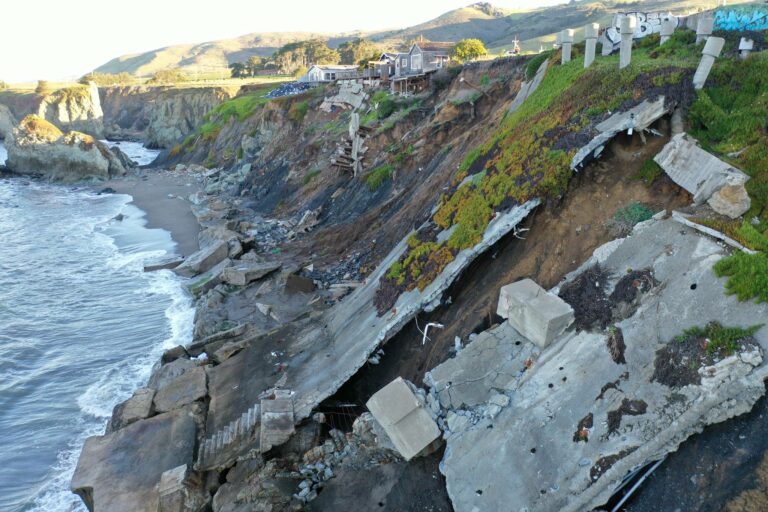
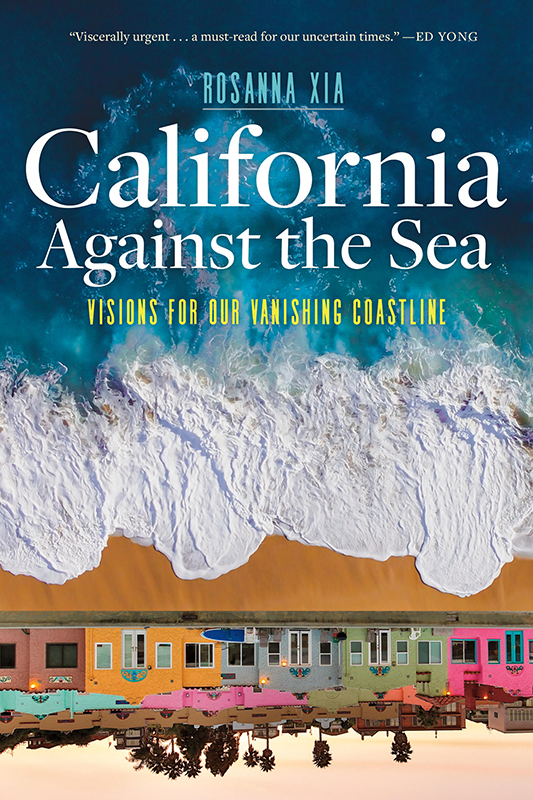
With the financial and human costs of climate change-fueled natural disasters rising rapidly, a new book invites Californians to reimagine their relationship with the state’s glorious and ever-changing coastline.
Rosanna Xia, a reporter for the Los Angeles Times, has spent the past few years traveling up and down California’s 1,200-mile border with the Pacific Ocean, speaking to residents, politicians, academics and public officials about the various challenges posed by sea level rise.
While many residents’ first instinct is often to fight to maintain the human-designated coastline with ever-more costly feats of engineering, California Against the Sea suggests that we humans should try a more humble—and hopefully less-costly—approach.
“Rather than confront the water as though it’s our doom, can we reframe the sea level rise as an opportunity—an opportunity to mend our refractured relationship with the shore?” Xia asks in the book’s introduction.
This reporter spoke to Xia by phone recently. The interview has been edited for length and clarity.
Will Carruthers: One of the things that I appreciated about the book is that you highlight that many of the development decisions that led to modern day California were made on the human time scale, not the Earth’s, which is obviously much longer. Why is that framing important to you?
RosannaXia: I love that that resonated with you. So often, our stories start with, you know, Western settlement, when the story of California began in the 1850s. So what does it mean to start before then?
The book opens with the Chumash, who have been along the coast from modern-day Malibu all the way to the southern edges of Big Sur for thousands of years. And then beyond that, geologically, the ocean and the coast have been here for thousands and thousands of years. I tried to put into perspective for readers and myself that we are mere humans on the edge of this massive edge where land meets the most gigantic ocean on this planet.
Something that humbles me every time I’m out by the water is the fact that the coast never looks the same twice. We might hide it a little bit better in some places, you know, down along Santa Monica near where I am, where sand gets brought in to help fill out the beaches and we actually rake and flatten the beaches. But the coastline itself is this incredibly dynamic space between land and ocean. This kind of tension between the two and also the marriage between the two has been in existence long before we arrived. So I think being able to capture that and establish that and really help readers reorient in that way was really powerful for me.
To start there felt like the right place to start and then, from there, let’s talk about how we got to where we are today, where we’re struggling with all of these things that we want from the coast that are in conflict with each other. And then add climate change to all that and ask, ‘Where do we go from here?’
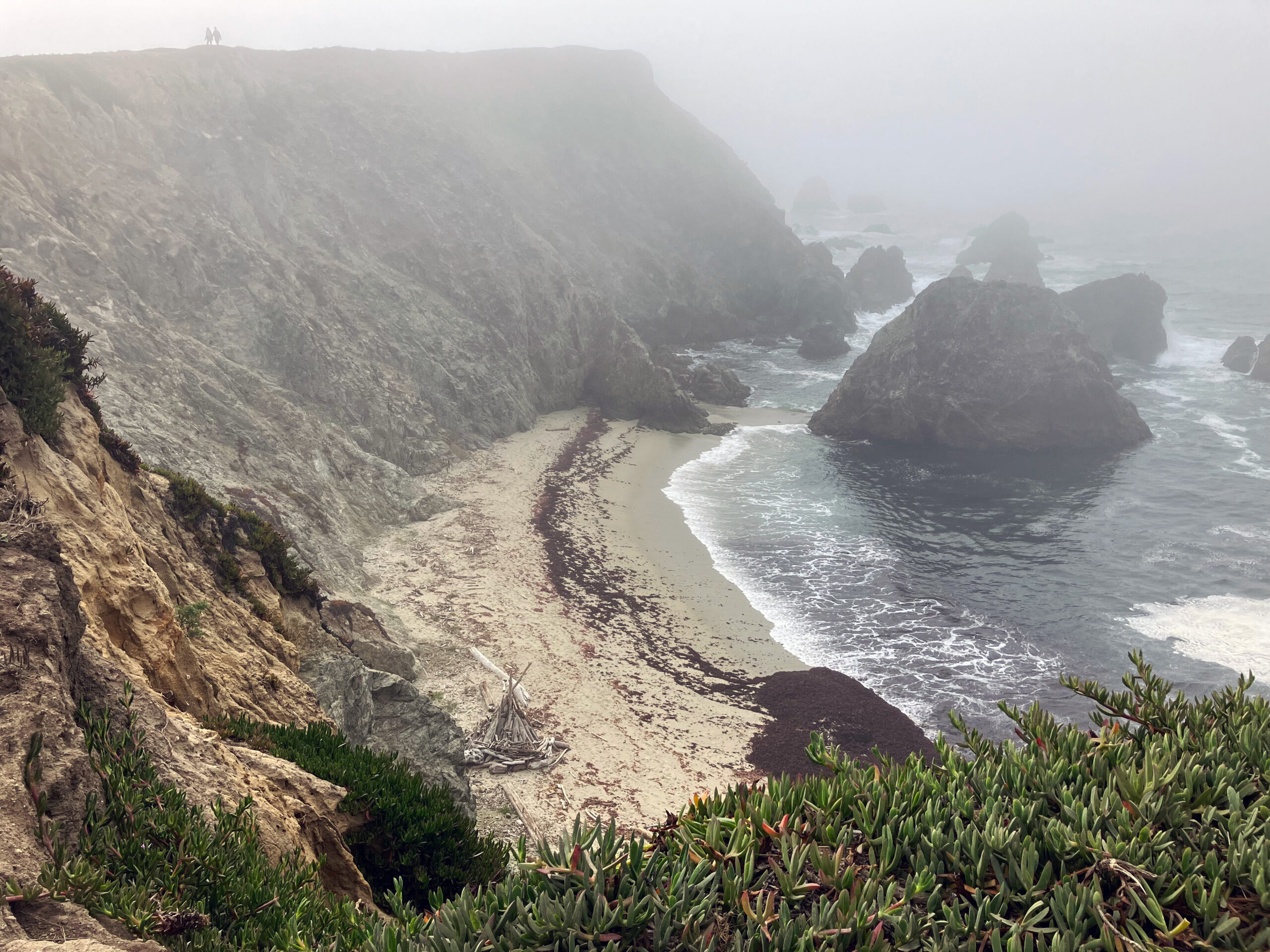
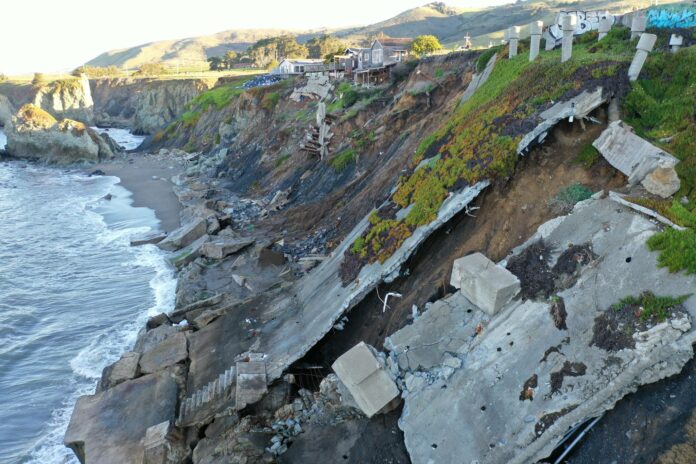
A section of Sonoma County’s coastline. Photo by Will Carruthers
WC: The other thing that stuck out to me was the tendency to talk about our relationship with the sea using war-like metaphors. For instance, managed retreat, the concept of moving homes and other human infrastructure out of harm’s way, is seen as a defeat while building a seawall is seen as fighting back and therefore more noble. However, on the longer time scale, humans, or at least our buildings, don’t stand much of a chance in that fight. Can you talk about this framing question?
RX: Once you see the number of ways we frame climate change using war metaphors, you’ll never be able to unsee it. Colloquially people will say, ‘the fight against climate change.’ My book’s title is guilty of this, but I’d say, once you get to the end of the book, it goes beyond that.
This idea of building a seawall versus managed retreat is such a black and white binary that we’ve kind of locked ourselves into when we start debating the adaptation strategies to sea level rise. There’s a lot of gray in between these two binaries, but these two extremes are what we’ve really spiraled into.
The seawall approach is the defend in place, we shall hold this fort forever kind of approach. Meanwhile, talk to anyone who has worked in the managed retreat space, and they’ll say, ‘This term needs a rebranding.’ The word ‘retreat’ just does not serve something emotionally in a lot of people, and it just feels very un-American to retreat from something. That’s a framing issue.
Ultimately though, the concept of managed retreat is just acknowledging that the ocean is moving inland, the coastline is supposed to move inland with it and we’re supposed to move with the coastline. This is something that has been happening for millions of years.
This book is asking the reader to reconsider our relationship to the ocean. Do we actually need to be at war with the ocean? Or can we work with it? Can we reach a point of deeper reciprocity with the natural processes along the coastline?
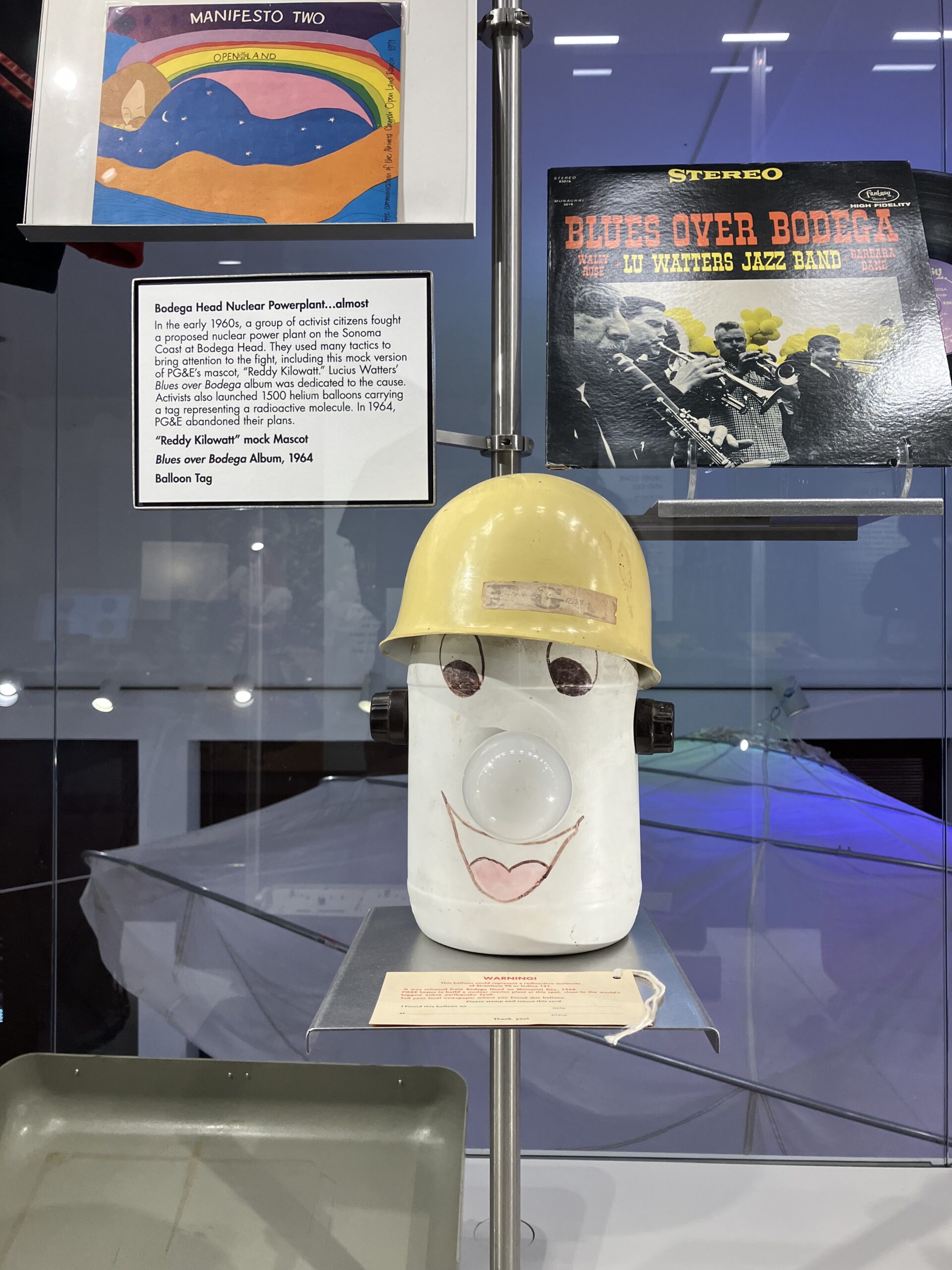
Artifacts from the local environmentalists’ struggle against a proposal to build a nuclear facility on Bodega Head are currently featured in a show at the Museum of Sonoma County. Photo by Will Carruthers
WC: The book also covers the passage of the California Coastal Act of 1976, a state law which has governed most of the development on the coast for the past few decades. Can you summarize how that came about and its origins in Sonoma County?
RX: The Coastal Act of 1976 is this pretty remarkable law that was started with a statewide ballot measure. It really made this philosophical stand that the coast can’t be owned by anybody, and therefore it belongs to everybody. As a result, there is no such thing as a private beach in California. This idea that we’re supposed to share this natural resource and that the coast and the beach itself is a broader public good, those concepts were enshrined by law with the Coastal Act of 1976.
The movement to get this law passed began in Sonoma County. There were a number of projects that were being proposed at that time that really just stirred the community. One of them was the proposed nuclear facility on Bodega Head. A number of folks gathered together and stopped the project. But I think what they realized in the process was that stopping the project in one location wouldn’t prevent the developers, the utilities, the bigger corporations from building it at another part of the coast where there was a more accommodating City Council, where the politics were better or where the community had less power to fight it.
From that one project it grew into the statewide movement to protect the rest of the coast and to encourage folks to stop and think, ‘Okay, what do we want out of this landscape? Do we want a coastline lined with sea walls and high rises and private beaches?’ You know, in California, the law now says, ‘This is a public good.’ The fight began in Sonoma County with a couple of really forward thinking people who thought about ‘What do we want to leave for future generations’ and really just took it from there.
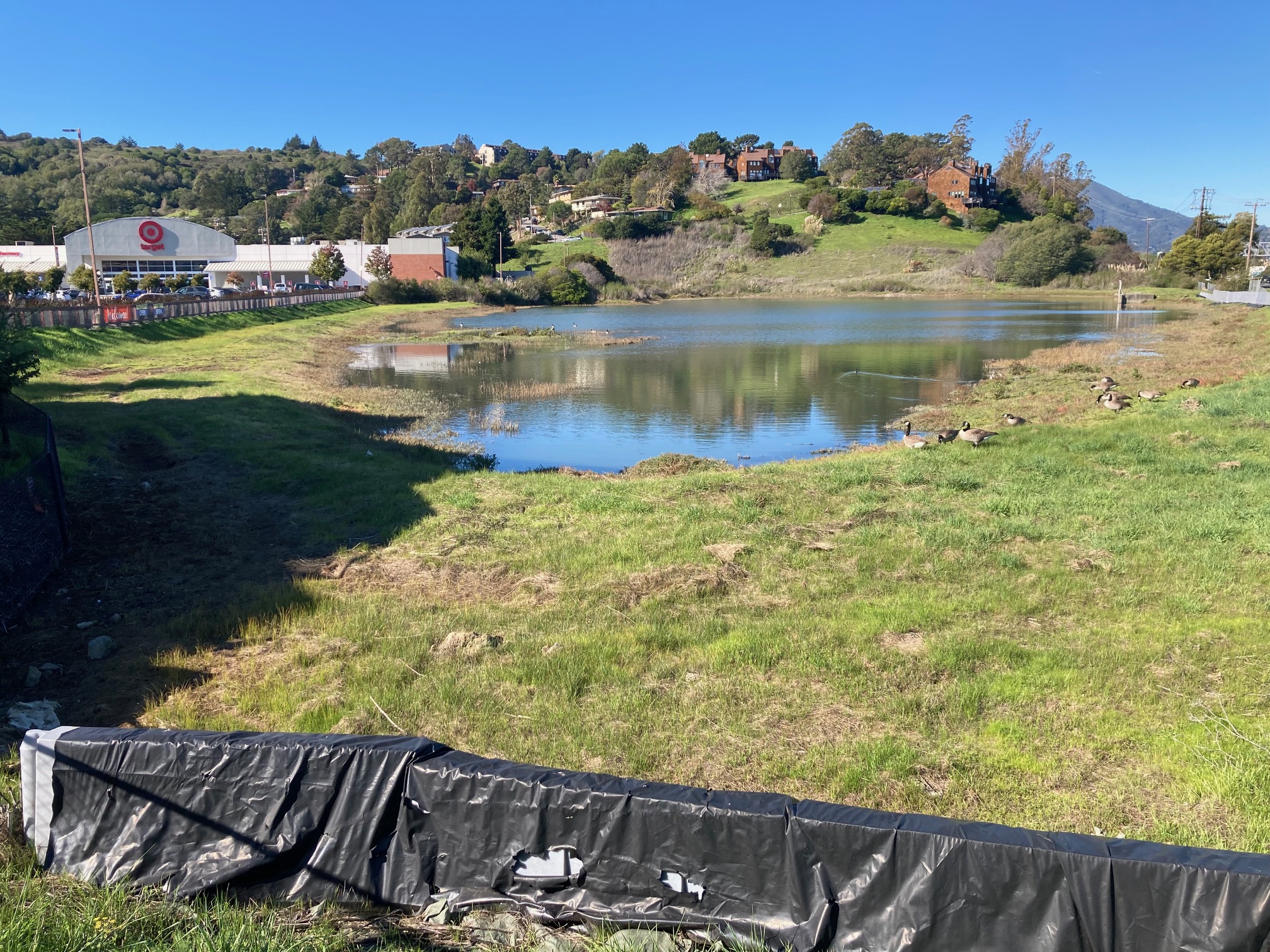
Marin City is shaped like a large bowl, tilted on its side, that drains into a small, privately-owned pond. Photo by Nikki Silverstein
WC: In the book’s chapter about Marin City, you quote a UC Berkeley researcher who points out that climate change will cause water to move from four different sides—“extreme rain from above,” “from river flooding” on one side, “from sea level rise” on another and “from below” due to rising groundwater. Can you talk about how Marin City and other communities will be impacted by rising groundwater?
RX: When we think of sea level rise, we think of waves crashing onto the beach and the ocean sweeping through streets and those kinds of dramatic images of just huge swells making landfall. But Kristina Hill at UC Berkeley and this growing movement of researchers have been looking into this more out of sight, out of mind aspect of sea level rise known as groundwater rise.
This is not like the groundwater that is embedded in aquifers hundreds of feet underground that we are drilling very long wells to draw from for drinking water. This is the groundwater that sits less than 10 feet below the surface. It’s the rainwater that gets soaked into the ground and forms a very shallow pool of groundwater pretty close to the surface. So if you think about it, when sea level rises, and the tide is moving in, pushing inland underground, as it’s pushing inland underground, the freshwater sits on top of the saltwater. And so, as that tide is rising, this shallow groundwater table is also rising. As it moves up, it’s getting closer and closer to breaking the surface.
This groundwater table tends to hold a lot of polluted runoff from rainstorms, the chemicals and the gross stuff on our streets that don’t make it into storm drains and don’t get treated. The question that Kristina Hill raises is ‘What about all these communities that have been stuck living next to or on top of formerly contaminated sites from industrial uses in past eras?’
The way we typically clean up a Superfund site, for example, a decommissioned chemical factory, is to cap it. You pour a layer of concrete over it and you’re like, ‘Okay, it’s no longer contaminated.’ But what happens if the groundwater underneath this cap starts remobilizing the soil and it starts moving the contamination elsewhere with the flow of water? So these are all really important questions to start asking and examining as, you know, the tides get higher and higher. And what does this remobilization mean for communities that, you know, have plumbing within the same 10 foot depths from the surface? What does it mean for communities who are living adjacent to sites that were, quote unquote, cleaned up?
There are just so many unanswered questions; however, there is a growing movement of research into this, and there are regulatory agencies now, really looking into this. However, no seawall is going to stop this rising groundwater table from potentially remobilizing so many legacy problems that we didn’t get around to cleaning up properly.
This is something that communities like Marin City and others in the San Francisco Bay Area are truly wrestling with. Think about every single formerly industrial site that got turned into something else. This is a question that affects all of us.
WC: The book isn’t all doom and gloom. Can you give our readers and preview of the final chapter, which takes us back to Sonoma County?
RX: Yeah, the movement to get the Coastal Act enshrined into law began in Sonoma County and, not to give too much away, but the book ends in Sonoma County with two examples what we could do going into the future.
What happened on the Sonoma coast in the ‘60s and ‘70s set us on this path and I was trying to find some measure of hope and a sense of inspiration for folks that reached the end of the book. I ultimately found it in Sonoma County. There was something really full circle when I got there.
The idea that we are building bridges both physically and symbolically with each other, with nature and with the ocean felt like a really meaningful way to conclude this book, although the broader story of ‘What do we do about sea level rise?’ remains ongoing. How do you end a book about an issue where we still have so much power and responsibility to write a different ending?
When I found myself back in Sonoma County, I found hope and I found inspiration and a window into what the future could look like if we start to rethink the way we’ve been doing things.
———
Xia has three scheduled appearances in Marin County next month. On Oct. 18 at 6pm, Sausalito’s Books by the Bay will host Xia in conversation with Mary Ellen Hannibal. At 4pm on Oct. 21, Point Reyes Books will hold an event at the Dance Palace (503 B St, Point Reyes Station). The next day, Oct. 22 at 4pm, Xia will have a conversation with Christina Gerhardt at Book Passage in Corte Madera.
Eric Johanson is a Billboard-charting performer, belting out original tunes that defy the dusty boundaries of blues, rock, and progressive Americana. This Saturday, he brings his spellbinding fretboard magic to Petaluma’s The Big Easy.
Five of his latest solo projects—”The Deep And The Dirty,” “Live at DBA: New Orleans Bootleg,” “Covered Tracks: Vol. 1,” “Covered Tracks: Vol. 2,” and “Below Sea Level”—skyrocketed into the Billboard blues top-ten stratosphere. To top it off, Guitar Player Magazine just anointed him as one of 2023’s Top 25 New Blues Guitarists.
If you think Johanson is merely a studio phenomenon, you’re sorely mistaken. Johanson is a road warrior. Festival-goers have witnessed his electric aura at stage-shaking events like the Legendary Rhythm & Blues Cruise, the Las Vegas Big Blues Bender, the iconic New Orleans Jazz & Heritage Festival, and Crescent City Blues Fest, to drop a few names.
When it comes to collaborations, Johanson’s shared the spotlight and guitar riffs with a who’s who of modern roots legends. His dance card includes Cyril Neville, Anders Osborne, the Neville Brothers, Samantha Fish, Tab Benoit, JJ Grey, and local legend Eric Lindell.
Eric Johanson performs at 8 pm, Saturday, Sept. 16, at The Big Easy. 128 American Alley, Petaluma. Tickets are $15 and available here.
For those Earth, Wind and Fire fans who missed their last area tour dates in June, the upcoming show with the Pacific Northwest’s greatest R&B export, Kalimba, should appease their fans and then some.
Taking on the vocal styling of EWF singer Philip Bailey is no easy task, but the band plays their catalog like it’s their very own. And while tribute acts today may seem a dime-a-dozen, this collective provides a show worthy of any venue’s stage.
Expect fan favorites such as “Reasons,” “Shining Star,” “September,” “After The Love Has Gone,” “Let’s Groove,” “Serpentine Fire,” and a handful of other dance-able EWF hits. For those still on the fence, visit Kalimba’s website to see and hear the band live in all its magical splendor.
Kalimba already played a handful of shows in the area recently, including (but not limited to) Sacramento, El Dorado Hills, Ripon, and San Francisco, and play up and down the coast with semi-regularity. And while most folks need to work on buying tickets for winery shows of this ilk, it would be wise to reserve your spot before the tables are gone.
Come hungry, as Fred’s Barbeque will be cooking up a storm. The day’s menu includes tri-tip sandwiches, BBQ Ribs, BBQ Chicken, hot links, hot dogs, tacos with beans & rice, chicken & shrimp pasta, and a handful of vegetarian options.
This “Fall Dance Party” lasts for three hours and will be a great way to burn off some calories you’ll rack up by eating the venue’s food fare beforehand.
The show starts at 1 pm, Sunday, Sept. 17. And all ages are welcome (sorry, no babes in arms). Tickets are $40 in advance and can be purchased here. For those who wish to try their luck at the door, tickets will be $45 the day of the show. The Vino Godfather Winery is located at 1005 Walnut Ave. in Vallejo.
On Aug. 31, Davis Wright Tremaine LLP filed a lawsuit against the National Park Service in California Northern District Court in San Francisco on behalf of freelance journalist Peter Byrne.
The complaint alleges that the National Park Service is violating the Freedom of Information Act by refusing to disclose public records that may reveal decades of federal mismanagement of Point Reyes National Seashore and ongoing environmental concerns.
Since 2020, the North Bay Bohemian and Pacific Sun have published a half dozen investigative reports by Byrne detailing how the Park Service has harmed the endemic ecologies of Point Reyes by leasing a third of the parkland to the environmentally destructive dairy and beef ranching industry. The science and historicity revealed by the reports are influential in informing activities in environmentalist circles, and have garnered attention in local and national press.
Byrne’s ongoing reporting on Point Reyes is supported by the Washington D.C. based Fund for Investigative Journalism and Reporters Committee for Freedom of the Press and has been recognized with several journalism awards.
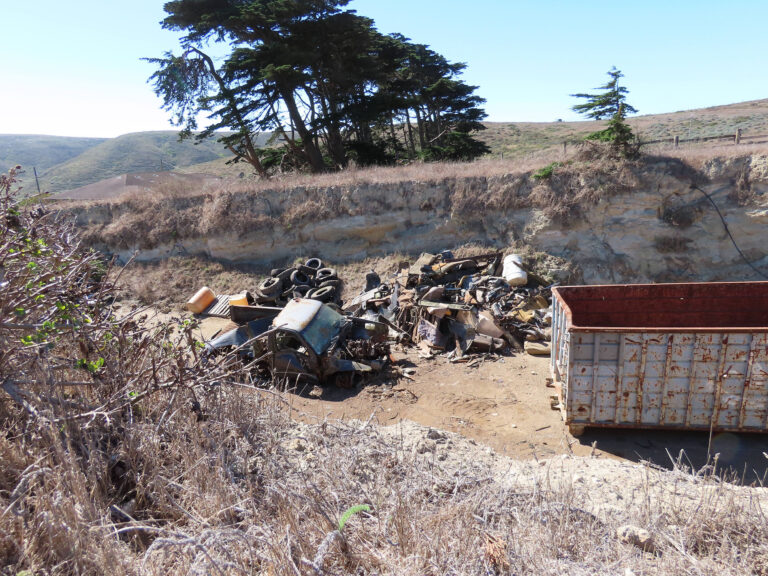
These investigative stories on the environmental and archeological disaster at Point Reyes are sourced by public records obtained at the county, state and federal levels. The lawsuit declares that the United States Department of Interior, of which the National Park Service is a division, is improperly withholding public records; and that the agency is overly redacting (censoring) some of the records it has provided to Byrne. The lawsuit protests that on the Point Reyes National Seashore website, the National Park Service wrongly accuses Byrne of publishing factual inaccuracies in what appears to be an attempt to avoid disclosing evidence of governmental malfeasance.
The opening of the lawsuit reads like a blurb for a John Grisham novel, if he wrote about matters as seemingly mundane as FOIA: “In December of 2020, Plaintiff authored an article, Apocalypse Cow: The Future of Life at Point Reyes National Park… The article was highly critical of the 250-page Environmental Impact Statement on Point Reyes that was released earlier that year by the National Park Service. The NPS was so sensitive to criticism of its work that it went so far as to post ‘corrections’ to Plaintiff’s Apocalypse Cow article on the agency’s website, which remain to this day.” After the Park Service posted its response online, the editors of the North Bay Bohemian and Pacific Sun investigated the claim that there were factual errors, and there are none.
The complaint continues, “Ever since Plaintiff’s Apocalypse Cow article was published, Plaintiff has consistently experienced unlawful barriers to obtaining public records from Defendants. Defendants have strung along, or stymied, his attempts to obtain what they are statutorily obligated to provide: public records. The public records that Plaintiff seeks—improperly withheld by Defendants—would shed light on credible, first-hand reports of a plethora of inter-related ecological, environmental, and archaeological issues, including: prioritization of commercial dairy and cattle ranching interests above statutorily mandated public-interest duties of Defendants; commercial dairy farms and cattle ranches neglecting septic systems on said farms and ranches, resulting in polluted water; polluted water harming elephant seals; enclosure of tule elk into an unsustainable environment for the benefit of dairy farms and cattle ranches, resulting in preventable deaths of these elk; and cattle trampling and destroying indigenous archaeological sites.”
The lawsuit describes the categories of records improperly withheld by the Park Service, and asks for a judge to order full disclosure.
Federal financial disclosure statements of Park Superintendent Craig Kenkel;
Annual budgets for the operation of Point Reyes National Seashore;
Park Service correspondence with the Federated Indians of the Graton Rancheria, the Seashore’s co-manager;
Park Service correspondence with Rep. Jared Huffman, who is a strong supporter of keeping federally subsidized industrial agriculture in the Seashore in perpetuity, despite the ecological damage attributed to ongoing dairy and cattle ranching in the park by the National Park Service’s own investigations;
Bids and contracts and disbursements awarded under government mandate to a small business for work cleaning up rancher generated toxic waste that was in actuality performed by a company that was not an eligible small business;
“All reports, memoranda, email or other forms of internal and external written communications regarding the health of elephant seals at Point Reyes National Seashore from September 2022 to the present which are reported by the PRNS co-manager to ‘sicken and die’ from Seashore waters polluted with agricultural run- off, including but not limited to correspondence between the NPS, Rep. Jared Huffman, Federated Indians of the Graton Rancheria, California Coast Commission, Marine Mammal Center.”
Records related to the preservation of, or failure to preserve, Indigenous archeology sites.
Davis Wright Tremaine LLP is a major force in all mediums of media law, representing many national companies. Firm partner Thomas R. Burke regularly litigates high profile public records cases.
Regarding Byrne’s complaint, Burke commented, “The public cannot provide meaningful oversight into the management of this national treasure unless and until the National Park Service begins to comply with the Freedom of Information Act. This lawsuit will force compliance.”
The Addams Family first appeared on the scene in 1938 in a series of single panel comics drawn by cartoonist Charles Addams and published in The New Yorker magazine and has been a presence in American pop culture ever since.
Fairly dark and macabre in nature, the original tone was lightened significantly for the 1960s television series. The show originally ran for only two seasons but has been rerun ever since and is how most people were introduced to the characters.
The 1990s brought two films that returned the family to more macabre surroundings while in 2022 Netflix revived the family with Wednesday. That series centers on the Addams’ daughter as she tries to solve a murder mystery at her school.
Amongst all this came, of course, a Broadway show. The Addams Family Musical premiered in 2010 and has become a community theater staple. Napa’s Lucky Penny has a production running through Sept 24.
Wednesday Addams (Emma Sutherland) has a problem. She’s fallen in love with a straight-laced boy named Lucas (Tommy Lassiter), of whom she knows her mother Morticia (Shannon Rider) will not approve. She turns to her father Gomez (Jeremy Kreamer) for support while Uncle Fester (Tim Setzer) works with the family ghosts in the background.
Her brother Pugsley (Arthur Mautner) worries that his sister won’t play with/torture him anymore, so he sees the family’s first dinner with Lucas’ parents (Dennis O’Brien and Sarah Lundstrom) as the perfect opportunity to sabotage them all. A potion stolen from Grandma (Beth Ellen Ethridge) does the trick, but not in the way Pugsley intended.
It’s a lightweight musical that fully plays into the audience’s affection for the characters. Director/choreographer Staci Arriaga has a game cast at work here, with Kreamer’s good-natured paterfamilias displaying hints of Nathan Lane (Broadway’s Gomez).
Rider makes for a slinky but lightly funereal Morticia while Setzer goes full Jackie Coogan as Fester, though the character is written quite differently from the TV series. Sutherland’s a petulant but loving teenage Wednesday while Lassiter’s Lucas is a study in puppy love. O’Brien and Lundstrom have fun with their sturdy mid-westerners gone wild.
While well sung by all, the songs by Andrew Lippa evaporate immediately from the mind but do present the opportunity for nice dance work by the ensemble (Tuolumne Bunter, Alex Corey, Rachelle King, Trey Reeves, Leslie Sexton, Caitlin Waite).
The Addams Family Musical is a cookie-cutter musical, but who doesn’t like cookies?
Da da dee dum (Snap, snap).
‘The Addams Family Musical’ runs through Sept. 24 at the Lucky Penny Community Arts Center. 1758 Industrial Way, Napa. Thurs–Sat, 7:30pm; Sun, 2pm. $22–$45. 707.266.6305. luckypennynapa.com.
Pumpkin spice lattes are back on the menu, which means—drum roll—it must be fall. Finally!
After the long, hot slog of summer, immersing oneself in some local harvest-themed events sounds like the perfect elixir (and much healthier than an artificially-flavored latte—spoiler alert: there’s no actual pumpkin in them). Anyway, we’ve harvested the following picks for your seasonal sojourns, which will...
The Centers for Medicare & Medicaid Services (CMS) just proposed a rule supposedly designed to improve transparency in Medicaid.
That’s hardly the real objective, however. The proposal is a back-door effort to expand price controls in Medicaid and beyond, a surefire way to derail the next generation of medical breakthroughs.
The CMS rule would require certain drug makers to participate in...
Burning Down the House
Members of the opposition party have been thrilled about Nancy Pelosi’s decision to seek re-election in 2024. No one, not even President Joe Biden, is more accountable for Democratic Party ineptness than the congressperson from Pacific Heights.
My impression of Pelosi is that when her house is burning down, she is outside mowing the lawn. Both parties...
Rohnert Park
Guadalajara, Chicago-style
Historically mariachi music comes out of places like Guadalajara and Mexico City. Súper-stylish Mariachi Herencia de México starts with that rich tradition and puts a big midwest heaping of style on top. Take mariachi’s smooth grooves, double the band size, upgrade the charro clothing and the result is an eye-poppin’, ear-lovin’ feast. The show is part of...
ARIES (March 21-April 19): So it begins, the Building and Nurturing Togetherness phase of your astrological cycle. The next eight weeks will bring excellent opportunities to shed bad relationship habits and grow good new ones. Let’s get you in the mood with some suggestions from intimacy counselors Mary D. Esselman and Elizabeth Ash Vélez: "No matter how long you’ve...
With the financial and human costs of climate change-fueled natural disasters rising rapidly, a new book invites Californians to reimagine their relationship with the state’s glorious and ever-changing coastline.
Rosanna Xia, a reporter for the Los Angeles Times, has spent the past few years traveling up and down California’s 1,200-mile border with the Pacific Ocean, speaking to residents, politicians, academics...
Eric Johanson is a Billboard-charting performer, belting out original tunes that defy the dusty boundaries of blues, rock, and progressive Americana. This Saturday, he brings his spellbinding fretboard magic to Petaluma's The Big Easy.
Five of his latest solo projects—"The Deep And The Dirty," "Live at DBA: New Orleans Bootleg," "Covered Tracks: Vol. 1," "Covered Tracks: Vol. 2," and "Below...
For those Earth, Wind and Fire fans who missed their last area tour dates in June, the upcoming show with the Pacific Northwest’s greatest R&B export, Kalimba, should appease their fans and then some.
Taking on the vocal styling of EWF singer Philip Bailey is no easy task, but the band plays their catalog like it’s their very own. And...
On Aug. 31, Davis Wright Tremaine LLP filed a lawsuit against the National Park Service in California Northern District Court in San Francisco on behalf of freelance journalist Peter Byrne.
The complaint alleges that the National Park Service is violating the Freedom of Information Act by refusing to disclose public records that may reveal decades of federal mismanagement of Point...
Macabre Musical
The Addams Family first appeared on the scene in 1938 in a series of single panel comics drawn by cartoonist Charles Addams and published in The New Yorker magazine and has been a presence in American pop culture ever since.
Fairly dark and macabre in nature, the original tone was lightened significantly for the 1960s television series. The show...