
MC5

0

Mo’ Town Sound

Bootleg anthology testifies to MC5

By Karl Byrn

The history of hard rock has mistakenly failed to afford the MC5 the same reverence that’s heaped on their brethren in Detroit’s late ’60s rock scene, the Stooges. The Spin Alternative Record Guide correctly lists the MC5 in a trio of protopunk fountainheads with the Stooges and the Velvet Underground, but it dismisses them as the so-called marginal third. Martin Popoff’s exhaustive guide 20th Century Rock and Roll: Heavy Metal correctly notes that the MC5 and the Stooges are the start of metal in America, but then only includes the Stooges in a list of its top 50 most influential heavy bands.

The Stooges did have a nihilism that has fed a certain hip aesthetic of dissolution in punk and metal, and singer Iggy Pop’s status as a surviving rock icon does merit some godfatherly awe. This almost makes the MC5 underdogs; they preached activism and idealism. Today, singer Rob Tyner and guitarist Fred “Sonic” Smith are both in rock ‘n’ roll heaven, leaving guitarist Wayne Kramer as the only functional original member of the once inflammatory Motor City Five.

With the increased presence of political energy in rock music, history may be ready for a second look at the MC5. They were clearly better musicians and songwriters than the Stooges, but moreover, where Iggy’s band offered boredom and destruction, the MC5 had a game plan that included revolution and success as an important rock band. The timing is right for the release of Are You Ready to Testify? The Live Bootleg Anthology (Sanctuary Records), a three-disc set (priced like a single disc) that captures the best of the Detroit punk-metal pioneers at three key shows during their explosive and inspiring career.

If Iggy and the Stooges articulated an inevitable schism that rejected hippie idealism, the MC5 embraced idealism but rejected complacency and tyranny, channeling a desperate gasp of antiestablishment fury meant to finally rally the freaks. A notable part of their story includes association with Detroit’s radical poet-Svengali John Sinclair and the White Panther Party.

Apart from aligning themselves with radical ideology, the MC5 weren’t really hippies, but rather a classic rock band at heart. Early efforts found the band amping up the tough R&B guitar energy of the British Invasion. With nods to both Chuck Berry and Little Richard, as well as the abstractions of free jazz, the band forged a loud and fast high-energy sound that pushed rock’s sonic envelope way ahead of contemporary psychedelic bands. Their sound wasn’t about the West Coast’s Summer of Love but, rather, the riotous Midwest Summer of ’68, replete with chaos, urgency, blues, good times and social unrest exploding into a frenzy of screaming, riff-heavy rock.

Are You Ready to Testify? is a decent slice of the MC5’s power in spite of the bootleg-at-best sound quality. The notes tell their familiar story with a few twists (such as Kramer relating that the band strove to play, write and perform with the same dynamic skill of the Motown session players and writers who worked a few blocks away). But this bootleg collection isn’t the place to start if you don’t already know the material.

Disc one is more or less the same set as their incendiary 1968 live debut Kick Out the Jams, taken from the show at which they were supposedly first seen by Elektra talent scouts. Disc two is more or less a live 1970 set of their second (and first studio) album Back in the USA. Disc three hosts other crucial live cuts from this era, such as their cover of Ray Charles’ “I Believe to My Soul” and the noise-epic “Black to Comm.”

The place to start, of course, is with the classics: Kick Out the Jams and Back in the USA themselves. The live debut is the deep legacy, a fireball that has scorched over the sound of the Sex Pistols and the polemics of Rage Against the Machine, and has found its current home in the sheer distortion of Wolf Eyes. On their second album, Back in the USA, the band pursued the tight power-pop sound of hyper teen anthems, basically presaging the Ramones. That leaves their third, final and most developed disc, High Time, which Are You Ready to Testify? doesn’t represent at all. It’s my favorite of the three original releases, on which they pursue boogie and community, laying the groundwork for AC/DC and Lynyrd Skynyrd. High Time isn’t a punk-metal standard, but it’s a loud and living testament to the MC5’s influential substance.

From the May 25-31, 2005 issue of the North Bay Bohemian.

© Metro Publishing Inc.

Exotic Meats

0

Got Offal?

Adventures in organ meats and other morsels

By Heather Irwin

Five or six cow feet go into a bag. The hooves and skin have already been removed, so only a sinewy, marbled little barrel of muscle and nerves remains. The meat man asks if we want anything else. Scanning the case, my friend Lily points to white folds of meat, what she calls tripa in her El Salvadorian dialect. Stomach. My knees go a little weak.

I’m already feeling conspicuous, the lone gringa standing at Lola’s Market meat case. We’ve met here to pick up specialized Central American ingredients Lily needs to make an old family favorite, cow foot soup. I’m honored she’s agreed to make it for me. OK, not really for me, but for the legions of friends and family who’ve been begging her to make it for months. But, hey, I’m the lucky duck who gets the first steaming bowl.

Into our basket goes a bulging bag of wet, blanched-looking stomach pieces. Along with the feet. And, Lord, I’m hoping nothing else from that case. Because even though I’m not particularly squeamish, the trough of liver, the piles of chicken feet, the severed tongues, assorted snouts and–oh, man–a whole pig’s head looking back at me is making me feel a little odd. Dorothy, we’re not at Safeway anymore.

This is just part of my adventure in offal. After reading the book The Whole Beast: Nose to Tail Eating by British chef Fergus Henderson, I’ve decided to broaden my carnivorous horizons by trying a variety of, well, variety meats.A bit controversial–especially among vegetarians–Henderson has incredible cult-cache with chefs who are now incorporating everything from pig cheeks and tripe to brains, intestines, blood, glands, ears and lips into a trendy (though actually very traditional) form of cooking.

Choosing cuts of meats that are typically left on the butcher’s floor, Henderson transforms offal into delicate, savory dishes that transfix eager diners from around the globe. Many celebrity chefs such as Anthony Bourdain (of Kitchen Confidential fame), Mario Batali and even locals like the French Laundry’s Thomas Keller, Cyrus’s Douglas Keane and Duskie Estes, and John Stewart of the Zazu roadhouse are dedicated offal/Henderson fans. (Bourdain once hosted a Henderson-inspired offal-only dinner in Portland, Ore., which included rabbit’s kidneys and cockscombs, among other things.)

With a McDonald’s or Safeway just around every corner and an easy presence of, say, a shrink-wrapped filet mignon the size of our heads for dinner, most Americans shudder at the thought of these exotic meats, though they’re as commonplace as hamburger for much of the rest of the pork- and beef-eating world. Why? Lily probably explains it best when she describes having to kill her daughter’s favorite chicken for a long-ago dinner. When meat is a luxury, as it has been for most of human history, you aren’t about to waste anything, even the not-so-pleasant parts. And when it comes right down to it, as her daughter said through her tears, it’s dead. So let’s eat it.

Reaching across cultures with my fork and knife, I’ve decided to try menudo (a common Spanish soup made with tripe, not the ’80s boy band), cow foot soup, sweetbreads, liver (of the non­foie gras type) and maybe some tongue or brain. My son says I’m braver than the people on Fear Factor who eat puréed frog guts. I’m not sure he’s wrong.

I decide to start my adventure simply, with chicken livers. A friend who regularly eats that kind of thing recommends trying them at Healdsburg’s Bistro Ralph. This is the same “friend” who brought me an old copy of The Joy of Cooking with highly detailed instructions on how to prepare calf head. Evil poppet. I’m not sure how much I trust her.

Ralph is fresh out of livers on my first visit, but I’m given an especially huge plate on my return trip. Oh, joy. It smells heavenly. I eat the polenta and rolls, and cut into my first bit of liver. The familiar iron tang and unique dryish texture comes flooding back from my childhood eating. And though I’m sure the oregano-infused wine sauce makes these livers a special treat for some, I can only get about five bites in before my brain takes over and stops me cold. Ew. Liver. My friend, to her delight, gets a steaming takeout bag of the stuff.

Next is my cow-foot-soup adventure. I arrive Saturday morning at Lily’s Santa Rosa home to find that the feet have already been cooked overnight, and a huge soup pot is starting to boil on the stove. As we chat about life, kids and her love of canned iguana (I’m already worried), she cuts up yucca, peppers, onions and a variety of other vegetables and spices to throw into the pot. The entire house is soon infused with a heady aroma as steam rises from the pot in wave after wave–a sort of El Salvadorian Bat signal to her family. The phone rings several times as we cook, and each time she tells me more people have invited themselves over for some of her soup. Word travels fast.

After everything has boiled and cooked down, she adds the sheets of stomach for a quick blanching and then ladles me a bowl the size of a soccer ball. She plops in a choice bit of gelatinous foot with a devilish smile. Lucky me.

I can honestly say that this soup is a lot like chicken soup: brothy, full of vegetables and little bits of floating meat that’s warm and comforting as an old quilt. I slurp the salty, spiced liquid; eat chewy pieces of Mexican squash and yucca happily; and gingerly pick around the stomach. Lily looks on inquisitively, downing her own bowl in just minutes. She laughs at my poorly veiled squeamishness as I finally chew and chew and chew . . . and chew and chew on a bit of stomach. My two-year-old daughter is the more enthusiastic eater, dropping bits of hoof and rubbery meat into her giggling face. Showoff.

Apparently, kids are naturals for this stuff (proving it’s all in our heads). Chef Duskie Estes of Zazu and the soon-to-open Healdsburg restaurant Bovolo says her four-year-old is a special fan of the pig heart and ear salad served every year by John Bertolli at his whole-pig dinner. Slightly less adventurous than her daughter, Estes says she’s more of a cheeks girl, serving the soft, somewhat gelatinous parts of the head year-round. This, I can say after having eaten it with relish, is good stuff.

At Healdsburg’s Cyrus, chef Douglas Keane does a brioche-crusted sweetbread (the thalamus glands) that has been dubbed nothing short of transcendent. I can only vouch for his foie gras sampler, which is divine. But really, who wouldn’t love some bready glands?

Apparently, me. After two weeks of adventure, my digestive track is done. I mean: not happy. My body has voted itself off of offal for a while. The menudo must wait, and I’m holding my tongue, for now. For health’s sake, one can’t be too careful when it comes to the looming threat of gout (known to be brought on by consuming too much organ meat).

Lily’s cow foot soup has, I’m sure, gone the way of her tongue tacos: consumed by eager family members always ready for some home cooking. She’s promised me El Salvadorian cooking lessons in foods a little less, um, challenging–as well as a date for some extreme sushi. A fair trade, I think.

Have an offal time at the following locations: Lola’s Market, 440 Dutton Ave., Santa Rosa, 707.577.8846; Bistro Ralph, 109 Plaza St., Healdsburg, 707.433.1380; Zazu, 3535 Guerneville Road, Santa Rosa, 707.523.4814, Cyrus, within the new Le Mars Hotel, 29 North St., Healdsburg, 707.433.3311.

From the May 25-31, 2005 issue of the North Bay Bohemian.

© Metro Publishing Inc.

Desalination

0

Liquid Manna: While other counties have looked to conservation as a cost-effective way to prevent drought, Marin may prefer the miracle of money.

Buyin’ Brine

Marin County looks to desalination

By Bruce Robinson

Paul Helliker, general manager of the Marin Municipal Water District (MMWD), worries that the taps, showers and hoses of Marin County might someday run dry. If the recent history of droughts in the North Bay region are any gauge, Helliker has every reason to be concerned.

“If we had a recurrence of the 1976-’77 drought here in Marin County, we would face 65 percent rationing during the second year,” he says. “We rely a lot on our local reservoirs, and in 1976-’77, those reservoirs came close to being completely depleted.”

Determined to avert a repeat, the MMWD has pinned its hopes on desalination, the process of extracting fresh drinking water from the salty soup of San Pablo Bay. A $1.2 million pilot plant has begun preliminary operations near San Quentin; if it performs as hoped, the district is preparing to spend another $50 to $70 million to build a full-scale desalination facility.

The temporary pilot plant, which will run for nine to 12 months, can produce 100,000 gallons of fresh water daily. A much bigger permanent plant could generate up to 10 million gallons per day. “If we ran it full-time, it would produce about a third of the water demand here in Marin County,” Helliker notes, adding that short of drought conditions, the plant will not operate at full capacity. “We’re planning on starting out running it at one-tenth that amount during the winter, and a third to half that amount during the summer.”

This is not the first time Marin has explored desalination. Following a test run in 1990 that proved highly expensive, county residents were given a choice between bond measures to fund a desalination facility or a pipeline to bring in water from the Russian River. They opted for the pipe.

“Everyone thought the Russian River was a highly reliable source without serious environmental problems,” recalls Jared Huffman, the current president of the MMWD. But now the reliability of the Russian River is in serious question, thanks to litigation that threatens to further curtail diversions from the Eel River into the Russian and efforts by state and federal regulators to save threatened salmon and steelhead populations in the Russian River watershed.

“We have an opportunity to not only avoid additional diversions from overtapped rivers like the Russian and the Eel, but to actually go further and reduce our current deliveries from those rivers,” Huffman says of the proposed desalination plant’s potential.

Desalination is essentially a two-stage process. The first stage removes all the sand, algae and other sediment from the seawater; then the still-salty water goes through a reverse osmosis process in which it is pushed through an extremely fine plastic membrane under high pressure. Only the freshwater molecules can squeeze through the membrane; the brine remaining on the other side is discarded.

It’s the first phase of the process that’s getting the closest scrutiny. Newly developed microfilters are less expensive and more durable, and a major part of the pilot project involves comparative testing of three competing filtration systems. With these and other technical innovations over the past decade, Huffman now predicts that desalination on the scale proposed in Marin can produce freshwater at a cost of no more than 25 cents per gallon, and possibly just a fraction of that.

Another obstacle desalination plants must contend with is disposal of the leftover brine. “You have to have the ability to discharge the brine,” notes Miles Ferris, director of utilities for Santa Rosa. “People who have ocean outfall don’t have a problem with that.”

That would include the MMWD, as its planned site is conveniently adjacent to the Central Marin Sanitation Agency’s wastewater treatment plant in east San Rafael, which already discharges into San Pablo Bay. “There’s a sweet spot where you can blend the brine with the wastewater and have an environmental benefit,” explains Huffman. The brine can be used to match the salinity of the treated wastewater discharge to bay water.

That’s an equation David Lewis of the Save San Francisco Bay Association is watching carefully. “They’ll have to look at the economies and whether they have enough [treated] water that they would be able to recombine these brines from a large-scale plant.”

Noting the sizable investment the new plant will require, Lewis observes that “other water districts have found that it is much more cost-effective to do additional conservation measures than to try to create a new source of freshwater. But the economics may be different in Marin.”

Adding to the economic impact, notes Dietrich Stroeh, former general manger of the MMWD prior to 1980, are the ongoing energy costs of the desalination process. “You don’t just plug the thing into a wall socket somewhere and expect it to run,” he laughs, adding that “solar villages” in the southern California desert have been suggested as one possible energy source, “but that has not been fully explored.”

If and when those obstacles are cleared, Stroeh says Marin should still maintain its pipeline to the Sonoma County Water Agency, “just for pure flexibility, to keep redundancy in the system.” That could allow the MMWD to aid the separate North Marin Water District in case of a water-supply emergency.

That kind of cooperative potential may be unique among the many desalination projects currently under study in the state.

“Many of these projects up and down the coast are being proposed by huge multinational corporations,” Huffman points out. “This is the only one in California that is publicly owned and operated.”

From the May 25-31, 2005 issue of the North Bay Bohemian.

© Metro Publishing Inc.

Swirl n’ Spit

0

Swirl n’ Spit

Perfectly Pinot

By Heather Irwin

Confession: A weekend away from home, and I got deep into a relationship unbecoming to a California wine lover: I dallied indiscreetly with Oregon’s wine country. I mean, after two years of wonderful romance with Sonoma and Napa, you can’t blame a girl for wanting, well, something a little different. You know–a sort of grapey one-night stand.

Rolling through the great, green hills outside Dundee–just about 30 miles from Portland–I stopped at Argyle, Erath, Lange and Torii Mor wineries, finding myself hooked, not just on a new wine region, but on a wine I’ve only dated casually at home–Pinot Noir.

Since the success of the Oscar-winning movie Sideways, Pinot Noir has newfound clout. And though Sideways highlights California Pinots, Oregon is, in many wine circles, an equally stunning–and growing–celebrity in the Pinot scene.

What’s so great about Pinot? Pinot is a notoriously difficult grape, both in field and bottle, known to be both a madman’s folly and a badge of honor for many grape growers. Knowing the difficulty with which it is produced, wine lovers have come to appreciate the subtle, rich, often earthy quality of Pinot–especially since it’s not Merlot.

Here at home, some of the most well-known Pinot Noir growers are located in the Russian River Valley. Wineries like Williams Selyem, Martinelli and Davis Bynum have reached near-cult status (with price tags to match). They are sweet manna. Others, including Landmark, Papapietro-Perry, Russian Hill and Merry Edwards are also on the rise, though still attainable. In the “I can afford this” range, Laurier Pinot Noir (less than $12) is a good bet.

There are many similarities between the mavericks of Oregon and the equally passionate Pinot growers of Sonoma’s Russian River Valley, not the least of which is that a number of Oregon winemakers are former Northern Californians, a fact they’re not always eager to share, having cut their teeth in Sonoma and Napa. Also somewhat similar is the weather and landscape. Oregon’s Willamette Valley has a similar growing season to French Pinot regions, though detractors say the humidity makes for uneven vintages. Higher and often hotter, the Russian River has steep hillsides with less humidity and cool ocean breezes.

As a generalization, Oregon Pinots seemed to have more fruit compared to the typically woody, mushroomy flavors and intense brambliness–what some might call earthy flavors–found in California Pinots. Though several winemakers in Oregon said the often typical “barnyard” nose of California Pinots is a fault, rather than a benefit, I’d beg to differ.

But no matter what my affinity for terroir or barnyardiness, flying home Sunday, watching the rolling green of Oregon hillsides morph into the rolling golden of California, I found myself glad for my little Oregon Pinot dalliance–but longing for home. And a nice glass of Pinot Noir.

To Do List: Check out the annual Russian River Pinot festival Oct. 28-30, featuring the beauty and bounty of Pinot Noir, and many incredible Pinot wineries not often open to the public.

From the May 18-24, 2005 issue of the North Bay Bohemian.

© Metro Publishing Inc.

Todd Rundgren/Joe Jackson

0


Up Against It: The avant-garde string quartet Ethel support Todd Rundgren and Joe Jackson in their Ortonesque quest.

Something, Anything

How Todd and Joe owe it all to Orton and the Beatles

By Alan Sculley

Music fans can thank the Beatles for enabling this spring’s pairing of Todd Rundgren and Joe Jackson on tour together. The two artists, both known as inventive, adventurous and stubbornly individualistic songwriters, had never met for anything more than perhaps a handshake until last May when the Beatles unwittingly united them.

Back in 1989, Rundgren had been asked to write the music for a stage production of a script written by the late English playwright Joe Orton (Loot, What the Butler Saw) that had originally been intended to be the Beatles’ third movie.

Orton, who wrote the script for the Fab Four in 1966, was at the time one of the most popular writers on the London scene. The Beatles rejected his initial draft, manager Brian Epstein telling Orton that it wasn’t “suitable.” Orton agreed to do a rewrite, and a chauffeur was sent to pick the playwright up for a meeting with the band. The driver reportedly knocked, heard no answer and looked through the mail slot. Inside the apartment, Orton lay dead on his bed, bludgeoned in the head with a hammer by his lover Kenneth Halliwell, who was slumped at his desk, the victim of a pill overdose. Three weeks later, Epstein also died of an overdose.

Orton’s play, titled Up Against It, was given to Rundgren in 1989 for his talents as a composer. Using the stage musicals of Gilbert and Sullivan, and Bertolt Brecht and Kurt Weill as inspiration rather than trying to write imitation Beatles music, Rundgren has done little with the music since, other than including revamped versions of a couple of those songs on his 1989 album Nearly Human.

“I’m not somebody who can actually write sheet music out with any degree of ease,” Rundgren says in an interview from his Hawaii home just prior to his tour with Jackson. “So all of my transcriptions were essentially the recorded demos of the songs. I had all of those collected. About eight years ago, I essentially dressed them up a bit and released them as an album that only came out in Japan.”

Last spring, Rundgren was asked to put together a new production of Up Against It.

A benefit performance was held in May 2004 at Joe’s Pub, a New York cabaret venue attached to the Public Theater.

“To cut a long story short, Joe [Jackson], who has a place in New York and spends some time of the year there, had his management call up and ask if there was any little part or something that Joe could do in this revival,” Rundgren says. “I said, ‘Sure, there are a couple of guys who are not showing up, and we have a few relatively critical parts that need to be sung.’ So Joe came in and rehearsed with everyone and performed, and that was all terrific and a big surprise for the audience because Joe was not billed.”

The organizers then approached Rundgren and Jackson about playing a show last summer as part of a Central Park concert series, with the string quartet Ethel opening. This marked the first time the two artists had ever shared a concert bill.

That day, both Rundgren and Jackson performed solo sets and then joined forces with Ethel for an encore. They appear with Ethel at the Luther Burbank Center on May 20.

“Everybody just kind of went berserk at the end of it,” Rundgren says. “They liked the flavor of that particular meal so much that we thought, ‘Well, let’s see if there’s any other interest outside of New York City.’ And it turned out that there was enough for us to be out for about 10 weeks of touring in both the U.S. and Europe.”

The tour this spring follows a similar format. It comes after both Rundgren and Jackson had wrapped up significant projects.

In 2003, Jackson reunited with his original band–bassist Graham Maby, guitarist Gary Sanford and drummer Dave Houghton–to record Volume 4, their first CD together since 1980’s Beat Crazy. A world tour kept the foursome on the road well into 2004.

Rundgren, meanwhile, released Liars, his first CD of new material since 1993’s No World Order. He supported the CD with a full-band tour.

Like Jackson, whose career has seen him make albums that have featured everything from edgy, punkish rock to big band to elegant pop balladry and classical music, Rundgren has shown a similar sense of exploration and accomplishment in his music.

After debuting in the late 1960s in the cult band the Nazz, Rundgren embarked on a solo career that has included the landmark 1972 double album Something/Anything, which demonstrated his ability to write finely crafted soul-inflected pop, a series of albums with his now-defunct progressive rock/pop band Utopia and other solo releases that have ranged from highly experimental (the 1993 interactive CD No World Order) to highly accessible (Nearly Human).

Like a number of Rundgren CDs, Liars carries a common lyrical theme. As the title suggests, the CD revolves around truth, but that one-word description doesn’t really capture the intent of Rundgren’s lyrics or the many facets of reality that the word “truth” entails.

“If all I was to say is this is an album about truth, I don’t think that would be true,” Rundgren told me in a 2004 interview. “It’s about all manner of reality versus nonreality, or what can be proven in the human realm versus what can’t, and also things that people may not even consider to be about truth or honesty, which is their everyday reflexive behavior that makes social interactions endurable, the little lies that you tell all the time just so that you can get on with business or whatever. It’s as simple as ‘How are you today?’ and you say ‘Fine,’ when you’re really having things on your mind that are really compromising everything else you do, but you’d never tell anybody what it is.

“I got so much material out of the topic that it was like 14 songs and 74 minutes later by the time I was finished at least with this round,” Rundgren said of Liars. “And I don’t even think the topic was exhausted.”

Todd Rundgren and Joe Jackson perform singly and together on Friday, May 20, at the LBC. The avant-garde string quartet Ethel supports. 50 Mark West Springs Road, Santa Rosa. 8pm. $45. 707.546.3600.

From the May 18-24, 2005 issue of the North Bay Bohemian.
© Metro Publishing Inc.

Oneida

0


Groomsmen: Bobby Matador, Kid Millions and Baby Jane of Oneida marry musical genres.

The Newlyweds

Spazz-rock trio Oneida take a baroque turn

By Sara Bir

For the release of their seventh album, The Wedding (Jagjaguwar), Oneida sent out a joke press release stating they had built “the largest music box on the East Coast,” describing it as a “hand-cranked behemoth” containing over 70 saws. The slight problem was that a number of hack journalists–including yours truly–actually took the bait. Duh.

“We didn’t know that people would take us seriously,” says Oneida’s Kid Millions in an e-mail exchange, “but Oneida’s music box exists only in our fancy. It’s a good metaphor for the process involved in making this record, but we’re just people who write music and distill it into something else.”

Even so, the minor hoax proved that folks like me are more than happy to believe Oneida capable of just about anything. This band has released an armload of material and grown musically from a mildly arty psychedelic throwback party band to an organ-driven growling beast of unexpected power and beauty. The band formed in 1997, playing alternative venues around Brooklyn, and established themselves in what has since been both dubbed and exploited as the “Brooklyn scene.” Over time, they’ve slimmed down in personnel to three members: keyboardist Bobby Matador, bassist and guitarist Baby Jane, and drummer Kid Millions.

Oneida often employ thrashing drums and hyperactive organ-pounding, but at times they’ll draw these elements out to nearly excruciating lengths, repeating themes like a skipping record so that when the music pulses with even the most subtle shift, it feels like the heaviest thing in the world. This was especially the case on their 2002 double album Each One Teach One, which featured the 30-minute track “Sheets of Easter,” a song that channels intuitive listeners to a higher state of being through repetition. Even so, it’s hard to listen to more than once a year.

I first found out about Oneida when I saw them open up for space rockers Kinski a few years ago. They became the elusive Unexpected Opening Band That Changed My Life. Their performance–a bawdy, focused explosion of pure musical energy, somewhat like a shimmering epileptic bulldozer–threw me for such a loop that I had to process it a night or two before I knew I had to go out and buy all of this band’s albums right away.

“Spazz rock,” Mr. Bir Toujour called it, a fairly apt term for their live incarnation. Kid Millions is a hurricane of a drummer, combining brutal athleticism with technical savvy. Add Bobby hammering away on his organ and Jane weaving layers of feedback over everything, and you get music so overwhelming it’s ecstatic.

Even so, their albums have been uneven, with deep pockets of greatness amid occasional flotsam. The moody Secret Wars released last year was more cohesive, but The Wedding finally delivers a fully realized work. The most listenable of Oneida’s albums, it still sounds wonderfully Oneida-like, at turns delicate, lurching, menacing and just the tiniest bit campy. And it has strings.

“Songs for The Wedding have been brewing since 2001,” writes Kid Millions. “Bobby and I were listening to the Left Banke on a car ride in 2000, and we thought, ‘Hey! Let’s do a record like this!’ Sounded good to us. We used them as a jumping-off point.”

There’s a substantial gulf of radio friendliness between the achingly lovely baroque-pop of Left Banke’s 1966 hit “Walk Away Renee” and the majority of Oneida’s previous work. Though still not radio-friendly, The Wedding offers spooky, complex arrangements (“Run through My Hair”), epic psychedelic balladry (“Spirits”) and fragile, sparse asides (“Charlemagne”).

Oneida writes songs as a three-headed unit, which could account for the cornucopia of genres that come through in their music. They throw stoner rock, late ’60s garage-punk and Germanic ambient noisemaking into their gurgling pot of tricks. Outside observers might take in their substantial stack of releases and think they’re always conjuring up something new, but that’s not how Kid Millions sees it. “I have to say, I think we could write more songs,” he writes. “People think we release a lot of music. I think other bands probably only have one principal songwriter or don’t really commit to the process like we do.

“We don’t turn down ideas,” he continues. “There are always new demos and recordings getting introduced into the mix. When a project reveals itself to us, we start to whittle stuff down. Bobby started writing songs with very complicated chords and structure that he can’t play anymore. None of those songs made the record except for ‘Charlemagne,’ the simplest of them all, and maybe the most penetrating.”

“Charlemagne” is one of the six tracks with string arrangements by the Fireworks Ensemble’s Brian Coughlin. The strings push Oneida into a quieter, lusher place, one they’re surprisingly good at inhabiting. One of the few bands better at forging new sounds than parroting their influences, Oneida always sound like Oneida no matter what. Which is why I’ll take them for better or worse any day–with or without a music box.

From the May 18-24, 2005 issue of the North Bay Bohemian.
© Metro Publishing Inc.

News of the Food

0

News of the Food

Bounty of the Counties

By Gretchen Giles

Clip ‘n’ go! The farmers market season blossoms into full-bloom.

Sonoma County

Cotati: Thursday, 4:30-7:30pm. Opens June 2. La Plaza Park, downtown Cotati. 707.795.5508.

Guerneville: Wednesday, 4-7pm. Guerneville Park and Ride lot, across from Fife’s Road House on Highway 116. 707.865.4171.

Healdsburg: Saturday, 9am-noon. North and Vine streets. Tuesday, beginning June 7, 4-6:30pm, Matheson Street on the Plaza. 707.431.1956.

Monte Rio: Saturday, 11am-2pm. Opens May 28. Monte Rio Beach access parking lot, across the street from the Rio Theater. 707.865.9380.

Occidental: Friday, 4pm-dusk. Opens June 10. Downtown Occidental, in front of Howard Station Cafe, 3611 Bohemian Hwy. 707.793.2159.

Petaluma: Saturday, 2-5pm. Opens May 21. Walnut Park, Petaluma Boulevard at D Street. 707.762.0344.

Santa Rosa: Saturday, rain or shine year-round, 9am-noon, Oakmont Drive and White Oak. 707.538.7023. Wednesday and Saturday, rain or shine year-round, Veterans Memorial Building, east parking lot, 1351 Maple Ave. 707.522.8629. Wednesday Night Market opens May 18, Fourth Street from B to D streets. Wednesday, 5-8:30pm. 707.524.2123.

Sebastopol: Sunday, 10am-1:30pm. Downtown Plaza at McKinley Street. 707.522.9305.

Sonoma: Friday, rain or shine year-round, 9am-noon. Depot Park at First Street West. Tuesday, 5:30pm-dusk, Sonoma Plaza on the Square. 707.538.7023.Windsor: Sunday, 10am-1pm. Thursdays, beginning June 9, movie and music nights with special farmers markets, 5-8pm. Town Green in Old Downtown Windsor. 707.838.7285.

Marin County

Corte Madera: Wednesday, 1-6pm. The Village Mall, 1554 Redwood Hwy. 415.382.7846.

Fairfax: Wednesday, 4-8pm. Starts June 1. Broadway Avenue and Pacheco Road, in the Fairfax Theater parking lot. 415.456.3276.

Larkspur: Saturday, 10am-2pm. Larkspur Landing Circle, Larkspur Landing. 415.382.7846.

Novato: Tuesday, 4-8pm. DeLong Avenue, old downtown. 415.456.3276.

Pt. Reyes: Saturday, 9am-1pm. Starts June 25. Toby’s Feed Barn, 15479 State Route 1, Pt. Reyes Station. 415.663.1535.

San Geronimo Valley: Saturday, 9:30am-1:30pm. Valley Presbyterian Church, bustling downtown San Geronimo. 415.488.4746.

San Rafael: Thursday, 8am-1pm, Marin Veterans Memorial Auditorium parking lot. Sunday, 8am-1pm, Marin County Civic Center parking lot. 415.456.3276. Also, Thursday Night Market, 6-9pm, rain or shine. Fourth Street, between B Street and Cijos. 415.457.2266.

Sausalito: Friday, 4-8pm. Sausalito Ferry Landing, Bridgeway Avenue. 415.382.7846.

Napa County

Calistoga: Saturday, 8:30am-noon. 1546 Lincoln Ave. 707.942.0808.

Napa: Tuesday, 7:30am-noon. Also, Saturday, 8:30am-noon. COPIA, 500 First St. 707.252.7142. Chef’s Market, Friday, 4-8pm. Opens May 27 in downtown Napa, between First and Main streets. 707.252.7142.

St. Helena: Friday, 7:30am-noon. Crane Park, Crane Avenue at Grayson Avenue. 707.486.2662.

Yountville: Wednesday, 4-8pm. Compadres parking lot, 6539 Washington St. 707.252.7142.

From the May 18-24, 2005 issue of the North Bay Bohemian.

© Metro Publishing Inc.

Briefs

0

Briefs

Cost of Cool

Just after midnight on Wednesday, May 11, Santa Rosa resident Shelby Buck was driving his 2004 Harley-Davidson near the intersection of Fourth Street and Alderbrook Lane when he lost control of the vehicle. According to the Santa Rosa Police Department, Buck was wearing one of those plastic half-shell helmets favored by those who ride so-called cruiser motorcycles. Such helmets often do not meet even the minimum requirements set by the U.S. Department of Transportation (DOT). When Buck lost control of the motorcycle, his head struck a guardrail. Paramedics pronounced the motorcyclist dead at the scene due to massive head injuries. Motorcyclists who choose such flimsy headgear over safer, DOT-approved full-face helmets may be interested to learn that according to studies, the majority of helmet strikes in accidents are to the face and chin area, which aren’t protected at all by half-shell helmets. Looking cool definitely has its price.

Bicycle Bonanza

May is National Bike Month, and Sonoma County bicycling has garnered some special recognition just in time for the occasion. First up, the San Francisco Bay Area Metropolitan Transportation Commission (MTC) named Petaluma the Most Improved Bicycle Community, in large part thanks to the city’s volunteer Bicycle and Pedestrian Advisory Committee, which since 1993 has been ensuring that the interests of Petaluma’s bicyclists and pedestrians are being met by local planning and development. The MTC also singled out Agilent Technology’s Santa Rosa site for Outstanding Workplace That Fosters Bicycle Transportation. Agilent provides its bicycling employees bike racks, lockers and, perhaps most crucially for co-workers on hot summer days, showers. In addition, the Sonoma County Bike Coalition was presented an honorable mention from the American Lung Associations of the Bay Area Clean Air Awards for its extensive public outreach effort promoting bicycling as recreation and transportation. Bike to Work day this year is May 19.

OOO-OOO That Smell

Two highly specialized Santa Rosa environmental cleanup firms are hard at work attempting to rid Marilyn Barletta’s infamous Petaluma “cat-house” of the odors associated with the 200 felines that once freely roamed the residence. It seems cat urine has completely impregnated the house’s wooden frame. “Permanent wood members need to be treated properly,” says Paul Deluca, who owns the two firms, Restoration Certified Specialists and Clean Crawl Space. The house has been on the market since May 2004 for an asking price of $679,000, but so far no one’s been able to get past the smell.

From the May 18-24, 2005 issue of the North Bay Bohemian.

© Metro Publishing Inc.

‘American Buffalo’

0

Photograph by Jeff Thomas

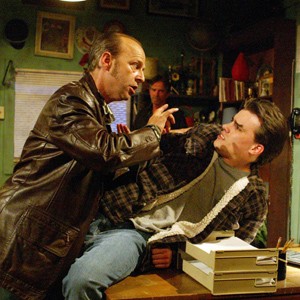
Men Behaving Badly: Ken Sonkin threatens actor Ben Stowe (Scott Phillips lurks behind) in ‘American Buffalo.’

‘Buffalo’ Hunt

The Rep gets real with Mamet’s tense and funny ‘Buffalo’

By David Templeton

As part of the patented comedy act performed by Bay Area comedians Debi Durst and Michael Bossier, the well-read duo regularly do a bit in which they act out a short “play” with some simplistic plot-thread–a man tries to buy a pie in bakery, for example–while changing the theatrical style of the scene every few moments based on names of playwrights called out by the audience. Should someone call out “Shakespeare,” Deb and Mike will morph into an iambic pentameter pie discussion. When someone suggests Arthur Miller, the two of them wallow morosely in a depressing, plain-spoken analysis of the ultimate meaning of pie.

Sooner or later, someone always shouts out the name “David Mamet.” Their response is always a crowd-pleaser–especially for those familiar with the coarse-spoken plays of Mamet (Glengarry Glen Ross, Speed-the-Plow, Oleanna)–with Deb or Mike instantly shouting something along the lines of “Give me the fucking pie!”

A Pulitzer Prize winner, Mamet is known for the blunt street poetry and fierce vulgarity of his characters, who are frequently lowlife men bullying or scheming their way through life using the most desperate and pathetic tactics. A giddy and judiciously generous employer of the f-word and a modern master of the super-tense buildup, Mamet is also hilarious. As such, his plays are insanely difficult to act and direct, requiring a strict balance of tone that lands somewhere amid slapstick, social satire and vicious slice-of-life melodrama.

Mamet fans and newbies alike will want to take in director Jennifer King’s pitch-perfect new production of Mamet’s 1977 masterpiece American Buffalo, now onstage at the Sonoma County Repertory Theatre in Sebastopol. Featuring a strong cast of three (Ken Sonkin, Scott Phillips and Ben Stowe), Buffalo is staged on a ’70s-era junk-shop set so authentic and detailed that it could fool a person into thinking they’d been magically transformed into a character from Bruce Springsteen’s song “Darkness on the Edge of Town.”

The cluttered Chicago junk shop belongs to Donny (Phillips, excellent as always), a small-time used-goods dealer with a struggling “side business” in burglary, home invasion and petty theft. Alternately kind and cruel, Donny is getting older and wants to pass along a bit of so-called hard-won wisdom, but the only person who looks up to him is a not-too-bright junkie named Bobby (sweetly played by Stowe), who hangs out in the shop and occasionally runs Donny’s errands, legal and otherwise. When Donny and Bobby discover that a local resident’s coin collection might contain a certain buffalo head nickel, they begin to dream of a big score.

When the plot is sniffed out by Donny’s hyperkinetic crook buddy Teach (an electrified Sonkin, all twitches and nervous energy), the chemistry is altered. Teach–the kind of guy whose ultimate put-down is to say, “Guys like that, I like to fuck their wives”–neither respects nor trusts Bobby, and the ensuing strain among the three forms the foundation on which the resulting plot–and all that four-letter wordplay–turns.

All three characters are fully developed lowlifes, the kind of folks who aren’t smart enough to realize how little intelligence they have, each one using a different method to cover his own self-doubts. Bobby just wants to please Donny but makes a well-meaning mess of every attempt to do so. Teach, angry at the world and everybody in it, runs a constant stream of high-strung chatter, a laugh-riot of self-deluded, profanity-laden nonsense, as when he suggests bringing a gun along on the impending burglary, just in case, as he puts it, “some crazed lunatic sees you as an invasion of his personal domain.”

For Donny, his defense is his belief that he has something worthwhile to share with Bobby, whether it’s his insistence that the young man eat a better breakfast or his belief that success is made of three vital things: “Skill and talent and the balls to arrive at your own conclusion.” The sad joke, of course, is that Donny possesses none of those things.

It is Mamet’s genius, aided by the fluid, focused direction of King, that these fifth-rate losers–whether straining for a better life or resorting to scary, desperate violence–remain funny and human and astonishingly real. Underneath it all, Mamet understands these guys, and likes them. And he clearly speaks their language, f-words and all.

‘American Buffalo’ plays through June 12. Thursday-Saturday at 8pm; special matinee on Sunday, June 12, at 2pm. Sonoma County Repertory Theatre, 104 N. Main St., Sebastopol. $15-$30; Thursday, pay what you can. 707.823.0177.

From the May 18-24, 2005 issue of the North Bay Bohemian.

© Metro Publishing Inc.

‘Oklahoma!’

0

Photo Courtesy of Doug Adamz

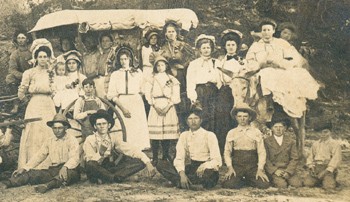
Stateward, Ho!: Members of the Adams family picnicking, circa 1907. Musician Doug Adamz’s grandmother is seen as a young girl, wearing a sun bonnet, second row, fourth from the right.

Mountain Man

At this year’s Mountain Play, a gritty, down-to-earth ‘Oklahoma!’ includes the rich family history of musician Doug Adamz

By David Templeton

Way up high on Marin County’s poetry-inspiring Mt. Tamalpais, at a lavish press-a-palooza for the 2005 Mountain Play, the organizers provide a number of attractions to draw the collective attention: wine flows like a creek in midwinter; the food is embarrassingly plentiful; several actors from this year’s show–Rodger’s and Hammerstein’s ever-popular Oklahoma!–mingle with reporters and theater critics; and Chaz Simonds (who plays Will Parker in the show) dazzles the midafternoon crowd with a series of rope tricks after the actors playing Curly, Laurey, Ado Annie and Jud Fry perform such show-stoppers as “Oh, What a Beautiful Morning” and “People Will Say We’re in Love.”

On top of all this entertainment, there is a spectacular view across the bay, the bridge and the city beyond. For those of us who happen to look down, there is even a charismatic, 150-year-old tortoise to gawk at as it eats crunchy hunks of iceberg lettuce.

With so much going on, it’s truly saying something that an ordinary picnic table with an enlarged pair of old photographs on display has become one of the party’s most popular bedazzlements. Except for one 45-minute period when lunch is being served and Ado Annie tells us that whenever she sits on a cowboy’s lap something inside of her snaps, there isn’t a moment when the photo table doesn’t have at least two or three people bending in to take a closer look.

At first glance, the pictures appear to be a cleverly weathered group of photos featuring the entire cast from some production of Oklahoma! There is clearly a Curly-type front and center. There’s Laurey in her bonnet, young and unburdened. That surly-looking guy on the left is a Jud Fry if ever there was one. All the others, from the stern-faced matriarch to the been-there, done-that mule brought in from the barn for the photo shoot, look as if they stepped right off the stage of some gritty, dust-coated staging of Oklahoma!

In reality, the photos, believed to be taken around 1910, belong to Novato-based musician Doug Adamz. The Oklahomans staring out from the black-and-white panorama are Adamz’s real-life ancestors, the very type of hardscrabble pioneers who inspired Rodgers and Hammerstein to tell their story.

“Those people could never have imagined, when that picture was originally taken, that a hundred years later people would be looking at them and saying, ‘Hey, they look like the cast of a Broadway show!'” Adamz says with a laugh.

“It’s really interesting to me that these people, who I know were real, who are my kin, have become icons in a way, just as the characters in Oklahoma! have become icons. They never knew they were icons or symbols or representations of a time and place, of course, the same way that my mom used to cook fried chicken and grits and okra and black-eyed peas, and we never realized that was Southern cooking–we just thought of it as dinner.”

Adamz (formerly Doug Adams) and his band Bravo! serve up their own brand of home-cooked treat after every performance of Oklahoma!, performing appropriately folksy tunes as audience members make their way from Mt. Tam’s Cushing Memorial Amphitheater and out to the parking lot and a herd of waiting shuttle buses.

Adamz, who once played Jud Fry in a school production of Oklahoma! back in his hometown of El Paso, Texas, appears to be genuinely tickled to be involved in such a major production as the Mountain Play, which, under the direction of James Dunn, will eschew the usual pastel colors and popcorn cartooniness of some renditions in favor of a starker, more historically grounded staging.

Dunn, in keeping with this down-to-earth approach, has even omitted the stage, instead incorporating a set made up of a barn and farmhouse built right into the ground by set designer Ken Rowland.

The outdoor amphitheater makes it possible to add another level of reality by being big enough to incorporate a number of large animals (Curly makes his entrance singing from atop his horse) along with a stage coach and an actual surrey, with that famous fringe on top.

Though not appearing in the actual show, Adamz and his band were invited to participate in order to add one more dimension of authenticity to the spectacle. Thus inspired, Doug Adamz and Bravo! have gone into the recording studio to produce a CD of appropriate tunes, all of which they’ll be performing up on the mountain.

“These are a bunch of songs we’ve been doing for years,” he explains, “some old classic fiddle tunes like ‘Little Rabbit,’ ‘Cherokee Shuffle,’ ‘Soldier’s Joy’ and ‘Whiskey before Breakfast,’ and some Woody Guthrie tunes like ‘Pretty Boy Floyd’–it fits in because it’s about Oklahoma–and another one called ‘The Lonesome Road,’ which was used as a theme song in the movie The Grapes of Wrath, which begins in Oklahoma. Then we have a bunch of other folksy things to do. It can be a long wait to get on that bus, so we’ll be there to help folks have a good time and stay in that Oklahoma spirit as they wait to leave the mountain.”

Adamz’s father was born in 1908 in Oklahoma, one year after the area won statehood, a major theme of the play.

His mother moved there as a young girl around 1911.

“I never lived there myself,” he says, “because my parents had left Oklahoma before I was born, but I always knew that deep down, a lot of my family’s roots were back in Oklahoma.” That understanding grew as Adamz, now in his late 50s, got older. “In some ways,” he says, “you don’t get a real strong sense of who you are and what your heritage means to you until you’ve grown away from it. It didn’t really strike me that I was connected personally to Oklahoma, more than just connected to it by ancestry, because I’d never lived there. But as I grew older, that connection became more powerful as I came to appreciate where my parents had come from and what my family, who were the classic pioneers, had gone through to make a home in Oklahoma. It takes a while to realize that who our parents were is part of who we are.”

Much of Adamz’s own music is inspired by tales his parents told about their own lives. “My dad had stories about working on the railroad, pounding stakes in the tracks and the changes that came when Route 66 came through,” he says. “That’s part of what my dad and mom left me: these really interesting, really small, really personal stories.”

One of those stories inspired the twisted Christmas song “Uncle Johnny’s Glass Eye,” recorded a few years back by fellow Novato resident Dr. Elmo, of “Grandma Got Run Over by a Reindeer” fame. It tells the story of a visiting uncle who does some very strange things with his glass eyeball.

“That’s my dad’s story,” Adamz says proudly. “His uncle, my great Uncle Johnny, was the one who had the glass eye that he’d pop out and scare the kids with.”Maybe it’s not too late to incorporate something like that into this upcoming production of Oklahoma! Director Dunn is going for authenticity, after all. And Uncle Johnny, pre-glass eye, is surely one of the folks in that classic old photo.

“Oh, I don’t know about putting the eye in the show,” laughs Adamz. “Maybe I’ll just have to sing about it after the show.”

“Oklahoma!” runs Sundays, May 22-June 19 at the Cushing Memorial Amphitheater on Mt. Tamalpais. Free shuttles are available from Tamalpais High School and Manzanita Commuter Parking Lot in Mill Valley. 1pm; bring a picnic and plan to get there early (we recommend taking a shuttle up as early as 10am). $20-$30. 415.383.1100.

From the May 18-24, 2005 issue of the North Bay Bohemian.

© Metro Publishing Inc.

MC5

Mo' Town SoundBootleg anthology testifies to MC5By Karl ByrnThe history of hard rock has mistakenly failed to afford the MC5 the same reverence that's heaped on their brethren in Detroit's late '60s rock scene, the Stooges. The Spin Alternative Record Guide correctly lists the MC5 in a trio of protopunk fountainheads with the Stooges and the Velvet Underground, but...

Exotic Meats

Got Offal? Adventures in organ meats and other morselsBy Heather IrwinFive or six cow feet go into a bag. The hooves and skin have already been removed, so only a sinewy, marbled little barrel of muscle and nerves remains. The meat man asks if we want anything else. Scanning the case, my friend Lily points to white folds of...

Desalination

Liquid Manna: While other counties have looked to conservation as a cost-effective way to prevent drought, Marin may prefer the miracle of money.Buyin' BrineMarin County looks to desalinationBy Bruce RobinsonPaul Helliker, general manager of the Marin Municipal Water District (MMWD), worries that the taps, showers and hoses of Marin County might someday run dry. If the recent history of...

Swirl n’ Spit

Swirl n' SpitPerfectly PinotBy Heather IrwinConfession: A weekend away from home, and I got deep into a relationship unbecoming to a California wine lover: I dallied indiscreetly with Oregon's wine country. I mean, after two years of wonderful romance with Sonoma and Napa, you can't blame a girl for wanting, well, something a little different. You know--a sort of...

Todd Rundgren/Joe Jackson

Up Against It: The avant-garde string quartet Ethel support Todd Rundgren and Joe Jackson in their Ortonesque quest.Something, Anything How Todd and Joe owe it all to Orton and the BeatlesBy Alan SculleyMusic fans can thank the Beatles for enabling this spring's pairing of Todd Rundgren and Joe Jackson on tour together. The two artists, both known as inventive,...

Oneida

Groomsmen: Bobby Matador, Kid Millions and Baby Jane of Oneida marry musical genres. The NewlywedsSpazz-rock trio Oneida take a baroque turn By Sara Bir For the release of their seventh album, The Wedding (Jagjaguwar), Oneida sent out a joke press release stating they had built "the largest music box on the East Coast," describing it as a "hand-cranked behemoth"...

News of the Food

News of the FoodBounty of the CountiesBy Gretchen GilesClip 'n' go! The farmers market season blossoms into full-bloom.Sonoma CountyCotati: Thursday, 4:30-7:30pm. Opens June 2. La Plaza Park, downtown Cotati. 707.795.5508.Guerneville: Wednesday, 4-7pm. Guerneville Park and Ride lot, across from Fife's Road House on Highway 116. 707.865.4171.Healdsburg: Saturday, 9am-noon. North and Vine streets. Tuesday, beginning June 7, 4-6:30pm, Matheson Street...

Briefs

BriefsCost of CoolJust after midnight on Wednesday, May 11, Santa Rosa resident Shelby Buck was driving his 2004 Harley-Davidson near the intersection of Fourth Street and Alderbrook Lane when he lost control of the vehicle. According to the Santa Rosa Police Department, Buck was wearing one of those plastic half-shell helmets favored by those who ride so-called cruiser motorcycles....

‘American Buffalo’

Photograph by Jeff ThomasMen Behaving Badly: Ken Sonkin threatens actor Ben Stowe (Scott Phillips lurks behind) in 'American Buffalo.''Buffalo' HuntThe Rep gets real with Mamet's tense and funny 'Buffalo'By David TempletonAs part of the patented comedy act performed by Bay Area comedians Debi Durst and Michael Bossier, the well-read duo regularly do a bit in which they act out...

‘Oklahoma!’

Photo Courtesy of Doug AdamzStateward, Ho!: Members of the Adams family picnicking, circa 1907. Musician Doug Adamz's grandmother is seen as a young girl, wearing a sun bonnet, second row, fourth from the right.Mountain ManAt this year's Mountain Play, a gritty, down-to-earth 'Oklahoma!' includes the rich family history of musician Doug Adamz By David TempletonWay up high on Marin...
11,084FansLike
4,606FollowersFollow
6,928FollowersFollow