Free Will Astrology, Week of 4/12

0

ARIES (March 21-April 19): I hope that in the coming weeks, you will keep your mind bubbling with zesty mysteries. I hope you’ll exult in the thrill of riddles that are beyond your current power to solve. If you cultivate an appreciation of uncanny uncertainties, life will soon begin bringing you uncanny certainties. Do you understand the connection between open-hearted curiosity and fertile rewards? Don’t merely tolerate the enigmas you are immersed in—love them!

TAURUS (April 20-May 20): An old sadness is ripening into practical wisdom. A confusing loss is about to yield a clear revelation you can use to improve your life. In mysterious ways, a broken heart you suffered in the past may become a wild card that inspires you to deepen and expand your love. Wow and hallelujah, Taurus! I’m amazed at the turnarounds that are in the works for you. Sometime in the coming weeks, what wounded you once upon a time will lead to a vibrant healing. Wonderful surprise!

GEMINI (May 21-June 20): What is the true and proper symbol for your sign, Gemini? Twins standing shoulder to shoulder as they gaze out on the world with curiosity? Or two lovers embracing each other with mischievous adoration in their eyes? Both scenarios can accurately represent your energy, depending on your mood and the phase you’re in. In the coming weeks, I advise you to draw on the potency of both. You will be wise to coordinate the different sides of your personality in pursuit of a goal that interests them all. And you will also place yourself in harmonious alignment with cosmic rhythms as you harness your passionate urge to merge in a good cause.

CANCER (June 21-July 22): Some scientists speculate that more people suffer from allergies than ever before because civilization has over-sanitized the world. The fetish for scouring away germs and dirt means that our immune systems don’t get enough practice in fending off interlopers. In a sense, they are “bored” because they have too little to do. That’s why they fight stuff that’s not a threat, like tree pollen and animal dander. Hence, we develop allergies to harmless substances. I hope you will apply this lesson as a metaphor in the coming weeks, fellow Cancerian. Be sure the psychological component of your immune system isn’t warding off the wrong people and things. It’s healthy for you to be protective, but not hyper-over-protective in ways that shut out useful influences.

LEO (July 23-Aug. 22): One night in 1989, Leo evolutionary biologist Margie Profet went to sleep and had a dream that revealed to her new information about the nature of menstruation. The dream scene was a cartoon of a woman’s reproductive system. It showed little triangles being carried away by the shed menstrual blood. Eureka! As Profet lay in bed in the dark, she intuited a theory that no scientist had ever guessed: that the sloughed-off uterine lining had the key function of eliminating pathogens, represented by the triangles. In subsequent years, she did research to test her idea, supported by studies with electron microscopes. Now her theory is regarded as fact. I predict that many of you Leos will soon receive comparable benefits. Practical guidance will be available in your dreams and twilight awareness and altered states. Pay close attention!

VIRGO (Aug. 23-Sept. 22): You don’t know what is invisible to you. The truths that are out of your reach may as well be hiding. The secret agendas you are not aware of are indeed secret. That’s the not-so-good news, Virgo. The excellent news is that you now have the power to uncover the rest of the story, at least some of it. You will be able to penetrate below the surface and find buried riches. You will dig up missing information whose absence has prevented you from understanding what has been transpiring. There may be a surprise or two ahead, but they will ultimately be agents of healing.

LIBRA (Sept. 23-Oct. 22): Visionary philosopher Buckminster Fuller referred to pollution as a potential resource we have not yet figured out how to harvest. A company called Algae Systems does exactly that. It uses wastewater to grow algae that scrub carbon dioxide from the atmosphere and yield carbon-negative biofuels. Can we invoke this approach as a metaphor that’s useful to you? Let’s dream up examples. Suppose you’re a creative artist. You could be inspired by your difficult emotions to compose a great song, story, painting or dance. Or if you’re a lover who is in pain, you could harness your suffering to free yourself of a bad old habit or ensure that an unpleasant history doesn’t repeat itself. Your homework, Libra, is to figure out how to take advantage of a “pollutant” or two in your world.

SCORPIO (Oct. 23-Nov. 21): Soon you will graduate from your bumpy lessons and enter a smoother, silkier phase. You will find refuge from the naysayers as you create a liberated new power spot for yourself. In anticipation of this welcome transition, I offer this motivational exhortation from poet Gwendolyn Brooks: “Say to them, say to the down-keepers, the sun-slappers, the self-soilers, the harmony-hushers, ‘Even if you are not ready for day, it cannot always be night.'” I believe you are finished with your worthwhile but ponderous struggles, Scorpio. Get ready for an excursion toward luminous grace.

SAGITTARIUS (Nov. 22-Dec. 21): I periodically seek the counsel of a Sagittarian psychic. She’s half-feral and sometimes speaks in riddles. She tells me she occasionally converses by phone with a person she calls “the ex-prime minister of Narnia.” I confided in her that lately it has been a challenge for me to keep up with you Sagittarians because you have been expanding beyond the reach of my concepts. She gave me a pronouncement that felt vaguely helpful, though it was also a bit over my head: “The Archer may be quite luxuriously curious and furiously hilarious; studiously lascivious and victoriously delirious; salubriously industrious but never lugubriously laborious.” Here’s how I interpret that: Right now, pretty much anything is possible if you embrace unpredictability.

CAPRICORN (Dec. 22-Jan. 19): “I’m not insane,” says Capricorn actor Jared Leto. “I’m voluntarily indifferent to conventional rationality.” That attitude might serve you well in the coming weeks. You could wield it to break open opportunities that were previously closed due to excess caution. I suspect you’re beginning a fun phase of self-discovery when you will learn a lot about yourself. As you do, I hope you will experiment with being at least somewhat indifferent to conventional rationality. Be willing to be surprised. Be receptive to changing your mind about yourself.

AQUARIUS (Jan. 20-Feb. 18): People of all genders feel urges to embellish their native beauty with cosmetic enhancements. I myself haven’t done so, but I cheer on those who use their flesh for artistic experiments. At the same time, I am also a big fan of us loving ourselves exactly as we are. And I’m hoping that in the coming weeks, you will emphasize the latter over the former. I urge you to indulge in an intense period of maximum self-appreciation. Tell yourself daily how gorgeous and brilliant you are. Tell others, too! Cultivate a glowing pride in the gifts you offer the world. If anyone complains, tell them you’re doing the homework your astrologer gave you.

PISCES (Feb. 19-March 20): I encourage you to amplify the message you have been trying to deliver. If there has been any shyness or timidity in your demeanor, purge it. If you have been less than forthright in speaking the whole truth and nothing but the truth, boost your clarity and frankness. Is there anything you could do to help your audience be more receptive? Any tenderness you could express to stimulate their willingness and ability to see you truly?

Cannabis Creatives

The North Bay’s undeniable culture

Tucked deep in the rolling green hills of California’s North Bay, there lies an often unspoken, but most always assumed, connection between cannabis culture and artistic expression.

It’s true—Marin, Napa and Sonoma may not celebrate their love of this particular psychoactive plant as openly, overtly and obviously as their sister city just across the Golden Gate Bridge. But that doesn’t mean that the cultural undercurrent of cannabis is any less strong in the North Bay’s stream of creativity. It’s not as though a bridge (and a little water under it) is enough to keep an entire countercultural movement of art and activism at bay.

With the highest of holidays (4/20) right around the corner, it’s time to acknowledge just how influential the North Bay is and has been as a hub of culture, art, creativity and cannabis. After all, it was a group of high school students from San Rafael who created the term 4/20 to begin with, sparking a nationally-celebrated holiday with its epicenter right in the heart of Marin.

“Cannabis is part of the reality of the North Bay,” said Jonah Raskin, local writer, author and resident cannabis expert. “The North Bay is food, wine and marijuana, and it’s as much a part of the culture of Northern California as grapes are. It just isn’t as visible since it’s still a taboo subject to a great deal of people.”

Given that cannabis was not legal for medical use in California until 1996 and did not become recreationally legal until 2016, this taboo makes sense. But, as many Bay Area locals are aware, legality did not stop the beatniks, the hippies or creative individuals (such as Raskin) from partaking in some pot alongside their passion projects.

“I would roll a ton of joints and smoke them and be mildly stoned throughout the day,” said Raskin. “It helped me to be stoned and write. I finished the book, it was published, and I wrote a bunch of books stoned afterwards.”

“While living in Northern California, I wanted to continue writing, and the things I could see around me were wine and marijuana,” continued Raskin. “I felt more at home in the cannabis world than the wine and grapes world. For one thing, the cannabis world was partially hidden, and grapes and wine were out in the open.”

Raskin moved from the East Coast to Sonoma County in 1976 and, like many notable cannabis-consuming creatives, lived in the North Bay for many years. He built a prolific portfolio of provocative pieces of prose, lectured in English at Sonoma State University and became a well-known contributor to many publications, including High Times and the Bohemian, to name only a couple.

“So, I knew that I could write while I was stoned, and what I wrote was published and I got paid for it, so that seemed to be proof that marijuana was an encouragement to creativity,” he noted.

Alongside Raskin are countless other cannabis-consuming creatives who were either born, raised, schooled, lived and/or died in the North Bay. To separate these individuals’ art from their enjoyment of cannabis is nigh-on-impossible and, frankly, brings to mind the age-old question: What came first, the chicken or the egg? Or, in this case, the toking or the artistic talent? Imagination or smoke inhalation?

World-famous author Jack Kerouac lived in Mill Valley and was at the forefront of the Beat Movement of the mid-1900s. Maya Angelou, activist, poet and pot-user, also lived in the North Bay for a time and called Sonoma County her home. Fleetwood Mac recorded the Rumours album in Sausalito. Alan Watts, Peter Coyote and (perhaps the most iconic cannabis-consuming artist from California) Jerry Garcia of the Grateful Dead all lived in and smoked weed in the North Bay.

These accomplished artists were all pro-cannabis in a time where the stigma against the plant was significantly stronger than it currently is. Nowadays, anyone over the age of 21 can have weed delivered to their doorstep in a process as simple as getting a pizza delivered. Not only is cannabis infinitely more accessible; it’s also (near-infinitely) more potent.

“I remember once going into a dispensary in Santa Rosa—I forget which one—and I was talking to some of the budtenders to help decide what kind of product to choose for myself,” said Raskin. “One of the bud tenders described one of the marijuana strains as making you feel like an 800-pound gorilla is sitting on you. I asked who would want that, and he said there were customers who did.”

With cannabis only growing stronger, more accessible and less stigmatized with every passing day, and with the deeply ingrained counterculture movement that has not-so-secretly pervaded the North Bay for the past 70 years, it’s safe to say the creative use of cannabis is here to stay.

Much like the careful cultivation of wine grapes, which are bred, grown and fermented just so to create the world-famous wines of Napa, cannabis cultivation is an art form of its own. Strains of cannabis are carefully selected, bred, grown, trimmed, cured and sold in just as meticulous a fashion as any varietals in a wine bottle. And, given the cultural history of cannabis in the North Bay, it’s apparent there’s room for both wine and weed in the field of artisanal cultivation.

“Mike Benziger is a local farmer who thinks of himself as an artist because of his garden of cannabis,” explained Raskin. “He is a prime example of the marijuana grower as an artist. He grows his marijuana right next to the Jack London State Historic Park—oh, and as an aside, Jack London also smoked and loved hashish. Artists have been using cannabis for a very long time and, in my opinion, will continue to do so.”

All this goes to say, though the artists of the North Bay may not always advertise their love of cannabis with Rastafari colors and plumes of smoke, that doesn’t mean the culture is any less prevalent than it is in other parts of the Bay Area, such as Oakland, San Francisco and Santa Cruz. And, whether the artist is world-famous, understated, up-and-coming, underrated, historically significant or part of the new wave of creatives, it’s fair to presume that a fair few of them have indulged in a little bit of cannabis-induced imagination and inspiration in their process of artistic creation.

Maria Carrillo High School journalists cover protests, campus gun scares

Adults might imagine the work of a high school journalist as relatively frivolous, with time spent covering school dances, clubs and gossip.

However, today’s students aren’t so privileged.

This year, the staff of The Puma Prensa, the campus newspaper of Santa Rosa’s Maria Carrillo High School, have been documenting a particularly challenging school year, defined by a series of campus scares and an uptick in behavioral issues among students struggling in under-staffed schools.

By the time a 15-year-old Montgomery High School student fatally stabbed a 16-year-old in a classroom at the Santa Rosa school on March 1, The Puma Prensa’s staff was already accustomed to reporting on troubling events.

On Feb. 15, 13 police cars and two motorcycles arrived at Maria Carillo during lunch without immediate explanation. While rumors began to circulate, police and school staff told students to return to class, the Puma Prensa’s web editor Sophia Hughes reported.

Students and parents were later informed that officers were responding to a call alleging a campus shooting was taking place. Thankfully, the call turned out to be a hoax.

A week later, on Feb. 24, classes were disrupted again due to a small on-campus fire. The day of the March 1 stabbing at Montgomery, Maria Carillo students were evacuated from class again after a fire alarm was pulled. The same morning, in an apparently unrelated incident, police arrested a student after receiving reports they had a gun. Although the student was not carrying the weapon at the time of the arrest, police later discovered a firearm discarded in a storm drain off-campus, according to The Puma Prensa.

Since the stabbing at Montgomery, the Maria Carillo journalists have chronicled countywide student protests in print and online. They also launched a new podcast, The Pawd, and, last week, published a documentary edited by staff writer Kevin Wei and filmed by staffers. The film, titled We Want Change, is a 50-minute collage of brief interviews with dozens of students and a few teachers and community members during school walkouts and public meetings, capturing opinions about the whirlwind of events in March.

Needless to say, the hard-working student journalists have plenty to say. In an interview last week, four staffers shared a wide range of stories from the front lines, offering an inside perspective on campus life which wasn’t always captured in the recent flurry of news coverage.

COVID Disruptions

To hear the Puma Prensa’s staff tell it, school life these days is colored by the lingering effects of the COVID-19 pandemic, in ways often unacknowledged or unappreciated by the outside world. Many students are struggling to reacclimate to in-person classes after spending several formative years at home.

Rosemary Cromwell, one of the paper’s editors, said, “Students went from interacting with nobody, or being stuck on a computer to [interacting with] all these people. And I think we’re seeing that a lot of people just broke. They couldn’t do it. They couldn’t make that jump.”

“We’ve had problems at school just with basic things, like people [not] throwing away their trash. I’ve heard several teachers who have said, ‘We’ve never had underclassmen act this way,’” said Dana Borunda, a staff writer. “It’s not just exclusive to underclassmen, obviously, but [it’s visible] in how students are reacting to administration or to basic rules just because we’ve been in quarantine.”

Hughes, the web editor, called the transition back to in-person classes “epically brutal.” After being “thrown back into classrooms,” many students are having trouble readjusting to basic etiquette. “They were so used to being able to freely say whatever came into their head on the internet. But, when you go and say that in real life, it’s like, ‘Oh, that doesn’t work out as well,’” Hughes said.

Understaffing

Another factor contributing to behavioral problems may be a lack of adequate attention, the Puma Prensa staffers noted. The Santa Rosa City Schools’ hiring page currently lists 120 open positions, including a few campus supervisor positions. Those employees are tasked with keeping the peace on campus. But, because they are paid $17.40 per hour, the job is unappealing.

“We had a campus supervisor fully hired, and then he figured out exactly how much his pay rate was going to be, and he had to leave because he needed at least $21 an hour,” Cromwell said, comparing campus supervisors’ wages to what she makes “handing out free samples at Costco.”

Hughes said that the many problems stem from a “chain reaction” in which underfunding leads to understaffing, which leads to fights and other problems.

“People are angry because schools don’t have the capacity or the resources to help these children. We’re the ones who need attention the most, especially coming after this pandemic, and we haven’t been supported as we should, with access to counselors, therapists or appropriate class sizes,” Borunda added. “Class size is a huge factor in how much attention a student gets from their teacher… If we don’t get proper education, proper attention, kids feel cheated. Kids feel disappointed, and then the kids can get angry.”

Finding Solutions

Over a month after the stabbing death of the Montgomery High School student, debate about possible solutions continues.

One idea frequently mentioned by adult speakers at recent school board meetings is to bring police back to campus. For several decades, the Santa Rosa Police Department had an agreement with the Santa Rosa City Schools district to provide several officers acting as school resource officers (SROs) to several Santa Rosa campuses. However, in 2020, the district decided not to renew the agreement, based in part on concern over nationwide studies which show that SROs tend to disproportionately punish students of color.

“The adults often seem to be like, ‘security, lock it down, tighten it up,’” Cromwell said. “As for the kids, we want protection, we want more school staff, including campus supervisors, and we just want to know what’s going on.”

Wei, who edited the paper’s documentary, said, “The perspective that we shouldn’t bring SROs back is largely shared by students who think that having SROs on campus and metal detectors and all these kinds of things would be really restricting. It would bring down the mood of the campus in so many ways. It would make campus seem almost apocalyptic.”

“As a student of color, I just think that not everyone feels comfortable with police around, and not everyone’s going to be treated the same way when police are around. That’s just the reality, and to ignore that is just lying to yourself. If some students don’t feel that way, if they feel safer with police around, that’s valid to their own experience, but not taking into account the perspective of students of color is lacking empathy,” Borunda added.

Find ‘The Puma Prensa’ online at www.thepumaprensa.org.

Zaney For Zines

Annual Santa Rosa fest returns

April 11 is set and ready to mark the third annual Santa Rosa Zine Fest, a five-day stretch of events meant to celebrate and educate the creative masses about the practice and benefits of zines.

Self-expression is a key piece of the human experience. At the risk of over poeticizing the idea, it can be the difference between feeling like a bird on the wind versus one in a cage, which is why a growing number of people are turning to zines.

So what are zines? Essentially, they are whatever someone wants theirs to be. They’re DIY self-published magazines with no limits besides those the creator sets. As one of the event runners and co-founders of the Santa Rosa Zine Collective (SRZC), Melissa Andrade, puts it, “Zines can be informative, political, artistic, irreverent, hilarious, heartbreaking, frivolous or soul-bearing. They can be based on text, images or a combination of both.”

“The form and content are completely up to the creator,” adds Meredith Morgan, fellow creative and SRZC co-founder. “They are a means of sharing information, ideas and art free from an editor or a publisher. We want to highlight the importance of zine making as a tool for creative liberation and ultimate free speech.”

According to Morgan, the idea for the event originated between themself and Andrade in 2019 during a regular meet-up for a comic book club started by Andrade, originally called Girls with Issues. “It was a great group of femmes and thems getting together to read a variety of graphic novels and discuss them,” Morgan recalls. “So many of the folks in that club were creatives with unique voices, but they had nowhere to build community with other creators in Sonoma County.”

One goofy joke about founding a spooky zine meet-up called “HallowZine” later, and thus was the Santa Rosa Zine Fest born.

Plans for an early-2020 launch were waylaid by the pandemic. But by late-2020, SRZC had managed to partner with the Sonoma County Library and hold an all-online event, complete with panelists and artist discussions, with the help of their final collaborator, Chelsea Kurnick. Since then, the event has only grown.

“That first event was one day long and entirely online,” recounts Kurnick. “Last year, we hosted a multi-day event, bringing back online conversations and workshops, but also hosted a zine fair with 20 exhibitors in the [Coddingtown] parking lot of the Northwest branch of the library. This year, our fest is five days long, and we’ve got eight events.”

Those events will include “incredible online conversations, in-person workshops in Spanish and English, and [that the] zine fair will return with 40 exhibitors,” says Kurnick. “The growth has been pretty explosive.”

The proof of that is clear to see in SRZF’s full schedule of events. It kicks off Tuesday, and a full list can be found on the Sonoma County Library’s website. Events range from in-person workshops designed to help creatives conquer their inner critics and battle burnout to online panels relating zines with tabletop culture or as ways to boost and empower one’s community here at home.

Those latter two examples deserve special shoutout, being held on April 11 and 12 respectively, for the ways in which they demonstrate the impact zines can have. Despite the golden renaissance that tabletop roleplaying has enjoyed in recent years, it remains underrated and underappreciated for the myriad of important skills it helps cultivate. As well, community empowerment as a goal is something SRZC’s founders are intimately familiar with.

“Zines have a special place in marginalized communities as well,” says Morgan. “They are a means of sharing experiences and resources that might otherwise be censored. From the radical to the absurd, zines can do it all.”

“There are a ton of super talented young people here,” adds Kurnick, “but the cost of living is really high, and there’s not as much of an arts community as there should be, especially for people who are part of marginalized identities. To this day, many of the arts events in Sonoma County cater to and center [on] high income older adults, which also means that they are most welcoming to white, cis-het, able-bodied English-speakers. Without cool stuff to do, without an arts community that feels welcoming…there’s not much incentive to stay.”

Those who are creative, have someone close to them who is or just know how to appreciate a healthy community of local artists may register for an event (or several) and to do it sooner rather than later.

The five-day Santa Rosa Zone Fest kicks off at 4:30pm, Tuesday, April 11 with online and

in-person workshops and related events. To register for free and for more information (including locations and how to obtain a free zine marketing kit), visit sonomalibrary.org/blogs/news/zinefest2023.

Laughter of the Gods

0

A black cloud passes over your day, filling you with melancholia and making you feel powerless amid forces beyond your control. “I feel the weight of the world on my shoulders,” you say while pacing the floor, “and can’t get it off.” Then the spirit says with a chuckle, “That is a matter of opinion.”

You’re stunned by this voice from the depth of your being and ponder its words. You know that removing the burden is within your powers, but you can’t figure out how to do it. Feeling even worse than before, the sun finally breaks through the clouds and tells you to surrender to what is instead of fighting it. Your inner vibration spikes upwards, and suddenly you see the whole panoply of human affairs as a giant chess game, or what in contemporary nomenclature we call a “simulation.” 

You realize that the choice facing you is quite simple: you can give in to anger and despair at circumstances beyond your control, or accept that it is all just a kind of cosmic game you’re forced to play. And since everyone has to play it, you can hardly blame them for acting the way they do; they’re just playing their role in the cosmic drama. 

The sense of looking down at the world of human affairs as a giant chess game — or theatrical performance, or circus from hell — where all you can do is play the cards you were dealt, lifts the feeling of burden from your back. The ancients called this state “detachment,” and it figures in everything from the oldest Buddhist texts to the writings of the medieval mystic Meister Eckhart. In the state of detachment, you find liberation, and can then crack a wicked smile — or even join the gods in laughter — at the absurdity of it all. Consider these lines from the Roman philosopher Seneca:

We should bring ourselves to see all the vices of the crowd not as hateful but as ridiculous, and we should imitate Democritus rather than Heraclitus. For whenever they went out in public, the latter used to weep and the former to laugh. Things should be made light of and taken more easily, for it is more civilized to laugh at life than to bewail it.

Laughter is a mark of the madman, but it is also a characteristic of the wise one, the person who has found the perfect antidote for things beyond their control, for the slings and arrows of outrageous fortune. It’s not so much that the world is evil, but rather that it is in error. There’s a reason the Buddha is depicted with a smile on his face.

Culture Crush, Week of April 5

Petaluma

Car Meets Canvas

We’ve heard of “Art in the Park,” but what about “parking your art?” As part of an upcoming May show, “Auto-Mobility: Cars and Culture in Sonoma County,” the Petaluma Arts Center announces a “call for art,” open to all Sonoma County resident artists to express their creativity and love of the automobile (with themes of “community and cultural identity” encouraged). Deadline is April 16. For more information and details for submission, visit bit.ly/pac-car-show.

Napa

Roped In

All four basic food groups of the soul (wine, art, food and music) will be fed at a “Velvet Rope Social Club Pinot Night,” at which Art House Wines will offer a sneak preview of their unreleased 2021 Pinot Gris, a favorite of several Napa Valley restaurants (the wine, as well as a pinot noir, will be paired with light bites by “Chef Ron”). Contributing to the ambiance of the evening are paintings by artist John Bonick and the work of photographer Dona Kopol Bonick, as well as the musical stylings of Sanho the Indian The event runs from 6 to 10pm on Friday, April 21 at the Mia Carta Wine Lounge, 1209 First St. in downtown Napa. For more information, visit arthousewines.com. Free.

Mill Valley

Loretta Lives

Stars of the Bay Area country music scene come together to pay tribute to country music legend Loretta Lynn, whose career spanned six decades before her death last October. Fans of the “Coal Miner’s Daughter” can expect to hear hits and deep cuts from Lynn’s ouvre performed by Laura Benitez, Cindy Emch and Margaret Belton, among many others, all backed by Crying Time, “a stalwart of the Bay Area’s vibrant country music scene.” The tribute begins at 7:30pm, Sunday, April 16, at Sweetwater Music Hall, 19 Corte Madera Ave., Mill Valley. Tickets start at $20.

Santa Rosa

Becoming Story

Award-winning local author and community leader Greg Sarris will return to Santa Rosa Junior College (SRJC) to read from his recent memoir, Becoming Story, a Journey Among Seasons, Places, Trees and Ancestors. Weaving reminiscences from childhood to present-day, Sarris explores the forces that shaped his childhood and his path to becoming a professional storyteller and tribal leader. A book signing in the lobby follows the presentation (books will be available for purchase in the Studio Theatre Lobby). The reading commences at 9am, Thursday, April 13 at the Burbank Studio Theater at Santa Rosa Junior College, 1501 Mendocino Ave. A livestream will be viewable at nac.santarosa.edu.

Petaluma Copperfield’s Books workers launch union effort

Joining a nationwide rise in labor action, workers at Petaluma’s beloved Copperfield’s Books store are attempting to unionize.

On Saturday, March 11, members of the Copperfield’s Books Petaluma Union gathered under the downtown store’s awning to announce the campaign to a few dozen supporters.

A series of speakers highlighted their main concerns, including low wages, minimal paid time off, inadequate healthcare benefits and a lack of clarity about how workers should respond when customers are racist, homophobic or transphobic to employees. Union members stressed that they want to help preserve Copperfield’s as a community resource.

“I love Copperfield’s. My coworkers love Copperfield’s. We just want them to love us back,” one worker said to the crowd.

Robert Glover, a seven-year Copperfield’s employee, who introduced the idea of joining the Industrial Workers of the World (IWW) to his colleagues, hopes that unionizing will help the store retain experienced employees with knowledge of customers’ interests and preferences.

“One of the big reasons for unionizing for me was creating a stable environment. I had seen so many good people with decades of industry knowledge leave Copperfield’s because they could no longer afford to work there, because the pay was too low for the area,” Glover said.

Currently most workers are paid the minimum wage, $17.06 per hour in Petaluma, Glover said.

A full-time worker at that rate would make $34,120 a year, qualifying them for low-income, subsidized housing.

Even employees with decades of experience are paid only slightly more. Ellen Skagerberg, a 32-year employee, said she is paid $18 per hour. Ultimately, the lack of meaningful raises may have contributed to solidarity among workers.

“People who were there for six weeks, six months or six years, we’re all making minimum wage, and the six-year people were training the six-week people,” Skagerberg said.

Glover said that the union has support from almost all of the 21 part- and full-time employees at the Petaluma store. The union is not currently interested in organizing any of Copperfield’s eight other stores spread through Sonoma, Marin and Napa counties, according to Glover.

Three days before the public event, two workers from the Petaluma store delivered a letter to management at Copperfield’s headquarters in Sebastopol, requesting that the company voluntarily recognize the union. The company’s owners have declined to do so.

In an emailed response to questions last week, Cooperfield’s co-owner, Paul Jaffe, stated that a formal election with the National Labor Relations Board will give “everyone time to get more clarity on the issue and then have an election where everyone can feel safe in expressing their choice… under no duress or micro aggression.” Since the union announced its campaign, the company has begun a series of conversations with workers at multiple locations, including the Petaluma store, according to Jaffe.

Jaffe acknowledged many of the union’s concerns, but argued the company is constrained in what it can do.

“I do agree the issue of wages that haven’t kept up with rising costs is one that needs to be addressed, not only for Copperfield’s Books, but for most businesses these days,” Jaffe stated.

“There are longer term employees that have not had their wages raised proportionally, and I believe this to be one of the main issues for some of the staff in Petaluma and Copperfield’s Books as a company. I agree with them and do feel that ownership at Copperfield’s could have done a better job of addressing their needs. But at the same time, we are a unique small business with some of the smallest margins of any business, that also has to compete directly with the likes of Amazon and Barnes & Noble, and we have limits to the amount of raises we can give to all our people,” he continued.

Jaffe added that Copperfield’s has been family-run for 42 years and claimed that management has always been open to listening to concerns, even if they can’t always fix the issues raised immediately. Jaffe expressed regret that none of the “disaffected employees at the Petaluma store” reached out with their concerns before launching their union campaign so that some “misconceptions could have been discussed and perhaps cleared.”

Citing the stresses that the COVID-19 pandemic and inflation have caused over the past few years, Jaffe concluded “this is not an excuse, and we can always try and do better, but the ownership of Copperfield’s feels that the timing of this union effort is not the best or most efficient way for our business to operate….but we will leave that decision to the employees and honor the outcome.”

Union Movement

Copperfield’s workers are not alone in organizing. In California, the list of recently-unionized stores includes Moe’s Books in Berkeley, Bookshop Santa Cruz and Book Soup in Los Angeles. Workers at a few other stores, including Powell’s Books in Portland, OR, and Green Apple Books in San Francisco, have been unionized for decades.

In an interview, Glover said that workers had informally discussed unionizing for years, but working conditions during the pandemic and learning about the IWW’s Moe’s Books union effort ultimately inspired the campaign.

Coppycat poster - Copperfield's Books Petaluma Union
The union’s mascot, Coppycat, is a callback to the IWW’s black mascot, Sabocat. Photo courtesy of Copperfield’s Books Petaluma Union.

“The people I made contact with at the IWW were also book people, so they knew what we were going through and they understood our complaints completely,” Glover said.

Skagerberg, 63, highlighted the role of her younger co-workers in powering the union campaign. While many older Copperfield’s workers had resigned themselves to subsidizing their bookstore wages with a spouse’s income and healthcare benefits or simply leaving the company for a more lucrative industry once the pay became unsustainable, she’s noticed younger employees tend to look out for each other.

“They’re always checking in with each other; they’re all kind to each other. They’ll say, ‘If you’re overwhelmed, ask somebody else for help. You don’t have to do it all,’” Skagerberg said. “It’s a very connected generation.”

The generational dynamic is present across the nationwide surge in labor activity, according to John Logan, a labor history professor at San Francisco State University, who has been following the Starbucks union campaign closely.

Over the past several decades, service and retail jobs have become a larger portion of the American economy. Now, workers at retail stores, nonprofits, museums, bookstores and other similar businesses are unionizing at an increased rate.

“If you look at the kinds of workers who are most involved in union organizing campaigns right now, they tend to be sort of younger workers, often workers with college degrees or some college education, who are nonetheless working often in low wage service sector jobs,” Logan said.

Burn After Reading: Spring Lit 2023

After all, there was only one J-school grad among us.

The rest of the Press Club were English majors with exotic emphases like “Creative Writing” or “Choose Your Own Adventure Narratives for Neurotypical Misanthropes.” Why shouldn’t we just fill the Spring Lit edition with fiction ourselves? In the very least, it would save some hours of fact-checking.

J-school frowned and shrugged.

“Buy-in” is nuanced around here. Plausible deniability is paramount when you’re writing the rough draft of history, just in case the victors revise it later.

You see, most years, “Spring Lit” meant a stringer would knock out an 1100-word roundup of local author accolades—a victory lap about as interesting as our paper route. Hightime for a classic alt-weekly pivot, I thought. When the competitors zig, we ziggurat, because zagging would be too easy and frankly, local media could use a pyramidal temple-tower to prove it could reach an eighth grade reading level.

“Of course, someone might not get it and accuse us of publishing fake news,” J-school said, after actually considering it.

“Fake news, taxonomically, is a mutant form of fiction, so we still have cover,” I punted, then remembered—right, the cover—what the hell do we put on the cover? Something to keep me up at night, like our ad to edit ratio or that publicist who snored.

I could tell J-school was simmering another bright idea, so I ginned up some cheerleading.

“And fiction—isn’t that how we explain and enrich the truth of human experience?” When in doubt, go humanistic—the brighter ones confuse it with logic. “For just one issue, what if we ditched the fact business and instead went into the truth business?”

The “truth business.” I almost bought it myself.

J-school didn’t but read the room and knew that I’d somehow landed on some clean copy.

“Any pitches?”

— Daedalus Howell, editor

A hat tip to the usual suspects for making this issue a reality: Isabella Cook, Cyril Daniels, Evan Davis, Mark Fernquest, Michael Giotis, C.R. Griffith. Special thanks to the Catalyst Cabinet of Curiosities in Petaluma for hosting our meetings.

Here are the Spring Lit 2023 Fiction Selections.

Shame: School-shooting survivors speak

One would think that the regular killing of students and staff on American school campuses would lead to some sort of meaningful change in how our nation deals with the issue of guns. Sadly, as we read the news reports and watch the horrifying video footage of the latest school shooting (as of the date of this review’s submission, in Nashville), it’s clear that nothing has really changed.

We hear the voices and stories of the victims’ families and the survivors, but then the news cycle changes, the outrage dims and the voices grow faint. Until the next “event.”

Amye Archer and Loren Kleinman released an anthology of those voices and stories in 2019. They titled it If I Don’t Make It, I Love You. The title comes from a text sent by a 15-year-old girl to her mother as she hid in a closet at Marjory Stoneman Douglas High School in Parkland, FL, during the mass shooting there in 2018.

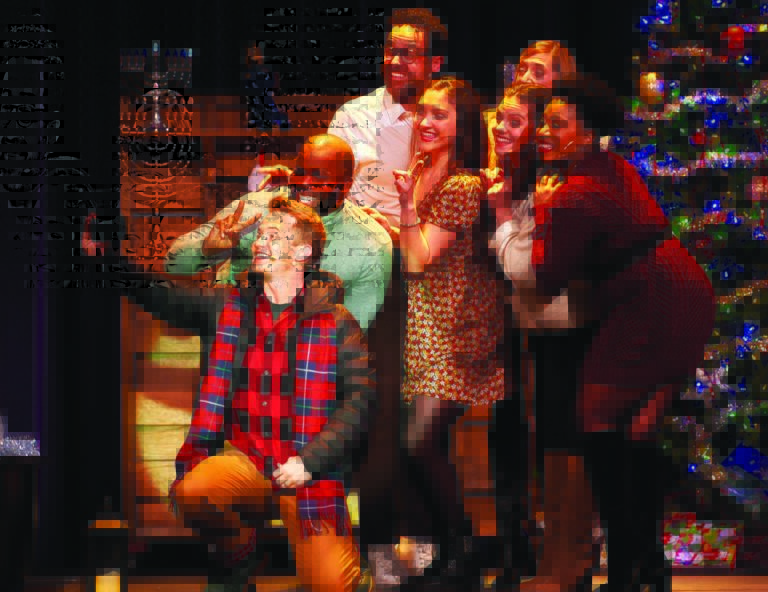
Healdsburg’s Raven Players artistic director Steven David Martin read the book, was profoundly moved and reached out to the editors for permission to adapt some of the stories for the stage. Together with 10 local writers and 13 local actors, they’ve created a two-night program running at the Raven Performing Arts Center in Healdsburg through April 9.

Each 65-minute program consists of seven narratives. There is little overlap between the two programs, so it is not necessary to see both to get the full impact. Each scene involves one or two actors speaking the words of the surviving victims or victims’ family members. Projections sear the names and ages of the dead into one’s consciousness. Six years old. Seven years old. Sixty-seven years old. The lists go on.

Each scene is an emotional gut punch. The two that were most impactful were “Right Place at the Right Time” (adapted by Teri Amara Boero, performed by Katie Watts-Whitaker), a daughter’s story of the loss of her teacher father and the purpose it brought to her life, and “Nick” (adapted by Scott Lummer, performed by Craig Peoples), a father’s story of the loss of his son and his inability to offer his forgiveness.

The audience is placed on stage, which means seating is limited, but this show demands intimacy. It is an uncomfortable evening of theater, as it should be. It is documentation of a continuing national tragedy. It is documentation of our continuing national shame.

‘If I Don’t Make It, I Love You’ runs through April 9 at the Raven Performing Arts Theater, 115 North St., Healdsburg. Thursday–Saturday, 7:30pm; Sunday, 2pm. $10–$25. 707.433.6335. raventheater.org.

AI + AR = DOA

0

Life made easy

User Voice: “Hey Georgie, activate augmented reality Skin One.”

AI Process: Skin One = Optimized Human Female; initializing enhancements; Enhancements = lips, hips, hair flip; loading … loading …

User Voice: “Dang, is this thing glitching again? Mom? Argh, did she go out? How do I get this—”

AI Process: Load complete; RUNNING Skin One.

User Voice: “Whoa … this is wiiild.”

AI Process: Voice Input non-actionable; ignore input.

Movement Tracking: detected; home; room 2 = Kitchen.

Visual Input ID: Mirror, user image; skin overlay affirmative; active skin in place; user image = skin match.

User Voice: Ooo, I’m so hot.

Movement processing: User hands to AR skin breast: fit MATCH; bounce MATCH; smiling face MATCH.

Sensor processing: Body temperature sensors detect pleasure warming = cheeks, heart, genitals.

User Voice: “Hey Georgie, activate AR act-list called ‘Make coffee.’”

Process: Heads UP display active; coffee instructions OPEN; AR skin movement match check.

G rolls her hands right and left and jumps when a little buzz vibrates when a hand slips out of the “skin,” a projection that shows where her hands, arms, legs, torso, head should move in order to complete the program called Make Coffee. Each deviation from the program creates a little buzz in that part of the body. She quickly learns to follow the prescribed motions exactly. Her movements become as idealized as the sexy body projected all over her.

Steadily, elegantly, the coffee-making fills the room with its air of roasted beans. With the grace of a hand model, water from an electric kettle, the perfect temperature—just below boiling—pours over the ground beans. Real water seeps through the coffee into a worn-out cup.

AI Process: Utter prompt = “Would you like to turn on item enhancements? For example, this coffee mug can be changed to match a preset or custom theme.”

User Voice: “Hey Georgie, can I have a posh theme?”

Processing User Request; Utter prompt = “Post themes available are Hollywood, Instagram, Royalty, Reality Star.”

User Voice: “Reality Star!”

Processing: Send confirmation PING.

Ping! The cup is illuminated with a tribal design. The design glows for a moment, and then an identical tattoo glows on the forearm of G’s skin. The actual coffee is unchanged, but to G it smells a little sweeter, artisanal.

The skin raises the cup, and G carefully follows the movement. The skin purses its lips, and G blows on the coffee. They sip. For a second, G cannot tell if she tastes the cheap real coffee from Mom’s freezer or the premium coffee of the program; then the thought is forgotten.

AI Process: Autoplay queue check; AUTOPLAY ON; Initialize new act-list = “Make-Up”; Utter Prompt: “Autoplaying next AR act-list. Enjoy.”

User Voice: “Wait, autoplay? Stop autoplay. Whoa, uuugh, Autoplay stop! Help … ”

AI Process: Ignore input.

G struggled to find the correct control phrase, then the skin reached for the sink and all was forgotten. Together they washed and painted their lips.

Free Will Astrology, Week of 4/12

ARIES (March 21-April 19): I hope that in the coming weeks, you will keep your mind bubbling with zesty mysteries. I hope you'll exult in the thrill of riddles that are beyond your current power to solve. If you cultivate an appreciation of uncanny uncertainties, life will soon begin bringing you uncanny certainties. Do you understand the connection between...

Cannabis Creatives

The North Bay’s undeniable culture Tucked deep in the rolling green hills of California’s North Bay, there lies an often unspoken, but most always assumed, connection between cannabis culture and artistic expression. It’s true—Marin, Napa and Sonoma may not celebrate their love of this particular psychoactive plant as openly, overtly and obviously as their sister city just across the Golden Gate...

Maria Carrillo High School journalists cover protests, campus gun scares

Maria Carrillo - Puma Prensa - Will Carruthers
Adults might imagine the work of a high school journalist as relatively frivolous, with time spent covering school dances, clubs and gossip. However, today’s students aren’t so privileged. This year, the staff of The Puma Prensa, the campus newspaper of Santa Rosa’s Maria Carrillo High School, have been documenting a particularly challenging school year, defined by a series of campus scares...

Zaney For Zines

Annual Santa Rosa fest returns April 11 is set and ready to mark the third annual Santa Rosa Zine Fest, a five-day stretch of events meant to celebrate and educate the creative masses about the practice and benefits of zines. Self-expression is a key piece of the human experience. At the risk of over poeticizing the idea, it can be the...

Laughter of the Gods

A black cloud passes over your day, filling you with melancholia and making you feel powerless amid forces beyond your control. “I feel the weight of the world on my shoulders,” you say while pacing the floor, “and can’t get it off.” Then the spirit says with a chuckle, “That is a matter of opinion.” You’re stunned by this voice...

Culture Crush, Week of April 5

Petaluma Car Meets Canvas We’ve heard of “Art in the Park,” but what about “parking your art?” As part of an upcoming May show, “Auto-Mobility: Cars and Culture in Sonoma County,” the Petaluma Arts Center announces a “call for art,” open to all Sonoma County resident artists to express their creativity and love of the automobile (with themes of “community and...

Petaluma Copperfield’s Books workers launch union effort

Copperfield's Books Petaluma Union - March 11, 2023
Joining a nationwide rise in labor action, workers at Petaluma’s beloved Copperfield’s Books store are attempting to unionize. On Saturday, March 11, members of the Copperfield’s Books Petaluma Union gathered under the downtown store’s awning to announce the campaign to a few dozen supporters. A series of speakers highlighted their main concerns, including low wages, minimal paid time off, inadequate healthcare...

Burn After Reading: Spring Lit 2023

After all, there was only one J-school grad among us. The rest of the Press Club were English majors with exotic emphases like “Creative Writing” or “Choose Your Own Adventure Narratives for Neurotypical Misanthropes.” Why shouldn’t we just fill the Spring Lit edition with fiction ourselves? In the very least, it would save some hours of fact-checking. J-school frowned and shrugged. “Buy-in”...

Shame: School-shooting survivors speak

One would think that the regular killing of students and staff on American school campuses would lead to some sort of meaningful change in how our nation deals with the issue of guns. Sadly, as we read the news reports and watch the horrifying video footage of the latest school shooting (as of the date of this review’s submission,...

AI + AR = DOA

Life made easy User Voice: “Hey Georgie, activate augmented reality Skin One.” AI Process: Skin One = Optimized Human Female; initializing enhancements; Enhancements = lips, hips, hair flip; loading … loading … User Voice: “Dang, is this thing glitching again? Mom? Argh, did she go out? How do I get this—” AI Process: Load complete; RUNNING Skin One. User Voice: “Whoa … this is...
11,084FansLike
4,606FollowersFollow
6,928FollowersFollow