


FOLLOW US
Here’s a Stretch
Land Lover
Blank Page
News Briefs
April 11-17, 2007
Don’t shop–impeach
Pushing the concept of a boycott to an entirely new level, the National Committee to Impeach for Peace and WeAreNotBuyingIt.org are urging folks dissatisfied with the present administration (especially those who’d like to end the war in Iraq by impeaching Dubya and his sidekick Cheney) to wholeheartedly embrace the National Corporate Shopping Boycott from April 15 (tax day) to April 22 (Earth Day).
“It’s something people can do. Actually, you don’t have to do anything. Go to the flea market; stay out of the mall,” explains Sonoma State University instructor Peter Phillips, co-author with Dennis Loo of Impeach the President: The Case Against Bush and Cheney. Asked the best way to support the nation after Sept. 11, Bush replied, “Go shopping.” Now Phillips, Loo, 25 endorsing organizations and more than a thousand grassroots organizers nationwide hope Americans will protest by doing exactly the opposite–suspending all corporate shopping for one week by delaying major purchases, avoiding chain stores and staying out of shopping malls.
Participants are urged to support local retailers and small business owners. Buy produce from farmers markets. Fill up the gas tank in advance, or at an independently owned station. “Not shopping is pretty important in this country because shopping is so important. It’s another pressure point we haven’t used yet,” Phillips explains. The goal is to make as many people as possible aware of the boycott plans and to get them all to participate.
“If millions of people do anything against the government in protest, they notice,” Phillips asserts. “Whatever the American people do together has an impact.” The boycott is being announced through e-mails, radio shows and newspaper stories. Positive responses have come in from all over the country, Phillips says.
In the past, activists have successfully boycotted a single product, such as grapes, or a particular company for its policies or practices. Now the idea is to go after every large corporation’s bottom line. “The corporate economy is tied to political power,” Phillips stresses. “This is aimed at corporate America. Whatever people do in mass numbers is scary to the elite.”
Three chamber art
April 11-17, 2007
Discovering the music of Estonian composer Arvo Pärt (above) for the first time is like stumbling onto a new language that expresses clearly and plainly the previously unthinkable; with a minimal investment, it provides great release. His “Spiegel Im Spiegel” is a work of inexhaustible beauty, his “Tabula Rasa” a piece of intricate challenge. While the former enjoys the spotlight on screen and stage, the latter is a well-loved yet underperformed masterpiece, mostly because of the daunting uphill climb toward violinist Gidon Kremer’s untouchable and definitive 1977 recording of this delicate work, blooming as it does with harbored rapture. “Whoever wrote it,” muses Wolfgang Sandner in the album’s liner notes, “must have left himself behind at one point to dig the piano notes out of the earth and gather the artificial harmonics of the violins from heaven.” San Francisco’s award-winning New Century Chamber Orchestra performs “Tabula Rasa” in an inspired pairing with Bach’s “Concerto for Two Violins and Strings” and Schoenberg’s “Verklarte Nacht” on Wednesday, April 11, at Osher Marin Jewish Community Center. 200 N. San Pedro Road, San Rafael. 7:30pm. $28-$42. 415.357.1111.
Adding to the reservoir of chamber music from which to drink is the wonderful Russian River Chamber Music Society, which graciously presents free performances from all over the musical spectrum. Whether with the dissonant glissandos and eerie tape loops of Ethel, presented last year, or the civilized Mendelssohnian veneer of the Amadeus Trio just last month, the RRCMS can be counted on for quality and taste. Next up, New York’s Proteus Ensemble perform works by Copland, Carter, Villa-Lobos, Piazzolla, Gershwin, and Rorem on Saturday, April 14, at the Healdsburg Community Church. 1100 University Ave., Healdsburg. 7:30pm. Free. 707.524.8700.
Finally, from out of the pit and onto the stage comes Craig Reiss and the Eos Ensemble, a group mainly comprising members from the San Francisco Opera orchestra. With guest artist Richard Savino on guitar, the quintet will perform works by Boccherini, Piazzolla and Falconieri before bowing out, guitarless, with Shostakovich’s String Quartet no. 8 on Thursday, April 12, at the 142 Throckmorton Theatre. 142 Throckmorton Ave., Mill Valley. 8pm. $15-$20. 415.383.9600.
Odds and Sods

Open Mic
April 4-10, 2007
Since its adoption in 1973, the Marin countywide plan has helped to preserve Marin’s hills and open spaces by containing sprawl and reversing earlier plans for rampant freeway construction and the paving over of our spectacular countryside. While most of the plan has withstood the test of time, a variety of unintended consequences remain concerning traffic congestion, our ongoing addiction to fossil fuels and a lack of affordable housing.
As state law requires, every county and city’s general plan must be kept up to date, and Marin County supervisors have twice amended the countywide plan. For the past six years, county planners have met with more than a thousand community members to help revise the plan. As a result, a broad consensus was reached to make “planning sustainable communities” the overarching theme of the current update. In keeping with the tradition of Marin’s visionary 1973 plan, the current update has received attention from around the state and the nation.
The proposed plan reflects Marin’s environmental sensibility. To our knowledge, it is the first local general plan in the nation to address both global warming and our high consumption of natural resources as demonstrated through a tool called the ecological footprint. Despite our environmental values, the typical Marinite consumes more resources than the average American and almost three times as much as the average Italian. The plan proposes to reduce our dependence on fossil fuels and consequent greenhouse gas emissions, to continue to protect our environment, to support our local agricultural producers and to focus additional housing within already developed areas, such as failing strip malls.
The proposed plan includes sections on renewable energy, green building and the public-health implications of how land use contributes to sedentary lifestyles, diabetes and heart disease. The plan encourages access to fresh local foods, and supports walking, biking and the ability to age in place rather than being forced to move. Another innovative feature is a series of benchmarks and targets to enable the community to track progress toward achieving its goals.
The plan continues Marin County’s trend for slow, targeted, carefully controlled growth. It anticipates our population expanding at less than 1 percent a year and encourages housing near public transportation, jobs and in community centers. The plan would allow more of our children, service providers, public-safety professionals, healthcare workers, retail clerks and teachers who now drive to Marin from far-flung areas to be able to afford to live here.
The plan celebrates Marin County’s cultural history and identifies types of businesses that have historically been a good fit and should be retained and encouraged to expand. While the plan addresses the entire county, including the cities and towns, its regulatory jurisdiction applies only outside town and city limits.
After a series of public outreach meetings, four working groups and 25 public hearings, the latest version of the plan is now in a final series of public hearings at the Marin County Planning Commission. The hearings began this month and will continue through July. Meanwhile, the Planning Commission and the Board of Supervisors still need to resolve several contentious issues. Should protections be retained or expanded for historic bay lands? How much housing and commercial expansion should be allowed? What strategies should be employed to address the “mansionization” of homes on agricultural land?
Care to join the debate?
Alex Hinds is the community development director for the county of Marin. The Byrne Report will return next week.
NO Foolin’
April 4-10, 2007
Leave it to accomplished director Lasse Hallström (Chocolat, Casanova, My Life as a Dog) to accomplish the unexpected not once but twice in his latest film. First he manages to take a very serious real-life crime and turn it into a buoyant and lighthearted comedy, and second of all he made me enjoy watching Richard Gere. Because it is, quite frankly, genius casting; only someone with the abundance of smarmy charm that Gere exudes onscreen could convincingly portray a man who used every charming bone in his body to pull off such an amazing stunt.
In the early 1970s, Clifford Irving was just another struggling writer. His one published book never sold very well, and his latest manuscript was soundly rejected. Eager for a chance to become famous, Irving decides to pen what he has dubbed (before even having any sort of idea in mind) “the most important book of the 20th century.” After blurting out said phrase to his contacts at McGraw-Hill, he turns to his friend, fellow author and crack researcher Richard Suskind (Alfred Molina) for help in figuring out just what would be this most important something to write about. Envious of the man’s obvious power, he settles upon Howard Hughes, but decides to go the extra faux mile by making his sham manuscript an autobiography. And thus begins an escalating series of illegalities that take our hero and his sidekick down a slippery slope into the land of felonious fraud.
Irving was clever enough to realize early on that–especially in the case of lying about your nonexistent dealings with a reclusive and probably insane billionaire–the more implausible the story, the more likely people are to believe it. Most of the fun comes from seeing the amazingly tall tales that Irving conjures up at the drop of a hat to keep his deception rolling along. Hallström and screenwriter William Wheeler also add a smartly placed layer to the story by focusing a sub-plot on Irving’s infidelities. Not only does this add to our understanding of the character as a habitual liar, but it also gives audiences some food for thought about how many of us, too, get through our lives via a series of little white lies.
The Hoax opens at select North Bay theaters on Friday, April 6.
New and upcoming film releases.
Browse all movie reviews.
Cinema History

April 4-10, 2007
Let’s talk numbers.
The Ten, directed by David Wain, is an affectionately heretical, indie-tinged spoof-romp through all 10 of those celebrated, party-pooping commandments from the Old Testament. It is purely coincidental that a movie named The Ten has been chosen to help kick off of the Sonoma Valley Film Festival’s grand and expanded 10th year (April 11-15), but the organizers of the festival are not above pointing out the freaky numerical synchronicity. Featuring Gretchen Mol, Winona Ryder, Famke Janssen, Oliver Platt and Paul Rudd (the latter of whom is expected to be in attendance at the SVFF, along with a gazillion other film-land notables), The Ten could be described as irreverent, funny, upsetting, experimental, bizarre, challenging and wonderful–all words that (another coincidence!) have actually been employed to describe the SVFF at various times in its first rags-to-riches decade.
“This is the big 10,” enthuses SVFF executive director Marc Lhormer, who, with his wife, Brenda, has been involved in the festival in one capacity or another for the last seven years. “To have reached 10 years is quite a milestone. For right now, though, I’m just looking forward to this year’s festival.”
The number of screening venues has grown from five to seven, positioned all around Sonoma’s historic plaza, with the addition of the Sonoma Veterans Hall, which will feature two venues: a 450-seat room named Hollywood (where the major events–a star-packed John Lasseter tribute and the closing-night awards ceremony–will be held) and a smaller side room dubbed Vine. With more than 80 films in play, most of them screening at least three times, the proudly unconventional film festival–which features free food and wine pairings at every screening–is clearly counting on big audiences this year for its big anniversary.
Moreover, the SVFF (which Brenda Lhormer dubbed “Cinema Epicuria” in 2002) has become famous for the quality of its parties, the hospitality with which visiting filmmakers are treated (many of them staying in the homes of Sonoma-based “host families”) and the general accessibility of the visiting celebrities. Another thing the festival has become known for–though this may never end up on the promotional brochures–is the somewhat happy-go-lucky, accident-prone nature of some of its celebrity tributes; people are still talking about 2003’s projector snafu that inspired Robin Williams to give a hilarious seven-minute rant about free wine at film festivals (“I saw a wino in the park across the street going, ‘Motherfuck! I should have made a film!'”).
But back when the festival began in the fall of 1997, the entire affair was conspicuously less memorable, decidedly grassroots and homespun (read: amateur but well-intentioned), mainly consisting of a big, fancy Saturday-night party surrounded by a bunch of lightly attended film screenings.
“It was a little embarrassing,” says Lhormer, who would not become involved until the festival’s third year. “Those first few years established the festival as a place where the filmmakers were treated very, very well, but there was not the full marketing program that would really generate an audience and justify even having the festival.”
The underlying problem was simple: with few exceptions, the festival didn’t offer films that anyone wanted to see.
In 2002, after two years of involvement as a host family for out-of-town filmmakers, Brenda was named executive director. One of her first acts was to hire a programmer with solid indie film connections: Chris Gore, editor of Film Threat magazine and website, and author of The Ultimate Film Festival Survival Guide. It is not hard to make the case that with Gore working to draw cool films and filmmakers from around the country and developing unique film venues, and with the Lhormer’s refocusing the festival with the Cinema Epicuria brand, 2002 was the turning point.
That year, the festival doubled its attendance.
Gore, who had just landed a television series with Stars Cinema, was back for 2003, which saw increased attendance, but when negotiations to bring him back again broke off during the summer of 2003, the SVFF went shopping for a new director of programming. Since Gore’s departure (he’s back this year as one of the jurors), there has been a new programmer every year, each one bringing his or her own flavor and tone to the festival’s strategically motley vibe.
With Hollywood film buyer Tiffany Naiman in the programmer’s seat, 2004 was the edgy year, with lots of films about heroin addiction and alcoholism showing up in the schedule, and articulate teenage charmer Jena Malone (Saved, The United States of Leland) cadging cigarettes from moviegoers on the sidewalk.
Two thousand five was the “personal movies” year, with Bay Area filmmaker Jesse Lindow programming a large number of solidly humane films about people pursuing their own dreams at all costs. It was the year teenage gay rights crusader Shelby Knox did not cadge cigarettes on the sidewalk, but was at all the parties, happily debating the merits of public-school sex education with anyone who’d listen.
Last year, with East Coast programmer (and sometime theater manager) Gabriel Wardell on board, an “urban sensibility” was in evidence, with a step away from some of the more playful, silly films seen in previous years and a noticeable upgrade in the technical and crowd-management professionalism of all the theater venues. For 2007, the festival has signed Cevin Cathell (pronounced like “Kevin”), a film producer (Eve’s Bayou) and the programmer of the Santa Barbara Film Festival.
This may become the year of the “big buzz” film, with movies like The Ten, the much-talked-about 1970s drama Diggers, the corporate vampire spoof Netherbeast Incorporated, Sarah Polley’s directorial debut with the bittersweet Away from Her, the truly great reality TV thriller Voyeur, and the atmospheric Alan Rickman and Sigourney Weaver romance Snow Cake, all of which have been getting a lot of good word-of-mouth.
“This is the more-eclectic-than-usual year,” says Cathell, “with some killer shorts [check out the animated masterpieces One Rat Short and The Ghost of Sam Peckinpah] that people will be talking about in all the restaurants, and a lot of strong, strong American independents. This is the year where people will say congratulations on the first 10, now we can’t wait for the next 10.”
“Ultimately,” Marc Lhormer adds, “no matter what you do in your festival, no matter how crazy the parties are and how many visiting stars there are, a film festival lives or dies based on the strength of its programming. If people don’t like the films, the festival’s not going to last. I truly believe the Sonoma Valley Film Festival is going to last a long, long time.”
For more information on this year’s lineup and how to get tickets, visit www.sonomafilmfest.com
New and upcoming film releases.
Browse all movie reviews.
Ugly Truths
April 4-10, 2007
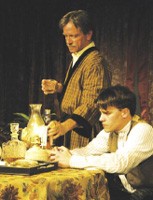
Eugene O’Neill’s towering family drama Long Day’s Journey Into Night is a play so good and so difficult that most companies that tackle it end up failing miserably. As good as the Sonoma County Rep frequently is, I nonetheless approached their new production of O’Neill’s masterpiece with a sense of apprehension that can best be described as dread. Had it turned out to be a disaster, I would merely have blamed them for having too much confidence in believing they were up to a test as fiery and potentially damning as Journey.
To my relief, it is decidedly not a disaster; in fact, as directed (with grace and wit) by Sharon Winegar and solidly acted by a first-rate cast, this production ranks as one of the best things the Rep has ever done, with several of its actors giving the finest performances of their careers.
And to think I almost skipped this one.
Long Day’s Journey Into Night, Eugene O’Neill’s richest and most autobiographical play (poor guy), was not written for the stage so much as it was written for the salvation of the playwright’s soul. It is an attempt on O’Neill’s part to cleanse his psyche of the crushing pain he must have felt after a lifetime of carrying all that anger and hatred for people he had also loved unconditionally and still grieved for. Written in 1942, O’Neill instructed it not be performed until 25 years after his death, a stipulation his widow skirted with the help of Yale University; the work was first performed three years after his death.
The play, about a single transformative day and night in the life of the chronically alcoholic Tyrone family, mirrors the details of O’Neill’s own childhood as the youngest son in a family of self-loathing, drink- and drug-addicted theater people, a messy clan of thinkers and dreamers who were as kind to each other as they were frequently, astonishingly cruel. On this one long night, the morphine-addicted wife and mother Mary (a brilliant, detailed performance by Elizabeth Fuller) falls spectacularly off the wagon, and the family, for all the damaged love they feel for one another, is too trapped in its own addictions and resentments to know how to deal with it. The amount of alcohol these characters ingest in one evening is staggering. So psychologically raw for its time was Journey, so crammed with the kind of beautifully crafted “ugly truths” that O’Neil had become famous for, the play was granted a posthumous Pulitzer Prize for Drama in 1957 (the author’s fourth such honor), and was immediately recognized as a masterpiece.
With just five characters, each one a bundle of rich opportunities for the actor, Journey gives the Rep’s cast an emotional workout. Some productions err by forcing the emotion too hard, pushing it into unbearable histrionics. Under Winegar’s measured guidance, gentle pace and almost loving tone, the cast sidesteps melodrama and gives up something achingly real.
As the bitter, fearful and disappointed patriarch James, Scott Phillips portrays a professional actor who can only drop his façade of artifice when drunk or in the arms of his beloved, increasingly distant Mary. Avila Reese, in the smallish part of the family’s Irish maid, manages to be both sweet and somewhat sad, an unwitting sponge for the family’s pain. David Yen, as the acerbic older son James Jr., gets many of the play’s funnier lines (O’Neill was a funny writer, something people tend to forget), and skillfully nails the bittersweet duality in such lines as, “I love you more than I hate you.” Benjamin Stowe, an intense actor who sometimes buries the truth of his characters in layers of arch self-awareness, steps so far inside the character of Edmund, the frail, tubercular youngest son, that it’s like watching an actor be born on stage; this is a magnificent, selfless performance that is frequently, heartbreakingly mesmerizing.
“Mesmerizing” is not the word for what Fuller does with the character of Mary; as she murmurs her dislike of the fog that encases the Tyrone summer home overlooking a river, Fuller descends, step by step, into her own fog of loneliness and despair as Mary moves, slowly at first, then frighteningly quickly, into a morphine-fueled stupor. It is a superb performance in a superb production that, for lovers of exhilarating theater, should quite definitely not be missed.
‘Long Day’s Journey Into Night’ runs Thursday-Saturday through April 29 at the Sonoma County Repertory Theater. Thursday-Saturday at 8pm; also, April 22 and 29 at 2pm. 104 N. Main St., Sebastopol. $15-$20; Thursday, pay-what-you-can. 707.823.0177.
Museums and gallery notes.
Reviews of new book releases.
Reviews and previews of new plays, operas and symphony performances.
Reviews and previews of new dance performances and events.
News Briefs
April 11-17, 2007 Don't shop--impeach Pushing the concept of a boycott to an entirely new level, the National Committee to Impeach for Peace and WeAreNotBuyingIt.org are urging folks dissatisfied with the present administration (especially those who'd like to end the war in Iraq by impeaching Dubya and his sidekick Cheney) to wholeheartedly embrace the National Corporate Shopping Boycott from April...
Three chamber art
April 11-17, 2007 Discovering the music of Estonian composer Arvo Pärt (above) for the first time is like stumbling onto a new language that expresses clearly and plainly the previously unthinkable; with a minimal investment, it provides great release. His "Spiegel Im Spiegel" is a work of inexhaustible beauty, his "Tabula Rasa" a piece of intricate challenge. While the former...
Open Mic
April 4-10, 2007 Since its adoption in 1973, the Marin countywide plan has helped to preserve Marin's hills and open spaces by containing sprawl and reversing earlier plans for rampant freeway construction and the paving over of our spectacular countryside. While most of the plan has withstood the test of time, a variety of unintended consequences remain concerning traffic congestion,...
NO Foolin’
April 4-10, 2007 Leave it to accomplished director Lasse Hallström (Chocolat, Casanova, My Life as a Dog) to accomplish the unexpected not once but twice in his latest film. First he manages to take a very serious real-life crime and turn it into a buoyant and lighthearted comedy, and second of all he made me enjoy...
Cinema History
April 4-10, 2007Let's talk numbers.The Ten, directed by David Wain, is an affectionately heretical, indie-tinged spoof-romp through all 10 of those celebrated, party-pooping commandments from the Old Testament. It is purely coincidental that a movie named The Ten has been chosen to help kick off of the Sonoma Valley Film Festival's grand and expanded 10th year (April 11-15),...
Ugly Truths
April 4-10, 2007Eugene O'Neill's towering family drama Long Day's Journey Into Night is a play so good and so difficult that most companies that tackle it end up failing miserably. As good as the Sonoma County Rep frequently is, I nonetheless approached their new production of O'Neill's masterpiece with a sense of apprehension that can best be described as...

Copyright © Weeklys All rights reserved.
Our Publications
