Kelp Cuisine

0

Biophilia:
Kelp! | Climate Control Campaign | Georgia Kelly | Why I Hate Being Green | Eco-Hostelry | Shout-Outs | Green String Farms

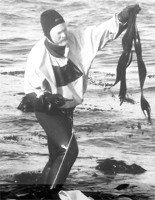
Kelp man: Rising Tide’s Larry Knowles inspects the day’s crop.

By Alastair Bland

Summer has arrived, and with it early sunrises, long warm days and burgeoning new life along California’s rugged North Coast.

These are the conditions that bring several men in wetsuits to the water’s edge at dawn. It’s 5:30am, the day is just breaking and the tide is low. Each man–OK, one could be a woman, but under the heavy-duty neoprene it’s hard to tell–drags a kayak down the beach and launches into the frigid Mendocino waters, and with several quick paddle strokes, shoots outward over the incoming breakers and onto the wide open sea. These kayakers are hunting, and quarry lurks nearby, yet they carry no diving gear, no spears, no fishing lines and no nets. Such weaponry is not needed in their line of business–only a pair of scissors–for their prey is seaweed.

In four hours, the small operation will snip and clip as much as 600 pounds of various kelps and algae from their comfortable beds in the ocean, taking care not to damage the plants beyond their capability to repair themselves. By 11am, the seamen are landsmen once more. They haul their harvest up to their blue pickup truck, deposit it in the back, pile into the cab and drive two miles inland to the headquarters of Rising Tide Sea Vegetables, the largest sea veggie harvester, producer and wholesaler on North America’s west coast.

Many cultures have used sea vegetables for centuries as a supplemental source of nutrition and simply a good-tasting thing to eat, but in the United States, interest in consuming kelp and algae has gained steam only in the last few decades. Larry Knowles, owner of Rising Tide, says it began with the macrobiotics movement in the 1960s, a trend toward natural and healthy eating which originated in Japanese culinary traditions. Mainstream dining, however, would not take the product seriously for decades, and in California the seaweed trade has puttered along at walking speed since the early 1980s.

This natural food tastes quite good, like fresh chard and smoked sea salt, and is a versatile supplement to soups, salads and stir-fries, but many people harbor a terribly negative image of seaweed. After all, they usually encounter it on the beach in heaps and piles, rotting in the sun and swarming with flies.

“But we don’t harvest seaweed from the beach,” says Kate Marianchild, who founded Rising Tide in 1981. “We get it while it’s alive in the sea.”

Bean0 of the sea: Kumbo not only leaches radioactivity from the body, it makes beans better, too.

As a very efficient absorber of nutrients and particulates, sea vegetables are generally not harvested from polluted regions, and the waters of Mendocino County are considered to be some of the cleanest on the West Coast. Many kelp beds and seaweed patches there go undisturbed year-round by boaters and shore walkers, and the prevailing north-to-south current of the eastern Pacific Ocean carries all the contaminated muck expelled from the Golden Gate southward toward Los Angeles. In remote regions of Oregon, Washington and British Columbia, there live other small seaweed harvesters, and most of these companies, like the handful in California, gather their veggies without the aid of motorized, fume-spewing transport, and most dry their harvest in the sun.

Marianchild left her company to Knowles last year to devote her time to other endeavors, but she credits herself with helping to open up the market and educate the public about sea vegetables. In the very early days, she would harvest by hand all summer, drying her goods in the sun and packing it in baggies. In the winter months, she hit the road with hundreds of pounds of dried seaweed in her truck. Careful not to tread in the market range of the Boonville-based Mendocino Sea Vegetable Company–then one of the only commercial producers in America, and a tiny one at that–she visited community grocery stores and natural-foods retailers in Oregon and Washington. Most people were not interested, yet she gained a few long-term customers on that pioneering road trip, and with time, business would only get better.

Rich Mineral Stew

Knowles reports that in the 12 years since he joined Rising Tide, the company’s seaweed production has increased 10-fold with Americans’ growing interest in health and holistic living. In fact, the Whole Foods Market in Berkeley was one of the first large retailers to pick up Rising Tide’s products in 1992.

Many sea vegetables grow at tremendous rates–30 centimeters or more per day–and those with an interest in sustainable resources have every reason to incorporate marine algae into their diets. Nutrition is another major selling point, and marine vegetation far surpasses most terrestrial leafy greens in nutritional value. Seaweed contains 15 to 20 times the nutrient densities of land plants due to its nearly perpetual immersion in seawater, which is basically a rich solution of many minerals. Various kelp species deserve special mention for their high densities of sodium alginate, a compound that can protect against radiation poisoning.

“Sodium alginate is responsible for the recovery of a lot of people after Chernobyl,” says Marianchild. “It actually removes heavy metals and radioactive isotopes from the digestive system. It’s a great thing to have on hand in case of a radioactive disaster.”

So you might want to bring your dried kelp stores down to the bomb shelter before we attack Iran. You might also stock the shelter with canned tuna, as sodium alginate can also negate the potentially harmful effects of dietary mercury. Kelp, it seems, is truly a wonder food.

Wine-Weed Pairings

While sea vegetables have long been an oddity eaten by back-to-the-landers celebrating the natural offerings of earth and sea, gourmets are now showing interest, and in California there is perhaps no more effective way to hook seaweed into the diet of high-end America cuisine than through wine-food pairings. That, anyway, is what chef Eric Tucker has done at the acclaimed San Francisco vegetarian restaurant Millennium.

Long a fan of eating sea vegetables, Tucker is gradually working kelp and algae into the regular menu at Millennium, and in early May one weekend he featured a five-dish sea-veggie special. Each concoction was paired with an appropriate wine. For example, he partnered his vegan South American tamale with seaweed and cream sauce with a white Sancerre, which Tucker chose as a good match for the spiciness of the dish and the pungent saltiness of the seaweed. Generally, he has aimed at developing wine-weed matches that complement, rather than contrast, one another.

“Dry white wines with a good mineral character, like Riesling, work well,” he says, although big reds may accompany such specimens as sea lettuce, which carries a broad and rounded black truffle essence.

Other local chefs are following a similar path as Tucker, and as America wakes up to the beautiful aromas and flavors of marine algae, John Lewallen, owner of Mendocino Sea Vegetable Company, today based in Philo, reports that in his 28 years in the trade, business has never been so hot.

“The market is in a real boom. I used to have to pump it, but now I can’t even get the mailer out to our customers because I’m too busy taking orders.”

Knowles, too, is pleased with the direction of things. He’s even begun to market one variety of kelp to zoos as far away as Minnesota, where keepers give the long ribbons of algae to the bears as edible playthings. Yet Knowles recognizes that in this fast-food nation he may never get rich off of seaweed.

“I’m now making almost enough to fully support me, and clearly there’s a growing understanding of natural health and organics, and seaweed is a part of that.

“But still,” he chuckles, “it’s not like selling burgers.”

Terry Nieves of Ocean Harvest Sea Vegetable Company is spotlighted on Sunday, June 24, at the Marin County farmers market as part of its ‘Meet the Producer’ series. Terry brings fresh sea veggies to the Civic Center on Thursdays and Sundays, and will speak from 11:30am to 12:30pm that day. Civic Center farmers market, Marin Civic Center, North San Pedro exit off Highway 101, San Rafael. 8am to 1pm. Free. 800.897.3276.

DIY kelp harvesting

Those interested in harvesting sea vegetables on their own may do so with nothing but a California fishing license and a very minimum of specialized equipment. The leafy ends of most algae and kelp are quite tender and make for the best eating; snip off the tips and leave the rest of the plant. Remember that state law forbids taking more than 10 wet pounds of seaweed per day per person.

As a general rule of thumb, most seaweeds are safe to eat. One variety, though, which resembles a feather boa, gives off a sulfury aroma, and when sun-dried, baked and eaten, it will fill your mouth with a thick, unpleasant burning paste that turns your teeth green. (Of course I’ve done it myself, and for days I dared not smile.)

Otherwise, the coast is clear, and all edible seaweeds may be consumed fresh or dried and reconstituted in water, which takes just several minutes. My personal favorite method of preparation is to dry-toast sea veggies in a cast-iron pan. This brings out the fresh-from-the-sea aromas, a flavor that goes well with many Asian spices. Sea vegetables are easily incorporated into soups, stir-fries and salads, and a sesame-soy-miso theme nicely complements the smoky, marine kelp flavor. Consider pairing your seaweed dishes with a Bargetto’s 2005 Santa Cruz Mountain Chardonnay, which itself carries a startling yet intriguing backnote of seaweed.

–A.B.

A tiny primer to the most common kelps

Kombu grows in long, tender ribbons, carries high densities of folate, calcium and magnesium. It also holds glutamic acid, a tenderizer, and when added to a pot of beans, will cause them to cook faster and become more digestible.

Nori is indigenous to the North Atlantic Ocean, but retailers carry it worldwide. Used for sushi rolls in Japanese cuisine, Britons call it “laver” and have traditionally mixed it with rolled oats and fried the mash as a breakfast item.

Wakame is a kelp that is described as looking like a cooked piece of spinach lasagne. The center vein should be cut out before using in cooking.

Finding sea vegetables well inland

Good Earth Natural Foods 1966 Sir Francis Drake Blvd., Fairfax. 415.454.0123.
Oliver’s Market 546 E. Cotati Ave., Cotati. 707.795.9501.
Oliver’s Market 560 Montecito Ave., in the Montecito Center, Santa Rosa. 707.537.7123.
Santa Rosa Community Market 1899 Mendocino Ave., Santa Rosa. 707.546.1806.
Whole Foods Market locations throughout Bay Area
To order direct from the source, go to:
Ocean Harvest Sea Vegetable Company 707.937.1923. www.ohsv.net.
Mendocino Sea Vegetable Company 707.895.2996. www.seaweed.net.
Rising Tide Sea Vegetables 707.964.5663. www.loveseaweed.com.

Yummy yummy on my plate

This recipe is adapted from Rising Tide’s “famous” dish
Gingered Wakame
1 tbsp. olive or toasted sesame oil
2 tbsp. soy sauce
3 medium cloves garlic, chopped
1 tsp. grated ginger
1 tbsp. local honey
1 c. (2/3 bag) dried wakame
Soak wakame in water for 10 minutes. Cut into 1/4-inch strips. Combine all other ingredients in a wok or frying pan and sauté for 2 minutes. Add wakame and simmer for 20-30 minutes, adding soak water as needed.


SEARCH AVAILABLE RESERVATIONS & BOOK A TABLE

View All


Quick dining snapshots by Bohemian staffers.


Winery news and reviews.


Food-related comings and goings, openings and closings, and other essays for those who love the kitchen and what it produces.


Recipes for food that you can actually make.

Ask Sydney

June 20-26, 2007

Dear Sydney, I am writing to you as a result of an interesting conversation held with a friend of yours in a writers group in Northampton, U.K. I have written approximately 100,000 words of a lesbian romance/drama. Earlier in the year, I began to write to mainstream agents, eight in total, I believe, plus two mainstream publishers. I sent off the standard three chapters and a synopsis with covering letter. I received negative responses from all.

I’m wondering if I ought to be approaching “specialist” agents and publishers, as I suspect that the mainstream presses are not interested in gay writing. Obviously, there’s always the possibility that my novel is not worthy of publication, that the plot is uninteresting or that my writing is dreadful. But I sort of suspect that there is more to it than this. The conversation came about as the friend of yours is writing a novel where two of the main characters are gay men. He says that at least two-thirds of his novel directly revolves around their story. I asked him if he would be looking for specialist agents/publishers; he didn’t believe that he would have to. I would value an opinion on this debate.–Gay Girl

Dear GG: Gay/lesbian fiction is often considered genre fiction. It doesn’t have to be, but if you don’t mention to an agent or a publisher that your novel deals with gay themes or relationships, and they start reading it, the minute they realize that it’s Suzy and Yvette that are getting it on, they’re going to look back at your cover letter with a big question mark on their face that says, did she mention that this is about gay people?

I don’t know what they have in Britain, but in the States, Writer’s Market is the submitting writer’s bible. Each agent and publisher listed has a list of types of fiction they will consider, and many specify gay/lesbian themes, along with literary fiction, etc. If you do get published, your book may be placed in the gay/lesbian section (they don’t have to label the heterosexual section, because that’s everything else).

You need to decide if you want your work to be pigeonholed. Consider if you are writing about what it means to be gay or if you are writing about what it means to be human and then decide what stance you want to take in regards to representing your own work. If you refuse to allow your work to be genre-fied, then your chances of getting published may diminish, but stand your ground. You need to choose your own route, and then insist upon it. And so what if you are pigeonholed? What’s wrong with being in the gay/lesbian section? Last I checked, they need some more material over there. Let’s work on making the gay/lesbian section fill half the store, shall we? Haven’t there been enough novels written about straight people?

Dear Sydney, last week I came home from work tired, hungry and stressed out. I started to cook dinner. I got the pasta pot boiling and the hamburger browning. As I sipped a fine glass of Cabernet Franc, I started to feel good. And then I tried to twist off the jar lid to the spaghetti sauce. It wouldn’t move. I turned and turned and still it wouldn’t budge. I twisted and twisted with all my might, and still no movement.

As that immoveable spaghetti jar top started to represent everything that has gone wrong in my life, I became enraged. With a furious roar à la Howlin’ Wolf, a gyration à la Elvis and a twist à la Chubby Checker, I proceeded to twist my body down to the ground, and then twisted it back up. I was furious! Who are these capitalistic pigs who put these lids on these jars anyway? I mean, I am an able-bodied person, so what are little old ladies suppose to do? This is indicative of those sociopaths from Enron and that other capitalistic pig on the hill, but I bet he has a butler to open his jars of spaghetti sauce, so he doesn’t care!

As I was performing this song and dance of rage, I looked across the gulley and realized my neighbor had seen the whole thing and probably heard my roaring due to our mutually open kitchen windows. Her face was a whiter shade of pale, and from her perspective, she could not see the spaghetti sauce jar so God only knows what she thought I was doing. I furtively held up the jar with a weak smile, but it was too late–she had snapped the shutters closed in order to obliterate the sight of me.

I don’t know my neighbor very well, as I am new here. Should I write her a note explaining things? I think if I showed up at her door she’d surely call the police, or worse yet, she might shoot me. I finally did open that jar, but I was too upset to eat my spaghetti. The dog seemed to enjoy it, though.–Ignatious O’Reilly

Dear Iggy: First and foremost, let’s deal with the jar issue. I’m sure you know the usual tricks: hit the bottom, pry around the inside of the lid with a butter knife to try and release the seal, and, one of my personal favorites, breathe in, breathe out, deep breaths, then untwist with a deep exhalation. As strange as this may seem, I find this technique very effective in a “use the force” sort of way. There are also a number of lid-poppers available in local markets that claim to get the lid off anytime, anywhere. You might consider investing in something of this nature. I just bought my mother one of those “guaranteed to open any jar” lid-poppers for only a few bucks. She has a bad wrist.

As for your poor neighbor, you can pretend it never happened and let time heal her wounds. Surely you will be able to win her over with enough friendly greetings, pulling to the side of the road to let her pass and slowing down so that you don’t run over her cat. If your good will is clear, she will probably be able to forget about the incident, or at least block it out. After all, at her age, she’s probably seen a lot worse than a little jar wrestling. Most women have. Buy her one of those jar openers I just got for Mom. Then, at a time when your neighbor is out in her yard, grab it and take it over to her. Tell her that you had such a dastardly time getting the top off of that jar of spaghetti sauce the other night (perhaps she remembers seeing you wrestle with it?). Then you found this miraculous item, which works so well you decided to buy her one, too. Just on impulse. That should endear you to her eternally. If it doesn’t, she probably isn’t good friend material anyway. At least you tried.

‘Ask Sydney’ is penned by a Sonoma County resident. There is no question too big, too small or too off-the-wall. Inquire at www.asksydney.com or write as*******@*on.net.

No question too big, too small or too off-the-wall.


The Byrne Report

June 20-26, 2007

Last week, I wandered over to Point Reyes Station to check out the demonstration against Robert Plotkin, the owner, publisher and editor of the Point Reyes Light newspaper. I was shocked by the vehemence of the anti-Plotkin threats emanating from the mouths of the 10 people (not counting five reporters) seething on the sidewalk in front of the newspaper’s office. “Shoplift the Light,” screamed one disheveled guy before he scampered off to do whatever troubled people do in West Marin.

Reyesians, who are mostly affluent, evidently count among their number some folks who eat goat heads on the beach as part of Satanic rituals! Goat heads! They eat them!

That the Light graphically illustrated the goat-head-eating incident on its front cover last year galled the demonstrators. Former Light editor and owner Dave Mitchell said the community newspaper, which won a Pulitzer under his editorship some 30 years ago, has been turned into a “scandal sheet” by the man who paid him $500,000 for it. In compliance with a restraining order against him by Plotkin, Mitchell was careful to keep at least 75 feet from the new owner during the protest, although he did not restrain himself from approaching calumny in our conversation.

(Full disclosure: Last year, Plotkin and I talked about working together, but it did not pan out since I require a living wage. Nor are we on the same political wavelength. He endorsed the RAND Corporation’s Joe Nation for Congress last year over Lynn Woolsey, whom I venerate for her antiwar courage, and he wrote an idiotic editorial praising genetically modified foods. Defying factual reality, he extolled the “Green revolution” that enslaved Third World farmers to Monsanto Corp.’s modified seed stock. But I have not seen any evidence that he has allowed his weird opinions to infect the Light‘s news stories, which are usually professionally reported tales, written with panache and, often, a touch of humor.)

It’s refreshing to see folks up in arms over their newspaper, but their complaints were of little value. Protester Elizabeth Whitney complained that the Light does not cover local news (it does) and accused the Light of the deep conspiracy involved in selling ads to businesses located all the way outside of Point Reyes Station.

Not surprisingly, this absurd demonstration was also attended by Joel Hack and Jim Kravets, who are respectively the publisher and editor of the new West Marin Pilot, a publication that was distributed for the first time on June 1, making Point Reyes perhaps the smallest two-paper town in America. Lacking the Light‘s financial clout and perhaps even its journalism skills, the Pilot‘s inaugural issue was cobbled together with badly printed photos and run-of-the-mill prose, making it dangerously close to the look and feel of the Light under the direction of Mitchell, which was staler than day-old toast.

It seems evident to me that Plotkin breathes journalism day and night, and has responded to the expressed desires of his provincial readers. Local columnists grace the pages every week with information and opinion. The June 7 issue set the record straight on the misguided attempt to shut down the local oyster farm. This summer, two young intern-reporters are doing a series on how global warming will affect West Marin.

It is true that Plotkin, 36, comes across as slightly narcissistic, but if I was surrounded by townies waving pitchforks and whale-oil lanterns, I’d probably be me-centric, too. Could it be that Mitchell, 63, back-stabbed Plotkin by abruptly backing out of a promise to help Plotkin learn the rural publisher-editor role–which makes one a lightening rod for all sorts of disaffected nonsense? In a telephone interview, Mitchell said he walked away from the Light after disagreeing over a photo placement (of Prince Charles, says Plotkin) on the front page. Without getting into sordid details, Plotkin sued Mitchell, who counter-sued. One is said to have attacked the other. Money and careers are at stake. Sides have been taken, knives sharpened.

For his part, Plotkin admits that he has made mistakes, especially in underestimating the “sensitivity” of some people in the community. As a businessman, he is not happy that his personality has become what he terms a “polarizing” issue, which indeed recently prompted an anonymous prankster to print up four-page dummy spoofs of the Light entitled the Point Reyes Dim. But he is justifiably proud of his role in promoting journalistic excellence, while working to turn the Light into a self-supporting enterprise.

As a guy who spends a lot of time basking in the environs of Point Reyes National Seashore, I am happy to see the Light resurrected from the doldrums of mediocrity. The good people of West Marin should be proud of their local newspaper.

or


Wine Tasting

0


I had just stepped through the sliding cellar door when Ryan Kaz turned out the lights and plunged the tasting room into darkness. Two light sabers glowed red and blue in front of me. As the opponents parried and thrust their sabers, the air crackled with electric sizzles and at least a few giggles. Who would declare “Now I am the master!” let alone have a go at the requisite metallic breathing? Alas, these were only dueling wine geeks–but they had clearly come to enjoy one of the unexpected moments one expects in the realm of Kaz, where the main trade is as much a cult of personality as cult wine.

Before becoming the president-for-life of the two-acre commonwealth of Kazzystan, Richard Kasmier was a commercial photographer. Some wily muse then directed him to his real life’s work, which is evidently operating the smallest family winery open to the public in the Sonoma Valley. Besides whatever new toys are on hand, the tasting room has more conventional sundries like mustard, hot sauce, T-shirts and posters in which “the Kaz,” looking like a deranged Shakespearean rep player, self-promotes in various guises. In winemaking, Kaz plays fast and loose with oddball grape varietals, creating why-not blends like Sangiofranc (why not Super Francan?). His motto is “No harm in experimenting.”

(At this point, I ought to mention that Swirl ‘n’ Spit’s rigorous standards of journalistic integrity demand full disclosure: I swear to the committee that neither my past relationship in selling grapes to Kaz nor the couple of bottles he floated my way influence this recommendation in any way. Take it with a grain of salt or half a ton of Zin, as you wish.)

Once finished with his swordplay, Kasmier’s son Ryan poured us a weird bird. The 2006 Trixie’s Secret Nebbiola Rosa ($18) has a what-the-heck taste like a meaty red wine, but finishes light and fresh. It was fermented on the skins, but it wanted so much to be a rosé that Kaz went with the flow. The brand-new 2006 Slide Chardonnay, reminiscent of peanut brittle, goes down caramelly smooth. Besides a note of clove, 2004 Red Said Fred ($38) has the hallmarks of many Kaz reds–tangy acidity and shy tannins that trick the tongue into sensing sweetness; Kaz’s organic, low-sulfite winemaking results in fulsome liqueur aromas.

At eight barrels, the mother of all releases, the 2004 Outbound Cab Franc ($35) has a nostalgic barrel-room aroma and blackberry juiciness. Likewise, the juicy 2003 Champs Cabernet Sauvignon ($50) is not your typical Cab but for its eucalyptus hints. Perennial favorite 2002 ZAM (made from Zinfandel, Alicante and Mourvedre) ($65) is a big, brambly blend from the Pagani vineyard. Kaz doesn’t hesitate to own up that it’s made from second-crop grapes–it’s more like a sequel. And speaking of sequels, Kaz also releases a trilogy of ports–White, Blush And Red–under a second label, the Bodega Bay Portworks. Clearly, the force is with him.

Kaz Vineyard & Winery, 233 Adobe Canyon Road, Kenwood. Tasting room open Friday-Monday, 11am to 5pm. $5 tasting fee. 877.833.2536.


View All

Grue-Bleen Planet

June 20-26, 2007

Biophilia:

Green was my favorite color until I was 11. I liked what it stood for–mainly, the Emerald City. Since the dimming of my tweens, however, the whole spectrum of greens may as well have been smushed into just one dismal value: the dull fluorescence of an energy-saving light bulb.

Throughout my formative years, pundits droned on about doom by global warming, and now I am convinced that there’s nothing I can do to stop it. Not only that, but the green frenzy has become totally annoying in a Paris Hilton kind of way.

I think it was in 1990, fourth or fifth grade, when my greening started. A group of local college kids came to my school auditorium and put on a performance about saving energy. That’s where I learned the classic tooth-brushing lesson: shut the faucet off when you brush your teeth, otherwise you’ll waste five gallons of water. Taking the lesson to heart, I often turned off the spigot when my mom, doing the dishes, left it running too long.

Later that year, my teacher posted a flyer on the classroom wall. Its list of earth-friendly tips suggested, among other things, “Wear a sweater at home.” At the time, this was confusing. What if it was hot?

Now I think back. Over a decade since Jimmy Carter snuggled up in his cardigan and exhorted America to turn the heat down, this is how far we’d come.

Shouldering the entire burden of the “save our planet” mantra, the color green has meanwhile traded its Oz-like magic for survivalist morality.

I once met an astronaut who told me that, while peering at our planet from the space shuttle window, she realized that the earth wasn’t going anywhere. It was a hunk of rock.

It’s not the earth we want to save, but the idea that we Homo sapiens will continue to survive at least a couple generations from now. But what about saving the people who are already here? I considered listing some of the awful things we go through, but, being human, you might already have some idea of what they are. Is our species really worth saving if we can’t get it together enough to take care of each other?

Well, sure.

Maintaining the earth’s climate and resources are worthy activities. But they should be our modus operandi by now. Instead of spending so much time praising green efforts, we should penalize polluting perpetrators. Being green shouldn’t be an exception anymore. It should be as normal as breathing. What’s taking so long?

The first bottle-recycling bill was introduced in 1969. Now, almost 40 years later, we still go through bottled water like Skittles. According to a recent New York Times article, Americans drink 30 billion bottles of single-serving water per year. But these bottles not only take energy and fossil fuel to make and ship, they take energy to recycle, too.

Don’t pollute. OK. Don’t litter. Duh. Don’t use toxic chemicals in your business. Check. Don’t buy bottled water. You bet. It’s just common sense, if you’ve been spoon-fed this stuff since elementary school. For me, trying to be green in this junk-filled environment is depressing. It’s like a new Catholicism, full of guilt and threats of Armageddon.

In many languages, there is no distinction between the colors green and blue. English translators often use the made-up word “grue” to convey this color. In this way, the blue-green earth, as viewed from above, is grue.

But grue has another meaning, too. The late Harvard-educated philosopher Nelson Goodman introduced the term to illustrate a shortcoming of inductive reasoning. As a former philosophy student who hasn’t thumbed through those textbooks in years, I understand grue to mean the following: just because we see an object that’s blue now, doesn’t necessarily mean that we can assume it was blue before we saw it. For all we know, it may have been green. Grue, then, is any object that was observed to be blue after some point in time, or any object that was observed to be green before that point in time. Goodman also coined its opposite: “bleen.”

Like Schrödinger’s cat, another philosophical thought experiment, grue is something you’ve seen before and could characterize then, but now it’s hidden and maybe it’s changed. It’s the unsettling feeling of sticking your hand into a paper bag during Halloween and not being quite sure whether you’re touching eyeballs or just grapes. (Incidentally, grue is also what author Jack Vance calls his monsters in his 1950 Dying Earth series, “the classic science fantasy of the world on the eve of destruction.”)

As global warming continues and the ice caps melt, the earth from above will probably look more and more blue. We’re turning ever grue-er, if you will, and that’s a weird feeling. So far, even if some of our efforts are working, they haven’t been effective enough to turn the process around (yet?). Stuck in grue-ish limbo, the earth is neither here nor there, and somehow the color green is supposed to save us.

As for me, trying to be green hasn’t gotten us anywhere. I’m giving myself up to grue.


First Bite

0

June 20-26, 2007

I really want to love the charming, earnest, Red Rose Cafe that opened a few months ago in Santa Rosa. And how could I not? It seems to be everything I want in a restaurant.

It’s family-owned (Arkansas transplants Harold and Nancy Rogers do the cooking, with their bevy of kids and grandkids helping out). It’s as cute as a button, looking like a little cottage with faux brick walls, red vinyl booths and potted plants everywhere. And it serves one of my favorite cuisines: soul food, with Southern staples like barbecue, fried chicken, catfish and sweet potato pie, plus daily specials like smothered pork chops, meatloaf and oxtails.

As a bonus in my book, Red Rose is quirky. Alongside the chicken-fried steak with gravy is a tofu-tempeh scramble and a Thai noodle salad with mint and sweet chili. Perfect for that mixed dining couple of hardcore carnivore and vegetarian, I suppose. Mom and I have certainly come prepared to adore. We’ve greedily ordered way too much food, not because I feel we should (professional duty) but because it all sounds so delicious.

Except now, we’re gnawing on pork ribs ($12.50), easily a full pound mounded in front of us, and the meat nicely edged with glistening fat. But the pork tastes primarily of smoke, and is interesting only when dunked in the mildly spicy-sweet barbecue sauce served on the side. We’re working our way through a pile of catfish fillets ($11.50), the breading gummy and the fish dry, revived only by the juices of very wet collard greens we’ve ordered alongside. We’re picking apart crispy fried chicken ($8.25), hoping for a little more good grease than this pressure-cooked (instead of dunked in sizzling oil) bird can give us.

As we poke at a dish of tepid, boiled-to-mush mac and cheese, and avoid ownership of a hot link ($7.25) that’s one-dimensional cayenne, I sigh. This isn’t the comforting soul food I crave, with deep flavors from achingly slow-cooked tender meat, loads of spunky spices and lots of fat. At least the hot link tastes like something, unlike the watery red beans and rice, or soft-as-paste yams. I focus instead on my salad, an excellent toss of romaine, cucumber, red onion, tomato, mushroom and chopped red pepper in tangy Italian dressing. Cornbread is superb, too, like crunchy edged cake, and mom and I jostle for the last crumbs.

As we wait for our check, I study the menu again. Maybe this visit was on an off day, I tell myself. So the very next week, mom and I are back, anticipating a big brunch of oxtails, rice, gravy and green beans that’s listed as a Sunday special–except that the cafe no longer serves it. Our waitress apologizes, explaining that a menu revamp is underway. Mom settles on the chicken, Belgium waffles and rice ($8.50). I get the chicken fried steak ($8.50). We order a combo of ribs (beef and pork) and catfish, in the spirit of second chances.

But problems abound: the waffle is more like a pancake with grill marks; the poultry is just three skinny wings; and the rice never shows. Mom pushes her fork around forlornly, and wishes for the coffee she’s requested twice now. Despite its light golden breading, the steak is absolutely raw inside, red and gristly when I try to cut into it. Our waitress is appropriately horrified when she sees it, and rushes the mess back to the kitchen. When the new chicken fried steak arrives 20 minutes later, the cheap-grade meat is burned. Pudding-thick brown gravy studded with bacon is no help, and soggy hash browns desperately need crisping, salt and lots of ketchup. No harm’s been done to my side of eggs over easy, but a leaden biscuit isn’t worth the butter spread on it.

When we finally leave, it’s with unsettled stomachs and upset hearts. Because there’s just no kinder way to say it: This rose is seriously wilted.

Red Rose Cafe, 1770 Piner Road, Santa Rosa. Open for breakfast, lunch and dinner. Monday through Saturday; breakfast and lunch, Sunday. 707.573.9741.


Quick-and-dirty dashes through North Bay restaurants. These aren’t your standard “bring five friends and order everything on the menu” dining reviews.

New Age of New Age

June 20-26, 2007

Biophilia:

Small incidents sometimes have enormous consequences. Many great and history-changing movements can be traced back to a single brief, almost trivial-sounding moment: a prank involving men dressed as Indians dumping tea into a harbor; a slight parliamentary change involving the distribution of votes in pre-Revolution France; a decision not to change places on a bus. From such innocuous events sprang the American and French revolutions and the Montgomery bus strike. For musician-activist Georgia Kelly of Sonoma, such a moment took place in a coffee shop more than 15 years ago, one that has had a profound effect on her life ever since and may one day prove to have been the start of a major international movement.

“I remember sitting in the Depot Cafe in Mill Valley in 1991, talking with a friend about the first Gulf War,” says Kelly, a renowned harpist and speaker who, at that time, was involved in organizing antiwar forums and public protests against American operations in Iraq. “There was a woman sitting near us,” she continues. “She was sitting with a man and could overhear us talking about the war, and she suddenly said, very loudly, ‘I am so glad war is not a part of my reality.’ War was not a part of her reality? I thought, ‘Am I going to engage this or am I going to let it go?'”

She decided the moment was too important to let pass without saying something, so she turned to the woman and said, “Isn’t it fortunate that you have the luxury of not worrying about war because you’re in Mill Valley at the Depot Cafe.” An argument ensued, and neither party left the conversation feeling better about the world. But the incident left Kelly with a smoldering realization that some people in America–many of them part of the New Age movement she had been a part of as one of the first “superstar” New Age musicians–had become too wrapped up in their own experiences of living to believe they had a responsibility to work for change in the world around them. Though it would be influenced and inspired by a number of other people over the years, that incident in Mill Valley resulted, in part, in Kelly’s formation of the Praxis Peace Institute, a nonprofit organization formed to educate on the subject of peace, to promote responsible citizenship and to work toward the goal of ending war on the planet.

“I wouldn’t have said it like that today,” Kelly says of her communication with the woman in the coffee shop, sipping a cup of coffee in yet another coffee shop, this one in downtown Sonoma, where she lives. Today, Kelly considers herself a “student of conflict resolution” and is renowned as a skilled and articulate expert on the peaceful handling of confrontation. Fifteen years after she overheard a stranger say that war is not a part of her personal reality, Kelly feels that apathy, self-involvement and a narcissistic obsession with self-improvement–some of the hallmarks of the New Age movement–are still a major part of America’s arguable lack of interest in the condition of the rest of the world.

For Kelly, this realization was supported when she read 1971’s Culture of Narcissism by Christopher Lasch, in which Lasch describes the Zeitgeist evolving in America at that time as, while undeniably self-absorbed, clearly powered by a feeling of impotence with the political system. According to Lasch, the phenomenon of people turning to increasingly commercial spiritual practices that gave the appearance of spiritual depth was an attempt to avoid political involvement.

“The result of that is that people began turning inward, bailing from the political system and involvement as citizens,” Kelly says. “So we ended up with Reagan and neoconservatives and a whole back-rolling of the things we thought we’d accomplished in the ’60s. The country has slipped so far back from the progress we’d made, it’s heartbreaking, and yet very few seem to care.”

In Kelly’s view, the lack of action on the part of so many left-leaning, spiritually inclined Americans–their disenfranchised relationship with the political world–is one of the first things that will have to change in this country if peace is ever to be truly achieved.

“Because we have the luxury of living in a country that is not all that likely to be bombed today or tomorrow–as happens every day in some countries–there is the option of opting out and saying, ‘I’ll meditate for peace, but I’m not going to write my congresswoman or write letters or go to marches, because that’s giving in to the spiritual disruption of war,'” Kelly says. “I don’t know if anyone would say that now, after 9-11, but I think it’s still an indicator of that kind of consciousness that bails from the political reality and says, ‘That’s not my reality. That’s not my world. I don’t need to know anything about it.’ That kind of thinking allows the real power-mongers to grab power and hold it, because [the meditators] are not engaged in the process that could prevent that.”

The Praxis Peace Institute now organizes conferences and forums around the world, events that bring people together to discuss strategies for avoiding violent conflict. In early June, Praxis sponsored such a conference in Dubrovnik, Croatia, an international event bearing the title “Transforming Culture: From Empire to Global Community.” It featured presentations by author Riane Eisler (author of The Chalice and the Blade), politician Tom Hayden, author Hazel Henderson (Beyond Globalization) and writer Thom Hartmann (Screwed: The Undeclared War Against the Middle Class).

Closer to home, Kelly will hold a major conflict resolution workshop in August at that bastion of New Age introspection, the Esalen Institute in Big Sur. According to Kelly, Praxis–while stirring in her head for many years–came into solid form during the first major peace conference she helped organize in the mid-1990s, shortly after she had left the United States for a six-month stay in Yugoslavia. She was living in Croatia when it seceded from Yugoslavia.

“I realized then that there was no escape from war,” she says. “We really have to deal with the reasons we are recycling the same wars over and over again without learning any lessons from the history of wars. If we do study the history of war, it’s to pick and choose what lesson we want to learn and ignore everything else, so that we can justify what we’ve already decided to do. We refuse to think of war in terms of the big picture, and that’s why we keep repeating the same mistakes.

“Why,” she continues, “when the 20th century had spawned so much spiritual introspection and searching and renewal and awakening, had the same century seen so many wars and conflicts, genocides and deaths? What aren’t we understanding? What’s not working? That’s what I want to find out.”

Sometimes, though, the big picture dissolves in the face of individual stories of war and violence. Kelly remembers an electrifying speaker who quietly shared his story at Praxis’ first major international conference in 2000, also in Dubrovnik. An Irish man, he was a trained killer who’d been adopted into a Catholic family in Ireland and trained to kill Protestants, because his adopted parents didn’t want their own children to have blood on their hands.

The story of his emergence from a life of war, violence and hatred, and the moment he made the decision that he’d never kill again, was one of the lightning-rod moments that convinced those in attendance that the work they’d begun there would have to continue, and that what they were dealing with was so much more than large countries attempting to dominate one another for political and economic reasons. War, it seems, would have to be uprooted from every culture and every heart in which it had taken hold.

It is an unthinkably overwhelming undertaking, but Kelly believes that ending war on earth is possible. But it will require commitment from many who currently have no place in their realities for such disturbing thoughts. The movement, she believes, begins with asking questions. Praxis’ original commitment was, as Kelly puts it, “to always be involved in inquiry, to never allow ourselves to think that we have all the answers. Our job is to set the inquiries, to bring the people together to have discussions, to see what we can learn from the experts, but also to seek out experts who do not think they have all the answers, experts who ask questions rather than letting themselves be locked into an ideology.”

Ending war, also, may require some people to get their hands dirty.

“Creating peace is not about doing magic and thinking good thoughts,” says Kelly. “Creating peace will be hard, hard work.”

To learn more about the Praxis Peace Institute, go to www.praxispeace.org.


Wine Tasting

0


Whether you love the smell of Malbec in the morning or the afternoon, the curtain is up on Francis Ford Coppola’s latest winery venture. From his base in the Napa Valley, the film-auteur-turned-wine-magnate has pushed onwards, taking over a 1970s chateau 40 clicks northwest of Calistoga. That’s Sonoma County.

Although Chateau Souverain was a kind of Gallic conceit to begin with, it has been rumored that Coppola was going beyond the pale. Reports came in that it was to be a “wine country Disneyland,” with swimming pools, cabanas, outdoor restaurant, bocce courts, amphitheater, dance floor and a new home for the Coppola movie museum. Could there really be a wine country Disneyland? This question pulled us north up Highway 101, as if the blacktop was flowing back into Geyserville. Whatever was going to happen, it wasn’t gonna be the way they call it back in Rutherford.

The heads. You’re looking at the heads–by which I mean, weak references to the more obvious Coppola movie lines. I’m the first to admit it. OK, we just came to taste wine. Taste wine, with extreme prejudice.

The cryptic “Moving Ahead” sign has been replaced with the brand new moniker, Rosso & Bianco. We saw only a vegetable garden along the quiet drive. The rumored sights and thrills must still be in preproduction.

The tasting room crowd was mainly of the holiday-weekend element, dressed-up women with underdressed T-shirted dudes in tow, but that’s not to judge. Because it’s judgment that defeats us. There’s no lack of merchandise for sale: pasta sauce, picnic basket ensembles and Sofia paraphernalia of both the bubbly and box-office kind. Lunch in the adjacent cafe features a reasonably priced menu of Italian starters and plates. They had just closed for the day, but if I have a chance to go back and do it all differently, I’d order a pizza quattro formaggi and kick it on the terrace.

Tastes of Rosso & Bianco wines are offered for free, an offer you can’t refuse. Served in tumblers to highlight everyday drinkability, this lower-shelf line was more pleasing than expected. The 2006 Bianco Pinot Grigio ($10.99) was clean, slightly sweet with mineral and citrus notes. A warm vanilla nose and tangy fruit carried the likable 2005 Rosso Classic ($10.99). I regret not having a jelly jar of the 2005 Rosso Shiraz ($10.99) right now, to revisit the sweet apricot jam nose and fruit leather flavors.

The finest wines are available at a price. Although not floral, the 2005 Reserve Russian River Viogner ($24) pleases with a light, sweet honeydew and vanilla palate. Strawberry smokiness, some gingerbread meatiness add interest to the 2005 Reserve Sonoma Coast Pinot Noir ($36). In homage to Argentina’s signature wine, the 2005 Diamond Collection Malbec ($18) is labeled with the blue of that nation’s flag. Smell that? Nothing in the world smells like that, that brand-new tire and cherry smell. The 2005 Director’s Cut Zinfandel ($22) gives up a cedary, bramble aroma and grapes eaten off the vine in the late afternoon. A shot of the 2005 Diamond Collection Claret ($19) seemed balanced and firmly tannic, not deeply moving. Try it with cold rice and a little rat meat–or spaghetti alla carbonara classico.

Francis Ford Coppola Presents Rosso & Bianco, 300 Via Archimedes at Independence Lane, Geyserville. Tasting Room open daily at 11am. Tasting fee $5; Rosso & Bianco wines free. 707.857.1400.


View All

Justice Averted?

0

June 13-19, 2007

Born in the mid-’80s, Renato Hughes, Christian Foster and Rashad Williams came into this world in the days of Jheri curl and feathered hair. By the time they were old enough to register style, hair had morphed into high-top fades and asymmetrical bobs. But the boys, growing up as neighbors and family friends, weren’t fashion-obsessed. They opted to play sports, learn tae kwon do and go to summer science camp.

The three friends flourished in San Francisco’s Bayview-Hunters Point neighborhood. All came from stable, working African-American families, and as teens they attended college preparatory schools. The boys enjoyed success in athletics and were active in church and community. No one would have predicted that as young adults Christian and Rashad would not survive an ordinary vacation to a small lakeside town. And nobody could have foreseen that Renato would be held without bail for their deaths, despite another man’s admission to having shot them.

Clearlake is the larger of the two cities in Lake County, but with the 2000 census putting its population at 13,000, it can hardly be called a metropolis. Its black population percentage is more than double the rest of the county at 5.2 percent, or just under 700 people–still not exactly diverse. The post&–WW II economic explosion saw a small trend in black families from the Bay Area vacationing and buying homes in the area, as secure jobs in shipbuilding and other manufacturing became more accessible to black communities.

Part of Lake County’s appeal is its affordability, especially when compared to neighboring Napa, Sonoma and Marin counties. While farther from the coastline and from the Bay Area cities than its adjacent counterparts, the county’s residents do not have to sacrifice stunning scenery or waterfront recreation. Lovely green hillsides rise dramatically above the blue expanse. Late in the morning on a recent weekday, a black man of retirement age stood in the reedy edge of the water, casting his line toward the depths at the center. A middle-aged white woman smoothly pedaled her cruiser bicycle through town. Families boat over to the county seat of Lakeport to shop and run other errands. The spacious public docks are a far cry from the crowded parking garages typical to a big city.

It’s little wonder that Rashad Williams’ grandparents decided to retire here. And when he was having a difficult time in the Bay Area, it’s no surprise that, struggling with the challenges of early adulthood, he would seek out their quiet refuge for a few months. As he found solace in his new surroundings, he never envisioned the trauma that would be visited on him, his family and his friends.

Golden Boys

Rashad entered the media spotlight in 1999 at age 15 when he raised tens of thousands of dollars for Columbine High School survivor Lance Kirklin. Kirklin had been shot in the face, chest and legs, rescued from the school’s walkway by firefighters, and brought to the Denver Health Center “almost dead,” according to a Center spokesperson.

The San Francisco Chronicle reported that Rashad had been running in track clubs since he was seven years old and was preparing to run in the Bay to Breakers when the Columbine shootings occurred. Since his legs were in great working order, he figured, why not use them to help someone whose legs were on the mend? Kirklin needed several surgeries that weren’t covered by his family’s health insurance. Rashad reportedly raised some $40,000, which earned him appearances on Oprah, CNN and Good Morning America.

Although he had been a shy adolescent, Rashad became accustomed to flying around the country and speaking to all kinds of groups. San Francisco mayor Willie Brown declared May 24 to be Rashad Williams Day. When Rashad flew to Colorado to present the check to the Kirklin family, Denver mayor Wellington Webb made a similar proclamation on June 22, and Kirklin exhorted, “Everybody in Colorado, have a good Rashad Williams Day.”

All that traveling and speaking took its toll on Rashad’s grades. With just a month left before graduation, his private Catholic school, Archbishop Riordan High, informed him that he wouldn’t be able to graduate on time. Three years later, under financial pressure and probable clinical depression, Rashad attempted two unarmed bank robberies for which he was liable to do three years of hard time. Awaiting sentencing, he fled to the respite of his grandparent’s home in Clearlake.

Christian Foster, 22, hadn’t received the media attention that his friend had, but he, too, was headed for success. He played college basketball and won martial arts championships in tae kwon do. At the time of his death, he was a few months from graduating from Notre Dame de Namur University in Belmont, where he was reportedly very popular. Christian aspired to become a guidance counselor for underprivileged and underrepresented adolescents, and he was about to become engaged to his long-term girlfriend.

Like Rashad, Chris was known for having a sweet, generous disposition. His mother, Sherrill Foster, describes her son by saying, “He lived his life in a way that reflected those values: helping his friends in need, volunteering to feed the homeless through our church and tutoring and mentoring junior high school students.”

Renato Hughes kept pace with his talented friends. According to Christian’s memorial website, Renato attended San Jose State University, receiving several scholarships. He was very active in his church as a mentor, usher and part of the choir. He shared Rashad’s passion for competing in track and field events, and like Christian, he excelled in tae kwon do, winning gold medals in the Junior Olympics.

As a teen, Renato also attended Riordan, where he served as vice president of his class and was even featured on the cover of the school’s brochures and pamphlets. He played cello with the Golden Gate Harmony Orchestra, played football on his school team and officiated as the master of ceremonies for the school graduation ceremony during his sophomore year. The following year, after his family experienced some hardships, he transferred to the public Mission High School.

Now 22, Renato spends his days in the Lake County Correctional Facility, charged under the banner of an unusual legal doctrine that blames the one who “provokes” another person to kill to be charged himself with murder. Developed to deal with gang problems between the Bloods and the Crips, “the provocative act murder doctrine” is being tested out on a young man whose future once looked to be anything but bleak. Renato and his family refused to speak with the Bohemian for this article.

The Last Night

Rashad had been staying with his grandparents for about eight months when Christian and Renato drove up from the Bay Area to visit him in the exurb of Clearlake Park on the night of Dec. 6, 2005. Not long after they arrived, in the early hours of the next morning, the three friends decided to relax in a fashion typical of countless Northern Californians–that is, with a bag of weed.

They headed a few blocks away, to the home of Shannon Edmonds, now 33. Edmonds, an alleged drug dealer, holds a medical marijuana card and had three pounds of pot at his home that evening. At home with him that night were his wife, her teenage son and another teen boy.

The prosecution’s version of what happened next has been widely publicized and is hugely disputed. What is known is that the scene was chaos. Lake County district attorney Jon Hopkins alleges that instead of transacting an ordinary small-time drug deal with Edmonds, the three young men shattered a glass door at the back of his home, demanded marijuana and entered his bedroom.

The district attorney’s office further alleges that they attempted to disguise their identities with bandanas and that one of the youths pointed a shotgun at Edmonds as he lay in his bed. Edmonds then reportedly wrestled for the shotgun while someone began to punch his wife, at which point Edmonds’ wife’s teenage son and another boy entered the room. One of them had a metal baseball bat that, in the melee, was used on Edmonds’ wife’s son, resulting in permanent brain damage. Edmonds is then said to have procured a 9mm pistol from the gun safe in his closet, and to have begun firing it as he chased the three young black men from the house.

What is not disputed is that Christian Foster and Rashad Williams died that night from Edmonds’ shots. Injured but alive, Renato Hughes was taken into custody later that morning, where he has been held without bail to this day. The man who fired the seven deadly shots walks free.

Provocative Acts

On a recent Friday, Renato’s attorney Stuart Hanlon has sped back to his office from an early morning meeting at the San Francisco County courthouse. He is no stranger to high-profile, racially loaded cases; he worked with media darling Johnnie Cochran for 27 years to gain the freedom of political prisoner Geronimo Pratt.

Back in his office, Hanlon speaks as sirens and car alarms pierce the otherwise tranquil setting. “The problem is, our case is so subject to manipulation of the facts,” he explains. “We don’t believe the evidence is going to show it was a home-invasion robbery.”

The distinction between a pot purchase and robbery attempt is the key to the case. Renato is not accused of actually firing a gun or wielding a bat, but of putting his friends in a situation that is “likely to provoke a lethal response.” A marijuana purchase is not a provocative act; a robbery is. This unusual legal gambit is ordinarily reserved to prosecute drive-by shooting cases.

A day earlier, district attorney Jon Hopkins sat with a reporter at the end of a long conference table covered in stacks of documents. Hopkins is personable and talkative, and even when his words seem defensive, his voice remains level. He explains why he’s not prosecuting Shannon Edmonds. “It’s just the kind of case where you’re not going to defeat his claim of self-defense. It’s not gonna happen. So why would we do that? So that we’d look ‘politically correct’? My focus is not to look politically correct to those who are out there, the PC police.”

But Edmonds’ self-defense claim is far from airtight. In the police report, Edmonds describes chasing the young men into the street. All bullet wounds were to their backs. No one other than Edmonds was armed at the time, and it is disputed whether the young men were armed at all. According to his taped police statement after the shooting, Edmonds said that he thought it was “funny” that as Christian stumbled, running for his life from the fusillade of bullets, his pants fell down. There are numerous other discrepancies, but attorneys for both sides request that specific details be withheld before trial.

This approach to prosecution is so unusual that when CNN covered the story in March 2006, they brought in their legal analyst, Jeffrey Toobin, to explain. “What it says is, if you, a defendant, commit an act . . . and there’s a high probability that violence will result, you are responsible for that violence even if you don’t pull the trigger,” Toobin said.

How have other provocative-act cases turned out? “They are harder to try. I mean, there have been, in fact, even more attenuated attempts to use this. For example, this has often been used with gangbangers. Let’s say a gangbanger starts a big fight in a crowd or shoots a gun at somebody. If someone shoots back, even if that person is acting completely illegally–in the case we’re talking about, the man . . . had the gun legally. But other times, people have been convicted. Even if the person who’s responding had the gun illegally and was responding illegally, the person who started the fight can still be held liable.”

Christian and Rashad’s families do not agree that Renato is responsible for the events of that night. They regularly attend the court hearings nearly three hours’ drive from San Francisco. Christian’s mother, Sherrill Foster, says that “the law can be manipulated and massaged to the point that it is no longer about justice, but convenience. I need to go up there so that the prosecution can look me in the eyes and tell me that shooting someone multiple times in the back and killing them is permissible.”

Hopkins, a former L.A. public defender, is sympathetic but denies that he can do anything. “I can’t help with it. It would not make it feel any better. It would not lift the load off his mother if I were to [prosecute differently].” Although Hopkins has worked for justice for bereaved families in the past, what he emphasizes now is that nothing can bring back the deceased.

Change of Venue

“Home-invasion robbery.” “Botched home invasion.” News stations and press across the region relayed the prosecution’s story of a robbery attempt. Most coverage left out such terms as “alleged” and “accused.”

Stories released at the time of the incident framed Edmonds as a righteous homeowner; the Santa Rosa Press Democrat went so far as to describe his actions as being “worthy of any action movie,” claiming that he took a “Dirty Harry approach” to the youths. But the real story could have begun as a Harold and Kumar adventure.

In stacks of documents filed with the court, the defense refutes the robbery accusation at every turn. They conclude that the three friends went to Edmonds’ home to purchase marijuana, not steal it. Renato may never even have entered the home.

In an e-mail interview in March, Stuart Hanlon states, “I am very concerned about the publicity that has convicted my client in the press of a robbery in the home before any evidence has been heard in the court. I am also very concerned that much of this biased publicity came from the chief of police and the elected district attorney.”

He doubts that a jury from an area saturated with the prosecution’s version could be fair and impartial, or could start with a presumption of innocence.

On Feb. 27, the Lake County Superior Court heard arguments for moving the trial out of the county. Hanlon and Hopkins called in two expert witnesses to compare other cases where change of venue had been ordered, and to evaluate the publicity of the case.

The experts testified for several days, both urging to move the trial, but Judge Arthur Mann ruled to keep it in Lake County.

Hanlon appealed the decision, but on April 26, the First District Court of Appeals maintained Mann’s ruling. As a last-ditch attempt, Hanlon filed a petition with the California Supreme Court, though hope for a move had mostly fizzled out.

Lake County began pre-trial conferencing. On the afternoon of May 7, one day before Edmonds was scheduled for an immunity hearing, the California Supreme Court notified Lake County to stay the proceedings while they considered the petition. Bar Association presidents in San Francisco and Mendocino counties speaking to the local media agreed that it was highly unusual for that court to get involved before a trial, and the defense team’s hopes for a move looked good.

Race Case

Across the bay, the case has been taken up by Oakland’s Ella Baker Center for Human Rights, a peace and justice advocacy group increasingly convinced that the charges against Renato are prompted by race.

Van Jones, now the president of the center, has stated, “It’s outrageous that anyone is able to chase down and shoot unarmed youth and not be put on trial for that killing. The DA has really gone through the Looking Glass here to avoid charging the white man who admits to killing people and find a black person to charge. The facts are that the two young black men were running away from the house and were shot in the back. That’s not self-defense; that’s execution. On top of this, there isn’t a single shred of evidence that links Renato Hughes to the scene of the crime.”

Part of the reason Hanlon’s team wanted the move is Lake County’s black/white racial disparity. Using little more than the 2 percent black&–90 percent white Lake County census statistic, the mainstream media again picked up the district attorney’s take on the matter: that a whole county was being accused of racism, and the black defendant/white shooter scenario was too simplistic to be inherently racist.

But Hanlon has never made such a blanket accusation. Since filing documents for a motion to change the venue in February, he maintains that the demographics are more a red flag than a cemented conclusion. “When you add to it a black-on-white crime,” he says, “you look at it more, and maybe you can fix it. When you add on to that a violent crime, it’s even more of a red flag. But you finally add on to that it’s a stereotypical crime, which is the home-invasion robbery, a black man from the city coming to the country and breaking into your house–that’s the allegation; we’re not agreeing with that, but that’s the allegation–then what [an expert witness] says is you can’t fix it in a county with that kind of demographic. You have to move it.”

District attorney Hopkins refuses to factor racism into the case. “People must get results by claiming, in some places, that race is involved,” he says, “and therefore ignore the law.”

Edmonds, too, denies that race plays a part of this case. Settled on his front step on a recent sunny morning, he draws on a cigarette and talks about the presence of black folks in Clearlake. “My neighbor, he’s from Oakland, we spend hours talking over the fence.” Lori Tyler, his wife, leans in the doorway. “My grandfather is black. This is not racist,” she says as the cigarette is passed to her.

Michael Ezra is a professor and the chair of the American Multicultural Studies Department at Sonoma State University. On high-profile cases that have had a change of venue, such as the Rodney King trial and the murders of Arthur McDuffie in Florida and Amadou Diallo in New York, he comments, “All of these changes in venue produced acquittals and infuriated local black populations. In Miami and L.A., there were riots. This is the first time I’ve ever heard of the reverse happening, in which a trial would be moved from a ‘white’ place into more ‘diverse’ place to protect the rights of a black defendant.”

What if the matter of race was excluded? Hopkins says, “If everybody was the same color in this case, would we be hearing the same criticism? I think not.”

Hanlon counters that unconscious stereotyping gives more credibility to some accounts than others. “If they weren’t black, we would never think of it. Take two kids who are in college, and one who had been a famous kid for helping people, and you wouldn’t say they’re capable of that.” He is skeptical of Edmonds’ credibility. “You forget that Shannon Edmonds is the one who has a history of meth use, meth sales.” (On the night of the incident, Edmonds had only marijuana and seizure medication in his system. Nearly everyone involved tested positive for marijuana.)

The district attorney asserts that the stereotypical criminal in Lake County is a young white man on meth, not a young black man. But this doesn’t account for stereotypes that people in a largely white area have when they look at a black defendant. Hanlon clarifies: “If you live in a community that maybe wouldn’t have any blacks on the jury but there’s a sizable minority, then you see the other two-thirds of African-American men who are students, who are garbage collectors, who are lawyers, who are teachers, your children see them at school, you go to parent meetings where there are black people, talk to them. So they’re not stereotypes any more; they’re people, and that’s how you break down racism on a basic level.”

On May 23, the state Supreme Court denied the change of venue. On June 14, Lake County Superior Court will hold a hearing to set dates for the trial, likely to be in the fall. Meanwhile, both Hanlon and Hopkins are preparing questionnaires for jury selection.

And as for Renato’s, Christian’s and Rashad’s families? Well, they are readying themselves for more long commutes to this small, remote county. And they are not willing to bear injustice being heaped upon their loss. In an e-mail exchange in April, Sherrill Foster writes, “I am angered by the thought that Shannon Edmonds might go free. He took two lives that he no right to take. Our laws were made so that justice is given to all and should be applied equally. In this case, it is obvious that he committed this heinous crime and has no remorse. I don’t want to see him make a mockery of our judicial system or allow him to get away with violating my son’s civil rights or have Renato pay for a crime he did not commit.”


Viewing Artists

June 13-19, 2007

The third in a trilogy of films intimately exploring the lives of modern artists, Art City: A Ruling Passion will be shown Thursday, June 14, as a benefit for the Petaluma Arts Council’s capital campaign to build an arts center. “These are some of the most interesting art films I’ve seen in a long time,” says Petaluma Arts Council board member Edwin Hamilton. He’s hopeful that Ruling Passion will attract an audience from throughout the North Bay. “This is a really important film for anyone who is interested in art,” Hamilton asserts.

Filmmaker Chris Maybach will attend the screening, followed by a reception in his honor. A resident of San Francisco, Maybach worked for 20 years as a film editor in Los Angeles and San Francisco before branching out into making documentaries. Fascinated by oil paintings and the process of creating something out of nothing, Maybach focused on the inspirations, aesthetic issues and lifestyles of modern artists including such as Louise Bourgeois (shown above in a magnificent Herb Ritts portrait), Ed Ruscha, Elizabeth Peyton and others.

Released in 1996, Art City: Making It in Manhattan visits New York City lofts, studios and galleries of intimate scenes with artists. That was followed by Art City: Simplicity and Art City: A Ruling Passion, which were filmed simultaneously nationwide and then edited into two separate films. “That way you get to spend more time with the artists,” Maybach explains. “You really kind of get to know them.”

A Ruling Passion focuses on intense personalities who have used their art to explore the emotional impact or dark humor of psychological truths. The film examines universal issues such as community, motivation, controversy, finding one’s audience and just “getting it right.” Maybach also created the 2005 documentary Richard Tuttle: Never Not an Artist for the San Francisco Museum of Modern Art and is currently working on a feature film about a drifter who returns home, to be filmed in Sonoma and Napa counties.

Art City is slated for Thursday, June 14, at Boulevard Cinemas, Petaluma Boulevard at C Street, Petaluma. 7pm. $12. Reception at the Barry Singer Gallery follows, 7 Western Ave., Petaluma. 707.766.5200.


New and upcoming film releases.

Browse all movie reviews.

Kelp Cuisine

Biophilia: Kelp! | Climate Control Campaign | Georgia Kelly | Why I Hate Being Green | Eco-Hostelry | Shout-Outs | Green String Farms ...

Ask Sydney

June 20-26, 2007 Dear Sydney, I am writing to you as a result of an interesting conversation held with a friend of yours in a writers group in Northampton, U.K. I have written approximately 100,000 words of a lesbian romance/drama. Earlier in the year, I began to write to mainstream agents, eight in total, I believe, plus two mainstream publishers....

The Byrne Report

June 20-26, 2007Last week, I wandered over to Point Reyes Station to check out the demonstration against Robert Plotkin, the owner, publisher and editor of the Point Reyes Light newspaper. I was shocked by the vehemence of the anti-Plotkin threats emanating from the mouths of the 10 people (not counting five reporters) seething on the sidewalk in front of...

Wine Tasting

Grue-Bleen Planet

June 20-26, 2007Biophilia: Green was my favorite color until I was 11. I liked what it stood for--mainly, the Emerald City. Since the dimming of my tweens, however, the whole spectrum of greens may as well have been smushed into just one dismal value: the dull fluorescence of an energy-saving light bulb.Throughout my formative years, pundits droned on...

First Bite

June 20-26, 2007I really want to love the charming, earnest, Red Rose Cafe that opened a few months ago in Santa Rosa. And how could I not? It seems to be everything I want in a restaurant. It's family-owned (Arkansas transplants Harold and Nancy Rogers do the cooking, with their bevy of kids and grandkids helping out). It's as...

New Age of New Age

June 20-26, 2007Biophilia: Small incidents sometimes have enormous consequences. Many great and history-changing movements can be traced back to a single brief, almost trivial-sounding moment: a prank involving men dressed as Indians dumping tea into a harbor; a slight parliamentary change involving the distribution of votes in pre-Revolution France; a decision not to change places on a bus....

Wine Tasting

Justice Averted?

June 13-19, 2007Born in the mid-'80s, Renato Hughes, Christian Foster and Rashad Williams came into this world in the days of Jheri curl and feathered hair. By the time they were old enough to register style, hair had morphed into high-top fades and asymmetrical bobs. But the boys, growing up as neighbors and family friends, weren't fashion-obsessed. They opted...

Viewing Artists

June 13-19, 2007 The third in a trilogy of films intimately exploring the lives of modern artists, Art City: A Ruling Passion will be shown Thursday, June 14, as a benefit for the Petaluma Arts Council's capital campaign to build an arts center. "These are some of the most interesting art films I've seen in a long time," says Petaluma...
11,084FansLike
4,446FollowersFollow
6,928FollowersFollow