Lyrics Born

0

10.31.07

The world of rock and roll is (you should pardon the term) studded with gifted visionaries and/or obsessive egomaniacs who not only write songs and sing them, but also play several instruments and produce the sessions, too. This article isn’t about them.

No, our purpose here is to celebrate the specialists who deal exclusively with words, whose lyric vision complements their colleagues’ instrumental and melodic talents so aptly that they blend into a seamless, holistic creative merging.

In the broader world of popular music, it’s easy enough to find such precedents as Ira Gershwin, Oscar Hammerstein or W. S. Gilbert, but among rockers, the prototype for these rare writers has to be Keith Reid, without whom Procul Harum would never have “tripped the light fandango.”

Although he never appeared onstage with the band and never played a note on any of their albums, Reid has been a full-fledged member of Procul Harum since the band’s inception (an early press release described the group as “five musicians and a poet-in-residence”). He provided the lyrics to all of their original material (save a pair of instrumentals, naturally), and is usually simply credited with contributing “words.”

Reid’s writing is evocative and often surreal in its imagery, a curious vehicle for the richly authoritative vocal stylings of Gary Brooker, Procul’s pianist and primary composer. Reid also co-wrote fairly often with guitarist Robin Trower, more extensively after he went solo. The Brooker-Reid partnership has endured for 40-plus years, and their early chart-topping collaboration “A Whiter Shade of Pale” may be the most widely covered English pop song not written by a Beatle.

Pete Brown was already a published poet in 1966 when he was recruited to try writing songs with Ginger Baker, who was trying to come up with original material for a new blues-rock trio he was part of called Cream. The two never clicked, but Brown unexpectedly found a strong creative rapport with the band’s bass player. (Ironically, Bruce’s wife, Janet, proved a more successful collaborator with Baker.)

Brown’s partnership with Jack Bruce not only generated some of Cream’s best-known songs (“White Room,” “I Feel Free,” “Politician” and, with Eric Clapton, “Sunshine of Your Love”), but also provided material for most of Bruce’s post-Cream recordings. Interestingly, at least for the purposes of this article, when Bruce and Robin Trower teamed up for the 1981 album, Truce it featured songs by both Bruce/Brown and Trower/Reid.

Pete Sinfield was a founding member of King Crimson—he also came up with the name—having been in earlier bands with co-founder Ian McDonald. He soon found his musical abilities eclipsed by others in the group, but Sinfield’s literary gifts ensured his continued participation through their first four albums, most conspicuously on the King Crimson debut, In the Court of the Crimson King.

Following a falling out with guitarist Robert Fripp, Sinfield began working with former band-mate Greg Lake who had moved on to form Emerson, Lake & Palmer. He provided lyrics for Lake’s “I Believe in Father Christmas” and numerous other ELP tracks, as well as co-writing with ltalian prog-rockers PFM, who were also signed to ELP’s vanity label, Manticore. Sinfield also mustered a obscure 1971 solo disc, Still, which he has recently reissued.

Renaissance was a capable, moderately successful progressive rock ensemble from the same era, perhaps most noteworthy for the blissfully assertive vocals of Annie Haslam. But it was another woman, Betty Thatcher, who provided their lyrics. In an unusual process, composers Jim McCarty (the former Yardbird) and later, Michael Dunford, would send Thatcher their music on tapes and lead sheets, and she would compose lyrics to fit and mail them back to the band.

Finally, on this side of the Atlantic, we come to Robert Hunter, who became Jerry Garcia’s primary lyric collaborator, although he wrote with other members of the Grateful Dead as well. From “Dark Star” to “Touch of Grey,” he provided the words for many of the Dead’s best-loved songs, including the signature phrase “What a long, strange trip it’s been.” Although Hunter performed with some early incarnations of the Dead (he was also briefly part of New Riders of the Purple Sage), that did not carry over into the band’s heyday. However, Dead members are prominently featured on Hunter’s several solo discs.

In subsequent years, the path these pioneers carved out was followed by the likes of Bernie Taupin and Tim Rice. But we mustn’t hold that against them.


Saint Elsewhere

0

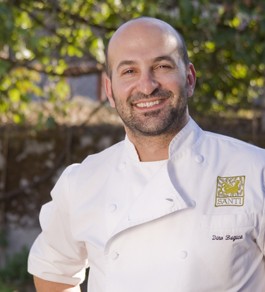
MAESTRO DI CUCINA: Chef Dino Bugica of Santi.

The population of Geyserville is 2,100 souls, give or take various seasonal winery workers or the random off-the-grid types drawn to this bucolic northern Sonoma County burg where, if one sneezes while driving into its downtown, one can miss the entire expanse of a dozen shops, the fire station and post office.

Except after 5:30pm on Friday and Saturday nights, when the numbers swell to 2,500 or more.

As the dinner hour beckons, limousines pull up in front of Taverna Santi on the main street, unloading resort-garbed visitors with faces flushed from daylong winetastings. Shiny SUVs and carefully scrubbed pickup trucks navigate parking spaces for their occupants, well-heeled locals who’ve traded their rumpled vineyard workaday dungarees for pressed jeans, polished cowboy boots and designer fleece. Rental cars crawl in, carrying tourists who’ve trekked from as far away as San Francisco and now peer cautiously out of their vehicle windows, wondering if the small metal sign cut with a filigree rooster is the beacon they’re looking for.

By 5:45pm, there’s a crush of hungry bodies spilling out of Santi’s front door up and down the narrow sidewalk, lining up for a seat at one of the white cloth-covered tables within.

Most are savvy enough to have made reservations far in advance, and are quickly led to tables in the two dining rooms of rustic exposed brick and buttery lemon painted walls; enough others are hoping to score last-minute space at the small bar or half-dozen communal “travelers tables” in the entry that it’s a push to make it through the throng to the hostess stand.

Whoever they are, however they got here, they’ve come for handmade, authentic Old World Italian fare, celebrating seasonal, local ingredients so fresh that produce and herbs are plucked, as much as a tiny and unpredictable harvest allows, from a small garden banking the trellised patio out back of the restaurant. They’ve made a pilgrimage for founding chef Franco Dunn and executive chef Dino Bugica’s pan-roasted pork tenderloin with slow-roasted pork belly, sautéed broccolini and potato purée in pork jus; house-made beef tripe braised with borlotti beans and garlic fettunta; and the daily cornucopia of handcrafted pastas, olives, salumi, sausages, gelato and even liqueurs that hold true to painstaking European artisan style.

They’re here for a wine list of almost 200 coveted selections from the boutique vineyards of the surrounding Alexander, Dry Creek and Russian River valleys. Many guests are winemakers themselves, a who’s who of the industry that have made a favorite of the rustic taverna as much for a casual meal of lasagna with Calabrian meatballs as for a complicated breasola decorated with Black Mission figs, Moliterno cheese, arugula and white truffle oil.

As the dining rooms bulge with glowing guests and the cash register rings up easy tabs of $75 per person, Santi—which means “saint” in Italian—appears a seamless, obvious success, effortless in its rustic-chic charm.

Yet for owner Doug Swett, it’s been a calculated acquisition of an enormously labor-intensive operation, and the slow but ceaseless grooming of its growth from a simple out-of-the-way cafe to a world-class destination.

Swett, who grew up in Sonoma and worked in various wine country resort restaurants, had recently returned to the county after seven years enmeshed in the Wolfgang Puck empire as manager of its portfolio of Italian eateries. After opening an eighth restaurant in Los Angeles, “It was time to come home,” Swett says matter-of-factly. “I missed Sonoma.”

When Santi first opened in 2000, it was as a joint venture by two former winery chefs with a dream, Thomas Oden and Franco Dunn. By 2001, their fledgling business crippled from 9-11, the chefs found little joy in the daily running of a restaurant and wanted to focus on their cooking. Swett saw a remarkable opportunity in the rough, and jumped at the offer to become general manager.

“Financially, [Santi] was severely hit by [the Sept. 11 attacks] and never fully recovered,” Swett explains. “The reputation locally was solid but not spectacular, and there were clearly things that had to be fixed. It became obvious that the set-up they had established was not going to work.”

In early 2005, he bought out the owners, retaining Dunn, as chef emeritus, and the 28-year-old, up-and-coming executive chef Dino Bugica, who joined the team in 2003.

As his first course of business, Swett invested in the chefs’ talents. Both are classic, Italian-trained artists of a peasant palate that relies on humble meats, obscure items like black cabbage and chestnuts, young chickens cooked under bricks, rough ragus slow-cooked to savory velvet and sumptuous exclamations like toasted anise shortbread under sambuca-infused whipped cream. So Swett sends them to Italy several times a year to refresh and expand upon their skills.

“Any restaurant is a risk, but this was definitely a calculated one,” he says of his leap of faith. “I felt like the food needed to come up a notch, and there had to be a better business plan and model in place, but ultimately it had a good chance of succeeding.”

He gradually changed the menu from being relatively fixed to changing every several weeks to being updated daily and fancied with an elaborate slew of specials fed by local farmers, the seasons and the traditions of the Italian culinary calendar.

He elaborated on the established seasonal tasting menus and added winemaker dinners plus a wildly popular Wednesday locals night, featuring dinners like succulent herb-roasted leg of lamb, Sicilian meatballs and mashed potatoes, or pork cotelletta with corn and sweet onions for a reasonable $18, including a house salad of local greens. He rounded out the in-house banquet functions with a full-service catering department, and began stocking Santi’s signature sausages, homemade spice rubs, barbecue sauce and other specialties for sale at Healdsburg’s Saturday morning farmers market.

Last summer, he added live jazz performances on the patio Sundays through the warm months. This January, he introduced the Supper Club, offering family-style communal dinners the last Sunday of each month, and in March began lunch service Wednesday through Friday.

Swett is the first to admit that it’s been a battle; he jokingly describes Santi to a visitor as being an “albatross around my neck,” but it looks like it’s paid off.

At a recent dinner, Swett greets a guest with a proud display of the oversized portrait of a bar scene that hangs on the wall next to the host stand. It’s an ancient shot of Catelli’s the Rex, a bar that for decades occupied the 1902 building that now houses Santi. Dusty and sun-worn, wearing overalls and broad brimmed hats, happy imbibers smile at the camera. The bartender serving them, long-retired and now in his 90s, remains a regular and holds court at a big, curved booth just inside the restaurant’s weathered wooden doors.

I have foolishly arrived without a reservation, and no private tables are available, but space is made at a travelers table, sharing with two other patrons what turns out to be a lovely evening of conversation and camaraderie.

The waiter lauds the oft-requested moscardini con patate as “amazing,” and he’s right. A quartet of whole baby octopus lie like cartoon dolls in the dish, deeply purple and likely having met their demise from being massaged to death by chef Bugica. Braised in red wine with tomato, garlic, black olives, herbs and diced potato, their juices soak into grilled crostone for a crunchy sog of salty tartness, gently chewy tentacles and buttery body.

The rest of the meal comes from the evening’s specials, and they shine as some of the finest Italian food to be found in northern California. Aromas of fresh earth and ocean waft from a hot cast-iron skillet glistening with silvery house-cured anchovy fillets, sharply tart roasted gypsy peppers, caramelized cauliflower and a thick mantle of toasted breadcrumbs. Monkfish is prepared osso bucco style (bone-in and braised) with finely diced tomato, battuta (typically onion-garlic-fatback), white wine and herbs over potato risotto (the little cubes cooked to beguiling silk in cream) sprinkled in an unexpected accent of pomegranate seeds. A fat slab of monkfish liver shimmers atop in a decadent display of pumpkin-colored organ meat.

The chefs make their own gnocchi, and tonight the tiny velvety dumplings come layered with chanterelles, crimini, porcini, oyster mushrooms and a dusky confit of duck hearts and gizzards bathed in a richly aromatic broth.

Desserts are equally sublime, with a Meyer lemon tart like a small slab of pie with its soft, toasted pine-nut crust, dollop of unsweetened cream and shock of tiny sweet-tart huckleberries in thick purple syrup. A slippery round of silky panna cotta studded with almonds arrives smothered in Black Mission figs from Santi’s garden.

Santi “is finally achieving what it’s potential always had,” Swett says, and it’s time for him to turn his attention to something new. In January, he will take another gamble on Geyserville, with the opening of Diavola in the former Geyser Smokehouse just a few doors down. It will be another homecoming of sorts, with Bugica in charge of the kitchen and Oden returning as an investor in the new LLC.

The trattoria will be more casual, set amid aged brick walls and rustic wooden floors and focusing on Bugica’s artisan wood-oven-baked thin-crust pizzas, simple roasts such as porchetta and quick bites like sautéed peppers. A small retail counter will offer house-cured meats and salumi, breads, soups, salads and cheeses.

Tonight, meanwhile, the population surge lasts until about 10pm, when—poof!—the sojourners disappear, the streetlights click off and the town slides back into its dusty slumber. The limos are gone; the tiny lot across the street will re-open in the morning, offering its shiny red and green tractors for sale, and the mercantile will sell its paint, hardware and fencing supplies.

And behind the rugged, terra cotta walls of Santi, Swett, Dunn, Bugica and crew will be quietly working their magic to bring it all to life again less than 24 hours later.

Taverna Santi

Address: 21047 Geyserville Ave., Geyserville

Hours: Open for lunch, Wednesday–Friday, 11:30am–2pm; dinner, Monday–Saturday, 5:30–9pm; Sunday, 5–9pm.


SEARCH AVAILABLE RESERVATIONS & BOOK A TABLE

View All


Quick dining snapshots by Bohemian staffers.


Winery news and reviews.


Food-related comings and goings, openings and closings, and other essays for those who love the kitchen and what it produces.


Recipes for food that you can actually make.

High on Grass

10.24.07

Three days pass before I discover my samples of Amazing Grass propped up against the front door that no one ever uses. The box is soft and soggy from rain, but this does nothing to quell my excitement. I love a package, even if what it contains are freeze-dried cereal grasses.

Inside, I discover three types of Amazing Grass drink powder: Green SuperFood, both plain and chocolate flavor, and wheat grass, all a little damp but apparently no worse for it. I mix my first sample of Green SuperFood drink powder with pink lemonade. Though not the most desirable combination, this is all I have on hand. I can’t stand to wait.

The resulting concoction, while not as good as, say, an Americano with half-and-half and brown sugar, definitely falls within the category of what I would consider consumable, and I’m pleased with the buzz I feel after drinking it. Perhaps I’m imagining things, inspired by the potential of having ingested more greens in one eight-ounce cup than I’ve had all month, but I definitely feel a subtle but discernable energy boost. Within only a couple of days, I grow addicted to the chocolate-flavored grass, which I mix with soy milk and down at an alarming rate, possibly exaggerated by the fact that I recently quit coffee and am desperate to engage in some type of addictive behavior.

Bored with my own experimentation, I decide to branch out and try my samples on unsuspecting friends. The adults I encounter, however, seem predisposed to not trying my grass, simply because they think they won’t like it, and so I’m forced to find a new set of victims, my own children. A few days earlier, after threats and cajoling, they both tried one sip, and then made gagging noises and refused to comment further. Bribery was obviously in order.

I start with a low-end bribe of $2 under the conditions that they consume an entire packet. They agree, and then begin to bargain. We finally settle on five Red Hots and five Sweet Tarts each, which saves me four bucks but probably annihilates the nutritional value obtained. However, the question remains: Will two boys, ages 13 and 11, drink an entire package of chocolate-flavored Green SuperFood, which, even in milk, fails to lose its disturbingly greenish tint? The answer is yes, and with nary a choke, gag or exclamation.

I speak to Brandon Bert, cofounder and co-owner of Amazing Grass with Todd Habermehl, about the beginnings of this four-year-old company and his inspiration to bring organic, nutritionally superior green foods to the marketplace. Bert grew up on green foods provided by his uncle and grandfather’s Kansas farm, where he says the cold winters are ideally suited for the growing of nutritionally superior grass. It is this same farm that supplies the grass they use today.

According to Bert, the nutrient levels contained in many of our fruits and vegetables are depleted from poor farming practices. Add to that the fact that many of us don’t have the time to eat as well as we should, and an easy fix like Amazing Grass makes a lot of sense. Granted, the idea of chugging down wheat, barley and alfalfa, with spirulina and chlorella thrown in for good measure, does not sound as tempting as, well, a lot of other things.

Because taste can be such an obstacle between any American and her greens, Bert and Habermehl have taken extensive measures to ensure that their products are not only of the highest quality, but as pleasing to the palate as it is possible for grass to be. For their children’s powder alone, which contains 33 fruits and vegetables (who knew there were so many?), they tested samples with over 500 kids, adjusting the ingredients until the taste was right. Their attention to this detail has paid off, and even the wheat grass powder, which I was the most hesitant to try, proves more than palatable.

Bert tells me his commitment is not just to keeping it local and organic, (all of their products are processed locally and grown in the United States), but to be as green as possible. As members of the nonprofit Co-op America, Amazing Grass is helping to sponsor the upcoming San Francisco Green Festival, slated for Nov. 9&–11.

At Bert’s urging, I check out the website for the Green Fest, which will be held at the Concourse Exhibition Center in San Francisco. With 150 speakers, including Deepak Chopra, Dr. Andrew Weil and, most importantly, pioneering journalist Amy Goodman, as well as 400 green businesses, live music, workshops and local, organic food and drink, this festival looks as promising as Amazing Grass tastes. For a mere $15 ($7 if you ride a bike), anyone can attend what is being called a three-day green party, with events into the evening. Amazing Grass will be there, and so will visionary activist and astrologer Caroline Casey, which is all the motivation this grass lover needs.

To learn more about Amazing Grass, go to www.amazinggrass.com; for details on the SF Green Festival, go to www.greenfestivals.org.


Present in Company

0

10.31.07


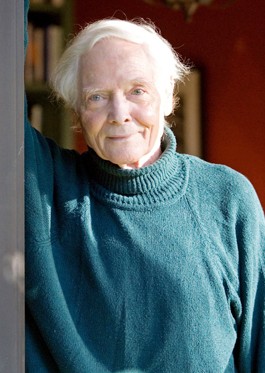
On a sunny Saturday afternoon in October, two weeks after his 80th birthday, the poet W. S. Merwin calmly announces that he’s just 27—on the inside. Wearing a jaunty hat given to him by the novelist Frank McCourt and dressed in cashmere against the chill that an evening’s birthday celebration in the Petaluma countryside promises, Merwin cuts a handsome figure for any age. Settling into a chair in the library of literary agent Steven Barclay’s comfortable home, Merwin says, “Actually, I think that I started realizing that I was me when I was about three.” But the strength of a man at 27—the keenness, the curiosity, the intellect, the mastery—is clearly evident even as Merwin embarks on his ninth decade.

He accepts congratulations on having received the Rebekah Johnson Bobbitt National Prize for Poetry, awarded by the Library of Congress and announced just the day before. He had received the news when returning a call by cell phone at the airport. “That was nice,” he says. “I was a judge on it 10 years ago and I’d forgotten all about it, so I was delighted.”

Reminded of Doris Lessing’s groceries-in-hand declaration that getting her October Nobel was little more than a “royal flush” in the pantheon of prizes, he smiles. He won the Pulitzer in 1970 for his collection The Carrier of Ladders, gave the money to antiwar protesters and angrily denounced the awarding of honors during wartime. The National Book Award was his in 2005 for the stirring compilation Migration: New and Selected Poems.

“It’s pleasant,” he shrugs, when asked about prizes. “I think it’s terrible for people to count on these things and to attach that kind of importance to them. Ideally, they should have no importance at all other than as a lovely surprise and nothing more. Some people gnaw themselves into little bits wondering if they’re going to get one. It’s a symptom of something else. I guess I was always pigheaded about being independent.”

Indeed. A renowned translator who works deeply in French, Spanish, Latin and Portuguese, Merwin is a poet who has rarely taught, save a short stint at NYC’s Cooper Union. Instead, he’s stayed outside of traditional academia, becoming the 20th century’s primary translator of Dante into English and bringing such ancient Romantic works as The Song of Roland to new light. He appears with former U.S. poet laureate Robert Haas at the Wells Fargo Center on Nov. 6.

Strictly raised by a Presbyterian minister in New Jersey, Merwin has often said that his first writings were hymns for his father. Entering Princeton at 16, he studied under John Berryman and made friends outside of his provincial circle. He tutored a son of New York’s powerful Stuyvesant family during the summer; that led to a job tutoring the son of the great poet, novelist and mythologist Robert Graves. “And that took me to Europe,” Merwin remembers. “And by that time, I had made a tiny bit of money, hundreds of dollars. It wasn’t a lot of money; it seemed like a lot, and it was a start.

“All of that,” he emphasizes, “was luck.” In his early 20s, a favored aunt died and left him a small inheritance, which Merwin used to purchase a house in France that he still visits annually. He’s lived in Hawaii for the last 30 years, cultivating rare and endangered palm trees with his wife on 18 ocean-bound acres.

Nominated by W. H. Auden for the Yale Series of Younger Poets Award in 1952, Merwin was acclaimed for his formal style, technical genius and imagistic brilliance. And then he abandoned grammar, causing one reviewer to critique his work in one huge paragraph, itself containing no marks save a period at the end. As some painters gradually move away from representation, painting down to the essence of color, composition and geometry, so has Merwin over the decades rejected the careful training of formalism in favor of poems that contain themselves on the page, forcing the eye to fight the brain for their truest rhythm and meaning. When read as a collection, the poems have the rapid tumble of nature, like being buffeted about by the ocean’s relentless, id-less broil.

His newest book, the recipient of the Bobbitt award, is 2005’s Present Company, a collection of work all told in the second person and masquerading as odes, each one’s title beginning with the word “To.” But Merwin’s interests are catholic and humble, the subjects as varied as “To Billy’s Car,” “To the Corner of the Eye,” “To Prose,” “To the Knife,” “To Absence”—each subject addressed directly as “you.”

“I remember starting [the collection],” Merwin says. “The first one of them was ‘To the Unlikely Event,’ and it came from being on an airplane for the umpteenth time, listening to the speaker say, ‘In the unlikely event of a water landing,’ and all that airline lingo that they go into, which is a deformation of the English language, and I thought, ‘In the unlikely event—what do they mean in the unlikely event?’ Everything that we do, every situation we’re in, is an unlikely event. They’re referring to an unlikely disastrous event, and that’s pretty likely too, sooner or later.

“I thought about that poem: imagine the unlikely event; imagine addressing the unlikely event, and then I thought, ‘I’d like to write a number of poems that address the unlikely event.’ I started to do that, and I realized that I couldn’t. The moment you start thinking of it that way, it becomes . . . likely. It becomes a sort of invention.”

The rich flourishes of Merwin’s early work give way in later collections like Present Company to very plain-spoken poetry whose truths are perhaps easier for the casual reader to grasp. “I love things that seem basic, seem very plain, almost as if nothing’s happening,” Merwin says. “I think that my favorite line of poetry in English is ‘Shall I compare thee to a summer’s day?’ If you think about that line, nobody ever said that. It’s simply not ornate and it’s not literary, but I’m sure that nobody ever said that, exactly. It’s not just spoken English; it is though nothing happened. That’s what Mozart was trying to do—it just happened. I know musicians who say that they’re bored with Mozart because he’s so predictable, and I say, ‘Oh, is that so? Nobody ever predicted Mozart!'”

In past interviews, Merwin has described poetry as a form of “paying attention,” which he explains is linked to the most basic human drive, that of pleasure. “You know, it’s amazing how we have this terrible puritanical background, which is why no one reads poetry in this society, but attention is based on pleasure, which is what we do with music or food or what we like with sexual attraction—it’s pleasure, the sensation of pleasure,” he says, leaning forward in his chair.

“Think of erotic attention; it comes by itself. You don’t feel it because you want to feel it; sometimes you feel it because you shouldn’t want to feel it—but it’s pleasure. It awakens the attention, and that moment of satisfaction is one of recognition, of recognizing something. It doesn’t matter whether it’s an abstract painting or someone singing Cosi Fan Tutte or that line of Shakespeare.”

Given Merwin’s acute observation about modern Americans and poetry, one wonders about the role of the poet as a leader. Artists have always been looked to as visionaries. After all, he and Haas are appearing together in an environmentally themed presentation titled “On Land and Language.” Can poets help to save the earth, its people, our wildlife merely through the art of language? And furthermore, do poets have a responsibility to do so?

“I think that you’ll be happy to know that I don’t have any quick glib answer to that,” he says with a smile. Citing the French philosopher and writer Albert Camus, he continues, “Those of us who can write, meaning those of us who are able to write and those of us who are committed to writing, have a duty to write for the unjustly mistreated, whether they’re people or not. Animals.”

His host quietly enters the room, signaling that it’s time for Merwin to grab that jaunty hat McCourt sent him and take off for a night’s revels.

“I haven’t done enough of it,” Merwin assents, though he is known for his vociferous opposition to the Bush administration and the war in Iraq, “but when the occasion presents itself, I think it’s important to speak to it. I just wouldn’t want to become some sort of professionally drum-thumping writer whose position everybody knows and says, ‘Oh, that’s just so-and-so.'”

W. S. Merwin could easily live another 80 years, and no one would ever make that mistake.

W. S. Merwin and Robert Haas appear on election day, Tuesday, Nov. 6, at 8pm. Wells Fargo Center, 50 Mark West Springs Road, Santa Rosa. $10&–$35. 707.546.3600.


Prisoners’ Progress

10.31.07


In 1996, when a jury convicted Jay Ly for manslaughter related to road rage, the judge ordered him to pay $3,500 for the funeral of the person he had killed. For a moment, Ly was shocked. “And I thought, ‘Oh, shoot—funeral,'” he says. “It had never occurred to me that there was a funeral.”

It wasn’t that Ly, then an 18-year-old Asian gangbanger from Southern California, didn’t know that he had killed someone. It was just that he had never thought about the consequences of his crime all the way through until that moment in the courtroom. He had never before considered the funeral and the grieving families and the loss that were caused by his actions. “Those thoughts had never been mentioned to me, and I never would have learned them if the judge hadn’t said that,” he says now.

It wasn’t until toward the end of Ly’s 10-year sentence, half of which was spent in Marin County’s San Quentin State Prison, that he continued the spark of deeper thinking he had started that day in the courtroom. He began taking classes at the Prison University Project at San Quentin.

Prior to the classes, even after five years of prison, Ly describes himself as being a bit of a hothead. When he first got to San Quentin in 2001, he almost started a riot against white inmates, but another prisoner stopped it at the last minute. Then he started hearing about the university, where inmates could take classes in everything from math to Spanish to philosophy.

“A couple of guys, Eddie and another guy, Mike, had all these books and were doing speeches and stuff, and they would come to my cell and say, ‘Hey, man,’ and would talk to me,” he recalls. “They were always talking about school and stuff and I was like, ‘Yeah cool, whatever,’ you know. But then the spring semester came and I took some courses.”

Over time, the classes began to work their way into Ly’s spirit. In his ethics class, reading Plato and Locke and other philosophers, he started looking at the world in new ways. He began to think critically, to reason, to question. And like that moment in the courtroom, he began to feel empathy for the world around him. “I would be in class and go, ‘Oh shoot, I never thought of it that way before,'” he says. “I was even a vegetarian for a while because I felt so bad for eating meat because of that class.”

San Quentin’s Prison University Project is the only onsite university for inmates in California. About 200 men take about two classes a semester toward their AA degrees. Since the university was founded in 1996, 68 students have earned AA’s at San Quentin, and many more have transferred and gone on to complete their studies after being paroled. The school is an extension of Patten University, a nondenominational Christian college based in Oakland.

Despite struggling at times, the Prison University Project gains momentum and prestige every year. It is also controversial. At a time when the cost of a four-year college education in California is approaching $100,000, many people are against providing free higher education to inmates.

“If you are a working-class family and you are law-abiding and struggling to put your kids through school, you may think, ‘Why should someone be able to commit a crime and then go to prison and get a college education?'” says Terry Thornton, spokesperson for the California Department of Corrections and Rehabilitation (CDCR). “People are supportive of education, but the taxpayers are not going to want to pay for prisoners to get a college degree while in prison.”

Building a School

Today, San Quentin’s university is completely privately funded. It didn’t start out that way. Originally, the university was supposed to be government-funded. Then, in 1994, Congress barred prisoners from receiving Federal Pell Grants, which in turn eliminated funding to higher education in prisons and forced some 350 programs to shut down. San Quentin would have done the same if it weren’t for one person: Jody Lewen.

In 1998, Lewen, a graduate student at UC Berkeley, went to a conference on psychoanalysis and happened to sit by someone who worked in San Quentin’s university program. Soon after, Lewen decided to volunteer to teach literature and composition to the inmates. Although she liked the university, Lewen could see how it could be so much better than it was, so she took an active role. She began e-mailing and contacting people in charge for more resources and bringing up her thoughts on the project to anyone who would listen.

Then the project’s executive director announced that he was leaving for another job in two weeks. People began saying the university would close down. They also started looking to Lewen for answers. “And I thought, ‘I’ll kill myself if I just stand here and watch this happen,’ you know,” says Lewen. “So I ended up saying, ‘This is really, really important to a lot of people, and I have to stabilize it somehow.'”

After she took over as executive director, Lewen found that she loved her new job. It was challenging, sure, but also satisfying. The inmates were so grateful and loved the classes so much, and it allowed Lewen a chance to teach and work in social justice at the same time.

“I was always a little uncomfortable teaching kids at Berkeley, because no matter what, I knew those people were going to be OK,” she says. “So I thought, ‘Oh, my God, here’s a way I can be in an academic setting and still help more marginal and needy people.'”

To generate funding, Lewen formed a nonprofit to support the university. Today, it is funded through donations from individuals, private foundations and corporations. Publishers donate textbooks. The classes are taught by approximately 60 volunteer teachers, most of whom are graduate students or instructors from Sonoma State University, UC Berkeley, SFSU and other Bay Area universities.

Freeing Minds

Running an accredited university within a prison system is a difficult challenge, to say the least. Much of Lewen’s time is divided between two things: getting funding and appealing to prison officials.

Since 2001, for example, Lewen has been trying to get officials to give her more classroom space. The university needs a minimum of eight classrooms five nights a week, but currently only has an average of three classrooms a night. Now, thanks to some pressure from members of the state Legislature, Lewen is seeing signs that her request may be granted. The Prison Industry Authority is building modular buildings, and one may be put aside for the university.

Although this is a positive development, six years is a long time to wait for such a basic resource. “Someone said to me, ‘Wow you’re running an entire college for us for free and all you’re asking for is some place to put it, and we can’t even do that,'” says Lewen. “‘What’s wrong with us?'”

While San Quentin’s program is the only on-site university in the state, other college opportunities are popping up for prisoners elsewhere. The CDCR is working with California community colleges to create opportunities for prisoners to learn online and through correspondence courses. In June, 71 inmates earned AA degrees this way at Ironwood State Prison and Chuckawalla Valley State Prison, making them the largest group of prisoners to graduate at one time with higher educational degrees in the United States.

Still, according to Thornton, there are no plans for taxpayers to pay for college education for prisoners. And we probably couldn’t afford to, anyway: the budget for the CDCR is $10 billion plus another $7.4 billion allocated to build 40,000 new prison beds. By comparison, the budget for higher education in California is around $15 billion. For the first time in the state’s history, Californians are paying more for prisons this year than they are for higher education.

On the other hand, studies suggest that spending money on educating prisoners may cost the taxpayer less in the long run. People who get an education in prison are far less likely to commit new crimes when they are released on parole, which means fewer repeat offenders. A 2001 study by the City University of New York found that prisoners who take college classes are four times more likely to behave themselves when they are released. It also found that college prison programs save taxpayers about $900,000 per 100 students every two years. It is more expensive to house a prisoner for a second and third time than to educate him once.

Prison education also lowers the toll that repeat criminals take on a community. “Ninety percent of people in prison today will be released back into the community,” says Owen Modeland, president of the Correctional Education Association, which serves educators and administrators who teach prisoners. “College education can mean that an ex-offender will get a job, pay taxes, support his family and stay out of trouble.”

Micro Macro

All inmates at the Prison University Project have to take college prep courses before they can start taking college-level classes, whether they have a high school diploma or GED or not. “I was naive about this when I went into the program,” says Lewen. “I thought, ‘Oh, a high school diploma. That means they should be able to write an essay, write a full sentence.’ No. A lot of students the schools are graduating can barely read or write.”

Half of California’s 173,000 prisoners read at a seventh-grade level and almost a quarter read below a third-grade level. Because of this, the college prep course in language skills starts with such basics as grammar and spelling. By the end of the semester, everyone has learned to write a five-paragraph essay.

The inmates are also required to take a college prep math course to get up to basic algebra. In some cases, this means reviewing decimals, fractions and multiplication tables. For other people, it means learning basic math for the first time.

“It is unbelievable,” says Lewen. “I had no idea going in what it was like. The story of what’s going on in California’s public school system is in the Prison University Project.”

Prisoners often couldn’t concentrate when they were in school because of other pressing issues like abuse, hunger, drug addiction, homelessness and gang activities. Additionally, a large portion of the prison population have undiagnosed learning disabilities, like ADD or dyslexia, making classroom time just that much more difficult. When they were ignored or chided by teachers for their disabilities, they may have acted out and slid into behavioral problems. Whatever the case, with most of them the educational system did not address their needs.

“In a way, prisoners are society’s failures,” says Department of Corrections spokesman Thornton. “When the average reading level is seventh grade, there have been a lot of failures. I’m not saying that that is the case with everyone; there are certainly people who deserve to be in jail. But a lot of people have been failed along the way.”

For these inmates, going back to school can bring back bad memories or unexpected emotions. It’s common for a prisoner to believe he is stupid and incapable of learning, and discovering this is not true can be upsetting. Some inmates will drop out of class when they start to do well, assuming it must not be a real class if they can get good grades.

Ly stayed in high school for the girls; if he had gone to an all-boys school, he jokes, he would have dropped out in the ninth grade. Yet he knew he was good at math. In 11th grade, he skated through calculus while barely paying attention, squeaking by with a C.

Still, Ly didn’t think of himself as intelligent until his prison classes. “I started realizing that I’m smart,” he says. “Not a super genius or anything, but I’m pretty quick. And I started thinking, ‘Hey, I could do something with my life.'”

This realization came slowly as Ly kept getting A’s. Then, for his intro to ethics class, he wrote a 30-page essay for his midterm, the longest thing he had ever written. When it was handed back, the teacher praised the essay in front of the class.

“She said, ‘This is the best paper in class,'” he remembers. “When I look back, it was nice. She said, ‘I don’t give out A-pluses very often.’ She had handed out only fours A-pluses in her whole career. I got an A-plus in that class because of that midterm.”

Life’s Random Pattern

Ly is one of many students who has been encouraged by the Prison University Project. When David Deutsch was sent to San Quentin for trafficking cocaine and marijuana in 2000, one of the first things he heard about from the other inmates was the university. “They absolutely loved that program,” he says. “There is no group of people more enthusiastic about learning than these prisoners.”

Deutsch, who got his bachelors from Humboldt State University in 1976, spent much of his time in prison tutoring other prisoners. Still, in his last year in San Quentin, he took some courses in Spanish. The class not only re-ignited his love of learning, he found that it distracted him from his situation in a way that almost nothing else did.

“When I would sit in Spanish class, I would forget I was in prison and just focus on Spanish,” says Deutsch, who was paroled in 2003 and is now pursuing a graduate degree in social work. “That may be another reason they love it so much. They completely forget about the fact that they are incarcerated. You temporarily forget where you are.”

Like most people, when Lewen first volunteered to teach at San Quentin, she was a little concerned about her safety. She was surprised to find that the prisoners were not threatening at all, but respectful and pleasant. In fact, in the program’s 11 years, there has never been a fight in a classroom and no teacher has ever been assaulted. By getting past the prison stereotype and getting to know the men as people, Lewen has started to see the potential the inmates once had—and, in many cases, still have.

“It’s almost like, as a society, we imagine people in prisons as a composite image of all the people who have ever committed a crime,” Lewen says. “Everyone imagines a psychopath. It’s just such a waste. Most of the people I see, if they had gone to my little private school in New York, they would have never been in prison. No way.”

For Ly, reentering society has been difficult after 10 years in jail, but he is still managing to get A’s in his five classes. While he finds the classes at SFSU are harder than the ones at the Prison University, the students are also less enthusiastic about learning.

“People here just sit in class, they don’t participate, they’re like, ‘Whatever, when are we going to be done?'” he says. “Half the class doesn’t show up. The class will have 60 students and only 30 will come.”

Ly can’t afford to be that apathetic. If he hadn’t gone to the Prison University, Ly thinks he would still be in jail now. Considering all it has given him, education is his top priority. “I know it’s work,” Ly says. “If I don’t have an education, with my background, things would be tough for me. That’s what education means to me.”


First Bite

0

10.31.07

Editor’s note: First Bite is a new concept in restaurant writing. This is not a go-three-times, try-everything-on-the-menu report; rather, this is a quick snapshot of a single experience.

For a part of the country already revered for its bounty of garden-fresh fruits and vegetables, Ubuntu in Napa has some of the most extraordinary specimens available on a restaurant plate. The upscale vegetarian oasis, opened in August, sources most of its ingredients from daily harvested organics grown in its own biodynamic gardens—planted by former COPIA curator Jeff Dawson—and its dairy, eggs, grains and accents like honey from Northern California’s finest purveyors.

The chic, sleek spot (it must be mentioned, for the novelty factor, that Ubuntu is a also swanky yoga studio upstairs), features some high-end international nods, like matsutake mushrooms that can cost $30 per pound in Japan, Marcona almonds and Padrón peppers from Spain, vadouvan spice from India, and burrata that comes from Italy’s mozzarella di bufala. And everything comes bundled in sophisticated dishes, like biodynamic risotto folded with globe onion purée and summer truffle-stuffed fougerus cheese (a bloomy-rind cow’s milk cheese from Tournan, in the ÃŽle-de-France), or a summer berry float of watermelon-hibiscus agua fresca spiked with lime granita.

Yet the best pedigreed food, most complicated recipe or glitteriest concept doesn’t guarantee excitement without the talents of a skilled chef, and for that, credit Ubuntu artist Jeremy Fox, a Johnson & Wales grad who’s cooked with Gordon Ramsay and was previously chef de cuisine with Manresa of Los Gatos. What he’s doing with these fine things is an inspiration.

Those precious matsutakes come thinly sliced but meaty, decorated with tiny bitterish white flowers, whole miniature hot radishes and dices of slippery homemade sesame tofu in a delicate, earthy broth ($10). A panzanella salad sings with grilled sweet-juicy peach, fluffy ricotta, crisp string beans and a zingy basil bud vinegar that imbues the bread with oily fire ($9). A single, simple beer-battered garden pepper stuffed with summer squash seemed pricey ($8), until the tempura melts in the mouth and the full-throttle romesco kicks in.

Fox sets the sensation bar so high, in fact, that in comparison, one evening’s “carta de musica” ($12) tasted almost ordinary, the whisper-thin cracker bread dotted with the slightest amount of porcini, pecorino and summer truffle, while the pizza of Kadota fig, braised amaranth and beet greens with Point Reyes blue cheese ($14) was more decoration than flavor.

The only true concern is that it’s very possible to leave here still hungry; the most filling dish on a recent menu was a gratin of three-hour braised fava beans and fideo sofrito with smoked tomato and a Long Meadow ranch egg. It was an intense but appetizer-portioned spaghetti casserole ($12).

That means that even the most generous ordering leaves room for dessert, prepared by Jeremy’s wife and partner Deanie Fox, also formerly of Manresa. Fox prepares such not-to-be-missed delights as brioche French toast with coastal huckleberries, sweet corn ice cream, honey and bee pollen ($8). The custardy bread is partnered with a crackly thin fruit roll-up and, yes, there were plenty of fat kernels in the ice cream for a weirdly pleasing effect. Brown butter crêpes, too, with nectarines, Bourbon-butterscotch ice cream and pecans ($7) were pillowy pleasures shocked with spun sugar. All of which adds up to a most remarkable meal in a most remarkable restaurant.

Ubuntu, 1140 Main St., Napa. Open for breakfast, lunch and dinner daily. 707.251.5656.


Quick-and-dirty dashes through North Bay restaurants. These aren’t your standard “bring five friends and order everything on the menu” dining reviews.

Thrones of Sludge

0

10.31.07

Metal bands invariably register in the public mind as loud, fast and mighty, but in recent years everything in the metal world has been delightfully up in the air. The stoner metal movement has slowed tempos down enormously, and it’s not uncommon to see a metal band play as quietly as possible. The next logical question: Can metal also be played by just one person?

Thrones is the solo project of Joe Preston (above, with kitty), who as a member of the Melvins played a high-profile role in the early reshaping of metal. He’s also been a sometime member of just about every “it” band of the last 10 years, including Earth and Sunn o))); he’d be the perfect go-to guy to score a documentary about the cleanup of Boston’s great molasses flood of 1919: a lot of slow-moving activity, a lot of horrific destruction.

Thrones’ music is inspired by long car drives, which provide hours of mental stagnancy. “And of course,” Preston admits, “I like to rip off parts from other people’s music.” (His solo setup, which runs drums and other backing music through prerecorded tracks and effects pedals, inherently obscures his sources.)

Preston is a big name in metal circles, but he prefers appearing in undiscovered, out-of-the-way locales, “where people are more appreciative of your effort to do something at all,” he says, “than your skill at aping a particular style.” On Thrones’ current tour, this philosophy goes to the extreme, with actual dates booked at an abandoned train station and a ghost-town smog shop and, on a lesser note, the Forestville Club. This, it must be noted, is thrilling news for Forestville’s three metal fans.

Preston represents the Pacific Northwest, but he appears with two other solo acts, both from Southern California: Bobb Bruno, who wears a bunny outfit, surrounds himself with stuffed animals and plays electronic drum pads with satanic metal riffs (must-see video of the week: Bruno, bunny outfit and all, being serenaded onstage by Fiona Apple singing “Tonight You Belong to Me”); and David Scott Stone, who plays experimental solo synthesizer. The excellent and off-kilter Petaluma duo Moggs open the show on Wednesday, Nov. 7, at the Forestville Club, 6250 Front St., Forestville. 9pm. Five measly bucks. 707.887.2594.


Letters to the Editor

10.31.07

Oozing in Ignorance

Normally, I look forward to your reviews, be they of food, music or local goings-on. They are a normally poignant and enlightened source of views. That said, the First Bite review on Rosso Pizzeria + Wine Bar (Oct. 24) by James Knight was, I felt, very poorly written and oozing in ignorance. For one, the inability to understand a pizza topped with an egg (an Italian classic) shows a lack of sophistication in a so-called food writer that is just beguiling. Quoting from the article, “There’s bread, there’s salad, why rock the table?” is the most insipid response to the piadini (a marvel of modern food) that I’ve ever heard.

Furthermore, the writer’s inability to differentiate sliced and roasted local artichokes from chicken is unforgivable. The passive-aggressive chastisement of Rosso for not carrying Zinfandel (possibly the worst pizza wine pairing in existence) frankly shows beyond incompetence, an underhanded grudge bristling forward.

And as for the spaghetti pizza, Knight just missed the cult favorite of the locals, possibly the best exhibition of the house-made mozzarella. Again, I love the Bohemian, but someone had to set the record straight. Support local produce!

Ross Katzenberg, Santa Rosa

James Knight replies: I’m sorry that Mr. Katzenberg was so “beguiled” by my lighthearted self-portrayal as an initially skeptical curmudgeon that he failed to notice that Rosso won me over thoroughly. To convey my growing enthusiasm, I chose words like “warmed up to,” “satisfying,” “quite tasty,” “such a pleasure,” “excellent,” “delectable” and, finally, “genuine commitment to quality gustation.” Perhaps I should have been more explicit?

Regarding roasted bits of artichoke vs. roasted bits of chicken, I bow to Mr. Katzenberg’s discerning eye, but the pie was supposed to be chicken-free in the first place.

And finally, I am surprised that my mild suggestion to offer some peppery, hearty Zinfandel to go with spicy, hearty Italian food is such an unpopular and grievous food pairing no-no. Being a fan as well, I appreciate that the reader jumped, teeth bared, to Rosso’s defense in the face of a positive review.

Sick Society

I am writing this letter about our pitiful and sad mental health system and programs. Throughout our country and in California in particular, people who enter the mental health system get very little, if any, adequate care. Our homeless population, jails and prisons are packed with people who have mental health disorders and problems. What we are seeing in California is more suicides, crime, poverty, homelessness, drug abuse and alcoholism because of this.

Also, our society is creating a segment of people who cannot take care of themselves and who have no, or very little, way to survive. They also have literally no place to go because there is no one to help them. What the mental health system is doing is not coping with people who need its services.

One thing is clear: mental health illness in America is treated in an ignorant way. The lack of programs, research and funding for treatment is a crime.

David Mik, San Rafael

insulting the Ancestors

The “This Modern World” comic strip that you ran in the Oct. 24 issue that compared Republican presidential candidates and pundits to Neanderthals was an insult to Neanderthals. How could you?

Ken Ward, Guerneville


The Byrne Report

ISSUEDATE

Later Alligators

THIS COLUMN MARKS the 120th issue of “The Byrne Report.” During the past three years, I have written at length about war, casinos, patriarchy, graft, war, television, corruption, the death penalty, war, Harry Potter, the stupid media, the devil Bush and, finally, the age-old wisdom of permaculture. My reporting goal has been to pull the covers off the self-serving prevarications of conservatives, liberals and progressives alike, keeping in mind George Orwell’s observation that “Political language is designed to make lies sound truthful and murder respectable, and to give an appearance of solidity to pure wind.” I hope that, to some degree, I have provided respite from the stink borne by that ill wind, if only by blowing hard against it.

I am going on an extended leave of absence from writing this column. In my smoking-gun files, there are dozens of stories I still want to write for the people of the North Bay, and I will grace these pages again. But for the near and middle future, I have to go off and write a book, and I cannot chew gum, do the column and write the book all at the same time.

The book is about multiple universes, mutually assured destruction and the meltdown of a nuclear family. It all started when a friend of mine told me that in the 1950s a man named Hugh Everett formulated a theory that solved the “measurement problem” in quantum mechanics. In short, the measurement problem arises because microscopic entities, such as electrons, exist in “superpositions” of possible positions and velocities. Yet when you measure, or interact with, a superposed electron, it assumes a definite position or velocity in space-time.

That definiteness does not follow from the mathematics used to describe the superposition. In other words, there is no logical reason why macroscopic objects—cannonballs, cups of coffee, human brains—are not viewed by us as existing in all possible states of being. In 1956, Everett resolved that contradiction mathematically, but his theory predicated the existence of uncountable numbers of disconnected universes in which trillions upon trillions of copies of you perform every action that probability pops up. Whew.

After it was published, Everett’s “many worlds” theory was pooh-poohed, and, bitter, he went to work for the Pentagon, taking a position calculating nuclear kill ratios. A heavy drinker and smoker, he died of a heart attack in 1982. Shortly thereafter, his theory was resurrected by quantum cosmologists. It is widely considered to be one of the most important discoveries in modern physics. This does not mean that all physicists believe they reside in multiple universes, but it does mean that Everett’s argument illuminates a way to view the quantum mechanics of the whole universe from inside without being able to see it from outside.

The American Institute of Physics funded me to research Everett’s life. I found a dozen boxes of Everett’s papers—not viewed since his death—stored in the basement of his son, Mark Oliver Everett, leader of the Los Angeles pop band Eels. The book I am writing is about the tragic trajectory of Everett’s family and the fate of his “many worlds” theory. It is also an account of top secret weapons research during the Cold War.

You can read about this in the upcoming December issue of Scientific American, which features my eight-page spread on this subject. In November, in the United Kingdom, BBC4 will air a new documentary, Parallel Worlds, that focuses on Everett. (I consulted with the BBC producers on the show, and I also appear in it wearing a fedora.) In July, I gave a talk on Everett’s work at the University of Oxford that was sponsored by the faculty of philosophy, and, recently, a similar talk at the Perimeter Institute for Theoretical Physics in Waterloo, Canada. Of course I have to write a book!

But be warned, I will be keeping my North Bay files up to date, so don’t try to get away with anything, local bourgeoisie! And I will contribute the occasional guest column now and then; the only alternative to doing that would be prolonged tooth-grinding or exploding.

I want to thank the Bohemian for providing me with this forum, for sticking by me when certain outraged advertisers pulled their ads in response to truths and for never even once suggesting that I butch it down.

And, from my heart, I thank the loyal readers of the Bohemian—an oasis of sanity in a swamp of media lies, corporate-run wars and intellectual pollution—for allowing me to write for you.

See you around.

or


News Briefs

10.31.07

MARIN REMEMBERS

More than 200 people turned out for a tearful Oct. 13 memorial service honoring the first Marin County solider killed in Iraq. Army Spc. Nicholas Olson, 22, died Sept. 13 when an improvised explosive device blew up near his unit in Muqdadiyah, about 60 miles north of Baghdad in Iraq’s Diyala Province. Olson attended Novato High School and graduated from Marin Oaks High School in 2003. During the memorial service in the Novato High gym, Olson’s family was given a folded state flag by the California Highway Patrol, a Novato City Council resolution honoring his sacrifice, U.S. flags presented by a retired U.S. Army Reserve general and numerous medals, including the Purple Heart and Bronze Star. Olson leaves behind his wife, Nicole, 20, and their one-year-old daughter, Melody.

SWEEPING NAPA COUNTY

The 218 registered sex offenders living in Napa County got official visitors on Wednesday, Oct. 24, thanks to a $1 million state grant to all 12 Bay Area counties. “We had pretty good luck,” says Napa County Sheriff’s Department captain Gene Lyerla of Napa County’s one-day “sweep” to verify registered sex offenders’ addresses. “We made six arrests and we’re filing charges on 13.” The effort involved more than 40 officers, including those from all the Napa County law enforcement divisions plus officers from sheriff departments in Contra Costa, Lake, Marin, Santa Clara, Santa Cruz and Solano counties, as well as California parole and Department of Justice agents. Lyerla notes that the grant makes this a cooperative process; in the future, Napa County officers will assist in similar sweeps in Marin and Sonoma counties and throughout the Bay Area.

MAKING IT BETTER

Problems at the Graton Community Services District equate to $29,500 for rehabilitating the Sonoma Land Trust’s newly acquired Pitkin Marsh Preserve on a tributary to Atascadero Creek. The California Regional Water Quality Control Board recently fined the Graton CSD $56,000 for wastewater violations including exceeding effluent discharge limits and filing late reports, according to water quality board representative Luis Rivera. In all, $14,500 goes to the State Water Pollution Cleanup and Abatement Account; $12,000 pays for removing soil that the 2005 New Year’s Eve flood deposited in three wastewater ponds; and $29,500 will fund Pitkin Marsh Preserve’s baseline plant survey, mapping the stream and wetlands, and creating a management plan. Rivera says the North Coast Regional Water Quality Board imposed similar fines on wastewater agencies about 20 times in 2005.


Lyrics Born

10.31.07The world of rock and roll is (you should pardon the term) studded with gifted visionaries and/or obsessive egomaniacs who not only write songs and sing them, but also play several instruments and produce the sessions, too. This article isn't about them.No, our purpose here is to celebrate the specialists who deal exclusively with words, whose lyric vision complements...

Saint Elsewhere

MAESTRO DI CUCINA: Chef Dino Bugica of Santi. ...

High on Grass

10.24.07 Three days pass before I discover my samples of Amazing Grass propped up against the front door that no one ever uses. The box is soft and soggy from rain, but this does nothing to quell my excitement. I love a package, even if what it contains are freeze-dried cereal grasses. Inside, I discover three types of Amazing Grass...

Present in Company

10.31.07On a sunny Saturday afternoon in October, two weeks after his 80th birthday, the poet W. S. Merwin calmly announces that he's just 27—on the inside. Wearing a jaunty hat given to him by the novelist Frank McCourt and dressed in cashmere against the chill that an evening's birthday celebration in the Petaluma countryside promises, Merwin cuts a handsome...

Prisoners’ Progress

10.31.07In 1996, when a jury convicted Jay Ly for manslaughter related to road rage, the judge ordered him to pay $3,500 for the funeral of the person he had killed. For a moment, Ly was shocked. "And I thought, 'Oh, shoot—funeral,'" he says. "It had never occurred to me that there was a funeral." It wasn't that Ly, then...

First Bite

10.31.07Editor's note: First Bite is a new concept in restaurant writing. This is not a go-three-times, try-everything-on-the-menu report; rather, this is a quick snapshot of a single experience. For a part of the country already revered for its bounty of garden-fresh fruits and vegetables, Ubuntu in Napa has some of the most extraordinary specimens available on a restaurant plate....

Thrones of Sludge

10.31.07Metal bands invariably register in the public mind as loud, fast and mighty, but in recent years everything in the metal world has been delightfully up in the air. The stoner metal movement has slowed tempos down enormously, and it's not uncommon to see a metal band play as quietly as possible. The next logical question: Can metal also...

Letters to the Editor

10.31.07Oozing in IgnoranceNormally, I look forward to your reviews, be they of food, music or local goings-on. They are a normally poignant and enlightened source of views. That said, the First Bite review on Rosso Pizzeria + Wine Bar (Oct. 24) by James Knight was, I felt, very poorly written and oozing in ignorance. For one, the inability to...

The Byrne Report

ISSUEDATELater AlligatorsTHIS COLUMN MARKS the 120th issue of "The Byrne Report." During the past three years, I have written at length about war, casinos, patriarchy, graft, war, television, corruption, the death penalty, war, Harry Potter, the stupid media, the devil Bush and, finally, the age-old wisdom of permaculture. My reporting goal has been to pull the covers off the...

News Briefs

10.31.07 MARIN REMEMBERSMore than 200 people turned out for a tearful Oct. 13 memorial service honoring the first Marin County solider killed in Iraq. Army Spc. Nicholas Olson, 22, died Sept. 13 when an improvised explosive device blew up near his unit in Muqdadiyah, about 60 miles north of Baghdad in Iraq's Diyala Province. Olson attended Novato High School and...
11,084FansLike
4,446FollowersFollow
6,928FollowersFollow