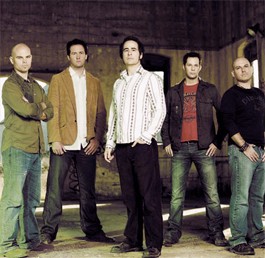
Rufus Wainwright Set To Sell Out Napa

0

Attn: eBay scalpers, please direct your attention elsewhere…

Here’s the inside scoop: It’s just been announced that Rufus Wainwright will be performing a special solo show at the tiny, 500-capacity Napa Valley Opera House on Sunday, March 9. The $55 tickets will go on sale THIS FRIDAY, January 25, at 10am.

The different methods for obtaining tickets are outlined here, though I wouldn’t recommend the “order by mail” option. If the gushing reports from Wainwright’s show in Santa Rosa last year are any indicator, then these tickets are going to disappear instantly.

This show in Napa is Wainwright’s only Bay Area appearance on his current tour.

Wage Slaves in Paradise

01.23.08


In democracy it’s your vote that counts; in feudalism it’s your count that votes.

—Mogens Jallberg

Remember the 1930s?

Me neither. But we’ve all seen the Marx Brothers turn those Great Depression class conceits into high-society pratfalls. Harpo swung from crystal chandeliers, tooting his horn at dullard stuffed tuxedos. Groucho goosed, then seduced, a haughty bejeweled matron, whisking her from ballroom to boudoir, playing the fat lady as the utter callow fool. Amidst deprivations that we today can hardly imagine, folks gathered together in movie houses like tribes, literally sharing in that era’s painful impoverishment. While a few hours at the talkies gave temporary cessation to otherwise unrelenting misery, the Great Depression effectively cleaved American society into haves and have-nots—feudal lords and common serfs.

Some 80 years later, things aren’t that different.

For example, last November was like some Depression Era melodrama for Kaysha Borromeo. Both the fridge and her cupboards lay bare. Her two growing boys no longer fit into their pants and shoes. She was about to get evicted. Her car insurance had nearly been cancelled twice, car payments were late and her gas tank was nearly empty. If her live-apart boyfriend hadn’t been footing the bill, she’d have had no telephone.

Borromeo, 30, faced bad credit and had savings amounting to three lousy dollars. She worried about the $500 charge for her sons’ dental work, worried over the late water, sewer and garbage bill, the PG&E bill and the thousands of dollars, evidenced by mail piling up in the kitchen, that she owed because of an emergency appendectomy.

Meet Kaysha Borromeo, poster mom for the latest trend in our North Bay economy—the impoverished trained professional living in the neo-feudal North Bay.

Is Borromeo a spendthrift? A substance abuser? An underperforming loser expecting society to provide her needs free of charge?

Not hardly.

Borromeo is a state accredited emergency medical technician who works what averages out to a 42-hour week. This enthusiastic union member carries medical insurance for her family, works a second job caring for an elderly disabled person, rents a modest two bedroom apartment in Rohnert Park, and is as bright and thrifty, hardworking, goal-oriented and inventive a person as you’ll ever meet. She is eager to continue her education and hopes to become a nurse.

She and her family may never be wealthy, but Borromeo should be getting along just fine.

She’s not.

Fantasy Finance


Everyone has the right to a standard of living adequate for the health and well-being of himself and of his family, including food, clothing, housing and medical care and necessary social services, and the right to security in the event of unemployment, sickness, disability, widowhood, old age or other lack of livelihood in circumstances beyond his control.


 —Universal Declaration of Human Rights, adopted and proclaimed by the

U.N. General Assembly, Dec. 10, 1948 


Borromeo earns $17.63 an hour as a full-time EMT. Add that to her part-time caregiving paycheck, and she averages about $45,000 annually, falling about $20,000 short of providing what the California Budget Project (CBP) says her three-member family needs to cover their basic necessities. According to the CBP, a single parent family in California’s region IV, which includes the entire North Bay, must make a “basic family wage” of $31.67 an hour, 40 hours a week, 52 weeks each year—just to get by.


That’s the bad news.


The good news is that Borromeo isn’t poor. In fact, she makes more than three times what the Federal Office of Management and Budget’s “updated for inflation” figures define as the upper limit of our national poverty threshold. Three times more.


Please enter, if you dare, the fantasy world of federally defined poverty. It’s just like in Harry Potter . Harry spends summers in the “real” world, and his school year at Hogwarts, where all sorts of scientific realities, like gravity, are suspended. Washington, D.C., is just like Hogwarts, only in those bureaucratic climes it’s economic realities that are suspended, as if some magic wand has made the untenable seem just fine.


In Washington’s world of magic, a family of three making $15,735.01 a year is not really impoverished. The federal poverty threshold determines who is and is not eligible for programs like food stamps, Head Start, the Children’s Health Insurance and National School Lunch programs. Poverty qualifications, set almost five decades ago, still apply today.


Some social programs stretch to 120, 140 or even 200 percent of the official poverty threshold in order to deliver needed services. There’s also the occasional inflationary adjustment. But basically, the equation for the numbers hasn’t changed since economist and statistician Mollie Orshansky drew up her eponymous poverty thresholds for the Social Security Administration back in 1965. Perhaps back then, when two bucks could get a gallon of gas, a dozen eggs, a jug of milk and still deliver change; when a house could be bought for well under $100,000, even in California; perhaps then, a family of three making just over $15,000 wasn’t mired in abject poverty.


Protect or Expand?

A bone to the dog is not charity. Charity is the bone shared with the dog when you are just as hungry as the dog.

 —Jack London 


In order to make sense of this poverty imbroglio, and to draw a bead on a few solutions, I called Fifth District U.S. House Representative Mike Thompson. I told him about Borromeo. “We live in a very wealthy country. And we have people who are providing essential services, and they continue to fall further and further behind,” Thompson sympathized. “And that’s just wrong for society to operate that way.”


What’s being done regarding legislation aimed at this particular group of hard-working poor?


Thompson described a bill passed by the House to increase national affordable housing stock, but couldn’t guarantee its Senate fate, nor its chances of being signed into law by our compassionate Decider. Pell Grants for higher education and minimum-wage enhancements were also cited, though I’d pay $5.85 to see anyone who’s currently making minimum wage jump up and cry “Hosannah!” over a hike that goes to $6.55 this July.


Next up, I contacted Assemblywoman Patty Berg. Berg was unavailable, but her aide, Maria Aliferis-Gjerde, kindly sent me a pithy poli-speak quote attributed to the assemblywoman. It assured me that Berg recognizes the gravity of hard-working folk going broke and getting booted from their homes, and is fully engaged in the “long political fight to protect state programs that help working families and the working poor.”


Note that she aims to “protect” programs. Protect is a perfectly good word. But why simply protect, instead of using that infinitely more progressive word “expand”? Social programs fail to reach many who qualify for them as it stands, not to mention the great many who, like Borromeo, seem to fall into an unserviced doughnut hole. Of course, now we’re talking deficit.


With Gov. Arnold Schwarzenegger’s proposed 10 percent across-the-board cuts in the face of a $14 billion deficit, even indigent services will diminish if the ol’ scalpel can locate bits of meat on those sun-parched bones. Banish the notion of any place at the budget table for the growing masses of working poor who’ve yet to taste a single crumb from the Cal State budget buffet.

Numbing Numbers


Affluence creates poverty .


—Marshall McLuhan 


UC Berkeley researchers, whose 2005 study of the North Bay economy (including Mendocino County), titled “The Limits of Prosperity,” scoured U.S. Census Bureau and the state Employment Development Department data and found that:


— Poverty has increased eight times faster among Sonoma County’s working families than our population as a whole. In Napa, it’s 40 percent faster; in Marin, 80 percent.


— Incomes have grown six times faster for the top one-fifth of working families than for the bottom one-fifth in both Sonoma and Napa counties. Meanwhile, the income of the one-fifth top income earners in Marin County shot up by 38 percent, while the bottom one-fifth dropped 2 percent.


— Over one third of all North Bay families can’t afford to support two children, even with both parents working full-time.

The Right to a Roof

If the misery of the poor be caused not by the laws of nature, but by our institutions, great is our sin.

—Charles Darwin 


Joelle Werner is the planner analyst for the Food Stamps and General Assistance programs for Sonoma County. She knows some sad facts. Say you’re a mother of two with not a dime to your name. If you’re that poor, you’ll receive the maximum monthly stipend: $426 worth of food stamps. But make any amount of income and the calculator goes into subtraction mode. If you’re a working mother with two kids like Borromeo, you could earn a whopping $1,861 a month (and not a penny more) and still be gifted with a couple bucks in food stamps to feed the kids. 


Like most everyone I chatted with, Werner strongly expressed the need for more affordable North Bay housing. It seems a no-brainer to help desperate people so they don’t resort “to whatever desperate measures they need to resort to,” she said.


And for those who think college-degreed public servants like Werner are immune to the deprivations of our rapacious housing market, think again. “There’s nothing affordable,” she said. “I can speak from my own experience. I make decent money—but it’s hard to live here. I’m fortunate that I found a roommate, but if I hadn’t, I’d be crunched every month for making any kind of house payments.”


Michael Allen, a founding member of the Sonoma County Living Wage Coalition who presently works as district director for State Sen. Pat Wiggins, shined light on that peculiar mutton-headed species who oppose affordable housing.


“I’m always astounded when I personally advocate for affordable housing,” Allen sighed, “and people start talking about drug users and syringes. We’re talking about nurses and teachers and people who are working full-time who are not making it.”


Allen also touched on Wiggins’ ongoing support for California Sen. Sheila Kuhl’s single payer universal healthcare plan, one of a host of solutions needed to lead us out of the state’s lower percent middle income morass. But, he says, Wiggins and other Dems are holding Kuhl’s bill back because of the governor’s certain veto. “A lot of people,” Allen said, “have odd ideas about how much it really takes to survive here.”


The Housing Authority’s leased-housing manager Carol Turner explained that the Section 8 program, also called the Housing Choice program, “is definitely earmarked to very low-income people. As far as middle wage earners, such as many of the people who might be employed in our offices, it can definitely be a struggle to find affordable housing.”


I was beginning to see a pattern: Vast hordes of indigents pleading their case for a roof over their heads or grub to quell their tummy ruckus, to college-educated social workers who, like Borromeo, not only make too much money to qualify for programs designed to help them meet their own basic needs, but probably carry finance-flattening college loans to boot.


Unlike food stamps, Head Start and the Children’s Health Insurance Program, Section 8 HUD Housing goes by a percentile of the local median income. Maybe that means Borromeo’s got a shot at it. As it turns out, she is already on their waiting list. Good thing too, because if she hadn’t signed up when she did, who knows how long she’d be waiting for a unit. With some 5,300 Sonoma County applicants in line ahead of her, that’s small relief. If and when she moves to the front of the pack, Borromeo will have to strategically cut her work hours to stay eligible. Otherwise, having worked long and hard to just barely keep a roof over her family, she’ll get screwed when her HUD number comes up because she’s making too much scratch to qualify.


Thomas Peters is the president and CEO of the Marin Community Foundation, one of this nation’s largest community granting organizations, with billions of dollars in assets. Peters was quick to remind me that the organization he heads is a funder, not a doer, though naturally, with its mounds of cash, MCF certainly has a word in any funded project.


“Some of the most essential vocational categories in our society are paid at this minimal level,” Peters said, discussing the plight of those such as Kaysha Borromeo. “It’s a matter of band-aids when surgery is needed. Lots of societies and cultures have faced this in the past and the verdict is usually about the same. If you let inequality—in this case, economic inequality to the point of despair—well up in a substantial portion of the population, it undermines the entirety of the social structure.”


Arthur B. Kennickell, senior economist for the Federal Reserve Board, crunched numbers for the Federal Reserve Board’s 2003 study, “The Distribution of Wealth in the U.S., 1989-2001,” and found that by 2001, the top 1 percent of Americans held fully one-third of our nation’s wealth. A second third was owned by the next-highest 9 percent. That left nine out of 10 Americans fighting one another for the remaining one third.


What do those figures have to do with the vanishing North Bay lower middle class? And, more to the point, what the hell does any of it have to do with Kaysha Borromeo?


Curiously enough, it has everything to do with it and with her.


John Records, executive director of Petaluma’s Committee on the Shelterless, said, “I find very often that people whose lives have been touched by pain, who have experienced these kind of challenges themselves—they understand. And people who haven’t, they may be less generously spirited.”


Unsolvable Problems

When a man tells you that he got rich through hard work, ask him: ‘Whose?’

—Don Marquis (1878-1937) 


With bad credit, no rainy-day discretionary buffer and a history of late rent and utility payments, Borromeo hasn’t the resources or track record to move elsewhere, so she’s stuck—as tied to her rental unit as any serf of feudal Europe was once tied to his land. But what about child support?


“My first child’s dad is nowhere to be found,” Borromeo says. “They have a child-support court order on him, but I’m not receiving anything from him. Last year, I got a couple checks in a row. He was working somewhere. They attached his wages. I lost contact with him. I tried to look him up in various places. I’m unable to locate him.”


Regarding her younger son, she says, “I met a man and we ended up dating. I got pregnant right away and had our son. I married him three years ago and I divorced him.”


Does he help with any child support?

“No. Absolutely no. In fact, I’m quite irritated with him because it’s taken him this long to get a job.”


Three years?


“Yeah, the whole time we were together he wasn’t working. And I’ve been gone more than a year now. It’s been 17 months, and he just got hired. He’s on Social Security and he has HUD housing. A voucher.”


It made me wonder how Borromeo managed ongoing stress like this. She sighs. “I’ve gained 50 pounds this year. I smoke cigarettes, even though I can’t afford to. I don’t sleep well. I have migraines. It affects my parenting. I think I’m a little more edgy with my kids. I’d like to be checked for an ulcer. I have bowel problems, like constipation and then diarrhea. That’s directly related to stress. I have panic attacks. I can’t breathe sometimes. I have nightmares. I feel like I’m just working to work. I go to work to just pay my rent and just barely pay the other bills I have, and then go right back to work. I don’t feel I’m getting anywhere.”


Is there any light on the horizon? Any hope to turn back the current onslaught against the North Bay’s overtime serfs? I posed this question to State Assemblywoman Noreen Evans.


“You’re talking funding programs to help the working poor. In a budget-cut era, it’s going to be very frustrating that we can’t do that,” Evans said. “It’s an unsolvable problem. I think that historically, we in the United States and here in California, have said that part of the function of government is to provide a safety net, and we’re losing it. It’s unraveling.”


Burbank Housing’s executive director John Lowery is also worried. “From the bigger political picture—historically, politically, philosophically—it’s an outrage, and it needs to be addressed,” he said. “And I think even those of us who have seen ourselves as liberals or progressives have been so frightened and intimidated by the political economics of neo-conservatism or neo-liberalism where we’ve done this to ourselves, that we don’t even talk about these issues. We don’t even talk about the big picture of income distribution and tax policy and public infrastructure investment policy. We don’t do that. We need to do that.”


Remembering Dignity

Poverty is like punishment for a crime you didn’t commit.


—Eli Khamarov, Lives of the Cognoscenti  


Yet, with all this talk about struggles to economically survive here, the most important parts of living haven’t even been mentioned. Having dinner with friends, playtime with family, doing volunteer work, smooching on a blanket in the park, raising hell at public forums, participating in the arts. Simply doing whatever gives one joy, pleasure and happiness.


What would Borromeo like?


“I’d like for everybody to afford somewhere to live, and I’d like them to be able to feed themselves,” she says quietly. “I’d like just to be able to have the simple things in life. The simple necessities. Not like a boat and a mansion. Not vacations to, I don’t know, Hawaii or something. We all work so hard for nothing, and I’d like for us to have something to show for it. I don’t know how that will happen. But I do know that most of our income is going to the rent and the water bill. If someone could fix that—help us in some way with the cost of living—then maybe we wouldn’t have so many patients in the back of my ambulance going insane. You know what I mean?

“I feel like I’m one step away from that.”


Say You Want a Revolution?

0

01.23.08

Former president Bill Clinton made a surprise trip to U. C. Davis on Jan. 15, where some 11,000 college students crowded the campus’ new athletic center to hear Clinton, the J.F.K. of their generation, re-envision the American Dream. The Clinton campaign had offered less than 24 hours to organize the event, hoping that a rough handful of 1,000 people might attend. That the total number was some 11 times their expectations speaks exactly to what young voters, and American voters in general, are rapaciously thirsty for: vision, leadership and even that workhorse of the current media blip, change.

Clinton spoke extemporaneously for over an hour that night, reminding the crowd who Americans are and what America is supposed to be. Were most of the students there that night—raucously repeating Clinton’s name, screaming in adulation and stomping the floor like he is a rock star—Hillary supporters? An informal survey of the crowd says no. Televised news stories say no. Newspaper interviews say no. Blog entries after the event say no. They were, by and large, Bill Clinton supporters, buoyed aloft by childhood memories of a larger-than-life politician whose mistakes are filmed in haze when compared to his successes; who, as a leader, spoke regularly of hope; who reminded citizens of our noblest goals. And they are absolutely thirsty for such leadership today.

Many of those still on the fence about the Democratic presidential candidate are attracted to Hillary’s “Ready to Go” slogan. There is a sense of childlike calm in thinking that since this mess is so big and so deep and so tall, someone who’s been there before can clean up it, all. And have Bill there to help her do it. (“Billary!” was a consistent bellow from the college crowd.)

Hillary knows Washington, she knows the players, she knows how the sausage gets made. As you’ll read in the argument below, that’s exactly what’s wrong with her.Given our current circumstances, it no longer seems wise to worry if the next president already knows how to find the washroom on the Oval Office floor. The right team can direct the president there.

The president, rather, needs to have an acute vision and leadership, ideas and values that match the highest principles. As wonderful as Bill Clinton is in hindsight and as ready to go as Hillary Clinton undoubtedly would be, we’re recommending away from dynasty. We’re recommending toward the future. That’s the best vision. —Gretchen Giles

Proposition recommendations written by Gretchen Giles, Traci Hukill, Eric Johnson, Steve Palopoli and Paul Wagner.

Democratic Primary: Barack Obama

Obama has the vision to return the U.S. to itself

Bill Clinton and Al Gore erected a bridge to the new century. George W. Bush bombed it. We need to rebuild it.

If Barack Obama is elected, it will send the world a message that this is a new America: not the monocultural, aggressive, ugly America that we occupy this very moment, but one that is hopeful, forward-looking and engaged with a diverse planet. Hillary Clinton is less well-equipped for that job. For all of her strengths, she is essentially a policy wonk, with more scars than accomplishments from her Washington years. Failed health care initiatives, as well as her votes on Iraq, should give voters pause. Her condemnations of disgraceful national practices like water-boarding and extraordinary rendition came only after she was pressed on the campaign trail, when she could have been a leader in the Senate opposing the administration’s conduct.Obama has been such a leader. The clarity of his ideas is rooted in the depth of his convictions. Even more important in this bleak political landscape, he has shown an extraordinary ability to inspire a broad range of Americans.

Obama has been primarily responsible for the rare buzz of excitement surrounding the 2008 primaries. This is often attributed to his prowess as a speechmaker, but it’s a mistake to think of Obama as merely a great orator. Ever since Obama first captured the national spotlight with a show-stopper of a keynote address at the 2004 Democratic National Convention, what’s electrified voters is the power and clarity of his ideas, and the sense that people get, when listening to him talk, that he is speaking the truth.

In a debate a few weeks ago, NBC’s Tim Russert asked the candidates to describe the moment that they decided to run for office. Obama’s response was by far the most memorable. He said he has struggled with the decision: “The most important question was not whether I could win the presidency,” he said, “but whether I should.”

At the same time that he is connecting in a heartfelt way with the people who hear him, Obama is putting forward some simple and powerful ideas. At the center of his campaign—as everyone knows—is the simple and profound notion that American politics is in need of a revolution.

“It’s not the magnitude of our problems that concerns me the most,” he says, “it’s the smallness of our politics.Obama’s promise is that he brings a vision, that he is a true leader. When he says, “I will bring the country together,” he is talking once again about building a bridge. Americans know in their hearts that this is exactly what needs to be done if the country is going to be able to more forward again. It’s a big job, and we believe Sen. Barack Obama can do it. We recommend voting for Barack Obama. —E. J.

YES on Proposition 91

Stop government raids on gas tax funds

The public, overall, likes it when overdue-book fines go solely to libraries, bridge tolls pay only for better bridges and fishing license fees fund the restocking of fish. But elected officials, always looking for bucks to bridge some budget gap, feel boxed in by these limits. As a result, the public and its servants struggle regularly over earmarking.

Proposition 91, the “Transportation Funds Constitutional Amendment and Statute,” is the latest such struggle; namely, a longstanding argument over where the approximately $3.3 billion annually collected state gasoline and diesel fuel taxes should go. Into the general fund, of course, say most officeholders. No. Into roads and transit, say voters.

Voters announced that they had won that in March of 2002 upon approving Proposition 42, which steered fuel taxes into a special fund solely for transportation projects; dedicated 40 percent of funds to critical state projects; directed 20 percent each to counties, cities and public transit; and allegedly prohibited raiding the fund except for financial emergency.

But victory was premature, as it turns out that Prop. 42 offered such loose definitions of the term “emergency” that within the next five years the governor and legislature had already declared two of them and had proceeded to strip the transportation fund of an entire year’s worth of revenue.The legislature offered a “solution” in the form of its own Proposition 1A, which purported to tighten the rules by limiting emergencies to two a decade and require repayment of any raided monies within three years. It passed in November of 2006. Apparently not noticing that Prop. 1A still allows funds to be raided six out of every 10 years, Prop. 91 petition organizers declared themselves content, turned in what they imagined was an inadequate number of voter signatures and declared their much tighter version “not needed.” In fact, they say exactly that in the official state ballot pamphlet.

But then, two significant developments occurred. First, the proportion of valid voter signatures supporting Prop. 91 turned out to be so much greater than usual that it qualified for, and by law had to appear on, the ballot anyway. Second, early this month, the governor and legislators once again began nibbling at the transportation funding lockbox, trying to lower the guaranteed Prop. 42 percentages cities and counties will get. The out-and-out raiding is likely to begin again. YES on Prop. 91. —P. W.

YES on Proposition 92

California’s community colleges deserve the boost

The question here is whether to leave community college funding lumped in with K-12 money or let it move out and get its own apartment, administratively speaking. A yes vote means an imminent trip to Ikea—separate funding, more money for community colleges in the future and an immediate reduction in fees from $20 per credit to $15.It’s a sad thing to see educators fight over money, but that’s what happens when there isn’t enough. Right now the state, under Prop. 98, spends 40 percent of its general fund on K-14 education. California’s 109 community colleges get roughly 10 percent of that pie; K-12 gets the other 90 percent. The way the community colleges figure it, the formula for determining that split is unfair (it’s tagged to K-12 enrollment—community college enrollment doesn’t count) and has cost them $2 billion since 1988.

There are good arguments against Prop. 92, chief among them that it’s silent on the subject of where that extra money will come from. Kind of a huge problem this year. As a result, the main opponents are the UC and CSU governing boards and the California Teachers Association, all of whom fear the community colleges will take money from their own strapped schools and universities.

California’s budget is going to need some fixing, with or without the financial burden this measure imposes. Meanwhile, California’s future deserves an investment. YES on Prop. 92. —T. H.

NO on Proposition 93

Term limits an end-run to protect Nuñez and Perata

Nothing on this ballot is generating as much confusion among California voters as Proposition 93. And that’s no accident. In fact, it’s by design. Prop. 93 is the initiative process at its worst: a measure written to insulate the state’s elected officials from checks on their power, spun around to be sold as term-limit reform. In truth, the only significant thing this measure will do to the terms of California’s lawmakers is to increase them: from six to 12 maximum years in the assembly, and from 8 to 12 years in the senate. It will also allow dozens of legislators who would term out this year to do an end-run around term limits via a so-called “transition” period. It’s not that we don’t like many of these seatholders; in fact, we’re sorry to see some of them go. But there’s a reason term limits are so popular with voters. They blunt the system’s ridiculous incumbent advantage and promote accountability to the electorate, while promoting new energy and ideas. Is this little more than a move to save the powerful jobs of Assembly Speaker Fabian Nuñez, Senate President Pro Tem Don Perata and a few select others? Yes. NO on Prop. 93. —S. P.

NO on Propositions 94-97

Don’t let budget woes influence these bad Indian gaming compacts

Propositions 94-97 are essentially identical, differing only in which of the so-called Big Four tribes will benefit if approved. These four Southern California tribes—the Pechanga, Morongo, Sycuan and Agua Caliente—each already have casinos with 2,000 slot machines a piece, so these propositions are not about the introduction of gambling into communities. What they are about is California’s unbridled avarice when it comes to the specter of gambling monies sluicing into the state’s General Fund.The Pechanga and Morongo tribes are each seeking to increase their slot machine inventory to 7,500; the Sycuan and Agua Caliente to 5,000. Their contributions to the state would accordingly rise to an estimated $9 billion over the next 20 years, averaging somewhere around $450 million a year.

The Governor signed a Memorandum of Agreement with the tribes last summer and the federal government approved the compacts in November, legally allowing them to be enacted before the Feb. 5 election. Only the U. S. Department of the Interior has curiously acted with a conscience, refusing to enter these compacts into the Federal Register, a final step in ratification.

Whether lawmakers should be larding California’s coffers with gambling monies is moot. It is the text of the propositions which give pause. Contrary to proponents’ advertising, none of the phantom profits are directly earmarked for schools. Environmental impact accountability is hugely weakened in these proposed propositions. Guarantees for casino workers are essentially nil. Also, the smaller of California’s 108 tribes would be adversely affected by sweetheart deals offered to just four of their tribal members.NO on Props 94-97. —G.G.


Junkyard Zin

0

James Knight


Many people admit to being hesitant about describing wine. “I like wine,” they say, “but I don’t know how to talk about it.” Fear of making a mistake may so seize them that they dare not ever tread in a tasting room. They imagine that an all-knowing employee pouring for an hourly wage will judge their knowledge, find it lacking, and serve as executioner. “Yummy raspberry? I don’t think so, honey. Try cassis and Chinese five-spice—or get back together with your friend, Carlo Rossi. He misses you.”


For others, it may simply be tedious to catalogue these fruit and mineral corollaries. Thinking about it too hard, one may forget to enjoy the glass before it’s empty. Well, it’s enough for a $4.99 bottle of wine to slake one’s thirst. But at $60, it had better be an ambrosial admixture of marionberry and Royal Anne Cherry—throw in a bouquet of allspice and toasted cashew, if it’s no extra charge.


There are no hard and fast rules. Blueberries ought to taste like blueberries. Wine, not so much. The wine wheel is merely a signpost. Descriptors help to identify what it is we like about a wine and allow us to tell the good news to others. Wine may not only taste similar to some of our favorite fruits, but also remind us of nonfood memories. “Cigar box” is a favorite, although the number of wine drinkers who remember their grandfather’s cigar box may be dwindling. Many a Pinot Noir has been saddled with the description of a “barnyard” aroma. To urban folks, that sounds derogatory, but rural France is Pinot’s first home, and to many, that conjures fond rustic associations. (It probably makes a difference whether we’re talking about wet or dry hay, horse barn or sheep pasture.) I’m particularly fond of Pinot that is redolent of strawberry conserve plus hay and scan tasting notes, mostly in vain, for this.


In honor of this week’s Zinfandel Advocate and Producers event, I submit a fresh New World descriptor: “Junkyard.” Hang in there. It’s for those few Zins that exhibit two aromas in harmonizing measure. One is the typical bramble-berry fruit; the other a mineral element, oil. Like “barnyard,” “junkyard” is not necessarily good or bad. Petrol has long been used to describe Riesling with no harm intended. (A recent wine magazine issue mentions petrol or “home heating oil” 23 times!)


Imagine a junkyard at the end of a country lane. A light afternoon breeze brings the scent of oily old engine blocks and rusted old cars intermingled with riotous blackberry vines that spill over them, in a not environmentally sound, but surely photogenically rustic, scene.

Junkyard is not a descriptor for every Zin, or even for every Zin fan (if they’ve never been to the pick-and-pull). You can take, leave it or, better yet, come up with your own. The more the private mystery between tongue and mind elicits a unique, memorable experience, the more you’re getting out of wine.


Yummy strawberry-barnyard: 2006 Siduri Willamette Valley Pinot Noir.


Nostalgic junkyard: 2005 Kokomo Timber Crest Zinfandel.


View All

Breaking ‘Wind’

0

01.23.08


The act of writing, it has often been said, may be interesting to the person doing it, but is boring as hell to watch. Writing is primarily an internal, cerebral activity taking place entirely inside the writer’s mind, while outside he or she appears to be doing little more than tapping on a typewriter or staring into space. Yet Moonlight and Magnolias, the three-year-old comedy-drama by playwright Ron Hutchinson now on the boards at the Sonoma County Repertory Theater, depicts the writer’s life in action. Moonlight and Magnolias tells the story of that legendary week in 1939 when producer David O. Selznick (Benjamin Stowe) impulsively shut down production of Gone with the Wind after just three weeks of filming. He fired director George Cukor, yanked director Victor Fleming (Chad Yarish) off the ready-to-wrap set of The Wizard of Oz and sequestered Fleming in Selznick’s studio lot office along with screenwriter Ben Hecht (Justin Scheuer). Hecht reworked the script into the version that would become one of the most beloved films of all time. What probably happened during those five days was a whole lot of Hecht banging out pages while Selznick and Fleming watched. Needless to say, this would make for stultifying (if somewhat daring) theater, so what we get instead in Hutchinson’s soft-focused romp is Fleming and Selznick acting out a condensed version of Margaret Mitchell’s epic novel, Reduced Shakespeare&–style, as Hecht sits at the typewriter taking dictation and making acerbic observations about the dubious merits and questionable politics of Mitchell’s Civil War melodrama. Is any of this believable? Not really. Can we accept that Fleming once donned a make-shift dress to vamp Scarlett O’Hara prancing and fiddle-dee-deeing her way around Tara, or dropped screaming to the floor to play poor Melanie giving falsettoed birth? Definitely not. Is there any chance that Hecht wrote his uncredited version of the screenplay inspired solely by the punch-drunk goofballing of two exhausted filmmakers without so much as glancing at any previous draft? Not for a second.Is it entertaining and amusing anyway? You bet. This is one example of a writer writing that is anything but boring.

Kicking off the Rep’s 15th anniversary, director Jennifer King has given Hutchinson’s loosey-goosey script a touch-up of her own, imbuing the antics of the three main characters with a solid dose of Marx Brothers&–like shenanigans just this side of pie-throwing. By spotlighting the humor of the situation, King sidesteps what could have been a very dark slog, as the three men slowly lose their minds while debating everything from the inherent badness and inappropriate racial notions of Mitchell’s epic, to the soul-sapping contradiction of being a wealthy Jewish filmmaker in a town that—this being set in 1939—does not allow Jews to join country clubs. The darkness of Hutchinson’s play is still intact, but with King’s inspired directorial nonsense, this production takes on a manic-depressive weirdness that is perfectly suited to a play so broadly and fantastically sketched. With a nicely detailed studio-office set by Doug Faxon, the energetic and youngish cast (all about half the age of the people they are portraying) give action-packed, mostly convincing performances. As Hecht, a screenwriter who was legendary for hating the source material he was forced to doctor, Scheuer plays his character’s frustration and dismay with potent, palpable discomfort. Ben Stowe, a Rep mainstay, gives one of his strongest performances to date, convincingly blending Selznick’s obvious megalomania with a charmingly sweet love of film. And Yarish, while not quite conveying the exhausted insanity of Fleming after days of being locked in an office and fed only bananas and peanuts, does exude a veneer of comic macho arrogance that makes it all the funnier when he’s playing Scarlett O’Hara’s more simpering tirades.A nice additional surprise is Denise Elia (hot off a sensational run in the Loading Zone’s seething Macbeth) as Selznick’s shell-shocked secretary Miss Poppenghul. With little to do through most of the play beyond uttering “Yes, Mr. Selznick” and “No, Mr. Selznick,” Elia still manages to incite huge gusts of laughter, sometimes with little more than a gesture with a pencil and the raising of an eyebrow.

‘Moonlight and Magnolias’ runs Thursday&–Saturday at 8pm through Feb. 24. Also, Feb. 17 and 24 at 2pm. $18&–$23; Thursday, pay what you can. Sonoma County Repertory Theater, 104 N. Main St., Sebastopol. 707.823.0177.


Museums and gallery notes.

Reviews of new book releases.

Reviews and previews of new plays, operas and symphony performances.

Reviews and previews of new dance performances and events.

Lush Latin

0

music & nightlife |

Photograph by Deb White

By Bruce Robinson

The early 1970s was a heady time for Latino rock. Santana had already blazed the trail, establishing the rhythm-rooted context for Carlos’ incisive guitar work on their first album, then adding Spanish-language vocals to the mix on Abraxas,notably with the chart-topping “Oye Como Va.” In Southern California, the freshly renamed El Chicano (formerly the VIPs) rode the midtempo instrumental groove of “Viva Tirado, Part 1” to a huge regional hit that cracked the Top 30 nationally, while War, and a bit later, Los Lobos quietly found their own transcultural sounds. Around the Bay, Tower of Power set the standard for horn-driven funk while Pete and Coke Escovedo formed Azteca, marshalling as many as 17 band members into a thick aural stew of percussion, horns, keyboards vocals that featured a teenaged Neal Schon on guitar.

Soon, Malo joined the party. Led by vocalist Arcelio Garcia and featuring Jorge Santana (Carlos’ younger brother) on guitar, Malo evolved from the Malibu’s, a popular regional show band in the mid-1960s, keeping the full horn section while adding timbales and congas. “Malo was the first band to incorporate the horns and the cha-cha together,” Garcia told the Coast Weekly last month. “Carlos [Santana] was Latin rock, and we were a Latin rock orchestra.”

With its irresistible mix of polyrhythmic percussion, crisp horns, layered vocals and rich harmonies, the hit “Suavecito” burst from the band’s debut album and shimmied into the Top 20 in the spring of 1972. That was their crossover peak—strictly speaking, you could include Malo in the roster of illustrious one-hit wonders—but the band continued touring and recording even after Garcia became ill in 1974 and had to leave the band for a while. (Little Willie G from Thee Midnighters stepped for the album Ascencion and subsequent tour.)His health restored, Garcia revived Malo in 1981. The revamped band has toured and recorded regularly, most recently releasing a pair of live sessions in 2005 and 2006. The modern Malo also often features Jorge Santana, who resumed playing with the band several years back. He’ll be part of the current 12-man lineup when Malo hits the Mystic Theatre on Jan. 25. As Malo celebrate their 35-year history, Garcia sees the band’s widespread influence in the current crop of Latino rockers, especially Ozomatli. “All of those groups were raised on me. Ozomatli is good; I listen to them and it’s like a copy of me.”

But he’s not worried that the younger generation will supplant the originators: “There’s a difference between the creator and the imitator.”

Malo perform on Friday, Jan. 25, at the Mystic. The Sisters Morales open. 23 Petaluma Blvd. N., Petaluma. 8pm. $22. 707.765.2121.


FIND A MUSIC REVIEW

Make or Break

0

01.23.08

The Santa Rosa pop rock band Five A.M.’s new video stars big Hollywood names in a futuristic morality tale of filthy New York streets illuminated by images of atrocity, revolution and global tragedy. Ice-T works surveillance from a secret control room, while Edward Furlong struggles against wayward taxicabs and gang beatings. By the time Rumer Willis appears, it’s hard not to wonder: How in the hell did an unsigned North Bay band make a video so elaborate?To find out, I met up with Five A.M. frontman Trent Yaconelli in a cafe, where the 38-year-old lead singer is sunk into one of those chairs so well-designed for sinking into. But when we start talking about the video and the nonviolence organization Pace e Bene that the video promotes, he edges forward on his seat, looking me directly in the eyes. “I love it when music tries to change the world,” he says. “I love it when anybody tries to change the world. As foolish as it sounds, I’m attracted to that kind of foolishness.”By virtue of a highly polished, radio-ready album far more professional than their two previous records and with the help of an enthusiastic investor, Five A.M. are poised, now more than ever, to break into a market larger than the Bay Area. In fact, so much has been invested in the band at this point that if their new album, Raise the Sun, fails to reach a wider audience, Yaconelli knows what will happen.

“I think Five A.M. will be done,” he says immediately. “The band—we feel like this is our shot. It’s that thing you don’t have control over: what people like and what people don’t like.”This isn’t the first time that the band, who won in the best rock band category in the Bohemian’s/ 2007 North Bay Music Awards (NORBAYs), has considered calling it quits. After moderate sales figures for their 2005 sophomore album, This Morphine Life, members seriously considered moving on. Yet when a hedge fund manager (who prefers to remain anonymous) showed up at one of their shows, loved the music and offered to drop $150,000 into the band, rejuvenation abounded.

Five A.M. recorded three initial songs for Raise the Sun with Jeff Dawson (the producer behind Daniel Powter’s “Bad Day”). Fully willing to “let go of the reins” and allow Dawson to sculpt their songs into finished versions, the band was thankful for not being pressured into the age-old industry request for a hit. But Yaconelli says he learned his lesson about so-called hits during a recent campaign run by Alice 97.1-FM, in which a slot at the station’s prestigious Now and Zen Festival was offered to the band that could submit the best hit song. One catch: the song had to reference, in some way, Dippin’ Dots, an ice cream product featured at McDonald’s. Yaconelli says he got talked into it by a station employee who all but guaranteed the win. “So we put this whole thing together, and I go down to record it,” Yaconelli says, still cringing. “And I feel like a total effin’ sellout. So we do it—and we don’t win! It was the worst thing ever.”I always think about it when someone says, ‘You need a hit song.'”

Full of solid hooks and thoughtful lyrics, there’s no logical reason why Raise the Sun shouldn’t splash onto radio playlists in the Bay Area—and, if the stars are aligned—across the country. No reason, that is, except that mainstream radio exposure of even regional magnitude almost always requires major label backing, no matter how many people love the music.

“If I knew how to make it in the music business, I would have made it by now,” Yaconelli says, swirling the last of his tea. “I don’t know why the wind picks some bands up and pulls them forward and leaves other bands behind. There certainly are some fantastic bands that I listen to, and I’m like, ‘I don’t know why these guys aren’t on the radio.’ And there’s certainly some shitty bands on the radio that I’m like, ‘How did this get on here?’ It’s just incredible.”

Five A.M. celebrate the release of ‘Raise the Sun’ with a record-release soiree on Saturday, Feb. 2, at the Last Day Saloon. Joni Davis, herself also toting a new album, opens the show. 120 Fifth St., Santa Rosa. 9pm. $10. 707.545.2343.


Food Fight Network

0

01.23.08

Somewhere in London, there’s an unfortunate kitchen. There, a yuppie couple picks and bickers at each other, destroying meals and burning hand towels amid the detritus of home cooking and a seemingly doomed marriage. It’s an ugly sight.


I’ve never been to England, and I don’t know Leanne White and Warren Murray. But through the magic of the Internet, Lennie and Waz (as they call each other) have broadcast their ineptitude and mutual disregard to the world through a series of video blogs called Crash Test Kitchen (www.crashtestkitchen.com). I feel as if I know them.


Someone so inclined could surely have a pop-psychological field day with Lennie and Waz and their deep-seated desire to share their cooking (and marital) travails with an online audience. But they’re not alone—and they have fans. There’s a virtual universe of wannabe Rachael Rays and Martha Stewarts (and Mario Batalis and Mark Bittmans) out there, all armed with a video camera, a stovetop and a certifiable over-share impulse. But who I am to criticize? I can’t get enough of these foodie vlogs, with their unsteady camera work, offbeat protagonists and eclectic recipes.


There’s Michelle in Australia, a charming, awkward hipster—with carefully mussed hair and a crafty apron—who produces Healthy Helpings TV (www.healthyhelpingstv.com) out of her enviable kitchen down under. Up to her eyes in gadgets (an electric pepper grinder, silicone cake molds, a hardcore hand-blender), she seems to exist in a magical playground of food, art and technology.


More important than her fancy pans and cute clothes is the fact that Michelle, a graphic designer by trade, seems to be a skilled, learned cook—at least as far as one can tell from half a world away. She makes things like quinoa paella (tongue in cheek, she calls quinoa “the new rice”), no-bake ricotta cheesecake (using filo dough) and grilled calamari salad, the sort of fast, healthy yet still-a-bit-glamorous dishes that one would expect from a super-cool Australian hipster-geek.


Some are not so much vlogs as fully formed, short cooking shows. Dinner with the Band (www.dinnerwiththeband.tv) is produced by Austin, Texas-based digital media company On Network and bills itself as “the perfect mash-up of indie music and edgy food for total entertainment.”


The host is tattooed and goateed Sam Mason—”part rocker, part chef”—of New York’s WD-50, who employs the musical fingers of touring bands for help in making such exotic specialties as black olive cobbler and miso butterscotch halibut (along with more staid creations, like steak and frites and bagels and lox). Among his helpers, so far, are New York-based new wave band Holy Hail (artichoke and edamame salad), Los Angeles hip-hoppers Pigeon John (burgers and “frites” with rum-spiked milkshakes) and Brooklyn’s Matt & Kim (almond ice cream).

Even the old guard, the Connecticut-based road food connoisseurs Jane and Michael Stern (Gourmet Magazine columnists and authors of the classic Roadfood ) have made baby steps into food vlogging (www.seriouseats.com). Their web compendium, even without the video, is a must-read, probably one of the best food websites I’ve stumbled across.

Quick dining snapshots by Bohemian staffers.

Winery news and reviews.

Food-related comings and goings, openings and closings, and other essays for those who love the kitchen and what it produces.

Recipes for food that you can actually make.

Two and a Half Years

0

01.23.08

Two and a half years after Hurricane Katrina laid waste to a major portion of the coastal South, the effects of this disaster still dominate the landscape. After years as exasperated bystanders, my 19-year-old son Alex and I drove cross-country in December for a week of volunteer work with Habit for Humanity in St. Bernard Parish. This parish abuts the much-publicized lower Ninth Ward of New Orleans along its southern and eastern borders.

For the most part, rebuilding is still a dream for residents of St. Bernard Parish. Their reality is much more grim.

Of course, the New Orleans Superdome has been repaired and the French Quarter is alive and jumping as it prepares for Mardi Gras. After all, the French Quarter never flooded. Not a drop of water flowed into this historic portion of New Orleans. And repairing the damaged Superdome was an obvious top priority. There is football to be played. But a short drive in nearly any direction from Bourbon Street quickly dispels any thoughts that the recovery process has more than just begun.

Katrina put all of the St. Bernard Parish under water, from five to 25 feet, depending on elevations. Whether the devastation was directly caused by Katrina and the ensuing Hurricane Rita, the result of the tidal surge off of Lake Pontchartrain or the failure of one level of government or another is irrelevant at this point—at least to the people who lived through hell on earth to tell their stories. What is relevant to them is the here and now. In this part of the country, roots run deep. The grandparents, aunts, uncles, brothers, sisters, cousins, nieces and nephews of families numbering a hundred or more hope one day to move back from distant places to the only land they’ve ever known.

Alex and I arrived at Habit for Humanity’s Camp Hope a week before Christmas. In its previous life, Camp Hope was a two-story middle school. The upper floor has been converted into a barracks-type living space for volunteers. The lunch room/gymnasium feeds three meals a day to more than 300 volunteers. We soon learned the hammers, saws and other construction tools we’d brought would spend most of the week untouched. Our backs, however, got a strenuous workout.We spent three days shoveling and wheeling piles of soaked drywall and other less identifiable detritus out of a parish health clinic, knocking down interior framing and hauling out miles of electric wiring, conduit, insulation and other materials. Two and a half years after Katrina, and this sort of work is still going on throughout the parish.

How is this possible? A drive down any main thoroughfare gives a pretty clear indication. The vast majority of the stores, businesses and other facilities are still boarded up. Most of the rest have either been left to the elements or been cleared from their foundations. Most traffic lights don’t function. Neither does the sewer system.

There is hope of repairing the infrastructure. That may begin in the spring if the money is finally allotted to the parish. Meanwhile, the aroma of raw sewage is readily apparent, even in December. Imagine what it must smell like in the heat of the summer.Residences are in much the same condition. Some have FEMA trailers in the driveways. Living in an 18-foot trailer next to what was once a home can’t be anybody’s idea of a solution. But government red tape continues to keep the money from the people. According to parish residents, doing any work on a structure—including removing moldy drywall—disqualifies the homeowner from FEMA help.

The children showed an amazing resilience. Christmas was just a few days away and their excitement was obvious, even to complete strangers. Adults were another story. Their thousand-mile stares were reminiscent of war veterans. But unlike most veterans, these people were willing and even eager to tell their stories. Storytelling in the Deep South rises to the level of an art form. We talked to people who had chopped their way through the roofs of their houses after being trapped in their attics. We heard stories of alligators swimming in the streets and of dead relatives, their bodies left for weeks in the standing water among the debris. Water flooded the entire parish in less than four hours. They were quick to say that St. Bernard is the first parish, or Louisiana county, in the history of the United States to be declared a total disaster area.

And that’s just one parish. There’s also an unfathomable amount of work to be done in New Orleans, to say nothing of the rest of the devastated area, an expanse that extends from the western Louisiana border into Alabama.

It is easy to point a finger, to blame the victims for their own lack of foresight, but a disaster of this magnitude can happen anywhere. Imagine what a 9.5 earthquake would do to any part of the West. Or the havoc a tsunami or another hurricane could wreak along the coastal United States. Rivers flood, buildings collapse from snow loads, entire communities are wiped out by an unexpected tornado or fire. Flood, famine, pestilence and death are all a part of the human experience.

But how can we turn our backs on the victims of any disaster, especially one the magnitude of Katrina?

After all, we could be next.

Pete Margolies is a retired journalist who runs a woodworking shop in Guerneville. Open Mic is now a weekly feature in the Bohemian. We welcome your contribution. To have your topical essay of 700 words considered for publication, write op*****@******an.com.


It’s Iranic

01.23.08

I am of two minds about Persepolis, even though I happily put it on my top 10 best of 2007 list. The simple answer is that I am recommending it highly as the best kind of cartoon—the one that takes a very specific situation and makes it universal. Persepolis is the animated version of a graphic-novel memoir of a female artist of a good Iranian family. As she grows up in ’70s-era Tehran, Marjane Satrapi (voiced by Chiara Mastroianni) has her world closed in by the mullahs. She has an uncle who is arrested by both the shah and the clerics who followed that deluded emperor. The one unchanging part of her life is her august, wise grandmother (voiced by French film legend Danielle Darrieux). The young girl is lured to Europe by forbidden pop culture. When she arrives at her Austrian boarding school, it’s only the memory of her grandmother’s strength that saves her. On the page, Satrapi’s drawings of herself are so minimal that they really only serve as a kind of word-balloon support for the text. In animation, the flatness, roundness and negative space are far more expressive—the way they are in Peanuts or Tintin comics. Even though it is a film of great importance (when ranking it, it’s fair to ask what Lynda Barry would have done with similar material), I wanted more out of the finale than a vaguely written account of a divorce. (One gets the sense that Marjane leaves her husband simply because he watches Terminator movies on TV.)

As an animated film, Persepolis knows its genealogy. In the shadow-puppet-style flashbacks to the history of Iran, Satrapi and her co-director, Vincent Paronnaud, seem to refer to the very first feature-length cartoon, Lotte Reiniger’s 1926 Adventures of Prince Achmed. The sleek figures, done in traditional hand-drawn animation, have the freshness and adventurousness of early UPA studios works. I particularly liked how the Iranian women, in their black nunlike cloaks, are shaped like walking Parcheesi pieces.

The visual styles evolve as the story travels. There are notes of Chagall in the Vienna sequences; tilted buildings of German Expressionism frame Marjane as she gets her heart broken by an unfaithful boyfriend. It’s probably too simplistic to do The Wizard of Oz dichotomy between the colorful life in France and the black-and-white life in the Ayatollah-plagued Iran. It works, though, in the context of a cartoon.

Perespolis does a first-rate job of outlining what it is like to be a teenager in religious dictatorship: the restrictions, the armies of snitches and the proclamations of a deranged government, such as “the veil is a symbol of freedom.” And it addresses this slow suffocation in a way any self-obsessed American teen could understand. Maybe if it had been more complex, it wouldn’t be as easily understood. In almost every interaction, the sometimes princessy heroine is always the injured party. Some would say—looking around the United States for plentiful examples—that narcissism is a natural first response to watching your country crumble.

‘Persepoli’ screens at the Smith Rafael Film Center (1118 Fourth St., San Rafael; 415.454.1222) and the Rialto Cinemas Lakeside (551 Summerfield Road, Santa Rosa; 707.525.4840).


New and upcoming film releases.

Browse all movie reviews.

Rufus Wainwright Set To Sell Out Napa

Attn: eBay scalpers, please direct your attention elsewhere...Here's the inside scoop: It's just been announced that Rufus Wainwright will be performing a special solo show at the tiny, 500-capacity Napa Valley Opera House on Sunday, March 9. The $55 tickets will go on sale THIS FRIDAY, January 25, at 10am.The different methods for obtaining tickets are outlined here,...

Wage Slaves in Paradise

01.23.08 In democracy it's your vote that counts; in feudalism it's your count that votes.—Mogens JallbergRemember the 1930s? Me neither. But we've all seen the Marx Brothers turn those Great Depression class conceits into high-society pratfalls. Harpo swung from crystal chandeliers, tooting his horn at dullard stuffed tuxedos. Groucho goosed, then seduced, a haughty bejeweled matron, whisking her from...

Say You Want a Revolution?

01.23.08Former president Bill Clinton made a surprise trip to U. C. Davis on Jan. 15, where some 11,000 college students crowded the campus' new athletic center to hear Clinton, the J.F.K. of their generation, re-envision the American Dream. The Clinton campaign had offered less than 24 hours to organize the event, hoping that a rough handful of 1,000 people...

Junkyard Zin

James Knight ...

Breaking ‘Wind’

01.23.08The act of writing, it has often been said, may be interesting to the person doing it, but is boring as hell to watch. Writing is primarily an internal, cerebral activity taking place entirely inside the writer's mind, while outside he or she appears to be doing little more than tapping on a typewriter or staring into space. Yet...

Lush Latin

music & nightlife | Photograph by Deb White ...

Make or Break

01.23.08The Santa Rosa pop rock band Five A.M.'s new video stars big Hollywood names in a futuristic morality tale of filthy New York streets illuminated by images of atrocity, revolution and global tragedy. Ice-T works surveillance from a secret control room, while Edward Furlong struggles against wayward taxicabs and gang beatings. By the time Rumer Willis appears, it's hard...

Food Fight Network

01.23.08Somewhere in London, there's an unfortunate kitchen. There, a yuppie couple picks and bickers at each other, destroying meals and burning hand towels amid the detritus of home cooking and a seemingly doomed marriage. It's an ugly sight. I've never been to England, and I don't know Leanne White and Warren Murray. But through the magic of the Internet, Lennie...

Two and a Half Years

01.23.08Two and a half years after Hurricane Katrina laid waste to a major portion of the coastal South, the effects of this disaster still dominate the landscape. After years as exasperated bystanders, my 19-year-old son Alex and I drove cross-country in December for a week of volunteer work with Habit for Humanity in St. Bernard Parish. This parish abuts...

It’s Iranic

01.23.08I am of two minds about Persepolis, even though I happily put it on my top 10 best of 2007 list. The simple answer is that I am recommending it highly as the best kind of cartoon—the one that takes a very specific situation and makes it universal. Persepolis is the animated version of a graphic-novel memoir of a...
11,084FansLike
4,446FollowersFollow
6,928FollowersFollow