


FOLLOW US
True Vinemen
02.27.08
Celebrity winemakers and world-renowned vintners are a bit of a yawn in the North Bay, where we just generally call them “neighbors.” Lesser known are the talented men who train the vines that produce the grapes that make the wine that earn winemakers and vintners such celebrity status in the first place. For the ninth year, such anonymous artistry is celebrated during the Sonoma County Pruning Contest.
Slated this year for Friday, Feb. 29, at the Santa Rosa junior College’s Shone Farm, the best vine-pruners from the five major AVAs in Sonoma County compete against each other before they judge the pruning skills of those other guys—their bosses.
Initial rounds have already been held and the competing pruners are as follows:
Russian River Valley AVA
1st Rosendo Avila Emeritus Vineyards
2nd Juan Avila Pinot Vineyards
Sonoma Valley AVA
1st Jose Arellano Sebastiani Vienyards
2nd Serbendo Rojas Enrique’s Vineyard Management
Dry Creek Valley AVA
1st Leonardo Gomez Valdez & Sons Vineyard Management
2nd Javier Gonzalez Valdez & Sons Vineyard Management
Alexander Valley AVA
1st Arturo Perez Vimark Vineyards
2nd Salvador Gomez Asti Vineyards-Fosters Wine Estates
Knights Valley AVA
1st Francisco Toldeo Clendenen Vineyard Management
2nd Fernado Gutierrez Vinepro Vineyard Management
The event begins sharp at 1oam on Feb. 29 and gosh-darn-it-yes, wine will be heartily available for tasting; proceeds benefit the Sonoma County Winegrape Commission’s Employee Development program. Shone Farms, 6225 Eastside Road, Forestville. 707.522.5863.
Send your community alert, political notice, call for help or volunteer opportunity to us at [ mailto:bl***@******an.com” data-original-string=”q0kEUg1zUDs4B5M7Rl/x6Q==06a+OdnRPMTvrqnGxTwtuhGrKJzLm6vGt3F0V4+Jv4hjofWz5P87rM7GHMW1YR+aB0XMsmNXmR8W+O/Nzmd7ePDbCOtwQpwLWBkHw4sK9o7UUw=” title=”This contact has been encoded by Anti-Spam by CleanTalk. Click to decode. To finish the decoding make sure that JavaScript is enabled in your browser. ]bl***@******an.com.
Poetic Penmanship
By David Sason
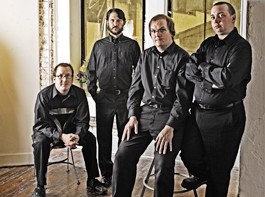
T he Omaha quartet Cursive’s artistry and acclaim have grown steadily since the band formed in 1995, making them one of the 21st century’s most consistent critical contenders for the title of indie rock’s Great White Hope. But that doesn’t mean they can’t still enjoy the simple pleasures of the rock life.
“I just love our gear,” guitarist and vocalist Ted Stevens says, “and I’d rather drive with it every night then risk losing it.” By way of rental car, the band returns to the Phoenix this Saturday as part of a short West Coast trek built around a highly anticipated appearance at San Francisco’s Noise Pop Festival. Just don’t call it a tour. “It’s not so much a tour as a flight to California, then a series of gigs,” Stevens says.
Consciously trying not to burn out with extensive touring, Cursive are in continued support of 2006’s Happy Hollow, their most unified concept album yet with a state-of-the-union lyrical view that contrasts the heartwrenching navel-gazing of previous records Domestica and The Ugly Organ. With songs like “Dorothy at Forty” and “Flag and Family,” the album’s dissection of small-town America’s disillusionment and hypocrisy have earned Cursive favorable comparisons to Springsteen, and its ubiquitous five-piece horn section has all but killed any inadequate emo pigeonholing. The band headlines Petaluma’s Phoenix Theater on March 1.
“We’re definitely getting to a point where we’re going one direction and people are either going to take that road with us or decide it’s not for them,” says Stevens who, in addition to lead singer Tim Kasher, writes the band’s material. Their productivity has already birthed 50 or so unreleased songs that will debut at upcoming shows, where they’ll be joined by a sax/flute/organ player to replicate their expanding sound.
“The new songs are only similar to Happy Hollow in the fact that they’re probably as drastic a change from anything we’ve done, ” Stevens says with a laugh. “I think people who understand the shifts the band has taken from album to album will expect it from us, hopefully. Tim’s got a new one called ‘Caveman’ that I like; it’s got more of an Elvis Costello vibe to it.”
As for his own musical progression since joining the band in ’99, the ever-humble Stevens, also of the recently reformed Mayday, remains true to form but appreciative of Cursive’s benefits. “I don’t think of myself as a good player, and I feel it’s taken me a couple of decades to make some progress with the instrument,” he says. “Maybe I lack the motivation personally, but the band keeps me playing the guitar a lot. I can’t say I’d ever play this much guitar if the band didn’t tell me to.”
Cursive play the Phoenix Theater on Saturday, March 1. The New Trust and Santiago open. 201 Washington St., Petaluma. 8pm. $15. 707.762.3565.
First Bite
02.27.08
E ditor’s note: First Bite is a new concept in restaurant writing. This is not a go-three-times, try-everything-on-the-menu report; rather, this is a quick snapshot of a single experience. We invite you to come along with our writers as they—informed, intelligent eaters like yourselves—have a simple meal at an area restaurant, just like you do .
Architects aren’t the only ones who know that buildings have souls. Restaurant-goers know that, too. And so it is that the building at 620 Fifth St. in Santa Rosa has long been mourned as the former home of Cafe Lolo, a Frenchified haven for seriously good-food-starved Santa Rosans. Two short-lived places tried briefly to illuminate this small space, and now Lolo alum, chef Brian Anderson, has returned with sous chef Adelaar Rogers to put the soul of the place back in order.
Opened just the first week in February, Bistro 29 was packed with twenty-somethings and other adventurous eaters on a recent Friday night. Tables are close together as in a traditional bistro and the high-ceilinged room is painted an attractive deep red and finished with bronze touches that will patina as the years flash by.
And flash by they will, as Bistro 29 is a keeper, a chic place that the after-work crowd can fall into and have an honestly prepared plate of excellence for a reasonable price, no pretensions or unnecessary frills welcome. (The wise are advised to “fall into” the place with a reservation well in order. We watched sad-eyed legions turned away from the hopping dining room by the professional serving team.)
Buckwheat crêpes are the true soul of Bistro 29 itself, and they find their way crisped as croutons into the baby green lettuce salad with fine herbs and a Champagne vinaigrette ($6) and as the toast in the Soupe des Johnnies ($7), a French onion soup finished with hard cider rather than the traditional cognac. Crêpes (all $10) have their own course on the menu, the rich and salty duck confit version napped with garlic thyme jus and freshened with a sprinkling of frisée.
Winter entrées range fruitfully among the hearty and the filling, including the de rigueur roasted chicken ($19) that defines a bistro, and the hanger steak with pommes frites ($20), a perfectly tender cut that arrives with a green herb butter slavishly melting on top. The cassoulet ($22) is in its own sweet little pot, a duck leg sticking lasciviously out from the creamy white beans, among which are hidden a melting slab of pork belly and a nice portion of Toulouse sausage.
The wine list favors North Bay vintages among a few French offerings, but runs dear, the average bottle ranging at $40 or so. A real coup was to find John Hawley’s Dry Creek Cabernet on the list, also at $40.
Not surprisingly, crêpes inform the dessert menu (all $6), with house-made ice creams and sorbet also beckoning, as does a chocolate fondant cake that sports a scoop of caramel&–sea salt ice cream. The “cafe gourmand” option is a three-item dessert tasting menu with coffee for a mere $9, but who has the room?
Bistro 29 has retained the small bar it inherited from Lolo’s, and one can easily envision sitting there with a glass of wine and a crêpe, quietly enjoying a $20 trip to a Paris of the mind. Now that’s some soul.
Bistro 29, 620 Fifth St., Santa Rosa. Currently only open for dinner, Tuesday&–Saturday. 707.546.2929.
Quick-and-dirty dashes through North Bay restaurants. These aren’t your standard “bring five friends and order everything on the menu” dining reviews.
High Above It
02.27.08
B ecause buildings are responsible for a vast amount of our daily CO2 emissions and have a larger impact on the environment than any other single element, high-density building and energy efficiency are a driving force behind architect Steve Sheldon’s vision of housing for a sustainable future. According to Sheldon, designer of the Florence Lofts, a new green complex in Sebastopol, sustainability in this case means getting to a point where the building project can sustain itself, ideally producing its own electricity and existing as a carbon-neutral zone.
As Sheldon gives me a tour of the property, I press him to further define sustainability. He explains that, in his view, the heart of sustainability is density. We need to limit traffic and movement by focusing on our urban environment, leaving our remaining open space undestroyed. The urban areas are for living, and should be used as such. For this reason, the 1.1 acres that contain the Florence Lofts are built to the maximum density allowed by town dictum. There are 12 live/work townhouses with an adjoining commercial building that contains retail, office space and a restaurant. Because the site sits just five blocks from downtown, and each of the living units includes a workspace, it would be possible to live here quite comfortably and never drive anywhere.
At 1,512 square feet per unit, including a downstairs office and upstairs living quarters, the lofts themselves are minimalist. Because the units are designed for maximum practicality as well as beauty, it’s easy to see how a small space can meet one’s needs. Each unit sports large windows allowing maximum sunlight in the winter and minimal direct sunlight in the summer, a plethora of built-in cupboards, cabinets and closets, and enough shelves to make this book junkie salivate with envy.
The wood used in the complex is certified by the Forest Stewardship Council, the steel framing comes from 80 percent recycled product, the paints are all clay-based and VOC-free, and the units contain dual-flush toilets. Everything, from the countertops made from paper stone (recycled paper) to the insulation made from recycled blue jeans and underwear, is as environmentally sane as possible.
There is a large research component to doing this type of work. Because green building is a relatively new field and new products are cropping up all the time, it can be difficult to find the best material for the job. There is little long-term evidence to rely on, and so Sheldon and his team have gone through the laborious process of tracking products from their inception to their place on the product line.
The entire site is permeable, including the paved parking lot. Water runoff flows into a bio-retention site, where it is cleaned of oils and residues by the resident plant life before being let out into the local waterways. All of the water coming from the laundry, bathing and hand sinks travels through a graywater system, which is then used in the subsurface irrigation to water the property’s landscaping. The extensive graywater reuse serves as a perfect example of what this project means on a grander scale. To live here, tenants must buy into the idea that building and living in an environmentally conscious manner is essential to our survival. This means no dumping paint thinner down the drain, as everyone’s plants will shrivel and die.
The electrical system, too, demands group consciousness. Photovoltaic panels cover the roofs, and a grid-tied system is in place allowing power to be moved from building to building, wherever it is most needed. The less electricity used, the lower the monthly owner’s dues. Rather than run AC systems during the summer months, water from the heating and cooling system sprays onto the roof at night where it cools before flowing back into the tank and providing lower temperatures for the buildings during the day.
As Sheldon walks me through the lofts, which start in the high $700,000s, I can easily envision myself living here. Of course, I would have to get rid of the children. Sheldon assures me I can have a dog so I won’t be too lonely. The office downstairs will be the perfect space for writing my bestseller, and the loft, though small, is ideally suited for entertaining. As I trudge back to my car, the permeable gravel crunching beneath my feet, I envision this life for myself: childless and independently wealthy with closet space and finally enough bookshelves. While hardly feasible for me, I imagine that there are people out there for whom this could be a reality. In which case, perhaps they would not mind asking me over for dinner.
Going for the Gamble
02.27.08
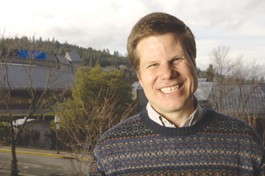
My point of view about Shakespeare,” says Bill Rauch, “is that—and maybe I’m a crazy person for saying this— I just want the artists who are interpreting the play to show me that there is risk being taken. I love risk. I don’t want safe, comfortable, recognizable Shakespeare, at least not all the time. And that’s pretty much how I feel about the art of theater in general.”
For the record, Bill Rauch is not a crazy person (not yet, anyway), but as a longtime stage director at some of the best and boldest stage companies in the country, he has proven that he is a risk-taker, one who enjoys working with other risk-takers as well. As the new artistic director of the 73-year-old Oregon Shakespeare Festival in Ashland, Rauch has already taken significant risks in the 12 months leading up to this opening month of his first full season in the captain’s seat, which he takes over from the equally iconoclastic but increasingly predictable Libby Appel, who has retired after 11 years as artistic director.
Since winning the appointment last year, Rauch has made significant changes in the festival’s personnel, bringing on new faces while saying goodbye to a number of longtime staffers. He’s taken a new direction in terms of the overall artistic environment, onstage and off, restructuring the organization of the company and how decisions are made. Most importantly, of course, Rauch has pushed the envelope in programming the current season of 11 plays, four of which opened in late February, with the rest opening gradually over the next several months.
This year will see a number of new things on the three festival stages, including a grand new staging of Thornton Wilder’s Our Town, marking the first time an American classic will be performed on the outdoor Elizabethan stage. There are a number of new plays, including Welcome Home, Jenny Sutter, a world premiere by Julie Marie Myatt, an imaginative drama about a returning Iraq soldier that will move, OSF cast intact, to New York’s Kennedy Center later this year.
Also new is the comedic Further Adventures of Hedda Gabler by Jeff Whitty (he wrote the Tony-winning Avenue Q), a play that Rauch directed an earlier draft of two years ago at Southern California’s South Coast Repertory theater, and which he’ll be directing again this year. Though it happens to be the oldest, perhaps the freshest thing onstage this year is the Sanskrit epic The Clay Cart, which marks OSF’s first presentation of a classic from the non-Western world. Directed by Rauch, it’s the play that launches the new season.
As for works by Mr. Shakespeare, Rauch has programmed a balance of rarely performed plays and beloved crowd pleasers (we said he wasn’t crazy), including the just-opened Midsummer Night’s Dream (with A Comedy of Errors and Othello in the summer), and the bloody and brooding Coriolanus (which opens next month).
About this new season, Rauch says, “One of the things I’m most excited about is that we do a combination of classics and new work, and so to be able to invite so many of the writers that I’ve worked with over the years to create work for Ashland or to do existing plays of theirs here is very exciting to me.”
Coriolanus is a play that is rarely performed, partly because of the intensity of its themes: war, political duplicity, inanity in leadership. “Coriolanus is one of my favorites,” Rauch says. “It’s such a constantly relevant play, especially right now. It feels very important. I’m really interested, every time we approach a Shakespeare play, in treating them like a brand-new play, a world premiere. I think that’s essential. I want to hire artists to interpret these plays who feel the same way.
“I do have a commitment to doing the whole Shakespearean canon,” Rauch adds. “Given that Shakespeare is our middle name and given that we do an average of four Shakespeare plays a year, I think that one of the things that’s exciting is that we can tackle not only the plays that are crowd pleasers—the plays that people love to see over and over again—but also to tackle the more difficult texts. That’s really important to me.”
Does this mean that productions of Shakepeare’s long-absent Cymbeline, Timon of Athens and Henry VIII are not out of the question for the near future?
“Why not?” Rauch says. “I believe that, on one level, we all want to be comforted by what’s familiar. But I’ve also realized that, ultimately, people come to OSF for more than comfort.
“Beginning this year, I plan to start offering a lot of surprises.”
For information on the 2008 Oregon Shakespeare Festival, go to [ http://www.osfashland.org ]www.osfashland.org.
The Local Angle
OSF draws a large North Bay contingent
Over the years, a hefty number of North Bay performers have emigrated north to strut their actorly stuff on the multiple stages of the Oregon Shakespeare Festival in Ashland. But not everyone is interested in being onstage, and there have been just as many, if not more, who’ve joined the ranks of the OSF as part of the vast backstage crew and support staff.
“There are a lot of us up here,” agrees set builder Elib Crist-Dwyer, formerly of Healdsburg, now a full-time scenic carpenter with the OSF. His first taste of the Oregon Shakespeare Festival came courtesy of a Healdsburg High School field trip, during which Crist-Dwyer dreamed of someday being the guy who raises the flag before every outdoor performance. A dozen years later—following a long stint building exhibits and creating educational theater programs for major museums—he has joined OSF’s mighty team of scenic carpenters.
He’s worked on sets for the current season since September, helping to construct an enormous green foot for The Clay Cart, set in India; an urban “forest” for A Midsummer Night’s Dream; and the detailed, multilayered backyard set of August Wilson’s Fences. Recently, he’s been building stair units for April’s upcoming production of Shakespeare’s sweeping Coriolanus.
While happy to be a behind-the-scenes player in an organization as massive and far-reaching as OSF, Crist-Dwyer hopes to someday ease into the company’s expansive education operation.
“That’s my real passion, and it’s one I share with the OSF—using theater as a way to teach people about the world,” he says.
Former Occidental resident Patrick Devon graduated from Analy High School and participated for several years in SRJC’s annual Summer Repertory Theater program, where he honed his craft in the ’80s as a dresser. It’s a skill he has since practiced with companies from San Francisco to England, where he worked in the wardrobe department of the renowned Royal Shakespeare Company. He’s been with OSF for three years.
“Basically, I dress naked people,” he says. “Also, a lot of being a dresser here is about protecting the actors from all the forces that might want to distract them from the performance at hand, people sending notes backstage and that kind of thing. We’re part costumer and part gatekeeper.” This year, Devon is working The Clay Cart and A Midsummer Night’s Dream, each of which has several rapid costume changes. “Everything is choreographed,” Devon says, “down to who moves left when someone moves right. Sometimes we only have 70 seconds to completely change a costume. It takes a lot of practice to get it right.”
An aspiring playwright, Devon was drawn to the OSF in part because of the company’s legendary support of its members’ extracurricular activities. In Devon’s case, he’s been able to stage his plays at special midnight showings, using first-rate actors from OSF’s stable of performers, drawing audiences from within the company and the surrounding community. His best-received play, Peaseblossom, is a comic romp telling the story of A Midsummer Night’s Dream from the point of view of the fairies “Getting to do my plays here is huge,” he says. “I’m fortunate to work with a company that supports its people so well.”
That’s how June Cummings feels.
After 20 years living in San Anselmo, Cummings and her husband moved up to Ashland three years ago, and she now works as an IT hardware technician, keeping all of OSF’s 280 computers and printers running, while also running cables for the various show’s sets and computerized equipment. “I’ve crawled through every inch of every theater and office in this place, from the basements to the ceilings,” she laughs. “I’m literally all over the place.”
Her favorite perk is being able to bring her dogs to work, where OSF has built an indoor dog run so the puppies stay happy.
“It’s wonderful here,” Cummings says. “And my job is great because it’s all about fixing things that need to be fixed. I’m not an actor, but this gives me my little bit of fame, because everyone appreciates the hardware technician. It’s really fun to always be the hero.”
Museums and gallery notes.
Reviews of new book releases.
Reviews and previews of new plays, operas and symphony performances.
Reviews and previews of new dance performances and events.
Letters to the Editor
02.27.08
Chickie-nobs®
Although Joy Lanzendorfer’s article “Replicant Repasts” (Feb. 20), didn’t encourage the cloning of meat, it completely failed to mention perhaps the most detrimental effect of the FDA’s approval of cloned meat in our nation’s food supply. Yes, small farms would suffer; yes, there could be health risks. But the biggest problem will be with the nature of this decision’s consequences on diversity. As recently explained by Verlyn Klinkenborg of the New York Times, this decision has nothing to do with the well-being of consumers or Mother Nature, but rather the large meat-industry corporations. “[They] would like it best if chickens grew in the shape of nuggets,” Klinkenborg wrote.
With money-hungry corporations in control, the most economically sound breeds will prevail, leaving all others in the dust—and the genetic diversity can only narrow. This decision is only the beginning of a quick downward spiral to not just a single breed of each animal, but a single genetic makeup. One by one the animal breeds will disappear, leaving consumers with less and less choice, and our once-rich-with-diversity farm animal kingdom poorer and poorer. Imagine living in a world where every steak tastes exactly the same as the next because every cow has the exact same genetic makeup as the next. This landmark decision is opening doors for money-hungry corporations and closing doors for citizens and Mother Nature. If we don’t act immediately to protect our planet’s diversity, there will be no turning back.
Emma McDonell, age 17
Sebastopol
Good Grief, Man!
Good grief, Templeton! Men dressed as nuns are not funny (“Sisters of Dreary,” stage review, Feb. 20). What’s more, women dressed as nuns—old-fashioned, habit-wearing nuns—are not funny. That was then. This is now. Get over it! The reason this production “presents a new low in high camp” is because the set-up is ho-hum with a zero punch line. Nunsense had a decent run. But it’s over. Move on.
Michael McCauley
Woodacre
Humane death ha, ha
I appreciated Christina Waters’ article about the “back to the pasture” movement (“The Meat of the Matter,” Feb. 20). I have been a vegetarian for 15 years now, but I am heartened that there are ranchers and farmers who are improving the lives of farm animals by raising them in a more humane fashion than the large, intensive factory farms do. And I am glad that better options (local, more humanely raised) exist.
There was one part about how animals are “taken to a family-run slaughterhouse and dispatched as humanely as they were raised.” I am sure that those pigs lived a far better life than their counterparts in factory farms, but I doubt that they were “humanely” killed. Most slaughterhouses, even small ones, use the same practice when killing animals. They are hung upside down by one leg, have their throats slit and then bleed to death while still conscious. It is a painful, terrifying and violent death.
I hope that while people choose a more humane option (and I am truly glad that they can), they don’t delude themselves into believing that the animal died a “humane” death. I also suggest that they contact farmers directly to ask for details on how the animals that they are eating are raised, transported and killed.
Rachel Cadman
Santa Cruz
Dept. of corrections
In our heated rush to convey immediate wisdom about the Sonoma Meat Buying Club and perhaps sway certain check-book-wielding family members that it was a great idea for journalists and artists and students to have rockin’ meat monthly delivered in a cool designer bag avec beurre, we evidently made a few teeny tiny errors (“Meat the Makers” sidebar, Feb. 20).[Marker]
Sonoma Direct president Marissa Guggiana gently points out that not all the meat from local ranchers is certified organic; evidently, one side of the phone interview was operating on wishes and sloth. She further refutes our sloppy assertion that she thought the whole darned thing up and then UC Davis just came rushing over to help. Rather, the University of California had the idea first. Guggiana was delighted to help. As always, apologies and etceteras rain down.
The Ed.
distinctly meat-headed
Getting the Point
02.27.08
The first time he did it, David Van Arsdale was extremely wary. The site was an out-of-the-way corner of a Santa Rosa supermarket parking lot, next to cartons of wilted lettuce. Van Arsdale didn’t say much, just did his business and got out of there. Eventually, over the years, he started chatting with the other people there. But not that first time.
“You kind of had to expose what you were doing. It was difficult at first,” Van Arsdale recalls. He kept up a jittery watch in case law-enforcement types were lingering nearby.
What kept him coming back was the chance to swap his used syringes for new ones. No more rubbing a matchbook flint across the point of a well-used syringe, trying to get it sharp enough for another injection. No more using the same needle 50 or more times to inject cocaine. “When you’re using a dull point, you know, you get a lot more pain,” he explains matter-of-factly.
Before needle exchanges were legalized in 2000, volunteers throughout California operated them clandestinely. Sonoma and Marin counties now both have active needle exchanges, and both participate in the statewide Disease Prevention Demonstration Project enacted in 2004 that lets addicts buy 10 syringes at a time from select pharmacies, no questions asked. If used syringes are properly housed, they are not considered as illegal drug paraphernalia. Napa County officials are studying the on-the-street exchange programs and the statewide pharmacy project, looking at what might work best there. In a bid to slow the spread of HIV and hepatitis C, both Marin and Sonoma counties are working to expand their exchange programs to reach ever more addicts.
Planting Seeds for Recovery
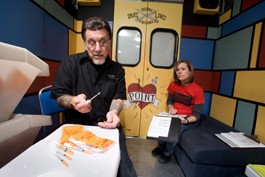
On a Friday night in January, a volunteer who asks to be known only as Pinky set up folding tables, bringing out boxes of syringes, piling up lunch-sized brown paper bags, and arranging cottons swabs, alcohol wipes, bio-disposal buckets and other items in an informal display in the lobby of a Santa Rosa office building. The tables also held abscess kits for cleaning infected injection wounds, and a notebook-sized book called Getting It Right: A Safety Manual for Injection Drug Users.
There were small containers of sterilized water for safely diluting drugs. A pot of soup simmered in a hot pot on one table. On another, Pinky arranged condoms, hotel-sized soaps, deodorants and a wide variety of wallet- and pocket-sized pamphlets on AIDS, safe sex and other health alerts for places that provide help for a wide range of problems or life situations. In a conference room nearby, a health professional was on hand to do AIDS testing if needed. Under one table was a box of clean clothes, available to anyone who needed them.
Almost every Friday for the past 10 years, Pinky has set up a needle exchange. “It’s something that needs to be done,” she says of her long-term commitment as a volunteer. “These people, most of the time they don’t get treated with the courtesy they deserve. We’re just trying to keep them safe, as far as getting sick and getting diseases.”
Pinky estimates that, in slightly less than three hours on an average Friday evening, about 45 to 50 people will drop by to replace their used syringes with new ones. Some come after they get off work, others before they start the night shift. About 10 or so arrive by bicycle, but most drive. “A lot of them have nice cars. They’re working and just trying to get by. Some are homeless, but I think the majority are working-class,” she says.
Sonoma County’s needle exchanges are run by the Sonoma County Hepatitis AIDS Risk Reduction Project (known as SHARP) under the organizational umbrella of the nonprofit Drug Abuse Alternatives Center (DAAC).
Over a year’s time in Sonoma County alone, SHARP estimates that some 100,000 to 150,000 needles are exchanged by roughly 250 to 350 different people. Last year, about 60 of those addicts got into some form of treatment for substance abuse.
“That doesn’t mean that person didn’t use after that time or not. We don’t know,” explains Lynn Campanario, who oversees SHARP’s exchange. The primary goal, Campanario says, is a clean needle every time an addict shoots up. Reusing a syringe can create a barbed point at the needle’s tip that can cause an abscess prone to infection. Sharing a needle means risking AIDS or hepatitis C. Addicts who need medical care rarely have health insurance; if they get ill, the community ends up paying for their care.
Another goal of the exchange, Campanario says, is to “plant seeds” so that eventually an addict might start thinking about getting out of a dangerous living situation, might leave a destructive relationship, might at least toy with the idea of rehab.
Talk Therapy
Over the years, the number of needle exchange sites in Sonoma County has waxed and waned depending on funding. Both SHARP and DAAC coordinate their efforts with Sonoma County’s Department of Health Services, which also provides some financial support. The rest comes from grants and donations.
Last September, the agencies won a five-year, $75,000-a-year state contract to expand the services offered through the needle exchange. They’ve subsequently added mobile exchanges in Guerneville and Monte Rio. During the first two months in Monte Rio, they took in more than 5,000 used syringes. That’s 5,000 needles that won’t turn up on local sidewalks, parks, garbage cans or vacant lots.
The plan is to continue to expand the program by adding sites in Petaluma and western and northern Sonoma County. The $75,000 annual state grant will also be used to set up a training program for overdose prevention and for those known as “primary exchangers,” people who turn in used needles and get new ones both for themselves and for their friends. Under the grant, primary exchanges will be offered incentives to act as peer counselors, passing on information to addicts who might otherwise have no contact with public health representatives or other officials.
A “ladies night” has already been added by SHARP on Thursdays in Santa Rosa, in partnership with Women’s Health Specialists. For two hours each week, female addicts can drop by, exchange needles and hang out in a safe space.
“We talk with them about whatever they’re wanting to talk about,” Campanario says. “It’s a very relaxed environment.”
They’ve already offered a night of free manicures, and volunteers will provide massages one evening. Such treats are not just for relaxation. The manicure night included information on hepatitis C risk from sharing nail clippers or a toothbrush.
It can be extremely difficult to find a site to hold a needle exchange. Not every suburban enclave welcomes one in the neighborhood. Therefore, the exchanges frequently end up outside in parking lots, which is less than ideal in the winter months.
One alternative is the pharmacy program, where addicts can buy syringes over the counter. It works for some people, but not every addict is willing to walk into a pharmacy and ask to buy syringes. Needle-exchange programs in the community are more discreet and they provide more than just fresh syringes. “One of the big things that we do is give resources on housing, food, shelter,” Campanario says. “We’re not just talking to them about how to deal with their drug-use stuff, because people don’t use in a tunnel. They have a whole life going on.”
It’s vital that volunteers and staff never try to persuade anyone to do anything, Campanario says. She points out that people who feel pressured or judged are unlikely to be return clients. A slow approach usually works best.
“When you’re talking to folks who come in to needle exchange, the hardest next step is to talk to them about their sex partners. So if we’ve built a good rapport, then that’s what opens up that door. I couldn’t do that the first time I talked with them.”
Blasting Social Stigma
The first woman points to the smallest possible size and says she wants that one, but her friend gently dissuades her. The first woman looks middle-class, dressed casually in a running suit, while her friend is clad in a stylish leather coat and would easily look at home in a Nordstrom’s or Neiman Marcus.
They could be discussing shoes or blue jeans, but they’re actually eyeing various sized syringes displayed in a former delivery van in a deserted parking lot in Marin County.
“The small ones jam easily,” the friend explains.
“Oh,” the first woman says, deciding that she wants a slightly larger syringe. She exchanges 80; her friend swaps 110, for herself and for friends who aren’t willing to come to the exchange van.
“The needle exchange is all about blasting through the social stigma,” explains volunteer Julie Muskat after the two women exit the van with their fresh syringes.
Muskat started volunteering as part of an ethics class, and stayed on after she satisfied her community-service requirement. “The work here is so helpful to the community, and if I have the time, why not help out?”
Muskat’s biggest eye-opener was the range of people who exchange needles in wealthy Marin. “You really don’t know what to expect,” she explains. “You quickly realize you can’t tell an intravenous drug user from anyone else. All kinds of people come here.”
The exchange is run by the Marin AIDS Project under the direction of point coordinator John Fenech. He worked in Sonoma County’s program for several years, and about three years ago took the job running Marin’s Project Point. In fiscal year 2006&–’07, they exchanged close to 80,000 syringes in 662 separate transactions.
“People come to needle exchanges in Escalades, in $50,000 Mercedes. You wonder, ‘Is this person parking in the wrong parking lot?'” Fenech laughs.
Although Marin County has more than a dozen pharmacies participating in the statewide exchange program and Sonoma County has two, Fenech says a lot of local addicts don’t want to get their syringes from a public store. “They can go to an exchange site and know they’re less likely to see their neighbors,” he explains.
One of the problems is that the average person has a jaundiced view of needle exchanges, believing that they perpetuate the use of drugs.
“I’ve been in recovery for 20 years, and I’ve never heard an addict say they got clean because they couldn’t find a clean syringe,” he says, laughing again.
“An addict will use any needle that they can find if they can’t get a clean needle,” Fenech asserts. “I’ve heard stories in recovery about people who’ve been with someone where the other person OD’d. Here’s a syringe hanging out of [an] arm, and the guy looks at it and says, ‘That must be really good stuff,’ and takes the syringe out of the dead person’s arm and injects himself with it.”
Needle exchanges, he adds, are about dealing with people as they really are, not as the community might want them to be, and reducing potential ways they might harm themselves.
“In reality, most people don’t get into recovery,” Fenech says. “So this keeps them safe, ‘healthy.’ A person could inject themselves for the rest of their lives and not get infected if they use needle exchange.”
He tells a story about his daughter, a hospital emergency room nurse. Sheriff’s deputies brought in a woman for a health check before taking her to jail on drug-related charges. The woman wore an oversized flannel shirt that she kept pulled down over one hand. “My daughter talked to her for quite a while about how important it was to let them see her arm,” Fenech recalls. “Finally the woman showed her arm. It was dead from her elbow down.”
An injection site had abscessed and gotten infected. Some of the bone was eaten away. Most addicts, Fenech adds, won’t seek treatment for an abscess because they don’t want anyone to see the needle tracks or know that they shoot up drugs.
On a lighter note, Fenech says there’s always a handy excuse. “I’ve never met so many people with infected spider bites in my life. Spider bites. That’s what they say.”
But They’re Just Junkies
Why are all of these volunteer hours, thousands of dollars and professional exertions being made to care for junkies? Who cares? Timothy Maroni, the syringe-exchange-program specialist for the Oakland office of the Harm Reduction Coalition (HRC), a national advocacy group, says that needle-exchange programs have a positive impact.
“There have been studies that have been inconclusive on different aspects, but overwhelmingly when they do a study, the evidence is clear that syringe-exchange programs save lives, save dollars, prevent infections, prevent destruction of families, keep syringes off the streets, are an excellent treatment entry point—all of those things.”
Based on studies, it’s estimated that only 15 percent of intravenous drug users are currently in treatment, and that syringe exchange has a two- to six-fold protective effect against HIV risk behaviors. Research also shows most people relapse several times before finally quitting. The goal of a harm-reduction approach is to keep them safe until they can get clean.
Maroni works with 39 needle-exchange programs statewide. He says such programs are one of the few places where addicts can be honest about who they are and what they do.
“Being in the closet is problematic and makes it hard to make behavior changes, to really look at yourself. And it’s hard to dialogue because you can’t speak,” Maroni says. “When people access services, they want to bring all of themselves, not just a part. They feel they have to lie in order to get services; they have to say they’re working on abstinence.”
Most injection drug users are socially isolated, and have small or nonexistent social-support networks.
“Every human being does have value,” Maroni stresses. “Everyone is worth saving. At [HRC], we’re all about being nonjudgmental, but that’s the one judgment we do have: that all human beings are complete, whole, worthy and valuable.”
From the Bottom Back Up
After his initial visit to that supermarket parking lot, David Van Arsdale continued using the needle exchange. Gradually he began to relax. “They treated me with respect. Nobody was there to corner you or to try to steer you towards recovery. They just took care of business.”
He started injecting cocaine back in his native Iowa, where it was legal to buy needles across a pharmacy counter, no questions asked. He relocated to California with a goal of getting away from the drug scene, but wound up in a motel his first day here, shooting up. And he quickly learned that clean syringes were a lot harder to get in California.
So he used and reused his needles. He knew friends who fashioned home-made versions out of little eyedroppers. “The value of a hypodermic needle was like gold,” he recalls. “You’d take the plunger out and use earwax to get it to slide back and forth. I used a syringe so often you couldn’t even read the numbers on it.”
Then another addict told him about Sonoma County’s needle-exchange program. For the next 15 years, he was a regular. The exchange had to move a couple of times, and he followed it wherever it went. He’d roll up on his bicycle, wearing headphones and be-bopping to the music. That became his connection with Fenech, who was then working in Sonoma County.
“We started talking about music. We kind of became friends,” Van Arsdale recalls. “When I came to exchange my needles, he never applied any pressure to get me into treatment. He always had time to come and sit with me. Sometimes they’d be serving food and I’d get a bowl of soup, and he’d sit down and talk.”
Van Arsdale was in and out of county jail on a variety of charges. A little over six years ago, he was arrested again, and this time there was talk of state prison. “I had kind of worn out my welcome on the county level,” he explains wryly.
At that point, Van Arsdale was 46 years old and out of options. He contacted the last friend who would accept calls from jail and had her get word to Fenech, asking him to visit.
Fenech came on a Saturday afternoon. “I told him, ‘Man, I need to do something about this problem,'” Van Arsdale recalls. By Monday morning, a representative of a local program was meeting with Van Arsdale in jail. He was admitted to the Turning Point rehab facility.
It was the threat of prison that steered Van Arsdale toward rehab, but it was his friendship with Fenech, nurtured through the needle exchange, that helped him find his way. [Marker]
Last December Van Arsdale celebrated six years clean and sober. He now works for DAAC as a counselor in the Sonoma County Drug Court program. He truly understands how hard it can be to kick a drug habit.
His advice? “If you’re out there using, utilize the needle exchange. It saves money, not to mention lives.”
Exchange Centers
In Sonoma County SHARP keeps its exchange sites confidential. To find out where they’re held, call the recording at 707.527.5277. For more information, including names of syringe-exchange pharmacies, or to volunteer or donate, call 707.544.3295, ext. 342. The SHARP office is located at 2403 Professional Drive, Santa Rosa.
In Marin County The Project Point van visits Mill Valley on Monday from 6pm to 8pm in the Park & Ride lot at the Stinson Beach exit off Highway 101. On Thursday, it’s in Novato from 6:30pm to 8:30pm on Rowland Boulevard, 0.1 mile west of Highway 101.
Exchanges are also held Tuesday from 5:30pm to 8pm at the Marin AIDS Project office, 910 Irwin St., San Rafael. Exchangers can also come by the office Monday to Friday from noon to 4pm on a drop-in basis. For more information or lists of syringe-exchange pharmacies in Marin, call 415.457.2487 or visit www.marinaidsproject.org.
System of an Up

02.27.08
T he L.A. quartet System of a Down stuck out from the nü metal pack like a sore thumb with their 2001 breakthrough release Toxicity . The vigorous album contained dizzying tempo shifts, funk, humor and a worldliness to accentuate the obligatory Metallica riffs and periodic rebel yell. Much of the credit goes to lead singer Serj Tankian, who plays a solo gig at the Warfield on March 8. With tender Middle Eastern inflections and biting socially and politically conscious lyrics, Tankian is an original, and despite a band hiatus, he’s relishing his solo debut, last year’s Elect the Dead .
“I felt the exact same energy as I did recording System’s debut in 1998,” he writes in an email interview from his hotel room in Norfolk, Va., on the morning of a gig headling with the Foo Fighters. “That sense of open experimentation—it’s liberating because all the choices are mine.” Recorded in Tankian’s home studio, the album stays true to the System sound, as in the thoughtful yet abrasive “The Unthinking Majority,” but veers excitedly off course with strings and a guest spot from 25-year-old opera soprano Ani Maldjian. His lyrics even delve inward, as with the powerful account of romantic discord “Saving Us.”
“Elect the Dead is definitely a more personal album for me lyrically, and musically more progressive,” he says. “My next solo work will go further into the orchestral and jazz vibes.”
It’s always just a matter of time before the creatively restless Tankian immerses himself into the next project. In just the past few years, he’s released the bestselling poetry collection Cool Gardens and launched his Serjical Strike record label. His vigorous work ethic isn’t new. Prior to becoming a metal god, he earned degrees in marketing and business, and ran his own company developing accounting software. Whew. “It taught me how to be organized and efficient,” he says. “Now I apply that knowledge to running Serjical Strike and my other ventures.”
Far and way the most admirable of his projects is the Axis of Justice, a nonprofit political-action organization he formed with fellow musician-activist Tom Morello. The election year will bring some interesting events, including a new website (www.electthedead.com) rallying support for the abolition of the Electoral College and lobbying firms, and capping donations by corporations, among other domestic concerns.
Sitting on the sidelines has never been an option for the Lebanon-born Tankian, whose Armenian family’s stories of genocide were a part of his upbringing. “The world still prefers profits over people,” he says. “Sudan is a good modern case study for this and, unlike during the earlier part of the century when the Armenian genocide occurred, we have more immediate knowledge and facts on the ground about it hourly. We cannot afford to deny a known genocide for political expediency or any other reason.”
His family also informed his musical aspirations, particularly his father who sang traditional Armenian songs around the house. “Lucky enough for me, he does really enjoy my music and is one of my most trusted critics,” Tankian says proudly. “He himself is getting ready to write and record an album of songs in Armenian, which I intend to release.”
To the disappointment of their fans, Tankian and the rest of System of a Down have been vague at best about the implications and length of their current hiatus. Onstage, Tankian steers clear of System’s songs and usual performance style. “We have a more vaudevillian comical experience with poetic politics,” he says of his current tour, which is partnered with the eco-rock nonprofit Reverb to ensure a lighter ecological footprint.
Inquiring about his remix work, which has covered everyone from Dredg to M.I.A., I may have unwittingly prolonged System’s hiatus. “I enjoy doing remixes of artists I like. A remix album?” he ponders. “Hmm, never thought of it. Thanks for the idea.”
And when asked if he’s nervous to be having this much fun away from the band, Tankian responds with characteristically playful wit. “Why would I be nervous making the music I’m supposed to make, in any configuration or manner?” he retorts. “You write for more than one paper, David. Does it make you nervous?”
Yet another good point from Serj Tankian.
To learn more, go to [ http://www.axisofjustice.org ]www.axisofjustice.org.
The Tudors

02.27.08
There’s a satisfying actor’s duel in The Other Boleyn Girl between Scarlett Johansson as Mary and Natalie Portman as Anne of the Thousand Days. Corsets grievously squash Johansson’s curves, and her golden hair is besnooded, or covered with those little birdhouse roofs the fine English ladies of the Tudor era chose to wear on their heads. Natalie Portman wins handily, making a fine Vulcan scowl in the latter half of the film, to indicate her embrace of power politics.
Eric Bana has more stomp in his step as Henry VIII than he had playing the Hulk; the castles seemed to shake under his footfalls. (That particular king is a choice part for any actor—even Homer Simpson was once seen courting the blue-haired “Margarine of Aragon.”) Bana’s Henry is young and desirable, with good muscles under his ermines. But he is a monster of fickleness, and not at all a subtle lover. Henry’s courtship of Mary Boleyn consists of a single word: “Tonight.”
Like a bull, he’s not to be interfered with during rut. That interference is the essence of Anne Boleyn’s mistake in this version of her story. Based on the popular novel by Philippa Gregory, The Other Boleyn Girl shows the problem with the principle “true love waits” (for marriage, that is). Certainly, the expression “Till death do we part” meant something different to Henry VIII than it did to most husbands.
The film shows the background of the climbing Boleyns, whose uncle was the sinister Duke of Norfolk, Thomas Howard (David Morrissey, bouncing back nicely from some unfortunate work in The Reaping and Fatal Attraction 2). Under his guidance, his niece Anne is raised as a dainty dish for the king. His majesty is married, though, to Catherine of Aragon, the Spanish queen who won’t come up with the requisite heir and a spare. Ana Torrent is a good Catherine, handsome but not haughty, correctly playing the queen as one of history’s unfortunates. Not quite so watchable is Kristin Scott Thomas as the mother of the Boleyn sisters and as full of predictions of doom to come as all the dowager queens in Shakespeare’s Lancastrian cycle wrapped into one.
Director Justin Chadwick has been a longtime British TV director (Bleak House, etc.). The budget shortfalls show, particularly in an off-screen hubbub to represent how the public feels about the king getting rid of their religion in order to divorce Catherine and marry Anne. The scenes have enough clarity, though, and the cast overcomes most if not all of the slow learner’s class lines that pop up. But Chadwick neglects the parvenu side of the Tudors. Henry’s fretting about an heir makes a little more sense if you’re reminded that decades of civil war had occurred over the line of succession, not long before this king’s own birth.
The camera work on The Other Boleyn Girl is the true drawback. Chadwick seems determined not to be Masterpiece Theater&–ish, even at the risk of visual illegibility. This is partially the fault of critics, who are always bemoaning Masterpiece Theater compositions in costume dramas. At least those simple compositions are clear. Trying to avoid a static, too formal world, Chadwick goes for an eclipsed lens, as if all the scheming was seen from behind a curtain or through leaded glass. The camera lurches from pillar to post, and it always seems to have its hair in its eyes.
‘The Other Boleyn Girl’ opens everywhere on Friday, Feb. 29.
New and upcoming film releases.
Browse all movie reviews.
True Vinemen
02.27.08Celebrity winemakers and world-renowned vintners are a bit of a yawn in the North Bay, where we just generally call them "neighbors." Lesser known are the talented men who train the vines that produce the grapes that make the wine that earn winemakers and vintners such celebrity status in the first place. For the ninth year, such anonymous artistry...
First Bite
02.27.08E ditor's note: First Bite is a new concept in restaurant writing. This is not a go-three-times, try-everything-on-the-menu report; rather, this is a quick snapshot of a single experience. We invite you to come along with our writers as they—informed, intelligent eaters like yourselves—have a simple meal at an area restaurant, just like you do .Architects aren't the only...
High Above It
02.27.08 B ecause buildings are responsible for a vast amount of our daily CO2 emissions and have a larger impact on the environment than any other single element, high-density building and energy efficiency are a driving force behind architect Steve Sheldon's vision of housing for a sustainable future. According to Sheldon, designer of the Florence Lofts, a new green complex...
Going for the Gamble
02.27.08My point of view about Shakespeare," says Bill Rauch, "is that—and maybe I'm a crazy person for saying this— I just want the artists who are interpreting the play to show me that there is risk being taken. I love risk. I don't want safe, comfortable, recognizable Shakespeare, at least not all the time. And that's pretty much how...
Letters to the Editor
02.27.08Chickie-nobs®Although Joy Lanzendorfer's article "Replicant Repasts" (Feb. 20), didn't encourage the cloning of meat, it completely failed to mention perhaps the most detrimental effect of the FDA's approval of cloned meat in our nation's food supply. Yes, small farms would suffer; yes, there could be health risks. But the biggest problem will be with the nature of this decision's...
Getting the Point
02.27.08The first time he did it, David Van Arsdale was extremely wary. The site was an out-of-the-way corner of a Santa Rosa supermarket parking lot, next to cartons of wilted lettuce. Van Arsdale didn't say much, just did his business and got out of there. Eventually, over the years, he started chatting with the other people there. But not...
System of an Up
02.27.08T he L.A. quartet System of a Down stuck out from the nü metal pack like a sore thumb with their 2001 breakthrough release Toxicity . The vigorous album contained dizzying tempo shifts, funk, humor and a worldliness to accentuate the obligatory Metallica riffs and periodic rebel yell. Much of the credit goes to lead singer Serj Tankian, who...
The Tudors
02.27.08There's a satisfying actor's duel in The Other Boleyn Girl between Scarlett Johansson as Mary and Natalie Portman as Anne of the Thousand Days. Corsets grievously squash Johansson's curves, and her golden hair is besnooded, or covered with those little birdhouse roofs the fine English ladies of the Tudor era chose to wear on their heads. Natalie Portman wins...

Copyright © Weeklys All rights reserved.
Our Publications
