Naked

04.02.08

Considering the trials and the hearings, much of what went on in Afghanistan’s Bagram, Iraq’s Abu Ghraib and Cuba’s Guantanamo Bay is a mystery to the general public. It may have been dismissed as the deeds of the proverbial few bad apples. But Taxi to the Dark Side makes a case that those bad apples didn’t fall far from a very bad tree.

Documentary filmmaker Alex Gibney (Enron: The Smartest Guys in the Room) traces the greatest blunder of the Bush administration right back to where it originated. George W. Bush’s career-long interest in punishment, Donald Rumsfeld’s arrogance and Dick Cheney’s cold sadism made them inclined to covertly approve the mistreatment of prisoners. The legal defense by attorneys Alberto Gonzales and John Yoo gave the executives plausible deniability. Ridiculously hypothetical “ticking bomb” scenarios, as enacted on TV’s 24, were used as guidelines for policy. And of course, Bush and Cheney have already pardoned themselves in advance against the possibility of war-crime trials.

Taxi to the Dark Side digests news that journalists Tim Golden and Carlotta Gall reported in the New York Times, and it’s an entirely different matter to see it than read it. The film loops around the tragedy of one Dilwar, a “person under control,” tortured and kicked to death by our troops in Bagram. This enemy of our state turns out to be a 122-pound taxi driver, framed for money by one of our Afghan allies. 

Gibney demonstrates how the methods of psychological torture and humiliation migrated from prison camp to prison camp. Uncensored news photos demonstrate the stress positions, terrorizing and constant sexual humiliation inflicted by MPs. Here were troops so dim and overworked that they couldn’t even spell “rapist” when they scrawled it on a naked prisoner’s buttocks.

Having access to a 65-page report of Mohammed al-Qahtani’s surreal, even Monty Python&–styled mistreatment at Guantanamo, Gibney restages it in docudrama—a Saw-style stutter of digitized images. (Interesting that the MPAA approves the severed-head posters for Saw IV, but balked when this film tried to advertise itself with a hooded prisoner on its poster.)

The fruits of just such mayhem were the lies and misinformation a dutiful Colin Powell hauled to the UN. While this is tragic, harrowing viewing, there’s some skull-faced humor during a Guantanamo Bay junket. Naturally, the tour finishes at the gift shop, where one can buy a souvenir T-shirt reading “Behavior Modification Instructor, Guantanamo Bay.”

During the end titles, Gibney reveals personal knowledge of how the military can retrieve info and still keep its gloves on. The director includes a modest, two-minute demonstration of the correct method of info-gathering by former FBI agent Jack Cloonan, an open-faced party on the lines of Sam Elliott. He is persuasive. (After a few minutes with him, even I would have given him power of attorney.)  Interviewee Alfred McCoy, author of A Question of Torture, has perhaps the biggest picture; he claims that what went on in our antiterrorist gulag represents “a 50-year history of CIA methods.”

So this national shame may not be rooted in military discipline or a lack of the same. Rather, it’s rooted in the intelligence cult, a cultural class who believe in betraying American values in the name of American strength, and who believe that causing suffering in others is how we prove ourselves tough.

‘Taxi to the Dark Side’ opens Friday, April 4, at Rialto Cinemas Lakeside. 551 Summerfield Road, Santa Rosa. 707.525.4840.


New and upcoming film releases.

Browse all movie reviews.

Letters to the Editor

04.02.08

It would be great to read more of John Sakowicz’s thoughts about the economy (“,” Open Mic, March 26). He is bold enough to tell what needs to be told. Because I am a prosecutor, I would prefer to keep a low profile. However, being a prosecutor, I know how hard it is for people to expose the kind of wrongdoing that is apparently ruining our country and allowing a few individuals to profit. Most people are only vaguely aware of what’s going on. Bravo to your newspaper for publishing this, and please keep up the good work!

Name withheld by request

Centennial, COlo.

John Sakowicz has chilled me to the bone. He made me go find out about CMOs and CDOs. He made me wonder how many of America’s “enemies” are already working on his proposal. If Mr. Sakowicz is “scared shitless,” I guess we better invest in Depends, because we are in for a wild ride. Canada has never looked better.

Lori Leigh

Santa Rosa

Today I read the article by John Sakowicz on the very possible—and perhaps impending—collapse of the U.S. economy. What Sakowicz writes about is shocking yet believable in view of news regarding other countries and the incredible wealth and power that they have and are currently using to become richer and more influential. The Bush administration and the current election strategies are all steering American eyes and ears away from the impending doom that may be at hand. And the rich are getting richer. Meanwhile, average citizens like myself are the sacrificial lambs being brought to the slaughter so that others can feast.

Suzanne Lacy

Fremont

Clark Wolf wrote , except for his remarks that “everybody seems to hate somebody” (Our Town, March 19). His perception is way out of line with our experience. For the last 20 years, Joe and I have lived here on the river. We found a community where a wide variety of folks appreciate our local diversity, who have weathered a number of crises over the years with warmth and good humor. We tolerate, put up with and are occasionally annoyed by each other, yes, certainly. But I can honestly say that I don’t know many people who hate anybody, even if “just a little.” (By the way, Box Canyon is over in Boyes Hot Springs. It’s Pocket Canyon that Highway 116 runs through.)

The Sisters of Perpetual Indulgence (not “Drag Queen Bingo”) sponsor a great bingo event once a month at Odd Fellows Hall, not the Senior Center. If you really want to see diversity in action in a hate-free community, you should come to our town and see for yourself during one of our local parades, by attending bingo or even by going to one of our local churches.

Patrick Mahoney

Forestville

Clark Wolf responds: I can’t help but noticing the Forestville address which is indeed a sweet place just through the appropriate canyon. I’m delighted with his experience of Guerneville and glad that our more serious snips are apparently still relatively private.

Drag Queen Bingo at the Senior Center is a poetic amalgam of the reality. Love, hate, life, death—we embrace it all!

There are one (million) ways to make mistakes when a lean staff produces one (million) paper 52 times a year, often with just one (million) set of eyes. And so it was with the March 26 news story (“Freedom of Hate Speech”), in which the number one (million) just didn’t seem right when appended to the sum that former Novato High School student Andrew Smith was recently awarded. So we helpfully added one (million) more word, thus inflating Smith’s $1 award a MILLION times over. We offer 2 million apologies.

Also, those reading all the way to the bottom of the page may be interested to know that Peck the Town Crier (“Hist-Hop,” March 26) appears on Wednesday, April 16, as part of the Comcast Battle of the Bands at the Sweetwater Station, 500 Magnolia Ave., Larkspur. 7pm. Free. 415.388.7769. Most of the preceding sentence somehow fell limp to the cutting room floor.

Pausing from the litany of correction, we take a moment to shout out about what we’ve done more than right. We are proud as all heck to announce that former contributing columnist Peter Byrne’s excellent four-part series on Dianne Feinstein placed as a , announced last week. These national awards don’t weigh publications for size and circulation when they pit stories against each other, and so Peter finds himself in excellent company, listed ahead of the venerable Village Voice as one of four finalists out of hundreds of entries.

In more brilliant Boho news, this issue marks the start of Gabe Meline’s new role as full-time associate editor. Lucky, lucky us. Makes us feel like a million.

The Ed.

Shaking Hands, Thumbing Noses


&–&–>

Fabric of Her Life

0

the arts | visual arts |

Courtesy Lydia Van Gelder Warp and Weft: Retired SRJC instructor Lydia Van Gelder sees the yin and yang of life through art.

By Patricia Lynn Henley

Lydia Van Gelder’s hand moves gracefully through the air as she talks, first pointing left, then right, then off at a diagonal. Her gestures deftly illustrate her point that weaving goes actively in many directions, as does life itself.

“As things develop, some go in this direction, some in that. Whether you’re doing warp or weft, all these things enter into it. I could always see the possibilities developing into another direction,” Van Gelder explains. “That doesn’t mean that the direction we left has died. No, it’s just that there are others that have developed.”

Whether it’s patterns in fabric or patterns in living, there isn’t one right way, she adds. It’s all a matter of possibilities, relationships and choices.

“You work with dark and you work with light, and then go back and forth and back and forth. But then there’s a time when they come together. That’s true of most all the things we ever do in life.”

Now 96 years old, Van Gelder has literally spent decades exploring, developing and promoting fiber arts. One of her first major pieces, a heavily textured wall hanging titled Houses on the Street, was displayed at the Pan Pacific Exhibition at the 1939 World’s Fair on Treasure Island. It’s now part of the permanent collection at the Cooper-Hewitt National Design Museum in New York.

Van Gelder took such techniques as tatting or bobbin lace, which were traditionally used in small, delicate projects, and applied the same skills but with coarser handspun fibers on a larger, architectural scale. She also did extensive research and experimentation with natural and synthetic dyes. Three separate times she was chosen as one of 10 artists representing the United States in fiber exhibitions in Japan (Kyoto in 1987, Tokyo in 1988 and Nagoya in 1989).

In addition to teaching spinning, dying and weaving at Santa Rosa Junior College for 26 years, she was instrumental in starting spinning and weaving guilds throughout Northern California. Over the years, Van Gelder presented lectures and fiber workshops worldwide, and wrote two books on her specialty, the resistance dying process known as ikat. In 1994, she was honored as a Sonoma County Living Treasure in the field of visual arts.

This month, the Redwood Empire Handweavers and Spinners Guild honors Van Gelder with a small retrospective of her work in display cases at the Frank P. Doyle Library at Santa Rosa Junior College.

“Our problem is that we could only get a few pieces in the display cases. Lydia’s work could fill a gallery,” laughs Suyin Stein, who is organizing the exhibit and opening reception for the guild.

Stein adds that it’s astonishing what Van Gelder has accomplished in 96 years.

“She really has been a major player worldwide in fiber arts,” Stein explains. “It’s amazing that she lives right here amongst us. Lydia’s work is timeless. Some of it was made 50 years ago, but it’s as contemporary as if it was made yesterday.”

The pieces chosen for display range from wall hangings to the deceptively simple potholders and wildly colorful socks that Van Gelder has been knitting in recent years, often using yarn she has spun and dyed herself.

Socks and potholders may seem like rather prosaic items for a fiber artist, but they let Van Gelder explore patterns and designs without the strenuous activity needed for weaving, explains Kay Elsbree.

“She’s enthusiastic about fiber in all forms, whether it’s art or practical,” Elsbree says of Van Gelder. “She wants to see it done and appreciated.”

Elsbree is part of a group that took Van Gelder’s class for two semesters (the maximum allowed by SRJC) and then wanted to continue, so they’ve met weekly in each other’s homes ever since. Van Gelder joined the Tuesday night group after she retired from SRJC a decade or so ago.

Van Gelder was a wonderful teacher, always encouraging her students, says Sui Gouig, a member of the Tuesday-night group.

“If you ever ask her anything, she’ll say, ‘That sounds good, try it,'” Gouig laughs, adding, “She’s always been our leader and our inspiration to keep going and trying new things. We just really treasure her.”

Asked how many pieces she thinks she’s created over the years, Van Gelder laughs and says she lost track long ago. She started experimenting with fiber as part of her formal art training in the 1930s at the San Francisco Art Institute (then called the California School of Fine Arts). She married Homer Van Gelder in 1936. They settled in Lodi, moved to Fresno in 1950 and to Santa Rosa in 1963. They had three sons.

“As a child, I remember climbing through the pedals of her large loom,” recalls Roger, her third child.

Her husband ran a trucking venture, then worked for the state managing various farm associations. She began teaching at SRJC in 1968, and her classes often had a waiting list of eager students. Her husband was one of her strongest supporters, and after he retired, he spent a lot of time hauling gear and helping her set things up. He died in 1992.

She’s remained active in retirement, but in recent years has made a few concessions to aging. She’s gotten rid of her looms, which require a lot of physical activity, and concentrates on knitting instead. “It’s easier to carry a pair of knitting needles than it is to carry a loom,” she laughs.

She no longer drives, but when she can get a ride, she still attends the Tuesday-night group, the monthly guild meetings, and a weekly knitting session at a local bookstore. She eagerly displays the new potholder she’s starting, using circular needles and a tricky double-knit method.

“See this?” she asks happily. “This is starting the patterning. It’s dark and light. This is how it all starts.

“Such is life,” Van Gelder adds thoughtfully. “We get variations and we look into that, and one thing leads to another and things develop.”

As is often true, her words apply both to fiber arts and to life in general.

“There’s never anything perfect or just right. It’s always a little of this and a little of that, and each in its own way also makes and brings out an issue. You have to relax. Never fight a situation; just face it and see.”

The opening reception for Van Gelder’s exhibit is Wednesday, April 9, in SRJC’s Frank P. Doyle Library, 1501 Mendocino Ave., Santa Rosa. Free. 4pm. Her works will be on exhibit in the library’s display cases throughout April.

View All –>

Museums and gallery notes.

Reviews of new book releases.

Reviews and previews of new plays, operas and symphony performances.

Reviews and previews of new dance performances and events.

View All

Concert notes and news.

–>

A Vine Frenzy

0

04.02.08

Winery owners are rich, self-important snobs with no established connection to reality. They hire relatives to run their wineries whether those relatives know anything about wine or not. Wine country tourists are boorish inebriates who think grape-picking is glamorous. Wine-industry marketing executives think that successful winemaking is all about sitting down and thinking up advertising ideas. Wine country fundraisers boast idiotic slogans like “Helping Africa has never tasted so good.” Vineyard managers are potentially psychotic. Winery managers are clueless and high-strung. Ostriches, and other colorfully ill-advised winery attractions, pretty much bite.

Please calm down. These are not accusations. They are plot points.

In the hilarious new mockumentary Corked , made by Sonoma County wine-industry insiders, nothing and no one is spared from the razor-sharp, brilliantly knowing gaze of the camera. Imagine Waiting for Guffman set among sun-drenched vineyards, atmospheric wine caves and million-dollar tasting rooms. Throw in an obsessive-compulsive winemaker, some rude tourists, a number of billionaires, the de rigueur crazy people, a few loud explosions, one or two mobsters, some epic wine spitting and those damned ostriches, and you have Corked , written and directed by Healdsburg’s Ross Clendenen and Paul Hawley (a tasting room “ambassador” for Bella Vineyards, and the son of legendary Sonoma County winemaker John Hawley, respectively).

The film, shot in Sonoma County during the 2005 harvest and edited over a long three-year process rife with its own drama and comedy, has its world premiere next weekend at the cozily wine-centric 2008 Sonoma Valley Film Festival, running April 9&–13. The filmmakers and much of the cast will be in attendance.

“Most people at the festival are going to love the movie,” says Clendenen, a Healdsburg High School graduate who studied film in Southern California before returning to Sonoma to pursue his dual passions. “And one or two other people,” he adds with a laugh, “are going to be offended—maybe more than one or two.”

Scheduled for the festival’s popular lounge venue ensconced within the Sonoma Community Center, Clendenen and Hawley’s fast-paced satirical comedy is expected to be one at the hits of this year’s festival, precisely because it might offend a few people.

“As critical and satirical as we are with all of this stuff,” Clendenen says, “there’s a lot of affection in the film, too. We love this business. We wanted to show as much of the actual process of winemaking as we can, in a relatively realistic way, while poking fun at the craziness and outrageousness that sometimes occurs.”

With a budget equal to the cost of “a pretty good new car,” Clendenen says that he and Hawley, along with producer Brian Hoffman, set out to make a film that didn’t look low-budget. The filmmakers began with a large, detailed script that contained an extremely large plot. “It was like the Lawrence of Arabia of mockumentaries,” he laughs. “But then we ended up just focusing on our favorite parts and letting our actors improvise a whole lot, and that became the film. In the end, we just fell back on the script when the improvs weren’t working, which wasn’t very often.”

The film focuses on four wineries located in the Dry Creek region of Sonoma County, various characters competing for the all-important approval of a high-powered wine critic and for a first-place trophy in the fictional Golden Harvest Award festivities. Petaluma actor Jeffrey Weissman—known to local theatergoers and anyone who’s seen the films Pale Rider, Back to the Future II and III, Twilight Zone: The Movie , and, ahem, Sgt. Pepper’s Lonely Hearts Club Band —plays Jerry Hannon, a winemaker with his sights set on winning the coveted Golden Cluster trophy.

His character is based on John Hawley, the father of co-writer and director Paul Hawley. John was the very first winemaker at Clos du Bois, and as the chief winemaker at Kendall-Jackson from 1990 to 1996, helped that company rise from producing 600,000 cases of Chardonnay a year to over two and a half million cases annually.

“What was interesting with what Jeffrey did,” Clendenen says, “was that, most of the time, we could just wind him up and let him go, but for a lot of the harvest scenes, we had John right there on the set, because it really was harvest. Since we based the character of Jerry on John, we basically told Jeffrey, ‘Watch John. See what he does, and do that.’

“John gets very . . . neurotic, shall we say, during harvest, and Jeffrey captured that. We would literally pull John out of the real winemaking production process, if he was shoveling grapes into the hopper or something, and we’d put Jeffrey in there instead, shoot him doing what John does, and then let John go back to doing his thing.”

“It was amazing, I had my character study right in front of me,” Weissman says, anticipating that Corked could prove to be a breakout role for him. Weissman also credits his wife, Kimball, who manages the tasting room at Freestone Winery, for interpreting the wine-speak and stream-of-thought vintner trivia that was a part of his character. “There is always homework in making a movie,” he says. “There’s research that an actor has to do to prepare for his part. But in my case, my research was handed to me on a golden platter.”

None of that prepared Weissman for some of the winemaking activities he had to pull off, including driving an ancient tractor, scaling enormous fermentation tanks and climbing inside a closed-quarters storage tank. “I overcame claustrophobia to do that one,” he says. “I did a lot of breathing exercises.”

Now that the film is complete, with the big film-festival premiere set for next weekend, the filmmakers are setting their sights on selling Corked to a national distributor.

“I think we have a shot,” says producer Hoffman, “because I think we have something unique, we have something funny, we have something smart and we appeal to a wide range of people. I think this film will really be a hit among wine drinkers, and may become a cult hit among that demographic.”

If the film does reach the levels of success Hoffman sees as achievable (and why not? Corked is funnier than the last two Christopher Guest films put together), he believes that success will be largely due to Weissman’s performance.

“Without Jeffrey, we wouldn’t have as funny a film as we have,” Hoffman says, “and it’s a very funny film.”

‘Corked’ screens Friday&–Saturday, April 13&–14, at the Ravenswood Lounge within the Sonoma Community Center, 276 E. Napa St., Sonoma. 3:30pm. $10. 707.933.2600.


New and upcoming film releases.

Browse all movie reviews.

Was Wright Right?

0

03.26.08

At the end of March, the long-simmering issue of Barack Obama’s pastor finally came to the forefront, with members of the media stumbling over each other to see who could air the most offensive remarks ever made by the Rev. Jeremiah Wright Jr. of Chicago. So let’s take a look at some of the comments that got the most airplay and therefore broke through white America’s bubble and stirred up all those scary projections lurking beneath the surface.

— The good Reverend, like many of the rest of us, felt that this country had some responsibility in the 9-11 event of 2001. He didn’t even go so far as some white conspiracy theorists who believe it was an inside job. He merely observed that our foreign policy of the past few decades may have stirred up some resentment around the world. He stated that 9-11 was a result of God’s wrath, and since he is a preacher, I can see why God played a major part in his analysis. But skip the God part and go directly to our foreign policy as a factor, and you’ll have lots of folks across the globe in agreement. 

— The Rev. Wright, who may have read Gary Webb’s well-publicized series in the San Jose Mercury about a decade ago, has talked about how the CIA helped to get drugs into black inner city neighborhoods. Of course, Webb wasn’t the only one making this charge. I was part of a group that put on the Drug Peace Conference at SSU in 1990 where Oakland’s Uhuru House came and made the same charges. We were a bunch of pot advocates dealing with pot decriminalization long before Proposition 215 was ever an idea in some state legislator’s mind. Some among us felt that the Uhuru House’s position was way too radical, but time went on and the idea finally got mainstream attention, thanks to Webb and others. 

— Horror of horrors, the good Reverend pointed out to his congregation that Israel was occupying the Palestine territories and being kind of mean to the people they had uprooted and oppressed since 1948. That of course is a huge no-no, even with some on the left. One must run the possibility of being called anti-Semitic for observing what is obvious, so most people just shut up about it and the elephant in the room gets comfortable. 

— Then there is the specter of AIDS being introduced by the government as a genocidal weapon against black folks. Like the other comments, it is hardly a new idea, as some in the gay community have felt targeted this way since the ’80s. Whether it is true or not, it has been a widely accepted talking point. 

These are just a few examples of the Rev. Wright’s remarks that have received the most airplay, and they are all things that have been talked about for decades but are apparently new ideas to a lot of white folks. Gee, could there be a reality disconnect among our various diverse communities? Much of white America still believes that everyone sees reality through the dominant culture, and they continue to be shocked when they are reminded that our realities are and have been very different for centuries. 

One of the reasons for Obama’s appeal to these white folks is that he has seemed to extend his hand and smile unconditionally. In other words, no work is needed by anyone to really understand the ongoing damage done by our legacy of racism. We’ll just all get united, sing some inspiring songs together and get past all that has yet to be discussed or understood by those who most need to understand. We can all continue to feel good about ourselves as we are very tired of feeling guilty and wondering what we can do.

After all, the concept of white racism, which has been around for a while but not yet embedded in the collective consciousness, is such a downer. With Obama, we can just forget all of that-after all, he is half-white; just by being, he can unify us. And then reality crashes through with the words of his pastor, and all hell breaks loose.

As a white woman of more years than you need to know who has worked for over 45 years against oppression, I’m really pissed that Obama must go through all these explanations just to pacify those who either haven’t been paying attention or just don’t care. And that doesn’t even include those who are deliberately fanning the flames of overt racism. What I’m talking about here are just the misconceptions and ignorance that lurk in the subconscious of those well-meaning people who are now scared of Obama’s longtime friend and adviser. The Rev. Wright is a respected fighter for justice in Chicago’s black community who has beliefs that are shared widely with many in this country for a variety of reasons. Good for you Obama, that you refused to denounce him even though it may cost you some votes.


Camp Meeker resident Mary Moore is a longtime Sonoma County activist. Open Mic is now a weekly feature in the Bohemian. We welcome your contribution. To have your topical essay of 700 words considered for publication, write [ mailto:op*****@******an.com” data-original-string=”C64liXBw8xX4gobvXHHsEg==06aJfX8l9f+QZIuPW/jo3B+EBcvSkcxgcKkPzrOHOJgwt4b/sX9W0UBdPQb8xeZYxQmZxHJ3LrveBgGLVInP2iavXRiJR9eWmyr31ZF3xVnxL4=” title=”This contact has been encoded by Anti-Spam by CleanTalk. Click to decode. To finish the decoding make sure that JavaScript is enabled in your browser. ]op*****@******an.com.


Maybe I’m Crazy

0

04.02.08

The Odd Couple is this year’s album by yesteryear’s stars Gnarls Barkley, and it begins with a go-go beat, a toy xylophone and a chant of “Ooh-chk-aahh,” lifted directly from Lee Dorsey’s “Workin’ in a Coal Mine.” Savor this moment, because its coy pleasantries swiftly evaporate. A mere 20 seconds in, the album transmogrifies into a hellish, unbearable Dr. Phil universe of codependency and self-help entangled in a delusion of its own importance, and for the next 39 minutes there’s no way out.Like that crappy friend you hate running into who always complains about his life, The Odd Couple contains more neurotic wallowing than a Jewel message board: typical lines include “I’m not doin’ so good,” “Got some bad news” and “My life is a lonely one.” Danger Mouse, Gnarls Barkley’s producer, strains for liveliness with handclaps, Farfisa organs, congas and tambourines of 1960s retro production (or, to be more precise, late-’90s retro production of 1960s retro production—was he passed out on glue when Smashmouth, Austin Powers and the Propellerheads did this to death already?), but it barely lifts the album’s spirits. Worse, it clashes horribly with Cee-lo’s incessant moaning.

This is a far cry from the fun-loving, carefree Gnarls Barkley we once knew, a fake band who paired up almost as a fluke, didn’t take themselves seriously at all, dressed in wacky costumes and were forced to become a real band only when they scored the biggest surprise hit of the decade. “Crazy” appealed to just about everyone, but now they’ve followed that same formulaic avenue, littering the roadside with obnoxious pronouncements about human depression, aiming at the dippiest common denominator. At this careless rate, the only Gnarls Barkley fans left will either be daytime-TV-watching Alanis Morissette fans or quasi-intellectual 11-year-olds on Ritalin who have never heard any music.Worst of all, The Odd Couple commits the ultimate crime: embarrassing the listener for having liked Gnarls Barkley in the first place. It takes everything that was slightly cringe-inducing about their first album, St. Elsewhere, and exacerbates these scratches into horrible open wounds—the “deep” thoughts, the cheeky meshing of styles, the suspension of fun for puling reminders of reality. On “Whatever,” an idiotic, thoughtless sequel to St. Elsewhere‘s “Who Cares,” Cee-lo whines to the listener, “You say fuck me? Well, fuck you, too.” To which the listener says: Right backatcha, Cee-lo. Enjoy the tumble.


News Blast

0

04.02.08

Chávez Health Fair

Families with little or no access to basic healthcare may attend this weekend’s César Chávez Health Fair, held at Roseland Elementary School in Santa Rosa. Marking the eighth year of the state’s César Chávez Day of Service and Learning, health professionals from area hospitals will be on hand to discuss and answer questions relating to any and all areas of healthcare, and free vision and hearing screenings will be offered along with basic dental check-ups. Participating health organizations include Kaiser Permanente, CalServes, St. Joseph Health System, Sonoma County Department of Health Services and Latino Service Providers. Over 500 families are expected to attend.

While nutrition, anemia and dental complications remain at the top of the list of concerns for low-income families, workers will be on hand to schedule follow-up appointments and offer financial counseling. Free bicycle tune-ups will be offered as well. Entertainment includes music, salsa dancing and a bike rodeo. A farmers market with fruits and vegetables rounds out the healthy festivities, and, yes, there’s even a free lunch. Everything is open to the public of all ages and free at the César Chávez Health Fair on Saturday, April 5, at Roseland Elementary School, 950 Sebastopol Road, Santa Rosa. 10am-2pm. 707.480.4660.

—Gabe Meline

Call for Entries

A shout out to all you pint-sized creators of slashing action-packed stage-performance, celluloid art pieces. Ahhh, waidaminute . . . methinks I read that wrong. Try this:

Hail the clarion trumpet announcing submission deadlines for your (no matter thy physical stature) short works of cinematic majesty and/or likewise brief but penetrating gems of stagecraft magic!

For you who thrive on pressure, this Friday, April 4, is the entry deadline for the North Bay Only (NOBY) filmmaker awards. Each jury-judged doc and drama short will showcase at Napa’s Nest Gallery in June. Best of all, winners in each of four award categories will be gifted $2,000 in cash prizes—and two of the award categories are for youths 17 years of age or younger. For more info, call 707.255.7484.

Playwrights seeking a romantic Russian River venue to vent their unpublished pleasures need but submit five- to 15-minute stage works to the third annual “Tapas: A New Short Play Festival,” to be held in the Pegasus Theater in Monte Rio. Every imaginable (and yet to be imagined) type and age of human being is invited to submit. And don’t forget to get the skinny on their “fabulous” playwright receptions. Deadline is June 30. Submissions should be sent to Tapas,

14290 Sunset Ave., Guerneville, CA, 95446.

—P. Joseph Potocki


Virtual Virtues

04.02.08


The basement room could hardly be more plain: unadorned windowless white concrete walls with fluorescent light fixtures hanging beneath industrial piping that snakes across the ceiling. Within this softly humming bunker, a thin, bearded young man is demonstrating his new “fork bomb,” a few lines of code that can force a computer defended with popular antivirus software to fill its hard-drive with useless cloned repetitions, crippling the machine within minutes and potentially rendering it useless. Observing from one side, George Ledin nods approvingly.

A professor of computer science at Sonoma State University, Ledin is watching the final presentations by six students from his quietly controversial “malware” course, an upper division class that studies an array of digital demons—viruses, worms, Trojan horses and more—and then asks the participants to devise one of their own. Their demonstrations, each representing a different sort of surreptitious approach and conducted in a meticulously isolated or “sterile” digital environment, are swiftly and methodically successful.

Offered for the first time last spring (a second section is underway now), Ledin’s class is, to his dismay, the only one of its kind offered at any university in the country, and it was reluctantly added to the curriculum only after months of urging by the professor.

The cadre of carefully chosen students have “seen the code of viruses and worms, something that computer professionals typically have never seen,” Ledin explains softly but seriously. “This is equivalent to a physician or nurse or any health practitioner never actually seeing anything microscopic.

“The idea that only the bad guys know how to do it is, to me, a travesty,” he continues. “If my students, who are beginners, can slip by all of the antiviral companies, then you can imagine what the Chinese and others are doing.

“Why is it that we aren’t more proactive? It’s absurd not to have any preparation.”

Ledin’s advocacy has made him a pariah in the realm of antivirus software makers. The major American companies not only refused to share information or participate in the SSU class, the professor says, but also vowed not to hire any graduating students who have taken it.

There is little love lost on Ledin’s side of that exchange, ether. He sees antivirus software, collectively, as “a complete placebo,” incapable of providing any meaningful protection from new assaults.

“There isn’t a single instance of a virus company thwarting a virus before it attacks,” Ledin scowls. “This is a $4 billion industry based on no science.”

The creations of the students in Marc Helfman’s SRJC class are less ominous and more tangible than the malware concocted in Ledin’s lab. Assembled from a huge tray of Lego pieces, according to an outline prepared by the instructor, these small, crablike rolling robots use repurposed Gameboys as their “brains.” But the bots themselves are a means to an end, the tools used by Helfman’s students to develop and apply their programming skills.

Offered for the first time last fall (and again this semester), Robotics Design and Programming is essentially a lab for students working with C, a widely used computer programming language. The students’ assignment is to craft instructions that will direct the robots to perform a series of moderately complex tasks: following a curving wall at a uniform distance, locating and removing an object from a designated area, distinguishing between light and dark colored targets and treating them differently.

“The students write a program on their computer in C and then, by hooking a cable into the contraption, they can download the program and connect the motors and various sensors, and then the robot’s able to do whatever they’ve told it to do,” Helfman explains. But once the instructions are downloaded, these robots are strictly hands-off.

“The intelligence is all in the program,” Helfman continues. “Once I press the button, it’s on its own. In this class—and most competitions—if you touch the robot, that’s it, you’re out of the game.”

The “game” in this class is a complex final exam, played out on a tabletop course set up to simulate a rescue or hazardous material removal situation. The students’ bots compete to quickly find their way into the correct chamber, search for and recognize the target object, then grasp it and remove it to the specified safe location.

“It’s a cumulative experience where they get to put together everything they’ve learned,” Helfman says, “and they were by and large successful with it.”

Gameboy-driven Lego-bots and home-made computer viruses may not seem to have much in common beyond their tech-based origins, but John Sullins sees a connecting thread. This semester, Sullins, a philosophy professor at SSU, is introducing a new course he’s titled “Digital Being” to begin exploring, among other things, the ethical implications of robotics.

“Are robots the types of things that deserve our moral consideration? How do they change our relationships with one another?” he asks. “Are some of my moral rights extended to my machines that are doing my bidding? What are the rights that we should extend to our technologies as they become more and more sentient? These are all very deep and difficult issues, things that have only really been thought about in science fiction.”

Sullins has also been carefully—and supportively—observing Ledin’s malware course experiment, keenly focused on the ethical question, “Should you teach someone how to use this very dangerous piece of technology?”

His answer echoes Ledin’s reasoning. “We should teach it because it allows us to deal with the reality that our students are going to face. They’re going to have to deal with this technology and understand it in order to defeat it or to use it beneficently.”

But Sullins’ considerations go further, to question if even the term “malware” is unfairly pejorative. “The name ‘malware’ would suggest to you that it’s just evil, that everything about it is wrong. But I’m not so sure about that,” he reflects. “Is malware really ethically wrong when it’s used as a way to maybe combat a tyrannical government?

“Malware has been used in China as a way of breaking down firewalls that prevent [citizens] from seeing the wider Internet, and it’s hard for me to say that’s necessarily wrong,” he continues. “So shouldn’t good people know how to use malware as a tool for forcing social change, as a way of disrupting a vicious system?”

John Aycock, a professor at the University of Calgary, is the only other educator in North America who is publicly teaching students how to recognize, write and repel malware. He sees these classes as critical to combating the growing number of cyber threats in the world, such as the mysterious attack that crashed many of the key systems in the Eastern European nation of Estonia early last year.

“The thing we’ve been worrying about,” Aycock says, “is the scale of some of these attacks. If you consider a bunch of bad guys who have 100,000 computers at their disposal which they’ve stolen access to, what are they going to do with them? Who knows?”

Ledin, who has also been warily pondering such questions, believes that an effective response ultimately lies in developing a comprehensive theoretical framework to understand destructive software, something he worries will take “a decade or two” if and when the effort seriously gets underway.

And even that might not be enough. Faced with the catastrophic consequences of a possible global cyber-terrorist onslaught, Ledin says, “Maybe we need to redesign the computer completely to be immune to this.”.


Ab Pirates

0

04.02.08


April is here, and for those who move like a snail, go wonderfully with butter in a hot skillet and can be legally harvested through November, abalone season is not the highlight of the calendar.

But for the nearly 40,000 recreational divers in California who pursue the big snails, spring, summer and fall are among the holiest times of the year. Along our craggy, kelpy North Coast thrives the most tenacious population of red abalone anywhere in the animal’s West Coast range.

The creature’s presence fuels many a road trip each season; economic stimulus in otherwise sleepy towns; its own festival in Mendocino each October; and one of the state’s most important recreational fisheries. The largest species of abalone in the world, Haliotis rufescens lives alongside six other species of Haliotis. The red abalone, though, is highly attractive for both its abundance and its high meat-to-shell weight ratio. It is also the only one that can be legally taken today.

The red abalone occurs naturally from Oregon to Baja California, from the tide pools to depths of more than a hundred feet. The good news is that, by many accounts, numbers seem to be holding relatively steady north of Marin. The bad news? Poaching is almost out of control. Department of Fish and Game (DFG) authorities estimate that only one lawless diver in 20 is apprehended, and the illegal harvest each year accounts for an estimated quarter-million abalone, making the total annual take somewhere around half a million individuals, which may or may not be a sustainable level. No one yet knows for sure.

Curiously, one of the greater threats to the fishery, say many law-abiding divers, could be restrictions on the recreational harvest. Shrinking legal bag limits and yearly quotas as well as the looming Marine Life Protection Act may eventually discourage legal divers, leaving the lonesome North Coast an unguarded poacher playground. 

Today, abalone are entirely protected south of the Golden Gate Bridge, and there is almost no poaching because there are almost no abalone. On the North Coast, though, the official season begins on April 1 and runs through November, with July a month of hiatus. During the seven months of harvest, throngs of divers overtake Salt Point State Park and regions beyond. Holding their breath without scuba gear, as the law requires, these divers pry thousands of abalone from subsurface rocks while generating some $14 million annually into seaside communities, where they rent gear, buy lunch and fill up on gas.

The abalone limit is strictly enforced at three per day per person, and 24 per year, with a minimum size limit of seven inches across the shell. Divers are required by law to document their catch on state-issued punch cards and return the slips at the season’s end. For 2006, DFG records show a total tally of more than 264,000 red abalone harvested. The previous year, divers took 235,000. Prior to 2002, when the limit was four per day and 100 per year, divers harvested over 700,000 per year.

Wildlife Crimes Pay

Poaching is more difficult to get an accurate handle on. Most poachers sell their “abs” door to door, to friends and to neighbors. Most avoid the restaurant circuit, as paper trails, secret informants and occasional inspections make doing business at licensed establishments risky. The price of a single abalone runs almost $100. For many people, the potential monetary gain of selling a few dozen abalone outweighs the prospect of getting caught, which may result in several thousand dollars in fines and perhaps a month in jail; the higher end of the court system is known for being rather gentle on poachers. 

“We just don’t feel that the punishments that poachers receive are strong enough,” says Steve Martarano, spokesman for the DFG. “We’d like to get it up to a felony or felony conspiracy when there are two or more people involved, but now it’s a misdemeanor in most cases. We can recommend a charge after we make a bust, but it’s ultimately up to the DA, and they’ve often got other priorities than wildlife crimes. They might see a guy who had six abalone and say, ‘Big deal.'”

There is every reason to take poaching seriously. Since 1997, state law has protected the species from any and all take south of the Golden Gate Bridge, but the slow-growing creatures, which may take over 12 years to reach the minimum size limit, have yet to rebound.

A quick, amateur survey of the seafloor anywhere south of Marin County will reveal the devastation that overharvesting can wreak upon abalone populations. Just a few decades ago, the animals littered the bottom, spilling out of crevices and sprawling over the tidal zones, and robust commercial and recreational industries thrived. Today, from the Golden Gate Bridge south, to see a large red abalone, even 30 feet under water, is a rare occasion. The big snails have declined at the hands of divers and sea otters, though small pockets of productivity in the Channel Islands host above-average densities.

Otters & Scattershot

Abalone may never recover in some regions. According to DFG senior biologist Ian Taniguchi, because of the presence of sea otters along the Central Coast, abalone diving there is likely a figment of the past.

“We have essentially no hopes for seeing a fishery within range of the sea otter. Wherever there are otters, they pretty much preclude any harvest of shellfish by humans.”

The predators’ numbers have steadily climbed since fur hunters nearly wiped them out in the 18th and 19th centuries, and they keep abalone at very low numbers between the Big Sur and San Mateo coasts. In 1987, the state began a relocation effort of sea otters to the Channel Islands, then halted the plan in 1990 due in part to fishermen’s arguments that the mammals would crush the recovering abalone population. The cause for concern is valid.

A 1994 report revealed that the red abalone population on parts of the Central Coast crashed by 84 percent within six years of sea otters’ reappearance in the area. The abalone density eventually stabilized as a furtive crevice-dwelling population just 7 percent of the estimated 1965 population. Along the North Coast, the sea otter has never recovered after the fur-trade slaughter, and the dense numbers of abalone that we see today, says Taniguchi, represent an artificial situation.

In southern regions, a major impediment to the recovery of red abalone is the inefficient nature of their reproduction. Abalone are “broadcast spawners,” meaning that males and females send out respective clouds of sperm and eggs. Biologists have determined that if abalone live at too low a density, their clouds of spawn will often dissipate into the blue before any eggs are fertilized, and the DFG considers 2,000 abalone per hectare to be the “minimum viable population” size. At numbers below this critical mass, reproduction success tails off dramatically.

ARM & Abs

The total population of red abalone is uncalculated, though periodic surveys provide snapshots of the creature’s health. Department of Fish and Game associate biologist Jerry Kashiwada says that he and several other state scuba divers survey eight “index sites” in Sonoma and Mendocino counties every few years.

Per site, the biologists scan 36 seafloor transects of 30 meters by 2 meters, and the density of snail per square meter has not dropped measurably over time, even in popular dive spots. The population seems to be holding at approximately 0.7 per square meter, or 7,000 per hectare, though Kashiwada has seen isolated spots where the animals are packed 10 to the square meter. Meanwhile, the DFG considers 6,600 red abalone per hectare to compose a “minimum sustainable fishery” density. 

At San Miguel Island off of Santa Barbara, local surveys have tallied up abalone densities at just 1,000 to 1,600 per hectare, far less than the optimum critical mass. Yet a growing number of voices, mostly commercial urchin divers and former commercial abalone divers, are arguing for reopening a limited commercial harvest. Milo Vukovich, president of the Sonoma County Abalone Network (SCAN), a nonprofit founded in 1995 which dedicates itself to the preservation and restoration of abalone populations, thinks the idea is preposterous.

“The Abalone Recovery Management Plan is supposed to be about the recovery of abalone, not about finding isolated, struggling populations and deciding how to fish them,” Vukovich says.

The “ARM Plan” was implemented in 1997 as part of a statewide overhaul of abalone harvest regulations, most notably the complete shutdown of the fishery south of the Golden Gate Bridge. The plan stipulates that any once-decimated population must achieve the critical 6,600-abalone-per-hectare density if fishing is to take place.

“They’re ignoring the rules we agreed on,” Vukovich charges. “They’re treating San Miguel Island like it’s another country and not part of California.” 

The fishery in Southern California is absolutely devastated, he says. Once bearing 86 percent of all the red abalone in California, waters south of Marin now have almost none, while the North Coast’s abalone population, which seems relatively huge today, represents just 14 percent of the state’s historical total.

Eyeballs in the Water

On the North Coast, the presence of the law and the absence of the sea otter, though unfortunate by some considerations, may ensure that the red abalone never dwindles. Wardens and park rangers patrol the coast at almost all hours throughout the season, spying on divers in the water with binoculars, watching from the bushes, waiting in parking lots to check those returning to their cars and conducting periodic Highway 1 checks of all passing vehicles.

But laws are only as efficient as those who enforce them, and on the North Coast, authorities are few. California has the lowest per-capita number of wardens of all 50 states, with one authority for every 185,000 residents. The odds may seem hopeless, and indeed, most poaching goes unseen.

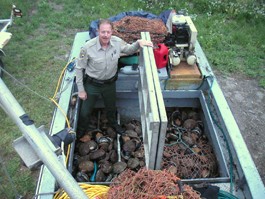
The occasional highly publicized case serves as a reminder of the trouble that can ensue when a diver is caught red-handed. In May 2004, Kurt Ward and Joshua Holt were busted by the DFG’s Special Operations Unit, a force of eight officers who watch for large-scale poaching rings. According to Lt. Kathy Ponting, leader of the unit, wardens searched the boat of the two Southern California commercial urchin divers after receiving a tip, and found 468 red abalone below deck.

Holt eventually received two years in state prison. Ward received three years. They were fined $10,000 and $15,000, respectively. Ward’s boat was impounded, and the two fledgling entrepreneurs were permanently barred from fishing ever again, commercially or recreationally, in California waters. The abalone were too far gone to survive, says Ponting, and wardens donated them to a food bank, a common course of action in the wake of poaching busts if the abalone clearly won’t survive replacement in the water.

But many law-abiding divers (many of whom have entered the poaching informant hotline 888-DFG-CALTIP into their cell phones) have complained that wardens unjustly cite them for the most trivial infractions, and a fine can run $1,000 or more for a single charge. These divers point out that there is a huge difference between one who actively poaches and one who accidentally neglects to follow a fine-print stipulation in the DFG’s ocean sportfishing regulations handbook.

“Ben,” a firefighter and part-time dive-shop attendant at Bodega Bay Pro Dive who doesn’t want his real name used, recounts a time two years ago at Fort Ross when he and three friends emerged from the water with limits of legal-sized abalone. On the beach was another foursome with “at least 70 or 80 abalone,” many undersized, he says. Ben and his friends jumped into their car and hurried up the road. They quickly flagged down a ranger and reported what they saw.

“He said, ‘OK, but did you guys fill out your punch cards?'” Ben recalls. Punch cards are supposed to be filled out before one lays a finger on one’s automobile and must note the date, time, location of the dive and how many abs were grabbed. “But we hadn’t because we’d gone looking for him. So he pulled us over and made us take out all our gear and had us there for two hours, and while he was searching us the other guys came up the road.”

The poachers were never apprehended.

President of SCAN Milo Vukovich concedes that rangers and wardens sometimes act inexplicably, though the greatest blame goes to the poorly written regulations handbook, which is notorious for being ambiguous and open to free interpretation. The most egregious sections are those that muse upon where and when divers must fill out their punch cards. Vukovich says that the DFG and SCAN cleared up all vagaries this winter, but for several years it was uncertain whether divers must fill out their documents on the beach, in the parking lot outside the car or while still in the water, clinging to a boogie board with numb hands, floundering in the waves.

Crawling with Cash

Big-time poaching is less of a problem today than a decade ago, officials say. Before 2000, there was no punch card, and taking a limit of abalone twice or more in a single day was relatively easy. Ponting recalls Operation Red Hat, in which she and several other wardens closely surveyed a team of nine people for three weeks as the gang made daily trips from Oakland up to Mendocino, took their legal limits of four abalone each, drove home, sold their catch, switched cars, swapped diving gear and returned for another round of limits. When the Special Operations Unit decided they had the evidence to nail the group on felony conspiracy charges, they swooped in and made arrests. Several received a year in jail, the two cars were confiscated and personal fines ranged from $2,500 to $12,500. 

Ponting says it can be troubling to watch one small group impact the resource so heavily, but allowing the suspects to build up their own case of evidence against themselves is often necessary.

“Other times, we take people down sooner than we want to if we think they’re damaging the resource too much. It’s a fine line, deciding when we finally go in and arrest them. If we can get the bigger picture really quickly and get a firm idea of all their commercial ties and who’s involved, then we won’t wait as long.”

Even with staunch guardians as Ponting and her team, the North Coast represents a lonesome, almost uninhabited poacher’s haven crawling with cash potential. Many lawbreakers are arrested every year and fined or jailed, but the regularity of repeat offenders is a discouraging syndrome.

Just one example: In January, Mark Fresquez, a Redwood City resident, was nailed for the third time in less than one year for poaching abalone. The first time, he was found at Fort Ross with seven abs. He received a fine and three years of probation. The second time, he was found in the company of another diver, and together they had landed 38 abalone. Fresquez served 30 days after being convicted of a misdemeanor. On the most recent bust, Ponting herself caught Fresquez with 11 abalone, and she is confident that they have a good case against the defendant this time.

Fresquez, who will be arraigned April 7, may lose his fishing license privileges for life, but to think that this restriction will affect such a fearless poacher seems optimistic. Higher fines and longer prison sentences are more likely the answer. Legislation last year increased abalone poaching fines by approximately 20 percent, but a proposal to make basic abalone poaching a felony was rejected; there are so many repeat offenders in this line of work that state prisons would soon be swamped with lifers, put away for good by the “three strikes” law, and the prison system can’t afford such an influx. 

“It’s kind of bleak,” says Vukovich. “If you poach every day and make thousands of dollars and you’re part of a poaching gang, then paying a $5,000 fine just becomes an expense of the job. There’s so much incentive that some of these guys just won’t quit, and with so little enforcement, I don’t see any way to stop it.”

Curbing the Catch

According to a 2005 DFG report, the half-million or so total abalone taken each year along the North Coast is a figure ominously close to the harvest levels that destroyed the Southern California fishery last century. To curb the catch, the DFG has been doing the easiest thing there is: cinching the noose on the legal harvest. Bag limits have dropped from 10 per day to seven to four to three, and from 100 per year to 24. But poaching remains a problem, and the reduction of legal limits may only facilitate the illegal take by discouraging law-abiders from ab diving anymore. For each such retired diver, there is one less guardian watching the resource, making the North Coast waters that much easier to pillage.

“At the rate they’re restricting things, there’ll end up being a lot fewer eyeballs on the water,” says Vukovich. “They could eventually be shutting down a fishery to accommodate poaching.”

Most of the six other abalone species in California waters are all in dire shape compared to the red, and none is legal to harvest anymore. The black abalone fishery closed in 1993. Pink, green and white abalone received full protection in 1996. A year later, red abalone diving south of the Golden Gate Bridge was banned. Now the Marine Life Protection Act is sweeping the state’s waters, and the North Coast will see some closures. Few divers, though, feel that the reserves will benefit abalone.

“As far as I can see, the closures won’t do much good,” says dive-shop owner Tom Stone of the Sonoma Coast Bamboo Reef in Rohnert Park. “The preserves might have more abs, but they don’t swim very far, and you’re just going to have the legal spots become more impacted.”

Vukovich holds the same opinion.

“You’re going to have fewer access points, and that will concentrate 40,000 divers into half the area.”

Surprisingly perhaps, most conversations with abalone divers end optimistically. While the odd cove has been “strip-mined” by poachers, most dive sites that crawled with abalone 30 years ago still crawl with them today. Most of the abs are seven-inchers, but a few are 10 and 11. Among them are the youths, grazing on algae, maturing slowly and hiding in crevices from the sea otters that may never arrive. Though the animals are frequently reported in Sonoma and Mendocino waters, most are just river otters on holiday at the beach.

Meanwhile, the most powerful protection abalone enjoy is not necessarily the officers who patrol the North Coast, but the isolated nature of the North Coast itself. And by far and away the best friends that abalone have are not the lawmakers who protect them or the activists who seek to halt legal diving, but the legal divers themselves.



Robyn Hitchcock Is Weirder When He’s Not Talking About It and Boy, Does Peter Buck Ever Hate Being In R.E.M.

0

It’s sort of counterproductive to watch a documentary about someone whose most attractive trait is mystery, and unless the film has something really, really juicy to offer, it risks revealing the man behind the curtain to be a bumbling hack.


That’s not exactly the case with Robyn Hitchcock in the just-released Sundance Channel DVD Sex, Food, Death. . . and Insects, but it’s close.
There are two perfect albums that Robyn Hitchcock has made: I Often Dream of Trains and Underwater Moonlight, with the Soft Boys. Buy them now. Relish in their evocative strangeness. Wonder boundlessly about the man who made them. And then don’t watch this documentary.
“Princess Robyn,” as he calls himself, spends much of his time on camera offering banal, universal observations about the songwriting process. He tells us that he’s obsessed with death and has a lot of rage inside, which is already evident in his music but severely diminished when it’s coming from the horse’s mouth. Delivering pronouncements about pylon cones and trolley bass, he comes off as trying unnecessarily hard to be weird. I mean, I love the Pink Elephant Car Wash sign in Seattle, but it’s certainly not worth a meandering philosophical analysis.
There’s a scene where Hitchcock premieres new material at a house party with his band (basically R.E.M., plus John Paul Jones and minus Michael Stipe & Mike Mills) and he hoodwinks a visibly tired Nick Lowe into singing backups. Lowe shuffles over to the microphone, Robyn compares him to Paul McCartney, but when the music starts it’s quickly apparent that Lowe does not know the song very well at all. It’s off-putting. Elsewhere in the film, Gillian Welch and David Rawlings explain how they were hoodwinked into making an entire album with Hitchcock (Spooked), and we start to wonder if we aren’t getting hoodwinked as well.
The main reason to watch this documentary, friends, is that Peter Buck takes every possible opportunity to demonize his experience in R.E.M. Try as he may, he can scarcely conceal his disgust with the band: “I just have to deal with such crap!” he complains. “I don’t want to spend four hours a day shaking the hands of people I don’t know!”
This year, Peter Buck goes on a nationwide tour with Modest Mouse and The National, traveling, as the members of R.E.M. do, in his own personal bus. When he moans about the ratio of “music to bullshit,” is it okay to not feel all that sorry for the guy?
R.E.M.’s new album, Accelerate, comes out this week.

Naked

04.02.08Considering the trials and the hearings, much of what went on in Afghanistan's Bagram, Iraq's Abu Ghraib and Cuba's Guantanamo Bay is a mystery to the general public. It may have been dismissed as the deeds of the proverbial few bad apples. But Taxi to the Dark Side makes a case that those bad apples didn't fall far from...

Letters to the Editor

04.02.08It would be great to read more of John Sakowicz's thoughts about the economy ("," Open Mic, March 26). He is bold enough to tell what needs to be told. Because I am a prosecutor, I would prefer to keep a low profile. However, being a prosecutor, I know how hard it is for people to expose the kind...

Fabric of Her Life

the arts | visual arts | Courtesy Lydia Van Gelder Warp and Weft: Retired SRJC instructor Lydia Van Gelder sees the yin and yang of life through art. By Patricia Lynn Henley Lydia Van Gelder's hand moves gracefully through the air as she...

A Vine Frenzy

04.02.08Winery owners are rich, self-important snobs with no established connection to reality. They hire relatives to run their wineries whether those relatives know anything about wine or not. Wine country tourists are boorish inebriates who think grape-picking is glamorous. Wine-industry marketing executives think that successful winemaking is all about sitting down and thinking up advertising ideas. Wine country fundraisers...

Was Wright Right?

03.26.08At the end of March, the long-simmering issue of Barack Obama's pastor finally came to the forefront, with members of the media stumbling over each other to see who could air the most offensive remarks ever made by the Rev. Jeremiah Wright Jr. of Chicago. So let's take a look at some of the comments that got the most...

Maybe I’m Crazy

04.02.08The Odd Couple is this year's album by yesteryear's stars Gnarls Barkley, and it begins with a go-go beat, a toy xylophone and a chant of "Ooh-chk-aahh," lifted directly from Lee Dorsey's "Workin' in a Coal Mine." Savor this moment, because its coy pleasantries swiftly evaporate. A mere 20 seconds in, the album transmogrifies into a hellish, unbearable Dr....

News Blast

04.02.08Chávez Health FairFamilies with little or no access to basic healthcare may attend this weekend's César Chávez Health Fair, held at Roseland Elementary School in Santa Rosa. Marking the eighth year of the state's César Chávez Day of Service and Learning, health professionals from area hospitals will be on hand to discuss and answer questions relating to any and...

Virtual Virtues

04.02.08The basement room could hardly be more plain: unadorned windowless white concrete walls with fluorescent light fixtures hanging beneath industrial piping that snakes across the ceiling. Within this softly humming bunker, a thin, bearded young man is demonstrating his new "fork bomb," a few lines of code that can force a computer defended with popular antivirus software to fill...

Ab Pirates

04.02.08April is here, and for those who move like a snail, go wonderfully with butter in a hot skillet and can be legally harvested through November, abalone season is not the highlight of the calendar. But for the nearly 40,000 recreational divers in California who pursue the big snails, spring, summer and fall are among the holiest times of...

Robyn Hitchcock Is Weirder When He’s Not Talking About It and Boy, Does Peter Buck Ever Hate Being In R.E.M.

It's sort of counterproductive to watch a documentary about someone whose most attractive trait is mystery, and unless the film has something really, really juicy to offer, it risks revealing the man behind the curtain to be a bumbling hack. That's not exactly the case with Robyn Hitchcock in the just-released Sundance Channel DVD Sex, Food, Death. . . and...

11,084FansLike
4,446FollowersFollow
6,928FollowersFollow