Cop / Killer

04.09.08

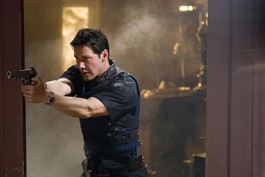
After the bleat of an alarm clock in the dark, the lights come on, and there’s Sgt. Tom Ludlow (Keanu Reeves), asleep in his clothes. He checks his gun, gets up, gives the mirror a good long look and dry-heaves the previous night’s booze.

And so begins the loftily titled Street Kings, the newest by screenwriter (L.A. Confidential) James Ellroy’s sometimes collaborator David Ayer. It follows up the fraught but interesting thug-opera Harsh Times and the neglected 2002 Ayer-scripted policier Dark Blue, both of which Street Kings resembles.

After his morning puke, Ludlow gets into his fast black car to head downtown for his first stop of the day, an illegal machine gun sale out of the trunk of his car. He ingratiates himself with some thugs in Koreatown by greeting them with “Kon-ichiwa.” (It’s a joke I would have liked better if it went unexplained, but explained it is.)

They beat Ludlow up for this and other insults, and pinch his car; Ludlow tracks his ride to their midtown fortress, retrieves a large gun from the trunk, and ventilates the household. After the occupants are safely dead, Ludlow find a chicken-wire cage in a closet where a pair of kidnapped underage twins have been imprisoned for Internet porn. Good deed done.

Riding up with the rest of the police to congratulate the detective is Ludlow’s bosom friend, protector and boss, Cmdr. Jack Wander (Forest Whitaker). Not everyone is appreciative of Ludlow’s policy of not only shooting first but never asking any questions at all. Ludlow’s former partner Washington (Terry Crews) has had a crisis of conscience and has been snitching to Internal Affairs.

When Ludlow spots Washington at a downtown liquor store, he is about to settle the matter, wrapping his fist up in his belt as impromptu brass knuckles just before a pair of AK-47-wielding thugs waste the place. As Ludlow draws his weapon, he accidentally shoots Washington in the shoulder (though it hardly matters, since Washington takes at least 85 bullets from the others).

But since the whole department, and especially Internal Affairs’ faux-friendly James Biggs (Hugh Laurie), knew Ludlow was furious at Washington, the extra bullet looks bad. Two usual-suspect drug-runners are framed for the killing, but Washington’s corpse has evidence that the cop had been reselling heroin from the LAPD’s evidence stash. Ludlow decides to find out who was really responsible for the hit, with only the help of a young, honest cop Paul “Disco” Diskant (Chris Evans).

Street Kings goes back and forth between the believable and the entertaining. Whitaker’s ambiguity is always a pleasure—which of those two eyes can one trust? Jay Mohr, given a mustache to make him look more insincere, plays a detective who might be in deeper than he seems. Keanu Reeves has been a movie star so long that it’s no longer important whether he can act or not. He’s the perfect blank pre-moral hero, looking like a smudgy photostat of Clint Eastwood.

Ayer tries his best to avoid those scenes with women because they put a break on the action, but he can’t get around it. The rogue cop is tended by a helpful nurse (Martha Higareda), who is so one-dimensional she barely casts a shadow. When Ludlow visits a policeman’s widow (Naomie Harris), she begs him not to take revenge on the killers. “Not in my name,” she says, as if she were protesting the war in Iraq.

The arc of Ludlow’s character is for desolation and destruction, and yet this movie finishes in right-wing pulp, endorsing the notion that the LAPD needs covert lawbreakers for “exigencies.” But it’s not the exigency of crime but the expediency of script-writing that we’re dealing with here.

‘Street Kings’ is ubiquitous come Friday, April 11.


New and upcoming film releases.

Browse all movie reviews.
News Blast

0

04.09.08

What Cost Free Speech?

The Santa Rosa City Council next week considers a proposed $1,500 fee for special events that attract over 3,000 participants, including marches and protest rallies. The current filing fee in Santa Rosa for permits is $75. Critics of the proposal, whose names have been piling up on an online petition, say that a $1,500 post-event fee would strip citizens of the constitutional right to peaceably assemble and would place a cost on free speech.

Pat Fruiht, assistant to the Santa Rosa city manager’s office, which is preparing the report in conjunction with the city attorney, explains that, in the eyes of the city, the amount is “really not a fee, it’s a cost recovery. What would happen is during the march, we would determine if there are over 3,000 people, and if there are, that would be their contribution toward cost recovery of the services we’re providing.” Currently the only marches in Santa Rosa that would be subject to the proposed fee are the Immigrant Rights March, held annually on May 1, and the United Farm Workers’ César Chávez Parade, both of which attracted over 3,000 participants last year.

Ben Saari, who posted a petition online that had been circulated hard copy at a recent ACLU event, calls the fee “totally asinine.” Saari says, “It would make it impossible for people to make their voices publicly heard.” He adds that instead of writing the rule into effect shortly after last year’s parades, the city council hearing falls conspicuously close to this year’s May 1 march, offering a small window of opportunity for the public to oppose the plan. Both Napa and San Rafael currently have no cost-recovery fee in place for large marches.

“We found that larger cities, like L.A., Berkeley and Oakland, either have a nominal cost recovery or no fee at all,” Fruiht says, adding that the city can technically charge the full and complete cost of police services and street closures. The organizers of last year’s marches were informed of and agreed to the $1,500 fee. “I can’t say they’re overly happy, because it’s going to cost them money,” she admits, “but they understand the reasons behind it and felt like it was a reasonable thing to do.”

Not everyone agrees. “People aren’t going to get fooled again by the tactics of last year,” Saari says. The public is invited to attend a hearing on the matter on Tuesday, April 15, at Santa Rosa’s City Council Chambers, 100 Santa Rosa Ave., Ste. 10. 4pm. 707.543.3010. The online petition is at [ http://www.petitiononline.com/srfeesp/petition.html ]www.petitiononline.com/srfeesp/petition.html.


First Bite

Editor’s note: First Bite is a new concept in restaurant writing. This is not a go-three-times, try-everything-on-the-menu report; rather, this is a quick snapshot of a single experience. We invite you to come along with our writers as they—informed, intelligent eaters like yourselves—have a simple meal at an area restaurant, just like you do.

The summer roll at Citrus & Spice in downtown San Rafael is stuffed with ribbons of roasted duck and fresh, juicy mango brightened by a wand of red bell pepper. The thin rice paper wrapper bulges almost to the size of a small burrito, tucked with chopped iceberg, purple cabbage, carrot, cellophane noodles and cucumber. There’s no expected cilantro, no chopped peanuts and no highly fishy sauce (nam pla ); the dip is instead a thick, sugary-fiery blend that’s friendly enough to eat with a spoon.

The appetizer ($8, lunch; $9, dinner) is nontraditional, but darn, it’s delicious. Cut into four massive sections and propped color-side-up on an electric-orange fan of shaved carrot, it looks like edible pop art.

It’s also a perfect example of what Citrus is trying to achieve since opening last spring in a small, avocado-and-tangerine-painted space that, while chic, would feel sparse if the food itself weren’t so decorative.

Essentially Thai, C&S adds a “California” accent, meaning the occasional addition of fruit (a terrific spicy calamari and grapefruit salad, $8.50 and $10), a few fusion nods (mild Indian chicken curry wrap, $7.50), and hard-to-categorize bites like sweet corn and taro fritters ($6.50 and $7.50).

That also means a light touch with the brilliant herbs and seasonings that are traditionally Thai. Which would be a shortcoming if the kitchen weren’t as meticulous in the seasonings it does use.

Coconut chicken soup ($6.50 and $8) is so lightly sweet it’s floral, bobbing with fat slices of mushroom, lemongrass and a drizzle of hot chile oil. The peanut sauce ladled over satisfyingly chewy slices of beef is subtle, too, velvety and studded with crunchy bits of nut on a bed of spinach and wilted bok choy ($7.50 and $8.50) alongside crisp-blanched broccoli and a heaping scoop of jasmine rice.

For such a small space, the kitchen puts out an ambitious menu, ranging from a complex curry noodle soup bobbing with chicken and pickled mustard cabbage ($8) to ginger-curry baby-back ribs decorated in lemongrass and shrimp paste atop green beans ($14). Not all of it works. I couldn’t get my mind around what a roasted eggplant wrap with red bell pepper, mushroom and garlic-goat-cheese yogurt ($7.50) might be, and indeed, it was pretty much nothing but mushy.

But I ordered the “emerald salmon green curry” ($11) because it sounded so pretty, and I wasn’t disappointed. The fish was expertly meaty and crisp-edged, the sauce balanced lots of fleshy chile heat with lime, sweet roasted peppers and a nest of fried basil leaves, and the whole tasted sparkling fresh.

I don’t often order dessert at a Thai house (enough with the sweet sticky rice and red bean ice cream), yet C&S offers a creative selection. House-made pumpkin spice cake with ice cream ($5) is moist and fragrant, though a banana crêpe ($5) was gummy.

It’s an evocative name for a cafe, Citrus & Spice, and, largely, the experience is just as stirring.

Citrus & Spice, 1444 Fourth St., San Rafael. Open for lunch and dinner Lunch and dinner Monday through Saturday. 415.455.0444.


View All

Quick-and-dirty dashes through North Bay restaurants. These aren’t your standard “bring five friends and order everything on the menu” dining reviews.

World of the Work

Cross Purpose

0

04.09.08

The sign on my bucket says: “All Proceeds Go to the Society for the Removal of the Meridians, in Support of the Abolishment and Eradication of the Unsightly Grid of Longitudinal Lines Encircling Our Planet.”

“Why not the parallels, too?” some wise guys will ask me. I’m ready for them. “They’re next,” I explain. “The latitude lines, because they are unconnected, have to be yanked off one at a time, but those meridians are all joined at the poles. All’s you have to do is slide a hook under one of the intersections and slip those suckers off, all of them at once, like the skin off a boiled onion.”

This is just a sideshow, however. The main action is my theremin. Whenever the sun shines and the mood strikes me, I set up my Moog Etherwave Pro in Santa Rosa’s Railroad Square, running it and my classic Fender 85 amp off a car battery that’s good for a couple of hours. In that time I can make $10 or $15 going ooeeoo and playing Rachmaninov, Debussy, Saint-Saëns and Roddenberry. I’ve got backup tracks queued up on a stomp box, my “thereoke.”

If a child comes by, I let him wave his arms at it—ooeeoo—and the momma’s sure to toss a dollar or two in the bucket. Your older guy will give me money just for the pride of knowing what the thing is. “The Beach Boys, ‘Good Vibrations,’ a theremin!” he’ll gush, and out comes the wallet. (I seldom bother to explain that the Beach Boys used a tannerin. Is the truth worth losing a buck or two? I doubt it.)

They come and they go. Birds sing. Clouds drift. The sun shines. Trucks doppler by. I wave my hands and pull music from the air. As long as there’s a little juice in my Sears DieHard, it’s not an unpleasant way to pass an afternoon.

The other day, toward the bottom of my charge and halfway through “Vocalise,” a big fellow staggered into my playing field from a Chevy’s across the street. He was a sturdy fellow with a thick neck and black hair neatly gooed. He wore the kind of zippered cloth coat you see on men driving tractors along country roads. He was shit-faced and half-dancing. I muted my air harp and watched him closely; the theremin is delicate, costly and rare.

“This was meant to be,” he said. “You’re exactly the man I’m supposed to meet. You know what I’m talking about, I can tell that you do.”

Sometimes drinks will ream a fellow of everything extraneous and render him clairvoyant. I un-muted my theremin and let the big guy gesture at it. “I’m going to tell you something I want you to do,” he said. “You’ll do it or you won’t, as God wills.” He looked both troubled and ardent.

He scanned the square in one slow sweep, but lingered on the Chevy’s. “Had to get out of there,” he says. “Had to get some air. Daughter’s birthday, 21 today. All those relatives, I know what they’re thinking when they look at me. ‘The drunk has to walk it off.’ But that ain’t it. I knew I had to come over here. You were waiting for me, but you didn’t know it. I come all the way from Wisconsin, from Baraboo, to be here. Not for the birthday—don’t think that. Jesus, Lord, I’m not used to big cities like this.”

A gang of boys skateboarding at the far end of the lot suddenly erupted in our direction. “They feel the energy,” the big guy said. “My name is Blake. What’s yours?”

“Eliot.”

“Well, Eliot, can you play a Hank Williams tune?”

“I’ll give it a try, Blake,” I said. It wasn’t the tiniest fraction of what I meant, but it was all I could make myself say.

“Well, I’m just about ready. Are you just about ready, Eliot?”

“I’m ready, Blake.”

Blake threw open his arms and danced and bellowed: “Yas, ma and daddy, don’tcha know, so glad, your son’s a-coming home?” I followed the best way I could with long low notes in the cello range, my hand to my breast bone, because, on the theremin, that’s where the deep notes are, the nearer the deeper. “This crazy world is rocking with happiness . . . sweethearts, can’t you hear me praying for that great day-ay-ay?”

Blake was on fire. He was a street preacher and a brawler and a great wounded beast. He sang like a mudslide and danced like a hemorrhage.

When he was done, he leaned against me, panting. “We did it, Eliot,” he said. Then: “You know who I am?” I thought he’d told me, but the fellow had more juice than a fresh DieHard, so I listened and waited. “I’m Blake Bitner, William Blake Bitner.”

“Like the poet.”

“Yeah, like the poet, but that’s not what my momma and poppa had in mind. They didn’t know a damned thing about any of that.” He managed it quickly, but his red face twitched, and I knew his folks had bruised him inside. “I come all the way across the country for my son. I bet you read about him in the papers—the Bitner kid?”

I shrugged. I read the clouds. I read the crowds. I never read the news.

“Look him up,” Blake says. “They say he killed a man, but he didn’t have nothing to do with it—some kids at a party. Fellow was stabbed more times than Julius Caesar. Naturally, they blame the guy with a record. On top of everything else, it’s the daughter’s 21st birthday. The make-it-or-break it age, when you bust out or you bust.”

“Which did you do, Blake?”

He gave me that clairvoyant look. “Whichever.” He read me, the real me, loud and clear. “It was ordained, just like you meeting me.” He ambled back to his daughter’s party.

I struck my gear and hunted up a local paper. It had been front-page news: a student from San Francisco State University, a boy of 21, the make-it-or-break it age, had been stabbed to death a week earlier outside a party, nobody knew why, and four boys were being held for his murder, one of them named Bitner. His picture took up a couple of inches: a porcine, bewildered country boy in a big-city police station. Kid had a record and was currently on probation for felony burglary.


Don’t you just hate that net of meridians? We are circumscribed but won’t call it real. It’s like the electrostatic field around my theremin: I play it, all right, but there’s nothing to touch. Waving my hands through thin air, I make children laugh and grownups drop their jaws. I am magical, invulnerable, immortal—until a beast wheels and shambles across Railroad Square to read my heart and make me harmonize. He brandishes a scythe and points a bony finger. I’m just a clown and busker. What’s death to do with me? 


Local Lit

Clue Note

Quick Scan

Ageless Fountain

0

music & nightlife |

These Days: Jackson Browne’s current live music restores the idealistic yearning that anchors the big picture of his career.  

By Karl Byrn

After 40-plus years in the music business, Rock and Roll Hall of Fame inductee Jackson Browne understands the uncertainty that makes his work tick. “What’s your pleasure?” he knowingly asks the audience on his newly released disc Solo Acoustic, Vol. 2. “I could sing you a really tender song filled with despair . . . or a really weary song laced with hope.” The audience laughs gently, cheering for the forlorn beauty of “Fountain of Sorrow.” He laughs back, joking that the song has “a gigantic dollop of good will.”

Browne’s new disc extends the warm, live-recording intimacy of his 2005 release Solo Acoustic, Vol. 1, and also offers a preview of what local fans can expect when he brings his solo acoustic tour to Santa Rosa on April 16. Together, Solo Acoustic, Vol. 1 and Vol. 2 connect the dots in his storied body of work, mixing hallmarks from his classic ’70s singer-songwriter era with a healthy dose of his solid but largely ignored later work, with only a touch of his uneven ’80s hits and politics. The two live volumes don’t make a complete best-of, but instead reveal the circular, single shape of the heart that Browne wears on his sleeve.

A reliable axis of tender despair and weary hope cemented Browne’s stature as the great California post-hippie rock-poet, but left him open to future disinterest. Even in his heyday, critics read his fresh and weighty poetics differently. “Jackson Browne is the most accomplished lyricist of the ’70s,” wrote American roots populist Dave Marsh, while arty, urban academic Robert Christgau complained that “there are a hundred country cheatin’ songs with more truth in them than any but five or so of Browne’s.”

As a ’70s teenager, I was drawn to his semi-truths—not casting him as a literate sage or a hackneyed wimp, but thrilled by the very incompleteness and simplicity of his struggles. His questing good-guy honesty and perpetual irresolution seemed like the whole point, the very thing that made his music essential rock ‘n’ roll.

After his early ’80s stadium success, more overt political content that explored global rhythms mitigated Browne’s soul-searching balladry. Ironically, as his records stuttered, he gained real-world credibility, with an arc of progressive activism that extends from spearheading the 1979 No Nukes concert to his current support of the Kensington Welfare Rights Union, a grassroots group that promotes empowerment of the poor.

Outspoken activism notwithstanding, Browne has never really emerged as an alternative hero like contemporaries Neil Young and Bruce Springsteen, two comparable ’70s songwriters who have sustained a rare undiminished reverence among indie-rockers and hip music media. Browne’s impact has thrived more indirectly, from the ongoing relevance of alt-country to new chart balladeers like Jack Johnson to the confessional basis of emo-rock’s romantic unrest.

Browne’s current live music restores the idealistic yearning that anchors the big picture of his career. Solo Acoustic, Vol. 2 highlights some post-classic gems, like the punchy “Enough of the Night,” from his forgotten 1989 disc World in Motion, and the loving “Sky Blue and Black” from his 1993 return-to-form I’m Alive. Four songs come from his latest studio album, 2002’s relaxed, substantial The Naked Ride Home, including the brooding social critique “Casino Nation.” Browne is planning to release a new studio album later this year. Meanwhile, if I were to answer his question about pleasures from his catalogue, I’d pick a whole new Solo Acoustic, Vol. 3, dug from all over his ageless fountain of sorrow and hope.

Jackson Browne performs on Wednesday, April 16, at the Wells Fargo Center, 50 Mark West Springs Road, Santa Rosa. 8pm. Sold-out. 707.546.3600.


FIND A MUSIC REVIEW

View All


Concert notes and news.

Moms of Invention

Cop / Killer

04.09.08After the bleat of an alarm clock in the dark, the lights come on, and there's Sgt. Tom Ludlow (Keanu Reeves), asleep in his clothes. He checks his gun, gets up, gives the mirror a good long look and dry-heaves the previous night's booze. And so begins the loftily titled Street Kings, the newest by screenwriter (L.A. Confidential) James...

News Blast

04.09.08What Cost Free Speech?The Santa Rosa City Council next week considers a proposed $1,500 fee for special events that attract over 3,000 participants, including marches and protest rallies. The current filing fee in Santa Rosa for permits is $75. Critics of the proposal, whose names have been piling up on an online petition, say that a $1,500 post-event fee...

First Bite

Cross Purpose

04.09.08The sign on my bucket says: "All Proceeds Go to the Society for the Removal of the Meridians, in Support of the Abolishment and Eradication of the Unsightly Grid of Longitudinal Lines Encircling Our Planet." "Why not the parallels, too?" some wise guys will ask me. I'm ready for them. "They're next," I explain. "The latitude lines, because they...

Local Lit

Clue Note

Quick Scan

Ageless Fountain

music & nightlife | These Days: Jackson Browne's current...
11,084FansLike
4,446FollowersFollow
6,928FollowersFollow