Channeling the Lorax

06.25.08

When Gov. Schwarzenegger threatened to close down 48 of California’s state parks, including the North Bay’s own Armstrong Woods, in order to “help” pull us out of our economic woes, I contacted Ruskin Hartley, executive director of Save the Redwoods League (SRL). The league was founded in 1918 in an attempt to save the coast redwood and the giant sequoia.

Since its inception, SRL has helped to ensure permanent protection for some 180,000 acres of California forestland, which, considering that less than 5 percent of the original number of these trees remain on earth, is a vital service to humanity. Though the imminent threat of park closures has since abated, my investigations into the importance of our redwood trees led me from the SRL to the Stewards of the Coast and Redwoods (formerly known as Stewards of Slavianka), and ultimately to Armstrong Woods itself.

Hartley speaks to me from his Bay Area office and manages to clearly convey his love for these giant trees, which are the tallest, most massive trees in the world. While I have long taken the redwood for granted, Hartley reminds me that people travel from far off to see these trees, which, as a species, date back to the time of the dinosaurs.

The league boasts a broad base of membership, with supporters from overseas and every state of the union. Such support allows it to preserve our existing forests, acquire new land, work to gather seeds and propagate more trees and award grants in education throughout California. Hartley tells me that people are decreasingly going outside, and believes this is something we need to change. Through the efforts of SRL, children are able to escape the fetters of the classroom and explore the redwoods and giant sequoias on foot.

I, too, feel inspired to escape the classroom, and so I decided to explore Armstrong Woods with the help of Stewards of the Coast and Redwoods. Stewards is a nonprofit dedicated to preserving, through education and stewardship, the Russian River state parks. Created in the early 1980s, Stewards offers a variety of education-based programs, as well as renovation and expansion of park facilities. Docents are available for seal watching at Goat Rock State Beach, March through August; January through May, docents facilitate whale watching at Bodega Head; and the first Saturday of the month, there are docent-led hikes through Willow Creek.

Joyce Bacci, volunteer and expert docent, is kind enough to meet my mother and me at Armstrong Woods. Bacci has been donating her time and energy to Stewards since the ’80s, and she knows her stuff. She teaches us about the river and coast cleanups, the volunteers who protect the baby seals from dogs and people at the Russian River’s mouth, the flora and fauna of the forest, and how the plaque at the beginning of the trail with a rope for the blind has typos in it–in Braille. They’ve had a few complaints over the years, Bacci says, but it’s too expensive to fix.

As we walk through the forest, pausing every few feet to admire the variety of sights–from a 1,300-year-old, 300-foot-high tree to the delicate flower hidden beneath the foliage of a wild ginger plant–I am reminded why a walk in the forest, though easy to push aside in favor of a plethora of other tasks, is so intrinsically satisfying.

At Bacci’s urging, my mother and I lie down on our backs in the center of the Burbank Circle, a magical, and so far unexplained, natural phenomenon. I could stay in this spot all day–a ring of redwoods, in the center of which, nothing grows. But Bacci is on a mission to take us to the Redwood Forest Theatre, and so we pull ourselves up and continue on. The theater has been reopened for events, and soon music will echo in the trees with the Third Annual Old Grove Festival, a fundraiser for Stewards that launches in August with live music, good food and even a theater piece.

My mother and I leave the park feeling thankful that, while we go on with our busy lives, at least some of the earth’s precious natural resources are being actively protected by people who understand that the natural world is more valuable to our state than the Governator’s budget cuts could ever possibly be.

 For more information on Save the Redwoods League, or to plant a redwood tree in your name, go to www.savetheredwoods.org.For more information on Stewards of the Coast and Redwoods, and to purchase tickets for the Old Grove Festival events, go to www.stewardsofthecoastandredwoods.org.

Fear and Fury

0

06.25.08


Arthur Miller’s The Crucible is one of those shows that, like Thornton Wilder’s Our Town and Frances Goodrich and Albert Hackett’s The Diary of Anne Frank, has suffered from decades of well-meaning but painful productions at the hands of underfunded high school theater departments and lesser community theater companies. After half a dozen such stagings, it is easy to forget that The Crucible, arguably Miller’s most accessible and riveting play, is a true American masterpiece. When done well, with a strong director, it is packed with drama and dripping with tension and roller-coaster emotions.

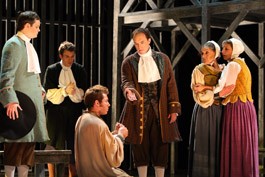
That’s the kind of Crucible that opens the Summer Repertory Theatre’s 2008 season at the Santa Rosa Junior College. With director David Storck orchestrating a first-rate cast of rising young actors from around the country, this is the Crucible to see.

Summer Repertory Theatre is one of the few remaining training-based repertory programs of its kind in America, and the North Bay is fortunate to have it. The first of five plays and musicals that make up this season at SRT (Claire Booth Luce’s The Women and Mel Brooks’ The Producers are up next), Storck’s production looks remarkable, with a sprawling, Broadway-quality set by Nathaniel Sinnet, and maintains a tone of grounded believability as the story of the infamous Salem witch trials plays itself out like a Hitchcockian thriller.

In 1792, in the contentious close-quarters of tiny Salem, Mass., farmer John Proctor (Matthew David Gellin) finds himself drawn into a local witchcraft scare when trouble-making Abigail Williams (an effectively duplicitous Jennice Butler), with whom Proctor once had an illicit affair, accuses several local people of trafficking with the devil. One of the accused is Proctor’s upright wife, Elizabeth (Denice Burbach, also very good), who has been struggling to forgive her husband after his fling with Abigail.

For her part, Abigail’s plot is two-fold: Her minister uncle, the self-serving Rev. Parris (Kyle Schaefer), has caught Abigail and several of the local girls dancing in the woods, playing at witchcraft as Abigail attempts to place a curse on Elizabeth Proctor. Frightened that they’ll be whipped or worse, the girls haphazardly improvise an alibi: they were under the spell of powerful local witches.

When the adults do more than just believe them, actually establishing a court to discover and try anyone consorting with the devil, the girls, with Abigail their tyrannical leader, find themselves gifted with a remarkable amount of local importance. From her new-found position of power, Abigail discovers a way to rid herself of Elizabeth, whom she sees as standing between herself and John, and she quickly devises a way to frame her for witchcraft.

The way all of this plays out is alternately hilarious and terrifying, with the superstitious and hypocritical Puritans turning on one another like starving dogs in a pit. While Gellin is a bit physically stiff, he has nailed the pent-up hurt and righteous rationality that defines John Proctor, and his final scene, in which, accused of witchcraft himself, he heartrendingly wrestles with own conscious, is a whopper of a performance.

Also good in a cast full of good young actors is Tyler Seiple as the visiting minister John Hale, an “expert” in the occult who at first unwittingly stirs up the villagers’ fears and then tries in vain to stop the destructive momentum he has started. Jacob Mahler, as Deputy-Governor Danforth, is properly frightening, wielding the powers of judge and jury with the right amount of arrogance and cruel relish. In the smallish role of Judge Hawthorne, Max Smythe displays a delightful ability to be skin-crawlingly creepy while doing nothing but staring at someone. Mollie Boice, as the good-natured Rebecca Nurse, the only one who keeps her head even after being accused herself, is also strong in a small but pivotal role.

The real star of this show, however, is David Storck, the director. With a firm hand on the play’s pacing, blocking, dramatic build and subtle sound elements (nicely done by Theo Bridant), he keeps this uniquely American story grounded in the human stories of its characters. And it is a timely story as well. In a world where a simple fist-bump or funny name can result in accusations of terrorist leanings, it is important to remember that we are never more than few idiotic steps from replaying Salem’s witch-hunt hysteria all over again.

  ‘The Crucible’ runs through July 27 at the Burbank Auditorium on the SRJC campus. June 27 at 7:30pm; July 2-3, 15-16 at 8pm; also July 2, 16 and 27 at 2pm. 1501 Mendocino Ave., Santa Rosa. $8-$15. 707.527.4343.


Museums and gallery notes.

Reviews of new book releases.

Reviews and previews of new plays, operas and symphony performances.

Reviews and previews of new dance performances and events.

First Bite

0

06.25.08

ditor’s note: First Bite is a new concept in restaurant writing. This is not a go-three-times, try-everything-on-the-menu report; rather, this is a quick snapshot of a single experience. We invite you to come along with our writers as they–informed, intelligent eaters like yourselves–have a simple meal at an area restaurant, just like you do.

Sometimes you have to dig a rose up and move it clear across the garden before it can blossom, full-petaled and fragrant, filling that hole along the road as if it were born to grace that very spot. So it is with Saint Rose, Sebastopol’s most welcome transplant. I admit I never got there when it was in Santa Rosa and called Cafe St. Rose, but I know it had its ardent fans. So, city dwellers, I feel your pain, but it’s buried somewhere under my own delight in having such a fine, fine restaurant close by.

Kismet abounded in this recent move (doors opened in May). Just as chef-owner Mark Malicki and his wife Jenny’s plans to expand their Santa Rosa restaurant fell through, they discovered their friends at the Two Crows Roadhouse were feeling the travel itch. Suddenly, that location Malicki had been eyeing practically from his front porch (they live that close) was opening. Just like that, they took their show west. They came home, and home is just how it feels.

The evening that Doug and I went, a flossy-locked girl hiked up her floral frock to ride a trike on the side patio. The back patio, where we sat, was bathed in amber light. Amy Winehouse was crooning “What kind of fuckery is this?” from the speakers. It was all so West County and so down-home. But the food . . . ah, the food. Our bouches amused by a dish of ripe figs, we considered our choices. The menu changes daily but always offers five or so small plates and an equal number of mains, prepared with fresh seasonal ingredients, some from Malicki’s adjoining Bohemian Grooves garden.

We chose the white corn soup with sheep’s milk ricotta dumpling ($10), and spooned it up with tears of gratitude in our eyes, sweet as summer love. An arugula salad with shaved Saint George cheese and pine nuts ($9) was subtle and simple. In our lobster salad ($16), plump chunks of tail meat cozied up with red, yellow and orange roasted baby carrots and beets. We split the main: grilled squab with parpadelle noodle, morels and pancetta ($23). I’d never eaten either squab or morels before (deprived childhood), but I will forever associate them dancing together in their Saint Rose waltz, for they are heaven-matched: savory, meaty, wild and earthy.

Our waitress could not have been sweeter or more solicitous. Minutes after delivering our second glass of wine, for such a night deserved toasting and re-toasting, she came with yet another glass, saying she’d confused our order. Heck, I wasn’t driving; what a happy mistake.

Before our dessert–a cherry almond upside-down cake with crème fraîche whipped cream ($7) and Flying Goat coffee–I took a cigarette stroll around the grounds, a comfy jumble of weeds, wild roses and upraised vegetable beds with a tortoise-shell cat as my escort, and I spoke to a fellow’s boots sticking out from a jacked-up vintage truck as he ratcheted his wrench to loosen a stubborn bolt. This is the place the new Saint Rose occupies, and it’s clearly flourishing.

Saint Rose. Dinner, Wednesday-Sunday; brunch, Saturday-Sunday. 9890 Bodega Hwy. Sebastopol. 707.546.2459.


Quick-and-dirty dashes through North Bay restaurants. These aren’t your standard “bring five friends and order everything on the menu” dining reviews.

On Ah Come Up

0

06.25.08

Nothing against children of the ’80s, but I believe the 1990s were the true golden age of hip-hop. The teenaged genre had finally hit its commercial and creative stride, giving us well-developed, eclectic voices from the Afrocentrism of Arrested Development and the gangsta swagger of West Coast g-funk to the urban vignettes of the Wu-Tang Clan and the trailer-park psychodrama of Eminem.

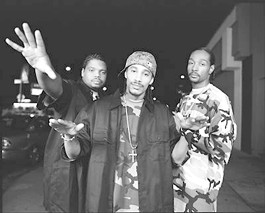
But few acts were as original or tuneful as Bone Thugs-n-Harmony. Long before Twista was hip-hop’s resident rapid tongue-wagger, the Cleveland group astounded with an infectious, speedy lyrical flow that never sacrificed melody or the gritty realism lying beneath the dizzying form. They appear at the Phoenix Theater on June 28.

After releasing their independent debut, Faces of Death, in 1993, the quintet chased fame the old-fashioned way: heading to L.A. in search of a big break, specifically through an audience with gangsta-rap pioneer and N.W.A. mastermind Eazy-E. After an audition over the phone, Eazy never contacted them like he’d promised. Undeterred, the group chartered a bus to Cleveland where Eazy was performing, got backstage and auditioned for him on the spot. The rest, as they say, is history.

Suddenly, Eazy had his own innovative protégés to counter then-rival Dr. Dre, complete with Ramones-style names: Krayzie Bone, Layzie Bone, Bizzy Bone, Wish Bone and Flesh-n-Bone. Their Ruthless Records release, Creepin’ on Ah Come Up, would soon be heard blaring out of every other car, especially their signature single “Thuggish Ruggish Bone.” Over thumping bass and distinctively Cali-style synthesizers, they stormed the major league. “Get ready for the bone and the mo thug, bustas, you know me as a hustla,” spit Wish Bone with an effortless internal rhyme scheme. “Try to creep and get beat, make me succeed, peep, gotta put them under.”

Getting a jump on millennium apprehension was the following year’s E 1999 Eternal, the group’s apocalyptic commercial breakthrough. The Grammy-nominated “1st of tha Month” was famously called an ignorant “welfare carol” by comedian Chris Rock, but the track’s uneasy world of short-term, hedonistic pleasures juxtaposed with territorial drug-deal murders conveys a regretful path born of violence and poverty. “Wake up, and I see that my sister was already dressed / She said, ‘I’m gonna run and go get my stamps / Watch and make sure no one snatches my check,'” raps Bizzy Bone.

Soon Bone was everywhere, on records for Mariah Carey and the Notorious B.I.G. (“Notorious Thugs” remains one of the few highlights on Life After Death). Their greatest success was “Tha Crossroads,” a tender, frustrated tribute to friends (including Eazy-E) and relatives who’d met their demise, naturally or unnaturally. Exhibiting substance to complement the speedy delivery, the song gave the thug life a compelling, empathetic sense of tragedy that became prescient of the murders of 2Pac and Biggie Smalls, both former Bone Thugs collaborators.

After the overly ambitious The Art of War in 1997, Bone’s star seemed to fade during what the All Music Guide calls “an age where weed-smoking gangsters have been replaced by champagne-sipping players.” High-pitched Bizzy Bone’s increasingly unreliable behavior led to his departure, and Flesh-n-Bone went to prison. But the remaining members persevered, releasing albums that culminated in last year’s Interscope debut Strength and Loyalty, which brought Bone gold status once again.

Armed with a slew of white-hot producers like will.i.am and Swizz Beatz, the new three-legged Bone Thugs sound grownup but not tired, even on the mature yet potent Jermaine Dupri-produced single “Lil’ Love” featuring old pal Mariah Carey. Most riveting is the spiritual “Order My Steps” with Yolanda Adams, which features a brash, synthesized grinding beat, perfect behind their best lyrical dilemma in years. “[I] simply know that the world gon’ tempt me, Satan is the enemy,” says a distressed Layzie Bone, “God please help us, I don’t want to be selfish / I don’t want to live my life tryin’ to be rebellious.”

Thankfully, there have been reliable rumblings about a full reunion, with Flesh-n-Bone eligible for parole next month. But the current lineup is enjoying their current creative spurt. “We recorded a ridiculous amount of songs for this album,” Layzie Bone excitedly said last year. “If it was smart to do, we’d put out about five albums at once, and blow they wig off.”

 Bone Thugs-n-Harmony perform on Saturday, June 28, at the Phoenix Theater, 201 E. Washington St., Petaluma. 8pm. $30. 707.762.3565.


Just the Facts

0

06.25.08

Since I started writing this column in 1999, I’ve seen a thousand Internet businesses rise and die. I’ve watched the web go from a medium you access via dial-up to the medium you carry around with you on your mobile. Still, there are three myths about the Internet that refuse to kick the bucket. Let’s hope the microgeneration that comes after the Web 2.0 weenies at last puts these misleading ideas to rest.

Myth: The Internet is free. This is my favorite Internet myth, because it has literally never been true. In the very early days of the Net, the only people who went online were university students or military researchers–the former got accounts via the price of tuition; the latter got it as part of their jobs. Once the Internet was opened up to the public, people could only access it by paying fees to their Internet service providers (ISPs). And let’s not even get into the fact that you have to buy a computer or pay to rent time on one.

I think this myth got started because pundits wanted to compare the price of publishing or mailing something on the Internet to the price of doing so using paper or the postal service. Putting up a site on the web is “free” only if you pretend that you don’t have to pay your ISP and a hosting service to do it. No doubt that’s cheaper than printing and distributing a magazine to thousands of people. But it’s not free.

Same goes for email. Sure it’s “free” to send an email, but again, you’re still paying your ISP for Internet access to send that letter. The poisonous part of this myth is that it sets up the false idea that the Internet removes all barriers to free expression. The Internet removes some barriers but erects others. You can get few free minutes online in your local public library, maybe, and set up a website using a free service (if the library’s filtering software allows that). But will you be able to catch anyone’s attention if you publish under those constraints?

Myth: The Internet knows no boundaries. Despite the Great Firewall of China, an elaborate system of Internet filters that prevent Chinese citizens from accessing websites not approved by the government, many people still believe that the Internet is a glorious international space that can bring the whole world together. When the government of a country like Pakistan can choose to block YouTube, which it has and does, it’s impossible to say the Internet has no boundaries. The Internet does have boundaries, and they are often drawn along national lines.

Of course, closed cultures are not the only source of these boundaries. Many people living in African and South American nations have little access to the Internet, mostly due to poverty. As long as we continue to behave as if the Internet is completely international, we forget that putting something online does not make it available to the whole world. And we also forget that communications technology alone cannot undo centuries of mistrust between various regions of the world.

Myth: The Internet is full of danger. Perhaps because the previous two myths are so powerful, many people have come to believe that the Internet is a dangerous place–sort of like the “bad” part of a city, where you’re likely to get mugged or hassled late at night.

The so-called dangers of the Internet were highlighted in two recent media frenzies: the MySpace child predator bust, in which Wired reporter Kevin Poulsen discovered that a registered sex offender was actively friending and trolling MySpace for kids; and the harassment of web pundit Kathy Sierra by a group of people who posted cruelly Photoshopped pictures of her, called for her death and then posted her home address.

Despite the genuine scariness represented by both these incidents, I would submit they are no less scary than what one could encounter “in real life,” offline. In general, the Internet is a far safer place for kids and vulnerable people than almost anywhere else. As long as you don’t hand out your address to strangers, you’ve got a cushion of anonymity and protection online that you’ll never have in the real world. It’s no surprise that our myths of the Internet overestimate both its ability to bring the world together and to destroy us.

 Annalee Newitz is a surly media nerd who is biased in favor of facts. Open Mic is now a weekly feature in the Bohemian. We welcome your contribution. To have your topical essay of 700 words considered for publication, write [ mailto:op*****@******an.com” data-original-string=”8TXAAy6322S3HIuhLTK4wg==06acfgds8FBHvEULnIhUbXgP4ONxN7dK9Z10TtQq44GF8Z4bkdfo2/HNZuX7NTH7EOWO+FhKY9P2N+kWtYBVsI5oUJhzwUCh0l6J6O8RYbIlbM=” title=”This contact has been encoded by Anti-Spam by CleanTalk. Click to decode. To finish the decoding make sure that JavaScript is enabled in your browser. ]op*****@******an.com.


Alien by Nature

0

06.25.08

Brick Lane, Monica Ali’s 2003 novel, is a tale of transition. Nazneen  emigrates from an idyllic childhood in rural Bangladesh into an arranged marriage with a middle-aged “educated” man, Chanu, and onto a bleak council estate (Britspeak for housing project) in the Bengali district of East London, the “Brick Lane” of the title.

The move from novel to film is just as bewildering as and much more frustrating than Nazneen’s journey from “simple village girl” to émigré Londoner. Rather than trying to stuff 400 pages of novel into two or three hours of film, director Sarah Gavron and three screenwriters have trimmed crucial aspects of Nazneen’s story to fit a shorter movie.

The film shows Nazneen (Tannishtha Chatterjee) living the subaltern role of dutiful wife and devout Muslim, largely sheltered from London. The novel linked much of Nazneen’s isolation to what is perhaps an immigrant’s greatest barrier to assimilation, illiteracy in her adopted country’s tongue, yet onscreen, all the characters speak (sometimes fractured) English.

And when Nazneen’s dormant passions arise after she meets the handsome young London-born Muslim delivery man Karim (Christopher Simpson), who delivers the jeans she sews at home in a bid for financial independence, the censorious feelings of sin prompted by her religious devotion, so prominent in the novel, are absent. To this critic’s Western eyes, she does not seem that different from Diane Lane in Unfaithful.

The film attempts to span many different worlds. In his review of the novel, critic James Wood mentions the greater difficulty facing immigrants in class-bound Britain than those arriving in the United States’ ostensibly free-for-all society. He also emphasizes the novel’s 19th-century sensibility. Immigrant cultures are often bound to duty toward marriage and religion, as epitomized in 20th-century Western novels. To twist British writer L. P. Hartley’s aphorism, a foreign country is the past; they do things differently there. By truncating the novel, however, the filmmakers produced a Bengali film fit for the Lifetime Channel.

Despite its abruptness, Brick Lane captures the persistence and endurance of immigrants in the bleak brick estates of East London. Nazneen spends most of the time in her underlit flat. Her flashback remembrances of the lush Bengali countryside of her childhood are bright as tropical fruit, and the contrast is heartrending.

Nazneen at first obeys if not adores her husband Chanu (Satish Kaushik). She cuts his corns as he discusses his latest get-rich-quick plan, which doesn’t pan out; she tolerates his nighttime snoring. Chanu could be a stock dominant husband, but Kaushik brings a sweet quixotic optimism to his attempts at getting ahead and disciplining his teen and tween daughters.

Although this is Nazneen’s story, the failed but smiling Chanu is the most fully realized character in the film. He accurately predicts that the Sept. 11 attacks will foment a racial backlash, similar to what he faced when he immigrated to England in the 1950s. While the political subplot seems bolted-on, the film’s final image finds a family idyll in a very cold place.

  ‘Brick Lane’ opens on Friday, June 27, at the Century CineArts Sequoia, 25 Throckmorton Ave., Mill Valley. 415.388.4862.


New and upcoming film releases.

Browse all movie reviews.

SFJAZZ Lineup Announced

0

The lineup for the new season of SFJAZZ was announced this morning, and once again, it showcases the kind of variety and talent that’s made the ongoing festival one of the Bay Area’s jewels.
The upcoming schedule, running Oct. 3-Nov. 9, includes jazz legends like Archie Shepp, Cecil Taylor, Charlie Haden’s Liberation Music Orchestra and the Dave Brubeck Quartet; vocalists Jimmy Scott, Sweet Honey in the Rock and Mavis Staples; new blood like Wayne Horvitz and Ravi Coltrane; world musicians Toumani Diabate and Le Trio Joubran; and, for some reason, Randy Newman.
Cecil Taylor, whom I saw about five years ago at the Palace of Fine Arts, rarely plays solo—and in Grace Cathedral, it should be insane. I saw Jimmy Scott a couple years ago at the Herbst Theatre, and he was excellent; age has only slightly slowed him down. Haden’s Liberation Music Orchestra at Yoshi’s a few years back demonstrated just how relevant his 40-years-and-running project is, and I have personally seen Ravi Coltrane blow Pharaoh Sanders out of the water on stage, which is saying something.
The guy I’m most excited to see? Saxophonist Archie Shepp, who very rarely comes to the Bay Area. A force that shows no signs of diminishing, Shepp has persevered under the radar as a lesser-known avant-garde artist since his “new thing” heyday of the late 1960s, and I’m not sure what kind of group he’ll have, but in the small Herbst Theatre, how can you go wrong?
Tickets go on sale to the public on Sunday, July 13. Complete lineup and information after the jump, or you can cue it up at the festival’s official website.

George Michael at the HP Pavilion in San Jose

1


Early on in Thursday night’s show in San Jose, George Michael thanked the rapturous crowd for sticking with him for 25 years. “Lord knows it’s not always easy being a George Michael fan,” he admitted, a self-deprecating statement which could be taken a number of ways—as either a reference to repeated tabloid scandals, or to his lingering reputation as a boy-toy manufactured pop star, or to the fact that he hasn’t toured in America since 1991. For me, the only thing hard about being a George Michael fan is the fact that the hands-down greatest singer-songwriter of my youth has made nothing but totally dull music in the last 15 years. Face it—after Listen Without Prejudice Vol. 1, it was all downhill.
But the stuff from that album and prior—including almost everything that Wham! did—represents, to me, a special pinnacle in pop music. Admittedly, my opinion is largely due to the fact that I was about 10 when Wham! was at their peak. I went to the Faith tour at the Shoreline Amphitheater in 1988, and as I grew up, George Michael was one of the first pop stars that I watched grow up, and get “mature,” and assimilate other sounds and attitudes into their music. Witnessing the ceremonial torching of his pretty-boy image in the video to “Freedom ‘90” coincided perfectly with my discovery of the Dead Kennedys and the idea that the mainstream music industry was actually a completely corrupt system.
But ultimately, George Michael has written more perfectly constructed pop songs and conveyed more complex sorrow and joy than any pop star on the charts since his relative disappearance thereof in the early 1990s. In his day, George Michael’s accomplishments put him in a category all his own; a star with an inimitable voice who brought a great deal of credibility to pop music.
So back to America Michael came roaring, and during a two-hour show, he gave his patient fans what they wanted. After opening appropriately with “Waiting (Reprise),” Michael tagged onto the end of “Fastlove” a brief portent of total and complete disappointment. By interweaving a murky techno version of his Wham! hit, “I’m Your Man,” onto the end of the dance number “Fastlove”—and then ending it after the first verse—it seemed early on that we’d be treated to an all-too-common occurrence in concerts of has-beens who perform shittier versions of their old hits in medley form. It was worrisome.
But only for a second. “Just kidding!” laughed Michael, and with that, the enormous screens exploded with black & white images from old Wham! videos. The 10-piece band and six-member backup choir erupted into the original version of “I’m Your Man,” and the packed arena became a huge party of huge, beautiful, ridiculous joy. I’ve never seen so many hella frumpy-ass Oprah fans losing their minds at once.
“Pretend it’s 1984!” Michael shouted. “Look at the person next to you and imagine them with five times more hair!”
The extended version of “Everything She Wants” continued the arena-wide sing-along, and the back-to-back renditions of “One More Try” and “A Different Corner” were like a wrenching emotional slaughter. After a 20-minute break, “Faith” kicked off the second set, and against all odds, it’s wasn’t actually the most unnecessary song of the night—that dubious honor would go to a cover of the Police’s “Roxanne,” which no one in their right mind ever wants to hear again.
During the second set, Michael turned more towards his post-Listen Without Prejudice dance numbers. “How many people here are from San Francisco?” he asked, relating that the first day he landed in America, he’d turned on the TV and seen same-sex couples getting married. He then announced that “this song is for my partner, Kenny,” and performed “Amazing,” a dippy reminder of how contented happiness and artistic decline can go hand-in-hand.
But the dance numbers ebbed during the perfect encores, which included a stripped-down version of “Praying for Time,” an obligingly true-to-form “Careless Whisper,” and a rousing closer in “Freedom ’90.” Driving home the two hours back to Santa Rosa, it was hard to imagine being any more satisfied. We’ll see if George Michael sticks with his promise to never perform in public again after this tour is over, but if it’s actually the case, then his concert in San Jose was about a fine farewell as anyone of his fans could imagine.
The only way it could have been better?
If Deon Estes were there.

More photos and set list after the jump.

George Carlin, 1937-2008

0

The news of George Carlin’s death of heart failure hit particularly close to home for his many fans in Sonoma County, and especially those in the sold-out crowd at Carlin’s two Wells Fargo Center performances earlier this year, on February 29 and March 1.



Wells Fargo Center Director of Programming Rick Bartalini offers this behind-the-curtain recollection:What impressed me most about Carlin’s time here this past February and March was he made it a family affair. His manager, publicist, producers, agents and staff were all part of his extended family, people that had been part of his team for decades. After taping two exhausting specials in February and March here, George could have easily got on the plane and went home. Instead he took well over an hour to walk around and personally thank each person on the production staff. It was the type of gesture that you don’t see often in this business. Sonoma County had a love affair with Carlin over the years, selling out 5 performances over the years as well as selecting the Center to be the stage for his 14th and final live comedy special for HBO. On selecting Santa Rosa as the location for the special, Carlin said, “I didn’t feel like going to New York. New York’s energy is unique, but I felt like changing the whole feel of the show. I’ve always had good audiences in Santa Rosa. I get a lot of good smart people, left of center, and they like for you to take some chances. It’s not like a Los Angeles audience.”

The first part of the HBO special from the Wells Fargo Center is on YouTube here. This excerpt resonates for those who just saw him:Now, speaking of dead people, there are things we say when someone dies. Things we say that no one ever questions. They just kind of go unexamined. I’ll give you a couple examples. After someone dies, the following conversation is bound to take place, probably more than once. Two guys meet on the street: “Hey, did you hear? Phil Davis died.”“Phil Davis? I just saw him yesterday!”“Yeah? Didn’t help. He died anyway.”

Carlin’s incredible “Seven Words You Can’t Say On Television” routine is here. “A Place For My Stuff” is here, and “Religion is Bullshit” is here. He was an irreplaceable genius, and we’ll miss him.

A Milli A Milli A Milli A Milli A Mill A Mill

2

Our good friend Bill Ryder predicts that one of these days, all the cool kids are going to be stapling dogshit to their foreheads. This idea resurfaced tonight when we were sitting around talking about Lil’ Wayne, who has to be the most delightfully bewildering rapper to dominate the charts in a very long time, if not ever.

[display_podcast]

Channeling the Lorax

06.25.08When Gov. Schwarzenegger threatened to close down 48 of California's state parks, including the North Bay's own Armstrong Woods, in order to "help" pull us out of our economic woes, I contacted Ruskin Hartley, executive director of Save the Redwoods League (SRL). The league was founded in 1918 in an attempt to save the coast redwood and the giant...

Fear and Fury

06.25.08Arthur Miller's The Crucible is one of those shows that, like Thornton Wilder's Our Town and Frances Goodrich and Albert Hackett's The Diary of Anne Frank, has suffered from decades of well-meaning but painful productions at the hands of underfunded high school theater departments and lesser community theater companies. After half a dozen such stagings, it is easy to...

First Bite

06.25.08ditor's note: First Bite is a new concept in restaurant writing. This is not a go-three-times, try-everything-on-the-menu report; rather, this is a quick snapshot of a single experience. We invite you to come along with our writers as they--informed, intelligent eaters like yourselves--have a simple meal at an area restaurant, just like you do.Sometimes you have to dig a...

On Ah Come Up

06.25.08Nothing against children of the '80s, but I believe the 1990s were the true golden age of hip-hop. The teenaged genre had finally hit its commercial and creative stride, giving us well-developed, eclectic voices from the Afrocentrism of Arrested Development and the gangsta swagger of West Coast g-funk to the urban vignettes of the Wu-Tang Clan and the trailer-park...

Just the Facts

06.25.08Since I started writing this column in 1999, I've seen a thousand Internet businesses rise and die. I've watched the web go from a medium you access via dial-up to the medium you carry around with you on your mobile. Still, there are three myths about the Internet that refuse to kick the bucket. Let's hope the microgeneration that...

Alien by Nature

06.25.08Brick Lane, Monica Ali's 2003 novel, is a tale of transition. Nazneen  emigrates from an idyllic childhood in rural Bangladesh into an arranged marriage with a middle-aged "educated" man, Chanu, and onto a bleak council estate (Britspeak for housing project) in the Bengali district of East London, the "Brick Lane" of the title. The move from novel to film...

SFJAZZ Lineup Announced

The lineup for the new season of SFJAZZ was announced this morning, and once again, it showcases the kind of variety and talent that's made the ongoing festival one of the Bay Area's jewels. The upcoming schedule, running Oct. 3-Nov. 9, includes jazz legends like Archie Shepp, Cecil Taylor, Charlie Haden's Liberation Music Orchestra and the Dave Brubeck Quartet; vocalists...

George Michael at the HP Pavilion in San Jose

Early on in Thursday night’s show in San Jose, George Michael thanked the rapturous crowd for sticking with him for 25 years. “Lord knows it’s not always easy being a George Michael fan,” he admitted, a self-deprecating statement which could be taken a number of ways—as either a reference to repeated tabloid scandals, or to his lingering reputation as...

George Carlin, 1937-2008

The news of George Carlin's death of heart failure hit particularly close to home for his many fans in Sonoma County, and especially those in the sold-out crowd at Carlin's two Wells Fargo Center performances earlier this year, on February 29 and March 1.Wells Fargo Center Director of Programming Rick Bartalini offers this behind-the-curtain recollection:What impressed me most about...

A Milli A Milli A Milli A Milli A Mill A Mill

Our good friend Bill Ryder predicts that one of these days, all the cool kids are going to be stapling dogshit to their foreheads. This idea resurfaced tonight when we were sitting around talking about Lil' Wayne, who has to be the most delightfully bewildering rapper to dominate the charts in a very long time, if not ever.
11,084FansLike
4,446FollowersFollow
6,928FollowersFollow