Connecting the Dots

12.10.08

In 2004, Marin Organic’s executive director HelgeHellberg was visiting the organization’s member farms when helanded at Peter Martinelli’s Fresh Run Farm in Bolinas. As hetoured the abundant fields, Hellberg noticed some large zucchinislying on the ground, clipped off the vine. When he asked why theyhadn’t been harvested, Martinelli replied that there was no marketfor zucchinis that big, and so they were destined to be worked backinto the soil. Distressed at this beautiful organic food going towaste, Hellberg asked for the veggies, dropping them at a nearbyelder-care center, which was thrilled by the gift.

In researching further, Hellberg learned that up to 20 percentof U.S. food crops don’t meet market standards for size, shape orcosmetic perfection, and thus end up either plowed under or fed toanimals. “But if you look at the energy and care it took to growthat food,” Hellberg says, “there’s a much wiser way of usingit.”

As he considered who could benefit from these discards, heremembered discussions with local schools that wanted to includefresh organic produce in their offerings, but found it difficultwith budgets allocating just over $1 per child per day. At thoselevels, Hellberg says, schools are “almost forced to buypreformulated” synthetic foods that are often “high-sugar, high-fatand don’t even taste very good.”  Plus, Hellberg notes,there’s growing evidence that this type of diet contributes toproblems such as obesity, ADD and decreased learning ability.

So he talked with area schools and farmers, and from thatcreated the Marin Organic School Lunch and Gleaning Program.Participating schools receive free, slightly imperfect produce(called “seconds”). In return, they buy additional food from memberfarms at regular prices; the seconds lower the schools’ totalcosts. Marin Organic transports the food from farms to schools in adonated biodiesel-powered truck.

In less than three years, the program has delivered 100,000pounds of local certified organic products to over 40 Marinschools, camps and community groups, which in turn feed 12,000children each week. The project also helps local organic farmersdiversify their income, nurturing both their survival and a healthyrural environment. Supporting farmers is especially vital now, withthe United States losing an estimated 400 family farms a weekbecause of economic pressure and development.

Hellberg hopes this program can be a model for othercommunities, and sees it as an example of how we can turn apparentproblems into opportunities. “We just need to connect the dots morewisely,” he advises.

For instance, he points to the Straus Family Creamery’sinnovative system for converting its cows’ methane, a harmfulgreenhouse gas, into energy that powers its organic dairy. Anotherexample is Marin Organic’s new Marin Climate Initiative, which haspartnered with the Marin Carbon Project to explore ways that localfarming practices can help solve global climate change. Increasingthe stored carbon in all the world’s agricultural land by as littleas 1.6 percent would significantly reduce the atmosphere’s currentexcess carbon dioxide (CO2).

Also vital to Hellberg is nurturing the connection between thepublic and farmers, deepening our shared understanding of “thecritical importance of local and organic agriculture.” Thus, MarinOrganic offers farm tours, education programs, food events and afarmers market. He also encourages consumer support of certifiedorganic, with its third-party verification of practices, to helpensure that “we’re all literally on the same page.”

This season, Marin Organic plans to gather with communitymembers and farmers to savor local organic food at its HolidayFarmer Dinner. Held at the MarketBar in the Embarcadero’s historicFerry Building in San Francisco, half the proceeds go to MarinOrganic. Hellberg likes the intimacy of these dinners. “You reallyfeel part of that community, that family,” he says.

“It’s actually those relationships,” he adds, “to each other,our farmers, our land and our soil, which will be the key for oursurvival as a society [for us] to come out of this economic crisisand create a system where we see how abundant everything really is,when we let nature guide us, and apply our creativity and beautifulminds to problem-solving within nature’s system.”

 Marin Organic’s Holiday Farmer Dinner is held onSaturday, Dec. 13, at the MarketBar. $50 per person; no-host bar.For reservations, call Marin Organic 415.663.9667 or go to [http:-/www.marinorganic.org- ]www.marinorganic.org.

to theeditor about this story.

Live Review: Johnny Mathis at the Wells Fargo Center

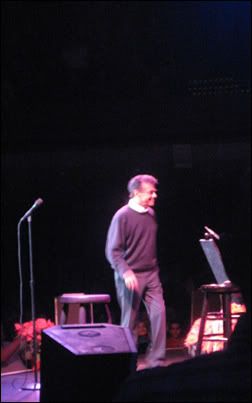
“After you’ve had a few hit records,” explained Johnny Mathis at the Wells Fargo Center last night, “you can just about do anything you want. And I wanted to record some of my mother’s favorite songs.”
His mother’s favorite songs, it turns out, were Christmas songs, and the rest is history—Johnny Mathis has put out nine Christmas albums since. Though for a concert billed as “A Johnny Mathis Christmas,” the set was actually a welcome 50/50 blend of seasonal classics and standards, touching on Mathis’ biggest hits and even snaking down very interesting territory—an electric-guitar version of the Stylistics’ “You Make Me Feel Brand New,” for example, or a raucous street-party “Brazil,” favela whistles and all.
Most noticeably, Johnny Mathis is a living miracle of preservation. At 73, he looks and sounds almost exactly like he did fifty years ago, with the same high-toned boyish singing and a surprisingly fit face and figure. He’s also not just going through the motions. That he’s still willing to take chances and go out of his comfort zone is one of the reasons he’s persevered as one of the last in a literally dying breed. (Oh, 960 KABL, how missed you are.)
Mathis opened with “Winter Wonderland,” the lead-off tune from his first and most famous Christmas album, and then went pretty quickly into “It’s Not For Me To Say,” sparking one of many sighs of recognition. The audience thrilled at the immediately recognizable piano intro to “Chances Are,” and during “Misty,” when he nailed the final octave-high falsetto in the third verse, you could hear an entire theater of 1,400 audibly gasp.
Sure, they laughed at “Gina,” but for the most part, Mathis—in a blue sweater and pants and white sneakers—held everyone rapt in his role as interpreter. “Stranger in Paradise,” “Secret Love” and “A Felicidade” are all songs associated with other singers, but Mathis did them right, just as he delivered a touching “Christmastime is Here” from A Charlie Brown Christmas after giving an introductory nod to Charles Schulz.
Yes, he did “The Most Wonderful Time of the Year,” and “Silver Bells,” and a bunch of other Christmas songs. He also did “The Twelfth of Never” with a solo guitar backing, and “99 Miles From L.A.,” and somewhere near the end of it all—after an intermission during which a know-your-audience comedian came out and told Viagra jokes—Mathis sang eight bars completely acapella, a 73-year-old man alone and unaccompanied in the spotlight, just totally ruling it. Miracles never cease.

Live Review: No Age at the Rickshaw Stop

1

Yesterday, Los Angeles’ favorite DIY vegan noise punk duo No Age was nominated for a Grammy Award. If that sounds like the most insane thing in the world to you, that’s because it is—No Age is the most anti-Grammy Award band on the whole damn long list of nominations, and yet there they are, next to Metallica and Coldplay and the Jonas Brothers and every other major player in the whole stinking industry.
The guys in No Age can look at the non-musical nod as a badge of honor; a sort of affirmation that their actual music will probably never get recognized by the asinine nomination process of the Grammy Awards. You know the only Grammy Thelonious Monk ever won in his lifetime, for 1968’s Underground? It was for the same category that No Age is nominated in: Best Recording Package. Not for his music.
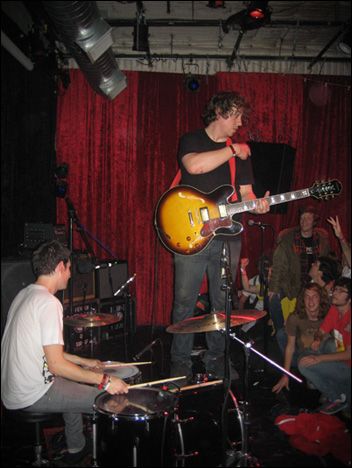
Last night at the Rickshaw Stop, No Age didn’t mention the Grammy Nomination from the stage. And for a band now officially noted worldwide for wrapping their music in a pretty package, well, they didn’t do that either. Instead they played a rambunctious 17-song set for a mostly staid crowd that for the first half of the show just stood there, barely moving. “Come on!” yelled drummer Dean Spunt, frustrated at the stone-faced wall of people. “You guys gotta work in the mornin’ or somethin’?! Loosen up! I said loosen up!”
The crowd eventually did loosen up, with multiple stagedives, bodies falling on the stage, and general dancing abandon. But by then it was too late to ignore what’s become No Age’s big problem: They’ve gotten too much mainstream attention for a band that belongs in basements instead of clubs. There are 100 other bands in the country like No Age, and getting plucked out of the pool and thrust into the limelight doesn’t seem to suit them, any more than being nominated for a Grammy Award does, or playing for a room of people with their arms folded, all thinking okay, guys, show me what you got.
Mitigating circumstances, too, made it an uphill battle. The night was a showcase for an upstart online music site owned by Hot Topic, and the band was introduced by a guy who dropped the phrases “business partnership” and “dot-com” way more than anyone at a show should have to bear. But No Age ultimately prevailed, passing their guitar to be mangled by the hands of the crowd, passing themselves to be levitated by the arms of the crowd, and re-creating a reasonable facsimile of the abandon found at basements, all-ages volunteer clubs and house parties for their trademark closer, “Everybody’s Down.” I’m down with that.
I’m equally down with Titus Andronicus, actually, who opened the show and won me over with their weary, Westerberg-like eight-minute anthem that they dedicated to the Louisiana Purchase. And incidentally, how can Nouns get nominated for Best Packaging—and the unbelievable, amazing designs by Southern Lord get overlooked? Just sayin’.

More Photos and Set List Below.

Cinematic Christmas Criminals

0

12.03.08

Across the wide spectrum that is holiday cinema, from adaptations of Dickens’ Christmas Carol to variations of the Santa Claus story, there are a number of conspicuous recurrent themes and archetypes: orphans, misers, bad people turning good, good people being tested but remaining good, miracles—and dead people. Adaptations of A Christmas Carol, even the Muppet version, are rife with the looming specter of death. The legend of St. Nicholas, if one does the research, reveals a Christmas miracle in which the good Bishop Nicholas discovers the severed bodies of three children stuffed in a pickle barrel, and after sewing the kiddies back together Frankenstein-style, brings them back to life.

There is a surprising amount of darkness in Christmas films, including the perennial It’s a Wonderful Life, the story of a bitter manic-depressive who attempts suicide on Christmas Eve but is saved by a clumsy angel and a pocketful of rose petals. Merry bloody Christmas. It is also notable that, from the beginning of cinema to the present, there are a surprising number of Christmas-themed films involving crime and criminals. What in the name of angels and snowmen could that be about?

“Maybe it’s an intentional exploration of the whole idea of sin and sinners, that promise of redemption that is such a big part of the story of Jesus,” suggests therapist Jill Silverman, director of the Petaluma Counseling Center. “He’s the one who sees the good in the sinners, the prostitutes, the criminals, and offers them a way to contact their own inner goodness. It seems that in a lot of these holiday films, we get a criminal, someone who has not been doing good deeds, and puts them through an experience where they end up operating out of a higher level of goodness.”

So, even when it’s a film about murderers and pickpockets discovering less selfish ways to wield their talents, a recurrent idea in many of these crime-themed Christmas films, the ultimate message is one of morality?

“These movies are almost always about selfish people who discover, by accident or by providence, an ability to exercise moral reasoning to be able to see the difference between right and wrong, and to choose actions that are for the highest good,” Silverman assures.

Here then, for your viewing and philosophizing pleasure, are eight of the better examples of Christmas crime movies, starting with a little-seen gem that is as funny as it is heart-warming.

Larceny, Inc. (1942) When a pair of low-life ex-cons (Edward G. Robinson and Broderick Crawford) buy a failing luggage store next to a bank—they get it cheap, since its owner is going bankrupt—their real goal is to tunnel into the adjoining vault, a several-months effort that will culminate in a huge score on Christmas Eve. Much to their surprise, however, the would-be robbers discover they have a knack for the retail trade, and their store starts raking in the dough, making the bank heist seem much less attractive. Edward G. Robinson plays wildly against type, spending the last 20 minutes of the film dressed as Santa. It’s a hoot.

Christmas Holiday (1944) Based on a novel by W. Somerset Maugham, this noirish potboiler follows a heartbroken GI (Dean Harens) as he searches for love in the Big City while home from the war, falling in with a femme fatale lounge singer (Deanna Durbin) who involves the poor guy in her ho-ho-hopeless attempt to escape her rich, murderous schemer of a husband (Gene Kelly!). The Oscar-nominated score makes great, atmospheric use of Christmas classics.

We’re No Angels (1955) Humphrey Bogart, Peter Ustinov and Aldo Ray are hardened criminals who escape from prison on Devil’s Island on Christmas Eve (of course), but must hide out with a kindly shopkeeper and his family while waiting to catch a boat off the island. Eventually, they employ their murderous skills—and a poisonous snake named Adolph—in saving the family from the wretched store’s owner and his nasty nephew. There’s a stiffening corpse hanging around for half the movie, but believe it or not, it’s really sweet.

Fitzwilly (1967) Dick Van Dyke is the dedicated head butler of a sprawling New York estate, whose sweet, doddering owner doesn’t know that she’s actually flat broke or that her head butler has turned the house staff into a gang of pickpockets, con artists and thieves to keep her from running out of money. The whole thing culminates in a Christmas Eve plot to rob Macy’s department store. It’s a perfect blend of low humor and high spirits, and Van Dyke is perfect; because he’s known for being so nice, it’s a kick to watch him being so bad.

Die Hard (1988) On Christmas Eve, in the middle of a drunken corporate Christmas party, a New York cop with marriage problems (Bruce Willis) finds himself shoeless and shirtless when terrorists (led by Alan Rickman) take control of the high-rise office complex where his wife works, and where he was washing up in the bathroom. It’s one man unarmed against a bunch of guys with guns, and one long O Holy Night as the bodies pile up and Bruce fights to save Christmas.

The Long Kiss Goodnight (1996) During a small-town Christmas parade, a run-of-the-mill suburban housewife (Geena Davis) suddenly has a revelation: she’s actually a trained assassin suffering from amnesia! Unfortunately, the parade’s public exposure blows her cover, and she is forced to relearn a few killing games to save her daughter. It’s knives, blowtorches, bombs and tinsel as that silent night gets really, really rowdy.

Reindeer Games (2000) Ben Affleck is a paroled car thief who assumes the identity of his dead cell mate so he can hook up with the dead guy’s beautiful pen pal (Charlize Theron), but then the pen pal’s brother turns out to be a psychotic criminal (Gary Sinise) who forces Ben to help him rob an Indian casino—on Christmas Eve, natch. Nothing says Merry Christmas like gun-wielding guys in Santa suits.

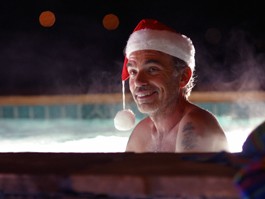
Bad Santa (2003) The curdled cream of the crop, Bad Santa features Billy Bob Thornton as an alcoholic scumbag burglar with a fascinating MO—he gets jobs playing Santa in shopping malls, and then robs the place on Christmas Eve. By the climax, he is redeemed—sort of—by the love of a kid. Not that he will ever be a good Santa.


“In the end,” Silverman says, “all of these movies are really about ethics. At the deepest level of any spiritual practice or philosophy, there’s that struggle to engage in the better parts of being a human. That’s why we watch holiday films—to remind ourselves of the goodness that we can all aspire to.

“Though sometimes,” she adds with a laugh, “the filmmakers are probably counting on that fact that, for some people, it’s just fun to watch people do bad things—and doing bad things at Christmas is somehow extra juicy, as long as it stays on the screen.”


New and upcoming film releases.

Browse all movie reviews.

Celebrating Winter

12.03.08

An old-fashioned holiday outing,” reads the invitation tothe Summerfield Waldorf School’s annual Winter Faire. I’m attractedby the chance to step out of the usual holiday hectic, plus Iremember warmly my past visits to Summerfield, both for thebiodynamic farm’s inspiring oak vistas and for the fascinating waysthe school weaves the land into students’ education.

Wanting more information, I talk with Leslie Young,Summerfield’s events coordinator. As she describes the festival, Ibecome excited at the idea of exploring unique locally made,nature-based handcrafts, and perhaps even buying a local biodynamicChristmas tree. (Biodynamic is even more earth-friendly thanorganic.) Visitors can also take a horse and carriage ride, watch apuppet show, peruse Waldorf-compatible books or enjoy a homemade,all-organic lunch prepared by the senior class to fund theiryear-end activities. Plus there’s a “Snowflake Shop,” offeringyoung children low prices on small, donated, handmade and recycleditems.

But I’m most enticed by the notion of doing the traditionalcrafting, including dipping beeswax candles, decorating gingerbreadcookies, making wool felt holiday bell ornaments and dying a silkscarf. While other crafts events might use less desirable materialssuch as Styrofoam, Young says that all their craft materials arenatural, including the silk dyes that are homemade by schoolreceptionist and parent Tracy Saucier. Young hands the phone toSaucier, who enthusiastically tells me that people are returning tothe natural dying techniques used for thousands of years because ofthe reduced impact on the earth, lowered toxic exposure andbeautiful rich colors.

Speaking again with Young, I comment that I enjoy interactingwith Summerfield folks. She replies, “Well, it’s not just a school,it’s a community.” The seasonal rhythm of the year’s festivals, sheexplains, helps create this sense of community, encouraging peopleto connect with each other in meaningful ways while honoringnature.

The school’s ceremonies start each fall with September’sMichaelmas, when they enact the story of St. Michael confrontingthe dragon. Their approach is not religious, Young says, butsymbolic, offering “living images” that can help us on life’sjourney. In Summerfield’s remake, the dragon represents ourchallenges, such as winter’s cold darkness or aspects withinourselves that we want to change. The goal is not to kill thedragon but to transform it, harnessing its strength to empower ourlives.

In another school ceremony, the Advent Garden, parents and youngchildren gather in a dark room. One at a time, each child walksinto a spiral of evergreen boughs, carrying a candle, which is thenlit. The child walks back out, placing the candle in the spiral.When the room is filled with light, the group sings a thematicsong. “It’s pretty magical,” Young says, adding that when the daysbecome short, these ceremonies help us rekindle the lightwithin.

Summerfield’s commitment to encouraging students’ connectionwith the earth is seen throughout the school’s work. For instance,it is one of the few U.S. Waldorf schools with its own onsitebiodynamic farm, which is integrated into the curriculum. This waspart of Waldorf founder Rudolf Steiner’s original vision. Duringboth the regular school year and summer Farm Camp, students helpcare for the animals; tend the growing fruits, vegetables andflowers; and process and prepare foods. Through this, according tothe school’s website, they “learn many basic skills that arerapidly becoming lost in today’s industrialized society . . . [andgain] a deeper awareness of the natural world.”

Summerfield’s land steward and farmer Perry Hart writes, “MotherNature is now ailing and . . . humanity must take theresponsibility to nurture our mother back to health.”

I feel soothed hearing about these earth-honoring ways. Toooften in our busy modern lives, nature’s cycles can seem likeoptional background noise. But for most of humankind’s time onearth, we’ve had shared ceremonies to help us honor and synchronizewith the light and the dark, the expansion into summer’s expressivesunshine and the contraction into winter’s restful introspection. Ithink that we viscerally long for nurturing relationships with theearth and community.  I’m moved by the opportunity to dip intothese ancient waters.

 Summerfield Waldorf School and Farm’s Winter Faire isslated for Saturday, Dec. 6, from 11am to 4pm; $1 entry fee.Adults-only preview, Friday, Dec. 5, 5:30–8pm; no entry fee.655 Willowside Road, Santa Rosa. 707.575.7194.

to theeditor about this story.


Letters to the Editor

12.03.08

An Open Letter

This is an open letter to Sonoma County Fifth District Supervisor-Elect Efren Carrillo

Dear Efren: They say you are a nice guy, but some of us in the West County wonder why you let your campaign be soiled by dirty money and dishonest ads. If you know your West County history, you will see a graveyard of politicians who ignored the conservation ethic that we require of our representatives. We wish you well, but we will be watching to see how you pay off your debt to your developer benefactors. They may have put you there, but they can’t keep you there.

Sincerely,

Pieter S. Myers

Occidental


Gates Should Go

I am very concerned about the notion of Bush’s Secretary of Defense Robert Gates staying on at the Pentagon. Gates has vocally opposed Obama’s withdrawal plan for Iraq. Gates has also become the leading voice in the Bush administration pushing for an aggressive nuclear-weapons posture. And even many conservatives have argued that he has a habit of skewing intelligence to fit his predetermined policy preferences.

Obama’s desire for a diversity of views around the cabinet table is refreshing. But Robert Gates’ support for the policies of the past makes him the wrong person to lead U.S. military and foreign policies in a new direction.

Colbee McManamon

Forestville

Crazy!

Saw Always, Patsy Cline last evening (“American Idol,” Nov. 19). The audience was delirious. Both actresses seemed to be freshly bonding. [Mary Gannon] Graham inhabited Cline. I wanted to rush the stage to worship Graham’s singing, reminiscent of k.d. lang. Good review. Please keep track of both these actresses.

Michael Gamble

Santa Rosa


Travelers Tales

This is a bus passenger alert: Sonoma County Transit is no longer going to the downtown Petaluma bus stop at Fourth and C streets. They are planning to eliminate this popular and much-needed access point. Riders will now have a long walk to and from the new transit mall.

No notice of this change has been given to the public, but you can make your voice heard by contacting Bryan Albee, transportation manager for the County of Sonoma, at 707.585.7516 or by emailing through the SCTransit.com website. Please let them know that the public wants and needs the downtown bus stop at Fourth and C.

Sandy Lee

Rohnert Park


&–&–>

Honey, I Shrunk Santa

12.03.08

W e’ve been pretty hard on Santa Claus for the last four years,” says Steve Fowler, co-writer and director of Pegasus Theatre’s popular annual fundraiser The HollyDay Show , “but this year we finally give the guy a little rest. First, though, we send him to the shrink.”

That’s right, Santa Claus, the beleaguered toymaker who, in the previous HollyDay productions, has seen his North Pole empire attacked by corporate interests, been subjected to a hostile takeover by his one-time favorite reindeer Rudy, had his elves facing unemployment after their jobs were outsourced to the South Pole, and experienced his beloved land of ice and snow melted from global warming has decided to consult a psychiatrist.

The whole Santa-in-therapy gag turned out to be the perfect framework for this year’s show, because Fowler and his co-creator, Andrea Van Dyke, have decided to make this one the last. “It’s a lot of work,” Fowler laughs, “and this year we’ve pulled out all the stops to try to make this one as amazing and as fun as we can, but over the last few years we’ve spent so much time writing and creating these shows, we’ve put a lot of other projects on the back burner. It’s time to let the HollyDay Show go and move on to other things, but first we’ll be revisiting some of our favorite moments from the last three shows.”

That’s right, as Santa takes the couch to vent his pent-up emotions, he’ll be having a series of singing-and-dancing flashbacks, visited by characters—and musical numbers—from the past. “There will be plenty of singing reindeer and dancing elves,” Fowler assures. “We’ll bring back the dancing dreidels that were such a hit in the past. We’re bringing back the Jolly Llama. Santa will be revisited by the Universal Child. It’s going to be one big enormous fun time, with the usual social commentary thrown in, because that’s what we always do.”


And will Santa get a happy ending?

“Does Santa live happily ever after?” Fowler chuckles. “You’ll have to come see the show and decide for yourself.”

The HollyDay Show runs Thursday&–Sunday, Dec. 11&–21, at Pegasus Theatre. 20347 Hwy. 116, Monte Rio. Thursday-Saturday at 7:30pm; Sunday at 2pm. $15&–$18; Dec. 18, pay what you can; matinees, $5 for kids under 10. 707.522.9043.


Museums and gallery notes.

Reviews of new book releases.

Reviews and previews of new plays, operas and symphony performances.

Reviews and previews of new dance performances and events.

Beer in the Toad

12.03.08

F or a British pub in Santa Rosa and the Englishman who operates it, Sonoma County is a long way from home. However, the cask-conditioned beers at the Toad in the Hole Pub are meant to take drinkers back to the old days when beer was brewed onsite, transferred to barrels and served at cellar temperature—and that, says the Toad’s owner Paul Stokeld, is the authentic taste of England.

“When people say English beer tastes warm and flat, that’s what a cask-conditioned beer is,” Stokeld explains. “It sounds bad, but it’s the way they used to do it, and the beer is actually so much better.”

Bottled beer is “conditioned” with a small dose of sugar in each bottle before the cap goes on. Secondary fermentation begins, resulting in carbon dioxide production and bubbles. Beer in kegs, meanwhile, is not conditioned at all, but rather pumped with carbon dioxide during each pour, again resulting in bubbles.

Cask-conditioned beer is drawn, without filtering, from the primary fermenter into the cask, which is then transported to beer’s final destination—say, a pub. While secondary fermentation proceeds, the cask is opened at room temperature and the beer poured, a process that involves a large hand pump and the movement of air, not CO2, through the system, called a “beer engine.” Oxidation begins immediately with the first pour, but most establishments with a loyal beer-loving clientele will empty a cask before the beer goes too far south.

In fact, cask-conditioned beer is considered by many critics to be far superior to other forms. The beer is fuller and richer and thick with aromatic particulates and hop matter.

“It’s like being in the brewery and having the beer straight out of the tank,” says Tony Magee, president of Lagunitas Brewing Company, whose Maximus double IPA is regularly served from a cask at the Toad in the Hole. “It’s beer that’s still in its adolescence. All the flavors are softer. The malt is silky and creamy. You don’t have all that carbon dioxide, and the beer is much less gassy.”


The Toad is now pairing its cask-conditioned ales to a Sunday prix fixe menu of roast beef, Yorkshire pudding and other British staples. The pub features just one beer engine, so the cask-conditioned brews rotate one at a time. Check with the pub to see what North Bay brew is pouring, and savor the flavor of beer from the barrel.

Toad in the Hole Pub, 116 Fifth St., Santa Rosa. Open Monday&–Tuesday at 4pm; Wednesday&–Sunday at 11am. 707.544.TOAD (8623).

Quick dining snapshots by Bohemian staffers.

Winery news and reviews.

Food-related comings and goings, openings and closings, and other essays for those who love the kitchen and what it produces.

Recipes for food that you can actually make.

Black Diamonds

0

Connecting the Dots

12.10.08In 2004, Marin Organic's executive director HelgeHellberg was visiting the organization's member farms when helanded at Peter Martinelli's Fresh Run Farm in Bolinas. As hetoured the abundant fields, Hellberg noticed some large zucchinislying on the ground, clipped off the vine. When he asked why theyhadn't been harvested, Martinelli replied that there was no marketfor zucchinis that big, and so...

Live Review: Johnny Mathis at the Wells Fargo Center

“After you’ve had a few hit records,” explained Johnny Mathis at the Wells Fargo Center last night, “you can just about do anything you want. And I wanted to record some of my mother’s favorite songs.” His mother’s favorite songs, it turns out, were Christmas songs, and the rest is history—Johnny Mathis has put out nine Christmas albums since. Though...

Live Review: No Age at the Rickshaw Stop

Yesterday, Los Angeles’ favorite DIY vegan noise punk duo No Age was nominated for a Grammy Award. If that sounds like the most insane thing in the world to you, that’s because it is—No Age is the most anti-Grammy Award band on the whole damn long list of nominations, and yet there they are, next to Metallica and Coldplay...
Outlawed Love

Cinematic Christmas Criminals

12.03.08Across the wide spectrum that is holiday cinema, from adaptations of Dickens' Christmas Carol to variations of the Santa Claus story, there are a number of conspicuous recurrent themes and archetypes: orphans, misers, bad people turning good, good people being tested but remaining good, miracles—and dead people. Adaptations of A Christmas Carol, even the Muppet version, are rife with...

Celebrating Winter

12.03.08An old-fashioned holiday outing," reads the invitation tothe Summerfield Waldorf School's annual Winter Faire. I'm attractedby the chance to step out of the usual holiday hectic, plus Iremember warmly my past visits to Summerfield, both for thebiodynamic farm's inspiring oak vistas and for the fascinating waysthe school weaves the land into students' education.Wanting more information, I talk with Leslie...

Letters to the Editor

12.03.08An Open LetterThis is an open letter to Sonoma County Fifth District Supervisor-Elect Efren CarrilloDear Efren: They say you are a nice guy, but some of us in the West County wonder why you let your campaign be soiled by dirty money and dishonest ads. If you know your West County history, you will see a graveyard of politicians...

Honey, I Shrunk Santa

12.03.08 "W e've been pretty hard on Santa Claus for the last four years," says Steve Fowler, co-writer and director of Pegasus Theatre's popular annual fundraiser The HollyDay Show , "but this year we finally give the guy a little rest. First, though, we send him to the shrink."That's right, Santa Claus, the beleaguered toymaker who, in the previous...

Beer in the Toad

12.03.08F or a British pub in Santa Rosa and the Englishman who operates it, Sonoma County is a long way from home. However, the cask-conditioned beers at the Toad in the Hole Pub are meant to take drinkers back to the old days when beer was brewed onsite, transferred to barrels and served at cellar temperature—and that, says the...
11,084FansLike
4,446FollowersFollow
6,928FollowersFollow