Video Shows New Angle of Napa County Sheriff Shooting

0

New video was just released by the Napa County District Attorney’s Office of a recent car chase that went horribly wrong. It shows a police officer shooting a teen named Demarea Vaughn Rogers III in the back as he runs in the other direction, on Jan. 11 in a North Vallejo neighborhood. Police say Rogers led them on a chase after they tried to pull him over near Highway 29 and American Canyon Road — a pursuit that ended in him getting out of the car and trying to flee. And while no one can ever know the whole story when it comes to high-intensity encounters like this one, the latest footage is not a good look for the officer who pulled the trigger. His name is Josh Coleman, and he’s a member of the American Canyon Police Department, which is staffed by the Napa County Sheriff’s Department. When he shot Rogers that day, it thankfully wasn’t enough to kill the 18-year-old — which I suspect is why this officer-involved shooting has attracted less attention than some others. (“He’s doing very well now,” Rogers’ attorney tells the Press Democrat. “He’s still walking with crutches. But he’s in physical therapy and he’s doing fine.”) Still, a good number of activists and journalists have been following the case — in particular, an independent newsroom called OpenVallejo. And it was thanks to a record request filed by the Vallejo Sun that we have this new video, captured by a home security camera in the neighborhood. Up until now, the only other footage the sheriff had released was mostly from police vehicle cams and the body cams of other officers at the scene — but none of it seemed to show what was happening when Coleman actually pulled the trigger. In fact, sheriff’s officials told reporters that the battery powering Coleman’s own body cam had died sometime before he shot Rogers — thus adding to the mystique of the whole case. Here’s a summary of what’s shown in the new home-security footage, courtesy of the San Francisco Chronicle: “‘Hands up, drop the gun,’ Coleman says in the video. Rogers drops one gun on the driveway in front of a house and continues to run with another gun in his hand. ‘Drop the gun, or I’ll shoot you,’ Coleman says as Rogers runs across the street toward another house. Seconds later, just as Rogers appears to throw another gun toward a patch of grass, Coleman opens fire on Rogers, striking him in the back.” In some of the previously released body-cam footage, from the aftermath of the shooting, Rogers can be heard saying things like “I can’t move” and “Please don’t let me die” and “I just want to see my mom.” And Coleman, who ends up being the one to apply a tourniquet to Rogers after shooting him, says: “I thought you were trying to pull that gun out on me, bro. It looked like you were trying to shoot me.” Coleman is also getting some heat, in light of all this, for his previous history at the Vallejo Police Department. The PD reports that he pulled the trigger on four different suspects while on the local force, and was also involved in a “badge-bending” scandal where “some members of the city’s police force had a ritual of bending the tips of their badges after on-duty fatal shootings.” (Source: OpenVallejo via X & Vallejo Sun & Press Democrat & San Francisco Chronicle; paywall)

Indian Casino Proposed in Windsor: Submit Your Input

0

One local tribe’s bold proposal for a massive new resort and casino in the ranch lands east of Windsor has entered an important planning stage: Officials from the Bureau of Indian Affairs are preparing a draft “environmental impact report” for the project, and as they do so, are inviting the public to give input on how it might affect the surrounding area. You have around three weeks left to throw in your 2 cents. The Shiloh Resort & Casino would be located on nearly 70 acres of unincorporated land between Old Redwood Highway and the Shiloh Ranch Regional Park, currently quilted in vineyards. It butts right up against a Windsor neighborhood, so it has some nearby residents spooked. A Pomo tribe from Lake County called the Koi Nation of Northern California reportedly bought the land for around $12 million a few years ago, and now they plan to make good use of it. They want to spend another $600 million building their proposed 100,000-square-foot casino and 400-room hotel on the site — plus a conference and event center, six restaurants and bars, a spa and a bunch of parking. “The property site is just over 10 miles from the Tribe’s historic lands within California’s Pomo territory,” the Koi say. “It gives life to negotiated treaty rights dating from the 1850s, undoing decades of woeful federal mistreatment.” At first, their proposal seemed like a long shot — especially since some other tribes nearby that run their own casinos pushed back. But since then, the Koi have announced the support of “a broad coalition of 18 California tribal governments, several political figures and one key ally in state government — California Treasurer Fiona Ma,” according to the Press Democrat. Sonoma County government officials say the tribe has asked the federal government if their property can be “placed into trust to become sovereign tribal land.” The Koi application is still under review, according to the county — but if it’s approved by the U.S. Department of the Interior, the county will “not have regulatory jurisdiction or decision-making authority” over whether the casino is allowed to open. In any case, the Bureau of Indian Affairs is going ahead with the environmental impact report. The bureau says it’s an effort to “further analyze the environmental effects which may result from” the Shiloh Resort & Casino, as proposed — and as part of that process, they’re inviting the public to “identify potential issues, concerns, and alternatives to be considered.” You can send your opinions to Chad Broussard, an environmental protection specialist for the bureau, at ch************@*ia.gov. Make sure to include your name and the phrase “NOI Comments, Koi Nation Fee-to-Trust and Casino Project” in the subject line. The deadline is April 8. (Source: Sonoma County Government & KRCB & Shiloh Resort Environmental & Town of Windsor & Koi Nation of Northern California & Press Democrat & Press Democrat; paywall)

Suspected Santa Rosa Theft, 101 Car Chase Ends in Crash

0

Maybe you saw that wild freeway car chase through Cotati and Petaluma on the news earlier this week? Here’s what happened on Monday afternoon, according to Santa Rosa police: Three twentysomethings from Oakland tried to steal around $6,000 worth of sportswear from a Dick’s Sporting Goods big-box store — the one on Cleveland Avenue in north Santa Rosa — by stuffing it into garbage bags. Then, when police got word of the heist from Dick’s employees, a sheriff’s helicopter spotted the suspects’ getaway car, apparently a white Kia minivan, barreling down the 101 South. (Which is where the dramatic car-chase footage came from.) And local cops started chasing in their cruisers, too. “The suspect vehicle drove in excess of 100 mph in all lanes including the shoulders eventually hitting another vehicle causing injury to the driver,” sheriff’s officials say. And here’s the report from the Santa Rosa Police Department: “All three of the suspects suffered minor injuries from the collision, but after medical clearance they were booked into the Sonoma County Jail for several charges. … Detectives from SRPD’s Property Crimes Investigations Team took over the theft investigation, and learned the crew were likely responsible for a series of similar thefts at several Bay Area Dick Sporting Goods Stores.  The extent of those other thefts is still under investigation, but employees estimated total losses attributed to this theft crew to be over $75,000. During a search of the crashed suspect vehicle, detectives located over $5,800 in stolen merchandise, clothing the suspects wore during the Santa Rosa theft, and a loaded privately manufactured firearm concealed within the vehicle.” The suspects have since been named as Brandon Owens, 23; Roy Andrew Jr, 22; and Heaven Henry, 20. They’re all now facing potential jail time here in Sonoma County for organized retail theft, conspiracy, burglary and carrying a concealed and loaded firearm. Officers also claim that the young woman involved, Heaven, gave them a fake name and tried to “resist/obstruct” arrest. (Source: Sonoma Sheriff via Facebook & Santa Rosa Police via Facebook)

Fromage Fête: California Artisan Cheese Festival

It’s time for the 18th Annual California Artisan Cheese Festival, happening from March 22-24. This much-loved festival, dedicated to celebrating the artistry of cheese-making, offers three days of gourmet delight, farm tours and educational experiences.

Since 2007, the festival has evolved into a three-day extravaganza of cheese appreciation, education and festivity, uniting California’s foremost cheese artisans. The weekend celebration provides the cheese-curious a chance to savor and acquire new, limited edition and rare artisanal cheeses while mingling with Bay Area farmers, chefs, brewers, winemakers, distillers and gourmet food providers.

The festival kicks off Friday with its signature Farm and Producer Tours spanning across Marin and Sonoma (and even Mendocino) counties. The tours offer an immersive peek into the craft of artisan cheese-making at the source, the farms and places where it all begins.

Saturday attendees will enjoy cheese tastings, expert pairings and informative seminars at a variety of locales throughout Sonoma County, and can finish the day with the Cheese Crawl, a tasty walking tour experience throughout The Barlow in Sebastopol. The festival culminates on Sunday at the Artisan Cheese Tasting & Marketplace with a grand finale tasting event at the Sonoma County Fairgrounds in Santa Rosa.

“We are over the moon with how the 18th Annual California Artisan Cheese Festival has come together for 2024,” says Sarah Simms, president of the California Artisan Cheese Guild and co-founder of the festival. “It will be a true celebration of the best of California cheese and the makers behind-the-scenes who create the real magic.”

For 18 years, the festival has promoted the appreciation of local cheese and the sustainability of the cheesemaking community, educated about artisanal cheeses, and celebrated the creations of California’s farmers and cheesemakers. They have also contributed over $180,000 in grants to nonprofit partners to foster local sustainable agriculture.

Producer and Farm Tours begin and end at various times and places, so folks can check the website to sign up for the tour that works for their interests and schedule. Tours offer attendees intimate glimpses into farms, creameries and producers showcasing the pivotal role of the farmer in cheese production. It’s a rare chance to enjoy guided behind-the-scenes walking tours where they can meet farmers, the animals and cheesemakers, and taste their creations.

“There is nothing like getting the chance to meet your favorite cheesemaker at the Cheese Crawl or cuddle with a baby goat on one of the farm tours,” says Simms.

The tours include curated offerings for every interest, including: “The Truly Artisan,” “Approachable Yet Refined with Cozy Lunch Vibes” or “Behind the Scenes Wines & Friendly Lunch” (with goats!). Tours will visit places like: Gold Ridge Organic Farms, Silver Penny Ranch, Nicasio Valley Cheese Co., Barber Lee Spirits, Marin French Cheese Co., Valley Ford Creamery, Black Kite Cellars and many more.

Specialized seminars, workshops and pairing sessions will be offered at various locations in Santa Rosa and Petaluma. These interactive sessions offer the chance to learn from industry experts, chefs and cheesemakers. Topics range from crafting one’s own cheese and charcuterie boards, to how to offer guests the ideal cheese and wine pairings, and cheese tasting with beer and aperitifs.

Culminating the event is the Artisan Cheese Tasting & Marketplace, where over 100 artisans gather every year to showcase their handcrafted cheeses, complementary gourmet delights, boutique wines, craft beers and artisanal ciders. Guests can peruse a wide selection of cheese, culinary literature, recipes and tasting experiences amid live entertainment. Children are welcome, but please note that strollers are not permitted.

Since 2007, the weekend-long festival has been dedicated to exploring handcrafted cheeses, alongside artisanal foods, wines and beers from California. Folks can attend one day or all three. With a variety of choices, from lectures, tours and tastings to meeting the farmers, the California Artisan Cheese Festival truly has something for everyone.

18th Annual California Artisan Cheese Festival, Friday, Saturday and Sunday, March 22-24. Info and tickets to all events: artisancheesefestival.com.

Women’s History Month in Sonoma County

Women don’t have a history.

That’s the message children got from their history textbooks back in the “olden days,” before five visionary women—Molly Murphy MacGregor, Mary Ruthsdotter, Maria Cuevas, Paula Hammett and Bette Morgan—created the National Women’s History Project in 1980.

“As teachers, we were aware that the history books mostly spoke about men,” said MacGregor, who still answers the phone and directs people to resources at the organization now known as the National Women’s History Alliance.

In fact, only 3% of the people featured in classroom history texts were women. So, working with the Sonoma County Commission on the Status of Women, these five intrepid souls went about writing women back into history.

First, they created a Women’s History Week, centered on March 8, International Women’s Day. Then they called the White House, and President Jimmy Carter agreed to make it official that year.

They brought this new idea to the local schools, where teachers agreed to put Women’s History Week on their school calendars and invited local women into their classrooms to talk about their lives. In 1987, Congress voted to make March Women’s History Month in perpetuity.

By 2018, so many women’s organizations were involved in Women’s History Month that the group changed its name to the National Women’s History Alliance.

Now, in celebration of Women’s History Month, the Bohemian is featuring five remarkable women who share their time, talents and expertise with the Sonoma County community and beyond.

Jackie Elward

Rohnert Park City Councilmember Jackie Elward says it is her kids who drew her into politics.

“My son was frightened, seeing me constantly pulled over, profiled by the police. He didn’t have anyone to speak for him. Our leadership lacks people of color, strong women of color, especially the Black community,” Elward said.

Deciding “not to stand on the sidelines any longer,” she organized a Black Lives Matter rally with Julie Royes and ran for City Council in 2020. Along with two other women newcomers, she flipped the council from a conservative one to a progressive one, Elward said. When she served a term as the city’s mayor in 2021, she was the first Black mayor from Marin County to the Oregon border.

With a progressive majority, the council secured $14 million in state funds for transitional housing and mental health programs, worked with Cotati and Sonoma State University to formulate a program that brings mental health professionals to non-violent emergency calls and purchased a 30-acre former Hewlett Packard site where they are planning to build a downtown.

Now, encouraged by her constituents, she is running for the state Senate in District 3.

Born and raised in the Democratic Republic of Congo, Elward came to California with her husband in 2005, to escape the political turmoil and, what she called a “silent genocide.” They have three children, ages 20, 17 and 13. Elward, who speaks six languages, is an instructional aide at the French American Charter School in Santa Rosa.

Duskie Estes

Restaurateur, farmer and food bank organizer Duskie Estes “fell in love with all things restaurant” at the tender age of 10. That’s when her parents divorced and she spent time with her father at “cool” restaurants, like Greens, Chez Panisse and Star.

When Estes grew up, she considered medicine and the law, but found herself irresistibly drawn to cooking and food. While working as an unpaid intern in Washington, D.C., Estes got a job in a restaurant and joined the Share Our Food, No Kid Hungry campaign and Food Matters.

Moving across the country to Seattle, she worked at the Palace Kitchen, wrote a cookbook and won a James Beard award. Eventually, she and her husband, chef John Stewart, settled in California, where they created Zazu Kitchen + Farm, and Black Pig Meat Company, while raising three children.

When their restaurant in Sebastopol’s Barlow flooded in 2019, they realized that restoring it was overwhelming, so they decided to leave the restaurant business behind after 19 years. They still operate their farm and meat company and a food truck that services winery events and music festivals.

“It’s impossible to make a living in the restaurant business, pay employees well and source your food ethically,” is her take-away.

By ethical sourcing, she means growing what one can oneself and buying organic produce and ethically raised meat from local farmers and ranchers.

“Farm to table instead of freezer to table,” she quipped.

Four years ago, she became the director of a gleaning organization that brings extra produce from farmers and backyard growers to “people who need it.” According to Estes, one in four Sonoma County residents are facing food insecurity while so much produce goes to waste in people’s backyards. All through the year, volunteers glean the excess food and transport it to local food banks.

“Every day I’m outside with people doing something for people they don’t even know,” she rhapsodized.

At the end of February, she retired from Food to Pantry, but is still involved with some of its programs, like Farm to Snacks, which provides afterschool and summer snacks for children.

Pastor Lindsay Bell-Kerr

As lead pastor at Santa Rosa’s Christ Church United Methodist, Lindsey Bell-Kerr is able to fulfill their passion for social change through religion.

“John Wesley founded the Methodist Church on social justice,”

Bell-Kerr said. “He believed that women could be church leaders. He was an abolitionist until his death. He believed in the rights of animals. I found a place in the most radical part of the church.”

Born and raised Catholic in western Pennsylvania, a conservative part of the country, Bell-Kerr noted, they studied journalism in college, but soon “had an itch to try something else.” It was also in college where they gravitated toward the Methodist Church.

After graduation, they traveled to Mindanao, Philippines, working with the interfaith organization, Initiatives for Peace. While there, they decided to study theology at the Pacific School of Religion in Berkeley.

“I heard my calling (to the ministry) in the Philippines,” they said.

Bell-Kerr identifies as non-binary and has faced some difficulties in the church as a result. But they have weathered the storm and found a home at Christ Church United Methodist, which was GLBTQ-friendly long before Bell-Kerr arrived. The church’s website is splashed with all manner of rainbow colors, and the congregation includes both GLBTQ people and their “proud parents.”

The church is also involved in other social justice issues. It houses the North Bay Organizing Project, as well as a Harvest for the Hungry garden and a food bank, Elisha’s Pantry. At Bell-Kerr’s “nudging,” it is moving even farther in that direction. The church has recently joined the Changemaker Church Project, which encourages members to become change makers in their local communities.

“I came to the church because I am not just interested in justice for GLBTQ people, but for all people,” they said.

Bell-Kerr is married to Rev. Diana Bell-Kerr, pastor at the First Congregationalist UCC Church in Santa Rosa.

Katie Ketchum

Singer, pianist, composer and painter Katie Ketchum was tongue-tied as a child—literally—which required two surgeries to loosen her tongue. And it hasn’t stopped wagging ever since.

Basically shy as a child, Ketchum found her self-expression in music. That meant studying classical piano at the Royal Conservatory in Toronto and finding her own voice as a singer and a composer of zany musicals about women in history.

While taking art classes at a university in Las Vegas, she learned about Mary Cassatt, a turn-of-the-century American painter who struggled to make her way in the male-dominated art world. After receiving a National Endowment for the Arts grant to complete this work, and enjoying a successful run of her first effort, she wrote a second musical about composer/pianist Clara Schuman, whose father controlled her musical career until she married composer Robert Schuman.

Then, because Ketchum had always been interested in how Mary Magdalene was ignored in the Bible, she decided to write a musical presenting her in various guises, including as a country western singer. Along the way, it turned into a comedy.

“All my plays are about women’s empowerment,” she said, adding that they have all had successful runs around the country.

Twelve years ago, she added another art to her repertoire—painting. Here again she focuses on the feminine, painting icon images of goddesses and some contemporary heroines, like Dolores Huerta and Ruth Bader Ginsberg. She also joined herchurch, a feminist church in San Francisco, where she serves as piano player, choir director and painting instructor. And, along with lyricist Jann Aldredge-Clanton, she has written a book of feminist chants, Hersay, Songs of Healing and Empowerment.

Currently she is showcasing a new musical, Mad Hattie Saves the World, an interactive tea party where she solicits suggestions for transformation from the audience. She is in her 50th year of teaching voice and piano in Sonoma County.

Renee Saucedo

“I’m fully bi-cultural,” is how Renee Saucedo describes herself, having spent her childhood traveling between her mother’s home in Mexico and her father’s in Saratoga, CA.

That’s what makes Saucedo uniquely qualified to help immigrant Mexican women bridge the gap between the country they left behind and their new lives in the U.S. Having spent several years as an attorney for La Raza Centro in San Francisco, and then the Graton Day Labor Center, she is now the director of Almas Libres (Free Spirits), a Sonoma County advocacy organization for Indigenous Mexican women.

Saucedo said she has always been drawn to helping Indigenous people better their lives.

“Growing up in Mexico, I became radicalized,” she said. “I saw the extreme poverty. I knew I wanted to work for oppressed people.”

Saucedo began working with the local women’s group when it was part of the Graton Day Labor Center. After she moved to the Raizes Collective, the group joined her and took the name Almas Libres. She said it provides a place where women can empower one another through sharing their stories and supporting each other along the difficult path of being an immigrant in an unfamiliar, and not always benign, new land. Las Almas is also working with state and federal organizations to create a pathway to citizenship for Mexican immigrants.

“I am so honored and privileged to work with these women,” she said. “I am a witness to their transformation, their courage and their love of family. I have been doing this work for 35 years, and I still wake up every morning excited about my work with immigrant and Indigenous women.

“They work hard, strenuous jobs, and still find the courage to support each other and work in the community for social justice,” she continued. “Many of them are forced to leave their loved ones behind, and risk their lives to come here and work to put food on their babies’ tables and provide for their elderly parents. They need citizenship to be able to travel and visit their families.”

Sonoma County Pride’s Grace Villafuerte

This winter, I had the pleasure of sitting down with one of the North Bay’s most cited and celebrated lifetime volunteers,

Grace Villafuerte. Among her responsibilities, she is currently the VP of Sonoma County Pride day, week, month and year. She is also in charge of volunteers.

Cincinnatus Hibbard: What motivates your service and advocacy for your communities?

Grace Villafuerte: Whether it be LGBT+, woman, Filipina or widow, with every single one of these identities, I owe my ability to love these parts of myself, because of the pioneers that came before me. Every right I have, they fought for. I am in constant gratitude for them. They opened the door. My job is to open the door a little more. And not let it close behind me.

CH: As a Gen Xer, you are a living witness and participant to major breakthroughs in each of those community’s struggles for recognition. Grace, I have noticed that with each LGBT+, widow, Filipina and woman, there was a process of your coming out, finding a community and creating love and pride through service. You said the hardest of all was coming out as a widow.

GV: Yeah, golly, people are awkward around that (laughs).

CH: You were and are married to Lynn Marie Campanario, who passed in 2014.

GV: Yes. We had built our lives around being of service.

CH: You intimated to me that your friends and family wanted to help you in your grieving, but not understanding could be unintentionally hurtful.

GV: Yes, I had to seek a new community. I found it at a gathering of Camp Widow. The experience of being surrounded by hundreds and hundreds of widows was so powerfully connective. I left with a lot of new friends that lost their husbands and wives at the same time. We shared milestones.

CH: I understand you now lead an online group for lesbian widows suited to the special issues of that community. Do you have any advice for the recently bereaved?

GV: Death ends a life and not a relationship. I now think of my relationship with Lynn as a really long-distance relationship (laughs).

CH: How is Lynn now?

GV: As in life, very busy. She volunteers helping the newcomers out.

Learn more: This interview is taken from a longer audio interview available at ‘Sonoma County: A Community Portrait’ on Apple, Google and Spotify podcasts. linktr.ee/cincinnatushibbard.

Susan Lieu’s debut memoir ‘The Manicurist’s Daughter’

The Asian American immigrant story of achievement is well-trodden territory, but to many outsiders, what motivates perseverance for Asian Americans is largely misunderstood.

In her seminal work on Asian American life, Cathy Park Hong critiques the perseverance narrative and argues that these stories are the cause of Minor Feelings, her book’s titular phrase.

Hong explains that minor feelings are “built from the sediments of everyday racial experience and the irritant of having one’s perception of reality constantly questioned or dismissed.” Minor feelings are induced by the assumption that Asian Americans are the model minority. We supposedly work hard and achieve social mobility because of our cultural values and beliefs, never mind the pain we endure in the process. We are rendered invisible when, in fact, we are raging inside.

The model minority myth and the narrative works that support it ignore the complicated histories of Asian Americans, a group that is composed of six ethnicities and renders Asian American reality invisible. This month, Santa Rosa’s Maria Carrillo High School alumnae Susan Lieu published a debut memoir that obliterates the perseverance narrative.

The Manicurist’s Daughter, out last week from Celadon, an imprint of MacMillan Publishers, examines how war trauma and migration impacted Lieu’s family. It also sheds light on the impossible beauty standards women are held to that took their mother’s life in California. Lieu’s mother died during a botched tummy tuck procedure she underwent in San Francisco in 1996 when Lieu was 11 years old. She was just 38.

The book is a lesson in grieving, healing and community-making through storytelling. It is especially valuable for Sonoma County Asian Americans, who make up just 5% of the county’s population and for whom Lieu’s book gives a voice. Readers may especially appreciate Lieu’s details of her family’s spiritual practices and food preferences. The story will make one cry, but it will also make one very hungry for Vietnamese cuisine.

Those who get their nails done in Santa Rosa may recall Lieu’s mother, Jennifer, as the owner of Today’s Nails on Fourth Street near the Santa Rosa mall, which she owned and operated with her husband and sisters and with the help of her children. Some locals may also recall Lieu and her sister, Wendy, selling chocolates outside of Today’s Nails during summertime farmers’ markets. Wendy Lieu recently celebrated her chocolate business, Socola Chocolatiers’ 10-year anniversary in San Francisco.

What is less known to the public is the story of Lieu’s family and the hardships they endured escaping Vietnam and assimilating into life in California. Lieu’s parents are boat people, refugees who, in the 1980s, survived a narrow escape from the Vietnamese communist government and a harrowing journey across the ocean in search of stability.

A matriarch and savvy businessperson, Jennifer Lieu started her own nail salon business in the East Bay. Eventually, Jennifer Lieu made enough money to bring her sisters and mother from Vietnam to California and move her business and family to Santa Rosa so her children could attend better schools.

Jennifer Lieu’s untimely death impacted the family. But after her passing, business needed to go on as usual for Today’s Nails, and the family grieved in silence. This confused and unsettled Lieu, who missed her mother. But when she attempted to seek consolation and answers from her family, her father, siblings and aunts only wanted to move on.

When asked what kept her going as a teenager in Santa Rosa after her mother’s death, she said it was community—former Santa Rosa public school principal and family friend Laurie Fong nurtured Lieu throughout high school. The former manager of the Santa Rosa Farmers’ Market admired Lieu and her sister’s industrious spirit and helped them sell their chocolates during the summer farmers’ market.

Still, Lieu’s suppressed grief followed her to Harvard, where she attended college, and later into her life as a married woman. Feeling pressure to be “a good Vietnamese daughter” and have babies, Lieu knew she needed to heal her grief before she could start her family. To do that, Lieu turned to storytelling.

In The Manicurist’s Daughter, Lieu’s desire to grieve her mother intersects with her increasing urge to seize the stage as a performer. At first, she resists writing a play about her trauma. But when Lieu eventually uses performance to explore her grief, she finds power. Storytelling enables Lieu to heal herself and, eventually, family members and strangers needing a way to reckon with their grief.

“Now I am doing it for the we,” Lieu told me. She considers her work a container that allows audiences and readers to feel their own grief. Storytelling is a spiritual practice for the author and audience.

The Manicurist’s Daughter began as one-woman play 140 LBS: How Beauty Killed My Mother, which Lieu performed on a 10-city national tour, including a performance in New York, which landed her an agent and led to her book deal. As with her play, Lieu intends for her memoir to inspire conversations within vulnerable communities dealing with intergenerational trauma and loss.

During her performance tour, Lieu led discussions with refugee and immigrant organizations. She is currently raising funds to purchase copies of her memoir for nonprofits directly serving refugees and minorities. “When we feel, we heal” is the core message of Lieu’s book.

There are many reasons that Asian American feelings are rendered minor. In The Manicurist’s Daughter, Lieu explores the political, economic and racist reasons her mother and family suffered. The plastic surgeon who operated on her mother placed ads in media that Vietnamese American women read and watched.

Though Lieu pieces much of her mother’s story together through external investigations, she ultimately turns inward to heal. In creating containers to explore and share her grief, Lieu finds a way to convene with her mother. Through writing, Lieu has found a way to let her mother guide her toward herself.

To celebrate the publication of ‘The Manicurist’s Daughter,’ Susan Lieu will be at Copperfield Books in Santa Rosa at 7pm, Friday, March 22, and at Sonoma State University at 6pm, Thursday, April 18.

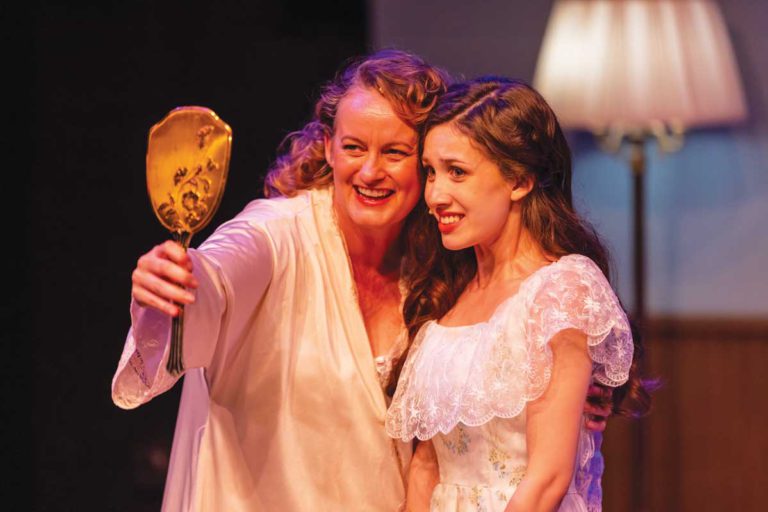
‘Spring Awakening’ in Napa Valley

If live theater, which is in crisis, ends up in a doom spiral, it won’t be for a lack of talent and energy from the current generation of performing artists.

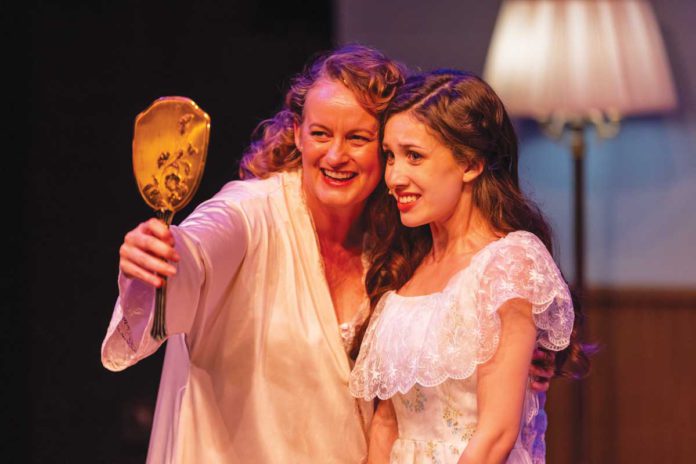
The stages at College of Marin and Santa Rosa Junior College have recently hosted productions featuring some very good work by their youthful casts. Napa Valley College now joins the mix with their production of the coming-of-age rock musical Spring Awakening. The multi-Tony Award-winning musical runs at the Napa Valley College Performing Arts Center through March 17.

Adapted by Steven Sater from an 1891 German play by Frank Wedekind, it’s the tale of a group of German youth on the cusp of adulthood. The boys, when not struggling with an oppressive education system, are thinking a lot about sex. The girls, when not dealing with clueless parents, are thinking a lot about sex.

Melchior Gabor (Ben Stevens) is a bright, rebellious boy who questions the foundations on which society is built. Moritz Stiefel (Gabriel Reyes) is in a panic about his burgeoning sexuality and seeks counsel from Melchior. Wendla Bergman (Lila Howell) is a young woman with feelings for her childhood friend, Melchior. Their three worlds will collide with devastating results.

The content and trigger warning displayed in the lobby gives you a good idea of how devastating—“This production contains references to sexual assault, child abuse, teen pregnancy, abortion, death, and child loss; depictions of violence, weapons, suicide, and sexual content; as well as use of explicit language.”

Pretty heavy stuff for any age performer. And they have to sing, too.

Director Jennifer King has a lot of fine, young talent involved here. The aforementioned leads are strong, and there’s good work from the diverse group of supporting players and ensemble. Music director Christina Howell leads a seven-piece, on-stage band that is heavy on strings and does Duncan Sheik’s score justice.

Bethany Deal’s costumes adhere to the rigidness of the era until they don’t and the connections to the youth of today become clear. Set designer Brian Watson’s multi-level set of hanging windows and doors reflects the desire of youth for clarity and the closed-mindedness of society.

The rousingly-delivered, show-stopping number, “Totally Fucked,” encapsulates every generation’s feelings around this time in their lives. It’s also how many in the theater community feel right now. Napa Valley College’s production of Spring Awakening should give both groups some hope.

‘Spring Awakening’ runs through March 17 at the Napa Valley College Performing Arts Center, 2277 Napa Vallejo Hwy., Napa. Fri. & Sat., 7pm; Sun., 2pm. $15–$25. 707.256.7500. Strobe lighting and haze effects. Mature themes and explicit language. Recommended for ages 16+. performingartsnapavalley.org.

Rent Bent: Housing prices are spiraling

How we gonna pay last year’s rent? the chorus implores in the song “Rent” from Jonathan Larson’s 1996 musical of the same name.

It’s the same refrain for many Americans today. A new Harvard study found that half of U.S. renter households now spend more than 30% of their income on rent and utilities. And rent increases continue to outpace their income gains. In the wealthiest country on the planet, this is unacceptable.

Over the past decade, according to the Harvard study, most growth in renter households has come from Millennials and Gen Zers who continue to be priced out of homeownership while also paying more for a declining supply of affordable units.

Meanwhile, construction in the high-end “luxury” rental market, which drives up rents for everyone else, remains in an upward trend. And private equity firms like Blackstone, the largest landlord in the U.S., have been expanding their real estate portfolios.

International law already recognizes housing as a human right. Countries are legally obligated to respect, protect and fulfill this right by enacting relevant policies and budgets to progressively realize adequate housing for all.

What might that look like? Possibilities include rent controls, housing assistance programs, reining in corporate landlords, and creating community land trusts and housing cooperatives to build permanently affordable rental units and homes.

The housing justice movement keeps growing, thanks to the sustained advocacy of community groups across the country.

In California, legislation is being pushed that would recognize the right to housing at the state level. Colorado lawmakers are considering legislation offering tenants “just-cause” eviction protections. In Congress, the “Housing is a Human Right Act” introduced last year would provide over $300 billion for housing infrastructure and combating homelessness.

The song “Rent” concludes, “Cause everything is rent.” But it shouldn’t have to be.

Farrah Hassen, J.D., is a writer, policy analyst and adjunct professor in Cal Poly Pomona’s department of political science.

Your Letters, 3/13

WikiPeaved

Barry Barnett’s defense of Julian Assange (Feb. 28, 2024 Open Mic) glosses over and ignores pertinent facts. Barnett states that “A fake rape charge (was) filed in Sweden…” As The Intercept has documented, multiple women publicly accused Assange of sexually molesting them, and the only reason the charges were ultimately dropped was that the statute of limitations ran out while Assange was in the UK, refusing to return to Sweden.

Assange, a Trump supporter, was very likely responsible for Hillary Clinton losing the 2016 election. Assange swore he would do whatever it took to defeat her, and by carefully releasing documents (reportedly in coordination with Roger Stone) that seriously and negatively impacted Clinton just before the 2016 election, Assange likely made the difference in that close election.

Certainly, he took credit for Clinton’s defeat and Trump’s likely true victory, and that is why I find him unforgivable.

Dan Shiner

Mill Valley

Diss-topia

The former “Republicant” is portraying America as a dystopian, failed state overwhelmed by lawlessness, urban blight and slipping toward World War III abroad.

However, I should add the following three important elements:

Dishonoring American treaties and commitments to other nations. Making America a vassal state to Russia. Making America subservient to China.

Finally, the sad truth is that anyone who has supported this person, has already abandoned America.

Gary Sciford

Santa Rosa

Video Shows New Angle of Napa County Sheriff Shooting

New video was just released by the Napa County District Attorney’s Office of a recent car chase that went horribly wrong. It shows a police officer shooting a teen named Demarea Vaughn Rogers III in the back as he runs in the other direction, on Jan. 11 in a North Vallejo neighborhood. Police say Rogers led them on a...

Indian Casino Proposed in Windsor: Submit Your Input

One local tribe's bold proposal for a massive new resort and casino in the ranch lands east of Windsor has entered an important planning stage: Officials from the Bureau of Indian Affairs are preparing a draft "environmental impact report" for the project, and as they do so, are inviting the public to give input on how it might affect...

Suspected Santa Rosa Theft, 101 Car Chase Ends in Crash

Maybe you saw that wild freeway car chase through Cotati and Petaluma on the news earlier this week? Here's what happened on Monday afternoon, according to Santa Rosa police: Three twentysomethings from Oakland tried to steal around $6,000 worth of sportswear from a Dick's Sporting Goods big-box store — the one on Cleveland Avenue in north Santa Rosa —...

Fromage Fête: California Artisan Cheese Festival

It’s time for the 18th Annual California Artisan Cheese Festival, happening from March 22-24. This much-loved festival, dedicated to celebrating the artistry of cheese-making, offers three days of gourmet delight, farm tours and educational experiences. Since 2007, the festival has evolved into a three-day extravaganza of cheese appreciation, education and festivity, uniting California’s foremost cheese artisans. The weekend celebration provides...

Women’s History Month in Sonoma County

Women don’t have a history. That’s the message children got from their history textbooks back in the “olden days,” before five visionary women—Molly Murphy MacGregor, Mary Ruthsdotter, Maria Cuevas, Paula Hammett and Bette Morgan—created the National Women’s History Project in 1980. “As teachers, we were aware that the history books mostly spoke about men,” said MacGregor, who still answers the phone...

Sonoma County Pride’s Grace Villafuerte

This winter, I had the pleasure of sitting down with one of the North Bay’s most cited and celebrated lifetime volunteers, Grace Villafuerte. Among her responsibilities, she is currently the VP of Sonoma County Pride day, week, month and year. She is also in charge of volunteers. Cincinnatus Hibbard: What motivates your service and advocacy for your communities? Grace Villafuerte: Whether it...

Susan Lieu’s debut memoir ‘The Manicurist’s Daughter’

The Asian American immigrant story of achievement is well-trodden territory, but to many outsiders, what motivates perseverance for Asian Americans is largely misunderstood. In her seminal work on Asian American life, Cathy Park Hong critiques the perseverance narrative and argues that these stories are the cause of Minor Feelings, her book’s titular phrase. Hong explains that minor feelings are “built from...

‘Spring Awakening’ in Napa Valley

If live theater, which is in crisis, ends up in a doom spiral, it won’t be for a lack of talent and energy from the current generation of performing artists. The stages at College of Marin and Santa Rosa Junior College have recently hosted productions featuring some very good work by their youthful casts. Napa Valley College now joins the...

Rent Bent: Housing prices are spiraling

Click to read
How we gonna pay last year’s rent? the chorus implores in the song “Rent” from Jonathan Larson’s 1996 musical of the same name. It’s the same refrain for many Americans today. A new Harvard study found that half of U.S. renter households now spend more than 30% of their income on rent and utilities. And rent increases continue to outpace...

Your Letters, 3/13

WikiPeaved Barry Barnett’s defense of Julian Assange (Feb. 28, 2024 Open Mic) glosses over and ignores pertinent facts. Barnett states that “A fake rape charge (was) filed in Sweden…” As The Intercept has documented, multiple women publicly accused Assange of sexually molesting them, and the only reason the charges were ultimately dropped was that the statute of limitations ran out...
11,084FansLike
4,606FollowersFollow
6,928FollowersFollow