Superbugs: The next health crisis is here

Bacteria and fungi are increasingly evolving into “superbugs” immune to existing treatments. According to the World Health Organization, this phenomenon, known as antimicrobial resistance, is one of the top 10 public health threats currently facing humanity. In 2019, antibiotic resistance was associated with more than 170,000 deaths in the United States and nearly 5 million deaths worldwide.

The U.S. government has a long and mostly successful history of responding to national health crises, from funding Operation Warp Speed to accelerate the development of Covid-19 vaccines to establishing the Office of Public Health Emergency Preparedness in response to the anthrax attacks of 2001.

Better stewardship alone won’t combat the superbug threat. We also need to develop new antimicrobials. Many antimicrobials are often only prescribed briefly, like several days or weeks. Consequently, low sales make it hard for inventors to recoup the significant investments required to develop any new medicine.

As a result, many companies developing new antimicrobials—most of which are small—have been unable to commercialize new products successfully. Eight antibiotics developed by small companies have received FDA approval since 2013. Since their approvals, these companies have either filed for bankruptcy, been acquired or left the antibiotics space entirely.

One fix would be to replace the volume-based sales model with something like a subscription, in which drug developers are compensated for new treatments based on the value of the treatment to public health, regardless of the number of doses patients need.

Legislation that would do this is under consideration in Congress. A bipartisan group of lawmakers introduced the PASTEUR Act. Under the bill, the government would contract with a company for a set amount of funds for reliable access to an effective new antibiotic, essentially stabilizing a return on investment.

Passing PASTEUR should be one of Congress’ top priorities. AMR is a national security threat we know how to prepare for. It’s time our political leaders take advantage of that opportunity.

Phyllis Arthur is senior vice president for infectious disease and emerging science policy at the Biotechnology Innovation Organization.

Your Letters, March 6

Safe Sex Party

Mr. Dan Savage’s advice for people who attend sex parties (“Savage Love,” Bohemian, Feb. 29, 2024) is to “maybe consider using condoms.”

I’m a semi-retired professional sex surrogate partner and sex educator, and a person who has occasionally attended a wide variety of events like sex parties and sex and tantra workshops. I’m also a polyamorist. My advice for Mr. Savage’s readers is to definitely at all times use condoms and other “safer sex” items and practices.

The only exception would be if there is a “closed loop” of polyamorous people who have been tested for at least the more popular STIs. There are about 30 STIs ready to be transmitted. Most of them are asymptomatic in their early stages.

Barbara Daugherty

Santa Rosa

Burrito Babies

Your readers may by now be aware that the Alabama Supreme Court has issued a ruling that frozen burritos—be they “beef, bean and cheese, chicken, or any combination thereof”— are, in fact, legally recognized as children.

What impact this decision will have on commercial burrito sales in roadside dining emporia in Alabama and across the country is unknown at this time.

What we do know is that “the moment the frozen burrito is placed in its plastic sleeve, it becomes human life in the image of Our Higher Power.”

Stay tuned to your favorite news outlets to learn more about this breaking story.

Craig J. Corsini

San Rafael

Bass Case, Docent Days and FORKS2FILM Fest

0

Santa Rosa

The Case for Bass

Lauded bassist Michael Manring and noted guitarist and poet Brian Gore join forces for a few sets—solo and duet—Thursday, March 14, at The Lost Church. Gore, known for his fingerstyle guitar playing, founded International Guitar Night and has performed with six-string legends like Pierre Bensusan, Ralph Towner, Vishwa Mohan Bhatt, D’Gary and Lulo Reinhardt. His sets will draw from his album, Seek the Love You’re Yearning. “Michael Manring … can do more with a bass than even the most creative individual could imagine,” according to the Napa Valley Register. Beyond his virtuosity, as Tom Darter wrote in Keyboard Magazine, “his brand of transcendental chops … is all in the service of … the joy of making music.” Doors open at 7:30pm. The venue is located at 576 Ross St., Santa Rosa, thelostchurch.org. $25.

Petaluma

Docent Days

Petaluma Historical Library & Museum seeks volunteer desk docents for shifts from 10am to 1pm and 1 to 4pm, Thursdays and Fridays. The volunteer position entails greeting the public, helping guests navigate the exhibits, mentioning upcoming museum events, explaining the benefits of museum membership and answering general questions. One need not be an expert on Petaluma to volunteer. Those interested in joining the museum’s fellowship of desk docents may contact membership manager Mary Rowe at mr***@************um.org or 707.778.4398.

St. Helena

FORK2FILM Fest

A four-day film fest that showcases the best feature-length narrative and documentary films about food, farming and wine, FORK2FILM Festival serves up its cinematic offerings from Thursday, March 14 to Sunday, March 17. “Throughout my 16 years of programming for the Cameo, CinemaBites has stood out as a favorite among patrons, especially when we connect audiences with a filmmaker or chef,” says founder and owner Cathy Buck. “It’s been a dream of mine to program a festival that centers around food, farming and wine, three things that make the Napa Valley stand out.” Over the course of the festival, attendees will partake in epicurean film screenings, food and wine experiences, filmmaker Q&As and more. This year, FORK2FILM Festival programmers have selected 14 independent movies to be screened alongside culinary classics and award-winning standouts, all screening at the Cameo Cinema, 1340 Main St., St. Helena. For complete programming information, visit cameocinemafoundation.org/fork-2-film-festival.

Novato

Comedy Cuvee

Headliner Dan Gabriel (as seen on The Late Late Show with Craig Ferguson, Showtime, Comedy Central’s Premium Blend and CBS’s Star Search) brings the laughs to Novato’s Trek Winery with a set that pairs well with pinot noir (we’re assuming). Gabriel honed his chops in San Francisco’s comedy scene and is now a seasoned Los Angeles-based comedian. He has appeared on several major TV shows, won competitions, co-developed a TV series, hosts a podcast and has released two comedy albums. Gabriel performs at 7pm, Saturday, March 16, at Trek Winery, located at 1026 Machin Ave., Novato. Special guest Jeff Applebaum will also perform. Tickets range from $20 to $30. For more information, marincomedyshow.com.

Santa Rosa JC Paying Some Students to Go to School

0

Some students are reportedly getting paid to go to school at the Santa Rosa JC. We’re talking more than just a loan or scholarship: These are actual wages being deposited into students’ bank accounts, as if they were working a job, KRCB news radio reports. Where the job is going to class and doing homework. This new experiment at our local JC is part of a $30 million pilot program called “Hire UP” that was just launched by the state in 10 different community college districts, according to KRCB — another way of testing the theory that a period of “guaranteed income” can give a leg up to someone who’s struggling to make ends meet, and allow them to thrive on their own in the future. College officials will reportedly be monitoring “how the money affects students’ outcomes.” KRCB news reporters talked to Leah Richardson, a 37-year-old student at the JC who’s enrolled in the state’s new program. She’s one of hundreds of formerly incarcerated JC students who can now apply to get paid from this $2.6 million pool. From the story: “On a recent morning, she sat at a cafe next to campus, where students hurried by, but she didn’t notice them as she stared at her financial aid statement on her iPhone. ‘I’m a little in shock,’ Richardson said as she used her fingers to zoom in on the web page that showed her current grants. She’ll receive monthly payments of nearly $2,000, starting today. Those payments are calculated based on the state’s minimum wage, $16 an hour, for each of the 30 hours she spends every week on school. When she enrolled at Santa Rosa Junior College in 2021, she couldn’t afford to attend full time. She was still adjusting to a new routine, after spending time in and out of jail and substance use treatment centers. She decided to take classes in the afternoon and work from 4:30 a.m. until about 1:30 p.m. at a Safeway store most days of the week. When she wasn’t working at Safeway, she took shifts at bakeries. ‘I was exhausted — a lot,’ Richardson said. Since then, she’s tried to work less and study more. ‘Now that I have this money, I don’t have the weight of having to go back to a job that’s going to drain me.'” Going forward, if the Hire UP program goes well and state funds keep flowing in, word is the JC might also extend these benefits to more students — including ones who grew up in the foster-care system and ones “receiving CalWorks benefits, the state’s cash aid program for low-income adults with children.” (Source: KRCB)

Music Studio Opens Inside Sonoma County Juvie

0

On the far-east side of Santa Rosa, all the kids locked up at juvie now have their own music studio inside the detention center, according to Sonoma County government officials — and two of the kids have already laid down tracks. Officials say the studio cost around $25,000 to set up and will cost $150,000 more each year to stay up and running. “Sonoma County’s Juvenile Hall has opened a new music recording studio with the goal of promoting self-expression, positivity and wellness among youth detained at the facility with the assistance of local music professionals,” says a new press release from the county. “The studio includes industry-standard microphones and recording software as well as three acoustic/electric guitars, one electric guitar, several keyboards, one electric bass and an electronic drum set. Future plans include wind and brass instruments.” One higher-up within the county’s probation department explains why they set up the studio: “Music is an outlet for expression and emotions. It provides an educational opportunity and introduction into the world of music, and it helps push the creative boundaries that our residents occasionally impose on themselves when they are housed in a detention facility and somewhat afraid to come out of their shells or show vulnerability. More importantly it’s something they want to do.” Here are some more details from the press release: “Juvenile Hall residents who express interest in the program are put on a roster and are assigned studio time. The program roster is incentive-based and a motivation for youth within the facility. … The studio was named Free Voices, following a facility-wide naming contest. The Probation Department is working with a local music professional as a consultant, who is making connections with the residents and assisting in the creation of unique music. The department is also seeking other industry professionals or community members who would like to volunteer and work with the program and the juvenile population.” (Source: Sonoma County Government)

4 Sonoma Sheriff’s Deputies Hurt in Chase, Shootout; Suspect Dead

0

A rare and dramatic shootout in the wee hours Monday morning in southwest Santa Rosa — between Sonoma County Sheriff’s deputies and a local middle-aged man with an AK-47, whom they were chasing — left the suspect dead and four deputies injured, according to police investigators. The Santa Rose Police Department has been tasked with getting to the bottom of what happened that night along Todd and Stony Point roads, since the Sheriff’s Office was the agency involved. “SRPD detectives have identified the suspect as Jose Luis Villasenor Cervantes, a 53-year-old resident of Santa Rosa,” the police department posted on Facebook yesterday. “Cervantes was in possession of an AK-47 style rifle when a deputy investigating a firearm brandishing call attempted to contact him. Cervantes exited his vehicle and immediately began firing at the deputy. The deputy was able to return fire. Additional deputies responded to the area and were also immediately fired upon by Cervantes. It is estimated that Cervantes fired numerous 7.62x39mm rifle rounds at the deputies before returning to his vehicle and engaging the deputies in a vehicle pursuit.” And then: “Following the initial assault on the deputies, the suspect led deputies on a pursuit which ended in a collision in the 3200 block of Stony Point Road. Four deputies were injured during this incident, one critically, and the suspect died at the scene of the collision due to a yet-to-be-determined cause.” In the aftermath of this “explosion of violence just west of Santa Rosa,” the Press Democrat published a photo of some sentimental items “left at the site where vehicles involved in a chase and shooting with Sonoma County Sheriffs Deputies crashed into a fence along Stony Point Road, between Todd Road and Butler Avenue” — including some yellow flowers, a candle and a colorful tub of Colombia Supremo Coffee from Trader Joe’s. “The Sonoma County Sheriff’s Office has not yet released the name of the deputies involved in yesterday’s incident or body camera footage,” the PD reports. “There was no update on the deputies’ status as of Tuesday afternoon.” (Source: Santa Rosa Police via Facebook & Sonoma Sheriff via Facebook & Press Democrat; paywall)

Tommy Orange Writes Second Urban Native Novel

The difficulty in beginning a conversation with Oakland-based, New York Times best-selling novelist and writer Tommy Orange is deciding which direction to go.

We could shift into reverse and march through his earliest years, being born and raised in the Dimond District by his parents, his father Cheyenne, his mother white and a Christian; playing roller hockey and noodling on his guitar during adolescence; graduating from college with a degree in sound engineering before working at San Leandro’s Gray Wolf Books and wondering what to do with his life. Beginning to write and investigate his Cheyenne and Arapaho of Oklahoma tribal identity and citizenship, he pursued and earned a master’s in fine arts from the Institute of American Indian Arts.

Or, is it best to plunge into the more recent here-and-now? After all, there’s the irresistible magnetism of Orange’s fascinating short stories. Published in literary magazines such as McSweeney’s and Zyzzyva, he nudged and eventually pushed hard against Native American tropes and misrepresentations—such as the iconic, mythical, stoic images of Indians as somehow immune from the brutal violence practiced against them throughout American history. 

Ultimately, Orange’s literary energy culminated and was mirrored in the momentous reception to his debut novel, There There (2018). Awards stacked themselves into towers surrounding his first work of fiction, which places as its centerpiece a powwow that attracts—for different reasons—members of a multigenerational, urban Native American family. There There was a finalist for the 2019 Pulitzer Prize and received in 2019 the American Book Award and the PEN/Hemingway Award.

Orange was suddenly and overwhelmingly heralded as a new voice in Indian literature and the visibility was widespread, resulting in demand for public appearances as a Native American thought leader. More honors, including nominations for the Andrew Carnegie Medal for Excellence in Fiction, the Audie Award for Multi-voiced Performance, and two Goodreads Choice Awards: Best Fiction and Best Debut Goodreads Author, also came his way.

All of this is ripe material for discussion, but instead there is the immediate moment and future—which is where the focus should begin.

Orange’s sophomore book, Wandering Stars (Alfred A. Knopf, March 2024), is already attracting starred reviews and notable buzz in the industry and with the general public. His second novel is in some ways a sequel to his first book and follows three generations of the Red Feather family with a story that begins by leaping back to the family’s pre-Oakland history in Colorado, where the Sand Creek Massacre destroys an Indian community and sends a young survivor, Jude Star, to the Fort Marion Prison Castle in Florida.

For three years Star, along with other young Indian children, is essentially imprisoned and must learn English and practice Christianity—all actions meant to erase her Native history and culture, and any traces of Indian identity. The narrative follows Star’s descendants, who end up in Oakland struggling with mixed success through the legacy of annihilation and trauma by white America: bias, prejudice, PTSD, opiate addiction, school shootings and more.

“With There There I could point at any character and give you the difficulty number,” says Orange. “With writing Wandering Stars, the whole thing was just hard. They talk about sophomore albums being difficult, and especially when you’re having success, you’re having to prove that you can still do it, or top it, or people just wanna see you fall from a height, because that’s a spectacle. There was weird pressure.”

Orange found writing during Covid severely challenging. He’s never aspired to write historical fiction because he feels it’s been overdone in Native American literature, but the story about the boarding school had reached a deep place in his soul that compelled him to persist. In part, his Southern Cheyenne tribe is at the story’s heart, and he recognized that the real-life facts and events represented a wrenching origin story that held within it the assimilation, relocation and dislocation that urban Natives experience.

While writing early scenes featuring Star, he researched intensely, changed tense back and forth, rewrote sections and cut out entire episodes as if, having stared into history’s bright lights, he was determined to chase and capture the afterimages. A sense of place had formed the foundation of There There, and the Red Feather family was firmly established, providing structure for Wandering Stars and allowing him to delve deep into character.

“It’s a more interior book, and that’s something I like to do in writing in general,” he says. “It’s where I started and where my characters begin. Fiction can do it in a way that other forms cannot. There’s an over-emphasized voice that says writing is about scene. But we have TV and movies; they’ll always be better than description of scene.”

Orange tried to bring back all of the characters from There There. “When I first started, I picked up right after the powwow,” he says. “In collaboration with my editor, we wanted it to be a standalone and not redundant. I fought to the end to keep the filmmaker character from There There and recently cannibalized some of that writing for my next book. I’ll get his stuff in somehow.”

Although Orange doesn’t keep lists, several of his characters do. The character Lony composes lists that he considers puzzles. “He wasn’t going to be a writer, but it was a way for him to collect information because he’s so curious,” Orange says. “It was a way for him to express that without him having a narrative voice.”

Another list serves a profound purpose and appears from a meditation by Orvil, Lony’s older brother. “He lists the names of tribes, reads them aloud and speaks them into existence,” Orange says. “He felt shame—and this is also my shame in not having the Ohlone people mentioned the way I should have in There There—about not knowing the names of the [nearly 200] tribes in California. I was happy because these are unknown, hard-to-say names that have been reduced to Indian or Native American. With the names of each tribe comes a ton of language, worldview and creation stories.”

Wandering Stars is written with Orange’s natural musicality and instinctive humor. Before becoming a writer, he says he was “a fully failed musician,” and music was his first art form. As a writer, he reads his words aloud; even recording other people reading his words to better hear the cadences, rhythms and sentence structures. He’s considering releasing compositions he’s written that might have been what Orvil, also a songwriter, would have written.

Orange is pleased to be asked about the humor in his work. “It’s rarely mentioned, even in my inner circles, but it was [John Kennedy Toole’s] Confederacy of Dunces that first made me want to write a novel,” he says. “I didn’t know books could make you laugh but also be sad and dark. I don’t try to be funny, but it’s important to render life and lively dialogue, to balance heavy matter, release tension, and provide payoff and lift for the reader having to sit with heaviness. In my family, I was the one cracking a joke during something super intense.”

Inevitably, the conversation wraps up with future thoughts, plans and dreams. Orange is astonished that half the country thinks Donald Trump is a hero instead of a person he says is “brazenly stupid and lacking in humanity, humor, taste—and a despicable human,” whose re-election as president would leave us doomed. On a more upbeat note, he’s thrilled Lily Gladstone won Golden Globe’s Best Female Actor and that Native American television shows, books and across-the-spectrum output from Native artists is thriving. “I just hope it’s a sustaining energy for our representation,” he says. “I believe art can change lives.”

He’s sold his third novel, which leaves behind the characters in his first two novels with a book full of dark humor, the world of Pretendians—ethnic fraud—run rampant and contemporary voices. Meanwhile, There There is being adapted for television, and he says the all-Native American cast it will showcase will raise the visibility of Indigenous people. He’s also writing and hoping to have produced a screenplay, and he laughs—but only lightly—at a suggestion he might compose the film score.

Limitless possibility is the perfect note upon which the conversation reaches its end.

Film Review: ‘Cabrini’ as Lady Liberty

0

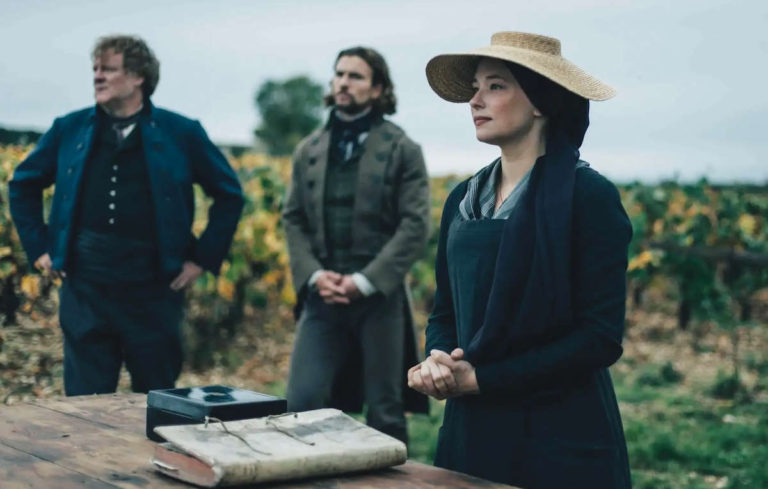
Aside from specialty items by religious film producers, it’s unusual for general audiences to find major releases that concern themselves with spiritual matters and figures from organized religion. That’s one of the reasons why director Alejandro Monteverde’s new film Cabrini, a dramatization of the life and times of Roman Catholic nun Sister Frances Xavier Cabrini (1850-1917), is so noteworthy.

Mother Cabrini (portrayed by Italian actor Cristiana Dell’Anna) immigrates to the U.S. in 1889, accompanied by six other nuns with whom she has founded the Missionary Sisters of the Sacred Heart of Jesus. In her luggage is a personal recommendation by Pope Leo XIII (Giancarlo Giannini) for her mission to aid poor immigrants—specifically Italians—in their painful process of fitting into the United States’ burgeoning multicultural landscape.

In those days newcomers from Italy faced more or less the same barriers as other immigrants from Southern and Eastern Europe in the age of America’s “Manifest Destiny”—the historical label for the global ambitions of the newly industrialized United States. Highly promoted in its time, Manifest Destiny institutionalized a framework of reckless imperialism overseas and systemic domestic racism for anyone outside the era’s White Anglo-Saxon Protestant ruling hegemony. As the Italian nuns soon realize.

Cabrini arrives in New York’s Lower East Side at a time when Italian immigrants are depicted in the press as a horde of poor, illiterate, non-English-speaking, swarthy brutes, reeking of garlic. The missionary sisters lose no time in moving into the notoriously crime-ridden Five Points neighborhood of Lower Manhattan.

Their goal is to help a group of people commonly portrayed as menial laborers and “threats to American values” set up hospitals, schools and a sense of community in a hostile environment. The similarities between the jingoistic, openly bigoted America on display in Cabrini by filmmaker Monteverde, a native of Mexico, and the political extremes of the present-day U.S. are there for all to see.

Seemingly everywhere Cabrini turns, she is met by indifference and outright hatred for her social work. Tea-sipping Archbishop Corrigan (David Morse) dismisses her on gender grounds—so what if this woman was sent by the Pope? New York’s Mayor Gould (John Lithgow) calls Mother Cabrini a “puffed-up dago” and harasses her with vengeful building inspections. A Five Points pimp named Geno (Giacomo Rocchini) physically attacks the nuns for enlisting one of his prostitutes. Meanwhile, ordinary white businessmen are content to mock Mother Cabrini by publicly snorting in her face—to them all Italians are pigs.

In fact, Cabrini is loaded with hot-button social issues that stress the “then as now” aspect of her moral crusade: poverty, immigration, social welfare programs, racial bigotry, narrow-minded opposition, language barriers, street crime, sexism, anti-Catholic prejudice, child labor laws, and that old favorite, cruel and greedy bankers. Looks like a dress rehearsal for 21st-century politics.

Monteverde’s Cabrini—screenplay by Rod Barr from a story he wrote with the director—does a better job than most mainstream films in capturing the flavor of its early-20th-century settings. It’s in a league with Gangs of New York, Once Upon a Time in America, Days of Heaven and even The Godfather in that respect. And cinematographer Gorka Gómez Andreu’s tribute shots invoking photographer/social activist Jacob Riis add to the poignancy. The cinematography is almost too pretty at times—that’s the worst that can be said about the production values.

In modern-day secular terms, Cabrini achieves a gratifying balance between the social and the spiritual in Mother Cabrini’s zealous championing of equality for the underdog. In particular, actor Dell’Anna strikes a positively heroic pose as the woman who intended to “build an empire of hope” in her adopted country, for the marginalized and downtrodden. 

Cabrini was canonized in 1946 as the first American saint, and patron saint of all immigrants. Today the Missionary Sisters of the Sacred Heart of Jesus is the largest charitable institution in the world. The American people were lucky to have her.

* * *

In theaters

Oscars 2024: What Will Win for Best Picture?

Here’s something I don’t even consider the tiniest of hot takes: I don’t care about the Oscars. Okay, I guess I sort of do. I enjoy guessing who’s going to win and getting all butt hurt about what got snubbed, but ultimately the Oscars only matter in one very specific way—the artists who are nominated/win get elevated up the Hollywood hierarchy and get to start making larger projects that had previously been denied them.

But most of the time the Academy gets it wrong. The nominations, the winners—it’s rare when films that actually cause a shift in the cultural zeitgeist win Best Picture. It’s always political and based on whatever the Academy voters took the time to watch. From 1944 to 2008 only five films per year were nominated for Best Picture. In 2009, the playing field was expanded to 10—mostly based on viewer complaints that elevated popcorn fare like The Dark Knight wasn’t getting nominated and that the voting academy was losing touch with audiences. 

Ten is a better field because it covers a wider variety of films, but there’s still usually one or two nominees that don’t belong anywhere near the Best Picture race. I look back over the last few years at movies like The Artist, Silver Linings Playbook, The Theory of Everything, Darkest Hour, Green Book, Vice and Nightmare Alley—just to name a few—that weren’t in the top 25 of the year, let alone worthy of a Best Picture nomination.

I even like a few of those movies just listed. But a film considered one of the best should either move the art form forward or be a sterling example of the importance of cinema and what it can achieve in the realm of allowing humanity to see itself better. 

Some of the greatest films in the history of the medium weren’t even nominated for Best Picture. When movies of great cultural significance, like Rear Window (1954), Eternal Sunshine of the Spotless Mind (2004), Touch of Evil (1958), Hoop Dreams (1994), 2001: A Space Odyssey (1968), Do the Right Thing (1989), Bicycle Thieves (1948), Tokyo Story (1953), The Third Man (1949), Chungking Express (1994), Cool Hand Luke (1967) and Ikiru (1952) don’t even get nominated, it can be difficult to take the contest seriously.

So what about the 10 nominees for Best Picture this year? Are they all worthy? Most assuredly not all of them. But let’s take a look.

Killers of the Flower Moon: Even though I think the film would have been stronger focused on a character other than Leonardo DiCaprio’s Ernest Burkhart, it’s still an important work from one of America’s greatest living filmmakers. I’d be surprised if Lily Gladstone doesn’t take the Oscar for Best Actress.

Oppenheimer: More proof that one should never bet against Christopher Nolan; this, along with Barbie, got people back into movie theaters and proved people will see something long and dramatic when intelligence is put into the filmmaking and performances. My biggest issue with the film is the handling of the women in Oppenheimer’s life, who all exist to further his narrative arc and not their own.

Barbie: Definitely belongs here as no other movie this year really hit culturally as hard as this one did. Whether you love it or hate it, Greta Gerwig and Margot Robbie made something truly original here that’s unapologetically feminist and layered—something not enough critics give the film credit for. Gerwig not getting a Best Director nomination is insane.

The Holdovers: Probably the most wholesome movie of the year, The Holdovers exists to be a big-hearted and empathetic look at our differences and similarities as human beings and how small acts of kindness are much easier to share than we sometimes think. Also, it’s one of the best Christmas movies we’ve had in a long time. Paul Giamatti probably has the Best Actor Oscar on lock.

American Fiction: A solid movie with a wonderful central performance from the great Jeffrey Wright, the first hour feels like what we imagine when we think of “Oscar bait.” Then the final 45 minutes turns the entire premise on its head and becomes a deceptively brilliant meta-textual satire of how White America consumes and discards BIPOC art. This probably won’t win anything, but it deserves to be up here. 

Anatomy of a Fall: Easily one of the best films of the year, and in a just world, director Justine Triet would win the Best Director Oscar instead of the almost guaranteed Christopher Nolan. The film is just so unpredictable and electrifying, with some of the most formally daring filmmaking of the last few years. It gets better every time you watch it, and it inspires the best post-film discussions of the year.

Maestro: I mean, Bradley Cooper directs the hell out of this and gives the best performance of his career as Leonard Bernstein, and Carey Mulligan is astonishing, but this is not one of the best pictures of the year. After 130 minutes focused on Bernstein, I didn’t feel like I understood him, his marriage, his music or his tortured soul any better than when it began. Something deep in the center of the film is missing, and I’m not sure it can be quantified. If films have souls, Maestro’s is AWOL.

Poor Things: This will win the more visual Oscars, like Production Design and possibly Cinematography. It’s a hell of a ride filled with jaw-dropping visuals and two bravura performances from Emma Stone and Mark Ruffalo, but I think it will be deemed too ‘weird’ by Academy voters. It’s a startling work of originality that general audiences often hate.

The Zone of Interest: The most powerful and stunning Holocaust film since Son of Saul, this bone-chilling examination of the banality of evil and the bureaucracy of genocide hits hard and often by compartmentalizing the horror in the same way the Nazis did. The audience is forced to watch evil exist without self-examination, as a Nazi family plays house on the opposite side of a wall from Auschwitz. The contrapuntal clash of visualizing the idyllic home and garden of the family with the nightmarish sounds of Auschwitz is unforgettable. 

Past Lives: Probably my favorite of the Best Picture nominees, Past Lives just hits differently. As a wistful elegy for dreams unrealized, it somehow makes each audience member feel nostalgic for a life they never had. I hope this wins something, but I won’t be surprised if it doesn’t.

Still, that leaves a ton of other great movies this year that should have been up for Best Picture. Incredible films like The Iron Claw, Fremont, How to Blow Up a Pipeline, Showing Up, Asteroid City, Fallen Leaves and Blue Jean were completely ignored. Maybe that just means 2023 was an exceptional year for film.

Either way, the Oscars’ track record sucks. So I’m going to start my own meaningless awards ceremony called The Classic Rasics. Our statue is a champagne bucket of popcorn, and the winner gets their own streaming service to populate with their favorite movies. Hey Hollywood … call me!

The 96th Academy Awards air Sunday, Mar. 10, 4-7pm.

Skeletal Remains at Arlene Francis Center, March 7

Since forming in Southern California some 13 years ago, Whittier’s Skeletal Remains have produced some of the most forward-thinking death metal. With a discography that includes a handful of singles, one split, one compilation, and four full-lengths, this is one group that hasn’t sat idle waiting for things to happen.

At a time when most bands were sidelined by canceled Covid-related tours, the band used the downtime to their advantage, as well as time on the road in 2022 to hone their chops. The end result is the band’s fifth album and nine-track opus, the long-awaited ‘Fragments of the Ageless.’ As luck would have it, the new album will be available one day before its March 8 release date on Century Media Records at their sole Sonoma County show.

The band currently features sole founding member/guitarist/vocalist Chris Monroy, guitarist Mike De La O, drummer Pierce Williams (drums), and bassist Brian Rush. Said Monroy about the band’s work ethic and trademark sound, “With every record, we try to push ourselves to make a better record. We don’t get into, ‘We need to sound more like this or that.’ As death metal fans, we write what we enjoy and want to listen to.”

Fans of latter-day Cannibal Corpse, Hate Eternal, Sinister (from Holland), and Morbid Angel will be floored by standout tracks such as “Relentless Appetite,” “To Conquer the Devout,” and “Verminous Embodiment.” With breakneck speed double-bass, wonderfully sequenced lead guitar lines, and some of the most ferocious arrangements, it’s songs like “Unmerciful” with its myriad sections that separate Skeletal Remains from the rest of the stale death metal diaspora. Mixed and mastered by incomparable Swedish sensation Dan Swanö (Diablolical Masquerade, Asphyx, Incantation), the ends certainly justify the means.

For those fans lucky enough to catch them on a full-fledged US tour with Suffocation and Incantation last year, this local show is one of the few chances to see Skeletal Remains before they head overseas to play the Wacken (Germany) and Alcatraz (Belgium) festivals. There are only four scheduled shows celebrating the new record, including Santa Rosa, Los Angeles, Santa Ana, and Las Vegas, Nevada.

We caught up with Sonoma County’s own Brandon McCubbin aka Bitter End Booking who has been flying the flag for underground metal with great effect.

Bohemian: When did Bitter End Booking start?

Brandon McCubbin: I have been booking shows since 2015. However, I didn’t start doing it under the name Bitter End Booking until 2019. I took the name from the song “Bitter End” by my band Water Into Blood whom I write songs and play guitar in.

Brandon McCubbin’s Bitter End Booking has been promoting shows for nearly a decade.

Bohemian: How many shows have you done so far?

McCubbin: I have done about 100 shows to date.

Bohemian: Do you feel like Santa Rosa is becoming a major market for metal acts?

McCubbin:  Santa Rosa is most definitely becoming a market for major acts. We’ve had bigger bands come through over the last 10 years but it started to die down a little bit before Covid hit. After Covid there wasn’t anyone bringing big bands anymore and I saw that as my window of opportunity to expand what had already been done here. Now, I am getting tours from agents all over the world.

Bohemian: Are you going to be doing more Neck Of The Woods shows or other Bay Area shows aside from Arlene Francis?

McCubbin: Yes, I am. I have already booked Bottom Of The Hill in SF along with Neck Of The Woods. I have a show at Brick And Mortar in May and a show in Morro Bay in July. I will continue to book in SF in the future but Santa Rosa is my home base. 

Bohemian: What is the hardest part about promoting underground metal shows?

McCubbin: One of the hardest things about booking is avoiding booking shows on the same night as a similar event in the same area. When this happens, it splits the draw between both shows and both shows will have a smaller crowd than they could have had. To avoid this, I am always paying attention to other shows happening and regularly communicating with other bands/promoters.

Bitter End Booking presents Skeletal Remains with Morta Skuld (performing songs from their 1993 release, ‘Dying Remains’), Oxygen Destroyer, and Laceration at 7 pm, March 7 at The Arlene Francis Center located at 99 6th St., Santa Rosa. Tickets are $25 and can be purchased at the door or www.eventbrite.com. All ages are welcome.

Superbugs: The next health crisis is here

Bacteria and fungi are increasingly evolving into “superbugs” immune to existing treatments. According to the World Health Organization, this phenomenon, known as antimicrobial resistance, is one of the top 10 public health threats currently facing humanity. In 2019, antibiotic resistance was associated with more than 170,000 deaths in the United States and nearly 5 million deaths worldwide. The U.S. government...

Your Letters, March 6

Safe Sex Party Mr. Dan Savage’s advice for people who attend sex parties (“Savage Love,” Bohemian, Feb. 29, 2024) is to “maybe consider using condoms.” I’m a semi-retired professional sex surrogate partner and sex educator, and a person who has occasionally attended a wide variety of events like sex parties and sex and tantra workshops. I’m also a polyamorist. My advice...

Bass Case, Docent Days and FORKS2FILM Fest

Santa Rosa The Case for Bass Lauded bassist Michael Manring and noted guitarist and poet Brian Gore join forces for a few sets—solo and duet—Thursday, March 14, at The Lost Church. Gore, known for his fingerstyle guitar playing, founded International Guitar Night and has performed with six-string legends like Pierre Bensusan, Ralph Towner, Vishwa Mohan Bhatt, D’Gary and Lulo Reinhardt. His...

Santa Rosa JC Paying Some Students to Go to School

Some students are reportedly getting paid to go to school at the Santa Rosa JC. We're talking more than just a loan or scholarship: These are actual wages being deposited into students' bank accounts, as if they were working a job, KRCB news radio reports. Where the job is going to class and doing homework. This new experiment at...

Music Studio Opens Inside Sonoma County Juvie

On the far-east side of Santa Rosa, all the kids locked up at juvie now have their own music studio inside the detention center, according to Sonoma County government officials — and two of the kids have already laid down tracks. Officials say the studio cost around $25,000 to set up and will cost $150,000 more each year to stay...

4 Sonoma Sheriff’s Deputies Hurt in Chase, Shootout; Suspect Dead

A rare and dramatic shootout in the wee hours Monday morning in southwest Santa Rosa — between Sonoma County Sheriff's deputies and a local middle-aged man with an AK-47, whom they were chasing — left the suspect dead and four deputies injured, according to police investigators. The Santa Rose Police Department has been tasked with getting to the bottom...

Tommy Orange Writes Second Urban Native Novel

Tommy Orange Writes Second Urban Native Novel
The difficulty in beginning a conversation with Oakland-based, New York Times best-selling novelist and writer Tommy Orange is deciding which direction to go. We could shift into reverse and march through his earliest years, being born and raised in the Dimond District by his parents, his father Cheyenne, his mother white and a Christian; playing roller hockey and noodling on...

Film Review: ‘Cabrini’ as Lady Liberty

Film Review: 'Cabrini' as Lady Liberty
Aside from specialty items by religious film producers, it’s unusual for general audiences to find major releases that concern themselves with spiritual matters and figures from organized religion. That’s one of the reasons why director Alejandro Monteverde’s new film Cabrini, a dramatization of the life and times of Roman Catholic nun Sister Frances Xavier Cabrini (1850-1917), is so noteworthy. Mother...

Oscars 2024: What Will Win for Best Picture?

Oscars 2024: What Will Win for Best Picture?
Here’s something I don’t even consider the tiniest of hot takes: I don’t care about the Oscars. Okay, I guess I sort of do. I enjoy guessing who’s going to win and getting all butt hurt about what got snubbed, but ultimately the Oscars only matter in one very specific way—the artists who are nominated/win get elevated up the...

Skeletal Remains at Arlene Francis Center, March 7

Since forming in Southern California some 13 years ago, Whittier’s Skeletal Remains have produced some of the most forward-thinking death metal. With a discography that includes a handful of singles, one split, one compilation, and four full-lengths, this is one group that hasn’t sat idle waiting for things to happen. At a time when most bands were sidelined by canceled...
11,084FansLike
4,606FollowersFollow
6,928FollowersFollow