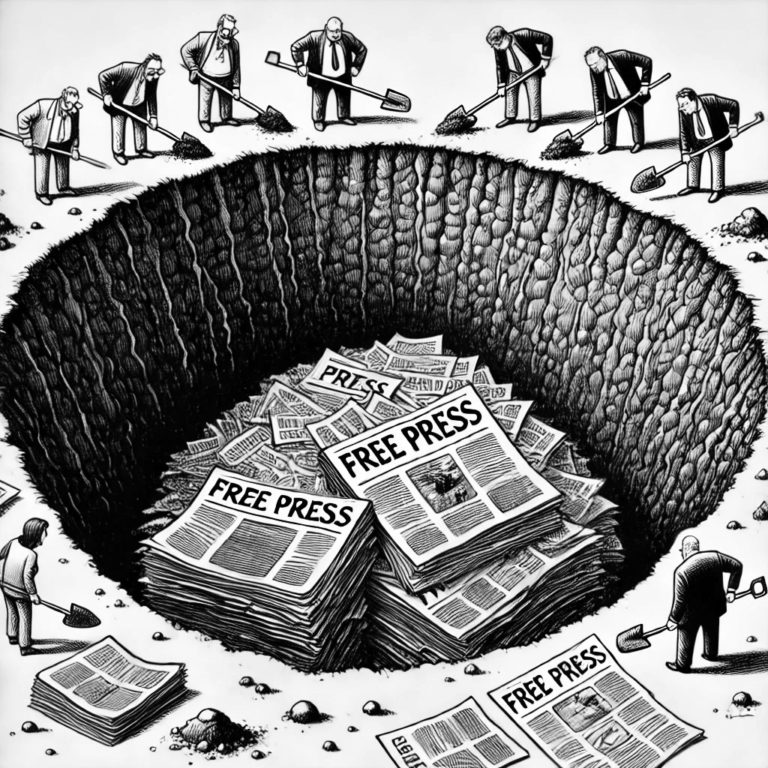
Lost & Found: Project Censored Unearths Underreported Stories

With any list, there’s a natural tendency to look first at No. 1. And neither I nor Project Censored would discourage one from doing that when it comes to their annual list of the top censored stories of the year. 

This year, the top story is about workplace deaths and injuries—with striking racial disparities, particularly for much-maligned foreign-born workers. Injury rates for southern service workers—predominantly Black—are especially alarming. Sensationalized deaths and injuries make the news all the time, but workplace deaths and injuries are another matter altogether. They’re a non-story, even when advocates strive to shine a light on them.

Associate director Andy Lee Roth writes, “Readers can only appreciate the full significance of the Project’s annual listing of important but underreported stories by stepping back to perceive deeper, less obvious patterns of omission in corporate news coverage.”

This has always been a theme of mine as long as I’ve been reviewing their lists because the patterns of what’s being blocked out of the public conversation are the clearest way of seeing the censoring process at work—the process that Project Censored founder Carl Jensen described as “the suppression of information, whether purposeful or not, by any method … that prevents the public from fully knowing what is happening in its society.”

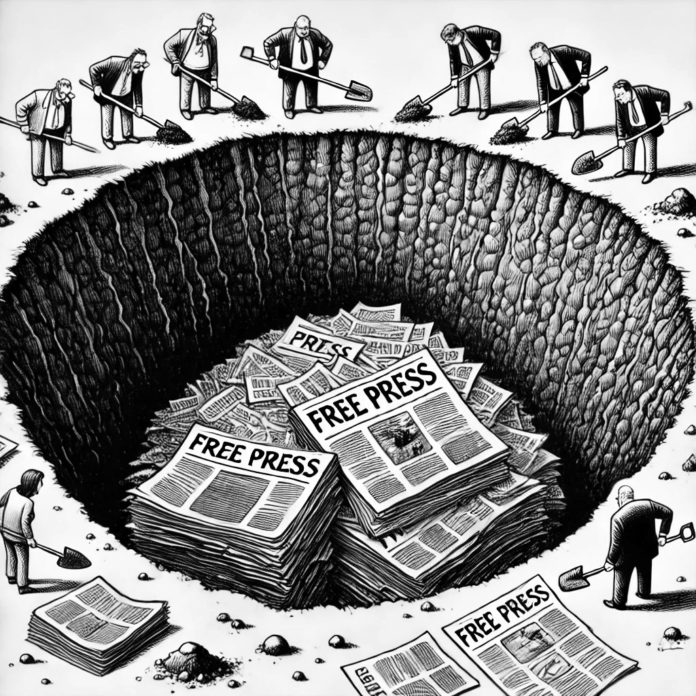
It’s not just that somehow all the news assignment editors in America overlooked this or that story. Where there are patterns of omission so consistently, year after year, they can only be explained by systemic biases rooted in the interests of particularly powerful special interests. 

As one does more than just simply read these stories—as they reflect on them, on why they’re censored, whose stories they are, what harms are being suffered, whose humanity is being denied—one will find themself seeing the world more from the point of view of those being excluded from the news, and from the point of view that one is interconnected with them at the least, if not one of them, too.

1. Thousands killed and injured on the job, with significant racial disparities in deaths and injuries 

Working in America is becoming more dangerous, especially for minorities, according to recent studies reported on by Truthout and Peoples Dispatch, while the same isn’t true for other developed nations.

Workplace fatalities increased 5.7% in the 2021-2022 period covered by the Bureau of Labor Statistics or BLS’s Census of Fatal Occupational Injuries, Tyler Walicek reported for Truthout. “Nearly 6,000 U.S. workers died on the job,” he wrote—a 10-year high—while “a startling total of 2.8 million were injured or sickened,” according to another BLS report.

The racial disparities were sharp. The average workplace death rate was 3.7 deaths per hundred thousand full-time workers, but it was 24.3% higher (4.6 deaths) for Latinx workers and 13.5% higher (4.2 deaths) for Black workers. The majority of Latinx deaths (63.5%) were of foreign-born workers, and 40% of those were in construction. “It’s not hard to imagine that communication lapses between workers on an active construction site could feasibly create dangerous situations,” Walicek noted.

The non-fatal injury rate for service workers in the South, particularly workers of color, is also alarmingly high, according to an April 5, 2023 report by Peoples Dispatch summarizing findings from a March 2023 survey by the Strategic Organizing Center or SOC. The poll of 347 workers, most of whom were Black, “found that a shocking 87 percent were injured on the job in the last year,” they reported. 

“Workers are increasingly organizing to fight back against hazardous working conditions,” Project Censored noted, citing a civil rights complaint against South Carolina’s Occupational Safety and Health Administration or SC OSHA filed by members of the recently-formed Union of Southern Service Workers or USSW “for failing to protect Black workers from hazardous working conditions,” as reported by the Post and Courier of Charleston, South Carolina. 

The USSW complaint alleged that “from 2018 to 2022, SC OSHA conducted no programmed inspections in the food/beverage and general merchandise industries, and only one such inspection in the food services and warehousing industries.” On April 4, 2023, when it filed the complaint, USSW went on a one-day strike in Georgia and the Carolinas, to expose unsafe working conditions in the service industry. It marked the anniversary of Martin Luther King’s assassination while supporting a sanitation workers strike in Memphis, Tennessee. 

Then on Dec. 7, USSW sent a petition to federal OSHA requesting that it revoke South Carolina’s state OSHA plan “because the Plan has failed to maintain an effective enforcement program.”

Neither the BLS findings nor the conflict between the USSW and SC OSHA have received much corporate media coverage. The BLS fatalities report was released in December 2023, with no U.S. daily newspaper coverage when Project Censored’s analysis was done. There was a story on the Minnesota findings by FOX in Minneapolis-St. Paul the month the report was released. And a full story on Green Bay ABC affiliate WBAY on April 12, 2024, “as part of its coverage of ‘Work Zone Safety Awareness Week,’” Project Censored noted.

“Corporate coverage of the conflict between the USSW and SC OSHA has also been scant,” they stated. While independent, nonprofits like DC Report “have consistently paid more attention,” there were but two corporate examples cited covering the second action: Associated Press and Bloomberg Law, but neither addressed the issue of racial disparities.

2. A ‘vicious circle’ of climate debt traps world’s most vulnerable nations

Low-income countries who contributed virtually nothing to the climate crisis are caught in a pattern described as a “climate debt trap” in a September 2023 World Resources Institute report authored by Natalia Alayza, Valerie Laxton and Carolyn Neunuebel.

“After years of pandemic, a global recession, and intensifying droughts, floods and other climate change impacts, many developing countries are operating on increasingly tight budgets and at risk of defaulting on loans,” they wrote. “High-interest rates, short repayment periods, and . . . the coexistence of multiple crises (like a pandemic paired with natural disasters) can all make it difficult for governments to meet their debt servicing obligations.”

“Global standards for climate resilience require immense national budgets,” Project Censored noted. “Developing countries borrow from international creditors, and as debt piles up, governments are unable to pay for essential needs, including public health programs, food security, and climate protections.”

In fact, The Guardian ran a story describing how global South nations are “forced to invest in fossil fuel projects to repay debts,” a process critics have characterized as a “new form of colonialism.” They cited a report from anti-debt campaigners Debt Justice and partners which found that “the debt owed by global south countries has increased by 150 percent since 2011 and 54 countries are in a debt crisis, having to spend five times more on repayments than on addressing the climate crisis.”

The concept of an ecological debt owed to the global South for the resource exploitation that fueled the global North’s development was first introduced “in the lead-up to the 1992 Earth Summit in Rio de Janeiro,” Ross noted. 

Subsequently, “The Kyoto Protocol laid the groundwork for such claims in 1997 by including the idea of ‘common but differentiated responsibilities’ among nations, but climate activists did not fully take up the call for debt justice until the Copenhagen summit in 2009,” continued Ross. Prior to that summit, in 2008, NASA climatologist James Hansen estimated the U.S. historical carbon debt at 27.5% of the world total, $31,035 per capita.

While a “loss and damage” fund “to assist developing countries that are particularly vulnerable to the adverse effects of climate change” was established at the 2022 Climate Summit, its current commitments ($800 million) fall far short of the $100 billion more each year by 2030 which the 14 developing countries on the fund’s board have argued for. Some estimates place the figure much higher, “at around $400 billion,” according to a Euronews story last June.

In May 2023, Bloomberg’s “analysis catered to the financial interests of international investors,” while a December 2023 New York Times report “focused primarily on defaults to the United States and China, with less focus on how poorer countries will combat deficits, especially as climate change escalates.”

3. Saltwater Intrusion Threatens U.S. Freshwater Supplies

Sea-level rise is an easy-to-grasp consequence of global warming, but the most immediate threat it poses—saltwater intrusion into freshwater systems—has only received sporadic localized treatment in the corporate press. 

“In fall 2023, saltwater traveling from the Gulf of Mexico up the Mississippi River infiltrated the freshwater systems of the delta region, contaminating drinking and agricultural water supplies as well as inland ecosystems,” Project Censored noted. “This crisis prompted a scramble to supply potable water to the region and motivated local and federal officials to issue emergency declarations.”

While outlets like Time, CNN and CBS News covered the saltwater intrusion at the time, they “focused almost exclusively on the threat to coastal Louisiana,” but “a pair of articles published in October 2023 by Delaney Nolan for The Guardian and [hydrogeologist] Holly Michael for The Conversation highlighted the escalating threat of saltwater intrusion across the United States and beyond.”

“Deep below our feet, along every coast, runs the salt line: the zone where fresh inland water meets salty seawater,” Nolan wrote. “That line naturally shifts back and forth all the time, and weather events like floods and storms can push it further out. But rising seas are gradually drawing the salt line in,” he warned. “In Miami, the salt line is creeping inland by about 330 feet per year. Severe drought—as the Gulf coast and midwest have been experiencing this year—draw the salt line even further in.”

“Seawater intrusion into groundwater is happening all over the world, but perhaps the most threatened places are communities on low-lying islands,” such as the Marshall Islands, which is “predicted to be uninhabitable by the end of the century,” Michael wrote. Here in the U.S., “Experts said the threat was widespread but they were especially concerned about cities in Louisiana, Florida, the Northeast, and California,” Nolan reported.

“Fresh water is essential for drinking, irrigation and healthy ecosystems,” Michael wrote. “When seawater moves inland, the salt it contains can wreak havoc on farmlands, ecosystems, lives and livelihoods.”

While Time, CNN and CBS News focused narrowly on coastal Louisiana, Project Censored noted that some news outlets, “including FOX Weather and Axios,” misreported the threat as “only temporary rather than a long-term problem.” 

4. Natural Gas Industry Hid Health and Climate Risks of Gas Stoves

While gas stoves erupted as a culture war issue in 2023, reporting by Vox and NPR (in partnership with the Climate Investigations Center) revealed a multi-decade campaign by the natural gas industry using the tobacco industry’s tactics to discredit evidence of harm, thwart regulation and promote the use of gas stoves. 

And while gas stoves are a health hazard, the amount of gas used isn’t that much, but “house builders and real estate agents say many buyers demand a gas stove,” which makes it more likely they’ll use more high-volume appliances, “such as a furnace, water heater and clothes dryer,” NPR explained. “That’s why some in the industry consider the stove a ‘gateway appliance.’”

In a series of articles for Vox, environmental journalist Rebecca Leber “documented how the gas utility industry used strategies previously employed by the tobacco industry to avoid regulation and undermine scientific evidence establishing the harmful health and climate effects of gas stoves,” Project Censored noted.

“The basic scientific understanding of why gas stoves are a problem for health and the climate is on solid footing,” she reported. “It’s also common sense. When you have a fire in the house, you need somewhere for all that smoke to go. Combust natural gas, and it’s not just smoke you need to worry about. There are dozens of other pollutants, including the greenhouse gas methane, that also fill the air.”

Documents obtained by NPR and CIC tell a similar story. The industry “focused on convincing consumers and regulators that cooking with gas is as risk-free as cooking with electricity,” they reported. “As the scientific evidence grew over time about the health effects from gas stoves, the industry used a playbook echoing the one that tobacco companies employed for decades to fend off regulation.”

“By covering gas stoves as a culture war controversy, corporate media have ignored the outsize role of the natural gas industry in influencing science, regulation, and consumer choice,” Project Censored noted. Instead, they’ve focused on individual actions, local moves to phase out gas hookups for new buildings and rightwing culture war opposition to improving home appliance safety and efficiency, including the GOP House-passed “Hands Off Our Home Appliances Act.”

5. Abortion Services Censored on Social Platforms Globally

On the first national election day after Dobbs, PlanC, a nonprofit that provides information about access to the abortion pill, posted a TikTok video encouraging people to vote to protect reproductive rights. Almost immediately, its account was suddenly banned.

“Access to online information about abortion is increasingly under threat both in the United States and around the world,” the Women’s Media Center or WMC reported in November 2023. “Both domestic and international reproductive health rights and justice organizations have reported facing censorship of their websites on social media platforms including Instagram, Facebook, and TikTok as well as on Google.” 

The governments of South Korea, Turkey and Spain have also blocked the website of Women on Web, which provides online abortion services and information in more than 200 countries. At the same time, abortion disinformation for fake abortion clinics remains widespread.

Within weeks of the decision, U.S. senators Elizabeth Warren of Massachusetts and Amy Klobuchar of Minnesota wrote to Meta, Ars Technica reported, questioning what the company was doing to stop abortion censorship on their platforms. “The senators also took issue with censorship of health care workers, Ars Technica wrote, “including a temporary account suspension of an ‘organization dedicated to informing people in the United States about their abortion rights.’”

Abortion disinformation is also a threat—particularly the promotion of “crisis pregnancy centers” or CPCs, which masquerade as reproductive healthcare clinics but discourage rather than provide abortion services. WMC reported on the June 2023 CCDH report, which “found that CPCs spent over $10 million on Google Search ads for their clinics over the past two years.” Google claimed to have “removed particular ads,” said Callum Hood, CCDH’s head of research, “but they did not take action on the systemic issues with fake clinic ads.”

As of June 2024, corporate coverage of abortion censorship has been limited. The sole CNN story it cited ran immediately after the Dobbs decision before most of the problems fully emerged. 

“There appeared to be more corporate media focus on abortion disinformation rather than censorship,” they added. “Independent reporting from Jezebel and Reproaction via Medium has done more to draw attention to this issue.”

Paul Rosenberg is a California-based writer/activist, senior editor for Random Lengths News and a columnist for Al Jazeera English and Salon.

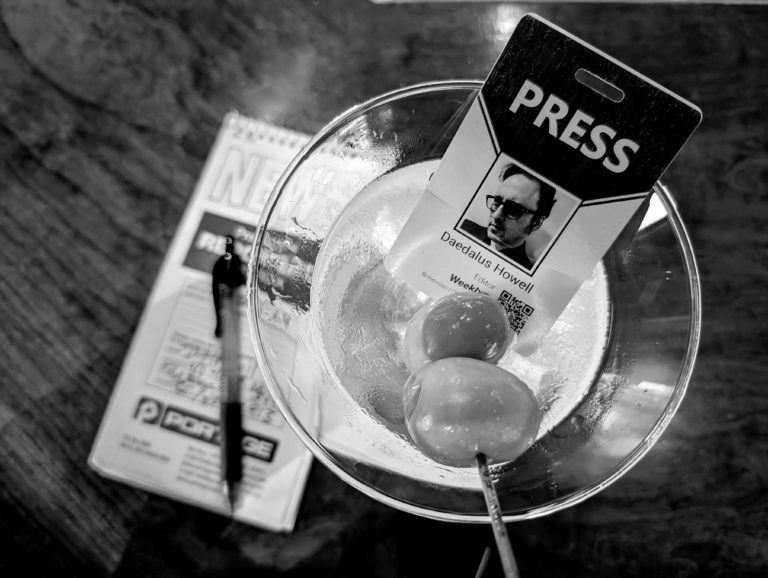
How to Toast NYE: A Year in Cocktails (all at once)

Mixology has become so mainstream, in the best way possible, that it would not surprise me to see my New Year’s Eve host make their own infused simple syrup, ferment a shrub, and shake up a creative take on a classic. 

The home liquor cabinet has expanded along with our desire for the new and the nostalgic. In these uncertain times, I’m glad we still have a vibrant beverage culture to spur much-needed conversation and connection. 

In the face of micro-dosing, mocktails, and making America gr– I don’t even want to think about it; I’ll take a cocktail. 

I’ll probably need a few strong ones to wrap up a year like this. After all, it might be our democracy’s last. Although the kids these days have replaced sex and booze with doom scrolling and dab pens, I think mixology is here to stay as long as it continues to evolve and delight. To bring in the new year, let’s honor traditional cocktails, which had their renaissance in the late 90s, and bask in the wave of experimental mixology. 

I’ll start my night with an espresso martini, trendy, yes, but worthy of the hype, mixology at its finest. The flavor profile plays well with the enduring cocktail definition from 1806 as “a stimulating liquor composed of any kind of sugar, water, and bitters.” The caffeine should stimulate me the way Biden stimulated my bank account during COVID-19. Let’s just hope Trump’s tariffs don’t drive up coffee and Kahlua prices or I’ll be drinking cold vodka from a silly glass.    

From there, I’ll move into the one-two punch of an M&M, a shot of 50/50 mezcal and Amaro Montenegro, smokey, bitter, sophisticated. Both Mezcal and amaro are having their moments. Mezcal, older brother to tequila, put Oaxaca on the map and opened our palates to the bolder corners of the Mexican liquor repertoire. While amaros, a category of bittersweet botanical liqueurs, provide Old World familiarity.    

Around the holidays, I always want an aromatic dark purple drink redolent with baking spices. Think cranberry or pomegranate juice, red wine, cinnamon, cloves, rosemary, orange peel—you get the idea. A warm mulled wine steeped with a clove-studded orange or a cranberry martini sweetened with rosemary-infused simple syrup will do the trick. 

2024 saw a trend of savory cocktails, so I might get weird with a hot dog martini, a shot of whisky backed by a warm gulp of salty broth, or a bloody maria (tequila instead of vodka) well after brunch time. 

Join the “dirty” crowd and pour olive juice into anything you’d like. The hot dog martini is essentially an extra dirty martini, one can build those savory flavors into your drink with pickle juice, celery salt, mustard-flavored bitters, and garnish with a lil’ smokey, gherkin and a cherry tomato. It’s not weird when you think about how martinis used to be garnished with a pearl onion. Even throwing a micro pinch of salt in the shaker can enhance your cocktails in a way you didn’t know you needed.

If you’re tired of eggnog and still want something creamy yet bubbly and balanced, try my orange creamsicle gin fizz recipe:

2 oz gin

¾ oz orange vanilla simple syrup

1 oz lemon juice

1 egg white 

Splash of club soda

For the simple syrup, combine ½ cup of sugar with ½ cup of water, orange zest, and a Tablespoon of vanilla extract in a saucepot. Bring to a boil and strain. 

For the cocktail,l add the gin, simple syrup, lemon juice, and egg white to a shaker with no ice. Shake for 20 seconds. 

Add ice and shake for an additional 10 seconds

Pour into a glass and top with a splash of soda water

Enjoy.

Olive Me: A Meditation on a Dirty Martini or Two

Drinking red wine has kept me out of most trouble, or at least in the kind of trouble I can manage for most of my drinking career.

When it comes to cocktails, however, I’m a dabbler. I’m allergic to hipness and am a mixologist avoidant. 

But I know that one of the secret ingredients of a good cocktail is the ambiance in which it’s served, and I knew where to go for this assignment.

Tucked into a ’30s-era building in an inauspicious corner of Santa Rosa’s Historic Railroad Square is a structure with the distinction of being the oldest “freestanding, continuously operating restaurant in Santa Rosa.” This is per their PR. I’m not sure why “freestanding” is necessary, but it’s true—it’s freestanding.

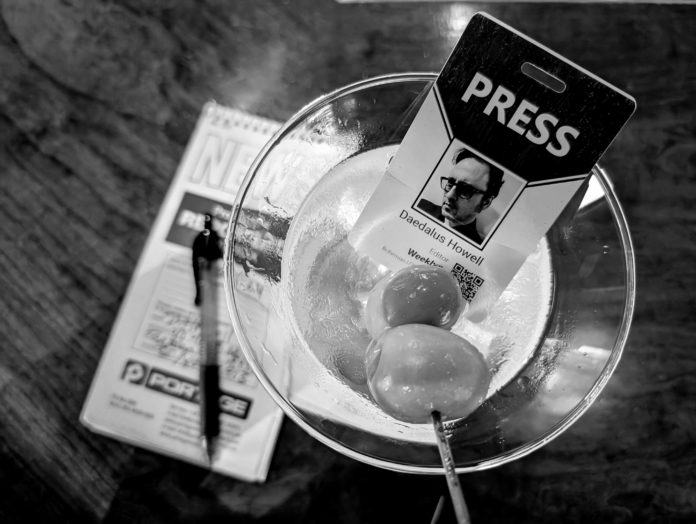
Purchased and brushed up by restaurateurs Mark and Terri Stark, the spot reopened in 2008 as Stark’s Steakhouse and was later re-christened as Stark’s Steak & Seafood in 2011 when the tide rose and surf met turf. But what got me was the name of the restaurant’s holding company—Stark Reality—and their website had a journo-friendly “media center.” Those seeking the press would be wise to follow their example—this is how editorial decisions are really made. A decision I didn’t make, however, was what I was drinking—a dirty martini. 

“I have never understood how a serious martini fancier could destroy the drink’s sensual flavor by plopping in a salty pimiento-olive or one of those rancid miniature cocktail onions (which immediately transforms a Martini into a Gibson),” wrote James Villas for Esquire during its mid-’60s, Mad Men era heyday.

If Villas were on the bar stool next to mine at Starks, I’d explain the Gen X need for a certain kind of controlled corruption. As a generation, we’ve collectively mistaken transgression for transcendence. “It’s because we never went to war,” someone once tried to explain to me. 

For us, a dirty martini has the same attitude as Madonna spray-painting the genitals of classical statues in her “Borderline” video. Of course, we didn’t know that then or appreciate the classy iconography of the martini until the following year when Roger Moore ordered one as James Bond in A View to a Kill, adding his crabby admonishment that it be “shaken, not stirred.” Try this at a bar. Bartenders love it.

A bearded, Millennial-aged man took the stool next to mine. His wife sat on his other side. They each ordered martinis, confidently specifying both brand and garnish—Hendricks gin with a lemon twist for him and something else for her, which, though out of earshot, was redolent with syllables and seriousness. And gin.

Yes, gin. 

It’s made from a grain base and infused with juniper berries and other botanicals. Vodka, martini’s frequent and inferior interloper, is made from a tuber dug from the pitiless and frozen tundra. Gin is for wits and wags. Vodka is the spirit of potato-eating peasants. A vodka martini is a declaration that one expects less in life. A real martini (it’s frankly redundant to mention gin as an ingredient here) is the blood of the gods.

Some knew this intrinsically—Robert “Now I Am Become Death, The Destroyer of Worlds” Oppenheimer, father of the atom bomb, had his own martini recipe that included a glass rimmed with lime juice and honey (but conspicuously no uranium). For a Barbenheimer Martini, add a jigger of Pepto Bismol.

Curious, I asked the young bartender the make and model of the gin in my dirty martini. It was New Amsterdam, but she reminded me that it didn’t really matter since any nuance is effectively destroyed due to, as she put it, the “olive juice.”

Olive juice—by which she meant the brine that makes a dirty martini dirty. I’ve since learned it is now bottled and sold in “premium” form by such brands as Dirty Sue and Filthy. 

I first encountered the term “olive juice” at a film festival in 2001 when Survivor host Jeff Probst seized his career ascendency to direct a lukewarm thriller called Finder’s Fee. In it, there’s a poker game, a stolen lottery ticket and a morally troubled protagonist unable to say “I love you” to his girlfriend. 

Instead, he dramatically says “olive juice” through a rain-streaked window, which looks like “I love you” to her. It’s a maudlin, chicken shit moment I’ve never forgotten.

Splendor in the Glass

Though the martini’s invention can’t be pinpointed to a particular year (most experts agree it was sometime in the aughts of the 20th century), we do know when the iconic glassware was introduced to the culture. 

The martini glass as we know it, with its iconic V-shaped bowl and long stem, was first introduced at the 1925 Paris Exhibition. Thus, this coming year marks its 100th anniversary. If one needs a news peg, this is it. It’s an elegant glass for a more civilized age.

To properly operate the glass while writing, hold it by the stem like a pen. Bring it slowly to your lips (otherwise, you will wear its contents). Sip. With one’s other hand, jot down a bon mot. Sip. Scratch out the original bon mot and replace it with an improved version. Laugh out loud—to yourself. Repeat until you have 900 words.

With a martini in one hand and a pen in the other, one’s fingers may resemble the manner of the Buddha’s Vitarka mudra, which suggests the continuous flow of energy and wisdom. In time, this may become a continuous flow of gin and vermouth.

But as New Yorker writer James Thurber observed, “One martini is all right. Two are too many, and three are not enough.” I had two and was beginning to rethink the second. The man next to me ordered another. His wife, however, downshifted to a pinot noir. Smart. I should’ve done that. I was beginning to reel.

Because, in the end, this is wine country—and wine is our first love, or at least we say it is. After my dalliance at this end of the bar, I was ready to return to wine as well. 

Oh, wine. It’s you. It’s always been you. 

Olive juice.

‘Politics as Unusual’ at Hippie Nudist Retreat

There were two men in the hot pool with me: One was a middle-aged white man like myself; the other, hoary, wiry and regal in the manner of a mad Shakespearean king. 

His eyes sparked with electricity—a dangerous quality, considering we were sitting in water. I never learned his name. To me, he was Lear.

I’d eased myself into the water and their conversation. It was a mistake. They were talking about the election and, worse yet, in cheerful tones.

We’d all just entered the strange and liminal time between election and inauguration. The side I’d chosen had lost. Badly and decisively. Pickup trucks cruised through downtown Petaluma, flying giant “Trump Nation” flags. It seemed a grim confirmation that the America I thought I’d known was gone. But the election had just been the foreshock; the earthquake wouldn’t start until Jan. 20, 2025. The “one really violent day” that Trump promised was yet to come. Probably that was a bluff. Probably.

I’d decided to take a mental health day for this and other reasons and to spend it in a place I thought of as an ultra-left bubble in a bubble—my hippie nudist retreat in the liberal Bay Area in the left-leaning state of California.

But in the hot pool, I sighed and asked, “Are we discussing politics?”

Lear looked me over and replied, “Yes, we’re talking about Donald Trump. Did you have something to contribute?” He was a commanding presence, even naked. Perhaps especially naked.

Well, yes, I had thoughts. I recently posted this on Facebook: “Every four years we flip a coin. If it’s heads, we get a $20 Starbucks gift card. If it’s tails, we get terminal cancer.” I’d thought Harris was the gift card—not a revolutionary, just someone to keep the lights on until the next coin flip for democracy. Most understood the joke, but I had to clarify for a few concerned friends that I was healthy and was referring to the cancer on the body politic.

How to respond to Lear? I considered my words, the possible outcomes. None seemed good. “There are a lot of problems in this country,” I began. Safe enough. “And I think Trump will only add to them.”

The magician Penn Jillette worked with Trump and had this to say: “However bad you think he is, he’s worse.” But I honestly couldn’t imagine thinking any less of the man. All of the qualities that I value—intelligence, honesty, empathy, humility—seemed to me to be utterly absent in the person of Donald Trump. And his policies, his lawlessness, worried me even more than the man himself.

Lear and I sparred, eventually landing on policy. “Why not cut the Department of Education?” he asked me. “Just leave education up to the states?”

A complex topic. I gathered my thoughts, preparing to point out the hypocrisy of the GOP’s argument to “move education back to the states” when they’d imposed a SALT cap in Trump’s first term that punished residents of high-tax states, especially working people like myself.

Fine, slash the federal government. I no longer cared if Kentucky replaced science education with Bible study. I was in the process of a divorce myself, and my marriage had never been as adversarial as the one between red and blue states. I saw the benefits of separation; I just didn’t believe that Trump and the GOP were guided by principles of fairness, and I had the tax bill to prove it.

But I only got out the words, “I don’t really care if my taxes are going to the federal government…” before he interrupted. “To kill Palestinians?” he grinned victoriously.

He’d outflanked me, and with a vicious non sequitur. Say you’re concerned with Israel’s actions and the plight of Palestinians. Why then support an Islamophobe who calls himself “the most pro-Israel president in American history”? And anyway, what did this have to do with public education?

“Now you’re putting words in my mouth,” I said. It was as good a rejoinder as I could manage. There was now blood in the sacred healing waters. We were at a retreat center dedicated to “the practical, living embodiment of oneness,” but it seemed possible that this argument might end with one of us drowning the other.

Lear pressed on. “Child trafficking is a real problem in this country,” he continued, “and Trump will put an end to it.”

A moment ago, I’d decided to stop engaging with him, but the absurdity of this statement broke my resolve. At that time, Donald Trump had just nominated Matt Gaetz to be his attorney general, a man literally under investigation for the sex trafficking of a minor. And of course, Trump himself. “You mean Jeffrey Epstein’s best friend?” I asked. The words slipped out, delaying my escape.

He paused. I’d finally scored a point. The third man in the pool gave me a smile, as if to indicate we shared at least an adjoining reality. “That’s just hearsay!” retorted Lear.

I thought of mentioning the recording of Epstein saying just that, but no, I was done. Leaving the pool, I offered up a rhetorical olive branch, attempting to relieve the tension: “Who knows what the truth is anyway?”

He took my olive branch and slapped me across the face with it. “I do,” he insisted. “I know what the truth is.”

“Sure you do,” I muttered, dripping my way toward the quiet pool. Steam rolled off my skin and likely out of my ears.

Why had this interaction surprised me? The extremes of political ideology resemble each other more than either resembles the center; that’s basic Horseshoe Theory. Rednecks with Confederate flags and naked hippies were both Trump’s natural constituency. He was the counterculture, a breaker of norms.

But it wasn’t my political differences with Lear that bothered me; it was the epistemological ones. The argument over truth and belief.

You know the problem. Two doors, one to freedom, one to death. One guard who always lies, one who always tells the truth. The solution seems obvious when one guard proclaims, “Windmill noise causes cancer” and “We’ll wipe out our national debt with a little Bitcoin.” Then your teammates point and shout, “That’s him, that’s the one who always tells the truth!” and you’re dragged toward what’s obviously the wrong door.

That is what America feels like to me right now: a $6.2 million dollar banana duct-taped to a wall, all reason suspended. Avian flu outbreaks increased the price of eggs, and in response, we gave the nuclear codes back to Trump, whose former chief of staff, Gen. Mark Milley, called “the most dangerous man in America.” Lunacy.

I remembered the play Rhinocéros, written by Eugène Ionesco in 1959, as an allegory of rising fascism. In the play, a society crumbles as its citizens turn one by one into rampaging beasts. They stampede, lose their reason and speech, and literally become inhuman. 

Bérenger, the last man left, has managed to hold onto his humanity but at the cost of being utterly alone. He listens to their braying and laments: “Their song is charming—a bit raucous perhaps, but it does have charm! I wish I could do it! … I’ve only myself to blame; I should have gone with them while there was still time. Now it’s too late!”

My alienation and paranoia were growing. Was that muscular and trim man to my left sporting a swastika tattoo on his arm? Were the acronyms inked into his skin white power sigils? I looked away; I didn’t want to know. I wasn’t capable of that conversation, not then.

I found my way to a sitting area beneath the roots of a fig tree that spilled down into a waterfall of wood. The roots intertwined, making phantasmagoric and sinuous figures—sensual, horrific, peaceful. And nothing more than roots as well. There I sat and looked and felt the weight of history.

A few days before, I’d listened to a former ICE director give an interview on Trump’s planned mass deportation. It made me think. My Jewish-European grandparents were brought to America as children back when immigrants were welcome. They’d entered officially through Ellis Island. But what about their ancestors who’d come to Germany and Poland long before in search of a better life? Did they have the proper documents?

How were my distant Jewish-European ancestors so different from the immigrants in my country doing the jobs that native-born Americans generally won’t do, providing easy scapegoats for demagogues like Trump to accuse of blood libel and eating cats and dogs?

The electoral map had just been stained red. But if the Republican Party was still “The Party of Ideas” and “The Law and Order Party,” then they had lost because Trump and his allies clearly belong to neither. The true victors then are Republicans in Name Only. The RINOs have won.

Facing his own rampaging crash of rhinos, Bérenger overcomes his cowardly urge to join them. Defiantly, he delivers the final line of Rhinocéros: “I’m not capitulating!”

Sadly, I fear we’ve capitulated by degrees, acclimating to our rising political temperature in the years between Reagan and Trump. Perhaps now we are cooked.

Time will tell if we can recover from this. However it turns out, Bérenger had it right. Stay human, hold your head above the rising tides of fascism, and proclaim with him: “I will not capitulate!”

March On, ‘Little Women’ in Sonoma

Even though Jo March was written as an outsider to society’s views on women, she’s the one that every girl in the friend group secretly thinks they are. 

It’s almost a rite of passage for young American girls to go through their Jo March stage. Jo is loud, brash, driven, unabashedly herself and loyal to a fault, which, coupled with her strong family, creates a story that is still relatable 156 years after Louisa May Alcott’s Little Women was initially published.

A Broadway musical version was unveiled in 2005, and this is Sonoma Arts Live’s holiday show. Directed by Sandra Ish, the story of Meg (Hannah Passanisi), Jo (Lauren Hartley), Beth (Joanna Lynn Bert) and Amy (Emma Sutherland) runs on the Rotary Stage at the Sonoma Community Center through Dec. 22. 

All four sisters are well cast. Bert’s Beth hits the perfect mix of delicate strength. Passanisi’s Meg is believably grounded and down to earth. Sutherland’s Amy hits the challenging combination of adorable but volatile while keeping the character likable. Hartley is a talented actor with great musicality, but Daniela Innocenti Beem’s Marmee steals the spotlight. This show was written for women with powerful voices, and the role of Marmee seemed tailored for Beem. 

Also noteworthy is Owen Hardisty’s Professor Bhaer. Before Team Edward vs. Team Jacob, there was Team Professor vs. Team Laurie, and as a youth, this critic was firmly on Team Laurie. Hardisty’s performance, however, brought warmth and smart stability to the role, which caused this critic to reconsider a lifelong affiliation. He made unexpected choices that stripped the character of its stodginess, making him a believable partner for the headstrong Jo.

Allison Sutherland’s beautiful costumes and Andrew Patton’s set exhibit his characteristic attention to detail. Despite all their fine work, they are up against an overly long script that often sinks into saccharine lyrics.

The cast does its best to keep the momentum going, but two and a half hours is a long time for a show that is so ballad-heavy. Though, at times, the script lets down the actors and the classic novel upon which it is based, there is still some truly beautiful work in this production. If nothing else, the final tableau is a sucker punch to the gut showcasing Ish’s talent for staging and storytelling. 

Be prepared to be patient with this script. The March sisters are worth it.

Sonoma Arts Live presents ‘Little Women’ through Dec. 22 on the Rotary Stage at Andrews Hall in the Sonoma Community Center, 276 E. Napa St., Sonoma. Thurs-Sat, 7:30pm; Sun, 2pm. $25-$42. 707.484.4874. sonomaartslive.org.

The Imaginists Bonded by Vision

For this pencil-wrist Hercules, writing this column sometimes seems an impossible task.

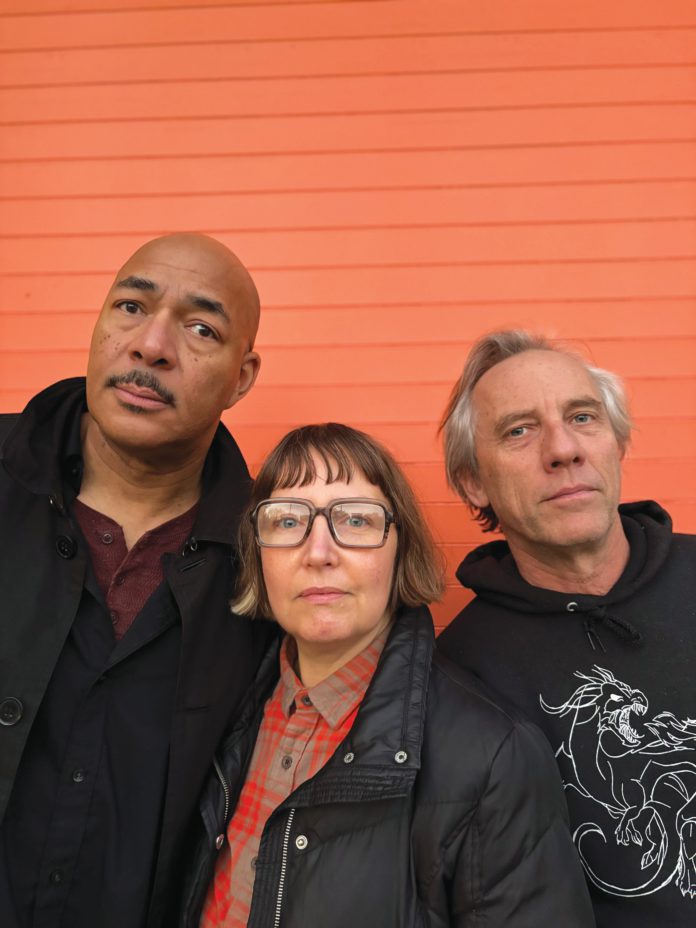
This week, my word limit must be made to contain the three-headed giant of the local arts scene—Amy Pinto, Steven K. Patterson and Brent Lindsay—the co-directors of The Imaginists theater company. 

For containment and contentment, I recommend the spacious 90-minute interview I recorded (in the Linktree below). Better catch a show in their converted garage container. I would buy any ticket they issued blind. They have the trust of the local art community.  Across a span of 24 years pushing limits on A Street, they have certainly earned it.

CH: Amy, can you recall and recollect a poppy POV moment in which you were really living your arts mission?

AP: In 2009, I conceived and co-directed a play with two other women. At the time, we all had kids ranging in age from 18 months to seven years. The piece was called Women’s Work and was about the history of unpaid labor, told in stories by the three of us while our children were on stage with us. We agreed that whatever our kids did, it would be part of the performance. And what happened basically is that children cried and were handed off to audience members, or they ran around and disrupted everything we tried to do, and the whole piece pretty much fell apart.

CH: Thus illustrating your point about unrecognized and uncompensated maternal labor.

AP: It was an incredible moment for me—emblematic of what we want to do—because these two women, who didn’t formerly consider themselves performers and now do, were up for this experiment and seeing what happened. Also, it was bilingual English/Spanish. 

CH: Your mission affirmed.

BL: Affirmation is such an important thing. Because artists in this county are not affirmed. But when you finally find your family of artists and that inspiration, that bar gets raised to such a point that it inspires not just your work but your artistry and personhood. It’s so important because it keeps you waking up and doing this art thing.

CH: Weakly attempting to encapsulate your company, I would say you have an abiding interest in progressive messaging and inquiry, the participation of non-professionals on an equal footing with yourselves, on-stage spontaneity, discovery, and also, I might say … silliness?

SP: In the search for what is true or what can be truth … I believe that truth is where the funny is.

CH: Then you’re very truthful.

Get involved:  linktr.ee/theimaginistsLINKS.

‘Gladiator’ all over: Try on these sword-and-sandals epics

1

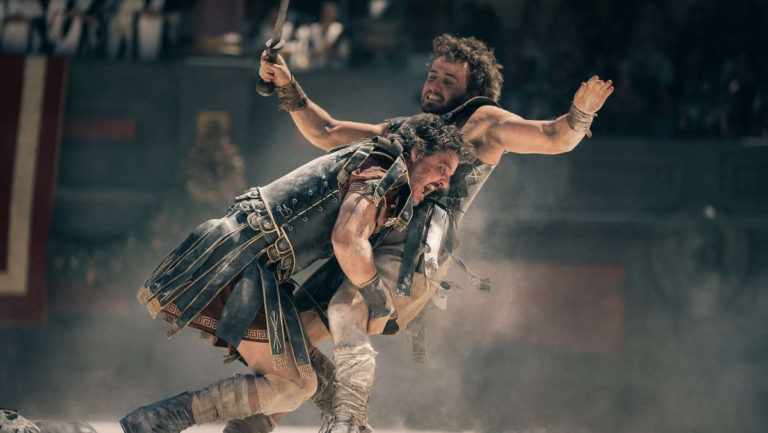
Regarding Ridley Scott’s Gladiator II, the sequel to his Gladiator (2000): What would the world do without gladiator movies? The ones set in the ancient Roman Empire, of course, preferably in the vast and menacing Colosseum. Where else would audiences get their regular dose of metaphorical decadence, cruelty and bloodshed, from the bad old days before killer drones and social media?

To help prospective audiences sort through the swords and sandals, here’s a handy overview of some noteworthy gladiator pics, the gaudier the better:

Old-fashioned filmmakers understood that if they wanted to get away with murder, perversion and other naughty ancient pastimes, they needed to present them in a suitably religious wrapper to placate the censors. The sorrowful plight of persecuted Christians dying in the Colosseum fit the bill nicely for director Cecil B. DeMille, whose The Sign of the Cross (1932) featured singing martyrs being torn apart by lions, sexy Claudette Colbert as Empress Poppaea and the perfervid hamming of Charles Laughton as mad Emperor Nero.

Mervyn LeRoy and Anthony Mann’s Quo Vadis (1951) upped the ante in all categories. Actor Peter Ustinov’s Nero has never been surpassed for inspired fruity insanity, and the requisite conscientious objector role of court-satirist Gaius Petronius Arbiter, author of the Satyricon, is ably handled by British thespian Leo Genn. That Technicolor blood is RED.

Spartacus (1960), the epic story of the rebellious slave/gladiator whose name later became a rallying cry for social revolutionaries, was a major career highlight for both actor Kirk Douglas and director Stanley Kubrick. The presence of tough guys Woody Strode and Charles McGraw at the gladiator academy set the violent parameters for every “savage Roman Empire” movie that followed, including Gladiator II.

For drive-in-style thrills and laffs, the 1973 Roger Corman production The Arena opened up new avenues of cheap sadism, as captured barbarian female warriors Pam Grier, a Nubian princess, and Margaret Markov, a Gallic amazon, take on all comers in the title venue. The joyous absurdity of movies like this naturally led to jokes from the Monty Python troupe. Their Life of Brian (1979) ramps up the iconoclastic irony, and the mayhem, with scenes of gladiatorial combat—“Children’s Matinee” at the Jerusalem Colosseum—and the funniest mass crucifixion ever staged. It’s directed by the Pythons’ Terry Jones, who also plays the Virgin Mandy.

And then there’s Barabbas (1961), with Anthony Quinn as the law-breaking would-be-martyr whose place on the cross was taken by a certain rabble-rousing carpenter from Nazareth—directed by Richard Fleischer. Or 1954’s Demetrius and the Gladiators, starring Victor Mature as yet another doomed slave/combatant with a guilty Christian itch that needs scratching. Throughout motion picture history, moviemakers looking for a way to get sweaty swordplay and religious platitudes—plus a little sex—on the same super-duper screen went to the Romans-versus-Christians spectacle well repeatedly.

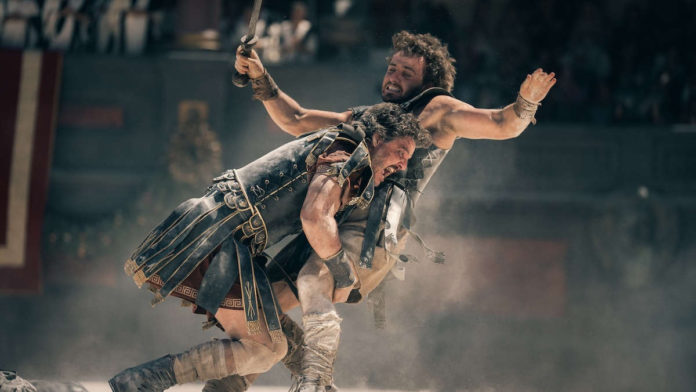
Scott’s Gladiator II follows the blueprint faithfully. Fearsome captured fighter Lucius (Paul Mescal), son of the late Maximus (Russell Crowe, from the previous installment), also happens to be the long-lost grandson of the noble emperor Marcus Aurelius. So he’s not just some ignorant prole. Lucius’ gory exploits in the Colosseum naturally gratify his mother Lucilla (Connie Nielsen, one of the film’s best performances), but not so much the unscrupulous gladiator dealer Macrinus (Denzel Washington, also in fine form).

The “twin emperors” Geta (Joseph Quinn) and Caracalla (Fred Hechinger), a pair of pallid, effete boobies, mince around the palace while gladiators are disemboweled and party guests are served a buffet from the head of a rhinoceros. Sample dialogue: “This city is diseased.” 

Filmmaker Scott’s visuals are as sumptuous, and obviously expensive, as usual, but this is plainly a rehash of familiar material, garnished with nonstop brutal action and a certifiable hint that the Roman populace is fed up with bread and circuses presented by utterly corrupt rulers. Maybe that applies to the rest of us as well.

In theaters

Free Will Astrology: Week of Dec. 18

0

ARIES (March 21-April 19): If you worked eight hours per day, seven days a week, it would take you 300 years to count to the number one billion. I don’t recommend you try that. I also discourage you from pursuing other trivial tasks with zero power to advance your long-term dreams. In a similar spirit, I will ask you to phase out minor longings that distract you from your major longings. Please, Aries, I also beg you to shed frivolous obsessions that waste energy; you should instead devote your time to passionate fascinations. The counsel I’m offering here is always applicable, of course, but you especially need to heed it in the coming months.

TAURUS (April 20-May 20): In 1951, minister and author Norman Vincent Peale was working on a new book. As he wrote, he would regularly read passages to his wife, Ruth. She liked it a lot, but he was far less confident in its worth. After a while, he got so discouraged he threw the manuscript in the trash. Unbeknownst to him, Ruth retrieved it and stealthily showed it to her husband’s publisher, who loved it. The book went on to sell five million copies. Its title? The Power of Positive Thinking. I hope that in 2025, you will benefit from at least one equivalent to Ruth in your life, Taurus. Two or three would be even better. You need big boosters and fervent supporters. If you don’t have any, go round them up.

GEMINI (May 21-June 20): I love how colorfully the creek next to my house expresses itself. As high tide approaches, it flows south. When low tide is on its way, it flows north. The variety of its colors is infinite, with every shade and blend of green, grey, blue and brown. It’s never the same shape. Its curves and width are constantly shifting. Among the birds that enhance its beauty are mallards, sandpipers, herons, grebes, egrets and cormorants. This magnificent body of water has been a fascinating and delightful teacher for me. One of my wishes for you in 2025, Gemini, is that you will commune regularly with equally inspiring phenomena. I also predict you will do just that. Extra beauty should be on your agenda!

CANCER (June 21-July 22): Just 81 billionaires have commandeered half of the world’s wealth. Even worse, those greedy hoarders are usually taxed the least. That’s hard to believe! How is it even possible that such a travesty has come to pass? I also wonder if many of us non-billionaires have milder versions of these proclivities. Are there a few parts of me that get most of the goodies that my life provides, while other parts of me get scant attention and nourishment? The answer is yes. For example, the part of me that loves to be a creative artist receives much of my enthusiasm, while the part of me that enjoys socializing gets little juice. How about you, Cancerian? I suggest you explore this theme in the coming weeks and months. Take steps to achieve greater parity between the parts of you that get all they need and the parts of you that don’t.

LEO (July 23-Aug. 22): Anthropologist Robin Dunbar theorizes that most of us have limits to our social connections. Typically, our closest circle includes five loved ones. We may also have 15 good friends, 50 fond allies, 150 meaningful contacts and 1,500 people we know. If you are interested in expanding any of these spheres, Leo, the coming months will be an excellent time to do so. In addition, or as an alternative, you might also choose to focus on deepening the relationships you have with existing companions and confederates.

VIRGO (Aug. 23-Sept. 22): Uncle Tom’s Cabin was the best-selling novel of the 19th century. It was written by a Virgo, Harriet Beecher Stowe. Her story about the enslavement of African Americans in the U.S. was not only popular. It awakened many people to the intimate horrors of the calamity—and ultimately played a key role in energizing the abolitionist movement. I believe you are potentially capable of achieving your own version of that dual success in the coming months. You could generate accomplishments that are personally gratifying even as they perform a good service for the world.

LIBRA (Sept. 23-Oct. 22): According to my reading of the astrological omens, you will be teased with an abundance of invitations to grow in 2025. You will be encouraged to add to your current skills and expertise. You will be nudged to expand your understanding of what exactly you are doing here on planet Earth. That’s not all, Libra! You will be pushed to dissolve shrunken expectations, transcend limitations and learn many new lessons. Here’s my question: Will you respond with full heart and open mind to all these possibilities? Or will you sometimes neglect and avoid them? I dare you to embrace every challenge that interests you.

SCORPIO (Oct. 23-Nov. 21): Scorpio-born Rudolf Karel was a 20th-century Czech composer who created 17 major works, including symphonies and operas. His work was interrupted when Nazi Germany invaded and occupied his homeland. He joined the Czech resistance, but was eventually arrested and confined to Pankrác Prison. There he managed to compose a fairy-tale opera, Three Hairs of the Wise Old Man. No musical instruments were available in jail, of course, so he worked entirely in his imagination and wrote down the score using toilet paper and charcoal. I firmly believe you will not be incarcerated like Karel in the coming months, Scorpio. But you may have to be extra resourceful and resilient as you find ways to carry out your best work. I have faith that you can do it!

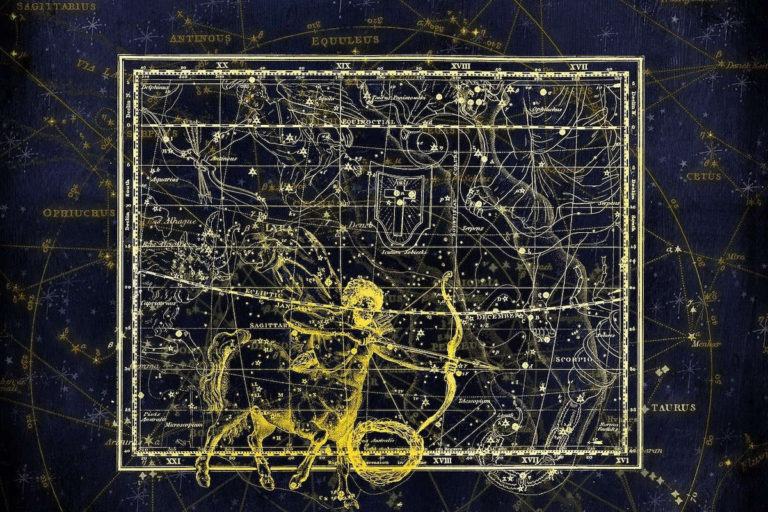
SAGITTARIUS (Nov. 22-Dec. 21): What is the perfect gift I could offer you this holiday season? I have decided on a large square black box with nothing inside. There would be a gold ribbon around it bearing the words “The Fruitful Treasure of Pregnant Emptiness.” With this mysterious blessing, I would be fondly urging you to purge your soul of expectations and assumptions as you cruise into 2025. I would be giving you the message, “May you nurture a freewheeling voracity for novel adventures and fresh experiences.”

CAPRICORN (Dec. 22-Jan. 19): One of my paramount wishes for you in 2025 is this: You will deepen your devotion to taking good care of yourself. You will study and learn more about the sweet secrets to keeping yourself in prime mental and physical health. I’m not suggesting you have been remiss about this sacred work in the past. But I am saying that this will be a favorable time to boost your knowledge to new heights about what precisely keeps your body and emotions in top shape. The creative repertoire of self-care that you cultivate in the coming months will serve you well for the rest of your long life.

AQUARIUS (Jan. 20-Feb. 18): To fulfill your life mission, to do what you came here to earth to do, you must carry out many tasks. One of the most important is to offer your love with hearty ingenuity. What are the best ways to do that? Where should you direct your generous care and compassion? And which recipients of your blessings are likely to reciprocate in ways that are meaningful to you? While Jupiter is cruising through Gemini, as it is now and until June 2025, life will send you rich and useful answers to these questions. Be alert!

PISCES (Feb. 19-March 20): Mysteries of the past will be extra responsive to your investigations in 2025. Persistent riddles from your life’s earlier years may be solvable. I encourage you to be aggressive in collecting previously inaccessible legacies. Track down missing heirlooms and family secrets. Just assume that ancestors and dead relatives have more to offer you than ever before. If you have been curious about your genealogy, the coming months will be a good time to explore it. I wish you happy hunting as you search for the blessings of yesteryear—and figure out how to use them in the present.

Homework: Get yourself a holiday gift that’s beyond what you imagine you deserve. Newsletter.FreeWillAstrology.com

Your Holiday Music Menu

0

Strawberry Village

Chanukah Lights

The Marin Chanukah Festival is all set to light up Strawberry Village in Mill Valley (and the hearts of Marin’s citizens) on Thursday, Dec. 26, from noon to 3pm. Those in the North Bay community may not want to miss out on this holiday celebration, hosted by Chabad of Tiburon with support from Chabads across the Bay Area. To ensure the Marin Chanukah Festival is celebrated in style, Strawberry Village will be transformed into a vibrant, festive space filled with sparkling lights, lively music and the scents of seasonal treats. There’s something for everyone, whether one is enjoying live music, getting crafty with Chanukah projects or even decorating donuts (because, really, who doesn’t love a sweet treat?). For the kids—and kids at heart—there’s a special “fun zone” to keep little ones entertained while adults indulge in goodies from the hot latke bar and kosher menu. Best of all? Admission is completely free. Reserve a complimentary ticket in advance at marinchanukahfestival.com.

Petaluma

The Heard Eye

It’s time to Jingle Bell Rock and funk this way to attend a performance put on by none other than the North Bay’s own musical group, The Heard Eye. This collection of local musical magic-makers is keeping the good times rolling with updates to end the year on a high note. Most notably, The Heard Eye’s self-produced, self-financed and self-promoted video, Boomerang (which dropped in November), has become a hit in time for the holidays. The video racked up 93,000 views on YouTube in just a few short weeks, which just goes to show what a loyal fanbase means in the music industry. If one hasn’t seen The Heard Eye’s new video yet, now’s the time to check it out and experience the funky, high-energy vibes. The Heard Eye is also still set to continue its monthly residency at The Big Easy in Petaluma. One can grab a friend or their whole family for a funky, rock-filled seasonal outing there on Thursday, Dec. 19 at 7:30pm. The Heard Eye show is free to attend, so one may come out early, grab a drink and catch some live music before next year is here. To learn more about The Heard Eye and its recent and future success, visit theheardeye.com.

Occidental

Solstice Soul

One may ring in the holiday season with some straight-up ear candy at the Barbara Higbie & Friends Winter Solstice Concert on Saturday, Dec. 21 at 7pm at Occidental Center for the Arts. This North Bay holiday show features Grammy-nominated, Bammy Award-winning pianist and multi-instrumentalist Higbie, known for her musical mastery and dynamic performances. Higbie will lead an ensemble of musicians, including Michaelle Goerlitz (Blazing Redheads), Vicki Randle (Mavis Staples), Lena Anderson, Jasper Manning, Kofy Brown (Skip the Needle) and Mia Pixley (Fantastic Negrito). Together, this star-studded group will guide their audience through a musical journey that blends genres and fills the room with festive cheer, perfect for celebrating the winter season. Alongside the show of the season, the Occidental Center for the Arts also offers refreshments, an open art gallery and accessible seating for patrons with mobility needs. Tickets for this magical musical evening cost $32 in advance, $27 for OCA members and $5 more at the door (if available). To secure a seat at this holiday performance, visit occidentalcenterforthearts.org.

Mill Valley

All That Jazz

Here comes a holiday show that’s anything but ordinary—that’s right, Maria Muldaur in Marin with her seasonal Christmas at the Oasis show, set to play at Sweetwater Music Hall in Mill Valley on Friday, Dec. 20. This special holiday performance promises a night of snazzy, jazzy and slightly irreverent holiday entertainment. Starting at 8pm, Muldaur and her “A-Team” of Bay Area jazz musicians will deliver a fresh twist on holiday classics, with swinging songs from jazz and blues legends. One can forget the predictable carols—this show is packed with rare gems that’ll have feet tapping and audience members grooving in their seats. Muldaur calls it “Christmas tunes for hipsters,” and it’s an antidote to the usual holiday ear fare. Whether one is in the mood for bluesy cheer or jazzed-up holiday magic, Christmas at the Oasis is designed to fill the night with style and soul. Tickets are $35 in advance, $40 at the door. So as not to miss out on this festive celebration, tickets can be obtained now at sweetwatermusichall.org.

Your Letters, 12/18

WWBD?

I used to go sit with Spirit Rock, starting when they were at the small community church in West Fairfax. As they grew, it felt more and more like a continual fundraising shakedown of greedy grasping expansion to build this and build that as more people drove, flew and consumed to sit on a cushion and be still.

I’m sure the Buddha never made anywhere near $250,000 per year, let alone took Ubers. Boo-hoo! Personally, I’d rather stay home and sit and be where I am.

Wow, just look at the Beauty of Nature—no need to do or undo; no need to buy and toss. Can we just Be?

Sierra Salin

Fairfax

Lines Crossed

Former President Barack Obama declared that if one side attempts to cement “a permanent grip on power” through suppressing votes, politicizing the military or weaponizing the judiciary and criminal justice system to target opponents, “a line has been crossed.”

Where has he been? All these “red” lines have been crossed already!

“Red” line Obama enabled Vladimir Putin to annex the Crimea and had so many other “red” lines that he has become superfluous. Obama couldn’t even help Kamala Harris.

Gary Sciford

Santa Rosa

We appreciate your letters to the editor—send them to le*****@******an.com and le*****@********un.com. Letters may be edited for clarity and space.

Lost & Found: Project Censored Unearths Underreported Stories

With any list, there’s a natural tendency to look first at No. 1. And neither I nor Project Censored would discourage one from doing that when it comes to their annual list of the top censored stories of the year.  This year, the top story is about workplace deaths and injuries—with striking racial disparities, particularly for much-maligned foreign-born workers. Injury...

How to Toast NYE: A Year in Cocktails (all at once)

Mixology has become so mainstream, in the best way possible, that it would not surprise me to see my New Year’s Eve host make their own infused simple syrup, ferment a shrub, and shake up a creative take on a classic.  The home liquor cabinet has expanded along with our desire for the new and the nostalgic. In these uncertain...

Olive Me: A Meditation on a Dirty Martini or Two

Drinking red wine has kept me out of most trouble, or at least in the kind of trouble I can manage for most of my drinking career. When it comes to cocktails, however, I’m a dabbler. I’m allergic to hipness and am a mixologist avoidant.  But I know that one of the secret ingredients of a good cocktail is the ambiance...

‘Politics as Unusual’ at Hippie Nudist Retreat

There were two men in the hot pool with me: One was a middle-aged white man like myself; the other, hoary, wiry and regal in the manner of a mad Shakespearean king.  His eyes sparked with electricity—a dangerous quality, considering we were sitting in water. I never learned his name. To me, he was Lear. I'd eased myself into the water...

March On, ‘Little Women’ in Sonoma

Even though Jo March was written as an outsider to society’s views on women, she’s the one that every girl in the friend group secretly thinks they are.  It’s almost a rite of passage for young American girls to go through their Jo March stage. Jo is loud, brash, driven, unabashedly herself and loyal to a fault, which, coupled with...

The Imaginists Bonded by Vision

For this pencil-wrist Hercules, writing this column sometimes seems an impossible task. This week, my word limit must be made to contain the three-headed giant of the local arts scene—Amy Pinto, Steven K. Patterson and Brent Lindsay—the co-directors of The Imaginists theater company.  For containment and contentment, I recommend the spacious 90-minute interview I recorded (in the Linktree below). Better catch a...

‘Gladiator’ all over: Try on these sword-and-sandals epics

‘Gladiator’ all over: Try on these sword-and-sandals epics
Regarding Ridley Scott’s Gladiator II, the sequel to his Gladiator (2000): What would the world do without gladiator movies? The ones set in the ancient Roman Empire, of course, preferably in the vast and menacing Colosseum. Where else would audiences get their regular dose of metaphorical decadence, cruelty and bloodshed, from the bad old days before killer drones and...

Free Will Astrology: Week of Dec. 18

Free Will Astrology: Week of Dec. 18
ARIES (March 21-April 19): If you worked eight hours per day, seven days a week, it would take you 300 years to count to the number one billion. I don’t recommend you try that. I also discourage you from pursuing other trivial tasks with zero power to advance your long-term dreams. In a similar spirit, I will ask you...

Your Holiday Music Menu

Strawberry Village Chanukah Lights The Marin Chanukah Festival is all set to light up Strawberry Village in Mill Valley (and the hearts of Marin’s citizens) on Thursday, Dec. 26, from noon to 3pm. Those in the North Bay community may not want to miss out on this holiday celebration, hosted by Chabad of Tiburon with support from Chabads across the Bay...

Your Letters, 12/18

WWBD? I used to go sit with Spirit Rock, starting when they were at the small community church in West Fairfax. As they grew, it felt more and more like a continual fundraising shakedown of greedy grasping expansion to build this and build that as more people drove, flew and consumed to sit on a cushion and be still. I’m sure...
12,118FansLike
4,924FollowersFollow
6,928FollowersFollow