A Trilogy in Verse: ‘Plagios, Volume III’ Released By Local Translators

Translator and educator Nancy Morales didn’t expect a former student’s invitation to join a literary translation project to blossom into a multi-book endeavor. 

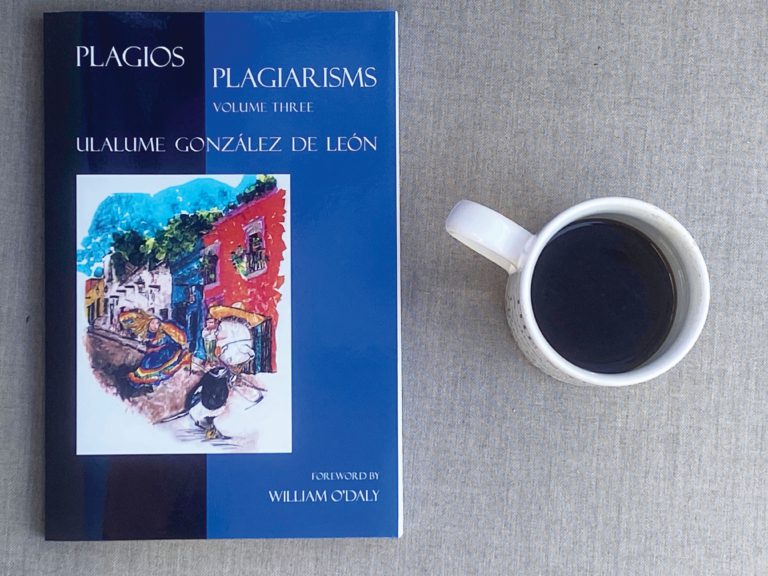
But it did—and over the next several years, Morales and her former student, John Johnson, joined by the poet Terry Ehret, began creating Plagios, a comprehensive trilogy of dual-language volumes that bring the complete works of Mexican poet Ulalume González de León into English for the first time.

Johnson remembered Morales using poetry in class to connect students more deeply with language, and asked if she was interested in translating some of González de León’s work. Her previous translation experience had been primarily academic, but this project would be an artistic endeavor. Meanwhile, Ehret was already regularly using González de León’s work in her creative writing classes. She had first read the poet’s work as a graduate student at San Francisco State.

“I was intrigued by the way [González de León] combined a highly sensual language with philosophical and scientific diction,” says Ehret, who often used the Mexican poet’s series of prose poems, Anatomy of Love, in her classes. When she looked for more of González de León’s poems in English, she found there was very little and ended up trying her own hand at translation.

So when Johnson contacted Ehret for recommendations on where he and Morales might publish their first translations, Ehret joined the project.

“The [three volume project] was Terry’s idea,” says Johnson. “I called her one day after Nancy and I had translated a few of UGL’s poems, to ask if she’d help us get them published in a journal somewhere,” he recalls. “How many poems did Terry have in mind? All of them. And along with publishing in journals, Terry suggested that we publish all of them together in a three-volume, bilingual edition.” 

The project was shaped by a commitment to preserving González de León’s voice while making her poetry accessible to a new audience. It would also be the first time that the Mexican poet’s collected published work would be available in a dual-language format. 

“John’s attention to Spanish grammar and idiom, as well as the original texts that González de León borrowed or plagiarized, were invaluable contributions to our work,” says Ehret. “And Nancy has always provided grounding in the Spanish text, and her bilingual talents have helped us craft our translations with sensitivity and accuracy.” 

Ehret’s own contribution to the project was rooted in her knowledge of the language theory and philosophy González de León studied at the Sorbonne, the poet’s feminist aesthetics and her experiments with text.

The trio worked together for several years before they were able to procure the translation rights from the Mexican publisher of the poems, along with an NEA translation fellowship. Next, they approached Sixteen Rivers Press with their three-volume book proposal.

Johnson worked with Morales and Ehret from 2012 to 2021 to produce the first two volumes, but bowed out of the project after the second volume. 

“After eight years, I decided to leave the translating of Volume III to Terry and Nancy, but continued to work behind the scenes on the book production process,” explains Johnson. So from 2022 on, Morales and Ehret continued together, and Plagios/Plagiarisms, Volume Three is the final result.

González de León, a Uruguayan-born poet who became a well-known literary figure in Mexico, is known for her radical experimentation with language. That made the work exciting—but also complex—to translate. 

The poet—a powerful presence in Latin American literature—wrote during the Latin American literary boom that gave rise to magical realism, where she stood out for her feminist voice and linguistic risks. She made her mark in Mexico, enjoying collaborations with Octavio Paz and a friendship with Elena Poniatowska, who’s considered Mexico’s grand dame of letters.

“Ulalume is a unique writer and poet; she not only borrowed from other poets but felt liberated in creating her own language, sounds, rhythms and grammatical demands,” Morales says. “In this way, she can be found to be elusive, challenging, erratic, fun, light and requires a lot from her translators. However, I also believe this is what makes her so current, fresh and edgy.”

González de León was known for playing with language and layered meanings. “We had to be very creative and thoughtful in our choices,” says Morales. 

That inventiveness made many translation decisions particularly delicate. Poetry is so much about rhythm, sound and nuance, that there’s a desire to stay true to the original meaning but also have the translation resonate musically in the spirit of the poem. 

“The rhythms of Spanish aren’t the rhythms of English,” explains Ehret. “Nancy and I brought our areas of expertise to each translation, but on many of the poems, we had help from several bilingual poets and translators: Stalina Villarreal, Christina Lloyd and Jabez Churchill. Ultimately, Nancy and I would sit with our translations for days or weeks, listening to its music, trying different synonyms, different syntax, different phrasings, till the language felt emotionally satisfying.”

Of course, collaboration also means respectful disagreement. 

“We initially were a group of three with three different voices, styles and even approaches to translation, to Ulalume, to poetry and to the direction of the project,” says Morales. “However, I believe that ultimately, we wanted to move forward, create a beautiful poem and be as respectful and kind to each other while also being in concert with Ulalume [González de León]. I truly believe that her voice guided many of our choices.”

“[The conversations] were at times difficult and humbling,” says Johnson of working on the first two volumes. “The experience of working collaboratively always led to a better understanding of the poems and, I believe, better translations.”

Translation is a living process. And over the years since they began the project, there has been growth and progress in the translators’ skills, confidence and familiarity with the work. Morales says that she’s grown as a person, translator, poet and writer because of this project. 

“I definitely feel more confident—and with that I’m willing to take more chances,” adds Morales, who believes that bringing González de León’s work into English fills a critical gap. This allows English-speakers to discover another influential voice among female Latin American writers.

“She’s an incredible writer,” adds Morales, explaining how the poet was an advocate for political and social issues during her time, representing women as one of the first Latin American feminists.

Ehret agrees that the work of poets like González de León is critical. She notes, “At a time when the rich diversity of our culture is being systematically erased, it’s important that we embrace other languages, to read beyond our borders, and beyond the monolinguistic paradigm.

A reading from ‘Plagios,’ as part of a 16 Rivers Press poetry event, begins at 6pm, Wednesday, May 28, at Readers Books, 130 East Napa St., Sonoma. More information at sixteenrivers.org.


No Such Thing as Rock ’n’ Scroll, Live Music Demands Attention

One wakes up and scrolls past footage of a protest at Tesla—scroll—a cooking video—scroll—a joke—scroll—and then asks their AI assistant if it’s going to rain. 

They drive to work listening to a playlist featuring artists from four continents. By the time they get home at the end of the day and sit on the couch, they look up, and there it is again: a big dark screen. On the other side, endless possibilities. Every story, every song, every image. 

Why would one put their pants back on, get in the car and see a show downtown?

After my first article in the Bohemian, most responses focused on my comment that North Bay music could use more integration. I argued for cross-genre and cross-identity collaboration as the path to creating our own regional sound.

Now, I see it’s even more urgent than that. Outside-the-box ideas are not just nice—they are necessary for survival in the performing arts. Because the competition isn’t another show. It’s Netflix, YouTube, TikTok, Spotify and an infinite scroll of algorithmic seduction.

Why go out, buy a ticket and brave the cold when dopamine is a swipe away? Local events feel like a gamble. Digital media is immediate, familiar and frictionless. The problem isn’t lack of talent—it’s that the cultural playing field has tilted so steeply that showing up in person now feels like swimming upstream.

The deck is stacked, but artists aren’t giving up. They’re getting weirder. More daring. More communal. More live—and more alive.

Bryce Dow-Williamson’s work at The Lost Church is a good example: His protest song show and album tribute nights feel more like community rituals than recitals. The DJ scene’s been way ahead as well, with Lush (every second Saturday at Vintage Space), Wolf Pack (first Fridays at Third Pig in Sebastopol) and Glitter/Goth (first Saturdays at Arlene Francis Center), creating immersive, people-powered parties. Musicians are also teaming up in unexpected ways and embracing in-the-moment creation. Audio Angel’s genre-bending performances at Moonlight Brewing and Arlene Francis featured surprise improvised collaborations with LaiddBackZach and Erica Ambrin.

Festivals continue to lead the charge for real-life experiences. Events like Gravenstein Apple Fair, Petaluma Music Festival, Rivertown Revival and Railroad Square Music Festival provide a full range of experiences for the crowd beyond staring at a stage. It raises the question—what can our shows learn from festivals? 

Performances are getting more interesting outside of music as well. I’ve seen more fashion shows than ever (North Bay Fashion Ball, Trashion Fashion, Trashlantis). Live comedy is experiencing a renaissance (Standprov, Creature Comedy, Barrel Proof Lounge in Santa Rosa with comedy four times a week).

I am particularly excited by the hybrid zone—where pop culture gets bent, remixed and infused with real-life interaction. North Bay Cabaret’s recent May the Fourth Be With You is a perfect example, taking a franchise and messing with it in a way that promoter Jake Ward has said is “bold, live and boundary-pushing.”

I am trying my own hand at this with my friend Cincinnatus Hibbard in a recurring show called Performance Lab, where we invite local performers to try something new, interactive and exciting. The next show, at 5:30pm on Sunday, June 1, features an immersive Lord of the Rings experience at Sebastopol Center for the Arts (282 S. High St.). That’s not a bit. That’s the gig.

To my fellow artists: Keep pushing. Keep inviting. Make it unforgettable. Make it live. 

And whoever is reading, I hope that this helps find something meaningful in the community. Something unpredictable. Something human.

Something that one doesn’t want to scroll away from.

Troubled Texting, ‘The Burdens’ at The 222

Who hasn’t been tripped up by the slip of a finger while texting with family or been infuriated with ducking autocorrect? 

Who hasn’t had their message misunderstood because tone and attitude can’t be conveyed via modern communication methods? 

Who hasn’t mistakenly wished for the death of their grandfather in a text chain with a sibling and then found themselves exploring options for doing so? 

That’s the crux of Matt Schatz’s The Burdens, a darkly comic tale now running at The 222 in Healdsburg through June 1.

Jane (Lizzie Calogero) and Mordy (Brady Morales-Woolery) are siblings who, like most families these days, communicate almost exclusively via text, email and voicemail. Jane is a high-powered attorney living in New Jersey. Mordy is a musician trying to make it in Hollywood but working as a pharmacist’s assistant. While separated by distance, they are joined by their mutual loathing of their abusive grandfather, “Zad Zad.”

During one text session, Jane wonders if their grandfather really appreciates what his daughter, their mother, does for him. Mordy responds that he hopes he does, except that he hits the letter “i” after “d” instead of “o”. The problem is, Jane quickly agrees. And she thinks they should do something about it. What follows is a series of texts, emails and voicemails as they debate, plan and eventually attempt to execute (literally) their plan. 

A series of texts, emails and voicemails? An entire show whose dialogue consists of digital communication? 

Yep, and it works.

Director Jennifer King and her cast meet the challenge head on and bring the characters alive as the messages are enacted with all the intent, emotion and humor that electronic communication lacks. Their delivery is to the audience, not each other, as they never acknowledge each other’s presence on the stage. It’s as if the audience is the midpoint between the flow of bits and bytes of data between the two. It also illustrates how unconnected we really are from each other when utilizing a technology that’s supposed to bring us together.

Beyond the issues of the pitfalls of modern communication (or miscommunication), Schatz’s brisk 75-minute play delves into the family dynamic, especially the bond and battles between siblings. While you may not relate to their desire for killing their grandfather, you may relate to their desire, after things go a bit haywire, to kill each other. 

While I think it cops out a bit at the end, The Burdens is a pretty funny look at the perils of letting your fingers do the talkin’.

‘The Burdens’ runs through June 1 at The 222. Fri & Sat, 7pm; Sun, 2pm. $45-$105. Students free with ID. 707.473.9152. the222.org.

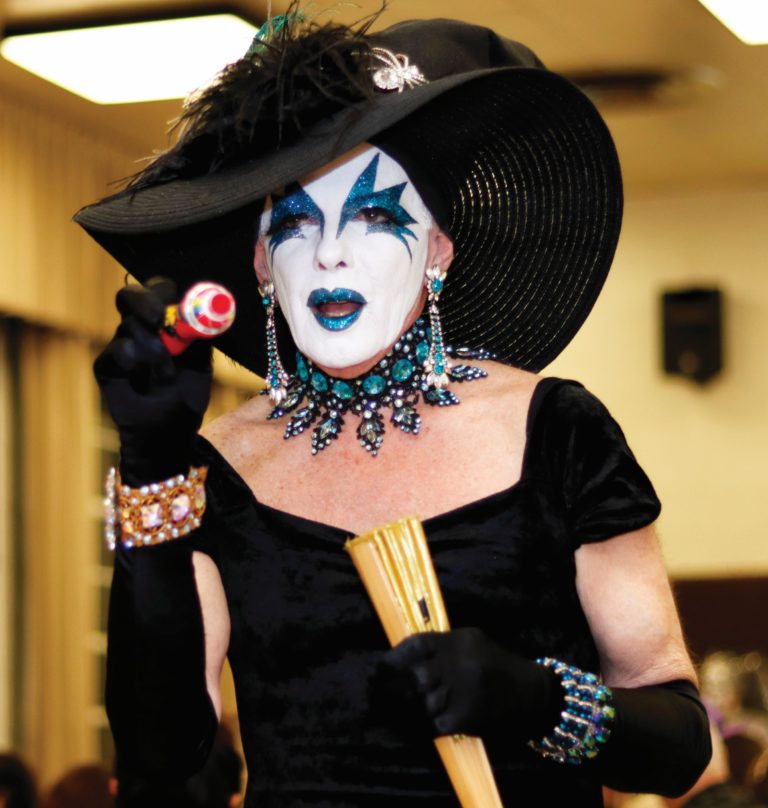
Lord’s Work with Sister Sparkle Plenty of The Sisters of Perpetual Indulgence

For the “expiation of stigmatic guilt”—these solemn words, spoken as a vow, are repeated each time a sister of Perpetual Indulgence dons her veil. 

Their clicking heels and pancake makeup and profuse glitter masks a deep purpose. “Perpetual indulgence” can mean “endless debauchery.” But within a liturgical or church context, “indulgence” means the forgiveness of sins. The Sisters are an order dedicated to endless forgiveness and compassion—for the guilty and innocent alike.

There is much guilt and shame to expiate. Notwithstanding the succession of two “liberal popes,” the modern Catholic church still regards homosexuality and transsexuality as a sins. Sins kindred to fraud, violence, usury and the sexual abuse of children.

The world Catholic communion stands at 1.5 billion members. Around the world, many hundreds of millions of LGBTQ + folk are persecuted, prosecuted, shamed and closeted for their love.

They are persecuted and closeted here in America. Now with a renewed and emboldened bigotry. 

The Sisters of Perpetual Indulgence first formed in the 1980s out of spontaneous drag counterprotests to traveling preachers (of all denominations) who had come to preach fire and damnation on the streets of the Castro District—the modern “Sodom.” 

The local River Sisters chapter formed in Guerneville in 2001. I caught co-founder Sister Sparkle Plenty outside one of our local chapters’ locally famous charity Bingo nights. 

Sisters keep the gaming action hot by layering multi-card Bingo with rounds of scratchers, raffles, random giveaways and sharp-tongued comic crowd work with the many regulars. At each monthly Bingo event, a different local nonprofit or cause-of-the-moment is supported. This month was Boy Scout uniforms. The Sisters’ ministry has expanded from the protection of their community to the support of all vulnerable communities. Such is their abundant love.

Cincinnatus Hibbard: Sister Sparkle, could you share with us the full vow that binds your order?

Sister Sparkle Plenty: It would be my pleasure … “I hereby promise, cross my heart and hope to die, that I will forever uphold the love and spirit of The Sisters of Perpetual Indulgence. I will dedicate myself to the promulgation of universal joy and the expiation of stigmatic guilt. I will be considerate of how my words and actions affect others. I will strive diligently to have a sense of humor and to never ever take myself so seriously that I forget to have fun. Amen, a women and everybody else.”

It must be beautiful to recite your purpose so beautifully every day. I would invite our readers to do the same. Sister … I noticed there wasn’t a vow of chastity in that. …

No. (archly) It is suspiciously lacking isn’t it? …

(Laughs) Speaking of  the “promulgation of universal joy,” I understand that you now count over 100 independent chapters all over the world.

Some call it global domination. (laughs) We’ve grown quite a bit—especially in the last 10 years. Growth has been surprisingly strong in the South.

A lot of guilt and shame to expiate there.

And a lot of fun to be had.

Although it isn’t in the oath, there is an implied vow of poverty because The Sisters give away every penny that you fundraise—nothing for overhead.

100%. We are all volunteers. … we are from time to time showered with personal gifts from our many admirers … which we never refuse, (winks)

(Laughs nervously) How much have you raised as an independent chapter?

Over $4 million for over 200 local charities and causes.

Lordy.

Learn more: A full calendar of events is available at rrsisters.org.

Greek to Me, Charles Bililies of Souvla

If one has never been to Souvla, the fast-fine Greek restaurant with six locations scattered about the Bay Area, they should run to one right now. 

And one should definitely order the Greek fries, if nothing else. Lucky for those of us across the bridge, the most recent location opened at the Marin Country Mart in Larkspur, being the first Souvla to launch outside of San Francisco city proper. 

Founder and CEO, Charles Bililies, moved to California in 2006 and started Souvla more as a passion project to honor his Greek-American heritage. The idea speedily evolved into the highly regarded brand that it is today. Bililies has become an authority on the intersection of food and tech and the innovation behind the casual-meets-high quality combo he has created at Souvla, often speaking on panels and in the press about all of it. He spends his down time at home in Sonoma County. 

Amber Turpin: How did you get into this work?

Charles Bililies: I’ve been on a long and windy road with restaurants and hospitality for more than half my life now. From delis, to line cooking in chain restaurants, hotels to 3-Michelin Star restaurants, from the fry station to dining rooms and the back office, to owning and operating Souvla for the last 11 years.

Did you ever have an “aha” moment with a certain beverage? If so, tell us about it.

I proposed to my wife over a 16-year-old bottle of Assyrtiko from Hatzidakis while perched on our balcony in Oia, on the caldera of Santorini, while the sun set over the Mediterranean Sea. The wine was unlike anything I’d had previously, and the moment was simply perfect.

What is your favorite thing to drink at home?

It should come as no surprise we drink a fair amount of Assyrtiko, the mineral-driven, crisp white wine native to Santorini but now grown throughout Greece. We planted a small vineyard of Assyrtiko in our Sonoma backyard. To our knowledge, it’s the only planting of the varietal in all of Sonoma County. We’ll let you know how it is in about three-four years.

Where do you like to go out for a drink?

We’re big fans of Buc’s in Sonoma. Either a negroni or a bottle of Malvasia with some wings or a slice.

If you were stuck on a desert island, what would you want to be drinking (besides fresh water)?

Sigalas Assyrtiko from Santorini. No doubt.

Souvla at Marin Country Mart, 1805 Larkspur Landing Cir., Suite 14, Larkspur, 415.660.9500. souvla.com/location/marin-country-mart.

Your Letters, May 28

Tradition

When you think about it, Donald Trump fits right in. 

The practice of widespread public lying as standard U.S. government practice goes back at least to the Civil War, accelerated around the Spanish-American War, rekindled in the HUAC-Joe McCarthy period, ramped up to an art form in Vietnam, coalesced with Watergate, reared up with Ronald Reagan and Iran-Contra, made history in Iraq, and fed the “stolen” election in 2020 and the pandemic. 

American institutions and their leaders lie. This is the great lesson we can all count on. Trump is simply carrying the torch. It’s the perfect job for him.

Craig J. Corsini
San Rafael

F/Elon

Thank you, Miriam Ginden, for speaking out about billionaire robber baron Elon Musk (“Open Mic: The Tesla Chainsaw Massacre,” by Miriam Ginden, May 13, 2025), in league with the other oligarchs. The more we know, and act on that knowledge, the greater our chances to defeat them. Power to the people.

Christina White
Sonoma County

Open Mic: Historic Moment. How Will We Respond Today?

A person escapes slave labor, torture, rape and murder, and illegally crosses a border to a land where such crimes are outlawed, to a land where people have the right to work for wages and are protected by the law. 

Anyone in this “free land” who harbors or aides such an escapee is subject to federal prosecution, fines and imprisonment. This was the United States in 1850 when Congress passed the Fugitive Slave Law, legislation requiring that all escaped slaves be returned to the slave-owner and that officials and citizens in free states must cooperate.

Americans in 1850 had to decide where they stood, with the newly passed federal law or with their conscience. The risk was great, for both the runaway slaves and those Americans who might help them.

Today, the Republican Party, the very party which grew from the outrage over the wickedness of the Fugitive Slave Act, now seeks to criminalize every aspect of helping a person who has fled a life of torture, violence and suffering. The Fugitive Slave Act of 1850 has been updated and amended for the fleeing refugees of 2025. 

We are only four months into Donald Trump’s Second Term of Cruelty. Where will we be a year from now? Two years from now? How draconian will the laws be then? 

So often, we wish to be part of a moment of great historical importance, a moment when we have to take a risk to save another, to take a stand when others wouldn’t. We feel certain we would know the right thing to do. If only such a moment would come our way.

Today, that moment comes not in whether to provide shelter and safety to a refugee fleeing violence in their home country, a person illegally in the United States.

How will we respond this time? In this century? In this historic moment?

That question is as potent, and as dangerous, today as it was then. For us, and for the victims in the breach.

Brad Wolf is a former prosecutor and co-coordinates the Merchants of Death War Crimes Tribunal.

Playing Chicken, Reporting from the Field

As Bob Dylan might’ve observed about Petaluma this past weekend, “The sun’s not yellow; it’s chicken,” when a poultry-hued sunbeam shone brightly on the quaint burg (once heralded as the “egg basket of the world”). For this, we can thank a potent admixture of arts, advertising and activism.

Friday saw the premiere of Mercury Theater’s The Resurrection of Freddy Chickan, a wild retrospective of nine unforgettable works by performance legend Fred Curchack. Featuring music, puppets, shadow-play, movement and mind-bending visuals—a fever dream of a show that showcases Curchack’s limitless imagination and virtuosic performance chops—the must-see show continues this weekend and is a fundraiser for Mercury Theater (more at mercurytheater.org).

Somehow, in the midst of celebrating Curchack’s onstage victory, we neglected to acknowledge that it was also International Drinking with Chickens Day. This came courtesy of the promotional genius of author Kate E. Richards, who’s pushing her book, Drinking with CHICKENS: Free-range Cocktails for the Happiest Hour, across the bar. Incidentally, Cuchack is Polish for “chicken,” so close enough. Saturday, however, a parade of protestors entreated Petaluma City Council, to “Help The Chickens” (their campaign name and call-to-action) at a local poultry plant (more at helpthechickens.com).

In other matters, studies suggest playing Mozart’s music to plants has a positive effect on their growth. At Petaluma’s Lagunitas Brewing Company, they’re playing music to beer.

Albeit, their approach is different, and the outcome sought has little to do with the brewing process, but the effect on the vibe has proved fundamental to the Lagunitas experience. Such was the case this past Memorial Day, when the local institution hosted “‘Live at Lagunitas’ Kicks Off with BottleRock Hangover Show.” 

The band in question, the three-piece was The Los Angeles League of Musicians—more popularly known in their abbreviated form as La LOM. The genre-blurring instrumental trio channeled the full spectrum of Los Angeles’ musical DNA into the brewery’s tank room (and later on the main stage).

The experience was part of a Live at Lagunitas’ VIP package, which included a “pre-show hang” in the brewery’s legendary loft (think: a private club meets one’s favorite uncle’s garage with national touring acts signing swag), an intimate set with the band (in the aforementioned tank room, in this case) and reserved space for the main show (meaning one gets to plant their butt on the lawn before the masses plant theirs).

We found playwright and Argus-Courier community editor David Templeton in the lounge and spent the next several hours swaying to the music but perhaps swaying more from the beer. Five out of five (IPAs). Would do it again.

Tragedy + Time: Aaron Foster Humorously Explores Mental Health

It’s said that comedy is tragedy plus time. In Aaron Foster’s case, it’s also depression, anxiety, grief, two restaurants, a defunct sports nutrition brand and a stint as an HGTV host—all seasoned with gallows humor and served under the banner Mostly Jokes.

The show, which lands at Sebastopol’s Main Street Theater on June 5, is a one-man dive into the deep end of mental health with nothing but a mic as a flotation device. Foster, who returned to stand-up after a 15-year hiatus, has crafted an autobiographical act that confronts—with harrowing hilarity—his family trauma, career detours and the garden-variety existential dread that festers behind curated Instagram smiles.

“The first time I told a joke about my brother committing suicide, it did not go well, to say the least,” he told me. “But, one person (one) found me after the show and said their brother had done the same thing and that it was the funniest joke they’d ever heard. That was enough reason to stick with it.”

Dark? Yep. But ultimately cathartic (for both the performer and the audience) and, above all, funny. 

“I don’t think there is such a thing as ‘too dark,’ but there is definitely such a thing as ‘not funny,’ and that’s the ultimate measuring stick,” Foster said. “When you’re starting out and audiences don’t know you, it’s not always ideal to open with five (or 15) minutes about clinical depression, so you’d better figure out a way to make that stuff really funny and relatable.”

Foster does. And he’s earned his black belt in emotional jujitsu, flipping pain into punchlines with finesse honed over years—years of therapy.

“My life is pretty fantastic on paper. Unfortunately, in my head, it’s a whole different thing,” he said, candid about his ongoing bouts with imposter syndrome and a tendency to catastrophize. “An hour on stage in front of 100 strangers is more comfortable to me than 10 minutes at a cocktail party.”

Comedy is where chaos and control share a safe-word. And Foster’s set is a masterclass in owning the narrative. From strained family dynamics (a bipolar father, a schizophrenic brother, among other issues) to the psychic wounds of the career complexifier known as Hollywood.

“Turning a breakdown into material might be easier than turning it into a breakthrough, unfortunately. Unless turning a breakdown into material is the breakthrough?” he noted. 

It might be. At least it’s honest. And in a culture over-attuned to performative vulnerability on TikTok and Instagram, the real deal is damn near revolutionary. That said, Foster is not deluded about the odds. Hollywood loves a comeback story—but it’s hard to get it to notice.

“Sure, it’s late in the game, but it ain’t over ’til you’re dead and buried, so you might as well keep swinging,” he said. “It’s probably as long a shot as doing it the other way, maybe longer, but at least it’s mine.”

‘Mostly Jokes’ plays at 8pm, Thursday, June 5, Main Street Theater, 104 N. Main St., Sebastopol. Tickets at mostlyjokes.com.

Culture Crush, 5/28

San Rafael

‘Wall of Voices’ Set at Rafael

CAFILM Education and Youth in Arts present Wall of Voices, a short documentary spotlighting the creation of a vibrant mural at Laurel Dell Elementary School in San Rafael. Directed by youth filmmaker Mia Huang, the film captures a year-long journey of community, identity and creative collaboration through the eyes of young artists. The free film screening on Thursday, May 29 includes a post-film conversation with Huang and instructor Luca Capponi, moderated by CAFILM Education’s Diana Sánchez Maciel. Produced with support from the Community Media Center of Marin, the project celebrates youth voices and the power of art to foster connection. 7pm, Thursday, May 29, at Smith Rafael Film Center, 1118 Fourth St., San Rafael. Admission is free; tickets required. More at rafaelfilm.cafilm.org/wall-of-voices.

Mill Valley

Pardon the Interruption…

We’re interrupting our usual broadcasting to inform all at home that the Sweetwater Music Hall in Mill Valley is set to host the legendary band, Pardon the Interruption. In this rather meta press announcement, all of the North Bay is officially invited to come on out to the Sweetwater for a concert that’s all about blending the genres of new wave, prog-pop and rock into some entirely unique and infectiously good listening. Pardon the Interruption will play alongside ska aficionados, Jethro Jeremiah Band. To move and groove along to soulful ska and genre-blending beats, one may come out to the Sweetwater Music Hall in Mill Valley. Doors open for the concert at 7pm, and the show starts at 8pm on June 5. Tickets cost $30. To learn more, visit sweetwatermusichall.org.

Santa Rosa

All That Glitters Isn’t Peanuts

The North Bay is going to go nuts over a new mobile map … Peanuts, that is. That’s right; the famed Charles M. Schulz, creator of the Peanuts comic strip, is being celebrated through increased visibility and accessibility; i.e., his nearly 100 local Peanuts-themed statues have just gotten a tech upgrade so they may be found and appreciated that much easier by visitors and locals alike. Now, those who come out to Santa Rosa can take a guided virtual tour of the city via a Peanuts on Parade digital map. This atypical treasure map leads its followers to all the most iconic Peanuts-themed statues, allowing people a chance to admire the city’s claim to fame face-to-fictional-metal-face. And who knows … maybe they’ll let admirerers pet Snoopy’s nose (for luck, like a Buddha’s belly). To access the Peanuts on Parade statue map online, visit VisitSantaRosa.com/Peanuts.

Sonoma

Sunsets at The Lodge

This is the vibe for summer of 2025: a monthly poolside concert in Sonoma with tacos, cocktails and a sunset view to match the immaculate mood. As luck would have it, The Lodge at Sonoma has all that and a bag of chips (I assume they have chips, at least, since they’ve got everything else I want). Regardless, I digress—this summer concert series is free to attend and includes onsite food and drink tickets for purchase. Plus, each month there’s a fun new activity alongside all the other fun activities. July 10, for instance, has live cigar rolling with Fumar Cigars. Sunsets at The Lodge takes place from 5 to 7pm on the second Thursday of each month, beginning on June 12. The Lodge is located at 1325 Broadway at Leveroni and Napa roads in Sonoma. To learn more, visit thelodgeatsonoma.com.

A Trilogy in Verse: ‘Plagios, Volume III’ Released By Local Translators

Translator and educator Nancy Morales didn’t expect a former student’s invitation to join a literary translation project to blossom into a multi-book endeavor.  But it did—and over the next several years, Morales and her former student, John Johnson, joined by the poet Terry Ehret, began creating Plagios, a comprehensive trilogy of dual-language volumes that bring the complete works of Mexican...

No Such Thing as Rock ’n’ Scroll, Live Music Demands Attention

One wakes up and scrolls past footage of a protest at Tesla—scroll—a cooking video—scroll—a joke—scroll—and then asks their AI assistant if it’s going to rain.  They drive to work listening to a playlist featuring artists from four continents. By the time they get home at the end of the day and sit on the couch, they look up, and there...

Troubled Texting, ‘The Burdens’ at The 222

Who hasn’t been tripped up by the slip of a finger while texting with family or been infuriated with ducking autocorrect?  Who hasn’t had their message misunderstood because tone and attitude can’t be conveyed via modern communication methods?  Who hasn’t mistakenly wished for the death of their grandfather in a text chain with a sibling and then found themselves exploring options...

Lord’s Work with Sister Sparkle Plenty of The Sisters of Perpetual Indulgence

For the “expiation of stigmatic guilt”—these solemn words, spoken as a vow, are repeated each time a sister of Perpetual Indulgence dons her veil.  Their clicking heels and pancake makeup and profuse glitter masks a deep purpose. “Perpetual indulgence” can mean “endless debauchery.” But within a liturgical or church context, “indulgence” means the forgiveness of sins. The Sisters are an order...

Greek to Me, Charles Bililies of Souvla

If one has never been to Souvla, the fast-fine Greek restaurant with six locations scattered about the Bay Area, they should run to one right now.  And one should definitely order the Greek fries, if nothing else. Lucky for those of us across the bridge, the most recent location opened at the Marin Country Mart in Larkspur, being the first...

Your Letters, May 28

Tradition When you think about it, Donald Trump fits right in.  The practice of widespread public lying as standard U.S. government practice goes back at least to the Civil War, accelerated around the Spanish-American War, rekindled in the HUAC-Joe McCarthy period, ramped up to an art form in Vietnam, coalesced with Watergate, reared up with Ronald Reagan and Iran-Contra, made history...

Open Mic: Historic Moment. How Will We Respond Today?

A microphone mounted in a holder
A person escapes slave labor, torture, rape and murder, and illegally crosses a border to a land where such crimes are outlawed, to a land where people have the right to work for wages and are protected by the law.  Anyone in this “free land” who harbors or aides such an escapee is subject to federal prosecution, fines and imprisonment....

Playing Chicken, Reporting from the Field

As Bob Dylan might’ve observed about Petaluma this past weekend, “The sun’s not yellow; it’s chicken,” when a poultry-hued sunbeam shone brightly on the quaint burg (once heralded as the “egg basket of the world”). For this, we can thank a potent admixture of arts, advertising and activism. Friday saw the premiere of Mercury Theater’s The Resurrection of Freddy Chickan,...

Tragedy + Time: Aaron Foster Humorously Explores Mental Health

It’s said that comedy is tragedy plus time. In Aaron Foster’s case, it’s also depression, anxiety, grief, two restaurants, a defunct sports nutrition brand and a stint as an HGTV host—all seasoned with gallows humor and served under the banner Mostly Jokes. The show, which lands at Sebastopol’s Main Street Theater on June 5, is a one-man dive into the...

Culture Crush, 5/28

San Rafael ‘Wall of Voices’ Set at Rafael CAFILM Education and Youth in Arts present Wall of Voices, a short documentary spotlighting the creation of a vibrant mural at Laurel Dell Elementary School in San Rafael. Directed by youth filmmaker Mia Huang, the film captures a year-long journey of community, identity and creative collaboration through the eyes of young artists. The...
12,117FansLike
4,907FollowersFollow
6,928FollowersFollow