Debriefer: June 16, 2015

LEGISLATIVE LANDSCAPE

California has struggled to get its medical cannabis house in order ever since passage of the landmark Compassionate Use Act in 1996. In that time, lawmakers have repeatedly failed to come up with a statewide regulatory regime. The stakes for success are higher this year, given that there’s little chance the state would enact a full-on legalization regime until it squares up the medical regulations. (See related story in Debriefer, “Local Grower Hoedown,” at Bohemian.com.)

With that in mind, here’s the medical lay of the land over in Sacramento: Last December, Oakland assemblyman Rob Bonta offered AB 34. The Emerald Growers Association hailed the grower-friendly bill as “the first cannabis regulatory bill that takes a multi-agency approach.” The leading growers’ lobby supported the bill for its protection of old-timey shadow-growers. “This basic recognition is tremendously important.”

That bill sat around for a while and was only assigned to committee after Bonta emerged as a co-author of AB 266, which effectively superseded his first bill. AB 34 got a 13–0 vote when last heard in the appropriations committee, then it was “held under submission” in that same committee.

While AB 34 languished, AB 266 picked up on last year’s failed bills written by the conservative California League of Cities and the California Police Chiefs Association. AB 266 includes grower-friendly language, and it’s over in the Senate after passing out of the Assembly.

That bill will now be treated to the legislative version of a sativa-indica hybrid. Lawmakers will consider it alongside
SB 643, which sailed out of the Senate on June 4 and is now before the Assembly. SB 643 creates an omnibus regulatory scheme designed to corral the medical cannabis industry, and also comes with an environmentally savvy emphasis on thwarting illegal water diversions and irresponsible outlaw grows. Local shout-out to Sen. Mike McGuire for this bill.

A couple other cannabis bills were offered this session to put some legislative meat on the 1996 medical cannabis law.
AB 243 strengthens existing water regulations for cultivators. The bill requires “best practices related to land conversion, grading, electricity usage, water usage, water quality, woodland and riparian habitat protection, agricultural discharges, and similar matters”—or else: the law will find you. It passed, and is under consideration in the Senate.

Then there was the omnibus reform bill AB 26, which pushed for more laws “in furtherance of the Compassionate Use Act of 1996, which provides for the Legislature to ‘implement a plan for the safe and affordable distribution of marijuana to all patients in medical need of marijuana.'”

The bill went by the wayside as AB 266 emerged as the cannabis du jour bill in the Assembly.

—Tom Gogola

SONOMA CANNABIS GROWERS HOEDOWN

It was smoke-free Sunday at the Sebastopol Grange for the first meeting of the new Sonoma County Growers Association (SCGA) this past weekend. The only thing that got fired up was the imagination of nearly 200 participants as speakers explored the bold new world of legal cannabis.

“There’s been a revolution in the way we talk about cannabis policy in California in the last nine months,” Healdsburg assemblyman Jim Wood told the crowd. Earlier this month the Assembly approved an omnibus bill that protects fragile watersheds—and mom-and-pop cannabis growers. “This was the first time that cannabis has ever been acknowledged as agriculture,” Wood told an approving crowd.

The bill now rests in the Senate, to be merged or otherwise mashed-up with Sen. Mike McGuire’s Medical Marijuana Public Safety and Environmental Protection Act. McGuire pushed for new laws to fulfill a “promise that was made to Californians 20 years ago . . . to put in rules and regulations to protect our community and our environment and help this multibillion dollar industry grow in the years to come.”

The SCGA was created to influence new policies that will affect the livelihood of thousands of small Northern California growers, especially after 2016. “To protect their interests, small family cultivators need to become more active participants in their community,” the group advises. “By organizing and educating themselves, cultivators become involved in the solution.”

Given the continued illegality of cannabis—and Sonoma County District Attorney Jill Ravitch’s decision to aggressively pursue cannabis crimes—none of the attendees was ready to step out of the shadows and identify themselves as cultivators.

One attendee, Laura, said the mere fact of a full house was good enough news for the day. “It’s good people are getting out in the open, and not being afraid anymore.”

There’s other aspects of the legalization push that put the fear to local cannabis growers: the emergence of large-scale cannabis agribusiness that will push prices down so low that small operators will be driven out of business.

This has led cannabis advocacy organizers and dispensary leaders to mobilize around industry groups like the new SCGA and the Emerald Growers Association.

A “Grow Local” future, panelists suggested, would feature a regulatory environment that encouraged mom and pop growers and that emulates the craft-beer industry.

“If you go down the beer aisle at Safeway, about 75 percent of it is taken up by craft microbreweries,” noted panelist Jamie Kerr, a founder of the 530 Collective dispensary. “We could follow the [California] Craft Brewers Association model where you have regulatory requirements that allow for a micro-farmer to still stay viable and compete. You do that through tiered markets and tax breaks”

This could mean access to local farmers markets, the ability to control appellations (think “Dry Creek Valley”), and local regulations that limit large grows. Wood explained that AB 266 places a 30,000-square-foot limit on all cannabis farms—too small to whet a large investor’s appetite.

If voters legalize marijuana, cities or counties eager to attract larger growers might also allow larger farms. Wood is optimistic that, as with fine wine, the expertise of small growers will convince buyers to shop local.

“Hopefully, in the end it’s going to be a recognition for people who use these products that there is a difference in the quality,” he told the approving crowd.

—Jonathan Greenberg
Unscrew It

0

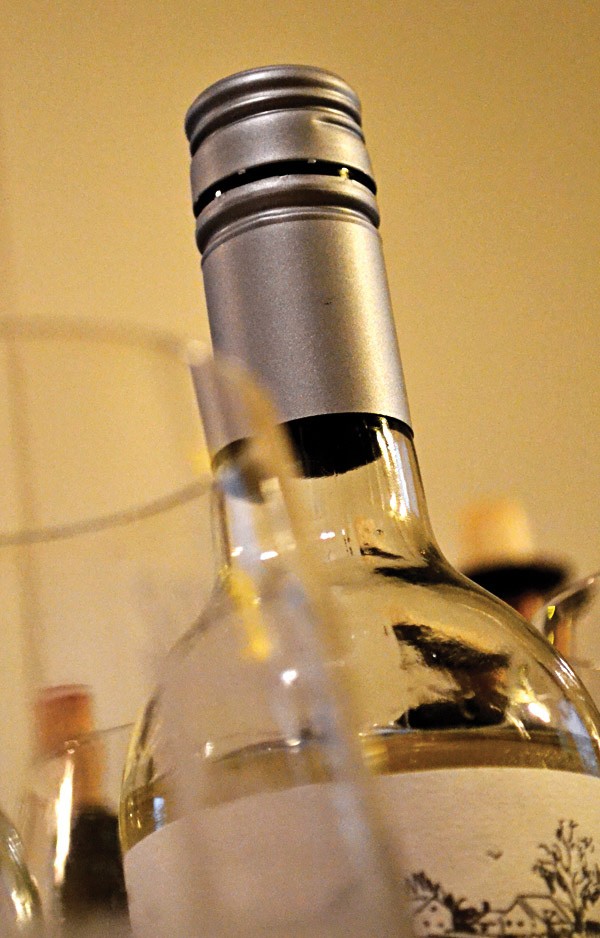
Some of my favorite wines are bottled with a screw cap.

Yes, I do consume them more or less within sight of the railroad tracks, but the point is this: While California wineries have mainly stuck with sticking tree bark in their bottles, whole nations have turned to sealing their wines with a screw cap, also known as a Stelvin closure. But now, despite cork-industry assurances that cork taint is a thing of the past, aluminum-capped wine samples are increasingly trickling into the Bohemian.

What I like about the screw cap is that it’s both convenient and honest. Synthetic corks can be more difficult to wrench out of the bottle than natural corks, and for what? The romantic pop of a plastic cork? If any of these wines becomes your summertime favorite, the metallic crack of the cap may yet bring just as much joy to your ears.

Charles Krug 2014 St. Helena Sauvignon Blanc ($18) You know it’s a thing when the great grandpappy of Napa wineries passes on cork for an estate-bottled wine. The non-oxidative style of this wine is perfect for it—this is no barrel-fermented fumé, as owner Peter Mondavi’s brother pioneered downvalley. Like in many New Zealand versions, here the grass is green, the Rancher is Jolly, and Key lime and pear cider give it over to melon as the wine opens. There’s enough fruit to balance the tongue-tingling acidity.

Matanzas Creek 2013 Sonoma County Sauvignon Blanc ($22) Sharp and exotic, the initial aroma also highlights a screw-cap hazard: they can lock in sulfury smells just as well as fresh fruit. Don’t crack-and-gulp in one motion—wait a minute to enjoy this elegantly defined wine, all zip with no heat.

Crossbarn 2014 Sonoma County Sauvignon Blanc ($22) Don’t expect that every tin-top Savvy is on the gooseberry express. Dainty pear candy here, with tangy lemon-marinated apple and white grapefruit flavor.

Angeline 2013 Signature Reserve Russian River Valley Pinot Noir ($18) The spices are baking, the jam is boysenberry, and a touch of sweetness on the palate is not cloying. Straightforward Pinot for having with pork dishes or shiitake stir fry.

Martin Ray 2012 Sonoma County Cabernet Sauvignon ($25) For several vintages, this winery has screw-capped its wines that aren’t expected to be cellared more than two years. And here’s a soft, red-fruited Cabernet you might want to open before brunch is over. Raspberry cookie and Mexican chocolate spice up a lush, plush palate of raspberry, boysenberry jam. What, it’s jammy and simple? Cork it.

Letters to the Editor: June 16, 2015

Sail On

Great article about the “Marco Polo exception” (“Eat Like Marco,” June 3) and sail transport!

I wanted to let you know of some similar local efforts. The local chapter of Sail Transport Network (www.sailtransportnetwork.org) is trying to drum up and organize interest in two local San Francisco Bay sail transport projects. First is a scow-schooner for transport on the bay. Petaluma was founded where it is because that’s as far as the scow-schooners (local Bay transport of the 1800s) could get up the Petaluma River.

The second project is similar to the Tres Hombres but for the Pacific. One of the best-ever Pacific sail transport ships, the Galilee, was built in San Francisco in the 1880s. She could move 300 tons of cargo from SF to Tahiti in 19 days on wind power alone—in 1885! A record that remains unbroken. A replica of that ship is being built in Sausalito (www.educationaltallship.org). This replica, named the “Matthew Turner” after the designer, will be used for educational purposes. We would like to build a second “Matthew Turner,” but use it for Pacific transport like the Tres Hombres is doing in the Atlantic. If anyone is interested in either of these two projects, feel free to contact me at bi***********@***il.com.

Santa Rosa

Small Problem

After reading “Small but Mighty” (June 3) I felt compelled to dispel the hype. It seems every other weekend I meet Bay Area transplants, artists, vagabonds and, sadly, young entrepreneurial farmers who are under the illusion that tiny homes and mobile, modular housing are a viable option.

Sonoma County has extremely narrow stipulations on how these dwellings may be occupied, which utterly excludes those of limited means. Under current conditions, these units will only be additions to pre-existing homes as backyard guest rooms, office spaces or, worse yet, Airbnb rentals.

Many people who grew up in this county and imagined staying dream that they may find a bit of land to live simply on. But a leftover bit of legislation meant to quell the growth of communes in the 1970s prevents those who choose to live small to do so. I feel that it is dishonest to hype this movement as a legitimate solution to housing, to environmental concerns, to simpler lives, and most importantly, as a means for young farmers to occupy and work land.

Many of these issues were not addressed in the article and remain under-addressed whenever the tiny-house movement is written about.

Although the concept is great and the designs exciting, it is the legal constraints that prevent it from actually becoming a reality for those who could truly benefit from the movement.

Occidental

Write to us at le*****@******an.com.

Not So Sweet

0

We know foods like doughnuts and soda can make you fat, but the effects of sugar on the liver and brain are less well-known. Dietary sugar can fry your liver in much the same way that alcohol can. This, in turn, can hurt your brain, leaving you with dementia-like symptoms decades earlier than is typical.

Most people associate liver disease with alcohol abuse or hepatitis. But another type, non-alcoholic fatty liver disease (NAFLD)—which barely existed three decades ago—has quickly become the most common liver disease in America. It isn’t caused by booze or a nasty virus, but dietary sugar, which causes a buildup of fat in your liver.

Overweight people are likely candidates for NAFLD. Memory loss and diminished cognitive function are often the first symptoms, as the liver loses its ability to filter toxins that compromise the brain.

According to the American Liver Foundation, at least one-quarter of the U.S. population suffers from NAFLD. That number is expected to swell to 40 percent by 2030, thanks to the insatiable American sweet tooth and the corporate interests that feed it.

A European Journal of Nutrition study published in March 25 further solidified the connection between sugar and NAFLD. It found that even moderate amounts of sugary drinks will stimulate the production of enzymes that deposit fat in the liver.

The Washington, D.C.–based Sugar Association once touted sugar as “a sensible approach to weight control.” But—alas for Big Sugar—it’s becoming ever more difficult to use even the most convoluted scientific principles to promote sugar consumption, much less defend it.

In addition to NAFLD, sugar promotes a variety of other ailments, including heart disease, tooth decay and diabetes. Meanwhile, new research is mounting that suggests sugar is behind Alzheimer’s disease, which has been dubbed type 3 diabetes, aka diabetes of the brain.

The case against sugar has grown steadily but quietly over the last four decades, in the shadow of dietary fat, which has widely been blamed for these ailments. Meanwhile, the Sugar Association has engaged in tactics reminiscent of those the tobacco industry employed during the height of its denial, including the funding of sugar-friendly research, the installation of sugar-friendly (and sugar-funded) scientists on government advisory panels, and even threats to scientists and politicians who question the place of sugar in a healthful diet.

In February, the USDA’s Dietary Guidelines Advisory Committee published its findings. They include several significant sugar-related proposals, including a sugar tax.

“Sugar starts to fry your liver at about 35 pounds per year, just like alcohol would at the same dosage,” wrote Robert Lustig, a specialist in pediatric obesity, in a March 20 op-ed in the Los Angeles Times. “This is because fructose—the sweet molecule of sugar—is metabolized in the liver just like alcohol.”

While the dust settles and sugar consumption and labeling guidelines are inevitably restructured, don’t wait for any final word from government agencies. You can use your common sense—but willpower might be more of an issue.

The Road Goes On

0

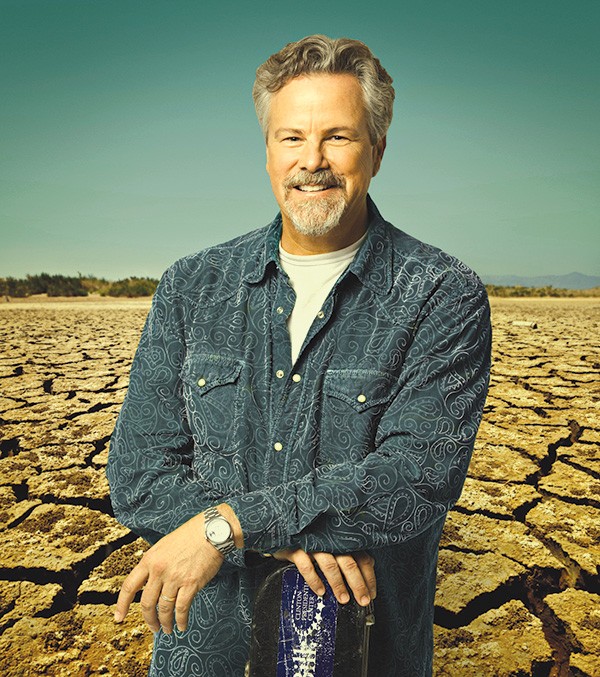
Acclaimed songwriter and country star Robert Earl Keen is best known for hits like his beloved anthem “The Road Goes On Forever,” yet the sixth-generation Texan has always had a soft spot for bluegrass, the music of his youth.

Keen shares this lifelong passion on a new album, Happy Prisoner: The Bluegrass Sessions, and a summer tour making its way to Mill Valley on June 24.

“The first date I ever had, I took a girl to a bluegrass festival,” says Keen, speaking by phone from the hill country of Kerrville, Texas. “I don’t recommend it. It did solidify the fact that, number one, I really did love bluegrass, and number two, that really shouldn’t be your first date with a girl you want to keep going out with,” he laughs.

Keen grew up on a steady diet of records by the likes of Bill Monroe and the Stanley Brothers, and learned to play guitar alongside their albums, and with bluegrass fiddle players in Houston, where he was raised. “It has really affected the whole way I write and sing,” he says.

Still, in a career that spans more than three decades, Keen never produced a strictly bluegrass album until this past February, when Happy Prisoner was released to universal praise and a top spot on the U.S. bluegrass charts.

“I got to a point in my life where I thought, you know, if I don’t do this now, I might never do it,” says Keen about the new album. Collected from a list of a hundred of his favorite songs, Happy Prisoner features 15 classic bluegrass tunes played with Keen’s signature grit.

Guest appearances by friends like Lyle Lovett and Sara Watkins (Nickel Creek) bolster Keen and his band’s playing, and the record encompasses an eclectic array of what bluegrass means to him.

“A lot of people have a real myopic view of bluegrass, but I think of it in terms of a broad spectrum with real nuances,” says Keen. “I wanted to pick songs that represented the entire bluegrass landscape.”

Bringing that landscape to the North Bay, Keen returns to Sweetwater, where he has appeared numerous times since sending the venue a handmade press kit back in his earliest days of playing.

This time around, Keen and his core band of 20 years will be working the stage with a blend of material off the new record as well as a crop of his biggest hits, like “Shades of Gray” and “Feelin’ Good Again,” done up in a bluegrass style.

Private Impressions

0

One of the late 19th century’s most gifted artists, and an integral figure in the impressionist and modernist movements, Edgar Degas worked in a variety of media yet rarely exhibited anything other than his paintings and pastels. He was a reluctant celebrity in the art world of Paris, and a private person.

A century later, Degas’ complex and emotionally penetrating work still fascinates art lovers around the world. This week, the most personal works of this legendary figure come to the Petaluma Arts Center (PAC)
for an intimate exhibition, “Edgar Degas: The Private Impressionist,” which collects more than a hundred works on paper by the artist and others in his immediate circle.

This world-class showing, drawn from the collection of San Francisco curator Robert Flynn Johnson, marks a major step for the ambitious PAC, which has grown exponentially in the last five years. “Edgar Degas: The Private Impressionist” runs through July 26, with a gala preview on Friday, June 19, and an opening reception on Saturday, June 20. Petaluma Arts Center, 230 Lakeville St., Petaluma. $100 (gala); $10 (opening). 707.762.5600.

Localize This!

Sometimes there’s so much to say about a topic that it’s hard to fit it all in. That’s what happened last week (“Hot Pockets,” June 10) when I reported on the bounty of resilient eco-enterprises popping up in the North Bay in response to climate change.

Climate change has become an intractable problem. What troubles me is why governments and corporations don’t figure out sensible policies to address an issue that so profoundly threatens the future of our children and grandchildren. Is it possible that some people are so corrupt, so greedy—so evil, really—that they can’t give up a few luxuries to refashion the game to protect our planet?

In my article, I took up author Naomi Klein’s view that capitalism is the cause of the problem. According to Klein, conservatives recognize that addressing climate change poses a threat to capitalism, which is their operating system; hence they resist.

We asked some innovative thinkers on this topic what they thought. Richard Heinberg, in particular, is clear that growth, made possible by cheap fossil fuels, must come to an end.

Michael Shuman and Marco Vangelisti agree that the economy cannot continue to grow. Whether (and when) it will collapse is certainly in question, but in fact it has already collapsed once, in 2008, and is currently supported mainly by debt. The situation, once again, looks precarious.

One alternative is to invest in small-scale, local businesses funded by local capital instead of conglomerate debt, that are accountable to the people they serve and respectful of the limits of nature. Ironically, that’s still capitalism; you might call it capitalism with a conscience. As I discovered, here in the North Bay there are dozens of small businesses trying to reduce emissions, produce food and other good things, and share information and resources. It’s working.

Whether localization is going to solve the problems created by uncontrolled growth and abusive capitalism remains to be seen. But, hey, it’s a step. At least somebody’s doing something that needs to be done, something we can all support. And who knows, it might trickle up.

Stephanie Hiller is a freelance writer living in Sonoma.

Open Mic is a weekly feature in the ‘Bohemian.’ We welcome your contribution. To have your topical essay of 350 words considered for publication, write op*****@******an.com.

Return to Form

0

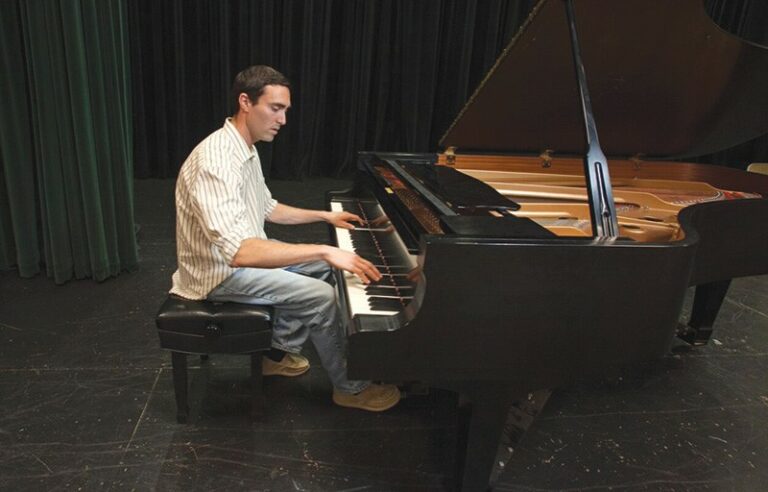
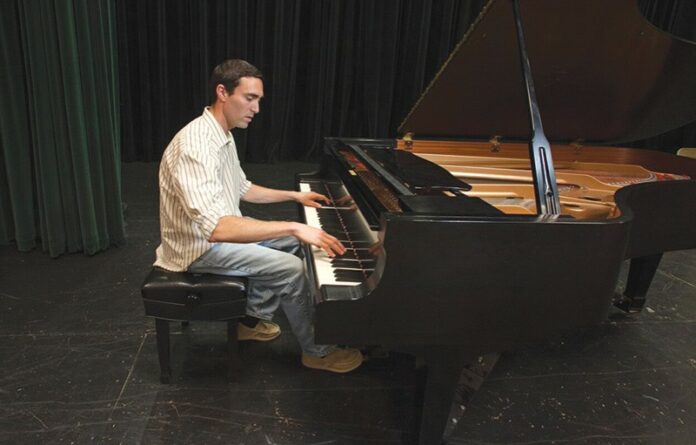
A talent at the piano from the age of three, and a Sonoma County resident since he was eight, Beau D Flasher is a master behind the keys.

Flasher got some of his jazz chops from gifted instructor Mel Graves, and for a decade he made a good living by teaching piano and giving occasional performances that showcased his skillful technique and graceful playing. Still, he struggled to find satisfaction.

“I stopped teaching because I wanted to get away from music to enjoy it more,” says Flasher, who performs a solo concert June 20 at Sonoma State University. “I wanted to understand myself a little more. I was helping people with music, but I wanted to reach them in other ways.”

That was before the accident.

In August 2012, Flasher was on a friend’s property in west Sonoma County when he stumbled down a hillside into a row of solar panels. The collision cut Flasher’s dominant arm to the bone, and severed four tendons that controlled his right hand.

“I didn’t feel it,” he recalls, showing off the striking, angular scar on his forearm. “I was just looking at it, thinking, ‘There’s no way this is happening.'”

For 10 days the tendons remained severed while he waited for treatment. Doctors were able to reconnect them in a procedure that essentially glued them back together. The tendons held, but there was no way to know if Flasher would ever play again.

“I didn’t touch a piano for half a year,” says Flasher. When he did, he was shocked to discover the lasting effects of his injury. “When I got back to hitting the keys, the timing was off,” he says.

The neural messages from brain to finger were delayed by a half second in his right hand. Flasher realized that to play again, he had to re-time his entire brain and body, even synching up his noninjured left hand to account for the latency in his right.

For two years, Flasher worked his way toward recovery. “I just started to play and play, and I wrote—I wrote a song a day,” he says. “This new energy came out of nowhere.” The newfound energy inspired him to return to playing music, and it also manifested in his daily life.

“I was hard to get to know,” says Flasher of his previous personality. “And I realized that I wasn’t allowing myself to be open and vulnerable, and I didn’t want to hold all that in again. I said, ‘I’m going to choose love everyday,’ and it affected all areas of my life.”

Since the accident, Flasher has found a renewed passion for inspiring others through his experience and through his music. This week, he steps back onto a stage for the first time in three years to perform a selection of his latest compositions accompanied by a powerful multimedia presentation.

“[The accident] was an important event in my life, like a rite of passage,” says Flasher. “I’m grateful for it, because it led me in a direction I needed to go. I used to hide the scar, but I don’t anymore.”

Head Trip

Pixar, the studio that tries harder than any of them, tries something different in Inside Out. It’s a cartoon inner-space voyage into the subconscious, starring a cast of psychological abstractions.

Riley (voiced by Kaitlyn Dias), not yet a teenager, is uprooted by her parents from her idyllic Minneapolis home to a dingy Victorian in an authentically delineated San Francisco. We see the crisis disrupting her life from the inside of her personality. Riley’s troubles are processed by five color-coded figures: the luminescent, blue-haired pixie Joy (voiced by Amy Poehler), who puts her seal on every event; Sadness (Phyllis Smith of The Office), a shapeless, bespectacled sloucher in a chunky white turtleneck sweater; Disgust (Mindy Kaling), green and scowling with disdain; and, lurking like minions, Anger (Lewis Black) and Fear (Bill Hader).

Joy’s job is to collect and protect memories before they’re sent to the core. The newly minted memories are the size and color of glow-in-the-dark bowling balls, which roll down ramps of mammoth machinery to be safely archived below decks, before sadness can touch and cloud them.

For all the mulling over of emotional conflict, Inside Out is as restless as any summer action film, with both a rocket journey and a train wreck. The amusement-park-like “islands” of Riley’s inner-life (one, a “Goofyland,” is where Riley goes when she pretends to be a monkey to cheer her dad) crumble under the girl’s stress, shaking as if they’d been built on a psychological San Andreas fault.

Co-director Pete Doctor is trying for something funny and also profound. He mostly succeeds. And once again, Pixar gets you right between the ribs, this time with a scene of reconciliation—when Riley comes to understand that there is something called bittersweetness that dwells between the extremes of joy and sadness.

‘Inside Out’ opens June 19 in wide release.

Into the Weeds

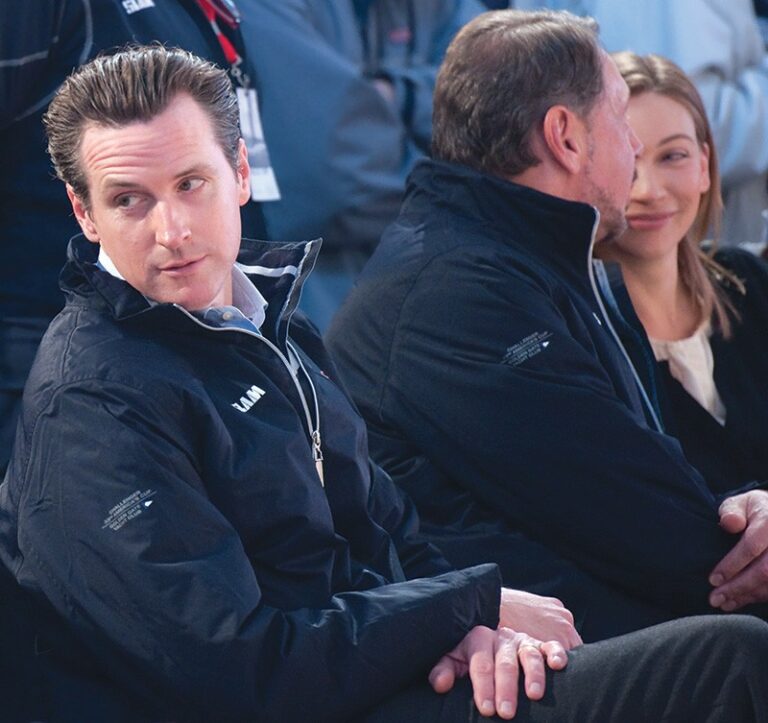
A state cannabis commission headed by
Lt. Gov. Gavin Newsom will issue its final report July 7, a key date along the road to an expected referendum on the legalization of recreational marijuana on the 2016 California ballot.

July 7 also marks the soft filing deadline set by state Attorney General Kamala Harris’ office to give the state enough time to vet qualifying signatures for voter initiatives.

The double sevens were not good news for ReformCA, a legalization advocacy coalition whose member groups range from the National Organization for the Reform of Marijuana Laws (NORML) to the NAACP. The group hasn’t filed its initiative yet because it wants to absorb the commission’s report to make sure it’s in sync with the commission’s findings. Now the group says it will have to spend more money to get its signatures verified.

The timing hints at the delicate dynamics at play as the state rolls toward 2016: the Blue Ribbon Commission on Marijuana Policy (BRC), and Newsom, can’t favor, or appear to favor, one of several legalization initiatives over another—especially when the commission isn’t itself pro-legalization, even if Newsom is.

Nor can the commission create an appearance that it is coordinating its effort with ReformCA, even if ReformCA tried to coordinate its effort with the BRC’s report.

But the commission has a timetable of its own.

ReformCA was waiting on the commission report to get input from legalization opponents such as the California Police Chiefs Association.

Also high on the list: What do to about cannabis users on probation or in jail, and those Emerald Triangle mom-and-pop growers anxiously awaiting their fate.

Newsom met Humboldt County growers last month to hear their concerns.

“We’d be foolhardy to not understand perspectives of other communities that we may not have had access to, who came out of the woodwork on behalf of the lieutenant governor,” says Dale Sky Jones, who chairs ReformCA and teaches at the Oaksterdam University in Oakland, a cannabis cultivation school.

“This is why we are waiting for the [commission],” she says.

In anticipation of the 7/7 deadline, ReformCA had set “an ideal drop-dead date” of July 6 to file its initiative, says Jones.

The cannabis activist says she understands the commission’s delicate position, given that Californians “don’t want to feel that [legalization] is being pushed down their throats.”

The 7/7 filing deadline is tied to verification measures used to certify signatures needed to petition for a proposition. The “full check” system goes beyond random sampling and requires that California’s secretary of state direct county elections officials to verify every signature on the petition.

Harris’ office could not comment on any of the pending initiatives. Press secretary Kristin Ford told the Bohemian via email that “the AG looks forward to reviewing the findings of the commission.”

Harris is a candidate for Barbara Boxer’s Senate seat in 2016 and has to walk a fine line here, too. Harris’ spokesperson reiterated a previously reported position that she’s not “morally opposed to the legalization of marijuana. But as the state’s top law enforcement officer, it is important to address issues that impact public safety in a thoughtful manner.”

Harris’ work extends to other states that have gone legal.

“Our dialogue with Washington and Colorado has yielded some important avenues to explore and understand further, like edibles and packaging,” wrote Ford.

The unfolding politics of ending prohibition in California seem to go as follows: There are very real concerns over a 2016 presidential election gone bad—Bush III backlash, anyone? Boxer’s seat is up for grabs. There’s an ambitious lieutenant governor running for governor who says he would support an initiative, “provided it is the ‘right one,'” as California NORML has pointed out.

Meanwhile, several legalization initiatives have already been filed with the attorney general—including one from Sebastopol cannabis lawyer Omar Figueroa—but ReformCA has been tuned in to the commission’s work this spring as it sought to establish itself as the most serious coalition.

How serious? ReformCA put Howard Dean campaign guru Joe Trippi on its payroll two years ago and is treating the legalization referendum as a “national issue,” says Jones.

Jones says she started to push Newsom “once [the BRC] was announced,” and at every opportunity, “I asked him to turn it the hell up!”

“I’m probably driving the lieutenant governor insane,” she says with a laugh, “if not amused. Every time I see him, I tell him, ‘Hurry up—you’re going too slow.'”

The commission’s general outlook on legalization? Not so fast.

The forthcoming white paper follows a trio of public forums held this spring that emphasized public safety, youth issues and the tangled web of banking and taxation, says Abdi Soltani, a member of the BRC steering committee.

Soltani, executive director of the American Civil Liberties Union of Northern California, says the report, 18 months in the making, will distill the findings and highlight challenges and options California faces as it moves toward the expected 2016 vote. It’s not a referendum on the referendum, he says, which is to say that the commission isn’t endorsing a pro-legalization regime.

“We wanted to gather people who would be thoughtful about what is it that has to be thought through if the state goes forward,” he says. “But there is nothing inevitable about anything. In the end, the voters will make the decision.”

Pressed for details on what the report might offer, Soltani stressed fairness and transparency. “After 7/7, we’ll be in a position to get on an equal-opportunity basis” with all interested parties, he says, “and we’ll share this with the public.”

Given the size of California, the order of magnitude is much greater here than in states that have legalized recreational cannabis, such as Colorado or Washington. “The biggest factor that presents the biggest challenge is that we would still be dealing with the federal prohibition,” says Soltani. “I don’t think we’ll come out of this process claiming to know everything. It’s a long road. How do you transition from a system that’s prohibition to a system that’s legal? There will be course corrections and new regulations along the way, and we have to take a long view.”

Jones says she’ll press on with the work of gathering signatures and raising money.

“The fact that they are coming in on July 7 when the ideal drop date is 7/6 is going to make it more expensive,” she says.

Jones says a referendum will cost between $4 million and $6 million: that’s for getting all the required signatures, and getting the vote out in November 2016. But she says “the [fundraising] goal we are shooting for is $10 [million] to
$20 million.”

To qualify for the ballot, the group must gather 585,000 signatures—
8 percent of the electorate in the 2014 gubernatorial election.

Jones says the main big-ticket expenditure would be for media buys—which are contingent on two unknowns at the present: “Who is going to be president, and how much opposition to legalization is going to be mustered in the state.”

Jones says she is treating cannabis not as an issue but as a national candidate in 2016. It’s a full-on hearts-and-minds campaign.

“Cannabis—you know her. You’ve had experiences, and you feel like you know Mary Jane already.”

Debriefer: June 16, 2015

LEGISLATIVE LANDSCAPE California has struggled to get its medical cannabis house in order ever since passage of the landmark Compassionate Use Act in 1996. In that time, lawmakers have repeatedly failed to come up with a statewide regulatory regime. The stakes for success are higher this year, given that there's little chance the state would enact a full-on legalization regime...

Unscrew It

Some of my favorite wines are bottled with a screw cap. Yes, I do consume them more or less within sight of the railroad tracks, but the point is this: While California wineries have mainly stuck with sticking tree bark in their bottles, whole nations have turned to sealing their wines with a screw cap, also known as a Stelvin...

Letters to the Editor: June 16, 2015

Sail On Great article about the "Marco Polo exception" ("Eat Like Marco," June 3) and sail transport! I wanted to let you know of some similar local efforts. The local chapter of Sail Transport Network (www.sailtransportnetwork.org) is trying to drum up and organize interest in two local San Francisco Bay sail transport projects. First is a scow-schooner for transport on the...

Not So Sweet

We know foods like doughnuts and soda can make you fat, but the effects of sugar on the liver and brain are less well-known. Dietary sugar can fry your liver in much the same way that alcohol can. This, in turn, can hurt your brain, leaving you with dementia-like symptoms decades earlier than is typical. Most people associate liver disease...

The Road Goes On

Acclaimed songwriter and country star Robert Earl Keen is best known for hits like his beloved anthem "The Road Goes On Forever," yet the sixth-generation Texan has always had a soft spot for bluegrass, the music of his youth. Keen shares this lifelong passion on a new album, Happy Prisoner: The Bluegrass Sessions, and a summer tour making its way...

Private Impressions

One of the late 19th century's most gifted artists, and an integral figure in the impressionist and modernist movements, Edgar Degas worked in a variety of media yet rarely exhibited anything other than his paintings and pastels. He was a reluctant celebrity in the art world of Paris, and a private person. A century later, Degas' complex and emotionally penetrating...

Localize This!

Sometimes there's so much to say about a topic that it's hard to fit it all in. That's what happened last week ("Hot Pockets," June 10) when I reported on the bounty of resilient eco-enterprises popping up in the North Bay in response to climate change. Climate change has become an intractable problem. What troubles me is why governments and...

Return to Form

A talent at the piano from the age of three, and a Sonoma County resident since he was eight, Beau D Flasher is a master behind the keys. Flasher got some of his jazz chops from gifted instructor Mel Graves, and for a decade he made a good living by teaching piano and giving occasional performances that showcased his skillful...

Head Trip

Pixar, the studio that tries harder than any of them, tries something different in Inside Out. It's a cartoon inner-space voyage into the subconscious, starring a cast of psychological abstractions. Riley (voiced by Kaitlyn Dias), not yet a teenager, is uprooted by her parents from her idyllic Minneapolis home to a dingy Victorian in an authentically delineated San Francisco. We...

Into the Weeds

A state cannabis commission headed by Lt. Gov. Gavin Newsom will issue its final report July 7, a key date along the road to an expected referendum on the legalization of recreational marijuana on the 2016 California ballot. July 7 also marks the soft filing deadline set by state Attorney General Kamala Harris' office to give the state enough time...
12,118FansLike
4,924FollowersFollow
6,928FollowersFollow