Third Act

0

Appropriately enough for a stage show based on Rex Pickett’s raunchy, gleefully bacchanalian novel Sideways, there is a lot of vino consumed over the course of the stage version’s nearly two-and-a-half-hour running time.

In Left Edge Theatre’s world premiere of Pickett’s own adaptation—significantly stripped down from the versions previously seen in London and L.A.—bottles and bottles of wine are uncorked and consumed, each one ceremoniously archived on one of several wall-mounted wine racks hanging here and there across director Argo Thompson’s spare, effective, and highly adaptable set.

Sideways, best known for the Oscar-winning film version starring Paul Giamatti and Thomas Haden Church, tells the doggishly shaggy story of two friends on a weeklong winetasting tour through Southern California’s Santa Ynez valley.

Miles (Ron Severdia, trading Giamatti’s high-strung self-hatred for an amiably laconic, soul-crippling fear) is a barely functioning, would-be novelist, part-time wine aficionado and full-time depressive whose fragile self-esteem (what remains of it) is dependent on his latest detective novel being picked up by the publisher currently considering it. As he waits anxiously for word from his agent, Miles acts as tour guide and wine instructor for his amoral, longtime actor-director friend Jack (Chris Ginesi, expertly capturing his character’s delightfully dim, affably caddish attitude), who hopes to commit a few final acts of oat-sowing before his wedding at week’s end.

The pair’s path soon crosses with two wine-loving friends. Maya (Maureen O’Neill, excellent), who has turned a bad marriage into a passion for wine-making, clearly likes Miles, enjoying his enological verbosity, while Terra (Jazmine Pierce, all sweetness and steel), a fiery tasting-room party girl, falls hard for Jack, who begins to return the favor. A variety of supporting characters are played by the first-rate team of Kimberly Kalember, Mark Bradbury and Angela Squire.

As Pickett’s bittersweet tale progresses through a sometimes hilarious, sometimes moving, sometimes achingly sad series of escalating successes and disasters, Miles and Jack’s friendship, the real theme of this story, is tested again and again. The production’s pace could stand to be picked up a bit, and the final moments of the play feel a bit too tidy. But on the whole, this cleverly faithful, wine-soaked journey through hope and disappointment is much more than just quaffable; it’s a road trip well worth taking.

Rating (out of 5): ★★★★

Staging ‘Sideways’

0

Rex Pickett is tall, funny, brutally honest and unfailingly energetic—even when exhausted and hungry. In conversation, he is passionate and personal, spontaneous and astonishingly self-critical. He speaks in a stream of short to medium-length proclamations, suggestions and confessions, strung all together like one long sentence that, on occasion, will go on for several uninterrupted minutes.

Pickett is not humble, exactly. He is on record as saying that Pinot Noir might not be so popular today were it not for him, but he has a habit of being more or less right about such statements. He really is responsible for the popularity of Pinot, though he would add that Pinot itself has something to do with that. For the record, he’s also responsible for a decline in popularity of Merlot, though he adds that Merlot might itself have something to do with that, too.

Pickett is, of course, the author of the novel Sideways, the inspiration for the Oscar-winning 2004 film by Alexander Payne that stars Paul Giamatti and Thomas Haden Church. The film, a road-movie through the wine country of Santa Ynez north of Santa Barbara, follows Miles, a sad-sack writer with a passion for Pinot Noir, and his best-friend, Jack, an aging Hollywood actor with a touch of sex addiction and a hankering to sow some final wild oats before getting married. The film famously allowed Miles to insult Merlot drinkers so hilariously that vast hordes of people stopped drinking the stuff.

After following up Sideways with two sequels, Pickett has spent the last several years adapting the original novel into a stage play. After test runs of earlier drafts in Santa Monica, San Diego and London, the completed version is about to receive its world premiere in Santa Rosa, courtesy of Left Edge Theatre and director Argo Thompson, with a mighty assist from actor Ron Severdia, who not only plays Miles in the show, but also had a hand in convincing Left Edge to take a crack at reinventing the play.

Last month, at the start of rehearsals, Pickett visited the cast and crew for several days, making final suggestions and alterations. During that time, he sat down with me for a nearly two-hour conversation.

Here are some of the juiciest moments.

THE BOHEMIAN: The Left Edge Theatre production of ‘Sideways’ is being billed as a world premiere, but there have been one or two previous stagings of the play, or some version of the play. I assume this is the latest incarnation of a show that has basically been in various stages of early development until now?

REX PICKETT: OK, here’s the story. It’s kind of crazy, because theater is kind of crazy. First of all, yes. This is the world premiere. An earlier version of Sideways was done at the Ruskin Group Theater in Santa Monica in 2012, in a tiny 50-seat theater, and then another incarnation was done at the La Jolla Playhouse in 2013—
a much bigger production.

And how’d those productions go?

They went great, but I learned a lot. Look, I’ve written novels, but this is my first play, right? And early on, it was a very difficult play. Really funny, but hard to stage. My script had 23 different scenes, with complete set changes between every one. The director of the San Diego version, Des McAnuff, who directed Jersey Boys, said that Sideways was the most difficult nonmusical he’d directed in 38 years.

You sound kind proud of that.

Well, yes and no. I was trying to make the play feel like the movie, because I know how much people love the movie. It’s a road movie, so I wanted the play to have that same sense of forward momentum and drive. A lot of quick scenes, one after the other, does have a sense of propulsion.

Anyway, after La Jolla, I was sort of waiting for the show to maybe go to Broadway. So I’m sitting there waiting and waiting. And Broadway didn’t happen. So I took the play to London last summer, and we had a run of it there at the St. James Theatre.

This was still the 23-scene version?

Yes. Reviews were good but mixed, and the scene changes were part of the problem. At La Jolla Playhouse, they used rear-screen projection, hot tubs coming up out of the floor, cars driving across the stage. That’s how the scene changes were handled. In London there was a kind of a turntable on the stage, but it’s an old theater, and it didn’t always work.

That was a little over a year ago. How did you end up deciding to bring the play to Northern California, and to Left Edge Theatre, another ‘small black box’–type place?

Well, Ron Severdia, who works with Left Edge Theatre, had been tracking the play for several years, writing me all these emails asking when the script of Sideways would be available. And I kept writing Ron back, saying, “It’s tied up. It’s still tied up.” But he kept at it, and I have to say, his determination and the ideas that came with the proposal, were very appealing.

All this time, I have been focused on getting the play into bigger and bigger theaters, but Ron’s thought was, this play should be in a lot of theaters all over the place, that it should be published in a version that is accessible—and not so technically challenging—for theaters large or small to produce. He told me that he and Argo Thompson, the [Left Edge Theatre] director, had an idea to take those 23 scenes and simplify the transitions, without losing a line of dialogue.

Let me be clear. I loved the La Jolla production, with all the fancy stagecraft a big, well-funded theater can do. And the London production, too. They were great. But what I learned from those versions is that the story of Sideways is really about connection, it’s about conversation and dialogue. And that’s what Ron and Argo convinced me of—that to really work, this story should be stripped-down to what makes it great. And that’s the relationship between Miles and Jack.

[page]

So I thought, “Wow! If we could just start over and rethink this thing, and make it truer to the book than to the movie, then maybe we’ll have something that can be done in theaters all over the world.” This play still takes you through a week in these guys’ lives, but it does it in a way that we’ve not tried before. So, yes, this is a changed version, a new version, and this is the one that Samuel French will be publishing and making available to regional theaters in the U.S. and beyond.

And to be honest, I now believe that this is the version that could end up on Broadway. It’s that good. Though Broadway is pretty congested these days. It’s mostly just shows with famous stars eager to show they can really act, or big splashy musicals.

Have you ever considered adapting ‘Sideways’ into a musical?

[Long pause] Honestly? Uh, yes. In fact, I’ve already done it. I’ve written the libretto for a musical version of Sideways, including writing the lyrics for all of the songs. And, yes, there’s a song about not liking Merlot. I’m working with a brilliant composer, who’s doing the music. I have no idea if it will ever be staged, but it was something I just had to do.

I imagine Miles would say some fairly acerbic and hilarious things if Jack told him they were making a musical out of one of the worst weekends of his life.

I might have said those same things once. Actually, I have said those same things. I don’t like musicals, with very few exceptions. And if this ever does happen, I think Sideways:
The Musical
will be one of those exceptions. Like the nonmusical version, it defies expectations.

By the way, I am Miles—you realize that, right? He’s based on me. There’s a lot of truth in the novel. He’s me. More or less. In the movie, Miles is kind of a wine snob, but in the book, not so much, because I’m not really a wine snob. I like wine. I like going to wine tastings, and I wrote the book because I’d been going to wine tastings in Santa Monica. Those people weren’t wine snobs either. I went there because I liked wine, and because it was my only social outlet at the time. Sure, there would be doctors and lawyers sometimes who’d try to prove they knew more about wine than me, but I mostly ignored them.

And the thing is, like me at the time, Miles had no money. I made two feature films in the 1980s and then went through a divorce, and I did not have a lot of expendable money—I still don’t, to tell you the truth, though everyone assumes I’m super-wealthy—so I’d go up to Santa Ynez Valley, to a golf course called La Purisima. It’s now surrounded by Pinot Noir, because of Sideways. I’d go up there for the weekend, and I’d stay at a place called the Windmill Inn, which has now been rebranded as the Sideways Inn.

Can they do that?

Evidently. I called an intellectual-property lawyer, and he said, “Sorry, Rex, you can’t own the word ‘sideways.’ It’s now the Sideways Inn.” And I discovered the place and made it famous.

I used to be able to go up there and play golf and spend the weekend for next to nothing. And winetasting was free. Now, because of Sideways, the place is overrun with tourists all the time and I can’t afford to go there all that often anymore. How’s that for irony? I’m not saying I’m bitter or anything. I’m really not. But I do find it ironic.

The point is, Miles is not a wine snob. Wine country is just where he goes to get away from L.A. It’s a cheap getaway. That’s what it was for me when I was just learning about wine. Most of what Miles knows about wine he got from reading about it, like me.

People come up to me sometimes, especially here in Northern California, and they want to know why Miles didn’t spend his time in Sonoma County or Napa—what some people call “the real wine country”—instead of Santa Ynez. Well, for one obvious reason, Miles lives in L.A. Santa Barbara and Santa Ynez were just closer, and it was a lot more affordable. I’ll be the first to say that when it comes to wine, Sonoma County and Napa County are awesome. I think, in terms of Pinot, Northern California has Burgundy beat. But it’s also way more expensive than Santa Ynez is. Or was, anyway.

How different is the play from the movie?

The play is funnier. It’s also a little bit darker.

Here’s the thing. The movie was based on my book. The play is based on the book, but not on the movie. I love the movie. I never get tired of watching it. It’s a very faithful adaptation of the book. I thank Alexander Payne for keeping it so faithful. In another filmmaker’s hands, it could have been two guys doing Jell-O shots in Cabo. But he did make some changes. In the movie, Miles is a schoolteacher. In the novel, he’s an out-of-work screenwriter. In the movie, he’s a bit more of a snob than in the book. In the book, his whole life is filled with dysphoria. He’s divorced, he can’t get published, his friend Jack is . . . well, he’s Jack. What Miles needs in his life is some euphoria, and winetasting is that euphoria. It gives him something poetic he can feel a bit of mastery over.

So to answer your question a different way, the difference is that the movie was very faithful to the book, and the play is even more faithful to the book.

Miles is based on you, you’ve pointed out. Unlike Miles in the book, though, you’ve now had a major literary success. So say a little more about what it is that excites you, Rex Pickett, successful author, about wine.

Wine is great. I’m going to sound like Miles, but there are so many identifiable grapes and so many different countries of origin and so many different regions and appellations. It’s subjective, too. I love the subjectivity of wine. And then every year it’s a new deal! And there are wines being cellared and bottled that we won’t know anything about for many more years. Then it could all change again. Wine is a vast world, a vast ocean of mystery—talking like my characters again—and nobody can ever master wine, not really. It’s too big. It’s like literature. You can try to learn everything about it, to read everything and taste everything, but you never will. And that’s OK, because the fun is in trying. The fun is in learning.

That’s what I love about wine.

Sept. 7: They’re Coming to Get You in Santa Rosa

0

The word “zombie” is never used in director George A. Romero’s groundbreaking 1968 horror film Night of the Living Dead, yet the movie effectively invented the reanimated horror trope. Night of the Living Dead became a worldwide sensation, and Romero’s sequels, 1978’s Dawn of the Dead and 1985’s Day of the Dead, used the horror genre to offer biting social commentary amid the gore. All three films screen at the upcoming CULT Film Series tribute to the director, who passed away in July at the age of 77. Revisit the greatest hits from the godfather of the dead on Thursday, Sept. 7, at Roxy Stadium 14 Cinemas, 85 Santa Rosa Ave., Santa Rosa. 7pm. $10. 707.525.8909.

Sept. 9: Folk Creations in Napa

0

In addition to world-class wineries and five-star tourism destinations, Napa Valley is home to an eclectic assortment of folk artists and antiques dealers who come together for the 10th annual American Folk Art Festival this weekend. One-of-a-kind works, both vintage and contemporary, will be on display from dozens of creative and passionate vendors like designer Nicol Sayre and assemblage folk artist Susan Bartolucci. Wines, chocolates and baked goods sweeten the deal. A portion of proceeds benefits Napa nonprofit Lucky Penny Community Arts Center. Find fabulous folk art on Saturday, Sept. 9, at Madonna Estate Winery, 5400 Old Sonoma Road, Napa. 10am to 3pm. $10. americanfolkartfestival.com.

Sept. 9: A Decade on the River in Petaluma

0

When North Bay photographers Lance Kuehne and Jerrie Jerné Morago sought out a location for a high-end art gallery in Sonoma County, they searched high and low before coming upon the Riverfront Art Gallery, which marks a decade of showing art on the Petaluma River this month. Operating as a cooperative, the gallery exhibits works from nearly 20 artist members and special guests in rotating shows. This weekend, the Riverfront Art Gallery Ten-Year Anniversary showcases these artists in a gala reception with music by the Rivereens, drinks and art raffles and silent auctions to benefit Petaluma High School’s art department. Saturday, Sept. 9, at Riverfront Art Gallery, 132 Petaluma Blvd. N., Petaluma. 5pm. 707.775.4278.

Sept. 10: Two More Seasons in Healdsburg

0

From cooking in New York City to managing a farm in Maine to wowing the culinary scene in Portland, Ore., as executive chef and co-owner of Italian restaurant Ava Gene’s, Joshua McFadden has gained an appreciation for vegetables of every season. Now he shares these insights in a massive cookbook, ‘Six Seasons,’ which celebrates the ever-changing landscape of veggies throughout the calendar year. McFadden brings these recipes to the North Bay for a seasonal four-course meal and reading this weekend. Chef Perry Hoffman helps prepare the food and Sonoma’s Scribe Winery provides the vino, and every attendee gets a signed copy of the book on Sunday,
Sept. 10, at Healdsburg Shed, 25 North St., Healdsburg. 6pm. $125. 707.431.7433.

Brew by the Bay

0

The Tiburon Taps Beer Festival on Sept. 23 has a feature that many others might envy: breathtaking vistas of San Francisco, the Golden Gate Bridge and the bay. Just like craft beer, the views never get old.

Thrown every fall by the Ranch, through the Tiburon-Belvedere Joint Recreation Committee, the festival is a one-day extravaganza that welcomes numerous breweries, cideries and even coffee roasters from the Bay Area and beyond. And this year, “beyond” really means beyond, with representation from Scotland, courtesy of Auchentoshan, a single malt whisky brand.

“The festival began when I ran into my old friend and co-worker Cathleen Andreucci, the director of the Ranch, at a Starbucks,” says Jessica Hotchkiss, the youth recreation supervisor of the Ranch and the festival’s chair.

The Ranch offers fitness, language, technology and art classes for adults, sports activities and classes for youth and a variety of specialty summer camps.

“[Andreucci] said she wanted to throw a beer festival, and would I be interested in doing that. I said yes, and the rest is history!”

Going into its fourth year, Tiburon Taps brings together more than 30 vendors, including Magnolia Brewing Company in San Francisco, Lost Coast Brewery in Eureka and Adobe Creek Brewing in Novato. All will be offering samples alongside complimentary food stalls and entertainment.

For a venture that started as a conversation at a Starbucks, the festival has definitely outgrown its humble beginning. Last year, the festival sold out, with more than 1,300 attendees. Hotchkiss is responsible for “begging every brewery in Northern California to attend our event,” and with the abundance of beer events in the area to keep makers busy, the mission isn’t as easy as it may seem. “It takes me around six months to fill our brewery and beverage roster,” she says.

This year, her efforts brought on some interesting participants. “We are very excited to introduce new local Marin County brewers, Indian Valley Brewing, Rugged Coast Brewing and Adobe Creek Brewing,” Hotchkiss says. “Another big addition is Ballast Point Brewing & Spirits, out of San Diego. I truly appreciate all of the brewers that attend our event, as they are donating their time and beverages.”

The vendors are not the only ones donating—the festival is largely run by volunteers, and ticket sales help raise funds for scholaships at the Ranch.

The festivities, all part of the $45 ticket price ($20 for designated drivers), include music from cover band Neon Velvet, food, lawn games and the Best Brew contest. Front and center are the stunning views.

“I’d have to say our location is the best in the bay,” Hotchkiss says.”

Breaking Ground

0

It may not appear so, but the Sonoma Coast is moving, shaking and eroding into the ocean as two massive pieces of the earth’s crust interact along the San Andreas Fault.

Geologist Thomas Cochrane has spent 40 years studying the coastline from his home in Sea Ranch. Now he shares his insights in a new book, Shaping the Sonoma-Mendocino Coast: Exploring the Coastal Geology of Northern California.

Raised in rural New York, Cochrane spent 25 years working as a petroleum geologist in the flatlands of Oklahoma. He says he stumbled into living in the North Bay after he visited friends and fell in love with the redwood trees and the ocean views.

“I wasn’t here four hours and I bought a forest lot,” he says. Once he settled in Sea Ranch, he took to studying the local geology in earnest.

“What I noticed early on is there weren’t any detailed geology books on the coast here,” he says. Cochrane gathered his knowledge in the field, spending decades looking at rates of erosion and rock composition of the varied and sometimes unusual geographic patterns of the coast.

“I was motivated a couple years ago to sit down and put it all together, and to write a book that was accessible to the public rather than just to scientists,” Cochrane says. Made up of nine chapters and an appendix that acts as a road log, the new book offers a complete picture of the terrain and explains several of the coasts unusual formations.

Viewing the land on a geological time scale, Cochrane explains how the rugged terrain was formed. “Four million years ago, we were under the ocean, and now the area here has risen to 2,500 feet,” Cochrane says. “The land is rising.”

His book explores sea caves, sinkholes and coastal river watersheds. But not even Cochrane can explain everything, such as the bizarre Bowling Ball Beach north of Schooner Gulch in Mendocino County, named for the hundreds of smooth, rounded sandstone boulders that sit along the coast in six straight rows in a manner that almost looks intentional. “Someday we’ll figure it all out,” he laughs.

After dispensing with the scientific information, Cochrane’s new book lays out an 80-mile road log extending from Bodega Bay north to the unincorporated town of Elk. The reader is encouraged to day-trip to all the geological attractions, using mile markers to direct travelers to the best views.

The book also offers insight into the human impact on the coastline. “I think the value of a book like mine is to give people the knowledge of what’s here,” he says. “They can use that knowledge to take ownership of and protect the land.”

Bramble Ramble

0

The vocabulary of winetasting is unduly maligned.

But statements like that are easy to make—you can call the language that’s used at winetasting rooms and in printed tasting notes snobbish and obscurantist all you like, but that gets boring in good time, too. More fun and interesting is the question: how much more might you enjoy the wine you’re drinking if you forget about the notion that anyone is saying these are the “right” words to use when talking about wine, and instead free your mind to associate—ramble, if you will—in the real-world experience of aromas and flavors you can relate to?

Just take the descriptors “riparian” and “brambleberry,” for instance. A riparian zone is an area along a creek or river that’s typically thick with vegetation. A brambleberry is a berry, like a raspberry or blackberry, grown on a thorny bush that thrives in riparian zones—see where this is going?

As a descriptor for wine, brambleberry covers an experience that’s beyond any single berry—if a wine smells exactly like a market-fresh basket of raspberries, there’s no reason not to say just that. Late summer is the ideal time to get both words in your aroma repertoire.

Recently I took a bike ride on the West County Trail in the Green Valley of Russian River Valley appellation on a hot day. A section of the trail is unpaved as it skirts brambly thickets that cloak Atascadero Creek. Perhaps encouraged by extra soil moisture from the rains of last winter, blackberry bushes have offered a reprise crop of big, red, unripe berries, even while the extra heat of this summer turns their neighbors into inedible crisps before they can ripen. But even more are perfectly ripe and sweet; volatizing in the heat, they perfume the air, their aroma mingling with accents of stagnant water, green leaves and silty dust. That’s what I think of when I sample a wine that smells like that: fruity but earthy, not supermarket-fresh and not baked.

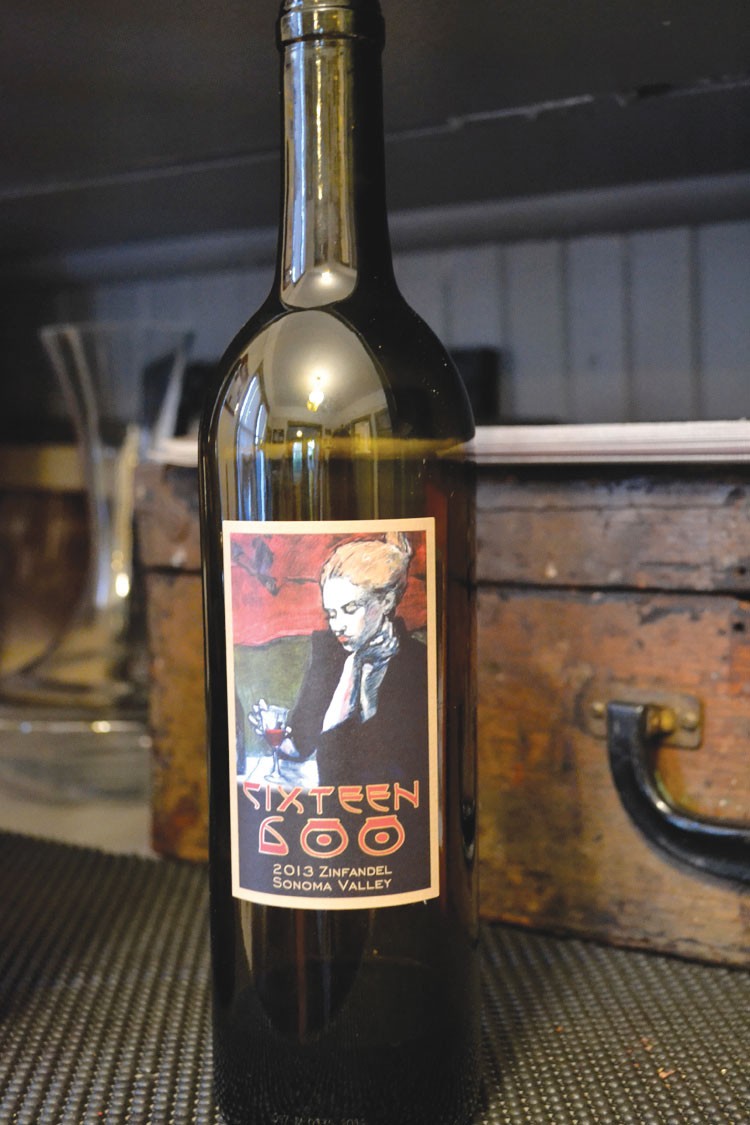
That being said, the most memorable Zinfandel I tasted lately was not riparian in the slightest: Frank Family Napa Valley Zinfandel ($37) has a frankly grapey liqueur, almost porty aroma—but note that port is not necessarily made from overly ripe grapes, and this wine, while sweetly suggesting baked figs and toasty Mexican chocolate, is neither cloying nor hot. Standout barbecue wine—but for teriyaki marinated steak or veggies, not burgers.

For burgers, go with the smoky, blackberry wine–scented Artezin 2015 Old Vine Mendocino Zinfandel ($18), or the green peppercorn-spiced and brambleberry-and-tomatillo-jam-flavored Cline 2015 Ancient Vines Lodi Zinfandel ($14.99).

Ah, the taste of summer.

London Fog

Was Karl Marx actually Jack the Ripper? If director Juan Carlos Medina’s Limehouse Golem doesn’t actually ask that question, it asks a similar one.

During a hunt for a murderer in 1880s London, the whiskery Marx is a suspect; one reenactment of the crime has him caped, glowering, talking straight to the camera in a slowed-down devil’s voice, before wielding a straight razor. Loads of right-wingers consider Marx to be history’s worst monster, but no one ever accused him of being a serial killer before.

The film is adapted from Peter Ackroyd’s tricky and literate 1994 novel, Dan Leno and the Limehouse Golem. The book told its story from several viewpoints; this version, scripted by Jane Goldman, is more straightforward, with a Holmes and Watson–like team on the case: John Kildare (Bill Nighy), a disliked police inspector, and Flood, a fleshy London copper (Daniel Mays) who has been on the hell-on-earth Limehouse beat for some time.

The investigation is catalyzed by the testimony of former music-hall star Lizzie Cree (Olivia Cooke), who faces the gallows for the accused arsenic murder of her husband, John (Sam Reid). Kildare suspects John of being a serial killer in a ghastly crime wave that included a young prostitute and an old Jewish scholar.

Medina’s eerie crimson and absinthe-green color scheme matches the painted backdrops of theater stages. In the context of a film about the stage copying life (and the other way around), it’s fine that the backdrops aren’t perfect illusions.

But the mystery’s revelation is unsatisfactory, with withheld evidence and reverse angles we didn’t get clues on first time around. The better actors here redeem the unlikely plot. Nighy’s role, in outline, is Holmes-like. But his Kildare is less competent than Sherlock, so he’s a tragic figure. Maybe he has a taste for this gaslight and madness material.

‘The Limehouse Golem’ is available on video on demand.

Third Act

Appropriately enough for a stage show based on Rex Pickett's raunchy, gleefully bacchanalian novel Sideways, there is a lot of vino consumed over the course of the stage version's nearly two-and-a-half-hour running time. In Left Edge Theatre's world premiere of Pickett's own adaptation—significantly stripped down from the versions previously seen in London and L.A.—bottles and bottles of wine are uncorked...

Staging ‘Sideways’

Rex Pickett is tall, funny, brutally honest and unfailingly energetic—even when exhausted and hungry. In conversation, he is passionate and personal, spontaneous and astonishingly self-critical. He speaks in a stream of short to medium-length proclamations, suggestions and confessions, strung all together like one long sentence that, on occasion, will go on for several uninterrupted minutes. Pickett is not humble, exactly....

Sept. 7: They’re Coming to Get You in Santa Rosa

The word “zombie” is never used in director George A. Romero’s groundbreaking 1968 horror film Night of the Living Dead, yet the movie effectively invented the reanimated horror trope. Night of the Living Dead became a worldwide sensation, and Romero’s sequels, 1978’s Dawn of the Dead and 1985’s Day of the Dead, used the horror genre to offer biting...

Sept. 9: Folk Creations in Napa

In addition to world-class wineries and five-star tourism destinations, Napa Valley is home to an eclectic assortment of folk artists and antiques dealers who come together for the 10th annual American Folk Art Festival this weekend. One-of-a-kind works, both vintage and contemporary, will be on display from dozens of creative and passionate vendors like designer Nicol Sayre and assemblage...

Sept. 9: A Decade on the River in Petaluma

When North Bay photographers Lance Kuehne and Jerrie Jerné Morago sought out a location for a high-end art gallery in Sonoma County, they searched high and low before coming upon the Riverfront Art Gallery, which marks a decade of showing art on the Petaluma River this month. Operating as a cooperative, the gallery exhibits works from nearly 20 artist...

Sept. 10: Two More Seasons in Healdsburg

From cooking in New York City to managing a farm in Maine to wowing the culinary scene in Portland, Ore., as executive chef and co-owner of Italian restaurant Ava Gene’s, Joshua McFadden has gained an appreciation for vegetables of every season. Now he shares these insights in a massive cookbook, ‘Six Seasons,’ which celebrates the ever-changing landscape of veggies...

Brew by the Bay

The Tiburon Taps Beer Festival on Sept. 23 has a feature that many others might envy: breathtaking vistas of San Francisco, the Golden Gate Bridge and the bay. Just like craft beer, the views never get old. Thrown every fall by the Ranch, through the Tiburon-Belvedere Joint Recreation Committee, the festival is a one-day extravaganza that welcomes numerous breweries, cideries...

Breaking Ground

It may not appear so, but the Sonoma Coast is moving, shaking and eroding into the ocean as two massive pieces of the earth's crust interact along the San Andreas Fault. Geologist Thomas Cochrane has spent 40 years studying the coastline from his home in Sea Ranch. Now he shares his insights in a new book, Shaping the Sonoma-Mendocino Coast:...

Bramble Ramble

The vocabulary of winetasting is unduly maligned. But statements like that are easy to make—you can call the language that's used at winetasting rooms and in printed tasting notes snobbish and obscurantist all you like, but that gets boring in good time, too. More fun and interesting is the question: how much more might you enjoy the wine you're drinking...

London Fog

Was Karl Marx actually Jack the Ripper? If director Juan Carlos Medina's Limehouse Golem doesn't actually ask that question, it asks a similar one. During a hunt for a murderer in 1880s London, the whiskery Marx is a suspect; one reenactment of the crime has him caped, glowering, talking straight to the camera in a slowed-down devil's voice, before wielding...
11,084FansLike
4,606FollowersFollow
6,928FollowersFollow