A cannabis ‘Cinderella Story’

When it comes to cannabis, Erich Pearson doesn’t take “No” for an answer. That approach has got him to where he is today: SPARC’s CEO and one of the marijuana industry’s biggest public faces. Now he’s bringing about a revolution in his own company, planning for pot tourism and a cannabis lounge with a view of Sonoma Valley.

He’s also changing his company’s roots and planting Cannabis ruderalis, the Cinderella in the marijuana ballroom long dominated by the world-famous sisters, Cannabis indica and Cannabis sativa.

Not everyone has heard of Cannabis ruderalis, which has been around for thousands of years, and has been used to treat depression and aid digestion in Russia and Poland. It still grows wild in that part of the world.

Farmers in Sonoma County and elsewhere crossbreed ruderalis with sativa and indica and then harvest, process and turn ordinary weed into extraordinary concentrates and pre-rolls.

The hybrids don’t look, smell or taste the way many cannabis connoisseurs expect weed to look, smell and taste. Still, the new girl in the fields has distinct advantages over her well-established sisters. Like the ruderalis that grows in the European wilds, the cultivated kind has built-in triggers that tell it to ignore the cycles of daytime and nighttime and to flower on a fast biological clock called “autoflowering.”

A crop is produced every three months, all year long, except in the dead of winter.

Over the years, Pearson has married outlaw ways to lobbying skills and business savvy. Plus, he knows all about cannabis. And if he doesn’t know what he wants to know, he finds someone who does.

“The industry now has specialists everywhere,” he says. On the subject of the new autoflowers, he explains that the plants “only grow two-to-three feet tall and 18–20 inches around.” 

Pearson buys seeds from a Sonoma County geneticist and ships them to Salinas, where they’re sprouted and shipped north 10 days later.

“I have 24–48 hours to plant them,” Pearson says. “You can’t miss a beat with autoflowers.”

A field with 20,000 ruderalis plants is a sight to behold!

After years of urban living, Pearson has moved to his farm, where he’s close to the action.

“I love it,” he says. “I’m outside almost all day long in a clean, healthy environment.”  

With tens of thousands of marijuana plants in his backyard, he’s never alone.

Jonah Raskin is the author of “Marijuanaland: Dispatches from an American War.”

Santa Rosa Protests Turn to Grief Vigil Tonight

0

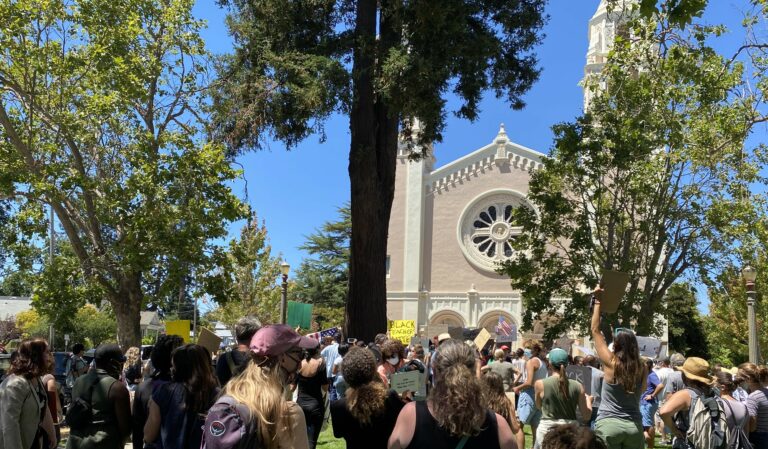
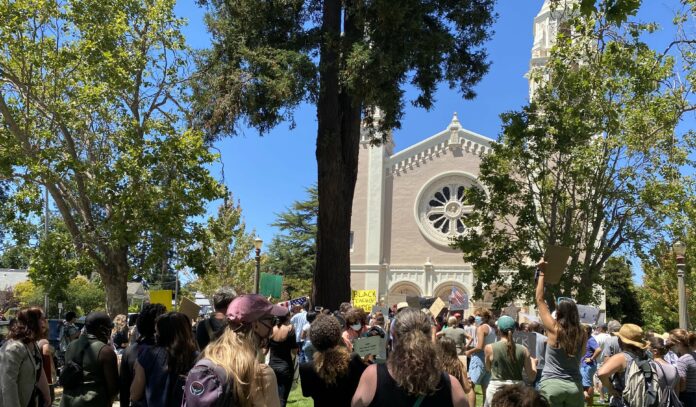
For the past three nights, Santa Rosa has seen the North Bay’s largest gatherings of protest against police brutality, part of a nationwide movement that began in the wake of George Floyd’s death at the hands of Minneapolis police on May 25.

These local protests, centered in downtown Santa Rosa’s Old Courthouse Square, have been marked by peaceful, but determined, demonstrators holding signs and chanting slogans like “Black Lives Matter” and “I Can’t Breathe,” Floyd’s last words.

Some isolated outbursts of vandalism led Santa Rosa Police to enact a citywide curfew starting Monday, June 1, and running until Thursday, June 4, from 8pm to 5am each night. Police allowed protesters to continue well past that 8pm time last night as they marched through downtown, though 27 arrests were made and there are reports that police used tear gas and rubber bullets to finally dispel the crowd around 11pm.

Tonight, June 2, will look very different from the last three nights, as a Grief Vigil to End Brutality and Honor Life is planned to take place in Santa Rosa’s Roseland neighborhood, specifically at the Dollar Tree Plaza at 777 Sebastopol Road, beginning at 5pm and running officially until 7pm.

The vigil is in honor of Andy Lopez, who was killed by a Sonoma County Sheriff Deputy in 2013. Today, June 2, would have been Andy’s 20th birthday.

The Police Brutality Coalition of Sonoma County is organizing the grief vigil. The event is also a vigil for George Floyd and other Black Americans who have been killed by police, and the coalition hopes to honor victims of police violence locally and nationally at the event.

Yet, unlike the recent protests, the coalition states that there will be no marching tonight, nor is there a program of featured speakers. Instead, the vigil is being planned as a gathering to grieve and remember. Signs are welcome, face coverings and social distancing is required, and water is recommended. The forecast calls for 90-degree heat at 5pm.

On the Facebook event page, the coalition writes, “There is much to grieve at this time, here in Sonoma County, across this country and around the world. Though the impacts vary considerably from person to person, we are all grieving; many of us for much of our lives. Whatever your grief, come grieve together, if you feel safe enough doing so.”

While Santa Rosa has been the center of the recent protests in the North Bay, there is a planned youth-organized event on Wednesday, June 3, at the Sonoma Plaza in downtown Sonoma. “Sonoma Stadning with Black Lives” will be a peacefull gathering at 1pm on the plaza for a show of solidarity with Black Americans.

On the “Sonoma Standing with Black Lives” Facebook event page, the organizers state, “Because of the current events, Sonoma’s youth has decided to organize a peaceful protest to help amplify the words of our black brothers and sisters, to support them in this fight they are facing. This protest will be peaceful, and we will not be standing in the street or inciting violence with police at the event. We want our voices heard.”

UPDATED: DA Drops Charges Against Anglero-Wyrick

0

In a brief court hearing Tuesday morning, a representative of Sonoma County District Attorney Jill Ravitch’s office dismissed all charges in a controversial case against a Graton man, citing insufficient evidence.

On April 4, deputies from the Sonoma County Sheriff’s Office approached Jason Anglero-Wyrick’s Graton home after receiving a phone call alleging Anglero-Wyrick had threatened the caller and his family with a gun.

In a separate hearing the same morning, Ravitch’s office dismissed additional charges against Naustachia Green, a woman who was arrested at the time as Anglero-Wyrick.

A bystander video of the April 4 events before the arrest shows Anglero-Wyrick and Green standing in front of a house with their hands raised. Almost simultaneously, deputies shot Anglero-Wyrick with a Taser, pulled Green away from Anglero-Wyrick, and released a K-9 unit on Anglero-Wyrick. The dog, Vader, bit Anglero-Wyrick, who was lying face down in the driveway, for over a minute. Deputies did not find a gun after searching the property.

Sonoma County Superior Court records show that Ravitch’s office filed multiple charges—including two counts of felony resisting arrest—against Anglero-Wyrick on April 6, two days after the arrest. The same day, Ravitch’s office filed two misdemeanor charges—one for resisting arrest and another for battery of a police officer—against Green.

All of the April 6 charges were dismissed on June 2.

The Court officially reopened the day before the June 2 trials, about two months after most court procedures were delayed due to efforts to slow the spread of Covid-19.

Approximately 30 of Anglero-Wyrick and Green’s relatives and supporters gathered across the parking lot from the courthouse as other court attendees lined up for Covid-19 health screenings now required to enter the court.

The protesters, all wearing white, were unaware that Ravitch’s office planned to dismiss the charges when they showed up in the morning.

Robert Evans, Anglero-Wyrick’s stepfather, said that charges were unjustified.

“His hands were up. He was giving up,” Evans said, adding that he believes the deputies involved in the arrest should be fired.

In an emailed statement on Tuesday afternoon Brian Staebell, the Chief Deputy District Attorney, said that the charges against Anglero-Wyrick and Green were dismissed because “we feel we do not have sufficient evidence to prove these charges beyond a reasonable doubt at trial.”

“After gathering additional information we simply feel that there is not enough evidence to prevail at trial on these charges,” Staebell wrote.

Two weeks ago, after the Bohemian broke the news that Ravitch’s office had filed charges against Anglero-Wyrick, Staebell told the Press Democrat that, “The evidence received so far indicates that those officers attempted to detain him and he physically resisted them.”

Staebell did not respond to a follow-up inquiry about what new information has come to light.


[NOTE: This article was updated at 4:35pm with information about the charges against

Naustachia Green and quotes from Robert Evans and Brian Staebell.]

Music Industry Goes Silent for Blackout Tuesday

Tuesday, June 2, is going to be a quiet day meant to send a loud message from those in the music industry. On this day several major record companies and artists join a national media movement, Blackout Tuesday, that intends to shine a light on the “long-standing racism and inequality” in the music business and American society in general.

With participants ranging from producer Quincy Jones to MTV, Blackout Tuesday is a daylong planned media blackout led by The Show Must Be Paused, an initiative created by black music executives Jamila Thomas and Brianna Agyemang in response to the killings of George Floyd and other black Americans at the hands of police.

For the last four days, Black Lives Matter protests have erupted around the country, beginning in Minneapolis where George Floyd, an African American, was killed in police custody on May 25. The day after Floyd’s death, the Minneapolis Police Department fired all four of the officers involved in the incident, and Hennepin County announced murder and manslaughter charges against Derek Chauvin, the officer who was filmed pinning Floyd to the ground by pressing his knee down on Floyd’s neck for nearly nine minutes.

Joining those Black Lives Matter protests, The Show Must Be Paused selected Tuesday, June 2, as Blackout Tuesday specifically to interrupt the work week for a day of reflection and conversation about “what actions we need to collectively take to support the Black community.”

In addition, The Show Must Be Paused notes that the billion-dollar music industry has “profited predominantly from Black art,” and they want to hold the industry accountable for supporting those Black artists whose work has benefited others, writing “To that end, it is the obligation of these entities to protect and empower the Black communities that have made them disproportionately wealthy in ways that are measurable and transparent.”

Thomas and Agyemang note that Blackout Tuesday is not just a 24-hour event, adding that a larger plan of action will soon be announced. “In the meantime,” they write, “to our Black friends and family: please take the time for you and your mental health. To our allies, the time is now to have difficult conversations with family, friends and colleagues.”

Announced this last weekend, Blackout Tuesday has already gained major industry allies. On Instagram, producer Quincy Jones joined the movement, writing “It’s hard to know what to say because I’ve been dealing with racism my entire life. That said, it’s rearing its ugly head right now & by God it’s time to deal with it once & for all. My team & I stand for justice. Conversations will be had & action will be taken.”

Other high-profile musicians and companies participating in the June 2 initiative include Peter Gabriel, Billy Bragg, Mumford & Sons, Def Jam Recordings, Interscope, Sony Music and Columbia Records.

In the North Bay, where Black Lives Matter protests are entering their fourth day in cities including Santa Rosa and Napa, BottleRock Napa Valley announced on Twitter that it was joining Blackout Tuesday “for a day of reflection,” adding that it will not be airing “(re)LIVE BottleRock” online this Friday as scheduled.

Music-industry meetup group Balanced Breakfast, which began in the Bay Area and features Santa Rosa and Napa networking meetings for musicians and promoters, is also joining the blackout, posting on its Facebook page, “Due to recent events, please join us as we take an urgent step of action to provoke accountability and change. As gatekeepers of the culture, it’s our responsibility to not only come together to celebrate the wins, but also hold each other up during a loss.”

The Show Must Be Paused website urges those directly impacted by police violence in recent days to take a break for Blackout Tuesday, writing “there is a lot going on and sometimes we all just need a minute. Take that minute.”

The website also directs visitors to links to help George Floyd’s family and others, and provides information on ways to donate to community bail funds for jailed protesters and additional anti-racism resources.

Redwood Empire Food Bank Offers Free COVID-friendly Kids “Summer Lunch”

From June 1 through August 7, the Redwood Empire Food Bank will offer free and healthy breakfast and lunch to children 18 and under across Sonoma County.

Nearly 1,000 Sonoma County children risk experiencing hunger over the summer months. Without enough food or proper nutrition, children face a variety of setbacks. The Summer Lunch Program sites give children a structured source of food to recharge body and mind during this critical time.

“While schools are closed, The Redwood Empire Food Bank is partnering with school kitchens to provide meals for students at varying sites across the county,” says Itzul Gutierrez, Hunger Relief Worker at the Redwood Empire Food Bank, which is the largest hunger-relief organization serving north coastal California from Sonoma County to the Oregon border.

“Families with children ages 0-18 can pick up meals from any of the schools, even if the child doesn’t attend that school,” says Gutierrez.

With the threat of coronavirus infection, this year’s Summer Lunch Program will have varying operations with some sites offering grab-and-go breakfast, lunch and care packages of groceries for the family that can be taken home to prepare and eat.

To find the nearest location, visit refb.org/summer-lunch-2020, or call 2-1-1. For immediate assistance or more information about the Summer Lunch Program. The Redwood Empire Food Bank can be reached directly at (707) 523-7900.

Meet Sonoma County’s First Youth Poet Laureate

Zoya Ahmed, an incoming senior at Maria Carrillo High School in Santa Rosa, has been named the first Youth Poet Laureate of Sonoma County. Nonprofit organization California Poets in Schools and Phyllis Meshulam, current Poet Laureate of Sonoma County, spearheaded the historical selection, and a local panel of poets and literary experts chose Ahmed from an esteemed pool of local student applicants.

Following in the footsteps of other California counties such as Alameda and Los Angeles counties, Sonoma County’s inaugural Youth Poet Laureate search began in March and aimed to recognize a local student who “achieved excellence in poetry” and who showed commitment to the arts through writing and engagement in clubs or afterschool activities.

The panel of judges tasked with selecting the youth poet laureate included Meshulam, outgoing Poet Laureate of Sonoma County Maya Khosla and other county poets and teachers.

“Zoya Ahmed is a brilliant performer,” Meshulam said, in a statement. “Empowering a young person with a microphone to reach out and address the many special concerns that others of her age may experience, is a very significant gift to the community.”

Before becoming Sonoma County Youth Poet Laureate, Ahmed was the 2019 winner of Sonoma County’s Poetry Out Loud recitation contest and went on to become a finalist in the California State Poetry Out Loud contest.

Ahmed’s one-year term as Sonoma County’s Youth Poet Laureate begins today, Monday, June 1. As the Youth Poet Laureate, Ahmed will lead or participate in at least five public appearances, including readings and workshops. While those events were originally planned to be in-person and ideally spread out over the county’s supervisorial districts, virtual events are now the likely and encouraged mode of engaging with the community until the Covid-19 pandemic retreats.

Ahmed’s first scheduled virtual appearance will be at the California Poets in the Schools Virtual Poetry Symposium happening June 26–28. Founded in 1964, California Poets in the Schools is one of the nation’s largest school literary programs and boasts over 100 trained, professional poet-teachers leading poetry sessions throughout the state.

Sonoma County schools and community organizations are encouraged to contact Ahmed through the California Poets in the Schools with inquiries about hosting her at a public event.

Along with the public and virtual events, Ahmed will be awarded a $500 prize and given the opportunity to publish a collection of her own poems or lead a similar youth-publication project of her choosing.

In a statement, Ahmed thanked her family and acknowledged poetry as her way of connecting to her heritage and staying resilient in difficult times. Read her full statement below:

“I embrace my diverse background as a first generation South Asian American, having both roots in Pakistan and India. This colorful heritage is my drive. Every day I am empowered to work hard towards achieving my goals, humbled by the opportunities I am given, and inspired to give back to the community.

My biggest motivators are my parents and my family, who encourage me each and every day. They are my muse; they symbolize the meaning of sacrifice in my life. Their stories, especially those of the women in my family, are what give my writing a spark of creativity and perspective.

My dad has really been one of my biggest supporters and has fueled my passion for poetry. Being a poet himself, he taught me Urdu as my first language along with Hindi, and that became the foundation of who I am as a desi American teen. Urdu is such a vibrant and poetic language as it embraces the rich tradition of poetry called shayari.

Having this background in poetry, I knew it was going to have a role in my life and thus I picked up writing a few verses in my free time. I find poetry to be a vehicle to connect with my own experiences and surroundings, a way to voice issues and topics that I want acknowledged. However, I never thought that I would have achieved as much as I have. Now, I am more motivated than ever to be resilient and persevere through my journey as a human being.”

Protesters Call For Increased Eviction Protections, Sheriff’s Resignation

0

Shortly after 8am on Monday a caravan of approximately 50 cars unleashed a volley of honks on a wide, tree-lined block of McDonald Avenue in Santa Rosa.

The protesters, organized by the North Bay Organizing Project (NBOP) as part of Sonoma County United in Crisis, called on District 3 Supervisor Shirlee Zane and District 4 Supervisor David Rabbitt to support stronger eviction protections for the duration of the Covid-19 crisis.

Two caravans—one in Santa Rosa in front of Zane’s home and the other in Petaluma in front of Rabbitt’s home—descended at the same time, with participants livestreaming on Facebook.

The supervisors passed the county’s current moratorium in March with a promise to reconsider the issue at a June 2 meeting. Zane and Rabbitt were selected because NBOP felt the two are most likely to oppose changes to the current moratorium.

NBOP argues that the current moratorium leaves thousands of county residents at risk of eviction if they cannot pay off accrued rent debt after the moratorium expires, 90 days after the Covid-19 pandemic is declared over.

The organizers of the Monday-morning protest called on the supervisors to extend the moratorium on Covid-19-related evictions to one year after the crisis and expand the moratorium to ban all evictions, not just those directly tied to Covid-19. They also called on the supervisors to ban late fees, rent increases and remove a requirement in the current ordinance requiring tenants to provide documentation proving a loss of income.

The Board of Supervisors is scheduled to discuss many of the changes NBOP advocated for at a meeting on Tuesday, June 2.

Sarah Casmith and Rio Molina, NBOP housing organizers, addressed Zane through a portable speaker after the honking stopped.

Zane, standing in front of her house, told the protesters, “I’m on your side.”

“There should be no evictions during a pandemic …” Zane said. “We have to extend the moratorium. We cannot afford to have one more homeless person …”

Asked whether she and the other supervisors would support extending the moratorium for a year or longer, Zane said, “I don’t want to answer a question—I don’t know at this point, but I will tell you that it needs to be extended at this point.”

Zane, who was first elected to the Board of Supervisors in 2008, lost a reelection bid in March to Chris Coursey, a former Mayor of Santa Rosa. Zane will leave office in January 2021.

In January, during Zane’s race against Coursey, the National Association of Realtors contributed $156,000 to an independent expenditure committee supporting Zane’s candidacy. By law, independent expenditure committees are not allowed to coordinate strategies with the candidates they support, but Zane’s critics say the contribution indicates that Zane’s sympathies lie with landlords and developers, not renters.

Landlord advocacy groups have argued that, if tenants do not pay rent, landlords, including mom-and-pops, will go out of business. Proposals that aim to solve the problem are being debated at all levels of government.

In April, Rep. Ilhan Omar introduced legislation that would cover landlord and mortgage holders’ missed rent payments if they promise to follow certain rules. More recently, the California Apartment Association, an industry group, has endorsed Senate Bill 1410, proposed state legislation that would set up a program to cover some landlords’ costs. It remains unclear how much funding the relief program proposed in SB 1410 would receive.

During her conversation with Casmith on Monday, Zane attempted to redirect from the eviction moratorium, saying that she has been an advocate for affordable housing during her time as a supervisor.

“I spent my whole career fighting for affordable housing and homelessness,” Zane told the protesters. “You guys should go talk to all of the white, middle-class NIMBYs that put their thumb on the Chanate project that would have brought 700 units of affordable housing… That’s why we’ve got more Latinos dying … because we have too many people living in a house and they get infected—it’s horrible. You’ve got to think about who your real enemy is. As long as white, entitled NIMBYs who think they shouldn’t have any apartments in their neighborhood …”

“Right now this is about evictions and people staying safe in their homes during a pandemic,” Casmith responded.

Zane was referring to the Chanate Property, a county-owned property in Santa Rosa.

In a 2018 lawsuit, the Friends of Chanate argued that the county had not followed environmental-planning rules. In a ruling, a judge agreed with their reasoning and effectively halted the sale of the property.

A proposal by Chanate Community Development Partners, LLC called for up to 800 units with 20 percent of them designated for very-low-income households, according to a June 20, 2017 staff report presented to the Board of Supervisors.

[Read the Bohemian’s 2018 investigation of the proposed Chanate deal and the Friends of Chanate lawsuit here.]

Sheriff’s Protest

After departing Zane’s house, the Santa Rosa caravan moved to the Sonoma County Sheriff’s Office a few miles away to call for the resignation of Sheriff Mark Essick following his announcement last Thursday that, beginning Monday, his office will only enforce the state Health Order, not the County Health Order. In his statement Thursday, Essick said that he was concerned about “inconsistent restrictions on business and personal activities” in the county order.

On Friday, after a morning meeting with elected leaders attempting to change Essick’s mind, Sonoma County Supervisor Susan Gorin told the Press Democrat that Essick had agreed to enforce the County Health Order.

The Sheriff’s Office responded by updating the Thursday night Facebook post: “Contrary to other reports the Sheriff is not reversing his position.”

More closed-door negotiations ensued on Friday afternoon while public confusion spread.

Finally, around 6pm, the Sheriff’s Office released another clarification to Facebook: “The Sheriff’s position stands and we will not be enforcing the County Health Order starting June 1.”

On Saturday, the Sheriff’s Office was the site of a daytime Black Lives Matter protest, after hundreds of people marched from Courthouse Square in downtown Santa Rosa to the Sheriff’s Office a few miles north.

In a speech in front of the Sheriff’s headquarters on Monday morning, Leticia Romero, the president of NBOP’s board of directors, called on Essick to resign over his decision not to enforce the County Health Order.

“I feel the Sheriff’s decision pits white people and the business community against people of color,” Romero said in an interview afterwards, referring to concerns that the Sheriff’s decision would worsen the already disproportionately heavy impact of Covid-19 on Sonoma County’s Latinx residents.

“These tensions have existed in our community for a long time but they’re not always so blatant,” Romero added. “We can’t stay quiet when that happens.”


Christo, Artist of ‘Running Fence,’ Dies at Age 84

0

There are those in the North Bay who remember “Running Fence,” the 24-and-a-half-mile-long art installation that criss-crossed its way through the hills of Western Sonoma and Marin County for two weeks in 1976.

The massive temporary art installation was one of many monumental artworks conceived and created around the world by artist Christo Vladimirov Javacheff and his partner in life and art, Jeanne-Claude Denat de Guillebon; who together were simply known as Christo and Jean-Claude.

Christo died peacefully in his New York City home on May 31, at the age of 84. A statement from his estate noted that he died of natural causes.

While Christo and Jean-Claude (who died in 2009) are gone, their artworks-in-progress continue, with “L’Arc de Triomphe, Wrapped” in Paris, France, still on track for September–October 2021.

Moreover, their ambitious array of temporary installations such as “Running Fence”—which exceeded the boundaries of any one medium art by combining site-specific architecture, sculpture, assemblage and fabric art—are forever imprinted in the memories of those who witnessed them firsthand.

Born in Gabrovo, Bulgaria, in 1935, Christo first met Jeanne-Claude Denat de Guillebon in Paris in 1958 when he painted a commissioned portrait of her mother. Together, the two artists embarked upon a career in art marked by their “wrapped” aesthetic, in which they covered entire coastlines, valleys or skyscrapers in colorful fabric.

In 1969, Jeanne-Claude and Christo made an international splash with “Wrapped Coast,” in which they used erosion-control fabric and 35 miles of rope to literally wrap the cliff-lined coast of Little Bay, in Sydney, Australia. They followed that with “The Valley Curtain,” a 1,300-foot-long cloth stretched across Rifle Gap in the Rocky Mountains near Rifle, Colorado, in 1972.

Perhaps the couple’s most famous work was their North Bay installation, “Running Fence,” which is remembered not only for its massive scale, but for its four-year process of realization. The installation, inspired by a snow fence Christo and Jean-Claude saw while driving along the Continental Divide in 1972, was conceived as an 18-foot-high fence of white, billowing nylon snaking along the hills of Sonoma and Marin County west of Highway 101.

The idea was for the fence to highlight the hilly topography of the North Bay, though they had to convince ranchers and other locals to let them do it, an ordeal that took 18 public hearings and three sessions in California’s superior courts before reaching approval. The installation itself, which began in April 1976, included some 400 workers stretching the reported 240,000 square-yards of woven nylon canvas between more than 2,000 steel poles.

When completed in September of 1976, “Running Fence” drew visitors from around the world to the North Bay for its two-week duration. The fence’s route crossed 14 roads and 59 private ranches as it wound its way from near Highway 101 to the Pacific Ocean near Bodega Bay.

No real trace of “Running Fence” remains on those ranches and along the roads leading to the coast, though a piece of the nylon hangs in the Rio Theater in Monte Rio and historical markers commemorate the work in Valley Ford. For those who could not see the Fence when it was up, several photos of the work, along with sketches and other documents, are on display on Christo and Jean-Claude’s website.

Local fans included Charles Schulz, who praised Christo and Jean-Claude in his Peanuts comic strip in 1978 by showing Snoopy’s doghouse wrapped in the artist’s signature fabric. In 2003, Christo returned the favor by presenting a wrapped doghouse to the Charles M. Schulz Museum in Santa Rosa.

After “Running Fence,” Christo and Jean-Claude continued to make headlines with art installations such as “The Umbrellas,” in which yellow and blue umbrellas were placed in Southern California and Japan, respectively. Those umbrellas were in place from 1984–1991.

In 2005, the couple installed “The Gates” in New York City’s Central Park, featuring over 7,500 saffron-colored sheets of fabric placed overhead along the park’s walkways. After Jean-Claude’s death in 2009, the pair’s conceived works continued on, with “The Floating Piers” in Italy, 2016, and “The London Mastaba,” made up of 7,500 oil barrels in the shape of an ancient Mesopotamian bench, in 2018.

In reporting his death, Christo’s office offered the following statement: “Christo lived his life to the fullest, not only dreaming up what seemed impossible but realizing it. Christo and Jeanne-Claude’s artwork brought people together in shared experiences across the globe, and their work lives on in our hearts and memories.”

Sonoma Supervisors Set to Discuss Eviction Moratorium on Tuesday

0

With thousands of residents out of work and increased federal unemployment benefits set to sunset in early July, many are worried state and local eviction moratoriums could result in a wave of evictions in the months after the Covid-19 pandemic is officially declared over, that is.

To that end, at its Tuesday, June 2 meeting, the Sonoma County Board of Supervisors will revisit a local moratorium on evictions due to lost wages as a result of Covid-19.

A meeting agenda released Friday afternoon states that the board will receive a briefing on “Housing Stability Measures during the COVID-19 Emergency.” The board passed a countywide moratorium in late March with a promise to revisit the issue at its June 2 meeting.

But, months into the Covid-19 pandemic, it remains unclear how—or whether—local, state and federal government agencies will be able to solve the multiple housing crises, affecting renters and mortgage holders, which are currently unfolding.

Of primary concern to tenants is that, under the county and state orders, renters are still required to make up missed rent payments after the pandemic. If they are unable to do so, landlords will be allowed to begin eviction proceedings after the moratorium is lifted.

From the landlords’ side, it still remains unclear how or when landlords will recover payments tenants missed due to Covid-19.

For its part, the California Apartment Association (CAA), a statewide advocacy group for landlords, supports Assembly Bill 1410. The proposed legislation, which is working its way through the state legislature, would create a fund called the Covid-19 Emergency Rental Assistance Program. The state program would pay some landlords 80 percent of missed payments.

In exchange, landlords would need to promise not to charge late fees for missed payments or pursue any remaining missed rent payments left after receiving payments through the state program.

But, as is often the case these days, where the money to pay for such an assistance program would come from—or how much would be offered in total—remains a mystery.

According to the current version of AB 1410, the program would receive funds through the state budget process.

But, with so many hands out for such a severely limited number of dollars, will the state be able to set aside a meaningful amount of money for a rent-relief program?

In April, the UC Berkeley Terner Center for Housing Innovation released a rough estimate of the number of missed rent payments. All told, about 2.3 million renter households in California could be impacted by Covid-related layoffs or other lost income.

Those impacted renter households could miss as much as $3.96 billion per month statewide, according to the Terner analysis.

Although the estimate is likely on the high side since some impacted tenants may be able to pay partial rent, the overall number illustrates the massive scale of the problem.

UPDATED: Sheriff’s Stance On Health Order Enforcement Now Unclear

0

According to the Press Democrat, during a Friday-morning meeting with other local elected officials, Sonoma County Sheriff Mark Essick reversed course on his Thursday-afternoon announcement that, starting June 1, his agency would no longer enforce the county Health Orders. Now, it looks like Essick has changed his mind again—or that the PD got its story wrong.

Here’s a summary of the past 24 hours: In a Thursday-afternoon social-media post, Essick announced that his agency would only enforce the state’s Health Order, not the County Health Officer’s orders. In the post, Essick cited what he called “inconsistent restrictions on business and personal activities” in the county Health Orders.

Members of the Board of Supervisors and other local law enforcement agencies said they were caught off guard by the Sheriff’s decision.

In a joint statement released Thursday evening, the Board of Supervisors said that “the Sheriff’s message has had the unfortunate effect of creating confusion in our community.”

Within hours of Essick’s announcement, other local law enforcement officials, including Santa Rosa Police Chief Ray Navarro, released statements saying they would continue to enforce the county health orders in their respective jurisdictions.

Then, on Friday, after a morning meeting between local, state and federal politicians along with county health officials, the Press Democrat reported that Sonoma County Supervisor Susan Gorin had said that the Sheriff had agreed to continue enforcing the County Health Orders.

Now, even that Press Democrat report is uncertain. An undated update to the Sheriff’s original statement on Facebook reads “UPDATE: Contrary to other reports the Sheriff is not reversing his position.”

The Sheriff’s Office did not immediately respond to requests for comment on Friday afternoon.

5:20 PM UPDATE: At 4:15pm, the Sonoma County Sheriff’s Office released a new statement about the Sheriff’s meeting with elected leaders this morning. The statement does not clarify whether or not the Sheriff’s Office will enforce the County Health Order.

“Sheriff Essick understands that during these challenging times a flexible response is necessary to adapt to the rapidly evolving situation presented by COVID-19. The Sheriff’s Office will continue to educate the community, while evaluating newly available data from our public health partners and collaborating with Public Health to determine enforcement priorities and protocols,” the statement reads in part.

Mike DeWald, a reporter and producer for KSRO and KCBS, Tweeted soon after the Sheriff’s new statement was released that the Sonoma Sheriff “clarifies that deputies will handle enforcement on a ‘case by case basis’ and determine enforcement priorities as new data becomes available,” according to a conversation he had with a Sheriff’s spokesperson.

Reached by phone, a spokesperson for the Sheriff’s Office was not immediately able to clarify whether or not the agency will continue to enforce the county orders in addition to state orders.

SUNDAY UPDATE: The Sheriff’s Office has added an update to its Friday, May 29 Facebook announcement “UPDATE 6pm: To clarify, the Sheriff’s position stands and we will not be enforcing the County Health Order starting June 1.”

A cannabis ‘Cinderella Story’

When it comes to cannabis, Erich Pearson doesn’t take “No” for an answer. That approach has got him to where he is today: SPARC’s CEO and one of the marijuana industry’s biggest public faces. Now he’s bringing about a revolution in his own company, planning for pot tourism and a cannabis lounge with a view of Sonoma Valley. He’s also...

Santa Rosa Protests Turn to Grief Vigil Tonight

For the past three nights, Santa Rosa has seen the North Bay's largest gatherings of protest against police brutality, part of a nationwide movement that began in the wake of George Floyd's death at the hands of Minneapolis police on May 25. These local protests, centered in downtown Santa Rosa's Old Courthouse Square, have been marked by peaceful, but determined,...

UPDATED: DA Drops Charges Against Anglero-Wyrick

In a brief court hearing Tuesday morning, a representative of Sonoma County District Attorney Jill Ravitch’s office dismissed all charges in a controversial case against a Graton man, citing insufficient evidence. On April 4, deputies from the Sonoma County Sheriff's Office approached Jason Anglero-Wyrick’s Graton home...

Music Industry Goes Silent for Blackout Tuesday

Day of reflection happening in conjunction with Black Lives Matter movement.

Redwood Empire Food Bank Offers Free COVID-friendly Kids “Summer Lunch”

From June 1 through August 7, the Redwood Empire Food Bank will offer free and healthy breakfast and lunch to children 18 and under across Sonoma County. Nearly 1,000 Sonoma County children risk experiencing hunger over the summer months. Without enough food or proper nutrition, children face a variety of setbacks. The Summer Lunch Program sites give children a structured...

Meet Sonoma County’s First Youth Poet Laureate

Local high school senior Zoya Ahmed uses poetry to connect to her heritage and remain resilient.

Protesters Call For Increased Eviction Protections, Sheriff’s Resignation

Shortly after 8am on Monday a caravan of approximately 50 cars unleashed a volley of honks on a wide, tree-lined block of McDonald Avenue in Santa Rosa. ...

Christo, Artist of ‘Running Fence,’ Dies at Age 84

The artist, with his partner Jean-Claude, created installations that wrapped landscapes and architecture in fabric.

Sonoma Supervisors Set to Discuss Eviction Moratorium on Tuesday

With thousands of residents out of work and increased federal unemployment benefits set to sunset in early July, many are worried state and local eviction moratoriums could result in a wave of evictions in the months after the Covid-19 pandemic is officially declared over, that...

UPDATED: Sheriff’s Stance On Health Order Enforcement Now Unclear

According to the Press Democrat, during a Friday-morning meeting with other local elected officials, Sonoma County Sheriff Mark Essick reversed course...
11,084FansLike
4,606FollowersFollow
6,928FollowersFollow