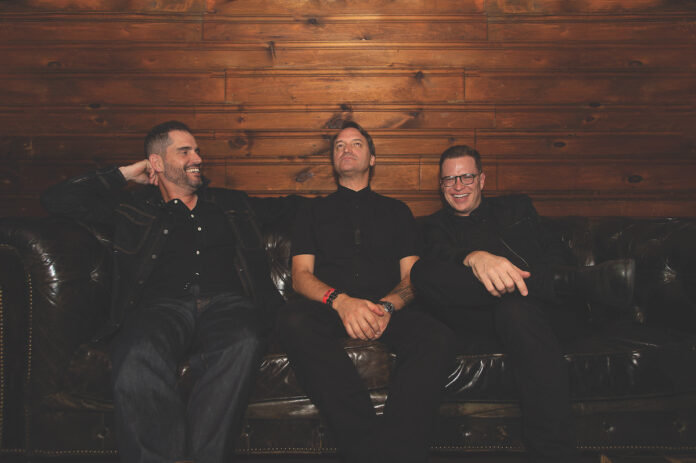
You may not know it by looking at him, but Mike Birbiglia has issues.
The comedian, writer, filmmaker and NPR darling specializes in turning his personal problems and family foibles into funny and endearing stage shows. This month, the Brooklyn-based performer is back in the Bay Area for a limited-run engagement of his new one-man-show, Mike Birbiglia: The Old Man and The Pool, at Berkeley Repertory Theatre.
Birbiglia burst onto the national scene a decade ago with his solo show Sleepwalk With Me, which he turned into his feature-film debut in 2012. That show and film chronicled Birbiglia’s early days of standup comedy, particularly an incident in which he jumped out of a second-story window while sleepwalking. Today, he sleeps in a sleeping bag with mittens on his hands so he can’t get out while he sleeps.
During the last decade, Birbiglia’s other shows, including My Girlfriend’s Boyfriend and Thank God For Jokes, enjoyed successful off-Broadway runs. His last show, The New One, moved to Broadway where he received the Drama Desk Award for outstanding solo performance.
Birbiglia quickly shares the sleepwalking story and dives into other tales from his life in The Old Man and the Pool, deftly mining laughs from heavy topics. Despite the serious content, especially talk about his own fear of dying, this is one of Birbiglia’s funniest shows yet. His understated acerbic wit comes through in his descriptions of the Brooklyn YMCA, where he takes up swimming, and in relating family gatherings and reliving arguments with doctors.
Performing the show in Berkeley Rep’s intimate Roda Theatre, Birbiglia keeps the set design to a minimum—a small chair, table and lamp, and a blue backdrop that gives the show an underwater feel. Birbiglia makes use of the whole stage to act out many of his stories.
The Old Man and the Pool has been in the works for three years, and this run is the first time audiences are seeing it fully formed. In a statement, Birbiglia remarks, “The Bay Area has smart, theatre-savvy audiences, and when an artist is creating new work that’s what they crave most. I debuted The New One at Berkeley Rep in 2017, and that show went all the way to Broadway. So maybe Berkeley has some kind of secret magical energy? It seems that way.”
‘The Old Man and The Pool’ runs through Sunday, Jan. 23, at Berkeley Repertory Theatre, 2025 Addison St., Berkeley. Proof of vaccination (with photo ID) and masks required. Find showtimes and tickets at berkeleyrep.org.
Last week I received some trade-pub spam from Editor & Publisher topped by the headline:
“Optimizing obituaries to drive traffic and increase revenue.” Ugh. I’m all for driving traffic and increasing revenue, but not as a digital grave robber.
Reconciling how our words are read by both humans and the search bots that feed them is par for the course these days. It’s to the point where some word choices comprise more algorithm than alphabet. And by word choices, I mean “keyword choices,” because I’m optimizing for a search ENGINE, which makes me sound less like a writer and more like a mechanic.
Certainly journalism isn’t poetry, but it isn’t code either, which I know is confusing to the makers of our content management system, WordPress, whose motto is “Code is Poetry.” That said, some businesses have found that journalism and code blend quite well.
Chicago-based Narrative Science has supplied Forbes with tech to write business stories, and the Associated Press accomplishes the same via another Chicago company, Automated Insights. Who knew the Second City would be first in robo-reporters?
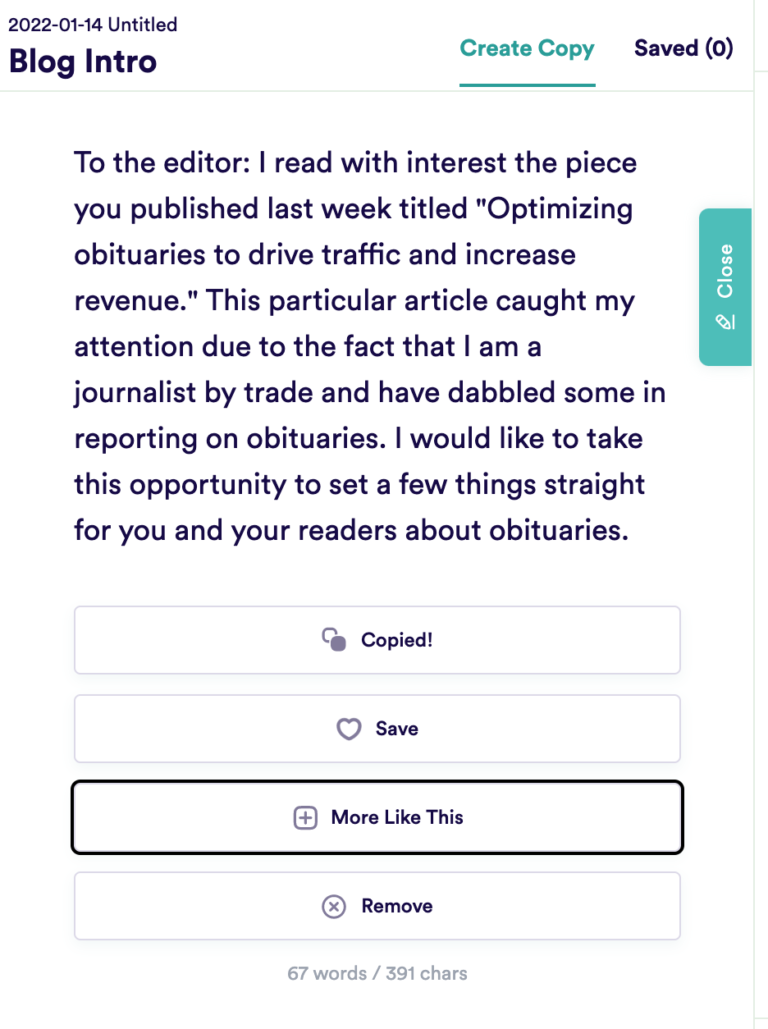
In fact, there are now numerous AI-fueled verbiage generators online that are smarter than the average intern. Some use GPT-3, the latest AI algorithm for natural language production, which it learned from reading the internet. Frankly, it’s a wonder it can write at all given the sad state of online discourse. Consider this next paragraph, which was seeded by the verbiage above and “written” by Copy AI:
“To the editor: I read with interest the piece you published last week titled ‘Optimizing obituaries to drive traffic and increase revenue.’ This particular article caught my attention due to the fact that I am a journalist by trade and have dabbled some in reporting on obituaries. I would like to take this opportunity to set a few things straight for you and your readers about obituaries.”
Yes, this was written by an AI. If I wrote it, trust me, it would be funnier. But I do love that this AI has “dabbled some in reporting” and considers itself a journalist. So does everyone, mate.
Here’s a dirty little newsroom secret—we have speculative obits at-the-ready in the event that somebody notable dies. That’s how, say, the New York Times, published a ream on director Peter Bogdanovich before the ink was dry on his death certificate. If a person’s a somebody in my market, there’s a chance I already drafted their obituary. And if current trends prevail, it will soon be optimized to drive traffic and increase revenue. Or be re-written by a robot.
Though the World Health Organization declared Covid-19 a pandemic on March 11, 2020, when Covid actually started in the United States is a somewhat difficult question.
In early March a cruise ship, called the Grand Princess, docked off the coast of San Francisco, found Covid cases among its passengers. Shortly afterwards, Bay Area health officials announced shelter-in-place orders, and hospitals began to exceed capacity as case counts soared. By late March–early April, countries had sealed their borders, sports teams had canceled their seasons, schools had shut down and people had begun wearing masks and social-distancing.
This distancing was challenging for every demographic, but some were undoubtedly hit harder than others. The elder community was one of those groups, not only relying on the support of others to survive—whether in a facility or at home receiving care from a family member or hired provider—but also the most susceptible to Covid-19. Dangerous for everyone pre-vaccine, the virus became increasingly lethal for people older than 50, with the Centers for Disease Control putting those above 85 at the highest risk of death. Though these numbers weren’t immediately available in the months following March and April 2020, enough about Covid’s lethal effect on elders was known to require their almost total isolation from the rest of the community.
The problem is that isolation can also be lethal. The CDC, through the National Academy of Sciences Engineering and Medicine, cites loneliness and social isolation as significantly increasing the risk of premature death, even rivaling risks caused by smoking, obesity and physical inactivity. Pre-existing or not-yet-onset health issues like dementia, heart failure and depression significantly increase as a result of loneliness and social isolation.
All of these issues were made worse by the pandemic, highlighting the country’s lack of preparation for such an outcome and the cracks in our healthcare system.
Now, nearly two full years after the Grand Princess docked in the San Francisco Bay, Marin and Sonoma county elder facilities take a look back at what they’ve been able to do for their residents to ensure their quality of life and survival.
Executive Director of Solstice Senior Living in Santa Rosa Paul Peck spoke with me at length about how the organization has pivoted to meet residents’ needs during the last two years. When I asked Peck how he handled the emotional struggle of the pandemic, he spoke initially about the challenges he faced as a director, and how senior-living centers have been affected from a staffing standpoint.
“A lot of executive directors have left the industry as a result of this pandemic,” he said. “The turnover, and the struggle to hire line staff, has been significant. Some caregivers were making $1,000 a month between unemployment and the additional government stimulus, and they didn’t want to come back to work. I’ve been down a business office manager and a maintenance director for three months, and I’m finally heading to fully staffed again.”
Regarding social isolation and loneliness, Peck said it was a matter of doing everything they could to return to daily activities and dining as a community, because even though residents were delivered daily activities to their rooms, the separation was challenging.
“Really the main thing was keeping in communication,” he said. “I put out a memo every seven to 10 days to keep them updated, and meet with them on a monthly basis to update them on the facility’s staffing, progress and so on. Keeping the residents up to date as things change helps them feel connected.”
“When we finally got everyone their second round of vaccines, in March 2021, we were able to gather in-person again, which was such a lift on people’s spirits. And we redid our whole community during the shutdown. … To return not only to one another, but to a totally redone facility, really boosted their spirits,” he added.
A Spring Lake Village employee who had not received permission to speak to the press by our print deadline echoed Peck’s sentiments of keeping residents informed, also saying technology, a bigger part of all of our lives then we could ever have previously anticipated, has proved a major source of connection for seniors during the acute periods of the pandemic and beyond.
“We had to learn to come up with ways to help our residents, and to stay connected—to teach them everything that we do. I can honestly tell you that seniors are now using cell phones, ipads, computers and email and Zoom meetings who probably never would have otherwise as a source of communication, and that has kept us connected,” the employee said. “They’re sharp, and I’m constantly surprised at what people can learn. And, truly, the need for connection exploded, so we had to figure out how we could keep people healthy while keeping them connected. And I think we were pretty successful.”
I asked Marin County-based nonprofit Vivalon, which serves the senior community, how they responded to the dangers of senior isolation.
“Since Vivalon provides essential services, we pivoted without missing a single meal, ride or class,” Chief Operating Officer Nancy Geisse said. “Throughout the pandemic, we have provided our classes free of charge to encourage participation, offered free delivery of our Jackson Café meals and Brown Bag Pantry groceries, and even when we reopened continued these services knowing some older adults were still isolated. Throughout the pandemic, combating social isolation has been a top priority for Vivalon, and we will remain devoted to fighting loneliness in Marin’s older adults.”
Vivalon CEO Anne Grey said, “At Vivalon we know all too well that a key social determinant of health is social isolation amongst older adults … . As we addressed social isolation during the pandemic, we found loneliness prior to the pandemic was even larger than we had thought. We’ve always incorporated social connection into our programs and services … but we now know we have to do more. We’ve launched technology-training programs for our seniors, to make sure they’re able to stay connected with contemporary tools.”
It’s an ongoing conversation that Sonoma and Marin Counties, along with their respective health and aging boards, will continue to address as circumstances develop. Teaching seniors how to use modern tools like cell phones, Zoom and other forms of internet-based connection seems to have played a vital role in fighting pandemic-related isolation, as well as continuing to keep them informed on the changing circumstances and variants so they don’t feel kept in the dark. Still, basic decency—continuing to treat seniors like respected and valued members of the community—is vital to their continued health during these trying times.
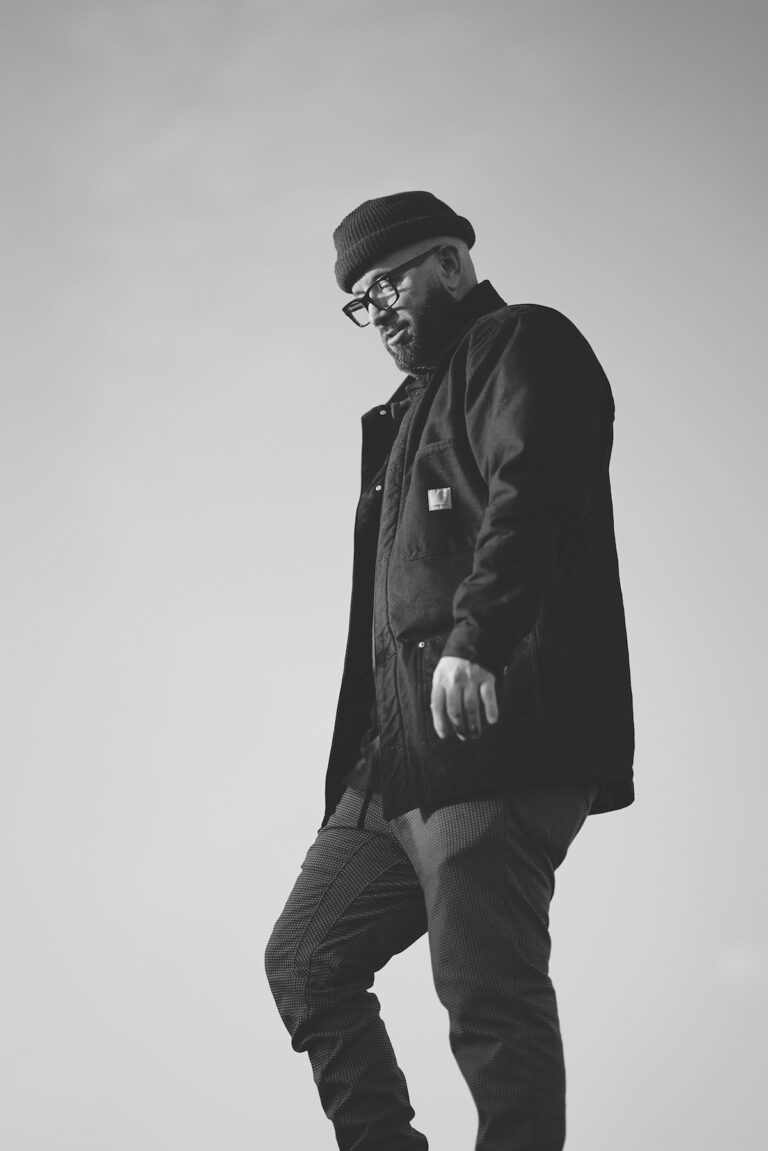
In the “Opening Remarks” of Vocab Slick’s latest album, Language, the longtime hip-hop performer lays out his mission in music:
“This is an invitation of engagement / An invitation to listen to my art, my language, my expression / A language encompassing all emotion: love, sadness, joy, anger and confidence / This is how I communicate. This is my therapy. This is my language.”
Over the course of the next 17 tracks, Vocab Slick takes the listener on a vernacular journey that touches on those emotions and more with the help of several guest artists and his own neverending glossary of rhymes and beats.
Repping the 707 his whole life, the Santa Rosa-based artist has been freestyling since he was a teen, and got serious about hip-hop after battling addictions and going through tough times, including jail time.
“I got out of jail and started taking my life more seriously, then my music became more serious,” Vocab Slick says. “Then I became clean and sober, and so there was a need for me to have an outlet, and music became that for me. It just so happens that people like what I do.”
Wordplay is a staple of Vocab Slick’s hip-hop, and his use of language—along with his super slicked-back hair—earned him his nickname early on.
For the new album, the rapper employs all of his vocabulary skills to create an engaging collection of songs that encompass classic hip-hop vibes, soulful serenades and just enough swagger to keep the beat moving forward.
Throughout Language, Vocab Slick speaks on his own personal experiences and the strength he finds in music and community, and several local performers join him on the album.
Petaluma artist Simoné Mosely lends her amazing vocals to the track “When I’m Here,” also featuring San Francisco rapper Equipto; Sebastopol rapper J. Lately gets on mic for the laid-back track “Moment Like This,” along with Sacramento artist Z Rokk; and Santa Rosa rapper Dela The Fella is one of several guests on the street-smart track “1122.” Other guests include The Grouch of Living Legends and the late Zumbi of Zion I. Vocab Slick also notes that friend and producer Starski was elemental to the record’s sound.
Touring as much as possible last year, Vocab Slick sees Santa Rosa getting more recognition for its hip-hop community, and he appreciates the camaraderie of the North Bay’s music scene.
“I’ve been everywhere,” he says. “And I don’t want to live anywhere else.”
Hi all, and happy Wednesday! Which outfits have you been excited about this week? Any particular look that’s brought you joy, or made you feel like your best self? As ever, I want pics! @northbaybohemian, @marinpacficsun
On to other Look-related items: Remember when I wrote the New Year’s Eve piece about wearing glitter and gold because we need to be the light for 2022? And remember how pretty much everything got canceled right after, and then I got Covid? Well, a super-cool event that was meant to happen this month has also been postponed due to the ongoing bummer that is Omicron. But, barring any additional disasters, it’s scheduled to happen May 28—and we all need to be there, because this is our chance to be the light-bearing sparkle hounds we were always meant to be.
I’m talking about the North Bay Ball, hosted at the Phoenix Theatre in Petaluma. This is an invitation to be the North Bay Glitterati. This is the North Bay’s Met Gala. It’s a runway show, showroom, drag extravaganza and dance party all rolled into one, with an MC. It’s the place to be.
Presenting six local designers and stylists—@2ndzshop, @7anet7ackson, @alejandro_salizar_g, @bigmouthunique, @bucklucky and @thaiteeaaa, be sure to follow them on instagram—and showcasing mini-collections, the North Bay Ball will also have live airbrushing from @malcolmstuart, a dance party DJ’d by @saintrosedisco, snacks and coffee from @neighborhoodgardeninitiative and, get this, anyone in the audience can walk the runway, with the best walk taking a tiara prize. Imagine being the person ending the night dancing with a tiara for best runway walk. Legs out, shoot the shot.
Postponed means things might even be in a better spot—who knows, the mask mandate might even be lifted—and either way, 100% of the door proceeds for the North Bay Ball go to Face 2 Face, a nonprofit dedicated to ending AIDS in Sonoma County.
We don’t need any further reasons to explore local fashion and dance.
See you all in May!
Looking good, everyone.
Love,
Jane
Jane Vick is a painter, writer and journalist who has spent time in Europe, New York and New Mexico. She is currently based in Sonoma County. View her work at janevick.com.
I got quite a dose of doom and gloom in the Jan. 12 edition of the Bohemian/Pacific Sun, which, ironically, had mental health as its cover issue. In his “Open Mic” piece, the Editor wrote, “… Some may say I’m a doomsayer, but I’m not —I have tremendous hope for life in general, just not for humans specifically …” Tom Tomorrow left the humor out of his usual weekly dose of dark humor (e.g., “Ha Ha Ha We’re all going to die!”). And a letter to the editor assessed the American political landscape and concluded, “… the end is near.”
I agree that we face existential threats and that our circumstances are likely to get worse before they get better. I also agree that if you never feel despair, you are not paying attention. But we need an awareness of our circumstances that is balanced with optimism, appreciation and a sense of possibility. There is a quote from Brian Andreas that comes to mind: “In my dream, the angel shrugged and said, if we fail this time, it will be a failure of imagination … and then she placed the world gently in the palm of my hand.”
Kevin O’Connor
Graton
Save the Wolves
Gray wolves in Montana and Idaho are being targeted by states that have authorized the killing of as many as 90% of the population.
The Biden Administration needs to act. The former Director of the U.S. Fish & Wildlife Service under President Obama published an Op Ed in the Washington Post calling on the Administration to issue emergency protections for gray wolves and detailed the authority that Secretary Haaland has to do so and provided ample reasons for this action.
Biden and Haaland are entrusted with the caretaking of our natural spaces and the species that live on them. Their inaction to date is inexcusable.
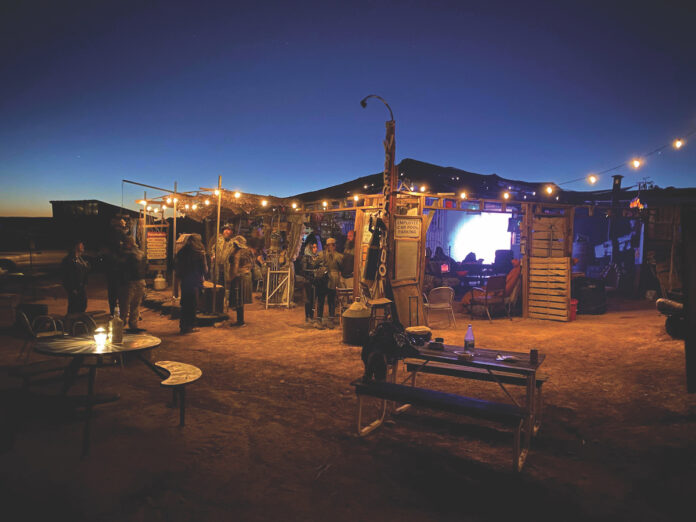
My fascination with towns that don’t exist began when I hitchhiked to Alaska in 1988 and spent that summer living feral in a place called the “Cove”—a patch of forest outside the town of Cordova. About 80 people squatted there—college students, hitchhikers, a drunken gold miner, a legendary survivalist named Gene who hadn’t washed himself in years—in a smattering of tents, trailers and scrap-wood cabins. There were no utilities or services of any kind. It was a crude and difficult life filled with almost limitless freedom. We worked long hours in the canneries and spent our off-time kicking it in camp around smoky fires, exploring back roads and eating hot meals at the restaurants in town. It was an experience I’ll never forget.
Shortly after that adventure I dreamt about an imaginary town that lay beyond the Cove, farther out in the Alaskan wilderness—an abandoned logging camp, only accessible by long trek through uncharted forest. It had no name and appeared on no map. Somehow, an assortment of people—travelers, mountain men, hunters, outlaws—found their way there and shored up the decaying structures and lived in them for a season, far from the land of men and machines. The sense of mystery and freedom that dream evoked haunts me to this day.
So I suppose it’s no accident that 25 years later, in the spring of 2013, I wound up at Uranium Springs.
The ruins at the end of the world
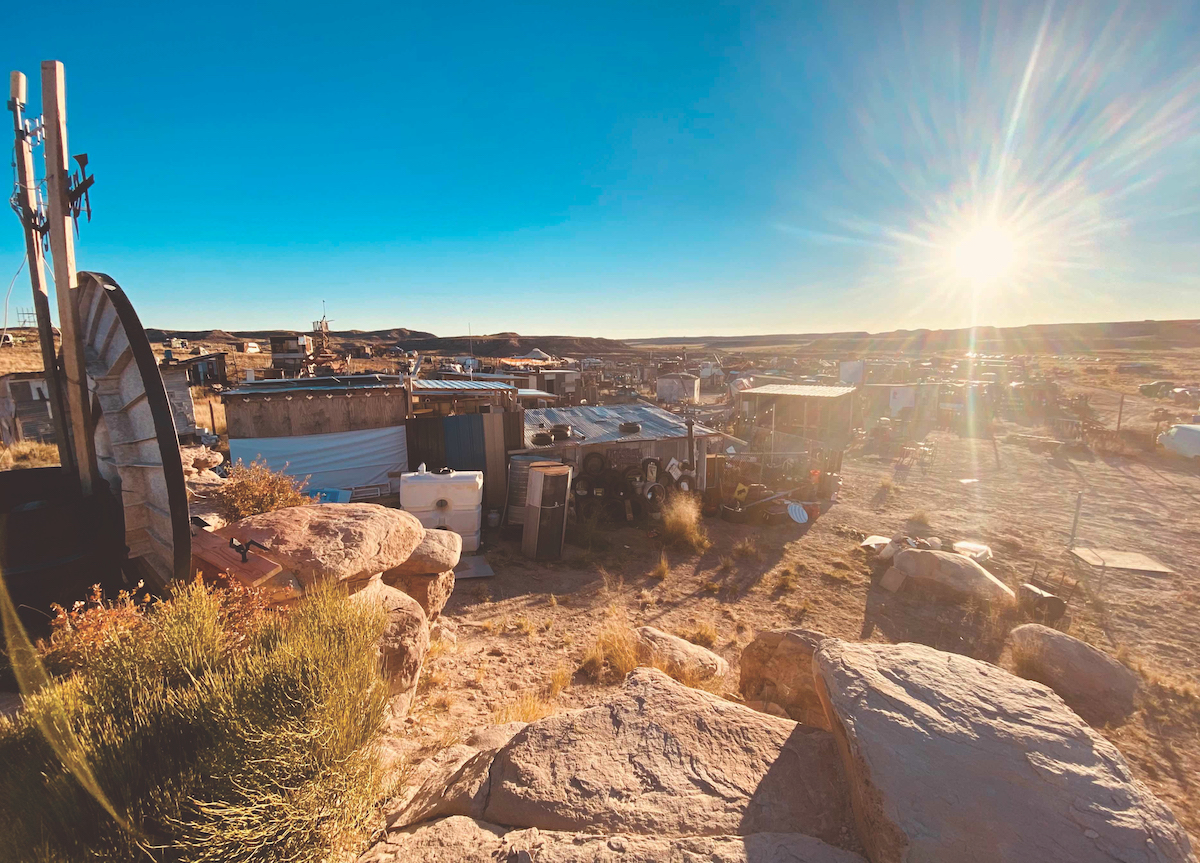
SHACKTOWN Uranium Springs sprawls for hundreds of yards across the desert, a warren of hovels, tents, wrecked cars, twisting dirt roads and rusting detritus. Photo by Mark Fernquest.
People are drawn to Uranium Springs for their individual reasons, though everyone arrives for the same event: Detonation, the annual week-long post-apocalyptic festival usually held there in May. What is a post-apocalyptic festival? Think: a heavy metal Burning Man … for the Mad Max set.
Gage Laykin bought his first ticket to Det on impulse, because he needed a change in his life. The Yard Hobo was invited by site-owner and event-founder Rev’rend Lawless, a gaming friend. Mayonegative heard about it through her friend, Tumbelina, via the Santa Fe underground grapevine. Many people catch wind of it through their association with Wasteland Weekend, the Hollywood-sized post-apocalyptic mega-event held in Southern California’s Mojave desert each fall.
I discovered Uranium Springs, and Det, by googling “post apocalyptic events” back in 2013. Something about the event website—something besides the name Uranium Springs—grabbed my attention: the $10 portage fee for crossing the “possibly flooded wash” on the drive in. Really, in the middle of the desert? Was that a lark? The question gnawed at me. I had to know.
I took a chance on the 15-hour drive from the Bay Area and encountered a group of uniquely talented creatives gathered on a 40-acre spread of privately owned land in Arizona’s Painted Desert. A mutual love for the Mad Max movies and the Fallout games formed the basis for our shared post-apocalyptic passion.
The experience was so fun and inspiring that I and others kept going back, and more people arrived every year, and what began as a small annual festival evolved into something more. The number of attendees grew from 60 my first year, to 400-plus last October. The number of festival events kept increasing, too, and now includes mini-dune buggy races, burlesque shows by the Molotov Mollies, vehicle parades of Road Warrior-esque cars and trucks, nightly feasts, karaoke, costume contests, talent shows and more.
Attendees earn “wasteland” names, and whatsmore, tribes develop naturally, among friends and associates who meet at Uranium Springs and sometimes only ever see each other there. The kicker: Each tribe may claim a 50-foot-by-50-foot piece of vacant land on site and build a permanent, theme-appropriate camp on it. In this way Uranium Springs continues to evolve from a bare meadow into a town—a town of shotgun shacks, rickety walls, stick fences and flimsy tents all made from, in Laykin’s words, “scavenged or reclaimed building material, or upcycled objects that would have otherwise headed to the scrap yard.”
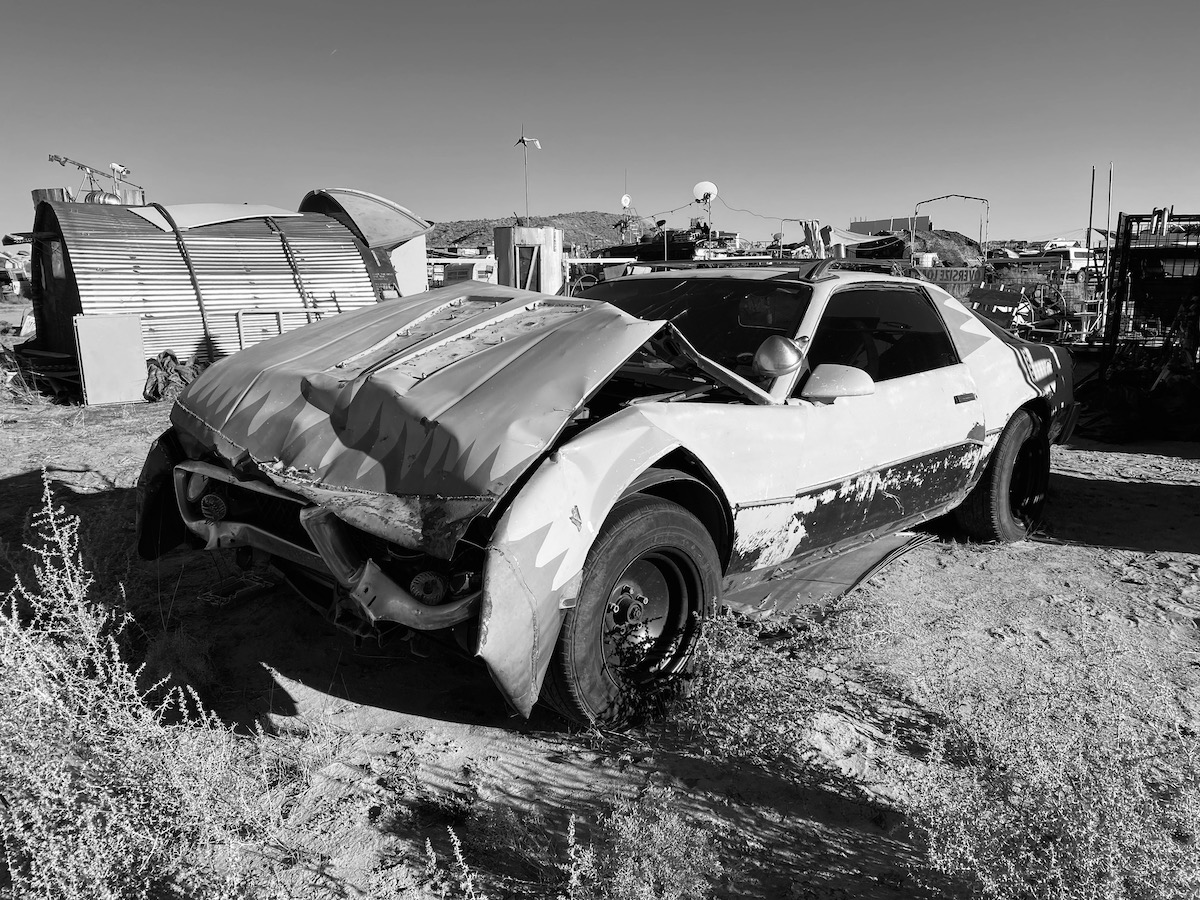
WASTED Gage Laykin’s renegade ‘Chimero’—a $900 1986 Chevrolet Camaro with mismatched antique bumpers and a swapped-out engine—met its wasteland-worthy end on Old World asphalt. Photo by Mark Fernquest.
The remote town, located 40 minutes from pavement and not found on any map, has a distinctly Wild West feel to it … in spite of the presence of black leather, dune buggies and smoke-spitting feral hot rods.
Some attendees, including 9 Yards, who hails from Colorado, love it for its isolation. “It really lets you believe you’re living in an apocalypse,” he says. “You start to get to know everyone, and it truly feels like a gathering of family.”
Mayonegative keeps coming back for logistical reasons. “I and my tribemates have a permanent camp there, so it’s easy for me to just jump in my truck with some food, water and my kit, and head out,” she says. “I have made some very close friends who are also Uranium Springs regulars, and I know that I will be in good company.” In fact, her musically gifted child, Pipes, is a well-loved regular at the festival.
For me, the draw is in the freedom the place exudes, as presaged by my dream back in ’88. At Uranium Springs I show up, hug my fellow tribemates at the Machine Army camp—we are the friendliest cannibal biker gang ever to grace the wastes—and spend the week fraternizing with friends old and new, drinking cold beer in the dust, riding my Outlaw 70 dirt bike on exploratory missions down the wash and hanging out at the free lounge, the Wreck Room.
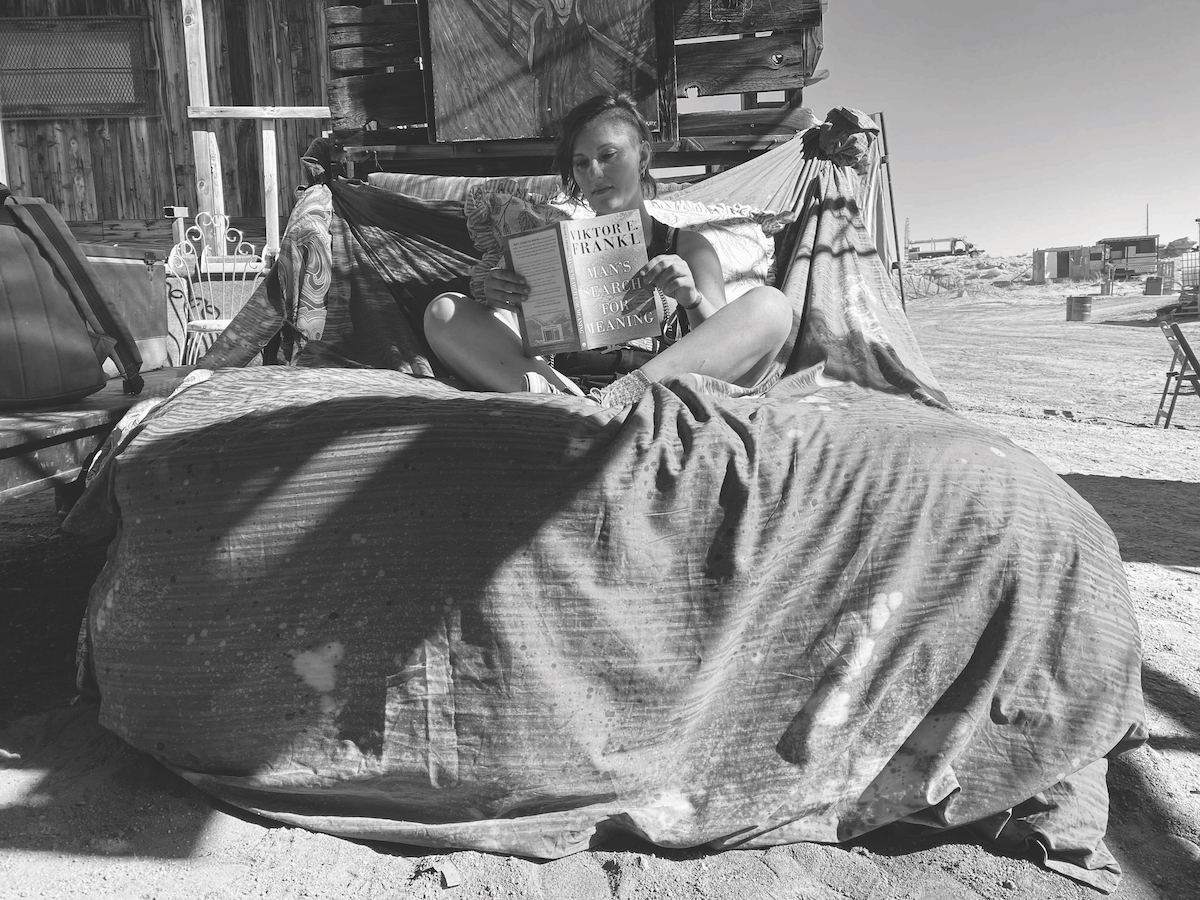
BIKER CHIC Rocket, a member of both Machine Army and the Molotov Mollies performance troupe, catches up on some night reading by the glare of a distant nuclear explosion. Photo by Mark Fernquest.
What a cannibal general wears
Another dream, this one from 11 years ago, shortly before I first heard about post-apocalyptic festivals: I was in the forest in Santa Cruz. A “tribe” of young people were camped there, milling around cooking fires. I felt a strong sense of belonging as I walked among them. Their clothing caught my attention—it seemed leathery and vaguely Ren Faire, but more modern, perhaps a bit dangerous. Some people wore black biker jackets. Some carried knives.
A portent, that dream, for costumery is of the utmost importance at Uranium Springs, and not just because festival rules require it. In a landscape as stark as the desert, clothing tells a story.
Laykin’s outfit, consisting of patched clothing and a leather helmet with handmade aluminum goggles, oozes a distinct future-tribal air, while 9 Yards’ well-weathered Eastern European battle suit evokes his retro-future Slavic wasteland persona. The good Rev’rend Lawless, draped in a duster and leather cowboy hat, exudes the countenance of a mythical gunfighter.
My own battle jacket—a 50-cent yard-sale score—is festooned with 20 pounds of knives, bullets, beads, hooks, ammo pouches, V8-can grenades, a coyote skull, a Grateful Dead patch, a replica World War II-era Liberator pistol and my mother’s tarnished, circa-1937 Christening cup. The exceedingly heavy war garment clanks dreadfully and commands the undivided attention of all who encounter it. I once walked into my parent’s family-packed living room wearing it and after several moments of pin-drop silence, my 4-year-old nephew simply shouted, “NO!” But wasteland reactions are more positive. Fellow revelers often stop to ogle it, and, to be blunt, the ladies like it.
And yet, more is not always better. Beetle wears thong underwear—exclusively—at Uranium Springs. The Yard Hobo often wears only a thick coating of mud. And many a young—or old, I don’t mean to be ageist—damsel—or mansel, I don’t mean to be genderist—leaves large-ish quantities of bare flesh exposed while sporting minimalist punk garments.
POSER The Yard Hobo showcases the latest in deep-desert mudwear. Photo by Mark Fernquest.
The ferals
This past year, Det was postponed due to Covid, and took place over Halloween weekend. One day during the revelries, General Car Killer—that is, myself—crossed paths with young first-timer Bradley Messmer, of Denver. I invited him on a desert run and we set off down the wash, he on his out-of-the-box Kawasaki 110 and me on my Outlaw 70. I took the lead, and for 40 minutes we wound our way between bushes and over sandy berms at top speed—25mph—in a loop down to the Interstate and back.
On the way back, young Messmer hit a large bump and crashed in a spectacular shower of sand. My God, I thought. What have I done? After removing his helmet and checking his skull and torn clothes for blood and protruding bones, we rode back to camp, where Medical kept him under observation until they deemed him healthy. Messmer’s crash gained him immediate celebrity, and earned him a wasteland name, Sandbar, as well as honorary membership in my tribe, Machine Army.
Thus is notoriety achieved in the wastes.
TORPEDO Nine Yards’ well-weathered Eastern European battle suit evokes his retro-future mercenary persona. Photo by Mark Fernquest
Another day, while talking to Laykin about this very article, he seized upon the idea of setting me up as a gonzo reporter in an office at his camp, replete with my own typewriter. An electric typewriter. “I’ll have to hook it up to a generator to get you power,” he mused. The creative genius of writing daily wasteland missives on an antique, generator-powered typewriter, from a quonset hut in the Annex, and then nailing the hardcopies to a pole for public viewing while also uploading digital photographs of the originals to social media, was not lost on me.
Thus are ideas hatched in the wastes.
Endgame
OLD BOYS Richard Kozak (left) and Sam Lawless, the caretaker and owner of Uranium Springs, respectively, hatch tyrannical plans while ensconced in pleasure thrones at the LZRD Patch. Photo by Mark Fernquest.
Every Det brings with it new excitement in the town that doesn’t exist. Our wasteland family plans for it for months, and some of us make the trek from as far away as Texas or California. Some adventures are written for the world to know, while others stay hush-hush in the wastes.
I always leave Uranium Springs with mixed emotions—eager to return to my home in the North Bay; but already missing my dirt family. There’s nothing mixed about my exhaustion, however. The trek wrecks me for a week.
And the portage fee for crossing the “possibly flooded wash” into Uranium Springs? It’s real. The wash can—and does—flood. But to my knowledge no one’s ever paid the fee. People just plow through the water in their 4x4s … or sit back and enjoy the wasteland until the water recedes.
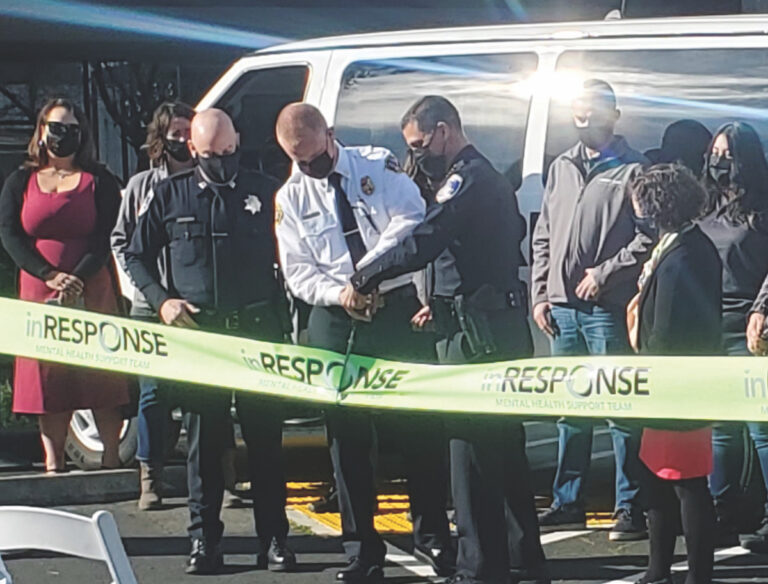
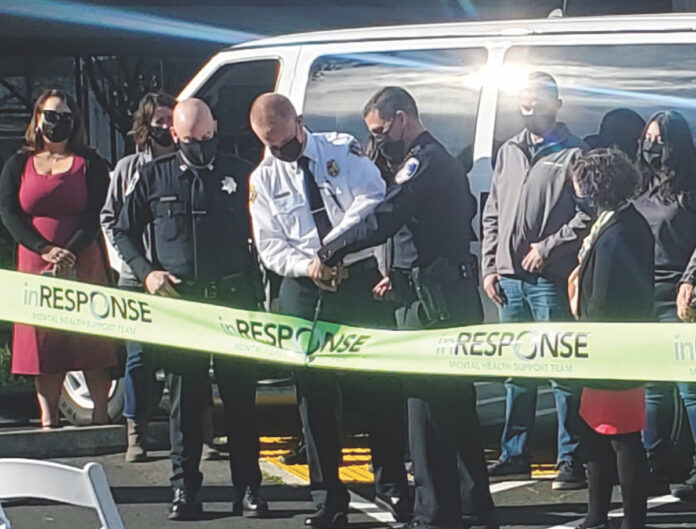
On Jan. 11, behind the official city ceremony launching Santa Rosa’s inRESPONSE mental health crisis response program, stood a circle of first responders entrusted to execute this new paradigm of community safety.
The ceremony’s elected officials and leaders of partner organizations spoke about the promise of the program. What does it mean to the team on the frontlines of first response?
Jennifer Vargas was born and raised in Santa Rosa. As part of the inRESPONSE team, she was driven to do the work because of her own experiences with mental health and gaps in the available services.
As a Latina, she learned the hard way that there were “not a lot of resources, especially if you are BIPOC.”
Speaking about the impact mental health had on her family, Vargas says that ease of use is important to effective care. “It was really hard to navigate, especially for my parents, who didn’t know English,” she says. “[F]or me this was very big, because it was not a program that existed before, and a lot of people need these resources. I know how it feels for those people who might not know that they have me to turn to.”
According to the City of Santa Rosa website, “The goal is for the inRESPONSE Team to handle all calls for service where mental health is the primary concern.”
Reports of a weapon channel any emergency call to the police. But, under the new approach to emergency response, mental health care is prioritized once police deem a situation safe.
Partnering with the City of Santa Rosa’s Homeless Outreach Services Team will not only provide mental health services to unsheltered people in crisis but also help people find more secure shelter.
All of these pieces fit together to reveal a radically different picture than what Americans are used to. According to a stat cited during the ceremony, in 2019 25% of those shot by police had mental health conditions. Too often they were in crisis.
Buckelew Programs, an inRESPONSE program partner, has been providing the city with cultural sensitivity and language services since working with the Mobile Support Team program that inRESPONSE supplants.
Liz Longfellow, like Vargas, a Buckelew Programs Community Navigator, says that those experiencing mental health crises who are unsheltered or who are behind the language barrier are at more risk of suffering and therefore in need of more support.
“Mental health issues touch most people’s lives. We need to shift away from there being a penalizing response [and toward a] more helpful and supporting response with the most vulnerable in our society,” Longfellow says.
InRESPONSE team member Stephany Lopez was scheduled to ride along with a paramedic and a HOST staffperson in the brand-new van on the first shift, just after the ceremony’s ribbon cutting.
As a veteran of the Mobile Support Team, Lopez previously rode with police. She says this will be different for the community.
“Our Latinx community doesn’t necessarily ask for support in mental health, it’s not something they are going to call police or 911 or necessarily understand the processes for,” says Lopez, who is Latina. “To have someone who is able to speak Spanish is really important, especially when they are right in crisis.”
When looking closely at the people doing the work of inRESPONSE, it is clear that this is good for the community, by the community.
If you or someone in your family is experiencing a mental health crisis, call 911 to access inRESPONSE.
Serving thousands of students across Marin County and beyond, Youth In Arts builds skills and confidence in young people, and they can’t do it alone. This week, Youth In Arts hosts its annual SING OUT! concert, a scholarship fundraiser for high school a cappella ensemble ’Til Dawn. The event will be held both in-person—with masks, proof of vaccination or negative Covid rapid test required—and online. Headlined by ’Til Dawn alums Lilan Kane (in-person) and Laura D’Andre (virtually), the concert happens on Friday, Jan. 21, at Marin Country Mart, 2401 Larkspur Landing Circle, Larkspur and online. 6pm. $20–$30. youthinarts.org.
Online
Star Talk
Veteran celebrity profiler Ruthe Stein covered movies for the San Francisco Chronicle from 1970–2020. In those 50 years, she interviewed seemingly every Hollywood celebrity there is to interview, speaking to icons ranging from Cary Grant to Julia Roberts, and even newcomers like Timothée Chalamet. Now, Stein collects a lifetime of these one-on-one encounters in the new book, Sitting Down with the Stars: Interviews with 100 Hollywood Legends. This week, she joins Barbara Lane, books columnist at the San Francisco Chronicle and director of events at Copperfield’s Books, to talk about the book on Friday, Jan. 21, at 7pm. Register at copperfieldsbooks.com.
Napa County
Eat Out
Culinary wonders never cease in Napa Valley, where visitors can find award-winning restaurants and inventive eateries in each of the valley’s towns. This month, the region celebrates its delicious heritage and foodie community during the Napa Valley Restaurant Week. Whether you’re looking for Michelin-rated destinations or farm-to-table goodness, this week will provide a chance to nosh at dozens of spots. Per Napa County mandate and to help protect visitors and residents, masks are required in indoor settings regardless of vaccination status. Napa Valley Restaurant Week begins on Friday, Jan. 21. Find a directory of participating restaurants at visitnapavalley.com.
Mill Valley
Classical Kickoff
Under the artistic direction of longtime board member and classical-music enthusiast Bill Horne, the Mill Valley Chamber Music Society opens its 49th season of presenting world-renowned musicians in an intimate setting. This weekend, the society welcomes Russian pianist Ilya Yakushev for a concert program featuring works from Haydn, Beethoven and others. The pianist received his first award at age 12, and he regularly wows audiences on three continents. See him in-person on Sunday, Jan. 23, at Mt. Tamalpais United Methodist Church, 410 Sycamore Ave., Mill Valley. 5pm. $40. Proof of Covid vaccination and masks required. chambermusicmillvalley.org.
On the morning of Tuesday, Dec. 28, Homeless Action! sent an advisory to the Sonoma County Board of Supervisors, Santa Rosa officials and media about the need to protect unsheltered residents from the ominous freezing-weather forecast for four successive nights beginning Dec. 29. The County Commission on Human Rights issued a supporting statement the following day.
Established County protocols mandate that forecasts of three consecutive nights at 35 degrees, or just one at below freezing, should trigger emergency precautions to protect those living outdoors.
However, by Wednesday morning, it was clear that the relevant County departments had made no such plans. Instead, the County Administrator’s Office released a freeze warning on Thursday afternoon advising that “residents limit time outdoors, as serious medical conditions including hypothermia and frostbite can develop with prolonged cold weather exposure.” The County’s last point-in-time estimate, conducted in February 2020, estimated that there were 1,702 unsheltered people in Sonoma County, far more than the number of additional beds local agencies provide in the winter. Are we to believe that authorities don’t actually understand that the vulnerable unsheltered have no inside place to go to?
At the 11th hour, Santa Rosa engaged with Catholic Charities to manage pop-up tents with heaters to accommodate 40 people on Wilson Street. Separately, Sonoma Applied Village Services, Homeless Action! and volunteers partnered with the Sebastopol Community Church to accommodate up to 100 people. In Santa Rosa, Sonoma County Acts of Kindness and the Squeaky Wheel Bicycle Coalition set up three 20-person-capacity warming tents.
However, those in the AOK tents were told by police that if seen lying down, they would be arrested. Katrina Phillips, chair of the Sonoma County Commission on Human Rights, regularly checked on the inhabitants of one of the tents. On Jan. 2, one woman told her, “There’s nowhere else to go. We appreciate these warming tents so much. The police were just here threatening to arrest us if we fall asleep. It’s like they want us to die.”
The next morning, the tent had been destroyed and torn down in the freezing rain by Santa Rosa Police. Is this discrimination and wanton cruelty acceptable to the people of Sonoma County?
You may not know it by looking at him, but Mike Birbiglia has issues.
The comedian, writer, filmmaker and NPR darling specializes in turning his personal problems and family foibles into funny and endearing stage shows. This month, the Brooklyn-based performer is back in the Bay Area for a limited-run engagement of his new one-man-show, Mike Birbiglia: The Old Man...
Last week I received some trade-pub spam from Editor & Publisher topped by the headline:
“Optimizing obituaries to drive traffic and increase revenue.” Ugh. I’m all for driving traffic and increasing revenue, but not as a digital grave robber.
Reconciling how our words are read by both humans and the search bots that feed them is par for the course these...
Though the World Health Organization declared Covid-19 a pandemic on March 11, 2020, when Covid actually started in the United States is a somewhat difficult question.
In early March a cruise ship, called the Grand Princess, docked off the coast of San Francisco, found Covid cases among its passengers. Shortly afterwards, Bay Area health officials announced shelter-in-place orders, and hospitals...
In the “Opening Remarks” of Vocab Slick’s latest album, Language, the longtime hip-hop performer lays out his mission in music:
“This is an invitation of engagement / An invitation to listen to my art, my language, my expression / A language encompassing all emotion: love, sadness, joy, anger and confidence / This is how I communicate. This is my therapy....
Hi all, and happy Wednesday! Which outfits have you been excited about this week? Any particular look that’s brought you joy, or made you feel like your best self? As ever, I want pics! @northbaybohemian, @marinpacficsun
On to other Look-related items: Remember when I wrote the New Year’s Eve piece about wearing glitter and gold because we need to be...
Less Gloom
I got quite a dose of doom and gloom in the Jan. 12 edition of the Bohemian/Pacific Sun, which, ironically, had mental health as its cover issue. In his “Open Mic” piece, the Editor wrote, “… Some may say I’m a doomsayer, but I’m not —I have tremendous hope for life in general, just not for humans specifically...
My fascination with towns that don’t exist began when I hitchhiked to Alaska in 1988 and spent that summer living feral in a place called the “Cove”—a patch of forest outside the town of Cordova. About 80 people squatted there—college students, hitchhikers, a drunken gold miner, a legendary survivalist named Gene who hadn’t washed himself in years—in a smattering...
On Jan. 11, behind the official city ceremony launching Santa Rosa’s inRESPONSE mental health crisis response program, stood a circle of first responders entrusted to execute this new paradigm of community safety.
The ceremony’s elected officials and leaders of partner organizations spoke about the promise of the program. What does it mean to the team on the frontlines of first...
Online/Larkspur
Song Night
Serving thousands of students across Marin County and beyond, Youth In Arts builds skills and confidence in young people, and they can’t do it alone. This week, Youth In Arts hosts its annual SING OUT! concert, a scholarship fundraiser for high school a cappella ensemble ’Til Dawn. The event will be held both in-person—with masks, proof of vaccination...
On the morning of Tuesday, Dec. 28, Homeless Action! sent an advisory to the Sonoma County Board of Supervisors, Santa Rosa officials and media about the need to protect unsheltered residents from the ominous freezing-weather forecast for four successive nights beginning Dec. 29. The County Commission on Human Rights issued a supporting statement the following day.
Established County protocols mandate...