Good morrow and happy Wednesday, my Looksters! How was everyone’s week? I hope the lifted mask mandate meant that some of us put lipstick on and topped our look off with a smile—we’re never fully dressed, as a certain red-headed orphan would say.
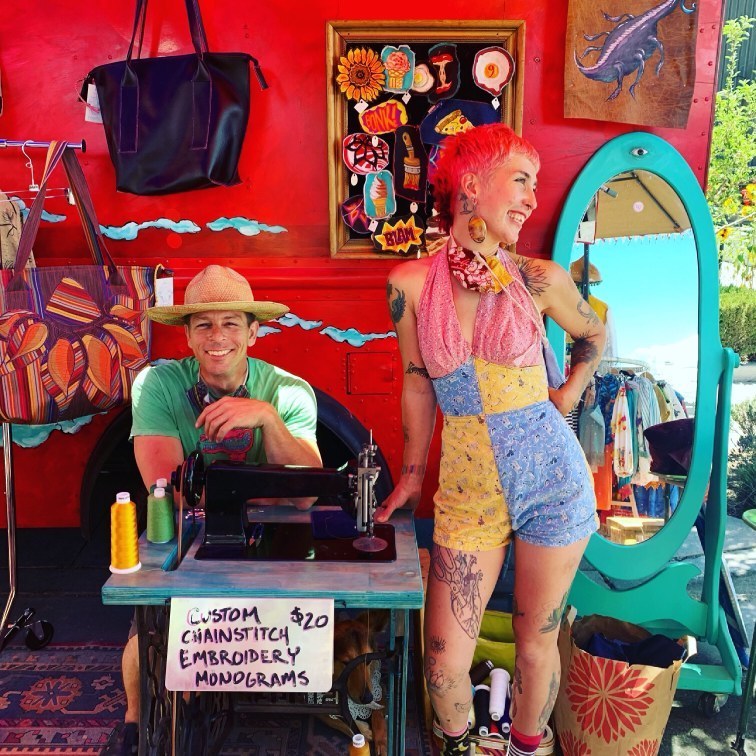
This week I’m excited to highlight an amazing style duo, local to Sonoma County and found in markets throughout the Bay Area all year round: BigMouthUnique.
BigMouthUnique specializes in one-of-a-kind handmade items, from clothing—anything from a renaissance-style page jacket to ’60s sailor pants to pink rompers with blue pockets—to wall art, pillows, ceramics, sculpture and jewelry. Everything is colorful, eye-catching and one of a kind. These are statement pieces and we will all want one—or two or three—in our closets.
The brainchild of dynamic duo Mathilde and Joshua, who have always loved making things and have sewed their whole lives, BigMouthUnique became manifest five years ago. Mathilde and Joshua love to use discarded items, like trash and donations, when creating—as opposed to buying new material—and they ride their bikes for transportation as much as possible. They’re a creative and conscious duo, making fashionable, ethical work. They also paint cars, so to anyone who sees a Merry Pranksters-esque prius cruising around town, it might be the work of BigMouthUnique.
Joshua and Mathilde, the humans behind BigMouthUnique (photo courtesy of BigMouthUnique.)
This weekend BigMouthUnique will be at the HEAD WEST Marketplace in the Barlow. Say hi, learn more about their inimitable fashion and buy a BigMouthUnique piece.
Follow Mathilde and Joshua on Instagram @bigmouthunique for an updated events calendar and fresh creations. Shop their Etsy BigMouthUnique anytime, anywhere. Email them at bi************@***il.com for custom work.
This is the kind of local fashion I live for. Power to BigMouthUnique!
Looking good, everyone. See you next week.
Love,
Jane
Jane Vick is an artist and journalist who has spent time in Europe, New York and New Mexico. She is currently based in Oakland. View her work at janevick.com.
The plan is elegant in its simplicity: If the people can’t get to the care, bring the care to the people. This is essentially the thinking behind a new initiative at Face to Face, Sonoma County’s HIV/AIDS services network, which has launched a $250,000 capital campaign to fund a mobile-services unit.
Dubbed “On The Move,” the campaign’s anticipated result is an electric van chockablock with everything the organization needs to deliver its HIV/AIDS prevention and care services throughout the County. Monies raised will not only launch the project but fund it for 24 months after its inception.
“With this electric van, we will be able to reach further into the communities we serve to provide HIV testing and harm reduction services as well as provide more care services to our clients who are living with HIV and can’t make it into our offices,” says Executive Director Sara Brewer.
The van will also provide something else to the organization—visibility.
Due to advances in medical care, an HIV diagnosis is no longer an imminent death sentence, which may contribute to lax attitudes about managing the potential for infection. Moreover, in recent years, the Covid pandemic has absorbed much of the media’s coverage of health issues, pushing HIV/AIDS further to the back burner.
“But AIDS still happens, and it happens here in our community,” says Face to Face Development Director Gary Saperstein. “We can bring awareness to our community that this still does exist, and hopefully by seeing this people will maybe go to our website and they’ll read about it and find out what’s going on.”
He adds, “All the services that we provide are hopefully leading us to ending HIV in the County—that’s our mission. Great strides have been made in HIV over the years, but it’s still not over. People are still getting HIV, people here—but you don’t hear about it as often.”
Legacy
Face to Face first offered services in the early days of the AIDS crisis in ’80s-era Guerneville. Now in its 39th year and based in Santa Rosa, the nonprofit organization continues its mission to end HIV/AIDS in Sonoma County.
In 2021 alone, Face to Face performed 452 HIV tests; introduced 25 new clients to PrEP 211, an HIV-preventative medication; helped house 15 clients; served 182 clients with financial assistance and benefit counseling; provided 6,325 Naloxone kits, which help in reversing drug overdoses—of which 3,780 were reported; not to mention exchanged 810,00 syringes and retrieved 735,500.
Since launching On the Move in a “quiet phase” prior to the public roll-out last February, the campaign has raised over $60,000. Once all the monies are raised, an electric van will be purchased and retrofitted to match the organization’s unique needs, including partitioning the cargo space into private rooms to conduct its confidential services. HIV tests will be available in the van, as well as consultations, needle exchanges, condoms, educational material and, as Saperstein says, “Everything that pertains to our mission”—including a staff of compassionate professionals.
“The people who work at Face to Face are so passionate about the work that they do,” Saperstein says. “I don’t think I’ve ever worked with people more passionate about what they do. They impress me and amaze me every day.”
Road Tested
In some ways, Face to Face has already conducted a proof-of-concept for the mobile unit.
“During Covid, our harm prevention director, Lorie Violette, literally took her car, emptied out her trunk, put all the supplies in there and went out there in the community,” Saperstein says. “It’s pretty amazing, doing that work. This is why we need the van. We saw it work, and the need for it, during Covid.”
The population Violette serves often faces a bevy of challenges, from housing and mental health challenges to the lack of safe spaces for people who use drugs and are unhoused to go and receive services.
“If someone asks me for help of any kind, I would find out what they are looking for, assess readiness and either provide a linkage or referral. I would follow up with them as well. We plant a lot of seeds here at Face to Face, and that is why we are unique,” says Violette, who points out that Face to Face’s harm reduction services are currently drop-in. “Folks just come up to the door; we welcome them and ask what supplies would they like to get today. It’s a low-barrier service, with a non-judgmental approach. One of the most important aspects is that people can be themselves and feel cared for. They also get what they need to be safe.”
Saperstein affirms this notion. “It’s not about judgment—we’re here to help you if you want help,” he says. “We can link you to care. We can find the ways to help you, but you have to help yourself first. You have to take that first step.”
By bringing its services to those it serves, Face to Face hopes to make that first step even easier.
HELP IS HERE Face to Face’s harm prevention director Lorie Violette says harm prevention is ‘in my DNA.’ Photo courtesy of Face to Face.
One aspect of combating HIV/AIDS is predicated on the concept of “harm reduction.” Face to Face’s Harm Prevention Director Lorie Violette shared what this means in practical terms with Bohemian editor Daedalus Howell.
Lorie Violette: Harm reduction is reducing any harm related to substance use—or really anything; brushing our teeth, seat belts, eating a salad rather than a hamburger—while treating people with dignity and respect. Showing compassion and meeting people where they are at, not where we think they should be at. Example, someone shows up for supplies, they are having a hard day. Instead of me saying, “Well, if you stop using drugs your life may get better,” a harm reductionist would say things like, “I’m glad you came in today. All that you’re going though, you still made a point to come in and get supplies. That’s awesome. Would you like to chat a bit?” Harm reduction is not ignoring the issues at hand. It’s just not forcing people to do anything or using any kind of coercion.
Bohemian: When it comes to managing issues around scenarios like intravenous drug use or unprotected sex, how does harm reduction apply?
Violette: It would all come down to, what does that person want to do? Do they have the right information about risks, and are they asking me for my expertise? If so, I would ask them, what was successful in the past? Are they aware of PrEP 211? Do they need any supplies to stay safe?
Bohemian: How will the van integrate into your current harm reduction programs?
Violette: The van will allow Face to Face to go directly to the people, and provide our services. Some of the most vulnerable community members can’t get to us. We will reduce stigma associated with HIV, people who use drugs, overdose—while serving our community. These kinds of things need to be talked about. We cannot pretend they don’t exist, and we need to make sure our community has the facts.
Confession: I drink cold coffee. Not the expensive hipster cold-pressed stuff, either—that isn’t confession-worthy. No, I make my own pourover in the morning and forget about it after a few sips and get back to it hours later, after the cream in it has languished for half the day. It tastes just as good to me that way. No, it tastes better, because I thought I’d drinken it all, but suddenly there’s more. Is there something wrong with me for liking this? Wait, don’t answer. Every time one of my witch friends tells me some great truth about myself, I recoil in horror and wind up rebuilding my self-esteem with a new set of lies.
Also, I prefer my coffee with a generous amount of cream or half-and-half, and it must remain cloudy, never stirred. Why does that make a difference, not stirring it, and why does it taste better that way? Don’t look to me for the answer, I’m just confessing.
Here is one of my favorite bits of forbidden trivia: In old-school prison lingo, a coffee with cream and sugar was known as a Cadillac. If I ever own any type of eating establishment, Cadillacs will be on the menu. But also, I will need to invent a name for a coffee with cream only—an Oldsmobile?—and names for stirred and unstirred options—stick and standard?
Apparently I am a budding social anarchist, or so I’m told, even though I mostly vote Democrat. To wit: I spend a lot of time daydreaming about my project cafe, of which there are two versions. The “town” version is a free cafe for kids 18 and under—a phone-free neutral zone. Its offerings are very simple, possibly relegated to a Mr. Coffee and donated books. Maybe it hosts a Penny University and game nights, to get young minds engaged. For some reason I imagine opening it in downtown Willits. There is logic there that I don’t have space for right now. Now the whole world knows.
The secret-hippie-village version of my dream cafe is a shed in a meadow with folding bunks against one wall, self-serve coffee, a couch, wifi and a covered porch with a projection screen for film nights. Or maybe it’s in a treehouse in a Redwood forest. It’s there for people in the know. It’s not free, per se, but rather operates on a “suggested donation” basis, because the thought of selling things out of a cafe that doesn’t officially exist gives me giddy goosebumps.
Do I have more to say? Hmmm, not sure. I’m out of space, yet I feel cleansed.
These are my secrets. Shhhhh … please don’t tell.
Mark Fernquest lives in West County. He imagines he is vastly wealthy but in a kind, highly creative, sub-billionaire, non-1% kind of way.
Templeton’s Galatea, which premiered at the Spreckels Performing Arts Center in Rohnert Park in September of 2021, is a rare theatrical foray into science fiction. It’s set aboard an earth-orbiting space station in the year 2167 where robot specialist Dr. Margaret Mailer is interviewing Seventy-One, a recently discovered “synthetic”. It is the last known survivor of the spaceship Galatea, a craft that mysteriously disappeared over one hundred years prior and whose wreckage had been discovered decades later.
Seventy-One’s memories of events are spotty at best. Whether those lapses of memory are genuine malfunctions or purposeful deceptions is what must be determined as answers are sought to the question “What happened to the Galatea?”
The script, which ATCA judges called “inventive” and “suspenseful”, was originally scheduled to premiere in March of 2020 but fell victim to pandemic-necessitated closures. It was previously recognized with an Honorable Mention by the 2020 Theatre Bay Area Will Glickman Award committee. That Award is usually presented to the Bay Area’s best new produced play, but eligibility was expanded to include plays whose productions were suspended due to the pandemic.
In 1977, ATCA began to honor new plays produced at regional theaters outside New York City. No play is eligible if it has gone on to a New York production within the award year. Since 2000, the award has been generously funded by the Harold and Mimi Steinberg Charitable Trust.
The five finalists were selected from eligible scripts recommended by ATCA members from around the country and evaluated by a committee of theater journalists.
The top award of $25,000 and two citations of $7,500 each, plus commemorative plaques, will be presented on April 9 at South Coast Repertory in Costa Mesa, CA. At $40,000, Steinberg/ATCA is the largest national new play award program of its kind.
The American Theatre Critics Association is the only national association of professional theater critics in the United States. Since the inception of its New Play Award, honorees have included Lanford Wilson, Marsha Norman, August Wilson, Arthur Miller, Lynn Nottage, Adrienne Kennedy, Donald Margulies, Moises Kaufman, Craig Lucas, Nilo Cruz, Lauren Yee, Horton Foote and Qui Nguyen. Last year’s honoree was Her Honor, Jane Byrne by J. Nicole Brooks.
Every day in the fog-caressed city of San Francisco, a half dozen souls are overwhelmed by the Big Sleep. But on Feb. 28, 2022 only one of the previous day’s dearly departed was granted a headline in the San Francisco Chronicle.
While middle class dead were remembered rosily in paid obituaries, wealthy investment banker Richard Charles Blum, 86, got a freebie hagiography. Education beat reporter Nanette Asimov breathlessly lauded the deceased financier as a “self made millionaire,” a “philanthropist,” a reform-minded University of California Regent, and, oh, yes, the husband of U.S. Senator Dianne Feinstein.
According to Asimov, and similarly flattering obits in rich and powerful-fawning media, Blum was a brilliant businessman with no flaws as a human being; he was, in fact, a morally pure saint who brightened a world shared by rich and poor alike.
Please allow us to set the record straight.
Beginning in 2000, this reporter published numerous stories in SF Weekly, Bohemian, and other California newspapers exposing the many ethically corrupted money deals engineered by Blum as he manufactured for himself a lucrative career by leveraging his wife’s political power to profit from billions of dollars in government contracts awarded to companies controlled by himself.
My investigative stories on Blum have been lauded through the years with journalism awards from organizations such as Project Censored, Society of Professional Journalists, Investigative Reporters & Editors, California Newspaper Publishers Association. The scandalous findings detailing Blum-Feinstein conflicts of interest have been echoed in other media news columns for decades. Some of the reports have inspired government investigations of Blum’s operations, and feeble efforts by Feinstein to disassociate herself from her partner’s scores of interlocking businesses by claiming that she only has ownership of a small “blind trust.”
In fact, Feinstein has always owned exactly one half of Blum’s assets under California community property laws, period. And she has many times intervened in Congressional oversight of projects that have benefited her family. But such is the reverence in which corporate-enslaved politicians and the press that depends upon their favor holds the politically neoliberal, closet-neoconservative Feinstein, that Blum was allowed to continue his grifts in broad daylight until his San Francisco-based bank, Blum Capital Partners, busted flat a few years ago, taking down with it many millions of dollars in public funds.
Feinstein’s reputation has long been protected by political Teflon and willfully blind reporters in the face of decades of documented havoc caused to the public interest by her family businesses. And, horribly, as she continues to sink into a widely-recognized zombie state of piteous dementia, she remains a powerfully influential Senator wielding life and death responsibilities in an out-moded, obstructionist branch of government run by obvious psychopaths and narcissistic, geriatric basket cases. But I digress.
In addition to his not-so-mysterious way of attracting billions of dollars in government construction and real estate and military supply contracts, Blum’s other business ventures were based on “private equity,” which is a piratical method of investing which coldly destroys businesses, like PetSmart, for one example of a Blum takeover. The private equity way practiced by Blum Capital Partners is to buy cash flow-healthy companies by assuming massive bank debt to finance the aggressive, normally unwanted take-over. The new owner’s acquisition loans are off-loaded onto the books of the just-acquired firm. Typically, the private equity banditos loot the firm by selling off its productive assets to pay back the acquisition debt and to generate surplus cash which they siphon off for themselves. The asset-crippled firm goes bankrupt, the workers are fired, and people like Blum walk away with largely untaxed profits, casually stepping on the company’s corpse as they sniff out the next victim.
Here is a compendium of the Blum-Feinstein family deals which I exposed to public light during more than two decades of factually robust and unchallenged reporting.
“San Francisco International Airpork” (2000) revealed that construction companies partnered with Blum caused the budget for renovating the airport to unnecessarily balloon by a billion dollars which generated excess profits for Blum and his partners.
“Hawk Tale” (2005) The firm of Feinstein, Condoleeza Rice, Blum, & Bush—war made easy and profitable.
“MIG Attack” (2005) How Feinstein interfered in Indian casino siting legislation, while her husband builds Indian casinos.
“Senator Warbucks” (2007) A national journalism award-winning expose of how Feinstein used her chairpersonship of the Senate Military Construction subcommittee (MILCON) to steer billions of Iraq & Afghanistan war dollars to firms controlled by her husband.
“Feinstein Resigns” (2007) Sen. Feinstein suddenly resigns from MILCON in public blow back from the Bohemian’s revelation that Blum sells prosthetic limbs at huge mark-ups to Iraq and Afghanistan war wounded troops.
“Daddy Kleinbucks” (2007) Founder of the nonprofit investigative Sunlight Foundation, lawyer-investor Michael R. Klein has made curious investment choices with his business partner, Richard C. Blum. Klein was Feinstein’s closest legal and ethical advisor.
“Blum’s Plums” (2007) The first story about how Blum finagled University of California endowment funds to profit himself while he was a university Regent in charge of investments.
“The Investor’s Club” (2011) How the University of California Regents Spin Public Money into Private Profit and into the Pocket of Regent Richard C. Blum. An 8-month investigation crowd-funded by Spot.us and published in multiple newspapers revealed how Blum steered University of California funds into private equity investments, often controlled by him, and how the university lost vast sums of money that would have otherwise gone toward education.
“Going Postal” (2013) The husband of US Senator Dianne Feinstein has been selling post offices to his friends, cheap. The investigation resulted in an damning Inspector General investigation of Blum’s firm, and Blum resigning from the company involved. It is also a “best selling” book.
And the final report, “Blum and Doom” (2017) Feinstein’s hubby, and California pension system, take a hit in the downfall of ITT Educational Services as Blum goes broke.
Last June, according to the Securities & Exchange Commission, Blum Capital Partners was officially terminated after losing most of its capital on bad investments promoting for-profit colleges which it controlled. Unfortunately, Blum had lured tens of millions of dollars from California Public Employees Retirement Fund into these bad investments, while he was a highly paid investment manager for the public fund. Remarkably, Blum steered public investments into his failing for-profit educational company, ITT Educational, trying to prop up the value of his own investments. ITT Educational profited mightily by making federally guaranteed student loans for providing certifiably substandard educations. The company was forcibly liquidated by the US government for fraud and Blum’s investment bank went down, at the same time.
Let us now leave insincere plaudits for the dead aside by reversing the standard sanctimonious obituary tropes made by obsequious reporters to the rich and powerful whom they envy and bootlick.
For more than a decade, Northern California event curator (((FolkYEAH!))) and the state’s oldest family-owned winery joined forces each summer to present the Huichica Music Festival on the pictorial grounds of Gundlach Bundschu in Sonoma Valley.
Huichica made it’s name (pronounced wah-chee-ka) by delivering intimate access to great indie-rock bands and artists, local food purveyors and estate-grown wines. Yet, the festival suffered the same fate as all social gatherings in 2020 when the Covid-19 pandemic canceled the event. Last year, Huichica changed it’s summertime schedule to a fall offering, taking place in October 2021.
This year, with health restrictions lifting on gatherings, Huichica Music Festival returns to Gun Bun Winery for its typical summer dates, June 10–11, 2022, and will feature a dynamic array of rock and folk acts and artists such as Allah-Las, ESG, Turnover, Damien Jurado, La Luz, Woods and others.
“Over ten years ago, we created Huichica because we believe that music and wine is best shared in intimate and epic settings with our community, family, friends,” Jeff Bundschu, President of Gundlach Bundschu and co-founder of Huichica Music Festival, says in a statement. “My family has farmed and lived on this property since 1858, and it’s an honor to share it with these amazing artists and our community every summer at Huichica Music Festival.”
The all-ages, family-friendly music festival takes place throughout Gundlach Bundschu’s winery estate in Sonoma, including a historic barn and outdoor amphitheater that offers vineyard views. Musically, the self-described ‘micro-music festival’ highlights both established and emerging artists from the Bay Area and beyond.
The festival’s 2022 full lineup includes Allah-Las, ESG, Turnover, W.I.T.C.H., Woods, La Luz, Damien Jurado, Midlake, Tamaryn, Avey Tare, Isobel Campbell, Bobby Oroza, Wand, Lilys, The Altons, Mega Bog, Mary Lattimore, Tropa Magica, Mystic Chords Of Memory, Dummy, Starcrawler, Tapers Choice, Spaceface, Jess Williamson, Oog Bogo, Brigid Dawson, Frank Locrasto, Thumpasuraus, Light Fantastic, Oliver Ray, Sylvie, Uni Boys, Madeline Kenney, The Shacks, Nico Georis, Matt Baldwin and Companion (Lineup subject to change).
To ensure the health of staff and all guests, Huichica Music Festival will comply with any laws and mandates recommended by the county and CDC. All Covid-19 safety policies are subject to change anytime.
“After a couple of tough years for live events and the music industry, it means the world to us to present this fun and diverse music experience at the oldest family-owned winery in California—it’s always one of my favorite music and family weekends of the year,” Britt Govea, founder of (((folkYEAH!))), says in a statement. “Huichica is smaller in size, but resonates big in the hearts of music and wine lovers looking for something more intimate and relaxing than the typical show. It is a treat to spend two glorious days at Gundlach Bundschu with some of the best artists of our time.”
Huichica Music Festival happens June 10-11, at Gundlach Bundschu (2000 Denmark Street, Sonoma). Two-day general admission passes ($295) to Huichica go on sale Friday, March 4 at 10am, with single-day tickets to follow. Children under 12 are free. To purchase, please visit huichica.com.
We picked up the new copy of 50 Up. I guess this is supposed to be a celebration of achievement and fun for peeps over 50.
So, it opens with Daedalus Howell’s op-ed telling us older folks that we definitely should feel our age: You’re too old to be doing whatever you think it’s okay for you to do. Oh, and we’re no longer allowed to skateboard. Should we switch to shuffleboard so we don’t fall and hurt ourselves?
And he sneers at us for wearing hoodies and flip-flops. (I can see not wearing flip-flops while skateboarding, but does anyone do that?) I’d better run out to Target for a pink sweater with a teddy bear on it. I understand that it’s difficult for the younger folks to get a handle on what aging is like, and that it’s all too easy to let some contempt sneak in. But didn’t anyone else read over this?
In future, if you want to talk to people over 50, I suggest you get someone in the same age group to do it.
Susan Kuchinskas
El Cerrito
Editor’s note: Daedalus Howell is, in fact, turning 50 this year.
Thrifty Shopping
The other day I was on a quest for 2 pints of ice cream. That turned into a crazy insightful day.
I thought, “I’ll just pick it up at a local convenience store.” Big mistake. One local store in Cloverdale wanted $6.99 for each pint. I put it back and said sorry. The next store was even more; $7.99 for their pints. I said no and walked out. I tried CVS next and paid $10 for two pints.
Twenty dollars does not go that far in today’s economy. These days you definitely have to watch the ever-changing prices or get stung by high-price inflation.
The glorious photograph illustrating the delightful “Spotlight on Sausalito” article in the Feb. 16 Pacific Sun sure ain’t the Sausalito waterfront, despite the caption’s claim. That’s a picture of the gorgeous view from Fort Baker. I know because I’m a lucky guy: I grew up in Sausalito.
And a different Sausalito it was when I moved to Spencer Avenue in 1960 and enrolled in the fourth grade at Bayside School. Tourists packed the town only on the weekends. A stroll for a block along Bridgeway north from Princess would take a flâneur such as me past Ole’s Bakery, the Purity Market, the Gate Theater, the hardware store, the five & ten and the Rexall with the soda fountain. Tourists came for our village atmosphere and waterfront, not T-shirts, ice cream and glitzy galleries.
In fifth grade a couple of classmates and I decided to start a newspaper, The Sausalito Sun—a few years later, when the Pacific Sun launched, we always figured the founders stole our name. We prowled the streets looking for news and selling ads, two bucks for a full page. Sally Stanford advertised her Valhalla restaurant with us; I played Little League for the Giants she sponsored and the madam’s Rolls-Royce was our team’s car for opening day parades. The old Kingston Trio-owned Trident always took a full page—after high school I was employed for a brief stint as a member of the overnight kitchen cleanup crew. The mayor called our Sun the best newspaper in town, an easy call since at that time we were the only paper.
When I moved back to town after a short interlude studying at Berkeley—of course I dropped out for a spell, it was the ’60s!—I moved into the Chicago, Burlington & Quincy Pullman business car parked at Tiki Junction. The Big G was our grocery store, before it became Mollie Stone’s, and across the street was the pungent distillery after which the Whiskey Springs housing development is named. Just before Bridgeway ends, Juanita held forth at her Galley on the Charles Van Damme, grounded at Gate Six.
So, with as much modesty as an adopted son can muster, I cover the Sausalito waterfront and can say with historical certainty that we don’t need our picturesque Fort Baker neighbor to play our double.
“Spiritual but not religious” is a cliche in common parlance, which means people parrot the phrase but are usually unable to explain what they mean by it. “Not religious” means, of course, not Christian, the dominant faith in the West for the past two millennia, for it’s been 140 years since Nietzsche declared that “God is dead,” meaning no educated person in the modern world can believe in Judeo-Christian theism. And so Christianity continues to turn from wine to water, thinned out in a stream that flows from the River Jordan to the sea of irrelevance.
So much for the religious part. As for “spritual,” invoking this seems to suggest, “I know there’s some kind of higher reality, but I don’t understand it and so drift with the times, focused on social values and material resources.” In other words, the very antithesis of spiritual.
The “spiritual not religious” catchphrase serves as a way of examining the four types of prayer, which take us from the most religious, in the formal sense, to the threshold of true spirituality, or awakening to that within us that is more than human.
The simplest form of prayer is devotion. Picture an elderly woman kneeling before the Virgin Mary, or a tribesperson adoring the statue of a deity. The experience is largely emotional, which for most people is as far as they can go, unable to invoke within them the powers the religious totem symbolizes. The next form is petition, in which one asks for something needed, followed by intervention, in which one asks on behalf of someone else. These acts can certainly have their effect, as research into the power of prayer has shown.
The most noble form of prayer, however, is called contemplation, and is a state in which, according to the Swiss metaphysician Frithjof Schuon in a video available on YouTube, the soul reflects upon its divine ground. This is less likely to be a prayer of short duration made with closed eyes, but rather the gradual sinking into a state of deep reflection reaching the innermost part of oneself. Often we experience this outdoors, feeling a sense of oneness with heaven and Earth, noting how everything is in its place, after its kind and performing its function. And at the center of it all is one’s own consciousness, powered by the divine spark of intelligence.
Not everyone is capable of metaphysical insight, but more could be if they took the time. Those who do can honestly say that while they may not be part of a formal religion, they have an inner orientation that can truly be called spiritual.
A “classic” is defined as something judged over a period of time to be of the highest quality and outstanding of its kind.
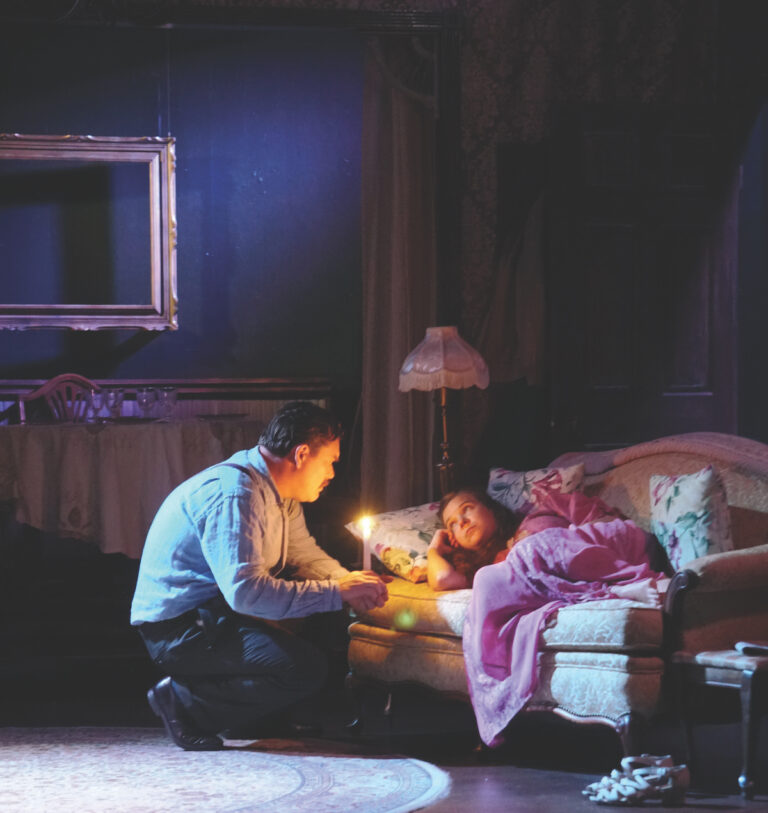
In theater, it can be a mark of a quality script that is at the mercy of the artists producing it. I’ve seen plenty of non-classic productions of classic plays. The Glass Menagerie, running at Sebastopol’s Main Stage West through March 5, is not one of those.
The Tennessee Williams memory play about the Wingfield family was written more than 75 years ago. While it may be draped in the trappings of its time, its look at the illusions we create to get through life, and the pain and regret that comes with the shattering of those illusions, still resonates today.
The type of run-down apartment where the fire escape is the means of entering and exiting is the home of faded Southern belle Amanda Wingfield (Sheri Lee Miller), her son Tom (Keith Baker) and her daughter Laura (Ivy Rose Miller). Tom spends his days toiling at a warehouse and his nights at the “movies” dreaming of getting out and living an adventurous life. Laura, a fragile girl, lives an isolated life spent playing records on the Victrola and maintaining her collection of glass figurines. Amanda is worried about Laura’s future and harangues Tom about bringing “gentlemen callers” in from his work. Tom acquiesces and invites his co-worker Jim (Damion Lee Matthews) over for dinner. What seems like a promising possibility quickly fades into harsh reality.
Williams’ characters are bucket-list roles for actors, and director Elizabeth Craven has four actors, including a newcomer to the area, at the top of their game. Mother and daughter are played by mother and daughter Sheri Lee and Ivy Rose Miller, which can’t help but add a deeper dimension to the characterizations. Baker channels Philip Seymour Hoffman in physical demeanor, vocal intonation and stage presence while newcomer Matthews expertly threads the needle with Jim, a character who has illusions of his own.
I’m always impressed by the sets placed on the tiny Sebastopol stage, and David Lear and director Craven’s design manages to make the space feel larger and yet claustrophobic at the same time. The period costume design—especially Amanda’s “gown,” by Adrianna Gutierrez—provided strong support to the characters and the story.
A sense of regret runs thick through The Glass Menagerie. It is not a sense I felt after attending this production.
‘The Glass Menagerie’ runs Thursday to Saturday through March 5 at Main Stage West, 104 N. Main St., Sebastopol. 8pm; $20–$32. Proof of vaccination with ID and masks required. 707.823.0177. mainstagewest.com
Good morrow and happy Wednesday, my Looksters! How was everyone’s week? I hope the lifted mask mandate meant that some of us put lipstick on and topped our look off with a smile—we’re never fully dressed, as a certain red-headed orphan would say.
This week I’m excited to highlight an amazing style duo, local to Sonoma County and found in...
The plan is elegant in its simplicity: If the people can’t get to the care, bring the care to the people. This is essentially the thinking behind a new initiative at Face to Face, Sonoma County’s HIV/AIDS services network, which has launched a $250,000 capital campaign to fund a mobile-services unit.
Dubbed “On The Move,” the campaign’s anticipated result is...
Confession: I drink cold coffee. Not the expensive hipster cold-pressed stuff, either—that isn’t confession-worthy. No, I make my own pourover in the morning and forget about it after a few sips and get back to it hours later, after the cream in it has languished for half the day. It tastes just as good to me that way. No,...
North Bay playwright and former Bohemian and Pacific Sun contributor David Templeton has been named as one of five finalists for the 2022 Harold and Mimi Steinberg/American Theatre Critics Association (ATCA) New Play Award and Citations. The award and citations recognize the playwrights of the best scripts that premiered professionally outside of New York City in 2021.
Templeton’s Galatea, which...
Every day in the fog-caressed city of San Francisco, a half dozen souls are overwhelmed by the Big Sleep. But on Feb. 28, 2022 only one of the previous day’s dearly departed was granted a headline in the San Francisco Chronicle.
While middle class dead were remembered rosily in paid obituaries, wealthy investment banker Richard Charles Blum, 86, got a...
For more than a decade, Northern California event curator (((FolkYEAH!))) and the state's oldest family-owned winery joined forces each summer to present the Huichica Music Festival on the pictorial grounds of Gundlach Bundschu in Sonoma Valley.
Huichica made it's name (pronounced wah-chee-ka) by delivering intimate access to great indie-rock bands and artists, local food purveyors and estate-grown wines. Yet, the...
Tone Deaf ‘50 Up’
We picked up the new copy of 50 Up. I guess this is supposed to be a celebration of achievement and fun for peeps over 50.
So, it opens with Daedalus Howell’s op-ed telling us older folks that we definitely should feel our age: You’re too old to be doing whatever you think it’s okay for you...
The glorious photograph illustrating the delightful “Spotlight on Sausalito” article in the Feb. 16 Pacific Sun sure ain’t the Sausalito waterfront, despite the caption’s claim. That's a picture of the gorgeous view from Fort Baker. I know because I’m a lucky guy: I grew up in Sausalito.
And a different Sausalito it was when I moved to Spencer Avenue in...
“Spiritual but not religious” is a cliche in common parlance, which means people parrot the phrase but are usually unable to explain what they mean by it. “Not religious” means, of course, not Christian, the dominant faith in the West for the past two millennia, for it’s been 140 years since Nietzsche declared that “God is dead,” meaning no...
A “classic” is defined as something judged over a period of time to be of the highest quality and outstanding of its kind.
In theater, it can be a mark of a quality script that is at the mercy of the artists producing it. I’ve seen plenty of non-classic productions of classic plays. The Glass Menagerie, running at Sebastopol’s Main...