Open Mic: Sonoma County Supervisors to review living wage law

The Sonoma County Board of Supervisors will finally revise the county’s Living Wage Ordinance approved in 2015 at their Oct. 18 meeting. Three fires and one flood since 2017 have delayed reconsideration of the ordinance, which a coalition of labor, environmental, faith and community-based organizations have long urged. The law applies to county workers and employees of large county contractors.

Nationwide, 120 cities and counties have implemented living wage laws, including 43 in California. Three cities in Sonoma County, Sebastopol (2003), Sonoma (2004) and Petaluma (2006), have done so. Sonoma County’s existing living wage law is one of California’s weakest and least comprehensive.

Corporate profits have reached record levels while, according to the latest U.S. Census data, wages have stagnated or declined for the bottom 60% of Sonoma County wage earners since 2000. Simultaneously, the California Housing Corporation reports that rents have climbed by 25%, while renter incomes grew by just 2% annually.

The county’s Portrait of Sonoma 2021 report recommends that the board thoroughly revise the Living Wage Ordinance to address inequality and working poverty.

Proponents are urging the board to expand the ordinance to the county fairgrounds and airport, increasing the number of workers covered to 1,800.

The board can further improve worker job quality by providing 12 days of paid sick leave, barring part-time employment by county contractors except in unusual circumstances, and implementing a retention provision for employees of a county contractor whose contract is not renewed. 

In addition, by adopting a proposed responsible bidder provision, the county will ensure that contractors have an excellent record of compliance with applicable federal and state labor laws.

Expanding the ordinance to the airport and fairgrounds, ensuring responsible contracting, and improving job quality for covered workers will promote racial and gender equity, as most affected employees are workers of color and women.

The county is the largest employer and contractor in the North Bay. By revising the ordinance as recommended, the county can become a model for public employment, and supervisors can demonstrate their commitment to economic and racial justice.

For more information, see www.northbayjobswithjustice.org/raise-the-wage.

Martin J. Bennett is instructor emeritus of history at Santa Rosa Junior College and a consultant for UNITE HERE Local 2.

Two Democrats spend $1.2 million in fight for North Bay Assembly seat

Two Democrats are waging a costly fight to represent the North Bay in the state Assembly.

In the June primary, Democrats Sara Aminzadeh and Damon Connolly took 36.2% and 37.1%, respectively. The district, newly numbered 12, covers all of Marin County and the southern half of Sonoma County.

Aminzadeh has taken the lead in fundraising, raising $620,111 this year through Sept. 24, compared to Conolly’s $530,789 in the same period. Recent campaign filings show that two Democrats have spent over $1.2 million fighting each other so far.

Connolly has represented San Rafael and surrounding communities on the Marin County Board of Supervisors since 2015 and, before that, sat on the San Rafael City Council. Aminzadeh is more of a newcomer to the district, but appears to have stronger connections in Sacramento. She worked for environmental nonprofits before being appointed to the California Coastal Commission in 2017.

Aminzadeh’s biggest financial supporters include the California Faculty Association ($19,200); Gap Inc. executive Robert Fisher and his wife, Elizabeth ($10,800); and the Association of California School Administrators ($9,700). Her campaign has also received $49,250 from 30 employees of Boies Schiller Flexner LLP, a law firm where her husband is a partner. 

Meanwhile, Connolly’s biggest single contributors include the American Federation of State, County and Municipal Employees ($19,400), the Operating Engineers Local Union No. 3 ($14,600) and a total of $49,000 from 10 chapters of Govern for California, a network of 18 nonprofits which has reportedly spent over $3 million on California elections this year.

The pair’s websites each sport long lists of endorsements, both including local politicians and labor groups.

Connolly has claimed endorsements from both daily newspapers in the district—the Press Democrat and Marin Independent Journal—and seven current members of the state legislature. Meanwhile, Aminzadeh has been endorsed by more state and federal officials, including Rep. Jared Huffman, Lt. Gov. Eleni Kounalakis and 36 current members of the state legislature.

Some are staying out of the in-fighting all together. The California Democratic Party failed to reach a consensus on an endorsement in the race and, as a result, local Democratic groups didn’t endorse in the race either. Levine, the outgoing Assemblymember, hasn’t publicly picked his successor.

One thing is certain: Once the dust settles, the North Bay will send another Democrat to the statehouse.

‘Macbeth’ Sequel in Mill Valley

There is an old Scottish proverb, “Eiridh tonn air uisge balbh.” Roughly translated, it means, “Waves will rise on silent waters.” 

Equal parts threat and hope, the concept that change, hope and danger come out of the seeming calm is at the dramatically beating heart of Dunsinane, the Marin Theatre Company’s season-opening collaboration with Tamalpais High School’s Conservatory Theatre Ensemble (CTE). It runs in Mill Valley through Oct. 16.

Dunsinane begins where Shakespeare’s Macbeth ends, with the battle of Birnam Woods. As Lord Siward, Earl of Northumberland (a solid Aldo Billingslea) and his soldiers take the castle, they find that they have been lied to and that Macbeth’s wife, Queen Gruach (Lisa Anne Porter), is still alive. Even worse for Siward and Macduff (a well-grounded Michael Ray Wisely), the queen has a son.

Much to the vexation of King Malcolm (Josh Odsess-Rubin) and the conniving opportunist Lord Egham (a very funny Daniel Duque-Estrada), Siward is a good man who is trying to do what is right. Unfortunately, in Scotland, honor is a weakness to be exploited by enemies and allies alike. One by one, Siward watches the young men around him die in the name of peace. Told through the eyes of those young soldiers (all students from CTE) writing letters home to their mothers, we watch the most hopeful of these child soldiers (poignantly played by Jack Hochschild) turn into a battle-scarred and mentally wounded man. 

Written during the 2010 Afghan war, playwright David Greig uses the 1054 invasion of Scotland to highlight the problems of one culture trying to define “peace” for another. It’s a sometimes pedantic, sometimes funny, but always earnest allegory about the dangers of imperialism.

The three-hour-long production does sometimes drag due to a dense script and pacing issues, but it is absolutely worth attending. If nothing else, the play contains one of the best sets of antagonists since Saturninus and Tamara. Porter’s Gruach is a force to be reckoned with, and the chameleon-like ability Odsess-Rubin displays as he shifts into the hedonistically conniving King Malcolm is a master class in acting. 

If Dunsinane is a measure of how youth theaters can benefit from collaboration with professional theaters, then this imperfect but well-cast show of veteran and youth actors shows promise for great things in the future.‘Dunsinane’ runs Tues–Sun through Oct. 16 at Marin Theatre Company, 397 Miller Ave., Mill Valley. Tues–Sat, 7:30pm; Sat & Sun, 2pm. $25.50-$65.50.  Masks, proof of COVID vaccination and ID required. 415.388.5208. marintheatre.org.

Annual Dia de los Muertos Exhibit Goes Multicultural

The new exhibit at the Petaluma Arts Center, “Honoring Life: Love and Remembrance,” takes a multicultural approach to display the ways various cultures deal with the death of loved ones.

How a culture celebrates its dead profoundly affects how the people of that culture treat the living and commit to their own lives. Perhaps this explains the broader resonance of the famous Mexican and American holiday, Dia de los Muertos.

Every year in Petaluma, which is over 20% Spanish speaking, the Petaluma Arts Center (PAC) shares its resources in support of local Dia de los Muertos activities, including a culminating fiesta with Mexican music and food. Several local groups have been organizing the associated activities together for years. PAC’s major contribution is the annual exhibition displaying ofrendas, artistically elaborate offerings to the recent dead among the family and friends of the creators. 

“Every ancient culture has its own way of following rituals to honor ancestors, usually around the fall or autumn, just like in Mexico,” said exhibit curator Irma Vega Bijou in an email interview. “In California, we have many culturally rich stories to share.”

For the first time, organizations outside of Mexican culture will be sharing their own cultural rituals in the exhibition. The California Indian Museum and Cultural Center and the Redwood Empire Chinese Association are two such participating organizations. 

The Redwood Empire Chinese Association will share examples of Ching Ming, or Tomb Sweeping Day. “Ching Ming is a time to visit the graves of departed family [members]. Grave sites are swept, cleaned and decorated with flowers. Food, tea or wine is brought to feed the ghosts. Incense and joss paper, representing money, is burned so the departed will be happy and wealthy in their other-world life,” according to the association.

The California Indian Museum and Cultural Center will provide an altar that honors heroes who gave their lives to protecting Indian lands and revitalizing tribal culture. According to the museum, “California tribal communities are dynamic and continue to be shaped by their members.” Indeed, whether adhering to ancient traditions or manifesting new ones, the people of participating cultures know that the dead have been and will always be with the living. 

“[The groups participating] all have their unique way to honor ancestors and loved ones, and PAC is a great place to open the doors for this inclusive event in support of our community,” said Bijou. 

The visibility of this celebratory showering of lost loved ones with beauty is a gift from Mexican culture to all of us. Now, with the help of PAC and local organizations, this gift is widening the tent to share space with valued traditions from other cultures represented in Sonoma County. 

‘Honoring Life: Love and Remembrance’ will be showing at the Petaluma Arts Center from Oct. 6-Nov. 5. Opening Reception is Thursday, Oct. 6, 5:30-7:30pm.

Portrait of a West County Family

On a recent Monday afternoon, I showed up at a local West County residence with a promising lead on a story. 

Rumor had it that the barn contained antiquated, steampunk-ish machinery once used to run an apple-processing warehouse. On the phone, Jeff Hergenrather, 74, owner of the farmstead, had told me, “Well, you might not get what you’re expecting. You be the judge.” He was right. I got more than I anticipated. And no, this is not really a story about a vintage apple warehouse. It’s a story about a family and an old farm and how to live a full life.

The short of it is, Starr, 72, and Jeff Hergenrather’s life in Sebastopol began in 1985, when they bought 21 acres of legacy apple orchard off a woman named Doris Kennedy. Doris Kennedy was the second wife of George Kennedy, who had purchased the original 42 acres with his first wife in 1906 in order to flee the immediate aftermath of the Great San Francisco Earthquake. George Kennedy planted a Gravenstein apple orchard and built a house and packing warehouse on the land, and farmed the property, using horses, for many years.

By the time the Hergenrathers purchased their half of the original acreage, in 1985, the apple trees came right up to the wall of the house. The horses had long since been replaced by a tractor, the apple-packing warehouse was in a state of disuse and the orchard was in decline. There was much work to be done to repair and revitalize the property.

The Hergenrathers’ route to Sebastopol was more circuitous than that of the Kennedys, however. In the late ’60s, while an undergrad at Cal Berkeley, Jeff Hergenrather began attending Stephen Gaskin’s Monday Night Class in San Francisco. Gaskin, a writing teacher at San Francisco State College, was hosting popular open discussions in which he talked about his psychedelic experiences, philosophy and ecological awareness. He quickly became known as San Francisco’s “acid guru” and drew a following of approximately 1,500 hippies.

Jeff Hergenrather graduated Cal in 1970 and within a year began attending Brown University, where he received medical training. In the meantime, Gaskin led his flock of followers around the United States in a large caravan of converted school buses, searching for the Promised Land. They found it in Summertown, TN, where in 1971 they purchased 1,750 acres and founded an intentional community called the Farm.

Starr and Jeff Hergenrather were married in 1972, and Jeff Hergenrather finished medical school at Brown in 1975. “We lived on the Farm from March 1977 until June 1982,” Jeff Hergenrather said. “Starr and I arrived in our 1960, 60-passenger school bus with our three young children, Sam, Nell and Harry, pregnant with our fourth child. Oliver Milo was born on the Farm on Oct. 29, 1977.”

On the Farm, he became the in-house doctor, while she ran the arts program. The experience was instrumental in both of their later careers. “That’s where I really learned a lot about cannabis,” Jeff Hergenrather said. “Not that I wasn’t pro-cannabis before and recognized its uses, but as the Farm community came to me and said, ‘This is working for my seizures,’ ‘this is working for my auto-immune disease,’ ‘this is working for my pain, my depression, my anxiety,’ and on and on and on and on and on, all these things we’ve [now] come to understand about cannabis was in my training.”

By the time the Hergenrathers arrived in Sebastopol in ’85, he was a practicing doctor. Soon after, she began teaching locally. She ended up teaching theater at Brookhaven for 11 years and at Analy for 16. He is still a practicing physician, a specialist in cannabis for the past 22 years. “These days, with legal adult use, it’s the youth and the elderly who need guidance; everyone else goes to dispensaries and figures it out for themselves,” he said.

In spite of their professional lives and the needs of their farm, in 1988 the Hergenrathers found time to embark, with their children, upon an extensive, around-the-world travel adventure. They flew to Europe, where in Germany they purchased a converted camper van, which they then proceeded to drive around Western and Eastern Europe.

“It was quite an experience to travel in the Soviet Union and Eastern Bloc countries,” Jeff Hergenrather said. “We left the van with friends in Germany when we flew on to Egypt, Kenya and Tanzania. From there, we went on to Pakistan, India and China. We crossed the old Silk Route into Western China. After several weeks in China, we went on to Thailand, Indonesia and Hong Kong before making our way back home after 14 months of travel.”

One of the highlights of their trip was visiting the Dalai Lama at his home in the Namgyal Monastery, in Dharamsala, India, where the Hergenrathers presented His Holiness with a gift of a radiation detector that they had made themselves before leaving Sebastopol.

The Hergenrathers’ tenure in Sebastopol has been characterized by endless improvement of their property. Upon arriving, they promptly split the old apple-packing warehouse into a dance studio, for her, and a workshop and storage area, for him. Later, they added a back patio to the house and expanded the driveway into a wraparound with two entrances. At one point, they repaired a dilapidated horse barn with salvaged lumber. In addition, new water tanks were added and the pump upgraded.

“The Gravenstein apples are still being farmed into an organic program, even as the orchard has dwindled to just a few hundred trees,” Jeff Hergenrather told me. In addition, a robust olive grove produces organic olive oil that is processed at a local press. Ten years ago, he planted a row of redwoods along one edge of the farm. They now stand 30 feet tall. The farmstead also now boasts an extensive solar array.

“Our PV solar power system was initially installed in the fall of 2004,” Jeff Hergenrather said. “We’ve been ‘grid-tied’ to PG&E since then. The array now has 72 PV panels. I’m not sure about the total energy production, but it is somewhere near an 8 KW system. The solar array covers all of our needs at this time.  We have two homes, shops and a well, and two all-electric cars. Some months, we get a check from the power company when we produce more than our needs.”

The next stop for the Hergenrathers? Hawaii, of course. Twenty-five years ago, they purchased four raw acres on Maui. Five years later, they salvaged the gymnasium floor from Brookhaven Junior High, which is now sorted and packed into a 40-foot shipping container along with windows, doors and sheetrock salvaged from Jeff Hergenrather’s parents’ house during a remodel. He has collected additional recycled lumber and plans to procure more wood from Sebastopol local Marc Lepp, who runs his own mill.

“I’m going to drive around and look at the logs he’s pointed out to me, and try to load them and get them to [the] mill, and then we’ll start milling up the [Douglas] fir for the first and second floor,” Jeff Hergenrather said. Soon his home-in-a-box kit will be complete, and he’ll ship it to Maui, where he and his wife will build it on site.

And what about that vintage, steampunk-esque machinery in the Hergenrathers’ old packing shed that initially drew me into writing this article? It’s there, and I saw it. Beautiful, belt-powered, hand-crank machines like those aren’t made anymore, and never will be again. No matter, though, because the 100-plus-year-old drill presses and mills are sure to last a thousand more. But take it from me, no matter how cool they seem, they’re only part of the mosaic of interesting things to be found at the Hergenrather Farmstead.

www.drjeffhergenrather.com

On a recent Monday afternoon, I showed up at a local West County residence with a promising lead on a story. 

Rumor had it that the barn contained antiquated, steampunk-ish machinery once used to run an apple-processing warehouse. On the phone, Jeff Hergenrather, 74, owner of the farmstead, had told me, “Well, you might not get what you’re expecting. You be the judge.” He was right. I got more than I anticipated. And no, this is not really a story about a vintage apple warehouse. It’s a story about a family and an old farm and how to live a full life.

The short of it is, Starr, 72, and Jeff Hergenrather’s life in Sebastopol began in 1985, when they bought 21 acres of legacy apple orchard off a woman named Doris Kennedy. Doris Kennedy was the second wife of George Kennedy, who had purchased the original 42 acres with his first wife in 1906 in order to flee the immediate aftermath of the Great San Francisco Earthquake. George Kennedy planted a Gravenstein apple orchard and built a house and packing warehouse on the land, and farmed the property, using horses, for many years.

By the time the Hergenrathers purchased their half of the original acreage, in 1985, the apple trees came right up to the wall of the house. The horses had long since been replaced by a tractor, the apple-packing warehouse was in a state of disuse and the orchard was in decline. There was much work to be done to repair and revitalize the property.

The Hergenrathers’ route to Sebastopol was more circuitous than that of the Kennedys, however. In the late ’60s, while an undergrad at Cal Berkeley, Jeff Hergenrather began attending Stephen Gaskin’s Monday Night Class in San Francisco. Gaskin, a writing teacher at San Francisco State College, was hosting popular open discussions in which he talked about his psychedelic experiences, philosophy and ecological awareness. He quickly became known as San Francisco’s “acid guru” and drew a following of approximately 1,500 hippies.

Jeff Hergenrather graduated Cal in 1970 and within a year began attending Brown University, where he received medical training. In the meantime, Gaskin led his flock of followers around the United States in a large caravan of converted school buses, searching for the Promised Land. They found it in Summertown, TN, where in 1971 they purchased 1,750 acres and founded an intentional community called the Farm.

Starr and Jeff Hergenrather were married in 1972, and Jeff Hergenrather finished medical school at Brown in 1975. “We lived on the Farm from March 1977 until June 1982,” Jeff Hergenrather said. “Starr and I arrived in our 1960, 60-passenger school bus with our three young children, Sam, Nell and Harry, pregnant with our fourth child. Oliver Milo was born on the Farm on Oct. 29, 1977.”

On the Farm, he became the in-house doctor, while she ran the arts program. The experience was instrumental in both of their later careers. “That’s where I really learned a lot about cannabis,” Jeff Hergenrather said. “Not that I wasn’t pro-cannabis before and recognized its uses, but as the Farm community came to me and said, ‘This is working for my seizures,’ ‘this is working for my auto-immune disease,’ ‘this is working for my pain, my depression, my anxiety,’ and on and on and on and on and on, all these things we’ve [now] come to understand about cannabis was in my training.”

By the time the Hergenrathers arrived in Sebastopol in ’85, he was a practicing doctor. Soon after, she began teaching locally. She ended up teaching theater at Brookhaven for 11 years and at Analy for 16. He is still a practicing physician, a specialist in cannabis for the past 22 years. “These days, with legal adult use, it’s the youth and the elderly who need guidance; everyone else goes to dispensaries and figures it out for themselves,” he said.

In spite of their professional lives and the needs of their farm, in 1988 the Hergenrathers found time to embark, with their children, upon an extensive, around-the-world travel adventure. They flew to Europe, where in Germany they purchased a converted camper van, which they then proceeded to drive around Western and Eastern Europe.

“It was quite an experience to travel in the Soviet Union and Eastern Bloc countries,” Jeff Hergenrather said. “We left the van with friends in Germany when we flew on to Egypt, Kenya and Tanzania. From there, we went on to Pakistan, India and China. We crossed the old Silk Route into Western China. After several weeks in China, we went on to Thailand, Indonesia and Hong Kong before making our way back home after 14 months of travel.”

One of the highlights of their trip was visiting the Dalai Lama at his home in the Namgyal Monastery, in Dharamsala, India, where the Hergenrathers presented His Holiness with a gift of a radiation detector that they had made themselves before leaving Sebastopol.

The Hergenrathers’ tenure in Sebastopol has been characterized by endless improvement of their property. Upon arriving, they promptly split the old apple-packing warehouse into a dance studio, for her, and a workshop and storage area, for him. Later, they added a back patio to the house and expanded the driveway into a wraparound with two entrances. At one point, they repaired a dilapidated horse barn with salvaged lumber. In addition, new water tanks were added and the pump upgraded.

“The Gravenstein apples are still being farmed into an organic program, even as the orchard has dwindled to just a few hundred trees,” Jeff Hergenrather told me. In addition, a robust olive grove produces organic olive oil that is processed at a local press. Ten years ago, he planted a row of redwoods along one edge of the farm. They now stand 30 feet tall. The farmstead also now boasts an extensive solar array.

“Our PV solar power system was initially installed in the fall of 2004,” Jeff Hergenrather said. “We’ve been ‘grid-tied’ to PG&E since then. The array now has 72 PV panels. I’m not sure about the total energy production, but it is somewhere near an 8 KW system. The solar array covers all of our needs at this time.  We have two homes, shops and a well, and two all-electric cars. Some months, we get a check from the power company when we produce more than our needs.”

The next stop for the Hergenrathers? Hawaii, of course. Twenty-five years ago, they purchased four raw acres on Maui. Five years later, they salvaged the gymnasium floor from Brookhaven Junior High, which is now sorted and packed into a 40-foot shipping container along with windows, doors and sheetrock salvaged from Jeff Hergenrather’s parents’ house during a remodel. He has collected additional recycled lumber and plans to procure more wood from Sebastopol local Marc Lepp, who runs his own mill.

“I’m going to drive around and look at the logs he’s pointed out to me, and try to load them and get them to [the] mill, and then we’ll start milling up the [Douglas] fir for the first and second floor,” Jeff Hergenrather said. Soon his home-in-a-box kit will be complete, and he’ll ship it to Maui, where he and his wife will build it on site.

And what about that vintage, steampunk-esque machinery in the Hergenrathers’ old packing shed that initially drew me into writing this article? It’s there, and I saw it. Beautiful, belt-powered, hand-crank machines like those aren’t made anymore, and never will be again. No matter, though, because the 100-plus-year-old drill presses and mills are sure to last a thousand more. But take it from me, no matter how cool they seem, they’re only part of the mosaic of interesting things to be found at the Hergenrather Farmstead.

www.drjeffhergenrather.com

SMART agrees to expand role of community oversight group

Following years of criticism for a lack of transparency, the North Bay’s public rail agency has agreed to expand the powers of a volunteer oversight board.

In a June report, the Sonoma County Civil Grand Jury recommended the Sonoma-Marin Area Rail Transit (SMART) clarify the role of the agency’s Community Oversight Committee (COC), in an effort to improve public trust in SMART’s decision-making process.

North Bay voters rejected a measure in a March 2020 election to extend a sales tax supporting SMART from 2029 to 2059. The campaign against the measure fed on the public’s “lack of confidence in the SMART operation which was itself attributed to a lack of transparency and communication,” the grand jury report states.

The report largely focused on the role of the COC, a group formed in 2008 with the passage of Measure Q, a sales tax funding SMART. 

Throughout its operation, the COC’s role remained unclear to the public and its own members. The group did not have by-laws, met irregularly—according to SMART’s website, it took a 14-month break between Oct. 15, 2020 and Feb. 10, 2022—and did not define how long members could hold a seat, allowing at least two members to serve since the COC’s formation 14 years ago.

The COC’s chair, Russell Colombo, spoke about the Grand Jury’s report at a July 20 SMART board meeting.

“[It] would be very good to really define in greater detail the role of the COC because, frankly speaking, among the COC, there was a difference in opinion about what we really were to do,” Colombo said. He and other board members who spoke at the meeting believed that the COC’s role was limited to reviewing SMART’s five-year strategic plans and periodic financial and operational updates. Other COC members thought the group should offer the board and staff advice on a broader range of subjects.

SMART board members endorsed the idea of expanding the COC’s role, though some were frustrated that SMART was being criticized for something they said the COC was never required to do.

“I think it’s time to make the changes that we need to make. Being prodded by the Grand Jury is not a bad thing,” SMART board chair David Rabbitt said. 

SMART board members endorsed the idea of expanding the COC’s role, though some were frustrated that SMART was being criticized for something they said the COC was never required to do.

“I think it’s time to make the changes that we need to make. Being prodded by the Grand Jury is not a bad thing, SMART board chair David Rabbitt said.

At its Aug. 17 meeting, the board agreed to implement 10 of 11 Grand Jury recommendations. Among other thing, SMART will expand the COC’s input and review role beyond the “minimal requirements” defined in the 2008 bond measure, create by-laws for the COC and specify how long COC members can serve.

The agreement to increase the COC’s role comes following a series of listening sessions hosted by SMART earlier this year under the leadership of the agency’s new general manager, Eddy Cumins. Last year, Cumins was named as the replacement for long-time director Farhad Mansorian, who was often criticized by members of the public for fostering the agency’s reputation for opacity.

The Sonoma County Grand Jury’s 2021-2022 reports and agencies’ responses are available here.

Social Capital Burns Bright

Playa life connects people in ‘default’

When the temporary metropolis of Burning Man is disassembled without a trace on the playa, the participants in Burning Man, known as Burners, head back to “default,” another word for everywhere else. 

Behind the founding of Burning Man nearly 40 years ago was the intention to create and spread new ways of living. What is it that Burning Man brings to the rest of us, out here in default?

To answer this question, one need not look far from home. The North Bay is one of the places that has attracted a concentration of talent from Burning Man. 

Longtime Burners with deep roots in the area even attract the deal flow to support artists from farther afield. Sometimes such a deal looks like studio space to support an art grant, like the case of Erin Douglas, assembling her piece “Black, Ase!” at the Marco Cochrane Studio on First Street. This was covered in the Bohemian profile of Aug. 17 on the artist’s work to improve racial inclusion at Burning Man.

Living in Black Rock City is very much about getting beyond the use of money as the dominant means of exchange. Since decommodification is one of the principles of the Burning Man movement, let us explore some of the other ways that Burning Man creates value out here in default.

The fact that we use words like capital and value to describe the impact of an anti-capitalist endeavor shows the power that the current economic paradigm has over how we think. 

Social Innovation

“Rather than talk about social capital, I think, ‘What is the benefit for all of society from Burning Man?’ is the better way to judge what’s really going on.” That was the response to my question from Ed Fletcher, a Burner since 2009, lead of a theme camp and the president of Sacramento Valley Spark, a nonprofit that hosts year-round Burning Man community centered events. 

Fletcher is also a volunteer coordinator in the Sacramento region for the Burning Man organization. “Which basically means I go to meetings,” he said in an emailed interview. “And I do get a free ticket to Burning Man.” 

These widely distributed events subsequent to the desert gathering are essential to the intended impact of the Burning Man movement.

“The late founder Larry Harvey truly believed that Burning Man could change the world by impacting the relatively small population that comes and then, through networks of affiliated organizations and people, creating events and experiences of the same mindset,” explained Fletcher.

That mindset is one of alternative modes of living and a radical idea of the value of self-expression. 

“People who attend use [Burning Man] as an opportunity to express themselves in new and creative ways. This creates a lot of spontaneous interactions that they never would have had,” said John Stayton, a Sebastopol-based sustainability leader, co-founder of the GreenMBA and a specialist in organizational innovation.

“There is a reason why the founders of Google and Elon Musk and all those folks go to Burning Man,” said Stayton. “They recognize that this is where social innovation is happening, and they want to be a part of it.” 

The basic structure of Burning Man fosters innovation, according to Stayon. The basic unit of Black Rock City is the theme camp, which camp teams build and live in during the Burn. “These camps are organized in a huge variety of ways, so there’s a lot of innovation that happens and gets spread [out through] people” at the event, he explained.

Sachi Denison is the leader and mayor of the theme camp Unicorner. 

“Black Rock City couldn’t exist without this network of people who are living and working together in a really harsh environment to collectively create a community with a vast array of experiences,” she said via email as she prepared to head out the desert with her camp partner and husband, Russel Woods.   

“Many of the connections I make with other Burners lead to more opportunities to collaborate and create. So many things we’ve created happened because we knew the right folks with the right combination of skill sets to make some magic,” she said.  

Burning Man itself gives one of the biggests clues to how it can impact the rest of the world, according to Denison. “It’s such a do-ocracy,” she said. “1600+ theme camps are there via the blood, sweat, tears and funds of the people who organize them in order to gift an experience to others.”

And it’s true. There are two things that define lifelong Burners: They are building community, and doing crazy shit.

Impact at Home

On the phone, Woods was busy with preparations to head out to the desert. He said with a strained voice, “I’m reaching deep inside my RV right now.”

“Thank you for that graphic image. That really brings it home,” said I.

“Hey, I mean, you’re gonna write about it; you got to hear about it,” he said with a laugh.

Woods is the Unicamp’s head of erection, meaning he leads the build of the camp over 50,000 square feet of playa, including a 20 foot by 24 foot public lounge, a 16 foot dome with a unicorn horn and crow’s nest on top. “There’s a whole kids’ games area… with stuffy launchers” built with his son, Orion. It was a pivotal moment for his family when they moved from North Carolina to northern California to be closer to the year-round Burner community here.

A recent exhibition at the Petaluma Arts Center called “Afterburn” explored the benefits and meaning of a year-round Burning Man community.

Local artist and activist Drake Cummingham was one of the organizers for that event. “I am very much into engaging other artists with the Burners, having them be, you know, more part of the community, not just the art community but especially the whole community,” said Cummingham.

“I do believe that public art is important for communities,” said Denison. “It elevates and inspires us and hopefully bridges connections and increases communications. And it’s awesome to see so much of the big art of Burning Man making it out to where more people can enjoy it and hopefully learn from it. If all of that can encourage more art, more community, more togetherness, then I think that holds immense worth.”

“More and more cities will come to understand that Burners can create a lot of good in their community and that they are artists at heart,” Fletcher said.

Confessions of Oakmont’s Nadine Condon

In the early 1970s, Nadine Condon found herself alone on a street in St. Louis, not far from her hometown. 

She stopped in her tracks and listened to a stranger warble the lyrics to Jefferson Airplane’s hit single, “Someone to Love.” 

“I was already a big fan,” Condon says at her Oakmont home, where she lives with husband and heartthrob, Mark, otherwise known as “Honey.” 

“That day in St. Louis, I told myself, ‘I want to be with that tribe. I want to be in San Francisco.’”                                                               

Listening to Condon talk about the glory days of rock ‘n’ roll feels like going on a magical musical tour. It’s perhaps ironic that she no longer lives in SF, which she describes as “a place that’s especially for the young.” 

But on Oct. 21, she’s at San Francisco’s famed Make Out Room on Valencia Street with some of the aging giants of the Bay Area music scene: Ben Fong-Torres, Michael Goldberg, Greil Marcus, Joel Selvin and Berkeley’s maven of funk, Ricky Vincent, plus British born critic, singer and songwriter Sylvie Simmons. The event, “The Only Truth is Music,” is part of Litquake’s Litcrawl 2022 program. “I feel once again that my life has come full circle,” Condon gushes.

In a review of Confessions, long time Marin Independent Journal writer Paul Liberatore says that what makes the book unique is the author’s “mid-life rediscovery of religion and spirituality.” As they have aged, boomers have turned increasingly to churches and synagogues, though back in the day, many of them balanced the demands of rock with the call of ashrams, gurus and chanting. The Beatles, at least some of them, rejected Chairman Mao for the Maharishi and meditation, as did Mike Love of the Beach Boys.

From St. Louis, Condon didn’t make a beeline for “Baghdad by the Bay,” as Herb Caen, the “oracle of the city,” dubbed SF. She had a serious case of wanderlust that took her to New England. “I wanted to be a famous writer,” she says. “I was afraid of New York, so I went to Boston, instead, took a lowly administrative job at a newspaper, hid my desire to be a writer and heard all the great blues singers.” Now, with her memoir, Confessions, Condon’s writing is no longer under wraps or on a back burner.

After Boston, she hit the road, arrived in California, soaked in a hot tub in Big Sur, took in the spectacle of the full moon and sniffed the scent of marijuana in the air. “It was the first time I was naked in mixed company,” she says. “It was the first time I felt really free.” Not long after that immersion, she moved to San Francisco, met famed guitarist and bluesman, Nick “The Greek” Gravenites, a longtime Sonoma County music maven, and became his “girlfriend” and his manager. By then, Gravenites had produced Brewer and Shipley’s “One Toke Over the Line,” a song that captured the cannabis habit of a generation.

“I knew I was not musically inclined when I got together with Nick, but I was a huge music fan,” Condon says. The two were a duo. As a girl, Condon had listened to rock ‘n’ roll at night on a transistor radio in her bedroom in Louisville, KY, where she was born in 1951. She grew up with the soundtrack to Hair—a gift from her parents—and graduated to the Beatles and the Stones, belting out the words, “I can’t get no satisfaction.” No, no, no. Yes, yes, yes. Satisfaction came her way big time. Hey, it was the ’60s.

Hunkered down in Baghdad by the Bay, Condon recognized that the real buzz in the music biz was behind the stage, and that it went on 24/7. 

“I wanted to be part of the action,” she says. It wasn’t a slam-dunk. The managers of the bands were, she learned, mostly male; the executives at the recording companies were mostly male; the concert promoters were mostly male; and the directors at the radio stations were mostly male.

“The men made the money and the women, who were employed by the companies, did the real work,” she says. “They were unsung.” Condon sings their praises and her own in Confessions and observes that she was “vastly underpaid” and that she contented herself with “the glam and the glitter.”

Fortunately, San Francisco hosted and boasted history-making women singers and songwriters such as Janis Joplin and Grace Slick. “I wanted to be like Janis,” Condon says. “A woman who was with the men in Big Brother and the Holding Company, but who was the star of the show, Grace stood out, but she was always part of the band, and not by herself on stage.” Nadine adds that “Janis was probably not the best role model, but I was inspired by her example as a woman who did it largely on her own.”

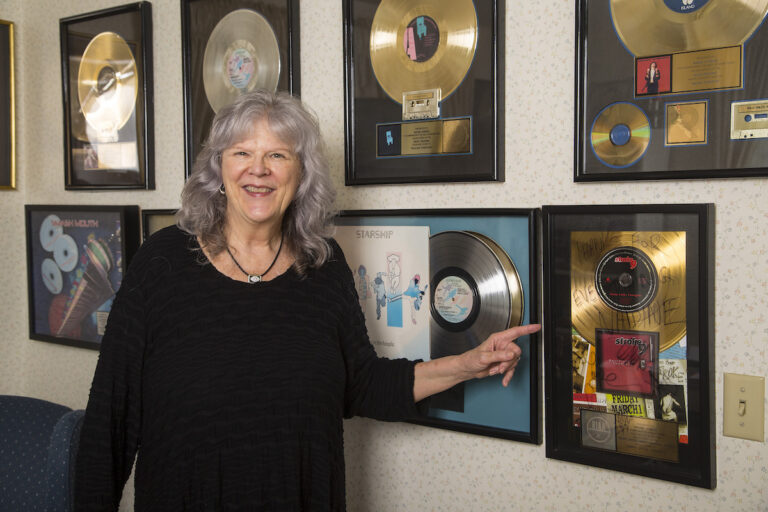
Condon slipped away from Gravenites and his high-powered studio, where she played backup, so to speak, and eased into a productive relationship with Starship and Slick. She toured the world with the band, and, when Slick left Starship in 1989, Condon started her own company, dubbed herself “The Godmother of Rock“ and launched “Nadine’s Wild Weekends,” a time she animates so loudly in Confessions that you can feel the beat bounce of the pages.

From 1998 to 2002, her increasingly wild “Wild Weekends” attracted superstars, as well as not so famous talents. They showcased 130 bands that stormed 20 venues. Condon had successfully branded herself and worked with Melissa Etheridge and Elton John’s Rocket Records. After that climb to the top of the rock pyramid, there was really only one thing to do, and that was to take a bow, say goodbye and exit the music scene.

“Grace offered me a template,” Condon says. “I thought that rock ‘n’ roll would be my whole life, but I watched Grace and saw that I could bring out a softer side of myself. She became an artist and painted wonderful portraits of people and whimsical rabbits, lots of rabbits.” No surprise that from the woman who gave audiences “White Rabbit,” that boasts the words, “Feed your head,” which recreates the Alice in Wonderland story and that Slick sang at Woodstock in 1969.

As a girl, Condon imagined herself wearing a habit, becoming a nun and devoting herself to the service of others. So, it wasn’t a huge shift to go from rock ‘n’ roll, sex and drugs to helping the homeless and working with people in hospice who were near the end of their time on the Earth. In one of the last sections of Confessions, Condon describes her current vocation as a spiritual helpmate to the dying and the severely ill. In the chapter called “Wisdom Keepers,” she says her life is one of “Practicing kindness.” She adds, “Kindness is my motto.” Her stellar work, which linked her to Grace Slick, has taken her, she says, “into a state of grace.”

Condon doesn’t miss the biz. Well, maybe “the expense accounts and the excitement.” Nor does she bemoan the loss of a Golden Age of Rock, which she says existed from about 1960 to the early 2000s when tech took over the city.

“Yes, San Francisco is different today than it was when I was in the thick of it,” she says. “It’s always morphing, and it’s always a city of opportunity. Right now, it’s in a chrysalis stage. The city that gave the world the wealth of the Gold Rush, the tycoons, Jack London, the dockworkers, Harry Bridges, the Beats, the hippies and the techies has something under its sleeve.”

How does she read Starship’s infectious words, “We built this city on rock ‘n’ roll”? “I take them metaphorically,” Condon says, her feet keeping the beat of a tune on her turntable. “San Francisco attracts people on the cutting edge. Always has and always will. Every time I come back here after traveling elsewhere, I kiss the ground.”

The city’s rock hasn’t been the same since the glory days, but there are rumors of a rock revival. Drummers, guitarists, harmonica players and more haven’t vanished. During the week, they’re at work making money so they can pay the bills. On weekends and on weekday evenings, they make music in garages, cafes and clubs, reminding themselves and audiences that rock ‘n’ roll is here to stay, though perhaps not to pay the way it once did.

‘The Only Truth is Music: Readings From Music Writers,’ 7:30pm, Friday, Oct. 21, The Make-Out Room, 3225 22nd St., San Francisco.

Professor Harold Hill Comes to Rohnert Park

American musical theater doesn’t get any more old-fashioned than it does with The Music Man. Broadway is currently hosting a revival of Meredith Willson’s melodic tale of con man Harold Hill and Marian the Librarian, but North Bay audiences looking to travel back to turn-of-the-century River City, IA need only head to Rohnert Park. The Spreckels Performing Arts Center is hosting a production through Oct. 2.  

Con man “Professor” Harold Hill (Benjamin Ball) barely escapes a train full of angry traveling salespersons whose reputations he has sullied with a variety of scams and swindles. He finds himself in River City, where the residents are ripe for the picking with his latest confidence game of forming a town band. 

Prim librarian Marian Paroo (Julianne Bretan) sees through him. But when she witnesses the positive changes brought about by Hill’s machinations in her shy and withdrawn little brother, Winthrop (Dakota Dwyer), she starts to see Hill in a different light. Will it be tar and feathers for one or wedding bells for two?

It’s tough not to smile through the big slice of Americana served up here by director Michael Ross. The show is bright, the score is bouncy, the costumes are colorful, and the cast is a great mix of North Bay veterans and energetic young performers.

Marian is the perfect role for Bretan, as she brings one of the Bay Area’s best voices back to the Spreckels stage. Ball makes for a solid Hill in his North Bay debut, though I do wish he brought a little bit more bombast to the character.

Veteran performers like Jill Wagoner (Marian’s mother) and Mike Schaeffer (Mayor Shinn) nicely fill out supporting roles, and there’s a great quartet (Michael Arbitter, Sean O’Brien, Tim Setzer, Cordell Wesselink) singing harmony throughout the show.  

A multi-generational ensemble of performers brings energetic support to the show that’s especially entertaining in the larger, Bridget Codoni-choreographed musical numbers.  

Janis Dunson Wilson expertly leads the live orchestra through such classics as “Ya Got Trouble,” “Wells Fargo Wagon,” “Til There Was You” and, of course, “76 Trombones.”

There’s an on-going debate over whether shows like The Music Man and their portraits of idyllic, small-town America are relevant in today’s world. There’s little debate, though, that at its heart, The Music Man is a very entertaining show.   

‘The Music Man’ runs through Oct. 2 in the Codding Theatre at Spreckels Performing Arts Center, 5409 Snyder La., Rohnert Park. Thurs-Sat, 7:30pm; Sun, 2pm. $12–$36. 707.588.3400. spreckelsonline.com

Free Will Astrology

ARIES (March 21-April 19): Poet Susan Howe describes poetry as an “amorous search under the sign of love for a remembered time at the pitch-dark fringes of evening when we gathered together to bless and believe.” I’d like to use that lyrical assessment to describe your life in the coming days—or at least what I hope will be your life. In my astrological opinion, it’s a favorable time to intensify your quest for interesting adventures in intimacy, to seek out new ways to imagine and create togetherness, to collaborate with allies in creating brave excursions into synergy.

TAURUS (April 20-May 20): Social reformer Frederick Douglass (1817-1895) had a growlery. It was a one-room stone cabin where he escaped to think deep thoughts, work on his books and literally growl. As a genius who escaped enslavement and spent the rest of his life fighting for the rights of his fellow Black people, he had lots of reasons to snarl, howl and bellow as well as growl. The coming weeks would be an excellent time for you to find or create your own growlery, Taurus. The anger you feel will be especially likely to lead to constructive changes. The same is true about the deep thoughts you summon in your growlery: They will be extra potent in helping you reach wise practical decisions.

GEMINI (May 21-June 20): “Conduct your blooming in the noise and whip of the whirlwind,” wrote Gemini poet Gwendolyn Brooks. I love that advice! The whirlwind is her metaphor for the chaos of everyday life. She was telling us that we shouldn’t wait to ripen ourselves until the daily rhythm is calm and smooth. Live wild and free right now! That’s always good advice, in my opinion, but it will be especially apropos for you in the coming weeks. Now is your time to “endorse the splendor splashes” and “sway in wicked grace,” as Brooks would say.

CANCER (June 21-July 22): “Don’t look away,” advised novelist Henry Miller in a letter to his lover. “Look straight at everything. Look it all in the eye, good and bad.” While that advice is appealing, I don’t endorse it unconditionally. I’m a Cancerian, and I sometimes find value in gazing at things sideways, or catching reflections in mirrors, or even turning my attention away for a while. In my view, we Crabs have a special need to be self-protective and self-nurturing. And to accomplish that, we may need to be evasive and elusive. In my astrological opinion, the next two weeks will be one of these times. I urge you to gaze directly and engage point-blank only with what’s good for you.

LEO (July 23-Aug. 22): Tips to get the most out of the next three weeks: 1. Play at least as hard as you work. 2. Give yourself permission to do anything that has integrity and is fueled by compassion. 3. Assume there is no limit to how much generous joie de vivre you can summon and express. 4. Fondle and nuzzle with eager partners as much as possible. And tell them EXACTLY where and how it feels good. 5. Be magnanimous in every gesture, no matter how large or small. 6. Even if you don’t regard yourself as a skillful singer, use singing to transform yourself out of any mood you don’t want to stay in.

VIRGO (Aug. 23-Sept. 22): In the coming weeks, you should refrain from wrestling with problems that resist your solutions. Be discerning about how you use your superior analytical abilities. Devote yourself solely to manageable dilemmas that are truly responsive to your intelligent probing. P.S.: I feel sorry for people who aren’t receptive to your input, but you can’t force them to give up their ignorance or suffering. Go where you’re wanted. Take power where it’s offered. Meditate on the wisdom of Anaïs Nin: “You cannot save people. You can only love them.”

LIBRA (Sept. 23-Oct. 22): Buddhist monk Thich Nhat Hanh was born under the sign of Libra. He said, “The root-word ‘Buddha’ means to wake up, to know, to understand; and he or she who wakes up and understands is called a Buddha.” So according to him, the spiritual teacher Siddhartha Gautama who lived in ancient India was just one of many Buddhas. And by my astrological reckoning, you will have a much higher chance than usual to be like one of these Buddhas yourself in the coming weeks. Waking up will be your specialty. You will have an extraordinary capacity to burst free of dreamy illusions and murky misapprehensions. I hope you take full advantage. Deeper understandings are nigh.

SCORPIO (Oct. 23-Nov. 21): I invite you to be the sexiest, most intriguing, most mysterious Scorpio you can be in the coming weeks. Here are ideas to get you started. 1. Sprinkle the phrase “in accordance with prophecy” into your conversations. 2. Find an image that symbolizes rebirth and revitalization arising out of disruption. Meditate on it daily until you actually experience rebirth and revitalization arising out of disruption. 3. Be kind and merciful to the young souls you know who are living their first lifetimes. 4. Collect deep, dark secrets from the interesting people you know. Employ this information to plan how you will avoid the trouble they endured. 5. Buy two deluxe squirt guns and two knives made of foam rubber. Use them to wage playful fights with those you love.

SAGITTARIUS (Nov. 22-Dec. 21): There’s an ancient Greek saying, “I seek the truth, by which no one ever was truly harmed.” I regard that as a fine motto for you Sagittarians. When you are at your best and brightest, you are in quest of the truth. And while your quests may sometimes disturb the status quo, they often bring healthy transformations. The truths you discover may rattle routines and disturb habits, but they ultimately lead to greater clarity and authenticity. Now is an excellent time to emphasize this aspect of your nature.

CAPRICORN (Dec. 22-Jan. 19): Let’s imagine you are in your office or on the job or sitting at your kitchen table. With focused diligence, you’re working on solving a problem or improving a situation that involves a number of people. You think to yourself, “No one seems to be aware that I am quietly toiling here behind the scenes to make the magic happen.” A few days or a few weeks later, your efforts have been successful. The problem is resolved or the situation has improved. But then you hear the people involved say, “Wow, I wonder what happened? It’s like things got fixed all by themselves.” If a scenario like this happens, Capricorn, I urge you to speak up and tell everyone what actually transpired.

AQUARIUS (Jan. 20-Feb. 18): To honor your entrance into the most expansive phase of your astrological cycle, I’m calling on the counsel of an intuitive guide named Nensi the Mercury Priestess. She offers the following advice. 1. Cultivate a mindset where you expect something unexpected to happen. 2. Fantasize about the possibility of a surprising blessing or unplanned-for miracle. 3. Imagine that a beguiling breakthrough will erupt into your rhythm. 4. Shed a few preconceptions about how your life story will unfold in the next two years. 5. Boost your trust in your deep self’s innate wisdom. 6. Open yourself more to receiving help and gifts.

PISCES (Feb. 19-March 20): Author Colin Wilson describes sex as “a craving for the mingling of consciousness, whose symbol is the mingling of bodies. Every time partners slake their thirst in the strange waters of the other’s identity, they glimpse the immensity of their freedom.” I love this way of understanding the erotic urge, and recommend you try it out for a while. You’re entering a phase when you will have extra power to refine and expand the way you experience blending and merging. If you’re fuzzy about the meaning of the words “synergy” and “symbiosis,” I suggest you look them up in the dictionary. They should be featured themes for you in the coming weeks.

Open Mic: Sonoma County Supervisors to review living wage law

microphone_matt_botsford_unsplash
The Sonoma County Board of Supervisors will finally revise the county’s Living Wage Ordinance approved in 2015 at their Oct. 18 meeting. Three fires and one flood since 2017 have delayed reconsideration of the ordinance, which a coalition of labor, environmental, faith and community-based organizations have long urged. The law applies to county workers and employees of large county...

Two Democrats spend $1.2 million in fight for North Bay Assembly seat

Sara Aminzadeh and Damon Connolly
Two Democrats are waging a costly fight to represent the North Bay in the state Assembly. In the June primary, Democrats Sara Aminzadeh and Damon Connolly took 36.2% and 37.1%, respectively. The district, newly numbered 12, covers all of Marin County and the southern half of Sonoma County. Aminzadeh has taken the lead in fundraising, raising $620,111 this year through Sept....

‘Macbeth’ Sequel in Mill Valley

There is an old Scottish proverb, “Eiridh tonn air uisge balbh.” Roughly translated, it means, “Waves will rise on silent waters.”  Equal parts threat and hope, the concept that change, hope and danger come out of the seeming calm is at the dramatically beating heart of Dunsinane, the Marin Theatre Company’s season-opening collaboration with Tamalpais High School’s Conservatory Theatre Ensemble...

Annual Dia de los Muertos Exhibit Goes Multicultural

The new exhibit at the Petaluma Arts Center, “Honoring Life: Love and Remembrance,” takes a multicultural approach to display the ways various cultures deal with the death of loved ones. How a culture celebrates its dead profoundly affects how the people of that culture treat the living and commit to their own lives. Perhaps this explains the broader resonance of...

Portrait of a West County Family

On a recent Monday afternoon, I showed up at a local West County residence with a promising lead on a story.  Rumor had it that the barn contained antiquated, steampunk-ish machinery once used to run an apple-processing warehouse. On the phone, Jeff Hergenrather, 74, owner of the farmstead, had told me, “Well, you might not get what you’re expecting. You...

SMART agrees to expand role of community oversight group

Following years of criticism for a lack of transparency, the North Bay’s public rail agency has agreed to expand the powers of a volunteer oversight board. In a June report, the Sonoma County Civil Grand Jury recommended the Sonoma-Marin Area Rail Transit (SMART) clarify the role of the agency’s Community Oversight Committee (COC), in an effort to improve public trust...

Social Capital Burns Bright

Playa life connects people in ‘default’ When the temporary metropolis of Burning Man is disassembled without a trace on the playa, the participants in Burning Man, known as Burners, head back to “default,” another word for everywhere else.  Behind the founding of Burning Man nearly 40 years ago was the intention to create and spread new ways of living. What is...

Confessions of Oakmont’s Nadine Condon

In the early 1970s, Nadine Condon found herself alone on a street in St. Louis, not far from her hometown.  She stopped in her tracks and listened to a stranger warble the lyrics to Jefferson Airplane's hit single, "Someone to Love."  “I was already a big fan,” Condon says at her Oakmont home, where she lives with husband and heartthrob, Mark,...

Professor Harold Hill Comes to Rohnert Park

American musical theater doesn’t get any more old-fashioned than it does with The Music Man. Broadway is currently hosting a revival of Meredith Willson’s melodic tale of con man Harold Hill and Marian the Librarian, but North Bay audiences looking to travel back to turn-of-the-century River City, IA need only head to Rohnert Park. The Spreckels Performing Arts Center...

Free Will Astrology

ARIES (March 21-April 19): Poet Susan Howe describes poetry as an "amorous search under the sign of love for a remembered time at the pitch-dark fringes of evening when we gathered together to bless and believe." I'd like to use that lyrical assessment to describe your life in the coming days—or at least what I hope will be your...
12,123FansLike
4,995FollowersFollow
6,928FollowersFollow