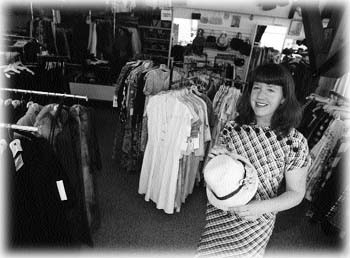
Les Claypool

0

Gone Fishin’

Sportin’ Life:
Les Claypool
debuts his
solo project
Aug. 23 in
Petaluma.

Photo by Gemm LaMana

Primus’ Les Claypool goes solo

By Greg Cahill

LITTLE DITTIES. That’s what bassist Les Claypool–head honcho for the Grammy-nominated thrash-funk group Primus–calls the songs on his new solo album. “I’ve always had some sort of a porta-studio in my house and have accumulated quite a few tapes filled with jams, ramblings, and whatnot,” explains Claypool, who recorded most of the tracks at Rancho Relaxo, his home near the Sonoma County coast. “Our manager has been on my case for a while to compile them into some sort of a record.

“I still have barely scratched the surface, even though there are 15 songs on it.”

The result is Les Claypool and the Holy Mackerel’s Highball with the Devil (Interscope), a surrealistic set of “pure self-indulgences”–lyrically cartoony, sonically hallucinogenic song sketches laced with smatterings of twangy surf guitar, early Pink Floyd psychedelia, herky-jerky rhythms, and abstract jazz stylings.

For the new solo project, set for an Aug. 27 release, Claypool invited friends to send material and used a revolving lineup of players. Former Black Flag front- man Henry Rollins came through with a biting spoken-word piece, “Delicate Tendrils.” Drummer Jay Lane of Sausage lends “fat-ass beats” to several tracks, including “The Awakening,” a little-known bass and drum rave-up by late soul singer Otis Redding’s son Dexter. Guitarists include Bay Area jazzman Charlie Hunter, Joe Gore of the Tom Waits band, and Mark Haggard of M.I.R.V., who plays a bowed electrified hand saw on “Cohibas Esplenditos.”

Claypool plans only a handful of solo concerts, citing a desire to stay close to his newborn son, Cage Oliver. But he will perform Aug. 23 at the Phoenix Theatre in Petaluma. Over the years, that punk/ska emporium has been a favorite of his. In 1993, Primus previewed their headlining Lollapalooza show there and later filmed the John the Fisherman video at the Petaluma venue.

“We have a pretty strong history with the Phoenix,” Claypool says. “I thought it would be a good place to go back to again.”

Two years ago, Claypool–an avid fisherman–and his wife moved from Berkeley to Bodega. “It just kind of happened,” he says of his decision to settle into a rural setting–a move that seems appropriate when you consider that Claypool often stalks the stage wearing a straw hat, cackling like a crazed hillbilly, and evoking a sort of farm-boy-on-acid persona. “I didn’t know much about the area until I moved up here. We all knew that Bodega is the place where Alfred Hitchcock filmed The Birds. But I never really spent much time up here, though Primus used to do shows at the River Theater in Guerneville and then the Phoenix.

“That was back in the good old days,” he notes, adding with the mischievous chuckle that often punctuates his conversation. “As long as you’re smiling, it’s a good old day.”

THESE DAYS, Claypool is busily auditioning drummers, following the recent announcement that Tim “Herb” Alexander has quit Primus. “It was something we had talked about for a long time because it seemed like [the relationship] was drifting farther and farther apart and Herb wanted to take the band in a different direction,” says Claypool, noting that he maintains a close relationship with Primus guitarist Larry LaLonde. “He was unhappy and that was making the rest of us unhappy, so it was a long time coming.

“It was like a marriage that just went bad.”

Alexander’s departure means that Primus will be moving in a different musical direction. “Well, it’s not something that you can put your finger on,” Claypool says about the change. “I’ve always felt that the band had become a little more progressive than I ever wanted; I never wanted to be in a progressive rock band, but Primus was leaning in that direction. So I’ll be happy to see it not go in that direction on the next record.”

Those “little ditties” that dominate the Holy Mackerel project and occasionally surface on Primus records may serve as a signpost for Primus’ new direction. All Claypool can say for sure is that he wants to feel good about collaborating with the new drummer. “It’s always an amazing thing when you sit down with somebody that you can click with,” he says. “When you sit down with a musician–no matter how good they are–and don’t click, it’s just not fun. But when you can do that consistently it’s great.

“That’s what I’m always striving for, just to enjoy myself when I play.”

Les Claypool and the Holy Mackerel perform Friday, Aug. 23, at the Phoenix Theatre, 201 Washington St., Petaluma. M.I.R.V. and Saturn’s Flea Collar open the show. $12. 762-3566 or 762-3565.

From the August 15-21, 1996 issue of the Sonoma Independent

This page was designed and created by the Boulevards team.
© 1996 Metrosa, Inc.

Tom Ribbecke

0

High Strung

By Gretchen Giles

EVEN PETE TOWNSHEND, the Who frontman famous for splintering his axes all over the stage in a fury of youth, would think twice about smashing a Ribbecke guitar. And it’s doubtful if Tom Ribbecke would ever make him another if he did. Each of them created during the labor of one month’s time and crafted from wood that Ribbecke calls “the gems of the earth,” these guitars can’t be bought from the music center down the street, and require such intense personal interaction between maker and client for the creation of tonality and voice that smashing one would be tantamount to taking a significant portion of one’s salary and dreams and stomping wickedly upon them.

Priced from between $5,000 to $20,000, these completely handmade instruments bring together a Zen synthesis of woodworking expertise, physics, people skills, and business smarts that satisfy the soul. “It’s a pretty romantic living,” Ribbecke admits, standing in the light-shafted, sweet-smelling order of his Healdsburg studio. “It’s a wonderful discipline, it’s a spiritual discipline. It’s physics and alchemy and marketing, and it’s something that you do with your hands.”

A luthier by profession for some 23 years–“That’s a highfalutin way of saying guitar maker,” he chuckles–Ribbecke is just one of the many instrument artisans who will be represented at the Healdsburg Guitar Makers Festival Aug. 21-23. Ribbecke’s specialty is the creation of jazz-oriented arch-top guitars that bell upward for a distinctive sound. “You think of people like Wes Montgomery and George Benson when you think of arch-top guitars,” he says.

A self-professed “fair to middling guitarist,” Ribbecke used to balance his making with his playing. Now he stays strictly on the aproned side of the stage. “About two years ago,” he recalls, “I had a six-week gig down in San Jose over Christmas, and on Christmas Eve–during my fifth week of doing this four nights a week–I was looking out over the audience, and it was a piano bar, and some guy threw up his gin and tonic on my feet. You know, who are you going to see in a bar on Christmas Eve except the most dysfunctional? It was like the Star Wars bar scene. I looked at those people, and I looked at myself and said, ‘I’ve got to stop this, I’m getting too old for this particular environment.’

“After that, I just sort of hung it up.”

Looking around his workshop, he elaborates, “This is too demanding. This takes so much of your spirit.” Now Ribbecke sells to players and collectors, recently returning from an L.A. trip where he sold two of his specialty instruments to pop-phenom Seal.

“Professionals are buying the guitars, and professionals are funny,” he says, “because they don’t really like to pay for them. I’ve just had a wonderful experience, though, with that guy Seal. He ordered two guitars, paid full price–a wonderful gentleman, intelligent focus. Guys like that are rare. Most artists get discounts for endorsing big companies. If you look at the other segment of the market, it’s baby boomers and jazz musicians.”

Because Ribbecke won’t discount for endorsements, he also prefers not to drop the names of his other clients.

While Ribbecke is clearly on a quest for perfection–a goal that he admits is impossible–he probably wouldn’t spend 12 hours a day, six days a week in his workshop if it weren’t for his materials. Pointing up to the loft rimming half his studio, he says “If you look at all the wood up there, I’ve had some of these woods for 10 years, sometimes 15. It’s like wine. One piece of that wood up there is about $250, and it’s not only that, but it’s the search for the wood. Instrument woods are the gems of the woodworking world . . . and this material here is so rare that it’s a privilege to work with.”

Picking up a guitar body backed in mahogany, Ribbecke applies a small amount of naptha fluid to the surface. The deep golden, rippling patterns and tone of the material immediately spring to life. “This is the most extraordinary wood I’ve ever seen,” he says reverently. Hewn from a tree felled some 75 years ago because it blocked the entrance to a silver mine being dug near a Mayan temple, the wood has an extraordinary quality of grain that makes this “the one tree of its kind ever found in its category,” according to Ribbecke. “A friend of mine found this tree about 30 years ago in Belize. He was drinking with some miners down there and was looking for wood, and they said, ‘You want to see a tree, we’ll show you a tree.’ Well, he saw this tree–he was a wood dealer from Sausalito–and knew immediately what it was worth, and helicoptered it out at huge expense.

“Personally speaking, I don’t use this material just for money, I use it only for the best client,” he says, stroking the guitar’s back. “And this is something from the jungle, this is just gorgeous. See the huge, reptilian patterns. This is magnificent stuff. When you have a chance to work with wood like this, the money is irrelevant. The thrill is that this is the best that the earth has to offer. I think that you’ll find with the best guitar makers, most have incredible reverence for their materials.”

Later, Ribbecke says philosophically, “It’s a great thing to do with your life, but it’s not brain surgery. You know, I’m not solving the problems in the Middle East. I’m making guitars.”

The Healdsburg Guitar Makers Festival runs Wednesday, Aug. 21, through Friday, Aug. 23, with workshops from 9 a.m. to noon and luthier exhibits from 1 to 5 p.m. at Villa Chanticleer. Adjunct events include flamenco guitarist Mark Taylor Aug. 21 at 8 p.m. at the Mark West Winery; the Acoustic Café concert Aug. 22 at 8 p.m. at the Raven Theater with Alex de Grassi, Sharon Isbin, Alvin Youngblood Hart, and the Hot Club; and jam sessions Aug. 23 at 9 p.m. with Richard Prenkert at the Flying Goat Coffee Roastery Café, and at 9:30 p.m. with Tom Ribbecke at the Bear Republic Brewing Co. For details, call 431-1814.

From the August 15-21, 1996 issue of the Sonoma Independent

This page was designed and created by the Boulevards team.
© 1996 Metrosa, Inc.

Vampires

0

Interview with the Vampires


Photos of Third Street vampires by Janet Orsi.

Role-playing bloodsuckers invade Sonoma County

By David Templeton

NIGHT HAS FALLEN completely over Third Street in downtown Santa Rosa. The sky is black and moonless. The streetlights glow dully, casting cottony shadows upon the walk, as four chattering moviegoers bound from the neon innards of the nearby theater. Nodding cordially to a threesome of diners who have just exited the restaurant next door, they are now joined noiselessly by a uniformed, homeward-bound cashier from an ice cream store down the street.

Without ceremony, barely aware of one another’s presence, this unofficial group all proceed together toward a common destination: the cavernous parking garage only a few short yards behind the theater. Stepping into the narrow corridor that leads to the Comstock Mall courtyard, the pedestrians begin to move across the alley and into the garage. Suddenly, they freeze in their tracks.

“What the hell is that?” mutters one of the theatergoers, as a tall, black-caped phantom, pale of face and graceful in movement, steps out in front of them, bowing formally.

“Good evening,” he whispers, and with flurry of his cape, folds himself around a corner, disappearing once more into the darkness. In the shadows beyond, similar figures are visible now, moving about mysteriously in the gloom.

“Vampires,” coughs the cashier.

Vampires?” laughs one young woman. “Jesus!”

“They come downtown on Sunday night,” explains the cashier with a weary nod. “You kind of get used to it.”

VAMPIRES. In Sonoma County. Hundreds of them. It’s true. The cultural progeny of novelist Anne Rice, their numbers have been growing steadily for over a decade. They have kin in San Francisco, San Jose, Santa Cruz, Pleasant Hill, Los Angeles, San Diego, and across the world. Many of these vampires are unrecognizable as such, they look like you or me, while others are more, shall we say, conspicuous.

A varied lot, they are enthusiastic slaves to the peculiar tenets of un-dead culture and gothic kitsch. Most of them are in their teens or early 20s. The serious ones observe a dress code: black tights, black cape, frilly collar, white-face optional, half-inch fangs a definite plus. Some are mere dabblers, “weekend vampires,” as it were. Among these are the fangy exhibitionists described earlier, a group of 80-plus young people that gathers each week in various locations around the county, participating in a complex, internationally popular vampire-themed role-playing game. It has become so popular, in fact, that the imposing bunch was politely asked by the city of Santa Rosa to relocate from their long-held Courthouse Square location. Eager to please, they relocated to the Comstock Mall, one street over, where they are now free to role-play in relative obscurity.

Falling between these two poles of Dracula-like existence are myriad murky gradations of otherworldly behavior, including certain artists and musicians, vampires of the mind who, in a spirit of whimsical social displacement, are the authors of some remarkably creative works of art. There is vampire poetry, vampire fiction, and vampire true confession. There is vampire dancing, vampire painting, vampire performance art, and vampire rock and roll. There are vampire rituals, vampire support groups, vampire dentists, and vampire shopping networks. Even the Internet has been invaded, with upwards of a thousand websites and chat groups devoted to all things .

It must give one pause. Though the myth of vampires is nothing new–the immortal little bloodsuckers have been a part of humankind’s folklore for centuries–it is only recently that vampires have become bona fide role models.

Has the world really become this weird?

The only appropriate answer is, well, yes, it has.

SMITTY WAS ALREADY dead,” smolders Cisco McKeever, dressed in rags and hungry for blood. “He never asked to be brought back from the dead, only to be killed again. He never asked to be chased down the street and then have his heart ripped out!” McKeever, enthusiastically consumed with revenge, is playing the part of an influential member of the vampire clan Malkavian, one of seven major clans described in the guidebooks for the role-playing game Vampire: The Masquerade (White Wolf Publishing).

McKeever is petitioning a group of fellow vampires to join her in an attack on poor Smitty’s destroyer, a fellow who, we are told, is part werewolf and who clearly does not want to die. Surrounded by Malkavians, Brujahs, Ventrues, Nosferatus, , and Toreadors, the werewolf battles fiercely for his life against a small army of attackers, a battle that takes the elegant form of . . . rock, paper, scissors. (He loses, but after a formal protest, is resurrected, no doubt to rip more hearts from the chests of unsuspecting un-dead people.)

The one-eyed Vampire Prince, played with dashing flair by Daniel Franco, glides up to find out what the fuss is about. “Well,” he says, observing the virtual carnage before us, “carry on then.”

As the prince wanders off again, one onlooking vampire comments, “This isn’t a democracy, you know. This is Roman fucking darkness.”

Without warning, a magic-using vampire, known as a Tremere, appears before us. Played by Pete Magnetti, the founder and organizer of the Sonoma County Vampyre group, he commands immediate respect from the players nearby, all of whom bow their heads before him. “Thunderstorm!” Magnetti shouts at one vampire. “If I don’t make it I lose 10 mental traits, but if I do I’ve got one kick-ass storm.”

He holds out a fist, as does the other. One, two, three. Magnetti’s paper beats his opponent’s rock. “Why did that Tremere just make a storm?” wonders Chris Piazzo, as Magnetti disappears.

Piazzo is the club’s official bookkeeper and, along with McKeever, is one of its earliest members. A full-time physics major at SRJC, he volunteers five to 10 hours per week to keep track of all the players’ successes and defeats, a job that cannot be simple.

As the evening develops, there are more battles and backstabbings as the Kindred jockey for more powerful social positions. At one point, it is announced that someone caused an explosion that has attracted the attention of federal agents, the leader of whom is played by Magnetti. While the agents argue with various people pretending to be vampires pretending to be people, dozens of players wander about with one finger pressed to their temple, a sign that they have made themselves invisible. Appropriately, everyone ignores them.

When a fellow with an outrageous Russian accent begins to murmur conspiratorially to a band of punkish-looking thugs, this reporter (apparently mistaken for a vampire who is pretending to be a reporter) is accosted by one of the thugs. When the vampire is told that the reporter is only observing, he points to the far side of the performance area. “Well,” he snarls, “you can observe better from over there!”

“He’s a Brujah,” McKeever explains later. “They’re supposed to act like that.”

Vampire: The Masquerade is the cornerstone of White Wolf Publishing’s immensely popular World of Darkness line of role-playing games. Launched in the fall of 1991 as a standard Dungeons and Dragons­type tabletop game, Vampire has quickly developed into the full-scale improvisational theater game that has made it one of the most successful gaming products ever, with dozens of books and related items. It even spawned a Fox TV series, the short-lived Kindred: The Embraced.

Vampire, as soon as it came out, struck some kind of nerve,” says Kris Nelson of Fantasy Books and Games in Santa Rosa. Among the first merchants in the county to offer the Vampire line, Nelson now counts them among his better-selling products.

“I saw this as being something that could become very popular with the Anne Rice crowd,” he nods. “But I had no idea how big it would get. I mean, who would have guessed that this many people would want to be vampires?”

“The vampire is a very romantic figure,” explains Magnetti, a professional dental technician (he designs dentures, and yes, he will custom-design a set of removable fangs) when he’s not refereeing his complicated multicharacter storylines. “The vampire is a figure that is at once both monstrous and tragic. They are victims, set upon by the one who embraced them and made them vampires. Though you are a predator, at the top of the food chain, and though you commit acts that are barbaric and hellish, you remember your humanity still. You remember what it was like to have human values.”

Though Magnetti does not deny that playing a vampire is a major part of the thrill of the game, he points out another reason that Vampire is so popular. “Its a very social game,” he suggests. “Face it, we live in a vastly impersonal society. We do not hold up the same values of civility and respect for one another that we once did. Strangely enough, while pretending to be vampires, we are also learning to deal with one another through specific rules of social conduct. Respect for our elders, for instance, and your basic, all-important politeness. Vampires, if nothing else, are very polite. What develops then, is a specific social interaction in which real friendships can begin.”

This is borne out in the stories of over a dozen players, who describe friendships, job referrals, even true love that have blossomed amid all the ghoulish pageantry and convoluted mythology. Magnetti has repeatedly stressed the word pretend, making it clear that he does not encourage acting out of the less socially acceptable aspects of vampirism. “Sometimes,” he laughs gently, “I’ll see someone who has begun obsessing on the game, trying to take it into the real world, and I’ll have to take them aside and say, ‘Hey, man! What are you doing? Get a grip. There is no such thing as vampires!'”

IT IS APPROACHING midnight. A slight chill has just begun to infiltrate the midsummer warmth of the evening. Within the “sacred grove” located behind the eerie Sonoma ranch house of artist/musician Stephen Buchanan, a small bonfire is crackling, sending spirals of smoke into a star-filled sky. Around the edges of the circular grove, two dozen or so people have gathered to participate in Buchanan’s monthly full-moon ritual and potluck dinner. Their garb and basic appearance are familiar, with the requisite capes, tights, and pale, powdered faces. With but one or two exceptions, all of those gathered here tonight are vampires.

Unlike their role-playing brethren, whom Buchanan and friends deride as “wannabes,” these individuals regard the title “vampire” with the utmost seriousness. One look at Buchanan’s permanently capped and pointed fangs, the result of his dentist’s specialized artistry, and you will know that he is not just playing a game. “I’m the real thing,” he smiles. “I am a vampire.”

Buchanan is the founder/director of , a highly regarded experimental theater group that is exclusively devoted to vampire-themed works. Last year, Buchanan staged his sensation-causing play Nosferatu before unsuspecting audiences in several countries. His next production, titled When Madness Is Salvation, is being readied for its October debut at the Valley of the Moon Winery, a recurrent spot for NeoDanze performances.

A painter, poet, and sculptor, as well as an actor and musician, Buchanan has reflected a vampire’s sensibility in his work since he was “converted” to vampirism about six years ago. His house is deliriously gothic, decorated with gargoyles and candles, huge shackles and chains adorning the walls, a terrarium with a pair of black widows. Then there is his artwork, giant paintings of draped and brooding men and women, all fanged and full of fun.

“I wanted a central theme that would tie all my art together,” he says, now gazing affectionately across the grove at his assembled companions. “When I found the vampire thing, it just sort of fit. It’s completely international, it’s completely ageless. It’s erotic and sensuous and very appealing.”

What is it, exactly, that Buchanan finds erotic about being a vampire? Is it the darkness of it, the danger of it? The promise of immortality?

“Yeah, it’s the darkness and the danger,” he nods. “And it’s also about biting somebody. Tasting their blood. There’s a powerful feeling in that. As for immortality, if you are an artist you already have that.”

He grins agreeably, the sharp points of those fangs just visible in his smile. Speaking of those fangs, Buchanan points out that the man who gave him his special bite is also his partner in an entirely different artistic venture.

“Every Wednesday I go to Alameda,” he explains. “And we do a cable access television show. My dentist is the producer. I’m the director. It’s called Canvas Cavity. It’s a combination of professional wrestling, dentistry, and vampirism.”

That’s must-see TV for darn sure. “Its the weirdest show you ever saw in your life,” he laughs, adding that the wrestling aspect has made it so popular that it is seen in 26 markets and five countries.

The moment of the full-moon ritual draws closer. Resembling a performance art piece with music, the ritual will consist primarily of the reading, in English and German, of a variation on an old druidic text, preceded by the clashing of swords and culminating in a loud, joyous yelp at the moon. But first, a casual mingling among the guests, many of whom are resting on prop coffins from Nosferatu, reveals several others who share Buchanan’s vascular notions of eroticism.

“The only people I drink from are willing participants, with similar interests,” explains one tall and slender fellow dressed in black, wearing a prominent crucifix around his neck. “People hear that and kind of freak out,” he shrugs. “But it’s not like I drain them dry or anything. Just a few ounces.”

At moments like this, one wonders if it is best to change the subject or to go ahead and ask the questions that are leaping to mind. Questions like, “Are you pulling my leg?” and “Aren’t you worried about blood-transmitted diseases?,” or even short ineloquent questions like “Why?”

“Why do I drink blood?” the tall man repeats as if the answer should be obvious. “Probably because we are not supposed to. Its a sin, right? And there is tremendous erotic power in the breaking of taboos. The taking of blood can also be a very sensuous, very loving thing.”

“Something else that is very important,” Buchanan interjects, “is the whole concept of light and dark. The balance between the two. We all hold them both within us. I am the darkness, as a vampire, but I am also the light, as a vampire. We hold the beast at bay.”

It’s true then. Undeniably so. The world has grown stranger.

And perhaps that is just the point, unconscious or not, that these unconventional souls are attempting to make. By meeting on lonely hillsides beneath the luminant moon, by flashing an occasional sharp-toothed grin, or by parading downtown in full view, they are saying, in effect, “Look up. Look around. The world is stranger than you think.”

Then again, any vampire worth his or her salt will quickly add that the world has always been weird, weird to the core. Weirder, wilder, and more beguiling than most poor mortals will ever know.

From the August 8-14, 1996 issue of the Sonoma Independent

This page was designed and created by the Boulevards team.
© 1996 Metrosa, Inc.

Sausages

0

Hot Links


DWIGHT CASWELL

Fat-free? Ha!: Frenchie White of Montibella Sausage cooks up a mess of tasty sausage.

Local chefs build a better banger

By Dwight Caswell

THE SETTING is a Farmlands Group wine and food tasting on the elegant grounds of Sonoma-Cutrer Winery. At the tables beneath large white umbrellas, with manicured croquet lawns in the background, wineries, restaurants, and other food purveyors serve Sonoma County’s famous cuisine. The grazing gourmands sip superlative chardonnays and sample organic breads, smoked scallop, eggplant pesto, sausage . . . Wait a minute: sausage? What is sausage doing here in the land of low fat and good health? Isn’t there some kind of county ordinance about that?

“It’s very low-fat sausage,” says Frenchie White, who is standing at the Montibella Sausage table. “See that?” He gestures at a modest amount of fat in his frying pan. “I’ve cooked 50 pounds of sausage today, and that’s all there is.”

Discreetly checking the package, I find the label bears him out. Montibella sausages rang from 7 to 15 percent fat. Not only that, they come in flavors like “Chicken with Potato and Sun-Dried Tomato,” “Lemon Chicken with Potato,” and “Spicy Pork with Potato.” And they’re good, very good.

The secret to the low fat content isn’t Olestra or some other chemical horror, but the humble potato. “I tried making sausage without the fat,” says Montibella owner Skip Lott, “but you could have pounded nails with the result.” The problem was that fat gives sausage its sinful texture and juiciness. Then Lott discovered the moisture-holding property of potatoes, and Montibella has done nothing but grow ever since.

The reason for that growth was not only Lott’s recipes, but his timing. “Designer sausage” has become a culinary trend, and over 100 kinds are now available in Sonoma County. Not all are as low-fat as Montibella’s, but they’re leaner than commercial sausages, which by law may be 50 percent fat (those breakfast links in the supermarket cooler are at least 35 per cent).

What designer sausages have in abundance, regardless of fat, is flavor and variety. Dream up a sausage flavor, and you can probably find it in Sonoma County. If not, you can find someone to make it for you.

Sausage makers have different philosophies about their craft. They all want to produce a product that is delicious and distinctive (usually without artificial additives), but there are three approaches to fat: (1) Substitute for fat; (2) use meat low in fat; or (3) the hell with fat.

Montibella represents the first approach, and there are several examples of the second. One of these is Martindale’s Quality Meats and Deli, where the first impression is an aroma delectable enough to tempt the most devout vegetarian. The cases are filled with meat of all kinds: aged beef and lamb, marinated sirloin, hickory-smoked ham. And row upon row of sausages, with those little butcher’s signs proclaiming, to list a few, “Smoked Chicken Broccoli with Cheese,” “Creole Style Smoked Chicken,” “Celtic Bangers,” and “Hawaiian Portuguese.”

That last one “is linguisa with roasted chilies,” says owner Ron Martindale, “only mine’s about 18 percent fat, half what it would be if you got it in Hawaii.” Most of Ron’s sausages are 10 to 15 percent fat, with the chicken sausages as low as 5 percent.

Ron and his crew make all his products in a spotless plant visible from the meat counter. Most of the recipes are Ron’s, and the flavors of even the spicy links (like “Meyguez,” an Algerian lamb sausage) are complex, not merely hot.

Ron keeps the fat low by personally selecting the finest meat available. “I won’t buy three fourths of the meat that’s out there. I’m looking for what was ‘choice’ 25 years ago.”

Making sausage, it turns out, is something like making bread. Bread is kneaded in order to break down the vegetable protein (gluten), and sausage meat must be “worked” while very cold to break down the animal protein (albumin). “If you do it right,” Ron says,” you don’t need a lot of fat or fillers. All you need is salt, seasoning, and a little water. If you don’t do it right, the texture is wrong. It falls apart when you cut it.”

Dave Ruedlinger of Food for Thought also disdains fat. “In the old days natural-food stores didn’t carry sausage, because they were made with meat byproducts and a ton of additives.”

But times have changed; no pork snouts or ears for Dave. “I use only pork sirloin, and for the chicken sausages we use only thigh meat, with no bone or skin.” Dave also uses Sonoma County products whenever possible, including Rocky the Range chicken and “Sonoma Lean” lamb. The result: 5-15 percent fat.

Another sausage maker who manufactures and retails in the same location is Oliver’s Market, where 10 varieties are made and sold, with Thai and the crowd-pleasing Chicken Apple Sausages topping the popularity list.

The “to hell with fat” approach is usually found among restaurants and caterers, where fat is less of a concern.

At Night Owl Catering, chef Barbara Hom began getting requests for sausage from her customers. Since she makes everything from scratch, she came up with her own recipes for “Moroccan Lamb” and “Thai Dungeness Crab” sausages (the latter is one third chicken and contains–the secret ingredient– peanut butter).

And at Healdsburg’s Mangia Bene Restaurant, chef Todd Muir makes delicious sausage from venison, and “spicy Italian sausage” with fennel and chilies. “Sausage isn’t supposed to be healthy,” says the outspoken chef. “I want a meaty, juicy sausage with good texture.”

Muir is not impressed with the proliferation of exotic flavors. “That’s California, always pushing the envelope,” he shrugs, “but do you like something because it’s different, or because it’s good?”

So-called designer sausages are available in such local markets as Petaluma Market, Fiesta Market, G&G, Montecito Market, Oliver’s Market, Sonoma Market, the three Food for Thought markets, Martindale’s Quality Meats and Deli, and Willowside Meats and Sausage Factory.

From the August 8-14, 1996 issue of the Sonoma Independent

This page was designed and created by the Boulevards team.
© 1996 Metrosa, Inc.

Stanley Mouse

0

Stormin’ Heaven

By Steve Bjerklie

THE MAN WHO helped create the most famous death icon in the world–the grinning skull and roses of the Grateful Dead–is talking about quite the opposite. “At one point there were hundreds all around me, shining and floating around,” says poster artist Stanley Mouse. “One would go by and I’d say, ‘Did you see her? Did you see the golden angel?'”

Three years ago the artist underwent a liver transplant. The angels began fluttering over his bed as he woke from surgery, and he hasn’t forgotten them. “Ah, Stanley,” says a friend in Mouse’s cluttered Sonoma studio, “you were having the good kind of hallucinations.” The gentle, soft-spoken Mouse concurs, “I feel completely great. This is just where I wanted to get to with drugs.”

Mouse, whose trimmed, mossy beard and scholar’s spectacles make him look a bit like a Bolshevik two or three decades after the Revolution–which is true, in a way–stares at an image of an angel even now. She’s an angel for Jacob to think twice about, occupying the center of the gorgeous poster Mouse has painted for his old friend Don Hyde. Below her is the advertisement for the benefit concert coming up on Aug. 11, at Hyde’s Raven Theater, a show to raise money to help pay legal costs generated by a flimflam LSD charge leveled against him. The benefit features Tom Waits, T-Bone Burnett, and Sam Phillips, among others.

“We’re using ‘Storming Heaven’ because the charges were dropped,” says Mouse, who seems genuinely amazed when it’s pointed out to him that this heavenly moniker is also the title of a book published a few years ago chronicling the rise and fall of, ahem, LSD. “Really? Well, wouldn’t you know.” A hint of a prankster’s grin lights his smile.

“The angel is a way of saying that this is a happy event.” A few minutes later, Mouse pulls out a print of the dark poster he drew for the first Hyde benefit, held last spring at the Paramount Theater in Oakland. On it, a woman lies encircled by a large snake. “Don was wrapped in coils back then,” Mouse smiles. The $100 ticket for Sunday’s benefit includes a print of the new poster.

With his longtime art partner Alton Kelley, and with fellow artists Wes Wilson, Victor Moscoso, Bonnie McLean, and the late Rick Griffin, Stanley Mouse ignited the poster renaissance in 1960s San Francisco, drawing brilliant, crazy art to promote rock-and-roll dance concerts.

The best pieces are insane group marriages of image, color, lettering, and whimsy. They still laugh out loud to the eye, reflecting the splendiferous exhibitionism of the hippie ballrooms. Originally tacked up on telephone poles and given away at the shows they advertised, these mint-condition first-edition posters now command hundreds of dollars from collectors.

Further, the original posters eventually led to commissions for album covers, and the Mouse/Kelly portfolio includes some of the most famous images in all of rock: the Grateful Dead’s “Workingman’s Dead” and “American Beauty” covers, and Journey’s “Infinity.”

Coming to the poster business indirectly, Mouse was by the early ’60s a hot-rod painting sensation, making his living painting cars and T-shirts at shows and fairs. Poking discreetly around, I find a nicely framed copy of Mouse and Kelley’s most enduring image, an Avalon poster from September 1966. The print is surprisingly small, 8 1/2 by 11. “That was the size of the original Avalon handbills,” he says. “I found the original image in the stacks of the San Francisco Public Library,” Created by 19th-century artist Edmund Sullivan as a woodcut to illustrate the 26th quatrain of The Rubaiyat of Omar Khayyam, this block print underscores the verse “The Flower that once has blown for ever dies.”

“I showed it to Kelley and said, ‘Here’s something that might work for the Grateful Dead.'”

It’s the skeleton and roses, of course. Thirty years after Mouse found it and made it the key element in the band’s powerful iconography, the shamelessly grinning skull wearing a crown of roses and admiring a pair of blooms still packs a punch. “You know, there are those who say that’s why the band lasted so long,” Mouse, the transplant survivor, says quietly. He pauses, but then comes another soft smile, a little wry, a little wistful. “Because of that image.”

Tom Waits and others appear Aug. 11 at 7 p.m. Raven Film Center, 415 Center St., Healdsburg. $100. Tickets at the Last Record Store, 525-1963 or 528-2350.

From the August 8-14, 1996 issue of the Sonoma Independent

This page was designed and created by the Boulevards team.
© 1996 Metrosa, Inc.

Talking Pictures

0

See No Evil


MICHAEL HELMS

Sinister scribe: ‘Dark Debts’ author Karen Hall offers her take on the celluloid scare-fest ‘The Frighteners.’

Karen Hall doesn’t scare easily

By David Templeton

Writer David Templeton takes interesting people to interesting movies in a quest for the ultimate post-film conversation. This time out, he talks with the unconventional, L.A.-based horror novelist Karen Hall (Dark Debts) about the clamorous, tacky new schlock-comedy The Frighteners.

WELL, I WENT and saw it,” confirms novelist Karen Hall, her gentle Georgian twang morphing smoothly into a soft, bemused chuckle over the phone. “If I had to choose between seeing this movie again and going through labor again–it would be a very tough choice.”

I see.

, from New Zealand director Peter Hall (Heavenly Creatures), concerns a burned-out ghostbusting con man (Michael J. Fox) who really can see spirits. When the Grim Reaper–or is it the Devil?–comes to town and starts ripping people’s hearts out, Fox is accused of the murders and so teams up with some deceased compadres to battle the Evil One, along with a nutcase FBI agent and the ghost of a serial killer, rising from his urn of ashes to continue the slaughter he was executed for. To call it all “campy” is being too generous; it’s got some loony energy, but on the whole, it’s a sad waste of good special effects.

“I actually read one review that gave it an A-minus,” Hall laughs. “I find this truly terrifying.”

Karen Hall doesn’t scare easily. A respected television writer and producer, she has just published what might be the most frightening novel of the year. Dark Debts (Random House, 1996), her first novel, is a captivating, extremely intelligent, well-crafted tale of a sexy Jesuit priest whose esoteric beliefs in evil are shattered when he comes face to face with the Devil, in the form of a demon that is systematically possessing and destroying each member of an entire family. Not your typical exorcism gorefest, Dark Debts is deeply, probingly spiritual: a page-turning, philosophical brainteaser that examines the nature of evil and the nature of faith, and dares to ask the question, “Just what the hell was God thinking about when he set things up this way?”

“Evil is something that I’ve been thinking about all my life,” says Hall, who comes from a fundamentalist Christian background. “I’ve read everything I can get my hands on. I’ve thought about it constantly. If God exists, then it doesn’t make sense for evil to exist, unless it’s OK with God, and if it’s OK with God, then I just don’t get it.

The Frighteners actually helped me understand a little bit about why I want to do what I want to do. See, to me, evil doesn’t work as a concept unless there is something more on the other side of it than just an aversion to evil.

“And this movie didn’t have any kind of dignity or humanity about creation that was glorious, so that it didn’t matter if anyone was destroyed. That’s why the movie was offensive to me.

“Good and evil are not some chicken-and-egg thing,” she goes on. “I think you have to understand good, at least a little, before evil makes any sense, before it is frightening. That’s why, in the book, there’s the dream sequence with the Guy in the Flannel Shirt (Jesus), whom I put in there even though a voice in my head was going, ‘People are going to read this and go screaming in the other direction!’ But it seemed right to me. If I had this personification of evil, I wanted a personification of good. Putting him in a flannel shirt was just common sense. Jesus didn’t come down here in some halo. He was hanging out with hookers and outcasts and guys who smelled like fish. He’d be somebody who’d just roll up his sleeves and get in there.”

She recalls the final segment of the film, where Fox is desperately battling his way through an abandoned hospital, trying to take the killer’s ashes to the consecrated ground of the chapel.

“I thought, ‘Now this is interesting. What are they going to do when they get there? Are they going to talk to God?’ ‘Cause up to that point there was no mention of anything good enough to balance out the all the evil.” Her hopes for a spiritual catharsis were dashed, however–the crazy FBI agent shows up just in time to trigger more messy FX. They never even make it to the chapel.

“Evil is hip in Hollywood,” Hall muses. “And I don’t know why.” She laughs again, saying, “I am now going to obsess about this for the rest of the day. Good is always shown onscreen as being either unattainable perfection or just kind of wimpy. But I believe in a real earthy kind of goodness. I think goodness can contain flawed humanity.”

It is clear why Hall was uncomfortable with the black-and-white fundamentalism of her youth.

“I’ve spent a lot of time ranting at fundamentalists,” she says. “It’s one of my causes in life. To me they represent everything that Christianity was never meant to be. They’re like a photo-negative of Jesus.

“I have one insane Jesuit friend, and he says, ‘You know you’ve created God in your own image when he hates all the same people you do.'”

She laughs. “I just have a hard time believing in a God who is less compassionate than I am.”

From the August 8-14, 1996 issue of the Sonoma Independent

This page was designed and created by the Boulevards team.
© 1996 Metrosa, Inc.

Textbook Case

0

By the Book

By Gretchen Giles

IT TAKES a whole village to raise a child. At least that’s what those of us with children in elementary or high school are being taught right now. Multiculturalism is in in a big way, from the cast of Sesame Street strategically strung out along racial-, gender-, and abilities-oriented guidelines to Coca-Cola ads that threaten to never show a white face, to textbooks that generally include the beliefs and achievements of indigenous peoples along with the triumphs of traditional European exploration.

For many parents, particularly the guilty white-liberal species among which I count myself as a member, this is a favorable trend.

Scientist Bill Bennetta agrees. He just wishes those texts that form the foundation of the teaching tools in middle school and high school classrooms told the truth.

“Most often, schoolbooks are distorted, twisted, and turned inside out not so much by commission as by omission,” says Bennetta, the president of the Textbook League, a non-profit watchdog group that publishes a bimonthly analytical newsletter reviewing new texts on history, science, human sexuality, geography, and social studies. “Because what these [publishers] really try to do is to expunge through a process of self-censorship anything that might offend anybody anywhere.

“The result is bland mush that has no meaning as science, as history, as geography, or as anything else because it has been trimmed and shorn, not only of reality,” he laughs while seated in his comfortable Petaluma kitchen, “but of the things that to any normal person represent some of the most important ideas that ever were.”

In Bennetta’s view, “This process has been, in the past couple of decades, very strongly slanted to favoring and catering to the Right,” he continues, citing Christian revisionism of texts, particularly those in Texas schools. “But now what we’re seeing is a completely analogous process that seeks to cater to the Left, and it is in the Left that we locate the multi-culti crazies.”

Like a Rush Limbaugh of the middle ground, Bennetta–a journalist with an advanced degree in chemical engineering and whose Ph.D. work in biology is just short of a thesis–is merely getting warmed up.

“Multi-culti is a racist movement,” he asserts. “If you look at it, again and again, for these people culture is a code word for race, and cultural is a code word for racial.”

That’s just how it is, he adds later. “I could give you one or two or three examples, but that wouldn’t make my case,” he explains. “I’m telling you that my inference is based on hundreds of examples.”

Bennetta’s examples include stock, thoughtless sentences found within many of the textbooks that line his home. These dispense such misinformation as that dosages of ginseng root are equivalent to a doctor’s checkup and assertions that Native American peoples invented irrigation, leaving a student to believe that they were the first and only ones to invent such a farming practice. There also are inaccurate comparisons of Hopi architectural practices with University of Iowa experiments in cooling systems, and questionable graphics that equate the spiritual sense indigenous Americans had of the earth with the scientific findings of core and mantle.

“There’s no reason why a biology book couldn’t have a chapter devoted to a history of different agricultural practices,” he reasons, “and show how many different peoples all over the world independently struck upon many similar, basic ideas, irrigation being one of them. That is exactly what is not done.

“To deliberately distort this stuff to glorify discredited ideas and people who simply were not able to cope with anything and were swamped when they did meet up with people who knew something about nature, this is a horror. It’s all being done to deny and suppress the fact–the grand, overarching fact–that a single intellectual tradition, invented only 500 years ago by a bunch of Europeans, revolutionized the world.”

Claiming that “the multi-culti types hate science” because it was invented by such dead white guys as Galileo and Kepler, Bennetta sees the multicultural movement in education as anti-intellectual and anti-scientific, one that rejects proven scientific tenets in favor of a jumble that includes Western empirical knowledge tossed freely with native mysticism.

“If we look it at in the realm of science,” he says, “what we find are repeated, consistent efforts in book after book to equate primitive superstitions with scientific findings, to suggest that weird, pre-scientific ideas about nature are equivalent to, or just as good as, scientific findings based on evidence and reason.

“If kids do not understand what science is, and the idea of learning about nature on the basis of evidence and reason,” Bennetta says emphatically, “apart from all of that other nonsense that from the beginning of time has held people in thrall–superstition, ignorance, and supernaturalism–then kids don’t have a chance.

“That’s what I’m so upset about.”

From the August 8-14, 1996 issue of the Sonoma Independent

This page was designed and created by the Boulevards team.
© 1996 Metrosa, Inc.

Arts & Crafts Time

0

Feeling Crafty

By Gretchen Giles

I AM A BAD MOTHER. I’ll admit it. Not that the kids are starving or being beaten or forced to sleep outside in the rain or denied schooling or hugs or books or videos or tree forts or popsicles or garden plots. They have all of those things. To borrow from Judith Viorst, what makes me a terrible, horrible, no-good, very bad mommy is crafts. You know, those happy moments that the magazines assert should be spent together as a family unknotting yarn, catching uncapped glue bottles as they edge off the table, and scrubbing ink off the walls. All the while trying to confine the glitter merely to the reaches of the entire spread-out protection of the Sunday paper, keep the egg dye from turning khaki with mixtures, and refereeing the inevitable brawl over the single red crayon left in the box.

Take this small test to determine if you are a similarly bad parent:a. Arts and crafts–a fine term for an artistic movement, resulting in some really terrific lamps.

or

b. Arts and crafts–a terrifying three-word term for 10 a.m. wine lust and tearfully constructed holiday presents.

AS AN EMPHATIC b, it seems only natural for me to seek help. After all, a craft impairment is a terrible thing to visit upon other generations. The madness must stop here, before my sons find themselves as grown men doing the rainy-day shout of “Dammit, if you’re not going to watch that TV, I’m going to turn it off!” at their own kids, rather than calmly setting out the playdough.

Once upon a time, before the dragons of Proposition 13 slayed the California school programs, the arts were emphasized in the classroom. And, as any modern parent who has ever considered buying an extra refrigerator simply for the additional gallery space knows, there are still plenty of art projects being done at school, at least elementary school.

Kindergarten is practically nothing but the glory of tempera paints and the fast whir of plastic-handled scissors slicing up the alphabet. That flood of creative fervor trickles upward to the sere flat plane of high school, where most kilns are cold and photography dark rooms have long been shuttered. If you want your budding Brancusi to have additional training but can’t do it yourself without feeling an irresistible irritable urge, what do you do?

On campus, many local schools offer after-hours enrichment programs partially funded by the PTA, featuring everything from leatherwork to computer classes for a nominal fee. Additionally, there are programs at the YMCAs, Boys and Girls Clubs, and various Community Centers, such as the one in Sonoma.

Petaluma boasts a new Children’s Art Center, co-founded by Laura Bussey and Kate Tatum, two mothers who found that demand for their artistic enrichment program at the local McNear Elementary School was so successful that they wanted to offer it to the whole community. “There aren’t a lot of choices, outside of athletics, for children,” says Bussey, on a short break from teaching art while her summer-session kids pound out a dance lesson behind her.

“If you have a kid who’s more cerebral than physical, what do you do?” she asks.

Her answer is the Children’s Art Center, where she and Tatum offer a full slate of performing and visual arts classes during after-school hours for children ages 2 to 14. Begun in the spring of ’95 with a small blessing from the city, the art center has grown quickly.

“People are definitely looking for this,” says Bussey. “They see much less art in public and private schools.”

In addition to maintaining the center, Bussey and Tatum are also glad to dispense advice, recently attending a Mother’s Club meeting to offer tips to new moms on how to survive the slings and arrows of outrageously messy art projects.

“Think of your level of tolerance and then provide that much,” says Bussey. “Papier-mâché may make too much of a mess for you, but we can all tolerate crayons.”

Linda Galletta, the director of the Sebastopol Center for the Arts, tolerates more than crayons. Her center offers everything from fabric art to a loosely structured open studio. Serving some 500 kids a year, the center offers sliding scale and scholarship options for lower-income families. “The arts center has always felt that art for children is very important,” she says. “It takes a lot of my time to develop the funding, but it’s something that we feel fills a need, and there is a demand, and our role is good.”

After listening politely to my moans about the craft infractions I have inflicted on my kids, Galletta says kindly, “We also offer a class for parents and teachers who want to do more with crafts.”

Perhaps there is hope, after all.

Children’s Art Center of Petaluma, 415 Western Ave. 762-5680. Sebastopol Center for the Arts, 6821 Laguna Park Way. 829-4797.

From the August 8-14, 1996 issue of the Sonoma Independent

This page was designed and created by the Boulevards team.
© 1996 Metrosa, Inc.

Virtual Vittles

0

Virtual Vittles


Janet Orsi

Eat your words: From alligator stew to zucchini boats, the Internet is an index to the kitchen.

Using the Web to find that perfect recipe

By David Templeton

THE PARTY INVITATION arrived unsurreptitiously in the morning mail, along with a stack of coupons and grocery ads and a promotional disc for yet another Internet software service. “Pirate’s Picnic,” the invite proclaimed. “Year of the Gator.” Cool. A piratical potluck, to be held on Angel’s Island. Guests requested to bring significantly themed edibles. The hosts would be cooking up a big batch of Alligator Jambalaya. Real alligator. Flown in from some weird meat supply service in Boston. “Them that dines will be the Lucky Ones,” it concluded.

I swiftly phoned in my R.S.V.P. and began to plan the menu. What could I bring to picnic that would blend thematically with Alligator Stew? A speedy flip through the pages of my vast cookbook library revealed nothing with the appropriate 18th-century theatricality.Suddenly I remembered that promotional computer disc. Didn’t the envelope scream the phrase “Online Recipes,” along with a list of other enticements? “Well, blow me down!” I said optimistically. “I’ll simply employ the greatest technological marvel of the 20th century, the Internet, to hunt me up and download me some palatable chow. It’ll be easy.”

But that was last week, and I was young and foolish then.

Online sites devoted to matters of food, it turns out, are far more abundant than I had expected. In fact, there is so much grub-related information available to those with the proper equipment, it rather spins the head.

There is a Virtual Kitchen, a Virtual Vineyard, and even a Virtual Lunch counter. Chat groups devoted to the authentic preparation of sushi are humming along with those offering tips for venders at Native American powwows, and hot-plate recipes for dormitory-bound college students. Slick interactive magazines devote themselves to California cuisine, ancient Egyptian cooking, freshwater trout, and you-name-it. You can order wine, order cookbooks, and order a pizza, then download the menu of a restaurant across the county or across the world. A random search is great entertainment, but searching for something specific can be daunting. If you have the time and the energy, however, there is little related to cooking and food that you won’t find. But be warned: There is plenty of junk food on the shelves of the virtual grocery store.

“Without putting the Internet down,” says Lawrence Sterling, of Iron Horse Ranch and Vineyard in Sebastopol, “two years ago you could go onto Yahoo and other browser services and put in the word ‘wine,’ and not that much would show up. Do it now and it goes on forever. And a lot of it makes you wonder if the people who put it there have a life.”

Two years ago, Iron Horse, with Sterling as enthusiastic cheerleader, joined forces with Peter Granhoff, the San Francisco webmaster behind the Virtual Vineyard , an online warehouse devoted to fine California wines. Net-surfing wine buyers can visit the Virtual Vineyard to ask about local wineries, find out which wine would taste best alongside a fillet of salmon, read reviews of wines from various wineries, and then hook up with specific wineries to get more information and even place orders.

Since it began selling wine over the Internet, Iron Horse has enjoyed a steady, if not spectacular, flurry of online business. “We’re quite content with it,” Sterling judiciously suggests. “It hasn’t replaced the neighborhood store. I don’t think it ever will. But we like it.”

Sterling’s sister, Joy, has also found the Web a useful place for members of the food industry. She contributes a monthly wine column to website. While the Virtual Vineyard is basically a store, the Kitchen is a full-fledged interactive magazine, offering a whole spate of informed columnists, along with beautiful graphics, recipe exchange forums, and a generous sprinkling of culinary humor.

In the Virtual Kitchen I discovered the “Dish Message Board.” Distracted by the message “Wanted: Easy Recipes for College,” I opened that link, where there were recipes for “Crockpot Meat Loaf,” “Easy Beefy-Roni,” and something called “Cheesy Chicken” that apparently involves Velveeta.

Fans of insects will be either delighted or appalled to learn of Iowa State University’s Tasty Insect Recipes page. How about some Bug Blox (Jell-O mixed with dry-roasted leafhoppers) or Rootworm Beetle Dip? Though I will always savor the thought of arriving at a party with a platter of Banana Worm Bread, I continued my search.

The surprises continued. I found a website full of Buddhist recipes; when I attempted to link on, I was repeatedly treated to a blank screen. Sensing a bit of Zen humor, I moved on to The Vegetarian, a magazine put online by the Vegetarian Society of the United Kingdom, featuring, among other things, Linda McCartney’s recipe for “Chili Non Carne” and John Cleese’s instructions for opening a box of corn flakes, with the odd final note: “Use Coca-Cola instead of milk. Add basil as required.”

Hours later, I discovered the Traditional Native American Recipe Page , with hundreds of entries describing everything from authentic posole and Indian Tacos to barbecued corn. Corn!

Detailed instructions on harvesting, husking, and barbecuing one to two truckloads of fresh corn, enough for a thousand hungry powwowians. I could cut the volume down to two dozen ears or so.

Finally, I’d hit pay dirt.

SURROUNDED BY the steamy aroma of simmering alligator flesh, I stood at the grill, turning my painstakingly prepared corn over the fire, the printed recipe folded in my back pocket. “Where’d you get the idea for this?’ someone asked. “I found it on the Internet,” I proudly confessed. “There’s a lot of interesting food info on the Web.”

“The Web, huh?” my friend smiled, sniffing at the roasting husks. “You should have called me and saved yourself the trouble. My grandmother’s been cooking corn like this for years.”

“That may be true,” I thought to myself, wondering why I didn’t just go to a bookstore instead of spending six hours in front of the computer. Then I thought of something that made me feel infinitely better. “Maybe so,” I replied, “but I bet your grandmother doesn’t know how to make Bug Blox!”

Ah, Brave New World that has such features in it!

From the August 1-7, 1996 issue of the Sonoma Independent

This page was designed and created by the Boulevards team.
© 1996 Metro Publishing and Virtual Valley, Inc.

Real Astrology

0

Heaven on Earth

Hands out: A taxi full of eager hands (and their attached humans) are glad to help Rob Brezsny unload a bit of his cash on a busy street corner.

Photo by Janet Orsi


Astrologer Rob Brezsny follows the signs to beauty and truth

By Gretchen Giles

BEARING a straightened-out cardboard box inked with the legend “I love to help, I need to give, please take some money,” astrologer Rob Brezsny stands at a freeway off-ramp stoplight holding out a dull-green bouquet of small bills. Clutching this fistful of cash, he approaches an unrolled window and leans in. “Would you like some money?” he asks in a low, seductive voice. As the driver tentatively selects one of the bills, Brezsny presses, “Take some more.” The driver refuses. In the 20 minutes that it takes to give away this $36 windfall, most people will refuse. Many motorists in beater-cars with cracked windshields and failing brake lights decline even the first bill.

But a black Mercedes pulls sleekly to the stop and the power window glides down. A slim, tanned arm emerges from the air-conditioned gloom of the interior. A diamond flashes in the glare of the sun as the fingers snap, impatient for a share.

An accident jams the intersection. Maneuvering around this small mess, one driver returns for seconds. Slowing, he gestures to the children in the back seat. “Could you give some to the kids?”

A man with a red face jams on his brakes. “Are you fucking nuts?” he shouts with the engorged jugular of the apoplectic.

Rob Brezsny just laughs.

EARLIER that day, Brezsny is seated on the overstuffed couch of a Marin bookstore dedicated to the higher order of the New Age movement. Three large paper bags full of tricks are lined up in front of him so that they just touch the toes of his black canvas semi-tennies. The dark greeny leaves of a bunch of fresh beets protrude from the top of one bag. He didn’t just come from the farmers market up the street. He needs these for the interview.

Brezsny, who writes the sage, witty, and wackily spiritual Real Astrology column that graces the back of some 90 alternative newsweeklies throughout the nation, doesn’t ordinarily do interviews. He doesn’t like to buy into what he terms “the cult of personality” that such recorded moments lead to. As the lead singer and chief songwriter for the passionately alternative and now disbanded World Entertainment Wars, he has had enough tape recorders poked up near his mouth to know that he doesn’t like it.

But this he likes. Because today we’re not going to just sit around and probe his marriage, dental habits, or age. This is no high exercise in journalistic discipline on my part. We’re not going to probe them because Brezsny simply won’t answer. He allows that he was born under the sign of Cancer, and that, yes, he really is a trained astrologer who does each week’s charts. He further grudges a marriage, a daughter, and the fact that he is trying to break himself of the habit of staying up all night and sleeping all day.

However, he has agreed to meet only because this is no chew-the-fat: This is a Bless-In.

His wiry, greying hair pulled into a ponytail off his face with the type of thick rubber band usually used to secure the Sunday paper, Brezsny rummages around in one of his paper bags. At his suggestion, this Bless-In will sanctify a number of “profane sites” with a few personal objects, items that we have separately chosen as curative symbols.

One such site is an abandoned, fenced-off, cement lot once used by PG&E. He would also like to visit a Lexus dealership, placing some small shrine to defract the mojo of what he sees as being a monument to flat-out crass consumerism. And then, of course, there’s the reverse panhandling. “I would like to have the intention of not being arrested today,” he grins.

Finding what he is looking for, he pulls a sheet of paper from one bag, a disc cut from a slender tree trunk glued on it. “If this had been five years ago, this is the fetish object I would have left, here in the back room,” he says, gesturing to the shrine area of the bookstore.

“This was sent to me by a reader one time,” he explains, “and it just says, ‘This is an extremely sacred object. Treat it with the utmost respect, and then burn it.’ My readers send me so many different things that I think that they’d almost appreciate it if I passed certain things on.”

BREZSNY has an unusual relationship with his readers. Most writers send their work off into the great void, rarely meeting up with anyone who will admit to reading it. If one does encounter such a soul, the response is often said in an accusatory tone: “I’ve read you.” This is why some writers drink.

But Brezsny probably isn’t someone who tipples. He doesn’t have time. Encouraging a very vital interaction with his audience, he offers weekly homework assignments at the end of each column–a feature not run by all papers–exhorting readers to write to him with fantasies and outrages, to send him fake money and mantras, and to just generally engage in the kind of sophisticated spiritual tomfoolery that makes Real Astrology such a gas. He also maintains a 900 number offering his own performance-art readings of his columns, as well as updating his Real Astrology website. Eavesdropping, dreaming, and input from his readers all swell what he admits are the “12 love letters” written to the sun signs each week.

“Part of why I seem so prolific creatively,” he says of the weekly column that he has been writing for the past 18 years, “is that I don’t have to rely solely on my own powers. I am receptive to the world around me, and I don’t have to do it all by myself.”

Later on he explains, “There’s something about the unusual interaction that I have with my readership. There’s some magic in that I’m always writing to you. I’m always writing love letters or greetings or salutations to the people out there, and I get a lot of mail, and I get a lot of phone calls, and so I have a really palpable sense of who’s out there. It’s a really high-value relationship, and it really feels like intimacy.”

Lotus seater: Seated before a shrine to Kali in the back room of a New Age bookstore, Brezsny exemplifies the prankster/guru dichotomy of his personal ethic.

A combination of prankster and guru, Brezsny is almost at home among the well-preserved middle-aged seekers with plenty of free afternoon time who are drifting around us in the bookstore, turning over volumes on tantric sex. A few customers have flowers tucked behind one ear, and more than one has a cellular phone parasitically attached to the other ear. Bookstore staffers wear flowing Eastern blouses, strategically cut low to reveal the curve of a breast or the proud grey hair of a chest fluffed up around a large medallion necklace. Low whiny music soothes the soul, and there is enough patchouli in the air to give an asthmatic the wheezes.

Yet on another occasion, Brezsny will dress up in what he calls his “huckster shaman rock star” outfit and literally stand on his head in the back shrine room.

As most beauty and truth fans know, Rob Brezsny is more than willing to kick his own ass.

“I regard the New Age with the same attitude as I do astrology,” he says. “I have gotten a lot out of it, and I feel a need to debunk it, to call attention to its excesses and superficialities. At the same time, I’ve obviously been nurtured by a lot of what’s been called New Age. That’s my running joke with life, to treat everything as if it’s about 70 percent worthy of belief, and about 30 percent worthy of total skepticism, and to borrow from them all. There are no idols.

“I feel like I’m caught between the high-court fundamental scientists, who say that there are no such things except those that we can see and feel and measure, and the high-court fundamentalist mystics, who believe that any manifestations of channeling or symbiotics must be true.”

DURING a midwinter’s midnight radio broadcast on a public station, Brezsny was heard seriously discussing his contention that Radio Shack franchises across America should be turned into menstrual huts for both men and women. In fact, he asserted, he is very much involved with the Male Menstrual Movement. The female radio host treated him with grave, quiet-voiced respect. Nary missing a beat, with a trace of humor coloring his voice, Brezsny began to hawk the book upon which he is still at work, A Feminist Man’s Guide to Picking up Women.

“Recently I had the inspiration to call it a docu-fiction memoir,” he says slyly now, looking away from the wheel as we drive toward the PG&E site. “It’s definitely experimental, but it’s a form that I hope is very entertaining at the same time. Without commenting too much, it’s a novel. A docu-fiction memoir disguised as a novel with equal amounts of truth and half-truths mixed in. It is in part a story about my life as a musician and of my initiation at the hands of numerous women over a period of time, climaxing in the kidnapping of me by members of the Menstrual Temple of the Funky Grail.”

And that is a real event?

“Yeah,” he says, shaking his head vigorously. “That’s the modern name for a group that is actually an ancient mystery school that predates Sumer.

“I don’t want to sound too megalomaniac,” he continues modestly, “but I am one of the few so-called lesbian men that has been chosen to receive this initiation.”

And just what is a lesbian man?

“Well, many things,” he chuckles. “It means embodying feminism as a man without becoming a wimp. It means holding the masculine sacred, but in such a way that the feminine is glorified and enhanced. It means being a macho feminist. It means promoting the feminine archetype and the redemption of the feminine mysteries which have been so degraded, promoting and working on that with a masculine, aggressive style.”

Later, he expands. “It requires mastering a certain understanding of the spiritual value of menstrual periods. This is a very complex subject, and I can’t do it justice. But I will say that the male body does not enforce a time-out for our psychic and physical growth. The male body–and therefore the psyche–can go on endlessly without having to check back in to the inner source.

“I don’t want to glamorize the menstrual period for women,” he says, “but one of the values that it could possibly have–I don’t think that it necessarily does have–is if there were a cultural context for it that would require a retreat to a sanctuary and a return to a communion and a conversation with the subtle self. My theory is an idealistic one, but to the degree that we don’t allow the collapse and don’t allow the retreat, and welcome and encourage it, it turns into crankiness, it turns into bad moods, it turns into fucking up and being mean to people. If we acknowledge that we need to have this regular communion with our shadow, then our shadow is not going to rise up and demand to be paid attention to.”

Brezsny actually has his period as we speak, not that I can tell. “It’s not always on a 28-day cycle,” he says, “but for the last two days, I’ve definitely been on my period. My body’s been telling me to shut down and withdraw, and,” he says–alluding to our Bless-In–“I can’t always accommodate that.”

He stops the car. We get out in front of PG&E’s forlorn, weedy wrack of abandoned cement and poles, completely encircled with cyclone fencing. “This is the ugliest site in Marin that I know of,” he says appraisingly. “I’m sure there are others, but I go numb every time that I pass it. I’m alienated from the land that it’s on, and I want to heal my alienation to it. I want to overcome my tendency to numb out and fall asleep every time that I pass it. Because when you get into the habit of going numb and falling asleep, it tends to get easier to do that in other aspects of your life.”

From the trunk, he hauls out two of his paper bags. The third contains nothing but a pile of $1 and $5 bills for his handout scheme. Squatting in the wind before the locked gate, we begin placing the artifacts for the shrine: a gold paper doily and gold petit-four wrappers that we weight with “magic rocks,” the shiny quartz kind that line driveways.

What makes them magic?

“I say that they are,” he returns with a smile.

To these he adds the bag of beets, a box of red crayons, candy wax vampire teeth, a light-up red bubble candle from the Christmas when he was 3 years old, the green tops from the persimmons that grow at his home, some walnuts, pre-formed Christmas ribbons, and an unwrapped Mozart CD. We thread four pinwheels through the linkage. I lay some purgative herbs tied in a bunch with party ribbon, and homegrown nasturium seeds, as well as a short poem that I have composed and torn up, dotted with my favorite perfume. Taking up one of the magic rocks, Brezsny–who is a published poet–grabs a Magic Marker and writes “Bathe in persimmon light” on one side.

Sitting back on his heels, he looks in pleasure at what we’ve arranged. “My interest is as much personal as it is in transfer,” he says. “If I can charge up the energy of this place in some mysterious subtle way, that’s great. But I’m also healing my own ignorance and numbness about it, and that’s part of the excitement for me. There are many different kinds of healing. Healing is to help someone who is sick. Healing is to eliminate the mental and psychic blocks or traumas that wound someone psychically so that they can’t function. And also, healing is to bring beauty and truth to a person or to a site, and that’s one that I like to think that I specialize in.”

NOT SURPRISINGLY, we get lost trying to find the Lexus dealership. A chance turn finds us face to face with a notorious thrift store. Knocking over a box inside, Brezsny stoops to find that disgusting little His and Hers sex-panties sized to fit dolls have spilled out. We buy them. He also finds a lint remover made by the ousted workers of one of GM’s Flint, Mich., plants, immortalized in the documentary Roger & Me. “A Flint Lint Remover!,” he cries. We buy that. He gets a delicate fan for his daughter, a wedding registry dated for his birthday in 1921, and an old Marvel comic book. We then perform the aforementioned reverse panhandle and return to the couch of the New Age hucksterism emporium where we met.

“Astrology was right up there with rock and roll in being responsible for saving my life, because part of my soul had started to shrivel,” he says. “When I was in high school, it was the Dionysian spirit of rock and roll and the mythological language of astrology that really gave me something to hold on to. They were institutions, not just some product of my imagination, and that gave me the idea that there were other traditions in this world that could sustain and could nourish.”

We get up and approach the shrine room. A tiny pair of gold sandals sit reverently outside the door. Going in, we set the Flint Lint Remover, a gold party hat, the tree-trunk letter, and a small gold-backed doll’s mirror from the thrift store among the Shiva statues and stone Buddhas. They look perfectly in place.

As we return to our cars, my reporter’s instincts are dismayed. Where did he grow up, go to college, love, marry, learn to ride a bike? How the heck old is he?

I have spent the greater part of one entire afternoon with Rob Brezsny only to find that he likes to eat beets and that he drives an abhorrently filthy car. In a pathetic, joking attempt to cull any small scrap of personal information, I have already promised not to ask him what type of toothpaste he uses. I turn sadly away.

Brezsny stops by his open door. “Hey!” he calls.

I look up hopefully.

“Interplak!” he shouts.

Then he grins, gets in, and drives away.

From the August 1-7, 1996 issue of the Sonoma Independent

This page was designed and created by the Boulevards team.
© 1996 Metrosa, Inc.

Les Claypool

Gone Fishin' Sportin' Life: Les Claypool debuts his solo project Aug. 23 in Petaluma. Photo by Gemm LaMana Primus' Les Claypool goes solo By Greg Cahill LITTLE DITTIES. That's what bassist Les Claypool--head honcho for the Grammy-nominated thrash-funk group Primus--calls the songs on his new solo album. "I've always had some sort...

Tom Ribbecke

High StrungBy Gretchen GilesEVEN PETE TOWNSHEND, the Who frontman famous for splintering his axes all over the stage in a fury of youth, would think twice about smashing a Ribbecke guitar. And it's doubtful if Tom Ribbecke would ever make him another if he did. Each of them created during the labor of one month's time and crafted from...

Vampires

Interview with the Vampires Photos of Third Street vampires by Janet Orsi.Role-playing bloodsuckers invade Sonoma CountyBy David TempletonNIGHT HAS FALLEN completely over Third Street in downtown Santa Rosa. The sky is black and moonless. The streetlights glow dully, casting cottony shadows upon the walk, as four chattering moviegoers bound from the neon innards of the nearby theater. Nodding...

Sausages

Hot LinksDWIGHT CASWELLFat-free? Ha!: Frenchie White of Montibella Sausage cooks up a mess of tasty sausage.Local chefs build a better banger By Dwight CaswellTHE SETTING is a Farmlands Group wine and food tasting on the elegant grounds of Sonoma-Cutrer Winery. At the tables beneath large white umbrellas, with manicured croquet lawns in the background, wineries, restaurants, and...

Stanley Mouse

Stormin' HeavenBy Steve BjerklieTHE MAN WHO helped create the most famous death icon in the world--the grinning skull and roses of the Grateful Dead--is talking about quite the opposite. "At one point there were hundreds all around me, shining and floating around," says poster artist Stanley Mouse. "One would go by and I'd say, 'Did you see her? Did...

Talking Pictures

See No EvilMICHAEL HELMSSinister scribe: 'Dark Debts' author Karen Hall offers her take on the celluloid scare-fest 'The Frighteners.'Karen Hall doesn't scare easilyBy David TempletonWriter David Templeton takes interesting people to interesting movies in a quest for the ultimate post-film conversation. This time out, he talks with the unconventional, L.A.-based horror novelist Karen Hall (Dark Debts) about...

Textbook Case

By the BookBy Gretchen GilesIT TAKES a whole village to raise a child. At least that's what those of us with children in elementary or high school are being taught right now. Multiculturalism is in in a big way, from the cast of Sesame Street strategically strung out along racial-, gender-, and abilities-oriented guidelines to Coca-Cola ads that threaten...

Arts & Crafts Time

Feeling CraftyBy Gretchen GilesI AM A BAD MOTHER. I'll admit it. Not that the kids are starving or being beaten or forced to sleep outside in the rain or denied schooling or hugs or books or videos or tree forts or popsicles or garden plots. They have all of those things. To borrow from Judith Viorst, what makes me...

Virtual Vittles

Virtual VittlesJanet OrsiEat your words: From alligator stew to zucchini boats, the Internet is an index to the kitchen.Using the Web to find that perfect recipe By David TempletonTHE PARTY INVITATION arrived unsurreptitiously in the morning mail, along with a stack of coupons and grocery ads and a promotional disc for yet another Internet software service. "Pirate's...

Real Astrology

Heaven on EarthHands out: A taxi full of eager hands (and their attached humans) are glad to help Rob Brezsny unload a bit of his cash on a busy street corner.Photo by Janet OrsiAstrologer Rob Brezsny follows the signs to beauty and truthBy Gretchen GilesBEARING a straightened-out cardboard box inked with the legend "I love to help, I...
11,084FansLike
4,606FollowersFollow
6,928FollowersFollow