What does Sonoma taste like? The area’s premiere tasting event has the answer. Taste of Sonoma, the annual juggernaut showcase of the best SoCo has to offer, includes a walk-around wine tasting, guided wine seminars (over 60 wine varietals from 19 unique growing areas!), garden tours, premium wine experiences, food trucks and themed lounges, among other sensual delights…like frosé at Rodney Strong Vineyard’s Destination Rosé Lounge. And so much more… Start early, stay for the day and post to pics to your Insta to inspire #SonoFOMO in your friends. Taste of Sonoma runs from 12 to 4pm (VIP Club Reserve ticket holders may come at 11am), Saturday, June 24 at Kendall-Jackson Wine Estate & Gardens, 5007 Fulton Rd., Santa Rosa. Attendees must be at least 21 years of age. No pets (service animals are allowed). Tickets are $180 to $245 and are available at TasteofSonoma.com.
Mill Valley
For Undead Heads
The Junction launches its first outdoor summer concert with Los Angeles-based instrumental supergroup Circles Around the Sun next Wednesday, June 28. The band was initially formed with the purpose of creating music for “Fare Thee Well,” a series of reunion concerts played by the surviving members of the Grateful Dead. The response was so positive that they continued. Revelers are encouraged to arrive early for dinner and drinks before the show. A free shuttle service is provided from the nearby Manzanita Park N Ride at Highway 101 at the Mill Valley exit. Doors open at 5 pm, show from 7 to 10pm, at The Junction, 226 Shoreline Highway, Mill Valley. Tickets are $30 and available at simpletix.com. For more information, visit thejunc.com.
Sonoma
Virtual Town Hall
Local radio KSVY 91.3 FM and SonomaTV will be hosting State Sen. Bill Dodd in another of his “virtual town hall” meetings at 6pm, Wednesday, June 28. Dodd will be joined by Lt. Gov. Eleni Kounalakis; University of California president Michael Drake; and Larry Galizio, president and CEO of Community College League of California. “We’re really proud to be able to present these town hall meetings to interested parties, as it aligns with our mission of keeping residents informed and educated with what is happening in their local government and gives people a chance to interact as well,” says KSVY program director Ronny Joe Grooms. The town hall will be streamed live on SonomaTV’s YouTube channel and broadcast over the air at 91.3FM and online at ksvy.org. Dodd and his guests will take questions via email and phone. The call-in line phone number is 707-933-9133. Interested parties can email questions as well to: to******@**vy.org.
Napa
Comedy Flashback
Comedian, actor, “most downloaded” podcast host and ’90s media stalwart Adam Carolla brings his comic stylings to Napa this Saturday. Here’s a refresher—Carolla was the co-host of syndicated radio call-in program Loveline with Dr. Drew Pinsky, as well as the show’s television incarnation on MTV through the late ’90s. He was also the co-host and co-creator of the cable TV venture, The Man Show with Jimmy Kimmel, as well as the co-creator of the early aughts puppet/prank call show Crank Yankers, which was reincarnated in 2019. His book, In Fifty Years We’ll All Be Chicks, debuted on The New York Times Best Seller list in 2010, and his second book, Not Taco Bell Material, also reached bestseller status. Carolla’s gig begins at 8pm, Saturday, June 24, at the Uptown Theatre, 1350 3rd St., Napa. Tickets are $35 to $45 and available at uptowntheatrenapa.com.
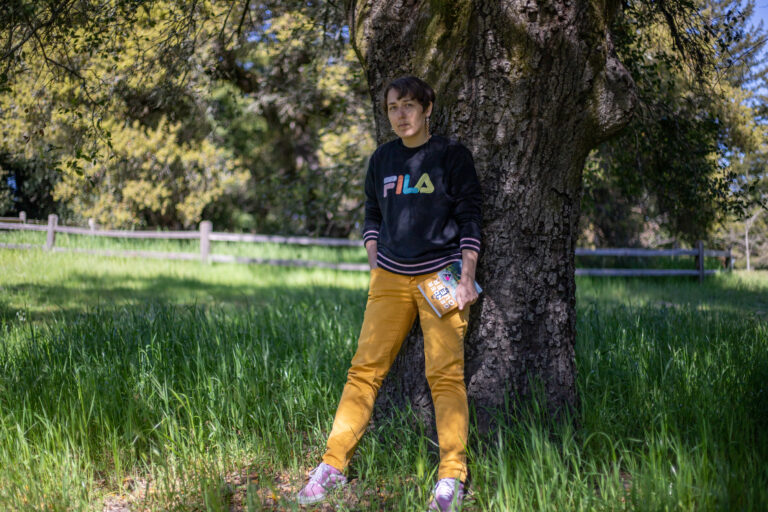
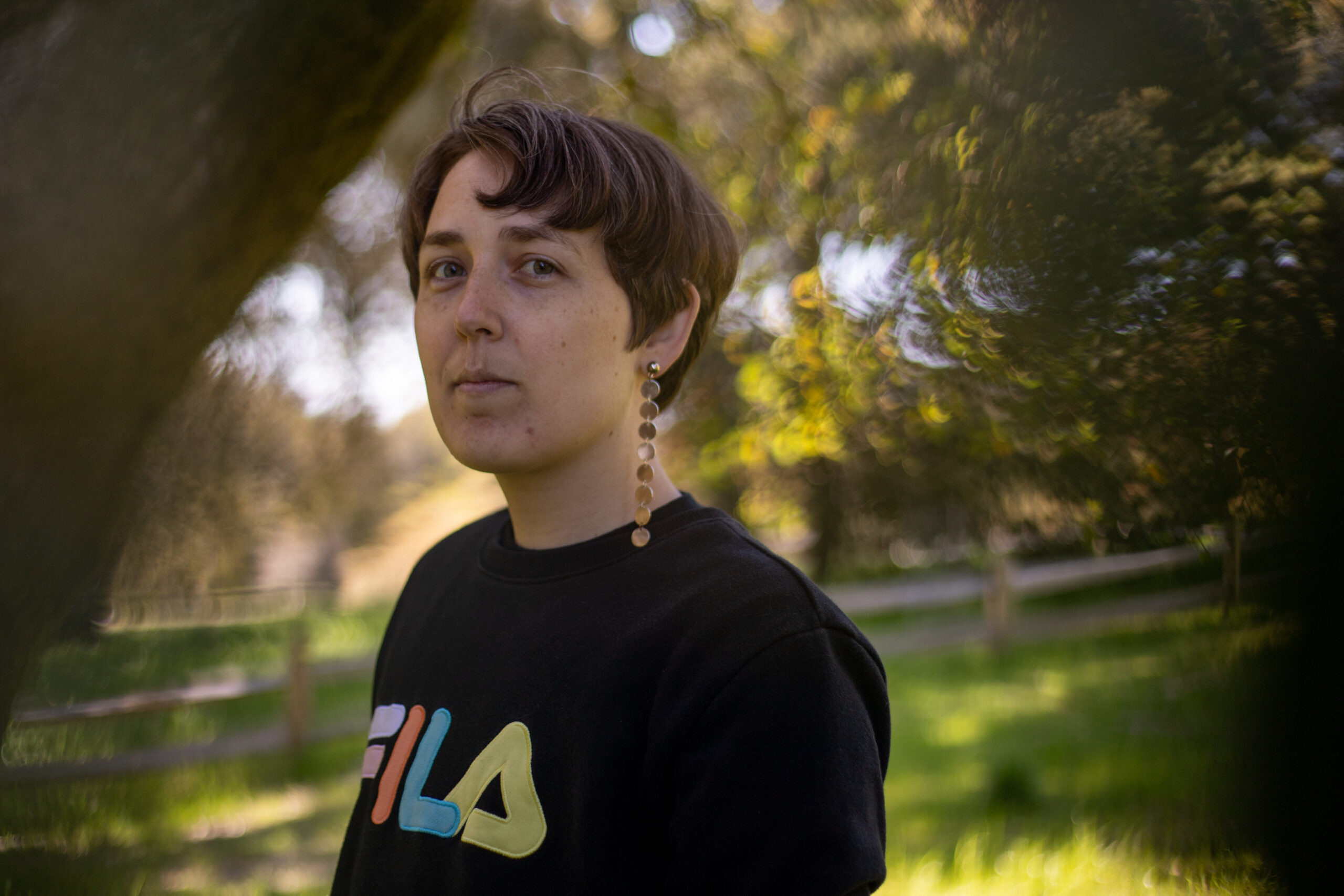
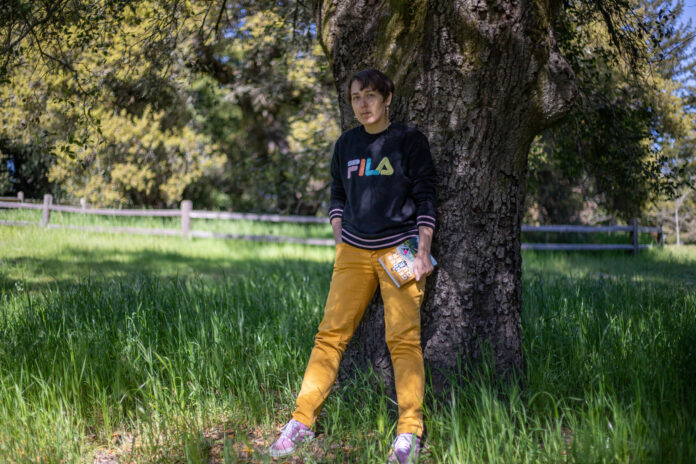
Maia Kobabe, author-illustrator of “Gender Queer: A Memoir,” sits atop a picnic table at Ragle Ranch Regional Park, eir legs perched on the bench. Kobabe (pronounced koh-BABE) pauses to point out birds during our conversation and to appreciate the laughter of kids at the nearby playground.
E wears one long earring that catches the dappled sunlight while we talk. Kobabe’s outfit—yellow pants, a black sweatshirt with the brand name FILA colorfully embroidered across the chest, the long earring—is familiar to me because e illustrated the look in a recent Instagram post showing off what Kobabe and eir friends wore to K-pop concerts last year.
K-pop and Sonoma County’s natural beauty are two things bringing Kobabe joy at a time that’s also caused em fear and fatigue. According to the American Library Association (ALA), “Gender Queer” is the most-banned book in America.
When it came out in 2019, “Gender Queer” was hailed as a powerful story, great resource and queer-comics classic. The first run of 5,000 copies sold out within a week.
Kobabe’s first book, “Gender Queer” is an illustrated coming-of-age autobiography about eir journey of self-discovery as a nonbinary and asexual person. The story chronicles Kobabe’s upbringing in rural Sonoma County and eir social experiences in grade school through grad school. E attended San Francisco’s California College of the Arts, where eir professor Melanie Gillman was the first openly nonbinary person e met.
Kobabe, now 34, depicts decades of dissonance between eir self-conception and society’s gendered expectations of em. During Kobabe’s childhood, eir parents never enforced gender roles on themselves or their children. E frequently felt like kids at school had access to information e lacked about things like shaving and using deodorant. Kobabe also struggled academically until e learned to read at age 11. This launched a lifelong love of books; from then on, e devoured fantasy books and later, queer stories.
“Gender Queer” palpably conveys Kobabe’s experience of gender dysphoria. Yet, what’s more striking is how well it also conveys instances of gender euphoria—profoundly positive experiences when Kobabe feels harmony between eir nonbinary identity and gender expression. Kobabe feels euphoria when e begins to use the pronouns e/em/eir and when e buys clothes that feel “queer and magical.”
Alongside eir exploration of gender, the book also documents Kobabe’s path of sexual discovery, from teenage crushes to masturbation to first times with a partner. Kobabe determines that e has a lower libido than most people e knows and that what arouses em in fantasy isn’t always enjoyable to do with a partner. Ultimately, Kobabe comes to identify as asexual.
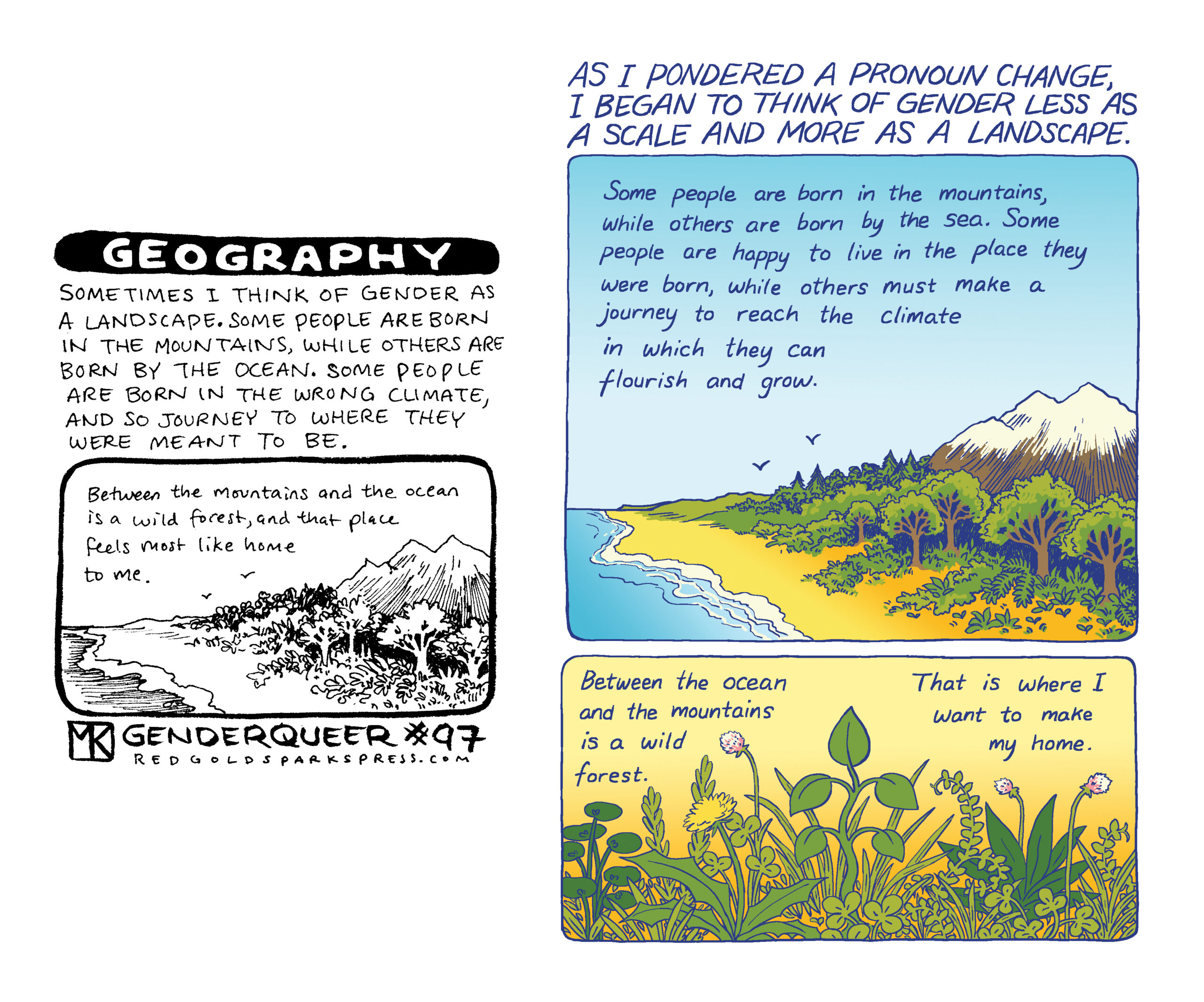
In 2016, Kobabe began creating black-and-white mini-zines called “Genderqueer.” Many pages from those zines later evolved into the book, “Gender Queer: A Memoir.” Courtesy of Maia Kobabe
“‘Gender Queer’ is the only time I’ve ever seen anything even remotely close to my identities,” says Alex Brown, a high school librarian, author and award-winning book critic who is genderqueer, asexual and aromantic.
“I came to [the book] long after I’d already come out, so it had no effect on my journey of queer discovery. But unless you’ve never seen yourself represented in media before, you don’t know how impactful representation can be. Maia and I dealt with so many of the same questions and concerns about relationships—both with others and with our own bodies—that I wish I’d had this book as a teen,” Brown says.
Stuart Wilkinson, a gay man who works as a teen-services librarian in Guerneville, calls “Gender Queer” a lifesaving work of art for LGBTQIA+ teenagers and adults.
“When you’re able to see yourself in a nonfiction book like this, especially a beautiful book to look at, I really do think this has a profound impact on mental health,” he says.
In 2020, “Gender Queer” won two major awards from the ALA—a Stonewall Honor in Non-fiction and an Alex Award, which recognizes “books written for adults that have special appeal to young adults ages 12 through 18.”
Then the challenges began.
As libraries and bookstores all over the country bought and displayed Kobabe’s celebrated work, conservative groups took notice, launching efforts to ban “Gender Queer” among a slate of other titles, mostly about LGBTQIA+ characters and characters of color.
Beginning in 2021, the ALA documented a massive surge in calls to ban or censor books in schools and public libraries. For nearly two decades, it tracked censorship efforts on fewer than 300 book titles each year; in 2021, more than 1,800 titles were under attack and by 2022 the number rose to more than 2,500.
Kobabe’s illustrated memoir was at the epicenter.
Kobabe says “Gender Queer” was especially susceptible to book challenges for several reasons—it was readily available in most libraries because of the awards it won, its title comes up immediately when one searches the words ‘gender’ or ‘queer’ and it’s a comic.
“Many of the biggest award-winning names in comics—‘Perspeolis,’ ‘Maus,’ ‘Fun Home’—are solidly books for adults, but there are people who see anything with pictures and think it’s a children’s book,” Kobabe says.
E also says books with pictures are vulnerable to misinterpretations that easily go viral on social media. Calls to censor comics are common enough that there is even a nonprofit organization, the Comic Book Legal Defense Fund, dedicated to protecting the First Amendment rights of the comics art form and its community. The organization issued a statement of support for “Gender Queer” when the challenges began.
“This nuanced memoir examines nonbinary gender identity in a way that benefits both those who identify as nonbinary and those who wish to better understand nonbinary identity,” the organization said. “In the case of ‘Gender Queer,’ challengers have taken a scant handful of out-of-context images to falsely assert that the graphic novel is pornographic and obscene.”
Ironically, having a banned book has come with some silver linings.
“Not every book that’s challenged sees sales increase, but mine did,” e says.
Articles about Kobabe appear in Time magazine, The New York Times and The Los Angeles Times, among other prominent publications. E has written opinion pieces for NPR and The Washington Post. E also has more speaking opportunities than ever before. In April, Kobabe traveled to Washington, D.C. to speak to librarians at the Library of Congress and to members of the Gay, Lesbian, and Allies Senate Staff Caucus.
“It’s given me a platform and a voice I didn’t have before. I’m trying to use that to the best of my ability,” Kobabe says.
Despite the personal successes the attention has brought, Kobabe wouldn’t choose to be in eir position.
“Saachi’s Stories,” Kobabe’s second book, is forthcoming on Scholastic Books’ Graphix imprint. E received offers from four major publishers. Photo by Chelsea Kurnick
Why are books under attack?
“I’m seeing all of these communities just completely tearing themselves apart over queer books and queer voices and, basically, whether or not they believe that queer and trans people are appropriate in the public sphere,” e says. “All of the personal benefits are pretty much outweighed by my fears over the rise of censorship, the defunding of libraries and all of the anti-trans legislation that’s being passed—limiting health care, bathroom access, sports team access and the teaching of history and pedagogy.”
E continues, “The wave of book challenges that started in 2021 was fueled by a very organized and intentional conservative push to make trans rights the new hot-topic talking point along with things like abortion and immigration,” Kobabe says.
E isn’t alone in characterizing book bans as part of a broader push against trans visibility and rights in the U.S.
In 2022, Randall Balmer, a Dartmouth professor of religion who researches evangelism in America, told The 19th* that the rise in anti-trans legislation is an effort to keep the religious right voting Republican.
“They have an interest in keeping the base riled up about one thing or another, and when one issue fades, as with same-sex relationships and same-sex marriage, they’ve got to find something else. It’s almost frantic,” Balmer said.
After same-gender marriage in the U.S. became legal in 2015, opposition to marriage equality quickly dwindled. Trans rights became the next issue to galvanize white evangelical voters, Balmer said.
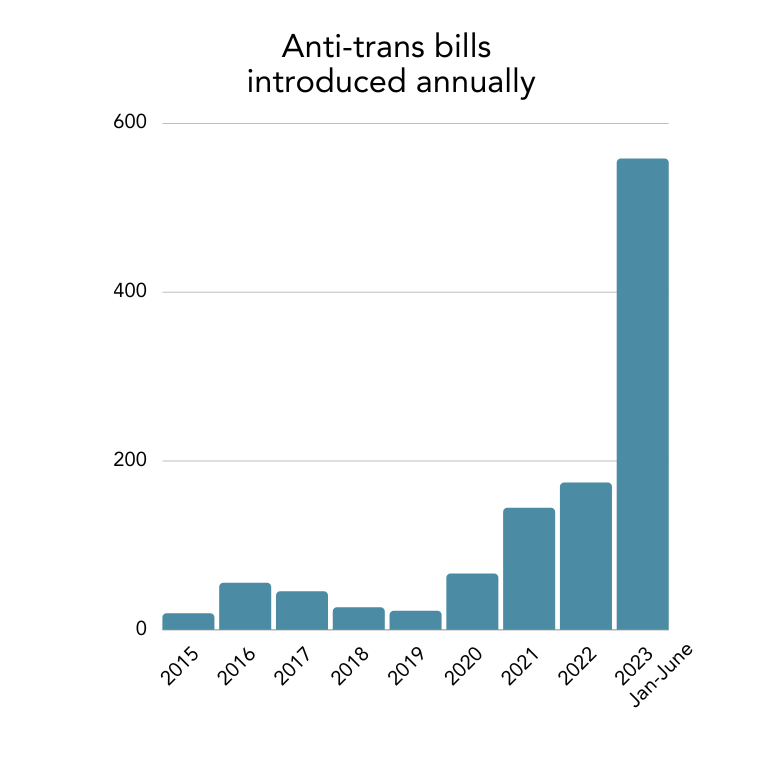
The website “Trans Legislation Tracker” counts 558 anti-trans bills introduced across 49 states in 2023 so far. This is an exponential surge since 2015-2019, when each year saw fewer than 60 anti-trans bills introduced nationwide.
A March 2023 PBS NewsHour/NPR/ Marist poll found a majority of Americans oppose anti-trans legislation, but as more bills are introduced, opposition to them is shrinking. For example, in April 2021, 65% of people were opposed to legislation that would criminalize providing gender-affirming care to minors, as compared to 54% in 2023.
“[Book bans] are able to ease in people who may feel confused by terms and identities that are new to them by making it sound like they’re just focused on books. But it’s never been about the books,” Brown says. “It’s about wanting to deny people options … forcing everyone into a cis-allo-heteronormative white supremacist box.”
According to Trans Legislation Tracker, 558 anti-trans bills were introduced in the first six months of 2023. In 2015, the year the Supreme Court legalized same-sex marriage, states introduced 19 anti-trans bills.
While the most numerous and most successful efforts to ban books have been in Texas, Florida and other majority- Republican states, local schools and libraries also face challenges. Last June, a national group called CatholicVote launched a campaign called “Hide the Pride” which instructed parents to check out all books from LGBTQIA+ Pride displays at libraries, then announce to the library that they won’t return the books unless the library agrees to remove “the inappropriate content from the shelves.”
The campaign made waves locally when the group targeted the Rohnert Park-Cotati public library, sharing photos on the CatholicVote website of an empty bookshelf. The library called it a censorship effort against their values.
Kobabe regards book bans as one effort among many to erode public services and human rights e says have long been taken for granted. “Book challenges were step one,” e says. “The ability of trans students to be safe in schools is step two. Completely eradicating trans healthcare—including for adults—is step three.”
Steps four and five, which e fears are forthcoming, would be the eradication of public libraries and public education.
In April, the Missouri House of Representatives voted to completely defund the state’s public libraries. Their decision was a retaliatory reaction to the Missouri Library Association and ACLU suing the state over a recent law that bans hundreds of books from school libraries and criminalizes school officials who don’t comply with the law.
Kobabe worked in an academic library for ten years and is passionate about the resources libraries offer people.
“Beyond access to books, libraries are one of very few places where you can get free WiFi, use free restrooms, even sit in the shade,” e says, adding that many libraries provide after-school care to kids and help adults with taxes and job applications.
“Not having a library really impoverishes a community,” Kobabe says.
In “Gender Queer,” Kobabe writes about how fashion helps em feel gender euphoria. Illustration courtesy of Maia Kobabe
What’s next for Kobabe?
This January, Kobabe announced eir forthcoming second book “Saachi’s Stories.” Written for a younger audience than “Gender Queer,” the new book is a graphic novel written in collaboration with nonbinary comics author-illustrator Lucky Srikumar. Scholastic Books’ Graphix imprint bought the rights to “Saachi’s Stories,” which is slated for release in 2025.
Between accolades and attacks, the continued spotlight on “Gender Queer” spurred a lot of interest in eir next book. “We showed the book pitch to six publishers and ended up getting offers from four of them,” e says.
Kobabe began a draft of what became “Saachi’s Stories” before the backlash to eir memoir started. After eir first book came out, Kobabe heard from many parents of queer and gender-expansive kids who asked if e would ever release a children’s version of the book. E wanted to respond to these requests, but re-working “Gender Queer” didn’t appeal to em.
“It felt weird to abridge my real, lived experiences, and I didn’t want to redo a book I had literally just finished,” Kobabe says.
Instead, e decided to write a new, fictional story geared toward a younger audience. Like “Gender Queer,” the new story is about gender, sexuality and exploring one’s identity. Kobabe first hired Srikumar to consult on writing the main character’s best friend as a first-generation Indian-American. After reading an early draft of the script, Srikumar instead suggested the story’s main character could be Indian-American. Kobabe loved their idea and asked if Srikumar would co-author the book.
“At this point, we’ve both worked on it so much, I couldn’t tell you who wrote many of the scenes. It’s been a very interwoven, collaborative process,” e says.
Kobabe is also working on a 32-page zine for transmasculine people about the physical and mental health effects of chest-binding. That project, written in collaboration with a researcher from University of Michigan, took about a year to create. E is nearly finished and beginning to pitch it to publishers.
“And then in the gaps when I’m waiting for editorial feedback on ‘Saachi,’ I have started writing the really rough outline of a third book. It’s a fantasy story that also has queer and nonbinary characters,” e says.
Backlash to “Gender Queer” has consumed a lot of Kobabe’s time and energy, but it hasn’t slowed em down ideologically. “If anything, it made me more determined to keep writing extremely queer stories for the rest of my life,” e says.
Kobabe urges other writers not to let book bans scare them away from telling authentic stories about their own minority experiences, whether that has to do with gender, race, disability, immigration status, neurodiversity or other aspects of intersectional identity.
“The publishers I’ve spoken to have made very firm statements about how they will not be censoring or refusing to buy these books out of fear of being challenged,” e says. “Don’t let fear silence you, because that is one of the goals of censorship—to cause people to censor themselves.”
To Kobabe’s allies, e advises, “Don’t fall into despair; we can’t afford despair. We need action.”
When Kobabe shares information to loved ones about anti-trans legislation or hate acts that make the news, e tries to pair the information with a suggested action they can take. Right now, for example, e suggests supporting the ACLU, which is fighting censorship efforts. Kobabe also asks people to write to government officials to voice opposition to the recently-introduced California bill AB-1314, which would require schools to notify parents when a student socially transitions gender at school.
Despite the challenges, Kobabe feels supported and embraced in the Bay Area, especially within San Francisco’s large queer-comics community. Locally, e credits the Charles Schulz Museum with fostering a cartoonist hub. When a Virginia politician attempted to sue Barnes & Noble for selling “Gender Queer” and another book he called obscene, Kobabe says Barnes & Noble in Santa Rosa reached out almost immediately to invite em to do a book signing.
“It was a lovely gesture of support,” Kobabe says.
Kobabe excels at finding respites from the stressors in eir life. Kobabe recently celebrated 20 years of reading at least 100 books per year.
And then there’s K-pop—popular music from South Korea that has amassed international fans and inspired reality TV shows, collectible pop star memorabilia, fan fiction, choreographed dance videos and more. “I’ve made more new friends recently through a shared love of K-pop than I have through any other venue since grad school,” e wrote in an Instagram post.
“I see live music and I also spend a lot of time with friends talking about album releases and music video releases and upcoming concerts,” e says.
Kobabe illustrates outfits e wore to K-pop concerts and shares the images on eir Instagram. Courtesy of Maia Kobabe
Even during the COVID-19 lockdown, the K-pop industry couldn’t be deterred. Kobabe says, “I saw, like, 30 concerts from my laptop in my bed. And it was great. It really gave me something to look forward to.”
In short comics Kobabe shares on Instagram, e writes about eir love of K-Pop and other fandoms. Whether writing about eir hobbies or the toughest experiences in eir life, Kobabe’s effervescence and authenticity are always apparent.
“I’ve realized how powerful it is to write your deepest truth—to say, ‘I did this,’ or ‘I felt this,’” Kobabe says. “People can argue against it, but they can’t refute it because it’s your truth and you’re saying it from the core of yourself.”
This article was published in collaboration with The Oak Leaf Magazine,the news publication of Santa Rosa Junior College.
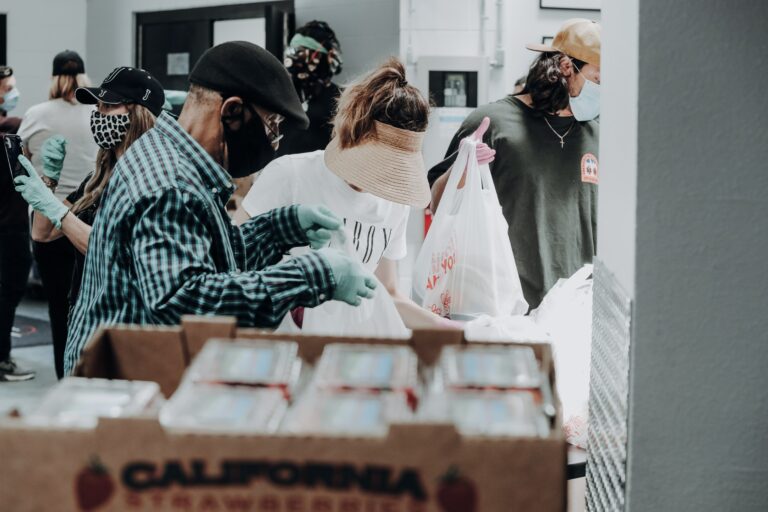
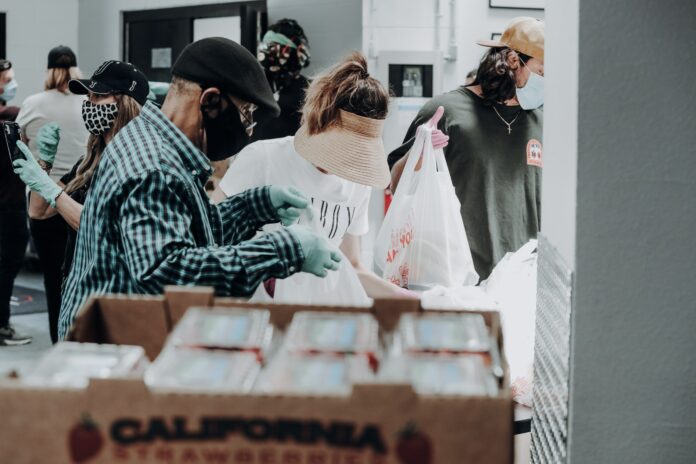
Every two weeks, cars line up at The Hill Church in Vallejo for a drive-thru food distribution. While Whitney Houston songs play over a speaker, volunteers load 39 pounds of food into each trunk—canned tuna, eggs, potatoes and other staples.
Elvira Santiago, a retired medical assistant living in senior housing, is particularly excited about the bag of apples.
“We eat them every afternoon. And I’ll cook chicken adobo with the chicken and vegetables,” said Santiago, who visited the distribution Wednesday for the first time this month and expects to return again. “When you go to Savers or the Filipino grocery, $50 is hardly enough.”
Santiago is one of the thousands of Californians visiting food banks this year, some for the very first time. The Food Bank of Contra Costa and Solano, which organizes the Vallejo distribution, is serving 350,000 people every month across the two counties—double the 175,000 people it served per month before the pandemic.
“With inflation going up and CalFresh food assistance going down, I see people in their 20s to people of retirement age all coming out for help,” said Geo Dinoso, who manages distributions for the food bank. “I’m requesting more food every month at my distributions.”
California food banks, which saw more families seeking help during the pandemic, are now serving more people every month as extra benefits started during the pandemic come to an end. That is reducing benefits to 5.3 million Californians—and prompting the statewide food banks association to warn of a “catastrophic hunger crisis” this year.
Instead of functioning as sources of emergency aid, food banks say they are becoming long-term supermarkets for Californians facing food insecurity.
Recipients of CalFresh, California’s version of the federal food stamp program, were given the maximum benefits available for their household size during the pandemic, or at least $95 more a month if they were already at the maximum. However, those emergency allotments ended March 26, meaning that for some single-person households, CalFresh benefits droppedfrom $281 to as little as $23 a month.
Also, a federal program that gives eligible households food benefits to replace in-person school meals will conclude at the end of this school year. While a summer program will replace it, the benefit will be$40 per month for each child, a substantial drop from the $125 per month for each child families received last summer.
“Often when people receive less CalFresh benefits or are kicked off the program more permanently, they turn to food banks to make up the difference. So we’re concerned about what the debt ceiling agreement will mean for food banks,” said Lauren Lathan Reid, director of communications at theCalifornia Association of Food Banks.
Allison Goodwin, the director of programs at the Redwood Empire Food Bank, said demand at the organization’s Sonoma County locations rose 19% in March and has yet to drop.
“We figured there would be an impact, but we did not anticipate the actuality of it,” Goodwin said. “Not only was the food distribution aspect of things more popular, but in March, we had crummy weather. People were coming out in really torrential downpour weather to access food. Normally, that would be something that might cause participation to decrease.”
Moreover, families are coming more frequently. The average patron has gone from using the food bank 2.3 times per month six months ago, up to 2.7 times per month since March, according to Goodwin.
Other food banks in Northern California have seen similar spikes in demand.Berkeley Food Pantry, which serves families in Berkeley and Albany, has seen a 56% increase in demand in the first five months of 2023 compared to 2019.
Dharma Galang, director of the Berkeley Food Pantry, traces this increase in demand to a letter CalFresh recipients received in January informing them that emergency benefits would be scaled back in March.
Since then, the pantry has been running out of fresh vegetables, meat, eggs and dairy products—nutritious foods that are often more expensive at groceries.
Across the Bay, theSan Francisco-Marin Food Bank is serving 56,000 households per week compared to 32,000 households before the pandemic. The programs it offers, including neighborhood pantries and home-delivered groceries, are at or over capacity, with long waiting lists.
“To deal with this, we’ve had to scale back and simplify our menus,” said Meg Davidson, the food bank’s policy and advocacy director.
The food bank also works with a multilingual outreach team that helps people sign up for CalFresh benefits. Since March, many people have stopped applying for CalFresh because the benefits have reduced so drastically.
“To go from $281 to $23 a month is devastating, you cannot come back from that,” Davidson said. “In a place like the Bay Area, the benefit allotments are completely out of touch with reality.”
From experiences during the 2008 Great Recession and recent survey results from food banks, Reid of the state association anticipates an increase in demand for food for many years to come.
There are efforts underway at the Legislature to increase the minimum CalFresh benefit. Senate Bill 600, authored by state Sen. Caroline Menjivar, raises the amount from $23 to $50 per month.
The bill, however, is estimated to cost $95 million a year, a steep price tag amid California’s $31.5 billion budget deficit. The Assembly-Senate budget deal unveiled on June 12 included $30 million for a pilot program in some counties.
Food banks across California are in favor of this bill, in addition to SB 348, which would ensure access to summer food and school meals programs, and SB 245 and Assembly Bill 311, which would provide state-funded nutrition benefits to all Californians regardless of their immigration status.
“We’re heartened to see that lawmakers at the state level have been acknowledging that this hunger crisis is still going on,” said Davidson of the San Francisco-Marin Food Bank. “We’ve been seeing the exact opposite at the federal level with Congress holding the debt ceiling hostage over SNAP restrictions, and unfortunately we’re seeing it from our local government.”
All four bills have passed their first house, but could face hurdles to become law as the Legislative Analyst’s Office warns that the state cannot afford costly new programs.
Gov. Gavin Newsom’s May budget plan includes $60 million for CalFood, which enables food banks to distribute California-grown produce; more than $300 million for School Meals for All; and a total of $2.7 billion in combined state and federal funding for anti-hunger programs.
The budget does not include any money for Market Match, California’s largest nutrition incentive program that allows CalFresh shoppers to double their benefits on fruits and vegetables at farmers’ markets across the state. This has sparked concern from farmers, food banks, and CalFresh recipients who obtained 38 million servings of fruits and veggies through the program.
Newsom’s plan also does not include money to increase the monthly minimum CalFresh allotment, and Menjivar said it will be a challenge to get it included.
Food banks are continuing to advocate for the bill to be in the final budget, which is now being negotiated, with a June 15 deadline for the Legislature to pass at least its version.
“Levels of hunger during the pandemic did not significantly spike, and that was only because we had public programs and food banks that stepped up. If we don’t continue to have investments from the state and federal governments, then all the weight is going to be put on food banks,” said Reid.
For now, people from all walks of life will continue to line up in their cars at the Vallejo food bank. Alvin Angeles, a 32-year-old caretaker in Vallejo who just had a baby, will wait in his car alongside Dave Terry, a 64-year-old on disability.
“It’s a sad thing to see in our United States of America,” said Terry. “I don’t see an end in sight. We need a lot of policy changes.”
Every performing art has a term for a transcendent theatrical “moment.” In flamenco, it’s called “duende,” when the dancer disappears and there is only the dance. In the world of competitive air guitar, it’s called “airness.”
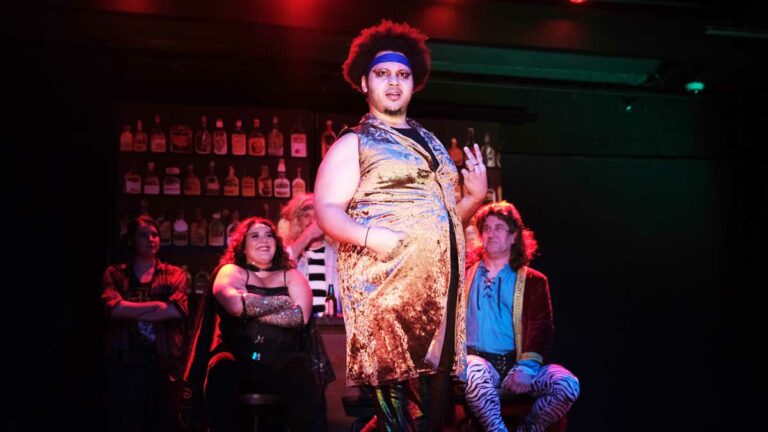
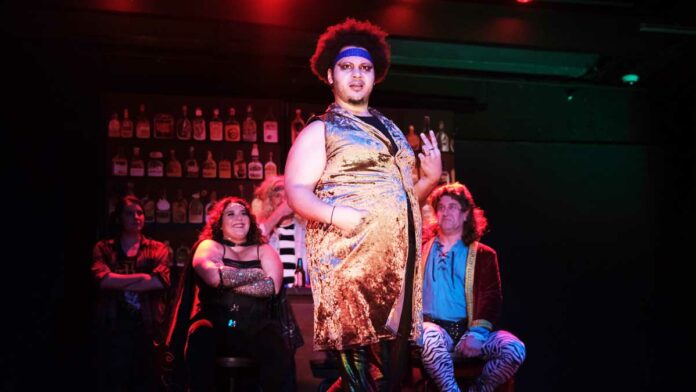
Airness is also the name of Left Edge Theatre’s latest production, currently running at The California in Santa Rosa through June 23. Written by award-winning playwright Chelsea Marcantel and directed by LET executive director Argo Thompson, it is a hard play to pin down.
The simplistic plot involving Nina, a sheltered girl (Brittany Law); David “D Vicious” Cooper, a “bad boy” (Danny Bañales); and a loveable group of misfits contains no surprises. Everything plays out as neatly and as unearned as a John Hughes film. But then again, the plot isn’t really the point. The script is more of a love song—sorry—rock ballad to the world of competitive air guitar. Yes, that’s a real thing, and like lip-synching or mime, it takes training and talent to get onto a national stage.
There is certainly training and talent on display in this production. The set (by director Thompson) is a simple, creative design and makes good use of the limited space. Dance/guitar choreography is energetically entertaining (though no choreographer is listed). The costumes (Tracy Hinman) are an exuberant representation of the stage personas. All actors obviously loved and put a lot of their hearts into their characters, most notably Jesse Lumb, with his surprisingly tender portrayal of Ed “Shreddy Eddy” Leary.
Unfortunately, the Sunday matinee at the end of opening weekend lacked a large audience to help with the energy, and everything sagged. Scene shifts took too long. The choreography robbed actors of breath and, often very noticeably, their lines. Costumes were sparkly, but the wear and tear on wigs and wings started showing, and the cast looked tired. Of course, the show a reviewer attends is just one in a full run, but the show as a whole felt under-rehearsed. That’s ironic since one of the critical points the guitarists stress is that in air guitar, one has to be prepared.
All in all, this is a frothy, sparkly show that doesn’t pretend to be anything other than what it is. For those who, like rock goddess Joan Jett, are “only doing good when I’m having fun,” then this might be the show for them. Just remember that true airness is exceedingly rare.
Left Edge Theatre’s ‘Airness’ runs through June 23 at The California Theatre, 528 7th St., Santa Rosa. Thu.–Fri., 7:30pm; Sat., 1pm. $22–$36. 707.664.PLAY. leftedgetheatre.com.
Listening to OTTTO reminds one of bands like Motorhead, Metallica, Pantera going for it with all they’ve got. With little fluff and a lot of fun.
The band consists of Triko Chavez on drums, singer Bryan Noah Ferretti on guitar and Tye Trujillo holding it down on bass.
OTTTO is getting known in its own right, a process eased by Trujillo’s own fame. Son of current Metallica bassist Robert Trujillo, the kid played on stage with Korn at age 12 and has toured with Suicidal Tendencies. Last summer, he recorded live guitar tracks for the now famous “most metal concert in the history of the world!” scene from season 4 of Netflix’s hit show, Stranger Things. He got the part thanks to the recommendation of a teacher who recognized the depth of his passion for heavy metal music. Trust a teacher to see.
The band’s debut album, Life Is A Game, was released in late March. None other than Revolver magazine called the album “a punky thrasher.” My 15-year-old son, Leo, and I have it on high rotation around the house when mom is out.
During a recent phone interview, there was a sweet moment after I picked up where my hard rockin’ son talked with Tujillo, himself a teenager.
Giotis: You guys play a really interesting brand of metal, and a lot of people around here are metalheads, so we can talk at any level of music geekery you want to, like how you guys write music, what kind of riffs you love. My son, Leo, himself a bassist, wants to ask about tips and tricks. Then just a little background on the band and a little bit about the tour. Those are the sort of three questions today. Is that cool?
Trujillo: That’s cool. It’s cool with me.
Giotis: Rad. Tips and tricks. Let’s geek out first.
Trujillo: All right. Yeah, bass-wise, music-wise, riff-wise, we all really enjoy catchier riffs, with catchy hooks. So, we try to incorporate some technicality into it a little bit, so it’s a little challenge for us to play, you know, a little challenge and twist to it. [But it is always] something that sticks with me, something that just gravitates towards me, and that’s how we kind of come up with riffs.
Giotis: What’s it like being in this band?
Trujillo: Our writing is a really collaborative process, like we’re all in it together. In the moment, enjoying it in the state of flow. That’s [been] our writing process ever since the formation of the band. We’ve been writing [together] ever since we were little kids. We just jam shit, and like when there’s something in the moment that just sounds amazing to us, we will make it a song and, like, build parts off of that.
Giotis: That’s what I love most about playing. You know, one person lays it down, someone picks it up, adds something and it just goes around the room.
Trujillo: Yeah. That’s how it is. It’s like the creativity just goes around the room. It just floats like a shadow.
Giotis: Whoa.
OTTTO play Friday, June 16, Phoenix Theater, 201 Washington St., Petaluma. Doors at 7:30pm, show 8. Tickets online or at the door, $10. All ages.
The toughest man I ever knew was my father. He enlisted in the Marines when he was 17 years old, because it was World War II, and the Marines were the ones doing the fighting.
All the years I was growing up, he slept with a loaded handgun on the nightstand next to his bed. I pitied anyone who might decide to break into our house.
But I also remember a time, when I was about 12 years old, my parents had some friends over. After dinner, they went into the living room to chat.
A few minutes later, my father walked out, went into the kitchen and started washing dishes.
Shortly afterwards, one of his friends went looking for him. When he saw what my father was doing, he laughed and said, “I can’t believe that you’re washing dishes! That’s women’s work.”
My father looked at his friend, and after a moment of silence said, “When I wash dishes, it’s man’s work.”
Education happens in many ways and many places, and most of it is not in a classroom. I never had to join the Marines, because my father knew how to take boys and turn them into men.
Excellent reporting as usual, Nikki (Silverstein)! So horrible to hear the duplicitousness of the county (in the June 7 “Decision Maker” piece). You expect it from a developer, but elected county officials saying “yes” and doing “no” is particularly galling. I’ll keep my eye on the Board of Supervisors elections. Seeing the people of Marin City fighting back is exhilarating!
Meg
(via PacificSun.com)
No More Greed
I am embarrassed to say I live in Marin after reading this article (“Decision Maker,” June 7). This, on top of all the issues with the Golden Gate project that’s been there for over seven decades.
The county and state must take responsibility to negate this project, clearly based in white privilege, and do what’s right for the people who live in Marin City.
I’m signing up to do my part in helping to do what’s right. Marin and Marin City don’t need another greedy developer.
Denise Kimura
(via PacificSun.com)
Untrustworthy
Nikki, another terrific, thoroughly researched article (“Decision Maker,” June 7) that gets to the heart of it. Neither the developer nor the county can be trusted to do the right thing. They don’t even understand what that is. We are fortunate to have you and the Pacific Sun to get it right!
Transcendence Theatre Company presents The Beat Goes On, directed by Susan Draus in her directorial debut. Of the show, which features music from the ’60s, ’70s and ’80s, said Draus, “Music has the ability to bring joy and spark memories, and it’s my hope that the audience will feel that same joy they felt the very first time they heard their favorite songs.” Transcendence’s first ever Pride Night will be Saturday, July 1. Pre-show picnic starts at 5pm, show starts at 7:30pm, June 16 through July 2, Friday, Saturday and Sunday nights. Belos Cavalos, 687 Campagna La., Kenwood. Tickets start at $35.
Bolinas
Painting Place
Painter Carol Duchamp’s exhibition, “Dance Me to the End of Time Retrospective 1983–2023,” features 25 high energy, colorful, abstract acrylic works on large format paper. The size of the works is well suited to the 1,500-square-foot Commonweal Gallery. Duchamp’s recent book, Poetics of the Invisible, uses poetry and quotations to let readers in on inspirations for the faithfully reproduced abstract paintings. The show, running since April, ends on June 23. Commonweal is open most Mondays-Fridays, 10am-4pm. 451 Mesa Rd., Bolinas. Call 415-868-0970 before visiting to confirm.
Santa Rosa
Guitar Night
John Trubee performs solo electric guitar with a selection of his original compositions at Whiskey Tip. Supporting act The Mood is a jam band that organically blends blues, rock and metal with a solid rhythm section supporting heavy guitar sound. Opener Chuck & The Hollywoods deliver blues and rock originals and vintage cover songs, with a mix of R&B rhythms, jazzy melodies and dueling guitars. First 10 to arrive receive a free LP. 6:30pm,Friday, June 16. Whiskey Tip, 1910 Sebastopol Rd., Santa Rosa. Cover charge is $5.
Sebastopol
Peace on Earth
The Peacetown Summer Concert Series is a festival “of the people, by the people and for the people,” meaning local bands, supported by local sponsors and donors, and attended by people of all ages. It is free to the public thanks to a number of generous sponsors and support of the City of Sebastopol. The concert series kicks off its 11th season with concerts every Wednesday at five venues all around The Barlow District near downtown Sebastopol. Every Wednesday starting June 14, 5-8pm. Times may vary by venue. The Barlow, 6770 McKinley St., Sebastopol. Free.
With her phone and handgun by her side, a Santa Rosa woman said she lay awake every night of the Derek Chauvin murder trial in mid-April 2021.
She was anxious because Barry Brodd, her ex-husband, testified as a defense witness as an expert on use-of-force, saying he felt it was “justified and objectively reasonable” of Minneapolis Police Officer Chauvin to kneel on George Floyd’s neck. Brodd said the action—which killed Floyd—wasn’t painful and, thus, Brodd didn’t even consider it a use of force.
The Chauvin trial and Brodd’s testimony kept a lot of people up at night; Floyd’s murder set off international protests against police brutality and for racial justice, including some of the biggest protests in Santa Rosa history.
When Brodd’s ex learned that her former husband would be a defense witness at the trial, she installed Ring security cameras outside the home they used to share. Before becoming a private consultant on police practices and use of force, Brodd worked for 22 years as a police officer at the Santa Rosa Police Department and for 35 years as an instructor at the Santa Rosa Public Safety Training Center.
Brodd moved out of state in 2020, yet his ex feared his testimony and his long career in Santa Rosa might endanger her life.
Last week, Brodd’s ex, who asked that the court refer to her as Jane Doe, shared her story at the beginning of a two-day preliminary hearing in Sonoma County Superior Court. The crimes in question, though bloody, weren’t an attempt on her life, but rather a night of vandalism that made national news and prompted a costly SRPD investigation. The evidence presented shed light on some of the impact Floyd’s murder had in Santa Rosa, thousands of miles away from Minneapolis.
A few nights after Brodd’s testimony, Doe’s Ring app on her phone pinged her with an alert around 3am. On the camera, she saw a person in her yard, so she called 911 and went to her window, Glock in hand. There, she saw a person throw something on her house and run away. Reviewing footage later, she and detectives learned four masked people actually visited her house. The group apparently splashed pig’s blood on her garage door, porch and front door, and left a severed pig’s head on her doorstep.
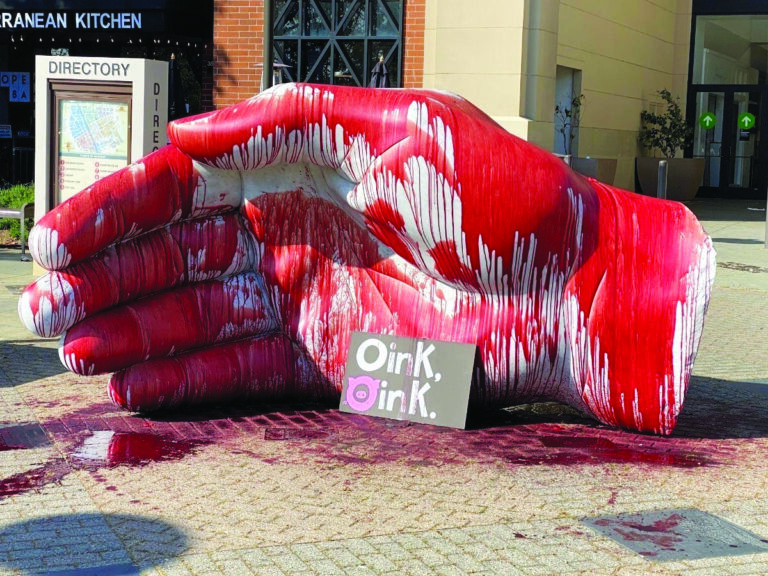
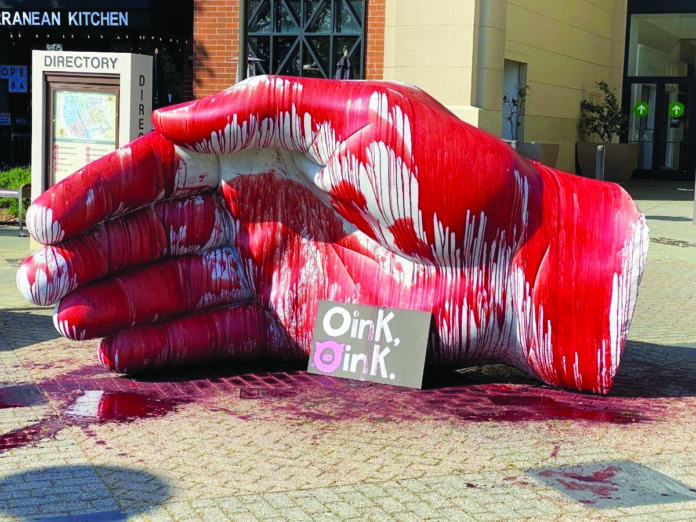
Around the same time Doe’s house was vandalized, people also vandalized the Agraria hand-shaped marble sculpture outside Santa Rosa Plaza Mall, coating it in blood and leaving a painted sign that said “Oink Oink” leaning against it.
In May 2021, SRPD arrested five local activists, initially charging all of them with felony vandalism and felony conspiracy to commit a crime. One defendant, believed to have created the “Oink Oink” sign at the sculpture, later pled guilty to reduced misdemeanor charges. Her case was dismissed after she completed a diversion program.
When the five were arrested, far-right media outlets and influencers shared their photos and personal information online, some calling them “BLM-Antifa extremists” and “militants.” Kristen Aumoithe and Amber Lucas, two of the defendants, said they faced numerous death threats from strangers.
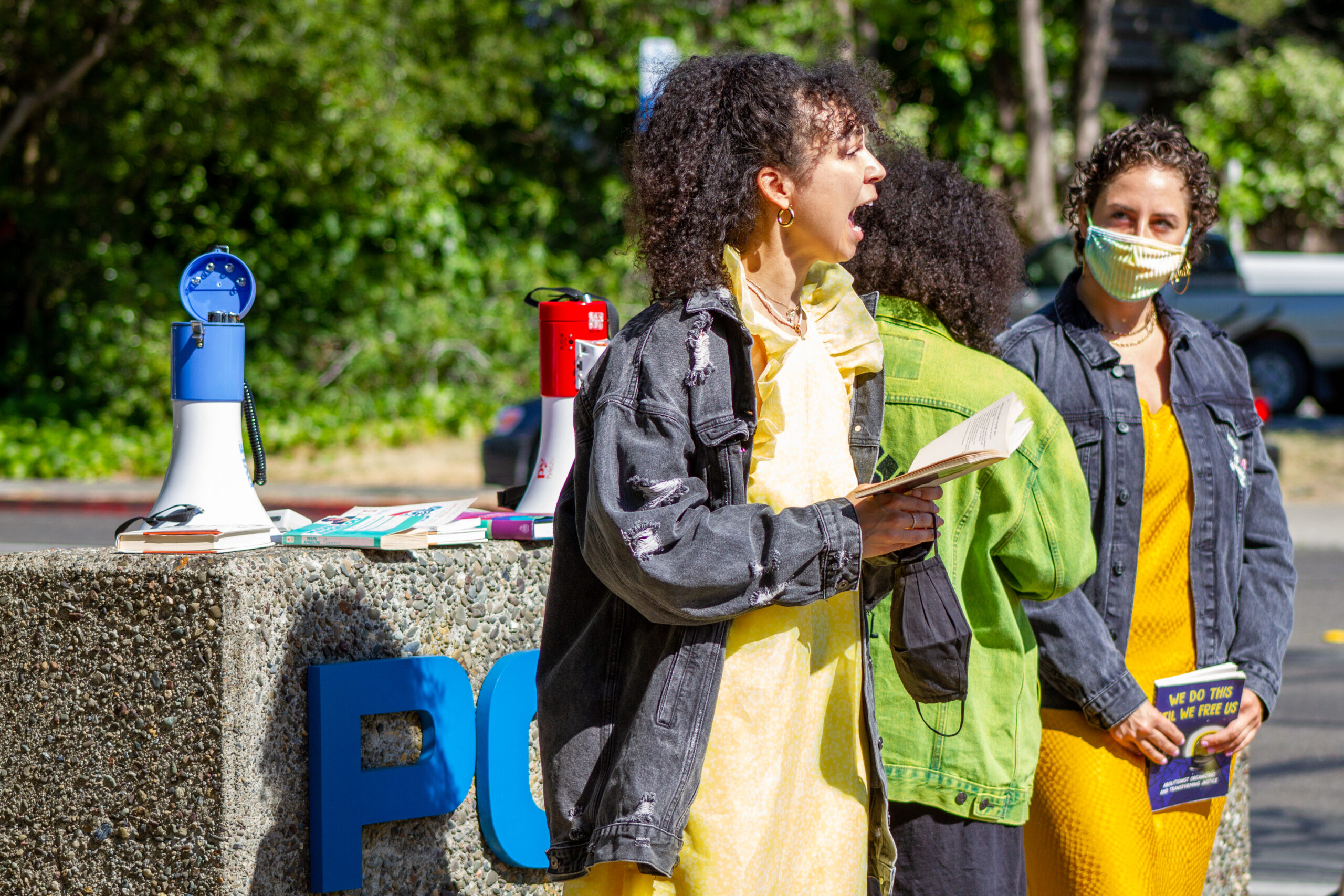
Days after their 2021 arrest, three vandalism suspects returned to SRPD headquarters, this time to read poetry in a peaceful protest outside the building. Photo by Chelsea Kurnick
The Evidence Presented
Last week, Hon. Judge John Behnke heard the cases against defendants Aumoithe, Lucas, Colin Metcalfe and Christina Henry.
At a preliminary hearing, a judge hears the prosecution’s case against defendants and determines whether there is probable cause a crime was committed and probable cause the defendants committed it. The prosecution called four witnesses.
Doe testified that the blood left stains and debris that could not be removed, so she had to replace her garage door, front door and vinyl windows. She spent $2,500 to pay her insurance deductible, though the damages were around $35,000, well beyond the $400 threshold of felony vandalism. She said she feels vulnerable and violated, still sleeping with her gun beside her.
SRPD officer Nolan Cleall and Sgt. Ryan Hepp testified about their investigation of the defendants. An anonymous phone tip from a butcher eventually led Cleall to get a search warrant for surveillance footage and receipts at Sonoma County Meat Company, where he said Kristen Aumoithe placed a special order for two gallons of pig’s blood.
Officers surveilled Aumoithe and her friends before serving search warrants at her home and Lucas’ home. They seized laptops and smartphones from the defendants, accessing text and audio conversations on the application Signal between Aumoithe, Lucas, Metcalfe and others.
Aumoithe’s lawyer, Vincent Barrientos, said there was more than 200 gigabytes of discovery in the case. On the stand, Hepp told Lucas’ lawyer, Omar Figueroa, the investigation probably took hundreds of hours of police time.
The prosecution alleged that on April 13, 2021, Aumoithe and Lucas, reacting to Brodd’s testimony, discussed the idea of vandalizing Brodd’s home. Later, they also discussed vandalizing the Agraria sculpture, which was defaced at least twice during the Black Lives Matter protests that began in 2020.
After her arrest, Lucas gave a statement to SRPD before she retained Figueroa. Lucas said she and Aumoithe vandalized the sculpture the same night Metcalfe and Henry vandalized Doe’s home. Lucas said she and Aumoithe had no part in vandalizing Doe’s home.
Barrientos and Figueroa both argued their clients only poured blood on the Agraria sculpture.
While investigators do not believe Lucas or Aumoithe went to Doe’s house, they presented evidence that the two spoke about the idea on April 13 and discussed inviting Metcalfe to participate in the blood vandalism. Later, Aumoithe bought blood and gave some of it to Metcalfe.
On Wednesday, June 7, attorneys for each of the four defendants filed motions asking that their clients’ charges be reduced to misdemeanors. Barrientos sought military diversion in lieu of a trial for Aumoithe, a veteran U.S. Marine.
Judge Behnke said if the vandalism of the hand sculpture was the only crime, he would likely accept everyone’s motions, but he could not in good conscience reduce the vandalism of Doe’s home to a misdemeanor.
However, only three of the four defendants will face charges. Behnke said the prosecution did not present sufficient evidence that Christina Henry participated in either the conspiracy or the vandalism itself. Behnke dismissed Henry’s case.
If found guilty, the maximum sentence Aumoithe, Lucas and Metcalfe could face is three years eight months in state prison.
Barrientos was upset that Behnke did not consider his request for military diversion, which is only applicable to misdemeanor offenses. A decorated veteran of the U.S. Marine Corps, Aumoithe toured Afghanistan twice before she was honorably discharged. Barrientos said Aumoithe is exactly who the program is designed for.
Aumoithe said she returned from war with diagnosed PTSD. She said she experienced many abuses of power during her time in the military and faced racist bullying by once friends when she married a Black Marine and started a family. George Floyd’s murder and Chauvin’s trial troubled her.
“Witnessing the same [abuses of power] play out again by people in power—police, who are supposed to serve and protect—was triggering,” Aumoithe said.
If found guilty, Aumoithe might still be offered the opportunity to participate in Veterans Court, a California program that allows qualified veterans to face probation and undergo court-ordered treatment as a consequence of a felony conviction, instead of serving time in jail or prison.
The defendants will appear on July 20 for arraignment, where, unless the prosecution offers a plea bargain, a pre-trial hearing and trial dates will be set.
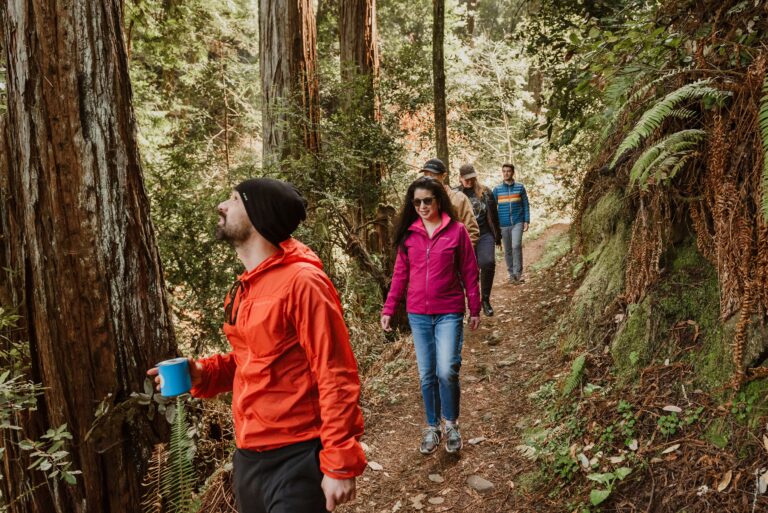
The size, age and variety of California’s state parks rank among the best in the country.
The Golden State sports 280 state parks, which include 5,200 miles of trails, 15,000 campsites, and countless natural and historical attractions.
However, it was only last year that a coalition of public agencies and conservation nonprofits came together to formally acknowledging the natural beauty, ecological role and history of the state’s park system one week per year.
“The COVID-19 pandemic brought many challenges to California’s communities, but it also illuminated the important connection of the outdoors to our physical and mental well-being. Parks across the U.S. experienced increased visitation in 2020-21, and California State Parks Week underscores the important role parks play in communities statewide,” a press release announcing the 2022 event stated. Organizers include California State Parks, Save the Redwoods League, Parks California and the California State Parks Foundation.
“We are excited to host the second annual California State Parks Week and build upon last year’s inaugural successes,” Armando Quintero, director of California State Parks, said in a statement announcing this year’s events. “California State Parks Week serves as a reminder that state parks belong to all who call California home. Everyone deserves to enjoy them, to stay healthy and active, find inspiration and connect with nature and areas of cultural significance.”
Like last year, the second annual State Parks Week will include dozens of events spread over five days (June 14-18) in parks across the state. In the North Bay, Sonoma, Napa and Marin county residents are invited to experience local parks for the first time or through a new lens of understanding.
Each of the five days of this year’s Parks Week has a theme. The theme of Wednesday, June 14, is “Explore New Experiences,” followed by “Nourish Your Health and Well-being” on June 15 and “Support Climate Resilience” on June 16. The weekend is split between a “Celebrate Community and Culture” theme on June 17 and “Care for Our Shared Lands” on June 18.
In an interview last week, Matthew Gomez, senior parks program manager at the Save the Redwoods League, said California State Parks Week requires organizers to have an “all hands on deck” mentality to pull off the 143 planned events in five days.
A midwesterner who worked for parks departments around the country before landing in California last year, Gomez highlighted the great range of natural wonders on display in the Golden State. A worthy reminder for any jaded, life-long California residents.
“The ecosystem out here is just so diverse,” Gomez said. “From the deserts in Southern California, up to the dense redwood forests near the Oregon border and everything in between, it is just stunning.”
So, grizzled Californian, if you can, take a break from your day job and set out to appreciate one or two of the state’s many natural wonders highlighted during one of the events listed below. Details are available at www.castateparksweek.org.
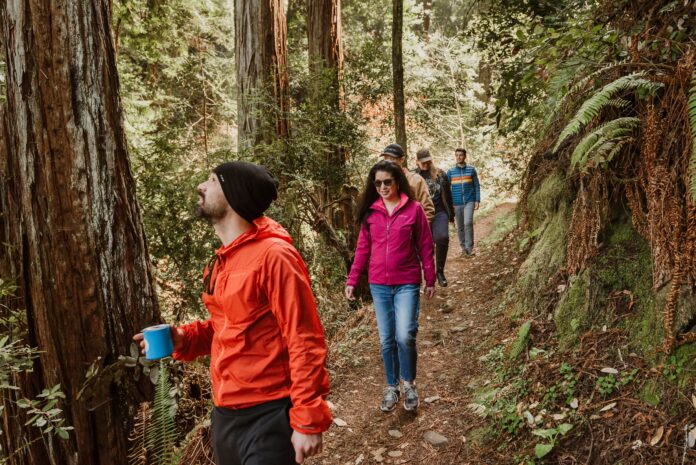
According to California State Parks, “Forest bathing, a literal translation of the Japanese word shinrin-yoku, is the practice of absorbing the calming, wellness-inducing atmosphere of natural places.” This is a low-key event. Participants will reflect on the experience of being in nature, instead of aiming to conquer a peak or finish a new trail. If that sounds enticing, meet up in the Pantoll parking lot at 9:15am or 10:30am on Wednesday. Contact hi************@******ca.gov for the meeting place.
Attendees of this event will “Learn how to start a nature journal, observe nature and explore why spending time in natural landscapes might improve our health and wellbeing.” Meet at the Azalea Picnic Area just past the kiosk entry station before the 10am start of the event. Participants are expected to bring their own writing materials, including pencils, paper and a notebook or nature journal. For more information, contact Ry*********@******ca.gov.
Due to logging during and after the Gold Rush, just 5% of Southern Oregon and California’s Old Growth redwood forests stand today. Attendees of this hike along Pioneer Trail will learn “how California State Parks works to preserve areas like [Samuel P. Taylor State Park], and why the preservation of these forests is so important.” The event is expected to run from 1 to 2:30pm. Contact Ry*********@******ca.gov for more details.
Attendees of this four-mile, moderate-difficulty guided hike will “pay homage to an elder tree estimated to be 2,000 years old. On the way, you can expect to see the Jack London Lake and spring native wildflowers for a fabulous morning of exercise and inspiration.” Participants’ park entry fees will be covered by the California State Parks Week sponsors; however, parking fees ($10) are not included. Attendees should meet in the Ranch parking lot, a right turn after the entry kiosk, ahead of the 10am start time. Online reservation at CaStateParksWeek.org is required.
For another Forest Bathing opportunity, meet with other attendees at the White Barn before 10am. According to the organizers, Forest Bathing is “a centering and calming restorative practice, it promotes balance and restored vitality through a quality of presence and heightened sensory awareness.” Online reservation at CaStateParksWeek.org is required for this event.
Those who can’t attend but are interested in the health benefits of parks are invited to join the Forest Therapy Series as part of Sugarloaf’s ParkRx Program the fourth Sunday of each month. For more details about those recurring events, led by certified Association of Nature and Forest Therapy (ANFT) practitioners, visit Sugarloafpark.org.
The Sonoma Ecology Center, which operates Sugarloaf Ridge State Park, is always looking for volunteers. Those seeking an excuse to get outside more often can attend this event, scheduled for 3 to 7pm. The orientation will take place at the Robert Ferguson Observatory classroom, followed by a volunteer social potluck at the group camp, where participants can meet some of the active volunteers.
Attendees must RSVP to su****************@*****************er.org.
Taste of Sonoma
What does Sonoma taste like? The area’s premiere tasting event has the answer. Taste of Sonoma, the annual juggernaut showcase of the best SoCo has to offer, includes a walk-around wine tasting, guided wine seminars (over 60 wine varietals from 19 unique growing areas!), garden tours, premium wine experiences, food trucks and themed lounges, among other sensual...
Note: Maia Kobabe’s pronouns are e/em/eir.
Maia Kobabe, author-illustrator of “Gender Queer: A Memoir,” sits atop a picnic table at Ragle Ranch Regional Park, eir legs perched on the bench. Kobabe (pronounced koh-BABE) pauses to point out birds during our conversation and to appreciate the laughter of kids at the nearby playground.
E wears one long earring that catches the dappled...
Every two weeks, cars line up at The Hill Church in Vallejo for a drive-thru food distribution. While Whitney Houston songs play over a speaker, volunteers load 39 pounds of food into each trunk—canned tuna, eggs, potatoes and other staples.
Elvira Santiago, a retired medical assistant living in senior housing, is particularly excited about the bag of apples.
“We eat them...
Every performing art has a term for a transcendent theatrical “moment.” In flamenco, it’s called “duende,” when the dancer disappears and there is only the dance. In the world of competitive air guitar, it’s called “airness.”
Airness is also the name of Left Edge Theatre’s latest production, currently running at The California in Santa Rosa through June 23. Written by...
Listening to OTTTO reminds one of bands like Motorhead, Metallica, Pantera going for it with all they’ve got. With little fluff and a lot of fun.
The band consists of Triko Chavez on drums, singer Bryan Noah Ferretti on guitar and Tye Trujillo holding it down on bass.
OTTTO is getting known in its own right, a process eased by Trujillo's...
The toughest man I ever knew was my father. He enlisted in the Marines when he was 17 years old, because it was World War II, and the Marines were the ones doing the fighting.
All the years I was growing up, he slept with a loaded handgun on the nightstand next to his bed. I pitied anyone who might...
Duplicity
Excellent reporting as usual, Nikki (Silverstein)! So horrible to hear the duplicitousness of the county (in the June 7 “Decision Maker” piece). You expect it from a developer, but elected county officials saying “yes” and doing “no” is particularly galling. I’ll keep my eye on the Board of Supervisors elections. Seeing the people of Marin City fighting back is...
Kenwood
Musical Magic
Transcendence Theatre Company presents The Beat Goes On, directed by Susan Draus in her directorial debut. Of the show, which features music from the ’60s, ’70s and ’80s, said Draus, “Music has the ability to bring joy and spark memories, and it’s my hope that the audience will feel that same joy they felt the very first time...
With her phone and handgun by her side, a Santa Rosa woman said she lay awake every night of the Derek Chauvin murder trial in mid-April 2021.
She was anxious because Barry Brodd, her ex-husband, testified as a defense witness as an expert on use-of-force, saying he felt it was “justified and objectively reasonable” of Minneapolis Police Officer Chauvin to...
The size, age and variety of California’s state parks rank among the best in the country.
The Golden State sports 280 state parks, which include 5,200 miles of trails, 15,000 campsites, and countless natural and historical attractions.
However, it was only last year that a coalition of public agencies and conservation nonprofits came together to formally acknowledging the natural beauty, ecological...