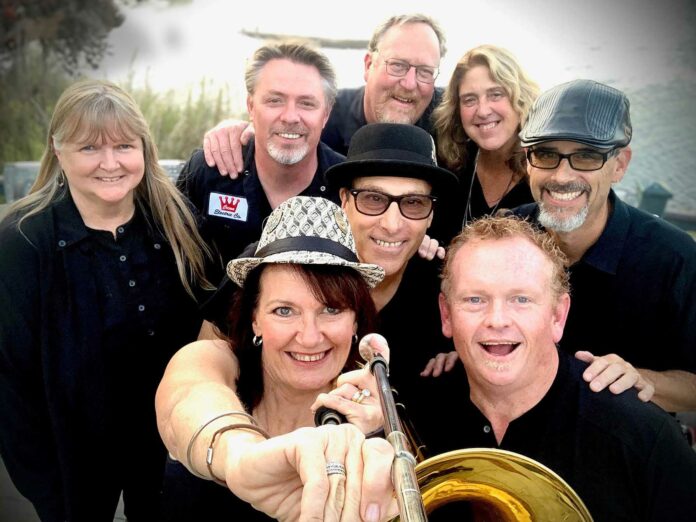
One of the most fun live bands in the North Bay plays this week at one of the area’s best clubs. What’s not to like? The Soul Section—multi-time recipient of the NorBay award for Best R&B Band—plays a hard and sweaty, grown-ass version of soul standards that satisfies for every bar of every song. Pete Donery’s flawless big-bottom bass provides the platform for singer Kevin Mulligan’s vocals to rise to the heavens in the glory of this eight-piece band. 8pm, Saturday, Aug. 5. Blue Note Napa, 1030 Main St., Napa. Ages 8+. Tickets start at $12.
Santa Rosa
Wild Art
Four local artists celebrate the wonder of the natural world in “Wild Things,” an exhibit at Corrick’s Stationery. Featured artists Stephen Heagan, Diane Schoenrock, Carolyn Wilson and Suki Diamond display original works in different media. Of particular interest is Wilson’s latest mixed-media canvas, “Otto and Eesha,” inspired by the recent baby rhinoceros birth at Safari West. Safari West Wildlife Foundation receives 15% of all sales. Meet the artists and staff from Safari West on opening night: 5-7pm Friday, Aug. 4; and from 10:30am to 5pm every Tuesday-Saturday until Aug. 26. Corrick’s, 637 4th St., Santa Rosa.
Petaluma
Ernie’s Turns 100
Perhaps the most authentic beer hole in the world—band’s play in the bay of the adjoining auto shop—Ernie’s Tin Bar will celebrate its 100th anniversary with three days of jazz, blues, rock and more. And brews; notably, specialty beers brewed just for this event from Pizza Port Brewing Company and Russian River Brewing Company. First-timers, be sure not to use a cell phone while standing at the bar. Enjoy food trucks all weekend. Music starts at 5pm, Friday Aug. 4, noon on Saturday and 11am on Sunday. Ernie’s Tin Bar, 5100 Lakeville Hwy., Petaluma. Free.
Larkspur
Musical Masters
A dazzling showcase of songs inspired by American musical masters Cole Porter, George Gershwin and Richard Rod, this live performance features classics including “In the Still of the Night,” “Anything Goes,” “Fascinating Rhythm,” “The Man I Love,” “Some Enchanted Evening” and more. Produced by Ellie Mednick in cooperation with The Cole Porter Society, singers Noah Griffin, Désirée Goyette, Bob Austrian and Deborah Winters join musicians Akira Tana, Ross Gualco and Joe McKinley in a show that will delight anyone who has ever belted a show tune. 7pm, Thursday, Aug. 17. Lark Theater, 549 Magnolia Ave., Larkspur. Lobby reception after the show. $45.
She was the tiniest, frailest person of my own generation I had ever met by the time I stood next to her in the rehab room where I was stationed to provide her care during night shifts as she recovered from an undisclosed procedure.
I suppose I could have found out more about her gory details if I’d tried, but her status as a celebrity made me want to protect her, even from my own prying mind.
Once I thought being famous would be everything I ever needed to make me happy. By that time, I definitely knew better. I wouldn’t wish fame on anyone, let alone on anyone with a predisposition to mental health and addiction issues, or a survivor of childhood trauma, both of which she qualified as.The thigh bone is connected to the leg bone. Neither bone does well under public scrutiny.
When I entered her room to sit watch, she was just a small bundle in the double bed against the wall. It was dim, with curtains drawn and all surfaces hushed by carpets, drapes, pillows, clothing, newspapers, towels. I don’t know what I had expected, but it wasn’t this. The punk icon of my youth laid low by who knows what instead of shredding pope photos on late night TV.
It dawned on me I hadn’t really heard much about her recently. I felt bad suddenly, as if I had forgotten to check on a dear friend. What shits we can be, consuming our heroes while they are fresh and vibrant, never giving two thoughts when they disappear from view, or we hear rumors they may be losing their edge.
I realized sitting in her room while she slept, I had no idea what her life was, or what being out there rocking the world on our behalf as a smart, political, outspoken, brave, Gen X woman had actually cost her.
I’d been called earlier that afternoon on an emergency basis, by the friend of a friend, to help provide round-the-clock support to a secret client. I had been working in recovery for a few years at that time, mostly as a provider of transportation and support counseling to in-patient rehab customers at private facilities in the Bay Area, sometimes as an art therapist.
I had been clean and sober myself for 20 years or more. I was a Gen X small town punk rock kid who had become a theater geek, folk musician, art weirdo and then married a Boomer trust fund hippie folk musician, had a baby, and ran screaming into sobriety for my dear life.
In my life as a band bitch, I had rubbed up against so many famous folk by this time, I was pretty immune to the sticker shock of A-List Players. But this was different. The world, rock and roll in general, and punk rock specifically being primarily a boys’ playing field, our roster of Gen X female punk rock role models was limited to begin with. Add spins of riot grrl feminism, addiction recovery, trauma recovery, mental health advocacy… the pool gets even shallower.
Sinead hit all the highlights. First, she had shrugged off the oppressive idealized projections of feminine beauty that we were all slogging through by shaving her head and telling everyone who said shit about it to, in essence, fuck off. Then, in 1992, nine years before anyone publicly acknowledged the institutionalized child abuse inside the Catholic church, when she performed Bob Marley’s “War” on SNL as a protest of sexual abuse of children by church officials, she entered legendary status.
The backlash she received from that point forward was painful to watch. I can only imagine what it felt like to be at ground zero: inside her life. But what it meant to me, and to lots of us I think, was everything. Because of her public actions, among others, when I encountered suppressed memories of childhood sexual abuse that emerged from the darkness between the years of 1992 and 1996, I was able to summon the courage to leave my abusive marriage, find support from a therapist, enter addiction recovery, break silence in my own family, and begin the journey of healing that began to unfold for me from that point.
For better or worse, whoever I became as a trauma survivor, woman, mother, and artist were in part because of Sinead. Now here I was, standing guard while she slept. She was so tiny and frail. This powerhouse. This icon. This leader.
I was humbled more deeply than I knew I could be. It occurred to me sitting in that room, no matter who you are, how powerful and mighty, life can crumble you. But there was a beauty to her that could not be erased by time and tragedy.
She came barely to my shoulder when she finally stood and walked with me. Hair greying, still shaved. Skin aging, tattoos blurring—like me.
Here’s how we do it. No nip and tuck, no stretched face shiny weirdness. No gloss, no glory. Thank gods for middle aged punk chicks. I learned a lot about her through those days. What she shared with me, I don’t share, and stays with me cherished as private conversation.
Each of us, in our vulnerable moments, deserves privacy and dignity. Being a successful artist doesn’t mean the world owns our insides. But much of what she spoke about with me was already out in the public record. I looked up her public interviews, visited her social media posts, caught up on what she was presenting to the world since I had last paid attention. Her life has been filled with so much difficulty, tragedy, struggle, and pain.
My heart went out to her. No amount of success in the world can guard us from what it costs to live in the world as ourselves.In the few days I had with her, I chose to quietly just be there, listening, helping her get back on her feet literally, talked to her like she was any other women in a vulnerable place, trying to get somewhere better.
I never told her what she meant to me. How much I admired her. How much I was rooting for her. It felt like an invasion of privacy to do so. I just tried to transmit my gratitude to her in my actions and leave the rest unspoken. Let her just be another person in need for a while. I don’t know if that was the right thing to do or not. Maybe it would have mattered to her to hear how she had made a difference in my life. How she had made a difference in the lives of so many women I knew of my generation and beyond. How so many of us were rooting for her. How we saw her as beautiful, and cherished, and vital, and irreplaceable.
Regardless, the moments I had with her on those days I cherish and carry with me. They inform how I am aging, how I treat myself, how I see other women at times. Life is going to crumble us all eventually. No matter how bad ass, how important, how amazing. The only thing we need to do in the meantime is keep getting up again, getting to our feet, speaking our truth, being ourselves, keep going on.
A few years after my time with Sinead, we all got to see her live performance from Berlin on world media. It was so glorious, I cried. Risen up from a tiny cocoon of blankets in the dark, that beautiful butterfly again. Never say never. It isn’t over ‘til it’s over.
Go easy, big soul. You blazed a trail for us. I’m here walking behind you, holding a little part of the light you carried maybe a little further down the path, hopefully handing pieces of it to those behind me too.
You changed us, you helped change the world, even if only a little. Change is ridiculously slow, but following your example, I’ll keep getting up, and keeping on.
The name Damon Runyon probably means little to most today. But in the early-to-mid 20th century he was a celebrated journalist, sports columnist and author. His short stories about New York and Broadway contained such colorful characters that the term “Runyonesque” was coined to describe the type of gamblers, gangsters, hoods and show people who populated his stories and the dialect they used.
Runyon stories were frequently adapted for film, including Little Miss Marker, the movie that made Shirley Temple a star. In 1950, Runyon’s characters returned home for their Broadway musical debut in the smash hit Guys and Dolls. Sonoma Arts Live has a production of the multi-Tony Award-winning show running on the Rotary Stage in Andrews Hall through July 30.
Nathan Detroit (Skyler King) is desperate for a place to hold the oldest established permanent floating craps game in New York, but he needs a thousand dollars to book it. He believes that Sky Masterson (Andrew Smith) would be an easy mark for the money and makes him a bet he figures he can’t lose: Take Sergeant Sarah Brown (Maeve Smith), leader of the Save-a-Soul Mission, to Cuba and wine and dine her there. Between avoiding the cops, holding off some anxious gamblers and distracting Miss Adelaide (Jenny Veilleux), his matrimonial-minded fiancé of 14 years, Nathan has his hands full.
Director Larry Williams and the cast try hard, but the essence of Damon Runyon’s New York is sorely missing from this production. Most characters fail to match the color level of their costumes—nice design work by Barbara McFadden and Sylvia Gregory—and the vernacular is delivered with varying degrees of success.
Jenny Veilleux does hit the Runyonesque mark as Adelaide. She gives a full-throttled performance and delivers in both character and voice. Any scene she enters, usually with the very entertaining Hot Box Girls, energizes the show. King’s Detroit only displays about 50% of the charisma he should have, while Andrew Smith’s Masterson is completely devoid of character. He shows none of the rapscallion charm an operator of his caliber should, at least enough to make the audience believe that a reserved, religious person like Sarah Brown would fall madly in love with him. Maeve Smith is fine in what is in essence the show’s “straight” role.
A community theater taking on a large-scale musical is pretty much a crap shoot—especially these days—and, unfortunately, Sonoma Arts Live’s Guys and Dolls doesn’t provide much of a payoff.
‘Guys and Dolls’ runs through July 30 at Andrews Hall in the Sonoma Community Center, 276 E. Napa St., Sonoma. Thurs–Sat, 7:30pm; Sun, 2pm. $25–$42. 707.484.4874. www.sonomaartslive.org
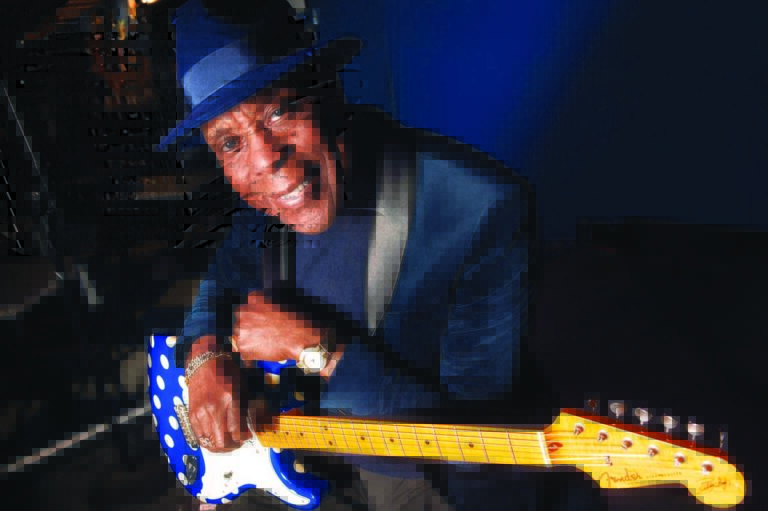
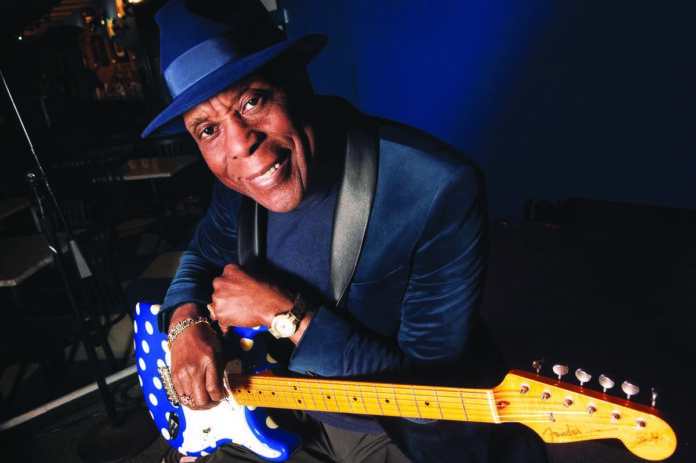
Having celebrated his 86th birthday last July 30, Buddy Guy remains one of the last pillars of the rich Chicago-blues music scene that counted the late Howlin’ Wolf, Muddy Waters and B.B. King among its luminaries.
Still at it, Guy brings his inimitable chops to Sonoma County next week with an appearance at the Green Music Center as part of his “Damn Right Farewell Tour.”
Auspiciously, the tour aligns with the release of Buddy Guy: The Blues Chase the Blues Away, a documentary, part of the PBS American Masters series, which aired last week and is now available streaming.
“The way they treat the blues now, you don’t hear it on your big radio stations anymore,” Guy said during a recent phone interview. “Your big AM/FM stations don’t play blues hardly anymore. So whatever little I can do to help keep blues alive, I’m open for it. I’m ready to wake up in the midnight hours of the night to help keep it alive, because without satellite radio, I don’t think you hear much of B.B. King no more.”
He added, “Even the British blues guys aren’t being played much on radio anymore. You get a lot of hip-hop and superstars’ records, which don’t need to be played because they’re so well-known. Their records are going to go [big] anyway. I don’t need to hear Muddy Waters as much as I hear Madonna or somebody else. Just play me Muddy Waters once or twice a month.”
Throughout the hour-and-23-minute-long American Masters episode, Guy’s life proves to be a fascinating tale. In addition to original interviews with Guy and numerous acolytes, including John Mayer, Carlos Santana, Gary Clark Jr. and Christone “Kingfish” Ingram, viewers are treated to quite the travelogue.
The filmmakers trace the guitarist from his origins working the Louisiana fields his sharecropper family plowed—and where a portion of highway was named after him in December 2018—to the thriving 1950s Chicago music scene he arrived in with nothing but a guitar in his hand and the suit on his back. It was here that he got his first break, when Waters took the 21-year-old fret-bender under his wing.
“Sixty-five years ago last year I’d just gotten to Chicago, and I wasn’t looking to be a professional musician,” Guy said. “I’d left Louisiana because they told me I could go to Chicago, get a day job and wouldn’t have to pay to see Muddy Waters, Little Walter, Sonny Boy Williamson and all those guys. I was looking for a day job because I didn’t never think I was good enough to play with them. But I learned how to play Lightnin’ Hopkins, Jimmy Reed and a few Muddy Waters licks.”
“I hadn’t eaten in three days and a guy took me to the 708, a famous blues club on 47th Street in Chicago,” Guy continued. “I went up and played a number with the late Otis Rush and somebody called Muddy Waters, who was living about five blocks away. He got out of his van, and because he heard I was telling people how hungry I was, he brought me a bologna sandwich.”
Word of Guy’s guitar prowess got around. After a brief stint recording a few sides for Cobra Records, he landed at Chess courtesy of Waters, who favored the young musician. Soon, other artists in the label’s stable started using him on their records as well.
Label founder Leonard Chess begrudgingly used Guy while denouncing what he did as “just making noise.” However, the Louisiana native’s combination of tasty playing and over-the-top showmanship made him a favorite of the British Invasion triumvirate of Jimmy Page, Jeff Beck and Eric Clapton, as well as stateside guitar god Jimi Hendrix. And while Guy is a humble man, he’s quick to acknowledge his abilities, particularly when asked what he thought about Hendrix the first time they met in 1968.
“You should ask what he thought of me, because he told me he came from a gig to come see me play because he’d picked up some things from me,” Guy said with a chuckle. “As a matter of fact, I was playing in New York, and he came in with a reel-to-reel tape recorder and I didn’t know who the hell he was. He asked if he could tape, and I could hear somebody saying, ‘That’s Jimi Hendrix.’”
He added, “I didn’t know much about him because I was following B.B. King, Muddy Waters and T-Bone (Walker). I said, ‘So what. Who in the hell is Jimi Hendrix?’ He come up and asked if he could tape what I was doing because he just canceled a gig to come to New York to hear me play.”
While blues may have fallen out of favor in the ’70s and ’80s, Guy experienced a comeback in the ’90s, beginning with the release of his 1991 album, Damn Right, I Got the Blues, his first recording in nearly a decade. Featuring cameos by Clapton, Beck and Mark Knopfler, the album is credited with kickstarting a blues rebirth. Guy has released a steady stream of albums since then, won eight Grammy Awards, earned a Rock and Roll Hall of Fame induction and played for fellow Chicagoan President Barack Obama.
“I always say I went from the outhouse to the White House,” he noted.
Having never stopped touring, even during his lean years, Guy understandably had slowed his pace some in recent years. But his fire for playing guitar and spreading the blues gospel hasn’t waned. Following on the heels of the PBS film is The Torch, a documentary that examines the guitarist’s ongoing influence on the blues and includes interviews with a number of musicians, including Carlos Santana and Susan Tedeschi.
As for what folks can expect coming out to see this living legend do his thing on stage, Guy promises prime rib in a world of Spam.
“Folks can expect the best that I got,” he said. “My dad told me this, and I’ll tell you the same thing he told me before I learned how to play when I was driving the tractor and plowing the fields in Louisiana. He said, ‘Son, don’t be the best in town. Just be the best until the best come around.’”
Buddy Guy performs at 7:30pm, Friday, Aug. 4 at Weill Hall at Green Music Center, 1801 E Cotati Ave., Rohnert Park. Tickets available at https://gmc.sonoma.edu/buddy-guy/
An article in Petaluma’s local newspaper last week prompted more questions than it answered.
On Monday, July 17, the Argus-Courier reported that a commercial real estate firm was advertising one of the city’s largest ag-processing facilities and a few neighboring properties for sale. However, the Creamery’s owner, Larry Peter, was quick to quash the story, telling the paper “I’ve never listed the Petaluma Creamery for sale.” The online real estate listing, first posted on June 8, was quickly deactivated, and the Argus-Courier has yet to do more reporting on the oddity.
That’s not the end of the story, though. An investigation by the Bohemian found that while the Creamery has successfully paid off a long-standing debt to the city for wastewater fees and fines, Peter continues to juggle other bills—and recently reached an agreement with the city cutting off the Creamery’s access to the sewer system for the foreseeable future.
Demand Drops
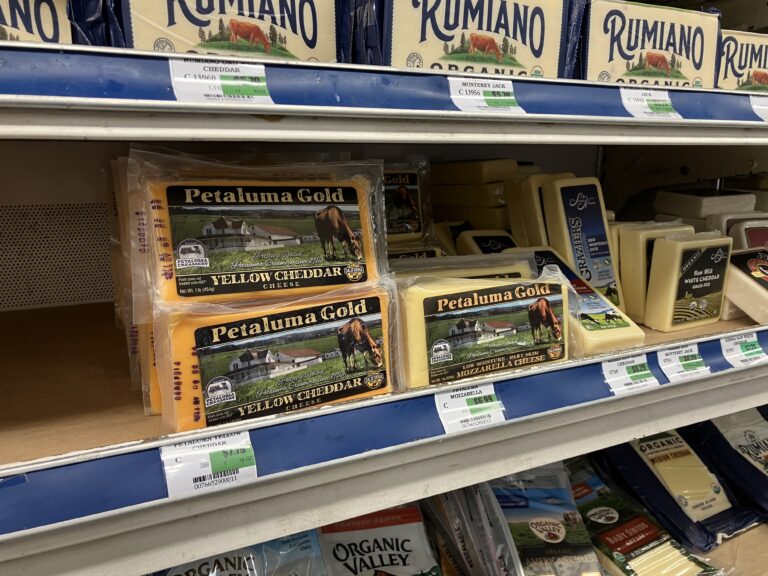
In 2004, Peter made his name in the local agricultural community by purchasing the Petaluma Creamery, a cornerstone for the North Bay’s shrinking dairy community.
However, by September 2010, the business owed the city of Petaluma $604,720 in unpaid water bills and fines, according topress coverage from the time. Despite a 2018 court order to pay off the remaining balance over 24 months, the Creamery continued to fall behind.
In late 2020, the issue came to a head. The Creamery had accrued a bill for over $1.4 million in unpaid water fines and fees and the city, apparently finally having lost patience, threatened to revoke the Creamery’s crucial wastewater permit if the company did not pay up.
After the Bohemian broke the story, drawing attention by the Argus-Courier, Peter delivered a cashier’s check for more than $800,000 to city hall and later signed a March 2021 agreement with the city, agreeing to pay off the Creamery’s remaining debt and to foot the bill for third-party monitoring of the Creamery’s compliance with various regulations.
In a response to questions last week, Petaluma deputy city attorney Jordan Green confirmed that the Petaluma Creamery has paid off its debt to the city, with the lien on the Creamery property being removed in February.
However, the release coincided with bad news.
“Towards the end of 2022, Petaluma Creamery’s … wastewater discharges slowed, and eventually stopped in early 2023 due to a stop in production,” Green told the Bohemian in an email last week.
On June 13, the city locked the Creamery’s wastewater system, preventing any discharge into the city’s sewer from the facility. Two weeks later, Peter signed a third amendment to the Creamery’s March 2021 Consent Order agreement with the city, which allows the Creamery to stop paying for the third-party wastewater inspector while the facility’s sewer access is shut off.
It is not clear whether the Creamery is able to produce anything or employ anyone without discharging wastewater. Peter and his attorney did not respond to multiple requests for comment on this story last week.
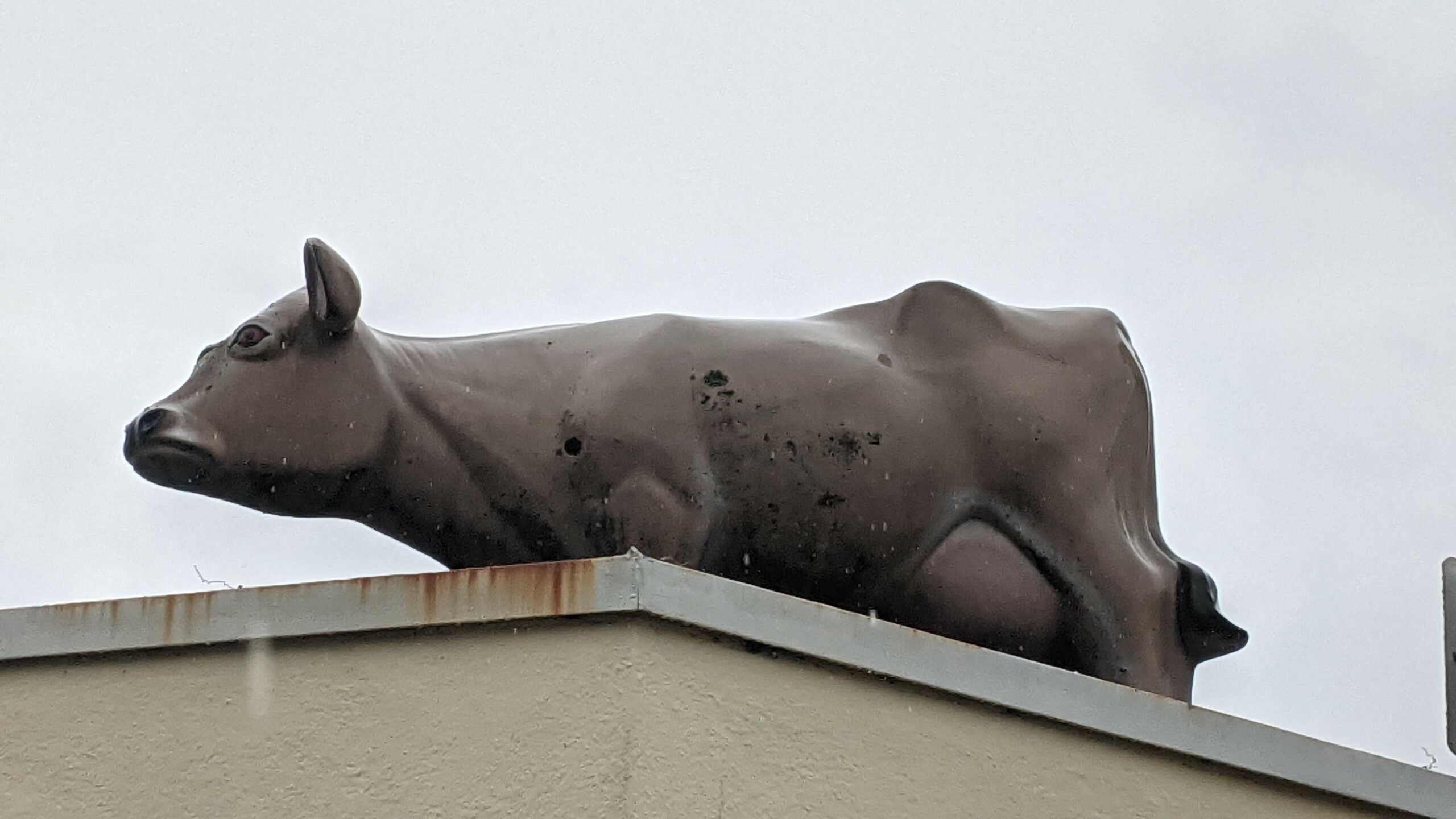
In late 2020, the City of Petaluma cracked down on the Petaluma Creamery for a debt of more than $1.4 million. Photo by Daedalus Howell.
Competing Debts
While Peter and the Creamery were paying off the city, other creditors came calling.
In July 2021, David Bianchi sued Creamery milk suppliers Jack and Olivia Dei over an outstanding debt of $381,788 used to pay for feed supplies. The Deis in turn counter-sued Peter and Spring Hill Jersey Cheese, the company which operates the Creamery. Peter, the Deis argued in court, had agreed to pay off their debt to Bianchi as part of a deal to settle his outstanding $674,138 debt to them for a variety of unpaid bills—and interest payments—dating back to 2016.
“Through the years, Spring Hill began having a variety of financial and other difficulties, some of which have been widely reported in the news. The financial problems led Spring Hill to take milk from the Deis (and others) repeatedly while failing to pay or underpaying them. Spring Hill obviously used and profited from the milk it took,” a legal filing by the Deis’ attorney states.
“Spring Hill’s president Larry Peter continually acknowledged Spring Hill’s outstanding obligations to the Deis and repeatedly assured them that payments would be made when he had the funds. But he never paid the debt. After three or four years of problems, there came a point where the Deis’ sons, Chris and Brian, got involved. They were understandably concerned that their aging parents needed the money in their final years,” the document continues.
According to legal filings, Spring Hill has paid the Deis enough so that they could cover their debt to Bianchi, who has dropped his suit against the Deis. However, the Deis’ debt has not been fully paid. This April, the Sonoma County court ruled in favor of the Deis, recording a judgment of $508,521 against Spring Hill.
In a separate San Joaquin County Superior Court case, Pacific Gold Milk Producers, Inc., a Stockton-based dairy collective, has alleged that Spring Hill owes them nearly $3 million for milk Pacific Gold delivered between February and May 2022.
“Petaluma Creamery never disputed the June [2022] statement, but it canceled the contract in or about September 2022,” Pacific Gold’s attorneys wrote in a November 2022 legal filing.
In a May 18, 2022 email included in court documents, a Spring Hill employee requested documents from Pacific Gold to compare the companies’ records. After receiving documentation from Pacific Gold, she wrote “Well the great news is our numbers match exactly!”
Peter stated in a March filing that the Spring Hill employees working on reconciling the Pacific Gold account were unaware that he had a separate arrangement with a Pacific Gold representative for some of the milk sales under question. “This is still unresolved,” Peter wrote.
In April, the Sonoma County Sheriff’s Office recorded a “writ of attachment,” an order of the court creating a lien on the property, for nearly $3 million on the Creamery properties on behalf of Pacific Gold. The case is ongoing.
Court filings also show that rumors about the sale of the Creamery did not begin last week with the Argus-Courier’s article.
“Pacific Gold recently learned that Petaluma Creamery is in the process of selling its business to a third party. [Pacific Gold] now files this action to protect its rights and obtain provisional relief pending trial,” a Nov. 22, 2022 filing states.
A month later, just ahead of Christmas break, a Petaluma Creamery employee emailed a Pacific Gold employee: “I don’t have any planned days off. We are close[d] Dec 26th and Jan 2 for the holidays but barring us going out of business (could happen), I will be here.”
Photo by Daedalus Howell
Peter himself has recently referenced the idea of selling as a means of paying off his debts, according to a legal filing by the Deis’ attorneys.
“Mr. Peter has sworn under penalty of perjury that if he won the lottery, the Deis would be paid the balance of their Note and much more. But he claims Spring Hill cannot pay because it does not have the funds to make the payment at the moment (though he has held out the specter of a possible future sale of Spring Hill which would allow it to repay the debt),” a March 29, 2023 filing states.
Juggling various debts is nothing new for Larry Peter. A review of county property records associated with Peter’s various companies reveals a decades-long history of property purchases, sales and debts in addition to fines levied by various state and local agencies.
Peter himself acknowledged that he started his dairy empire with high-interest loans in a December 2020 radio interview with then-Sonoma County Farm Bureau executive director Tawny Tesconi for The Crush’s Farm to Table segment.
“My dream was to own a dairy, so I went out and borrowed blood money—high-interest money—and went out and bought a dairy on Spring Hill Road… The first 20 years were pretty hard because I always had to borrow money at 20–25% interest to get started,” Peter told Tesconi.
It appears the debt dance has continued to the present. Last June, county records show, Peter and Spring Hill Jersey Cheese received a loan for $5.75 million from Socotra Capital, a Sacramento-based firm which specializes in “direct hard money loans to meet your real estate needs.”
Socotra is a “money lender specializing in financing real estate investors on projects that may not be possible through traditional methods,” the firm’s CEO Adham Sbeih said in an interview with River City Bank last month. “We are filling the space that many banks aren’t filling, whether it be a bridge loan, fix and flip loan, commercial refinance, construction projects, or other real estate projects.”
In return for the loan, records show, Peter staked the Creamery and the neighboring properties listed in the June real estate listing which the Argus-Courier reported on. The length and interest rate of the loan are not publicly available.
There is something out there that can dissipate all our sorrows, instilling both immutable calm and readiness for action.
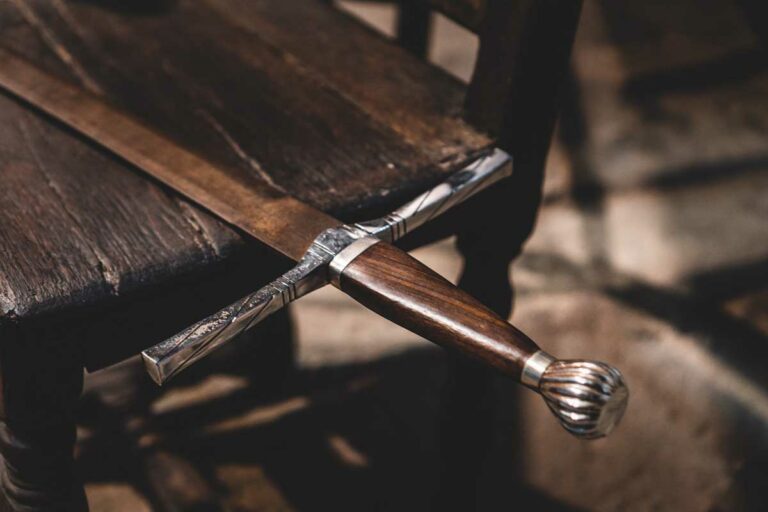
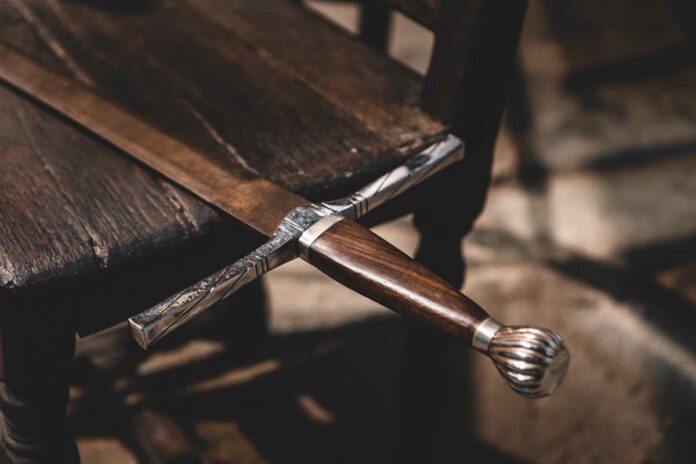
It sometimes appears in the mind’s eye as a cup or as a sword buried in stone. The object is hidden in an inaccessible place: the sword may rest upon a mountaintop, while the cup that holds the Water of Everlasting Life lies in a subterranean cavern on a remote island. We are likely either searching for the sword or the cup, because we possess the other—or at least a rudimentary version of it. But we need to join them, and while not easy, that can be done. After all, the two do exist together somewhere—in the Tarot, for example.
Why all this mystery? Because it’s called the Mystery Tradition.
But the schools have been closed for 2,000 years, and since then the Ageless Wisdom rests not at the center of civilization but on the outskirts. It is not the sacred science that has moved, of course, for it is the great Unmoved Mover, the axis around which the world turns. Instead it is mankind that has drifted away, cycling through the stages of civilization before arriving at the Age of Iron described by Hesiod, the spiritual winter in which all contact with the divine has been severed.
During such epochs—when the immortal wisdom becomes hidden and when sacred kings and temple priestesses are all extinct—metaphysical knowledge must be sought for and won through an inner battle between the part of us that is human and the part that is divine. The term for this quest for knowledge, enlightenment and awakening of dormant powers is “heroic spirituality.”
Typically brought about by crisis, it is an adventure that takes place when all the temples are closed. People no longer believe in the old gods, or know how to act upon the invisible realm of causation so as to produce effects in the visible realm. The Everlasting Light still shines, but its source must be found, and only the daring hero, guided by ancient books and his own dauntless determination, can find it.
We’re all no doubt familiar with someone who has undertaken this quest for the spirit, who said, in an iconic archetypal film, “I want to learn the ways of the spirit and become a knight like my father,” when his world lay in ruins, and others called the spiritual force a silly superstition.
An old alchemical text says one needs to be born for this undertaking. The thing is, everyone who was ever born for it didn’t know it until the hour arrived, and what seemed impossible suddenly became necessary.
Nearly two decades ago, I somehow convinced my filmmaking pal, Abe Levy, to accompany me on a drive across the American Southwest, through the endless ribbon of mirages known as Interstate 40 until we reached the White Sands Missile Base in Socorro, N.M.
This was not our final destination, but an obligatory stop made on behalf of the U.S. government so that they could clear our rental car, our camera gear and our very persons before granting passage onto the base. After that, we drove 17 more miles into the base’s interior, then rendezvoused with a press liaison who drove us further still.
Levy was the cameraperson and I was the reporter, and our story was pegged on the 60th anniversary of the first detonation of the atom bomb. The subject had haunted my imagination since sixth grade, after I managed to miss the broadcast of ABC’s dystopian TV-movie about nuclear war, The Day After. In its absence, during the morning’s class discussions intended to soothe our anxious minds, my own nuclear nightmares filled the void.
At the end of the original broadcast, a disclaimer read, “The catastrophic events you have just witnessed are, in all likelihood, less severe than the destruction that would actually occur in the event of a full nuclear strike against the United States.” Naturally, this added more fuel-rods to the reactor fire of the Thanksgiving holiday, when families all across America shared solemn conversations about vaporization, radiation sickness and—oh, no!—hair loss, as the gravy boat dolefully bobbed around the table.
Not my family, of course—we missed it. But I knew what had happened on TV, if only secondhand, and that it was “less severe” than the real deal, which then seemed imminent.
Fortunately, President Ronald Reagan commanded Soviet President Mikhail Gorbachev to “tear down this wall!” and I guess he did, because Jesus Jones made a music video about it, and my nuclear holocaust anxiety quelled into a low thrum through the ’90s. By 2006, I was able to confront the nearly forgotten fear at its literal genesis—the Trinity site in New Mexico—recorder in hand, as Levy popped off shots. I wrote and filed my story, and it eventually became yesteryear’s news.
Since then, not even North Korea’s nuclear-saber rattling during the early provocations of Donald Trump’s presidency resurfaced my atomic anxiety—though nicknaming Kim Jong-Un “Rocket Man” was, dare I say, inspired. No, it took filmmaker Christopher Nolan and his Oppenheimer marketing machine to flare up this radioactive half-life within me. But it’s not anxiety anymore; it’s angst. And I suppose it will always be there, like the shadows etched into the stone walls of Hiroshima by the boiling light of Little Boy. After 40 years, it’s an old friend. I suppose this is how we learn to stop worrying and love the bomb.
With its 825 Drake development project, the Board of Supervisors has again taken action that impacts Marin City without consulting, and over the objection of, Marin City residents. This is both a moral failure and a failure of representative democracy.
Marin City is the most diverse community in Marin County. It is a strong and vibrant community on a relatively small but beautiful patch of land in Marin County. Marin City is a half-square-mile community of 3,094 people—with only 1.2% of the total county’s population and .1% of the county’s land area.
Shockingly out of proportion to Marin City’s relatively small size, the county has concentrated its higher-density housing there. It has concentrated in Marin City 60% of the county’s public housing and nearly half of its publicly assisted multi-family rental units.
To this over-burdened community, the Board of Supervisors has now decided to add more high-density housing, reviving the previously shelved 74-unit 825 Drake project. There was no communication with the Marin City Community Services District—who have now voiced their strenuous objections—before pushing through a $40 million bond to support the developer.
This action is just the latest in a long history of initiatives that the Board of Supervisors has undertaken without consulting the residents of Marin City. For far too long, the Board of Supervisors has announced projects without seeing the need to listen to input from the residents. Like all Marin County residents, the residents of Marin City deserve representatives who listen to their concerns before deciding issues that impact their lives and community. They deserve the dignity of self-determination in the community that is their home.
The 825 Drake development project should be stopped immediately. The property should be conveyed to an entity committed to working on behalf of—and not against—the interests of the Marin City community. The Board of Supervisors should recommit to living up to their affordable-housing responsibilities in a way that does not perpetuate and increase racial disparities in Marin County.
Rev. Scott Clark is a pastor at First Presbyterian Church of San Anselmo.
Dave Heller (“Letters,” July 19) is right, we need both “final five” and ranked voting in all elections. The 50 Republican senators represent 40% of the population. Minority rule happens when voters have no choices except the incompetent candidates from the two lame-ass major parties. Competition and anti-monopoly practices work for consumers, and they will work for voters. What organization in the world would tolerate replacing a degenerate imbecile “leader” in his 70s with a man older than he is? Is this really the best we can do, America?
Craig J. Corsini
San Rafael
Oppression
Thank you, Nikki Silverstein, for providing the true information about, and straight from, the unhoused residents whose conditions you write about (“Tent Tension,” July 19). Government and mainstream media tend to disinform and refuse unhoused people a voice. I appreciate, also, your coverage of the oppression of unhoused folks by governments.
Monica Martella
Via PacificSun.com
Local Resource
Whether addressing homelessness, housing inequities or rogue police brutality, your articles are always well researched, balanced, insightful, articulate and timely (“Tent Tension,” July 19). You are a valuable local resource. The Pacific Sun and our community are fortunate to have you!
Barbie mania is so pervasive that if one googles “Barbie” right now, the web page turns pink and sparkles with animated magenta stars.
Barbie has been a ubiquitous toy for decades, reigning as “supreme doll” before, during and after my childhood. So when I heard the new Greta Gerwig movie was Barbie, I was intrigued.
Gerwig’s previous films, Ladybird and Little Women, are poetic depictions of a mainstream story—women coming of age in a world hostile to them. They seem the perfect segue into Barbie, another reimagined feminine classic.
While one might expect shallow and beautiful, the Barbie movie owns it all—the good, the bad and the ugly—with a timely and compassionate message for women and men alike.
For the record, I didn’t see it with Oppenheimer, a phenomenon called “Barbenheimer,” where moviegoers watch the films as a double feature, ostensibly because they were released on the same day. For those participating in this five-hour film extravaganza, see Barbie last.
Directed by Gerwig, the live-action film Barbie was co-written by her and partner Noah Baumbach, and stars Margo Robbie and Ryan Gosling. It pokes fun at Mattel, even briefly featuring the character of Ruth Handler, first president of Mattel, who invented the iconic doll in 1959.
The story begins with “Stereotypical Barbie” living her best life in her dreamhouse, in an idyllic matriarchal world where the Barbies are in charge and the Kens play on the beach.
When Barbie suddenly has heretofore-unknown dark thoughts, she seeks the counsel of “Weird Barbie”—a Barbie who was played with “too hard” and as a result sports a choppy haircut, pen marks on her face and is always in the splits. Weird Barbie advises her to leave Barbie Land and travel to the “real world” to discover what’s wrong.
It’s a heroine’s journey into the dark-pink night of the soul, with dramatic consequences for not only Barbie, but for those in the real world and Barbie Land alike.
Part of the joy of the film is how visually over-the-top it is. The filmmakers spare no production-design expense, recreating all the accessories we remember, from the plastic furniture in the open-air dreamhouses to decals representing food on the fridge door.
Like Barbie herself these days, the film is more sophisticated than one might expect, and Gerwig uses all the satirical devices and comedy to deliver a drama with heart that is as aspirational for our world as its namesake doll is for kids.
Barbie was always considered an “aspirational” doll. Unlike baby dolls, Barbie represented what girls were to become personally; and what that is has changed considerably since 1959.
She’s come a long way, baby, to quote the old Virginia Slims cigarette ads from the ’80s, themselves conflicted times for feminism. For years, Barbies were only thin and white, with either platinum blonde or brunette hair. It wasn’t until the ’80s that Mattel made Black, Latina, and Asian Barbies. A Black doll in the Barbie world was first sold in 1968, almost a decade after Barbie was invented. But she wasn’t a Barbie, she was instead Barbie’s Black friend, Christie.
And more than just Barbie’s looks have changed. Moving on from her first words: “I love shopping,” and “Math class is tough,” her voice has evolved to the more inspiring “Find the beauty in everything you do,” and “What makes you different makes you special.”
Since the ’50s, Barbie has potentially become the most diverse doll line, and the doll in the film, and the film’s storyline, reflect those changes, too.
She’s come a long way; just don’t call her “baby.”
PQ
While one might expect shallow and beautiful, the Barbie movie owns it all—the good, the bad and the ugly—with a timely and compassionate message for women and men alike.
Napa
R&B for the Soul
One of the most fun live bands in the North Bay plays this week at one of the area’s best clubs. What’s not to like? The Soul Section—multi-time recipient of the NorBay award for Best R&B Band—plays a hard and sweaty, grown-ass version of soul standards that satisfies for every bar of every song. Pete Donery’s...
She was the tiniest, frailest person of my own generation I had ever met by the time I stood next to her in the rehab room where I was stationed to provide her care during night shifts as she recovered from an undisclosed procedure.
I suppose I could have found out more about her gory details if I’d...
The name Damon Runyon probably means little to most today. But in the early-to-mid 20th century he was a celebrated journalist, sports columnist and author. His short stories about New York and Broadway contained such colorful characters that the term “Runyonesque” was coined to describe the type of gamblers, gangsters, hoods and show people who populated his stories and...
Having celebrated his 86th birthday last July 30, Buddy Guy remains one of the last pillars of the rich Chicago-blues music scene that counted the late Howlin’ Wolf, Muddy Waters and B.B. King among its luminaries.
Still at it, Guy brings his inimitable chops to Sonoma County next week with an appearance at the Green Music Center as part of...
An article in Petaluma’s local newspaper last week prompted more questions than it answered.
On Monday, July 17, the Argus-Courier reported that a commercial real estate firm was advertising one of the city’s largest ag-processing facilities and a few neighboring properties for sale. However, the Creamery’s owner, Larry Peter, was quick to quash the story, telling the paper “I’ve never...
There is something out there that can dissipate all our sorrows, instilling both immutable calm and readiness for action.
It sometimes appears in the mind’s eye as a cup or as a sword buried in stone. The object is hidden in an inaccessible place: the sword may rest upon a mountaintop, while the cup that holds the Water of Everlasting...
Nearly two decades ago, I somehow convinced my filmmaking pal, Abe Levy, to accompany me on a drive across the American Southwest, through the endless ribbon of mirages known as Interstate 40 until we reached the White Sands Missile Base in Socorro, N.M.
This was not our final destination, but an obligatory stop made on behalf of the U.S. government...
With its 825 Drake development project, the Board of Supervisors has again taken action that impacts Marin City without consulting, and over the objection of, Marin City residents. This is both a moral failure and a failure of representative democracy.
Marin City is the most diverse community in Marin County. It is a strong and vibrant community on a relatively...
Minority Rule
Dave Heller (“Letters,” July 19) is right, we need both “final five” and ranked voting in all elections. The 50 Republican senators represent 40% of the population. Minority rule happens when voters have no choices except the incompetent candidates from the two lame-ass major parties. Competition and anti-monopoly practices work for consumers, and they will work for voters....
Barbie mania is so pervasive that if one googles “Barbie” right now, the web page turns pink and sparkles with animated magenta stars.
Barbie has been a ubiquitous toy for decades, reigning as “supreme doll” before, during and after my childhood. So when I heard the new Greta Gerwig movie was Barbie, I was intrigued.
Gerwig’s previous films, Ladybird and Little...