Larry Stiner

0

Photograph courtesy of the Stiner family

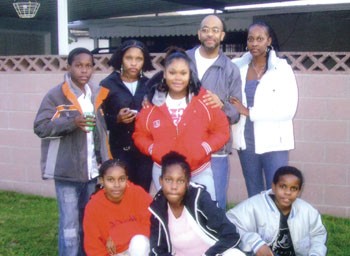
Family Found: Larry Stiner and his six half-brothers and -sisters are finally reunited, 11 years after asylum should have been granted.

Asylum Granted

Prisoner’s family comes to America

By Jordan E. Rosenfeld

This past January, 40-year-old Larry Stiner’s household more than doubled in size. His six half-siblings, born and raised in the South American country of Suriname, finally received the political asylum they were promised by the United States government nearly 11 years ago.

Larry and his half-sisters Kishana, Latanya, Natisha and Taminia and his half-brothers Lige and MTume, share the same father: Watani Stiner, a San Quentin inmate sentenced to life in prison in 1969 for conspiracy to commit murder.

The conviction was the result of a dispute between two black civil rights groups that left two men dead. Watani Stiner’s brother George was also convicted. In 1975, the two brothers, fearing an alleged retaliatory plot by white prison guards, escaped from San Quentin and fled to Suriname.

Earlier this month, the family eagerly awaited the final step in its reunification: Watani Stiner’s parole from prison.

For Stiner, it’s been a long journey. He was a film student at UCLA in the mid-1960s when the Civil Rights movement attracted many disenfranchised young men to black power organizations. Watani (who then went by his given name of Larry) was drawn into a group called Us, run by Maulana Karenga, founder of the holiday Kwanzaa. A year after Us became one of the most visible black power groups in Los Angeles, Huey P. Newton and Bobby Seale founded the Black Panther Party in Oakland.

According to numerous books and newspaper articles, FBI director J. Edgar Hoover’s counterintelligence program began to covertly fan the flames of violence between such groups, hoping to prevent the rise of another Martin Luther King or Malcolm X. In August 1967, Hoover wrote an internal memorandum to all FBI offices “to expose, disrupt, misdirect, discredit or otherwise neutralize the activities of black nationalist hate-type organizations and groupings, their leadership, spokesmen, membership and supporters.”

On Jan. 17, 1968, Us and the Black Panthers met at UCLA to resolve a dispute between the two groups. Both Watani and his brother George Stiner were present. The meeting itself was uneventful, but afterward, sparked by nervous tension–and possible FBI involvement–one man shot his weapon into the crowd, causing panic and further gunfire that ultimately left two men dead. Watani himself was shot in the shoulder. In 1969, the Stiner brothers were indicted with three others for the deaths of Alprentice “Bunchy” Carter and John Huggins. The brothers were eventually convicted, although evidence presented at the trial remains controversial.

Watani was first placed in a Chino guidance center, then Soledad Prison. In 1970, he joined George in San Quentin, and learning of an alleged plot against their lives by white prison guards, the brothers planned their escape.

In 1974, aided by a black prison guard, the two men escaped.

Watani and George fled to Guyana, an international hub for the black power movement. (George Stiner’s whereabouts are unknown today.) Watani settled in politically volatile Suriname, a Dutch colony bordering Guyana. There, he met a Surinamese woman and started a family. Civil war broke out in 1980, and the already weak economy of Suriname collapsed. For more than a decade, Stiner and his family faced cholera and tuberculosis epidemics, as well as heavily armed soldiers. Fearing for his children, Stiner eventually turned himself over to American authorities in exchange for their political asylum in 1994.

The U. S. government was slow to grant the asylum request, and in the interim, the children’s mother became unstable. They were shuffled off to separate foster care homes. Finally, last January, all six children were reunited in Los Angeles with their half-brother, Larry Stiner, his wife, Diane, and their two daughters.

The children, says Stiner, are just “eager for Dad to come home.”

Though Larry Stiner is determined to keep this family together, adding six children to an existing household of four on one income has been stressful. Larry works as a communications operator for the city of Los Angeles. When he gets home at the end of the day, his and Diane’s work has only just begun.

Enter Suzi Jestadt, a Marin County woman who made Watani Stiner’s acquaintance when she began working as a volunteer this year with a men’s support group inside San Quentin.

Jestadt was so moved by Watani’s story and his children’s situation that she began to look for ways to help out. She and Pastor Liza Klein of the San Rafael First United Methodist Church are in the final stages of setting up a fund called the San Quentin Families Project.

“Watani is the one that everyone looks up to and admires in the group,” says Jestadt. “He has a quality of peacefulness. Working with him and these men has completely transformed my life. He’s a hero to me.”

The purpose of the project is to help the families of prisoners in need and, says Jestadt, “to encourage inmates to stay in relationships with their children while they are serving their time.”

On April 5, Watani Stiner stood before the San Quentin parole board for his annual hearing. The board denied his parole, calling him an “unreasonable risk to society.” Watani’s actions in the 1960s now qualify as an “act of terrorism” under Section 865 of the Homeland Security Act.

“There is no possible way that he is a risk to society,” says Larry Stiner. “We’re talking about someone who was 19 during a time of social turmoil. [The parole board] paints him as someone you shouldn’t dare let on the street, and suggested that all those years he was in Suriname he was living in the Caribbean, high on the land, when that was not true at all.”

Watani will get to see his children, for the first time in 12 years, when they visit him in San Quentin next week. He plans to continue fighting for his release, and hope remains that the family will one day be permanently reunited.

“Over the years, he [Watani] has compiled documents that are full of inconsistencies about his case,” says Jestadt. “He thinks he will be able to take the case to lower courts. He has more than proven his good behavior.”

From the April 20-26, 2005 issue of the North Bay Bohemian.

© Metro Publishing Inc.

First Bite

First Bite

SRJC Culinary Academy

By Ella Lawrence

Editor’s note: First Bite is a new concept in restaurant writing. We invite you to come along with our writers as they–informed, intelligent eaters like yourselves–have a simple meal at an area restaurant, just like you do. This is not a go-three-times, try-everything-on-the-menu report; rather, this is a quick snapshot of a single experience.

The first thing I noticed about the Santa Rosa Junior College Culinary Arts’ Cafe and Bakery is that everyone is so darn friendly. Heartfelt smiles abound, from the espresso-making cashier dispensing divine pastries early in the morning to the teenager in the chef’s hat in the wide-open kitchen. The cynic in me wants to think, “Hah! Naive! That smile will wash off once they go to work in a real restaurant!”

Maybe it will, maybe it won’t. The optimist in me quickly quieted the cynic over lunch at the culinary cafe, which is certainly a real restaurant and sometimes books out days in advance. And for good reason.

A recent lunch began with the leek-chive soup ($3) and the mixed-greens with red Bartlett pears, radicchio and feta ($3). The soup was a pleasing pale green, very creamy and mild, adorned with a darling sprig of flowering garlic chive, which was a bit underwhelmed by the richness of the soup. The salad was perfect (especially the pear), an early promise of the produce that would make the rest of our meal spectacular. The SRJC’s culinary academy supports local farmers and features organic produce and meat from its own Shone Farm in the north county.

Next up was the Shone Farm beef polpettine with tomatoes and peas ($8.50), served over house-made fettuccine and Swiss chard, and the Dungeness crab cake with orange-chipotle sauce ($10.50). Polpettine, in case you didn’t know (we didn’t), are breaded, deep-fried meatballs, and everything on the plate was comforting just to look at (although I suspect those “peas” were actually lima beans). The sauce was reminiscent of a ragout, complete with chunks of pancetta. Mmm . . . bacon . . .

The crab cake was more Southwestern than I’d anticipated, which was a welcome change from the creamy, aioli-covered dishes that are the standard accoutrements to crab cakes this time of year. The sauce was the highlight of this dish‹I’d never have thought that the smoky orange and chipotle would pair so wonderfully with the sweetness of the crab. All of the produce on our plates was of superb quality.

The best part of lunch was dessert: we ordered the chocolate bread pudding with coffee-brandy sauce ($3.50) and the maple custard with pecan butter crisps ($3.50). The bread pudding was a little intense for me after the delicate orange flavors of the crab, so the maple custard was a perfect pairing. It came with fresh segments of mandarin orange swimming in its own fresh juice, and the custard was divinely light, paired with tiny, sweet crunches of clear pecan brittle.

And the best part of the culinary academy’s restaurant? Its prices. Six courses, a coffee and a hefty tip later, my wallet was only 40 clams lighter!

SRJC Culinary Arts’ Cafe and Bakery, in the Brickyard Center, 458 B St., Santa Rosa. Lunch, Wednesday-Friday, 11:30am to 2pm. Reservations required. 707.576.0279.

From the April 20-26, 2005 issue of the North Bay Bohemian.

© Metro Publishing Inc.

Nomeansno

0

Boiling with Soul

Nomeansno create punk-rock-jazz roadkill

By Gabe Meline

When some really old guys walk out onstage and pick up instruments at the Phoenix Theater on May 4, it’s not some kind of joke that Phoenix manager Tom Gaffey’s parents are pulling. It’s actually the band.

Seriously, Nomeansno look old, but they will fuck you up.

Rob Wright is used to people’s initial shock by now. “When I started playing, I was in my mid-20s, so right from the very beginning, I was 10 years older than everyone around me,” the 51-year-old Nomeansno frontman says during a recent phone interview. “So hearing people say ‘God, you’re old’ has never really bothered me. What has surprised me is how little it seems to matter.”

When his band first came to Sonoma County for a warehouse show in Santa Rosa, Wright (then only 33) was already gray and starting to bald. But as Nomeansno continue their 25-year (and counting) reign as the Greatest Canadian Punk Band ever, the “old guys playing rock and roll” stigma continues to be flipped in their favor as reassuring proof that you can age not only with grace but with fire.

“I think people appreciate the fact that there are people who are above 40 who don’t mind getting up there and screaming and sweating and playing at 110 decibels,” he says, summarizing his band’s powerful stage presence. “We haven’t slowed down and just gone to our ballads, reminiscing about the good old days.”

In fact, the band’s song titles show that, if anything, Nomeansno’s music ominously tells of the bad old days: “The Day Everything Became Nothing,” “The End of All Things,” “Dark Ages,” “Life in Hell.” The Nomeansno formula is hard to nail down, but it generally contains a mixture of horror and total surprise.

Punk has since separated into countless subcategories, but when Nomeansno began, the rules were rigid: violent music played at breakneck speed. Nomeansno were among the first to blow the genre’s limitations wide open with pounding jazz bass lines, celestial vocals and psychedelic songwriting; those of us it has affected have never fully recovered.

The band have hammered out a formidable catalog of albums with titles like Small Parts Isolated and Destroyed, each with a unique vision that we can only hope to understand in a few days’ time. Each album, more expansive than the last, reminds us of the original impulse we felt when we first heard Rob Wright’s distinctive bellow telling us that real love don’t care about me or you, and that impulse told us: I think these guys know more than I do.

When asked how he thinks his band will be remembered in the history books, Wright wryly suggests “watching from the sidelines,” though the band have earned modest success. “Dad,” a surprise underground hit from the band’s first album as a trio, 1987’s Sex Mad, describes from a son’s point of view a family’s helplessness under an abusive father. The song struck a nerve, and the band stepped out from the sidelines.

Wright himself has not worked a day job for years. “It’s always been such a surprise to us that anything we did was popular,” he remarks. “Our songs have been quite personal and idiosyncratic, and even if I wasn’t in the band, I’d have a hard time finding a slot for us.”

Likewise, there is no typical audience for the band, but a certain contingent of Nomeansno’s core crowd are musicians. Wright has never been featured on the cover of Bass Player magazine, yet his thundering command of the instrument has single-handedly revolutionized punk rock bass playing. These days, it’s said that he listens to a lot of jazz fusion, like a curious driver who turns back to survey the animal he has just run over. Bassist Jaco Pastorius may have beat him to the punch in coining the term “punk jazz,” but after you have heard Rob Wright, Jaco Pastorius is roadkill.

Though the band covers Miles Davis’ “Bitches Brew” on their latest album, 2001’s One, Nomeansno’s true strength lies not in sheer virtuosity, but in a peculiar ability as both songwriters and performers to channel terror and elation at the same time. Even a basic assessment of the band’s songs yields a subtle concoction: the music can contain anguish or joy, but above all, it boils over with soul.

“Stocktaking,” from the landmark 1989 album Wrong, is based entirely around one simple chord, repeated over and over. Slowly building in intensity, the song’s prodding questions about desire and necessity create a dynamic spectrum of wild emotional depth.

Sadly, almost all of Nomeansno’s albums are currently out of print, but the band are currently working on eventual re-releases–some say a little too lackadaisically. A new deal with noted madman Mike Patton’s label is causing Wright to look toward the future. “We’re gonna probably work with Ipecac for our new record when it comes out,” he clarifies, “which we’re writing right now.”

Wright is unfazed when asked about the possible pressure involved in signing with Ipecac, whose roster includes newer, younger heavyweights like Fantomas, Isis and the Locust. “We’ve never really played the kind of music that even our audience wanted to hear,” he points out. “The only pressure we feel now is that what we’re doing is worth doing. I mean, we’ve had a great run. If it were to end tomorrow, I can’t say I’d be disappointed about what we’ve done and the legacy we’ve got.

“You know, it’s a damn fine profession,” Wright adds reflectively. “For all its cartoonishness and clowniness, music has been going on since before people grew food and built houses. It’s completely integral to any human culture, and we’re the guys who do that job. And as long as we can do it, and do it effectively, then why not?”

Nomeansno play on Wednesday, May 4, at the Phoenix Theater (“We’ve always had great shows there,” says Rob) with Polar Bears and the New Trust. 201 Washington St., Petaluma. 8pm. $10; all ages. 707.765.3566.

From the April 20-26, 2005 issue of the North Bay Bohemian.

© Metro Publishing Inc.

Phil Lesh

0

Dead Ahead

Phil Lesh goes truckin’ through the past

By Greg Cahill

At their first gig, the Grateful Dead played for an audience of three. Of course, the group became one of rock’s most adored bands, leading a horde of fans on what has been memorialized–and chronicled in stacks of books–as a long, strange trip. Now the band’s 65-year-old bass player, Phil Lesh, has become the first band member to lift the veil for a candid behind-the-scenes look at the rise of the Dead.

Searching for the Sound: My Life with the Grateful Dead (Little, Brown and Company; $25.95), replete with 32 pages of photos, strolls through not only the band’s growth from house band at the legendary Acid Tests, the series of LSD-soaked parties thrown by novelist Ken Kesey in and around San Francisco, to the worldwide stadium tours, but also investigates the evolution of the band’s signature sound.

Lesh doesn’t skirt around the dark side, especially the excesses that eventually killed or contributed to the deaths of guitarist Jerry Garcia, organist and harmonica player Ron “Pigpen” McKernan and pianist Keith Godchaux, and which nearly killed Lesh, who had a liver transplant in 1999 as a result of his chronic hepatitis C infection.

While substance abuse crops up over and again, it is the band’s personal mix, on and off stage, that is the heart of his story. “From the beginning, the chemistry was more intense than anything I’d ever experienced,” Lesh notes in a statement appearing on the band’s website. “We knew we were on to something, but didn’t quite know what. Here it is, then, the Grateful Dead, from the inside, as I saw it and as I lived it. It’s neither a work of historical scholarship, nor a work of fiction–just my story of a unique phenomenon.”

In many ways, Lesh is particularly well-suited to tell the band’s story. He is probably the most educated musician to emerge from the San Francisco scene in the 1960s. He studied avant-garde composition at Mills College in Oakland, and continues to study and compose under the influence of such modern classical composers as Arnold Schoenberg.

Lesh was there at the beginning and is an engaging guide, providing plenty of details about the band’s inner workings, philosophical leanings and musicological influences. Some of his tales are lighthearted, like the time he met his doppelganger (a classical cellist) at the Hamburg Musikhalle in Germany.

He also displays a knack for bringing the reader right into a particular place and time. For instance, on the band’s 1972 tour of Europe, Lesh was overcome by the radical spirit of the students and workers during a free outdoor concert in Lille that followed the cancellation of an earlier concert there.

“The landscape, the flowers and the people seemed to radiate a simple joy in just being,” Lesh writes. “Afterward, the student promoters embraced us tearfully–they hadn’t believed up until the moment we pulled into town that we would actually make good our promise [to return].

“It was one of the finest ‘music for the people’ moments, if I do say so myself.”

The band’s official website offers a companion CD that includes the long-lost studio take of the seminal 1966 Grateful Dead recording “Cardboard Cowboy” and the July 9, 1995, live version of “Box of Rain,” recorded at Soldier Field in Chicago, the last song the band ever played together before Garcia’s death.

Meanwhile, the band’s San Rafael-based record label, Grateful Dead Records, has launched a 40th anniversary series with the release of Rare Cuts and Oddities, 1966, which spotlights the band a year before their major label debut, before their music became psychedelicized. The rarities disc finds the band heavily influenced by blues DJ and band member Pigpen, covering the Rolling Stones’ “Empty Heart,” Buddy Holly’s “Not Fade Away” and Slim Harpo’s “I’m a King Bee” (the latter two songs already having been covered by the Stones) and sounding very much like a U.S. bar-band version of the Stones.

What a difference a few micrograms of hallucinogens can make.

From the April 20-26, 2005 issue of the North Bay Bohemian.

© Metro Publishing Inc.

News of the Food

0

News of the Food

Pesach

By Gretchen Giles

The eight-day holiday celebrating the exodus and freedom of the Israelites from Egypt and the clutches of Pharoah Ramses II, Pesach–or Passover–is a holiday in which food figures hugely. Featuring tables laden with dishes that represent as well as nourish, Pesach offers many opportunities for families to celebrate Seder together and to gather in community. While most area synagogues have long closed their reservation lists for congregational gatherings, at least two area restaurants also offer Pesach meals.

The newly opened Bistro V in Sebastopol takes an unusual approach to the traditional Seder, celebrating the crossing of the Red Sea in honor of Miriam the prophetess. Led by Rabbi Elisheva Salamo of Congregation Ner Shalom in Cotati, this women-only Seder focuses on the Dance of Miriam in both the Ashkenazi and Sephardic traditions. Diners are encouraged to bring tambourines, as selections from the Song of Songs are an emphatic part of the evening. Chef-owner Rick Vargas prepares a special six-course menu that serves both carnivorous and vegetarian diets, and the whole event is only $36. The restaurant will also be open with its regular menu to the non-Miriam-celebrating public. The Passover women’s celebration is slated for Friday, April 29, at 6pm. The Seder menu is available from the first day of Pesach, April 23, through Friday, April 29. Bistro V (formerly Chez Peyo), 2295 Gravenstein Hwy. S., Sebastopol. 707.823.1262.

The Syrah bistro in Santa Rosa’s Railroad Square offers a one-night-only Seder celebration on Sunday, April 24, from 5:30pm. Chef-owner Josh Silvers explains that he doesn’t want to tempt diners away from the family table on the first night of the holiday, perfering instead to lure them on the second evening with his version of “chopped liver” featuring duck liver and foie gras. Silver’s innovative take on the traditional Passover meal is a five-course feast that includes matzoh ball soup, as well as veg dressed in white truffle oil and a marvelous marriage of fish and lamb. $60. Syrah, 205 Fifth St., Santa Rosa. 707.568.4002.

Meanwhile, those hoping to pick up a few bottles of Gan Eden‘s excellent kosher wine had better act fast. Finding it impossible to properly educate his children in Orthodox tradition in the North Bay, vintner Craig Winchell has slashed the prices on his bottles and is preparing to literally close up shop in order ot move his family to Los Angeles for its excellent yeshivas. While Winchell admits to being extremely busy preparing for Pesach and closing down a business, he will sell cases of his award-winning kosher wines for half price to those who make a brief appointment at the winery. For details, contact Winchell at 707.829.5686. Gan Eden Winery, 4950 Ross Road, Sebastopol.

From the April 20-26, 2005 issue of the North Bay Bohemian.

© Metro Publishing Inc.

Commute Shortcuts

0

Roads Less Traveled

The secret rites, short cuts and back roads of guerrilla commuting

By Alex Horvath

It’s just after 6am, and the day is about to begin for Petaluma resident David Spangler. As it is each work day, this will be a long one for Spangler, who drives an arduous commute each morning from his east Petaluma neighborhood to downtown Mill Valley, where work starts at 8am. It’s a straight shot down Highway 101 that at some times of the day might only take 40 minutes, but which at 6am can take as long as two hours. Like a sailor sticking his finger into the wind, Spangler turns on the car radio and listens for the traffic report, the ultimate arbiter that decides which of the several creative routes he has plotted out to get to work on time he will use that day.

On some mornings, Spangler can be found zipping along the Point Reyes-Petaluma Road, past the Cheese Factory, over the Nicasio Reservoir, to Olema. From there he proceeds south on Highway 1, finally turning left at Stinson Beach onto the Panoramic Highway, curving over Mt. Tamalpais, and eventually dropping down into Mill Valley off Miller Avenue, where he turns a wrench each workday as a mechanic at B&G Automotive.

On other days, he might find himself passing through sleepy Nicasio and out Lucas Valley Road, past Skywalker Ranch, putting himself ahead of the logjam that is a regular occurrence on the roads through Petaluma and Novato, and close enough to work so that the rest of the commute on 101 through San Rafael and southern Marin is tolerable. With the exception of the occasional cow in the road, Spangler finds the drive effortless.

“You listen to the radio to figure out what direction you will drive in,” he says. “Sometimes I will take D Street down to San Antonio Road, past the bridge, and just get on there. Other times, I might take Lakeville [Highway] down to Novato. Last week there was an accident between a motorcycle and a vehicle at Lincoln Avenue. I got stuck in the crawl through San Rafael. It can take over an hour and a half to do the crawl.”

Spangler, 45, is a blend of road philosopher and urban traveler. He’s a guerrilla commuter in a time when taking the freeway is the least likely way to get to or from work in the fastest manner. Married for some 20 years, and the father of two teenager sons, Spangler is one of a growing number of people in the North Bay who have adapted their own short cuts and back-road sojourns in order to stay off the dreaded gridlock that can be Highway 101.


It’s an exaggerated understatement to merely note that traffic sucks in the North Bay. And it’s no secret that the local commute situation won’t be fixed any time soon. Further, consider the fact that the average North Bay commuter will spend more than 20,000 hours sitting behind the wheel of a car in Marin-Sonoma traffic over a 20-year span of time. There is no fast rail system, the bus system has routes and schedules that make hitchhiking seem like a smart plan and flying cars have, alas, yet to be invented.

The only relief to the daily congestion lies in the back roads and short cuts that a growing number of daily drivers are taking, guarding their secret routes with an intensity that would make one think these public roads were a matter of top national security.

“There are different reasons why I commute through West Marin to get to work,” Spangler says, even casting back to last year’s holidays. “On the Wednesday night before Thanksgiving,” he cites by example, “I know for a fact it will take at least two and a half hours to get home. It’s exactly 10 miles more to go this way, and I get home in 90 minutes. This way, I’m relaxed. I haven’t been stopped in traffic and wrapped up in the whole ‘hurry up and stop’ mentality.”

Spangler, who grew up in Mill Valley, believes that there are different “levels” of commuters. “We are all like drone bees leaving the hive each day, knowing where we have to go,” he says. “There are the young people with no experience who hurry up and stop. Then there are the older ones who just stay in our lanes. I have seen women putting on their makeup in traffic and people reading the newspaper.”

It is for this reason, he says, that he opts for the long route–which is quite often a lot shorter.

“The key for me is watching the scenery change,” he says. “It could be something as simple as driving past Pegasus Stables [near Petaluma] and seeing how much water is in the pond. Or watching the grapevines change. It’s the ambiance of doing the different routes instead of the toil of traffic, the separation time, or winding down, from work to home. I come home each day all relaxed, not stressed.”

Spangler wasn’t even stressed when, driving home one rainy afternoon last year around the bucolic Bolinas Lagoon, he wound up sliding and flipping his Chevy S-10 pickup truck one and a half times, landing in the water and gaining him membership in the somewhat exclusive Bolinas Lagoon Club.

“I called my wife to let her know I would be late and that I wasn’t hurt,” Spangler recalls. “The funny part was that I hated the truck and wanted to get a new one anyway.”

Now in a newer truck, Spangler says he is not alone in his commute. He says he has met others from Sonoma County who take the same back roads down to central Marin and the city. “It gets so that you recognize the vehicles,” he said.


Like Spangler, more people are developing their own private methods of getting from here to there. Try to find out about the shortcuts, though, and you are likely to get a grimace like you had just asked them to attend an Amway meeting. Some won’t reveal their routes for fear of more congestion. Indeed, during commute time, some back roads, such as Adobe Road approaching Penngrove at around 4:30pm, can have as many as 30 cars backed up at a rural country stop sign.

Jennifer Crandall, 20, a Le Cordon Bleu graduate of the California Culinary Academy who commuted to San Francisco and is now a chef at Rohnert Park’s Olive Garden restaurant, reluctantly says that she goes home to Santa Rosa via Highway 116 through Sebastopol on those days when traffic is at its worst, adding that the longer commute seems to take less time.

“Maybe it’s because you are moving the whole way,” she shrugs.

Crandall adds that there are other side routes that many in the know take, but then hesitates to reveal them for fear the routes might become congested.

“Don’t tell anyone about this,” Cotati carpenter Mike Stephens begins in a hushed voice, drawing a diagram on a restaurant napkin, detailing how to get to the Sebastopol Road area of west Santa Rosa at around 9am on a recent Thursday.

“Traffic is probably backed up at Santa Rosa on 101 right now,” Stephens says conspiratorially. “Just take Redwood Drive past Wal-Mart, making a right on Langner, which is a tiny country road. Make a right at the end, and you are on Old Redwood Highway. Take a left at Todd and an immediate right at Frank’s Mini-Mart.”

Stephens says to go straight, through a little neighborhood, making a left turn at the end of the street where it comes out, followed by an immediate right. Then proceed on a street behind the car dealers on Santa Rosa’s auto row. At the next stop light, take a left turn over some railroad tracks. Finally, turn right onto Dutton and straight through to Sebastopol Road. “It should take you about 15 minutes.”

His directions seem cryptic, but they work on another rainy morning when traffic was completely stopped on 101 north due to a six-car traffic accident. I emerged in downtown Santa Rosa in time for an appointment that I most certainly would have missed had I sat in traffic.


For some, commuting on the freeway is the only option. But what was a one-hour commute 10 years ago now takes many drivers upwards of three hours. People plan early drives in and late returns to accommodate the traffic, which backs up as far south as Sausalito by 3:30pm on some days and slowly continues in fits and starts all the way to Santa Rosa. Of little aid are the bus service routes cut by Golden Gate Transit in 2004.

“If I left home by 5:30am, it only took me an hour and 15 minutes to get to my office in South San Francisco,” says Rohnert Park resident Robin Holliday, a workers’ compensation insurance underwriter who commuted to the city for three months after moving to Sonoma County last year. “On the way home, it took a bit longer. I was sitting in traffic most nights for an average of three hours.”

Commuting on 101 had been a disappointment for Holliday, who had purchased a Honda Civic hybrid last year in anticipation of legislation that would allow hybrid owners to use the high occupancy vehicle (HOV) “diamond” lanes in single-occupancy cars after Jan. 1. When pending federal legislation didn’t receive approval, Holliday and others who had purchased their vehicles for similar reasons remained stuck in traffic.

One afternoon, while stopped in traffic before the so-called Novato Narrows, that freeway strip in north Marin where lanes suddenly disappear, Holliday decided to get off at Atherton Avenue and try her luck getting over to Highway 37 and then Lakeville Road for a back-road trip home. As fate would have it, apparently the only traffic cop working in northern Marin that evening happened to be on Atherton–which, psst, is a speed trap–and cited Holliday for driving a few miles over the speed limit. These days, Holliday has a more palatable commute, less than 10 miles each way to her new office in Santa Rosa, an appealing change, as she never has to get on the freeway.

Some officials, like the members of Marin’s Congestion Management District, are putting together a plan for fixing freeway on-ramps and other traffic-related issues, which they say will take 25 years to complete–and they are just in the beginning phases. There is also some chatter among transit officials about charging single occupant vehicles for the right to drive in high occupancy toll (HOT) lanes at the Novato Narrows, which some say would cater to those drivers who could afford the expensive surcharge, and in the long run would wind up slowing down traffic even more.

An Internet chat room recently abuzz with the topic compared the proposed HOT lanes to “the old Soviet Union, where the powerful drove in their special, traffic-free lanes, while the masses sat in traffic.”

In July 2004, transportation officials in Marin found that HOV lanes through that county carried an average of 2,698 people per hour, compared to 2,181 people per hour traveling in the mixed-use lanes. In the HOV lanes, drivers traveled at an average 46 mph in the southbound morning commute, and 54 mph in the afternoon northbound HOV lanes. When compared with the mixed-lane figures, HOV drivers only saved about 12 minutes in their southbound travels, and five minutes in the northbound direction. (Southbound travel is expected to improve slightly with completion of the Caltrans HOV Lane Gap Closure Project and as HOV lanes become available from Highway 37 to the Richardson Bay Bridge.)

None of these statistics really equal evidence of an improving commute.

In reality, the gridlock situation sucks as bad as it does not because people aren’t carpooling (and, please, two in a vehicle does not a carpool make); it’s because, among other reasons, officials have allowed new development to go unchecked for decades without taking into adequate account the state of the commute. As we say hello to the new Codding-Agilent development taking shape in Rohnert Park, we will also be saying hello to more gridlock, particularly in Penngrove and on the rural Petaluma Hill Road, which is already a not-so-secret side road that many new commuters will use.


David Spangler admits to occasionally taking Highway 101 north home from work, which can sometimes be easier than the southbound grind.

“It’s the luck of the draw, a gamble,” he says. “It depends on which side of town you live in. This is the comical part. I can wind up getting off the freeway and going through five or six lights. If I had taken Lakeville [Highway], there is only one light until I get to Freitas [Avenue].”

Spangler recalls a recent afternoon when traffic was so backed up at the Novato Narrows that he jumped off the freeway and took San Marin Drive all the way out Novato Boulevard, past Stafford Lake and onto the Point Reyes-Petaluma Road, an out-of-the-way loop laughably far from his destination that nonetheless took him less time–and aggravation–to complete.

“If you’ve had a really bad day and are not in a hurry to get home, take the time to smell the pine trees, the high tides and the low tides,” he counsels. “You wind up not taking work home with you. There is this tune down time, a wind down. That’s why I do it.”

He adds, “In these days of increased road rage, it’s sometimes better to take the road less traveled.”

From the April 20-26, 2005 issue of the North Bay Bohemian.

© Metro Publishing Inc.

The Byrne Report

The Byrne Report

Family Values

IN DOWNTOWN NAPA, there is a renovated farmhouse set off by a white picket fence. An American flag waves in the breeze. Inside the house on a Saturday morning, twin babies laugh and play while their parents do chores and talk to a reporter about what it’s like to be moms.

Gap Inc. marketing executive Margo McShane, 40, and her wife, Alexandra D’Amario, 35, have been a couple for about five years. When they got married at City Hall in February 2004, D’Amario was pregnant with the twins, Luca and Isabella. They are a happy family, so traditionally normal that one expects Jimmy Stewart to peer through the window looking at their wonderful life.

In California, there are more than 100,000 same-sex couples, raising 70,000 children, according to the Williams Project at the UCLA School of Law. The McShane-D’Amario household is wealthier and whiter than most of these couples, who tend to be racial minorities with lower household incomes than heterosexual couples. Nonetheless, they are not immune from being targeted as objects of irrational hatred.

According to U.S. Census data, there are nearly 600,000 lesbian and gay families in the country. While California has 11 percent of all households in the country, 16 percent of same-sex couples live here. In San Francisco, same-sex mates make up 7 percent of the total population of couples. In Napa county, it is 1.2 percent.

Lesbian and gay families are increasingly visible. But in the North Bay last week, a disproportionate amount of media attention was lavished on a handful of emotionally tortured Rancho Cotate high school students who marched around carrying signs saying that gay marriage is evil. The youngsters are Svengalied by a local right-wing gun nut. Fortunately, the anti­human rights demonstrators were opposed and vastly outnumbered by members of the Gay-Straight Alliance, a remarkable club with chapters in high schools around the nation.

McShane comments, “Young people are not intuitively anti-gay. Teenagers are vulnerable. Someone in a position of authority taught them that.” Although McShane is wigged out by the homophobic antics of the likes of Congressman Tom DeLay, R-Texas, and President Bush, she professes faith in the U.S. Constitution to carry the nation through the crisis of neoconservative power-mongering and sexual intimidation.

DeLay, of course, is calling for the impeachment of judges that uphold the rule of law and the concept of democracy. And he is joined in his perverse jihad by such widely syndicated columnists as Cal Thomas, who regularly compares homosexuality to bestiality, and whose columns appear in the Op-Ed pages of the Santa Rosa Press Democrat, thereby lending the country’s leading homophobe whatever credibility that paper has to offer. (A spokesperson for the PD says they do not buy all of his columns, although giving him any forum is akin to subsidizing the Jew-bashing Nazi ideologue, Julius Streicher.)

Teenagers searching for social identity–and perhaps confused and shamed by the power of their own sexual attraction to members of the same sex–may gravitate toward the gender-fascist rhetoric of Thomas, DeLay and some of our local “Christian” preachers as an easy way out of the dilemma of finding one’s self mired in a sex-obsessed culture controlled by public-relations algorithms. But the so-called conservative youth expose their ignorance when they call upon the state and federal constitutions as justifications of their self-hating diatribe against gay marriage.

In March, San Francisco Superior Court Judge Richard Kramer ruled in the City and County of San Francisco v. State of California that the state constitution guarantees that civil marriage is a fundamental right that must be open to all people, regardless of sexual orientation.

In a cogent brief, Kramer states there is no “rational” basis for abridging the rights of due process, equal protection and privacy accorded to all individuals by the state Constitution just because an individual is homosexual. The logic of the lawsuit, well worth reading in a high school social studies class (hint, hint), is built upon a series of declarations by experts in the history of marriage and the oppression of homosexuals. Gender is a social construct, and marriage, they assert, is an evolving institution. Prohibiting same-sex unions is akin to the “separate but equal” segregation of blacks and whites, and statutes forbidding interracial marriage, which were struck down in the last century by the U.S. Supreme Court as unconstitutional.

And in downtown Napa, there is at least one family that has proudly taken a stand, not only to live the life that they have freely chosen, but to come out and proclaim their human right to do so–regardless of the attention paid by the media to the theological babble and sexual confusion of some teenagers and their psycho mentors in Washington, D.C.

From the April 20-26, 2005 issue of the North Bay Bohemian.

© Metro Publishing Inc.
Annalee Newitz

0

Geek Grrrl: Cyber philosopher Annalee Newitz worries about Big Brother, and you should, too.

Notes from the Underground

Annalee Newitz and the plight of privacy

I first met Annalee Newitz in the summer of 1997 while working on my master’s thesis at San Jose State University. Famed mathematician and cyberpunk science-fiction author Rudy Rucker sat on my committee, and after I complained to him that no one would listen to all my crazy ideas, he told me to contact Annalee. She had recently interviewed Rucker for her anarchist magazine, Bad Subjects, so he kicked me in her general direction.

“So I’m the one that’s supposed to be receptive to all your crazy ideas?” she said over the phone. “I guess so,” I answered.

After a drive up to Berkeley, where she lived at the time, we sat down and talked about resisting the decentralized power of late capital by engaging in shadow tactics of ridicule and anonymity inspired by the 19th-century East Indian strangulation cult the Thugs in their resistance to the centralized authority of British colonial rule. I suggested using human sacrifice as a metaphor for artistic expression via transgressive ridicule in cyberspace, and Annalee strengthened my understanding of Foucault, Baudrillard and Rene Girard’s Violence and the Sacred. (I still have the notes and flow charts from that conversation. It actually wound up as a fictionalized scene in a later version of the thesis.)

Nowadays, Newitz sets up shop as the media coordinator and policy analyst for the Electronic Frontier Foundation while cranking out a syndicated weekly column called “Techsploitation,” an award-winning chronicle of haute geekdom she launched in 1999 for , Silicon Valley’s weekly newspaper.

On April 28 at the Mill Valley Community Center, Newitz will take part in a cutting-edge science and technology panel session titled “The Future of the Future: The Next 10 to 30 Years,” the second in a series of public forums sponsored by NeoFiles, an online exploration of edgy, visionary philosophy, science and technology. The panel includes virtual reality godfather Jaron Lanier, San Francisco Chronicle journalist David Duncan and Eliezer Yudkowsky, director of the Singularity Institute for Artificial Intelligence, a Palo Alto-based organization founded for “the pursuit of ethically enhanced cognition by creating beneficial AI.” Legendary cyberculture impresario R. U. Sirius moderates the whole shebang, and the group will explore the changes that can be expected throughout the next few decades.

I recently ambushed Newitz over the phone to ask what she intends to discuss at the forum. “I’m going to be talking about how current trends in location technologies and also other kinds of online surveillance have the potential to create a future where we have no expectation of privacy,” she said. “And at the same time we also have our creativity, our ability to make creative works, really curtailed. Because we’re unable to speak out without being identified–because so much creativity relies on anonymity or partial anonymity–we’re going to see this kind of unholy alliance between copyright holders who want to make sure their work isn’t being stolen and the government that wants to keep track of what everyone’s doing so we don’t become terrorists. It will create a situation where we have a very stagnant pop culture. And also, a population that doesn’t have a way of finding privacy.”

Which makes one immediately ask how folks will be able to circumvent such a destructive scenario. “There’s a lot of different ways,” Newitz explains. “There’s traditional modes of activism where people can try to fight legislation that threatens to create greater surveillance states on the Internet. But also, people need to be thinking about designing tools that protect peoples’ anonymity, and think about designing networks where people can share information without being tracked, and creating machines that allow us to maintain our privacy while still allowing us to speak out.

“The guy who’s organizing this panel, R. U. Sirius–he writes under a pseudonym, and part of his creativity is connected with his ability to have this kind of identity that’s separate from his real-life identity. We need to develop technological tools to protect people who want to be creative.”

Annalee Newitz, Jaron Lanier, David Duncan and Eliezer Yudkowsky join R. U. Sirius at the NeoFiles Public Forum on the topic of ‘The Future of the Future: The Next 10 to 30 Years,’ on Thursday, April 28, at the Mill Valley Community Center. 180 Camino Alto, Mill Valley. 7:30pm. $10. 707.773.3175.

From the April 6-12, 2005 issue of the North Bay Bohemian.

© Metro Publishing Inc.

The Baja California Desert

0

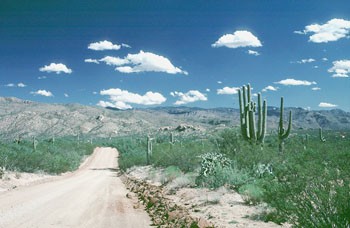
Dry Baptism: Trading faith for water and the pagan ‘pitahaya.’

Soul in the Desert

On water, God and cactus fruit

By Alastair Bland

A seed of fear began to grow in my gut as I hiked along a lonely dirt road in the desert of Baja California. This was desolate country, and my drinking water was nearly gone. The previous day, I had walked from the Pacific fishing village of Los Bandoleros northward about 20 miles without meeting a soul, and by this evening I would have no water left. I needed to pick up a ride soon, or at least run into a group of–“Ah ha! People!” I exclaimed.

Two hundred yards off to my right, there sat about 20 men, women and children under a lonesome acacia tree. Parked beside them were three pickup trucks. As I drew near, several figures stood and waved to me, and I sallied forth with a fresh bounce in my step. On this good day in this good land, it looked as though I would not die after all. I could hear the folks singing to the rhythm of a guitar, and they exuded an air of hospitality and warmth–what I’d come to expect of the people in Baja California.

“Hello, friend,” a smiling, smooth-faced man of about 30 said to me in Spanish as I approached. He gestured to an empty lawn chair, then asked if I wanted food. Over a cactus-wood fire, there sizzled several small fish. “Yes, please,” I said. “But mostly I’m thirsty.” I shook my empty milk jugs.

As a young boy handed me a plate of corn tortillas and a headless kelp bass, the man said, “It is lonely out there in the desert.”

“There’s hardly a soul,” I agreed through a mouthful of fish and cornmeal.He nodded toward my pack. “You carry a Bible, yes?”

Suddenly the people grew quiet, and I sputtered, “Oh, that is a very heavy book to carry.”

“But you are a Christian, yes?” the man asked. The semicircle of people leaned in to listen. The guitar stopped, the hot coals crackled, the surf roared distantly and the earth’s gravity seemed to triple. “You pray to Jesus at night? You have faith in Him?”

I am an atheist, and what faith I have is in the old adage about the truth setting you free, so I said carefully, “I am not a Christian and, no, I do not always pray.”

The people all stared at me in horror. I wished now that I was camped out on some lonely beach under a palm tree, or hiking through a mango orchard in the mountains, or even fighting the hustle and bustle of Tijuana–anything but this. The young man looked me hard in the eyes. “My friend, you will go to Hell,” he said. He paused. I raised an eyebrow. “But if you repent,” he continued, “you can be saved–here and now.”

“Um . . .”

“You must repent your sins now!” He ordered me to close my eyes and repeat after him a verbal contract of repentance. To adopt a new religion without at least a day to think it over is crazy. But it seemed I was surrounded by crazy people, and I clearly had no choice in the matter. I took a look around at the blue sky and the free world beyond the shade of this acacia tree, then closed my eyes.

Abruptly, I was stricken with fear. I recalled an old roommate from college who had been sucked into a religious cult that performed nocturnal baptisms at the beach and went off to strange retreats in the mountains, and I became terrified for my mind and soul.

Jesus Christo,” the man began, and I followed his words through the darkness.

Yo creo en Su poder . . .” A deep sadness washed over me, and I recalled all the things that my parents had taught me. I thought sadly of my twin brother, my relatives and my friends. I thought of the house I grew up in and the city I called home. It seemed desperately far away, and I believed that I was about to die in this barren place.

But then the man’s voice stopped. I slowly opened my eyes and realized that I was still alive, healthy and sane. I gazed about me in exaggerated wonder.

The men, women and children clasped their hands and beamed in awe. “You are born again!” a woman gasped. The young man who had done his best to rob me of my soul came over and took my hands, and I stood up to accept his embrace. He gently patted my mop of hair. “You now have brothers and sisters in the town of Los Bandoleros. Just come to the church. And when you go home,” he instructed me, “you must tell the people in your city about the Church of Christ.”

“Of course,” I lied, and we smiled at each other.

A woman handed me my milk jugs, each filled with cool water. “Thank you,” I said. “Thank you.” And with that I shouldered my backpack and departed into the desert, free again, with my water and my soul.

From the April 20-26, 2005 issue of the North Bay Bohemian.

© Metro Publishing Inc.

Classic Rock

0

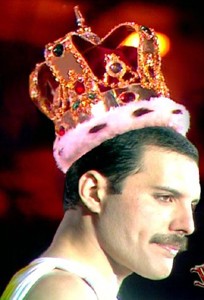
King of Queen: Freddie and the lads didn’t score a classic with the faux whimsy of ‘Bohemian Rhapsody.’

Sound Salvation

Defining the classics in classic rock

By Karl Byrn

I love classic rock. Sonoma County’s KRVR 97.7-FM (whose motto is “Classic rock for the North Bay”) is the first and favorite preset on my car radio dial. I attended high school in the ’70s, and I enjoy the familiar music of their commercial-free 10-song sets during my commute time. But I’m also a channel changer–I’ll cruise for new rock on KXFX, hip-hop on KMEL or whatever country, oldies and roots music is coming in clearly.

I can’t love KRVR itself, though, because its definition of classic rock is based on age and era. One of the station’s DJs recently made an amusing comment as to whether “we” the listeners now thought the same about the names of new bands like the White Stripes and Hoobastank as our parents did of “our” bands and band names like Mott the Hoople. I wondered what the difference is. Anyone aware of Mott and ’70s glam rock can’t think Jack White and nu-metal are that weird.

But the classic-rock format has been conceived as a marketing category based on this separation of new and old rock–Eric Clapton and the Eagles over here, Green Day and Nirvana over there. In this context, classic rock is merely the new oldies–feel-good, easy-going hits for the second wave of baby boomers.

But isn’t there more? Isn’t truly classic rock music an artistic force that transcends the nostalgia of a single generation? Webster’s Dictionary says a classic is foremost “of recognized value; serving as a standard of excellence.” What, then, makes rock music of any era truly classic?

The so-called test of time can be deceptive. Witness the Rock and Roll Hall of Fame’s failure to induct immeasurably influential ’70s acts Black Sabbath and the Sex Pistols, not to mention such a mainstream classic-rock poster act as Lynyrd Skynyrd. The greatness of any piece of rock music simply can’t be judged by its generational acceptance.

More accurately, the “standard of excellence” has little to do with era-based comfort and lots to do with the core values of rock ‘n’ roll. Rock’s core values have historically included idealism, self-determination, lust for thrills, dismissal of authority, restless energy, brutal self-evaluation, confessionalism and a quest for community. Rock isn’t classic because the band played it at your 1978 prom; rock is great when its “recognized value” makes you dig deeper.

My brother and I recently debated the merits of Queen’s mammoth classic-rock hit “Bohemian Rhapsody,” a song he admires and that I disregard. This was partly a matter of taste: he likes baroque rock; I like bar-band rock. He tried defending the song as a portrait of teenage angst, but I busted him on the error of defining classics through a lens of age-based acceptance. “Bohemian Rhapsody” is not a genuine expression of teen angst; it is, rather, faux play-acting, whimsy for whimsy’s sake. As art, it isn’t born of a desire to release and resolve turmoil; it’s born of a desire to be clever.

He finally offered that the real thing, the genuine rock article, is more convincingly conveyed on a ’90s classic, Nirvana’s mammoth “Smells Like Teen Spirit.” That’s right, I’m saying that “Bohemian Rhapsody” has a lesser claim to classic-rock status than “Smells Like Teen Spirit,” since it reveals less of rock’s core values. FM rock hits of the ’70s are good marketing tools, but profound classic rock keeps a clearer essence of rock ‘n’ roll alive.

A narrow, generation-based focus misses not just classic-rock values, but essential rock music as well. Consider the impact of two great songs now limited to “oldies” status. On Buddy Holly’s “Peggy Sue,” the 16th notes that cascade over the tom-toms predict heavy rock’s double-bass drum sound, and on Elvis’ “Hound Dog,” the rhythm chord that scrapes through the verses is slightly out of tune and distorted, predicting everything from the Who to Sonic Youth.

Classic-caliber rock can be found in any era. If the classic-rock format could ditch its need for age-based marketing, a commercial-free 10-song set could sound as richly compelling as “Shapes of Things” (the Yardbirds); “Unsatisfied” (the Replacements); “Catharsis” (Anthrax); “Stand!” (Sly and the Family Stone); “Daughter” (Pearl Jam); “In Between Days” (the Cure); “Kentucky Rain” (Elvis Presley); “Nobody’s Crying” (Patty Griffin); “White Man in Hammersmith Palais” (the Clash); and “You Never Can Tell” (Chuck Berry).

That’s what I want from classic rock–not a marketing category that’s built to make for better business by comforting me, but rather a “standard of excellence” that’s built to make for better listening and living by challenging us.

From the April 13-19, 2005 issue of the North Bay Bohemian.

© Metro Publishing Inc.
Larry Stiner

Photograph courtesy of the Stiner familyFamily Found: Larry Stiner and his six half-brothers and -sisters are finally reunited, 11 years after asylum should have been granted.Asylum GrantedPrisoner's family comes to AmericaBy Jordan E. RosenfeldThis past January, 40-year-old Larry Stiner's household more than doubled in size. His six half-siblings, born and raised in the South American country of Suriname, finally...

First Bite

First BiteSRJC Culinary AcademyBy Ella LawrenceEditor's note: First Bite is a new concept in restaurant writing. We invite you to come along with our writers as they--informed, intelligent eaters like yourselves--have a simple meal at an area restaurant, just like you do. This is not a go-three-times, try-everything-on-the-menu report; rather, this is a quick snapshot of a single experience.The...

Nomeansno

Boiling with SoulNomeansno create punk-rock-jazz roadkillBy Gabe MelineWhen some really old guys walk out onstage and pick up instruments at the Phoenix Theater on May 4, it's not some kind of joke that Phoenix manager Tom Gaffey's parents are pulling. It's actually the band.Seriously, Nomeansno look old, but they will fuck you up.Rob Wright is used to people's initial...

Phil Lesh

Dead AheadPhil Lesh goes truckin' through the pastBy Greg CahillAt their first gig, the Grateful Dead played for an audience of three. Of course, the group became one of rock's most adored bands, leading a horde of fans on what has been memorialized--and chronicled in stacks of books--as a long, strange trip. Now the band's 65-year-old bass player, Phil...

News of the Food

News of the FoodPesachBy Gretchen GilesThe eight-day holiday celebrating the exodus and freedom of the Israelites from Egypt and the clutches of Pharoah Ramses II, Pesach--or Passover--is a holiday in which food figures hugely. Featuring tables laden with dishes that represent as well as nourish, Pesach offers many opportunities for families to celebrate Seder together and to gather in...

Commute Shortcuts

Roads Less TraveledThe secret rites, short cuts and back roads of guerrilla commuting By Alex Horvath It's just after 6am, and the day is about to begin for Petaluma resident David Spangler. As it is each work day, this will be a long one for Spangler, who drives an arduous commute each morning from his east Petaluma neighborhood to...

The Byrne Report

The Byrne ReportFamily Values IN DOWNTOWN NAPA, there is a renovated farmhouse set off by a white picket fence. An American flag waves in the breeze. Inside the house on a Saturday morning, twin babies laugh and play while their parents do chores and talk to a reporter about what it's like to be moms.Gap Inc. marketing executive Margo...

Annalee Newitz

Geek Grrrl: Cyber philosopher Annalee Newitz worries about Big Brother, and you should, too.Notes from the UndergroundAnnalee Newitz and the plight of privacy I first met Annalee Newitz in the summer of 1997 while working on my master's thesis at San Jose State University. Famed mathematician and cyberpunk science-fiction author Rudy Rucker sat on my committee, and after I...

The Baja California Desert

Dry Baptism: Trading faith for water and the pagan 'pitahaya.'Soul in the DesertOn water, God and cactus fruitBy Alastair BlandA seed of fear began to grow in my gut as I hiked along a lonely dirt road in the desert of Baja California. This was desolate country, and my drinking water was nearly gone. The previous day, I had...

Classic Rock

King of Queen: Freddie and the lads didn't score a classic with the faux whimsy of 'Bohemian Rhapsody.'Sound SalvationDefining the classics in classic rockBy Karl ByrnI love classic rock. Sonoma County's KRVR 97.7-FM (whose motto is "Classic rock for the North Bay") is the first and favorite preset on my car radio dial. I attended high school in the...
11,084FansLike
4,606FollowersFollow
6,928FollowersFollow