On the Walls

0

09.19.07

On a beautiful late summer Sunday afternoon, the Sonoma Valley Museum of Art packed a crowd into its modern indoor gloom. Nibbling on chicken satay sticks, fresh spring roll wraps and sipping the museum’s own brand of wine, hundreds of people massed in to hear sculptor Linda Fleming give a personal tour of her one-woman retrospective, “Refugium,” showing through Oct. 21.

The 52nd exhibit since the SVMA opened its doors 10 years ago, “Refugium” gathers together 30 years of the sculptor’s work, including the drawings and maquettes that precede the birth of a full-fledged three-dimensional piece. Large-scale steel sculpture that is characterized by lacey, curvy, biomorphic design that both grants and denies access, Fleming’s work is informed by science and cosmology. Her own home furniture is scattered throughout, allowing visitors the opportunity to relax in a comfortable living room chair while contemplating the work. Fleming variously referred to her sculpture as being “smokelike,” “sinuous, vaporlike constructions” and “cosmological structures,” and described how they, coupled with the comfy chairs, are intended to evoke that moment when one is at home and naturally enough begins to contemplate the particulate structure of the universe. “These are diagrams of thoughts that you might be having in your regular life,” she instructed.Not everyone was thinking such lofty thoughts. Some of us began to wonder how it is that the SVMA can regularly command such a crowd smack amid a gorgeous Sunday packed with other pleasures on the North Bay’s calendar. Their own wine label, their lavish food, the Sonoma Palette appetizers cookbook that the museum is due to release on Oct. 4, the impressive effort of mounting a serious retrospective of a living, nationally acclaimed artist like Fleming: Why is such good cultural news happening in the Sonoma Valley and where is the rest of it? SVMA, 551 Broadway, Sonoma. 707.939.7862.

The Marin Museum of Contemporary Art, opened last month in the newly reclaimed Hamilton Field area, has been paying attention. Marin MOCA has gone so far as to snag the assistance of Sonoma painter Chester Arnold, a College of Marin instructor who was influential in the birth of the SVMA, an institution that has clearly kept its supporters engaged and excited—a decade-long experiment that the Marin MOCA is avid to emulate. “People are frustrated that, in the richest county in the U.S., they don’t have a fine arts museum,” Arnold says. (Not strictly true, as the very wonderful Bolinas Museum has heretofore been the only fine arts museum in Marin, a great distinction—if, of course, you can find it.)

Begun modestly in 1991 by the 11 members of what was then the Indian Valley Artists collective, the group changed in 2005 to become the Arts League of Northern California. Already charged by the city of Novato to spearhead an arts renaissance in northern Marin, the League pondered the future. “We were already doing the criteria for a noncollecting museum,” says volunteer Ronile Valenza of her group’s leap from collective to institution, “and we thought, why not just do it?” Their first exhibit as the Marin MOCA, a national juried show, ends Sept. 23. Their second formal show, “Re-Newal,” a national encaustic exhibit juried by Santa Rosa painter Bob Nugent, opens Sept. 29. Marin MOCA, 500 Palm Drive, Hamilton Field, Novato. 415.506.0137.

Meanwhile, the Sonoma County Museum, reeling from the recent health-related resignation of well-regarded executive director Ariege Arsguel, gears up for its new exhibits, “Obsession: Art and Artifacts from Sonoma County Private Collections” and, in the project space, “Be(e)ing,” an installation by Napa apiarist and artist Rob Keller, both opening Sept. 22. The main exhibit is designed and installed by Napa artist Lewis DeSoto (himself featured at the Di Rosa Preserve’s “3 X 3” show through Sept. 22) and draws from 15 private collections ranging from Henry and Holly Wendt’s antique cartography cache previously hung at the museum to Civil War artifacts, Native American walrus ivory carvings, Ansel Adams photos, Petaluma artist David Best’s funk works, hair from Abraham Lincoln’s fatal head wound and more. The idea of the exhibit is that the private obsessions of those who long to amass reveals something that is both personal and universal, involves the desire to instill order in an otherwise chaotic world and reflects the compulsion to find higher truths in small acts.

Keller plans to use the museum’s former vault to install a Victorian model dollhouse filled with bees that freely vents to the outdoors through a tube. Given the museum’s “Where Land Meets Art” ethos, Keller works to reflect the interdependence between humans and the hard-working pollinators who sustain us, allowing visitors to have a better understanding of the marvelously complex apiarian world. Sonoma County Museum, 425 Seventh St., Santa Rosa. 707.579.1500.

Also collector-driven, the spanking-brand- new SRJC Art Gallery kicks off the semester with an unusual gathering of textiles from Central Asia and Turkey loaned by area owners. “From Tent to Palace” opens Oct. 4 and is co-curated by SRJC instructor Donna Larsen with San Francisco State humanities professor Carel Bertram. The exhibit will not only encourage flat-out admiration for the handiwork on display, but illustrate what a bride might bring to her husband’s yurt or what the use of paisley means to different peoples across the Asian diaspora. SRJC Art Gallery, Frank P. Doyle Library, 1501 Mendocino Ave., Santa Rosa. 707.527.4298.

Short List

Other exhibits that have got us thinking

Painter Richard Standard tackles nothing less than the I-Ching with his new series, “Order out of Chaos,” opening Sept. 24 at the Pelican Art Gallery. Using Heisenberg’s uncertainty principle as his model, Standard takes the horizontal plane forward and backward, referencing Mark Rothko and obscuring and allowing sight in a stirring geometry of emotion. . . .

Emerging artists Frank Ryan and Allen Marshall, both recent graduates of Sonoma State University, share a love of narrative painting that flirts with illustration but pulls back just at the right moment. They show at the A Street Gallery through Oct. 27. 312 South A St., Santa Rosa. 707.578.9124. . . .

We are piqued by the work of Native American historian Frank LaPena, who opens his multimedia show “There Is No Dance Without a Song” on Sept. 22 at the Hammerfriar Gallery (see image, p40). LaPena explains his approach and the mythology he draws upon when drawing on Oct. 5. 139 Healdsburg Ave., Healdsburg. 707.473.9600. . . . The Northern California Center for the Photographic Arts makes its first foray on Sept. 20 featuring a cross-section of fine art photographers. Visionary Glen Graves expects to establish a permanent gallery space and a teaching center in the North Bay for the photographic arts. The initial show is slated for the Energy Plus Lighting and Design, 999 Airway Court, Santa Rosa. www.nccenterphotoarts.com. . . .

The Sebastopol Center for the Arts sponsors a “block party” on Oct. 4 from 6pm to 8pm that includes Sculpture Jam—now in its 10th year—new work “Drawing the Line” at the library and the wood furniture of designer Carol Vena-Mondt at her eponymous gallery. For details, go to www.sebarts.org. . . .

The Di Rosa Preserve hosts its annual fundraising auction Moon Proof Madness on Oct. 20 and gears up for winter with a remarkable one-woman exhibit by sculptor Gay Outlaw opening Nov. 3 that promises to be the must-see exhibit of the winter. . . . The must-see exhibit of right now remains the Masami Teraoka exhibit at the SSU Art Gallery, a shatteringly excellent 40-year retrospective. Check these pages next week for your how-to cheat-sheet on “reading” the Teraoka show.


Museums and gallery notes.

Reviews of new book releases.

Reviews and previews of new plays, operas and symphony performances.

Reviews and previews of new dance performances and events.
Preview: The Kronos Quartet

0

09.19.07

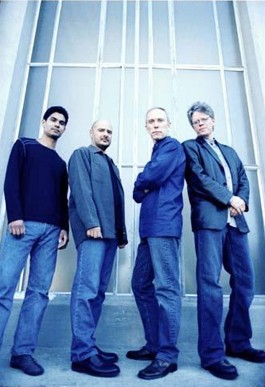
s if any further proof were needed that Kronos Quartet are the most cutting-edge string ensemble on the planet, the Bay Area&–based collective have just announced the program for their upcoming Redwood Arts Council performance in Santa Rosa on Sept. 28, and holy hell, is it ever out of this world. When Thelonious Monk is the only household name on the list of the scheduled program’s composers, it’s a sure bet that Kronos will live up to the promise of “works without boundaries.”

The globe-spanning lineup includes compositions by Xploding Plastix, a jazzy electrofunk duo from Norway; Aleksandra Vrebalov, a Serbian composer with an eastern European vision of musica universalis; and Indian saranghi master Ram Narayan, whose years of working in Bollywood lend a buoyant quality to interpretations of traditional ragas.

Along with Clint Mansell (whose Requiem for a Dream score is a timeless provocateur of chill) and an entry by current New York avant-gardist Scott Johnson, Kronos Quartet also delve into America’s past with two seemingly opposite composers. Harry Partch hopped trains and utilized graffiti as libretto, while Raymond Scott’s pioneering compositions are linked most in the public ear to classic Bugs Bunny cartoons. Both, however, designed and built their own instruments and toyed with musical forms with innovative vision.

More to the present day, there’s the rock music of Mexico’s Café Tacuba (arranged by noted Argentinean composer Osvaldo Golijov) and the blistering strangeness of Manhattan iconoclast John Zorn. But the program’s most current composers are the reason the kids might be asking to tag along. Sigur Ros, a hip Icelandic band who sing in a language of their own design, are a perfect complement to Brazilian-born DJ Amon Tobin. Tobin’s released seven albums of staggering sound mutations on renowned U.K. label Ninja Tune; his layering of disparate effects and polyrhythms tilts towards the cusp of a new language in the digital age.

And to think, the last time Kronos Quartet were here, 25 years ago, they were playing songs by moldy-fig composers like Jimi Hendrix! Don’t miss the latest wave of the Bay Area’s avant-garde jewel in a very special appearance on Friday, Sept., 28, at the Glaser Center. Their next area appearance is at the massive Shoreline with the massive Mr. Waits at the Bridge School Benefit.

547 Mendocino Ave., Santa Rosa. 8pm. $10&–$25. 707.874.1124. www.redwoodarts.org.


Crazy ‘Love’

0

the arts | stage |

Stolen hearts: Burgler Molly (Jody Flader) and bungler Beane (Darren Bridgett) find love after felony.

By David Templeton

In love and in life, you cannot always judge a thing by its appearances—or by its name. John Kolvenbach’s Love Song, which just opened a month-long run at the Marin Theatre Company, is such a case. That name, Love Song, is much too generic and uninspired a title for a show this fresh and clever and original, a truly wonderful play that positively glows with inspiration, invention and wonder.

Some plays work slowly on viewers, who may gradually come to appreciate the show as they reflect back upon it and consider its images, methods and messages. Other plays are love at first sight. For this reviewer, MTC’s new show—the exuberant kick-off to the company’s 2007–2008 season—is definitely the latter. I have fallen in love with Love Song.

Beane (Darren Bridgett) is an odd little man, an innocent, thoughtful, overly fearful guy whose grasp of reality is growing a bit weak after years of monumental loneliness. In his tiny apartment, which he keeps appallingly free of belongings (“I don’t trust objects,” he explains), his world is growing smaller by the day, and darker, too; the lamps seem to fade when he grows near.

His sister, Joan (Julia Brothers), is similar, but in a different way. Uptight and easily irritated, she rails at the small inconveniences of life, while her genially cynical husband, Harry (Steve Irish), spars verbally with her as an antidote to the boredom and predictability of their marriage. When Beane visits, they barely notice his arrival, and when he departs, it takes ages before they realize he’s gone. As to the rest of the world, Beane is essentially invisible—even to himself.

Boldly written with a singular sense of dialogue that is revealing and clear-sighted while staying one step removed from ordinary speech, the play demonstrates Kolvenbach’s unique facility for sharp language and sneaky-weird poetic emotionality. The production features a clever set by Eric E. Sinkkonen and excellent lighting and sound design by Kurt Landisman and Steve Schoenbeck, respectively.

Smartly and playfully directed by MTC’s artistic director Jasson Minadakis, the show features a strong cast capable of playing the extremes without losing the sweet and silly humanity at the core of every character. Especially strong is Darren Bridgett, a regular at MTC and one of the finest actors currently working in the Bay Area. His ability to play several disparities at once—pain and sweetness, despair and humorousness, fear and hope—makes Beane’s incredible journey a thing of wonder.

Everything changes when Beane discovers a burglar ransacking his apartment. Molly (a wonderful Jody Flader) is a wild woman, simultaneously fierce and funny, dangerous and strangely appealing. She is given to grandiose pronouncements and cut-to-the-bone observations about Beane’s shabby existence. “Is this all you own?” she wants to know. “Who lives like this?” Though initially terrified, Beane finds himself strangely moved by this offbeat encounter, and after she’s gone, with his few belongings carried off in a plastic bag, Beane finds that he has fallen head-over-heels in love with his bizarre burglar.

The change is immediate. To Joan’s alarm—she assumes her brother has finally lost his mind—Beane is suddenly thrilled to be alive, aware of sights, sounds and tastes he’s never noticed, reveling in the simple joy of a turkey sandwich while expounding on the powers of sexual attraction and given to talking to his empty room, pining for the return of the terrifying woman who stole his heart. When she finally does reappear, informing him that she sold all of his stuff for a mere $6 (“I bought a hamburger with it. I ate it standing up”), Beane takes a chance and declares his love.

What follows is a series of delicious surprises, pessimistically hopeful conversations and complexly simplistic observations about life and love. With Beane’s transformation into a person willing to risk all for love, even his own life and sanity, Joan and Harry are also altered, cautiously emboldened to introduce some long-absent playfulness to their own marriage, willing at last to go a little crazy in pursuit of a love that really matters.

‘Love Song’ runs Tuesday–Sunday through Sept. 30. Tuesday and Thursday–Saturday at 8pm; Wednesday at 7:30pm; Sunday at 2pm and 7pm; also Sept. 29 at 2pm. Sept. 20, preshow lecture; Sept. 23 at 6pm, Out and About reception for LGBT community. $20–$50; Tues, pay what you can. Marin Theatre Company, 397 Miller Ave., Mill Valley, 415.388.5208.


View All


Museums and gallery notes.


Reviews of new book releases.


Reviews and previews of new plays, operas and symphony performances.


Reviews and previews of new dance performances and events.

Casa Verde

09.19.07

Amid the clutter of my desk rests a biodegradable to-go container, inside of which I have a biodegradable drinking straw, one business card that reads “The Compost Club,” and pieces of recycled wine-bottle glass and broken terracotta pot that have been tumbled in a cement mixer until their edges have gone thick and soft.

When I recently drove to Kenwood in order to take a tour of the Vineyards Inn restaurant, it was not in search of these treasures, it was to see compost, and I did see compost. I also ate the best ceviche I have ever had, but that’s another story.

Steve Rose and his wife Colleen have owned the Vineyards Inn for 27 years, and their menu and green business practices have been evolving over the decades. The food they serve is local, with vegetables from their nearby organic farm, and organic meats, organic dairy and local fresh fish brought in almost daily. The atmosphere of the restaurant is friendly, relaxed and unpretentious. I’m instantly impressed, but I’m here to see the compost, not ogle the menu.

Steve begins our tour of the restaurant but quickly moves on to the source of my interest, a machine called the Earth Tub. The Roses purchased the Earth Tub about 10 years ago, when Sonoma County made an offer to local restaurants, grocers and schools that it would shoulder half the cost of this $6,000 piece of pure beauty. It is to here that almost all of the pre- and post-consumer waste from Vineyards Inn, including food waste, those nifty biodegradable drinking straws, place mats, cocktail napkins and shredded paper, are toted and dumped.

A gorgeous monstrosity, the Earth Tub holds and creates, in a mere six to eight weeks, mountains of nutritious compost, which the Roses then use to feed their organic farm. Steve Rose is so into composting that he serves on the board of directors for the Compost Club, a nonprofit that helps schools and businesses set up composting systems. The Roses do a lot of impressive things like this—so many that it’s difficult to keep track of them all. They have chickens and doves. They use garbage bags and to-go containers made from compostable corn product.

When they added an addition to the Vineyards Inn, they built it to accommodate the existing grape vines, and these vines now envelop the ceiling and drip with grapes that fill the dining room with a scent so intoxicating I want to curl up in there on a cot and have a nap. The farm and vineyard are certified organic, and the Roses are actively working to gain their biodynamic certification.

Steve’sRose tour continues to a recently acquired six-acre vineyard and the couple’s newly built green home and adjacent one-room B&B. I thought I came for compost and some Basque-inspired food, and I end up seeing the most amazing piece of green architecture that I have ever witnessed.

Everything Steve shows me is recycled or reclaimed: the gravel, the fencing, the gates, the beams, the sub flooring, the gutters, the sinks, cabinets, doors, granite, brick . . . everything. Even the insulation is made from recycled denim. At one point, I hold a sample of the insulation in my hands and take a sniff. It’s quite pleasant. All of the wood finishes are free of volatile organic compounds, and the entire house has this smooth, soothing smell, so different from the chemical tang usually associated with new houses or freshly painted rooms.

The landscaping is drought-resistant and fed with reclaimed water. The solar panels provide power for the house, with enough left over to feed back into PG&E’s grid, earning electrical credits for the darker months. The Roses only pay about $50 a year in electric bills. Their house is so ingeniously built that it can practically maintain the perfect temperature unassisted. It’s almost like it’s alive.

The fact that every door, sink, cabinet and countertop is created from reclaimed materials gives this house a sense of character that leaves me ready to uproot and move in permanently; for those interested in staying for a night or two, the Roses B&B, Casa Verde, is open for business, serving organic breakfast and a gorgeous view.

By the time I leave Kenwood, I am stuffed (did I mention the ceviche?) and oddly elated. It takes me until I am almost home to figure out that the feeling is relief. I have been reminded that there are people in our community who have the vision, the means and the ability to facilitate change for our environment, and that they are doing so. I’m awash with what could only be called a sense of hope, that penetrates my cynical soul. My mission has become clear. I must find others who are doing the same, if only so that I can feel this good again.

For information on the Compost Club call 707.922.5778 the Vineyards Inn, 707.833.4500; Casa Verde, Phone 707.833.2143.


Super Hyphy R.I.P.

0

09.19.07

In 2005, I asked Super Hyphy promoter Daniel Gelotte a question that, at the time, was on everyone’s mind: What, exactly, is hyphy? His tip-of-the-iceberg answer was indicative of the wide-openness of the new phrase, the new genre, the new lifestyle. “Hyphy is driving your car backwards, running from the cops, being out of control, whatever,” he riffed. “Some guy getting beat up by his girlfriend, you could say that’s hyphy–really, hyphy is anything you want it to be.”

Now, as he and DJ Amen’s successful and culturally defining Super Hyphy concert series comes to a climactic end next weekend, he’s got a different answer: Hyphy is over.

“Hyphy’s kinda dyin’,” he says. “Everybody’s making it, and a lot of people are making it poorly, and I think that’s really watering it down.”

Indeed, slowly diminishing ticket sales for the last few Super Hyphy shows have been an indicator of waning interest in ghostridin’, thizz-facin’ and bird-dancin’. Not one to go out with a whimper, Gelotte’s booked a farewell bash on Sept. 29 with the return of E-40, the legend who has single-handedly defined hyphy for the rest of the nation.

“We gotta pay him a few thousand more dollars now,” Gelotte shrugs, “but you know, he’s E-40. He’s the biggest artist in the Bay Area, without a doubt.” Is hyphy dead? The question almost seems silly to ask. Bay Area rap overall thrived for decades before the hyphy craze, and there’s no reason at all to suspect that it will die anytime soon just because a high-profile phenomenon has run its course.

Most importantly, if hyphy is indeed dead, then it means that the hip-hop scene will be forced into new creativity, daring and innovation–three keys that the late Mac Dre embraced in his time on Earth that directly spurred the Bay Area’s rap scene to new heights.

The very first Super Hyphy show in August 2005 was a palpably mind-blowing display of anthropologic mayhem. A wall-to-wall crowd jammed Petaluma’s Phoenix Theater, chanting along to choruses by Keak Da Sneak, Mac Mall and Mistah F.A.B. with an energy usually reserved for national touring acts. At one point, jacked on adrenaline, someone grabbed the mic to joke that Jay-Z was in the building; for all the unbridled, hormone-driven excitement in the room, hell, he may as well have been.

Never before had Bay Area rap been so celebrated by its own in the North Bay. There’d been one-off shows before, like the notorious Mac Dre appearance at the Phoenix Theater in 2001. (He showed up an hour late and delivered an uninspired set, rapping along to his own CD and causing a certain broom-wielder outside to remark in embarrassment that “this is the worst thing I’ve ever had on the stage.”) But Super Hyphy, with its unified energy, was clearly a thrust not for any single rapper but for the entire Bay Area.

In the ensuing months, the inaugural Super Hyphy North of the Gate turned into Super Hyphy Reloaded, then Super Hyphy Halloween and Super Hyphy Holiday–all of them packed. By the time E-40, the aptly christened Ambassador of the Bay, headlined Super Hyphy 5, all hell was due to break loose. E-40’s “Tell Me When to Go” had just hit the airwaves with tremors that would soon shake the world.

Flanked by groupies, fans and aspiring rappers, I watched E-40’s SUV pull into the backstage parking lot before his set, all of us crowding for a glimpse through tinted windows at its heavyweight passenger. One fan, a young girl, explained in no uncertain terms what she would do to be let into the car; another, a skinny kid, begged for a verse to bolster his upcoming album. Both were brushed away by security, left to stand outside a theater so overly sold-out that its doors were blocked by police.

“Sprinkle Me,” “Sidewayz,” “Captain Save a Hoe”—all the old classics–paled next to “Tell Me When to Go.” At the deep bass-drum intro, a flood of fans blitzed the stage on cue, going apeshit and mimicking all the video’s moves: the gas-brake-dip, the shaking dreads, the thizz face. The show was over, but a movement had officially begun, and for better or worse, it was dubbed hyphy.

In the next few months, media outlets coast to coast became obsessed with Bay Area rap, running columns about the dangers of ghostriding the whip, tips on the flyest stunna shades and offering tortuous translations of hyphy slang. Sales of all things relating to hyphy’s crown prince, Mac Dre, skyrocketed into the stratosphere (you’ve never lived until you’ve seen a flossed-out, iced-up baller drop $25 on a Mac Dre toy doll). Suddenly, everyone and their mother was in on the secret.

To accommodate the clustering crowds, Super Hyphy 6 moved to the Sonoma County Fairgrounds and its larger 1,200-person capacity venue to feature legendary Oakland pimp-stylist Too $hort. A cop car pulled up backstage, a bad sign for a rap show. Turns out the cop just wanted to get Too $hort’s autograph.

Hoping to get a taste for the future of hyphy, I showed up early at Super Hyphy 9 to check out the opening acts. Would they bring anything original to the plate? Each act got three or four songs–boom, boom, on, off–and I winced as each one played out variations on the same hyphy trademarks and phrases utilized by the tried-and-true Super Hyphy headliners.

(Or burn, perhaps, in the courtroom. Mistah F.A.B.’s video for “Ghost Ride It,” which lifted trademarks from the song and movie Ghostbusters, received a cease-and-desist for copyright infringement, and his Atlantic Records deal for hyphy’s great hope, Da Yellow Bus Rydah–an all-star album originally due out last year–seems all but dead in the water. Likewise, the Federation’s radio hit “Stunna Glasses at Night” was shut down for uncleared samples.)Here and there, new styles still arrived, from performers both new and old. A young high school group, the Pack, delivered a sparse, high-hat-driven hit (“Vans”) which sounded fresh and unlike anything else, while Ray Luv, deep in the game for almost 20 years, surprised a Super Hyphy crowd by showing up with a live heavy metal band and freestyling over a crunch-guitar version of Mac Dre’s “Thizzle Dance.”

Even at Super Hyphy 13, in November 2006, audiences were still wild, to say the least. While Keak Da Sneak polished off a night at the fairgrounds, a twenty-something couple to the side of the stage gyrated and grinded on each other, stripping off almost all their clothes and drawing a rabid crowd of video cameras and cell-phone snapshots. Before security came and the dust settled, she’d gotten down to nothing but a tiny thong, her legs wrapped around his hips, body arched backward in a naked rhythmic dry hump.

Despite such abandon, something strange happened in the last six months: the public suddenly became discriminating. In the beginning, people had bought tickets for Super Hyphy without any idea who was appearing; it was always an event. But as months wore on and repeat headliners failed to draw interest, attendance for Super Hyphy spiraled–last month’s Super Hyphy 19 drew less than half the ticket-buyers of its heyday.

So where are we now? Unfortunately, the phrase “hyphy” carries a paltry percentage of the impact it once proudly brandished. But the artists who created and nurtured it, many of them active and innovative before the word came into being, are still dropping rhymes over beats. As long as they can remain undaunted by the biters, players and copycats who have driven hyphy into the dirt, they’re perfectly capable of rising from its ashes to create a new future for Bay Area hip-hop.

As the rollercoaster that has been Super Hyphy grinds to a halt next weekend, it’s imperative to look among the celebration, among the commemoration, among the covert blunts and indiscreet dry-humping, toward some sort of vision for that future. It’ll be called something different, sure; but the thrust of energy that propelled that very first Super Hyphy two years ago remains. And the party anthems, the street raps, the crazy flows and the choice beats will be tight as ever.Shit, man, we’re the Bay. It’s how we always do.

Super Hyphy 20 with E-40, San Quinn, Turf Talk, Dem Hoostarz, Berner and Hot Dollar completes the journey on Saturday, Sept. 29, at the Phoenix Theater. 201 Washington Blvd., Petaluma. 8pm. $30. 707.762.3565.


News Briefs

09.19.07

Planning Ahead

Thick bureaucratic documents that will shape the North Bay for years are being crafted in ongoing but separate processes in Marin, Napa and Sonoma counties. Each is revising its general plan, a state-mandated document which is the basis for all land-use decisions. Sonoma is also creating a separate strategic plan to set priorities on a wider range of issues affecting the overall delivery of county services.

While the dry nature of these documents might be daunting and the meetings may have the potential for trivia and tedium, the overall impact of these final guidelines will be significant.

Municipalities periodically update portions of their general plan, but only occasionally review and revise the entire document. It’s just a coincidence that Marin, Napa and Sonoma counties are pursuing this process simultaneously, says Kristin Drumm of Marin County. “We all have different issues,” she explains. Marin began its general plan update process in 2000. The planning commission recommended a draft version

_in July, and the board of supervisors will discuss final details Sept. 25 and Oct. 16, with an eye to approving the new _general plan on Oct. 23. For details, visit www.co.marin.ca.us/depts/cd/main/fm/index.cfm.

Napa County adopted its current general plan in 1983, and a new version is expected to be approved some time next year. The plan-update steering committee meets Sept. 26 and Oct. 10 and 31, followed by a series of public hearings before the planning commission and the supervisors. The comment period has ended for the plan’s environmental impact report, but the public can comment on the revised general plan up until its final approval. Documents and calendars are at _www.napacountygeneralplan.com.

The Sonoma County Board of Supervisors holds its next general plan update hearing on Sept. 26. Written comments on the proposed revisions must be submitted to the county by Sept. 28. The county’s current plan was adopted in 1989. The revision process started in 2001, and the new version is expected to be OK’d by the end of this year or early next year. Details are at www.sonoma-county.org/prmd/gp2020/index.html.

In a separate move, Sonoma County is also creating a strategic plan (www.sonoma-county.org) to shape future spending on programs and services. This document is not required by the state, but will give the county a blueprint to follow on a wide range of issues. Community meetings on this strategic plan are set for Sept. 20 in Sebastopol, Sept. 25 in Sonoma and Sept. 27 in Petaluma.


Elder Tales

0

09.19.07

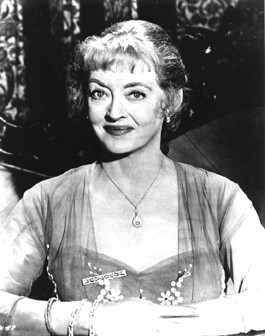
Bette Davis once said, “Old age ain’t no place for sissies.” In Pacific Alliance Stage Company’s season-opening show, Conversations with Our Elders—part of the ongoing county-wide Performance Sonoma festival—Davis’ statement is aptly illustrated by the true-life stories of over a dozen Sonoma County senior citizens. PASCO’s artistic director, Hector Correa, having amassed over 20 hours of taped interviews with local folks over the age of 70, has created a lovely performance piece that honors the lives and hard-earned wisdom of a demographic that is often overlooked and underappreciated. An oft-dropped truism within theater circles is that what audiences most want to see onstage are characters who remind them of themselves. What Correa and his cast of five actors have done with Conversations is to build a show that does exactly that.

A bare staged reading finds the actors—Gene Abravaya, Alexandra Matthew, Shannon Veon Kase, Phoebe Moyer and Norman A. Hall—seated in a row, taking turns reading and performing the words of the interviewees. They describe their feelings about historically significant moments from the bombing of Hiroshima to the death of JFK, and discuss marriage, divorce, parenthood, the groans of getting old, life after death, the best cure for depression (“Naps!”) and even ghostly visitations by deceased pets. This is pure reader’s theater, with little to look at beyond some photos floating above the simply lit stage, and the simplicity is effective. The actors do a fine job of establishing many different voices, with Gene Abravaya (recently seen in Sixth Street Playhouse’s Beauty and the Beast) a particular standout.

This is a work in progress, with a great deal of power and potential, though some of Correa’s choices infect the show with an inconsistent tone, particularly in the way Alexandra Matthew must juggle a mix of thematic narration, quotes by famous and the occasional character. This makes her contributions a bit confusing and sometimes—as when a moving series of stories by the other actors is interrupted by yet another famous quote—distracting and intrusive. On the whole, though, Conversation with Our Elders is a moving and inspiring opportunity to remind ourselves of the people who pave the way for our own lives and adventures, the people we will all one day become.

Conversations with Our Elders runs Thursday&–Sunday through Sept. 30. Thursday at 7:30pm; Friday&–Saturday at 8pm; Sunday at 2:30pm. Spreckels Performing Arts Center, 5409 Snyder Lane, Rohnert Park. $17&–$20; Thursday, $15. 707.588.3400.


Museums and gallery notes.

Reviews of new book releases.

Reviews and previews of new plays, operas and symphony performances.

Reviews and previews of new dance performances and events.
The Byrne Report

09.19.07

Fish Wrap

On June 26, 2007, Bruce Kyse, who publishes the Santa Rosa Press Democrat and is a board member of the Santa Rosa Chamber of Commerce, printed a “Note to Readers” announcing that he is selling advertising on the once-sacrosanct front page because of “competition” from the Internet. “This change is one of the ways we are responding to meet advertiser needs while also sustaining our news gathering operation,” Kyse wrote.

Such a statement naturally leads a reasonable person to wonder: What news gathering operation? Out of 33 stories published in the front-page section of the Sept. 9, 2007, Press Democrat, exactly one story was written by a PD reporter–and it was a vastly hyped promo for a local business park. The rest of the section was filled with stories grabbed, essentially, off the Internet. Three were picked up from the PD’s corporate parent, the New York Times Co.; two from the Los Angeles Times; one from the Seattle Times; and 27 large and small tales were generated by the Associated Press and other wire services.

Almost 50 percent of the front section was colorful, eye-catching advertising; the rest of the paper was about 85 percent advertising and duplicitously formatted mind-benders called “advertorials.” That people will pay real money to read advertising and Chamber of Commerce press releases disguised as local feature stories gives me gas.

Despite Kyse’s fiscal lament, the fact is that most newspapers generate operating profits of 10 to 25 percent. Securities and Exchange Commission filings show that, despite falling circulation, the New York Times Co. booked an increase in earnings per share this year of 57 percent on total revenue of more than $1.5 billion. And one of the most lucrative growth sectors for the Times and its 14 regional newspapers, including the profit-exporting PD, is online advertising.

The late columnist Molly Ivins remarked earlier this year, “What really pisses me off is [when] newspaper owners look at one another and say, ‘Our rate of return is slipping a bit; let’s solve that problem by making our product smaller and less interesting.'” Why have 34,000 reporters, many of them investigative, been laid off nationally in the past five years? So that shareholder profits can rise.

Kyse is being disingenuous when he blames the Internet for his ever-shrinking news hole. Kyse buys syndicated stories so that he does not have to hire reporters and editors. And the industry-wide 10 percent decline in classified print advertising is being compensated for by burgeoning online advertising revenues.

Furthermore, a recent University of Missouri-Columbia study examined a decade’s worth of daily newspaper financial data and concluded that “If you lower the amount of money spent in the newsroom, then, pretty soon, the news product becomes so bad that you begin to lose money.” Bad newspapers like the PD offset declines in circulation revenue by flooding mailboxes with unwanted advertisements and cutting back the news operation. Apparently, it has not occurred to the local daily that subscribers might be attracted to quality reporting.

What PD readers need to understand is that the pro-business publisher and the editors who obey him are not interested in ferreting out “news” when they can buy online government and corporate propaganda for a warble. And as for real investigative reporting–which barely now exists at the PD–why bother to potentially embarrass Kyse’s colleagues at the Chamber, such as Iraq war contractor Agilent Technologies or Medtronic, against whom the United States Attorney began proceedings in 2005 for violating anti-kickback statutes.

Is love of Agilent why Kyse and his editorial staff continue to run pro&–Iraq War people profiles so pasted together with jingoist treacle that they stick to your eyeballs? Here is a revealing line from an anti&–free speech editorial (May 16) slamming peaceful antiwar protesters: “When people line up to watch a community parade, they aren’t there to hear political rants. As a rule, aggressive politicking doesn’t belong here.” Naturally, that lofty admonition does not apply to the printing rants by such regular featured columnists as the politically deranged Charles Krauthammer.

The Bruce Kyses of American publishing are working hard to blur the line between news and advertising. Here are two examples: On Sept. 6, Kyse ran a full-page advertorial paid for by Toyota “celebrating” the “community” consciousness of 13 Chamber firms who are “partners” of the PD. What kind of “partners”? Domestic partners?

The most duplicitous advertorial ever ran on May 15, 2007. The faux headline was “Credit Card Debt?” The faux bylined “news” story was about CreditGuard, a “nonprofit” credit-counseling company that supposedly helps stressed-out consumers reduce debt. I tracked the company online and quickly discovered that CreditGuard functions as a debt collector for the credit-card industry. There is a real story there, but you won’t see it in the PD.

The Byrne Report welcomes feedback. _Write pb****@***ic.net.

or


Speed of Film

0

current reviews |

Photograph by Jessamyn Harris
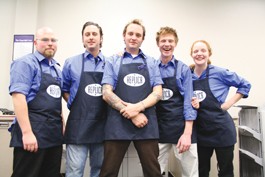
Midnight Shift: From left, _Martin Roeben, Daedalus Howell, Josh Staples, Ben Kramer and Jessamyn Harris costar in the swift indie ‘Replica.’

By David Templeton

Everything moves so fast these days.An hour ago I was waiting in line for a martini at the opening-night reception of the Sonoma Valley Film Festival. Everyone was engaged in cinematic chit-chat of the highest order: Who’s making what with whom? Is the future of movie-theater cinema really doomed or does it just look that way? F-stop this, Film Comment that. Blah, blah, blah. That’s when I bumped into Daedalus Howell, producer-writer-director with the newly launched film-production company FilmArt3.

One thing, as they say, led to another, and now, faster than the Millennium Falcon coming out of hyperspace, I find myself wearing a white paper jumpsuit and a hard-hat draped in glowing plastic tubing, hunched in a corner of Howell’s downtown Sonoma office, as a quintet of film-crew people hover above me with cameras and lights and crouch on the floor below me with patient faces and slinky recording devices.

The office has been transformed into a futuristic, vaguely Orwellian tech-support cubicle, everything wrapped in that glowing plastic tubing, courtesy of visiting filmmaker Raymond Daigle (his short film Replica will go on to win the Audience Award for Best Lounge Short at the festival), who works for the Oakland-based portable-light-tube company Cool Neon. As I deliver my lines, Daigle hunkers on the floor at my feet, aiming a microphone at my face, which is bathed in the eerie light of a futuristic phone created by taping an upside-down computer mouse to a standard telephone mouthpiece.

Howell says, “OK. . . action,” and 15 minutes, five takes and several insightful directorial suggestions later (“Now do it in a high-pitched, kind of creepy-sounding axe-murderer voice”), Howell pronounces the film a wrap.

If the speed at which this little scene was set up and shot seems fast, consider how fast the entire project was started up and completed. The film, to be titled Farewell, My Android–about a laconic futuristic geek squad handling an escaped android emergency–was dreamed up yesterday morning by Howell, who wrote the script last night, assembled his crew this morning and had filmed the bulk of the film by mid-afternoon.

Now that the last scene has been shot, Howell says he’ll edit the final piece later this evening and expects to have the entire three-and-a-half minute short–soundtrack, special effects, end credits and everything–ready to upload to the Internet by breakfast tomorrow morning. From start to finish, that’s about 48 hours.

Short & Fast

As the time it takes to make a film accelerates, more and more filmmakers are making names for themselves and finding steady work outside the Hollywood system. Howell is just one small player in a massive global filmmaking movement, made possible by the availability of relatively affordable new digital cameras, editing software, effects packages and other computer-based filmmaking gear, with which almost anyone can make a film today.

With the emergence of video-sharing technologies like YouTube, video postings on individual websites, mail-order DVDs sold from filmmakers’ websites and instant online uploading of submissions to major cable stations like the Independent Film Channel, filmmakers can make a movie and get it in front of millions of people literally overnight. That much of this online movie-watching involves short films rather than features is likely about to change, but at the moment, all of this YouTube activity has spawned a renaissance.

“I love the short films, and as an actor, I have nothing against being approached to be in one if it’s a well-written script and the filmmaker is trying to do something interesting,” says actor Ernie Hudson (Ghostbusters, Desperate Housewives). “The new technologies that have speeded up _the art of filmmaking haven’t really affected Hollywood, though, where making a movie is still like taking a dinosaur for a walk,” he chuckles. “For me, I love to make small, fast independent films, because if it’s interesting and challenging, I can probably squeeze it in around the Hollywood stuff. And some of [it] is really good. Just because a Hollywood movie is made slowly doesn’t keep it from turning out bad, and in the same way, just because these small films are being made quickly doesn’t mean they’re not going to be good. The speed doesn’t necessarily have anything to do with it.”

In this new frontier, in fact, it’s often crucial to be fast. If a neophyte filmmaker intends to do this as a commercial proposition, he or she is competing, at any given point, with 100,000 to a million different filmmakers. Instead of creating colossal chunks of content that the filmmaker hopes will dazzle the world, it’s now a better strategy to create a pack of smaller pieces and use them to grow an audience by constantly engaging that audience with new and better content, honing his or her chops in the meantime. The greatest thing about being able to make films so fast is that you can make a film in a day, and by the next day find out if anyone cares that you did it.

“No one who’s logged on to YouTube can deny that we are in the midst of a massive short-film revolution,” says Raymond Daigle, whose Replica has been teased on YouTube with a short excerpt that drives viewers to his own website, where they can buy the full DVD. A comedy about graveyard-shift workers at a Kinko’s-type copy shop, the film is being marketed to the millions of folks who labor in the copy industry, and has been doing remarkably well.

Not surprisingly, the audience for most of this content tends to be young. “For filmmakers in their thirties,” Daigle says, “this current appetite for short films represents the second wave of technology-driven, short-film popularity in their lifetime. Back in 1999 and 2000, due to all the new people coming to the Internet, short films were suddenly the rage, mainly because they were small enough to fit through the bandwidth that existed at the time.”

At that point, the model for filmmakers was the same as they might have found in film school, where a director would make a short film to use as a calling card, hopefully to attract the attention of a studio and move up through the ranks before becoming the next Steven Spielberg.

“These days, however,” Daigle says, “making short films is not the means to an end goal—it is the end goal.” Short films, in this current epoch, are more often than not created as films for their own sake, and as such are purer examples of the cinematic art. Adds Daigle, “We are seeing a proliferation of this, of course, because now the technology is available to everyone. The only thing that sets one filmmaker apart from another is the degree of raw talent they demonstrate. One major advantage to short films is that, if they happen to be bad—and, let’s face it, most of them are—at least they are over in a matter of minutes.”

Quick StudyFrom the mass of filmed material now flooding the web, there have been a fair number of success stories. Many major studios and talent agencies have finally begun trawling the Internet in search of the next great young filmmaker. Agencies like United Talent Agency and studios such as 20th Century Fox’s boutique Fox 21, are going online in a major way, setting up divisions of agents and talent scouts to scour YouTube and similar websites for potential new clients.

These efforts are resulting in young filmmakers picking up development deals and potentially lucrative assignments: Brookers Brodack, whose comical video spoofs and trippy on-camera confessionals were discovered by Carson Daly on YouTube; writer-directors Joe Bereta and Luke Barats, signed last year to a two-year deal by NBC, leaped to the studio’s attention when their smart-alecky, knock-knock short Completely Uncalled For was seen by over a million people within five days of its posting on YouTube; Sonoma County’s Mitch Altieri and Phil Flores, working under the name the Butcher Brothers, snapped up a deal with Lionsgate after their low-budget horror flick The Hamiltons began gaining buzz through its kicky online “trailers,” and they’ve built up their creep cred with the popular online gore-shorts featuring the homicidal Slaughter Sisters; Kentucky’s William Sledd, whose popular YouTube series Ask a Gay Man has generated fans, copycats and heated debates about the negative potential of gay stereotyping, just last month picked up a deal with NBC to star in his own Queer Eye–style TV show.

As these stories illustrate, a fun, cleverly made short film, put together cheaply and quickly, can be all filmmakers need to prove they have what it takes to make a go of it on more ambitious projects. The cheapness of video, as opposed to film, has made it much easier to experiment, and some studios and cable stations are now far more willing to give a shot to young video artists than ever before.

“It’s pretty evident when somebody’s trying to communicate something in coherent film language, and whether or not they are doing that effectively,” says Santa Rosa’s John Harden, a filmmaker whose award-winning short La Vie d’un Chien—about a French scientist turning people into dogs in Paris—is still earning him sought-after slots in film festivals around the world over two years after it premiered. An early short-film, Crutemobile, or, Jesus Crushed My Car, has earned close to a thousand hits on YouTube, but he has decided not to post all of La Vie d’un Chien—just a 35-second excerpt, like Daigle’s Replica—to retain the film’s viability as a film-festival candidate and to drive sales of the DVD, which he also sells through his own website.

While agreeing that most of what you find posted on YouTube is “artless crap,” Harden feels that is the norm for any art form. “Most of what you see on television is crap, most of what you see at the movies is crap, most of the books published are crap,” he says. “But the good stuff has a way of rising to the top. People have a way of discovering what is well-done and artfully made, though some great stuff falls through the cracks, and those artists who are discovered will, hopefully, be able to take every bit of success and popularity and use it to keep making films.”

According to Harden, it won’t be long before the audience that has cultivated a taste for these handmade short films begins to demand more substantial product, which will also be available on sites like You Tube, along with pay-per-view sites that are surely on their way to make feature length non-Hollywood films available to a hungry audience. Former Santa Rosa resident Arin Crumley has paved the way with his full-length film Four Eyed Monsters, YouTube’s first ever full-length film. With its attached request for a one-dollar donation to pleased viewers, the filmmakers have made over $35,000 so far.

This kind of marketing approach is the wave of the future, says director Sol Papadopoulos, whose low-budget movie Under the Mud, about an eccentric Liverpudlian family, was made with an amateur cast for almost no money, and has since become a darling of film festivals, where the filmmakers raise money selling T-shirts, stickers and DVDs.

“The sky’s the limit now,” Papadopoulos says. “The future of filmmaking is now in the hands of the filmmakers. With the kinds of technologies that now exist, we can make films cheaper and faster—and better. We can do films that matter, films that are immediate, and not have to wait for permission from some big studio. To make a film today, all a filmmaker has to do is think it up and do it. And there is an audience waiting to see it.”

It is, he says, the beginning of true artistic revolution, one in which the rules have changed and the power has shifted.”Filmmaking began as an art,” says Papadopoulos, “and the studios made it into a business. Now, with the pace of making a film having picked up so much, film is about to be seen as an art form again.”


Silicon Valley | Santa Cruz County |


New and upcoming film releases.


Browse all movie reviews.

Help!

09.19.07

The Beatles are the subject of the muzziest human reveries, like other vague capitalized topics such as “Christ” or “Poetry” or “Love.” Trying to visualize a concept this high is the quickest path to kitsch, and director Julie Taymor’s Across the Universe is rock-solid kitsch, compete with giant puppets, hidebound lyricism and chiffon-wrapped floating nudes, much like the levitating Greek oracle in 300. (The more I see “tasteful nudity,” the more I’m convinced I’m only interested in the distasteful kind.) With Across the Universe, there’s something lacking. What it needs is a damned good whacking.

Thirty Beatles songs are ransacked for this period musical. A Liverpool boy (“Jude,” Jim Sturgess) crosses the pond to search for his father, a WW II GI who abandoned him. There he meets a patrician American girl (“Lucy,” Evan Rachel Wood). Meanwhile, Lucy’s brother Max (Joe Henderson), a wastrel Princeton dropout, risks being drafted for Vietnam.

The three principals live in a New York flat, where the landlady is the Janis Joplin–like Sadie (Dana Fuchs, channeling Idina Menzel in Rent). Sadie’s common-law-boyfriend-cum-backup-guitarist is the Jimi Hendrix&–like Jo-Jo (Martin Luther McCoy) from riot-torn Detroit. Coming in through the bathroom window is the incipient lesbian Prudence (T. V. Carpio).

Now that we have something like the cast of Friends together, the movie seems staffed with nothing but minor characters. Together, they endure the turmoil of that one particular decade that no one wants to see reenacted on screen again as long as they live.

Across the Universe’s take on the 1960s is politically spineless. Lucy drifts into antiwar activities and begins hanging with a thinly veiled version of the activist group Students for a Democratic Society. Her telephone call home: “I’m a radical! You should be a radical, too. Everyone should be a radical!” In turn, Jude berates the activists with a rendition of “Revolution.” How did a worker from the Liverpool docks end up so apolitical? Finally, a restaging of the accidental Weatherman bombing at a New York townhouse demonstrates the wrongness of all antiwar efforts–except, that is, for carrying puppets and crying.

Drugs darken this film’s door when a Neal Cassady-like Dr. Robert arrives via magic bus. As the driver, Bono provides an acceptable version of the Beatles’ great moment of foaming, wrathful Dada, “I Am the Walrus.” It’s equaled only by Joe Cocker’s downtown pimp singing “Come Together.” Weirder is Salma Hayek in a digitized five-part harmony. She’s dressed in naughty-nurse regalia and wields a hypodermic. This Cinco de Salma party, set to “Happiness Is a Warm Gun,” is indebted to the “Acid Queen” sequence in Tommy. You won’t remember it, but it convinced virginal viewers worldwide that LSD was an injectable drug.

Of Eddie Izzard’s “Being for the Benefit of Mr. Kite” it is perhaps best not to speak.

The ballads and the raveups alike are mashed (or rather, mushed). Taymor (Frida, The Lion King) sought artlessness and got amateurism. The songs that work do so despite what performers do to them. “Blackbird,” like John Prine’s “Angel from Montgomery,” seems to survive any musician.

Illustrated with derivative or catastrophic psychedelia, the film bottoms out when Jude creates the “Strawberry Records” logo. Impaled on pushpins, a basket of berries hang, leaking gore. It’s a veritable dysfrutopia. So many little bleeding hearts, just like the one Across the Universe has on its sleeve. What a bloody mess.

‘Across the Universe’ should open wide on Friday, Sept. 21, if the reviews don’t kill it first.


New and upcoming film releases.

Browse all movie reviews.

On the Walls

09.19.07On a beautiful late summer Sunday afternoon, the Sonoma Valley Museum of Art packed a crowd into its modern indoor gloom. Nibbling on chicken satay sticks, fresh spring roll wraps and sipping the museum's own brand of wine, hundreds of people massed in to hear sculptor Linda Fleming give a personal tour of her one-woman retrospective, "Refugium," showing through...

Preview: The Kronos Quartet

09.19.07s if any further proof were needed that Kronos Quartet are the most cutting-edge string ensemble on the planet, the Bay Area&–based collective have just announced the program for their upcoming Redwood Arts Council performance in Santa Rosa on Sept. 28, and holy hell, is it ever out of this world. When Thelonious Monk is the only household name...

Crazy ‘Love’

the arts | stage | Stolen hearts: Burgler Molly...

Casa Verde

09.19.07 Amid the clutter of my desk rests a biodegradable to-go container, inside of which I have a biodegradable drinking straw, one business card that reads "The Compost Club," and pieces of recycled wine-bottle glass and broken terracotta pot that have been tumbled in a cement mixer until their edges have gone thick and soft.When I recently drove to Kenwood...

Super Hyphy R.I.P.

09.19.07In 2005, I asked Super Hyphy promoter Daniel Gelotte a question that, at the time, was on everyone's mind: What, exactly, is hyphy? His tip-of-the-iceberg answer was indicative of the wide-openness of the new phrase, the new genre, the new lifestyle. "Hyphy is driving your car backwards, running from the cops, being out of control, whatever," he riffed. "Some...

News Briefs

09.19.07 Planning Ahead Thick bureaucratic documents that will shape the North Bay for years are being crafted in ongoing but separate processes in Marin, Napa and Sonoma counties. Each is revising its general plan, a state-mandated document which is the basis for all land-use decisions. Sonoma is also creating a separate strategic plan to set priorities on a wider range...

Elder Tales

09.19.07Bette Davis once said, "Old age ain't no place for sissies." In Pacific Alliance Stage Company's season-opening show, Conversations with Our Elders—part of the ongoing county-wide Performance Sonoma festival—Davis' statement is aptly illustrated by the true-life stories of over a dozen Sonoma County senior citizens. PASCO's artistic director, Hector Correa, having amassed over 20 hours of taped interviews with...

The Byrne Report

09.19.07Fish WrapOn June 26, 2007, Bruce Kyse, who publishes the Santa Rosa Press Democrat and is a board member of the Santa Rosa Chamber of Commerce, printed a "Note to Readers" announcing that he is selling advertising on the once-sacrosanct front page because of "competition" from the Internet. "This change is one of the ways we are responding to...

Speed of Film

current reviews | Photograph by Jessamyn Harris Midnight Shift: From...

Help!

09.19.07The Beatles are the subject of the muzziest human reveries, like other vague capitalized topics such as "Christ" or "Poetry" or "Love." Trying to visualize a concept this high is the quickest path to kitsch, and director Julie Taymor's Across the Universe is rock-solid kitsch, compete with giant puppets, hidebound lyricism and chiffon-wrapped floating nudes, much like the levitating...
11,084FansLike
4,446FollowersFollow
6,928FollowersFollow