Here’s the latest bombshell in the sprawling, multi-pronged federal investigation right now into Napa County government agencies and the nature of their relationship with powerful local people and entities. The Napa County Farm Bureau, an industry org representing ag interests, just got subpoenaed as well, according to the Press Democrat — along with its super influential political action committee (PAC). Insiders see the Farm Bureau as one of the biggest and most successful players in Napa politics — which is why it was so shocking with the bureau’s CEO, 46-year-old Ryan Klobas, reportedly shot himself to death last month on the side of the road. Along with the bureau itself and its PAC, the U.S. Department of Justice is also investigating “major funders of the Napa County Farm Bureau’s political wing,” the Napa Valley Register reports. “Six winemakers and winemaking concerns — most of them Napa Valley-based — together have given $155,000 to the Fund to Protect Napa Valley Agriculture, a political action committee the Farm Bureau launched in 2019. Those donors appeared in a list of 40 entities that were mentioned in one of three subpoenas the U.S. Department of Justice issued to Napa County in December. … Among those named in the federal subpoena, Caymus Vineyards contributed $60,000 to the Farm Bureau’s PAC in three separate transactions from 2019 to 2021. A Caymus co-founder, Charles J. (Chuck) Wagner, supplied the group another $45,000 from 2022 to 2023.” No one can say what, exactly, the feds are investigating yet — but by the magnitude of these subpoenas, they really seem to think they’re onto something. From the PD: “The DOJ investigation appears to be sprawling, with branches of inquiry that reach into the Upper Valley Waste Management Agency, redevelopment of the Napa County Airport, road pavement projects on Atlas Peak, a controversial — and now scuttled — vineyard project involving Napa County Supervisor Alfredo Pedroza, and other prominent agricultural and development interests.” BTW, I talked to Napa radio host Barry Martin about all this on morning-drive radio show — 99.3 The Vine — last Thursday. Going forward, you can tune in Thursday mornings around 9:10 a.m. to hear us chat about all the biggest stuff going down in the Napa Valley. 💥 (Source: Napa Valley Register & Press Democrat & Press Democrat; paywall)
I think we could probably all use some closure, re: the Aleutian Storm, that fishing boat that ran aground and got stuck at Salmon Creek Beach during a crabbing mission along the Sonoma County coast a couple of weeks ago. As expected, the powerful ocean waves during this last storm reportedly ripped what was left of the 58-foot, 57-ton vessel to shreds over the past week. That’s awful news for the San Francisco fishing crew who depended on the ship for their livelihood — and also awful news for the local ecosystem absorbing the ship’s remains. From the Press Democrat: “The vessel has been torn apart piece by piece — the mast, the pilot house, the cabin, the decking — resulting in a debris field that now encompasses much of North Salmon Creek Beach, as well as the south. Bits offoam rubber and Styrofoam are scattered far and wide. The boat also appears to have leakedall or most of the diesel fuel still left on board after an attempt to drag it out of the surf and onto the beach failed on Friday. The site ‘just reeked of diesel fuel,’ said Jerry Dodrill, a local photographer and director with the nonprofit B-RAD Foundation who helped with some of the cleanup over the weekend and earlier. The fumes were so bad that Cea Higgins, a Bodega Bay resident and executive director of Coastwalk California, went home after four days of collecting wreckage with a headache…. But what bothers her and many people the most are what they consider gaps in the response to the vessel’s late-night grounding near Bodega Dunes State Park. They cite missed opportunities they believe could have saved the vessel, preserved the financial future of its owner, Capt. Chris Fox, and spared protected coastline from the fallout.” Another longtime fisherman from Fort Bragg tells the paper: “It’s traumatizing is what it is. I wake up every night grinding my teeth over this. We know how to do this. It doesn’t have to be a loss every time.” The various government agencies involved in overseeing this mess haven’t released any information about how much diesel spilled, or what the damage is — they just keep warning everyone to avoid the area. “The California Department of Parks and Recreation has announced a BEACH CLOSURE for South Salmon Creek Beach,” the county government posted a few days ago. “The beach is closed to ensure the health and safety of the public due to the ongoing salvage operation of the Aleutian Storm. The operation requires the use of heavy equipment and a large safety buffer for the operators. This closure includes all State Park lands from Salmon Creek extending south to Mussel Point, until further notice.” (Source: County of Sonoma via Facebook & CA Office of Spill Prevention & Response via Facebook & ABC7 & Press Democrat; paywall)
I think we could all probably use a quick storm recap to integrate those five long days of rain, wind and general storminess we just went through. It wasn’t quite as dramatic as the storm before, but it really had a long-haul feel to it, wouldn’t you say? There was also an “uncommon” amount of lightning this time, meteorologists tell the Press Democrat, along with plenty of falling trees and power outages reported across Sonoma and Napa counties, affecting thousands. At one point, a 30-foot oak tree fell onto the band room at Analy High School, which meant a snow day Tuesday for the kids. Russian River water levels also rose higher this time, due to the sheer volume of rain that came down — at least 7 or 8 inches between Friday and Wednesday. The river came within about a foot of jumping its banks in at least one spot along its route through Healdsburg, according to data from the National Weather Service, and came within four feet of flooding in Guerneville. Meanwhile, those super flood-prone country roads in the Forestville area did end up flooding really bad, as predicted — and one person got their car stuck in the floodwaters on Wohler Road, near where a woman died last year, according to the Sonoma County Fire District. Officials posted a pic of the stranded car on Facebook, writing: Once again, we would like to emphasize TURN AROUND, DONT DROWN. Luckily this driver made it to dry ground with the assistance of 1st responders.” The driver “had to be pulled from their vehicle by first responders,” the PD reports, and “the vehicle was tagged and left at the scene.” The same fire department made another very important cat rescue during the storm, too. “Just as the skies turned menacing” on Sunday, fire officials wrote on Facebook, “our brave Sonoma County Fire District crew from Station 4 – Bellevue, performed a heartwarming rescue at Taylor Mountain Regional Park. At 1:30 PM, amidst growing concern, we received a distress call. A couple enjoying a pre-storm walk with their beloved feline, on a leash, found themselves in a panic when their adventurous cat decided to explore the heights and got stranded atop a tree.Without hesitation, our Fire Explorer demonstrated courage and compassion, climbing up the ladder. In an incredible moment of trust, the cat leaped into his arms, safe at last.The reunion was nothing short of emotional.” (Source: National Weather Service & National Weather Service & Cal Fire via Facebook & Sonoma County Fire District via Facebook & Sonoma County Fire District via Facebook & Santa Rosa Fire Department via Facebook & Sebastopol Times & KRCB & Press Democrat; paywall)
As the interest in psilocybin mushrooms grows, finding reliable vendors for purchasing mushroom spores has become increasingly crucial. This article overviews the top websites where enthusiasts can buy mushroom spores online. Here is a list of some of the best websites selling mushroom spores:
Fungushead—Best Online Mushroom Store for Unique Strains
Spores101—Best Online Mushroom Store for Comprehensive Selection
Spore Store—Best Online Mushroom Store for Quality Assurance
Mushly—Best Online Mushroom Store for Experienced Mycologists
Top Sites to Buy Mushroom Spores
To learn more about the fascinating world of mycology demand a reliable source for quality mushroom spores. Several vendors have risen to prominence, each contributing to the growing community of mycology enthusiasts. This section introduces notable players in the field, highlighting their commitment to providing diverse and fresh offerings.
Fungushead stands out as an ultimate online destination for mushroom enthusiasts, offering a comprehensive platform curated by a team of passionate mycologists. The website is a valuable resource, providing in-depth information, essential tools, and high-quality Psilocybin mushroom spores for microscopy research. They also appeal to mycologists interested in edible mushroom cultivation by selling high quality edible mushroom liquid cultures!
Fungushead offers competitive pricing for its Psilocybin mushroom spores. The range varies depending on the strain, with prices typically falling between $38.00 and $45.00 per spore syringe. This ensures accessibility for both beginners and advanced researchers.
Product Variety
Fungushead’s product catalog thrives on diversity, showcasing a meticulously chosen selection of Psilocybin mushroom strains. Each strain, selected for its distinct genetic identity, provides researchers with a rich palette for exploration.
Delivery Fees and Time
Shipping fees are calculated at checkout based on the delivery location. Fungushead takes pride in its fast shipping service, with orders typically reaching customers within a specified timeframe. The vendor provides a tracking option for customers to monitor the delivery progress.
Return Policy
Fungushead’s return policy is customer-centric, offering a straightforward process for those unsatisfied with their purchase. Customers can initiate a return within a specified period, and the vendor ensures a hassle-free replacement process.
Spores101—Best Mushroom Spores Site for Comprehensive Selection
Established in 2004, Spores101 has maintained a robust online presence, offering high-quality mushroom spores at competitive prices. The platform caters to novice researchers and experienced mycologists with a diverse range of strains. The extensive collection includes spore prints, spore syringes, grain spawn bags, casing soil, compost substrate, live cultures, and live mycelium, providing researchers with various experiment options. Emphasizing discreet shipping, Spores101 ensures that all orders are delivered securely and promptly, prioritizing customer satisfaction. The website’s secure ordering system and guaranteed delivery reflect its commitment to providing a seamless shopping experience.
Spores101 offers a range of pricing options, ensuring affordability for researchers with various budget considerations. Prices vary depending on the product type, with single spore prints and syringes typically ranging from $19.99 to $29.99. Special promotions, such as “Buy 3 Get 1 Free” on spore prints, provide additional value for customers.
Product Variety
The platform boasts an extensive product variety, including spore prints, spore syringes, grain spawn bags, casing soil, compost substrate, live cultures, and live mycelium. This diverse selection caters to researchers with different preferences and experimental requirements.
Delivery Fees and Time
Spores101 offers flexible shipping options for both USA and Canada orders. Customers can choose from regular post, expedited with tracking, and Xpress with guaranteed delivery and insurance. Delivery times vary, with the expedited option typically taking 3-15 business days for USA and Canada orders.
Return Policy
Spores101 provides a refund policy for unsatisfied customers. The refund process involves contacting the support team and detailing the order number and reasons for dissatisfaction. While replacements are offered, customers should be aware of the deduction of the original shipping cost and transaction fee associated with processing a refund.
Spore Store—Best Online Mushroom Store for Quality Assurance
Spore Store is a pioneering spore company with a rich history from 2006. Boasting over 40 years of combined academic experience, Spore Store has a singular mission—to deliver rare and exotic premium spores of the highest quality. Recognized for offering 100 percent clean and viable spore syringes and top-grade spore prints at remarkably affordable prices, Spore Store has become a trailblazer in the mycology laboratory landscape.
Spore Store offers competitive pricing for its premium spores. Strains like Alacabenzi, B+, Golden Teacher, and Mazatapec are available from $14.00 to $150.00. Additionally, customers can explore cost-effective 4-PACK samplers for a varied selection.
Product Variety
Spore Store boasts an impressive array of strains, each with unique characteristics. From the robust Alacabenzi to the beginner-friendly Golden Teacher, the company caters to a diverse audience of researchers. The Spore Syringe 4-Pack Sampler offers a convenient way to explore multiple strains.
Delivery Fees and Time
Customers can select from various payment options, including Bitcoin, Credit Card, and Cash for Mail Orders. The company emphasizes accuracy in matching names and addresses for Credit Card orders, ensuring a smooth transaction process. While expedited service is available for Credit Card and Bitcoin orders, Mail Orders may take up to 1-3 weeks for processing and shipping.
Return Policy
Spore Store strongly emphasizes customer satisfaction, offering a quality guarantee for its spore syringes. The company’s vision and process prioritize optimal spore concentration, viability, and a shelf life of over six months when refrigerated. The storage recommendations include keeping spores in the refrigerator for long-term viability.
Spore Printers is a premier destination for psilocybin and magic mushroom enthusiasts, offering one of the largest spore libraries for purchase. Based in Oregon, surrounded by the expansive mycelium bed of Armillaria ostoyae, the honey mushroom, Spore Printers leverages its unique location to provide top-quality psilocybin spore specimens. With a commitment to meticulous lab processes and sterile environments, the company ensures viable and contaminant-free products, catering to researchers and mushroom enthusiasts alike.
Spore Printers provides a range of psilocybin spores, syringes, liquid cultures, and culture plates at competitive prices. With Psilocybe Cubensis spore syringes priced at $19.99, customers can explore various strains without breaking the bank.
Product Variety
Spore Printers has a comprehensive selection of magic mushroom spore prints, spore print syringes, liquid cultures, and culture plates curated for Psilocybin, Psilocybe Cubensis, and Panaelous strains. From Treasure Coast to Tidal Wave, the diverse product lineup caters to both experienced mycologists and those venturing into the world of mushrooms.
Delivery Fees and Time
Spore Printers offers free shipping on all orders over $150, ensuring cost-effectiveness for customers. Orders are typically shipped within 24-48 hours, utilizing insured priority mail services to guarantee safe and prompt delivery within the United States.
Return Policy
With a focus on customer satisfaction, Spore Printers provides a viability guarantee for its liquid spore cultures and culture plates. While returns are accepted within seven days of receiving the order, a 20 percent restocking fee applies, and products must be returned in their original, unopened condition. The company prioritizes resolving issues related to shipping damages, unsatisfactory products, or signs of contamination.
Mushly—Best Mushroom Spores Site for Experienced Mycologists
Mushly, a seasoned player in the spore game for over ten years, stands as a reliable hub for mushroom enthusiasts and researchers. Boasting an impressive collection of over 30 Cubensis strains, five exotics, and even edibles like reishi and portobello, Mushly is a go-to destination for those seeking diverse genetics. Operating from a sterile lab, Mushly ensures contamination-free products, including spore syringes, spore prints, and edible cultures.
Mushly keeps it simple with Spore Syringes like Golden Teacher, Thai Pink Buffalo, Penis Envy 6, etc., all priced at $19.95. Particular strains in spore prints, such as Malabar, Golden Teacher, and Stropharia, are slightly higher at $34.95 each. The straightforward pricing makes it easy for mycology enthusiasts to explore various options without breaking the bank.
Product Variety
With a focus on diversity, Mushly presents an extensive array of spore syringes and spore prints featuring sought-after strains such as Malabar, Golden Teacher, and Stropharia.
Delivery Fees and Time
Shipping is discreet and free for orders over $150, with guaranteed deliveries within specified timeframes. Mushly’s efficient processing ensures orders are typically shipped within 24 hours.
Return Policy
Mushly’s commitment to customer satisfaction includes a 100 percent viability guarantee. In case of dissatisfaction or shipping issues, the company offers reshipping options, emphasizing customer support for a seamless experience.
Choosing the Best Website to Buy Mushroom Spores
When venturing into buying produce mushroom spores online, it’s essential to consider various factors to ensure a seamless and satisfying experience.
Shipping and Return Policy
Before making a purchase, prospective buyers should carefully review each vendor’s shipping and return policies. A reliable vendor will provide discreet packaging to ensure privacy, and their policies should guarantee the safe arrival of the ordered spores. Understanding the return process is equally crucial in case any issues arise.
Store Reputation
Checking the reputation of the online store is paramount. Customer reviews and testimonials offer valuable insights into the reliability and trustworthiness of the vendor. A vendor with a positive reputation will likely provide quality products and excellent customer service.
Brand Reputation
In addition to the store’s reputation, buyers should also consider the reputation of the specific mushroom spore brands offered. Established and reputable brands are more likely to provide spores of high genetic quality, ensuring a successful mycology experience.
Mushroom Strains
The variety of mushroom strains offered by a vendor is a crucial factor. Enthusiasts often look for a diverse selection, including popular strains like Golden Teacher, Thai Pink Buffalo, and Penis Envy, among others. A vendor with a broad range caters to different preferences and experience levels.
Products Variety
Beyond many mushroom spores, a diverse product range enhances the shopping experience. Vendors offering additional mycology products, such as cultivation supplies or educational materials, contribute to a comprehensive and satisfying buying journey.
In conclusion, purchasing mushroom spores online requires careful consideration of various factors. The top websites mentioned stand out for their quality products, diverse strains, and positive reputations. By following the tips on choosing the best website, mycology enthusiasts can embark on a successful and enjoyable journey into psilocybin mushrooms.
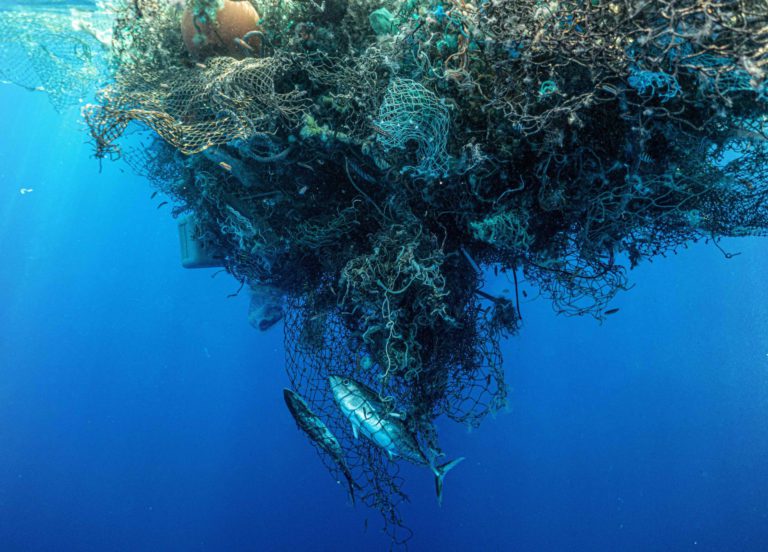
To give that statistic some perspective, worldwide, 269,000 tons of plastic is floating in the oceans, revealed a 2014 study in PLOS One. The section of the Pacific Ocean between California and Hawaii contains almost a third of the global total.
If anyone can accurately describe the massive scope of the plastics problem in the Pacific, it’s Crowley, the founder and director of Ocean Voyages Institute, a nonprofit based in Sausalito. She didn’t, however, set out to become an expert on the topic. In fact, the seasoned mariner was happy operating her yacht chartering company and logging 125,000 miles sailing the world. Yet with each passing year, she noticed more and more plastic in the ocean.
Finally, Crowley knew she had to act. Since 2009, she’s led eight cleanup expeditions, hauling more than 700,000 pounds of plastic out of our planet’s blue heart and transporting it to recyclers. Although Ocean Voyages Institute is relatively small, it’s dynamic, Crowley said. The local nonprofit works with renowned establishments, including the Smithsonian Institution, Scripps Institution of Oceanography, the University of Washington and the University of Hawaii.
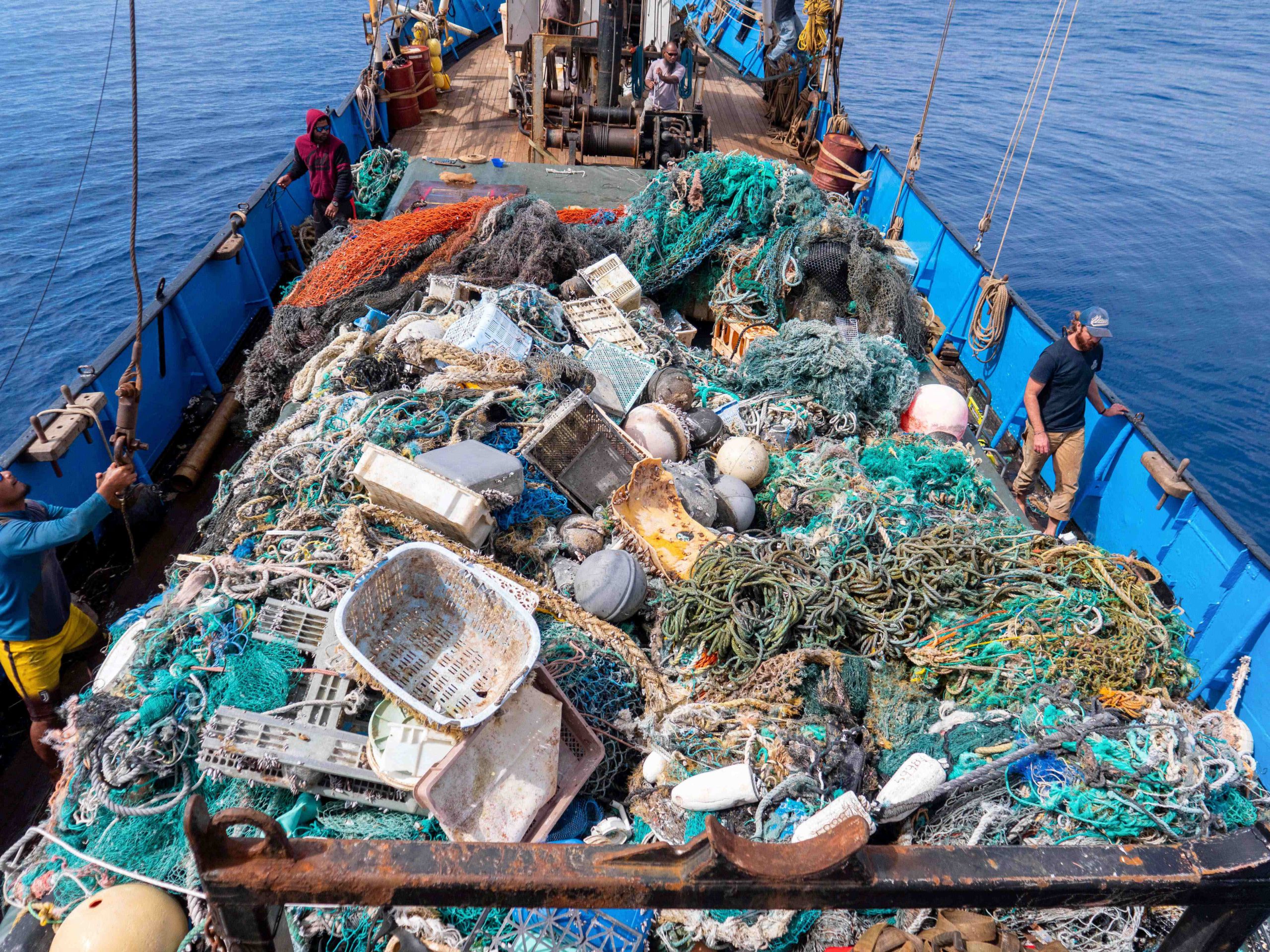
Ocean Voyages Institute has plucked all types of plastic from the Pacific, including laundry baskets, car parts and pieces yet to be identified. Photo courtesy of Ocean Voyages Institute.
Crowley and her team of volunteers from Ocean Voyages Institute don’t simply sail to a huge stationary island of trash ready to be collected—there’s actually no such thing. Instead, they head to a portion of the North Pacific Subtropical Gyre, between California and Hawaii, in search of accumulated plastic.
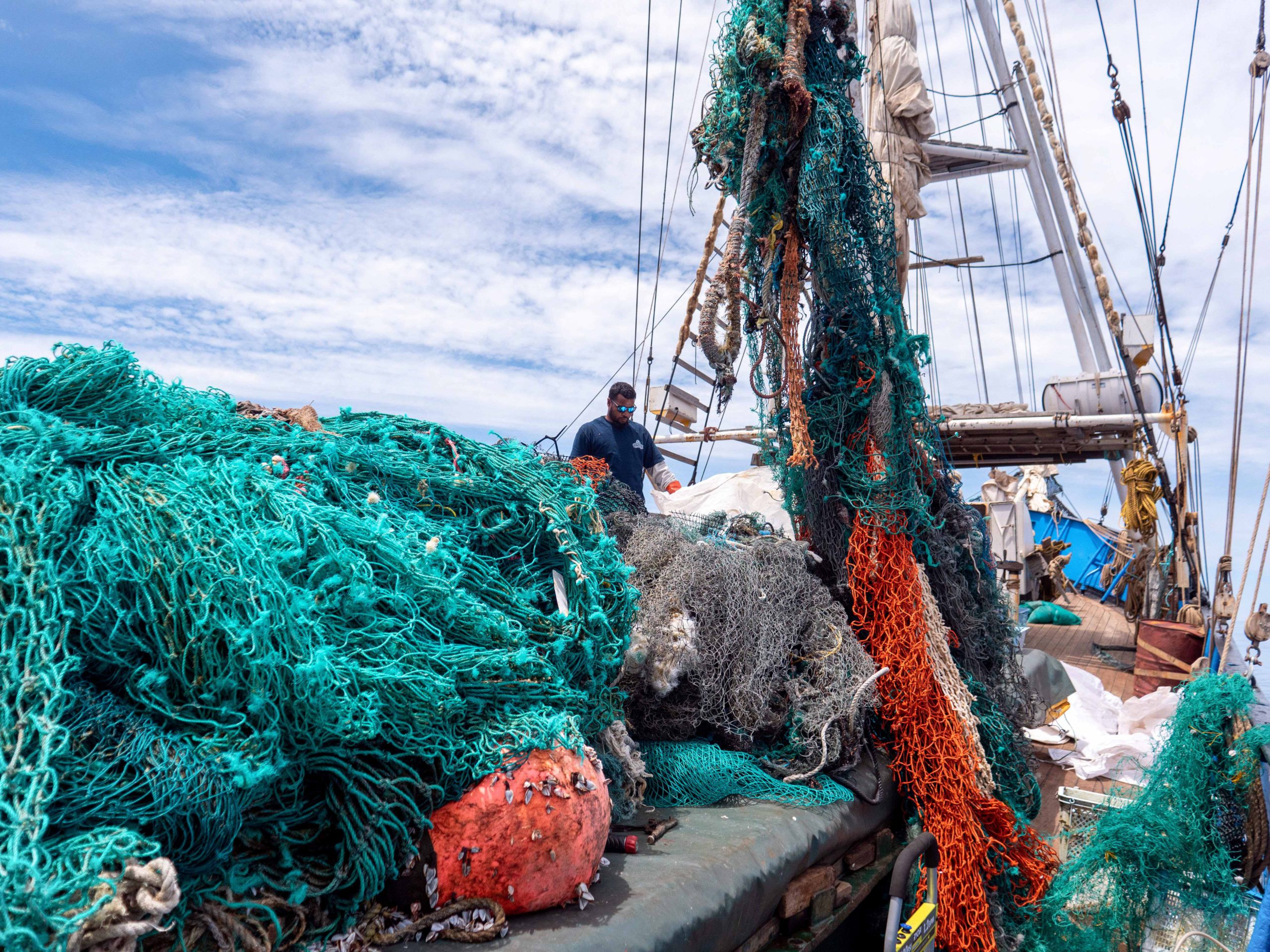
A gyre, a large swirling ocean current, draws in and traps debris in the calm center of its vortex. Each of Crowley’s cleanup missions has recovered almost every type of plastic garbage imaginable, including enormous pieces of fiberglass vessels, tangles of nylon fishing nets weighing from 600 pounds to 10 tons, lawn furniture, children’s toys and microplastics.
“The question comes, where is the garbage gyre, and how large is it?” Crowley asks. “Because it’s an area made by ocean currents, it moves around some and changes in size. It can start as close as 600 miles off the coast of California and as far as 600 miles off the coast of Asia. Some say it’s the size of Texas, or double or triple that large. But the plastics are really quite spread out.”
As Crowley learned during Ocean Voyages Institute’s first two missions, it’s challenging to locate these moving targets of garbage in the vast ocean. The problem, currents pushing the garbage from place to place in the ocean, also presented the solution.
“I began thinking about debris distribution—the way the ocean sorts things,” Crowley said. “The current puts things of similar shapes and sizes together over time. I have personally seen more than 4,000 white laundry detergent containers spread across a five-mile area in the ocean. People who don’t understand ocean currents ask, ‘Who dropped all these bottles out here in the same place?’”
Crowley wondered if the ocean currents also sorted synthetic fishing nets in the same way, even though they come in many different shapes and sizes. While all plastic pollution in the ocean spells disaster for the ecosystem, abandoned fishing nets can be particularly deadly to marine life. Ghost nets, as the derelict gear is often called, continue to fish for as long as they remain in the ocean, ensnaring and killing whales, dolphins, sea turtles and pelagic fish such as tuna, swordfish and mackerel, which inhabit the ocean column away from the bottom or shore.
A sea turtle skeleton entangled in a deadly ghost net that was hauled out of the ocean by Ocean Voyages Institute. Photo courtesy of Ocean Voyages Institute.
“Sadly, we hardly ever get to rescue creatures caught in the ghost nets,” Crowley said. “Because they’re skeletons when we find them.”
Removing ghost nets became a priority for Ocean Voyages Institute. But the organization still needed effective methods to locate the gear. In 2010, Crowley put together a “marine debris collection think tank,” which included folks from sailors to scientists trying to find the answer.
Think tank members developed a method to keep track of the abandoned nets, even as the ocean currents moved them to different areas. Using GPS technology, they designed a volleyball-sized tracking device with a very long battery life that could be attached to the debris with carabiners.
The organization now distributes these reusable seven-pound trackers to volunteer mariners making a trip from California to Hawaii. Upon encountering ghost nets or other large debris, the sailor clips the tracking device to the garbage, turns it on and informs Ocean Voyages Institute that the beacon is now operating.
“The trackers were a breakthrough for us,” Crowley said. “It allows our oceanographers to have access to the movements of the plastic in real time and allows our cleanup ships to go directly to the ghost nets.”
Tracking the garbage also proved Crowley’s theory that the currents sort the derelict nets in the same way they sort laundry detergent bottles.
“Frequently, where there is one ghost net, we might find five or six in the same area, along with other plastic debris,” Crowley said.
Sausalito nonprofit Ocean Voyages Institute focuses on finding fishing nets between California and Hawaii, eventually sending the debris to plastic recyclers . Photo courtesy of Ocean Voyages Institute.
After the plastic is collected by Ocean Voyages Institute, it’s brought to land—but never to a landfill. Volunteers sort the plastic for distribution to different recycling companies. Climate action artists from the University of Hawaii used the plastic in art projects, and a German company transformed it into jewelry and dog leashes.
The bulk of the garbage goes to larger companies, such as ByFusion in Los Angeles, which recycles plastics into building materials. Resynergi, a Rohnert Park company, uses the debris to produce clean chemicals that can then be turned into plastic again. Circle of life.
Since it appears that society and industry aren’t willing to stop manufacturing and using plastics anytime soon, Ocean Voyages Institute’s mission continues. This summer, the team will again be cleaning up the Pacific’s plastic vortex, and they’re asking for assistance from the mariner community.
“We’re actively seeking sailors who are going from California to Hawaii,” Crowley said. “They could take photographs or bring our GPS trackers to tag ghost nets. People doing more extensive cruising can help with water sampling. Sailors can make a big difference to help ocean science.”
Mariners interested in volunteering, contact Ocean Voyages Institute at
When mounting a Shakespeare production, companies usually pick either a well-known adaptation or inject a “concept.”
Rohnert Park’s Spreckels Theater Company, however, has chosen to do both with its three-hour-long production of A Midsummer Night’s Dream…60’s Style! The result is a really good Shakespearean production that often seems to break out into a jukebox musical. The ambitious show runs through Feb. 25.
Don’t get me wrong; both shows are good. Co-directors Sheri Lee Miller and James Pelican have a firm grasp of the bard and have some of the county’s finest Shakespearean actors at work. Amongst the very strong cast, Taylor Diffenderfer’s Helena and John Browning’s Demetrius (hilarious in their haplessness), and Matt Cadigan’s Oberon (somehow simultaneously stoned and commanding) are of special note. Even the changeling child, played by the adorable Jacey Dae Covella, is engaging.
The same is true of the jukebox musical component. Under the musical direction of Jared Emerson-Johnson, Serene Elize Flores (Titania), Austin Aquino-Harrison (Hermia) and Noah Vondralee-Sternhill (Lysander) all give vibrant performances of some very familiar ’60s songs.
Using Titania’s fairies as backup singers is an inspired yet logical choice. However, it does necessitate that the fairies and mechanicals not be double cast (as they commonly are), which robs the play of a bit of its magic.
Only Alex Delzell’s performance as a flower-powered Puck felt fully grounded and at home in both worlds.
This visually striking set design by Eddy Hansen and Elizabeth Bazzano, costume design by Donnie Frank and lighting design by Eddy Hansen all strongly supported the blending of the production’s high-concept with the adaptation. Their work is actually close to brilliant.
The audience was invested, the cast and orchestra were talented, and the atmosphere was fun. But every time a song came up, the entire play stopped. The songs often broke the flow of the lines, which felt contradictory to the work being done by the actors, making me wonder why further script cuts were not made to keep the songs from repeating information already given and elongating the show’s run time.
To be fair (and in the spirit of full disclosure), Midsummer was the first show I appeared in (as a child), and 20 years later it was the last show in which I acted (both as Cobweb). It’s a play that holds deep and meaningful associations for me. It’s a play I thought held no more surprises.
Real Douglas fir and bay laurel trees on stage were a delightful surprise.
‘A Midsummer Night’s Dream’ runs through Feb. 25 at Spreckels Performing Arts Center, 5409 Snyder La., Rohnert Park. Fri-Sat, 7:30pm; Sun, 2pm; $16-$42. 707.588.3400. spreckelsonline.com.
Novelist Thomas Wolfe once famously quipped that one can never go home. Clearly, he never met Melissa Etheridge, whose latest album, One Way Out, consists of seven songs she penned in the late 1980s and early 1990s.
While this material is roughly three decades old, the seed for Etheridge’s 16th studio album was planted in 2013. At the time, she was working on a proposed box set of archival recordings when she came across this cache of material the Kansas native felt compelled to revisit.
“A lot of these were things I had recorded for different albums where I’d done one take and then decided I couldn’t do it and moved on,” she said in a recent phone interview. “These were songs I’d done demos of and forgotten about. This is stuff I wouldn’t write now because I’m not feeling sexually frustrated. And ‘For the Last Time’ was written at a time when I didn’t want everybody to know how sexually frustrated I was.
“All of these are songs that I loved back then, but it was done before I came out (as gay). ‘Wild Wild Wild’ was obviously about a woman, so I pushed it aside and left it. But it’s fun to sing those songs. It’s like finding a treasure and seeing that I can do this again—rock and hit you in the teeth. And while it’s truthful, I don’t have to have gone through it now. It’s so nice to look back at them and know I can play them now,” she continued.
While the box set never came to fruition, she did go back into the studio with her old band of guitarist John Shanks, bassist Kevin McCormick and drummer Fritz Lewak. Once the group reunited, they hit the studio and recorded new versions of the songs that were intended for this proposed multi-disc anthology.
Instead, Etheridge parted ways with longtime label Island Records, and since she paid for the sessions, the singer-songwriter owned the masters, which wound up in the vault. In the near-decade since she cut those songs, the 61-year-old rocker survived cancer, cut three records and was ready for a fresh start coming out of the pandemic.
“When Covid-19 hit and BMG approached me and said they’d love to release something, I said I actually happened to have something that was already recorded and all done,” she explained. “It fits this time. The songs are ready, and I love coming back on tour with these songs. It’s really fun.”
One Way Out opens with the title track, a cut that blisters with smoldering guitar riffs, filthy harmonica runs and a sinewy groove. From here, the rest of the album plugs into a barroom rock ’n’ roll vibe that ranges from the Stonesy strut of “As Cool As You Try” to the more ruminative “I’m No Angel Myself,” a confessional nod to a former partner, to “For the Last Time,” an in-your-face stomper in the vein of vintage Humble Pie. Tying it all together are “You Have No Idea” and “Life Goes On,” a pair of songs recorded live in 2002 at West Los Angeles’ Roxy.
The experience of pulling together One Way Out proved surreal in a way that made Etheridge feel like she was bending the time-space continuum far differently than in her prior recording experiences.
“Each album is a growing and learning experience for me, and I love each one so much because they’re all different in their own way,” she said. “This one is unique because it’s older songs recorded newer, but also a few years ago. It’s a time capsule of a time capsule, and I dig that. Now I’m going to go out and perform these live and probably make recordings now of these songs that go back. And it’s still 100% me.”
With venues fully open, Etheridge is thrilled to be back on tour, having spent a year-and-a-half live streaming from her garage five days a week onto an Internet channel called EtheridgeTV, where she could bring shows and entertainment to fans who subscribed. When asked what fans can expect from her concerts, Etheridge is bubbling over with excitement to be back in her natural element—playing music before a live audience.
“You can expect me to be having so much fun,” she said. “Because I’ve had so much time to think about it, I’ve decided to have the band learn 50 more songs than they knew,” Etheridge said, noting she may delve into deep cuts or highlight certain albums from her catalog. “We’re kind of going to steer in there, do the hits, jam on some songs and have a good time. We’re going to be back with people loving music.”
‘Melissa Etheridge: I’m Not Broken Tour,’ 7pm, Friday, March 15 at the Graton Resort & Casino, has sold out as of press time.
Americans have been on a vacation binge since the easing of Covid-19 restrictions. In particular, the vacation rental company Airbnb is thriving. Late last year, the company posted its highest-ever profits.
Meanwhile, cities are seeing rising rents, unaffordable home prices and increased homelessness. Authorities are now linking these crises partly to Airbnb—and some are now passing strict regulations.
Just as companies like Uber were once touted as a way for working people with cars to earn a little extra spending cash, Airbnb offered the promise of supplementary income for those with an extra room or converted garage.
I’ve rented several Airbnb homes over the 15 years since the company was founded. In the early years, staying in other people’s houses felt like an act of rebellion against corporate hotel chains. The privacy, convenience and often lower cost enabled tourists with tighter budgets to enjoy family vacations that otherwise might have been unavailable.
Now, however, the market is increasingly dominated by a small number of corporate “hosts” and professional property managers—wealthy elites and corporate entities that scoop up large numbers of properties and turn big profits by renting them out to travelers. And that’s driving up housing costs for everyone.
While cheaper vacation stays are certainly desirable for those of us who love to travel, vacationing is a privilege in the U.S. More than a third of Americans, a 2023 survey found, are unlikely to take a summer vacation. And of those, more than half say they simply can’t afford it.
A 2019 Economic Policy Institute study pointed out that “Airbnb might, as claimed, suppress the growth of travel accommodation costs, but these costs are not a first-order problem for American families.” What is a first-order problem is affordable housing.
While regulating Airbnb will not mitigate all economic injustices facing Americans, it certainly will move the needle in the right direction.
Sonali Kolhatkar is the host of ‘Rising Up With Sonali,’ a television and radio show on Free Speech TV and Pacifica stations.
I am nearly 73 years old, hearing-impaired, forgetful, degenerate, infirm, cognitively challenged, unfocused, lame, imbecilic, thoughtless, incoherent, syphilitic, worn out and incapable of original thought.
The last time I was worth a damn to society, they were creating a bonfire with disco records out in left field at Comiskey Park.
There is only one thing left to do for which I am qualified, based on observations of what’s happening in our country.
I’m running for president.
Craig J. Corsini
San Rafael
Gerontocracy
President Joe Biden and his new rock ’n’ roll band, the Dystopiacrats, will soon embark on their 2024 Propaganda/Censorship Tour.
While on the road, the band will be performing favorite songs from their new album, including “Ode to Genocide Joe: Tallakerchie Bridge,” “Yes—We Will Be Fooled Again,” “Eco-terrorist Blues,” “2000 Light Years From Reality” and their new hit single, “Crimea River.”
Economists predict that this year’s tour will not make any money but actually go into debt, (another) trillion dollars. The band isn’t worried, though…they know that the ticket holders (their adoring fans) will be more than happy to pay for the whole thing.
Book Passage hosts a conversation between Calvin Trillin and Michael Krasny, centered around Trillin’s latest work, The Lede: Dispatches From A Life In The Press. This rare event is scheduled for 1pm, Saturday, Feb. 24, at 51 Tamal Vista, Corte Madera. Admission is free, which we journos find astounding given that Trillin is one of journalism’s most distinguished figures. The Lede provides a captivating look at journalism and its architects, as seen through the lens of Trillin’s unmatched six-decade tenure as a bestselling author and a stalwart of The New Yorker. Dwight Garner of The New York Times remarks, “’The Lede’ contains profiles… that are acknowledged classics of the form and will be studied until A.I. makes hash out of all of us.” Trillin himself shares, “I’ve been writing about the press almost as long as I’ve been in the game. At some point, it occurred to me that disparate pieces from various places in various styles amounted to a picture from multiple angles of what the press has been like over the years since I became a practitioner and an observer.” For more details, visit bookpassage.com.
Mill Valley
Wine & Dine
Gravity Tavern in Mill Valley is set to host an exclusive Honig Wine Dinner from 5:30 to 9pm, on Thursday, Feb. 29. The event, priced at $140, includes a five-course meal crafted by chef Pedro Villalobos, paired with wines from the award-winning Honig Vineyard. Steve Honig, the vineyard’s representative, will be present. The dinner features dishes such as Ahi Tuna Poke Taco and Slow Braised Lamb Shoulder Ragu, each accompanied by select Honig wines. The price covers wines, tax and tip. Honig Vineyard, a family-owned operation since 1964, is known for its sustainable, solar-powered production focusing on cabernet sauvignon and sauvignon blanc. Gravity Tavern uses locally sourced ingredients to blend old-world comfort food with modern tastes. Located at 38 Miller Avenue, Mill Valley, the restaurant serves lunch, brunch and dinner, with to-go orders available online or via UberEats and DoorDash. For more information, call 415.888.2108 or visit gravitytavern.com.
Santa Rosa
Law Review
The Independent Office of Law Enforcement Review and Outreach (IOLERO) in Sonoma County is hosting a strategic planning workshop through its Community Advisory Council. Scheduled from 10am to 2pm, Saturday, Feb. 24, the event aims to engage the public in setting the agency’s priorities for the upcoming year. The workshop will be held at the Sonoma County Regional Library, located at 9291 Old Redwood Highway, No. 100, Windsor. Supervisor David Rabbitt, Sonoma County Board of Supervisors chair, and Sheriff Eddie Engram are slated to speak to attendees. IOLERO aims to foster a stronger bond between the Sheriff’s Office and the community by enhancing transparency and outreach. The Community Advisory Council seeks to involve the community in understanding IOLERO and the Sheriff’s Office’s roles more clearly. Those unable to attend can contribute their ideas via email to CA*@***********ty.org.
Sebastopol
Slick
Gold Ridge Organic Farms invites lovers of olive oil to experience its 2023 olive harvest with its Olio Nuovo Olive Oil Tasting event. Scheduled from 11am to 3pm, Friday, Feb. 23, and Saturday, Feb. 24, the event offers the opportunity to explore the freshest olive oils directly from the source—specifically, 3387 Canfield Road in Sebastopol. Founded in 2001 by Brooke Hazen, Gold Ridge Organic Farms consists of 88 acres of organically farmed olives, heirloom apples and citrus. The farm produces four olive oil blends—Tuscan, Picholine, Arbequina, Minerva—and grows 21 olive cultivars. All organic olive oils are milled on-site within hours of harvest to ensure the highest medicinal quality, maximum freshness and unparalleled flavor.
Tickets range from $50 to $156, for a range of tasting experiences. Reservations are now open. For more information or to make a reservation, visit Gold Ridge Organic Farms’ website at goldridgeorganicfarms.com.
Here's the latest bombshell in the sprawling, multi-pronged federal investigation right now into Napa County government agencies and the nature of their relationship with powerful local people and entities. The Napa County Farm Bureau, an industry org representing ag interests, just got subpoenaed as well, according to the Press Democrat — along with its super influential political action committee...
I think we could probably all use some closure, re: the Aleutian Storm, that fishing boat that ran aground and got stuck at Salmon Creek Beach during a crabbing mission along the Sonoma County coast a couple of weeks ago. As expected, the powerful ocean waves during this last storm reportedly ripped what was left of the 58-foot, 57-ton...
I think we could all probably use a quick storm recap to integrate those five long days of rain, wind and general storminess we just went through. It wasn't quite as dramatic as the storm before, but it really had a long-haul feel to it, wouldn't you say? There was also an "uncommon" amount of lightning this time, meteorologists...
Sponsored content by Levitated Media
As the interest in psilocybin mushrooms grows, finding reliable vendors for purchasing mushroom spores has become increasingly crucial. This article overviews the top websites where enthusiasts can buy mushroom spores online. Here is a list of some of the best websites selling mushroom spores:
Fungushead—Best Online Mushroom Store for Unique StrainsSpores101—Best Online Mushroom Store...
Mary Crowley prefers not to use the term “garbage patch” when referring to the tons of plastic littering the Pacific Ocean and killing marine life.
“Patch sounds small,” Crowley said. “People mistakenly think of it as a big clump of garbage.”
Small, it’s not. There are 79,000 metric tons (87,100 U.S. tons) of plastic afloat in the area from California to...
When mounting a Shakespeare production, companies usually pick either a well-known adaptation or inject a “concept.”
Rohnert Park’s Spreckels Theater Company, however, has chosen to do both with its three-hour-long production of A Midsummer Night's Dream…60’s Style! The result is a really good Shakespearean production that often seems to break out into a jukebox musical. The ambitious show runs through...
Novelist Thomas Wolfe once famously quipped that one can never go home. Clearly, he never met Melissa Etheridge, whose latest album, One Way Out, consists of seven songs she penned in the late 1980s and early 1990s.
While this material is roughly three decades old, the seed for Etheridge’s 16th studio album was planted in 2013. At the time, she...
Americans have been on a vacation binge since the easing of Covid-19 restrictions. In particular, the vacation rental company Airbnb is thriving. Late last year, the company posted its highest-ever profits.
Meanwhile, cities are seeing rising rents, unaffordable home prices and increased homelessness. Authorities are now linking these crises partly to Airbnb—and some are now passing strict regulations.
Just as companies...
Announcement of Candidacy
I am nearly 73 years old, hearing-impaired, forgetful, degenerate, infirm, cognitively challenged, unfocused, lame, imbecilic, thoughtless, incoherent, syphilitic, worn out and incapable of original thought.
The last time I was worth a damn to society, they were creating a bonfire with disco records out in left field at Comiskey Park.
There is only one thing left to do for...
Corte Madera
Fishwrap
Book Passage hosts a conversation between Calvin Trillin and Michael Krasny, centered around Trillin's latest work, The Lede: Dispatches From A Life In The Press. This rare event is scheduled for 1pm, Saturday, Feb. 24, at 51 Tamal Vista, Corte Madera. Admission is free, which we journos find astounding given that Trillin is one of journalism's most distinguished...