
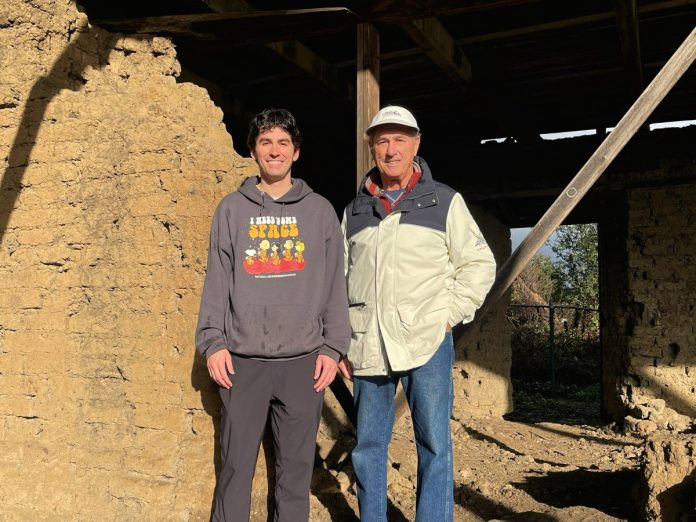
The rain was hard. The mud was thick and glutinous. It was adobe. Notwithstanding the stout rain shelter built over the ruin by Larry Carrillo and “The Friends of the Carrillo Adobe,” the house of Maria Carrillo was little by little washing away.
That main house is the last house standing of what was once the Carrillo Rancho, granted by Gen. Vallejo, military governor of Mexican California in 1837. Mark that year. Count forward to 1849 (The Gold Rush) and 1850 (statehood). Mexican California had another 13 years left in its existence.
Maria Carrillo was Gen. Vallejo’s mother-in-law. History was intimate then. The names that became our place names (like Carrillo and Vallejo, Finch and Dutton) knew each other well, and their relationships and their mistakes largely determined our present. For Larry Carrillo, this history is family history.
The Maria Carrillo Rancho once covered most of Santa Rosa as one vast property. Its ranch buildings once covered most of the 14 acre property now fenced off at 2323 Montgomery Dr. Their stone foundations extend far out into the planned high density housing development proposed by Swenson Builders (of San Jose).
That housing development would also cover the ruins of a Southern Pomo settlement (that of course predates the Mexican rancho). The site is thought to have been a seasonal settlement used by the Indigenous in part to mine obsidian for cutting tools in the Santa Rosa creek—not a hundred yards from the future adobe.
There may be Southern Pomo graves there. It’s uncertain. The preliminary archeological survey of the development site is incomplete. In another complicated intersection of local Indigenous and Mexican history, the adobe is not half a mile from the creek site where an Indigenous woman was baptized Rosa after Catholic Saint Rosa de Lima—giving name to her, the creek and the town of which the ranch was just the beginning.
Thus, the fenced and neglected property, consisting of ruined adobe, flattened Pomo village and messy Catholic orchard, is where Santa Rosa had its messy genesis. Surely then, it will be preserved as a hallowed place?
In a right world, yes. While the main house and about 20 feet surrounding it is a registered historic landmark, it sits on private land. That property was sold away by the Catholic Diocese of Santa Rosa to Swenson Builders around 2000 to pay diocese debts and settle early claims of child sexual abuse.
Swenson originally proposed a 265-unit apartment in 2004. This plan was scuttled, presumably by the housing/banking crash of 2008. A new proposal, submitted late last year, now proposes 162 units, which surround the ruined adobe on three sides (one may review the plans and process at srcity.org/4279/Creekside-Village-Townhomes).
A neighborhood meeting, organized by The City, was held Dec. 15. The venue had to be changed to accommodate all the angry comment by neighbors, historians, Pomos and latter-day Carrillos. As a strict vote, this project would not go forward. But it is private land, and The City is under great pressure to meet a state-mandated housing quota.
This is all a strange echo of the past. Indigenous California trampled and Mexican California pushed to the ruined margins in a sudden rush of new settlers. Have we learned from the past? Will history repeat itself? And will Santa Rosa, a large town with little pride, take itself seriously enough to preserve its birthplace?
Learn more: This is history in progress. Larry Carrillo of ‘Save the Carrillo Adobe’ can be reached at lj********@*sn.com. Project updates can be received from the city website.








That was then, this is now. Put up a plaque and move forward. Nobody cared about this place until a developer proposed housing we need today. No NIMBYs.
Save this property and history of California. Developers can renovate buildings that are vacant for housing. Erasing this history is not for sale!!!
Its currently a druggie haven. Fentanal meth users sellers live in there. For years its been a drug camp.
Its the first building in santa rosa ever built. Its part of history.
Fix it for carillo history!
Thank you
I grew up in Montgomery Village when it was brand new. Santa Rosa Creek was our playground. The Carrillo Adobe was just steps from our home. My brother came home from his Press Democrat paper route with a human skull and some bones from a site adjacent to the Adobe.
My parents contacted a UC Professor who went to our church, who was also a member of the Sierra Club.
I remember sitting in our living room as the UC Professor studied the skull…
After close examination he said “this was a Native American female basket weaver approximately 35 years old.”
I was amazed at his statement. I asked him how he could tell it was a basket weaver.
He showed me the rear molars on the skull had small grooves in them. (!) He said that t he basket weavers would draw the native grasses ‘sedge’ through their teeth to soften and flatten it so it would weave easier.
Clark Natkemper was the UC Professor’s Name. Somewhere in the archives of the UC is this valuable link to the earliest Santa Rosa residents- the skull of a Native American Basket Weaver, who was apparently so important that she was buried right next to the Adobe.
This property MUST BE SAVED!!
Please save the property. Any land that is still uncovered is a Blessing. Born & raised here. Thank you
I live across the street from this property. Even though housing is a big issue for our city, we should balance growth with protecting historic sites. With private money, this site can be turned into a park and learning center, informing residents and visitors or California’s complicated history. Restore the Adobe, create an interactive model of the Indigenous community — we have paved over and destroyed and erased so much of our history,–now is the time to correct mistakes of the past.
It is worth it, times 100, to preserve the landmark and essence of the original founding site of Santa Rosa. Money for the project is lacking and it brings up the question of what ever happens to the great wealth produced in Sonoma County?
It took seemingly forever to get a major concert hall ready in Rohnert Park, because the promised funds became so small in comparison to the project.
Remember what happened to the original first house from Santa Rosa that was on First Street? The promise was made to move it and save it. Ha. They moved it and allowed it to be trashed. Development often means tossing out the baby with the bathwater. The story of Saint Rose is worth keeping alive, and you know that what is discovered in the proper development of a Museum will probably astonish everybody. Petaluma and Sonoma and even Windsor have proper museums preserving the heritage. Why not Santa Rosa?
If someone does step up to make it happen, I will offer my beautiful song for the inauguration of it.
” El Rio de la Rosa, is it spring all through the year?
In the garden of Santa Rosa, right here.
And I’m happy, yes, to walk all around and see the flower as she grows.
And I love Santa Rosa’s town. El Rio de la Rose.”
Free!
Without history and historical landmarks- what and who are we, and what are we leaving for the generations?
Research your own history and see how you feel about what your ancestors left behind or didn’t. Look a a photo without a name- write their name and write your name, leave a legacy- leave a mark.