The world is held together with duct tape and denial. The oceans are warming; billionaires are trying to colonize Mars; and half the country is one Facebook notification away from losing their frickin’ minds over beef tallow and Tylenol.
Even here in Sonoma County—our pastoral bubble of redwoods and rosé—the vibe is vaguely dystopian, especially during the holidays, when that old adage about being able to choose one’s friends but not one’s family makes the crisis lines ring like the Horn of Winter.
So, as we head into Thanksgiving again, trying to muster the emotional range to feel thankful despite it all may seem positively Sisyphean. Fortunately, gratitude turns out to be one of the best legal mood-altering substances available—and it’s free. For now.
Psychologists define gratitude as a personal orientation toward noticing life’s gifts—not the sham “thoughts and prayers” kind, but the genuine micro-moments of “oh hey, things aren’t completely terrible.” Harvard Medical School reports that Harvard and UC San Diego researchers followed nearly 49,000 older women and found that those with high gratitude scores were 9% less likely to die over four years (actuarial math never felt so good). And as Tyler VanderWeele says in the same Harvard piece, anyone can practice gratitude, “even on tough days,” which in 2025 are those generally ending in “y.”
Gratitude Is Medicine
UCLA Health reviewed 70 studies involving more than 26,000 participants and found that grateful people have lower levels of depression and higher self-esteem. Gratitude also activates the parasympathetic “rest and digest” system—something capitalism has been trying to smother for decades.
Meanwhile, neuroscientists cited by PositivePsychology.com report that practicing gratitude lights up the brain’s reward network and enhances empathy. Translation: The ventral striatum gets a warm buzz every time one says “thanks.” I didn’t even know I had a ventral striatum, but I bet if said it out loud, some Harry Potter shit will happen.
Naturally, fostering gratitude is a boon to Sonoma County’s nonprofit backbone—and it works. Over at LandPaths, an environmental education and conservation organization, a program coordinator blogged that a feeling that often surfaces among volunteers is “gratitude—gratitude for the feeling of community, the opportunity to tend the land.” Ripping out invasive vegetation is far more grounding than hate-scrolling one’s frenemy’s Hamptons vacay.
Even Sonoma’s literary soul gets in on the act. The Jack London Park Partners’ 2018 Gratitude Report includes reflections from volunteers who say giving time at the park made them feel they get more than they give, and that helping others “enhances life.” Which is another way of saying: Service is self-care disguised as altruism.
And if the research from UCLA Health is right—15 minutes of gratitude practice a day, five days a week for six weeks can improve mental wellness. Positive-psychology researcher Robert Emmons reminds us that gratitude blocks toxic emotions like envy and resentment, which can moot everything from that irksome Nextdoor thread to the self-righteous cousin at Thanksgiving who embodies the “Ha” in MAHA.
Moreover, one’s expressions of gratitude need not be pious or twee. Consider these fine AI-generated suggestions:
- Spray-chalk “Thanks for not blowing up the planet (yet)” somewhere official.
- Give free vegetables away in front of McDonald’s.
- Kiss humanity goodbye.
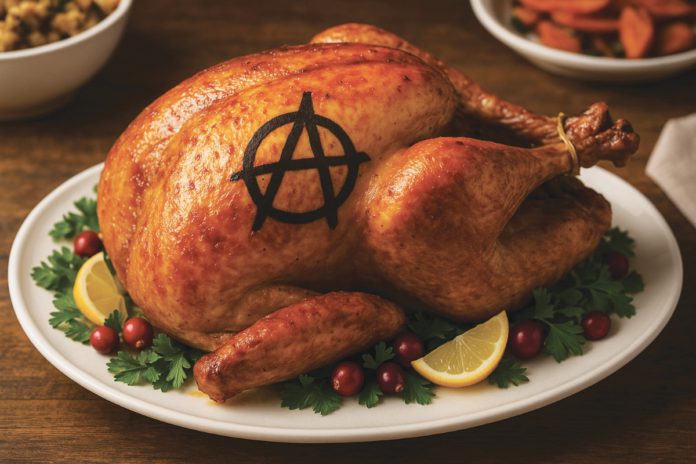
In a world engineered to keep us anxious, numb and consuming, taking a moment to be grateful might actually be the most rebellious act one can commit. It’s kinda punk (in the Superman “Maybe that’s the real punk rock” kinda way) and, in all practicality this holiday season, it might just save one’s soul. Happy Thanksgiving.