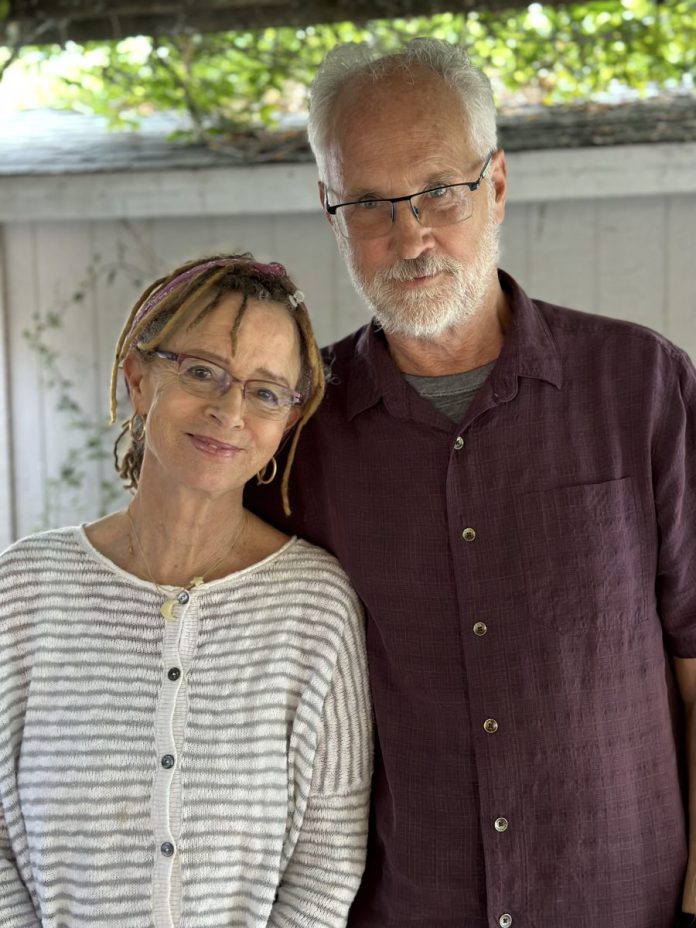
Anne Lamott and her husband, Neal Allen, aren’t just life partners; they’re now partners in their life’s work—writing.
The Marin couple recently sat in their cozy and casual living room to discuss collaborating on a new book, Good Writing: 36 Ways to Improve Your Sentences. The marriage, Lamott is happy to report, survived the process.
“I’m the straight man around here,” Allen said. “Annie has the humor gene.”
Allen, a former journalist who also had a career in corporate communications, has three books under his belt and is currently working on a novel. A New York Times bestselling author, Lamott has written more than 20 books, including novels, memoirs and Bird by Bird, another treatise on writing.
Indeed, it would be hard to find a more qualified twosome to set down writing guidelines. Lamott, 71, and Allen, 70, succeeded in keeping Good Writing lively and informative, lacing it with matrimonial banter. Note: Lamott always gets the last word.
However, the book began as Allen’s solo venture. Lamott came in as an afterthought.
“I sort of foisted myself on the project,” Lamott said.
Over the decades, Allen had collected 36 rules on improving sentences. The idea for the book came after he looked for a similar list of rules. He couldn’t find one.
“Hemingway had his four, and Elmore Leonard his 10,” Allen said. “Margaret Atwood has 10. I realized I had more.”
He also had rules that the other prose pros didn’t cover.
Rule 12: Jettison [All Those] Tiny Verbs. Rule 14: Remove the Boring Stuff (according to Lamott, the most important rule). Rule 34: Break the Rules.
In the initial draft of Good Writing, Allen said he established each rule and then “riffed” on it. After Lamott read the manuscript, she tugged on his sleeve.
“I know a little about writing myself, Bub,” Lamott told him. “What if I write a response or a meditation on each of your little essays?”
Allen liked the concept and provided the framework for each rule, setting up Lamott’s coda. The writers created an effective formula for Good Writing, giving readers a blueprint for refining sentences and sharpening writing chops.
Often they agree with each other on the rules. Sometimes they don’t. That push and pull makes reading the rule book a downright pleasure. Consider how Lamott responded in Good Writing to Allen’s take on the rule about using “Very and Other Crutch Words”:
“Neal is a stickler about the use of ‘very,’ and in the early days of our marriage, when he edited my writing and redlined all the ‘verys,’ I used to wonder what kind of rigid, puritanical killjoy I had married. But then I did a word search in the essay I was working on and discovered I had used ‘very’ seven times.”
Lamott reconsidered her position, deciding to limit the number of “verys” in her writing. It appears to be working out well.
They’ve been together for 10 years now. Allen shared the story of how they met on Our Time, a dating website.
“It’s a division of Match for decrepit old people,” Allen said. “Annie and I started exchanging emails. And at some point, I told her that I was allergic to cats, at which point she cut off all conversation.”
Subscribing to Eastern philosophies, Allen also thought he wasn’t “Jesus-y” enough for Lamott, who has belonged to a Marin City church for 41 years. Although Allen isn’t Christian, faith is an important part of his life. He’s a spiritual coach helping clients wrestle down their inner critics, and he wrote a book about the struggle, Better Days: Tame Your Inner Critic.
Despite the cat and Jesus shortcomings, six weeks later, Lamott came around again. She sent him an email.
“Apparently you don’t remember, but you already rejected me,” Allen responded.
She had forgotten.
The allergy had been a dealbreaker for Lamott, who sleeps with her cats. Given a second chance, Allen wasted no time informing her that he has a method for dealing with his sensitivity to felines. He said sprinkling a tablespoon of Brewer’s yeast on the cat’s kibble stops the pet from secreting a particular enzyme—the one that causes his allergic reaction. As an extra measure, he takes a daily anti-allergy medication.
Since their first date in 2016, the duo has spent almost every day together, only parting when one has to go out of town. In 2019, Lamott and Allen married under the redwoods at Deer Park Villa in Fairfax.
Yoko, the cat, sleeps in bed with them, and Allen feels just fine. An affectionate and energetic mixed-breed dog, Mukti—Sanskrit for liberation—also shares their space. Lamott’s son and grandson live just steps away in the guest house.
While the pair remains busy with family, individual work projects and watching Scandinavian detective shows together in the evening, they always take the time to edit each other’s writing, a serious and sometimes delicate matter.
“No matter who you are or how much you’ve written, you’re going to be sensitive with somebody else rejecting your words,” Allen said. “Honesty doesn’t have to be brutal. It can be kind and comforting.”
The “sandwich method” has proven beneficial for them. Advice about what needs to be changed is preceded and followed by praise for the writing.
Even with the gentle approach, Allen said he rejects every one of Lamott’s changes and then returns with his tail between his legs 24 hours later and accepts them all. He calls Lamott “more adult” because she adopts the changes the first time around.
“Except that I cry sometimes because my feelings are hurt,” she said.
Allen once hurried through his feedback right before a scheduled session with a client. Lamott thought her essay for The Washington Post was a strong piece, but his comments were about what didn’t work, never mentioning “the good stuff.”
“I thought, oh, the piece sucks,” Lamott said. “And I’m a total loser. And plus, I should have never gotten married, and men are pigs.”
Later, she told her spouse the critique hadn’t landed well. It turns out, Allen had loved the piece—he just forgot to say it.
“That was a lesson,” he said.
The pair remains respectful of each other’s styles. Lamott said that Allen has the structure in place from the first draft, a skill he honed as a journalist. He’ll make revisions, but the material is already there.
Characterizing herself as a quilter, Lamott’s process is much different. She’ll write nine pages and whittle them down to four.
“I have ideas for what the piece feels like to me,” Lamott said. “Then I’m putting together squares for the quilt and ribbons and string to patch it all together.”
Allen describes Lamott’s voice as “distinctive.” She says his is “more professorial.”
Clearly, the two mesh in life and work. What a very, very, very good combination.
Join Allen and Lamott for an evening on ‘Good Writing’ at7pm, Tuesday, March 17, Curran Theatre, San Francisco. For tickets, visit us.atgtickets.com.