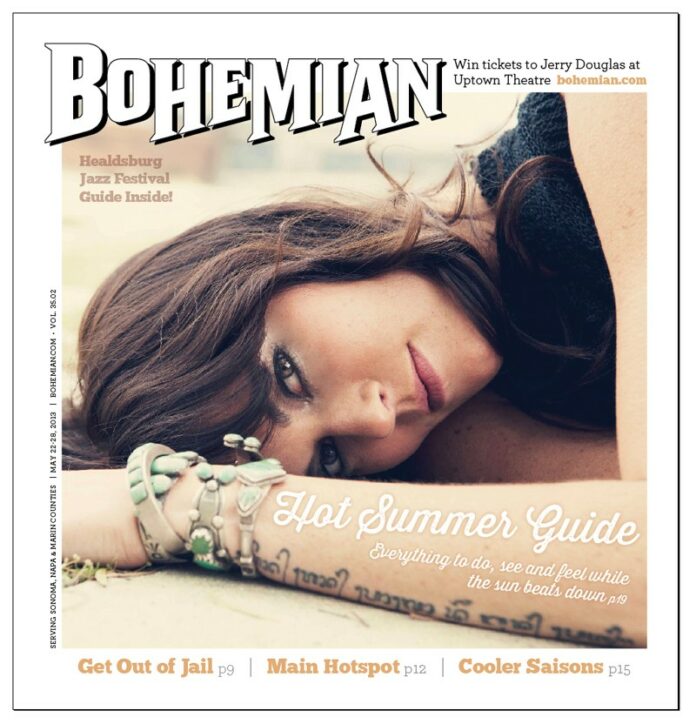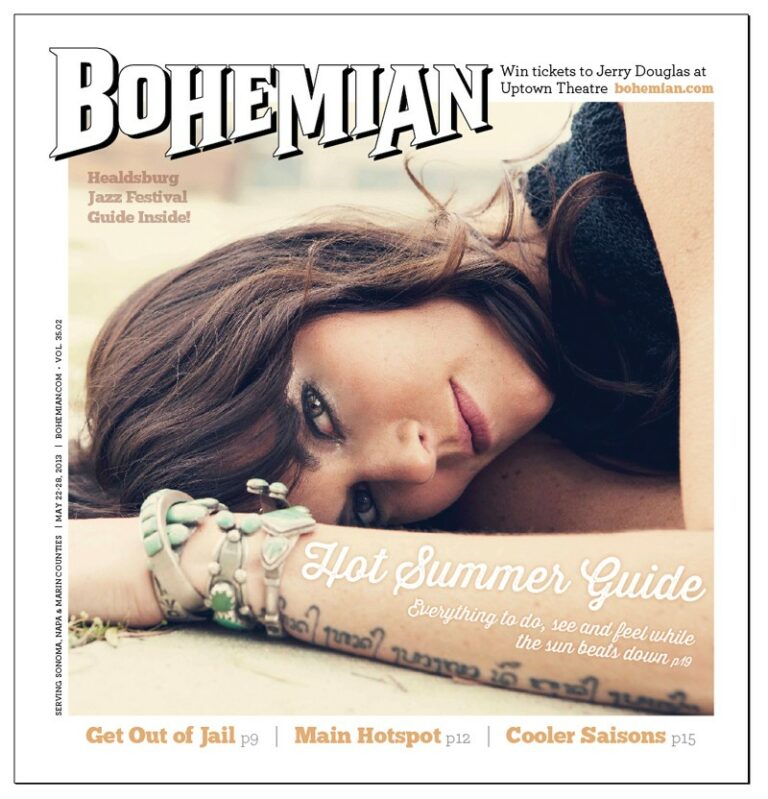
Summertime memories are best made casually—the late-night walks, the impromptu skinny-dipping sessions, the boozy kisses and the houses full of friends. But planning your summer is key also, if only to make sure you don’t miss the best that the North Bay has to offer. Here’s our selective list of ways to spend the hottest season of the year, from Memorial Day to Labor Day.
MAY
Napa Chefs’ Market It’s not all about wine in Napa—there’s food, too. At the Napa Chefs’ Market, check out two cooking demonstrations each night and enjoy the finished product. Local produce for sale, live music. Thursdays, May 16 through Aug. 1, downtown Napa. 5–9pm. Free. 707.257.0322.
Larkspur Flower & Food Fest Local gardeners bring their best flora to the 23rd annual celebration of pretty things that smell good and good things to eat. May 26 on Magnolia Avenue, downtown Larkspur. 11am–6pm. Free. 415.924.3803.
Oysterpalooza Celebrate the bivalve with New Orleans cuisine, live music and, of course, salty, sweet oysters in this sixth annual event. Music by Arann Harris and the Farm Band, the Crux, Church Marching Band, the Far West, Windy Hill Bluegrass and Supermule. Music begins at noon for the May 26 event at Rocker Oysterfellers, 14415 Hwy. 1, Valley Ford. $15, does not include food. 707.876.1983.
Healdsburg Jazz Festival Triumphantly returning for its 15th year, this not-to-be-missed, 10-day music festival delivers a straight-ahead jazz lineup of vibrant talent including Carla Bley, Charlie Haden, Ravi Coltrane, Gonzalo Rubalcaba, Geri Allen, Lee Konitz, Bill Frisell and many others. Various locations in and around Healdsburg. May 31–June 9. Prices vary per event. 707.433.4633. www.healdsburgjazzfestival.org.
Friday Night Live The small town of Cloverdale hosts this big music series in conjunction with its farmers market. Among others, it features Roy Rogers & the Delta Rhythm Kings (May 31); Tommy Castro & the Painkillers (June 21); Hot Buttered Rum (July 12); SambaDá (July 26); and Chuck Prophet & the Mission Express (Aug. 30). May 31–Aug. 30 in the Town Square, Main Street, Cloverdale. Free. www.cloverdaleartsalliance.org.
JUNE
Pride Comedy Night Sonoma County’s most popular pride event, the lesbian, gay, bisexual and transgender celebration features the riotous humor of comedian Marga Gomez on June 1. Wells Fargo Center, 50 Mark West Springs Road, Santa Rosa. 8pm. $35–$45. 707.546.3600.
Sonoma County Children’s Museum Witness the groundbreaking for this fun museum that will surely delight for several generations. June 1. 10am. Future site of Sonoma County Children’s Museum, 1835 W. Steele Lane, Santa Rosa. $5. 707.546.4069.
Beerfest: The Good One! Eat, drink and be merry to support Face to Face—Sonoma County Aids Network. With more than 50 microbreweries, this event is a who’s who of Northern California artisans. June 1, 1–5pm. 50 Mark West Springs Road, Santa Rosa. Twenty-one and over (alcohol till 4:30pm). $45. 707.546.3600. www.f2f.org.
Mateel Center Summer Arts & Music Festival The most comprehensive celebration of art and music on the North Coast kicks off with music from over 60 local bands, musicians, dance troupes, and children’s entertainers. Over 150 handmade craft and food booths, an all-media fine arts showcase, the Outrageous Kid Zone, Belly Dance Temple and more on June 1–2 at Benbow Lake State Recreation Area. $15–$25; kids free. www.mateel.org.
Marin Home & Garden Expo Exhibitors, lectures and demos showcase all things for house and yard in Marin County at this third annual expo event. Put on by the Marin Builders Association, all proceeds benefit the association’s scholarship fund. June 1–2. Marin Center Fairgrounds and Exhibit Hall, 10 Avenue of the Flags, San Rafael. 10am–5pm. $10. Free for kids 12 and under. 415.507.1537.
[page]
Forestville Youth Park The only privately owned public park in the country celebrates with plenty of barbecue, community spirit, a parade, a carnival and live music, including evening performances by the Unauthorized Rolling Stones (Saturday) and Wonderbread 5 (Sunday). June 1–2. Parade, Saturday at 10am; festival, Saturday–Sunday. 7045 Mirabel Road, Forestville. Free. www.forestvilleyouthpark.org.
Art at the Source More than 160 artists in dozens of studios throughout western Sonoma County are open to the public during two weekends, June 1–2 and 8–9. Art at the Source provides an opportunity to look behind the scenes, meet the artists and snap up some great deals. Maps can be found at www.artatthesource.org or at the Sebastopol Center for the Arts, 6780 Depot St., Sebastopol. Free. 707.829.4797.
Long Meadow Ranch Concert Series Music, wine, sunshine—what more could anyone ask for? Especially with a lineup like Matt Costa on June 2; Nicki Bluhm & the Gramblers on June 30; USAF Band of the Golden West (free) on July 5; Langhorne Slim & the Law on July 14; the Mother Hips on Aug. 25; and Sean Hayes on Sept. 15. $30–$45. 738 Main St., St. Helena. 3:30pm each day. 877.963.4555.
Peggy Sue’s All-American Cruise Four days of classic-car mania sweep up downtown Santa Rosa for the 11th annual cruise-till-you-snooze celebration. Opens with a cruise-in and performance by the Poyntlyss Sistars (June 6) at a Place to Play Park, 2375 W. Third St., Santa Rosa. Live music, cruises across Sonoma County, chili and pasta cook-offs, pancake breakfasts, contests and awards. June 6–9 at various locations in Sonoma County. $6–$80.
Film Night in the Park Another year of blockbusters and award-winning films free to audiences throughout Marin County’s community parks. Films scheduled this summer include Hugo, Skyfall, Argo, Vicky Christina Barcelona, The Princess Bride and The Birds. Bring blankets, pillows, back rests and low-seated chairs. June 7–Sept. 21. 415.272.2756. www.filmnight.org.
Novato Festival of Art, Wine & Music Two-day live music fest features crafters, food and drink and music on two stages. Highlights include Luvplanet (June 8), the Tubes (June 8), Davey Pattison (June 9) and Tom Rigney & Flambeau (June 9). Saturday–Sunday, June 8–9. Old Town Novato, on Grant between Redwood Avenue and Seventh Street. Free. 415.472.1553.
Filipino Fiesta 41st annual celebration of the Philippine Independence Day in Santa Rosa. Traditional Filipino dancers and singers provide entertainment throughout the day, and delicious food like lumpia and adobo. June 9, 11am to 4pm. Filipino Center, 3361 Fulton Road, Fulton. Free. 707.280.4842.
Huichica Festival Blitzen Trapper, Fruit Bats, Cass McCombs Band, Jonathan Wilson and others serenade locals with a broad range of styles at the scenic Gundlach Bundschu Winery for its third annual celebration. Includes a wine city, gourmet food trucks, film screenings, three performance areas and a “good times” vibe. A first-class, three-course wine dinner offered the eve of the fest. June 14–15. Gundlach Bundschu Winery, 2000 Denmark St., Sonoma. Farm to Table to Amplifier dinner, 6–10pm; 18 and over (June 14). Music Festival, noon–10pm; all ages (June 15). $18–$80. 707.938.5277.
DjangoFest The great French-Belgian-Gypsy guitarist Django Reinhardt gets a four-day blowout of fans and players presenting concerts, workshops and, yes, “djam” sessions to honor his spirit and inimitable sound. June 14–15 at the 142 Throckmorton Theatre. 142 Throckmorton Ave., Mill Valley. $35–$85. 415.383.9600.
Marin Art Festival This “lawn party for the arts” features over 250 artists by the lagoon in the Marin Civic Center in a two-day outdoor party that includes live music, fine wine and brews and a wide variety of Cajun, Greek and French fare. June 15–16, Lagoon Park, at the Marin Center, Avenue of the Flags, San Rafael. $10; kids and parking, free. 415.388.0151. www.marinartfestival.com.
Cotati Jazz Festival The “biggest little jazz festival” celebrates its 32nd anniversary with food, beer, music and every musical and nonmusical venue in downtown Cotati. Performers include Jason Bodlovich, One World Latin Band, Bautista and the Burleigh Bunch. June 16. Noon–7pm. www.cotatijazz.com.
Sonoma-Marin Fair The world’s ugliest dogs appear and a hundred tons of metal collide in the destruction derby, with carnival rides, fair food and more. Musical lineup includes the Marshall Tucker Band (June 19), Kix Brooks (June 21) and Loverboy (June 22). The Fiesta Latina buttons it up on June 23. Sonoma-Marin Fair, Petaluma Fairgrounds, two blocks west of East Washington Exit, Petaluma. June 19–23. Noon to midnight. $10-$15. sonoma-marinfair.org.
[page]
Sierra Nevada World Music Fest Slightly outside the North Bay but of avid interest to locals is this three-day roots reggae and world-music festival at Booneville’s Mendocino County Fairgrounds, running this year June 21–23. Acts include Damian Marley and Stephen Marley with Ghetto Youths Crew, Alpha Blondy, K’naan, Marcia Griffiths and many others, plus late-night dancehall. All three days, $170; limited camping available. 916.777.5550. www.snwmf.com.
Rodney Strong Concert Series The 23rd annual Summer Concert Series in the sunny grasslands behind the Rodney Strong features adult contemporary favorites and music legends. June 22, Michael McDonald; Aug. 2, BWB (Rick Braun, Kirk Whalum, Nora Brown); Aug. 4, Dwight Yoakam; Aug. 17, Dave Koz with Mindi Abair, Gerald Albright and Richard Elliot; Sept. 1, BB King. Rodney Strong Vineyards, 11455 Old Redwood Hwy., Healdsburg. $60–$115. 707.869.1595.
San Anselmo Art & Wine Festival Over 60,000 folks converge on downtown San Anselmo each year—hungry, thirsty, craft-starved folks. As usual, a section of the fest will include over 200 artists and their various works. There will also be food booths, wine, a merchant marketplace, an emphasis on live music and a kids area. June 22–23. San Anselmo Avenue between Bolinas and Tamalpais streets. 10am–6pm. 415.454.2510.
Mill Valley Wine & Gourmet Food Tasting Now in its 32nd year, this event was founded by Jim Canepa, the late owner of the Mill Valley Market, and has evolved over the years into a fest noted for its large selection of boutique wines and new food trends. Live music, too! June 23 at Depot Plaza, downtown Mill Valley. 1–4pm. 415.388.9700. www.millvalley.org.
Kate Wolf Memorial Music Festival A fantastic lineup appears at this festival’s 18th year honoring the work of late singer-songwriter Kate Wolf. Artist highlights include performances by the Brothers Comatose, Angelique Kidjo, Iris Dement, Pool Man’s Whiskey and many others. Plan to camp. June 28–30. Black Oak Ranch, Laytonville. Full festival pass, including three nights camping, is $80–$225. Daily tickets available, $40–$90. Under six, free. www.katewolfmusicfestival.com.
Broadway Under the Stars Presented each year by Transcendence Theatre Company, some of the brightest stars in Hollywood and on Broadway come to perform in the comfortable night air in Jack London State Park. June 28–30 and July 5–6, “Fly Me to the Moon”; July 19–20, “Fantastical Family Night”; Aug. 9–10, 15–17, “Dancing Through Life”; Aug. 30–31, “Gala Celebration.” Pre-show picnic at 5pm; concerts begin at 7:30pm in the outdoor winery ruins. 2400 London Ranch Road, Glen Ellen. $29–$117. 877.424.1414.
California Beer Festival The best brewers in the Golden State face off with over 70 beers on tap. There’s music by Petty Theft, Monophonics and Metalshop with a barbecue cook-off. June 29, 12:30 to 5pm. Stafford Lake, Novato Blvd., Novato. $40. www.californiabeerfestival.com.
Marin County Fair The annual Marin County Fair is back, and, as always, the music and fine art are stellar, with fireworks ending every night. Things kick off with Kingston Trio and Eddie Money (July 4). Disney Channel star, Zendaya entertains (July 5), the Wailers take the stage (July 6) and The Pointed Sisters get excited (July 7). July 3–7. Marin County Fairgrounds, adjacent to the Marin Center, Avenue of the Flags, San Rafael. $13–$15; under four, free. June 30, 12 and under, free. 415.499.6400. www.marinfair.org.
Mondavi Winery Summer Music Fest The 43rd edition of this festival includes Martina McBride (June 29); Lifehouse (July 6); Huey Lewis & the News (July 12); Bruce Hornsby & the Noisemakers (July 13); and ZZ Ward and Delta Rae (July 20); Highway 29, Oakville. Dinner available. $50–$225. 888.769.5299. www.robertmondaviwinery.com.
JULY
Fourth of July with Santa Rosa Symphony Reviving a past tradition dating back to the pre-Green Music Center days, this concert culminates in an explosive celebration of America with a choreographed fireworks display. The back of the main hall will be open for maximum awesomeness. Thursday, July 4, Green Music Center. 1801 East Cotati Ave., Rohnert Park. 7:30pm. $25–$85. 866.955.6040.
B.R. Cohn Winery Charity Car Classic Now in its fifth year, this free event with live music, an auction and raffle takes place Sunday, July 7, and features a classic-car exhibit that includes handpicked vintage, rare, sport and collectable cars. Donation proceeds benefit the Redwood Empire Food Bank of Santa Rosa. 15000 Hwy. 12 in Glen Ellen. 707.938.4064, ext. 136.
Festival del Sole An astounding success in fine music, the Festival del Sole is back for its seventh year with a flourish July 12–21. The slate includes Audra McDonald, Sarah Chang, the Russian National Orchestra, pianist Andrew von Oeyen, cellist Nina Kotova, youth ensembles, ballet, theatrics, festive meals and much more. Tickets run from $45 to $150. At various venues. www.festivaldelsole.com.
Pink Martini This retro-pop orchestra crosses genres like a Bach-themed burlesque show, but it always gets those bon-bons shaking. Back wall open to allow lawn seating. Sunday, July 14, Green Music Center. 1801, East Cotati Ave., Rohnert Park. 4pm. $25-$85. 866.955.6040.
Rivertown Revival Petaluma honors its woefully underloved waterway with art boat races, aerial acts, a deliciously mysterious “river monster” and a DIY art fair aesthetic that this year salutes an old-timey Coney Island feel. Featuring 27 bands, including the Crux, Frankie Boots, Steve Pile, Highway Poets, Hubbub Club and others. July 20, 11am to 7pm, at McNear Landing (Steamer Landing parking lot, follow the trail). $5. www.rivertownrevival.com.
[page]
Catalan Festival The fastest possible trip to Barcelona, the annual festival at Gloria Ferrer features live flamenco, sparkling wine and tastings from many Spanish-influenced eateries, cooking demonstrations, along with a festive grape stomp and traditional folklore surprises. July 20–21. Gloria Ferrer Champagne Caves, 23555 Carneros Hwy., Sonoma. $45–$55. 707.933.1931. www.gloriaferrer.com.
Sonoma County Fair Celebrating 77 years, this year’s theme is “Homespun Fun,” offering the largest themed flower show in the country and more horse racing, rodeos, destruction derbies, Farmers Day activities than you can shake a 4-H kid at. The Harvest Fair is included in this year’s county fair. Separate admission is required for Hunter Hayes (Aug. 6), Florida Georgia Line (Aug. 7), Bridgit Mendler (Aug. 8) and Intocable (Aug. 9). Fair runs July 25-Aug. 12. 1375 Bennett Valley Road, Santa Rosa. www.sonomacountyfair.com.
KWMR Eighth Annual Far West Fest Voted best music festival in Marin County, this annual green festival boasts three stages with several genres including funk, blues, country, rock and experimental. Bands include Zigaboo Modeliste & the New Aahkesstra, John Doe, Lebo and friends, Beso Negro and others. July 27, 11am–7pm. Love Field, 11191 Sir Francis Drake Blvd., Point Reyes Station. $25–$75. www.farwestfest.org.
Fifteenth Annual San Rafael Twilight Criterium Downtown San Rafael is transformed into a bike racetrack as pros take over the main downtown streets. Look for an expo on Fourth Street and plenty of kids’ stuff. July 27. www.srtwilight.com.
AUGUST
Reggae on the River Annual festival features Julian Marley & the Uprising Band, Morgan Heritage, Tarrus Riley & Black Soil, J Boog & Hot Rain, Natural Black and many others. Aug. 1–4 at French’s Camp, Highway 101, Piercy. $190 (three-day) to $250 (four-day) 707.923.3368. www.reggaeontheriver.com.
Petaluma Music Festival Besides hosting a ton of great bands, this festival raises money for music programs in schools. Acts on the three stages include: Xavier Rudd, Sean Hayes, the Pimps of Joytime, the Soul Rebels, Stroke 9, the Brothers Comatose, the Easy Leaves, David Luning, Dgiin, the Incubators, Victoria George and the Grain. Aug. 3 at noon. Sonoma Marin Fairgrounds, 175 Fairgrounds Drive, Petaluma. $15-$30. petalumamusicfestival.org.
San Rafael Food & Wine Festival The Falkirk Cultural Center hosts the fifth annual San Rafael Food and Wine Festival with 25 regional wineries, local brew folks and plenty of food purveyors. What would wine be without art and music? Plan for Aug. 10 at the Falkirk Cultural Center, 1408 Mission Ave., San Rafael. $25, all-day food and winetasting. 800.310.6563.
Patti LaBelle The soul diva makes her Santa Rosa debut, four-octave voice included. See “Lady Marmalade” take the stage Aug. 16 at the Wells Fargo Center for the Arts. 50 Mark West Springs Road, Santa Rosa. 8pm. $79–$119. 707.546.3600.
Solfest The Hopland solar-power hootenanny is back with workshops, music and speakers. Solar Living Center, Aug. 17. 10am. 13771 S. Hwy. 101, Hopland. 707.472.2450.
Napa Valley Art Festival Sixth annual juried art exhibit and sale features several representational artists from around the country. Sip Napa Valley wines and taste other delicacies while listening to live music. Aug. 17 at the Yountville Community Center, 6516 Washington St., Yountville. 707.256.3828. www.napavalleyartfestival.com.
Grape to Glass Pre-Harvest Party The Russian River Valley celebrates its 18th annual wine gala with more than 50 wineries, restaurants and food purveyors, a silent auction, a barbecue dinner and fresh, warm Gravenstein apple pie for dessert. Aug. 17 at Richard’s Grove and Saralee’s Vineyard, 3575 Slusser Road, Windsor. 4pm. $85. 707.521.2534.
Cotati Accordion Festival Use an accordion—go to Cotati! This year marks the 22nd festival of keys and bellows. Italy’s jazz accordion legend, Renzo Ruggieri, comes to the festival to play his squeezebox, as do Andre Thierry & Zydeco Magic, the Mad Maggies, Jet Black Pearl, The Internationals and many others. Aug. 18–19. La Plaza Park, Cotati. $15–$25; under 15, free. 707.664.0444. www.cotatifest.com.
Randy Travis Country music’s distinctive baritone touches even the coldest of hearts. Aug. 21 at the Wells Fargo Center for the Arts. 50 Mark West Springs Road, Santa Rosa. 8pm. $45–$59. 707.546.3600.
Goat Rodeo Sessions Yo-Yo Ma returns to Rohnert Park, but this time he trades the suit for a straw hat. This bluegrass-classical ensemble features fiddle, bass, mandolin, vocals and, of course, cello. Back wall open for lawn seating. Aug. 23. Green Music Center. 1801, East Cotati Ave., Rohnert Park. 7:30pm. $25–$100. 866.955.6040.
Seafood Art & Wine Festival Bodega Bay celebrates for the 19th time with seafood and music. Benefits Stewards of the Coasts and Redwoods and the Bodega Volunteer Fire Department. Aug. 24–25. 16855 Bodega Hwy., just east of the town of Bodega. $8–$15; under 12, free. No dogs this year. 707.824.8717. www.winecountryfestivals.com.
Chris Botti This jazz trumpeter has 12 solo albums, including collaborations with Andrea Bocelli, Paul Simon and Sting. His pop instrumental style has garnered him huge success. Back wall open for lawn seating. Aug. 25 at the Green Music Center. 1801 East Cotati Ave., Rohnert Park. 4pm. $25–$85. 866.955.6040.
Sonoma Wine Country Weekend Three-day foodie love fest, Aug. 30–Sep. 1, features the 34th annual celebration starting with the Sonoma Starlight Supper Club (Aug. 30) at the Francis Ford Coppola Winery followed by various winery lunches and dinners (Aug. 31–Sep. 1) and the Sonoma Valley Wine Auction (Sept. 1). www.sonomawinecountryweekend.com.