I spend my days and years haunted by the past; whether my own or someone else’s makes little difference. My father’s intense love for Old San Francisco imprinted itself upon me at a young age, and to this day I wistfully recall a Depression-era city of drunken Swedes and striking longshoremen that I never actually experienced.
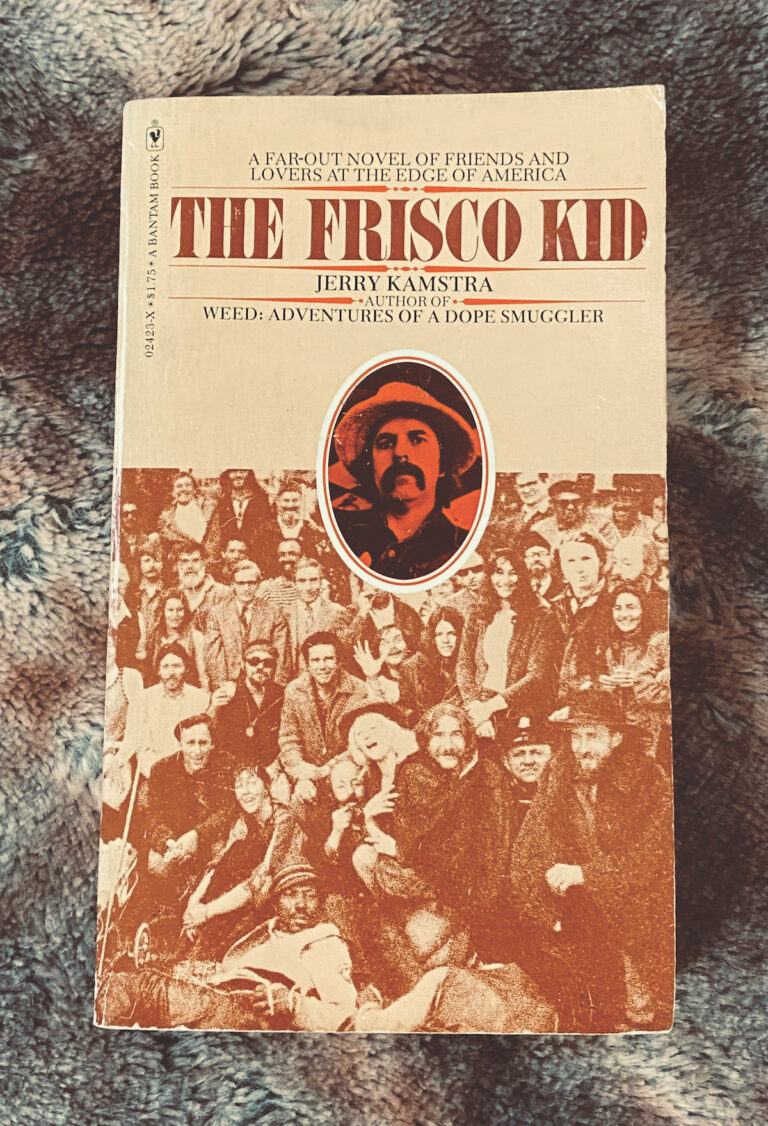
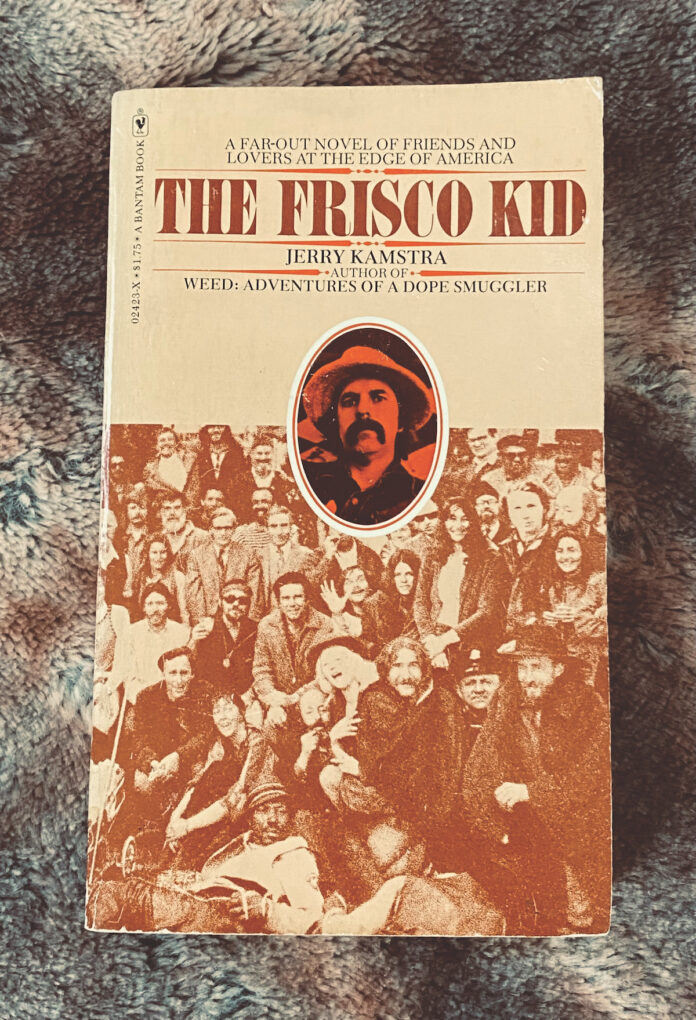
Twenty five years ago, while living in San Francisco and attending a class taught by poet Diane di Prima, I happened upon a Beat anthology which contained a bittersweet morsel from a book called The Frisco Kid, by Jerry Kamstra. My curiosity peaked, I did some research and tracked down a copy, and the book—a raw, poetic reminiscence of Kamstra’s time spent among the Beatniks of San Francisco’s 1950s-era North Beach—proved to be the most beautiful and heart-rending book I’ve ever read. Four copies now sit on my bookshelf, along with a copy of Kamstra’s Weed: Adventures of a Dope Smuggler.
So taken with The Frisco Kid was I, that a few years later I left a message in a Beat-related chat room inquiring as to whether anyone knew what had become of Kamstra. I received a response from a man who told me that Kamstra lived in Santa Cruz. He also related a story that was as haunting as Kamstra’s own memoir: His mother, an up-and-coming singer in San Francisco’s underground countercultural cafe scene, had overdosed in a hotel room in La Paz, Baja California, in the mid-1960s, leaving him, a toddler, alone with her body until they were discovered. His father, a renowned San Francisco Beat painter named Michael McCracken, had died tragically and in obscurity in a London hospital not long after, leaving him orphaned. Both his parents had known Kamstra.
Kamstra himself outlived his North Beach colleagues by over 50 years; he died in 2019. Through his obituary I was finally able to learn his entire life story, which, unsurprisingly, was far more interesting than I could have imagined. Knowledge was never so bittersweet.
The Beatniks are all but gone now. Only their literature remains, and much of that is lost in the dustbin of history. I was fortunate to know one Beat writer in person—Diane di Prima. During the year and a half I spent under her tutelage, I learned to fine-tune my own writing to an uncanny degree and to embark upon magical journeys through my imagination. It was during one such inner journey that I met an iteration of another of my Beat literary icons: the ghost of William S. Burroughs. But that is a story for another time.
Mark Fernquest lives and works in Northern California. He imagines he is a writer.
The New Year’s Baby is a tradition that goes all the way back to ancient Egypt, though many of us probably associate it with more recent iterations, such as JC Leyendecker’s vintage covers for the Saturday Evening Post stacked at the antiques store alongside plaster busts of Dionysus, who was symbolically reborn on Jan. 1, bringing fertility for the year ahead.
While hailing Dionysus and philosophizing with a hammer, Nietzsche said that in order to be a creator one must first be a destroyer. And so, armed with New Year’s resolutions and determination to bring forth our stronger and wiser selves, let’s look at what is meant by “ego death,” a common term in spiritual circles.
The process of awakening follows a familiar pattern. We find ourselves in a crisis for which our conventional personality cannot find a solution, because it does not operate in four dimensions. But in this dark night of the soul a glimmer of light appears, the divine spark greater than the troubled ego.
We can experience this in a Pure Consciousness Event, typically triggered by a really bad day with much weeping. When the suffering ego exhausts itself, a rainbow appears through the tears. Staring at the ceiling, or with one’s face buried in a pillow, we suddenly realize we’re alert, wide awake even, but at a level beyond name and form. What happened to that miserable person we were just a few minutes ago? We have now passed through the first gate, and possess an entirely new perspective on what is meant by the word “me.”
In Christianity, this process is called making room for God, while Hinduism might say it’s the realization of the unity of atman, or soul, and braman, or spirit. Alchemists would call it the Great Work, astrologers the realization of the natal chart and Jungian psychologists the relocation of the center of gravity in the personality from the ego to the Self, which includes the shadow and contrasexual dimension, which is called the anima for males and the animus for females.
Bidding farewell to one’s outgrown ego is less an event and more a process. It is a long journey, filled with growing pains and confusion. Consciousness must come to know that many more things comprise the personality than previously imagined, including a flaming energy source at the heart that one intuitively feels comes from somewhere else.
We’ll examine more of the rebirth process in this column throughout January, as we valiantly vow to have a Happy New Year, no matter what life sends our way.
Since the state announced plans to close the Sonoma Developmental Center several years ago, the potential of the sprawling property has captured the imaginations of Sonoma County residents.
The 900-acre plot of land near Glen Ellen is seen by many as a rare opportunity to address worsening problems—among them, a lack of affordable housing in the midst of a worsening climate crisis and soaring inequality.
That’s not to say the SDC is an entirely blank slate. It has plenty of history—good and bad.
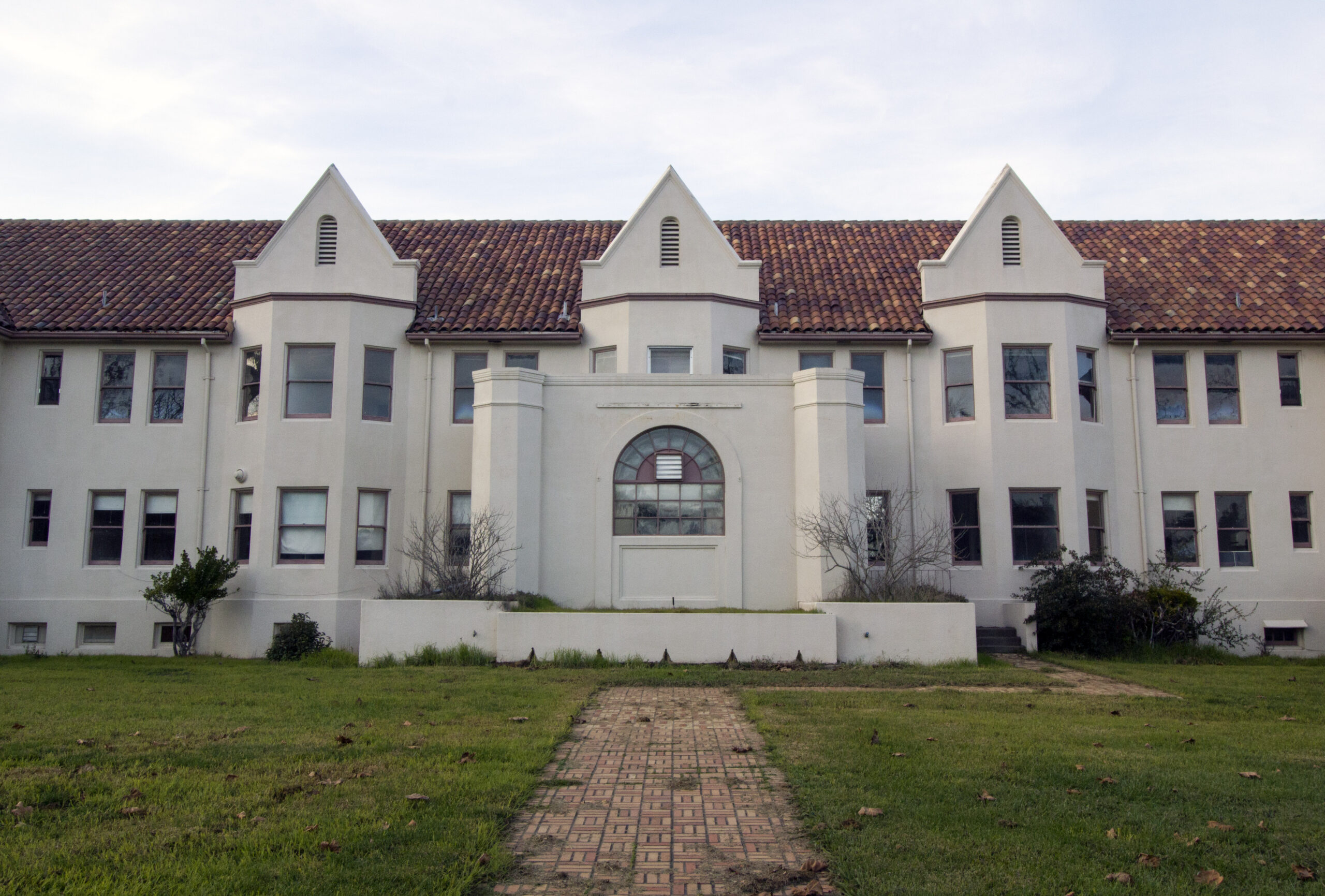
Nestled between the Sonoma Valley Regional Park and Jack London State Historic Park, the center of the property is populated with buildings spanning the past century-plus.
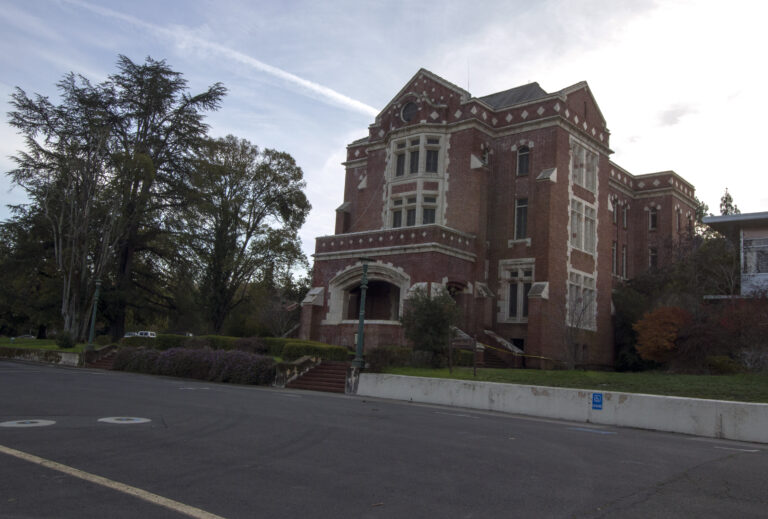
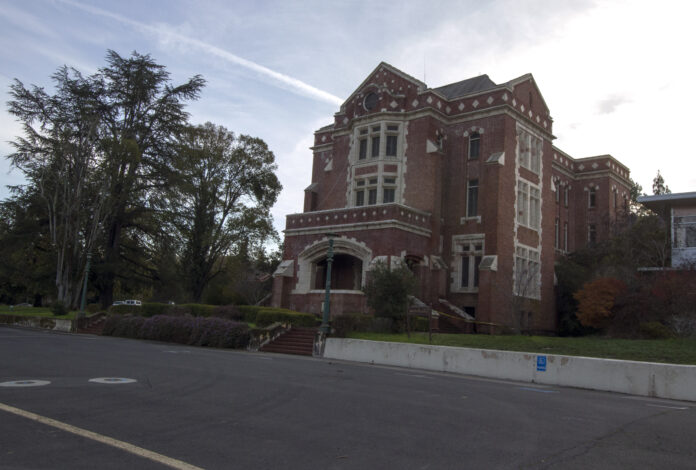
The brick-clad “Main Building,” constructed in 1908 after its predecessor was damaged in the 1906 earthquake, stands at the end of a long drive dotted with pollarded trees and flanked by a variety of vacant buildings.
The SDC was one of numerous state-run “developmental centers” sprinkled throughout California. For decades, the campus served as a medical and residential center for people with mental illness and various medical conditions. At the height of its use, the SDC was the county’s largest employer and housed thousands of residents, who were offered job training and access to farms and orchards.
However, the track record wasn’t all positive.
“Between 1909 and 1952, [a] total of 5,530 men and women were involuntarily sterilized at Sonoma State Home, more than at any other state hospital or at any single facility in the nation,” says the SDC planning website. The practice was legal in California until 1979.
On a late-December weekend tour, the campus was deserted except for a few dog walkers wandering the grounds, some of whom headed off to explore the hills above the main campus.
In 2015, the state announced plans to close the developmental center. It was officially closed in late 2018 after all residents were relocated. Now, the state wants to sell the now-surplus land.
The state has paid to maintain the buildings, but most of them are no longer used.
To residents of the surrounding areas—and, presumably, real estate developers—the next chapter in the history of the SDC represents enormous potential. In an age of great systemic problems, the SDC looks like a relatively blank slate which could be used to address some local societal problems.
However, the vision considered by planners has been limited since 2019 when the state legislature passed a bill defining the process to plan the future use of the SDC. Although the property is state-owned, as a form of courtesy, the state would collaborate with Sonoma County on a plan.
Per the state law, the plan needs to include market rate and affordable housing; preserve open space around the 180-acre developed core; and, likely the most unpopular restriction, be mindful of the “economic feasibility of [a] future development.” In other words, the state wants to sell the property to a private party and the plan should allow the future owner to make money.
The baked-in costs of redeveloping the SDC make the last requirement a significant constraint on any possible plan. All told, the cost of tearing down buildings and remediating the property is expected to cost the future owner $100 million or more. As a result, if the new owner intends to profit on the project, they’ll want to build as many market rate—read: expensive—units and commercial buildings as possible.
The three alternatives released in November call for between 990 and 1,290 units of housing, 75% of which would be market rate. Almost immediately, the proposals were met with frustration and calls for a “4th alternative.” One common concern is that the total number of housing units is too high and the portion of affordable units is too low.
According to the latest Regional Housing Needs Assessment released by the Bay Area planning agency last month, Sonoma County needs to construct 3,881 affordable housing units in the unincorporated county for people making less than a Moderate Income between 2023 and 2031. A Moderate Income in Sonoma County is currently defined as less than $123,950 for a family of four. Of the total required, 1,036 units need to serve extremely low-income residents, currently defined as a family of four that makes less than $34,900 per year.
Facing that massive need for affordable housing, it might be tempting to build as many new units on the property as possible. However, many have concerns about evacuating a large number of residents from the property along Highway 12 during a fire, and about the long-term transportation and climate impacts of building a significant housing development far from any existing city.
On Tuesday, Jan. 25, the Sonoma County Board of Supervisors will consider the three proposals on the table. It remains unclear whether the Supervisors will push for a fourth alternative.
The Bohemian took a tour of the property in December with two of the many people following the SDC planning process.
Bonnie Brown, a Sonoma Valley resident, advocates for reusing as many of the existing buildings on the property as possible. Brown argues that this approach would save a developer money and be more environmentally-friendly, since construction is a carbon-intensive process.
Tracy Salcedo, the Bohemian’s second tour guide, prioritizes maintaining the open space surrounding the SDC’s core. The author of numerous hiking guides, Salcedo sees the potential of having hundreds of additional acres of open space in addition to the nearby Jack London State Park.
“What I do see personally as being important, and I think will always be important, is preservation of the open space, because there has not been a time in human history when it hasn’t been important for us to be able to access wildlands for us to make that connection,” Salcedo said.
Ultimately, Salcedo, who has written about the SDC planning process for publications including the Kenwood Press, sees the process as a balancing act. Different advocates are excited by different aspects of the property today, and the needs of future generations are always in flux.
The trick will be for the numerous groups to come together around a shared vision, a process Salcedo already sees happening. Whether they can break free of the financial constraints set by the 2019 state law is another question.
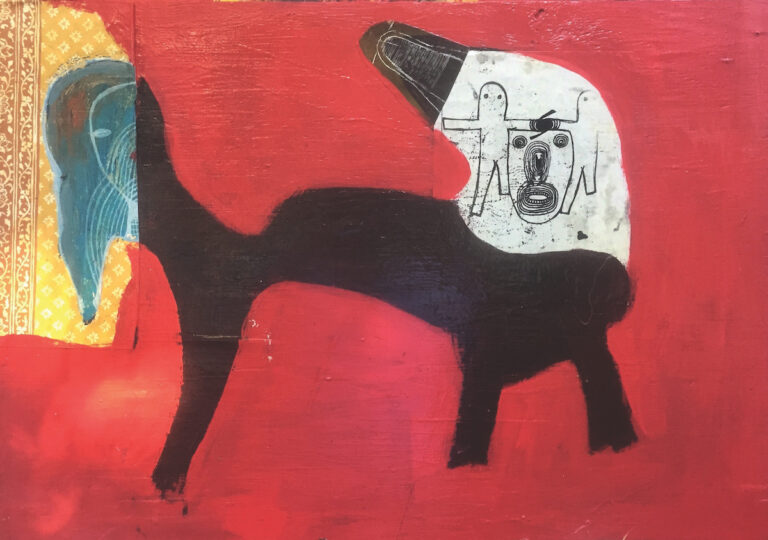
Art Moura—refreshingly—doesn’t have a significant online presence. I pieced my knowledge of him together through different articles and time spent with images of his work.
Moura’s story is interesting—he’s traveled extensively in Spain, worked as an electrician and—until its demise in a 2018 demolition derby—drove a Volvo 740 Station Wagon covered in doll’s heads, painted figures and mannequin legs. Growing up in Santa Rosa, I saw this car many times.
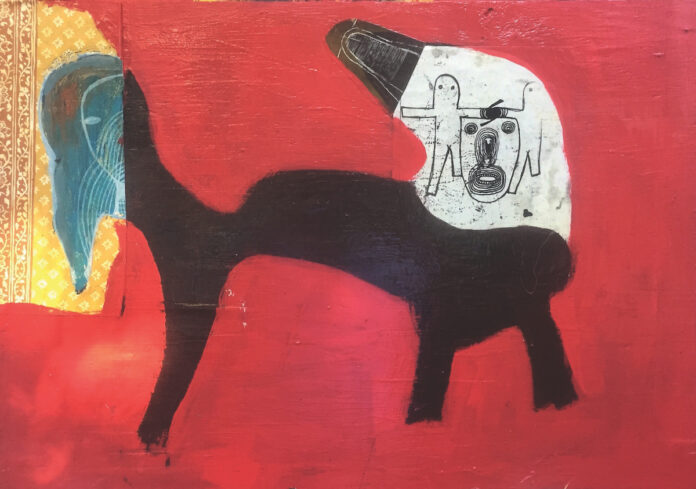
Among other things, Moura creates dolls—I would call them creatures—out of found objects such as fabric, paper and wire. Looking at them is intense. I spent a while with the images I found from Moura’s exhibition with the Good Luck Gallery in Los Angeles in 2015 and came away feeling slightly haunted, as though his gaze was on me.
In explaining his process, Moura says that a piece isn’t complete until it has a soul. In an interview at the 2015 Good Luck Gallery exhibition opening, Julian Stern wrote, “Moura explains that, though he doesn’t believe his pieces to truly have souls, he imagines them vividly and personifies them. Each of them has what he describes as a rascally, slightly wounded personality.”
I don’t believe that Moura doubts his pieces truly have souls—I think he knows they do. Something truly magnificent about the motivation to create art is its root in the experience of inspiration, in its etymological sense, from the Latin inspirare, meaning “to breathe life into.”
For the creator or artist, the experience of inspiration is a transfer of vital force from an internal to an external manifestation, a.k.a. the imparting or producing of a soul. It is what separates bad art from good art, and here the word bad could be substituted with dead, or sterile. “Bad” art meaning lifeless art, lacking that pulse of vitality that animates “good” art, or simply, art that is alive. This is how the artist knows their work is real, even if it stares back at them mockingly or with the X-ray vision one’s art can sometimes have when it takes shape outside of their own consciousness.
This is an alchemical process, taking rags and wire, or paint and canvas, and creating something vital from them. No, the creature does not take literal breaths, does not independently reach its hand out or stand up on its own, but it is undeniably alive, animate with the inspiration by which it was conceived.
This imparting of soul is what makes Moura’s work such a reactive pleasure to experience.
His latest exhibition is on view at the Hammerfriar Gallery in Healdsburg. The video his daughter, Aja DeWolf Moura—an exceptional artist in her own right—made of his creative process is also on view for the length of the exhibition, as well as on her website at ajadewolfmoura.com.
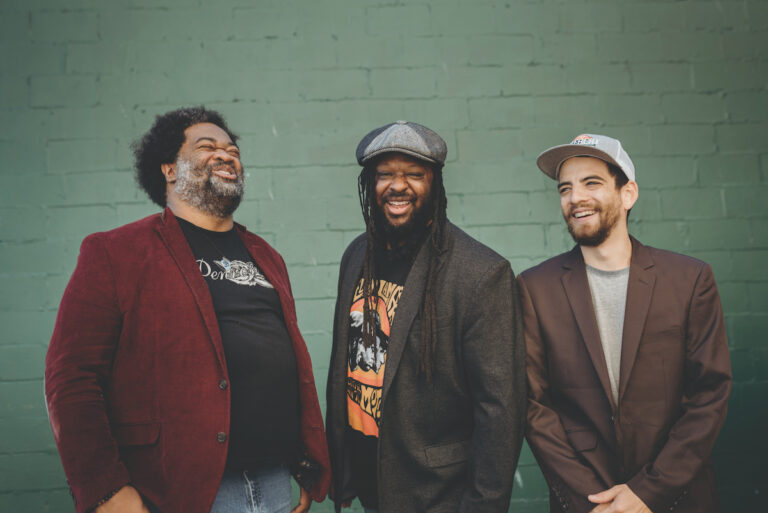
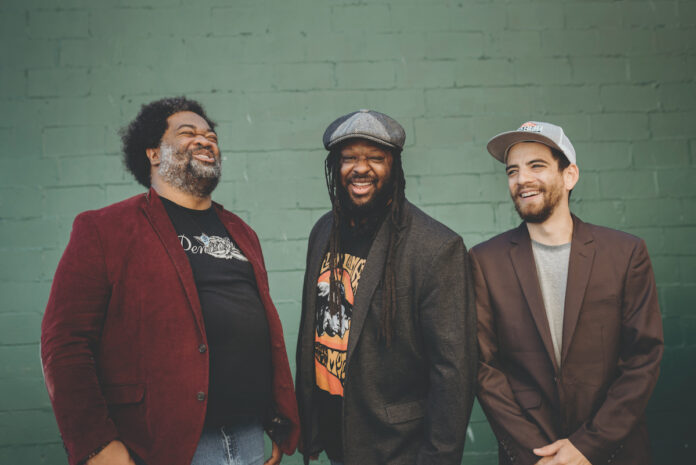
North Bay-native Mo Mandel is a comedian and actor who’s been seen on TV shows including Conan, Chelsea Lately and 2 Broke Girls. This week, he’ll be onstage, delivering standup at two shows. First, Mandel gets funny at a show hosted by Barrel Proof Comedy on Thursday, Dec. 30, at Sally Tomatoes (1100 Valley House Dr., Rohnert Park. 7pm. $15–$45. barrelproofcomedy.com). Then, Mandel headlines the annual “Best of the San Francisco Stand-Up Comedy Competition” showcase on Friday, Dec. 31, at Marin Center (10 Avenue of the Flags, San Rafael. 9pm. $25–$58. marincenter.org). Covid mandates apply.
North Bay
Walk It Off
One popular way to welcome in the new year is with a First Day Hike at one of the North Bay’s parks. These hikes include a New Year’s Day Hike of Mount St. Helena, in Napa Valley, on Saturday, Jan. 1 at 9am (napaoutdoors.org). Additional hikes are offered at Jack London State Park (jacklondonpark.com) and Sugarloaf Ridge State Park (sugarloafpark.org) in Sonoma Valley, both on Jan. 1 at 10am. The Stewards of the Coast & Redwoods leads four walks among the Armstrong Redwoods on Jan. 1, 10am to 1pm (stewardscr.org). Friends of Mt. Tam offers a hike of Mount Tamalpais State Park on Sunday, Jan. 2, at 9am (friendsofmttam.org). Covid mandates apply.
Healdsburg
New Year Jazz
Featuring the region’s best players performing an eclectic mix of jazz with diverse influences, Hotel Healdsburg’s Jazz Music Series rolls into 2022 with an intimate concert outdoors at the Fireside Lounge at the hotel’s Spirit Bar on New Year’s Day. Curated by local arts ambassadors Healdsburg Jazz, the weekly series presents a performance by the Neil Fontano Trio; fronted by pianist Neil Fontano and including Trevor Kinsel on bass and Ian Scherer on guitar. The trio plays a blend of jazz and Harlem swing on Saturday, Jan. 1, at 25 Matheson St., Healdsburg. 5pm. Free. healdsburgjazz.org/hotelhealdsburg.com. Covid mandates apply.
Napa
Grand Return
After a 22-month hiatus due to the pandemic, Napa’s acclaimed Jarvis Conservatory relaunches the monthly concert series, “It’s a Grand Night for Singing,” with a concert on New Year’s Day. The longest-running show in the Napa Valley returns to the conservatory’s jewel box theater for it’s 25th season, which will also see the musical torch passing from longtime host Richard Evans to newly-named Resident Music Director Frank Johnson. Hear popular Bay Area vocalists and up-and-coming talent at the monthly singing series, opening on Saturday, Jan. 1, at 1711 Main St., Napa. 7pm. $20. Jarvisconservatory.com. Covid mandates apply.
Matt Metzler’s letter (“Historical Accuracy,” Letters to the Editor, Dec. 22) about naive exhibits at Mission Sonoma State Park, like much recent scholarship, attempts to blame genocide upon the Spanish Viceroyalty and Mexican, Catholic missions.
However the cultural violence of Christianity affected the Native Californians, a firm study of the well-researched life of Chief Marin shows the missions as both a refuge from settler violence and an education in adapting to new technologies such as steel, firearms, the written language and horses. Spanish-era documents show a self-criticism of their failings, and renewed legal rights—such as voting and owning property—for the Indians. Chief Marin was an elected alcalde in both Mission Dolores and Mission San Rafael Arcangel.
All of these rights were removed by the new State of California, in 18 of the 24 paragraphs of the 1850 State of the State address to the California legislature by our first governor. These paragraphs deal solely with the need to make a war of complete annihilation against the Native Californians.
Therefore, we have to look at the actual intentional attempted genocide, by American settlers of the Golden State, with government bounties, and not fall into the trope of “Black Legend” anti-Catholic scapegoating.
Neil Hammari
Marin City
DEPARTMENT OF CORRECTIONS: Last week’s Bohemian/Pacific Sun news article (“Mouse Management,” Dec. 22) incorrectly stated that the approved plan includes dropping 2,880 pounds of poison on the Farallon Islands. That figure should have referred to the weight of the poison-laced pellets, not pure poison.
In addition, last week’s feature story (“Countdown to the Countdown,” Dec. 22) about New Year’s Eve events failed to emphasize that all in-person gatherings will follow Covid-related safety and health protocols, including requiring proof of vaccination or negative Covid tests, and requiring face coverings indoors.
I thought for a while about this week’s “Look.” With 2022 around the corner bringing us to two full years of overt strange, and last week devoted to sequins and metallics to keep spirits shining, this one needed something extra.
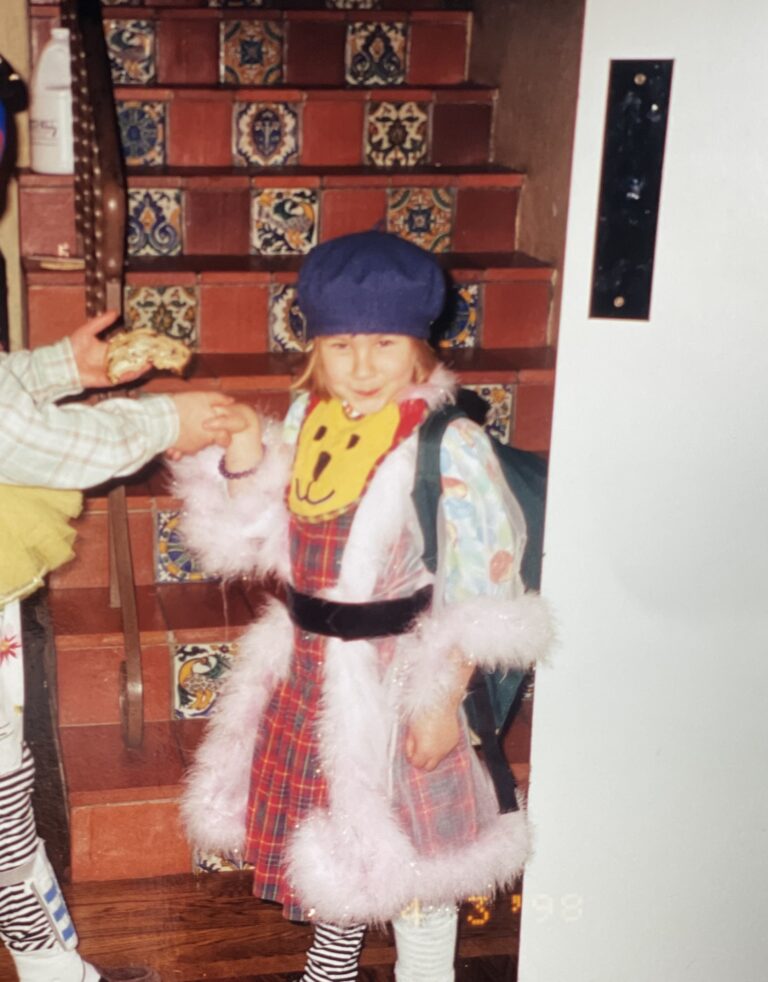
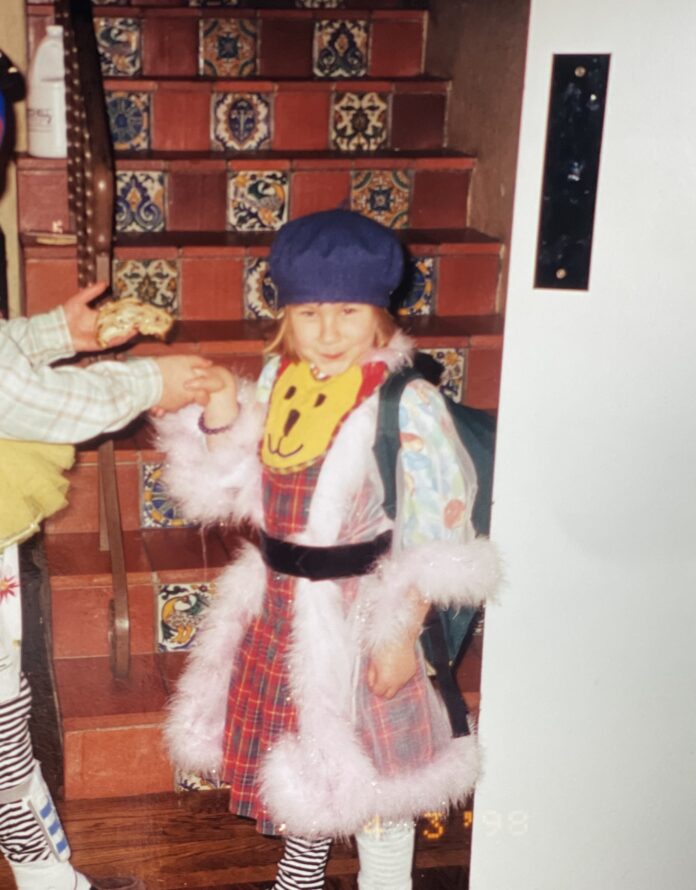
I sat contemplating fashion for a while, and the image flashed into my mind of me as a little girl, wearing a long, pearl-colored slip on my head.
As a little girl I had a rebellious relationship with scissors—resulting in generally very short hair and precarious bangs. I also had a deep love of dressing up and a sense that glamour and long hair were deeply associated. There was a mood, a character, I felt I couldn’t really access without a mane of hair to gracefully draw over one shoulder and stroke.
I found a solution in my mother’s slips, which more often than not went unused—the late ’90s rendered the slip largely irrelevant, except to young children playing dress up. I would wrap and secure the elastic waistline around my head, letting the fabric hang down my back, or else if I was going for casual chic, I would secure it in a scrunchie.
Dress up was a huge part of my childhood—not long after my slip-wearing, hair-cutting days ended I began to experiment with shirt-cropping, fringe-cutting, power-clashing and so on. There was a year in middle school where I recall going to Six Flags with upwards of 16 rings on my fingers, all of which had to be removed when I went through security.
My childhood fashion sense—free, curious and inimitable—was influenced by movies like Auntie Mame and pictures of Greek gods and goddesses. I was fearless in my experimentation and proud of my combinations.
Now, as an adult woman who studies fashion from an artistic and an anthropological standpoint, I find incredible benefit in returning to the mindframe of that fearless, creative little girl in her mother’s slip. It reinforces my sense of courage in creativity without boundaries.
As 2022’s sun rises in the sky and a new year breaks, I look back on those first few hilarious outfits and take inspiration from the open-minded, free-thinking dresser I once was. Now is a time when creativity without boundaries is needed, in fashion and in everyday life. This is a great moment to let the inner kid offer some refreshing direction.
To this end, I’m calling on all the fashion heads out there who started early. From Wednesday Dec. 29 through Wednesday Jan. 5 post your wildest childhood fashion photos to your instagram story, tagging @pacificsunweekly or @northbaybohemian and using #firstlook. We will feature you on our socials, and the winner will get a special shout out in next week’s “Look.”
Looking good, everyone.
Love,
Jane Jane Vick is a painter, writer and journalist who has spent time in Europe, New York and New Mexico. She is currently based in Sonoma County. View her work at janevick.com.
Remember playing this childhood game with friends?
A small group of boys and girls would get together and designate one person as IT—and then scatter to see how long they could avoid being tagged—but once caught it would be their turn to be IT. As a child, there was much joy and laughter involved in the activity. It was also a game that was discarded for more interesting challenges.
The boys and girls from both sides of the aisles in Congress seem to have rekindled the flames of this game … calling out the opposition party, as well as specific members on each side … to be IT. It has become an underlying tactic of calling out and attacking when disagreements occur in seeking solutions to critical questions that face our nation.
This continued childish behavior, by “adults,” has resulted in yet another supply chain issue—not from lack of goods or employment—but of goodwill and compromise. It has created a stagnation and build-up of toxins that continues to erode the foundations of trust in our basic institutions of governance and towards each other. It is trickling down and poisoning the psychic soils of both our urban and rural populations. The result will be a bitter harvest of anger and blame—everyone will be IT. If we cannot learn that we all must sacrifice, then this game is really over and the clock—truly—has run out!
Maybe, those “enlightened leaders” we have elected to serve at the will of the people should end this game now. After all, even the children knew when the game was over and it was time to move on.
Perhaps we can suggest to those “so-called statesmen and women,” another game—one that might be more challenging, for their young minds, based on common sense and logic—and not emotion—to solve the crimes that are being committed against the nation. Hey boys and girls … how about a fun game of Clue?
These internal emails between “Bohemian” and “Pacific Sun” Editor Daedalus Howell and copy editor and writer Mark Fernquest were obtained through a Freedom of Information Act request. They are presented here, including redactions purportedly made in the interest of national security, in their entirety. We present them here in the interest of fostering a transparent and open news-gathering process.
Hey, Mark—I need a Gen X gut check here. As the elders of the editorial team we have undoubtedly accrued the knowledge necessary to know whether or not something is going to fly over the heads of our readers, right? First off, as you know, I never aim that high—so why is it that every time I attempt to publish a column with a John Hughes film reference—“Breakfast Clubbing: The Up-All-Night Guide to Dining and Dashing in the Early AM” or “Daedalus Howell’s Day Off: In Which Our Hero Ditches Work, Lip Syncs the Beatles and Gets Up Close and Personal With a Seurat Before Trashing a Classic Car,” you “copy edit” the headline to a truncated shadow of my original? “Scone Zone?” That has none of the David Foster Wallace-ian zeal of my original breakfast piece headline. “Work From Home” completely misses the point of my eponymous day off. What’s the deal man? Is [REDACTED] once again threatened by my genius? Please inform. —Your Editor.
My Good Man—Proud ’68er here, as you know, wot. First lesson of the trade: Less is more. Less is always more. But also, regarding my continued egregious butchery of your insufferably gregarious headlines: We’re appealing to a multigenerational readership at this establishment, lad, not just our personal flocks of doddering groupies. Bridging the gap between “I love your sardonic sense of literary humor, you big, barrel-chested bucket of dry laughs!” and “ROFL,” as it were. I’ve been granted full command to wield the sword of grammatical propriety at this papyrus-printing enterprise, and wield it like the Grim Reaper I shall. The key word is “readership,” old chap. Because readership = gold. Think: pieces of 8. We must. Maintain. Readership. And yet, with regards to [REDACTED]: your fear is so very real and poignant—grounded, as it were, in insufferably correct observation. In truth I’m quite verbose myself, as you well know, and if I’d my way I’d let the written words run away like wild horses over the hills—but there is a sound at my door, and I must take my leave immejiately, wot. I will continue to work “remotely” until the situation with [REDACTED] er … “resolves.” I will flee now, but remember: Less is more. Less is always more. —Your inimitable underling, Lord Fernquorcestershire
In his poem, “Correspondences,” Charles Baudelaire invokes the great mystery, likening our earthly dream-life to the experience of walking through a forest composed of symbols.
Everything is linked by analogy to a higher realm of laws and principles, and those who hold the key tread their terrestrial path in an exalted state of serendipity and synchronicity, with nothing taken at face value. The material world is merely the realm of effects; causes come from above, from the mysterious forces, always in motion, circling with the wheel in the sky. What’s more, our experience of physical life is determined by the subtle flow of cosmic energies and whether they are blocked or flow freely.
Since the beginning, when order was formed from chaos, mankind has used symbols to express a metaphysical reality that eludes rational thought. Symbols have a universal character and appear in world civilizations isolated in time and space, suggesting they appeared in mankind’s imagination via divine transmission.
Consisting of two simple intersecting lines, the cross is perhaps the world’s oldest symbol. Its meanings are myriad: the four points can represent, for example, the four elements or cardinal directions, while the horizontal line can stand for everything that rises and falls, lives and dies in the world of Becoming, with the vertical line symbolizing the eternal present of Being in the immutable, celestial realm outside of space-time.
Those who feel the stirrings of spiritual awakening, the growing-pain tremors of something greater than their personal ego starting to rise like incense into conscious awareness, can orient themselves by visualizing one symbol said to perfectly illustrate the task that lies ahead.
Let us take those two intersecting lines forming a cross and have the vertical stand for the ordinary waking consciousness. The spiritual journey begins with a rupture, a long process of “ego death” in which the person lies down in the “earth” or “waters” symbolized by the horizontal plane.
This is the realm of the subconscious: the shadow figure with its unrealized powers, the energies of the opposite-gender polarity and the suprapersonal spark of life. It is a hero’s journey into the cave of the psyche, where past sorrow lies petrified, and where the bugbears of fear and anxiety cast their spells. But it is also the place where the Spirit is found, which lifts the hero back to their feet in a state of wholeness and illumination. The cross is now complete: vertical, fallen and resurrected.
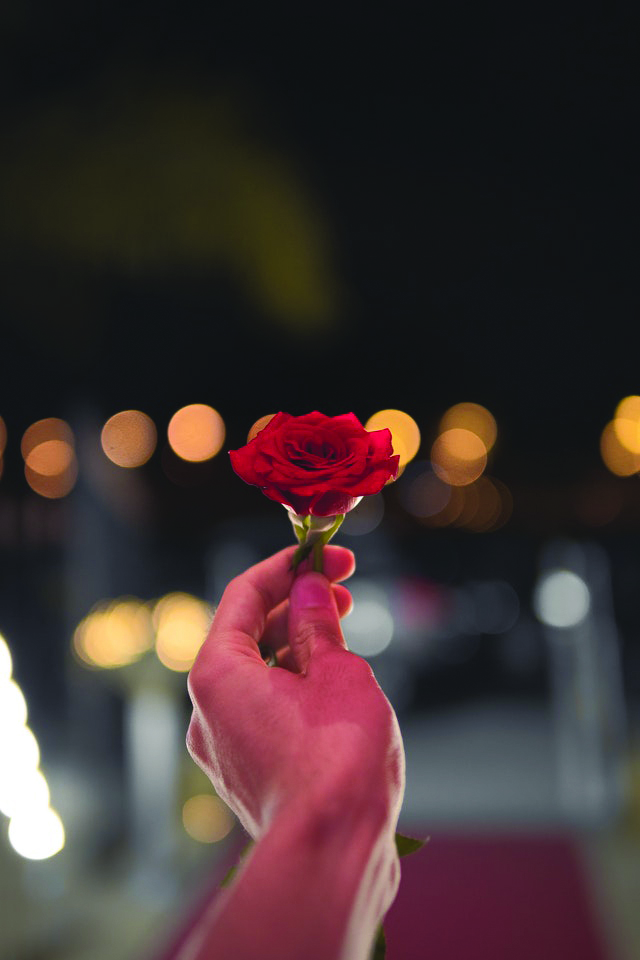
And at the center of the intersecting lines blooms a rose, the symbol of spiritual rebirth, with petals unfolding across eternity.
I spend my days and years haunted by the past; whether my own or someone else’s makes little difference. My father’s intense love for Old San Francisco imprinted itself upon me at a young age, and to this day I wistfully recall a Depression-era city of drunken Swedes and striking longshoremen that I never actually experienced.
Twenty five years ago,...
The New Year’s Baby is a tradition that goes all the way back to ancient Egypt, though many of us probably associate it with more recent iterations, such as JC Leyendecker’s vintage covers for the Saturday Evening Post stacked at the antiques store alongside plaster busts of Dionysus, who was symbolically reborn on Jan. 1, bringing fertility for the...
Since the state announced plans to close the Sonoma Developmental Center several years ago, the potential of the sprawling property has captured the imaginations of Sonoma County residents.
The 900-acre plot of land near Glen Ellen is seen by many as a rare opportunity to address worsening problems—among them, a lack of affordable housing in the midst of a worsening...
Art Moura—refreshingly—doesn’t have a significant online presence. I pieced my knowledge of him together through different articles and time spent with images of his work.
Moura’s story is interesting—he’s traveled extensively in Spain, worked as an electrician and—until its demise in a 2018 demolition derby—drove a Volvo 740 Station Wagon covered in doll’s heads, painted figures and mannequin legs. Growing...
Rohnert Park/ San Rafael
Local Laughs
North Bay-native Mo Mandel is a comedian and actor who’s been seen on TV shows including Conan, Chelsea Lately and 2 Broke Girls. This week, he’ll be onstage, delivering standup at two shows. First, Mandel gets funny at a show hosted by Barrel Proof Comedy on Thursday, Dec. 30, at Sally Tomatoes (1100 Valley House...
Matt Metzler’s letter (“Historical Accuracy,” Letters to the Editor, Dec. 22) about naive exhibits at Mission Sonoma State Park, like much recent scholarship, attempts to blame genocide upon the Spanish Viceroyalty and Mexican, Catholic missions.
However the cultural violence of Christianity affected the Native Californians, a firm study of the well-researched life of Chief Marin shows the missions as both...
I thought for a while about this week’s “Look.” With 2022 around the corner bringing us to two full years of overt strange, and last week devoted to sequins and metallics to keep spirits shining, this one needed something extra.
I sat contemplating fashion for a while, and the image flashed into my mind of me as a little girl,...
Remember playing this childhood game with friends?
A small group of boys and girls would get together and designate one person as IT—and then scatter to see how long they could avoid being tagged—but once caught it would be their turn to be IT. As a child, there was much joy and laughter involved in the activity. It was also...
These internal emails between “Bohemian” and “Pacific Sun” Editor Daedalus Howell and copy editor and writer Mark Fernquest were obtained through a Freedom of Information Act request. They are presented here, including redactions purportedly made in the interest of national security, in their entirety. We present them here in the interest of fostering a transparent and open news-gathering process.
Hey,...
In his poem, “Correspondences,” Charles Baudelaire invokes the great mystery, likening our earthly dream-life to the experience of walking through a forest composed of symbols.
Everything is linked by analogy to a higher realm of laws and principles, and those who hold the key tread their terrestrial path in an exalted state of serendipity and synchronicity, with nothing taken at...